
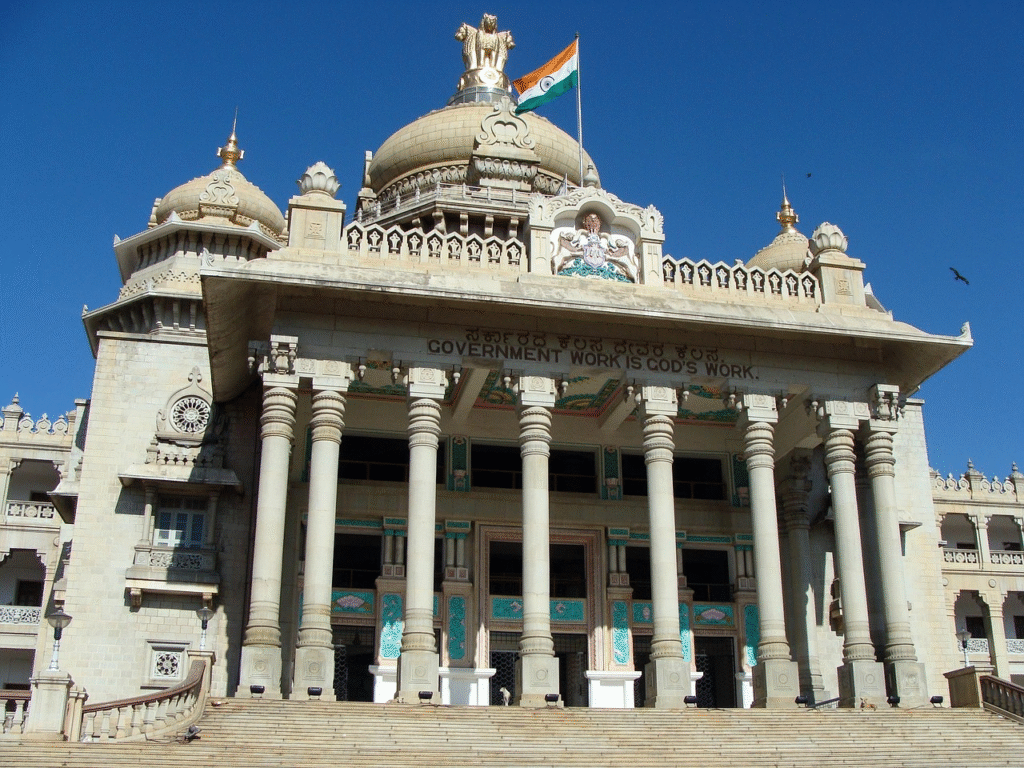
Photo credit: The Vidhana Soudha, Bengaluru’s iconic state legislative building
Bengaluru — known internationally as Bangalore until the 2014 official name change — earns its modern reputation as the “Silicon Valley of India” for legitimate reasons: the city hosts Indian operations of Microsoft, Google, Amazon, Apple, Intel, Cisco, IBM, Oracle, and SAP; the headquarters of homegrown giants Infosys, Wipro, Flipkart, and Ola; the Indian Space Research Organisation (ISRO) headquarters; and the country’s most active startup ecosystem (over 14,000 active startups as of 2024). But the city’s identity is far more layered than the tech-hub branding suggests. Founded by Kempe Gowda I in 1537, ruled by the Vijayanagara Empire, the Sultanate of Bijapur, the Marathas, the Mughals, Tipu Sultan of Mysore, and the British, then independent India — Bengaluru carries 500 years of layered architecture, deep South Indian culinary traditions, and a remarkably temperate climate (the city sits at 920 m elevation) that earned it the historical nickname “the Garden City of India.” Today’s Bengaluru combines the Vidhana Soudha neo-Dravidian government complex, the colonial-era Bangalore Palace, the 240-hectare Lalbagh Botanical Garden, the country’s most varied craft beer scene, and the dense Brahmin-vegetarian tradition of Karnataka cuisine into a complicated, fast-moving, infrastructurally-stressed but genuinely fascinating city.
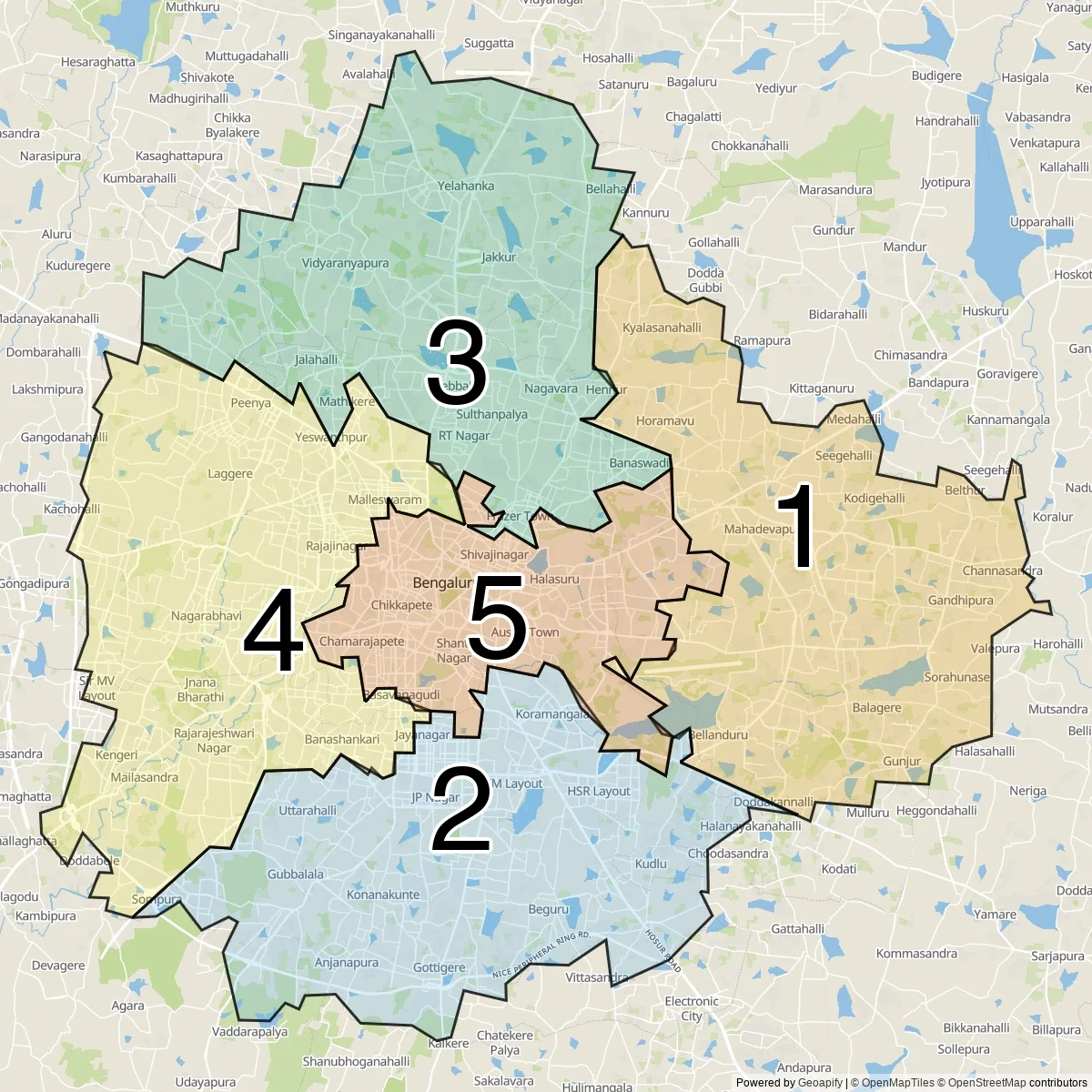
Bengaluru by District: The 5 BBMP zones
Bengaluru is divided into 5 municipal zones. The map below shows their official OSM boundaries, colour-coded to match the table — a quick way to orient yourself before zooming in on individual sights.
| # | BBMP zones |
|---|---|
| 1 | Bengaluru East City Corporation |
| 2 | Bengaluru South City Corporation |
| 3 | Bengaluru North City Corporation |
| 4 | Bengaluru West City Corporation |
| 5 | Bengaluru Central City Corporation |
Bengaluru at a Glance: Essential Facts for Travelers
| Location | State of Karnataka, Southern India (Deccan Plateau) |
|---|---|
| Coordinates | 12.9716°N, 77.5946°E |
| Population | ~8.5 million (city, 2024 estimate); metro ~13.9 million |
| Area | 741 km² (Bruhat Bengaluru Mahanagara Palike) |
| Elevation | 920 m above sea level (one of India’s highest major cities) |
| Time Zone | Indian Standard Time (IST, UTC+5:30 — no daylight saving) |
| Calling Code | +91 (city code 80) |
| Currency | Indian Rupee (INR ₹) |
| Languages | Kannada (official); English widely spoken in business, tourism, and IT; Hindi, Tamil, Telugu, Malayalam, Urdu also common |
| Climate | Tropical savanna moderated by elevation — pleasant year-round; mild winters, warm summers, monsoon rains June–October |
| Founded | 1537 (Kempe Gowda I); officially renamed Bengaluru from Bangalore on November 1, 2014 |
| Famous For | “Silicon Valley of India” IT hub, ISRO headquarters, Vidhana Soudha, Lalbagh Botanical Garden, Cubbon Park, craft beer pub culture, year-round mild weather, South Indian cuisine |
Upcoming Events in Bengaluru
| Date | Title | Details |
|---|---|---|
| 2026-10-10 | Bangalore Open Air 2026 | India’s flagship heavy metal festival returns for its fourteenth edition with British death metal pioneers Carcass headlining, joined by Paradise Lost, Thy Art Is Murder, Norwegian black metallers 1349, Nervosa, The Ocean and homegrown acts such as The Down Troddence. Staged in the Ramagondanahalli area, with earlier editions hosted at the Royal Orchid Resort in Yelahanka, the single-day festival draws metalheads from across the country. Tickets start from Rs 5,499 through BookMyShow and popular tiers tend to move fast. Strictly one for fans of loud, uncompromising live music. [Source] |
| 2026-10-18 | Bengaluru Marathon 2026 | The Bengaluru Marathon is the city’s flagship distance-running event, offering a full marathon, half marathon and shorter timed runs on traffic-managed roads, typically starting and finishing at the Sree Kanteerava Stadium. Held on a Sunday in October, it attracts thousands of amateur runners plus competitive fields, with charity fundraising a strong theme. Cool morning weather and enthusiastic roadside crowds make for a lively atmosphere. Entry is by paid registration across categories; spectating is free. The exact 2026 date is confirmed by the organisers closer to the event. [Source] |
| 2026-11-01 | Kannada Rajyotsava Celebrations | Karnataka’s state formation day on 1 November turns Bengaluru red and yellow, with the state flag hoisted across neighbourhoods, cultural performances, processions and the government’s annual Rajyotsava Awards honouring distinguished Kannadigas. Official celebrations centre on Sree Kanteerava Stadium, while localities stage their own music and dance programmes through the day and landmarks are lit in the state colours. Public events are free to attend, and the holiday offers visitors a colourful introduction to Kannada language, culture and pride. Expect processions and some traffic diversions in central areas. [Source] |
| 2026-11-17 to 2026-11-19 | Bengaluru Tech Summit 2026 | The 29th Bengaluru Tech Summit, Asia’s premier technology and innovation gathering, takes over the Bangalore International Exhibition Centre under the theme AI and Beyond. The three-day summit expects more than 60,000 business visitors, 1,800-plus exhibitors, over 1,000 startups and some 600 speakers from more than 75 countries across eight thematic tracks spanning IT, deep tech, biotech and startups. Delegate passes are ticketed with prices varying by category, and exhibition access requires registration. Essential for entrepreneurs, investors and technology professionals looking to tap India’s innovation capital. [Source] |
| 2026-12-20 to 2026-12-21 | Bengaluru Comic Con 2026 | Bengaluru Comic Con returns to the KTPO Exhibition Centre in Whitefield for a two-day pop-culture extravaganza featuring the National Cosplay Championship, gaming arenas, comics and artist stalls, exclusive merchandise and immersive fan zones. The weekend event is firmly family-friendly, with activities for younger visitors alongside panels and meet-ups for dedicated collectors, and cosplayers turn the halls into a riot of colour. Tickets are sold through the District app, with day passes at varying prices, and the venue is reachable via the Whitefield metro line. [Source] |
City News in Bengaluru – last 14 days
| Date | Category | Headline | Details |
|---|---|---|---|
| 2026-10-09 | Public transport | Safety inspection of Namma Metro’s elevated Pink Line completed | The CMRS has completed its safety inspection of the elevated section of Namma Metro’s Pink Line in Bengaluru. The inspection was carried out from Tuesday to Thursday and covered all six stations on the corridor: Kalena Agrahara, Hulimavu, IIM-B, JP Nagar 4th Phase, Jayadeva Hospital and Tavarekere. A safety inspection of this kind is a standard step in the review of a new metro corridor. The report did not give further details on the findings or on the next steps for the line. [Source] |
| 2026-10-09 | Public transport | Jalahalli Cross underpass project gets fresh push after inspection | The underpass project at Jalahalli Cross in Bengaluru has received a fresh push following an inspection by the Chief Commissioner of the GBA. The site visit by the senior civic official signals renewed attention to the road infrastructure project at the junction. The initial report did not include details on the project’s timeline, cost or design, or on any instructions issued during the inspection. Commuters who regularly pass through the junction may want to watch for further announcements. [Source] |
| 2026-10-09 | Local government | Jayanagar parking fees to apply only on major commercial roads | Parking fees in Jayanagar will apply only to the area’s major commercial roads, according to the Commissioner of the South Corporation. The statement clarifies the scope of paid parking in the Bengaluru neighbourhood, limiting charges to the main commercial stretches rather than to every street. The initial report did not list the specific roads involved or the fee levels. Residents and visitors driving to Jayanagar’s busy commercial streets should check local signage to see where charges apply. [Source] |
| 2026-10-09 | Local affairs | Potholes, dust and sewage slow commutes in eastern tech corridor | Commuters in Bengaluru’s eastern tech corridor are facing serious difficulties because of deteriorating road conditions. Stretches such as Gunjur-Doddakaneli and Hosa Road are riddled with deep potholes and broken surfaces, while dust and sewage add to the problems and turn daily journeys into a crawl. Recent accidents have highlighted the dangers linked to these conditions and raised concerns among residents. Authorities are taking steps to address the road damage and improve infrastructure for safer travel. [Source] |
| 2026-10-09 | Local affairs | Long, congested school commutes strain Bengaluru families | Children in some parts of Bengaluru face long and arduous journeys to school, while residents living near schools suffer as surrounding roads become choked during peak hours. A report by Chetan B.C. in The Hindu looks at the situation on the ground and examines possible solutions to the daily congestion. The issue affects both families making the school run and neighbours who deal with the resulting traffic around schools during the busiest times of the day. [Source] |
| 2026-10-09 | Health | Expired ingredients found at two Bengaluru ice cream units | The Karnataka Food Safety and Drug Administration has carried out inspections at numerous ice cream manufacturing units across the state. The checks uncovered expired ingredients and unsanitary conditions, leading to legal action against several facilities. In Bengaluru, products at two units were confiscated because they had expired, while a plant in Raichur was criticised for its lack of hygiene. Officials have collected samples for testing to ensure that manufacturers comply with food safety laws. [Source] |
| 2026-10-09 | Education | IIM Bangalore ranked 11th in the world for teaching impact | IIM Bangalore has been placed 11th in the world for teaching impact, according to a report in the Times of India. The result puts the Bengaluru institute among the top performers globally on this measure. The initial report did not name the organisation behind the ranking, the methodology used or the institutions placed above it. The placing is a notable international recognition for one of the city’s academic institutions. [Source] |
| 2026-10-09 | Education | NIMHANS launches online course on student well-being | NIMHANS has launched an online course that trains faculty members to act as student well-being ambassadors. The initiative is among the steps being taken to implement Karnataka’s student mental health policy for higher education. By preparing teaching staff for this role, the programme is intended to strengthen support for students’ mental health on campuses. The report did not specify the length of the course or how many faculty members are expected to take part. [Source] |
| 2026-10-09 | Culture | Read A Kitaab literature festival comes to Bengaluru for the first time | Read A Kitaab is hosting its literature festival in Bengaluru for the first time. The festival previously held two successful editions in Mumbai before expanding to the city. Its Bengaluru debut adds a new event to the local literary calendar for readers and book lovers. The initial report did not include the programme, the dates or the venue, so those interested should check the organisers’ announcements for details on speakers and sessions. [Source] |
| 2026-10-09 | Culture | Maya Bazaar returns to Bengaluru for a two-day eighth edition | Maya Bazaar 2026 is back in Bengaluru for two days. The eighth edition of the event will see the participation of more than 130 entrepreneurs, performers and rap artists. The mix of stalls and live acts makes it an option for residents and visitors who want to combine browsing local businesses with live performances. The initial report did not give the exact dates or the venue of this year’s edition. [Source] |
| 2026-10-09 | Culture | Rohit Barker bets on house and Latin music with new club Bahati | Radio host and DJ Rohit Barker has opened Bahati, a new club in the heart of Bengaluru that focuses on house and Latin music. In a conversation with The Hindu, he spoke about the city’s evolving nightlife and its taste in music, as well as about leopard spotting in the Masai Mara. The venue adds another option for visitors exploring Bengaluru’s night scene. The report did not give the club’s address or opening hours. [Source] |
| 2026-10-09 | Local government | CM DK Shivakumar alleges plot to trap him in sting operation | Karnataka Chief Minister DK Shivakumar has alleged that he was targeted in a sting operation soon after taking office. His comments followed accusations made against him by Union minister HD Kumaraswamy concerning an earlier sting operation. Shivakumar said he has evidence identifying those behind the alleged attempt to trap him. He also cautioned his colleagues and government officials to remain vigilant against such political tactics. [Source] |
| 2026-10-09 | Business | Experts in Bengaluru say AI is reshaping what employers expect | Artificial intelligence is changing what employers expect from job seekers, according to experts speaking in Bengaluru. They said that academic degrees alone are no longer enough for candidates entering the job market. The remarks point to the growing importance of skills beyond formal qualifications as AI changes the way companies work. The initial report did not name the experts involved or the event at which the comments were made. [Source] |
| 2026-10-08 | Environment | Karnataka told to release 3,000 cusecs of Cauvery water daily to Tamil Nadu | The Cauvery Water Management Authority has upheld a direction from the Cauvery Water Regulation Committee requiring Karnataka to release 3,000 cusecs of water a day to Tamil Nadu for 15 days. Karnataka had argued that it was reeling under serious hydrological distress, pointing to a 54% deficit in cumulative inflows into its four reservoirs in the Cauvery basin. With the direction upheld, the state’s objection over low reservoir inflows did not change the required release. [Source] |
Bengaluru Events & City News Archive
Sources: Rolling Stone India, Bengaluru Marathon, Wikipedia, Bengaluru Tech Summit, SMEStreet, The Hindu Bangalore, The Hindu Bangalore, The Hindu Bangalore
Weather Forecast for the Next 14 Days in Bengaluru
| Date | Weather | Max °F | Min °F | Rain mm |
|---|---|---|---|---|
| 2026-10-09 | 🌧️ | 85.9 °F | 70.0 °F | 0.8 mm |
| 2026-10-10 | ☁️ | 86.3 °F | 68.7 °F | 0.0 mm |
| 2026-10-11 | ⛅ | 87.0 °F | 68.7 °F | 0.0 mm |
| 2026-10-12 | 🌧️ | 87.9 °F | 67.2 °F | 3.0 mm |
| 2026-10-13 | ☁️ | 87.8 °F | 67.8 °F | 0.0 mm |
| 2026-10-14 | ☁️ | 89.7 °F | 70.3 °F | 0.0 mm |
| 2026-10-15 | ☁️ | 88.7 °F | 69.1 °F | 0.0 mm |
| 2026-10-16 | ⛈️ | 88.6 °F | 69.4 °F | 36.6 mm |
| 2026-10-17 | 🌧️ | 81.4 °F | 67.5 °F | 22.2 mm |
| 2026-10-18 | 🌧️ | 80.6 °F | 67.7 °F | 2.4 mm |
| 2026-10-19 | ⛈️ | 79.2 °F | 68.3 °F | 16.8 mm |
| 2026-10-20 | 🌧️ | 79.5 °F | 68.0 °F | 11.4 mm |
| 2026-10-21 | 🌧️ | 79.4 °F | 67.8 °F | 5.4 mm |
| 2026-10-22 | 🌧️ | 78.6 °F | 66.5 °F | 14.4 mm |
Bengaluru’s History
Bengaluru’s modern history begins in 1537 with Kempe Gowda I, a feudatory chieftain of the Vijayanagara Empire who built a mud fort and four watchtowers (the four Gavi Gangadhareshwara markers) defining the original village. Folk tradition traces the city’s name to an earlier moment: an 11th-century king lost on a hunt was given bende kalu (boiled beans) by an old woman in a forest settlement; he named the place Bende Kaluru (“town of boiled beans”), which evolved through Kannada into modern Bengaluru.
The city changed hands many times over the next three centuries. The Adil Shahi Sultanate of Bijapur took it in 1638; the Mughal Empire seized it in 1687; Chikka Devaraja Wodeyar of the Kingdom of Mysore bought it in 1689 for 300,000 rupees. Mysorean rule under Haider Ali and his son Tipu Sultan (the “Tiger of Mysore,” who fought the British in four Anglo-Mysore Wars) modernized the city’s military infrastructure and built Tipu Sultan’s Summer Palace (1791) — one of the city’s most-visited heritage sites today.
The decisive turn came on May 4, 1799, when British forces under Lord Cornwallis and the Marquess of Wellesley breached Tipu Sultan’s last stronghold at Srirangapatna; Tipu died defending the fort. The British returned Bangalore to the Mysore Wodeyars as a princely state under British paramountcy. A British cantonment was established east of the old city in 1809, dividing Bangalore into two parallel cities: the densely populated “City” (the original Kannada/Old Bangalore around K.R. Market) and the planned “Cantonment” (the British military-and-administrative quarter around MG Road, Brigade Road, and Commercial Street). This dual urban structure remains visible today.
Bangalore became one of British India’s preferred postings for retirees, military, and administrative officers — drawn by the cool elevation, the famously pleasant climate, the public gardens, and the Anglican churches. The Maharaja’s government founded the Indian Institute of Science (1909), the Bangalore Palace (1887), and a thriving Anglo-Indian community.
Post-independence, the Government of India deliberately located strategic industries in Bangalore — Hindustan Aeronautics Limited (1940), Indian Telephone Industries (1948), Bharat Electronics (1954), Hindustan Machine Tools (1953), and Indian Space Research Organisation headquarters (1969). These public-sector seeds attracted technical talent that, beginning in the 1980s, formed the foundation for the city’s private IT-services revolution — Wipro (1980s pivot to IT), Infosys (1981), Texas Instruments India (1985, the first MNC), and the dramatic post-1991 economic-liberalization boom. Bangalore became the country’s IT capital virtually overnight, and the city’s population doubled between 1991 and 2011.
The official renaming from “Bangalore” to “Bengaluru” took effect on November 1, 2014, restoring the Kannada-language original. The change is real on government signage, road maps, and official documents; “Bangalore” remains in casual use internationally.
Geography, Climate & Best Time to Visit Bengaluru
Geographic Setting
Bengaluru sits on the Deccan Plateau in southern India at an unusual altitude for a major city — 920 meters above sea level. This elevation produces the city’s mildest-in-India climate and made it historically preferred by the British colonial elite. The city occupies a rolling-hill landscape with no major river but extensive historic tank lakes (artificial reservoirs built over centuries for irrigation) — Ulsoor Lake, Hebbal Lake, Bellandur Lake, and dozens of smaller water bodies. Many tanks have been encroached and polluted by recent unchecked development; the Bellandur Lake foam fires (since 2015) became symbolic of the city’s infrastructure crisis.
The city sprawls across approximately 741 km² administered by the Bruhat Bengaluru Mahanagara Palike (BBMP), with the metropolitan area extending further into surrounding districts. The historical core divides between the “City” (the dense pre-British original around Chickpet, KR Market, Avenue Road) and the “Cantonment” (the British-planned area around MG Road, Cubbon Park, Indiranagar). Modern expansion has produced the IT corridors — Electronic City to the south, Whitefield to the east, Outer Ring Road and ORR-Marathahalli — and high-end residential areas like Koramangala, Indiranagar, HSR Layout, and Sadashivanagar.
Climate Overview
Bengaluru has a tropical savanna climate (Köppen Aw) significantly moderated by elevation. Summer (March–May): pleasant compared to the rest of India, with daytime highs of 33–36 °C and cool nights (20–23 °C). Monsoon (June–October): rains daily but rarely all day, daytime highs of 26–30 °C, the greenest period. Post-monsoon and winter (November–February): the year’s prime stretch, with sunny days at 26–28 °C, cool nights (12–16 °C), low humidity, and remarkable visibility.
Best Time to Visit
November to February is genuinely the prime window — pleasant temperatures, clear skies, comfortable evenings, and the country’s most temperate climate. March to May is the city’s hottest stretch but still mild by Indian standards — perfectly tolerable. June to October brings monsoon rains; daily showers are pleasant rather than disruptive, but traffic flooding is significant. Festival timing: Karaga (March–April) — Bengaluru’s distinctive 9-day Hindu festival ending with the dramatic Karaga procession through the old city; Karnataka Rajyotsava (November 1) — the state-formation day, also Bengaluru’s renaming anniversary; Sankranti (mid-January) — kite-flying festival; Diwali (October–November) — five days of lights and festivities; Christmas — significant in Cantonment areas with Anglo-Indian heritage.
Bengaluru’s Districts & Neighborhoods
MG Road / Brigade Road / Church Street
The British-era cantonment commercial core — the city’s traditional “downtown.” MG Road runs from Trinity Circle to the Cubbon Park entrance, lined with shops, restaurants, hotels, and the Bangalore Metro. Brigade Road is the pedestrianized shopping strip; Church Street is the dining-and-cafés cluster; Commercial Street is the older fabric-and-jewelry market. Cosmopolitan, anglophone, useful first base for short-stay visitors.
Indiranagar & Koramangala
The two trendiest middle-class neighborhoods. Indiranagar — 100ft Road, 12th Main, the Sony World junction — is restaurant-and-bar central, with the best concentration of craft-cocktail venues, pubs, and contemporary restaurants. Koramangala (5th Block, 6th Block, 7th Block) — startup-hub residential with the city’s densest food-delivery culture, large parks, and a younger expat community.
Whitefield & the Eastern IT Corridor
The original “Silicon Valley of India” — Whitefield was a small Anglo-Indian settlement until the 1990s, when ITPL (Indian Information Technology Park, the country’s first IT park) opened in 1998 and triggered massive corporate development. Today it hosts campuses of Microsoft, Dell, IBM, Cognizant, and dozens of others. The Phoenix Marketcity mall and the new Bangalore Metro Purple Line extension have made Whitefield more livable.
Electronic City
The southern IT cluster — Infosys, Wipro, Tech Mahindra, and many others. Connected to the city center by the dedicated Elevated Expressway (the only NICE Road bypass to Bengaluru’s chronic traffic). Less a tourist area than a working corporate hinterland.
Jayanagar / Basavanagudi (South Bangalore)
The traditional Kannada-speaking residential heartland — leafy, family-oriented, with the city’s best traditional South Indian restaurants (Vidyarthi Bhavan for masala dosa, Brahmins’ Coffee Bar), the Bull Temple, Bugle Rock Park, and the historic Gandhi Bazaar street market. The architectural personality is one- and two-story bungalows with garden courtyards.
Old City: Chickpet, KR Market, Pete
The pre-British dense urban core around the original Kempe Gowda fort. Chickpet is the textile-and-jewelry wholesale market; K.R. Market is the country’s largest flower market (best at 4 am as wholesale flowers arrive); Avenue Road is the historic book-printers’ street. Intense, chaotic, much more “Indian” than the cantonment-area Bengaluru.
Cubbon Park & the Vidhana Soudha
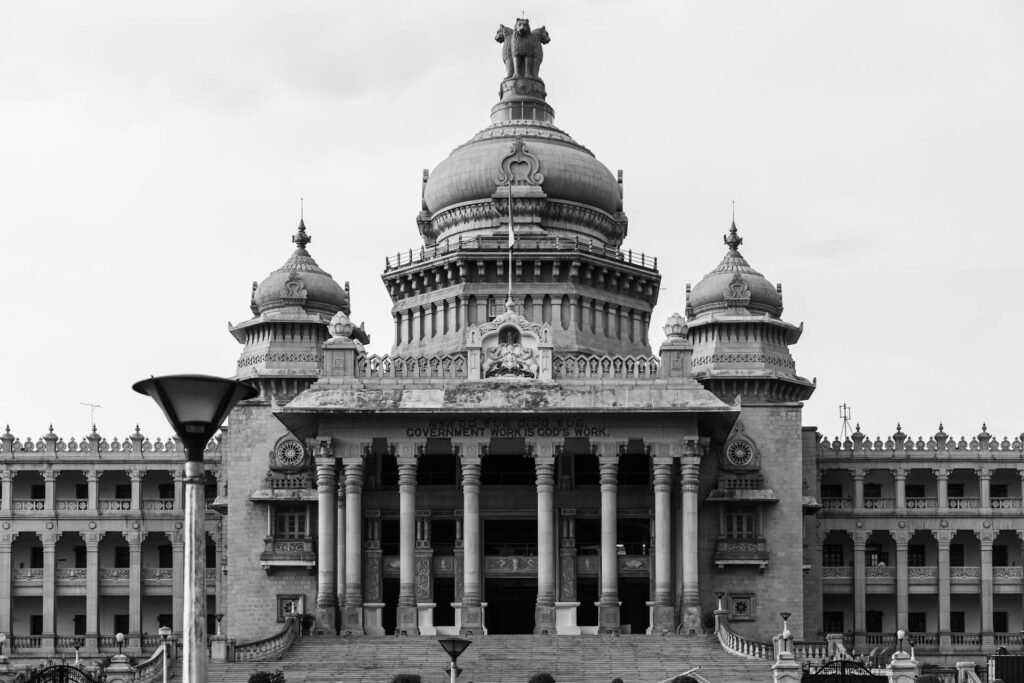
The central green-space-and-government district — 120-hectare Cubbon Park with shaded walks and the High Court; the Vidhana Soudha (Karnataka legislative assembly building, 1956); the Vikasa Soudha (newer state-government addition); the Government Museum; the Visvesvaraya Industrial Museum; and the Bangalore Palace. The most-photographed government complex in Karnataka.
Top Things to Do in Bengaluru
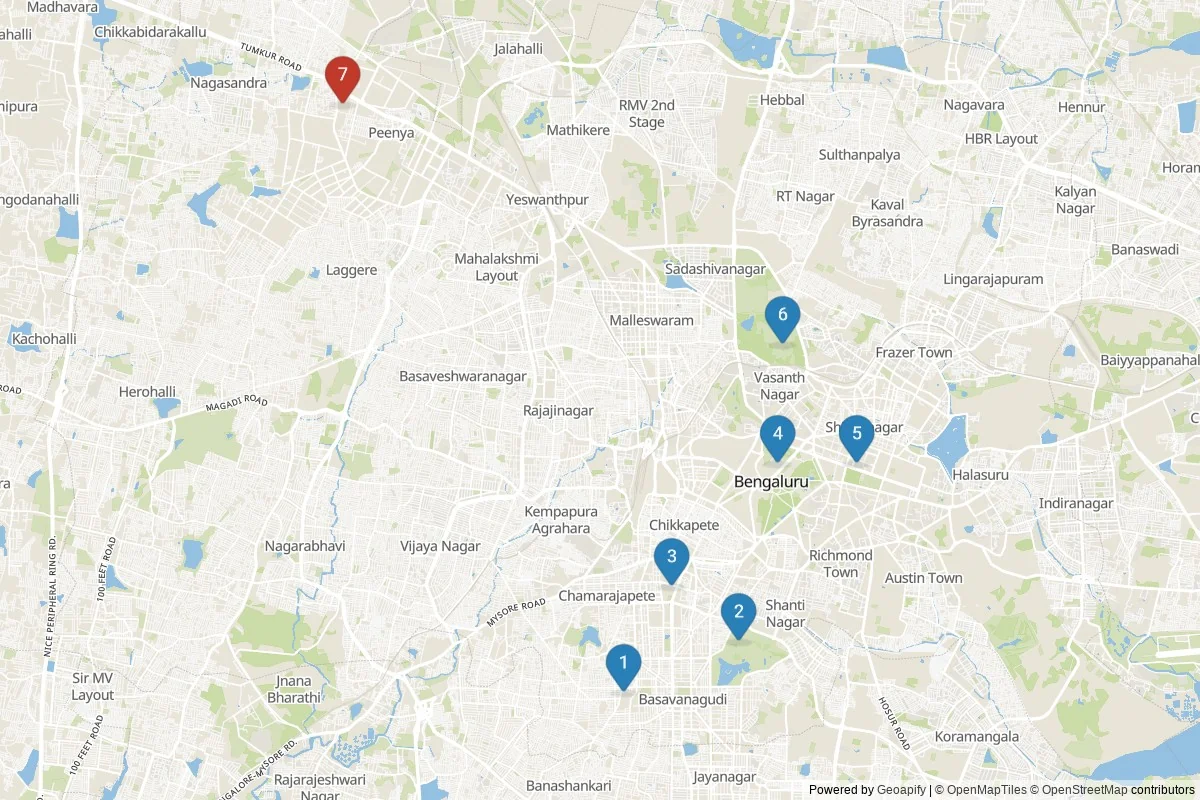
| # | Sight | Cluster | Type | Time | Entry | Best |
|---|---|---|---|---|---|---|
| 1 | Bull Temple & Bugle Rock | Central | Hindu temple | ~1 hr | Free | Morning |
| 2 | Lalbagh Botanical Garden | Central | Botanical garden | ~2 hrs | ₹30 | Morning |
| 3 | Tipu Sultan’s Summer Palace | Central | Heritage palace | ~45 min | ₹15/₹200 | Morning |
| 4 | Vidhana Soudha & Cubbon Park | Central | Government & park | ~2 hrs | Free | Morning |
| 5 | Pub Crawl: Church St & Indiranagar | Central | Nightlife | ~3 hrs | ₹2,000+ | Evening |
| 6 | Bangalore Palace | Central | Royal palace | ~1.5 hrs | ₹230 | Morning |
| 7 | ISRO Visitor Centre | Outer | Space museum | ~1.5 hrs | Free | Morning |
| 🚗 | Try the Masala Dosa Trinity | Day trip | Culinary | ~1 hr | ₹100–300 | Morning |
1. Visit the Vidhana Soudha & Cubbon Park
The neo-Dravidian-style Karnataka state legislative building — the largest state government building in India and one of the city’s defining landmarks. Visit the exterior (interior access for non-officials requires advance permission via the Speaker’s office). The surrounding 120-hectare Cubbon Park offers shaded walks, the High Court Building, the Bangalore Aquarium, and the Government Museum. Free entry to the park; museums modest fees.
2. Lalbagh Botanical Garden
The 240-hectare botanical garden originally commissioned by Haider Ali in 1760, expanded by Tipu Sultan, and developed by the British. The Glass House (1898, inspired by London’s Crystal Palace) hosts the famous biannual flower shows (Republic Day in January and Independence Day in August). The Kempe Gowda Tower on the lake island, the 3,000-year-old rocky outcrop, and the boating pond round out the experience. Entry INR 80 (~US$1) for foreigners.
3. Bangalore Palace
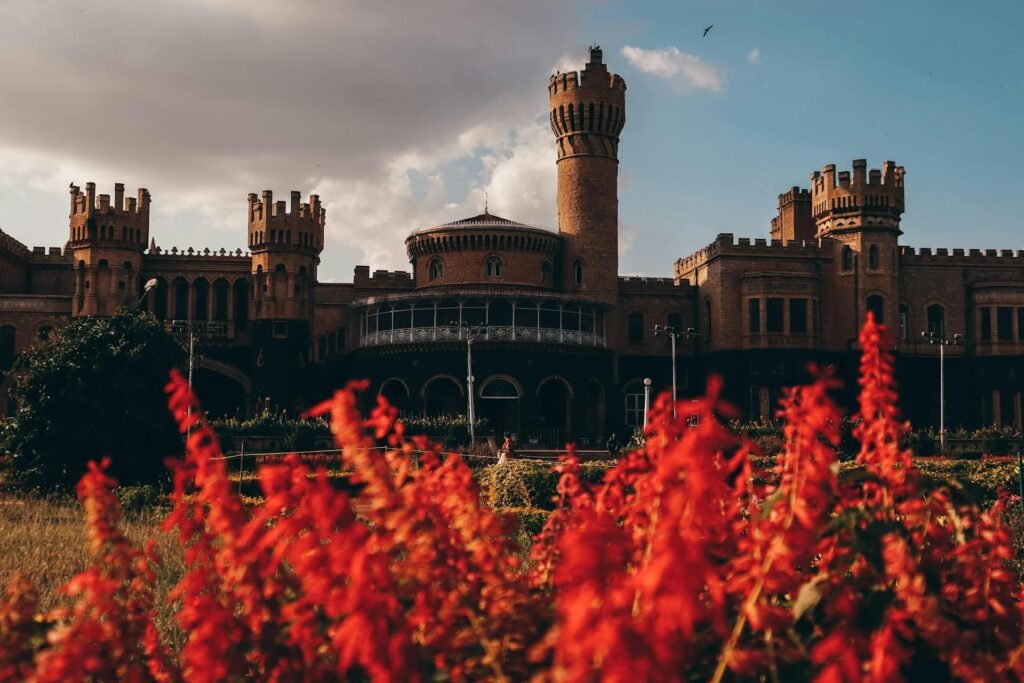
The 1887 Wodeyar royal residence — a fairytale Tudor-Gothic building inspired by Windsor Castle, set in 178 acres. The interior retains original royal furniture, family portraits, and the personal effects of the Wodeyar maharajas. Audio tours INR 460 for foreigners; the gardens host major outdoor concerts.
4. Tipu Sultan’s Summer Palace
The 1791 wooden teak palace of the Tiger of Mysore — the only surviving Tipu palace and one of the city’s most atmospheric heritage sites. The intricately carved teak arches, balconies, and floral murals are remarkably preserved. Small entry fee (INR 100 for foreigners); plan 1 hour.
5. Walk Through Bull Temple & Bugle Rock
The 16th-century Bull Temple (Nandi Temple) in Basavanagudi houses a giant monolithic granite Nandi statue (5 m tall, carved from a single rock outcrop). Adjacent Bugle Rock is one of the city’s oldest natural features — a Precambrian granite outcrop (3 billion years old) with the small Hanuman temple atop. Both free.
6. Eat the Masala Dosa Trinity
Bengaluru is the spiritual home of the dosa. Three legendary establishments anchor the experience: Vidyarthi Bhavan (Gandhi Bazaar, since 1943) — the original golden-brown masala dosa, served in a Gandhian-era setting; Brahmins’ Coffee Bar (Shankarapuram) — the locals’ choice for the perfect idli-vada-dosa combo; MTR (Mavalli Tiffin Rooms) (Lalbagh Road, since 1924) — the institution that exported the rava idli and Mysore masala dosa to the world. Expect queues at all three; arrive at opening (Vidyarthi Bhavan opens 6:30 am) to avoid the worst.
7. ISRO Visitor’s Centre & the HAL Aerospace Museum
For STEM-minded travelers: HAL Aerospace Museum at the Hindustan Aeronautics Limited campus displays Indian-built fighter jets, helicopters, and engines — a unique tour through Indian aviation history. ISRO Visitor’s Centre at the Antariksh Bhavan provides public access to the Indian space program’s history and current missions; advance booking required for tours.
8. Pub Crawl on Church Street & Indiranagar
Bengaluru’s pub scene was the model for the rest of India after the 1980s liberalization of alcohol laws in Karnataka. Toit (100ft Road, Indiranagar) — one of the country’s best-known craft breweries; The Permit Room for retro Karnataka cuisine; Truffles for burgers; Koramangala 6th Block for the highest density of new bars and pubs. The metropolitan corridor between MG Road, Church Street, and Indiranagar 100ft Road is a continuous walkable pub-crawl experience on most weekends.
How to Get to Bengaluru
By Air
Kempegowda International Airport (BLR), 40 km north of central Bengaluru, is India’s third-busiest airport. Direct nonstop international routes to most major Gulf hubs (Dubai, Doha, Abu Dhabi), London, Paris, Frankfurt, Munich, Amsterdam, Singapore, Bangkok, Hong Kong, Kuala Lumpur, Tokyo, Seoul, Toronto, and Newark, plus regional flights to Colombo, Male, Kathmandu, Yangon, and more. Domestic flights connect to every major Indian city — Mumbai (90 minutes), Delhi (3 hours), Hyderabad (75 minutes), Chennai (60 minutes), Kolkata, Pune, Goa. Carriers: IndiGo, Air India, Vistara, Akasa Air, SpiceJet, Emirates, Singapore Airlines, and many more.
From the airport: BMTC Vayu Vajra airport bus INR 250–350 to most city points (90 minutes); Ola/Uber INR 700–1,200 to central city (60–90 minutes depending on traffic); airport taxi INR 900–1,400; BLR Express train (Cantonment station, recently launched) INR 60–80, 35 minutes — the fastest option to the city center.
By Train
KSR Bengaluru (formerly Bangalore City) Railway Station is the primary inter-state railway hub. Major routes: Rajdhani Express to Delhi (34 hours), Vande Bharat Express to Chennai (4 hours, premium AC), Shatabdi Express to Chennai/Mysore, overnight expresses to Mumbai, Hyderabad, Kolkata, Kerala. Tickets via the IRCTC official portal or in person at the booking office; foreign-tourist quota seats can be booked in advance through Indian Railways’ tourist quota.
By Long-Distance Bus
The Majestic Bus Terminal (Kempegowda Bus Station) is the country’s largest bus terminus, with services across Karnataka and to neighboring states. KSRTC, VRL Travels, and Orange Travels operate Volvo air-conditioned coaches to Mysuru (3 hours), Goa (12 hours), Mumbai (16 hours), Hyderabad (10 hours), Chennai (6 hours), and many other destinations.
By Car
Self-drive is feasible but Bengaluru traffic is genuinely difficult — Google’s Driving Direction times rarely capture the chronic congestion. National Highway connections: NH48 (Mumbai-Bengaluru), NH75 (Chennai-Bengaluru), NH44 (Hyderabad-Bengaluru). The Bengaluru-Mysuru Expressway opened 2023, cutting the drive to Mysuru to 90 minutes.
Visa Notes
India offers e-Visa for tourists from over 165 countries through the official Indian Government e-Visa portal. 30-day, 1-year, and 5-year tourist e-Visa options available; fee $10–80 depending on duration and nationality; processed in 3–5 working days. Passport must have at least 6 months remaining validity. Common mistake: applying through unofficial third-party sites that charge 200–500% premiums; always use the .gov.in domain. Indian visa rules change occasionally — check current requirements 4–6 weeks before travel.
Getting Around Bengaluru
Ride-Hailing (Ola & Uber)
The default option for visitors. Both Ola (homegrown) and Uber operate extensively with English apps, transparent pricing, and credit-card or rupee payment. An Ola/Uber across the city center costs INR 150–400; airport to central city INR 700–1,200. Rapido and Uber Bike offer motorcycle-pillion options that are dramatically faster in traffic for solo travelers (INR 60–150 for typical city trips).
Bangalore Metro (Namma Metro)
The city’s metro system — Purple Line (East-West, Whitefield to Challaghatta) and Green Line (North-South, Nagasandra to Silk Institute) — is the most reliable way to bypass traffic. The new Phase 2 expansions (Yellow Line, Pink Line, Blue Line, Orange Line) are gradually opening. Single fares INR 10–60; Namma Metro Smart Card recommended for repeat travelers. Coverage is improving but still limited compared to Delhi or Mumbai.
Auto-Rickshaws (Three-Wheelers)
The classic Indian three-wheeler — yellow-and-black autorickshaws are abundant. Meters exist but are often “broken” for tourists — agree the fare in advance or use Ola/Uber Auto (the meter applies, and the price is transparent). Fares INR 30 base + INR 17/km for the first 2 km, then INR 13/km.
BMTC Buses
The Bangalore Metropolitan Transport Corporation operates extensive city bus services. The premium Volvo air-conditioned services (route numbers starting with “V”) are comfortable and recommended for travelers; standard non-AC buses are crowded but cheap (INR 10–30 typical fares). The Vayu Vajra airport buses are particularly useful.
Self-Drive Car/Bike Rentals
Car rental from Avis, Zoomcar, Revv from INR 1,500–3,500/day. Bike (motorcycle/scooter) rentals from INR 250–800/day. Important: Indian traffic is notoriously chaotic; foreign drivers need an international driving permit (IDP) under the 1949 Geneva Convention; even confident drivers should plan a learning curve. Most international visitors prefer to use Ola/Uber and hire a private driver for day trips.
Walking & Cycling
Bengaluru is not a particularly pedestrian-friendly city; sidewalks are intermittent and traffic respect for pedestrians is limited. Cubbon Park, Lalbagh, and MG Road–Church Street area are exceptions — walkable and pleasant. Bicycle rentals (Yulu) and scooter rentals at metro stations provide some last-mile flexibility.
Food & Drink in Bengaluru
South Indian — specifically Karnataka Brahmin vegetarian and Mangalorean coastal — defines Bengaluru’s culinary identity. The city’s cosmopolitan mix has produced one of India’s most varied restaurant scenes, with thriving Andhra, Tamil, Kerala, Konkan, North Indian, Chinese, Mexican, Italian, and pan-Asian options alongside the canonical South Indian core.
What to Try
- Masala dosa — the iconic crispy fermented rice-and-lentil crepe with a spiced potato filling; the dish that defines Karnataka breakfast. Vidyarthi Bhavan, Brahmins’ Coffee Bar, and MTR are the canonical addresses.
- Bisi Bele Bath — Karnataka’s signature one-pot rice-and-lentil-and-vegetable dish, intensely spiced with the regional bisi bele bath spice blend.
- Rava idli — the wartime-rations invention of MTR in 1947 — steamed semolina dumplings, lighter than traditional rice idli.
- Mangalorean coastal cuisine — neer dosa (water-rice pancake), chicken ghee roast, fish curry rice — at Coastal Karnataka or Hotel Janatha.
- Andhra biryani — Bengaluru’s claim to South Indian biryani; Meghana Foods Andhra Style for the canonical version.
- Filter coffee — the South Indian morning ritual of decoction-coffee blended with hot milk in a steel tumbler; at any Brahmins’ Coffee Bar, Vidyarthi Bhavan, or any of the older South Indian “tiffin” restaurants.
- Bangalore pubs and craft beer — Toit, Arbor, Brewsky, Windmills Craftworks brewpubs.
- Indo-Chinese (Mainland China / Schezwan) — Bengaluru is one of India’s best cities for this hybrid cuisine.
- Karaikudi Chettinad cuisine — at Nair Mess or Karavalli; intense Tamil Nadu spice-heavy chicken and mutton dishes.
Where to Eat
Vidyarthi Bhavan (Gandhi Bazaar, since 1943) — masala dosa pilgrimage. Brahmins’ Coffee Bar (Shankarapuram) — idli-vada-coffee perfection. MTR (Lalbagh Road, since 1924) — the institution. Karavalli at The Oberoi — fine-dining South Indian. Toit (Indiranagar) — craft beer. Truffles (Koramangala) — burgers. Meghana Foods — Andhra biryani. The Permit Room — retro Karnataka. Khansama Dum Pukht at ITC Gardenia — Awadhi fine-dining. Mavalli Tiffin Rooms (MTR) branches throughout the city. UB City Mall for upmarket international dining.
Drinks
South Indian filter coffee — the city’s caffeine ritual. Craft beer: Bengaluru is India’s craft-beer capital with 70+ microbreweries (Toit, Arbor, Brewsky, Windmills, Drifters Tap Station). Karnataka wine: Grover, Big Banyan, and Sula are the main South Indian labels. Indian whisky: Amrut (distilled in Bengaluru itself) and Paul John (Goa) are world-class. Buttermilk (chaas), lassi, sugarcane juice, tender coconut water — the traditional non-alcoholic options. Alcohol regulation: Karnataka has a complex licensing system; not all restaurants serve alcohol; specifically Bengaluru pubs by 1 AM closure rule is occasionally extended for events.
A Note on Tap Water
Tap water in Bengaluru is not safe to drink for foreign visitors. The municipal Bangalore Water Supply and Sewerage Board (BWSSB) treats the supply, but distribution-network contamination is common and most Bengaluru residents (including locals) drink filtered or bottled water. Always use sealed bottled water (INR 20–40 per liter at convenience stores; major brands Bisleri, Kinley, Aquafina, Bailey, Himalayan) for drinking and brushing teeth. Reusable filter bottles (LifeStraw, Grayl, Sawyer with 0.1-micron filter) work well in India. Hotel kettles boil water reliably. Ice in mid-range and upmarket restaurants is generally safe (machine-made from purified water); avoid ice from street stalls. The CDC traveler health page for India recommends bottled or boiled water plus standard food precautions and consideration of hepatitis A, typhoid, and Japanese encephalitis vaccinations before travel. Traveler’s diarrhea (“Delhi belly”) is the most common visitor complaint; eat at busy, established restaurants where food turnover is high.
Frequently Asked Questions About Visiting Bengaluru
Do I need a visa to visit Bengaluru?
Yes — most foreign passport holders need a visa to enter India, but the process has been substantially simplified through the e-Visa system. Citizens of 165+ countries — including the US, UK, all EU member states, Canada, Australia, New Zealand, Japan, South Korea, Singapore, Malaysia, Brazil, Mexico, and most others — can apply for the e-Tourist Visa at the official Indian Government e-Visa portal. Options: 30-day single entry $10–25; 1-year multiple entry $40; 5-year multiple entry $80. Processing 3–5 working days; tourists must enter through 31 designated airports including Kempegowda International (BLR). Passport must have at least 6 months remaining validity and at least two blank pages. Common mistakes: applying through unofficial third-party visa sites that overcharge by 200–500%; assuming the old visa-on-arrival sticker still works; arriving without printing the e-Visa approval. Print two copies to show at airline check-in and Indian immigration. e-Medical Visa and e-Business Visa categories exist for specific purposes. For multi-month stays or work, regular paper visas via Indian embassies/consulates remain the appropriate path.
Is Bengaluru safe for tourists?
Bengaluru is broadly safe — one of India’s safer major cities, with strong police presence in tourist areas and very low rates of violent crime against foreigners. The US State Department rates India at “exercise increased caution” — primarily for terrorism risks rather than street crime. Real risks in Bengaluru: traffic accidents — Bengaluru has notoriously chaotic traffic; pedestrians are not prioritized; motorcycle accidents are the most common foreign-visitor injury; petty theft and pickpocketing in crowded markets (KR Market, Chickpet, Commercial Street); auto-rickshaw overcharging — drivers often refuse meters with tourists; use Ola/Uber for transparent pricing; airport taxi scams — use prepaid taxi counter or Ola/Uber; “famous tea-shop” scams where strangers offer to take you to “amazing local spots” that involve commission-paying handicrafts shops; monsoon flooding June–October — some neighborhoods (Bellandur, Sarjapura, Whitefield) become impassable after heavy rain; air pollution moderate (better than Delhi but worse than Kerala). Female travelers: Bengaluru is considered one of India’s most progressive cities for women travelers; standard precautions (avoid isolated areas at night, dress reasonably modestly in religious sites and conservative neighborhoods) apply; female-only train cars and bus seats are reserved by law. Drug enforcement: India imposes harsh penalties for drug offenses — multi-year prison sentences for possession; trafficking carries the death penalty in extreme cases. Cultural sensitivities: don’t photograph religious devotions without permission; remove shoes at temples; dress modestly at the Bull Temple, Iskcon Temple, and similar sacred sites.
How many days do I need in Bengaluru?
Two to three days handles Bengaluru’s main cultural sights; combined with a Mysuru day trip and the surrounding state, 5–7 days makes a comprehensive Karnataka trip. A solid 3-day Bengaluru plan: Day 1 — Vidhana Soudha exterior + Cubbon Park + Government Museum + lunch at Karavalli or Mavalli Tiffin Rooms + Bangalore Palace afternoon + dinner on Church Street. Day 2 — Tipu Sultan’s Summer Palace morning + Bull Temple + Bugle Rock + masala dosa at Vidyarthi Bhavan + Lalbagh Botanical Garden afternoon + Toit craft beer evening. Day 3 — Old City wander (Chickpet + KR Market dawn flower visit + Cottonpet) + Filter coffee at Brahmins’ Coffee Bar + ISRO Visitor’s Centre afternoon + Indiranagar pub-crawl evening. Add Day 4 for a Mysuru day trip (Bengaluru-Mysuru Expressway 2-hour drive; Mysore Palace + Chamundi Hills + Brindavan Gardens). Add Day 5 for a Coorg/Kodagu coffee-plantation overnight or the Hampi UNESCO ruins (Hampi via overnight train, 2 days minimum on site). Day-trip Bengaluru from Mysuru or Chennai: feasible for the main sights but too rushed. For tech-conference attendees: 1–2 extra days at the bookends of the conference is sufficient for the main cultural exposure.
What’s the best area to stay in Bengaluru?
Highly dependent on purpose. MG Road / Brigade Road / Church Street — central Cantonment area, best for first-time visitors; The Oberoi, ITC Windsor, The Taj West End, Sheraton Grand at Brigade Gateway; mid-range Lemon Tree Premier, Hyatt Centric; INR 4,000–18,000/night (US$50–215). Cubbon Park area — Taj West End (the iconic colonial-heritage hotel), the Leela Palace; quieter, near major government and cultural sites. Indiranagar & Koramangala — trendier neighborhoods with younger expat presence; boutique hotels and serviced apartments; great food/pub access; INR 3,000–10,000/night. Whitefield — for tech-corporate visitors; major business hotels (Marriott Whitefield, Sheraton, Park Plaza); far from heritage sites; INR 5,000–14,000/night. Electronic City — only for tech-corporate needs; remote from the city center. For longer stays: serviced apartments in HSR Layout, Indiranagar, or Koramangala offer better value than hotels. Skip: budget hotels in Majestic (KSR Bengaluru station area) without specific recommendations — much of the bus-station-area accommodation is poorly maintained.
How much does it cost to visit Bengaluru’s major sights?
Bengaluru is one of India’s better-value major destinations. Cubbon Park: free. Vidhana Soudha: exterior free; interior access requires Speaker’s office permission. Lalbagh Botanical Garden: INR 80 (~US$1) foreigners. Bangalore Palace: INR 460 (~US$5.50) foreigners with audio guide. Tipu Sultan’s Summer Palace: INR 100. Government Museum & Visvesvaraya Industrial Museum: INR 50–100. Bull Temple: free. Bugle Rock Park: free. HAL Aerospace Museum: INR 50–80. ISRO Visitor’s Centre: free with advance booking. Local meals: masala dosa breakfast INR 60–120; mid-range South Indian thali INR 200–400; upmarket South Indian fine-dining INR 600–1,500 per person; international restaurant INR 800–2,000 per person; fine-dining INR 1,500–5,000 per person. Filter coffee: INR 25–80 per cup. Craft beer at Toit: INR 250–400 per pint. Ola/Uber across the city: INR 150–400; airport-to-city INR 700–1,200. Auto-rickshaw (with meter): INR 50–250 typical city trips. Train to Mysuru: INR 200–800 (depending on class). Overall daily budget: INR 1,500 (frugal hostels + street food + autos), INR 4,000 (mid-range), INR 12,000+ (luxury palace hotel + fine dining).
Should I drink the tap water in Bengaluru?
No — tap water in Bengaluru is not safe to drink for foreign visitors. The Bangalore Water Supply and Sewerage Board (BWSSB) treats the supply, but distribution-network contamination is widespread and even most Bengaluru residents use filtered or bottled water for drinking. Always use sealed bottled water (INR 20–40 per liter at convenience stores; major brands Bisleri, Kinley, Aquafina, Bailey, Himalayan, Tata Copper Plus) for drinking and brushing teeth. Reusable filter bottles (LifeStraw, Grayl, Sawyer 0.1-micron) work well in India. Hotel kettles boil water reliably; check that they have been used recently to avoid stagnant-water bacterial growth. Ice: at international hotels, large chain restaurants, and reputable cafés, ice is machine-made from purified water and generally safe; avoid ice from street stalls, smaller restaurants without obvious purified-water source, and roadside drinks. The CDC traveler health page for India recommends bottled or boiled water plus standard food precautions and consideration of hepatitis A, typhoid, hepatitis B, Japanese encephalitis, and rabies (for long-term travelers) vaccinations before travel. “Delhi belly” / traveler’s diarrhea is the most common visitor complaint — eat at busy, established restaurants where food turnover is high; cooked vegetables and well-grilled meats are lower-risk than raw salads.
What payment methods work in Bengaluru — credit cards, UPI, or cash?
India’s digital-payment revolution makes Bengaluru one of the world’s most cashless major cities. UPI (Unified Payments Interface) dominates — Google Pay, PhonePe, Paytm, BHIM apps with QR-code scanning are used everywhere, from luxury hotels to street vendors. However, UPI requires an Indian bank account, which most foreign visitors cannot easily obtain. Practical visitor payment mix: Credit/debit cards (Visa, Mastercard, AmEx, JCB; RuPay less universal): accepted at hotels, mid-range and upmarket restaurants, malls, taxis (Ola, Uber), supermarkets, and most shops in tourist areas. Many smaller restaurants, autorickshaws, and traditional markets are cash-only. Indian Rupees (INR): essential for cash-only situations, tips, and emergencies; carry small bills (10, 20, 50, 100) for autorickshaws and small purchases. ATMs: abundant at every major intersection (HDFC, ICICI, Axis, Kotak, SBI) — accept foreign cards with INR 10,000–25,000 per-transaction limits and INR 150–250 international fees. Currency exchange: airport and hotel rates are bad; bank-branch exchanges and licensed Western Union/Thomas Cook outlets in Brigade Road area offer the best rates. Foreign exchange: bring USD, EUR, GBP — clean bills only; old or damaged notes are often rejected. Tipping: 10% at restaurants without service charge (many automatically add 10%, check the bill); INR 20–50 to porters per bag; INR 100–200 per day for housekeeping; INR 200–500 per day for tour guides; round up taxi fares INR 10–30. Tip in Indian rupees; USD/EUR cash tips are not the local norm.
What’s the deal with monsoon flooding, traffic, and tech-corridor logistics?
Bengaluru’s chronic infrastructure challenges are real and worth planning around. Monsoon flooding (June–October): heavy rains regularly flood the eastern IT corridors — Bellandur, Marathahalli, Whitefield, Sarjapur Road — sometimes for 24+ hours; the iconic 2022 floods left luxury cars stranded in Bellandur for days. Avoid hotels in these areas if traveling during peak monsoon; central Bengaluru (Cubbon Park, MG Road, Indiranagar, Koramangala) drains better. Traffic: Bengaluru consistently ranks among the world’s most congested cities — average commute speeds of 18 km/h during peak hours. Plan times generously: a 15 km journey can take 2 hours during 9 am–10:30 am or 5:30 pm–8:30 pm peak; plan to be at the airport 4+ hours before international flights. Bengaluru Metro is gradually bypassing traffic but doesn’t reach the airport yet; the new Outer Ring Road expressway and the upcoming metro line to BLR airport (2026 expected) will eventually help. Tech corridor visitors: choose hotels in your specific corridor (Whitefield, Electronic City, ORR-Marathahalli) rather than commuting from central Bengaluru. Power outages: less common than they were a decade ago but still occasional; major hotels have backup generators; budget accommodations may not. Air quality: Bengaluru’s AQI is moderate (typically 80–150 on AQI scale) — significantly better than Delhi or Kolkata but worse than European norms; sensitive travelers may want N95 masks for the worst-traffic periods. Overall: Bengaluru rewards patience and lower expectations on logistics; build flexibility into itineraries and don’t try to do too much in a single day.
Education & Notable People
Bengaluru is India’s most concentrated higher-education center for science, engineering, and technology, anchored by the world-class Indian Institute of Science and many of the country’s leading engineering institutions.
Major Universities & Research Institutions
- Indian Institute of Science (IISc) — founded 1909 by Jamsetji Tata; India’s premier graduate research university; consistently ranked among the world’s top engineering and science institutions.
- Indian Institute of Management Bangalore (IIMB) — one of India’s top three IIM business schools.
- National Centre for Biological Sciences (NCBS-TIFR) — premier biology research institute.
- National Aerospace Laboratories (NAL) — Indian aerospace R&D.
- Bangalore University — the state’s flagship public university with multiple colleges.
- Christ University — leading private liberal arts university.
- RV College of Engineering, BMS College of Engineering, PES University — top engineering colleges.
- National Law School of India University (NLSIU) — India’s premier law school.
Notable People
Kempe Gowda I — the 16th-century chieftain who founded the city; his statues mark the historic four watchtowers. Tipu Sultan — the “Tiger of Mysore” who fought the British in four wars; died at Srirangapatna 1799. Sir M. Visvesvaraya — celebrated engineer and statesman, dewan of Mysore 1912–1918, designer of the Krishnaraja Sagar dam; his birthday (September 15) is observed as Engineer’s Day in India. C.V. Raman — physicist, Nobel Prize 1930, founded the Raman Research Institute in Bangalore. N.R. Narayana Murthy — co-founder of Infosys (1981), one of the pioneers of the Indian IT industry; his son-in-law Rishi Sunak became UK Prime Minister 2022. Nandan Nilekani — co-founder of Infosys, architect of India’s Aadhaar biometric identity system. Azim Premji — chairman of Wipro, one of India’s leading philanthropists. Anil Kumble and Rahul Dravid — legendary Indian cricket players from Bengaluru. Deepika Padukone — actress, daughter of Indian badminton legend Prakash Padukone. P.V. Sindhu — Olympic-medal badminton player trained at the Bengaluru Pullela Gopichand Academy.
Sister Cities & International Relations
Bengaluru’s sister-city network reflects the city’s identity as a major Indian tech hub with strong global IT-services connections. The relationships emphasize technology partnerships, university exchange, and IT-industry cooperation.
Bengaluru’s sister and partnership cities include (selection):
- Cleveland, Ohio, USA — sister city since 1992; medical and biotech cooperation.
- San Francisco, California, USA — informal partnership; the canonical Silicon Valley / “Silicon Valley of India” pairing.
- Minsk, Belarus — paired since 1973 (during the USSR era); cultural exchange.
- Chengdu, China — IT-and-tech-industry partnership.
- Yokohama, Japan — port-and-business friendship.
- Stockholm, Sweden — IT-industry cooperation.
- Frankfurt, Germany — business-and-financial-services link.
Bengaluru hosts more than 2,000 multinational corporations’ Indian offices and is the country’s leading destination for global capability centers (GCCs). The Karnataka government’s Department of IT, BT and S&T actively promotes the state as an investment destination through trade missions and the annual Bengaluru Tech Summit. The city is the operational headquarters of major Indian space, defense, and aerospace public-sector enterprises — placing it at the strategic heart of India’s hi-tech industrial base. The Karnataka Tourism Department coordinates promotion of Bengaluru and the wider state.
AFRIKA
Cairo Hurghada Johannesburg Marrakech
ASIA
Abu Dhabi Agra Antalya Bangkok Batam Beijing Bengaluru Cebu City Chiang Mai Chiba Chennai Da Nang Dammam Delhi Denpasar Dubai Fukuoka Guangzhou Guilin Ha Long Hanoi Ho Chi Minh City Jakarta Jaipur Johor Bahru Kolkata Krabi Kuala Lumpur Kyoto Macau Mecca Medina Mugla Mumbai Osaka Pattaya Penang Phuket Riyadh Seoul Shanghai Shenzhen Singapore Taipei Tokyo Zhuhai
EUROPE
Amsterdam Athens Barcelona Berlin Brussels Budapest Copenhagen Dublin Florence Frankfurt am Main Heraklion Krakow Lisbon London Madrid Milan Munich Nice Paris Porto Prague Rhodes Rome Stockholm Venice Vienna Warsaw
NORTH AMERICA
Cancun Las Vegas Los Angeles Miami New York City Orlando San Francisco Toronto Vancouver
SOUTH AMERICA
Buenos Aires Lima Rio De Janeiro
OCEANIA
Auckland Honolulu Melbourne Sydney