
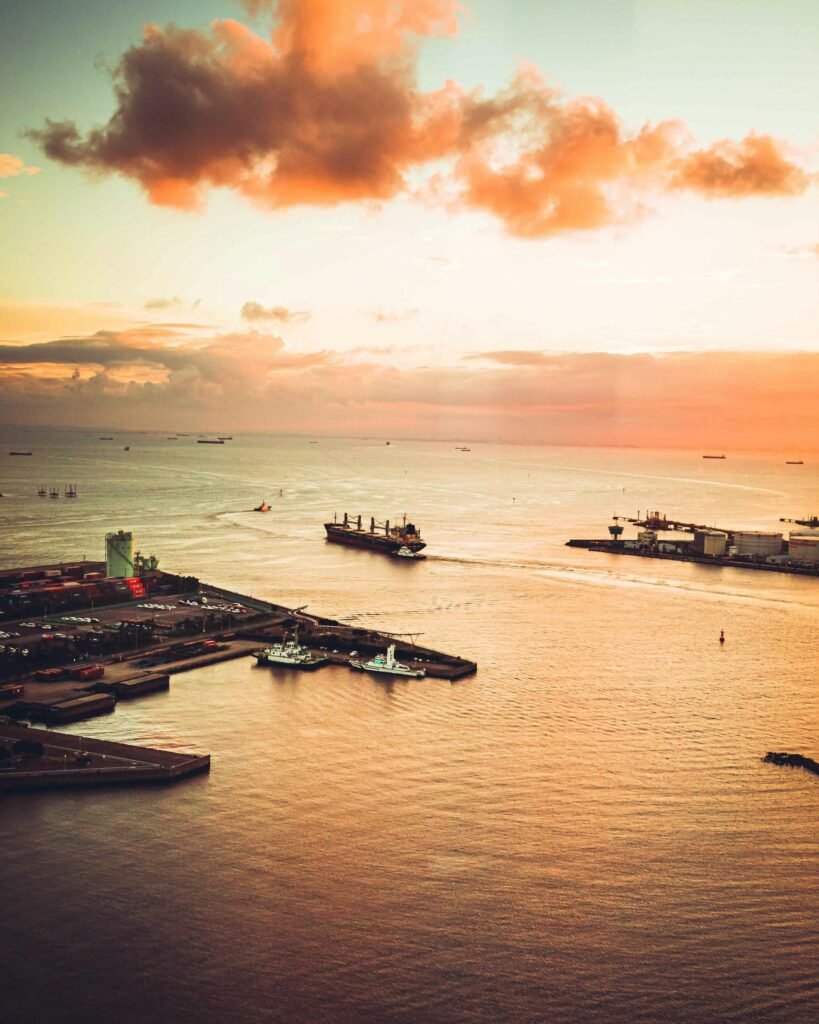
Photo credit: Chiba’s waterfront on Tokyo Bay
Chiba City is the capital that international travelers usually fly through without noticing. Most arrivals to greater Tokyo land at Narita International Airport — which sits 35 kilometers east of Chiba City within Chiba Prefecture — and immediately board the Narita Express train to central Tokyo, never seeing the city itself. Yet Chiba is a major Japanese city in its own right: nearly one million residents, a major Tokyo Bay port, the Makuhari Messe convention complex (the country’s second-largest after Tokyo’s), the Tokyo Disney Resort (technically in Urayasu, Chiba Prefecture), and a culture that mixes the Boso Peninsula’s rural seafood traditions with Tokyo-commuter modernity. The prefecture’s eastern Pacific coastline offers some of the closest surfing beaches and onsen retreats to Tokyo, while inland temples like Naritasan Shinshoji draw millions of pilgrims annually. For travelers willing to slow down a half-day on the way to or from Narita, Chiba rewards with a quieter, less self-consciously polished view of urban Japan.
Chiba by District: The 6 区 (Ku)
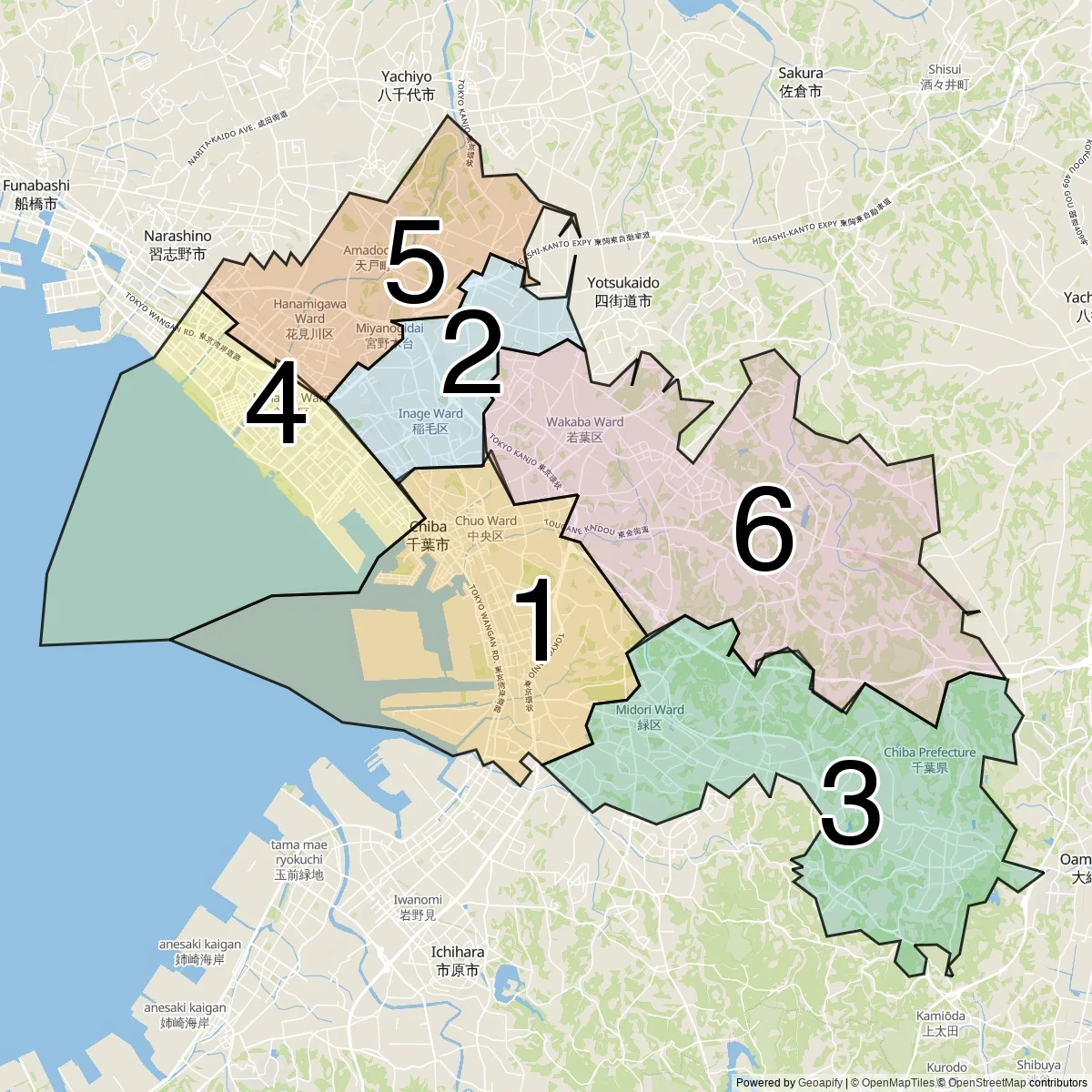
Chiba is divided into 6 wards. The map below shows their official OSM boundaries, colour-coded to match the table — a quick way to orient yourself before zooming in on individual sights.
| # | 区 (Ku) |
|---|---|
| 1 | 中央区 · Chuo |
| 2 | 稲毛区 · Inage Ward |
| 3 | 緑区 · Midori Ward |
| 4 | 美浜区 · Mihama Ward |
| 5 | 花見川区 · Hanamigawa Ward |
| 6 | 若葉区 · Wakaba Ward |
Chiba at a Glance: Essential Facts for Travelers
| Location | Chiba Prefecture, eastern Kantō region, Japan (Tokyo Bay coast) |
|---|---|
| Coordinates | 35.6073°N, 140.1064°E |
| Population | ~975,000 (2023; prefecture ~6.27 million) |
| Area | 271 km² (city); 5,156 km² (prefecture, the Boso Peninsula) |
| Elevation | Sea level to ~80 m |
| Time Zone | Japan Standard Time (JST, UTC+9 — no daylight saving) |
| Calling Code | +81 (city code 043) |
| Currency | Japanese Yen (JPY ¥) |
| Languages | Japanese; English signage on major transit and tourist sites |
| Climate | Humid subtropical — hot humid summers, mild dry winters; typhoon season August–October |
| Status | Designated city; capital of Chiba Prefecture; eastern anchor of Greater Tokyo |
| Famous For | Narita Airport (within prefecture), Tokyo Disney Resort (Urayasu), Makuhari Messe, Chiba Port Tower, Naritasan Temple, Bōsō Peninsula surfing |
Upcoming Events in Chiba
| Date | Title | Details |
|---|---|---|
| 2026-09-15 to 2026-10-31 | Disney Halloween at Tokyo Disney Resort | Tokyo Disney Resort in Urayasu, Chiba, transforms for Disney Halloween each autumn, decking Tokyo Disneyland and Tokyo DisneySea in seasonal decorations, special parades, character costumes and limited-edition food and merchandise. Running from mid-September through the end of October, it is one of the most popular times to visit, with guests encouraged to dress up on select days. The resort sits just across the prefectural border east of Tokyo and is easily reached by train. Tickets are dated and best booked in advance, and it is a family favourite. [Source] |
| 2026-09-19 to 2026-10-25 | Autumn Cosmos at Mother Farm | Mother Farm, a large hillside farm park in Futtsu on Chiba’s Boso Peninsula, is a popular family day out that turns especially colourful in autumn, when fields of cosmos flowers bloom across the slopes. Visitors can meet sheep, cows and alpacas, watch animal shows, pick seasonal produce and enjoy farm-fresh food, all with views over Tokyo Bay. Open year-round with seasonal highlights, it combines nature, animals and food in one accessible outing. Admission and activity prices vary, and it is well suited to children and families. [Source] |
| 2026-10-09 to 2026-10-11 | Sawara Grand Autumn Festival | The Sawara Grand Festival, held each October in the historic canal town of Sawara in Katori, Chiba, is one of the great float festivals of the Kanto region and recognised on UNESCO’s list of intangible cultural heritage. Enormous wooden floats topped with towering figures of legendary heroes are pulled through the old merchant streets to the haunting sound of Sawara-bayashi festival music. Held over a weekend, it draws large crowds to one of Japan’s best-preserved Edo-era townscapes. Watching is free, and it is a spectacular window into living tradition. [Source] |
| 2026-10-13 to 2026-10-16 | CEATEC 2026 at Makuhari Messe | CEATEC, Japan’s flagship digital-technology exhibition, returns to Makuhari Messe in Chiba City from 13 to 16 October 2026 under the theme of transformation across companies, industries and society. Hundreds of exhibitors present advances in AI, IoT, electronics, mobility and sustainability, and this edition is held concurrently with Japan Mobility Show Bizweek to accelerate cross-industry co-creation. Admission is free for all visitors, but online registration in advance is required. Aimed at business visitors, engineers, students and anyone curious about future technology. [Source] |
City News in Chiba – last 14 days
| Date | Category | Headline | Details |
|---|---|---|---|
| 2026-10-09 | Education | 751 Chiba secondary students still cannot get to school after typhoon | In Chiba, 751 junior high and high school students are still unable to attend school, as railway suspensions and other disruption caused by Typhoon No. 25 continue to affect their journeys. Some schools are considering cancelling or postponing regular exams and school events as a result, according to a report carried by d Menu News. The figures show that the storm’s impact on daily life in the prefecture is lasting well beyond the immediate damage, particularly for students who rely on rail connections. [Source] |
| 2026-10-09 | Local affairs | Extra pumps deployed as Shisui housing area remains flooded | Additional pumps have been brought in to drain floodwater in the town of Shisui in Chiba Prefecture, where a collapse of embankment fill during Typhoon No. 25 left a residential area under water, Nippon TV News reports. Flooding of the housing area was still continuing at the time of the report. The item underlines that recovery from the typhoon is ongoing in parts of the prefecture, with residents of the affected neighbourhood still waiting for the water to be removed from their homes and streets. [Source] |
| 2026-10-09 | Culture | Chiba Lantern Night to light 100 lanterns for recovery on November 21 | A lantern event called Chiba Lantern Night will be held on Saturday, November 21, with 100 lanterns released into the night sky over Chiba, according to an announcement distributed via PR Times. The organisers present the event as a way of lighting up wishes for recovery and reconstruction. The announcement summary does not specify the exact venue, ticketing or start time, but the event offers a reflective cultural outing for residents and visitors in the region later this autumn. [Source] |
| 2026-10-09 | Local affairs | Chiba’s tourist spots show storm scars ahead of the long weekend | Ahead of the three-day holiday weekend, a report carried by d Menu News looks at the state of tourist destinations in Chiba. It finds autumn scenery still on show but also visible damage left behind by the recent heavy rain. The snippet does not name individual locations or say which attractions are affected. Visitors planning a trip to the prefecture over the long weekend may want to check opening information for specific sites, as some places are still dealing with the after-effects of the downpours. [Source] |
| 2026-10-09 | Public safety | Man arrested for attempted murder after slashing in Chiba’s Wakaba Ward | A woman in her 60s was injured in an apparent slashing attack in Wakaba Ward, Chiba City, TV Asahi reports. A man was arrested at the scene on suspicion of attempted murder. The brief report does not give details on the relationship between the two, the motive or the woman’s condition beyond the fact that she was hurt. Further information on the circumstances of the incident was not included in the initial report on the attack in Wakaba Ward. [Source] |
| 2026-10-09 | Public safety | Two Brazilian nationals arrested over Chiba pawn shop robbery | Two Brazilian nationals have been arrested in connection with a robbery at a pawn shop in Chiba, the news site TokyoReporter reports. According to the item, the heist is linked to a crime syndicate. The short snippet does not give the date of the robbery, the value of the items taken, the exact location of the shop or the charges filed. The arrests mark a development in an investigation into a case that the outlet connects to organised crime rather than an isolated theft. [Source] |
| 2026-10-09 | Health | Matsudo hospital suspends three over nurses’ patient videos on social media | Nurses at Chiba Nishi General Hospital in Matsudo, Chiba Prefecture, are suspected of filming patients without consent and posting the videos on social media, TBS News Dig reports. The hospital has suspended three people from work in response. The inappropriate posts have caused a considerable stir and are being widely discussed. The report does not detail how many patients were affected, but the incident raises questions about privacy protection and staff conduct at medical institutions. [Source] |
| 2026-10-09 | Environment | Second whale stranding in weeks draws crowds to a Chiba beach | A whale has stranded on a beach in Chiba, the second such case within a few weeks, according to JAPAN Forward. The stranding has drawn crowds of onlookers to the shore. The headline-only item does not identify the species, the exact beach or what the authorities plan to do with the animal. Two strandings in such a short period make the event an unusual sight on the Chiba coastline and explain the strong public interest in the scene. [Source] |
| 2026-10-08 | Public transport | How the Uchibo Line kept Chiba and Kisarazu connected after storm damage | Rail news site Norimono News looks at how the link between Chiba and Kisarazu on the Uchibo Line has been maintained through a combination of replacement buses and a provisional restoration of the line. The report describes the effort as a feat of sheer force by the operators. For travellers heading south from Chiba towards Kisarazu, the item is a reminder that services on this route have been running under emergency arrangements, so checking current timetables and replacement bus options before setting out is advisable. [Source] |
| 2026-10-08 | Business | Inzai data centre plan near station sparks new controversy | A plan to build a new data centre inside a commercial facility in front of a railway station in Inzai, Chiba Prefecture, has become a fresh point of contention, the Nikkei business daily reports. The headline describes the proposal as a new flashpoint over data centres in the city. The snippet does not name the operator, the station or the main objections raised. The debate touches on how central commercial space next to transport hubs should be used in local communities. [Source] |
| 2026-10-07 | Culture | Chiba City opens 30 facilities free of charge for Citizens’ Day | Chiba City will mark its Citizens’ Day on the 18th by offering free admission to around 30 facilities, including the zoological park and an art museum, the Chiba Nippo newspaper reports. Schools will also serve a special menu for lunch on the day. The free entry makes the date an attractive opportunity for residents and visitors alike to explore the city’s cultural and leisure attractions without paying the usual admission fees. Details of the full list of participating venues are not included in the snippet. [Source] |
| 2026-10-07 | Public safety | M4.8 earthquake in northeastern Chiba, no tsunami risk | A magnitude 4.8 earthquake struck the northeastern part of Chiba Prefecture, Weathernews reports. The strongest shaking, a seismic intensity of 4 on the Japanese scale, was recorded in the city of Asahi. There was no concern of a tsunami. The snippet does not mention damage or injuries. Earthquakes of this size are felt clearly in the region, and the event is a reminder for residents and visitors in Chiba to keep basic emergency preparations in place. [Source] |
| 2026-10-07 | Culture | Millions of cosmos flowers reach full bloom in Chiba Prefecture | Millions of cosmos flowers have reached their peak bloom in Chiba Prefecture, the Mainichi newspaper reports in its Japan Photo Journal series. The photo feature showcases the seasonal display of the autumn flowers. The snippet does not name the specific park or field where the flowers are blooming. For visitors to the prefecture, peak bloom is the best time to see the cosmos fields, which are a popular autumn attraction and a colourful counterpoint to the recent storm damage. [Source] |
| 2026-10-06 | Business | $15 billion Chiba project to combine AI and on-site power | A large project in Chiba worth 15 billion US dollars will integrate artificial intelligence infrastructure with behind-the-meter power generation, according to the trade publication Microgrid Knowledge. Behind-the-meter power refers to electricity produced on site rather than drawn entirely from the public grid. The short item does not name the developers, the exact location or the timeline. The scale of the investment makes it one of the notable business stories for the prefecture this week. [Source] |
Chiba Events & City News Archive
Sources: Tokyo Disney Resort, Mother Farm, Katori City, CEATEC Official Website, Google News 千葉, Google News 千葉, Google News 千葉, Google News 千葉
Weather Forecast for the Next 14 Days in Chiba
| Date | Weather | Max °F | Min °F | Rain mm |
|---|---|---|---|---|
| 2026-10-10 | ☁️ | 75.6 °F | 58.8 °F | 0.0 mm |
| 2026-10-11 | ☁️ | 77.4 °F | 57.3 °F | 0.0 mm |
| 2026-10-12 | ☁️ | 76.5 °F | 61.8 °F | 0.0 mm |
| 2026-10-13 | ☁️ | 76.3 °F | 59.9 °F | 0.0 mm |
| 2026-10-14 | 🌧️ | 79.4 °F | 63.1 °F | 1.2 mm |
| 2026-10-15 | ⛅ | 74.5 °F | 61.6 °F | 0.0 mm |
| 2026-10-16 | ☁️ | 74.4 °F | 61.0 °F | 0.0 mm |
| 2026-10-17 | 🌧️ | 71.0 °F | 59.6 °F | 0.6 mm |
| 2026-10-18 | 🌧️ | 72.0 °F | 60.5 °F | 0.6 mm |
| 2026-10-19 | 🌧️ | 73.8 °F | 63.0 °F | 0.6 mm |
| 2026-10-20 | 🌧️ | 65.2 °F | 60.6 °F | 16.4 mm |
| 2026-10-21 | 🌧️ | 70.5 °F | 59.9 °F | 14.2 mm |
| 2026-10-22 | ☁️ | 80.6 °F | 64.0 °F | 0.0 mm |
| 2026-10-23 | 🌧️ | 64.3 °F | 57.7 °F | 20.2 mm |
Chiba’s History
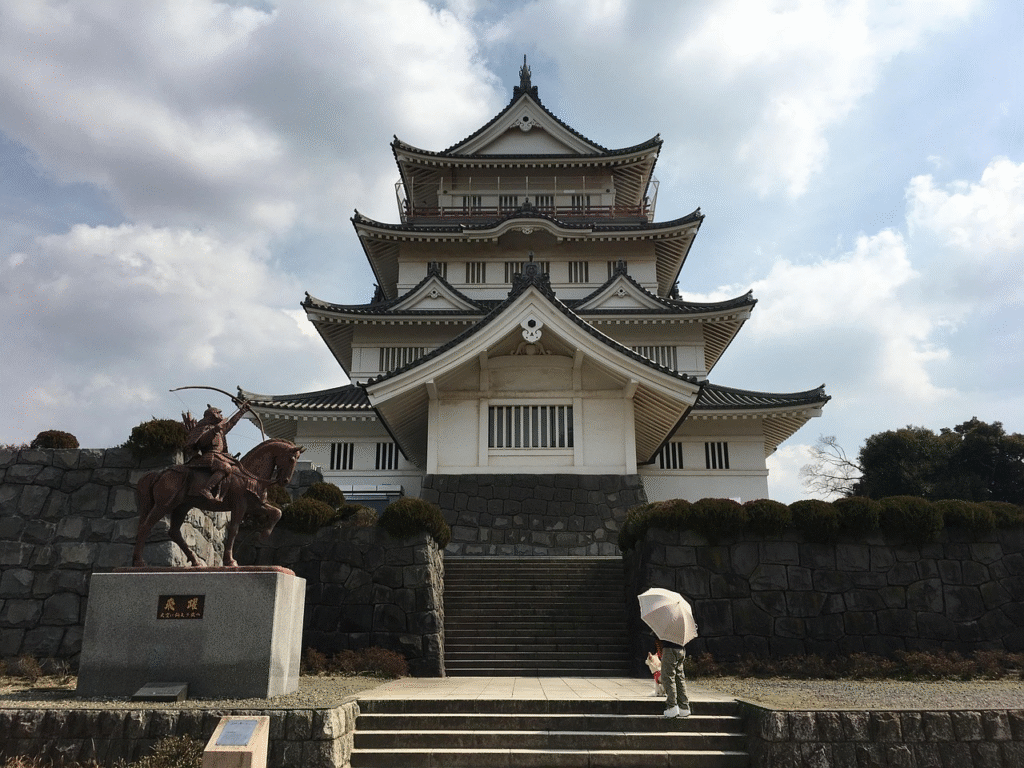
Chiba’s name traces directly to the powerful samurai clan that ruled the region from the late Heian period (12th century) through the medieval era. The Chiba clan (Chiba-shi) built its first stronghold at Inohana Castle on what is now Inohana Park in central Chiba City — the modern city is built around the old castle site, and a 1967 concrete reconstruction of the castle keep houses a small folk museum. The clan’s name combined the characters for “thousand” and “leaves,” giving the area its modern Japanese name.
The region was significant in Japan’s broader political history as the territorial bridge between Edo (Tokyo) and the rich agricultural plains of Awa, Kazusa, and Shimōsa provinces — the three classical provinces that today make up Chiba Prefecture. The Bōsō Peninsula’s coastal villages supplied fish, seafood, and rice to Edo during the Tokugawa shogunate (1603–1868), and the maritime route across Tokyo Bay was an essential supply line for the shogun’s capital.
The Meiji Restoration of 1868 abolished the feudal system and consolidated the old provinces into Chiba Prefecture in 1873, with Chiba City becoming the prefectural capital. The 1894 opening of the Sōbu Railway from Tokyo to Chiba transformed the city from a provincial castle town into a Tokyo commuter satellite. Massive industrial growth followed during the 20th century, particularly along the Keiyō industrial zone running between Tokyo and Chiba — steel mills, oil refineries, chemical plants, and shipyards lining the bay. The 1989 opening of the Tokyo Disneyland in Urayasu (which is technically within Chiba Prefecture, not Tokyo) and the 1989 opening of Makuhari Messe convention complex repositioned the prefecture toward services and tourism. Narita International Airport, opened controversially in 1978 after years of farmer protests (the Sanrizuka Struggle), made Chiba Prefecture the country’s primary international gateway.
The 2011 Tōhoku earthquake caused significant liquefaction damage to coastal Chiba City and Urayasu, but did not affect the city’s broader economic trajectory. 2020 Tokyo Olympics events — surfing on the Bōsō Peninsula, sailing at Enoshima — gave Chiba additional international visibility.
Geography, Climate & Best Time to Visit Chiba
Geographic Setting
Chiba City sits on the eastern shore of Tokyo Bay in the northern part of the Bōsō Peninsula. The city itself is largely flat coastal land, with gentle hills rising inland. The broader prefecture extends south and east from the city to cover the entire Bōsō Peninsula — a roughly diamond-shaped landmass facing the Pacific Ocean on its eastern shore and Tokyo Bay on its western shore.
The peninsula’s geography produces three distinct sub-regions: Northern Chiba (Chiba City, Funabashi, Matsudo, Kashiwa, Urayasu) — the densely urbanized Tokyo-commuter belt; Central Chiba (Narita, Sakura, Sawara) — agricultural and historical-temple country; Southern Bōsō (Tateyama, Kamogawa, Katsuura) — surf coast, fishing villages, and the Tokyo-area’s closest beach and onsen retreats. The Tokyo Aqua-Line bridge-and-tunnel combination (15 km, opened 1997) connects the peninsula directly to Kawasaki on the western side of Tokyo Bay.
Climate Overview
Chiba has a humid subtropical climate (Köppen Cfa) with maritime moderation from Tokyo Bay and the Pacific. Summer (June–September) is hot and humid with daytime highs of 28–33 °C and overnight lows in the low 20s; the Pacific coast is 1–2 °C cooler than central Chiba. Winter (December–February) is mild, mostly dry, with daytime highs of 8–13 °C and overnight lows that rarely drop below 0 °C; snowfall is rare on the coast but accumulates inland and on the higher Bōsō hills.
Typhoon Season & Weather Hazards
The Bōsō Peninsula sits in the direct path of Pacific typhoons, with peak risk August through October. The catastrophic 2019 Typhoon Faxai caused widespread power outages and damage across the peninsula; Typhoon Hagibis the same year flooded large parts of central Chiba. Check current advisories from the Japan Meteorological Agency (JMA) during fall travel. Major earthquakes are also a real consideration — Chiba is exposed to both the Sagami Trough (which generated the 1923 Great Kantō earthquake) and the Japan Trench (which generated 2011 Tōhoku). Familiarize yourself with hotel evacuation procedures and the JMA earthquake-warning notification system on smartphones.
Best Time to Visit
Late March to early May is genuinely the prime window — cherry blossoms (early April at Inohana Park and Sakura City’s Sakuragaoka), pleasant temperatures, and the spring festival season. October–November is the second-best window — autumn colors at Yoro Gorge and the surrounding Bōsō hills, comfortable temperatures, and reduced humidity. December–February is mild, dry, and unusually pleasant for Japan in winter; ideal for cultural travel and avoiding crowds. July–August is hot, humid, and busy with festivals but generally pleasant on the Pacific surf coast. September brings the heaviest typhoon risk; build flexibility into itineraries. Late January–early March: plum blossoms at Mito and various local gardens.
Chiba’s Districts & Neighborhoods
Chuo (Central) & Inohana Castle Area
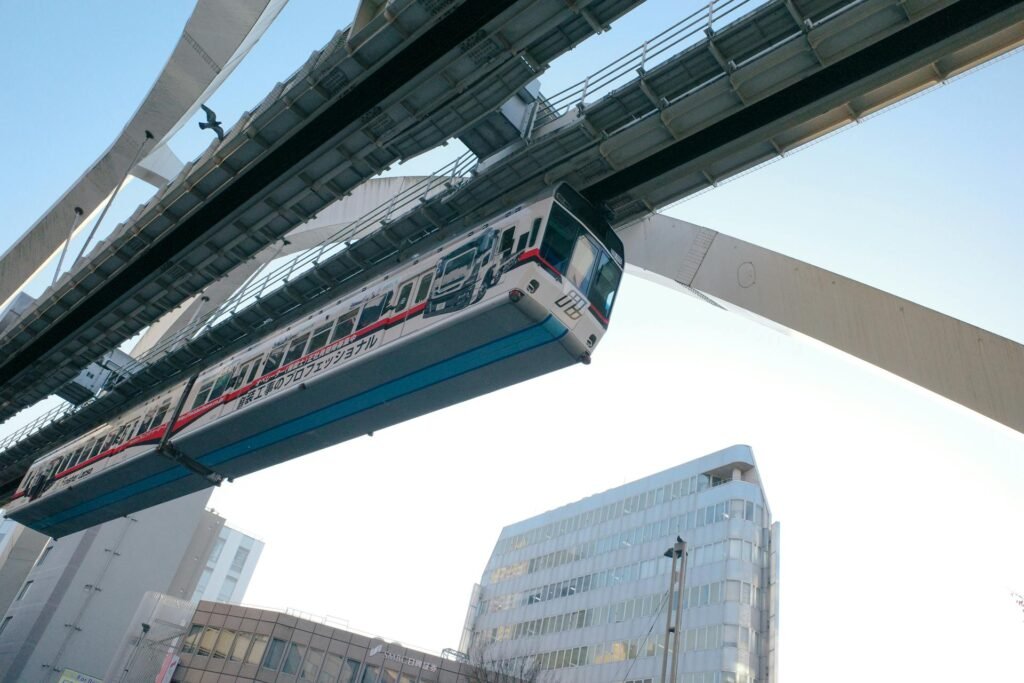
Chiba City’s administrative and commercial core. Inohana Park with the reconstructed Chiba Castle keep, Chiba City Folk Museum, the prefectural government office, and the central station (Chiba Station, the city’s main transit hub with JR, Keisei, and Chiba Monorail lines). Mid-range business hotels, department stores (Sogo Chiba, Mitsukoshi), and the Central Park retail district. The Chiba Monorail — the world’s longest suspended monorail — runs from the station through the city.
Mihama Ward & the Waterfront
The reclaimed-land district along Tokyo Bay containing the Chiba Port Tower (125 m observation tower, free entry), Inage Beach (one of Tokyo Bay’s few sandy public beaches), and the modern Chiba Port. The Makuhari Bay Town sub-area features the Makuhari Messe convention complex, the Marine Stadium (Chiba Lotte Marines baseball), the upscale ZOZOMARINE area, and the AEON Mall Makuhari New City — Japan’s largest mall.
Inage Ward
The university-and-residential district north-west of the center; home to Chiba University‘s main campus and the Mihama Park with its Showa-era buildings. Quieter, leafy, and useful as a budget-base alternative to the central business district.
Wakaba Ward & the Inland Hills
The hilly inland residential district containing the Chiba City Zoological Park, Showa-no-Mori park, and some of the city’s quieter residential neighborhoods. Worth a stop for the zoo’s famous red-panda population.
Hanamigawa Ward
The eastern residential ward, bordering Yotsukaidō and the central-Chiba agricultural areas. Less of a tourist destination but contains useful suburban shopping centers.
Beyond the City: Key Prefectural Destinations
Most travelers staying in Chiba combine city time with prefectural day-trips: Urayasu (Tokyo Disney Resort, 25 minutes by JR Keiyo Line); Narita (Naritasan Shinshoji Temple + the airport-area Edo-style preserved town, 60 minutes by Keisei Line); Sawara (the “Little Edo” preserved canal town, 90 minutes north); Kamogawa (Pacific surf and the Kamogawa Sea World aquarium, 90 minutes south); Tateyama (Bōsō Peninsula southern tip, beaches and onsen).
Top Things to Do in Chiba
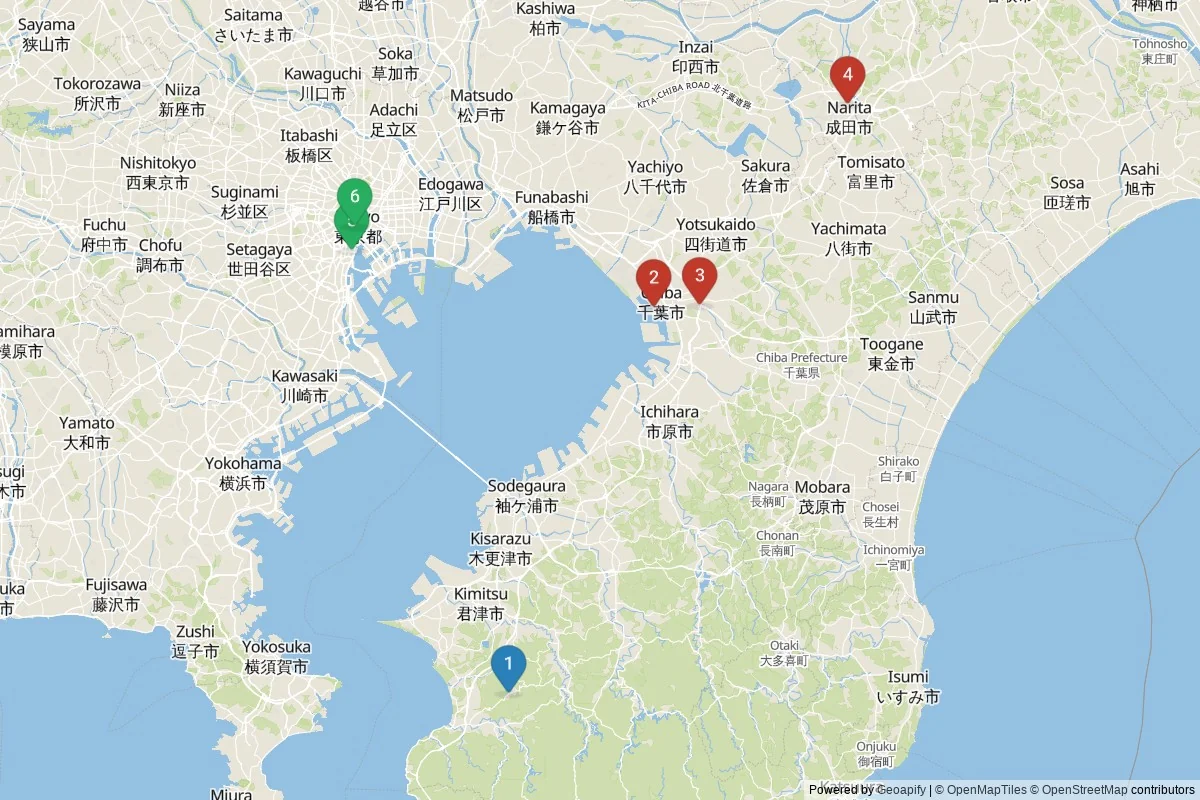
| # | Sight | Cluster | Type | Time | Entry | Best |
|---|---|---|---|---|---|---|
| 1 | Mother Farm & Tokyo German Village | Cluster A | Park | — | — | — |
| 2 | Chiba Port Tower & Inage Beach | Cluster B | Park | — | free | Afternoon |
| 3 | Tokyo Disneyland and DisneySea (Urayasu) | Cluster B | Park | 25 minutes | — | — |
| 4 | Naritasan Shinshoji Temple | Cluster B | Temple | 60 minutes | — | — |
| 5 | Walk Sawara’s Edo-Era Canals | Cluster C | — | 90 minutes | — | — |
| 6 | Day Trip to the Bōsō Peninsula Southern Tip | Cluster C | Temple | — | — | — |
1. Visit Tokyo Disneyland and DisneySea (Urayasu)
Despite the “Tokyo” name, the Tokyo Disney Resort is in Urayasu, Chiba Prefecture — 25 minutes from central Chiba City and 15 minutes from Tokyo by JR Keiyo Line. The two-park complex (DisneyLand opened 1983, DisneySea opened 2001) is widely considered the best Disney experience outside the original Anaheim park; DisneySea specifically is unique to Japan and has no equivalent at any other Disney location. Adult one-day single-park ticket ¥7,900–10,900 (varies by date); two-park hopper ¥13,900–15,300. Plan a full day per park; arrive at park opening; download the Tokyo Disney Resort app before visiting.
2. Naritasan Shinshoji Temple
One of Japan’s most-visited Buddhist temples — over 10 million pilgrims annually — Naritasan Shinshoji has been the spiritual heart of the eastern Kantō region since its founding in 940. The temple complex includes the main hall, the three-story pagoda, the Buddhist library, and 165,000 m² of landscaped gardens. The famous Naritasan Omotesandō approach street is lined with eel restaurants serving the regional specialty (kabayaki — grilled eel over rice). 60 minutes from Chiba Station by Keisei Line; the temple is 10 minutes walk from Narita Station.
3. Walk Sawara’s Edo-Era Canals
Often called “Little Edo of the East,” the canal town of Sawara (90 minutes north of Chiba City by train) preserves the merchant-house architecture of the late Edo period almost perfectly intact. The Ono River with its working canal boats, the Itō Tōko residence, and the former home of Inō Tadataka (the surveyor who created Japan’s first accurate map in the early 1800s) anchor the historic core. The annual Sawara Grand Festival in July and October features magnificent wooden float parades.
4. Surf at Kujūkuri Beach or Ichinomiya
The Pacific surf coast of the Bōsō Peninsula has the closest reliable surf to Tokyo. Kujūkuri Beach stretches 66 km along the eastern coast; Ichinomiya hosted the 2020 Olympic surfing events. Surf schools and equipment rental are widely available; the breaks suit beginners to advanced surfers depending on swell. 90–120 minutes from Chiba City by train + bus.
5. Chiba Port Tower & Inage Beach
The 125-meter rhombus-shaped Chiba Port Tower (free entry to the observation deck) and the adjacent Inage Beach Park — Tokyo Bay’s largest artificial sand beach — make a pleasant afternoon. The beach itself is more for atmosphere than swimming, but the bay-view sunset is reliable.
6. Chiba Monorail Ride
The city’s suspended monorail system (15.2 km) is recognized by Guinness as the world’s longest suspended monorail. The Y-shaped network runs from Chiba Station to Chiba Minato (the bay/Port Tower) and to Chishirodai inland. Worth riding once for the panoramic-cabin views of the city; flat ¥200–410 per ride.
7. Day Trip to the Bōsō Peninsula Southern Tip
A combined day trip to Kamogawa (the Pacific coast town with Kamogawa Sea World — among Japan’s best aquariums with daily orca shows) and Tateyama (southern tip beaches and the Niō-zan Buddhist temple) covers the southern half of the peninsula. The Bōsō Peninsula JR Tokkyū services make this practical as a day trip.
8. Mother Farm & Tokyo German Village
Two of central Chiba Prefecture’s most-visited family attractions. Mother Farm in Futtsu is a working farm-themed park with sheep, alpacas, and seasonal flower fields; Tokyo German Village in Sodegaura is a Bavarian-themed park famous for its winter illuminations (one of Japan’s largest light displays, December–January). Both are easily reached by car or by JR/highway-bus combinations.
How to Get to Chiba
By Air
The most important transit fact: Narita International Airport (NRT) — Tokyo’s main long-haul international airport — is in Chiba Prefecture, 35 km east of Chiba City. International flights from virtually everywhere in the world land here. From Narita to Chiba City: Narita Express (N’EX) 30–40 minutes ¥1,950 (one-way coach); Keisei Limited Express 45 minutes ¥770; Airport Limousine Bus 50–80 minutes ¥1,200; taxi ¥10,000–14,000 (rarely the right choice — trains are vastly cheaper).
From Haneda International Airport (HND) — Tokyo’s primary domestic airport with growing international routes — Chiba City is 60–90 minutes by limousine bus (¥1,400) or by train change via Tokyo Station.
By Train from Tokyo
The JR Sōbu Line (rapid service) from Tokyo Station to Chiba Station takes 40 minutes for ¥670; Keiyo Line (along the bay, through Maihama for Disney) takes 40–50 minutes; JR Sōbu Local for commuters from Akihabara/Shinjuku side. Most travelers visiting Tokyo Disney Resort take the JR Keiyō Line to Maihama Station, not all the way to Chiba City.
By Tokyo Aqua-Line
The Tokyo Bay Aqua-Line (15 km bridge-tunnel combination, opened 1997) connects Kawasaki on the western side of Tokyo Bay to Kisarazu on the Chiba side. Highway buses run frequently from major Tokyo terminals to all major Bōsō Peninsula destinations; useful for direct trips to southern Chiba.
By Long-Distance Bus & Train
Direct trains and highway buses connect Chiba City to Sendai, Tōhoku region, Niigata, and most Kantō-region cities. The Tokyo-Chiba commuter belt sees more than 1 million daily train passengers.
Visa Notes
Japan offers visa-free entry for up to 90 days for citizens of 68 countries — including all EU member states, US, UK, Canada, Australia, New Zealand, Singapore, South Korea, Hong Kong, and Taiwan. Chinese passport holders need a visa in advance. Passport must have at least 6 months remaining validity. The Visit Japan Web system streamlines digital immigration and customs declarations — fill in details before arrival. Check current entry rules with the Japanese Ministry of Foreign Affairs.
Getting Around Chiba
JR Trains & Keisei Line
The dominant transit option. JR East operates the Sōbu, Keiyō, Uchibō, and Sotobō lines through the prefecture; Keisei runs the Tokyo–Narita corridor. Suica or Pasmo contactless transit cards work seamlessly across all networks; Apple Pay Suica works on iPhone. Single fares from ¥150 city, ¥1,500–2,500 for cross-prefecture trips.
Chiba Monorail
The world’s longest suspended monorail system — Y-shaped routes from Chiba Station to Chiba Minato (Port Tower area) and to Chishirodai. Useful for getting to the waterfront sites and as a tourist experience in itself. ¥200–410 per ride; one-day pass ¥630.
Local Buses
Chiba’s bus network is dense but Japanese-language-only; useful primarily for reaching the southern peninsula destinations not served by JR. Most international visitors find trains sufficient.
Taxis
Japanese taxis are spotless, metered, and very expensive — typically ¥420 flag drop plus ¥80 per 240 meters. Go (formerly JapanTaxi) and S.Ride apps enable English-language hailing. Most drivers do not speak English; have your destination saved in Japanese or as a map pin.
Self-Drive Rentals
Car rental is practical and often necessary for southern Bōsō Peninsula destinations — Toyota Rent-a-Car, Nippon Rent-a-Car, Times Car Rental from major stations. Foreign visitors need an international driving permit (IDP) under the 1949 Geneva Convention; the 1968 Vienna Convention IDP is NOT valid in Japan. Highway tolls are significant (Aqua-Line ¥3,140 one-way for cars).
Cycling
Chiba City has reasonable bike infrastructure and Inage Beach Park has dedicated cycle paths. Bike share programs operate around major stations. The Bōsō Peninsula has scenic cycling routes for serious cyclists.
Food & Drink in Chiba
Chiba’s cuisine reflects its geography — the Bōsō Peninsula’s Pacific and Tokyo Bay coasts produce some of Japan’s most varied seafood, while the inland agricultural plains have historically supplied Tokyo with peanuts, vegetables, and fruits. The proximity to Tokyo means access to nearly any Japanese regional cuisine, but the local specialties are worth seeking.
What to Try
- Boso peanut specialties — Chiba produces the majority of Japan’s peanuts (落花生 rakkasei); raw peanuts, roasted peanuts, peanut miso, peanut tofu, and peanut sweets are everywhere. Specialty shops around Yachimata sell aged single-origin Chiba peanuts.
- Naritasan kabayaki unagi (grilled eel) — the eel restaurants along the Naritasan Omotesandō approach to Naritasan Shinshoji Temple serve some of Japan’s most respected unagi, charcoal-grilled and lacquered with sweet soy sauce.
- Bōsō seafood — Pacific tuna from Choshi port (one of Japan’s largest fishing ports), sashimi-grade horse mackerel, sea bream, sea urchin from Tateyama, and the Ise-ebi (Japanese spiny lobster) of Katsuura.
- Maguro (tuna) — Chiba’s Pacific tuna fisheries supply much of Tokyo’s sushi-grade fish; tuna donburi (rice bowls) are a regional standard.
- Choshi soy sauce — Yamasa and Higeta — two of Japan’s three largest soy-sauce brewers are based in Choshi at the prefecture’s eastern tip. Distillery tours available.
- Chiba-ramen — Yokohama-influenced Iekei-style and lighter Tokyo-style ramen shops are everywhere; nothing globally famous but solid local quality.
- Loquat (biwa) — the orange-yellow stone-fruit specialty of southern Bōsō; Mother Farm and roadside stands sell the fresh fruit in May–June.
- Edamame and goku-zumi (sweetcorn) — the early-summer agricultural specialties from inland Chiba.
Where to Eat
Chiba Station area: standard Japanese chain restaurants and izakayas at the station’s restaurant floors; Soga and Tsuga neighborhoods for traditional family restaurants; Naritasan Omotesandō for canonical eel and tempura; Choshi for tuna donburi at the fish market; Katsuura Asaichi (Tuesday-Sunday morning market) for spiny lobster and sashimi; Mihama AEON Mall for a wide selection of regional Japanese cuisine. Chiba City has multiple Michelin-starred sushi restaurants and several long-running kaiseki (traditional multi-course) restaurants worth advance reservations.
Drinks
Sake: Chiba’s local breweries — Iinuma Honke (Sawara), Fukunoka (Sawara), Tobei (Shiroi) — produce respected regional sake. Tasting rooms at the breweries offer flight tastings. Awa-mochi tea at temple Buddhist tea houses. Japanese craft beer: the Boso Beer microbrewery has a brewpub in Chiba City. Local shōchū and umeshu at traditional izakayas.
A Note on Tap Water
Tap water in Chiba is safe to drink straight from the tap — Japan’s municipal water systems are among the world’s cleanest, and Chiba’s supply meets stringent national drinking-water standards. Bottled water is available everywhere if preferred (¥100–200 per 500 ml at convenience stores) but is not necessary for safety. Reusable filter bottles are unnecessary. Ice is universally safe. Food safety: Japan has very low rates of foodborne illness; raw fish at any reputable restaurant is consistently safe; raw chicken (torisashi) is occasionally served at specialty restaurants but carries non-zero salmonella risk per CDC guidance for Japan.
Frequently Asked Questions About Visiting Chiba
Do I need a visa to visit Chiba?
For most foreign passport holders, no — Japan offers visa-free entry for up to 90 days for citizens of 68 countries, including the US, UK, Canada, Australia, New Zealand, all EU member states, Singapore, South Korea, Hong Kong (SAR passport), Taiwan, and most other developed-economy nations. Chinese mainland passport holders require a visa applied for in advance at a Japanese consulate. Visa-free travelers must: have a passport valid at least the duration of stay (Japan does not technically require 6 months, but airlines often do); have an onward/return ticket; have proof of accommodation; have sufficient funds. Japan launched the Visit Japan Web digital system in 2022 — fill in your immigration and customs declarations online before arrival to skip paper forms; the QR codes are scanned at Narita immigration. Always verify current rules with the Japanese Ministry of Foreign Affairs. For longer stays or work, multiple visa categories exist — student visas, working-holiday agreements (for citizens of partner countries including the UK, Germany, Canada, Australia), and specialized work visas.
Is Chiba safe for tourists?
Chiba — and Japan broadly — is among the world’s safest tourist destinations. The US State Department rates Japan at “exercise normal precautions” — the most relaxed advisory level. Violent crime against tourists is statistically negligible; pickpocketing exists but at a fraction of European or American rates. Real risks in Chiba: earthquakes — Chiba sits in an active seismic zone; the 2011 Tōhoku earthquake caused liquefaction damage; magnitude-7+ earthquakes are a periodic regional risk; familiarize yourself with hotel evacuation procedures and the JMA earthquake-warning app on your phone; typhoons August–October — 2019 brought major damage to the prefecture; traffic accidents involving cyclists — Tokyo-area cycling on sidewalks is normal but watch for sudden stops at intersections; swimming hazards at Pacific surf beaches — strong rip currents at Kujūkuri and other Bōsō coast surf spots; medical-cost shock — Japanese healthcare is excellent but uninsured foreigners pay full sticker prices that can run thousands of dollars for an ER visit; comprehensive travel insurance is essential. Drug laws: Japan imposes extremely harsh penalties for any drug offense including possession of small amounts of cannabis — multi-year prison sentences and deportation. Photography of military bases, police stations, and certain government buildings can attract police attention; ask first.
How many days do I need in Chiba?
Two days handles Chiba City itself; the realistic time-investment depends on what within the prefecture you want to do. If Chiba is a Tokyo Disney + Narita transit stop: 1–2 days, basing at a Disney area hotel. Cultural Chiba including Sawara and Naritasan: 3 days. Combined city + Bōsō Peninsula southern beach + Sawara cultural: 5 days. Tokyo + Chiba combined: most travelers stay in central Tokyo and do Chiba sites as day trips — Disney (full day), Naritasan (half day, often paired with the flight day), Sawara (full day). Chiba does not require a separate city base for most international visitors — Tokyo central hotels are 30–50 minutes from most Chiba sites by direct train and significantly more dining and accommodation variety. The exception: Tokyo Disney Resort multi-day visitors should stay at an on-property or near-property hotel in Urayasu/Maihama; surfing-and-onsen Bōsō Peninsula travelers should base at Tateyama or Katsuura overnight to maximize beach time.
What’s the best area to stay in Chiba?
Highly dependent on purpose. For Tokyo Disney visitors: Urayasu/Maihama area — Disney Resort Hotels (Disneyland Hotel, MiraCosta, Ambassador) at ¥30,000–80,000/night; “official Disney Resort partner hotels” (Sheraton Grande Tokyo Bay, Hilton Tokyo Bay, Hotel Okura) at ¥20,000–60,000/night; budget chain hotels in Shin-Urayasu at ¥10,000–18,000/night. For business at Makuhari Messe: Makuhari Bay Town — APA Hotel, Hotel New Otani Makuhari, Hotel The Manhattan; ¥10,000–25,000/night. For Narita Airport early departures: Narita town — Hotel Nikkō Narita, Hilton Tokyo Narita, ANA Crowne Plaza; ¥8,000–22,000/night; free airport shuttle. For central Chiba culture: Chiba Station area — Hotel Springs Makuhari, Tokyu Stay Chiba; ¥8,000–18,000/night. For Bōsō Peninsula surf: Tateyama or Katsuura — small inns and surf-house guesthouses ¥6,000–18,000/night per person. For onsen ryokan experience: Yoro-Onsen, Yoro Keikoku, Awa Kamogawa onsen ryokan ¥15,000–40,000/night per person with two meals. Skip: budget hotels far from any train station — Chiba’s rail-dependent geography makes them inconvenient.
How much does it cost to visit Chiba’s major sights?
Japan is moderately expensive but offers excellent value for the quality of experience. Tokyo Disneyland single-park adult: ¥7,900–10,900 (~US$53–73, varies by date); two-park hopper ¥13,900–15,300. Naritasan Shinshoji Temple: free entry. Inohana Park & Chiba Castle Folk Museum: free / ¥60. Chiba Port Tower observation deck: ¥400. Chiba Monorail single ride: ¥200–410; one-day pass ¥630. Sawara canal tour: ¥1,500–2,000 per person. Mother Farm entry: ¥1,500 adult. Tokyo German Village: ¥800 entry + parking ¥1,000. Kamogawa Sea World: ¥3,300 adult. Local meals: convenience-store breakfast ¥500–800; chain ramen lunch ¥800–1,500; sit-down family restaurant dinner ¥1,500–3,000 per person; sushi/kaiseki ¥4,000–25,000 per person; eel-on-rice at Naritasan ¥3,500–8,000. Train Narita to central Chiba: ¥770. JR Tokyo to Chiba: ¥670. JR Pass (Foreign Tourist Rail Pass): 7-day ¥50,000, useful for travelers also visiting Kyoto/Osaka. Overall daily budget: ¥10,000 (frugal), ¥20,000 (mid-range), ¥40,000+ (luxury).
Should I drink the tap water in Chiba?
Yes — tap water in Chiba is completely safe to drink straight from the tap. Japan’s municipal water systems are among the cleanest in the world, treated to drinking-water standards exceeding most countries’ bottled-water requirements. Chiba’s supply comes from the Tone River system and is treated to nationally regulated quality standards. No bottled water needed: ice in restaurants is universally safe; tap water in any restaurant or hotel is safe; refillable water-bottle stations are increasingly common at train stations and parks (free). Reusable filter bottles are unnecessary in Japan — a regular water bottle works fine. Food safety: Japan has very low foodborne illness rates. Raw fish (sashimi, sushi) at reputable establishments is consistently safe due to rigorous regulatory standards; raw beef (gyusashi, yukke) is regulated since 2011 and only certified establishments may serve it. Higher-risk items: torisashi (raw chicken) — occasionally served at specialty restaurants and carries non-zero salmonella risk; raw eggs (tamago gohan) — Japan-regulated eggs are sterilized and broadly safe but consume freshly cracked, not pre-cracked. The CDC traveler health page for Japan recommends standard hygiene precautions but does not require water-purification measures. Foreign travelers’ most common health complaint in Japan: jet-lag-driven stomach issues from over-eating, not actual contamination.
What payment methods work in Chiba — is Japan still cash-heavy?
Significantly improved but still cash-friendly. Japan was historically cash-dominant, but rapid 2019–2024 expansion of contactless payment has reshaped the landscape. Credit cards (Visa, Mastercard, JCB, AmEx): accepted at most major hotels, department stores, chain restaurants, supermarkets, convenience stores (7-Eleven, FamilyMart, Lawson), and the Tokyo Disney Resort. Suica/Pasmo IC cards: rechargeable transit cards that double as small-payment cards at most convenience stores, vending machines, and chain restaurants. Apple Pay supports Suica natively on iPhone; Android users can register a physical card. Mobile payment: PayPay dominates QR-code payments locally but requires a Japanese phone number for full registration; many tourists can use Apple Pay / Google Pay at NFC-enabled terminals instead. Cash: still needed for many small restaurants (especially family-run), traditional ryokans, temples and shrines, smaller shops, and most outdoor markets. ATMs at 7-Eleven (Seven Bank), Family Mart, and Japan Post Bank accept foreign cards with daily limits of ¥100,000–300,000 and reasonable fees. Currency exchange: airport rates are competitive in Japan; alternatively, banks and post offices exchange travelers’ checks and cash. No tipping culture: Japan does not have a tipping tradition; restaurants will return cash left as tips, and tipping can cause genuine confusion or offense. The price you see is what you pay; excellent service is included.
What’s the realistic Tokyo-to-Chiba trip plan — is it worth the detour?
It depends on what you’re prioritizing. If you have only 3–5 days in greater Tokyo: do Disney as a day trip and Naritasan on the airport-departure day; skip the rest of Chiba. If you have 7+ days in greater Tokyo: add a day for Sawara’s canal-town beauty (it’s one of the most photogenic preserved towns in Kanto). If you specifically want Japanese surf: 2–3 days on the Bōsō Peninsula at Ichinomiya or Onjuku is the closest reliable surf to Tokyo. If you want Japanese onsen but can’t get to Hakone or Atami: Bōsō Peninsula onsen towns (Yoro-Keikoku, Awa Kamogawa) are 60–90 minutes from Tokyo Station. Disney visitors: stay at a Disney Resort Hotel or partner hotel; do not commute from central Tokyo unless price is the absolute priority. Time-pressed travelers: skip Chiba City itself unless you have a specific connection (university visit, Makuhari Messe event, baseball at the ZOZO Marine Stadium). Foreigners’ biggest Chiba miss: Naritasan Shinshoji Temple — frequently visited on departure day but rushed; allow 3 hours for the temple and another hour for the eel restaurants on the omotesandō approach street.
Education & Notable People
Chiba is one of the major educational centers of the greater Tokyo region, anchored by the highly respected Chiba University and a strong technical-and-engineering university tradition.
Major Universities
- Chiba University — the prefecture’s flagship national research university, founded 1949 with roots in the 1870s; approximately 14,000 students; renowned for medicine, horticulture, and engineering; the only Japanese national university with a horticulture faculty.
- Chiba Institute of Technology — private engineering university with strong robotics and aerospace programs.
- Reitaku University — private university with international business and global studies programs.
- Nippon Sport Science University Chiba campus — sports sciences and Olympic-training affiliations.
- Tokyo University of Science Chiba campus — engineering and science programs.
Notable People
Inō Tadataka — the great 18th–19th-century cartographer who walked Japan from end to end to create the country’s first accurate map, born and lived much of his life in Sawara. His former home is a preserved museum and pilgrimage site. Yokomizo Seishi — the writer who created the Kindaichi detective novels, born in Kobe but a longtime Chiba resident. Sadaharu Oh — Japan’s greatest baseball player (868 career home runs), spent his playing career mostly in Tokyo but has strong Chiba ties through coaching at the Chiba Lotte Marines organization. Yuji Hyodo — celebrated wrestler. Hirobumi Itō — the architect of the Meiji Constitution and first Prime Minister of Japan, although based primarily in Tokyo, maintained a Chiba villa. Modern entertainment industry: dozens of singers, actors, and idols who attend the Chiba-based AKB48 sister group operations. Mariko Hayashi — celebrated contemporary novelist, born in Yamanashi but a longtime Chiba resident.
Sister Cities & International Relations
Chiba’s sister-city network reflects the prefecture’s identity as a major port, university, and Olympic-host region. The relationships emphasize port cooperation, university exchange, and Pacific-Asia partnerships.
Chiba City and Chiba Prefecture’s sister and friendship cities include (selection):
- Houston, Texas, USA — sister city since 1973; one of Chiba’s oldest international relationships, focused on aerospace and medical-research cooperation.
- Quezon City, Philippines — paired since 1972; Pacific-region cooperation.
- Tianjin, China — sister city since 1986; Chinese port-city partnership.
- Kitchener-Waterloo, Ontario, Canada — friendship city; university partnership.
- Asunción, Paraguay — friendship city since 1972; based on the historic Japanese immigration to Paraguay.
- Düsseldorf, Germany — through prefectural-level friendship with North Rhine-Westphalia.
- Montreux, Switzerland — friendship city.
- Hai Phong, Vietnam — port-city friendship.
Chiba Prefecture maintains active participation in the Pacific Rim Capital Cities network and is a regular host of international Olympic-pathway events. The prefecture’s economic-development office maintains direct trade-and-investment promotion offices in Düsseldorf, Singapore, Bangkok, Hong Kong, and Houston. The Chiba Prefectural Government publishes detailed economic and tourism statistics through its official multilingual portal.
AFRIKA
Cairo Hurghada Johannesburg Marrakech
ASIA
Abu Dhabi Agra Antalya Bangkok Batam Beijing Bengaluru Cebu City Chiang Mai Chiba Chennai Da Nang Dammam Delhi Denpasar Dubai Fukuoka Guangzhou Guilin Ha Long Hanoi Ho Chi Minh City Jakarta Jaipur Johor Bahru Kolkata Krabi Kuala Lumpur Kyoto Macau Mecca Medina Mugla Mumbai Osaka Pattaya Penang Phuket Riyadh Seoul Shanghai Shenzhen Singapore Taipei Tokyo Zhuhai
EUROPE
Amsterdam Athens Barcelona Berlin Brussels Budapest Copenhagen Dublin Florence Frankfurt am Main Heraklion Krakow Lisbon London Madrid Milan Munich Nice Paris Porto Prague Rhodes Rome Stockholm Venice Vienna Warsaw
NORTH AMERICA
Cancun Las Vegas Los Angeles Miami New York City Orlando San Francisco Toronto Vancouver
SOUTH AMERICA
Buenos Aires Lima Rio De Janeiro
OCEANIA
Auckland Honolulu Melbourne Sydney