
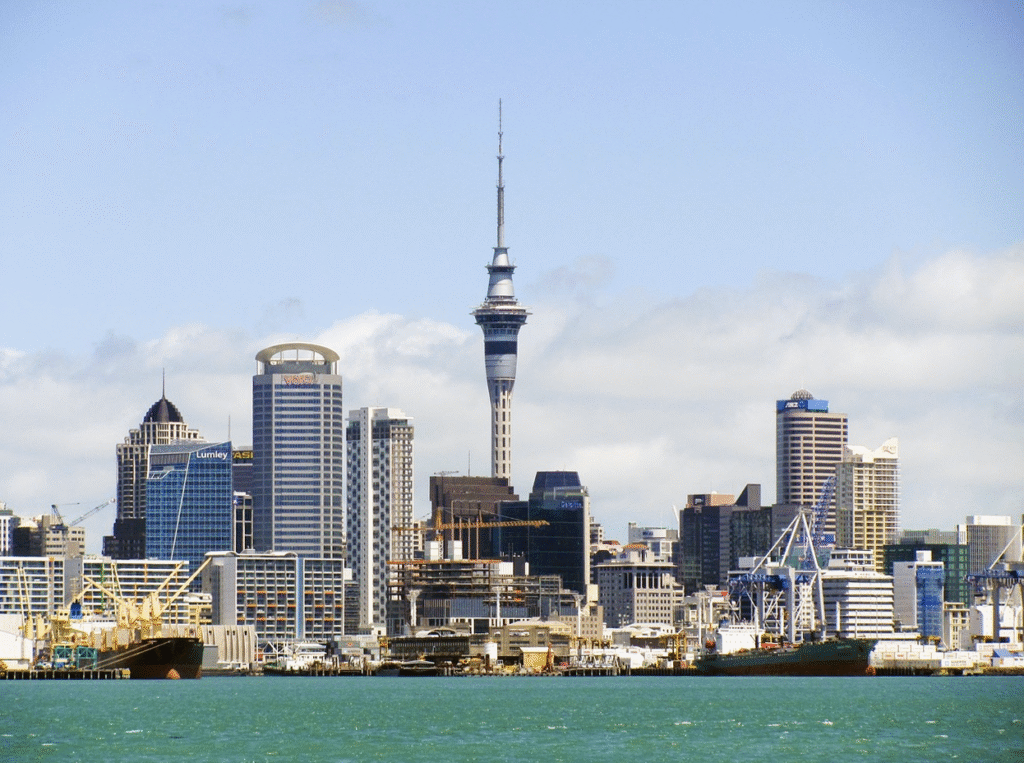
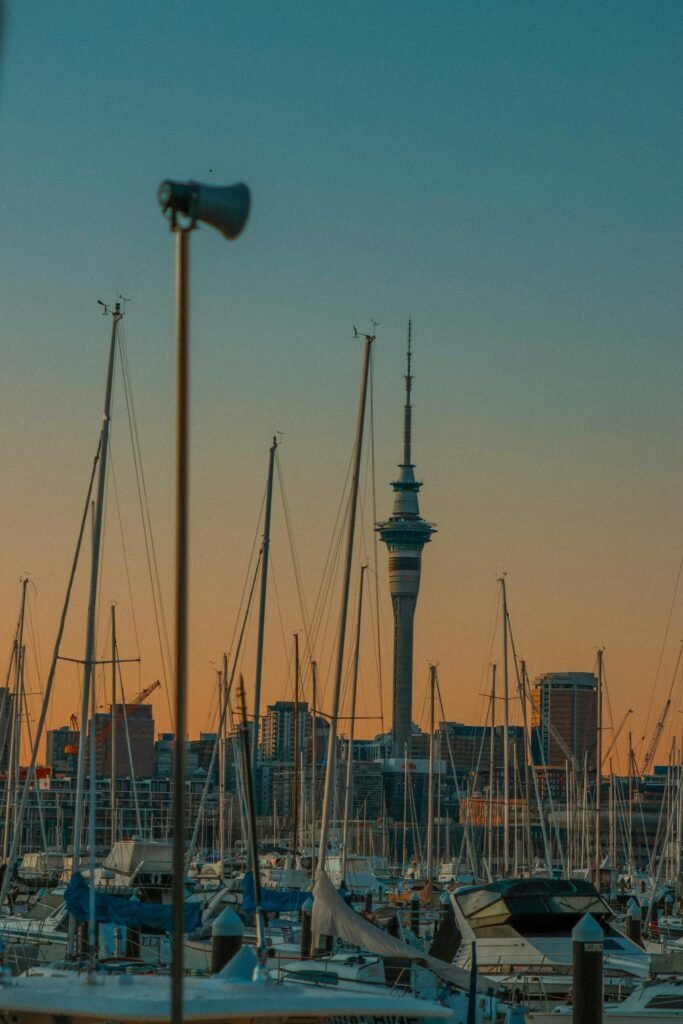
Photo credit: Auckland skyline with Sky Tower
Auckland — known in Māori as Tāmaki Makaurau (“Tāmaki desired by many”) — is New Zealand’s largest city, home to roughly one-third of the country’s population (~1.7 million) on the narrow isthmus between two major harbors. The defining geography is unique: Auckland is built on 53 volcanic cones (most extinct, the most recent — Rangitoto Island — erupted just 600 years ago), framed by the Hauraki Gulf to the east (with its 50+ islands including Waiheke, Rangitoto, and Great Barrier) and the Manukau Harbour to the west. The Māori name reflects the area’s pre-European importance: the rich volcanic soil and protected harbors made it one of the most contested and densely populated regions of pre-contact New Zealand. Modern Auckland is the country’s commercial, financial, and creative capital — home to 40% of New Zealand’s GDP, the country’s most diverse population (significant Polynesian, East Asian, and South Asian communities), and the highest concentration of restaurants, bars, and cultural venues. Known as the “City of Sails” for having the world’s highest per-capita boat ownership, Auckland offers easy access to remarkable natural experiences within 30 minutes of the city: black-sand surf beaches at Piha, the wine-and-cheese island of Waiheke, the volcanic cones of Mount Eden and One Tree Hill, and the broader North Island attractions of Rotorua’s geothermal landscapes, the Coromandel Peninsula, and the surfing beaches of the East Cape.
Auckland by District: The 21 Local boards
Auckland is divided into 21 local board areas. The map below shows their official OSM boundaries, colour-coded to match the table — a quick way to orient yourself before zooming in on individual sights.
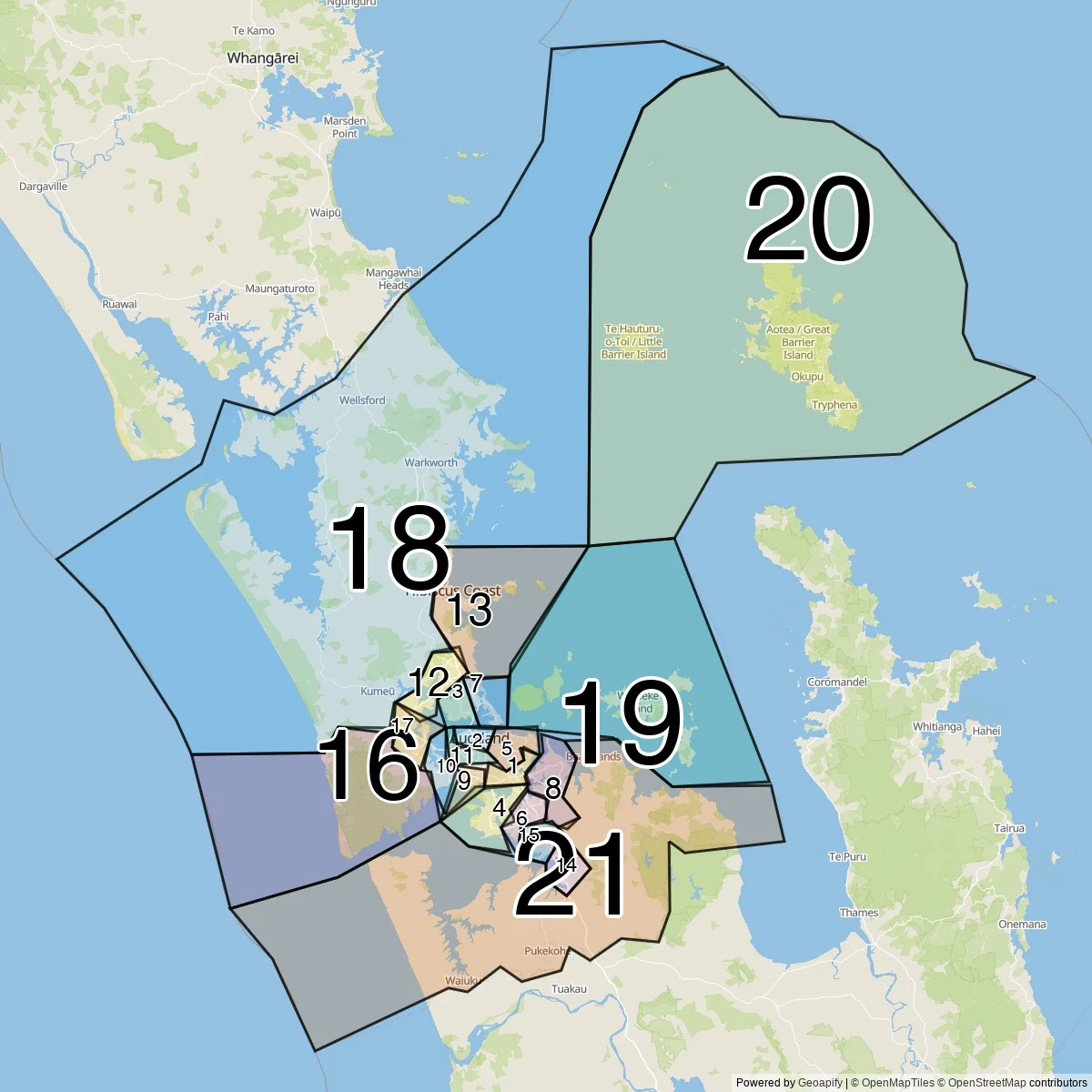
| # | Local boards |
|---|---|
| 1 | Maungakiekie-Tāmaki |
| 2 | Waitematā |
| 3 | Kaipātiki |
| 4 | Māngere-Ōtāhuhu |
| 5 | Ōrākei |
| 6 | Ōtara-Papatoetoe |
| 7 | Devonport-Takapuna |
| 8 | Howick |
| 9 | Puketāpapa |
| 10 | Whau |
| 11 | Albert-Eden |
| 12 | Upper Harbour |
| 13 | Hibiscus and Bays |
| 14 | Papakura |
| 15 | Manurewa |
| 16 | Waitākere Ranges |
| 17 | Henderson-Massey |
| 18 | Rodney |
| 19 | Waiheke |
| 20 | Aotea Great Barrier |
| 21 | Franklin |
Auckland at a Glance: Essential Facts for Travelers
| Location | North Island, upper North Island isthmus, New Zealand |
|---|---|
| Coordinates | 36.8485°S, 174.7633°E |
| Population | ~1.72 million (Auckland Council region, 2024); ~one-third of New Zealand’s 5.2 million national population |
| Area | 4,938 km² (Auckland Council region) |
| Elevation | Sea level to 196 m (Maungawhau / Mount Eden, the highest volcanic cone in the central city) |
| Time Zone | New Zealand Standard Time (NZST, UTC+12) / Daylight Saving Time NZDT (UTC+13, September–April) |
| Calling Code | +64 (city code 09) |
| Currency | New Zealand Dollar (NZD $) |
| Languages | English (official); Te Reo Māori (official, growing usage); New Zealand Sign Language (official); significant Pacific Island, Mandarin, Korean, Hindi/Punjabi communities |
| Climate | Oceanic (Köppen Cfb) — mild year-round, warm summers, cool winters; opposite-hemisphere seasons (summer Dec–Feb, winter Jun–Aug) |
| Founded | Māori settlement since c. 1350; European-founded 1840 by Governor William Hobson |
| Famous For | Sky Tower (Southern Hemisphere’s tallest structure), 53 volcanic cones, Waiheke Island wineries, Hauraki Gulf, City of Sails (world’s highest per-capita boat ownership), Pacific Islander cultural capital, gateway to North Island |
Upcoming Events in Auckland
| Date | Title | Details |
|---|---|---|
| 2026-09-22 to 2026-10-18 | Cabaret – Auckland Theatre Company | Auckland Theatre Company stages the Kander and Ebb musical Cabaret at the ASB Waterfront Theatre in Wynyard Quarter from 22 September to 18 October. Nomi Cohen stars as Sally Bowles with Matu Ngaropo as the Emcee, leading a cast of New Zealand’s finest musical theatre performers into the decadent world of Berlin’s Kit Kat Club as the Weimar era darkens. Evening performances run through the season at the 660-seat venue at 138 Halsey Street; tickets vary by seat and date, and booking ahead is advised for weekend shows. [Source] |
| 2026-09-26 to 2026-10-12 | Auckland Heritage Festival 2026 | The Auckland Heritage Festival is an annual celebration of the region’s history, running across late September and October with hundreds of mostly free events. Walking tours, talks, open days at historic buildings, exhibitions and family activities invite residents and visitors to explore the stories, places and people that shaped Auckland. Coordinated by Auckland Council, the festival opens doors to sites not normally accessible and highlights both Maori and colonial heritage. It is a rich, low-cost way to discover the city’s past; check the official programme for confirmed 2026 dates and full listings. [Source] |
| 2026-10-10 to 2027-02-01 | Picasso: Designed by Paul Smith at Auckland Art Gallery | Auckland Art Gallery Toi o Tamaki opens its summer blockbuster on 10 October, running until 1 February 2027. The exhibition brings outstanding works from the Musee national Picasso-Paris to New Zealand in a playful collaboration with legendary British fashion designer Sir Paul Smith, who stages the paintings with his signature bold colour and pattern. It is a rare chance to see major Picasso works in Auckland, aimed at art lovers and curious families alike. The gallery on Kitchener Street is open daily; the exhibition is ticketed with prices varying by session. [Source] |
| 2026-10-17 to 2026-10-18 | Auckland Diwali Festival 2026 | Auckland’s Diwali Festival is one of the city’s biggest cultural celebrations, marking the Hindu festival of lights with a vibrant free event traditionally held in October around Aotea Square and Queen Street. Crowds enjoy Indian music and dance performances, colourful stalls, street food, craft and a dazzling display of lights. Organised with the city’s Indian communities, it celebrates Auckland’s diversity and draws families and visitors of all backgrounds. It is a lively, welcoming occasion; check the official listings for confirmed 2026 dates and the full programme of performances and activities. [Source] |
| 2026-10-18 | Silver Ferns v Australian Diamonds – Netball at Spark Arena | New Zealand’s Silver Ferns take on Australia’s Diamonds at Spark Arena on 18 October at 7.30pm as part of the WM New Zealand Netball Series, renewing the fiercest rivalry in world netball. The trans-Tasman clash between the sport’s two powerhouse nations reliably delivers a loud, family-friendly arena atmosphere and world-class athleticism. Tickets are sold through official ticketing channels at a range of prices, and matches between these two sides frequently sell strongly, so early booking is sensible for good seats. A great pick for sports fans visiting the city. [Source] |
| 2026-10-23 to 2026-10-26 | Armageddon Expo Auckland 2026 | New Zealand’s biggest pop-culture convention returns to Auckland Showgrounds over Labour Weekend, Friday 23 to Monday 26 October. Armageddon Expo packs the halls with celebrity guest panels, comics, anime, gaming zones, cosplay contests and hundreds of merchandise stalls. Doors open Friday evening from 6pm to 9pm, then 10am to 5pm across Saturday, Sunday and Monday. Day passes and multi-day tickets are sold at varying prices, and the event draws tens of thousands of fans of all ages, from families to dedicated collectors. Costumed attendees are very much part of the spectacle. [Source] |
| 2026-10-25 | Zara Larsson – Midnight Sun Tour at Spark Arena | Swedish pop star Zara Larsson brings her Midnight Sun tour to Spark Arena on 25 October, her latest visit to Auckland on the back of a string of international hits. Expect a high-energy arena pop show with slick choreography and singalong anthems spanning her catalogue. Tickets are available through official ticketing outlets at a range of price points depending on seating or standing floor access. The concert suits pop fans of all ages, and central Auckland’s bars and restaurants around Britomart make an easy pre-show meeting point. [Source] |
City News in Auckland – last 14 days
| Date | Category | Headline | Details |
|---|---|---|---|
| 2026-09-14 | Public transport | City Rail Link carries 25,000 extra passengers on first weekday | An estimated 72,500 passengers were counted on trains across the Auckland Transport network by 5pm on the City Rail Link’s first weekday, about 25,000 more than usual. The milestone followed an opening Sunday that officials described as incredible, when the first public day drew large crowds and passed off with only minor disruption. Commuters reported smooth journeys through the new underground stations during the first morning rush hour, and reporters who raced the train against car, bus and bike across the city found the new link highly competitive. [Source] |
| 2026-09-14 | Local government | Mayor Wayne Brown cool on National’s transport police pledge | National announced on Sunday that, if re-elected to government, it would establish a dedicated Auckland Transport Police Team to boost safety on buses and trains. Auckland’s mayor gave the plan a lukewarm reception, saying policing public transport is not where he would be spending money and questioning whether the proposal matches the city’s priorities. The exchange underlines ongoing tension between central government election promises and the council’s own transport agenda, just as Aucklanders adjust to a much larger rail network. [Source] |
| 2026-09-14 | Public safety | Mt Albert medical centre blames confusion after death at its door | Mt Albert Medical Centre is facing intense public criticism after a man died just metres from its practice and staff allegedly refused use of a defibrillator. The centre now says confusion arose because staff believed they had been asked to help jump start a vehicle rather than provide a defibrillator, while a doctor there says he was unaware of the situation as it unfolded. The case has prompted wider debate about access to defibrillators and how practices respond to emergencies on their doorstep. [Source] |
| 2026-09-14 | Sports | Warriors chase big reaction in Eden Park NRL semifinal | The Warriors face the Newcastle Knights in an NRL semifinal at Eden Park on Sunday evening at 6.05pm, with their season on the line after a bruising finals defeat a week earlier. Senior figures at the Auckland club say the squad cannot sulk for long and are demanding a strong response in front of a home crowd. Commentators note the path to the grand final has flipped dramatically, making the Eden Park clash a defining test of the team’s premiership credentials. [Source] |
| 2026-09-14 | Business | July visitor arrivals top pre-Covid levels for first time | For the first time in a single month, overseas visitor arrivals to New Zealand have eclipsed their pre-pandemic levels. The milestone matters especially for Auckland, the country’s main international gateway, where most long-haul visitors arrive and spend their first nights. The rebound is welcome news for the city’s hotels, restaurants and retailers heading into the warmer months, and it caps a steady multi-year recovery in international travel since the borders reopened after Covid-19. [Source] |
| 2026-09-14 | Public safety | Copper and metal thefts causing millions in infrastructure damage | KiwiRail and electricity network company Vector say escalating thefts of copper and other metals, along with vandalism, are causing millions of dollars in damage, delaying projects and draining resources. The companies warn the offending is dangerous for the thieves themselves as well as for the public, with live electrical equipment and rail corridors among the targets. For Auckland, where Vector runs the power network and trains are carrying record numbers of commuters, the thefts risk disruption to essential infrastructure. [Source] |
Auckland Events & City News Archive
Sources: Auckland Theatre Company, Auckland Council, Auckland Art Gallery, Auckland NZ, Ticketmaster NZ, Armageddon Expo, Songkick, RNZ
Weather Forecast for the Next 14 Days in Auckland
| Date | Weather | Max °F | Min °F | Rain mm |
|---|---|---|---|---|
| 2026-09-15 | ☁️ | 61.3 °F | 48.6 °F | 0.0 mm |
| 2026-09-16 | 🌧️ | 58.4 °F | 47.6 °F | 0.7 mm |
| 2026-09-17 | 🌧️ | 62.1 °F | 52.3 °F | 6.6 mm |
| 2026-09-18 | ⛈️ | 60.1 °F | 55.9 °F | 31.4 mm |
| 2026-09-19 | 🌧️ | 58.8 °F | 54.5 °F | 5.8 mm |
| 2026-09-20 | 🌧️ | 60.3 °F | 53.6 °F | 0.9 mm |
| 2026-09-21 | 🌧️ | 59.3 °F | 53.9 °F | 1.2 mm |
| 2026-09-22 | 🌧️ | 57.8 °F | 52.2 °F | 0.6 mm |
| 2026-09-23 | ⛅ | 58.4 °F | 50.5 °F | 0.0 mm |
| 2026-09-24 | 🌧️ | 59.5 °F | 47.8 °F | 0.5 mm |
| 2026-09-25 | 🌧️ | 63.7 °F | 54.1 °F | 1.2 mm |
| 2026-09-26 | 🌧️ | 59.5 °F | 47.4 °F | 1.2 mm |
| 2026-09-27 | 🌧️ | 59.4 °F | 55.2 °F | 3.7 mm |
| 2026-09-28 | 🌧️ | 59.9 °F | 53.8 °F | 1.2 mm |
Auckland’s History
The Auckland isthmus has been inhabited by Māori for at least 700 years — Polynesian voyagers reached Aotearoa (New Zealand) in waves between approximately 1300 and 1400 CE in oceangoing double-hulled canoes from the broader East Polynesian region. The isthmus’s protected harbors, volcanic cones (which served as defensible pā hill-fortresses), and rich soil made the area one of the most contested and densely populated regions of pre-European Aotearoa. The Māori name Tāmaki Makaurau (“Tāmaki desired by many”) reflects the multiple iwi (tribes) — including Ngāti Whātua Ōrākei, Te Kawerau ā Maki, and Ngāi Tai — who claimed and fought over the area.
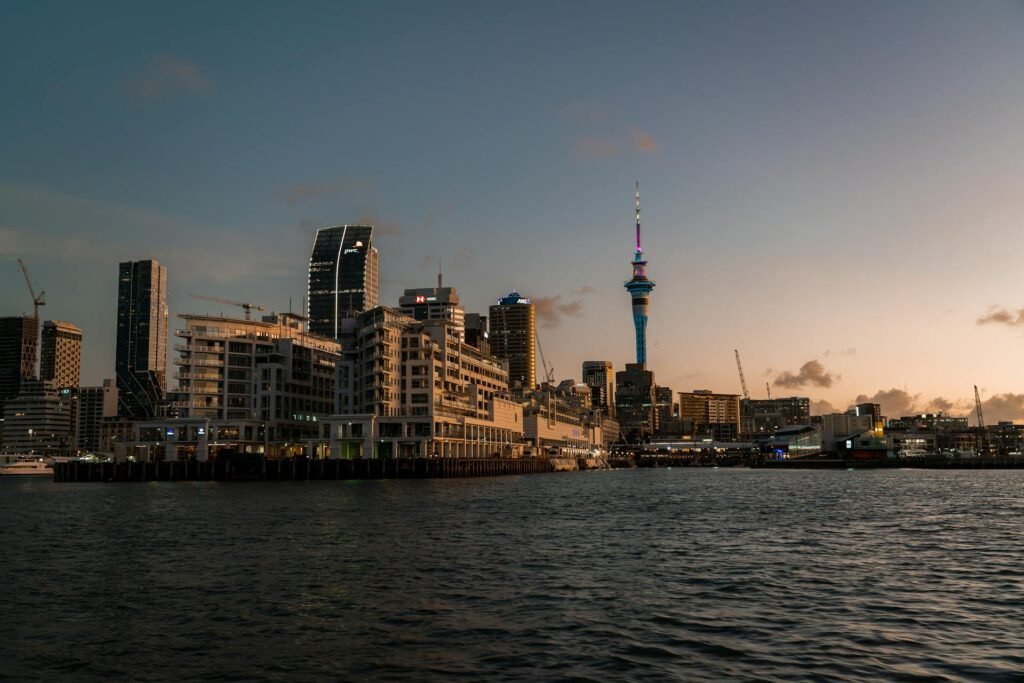
European contact began with British explorer James Cook‘s 1769 charting of the New Zealand coastline. Significant European settlement followed the 1840 Treaty of Waitangi — the foundational and still-contested treaty between the British Crown and 540 Māori chiefs that established British sovereignty while supposedly guaranteeing Māori land rights. Governor William Hobson chose the isthmus as the new colony’s capital, founding Auckland on September 18, 1840, naming it after his patron Lord Auckland.
Auckland served as the capital of New Zealand from 1840 to 1865, when the seat of government moved to Wellington for a more central national location. The city continued to grow as the colony’s largest commercial center. The post-1860 New Zealand Wars and the broader Crown-Māori land disputes deeply affected the Auckland region; the controversial 1863 Waikato War involved imperial forces moving south from Auckland.
The 20th century brought transformative immigration. Initial waves of Scottish, English, Irish, and Dalmatian Croatian settlers were joined post-WWII by significant Pacific Island immigration (particularly Samoan, Tongan, Cook Islands, Niue, and Fijian communities); the post-1980s relaxation of immigration restrictions brought substantial Chinese, Korean, Indian, and broader Asian immigration. Auckland is now one of the world’s most ethnically diverse cities — with the largest Polynesian population of any city globally and the highest non-European population share of any New Zealand city.
The 2010 amalgamation of seven previous councils into the unified Auckland Council created the “Super City” — one of the largest local government jurisdictions by population in Australasia. The 2010s rebuild of the Auckland CBD waterfront for the America’s Cup yacht races and the broader Wynyard Quarter redevelopment transformed the city center. Auckland hosted the 2021 America’s Cup successfully despite pandemic restrictions. The City Rail Link (a major underground rail tunnel project) is scheduled to open in 2026.
Geography, Climate & Best Time to Visit Auckland
Geographic Setting
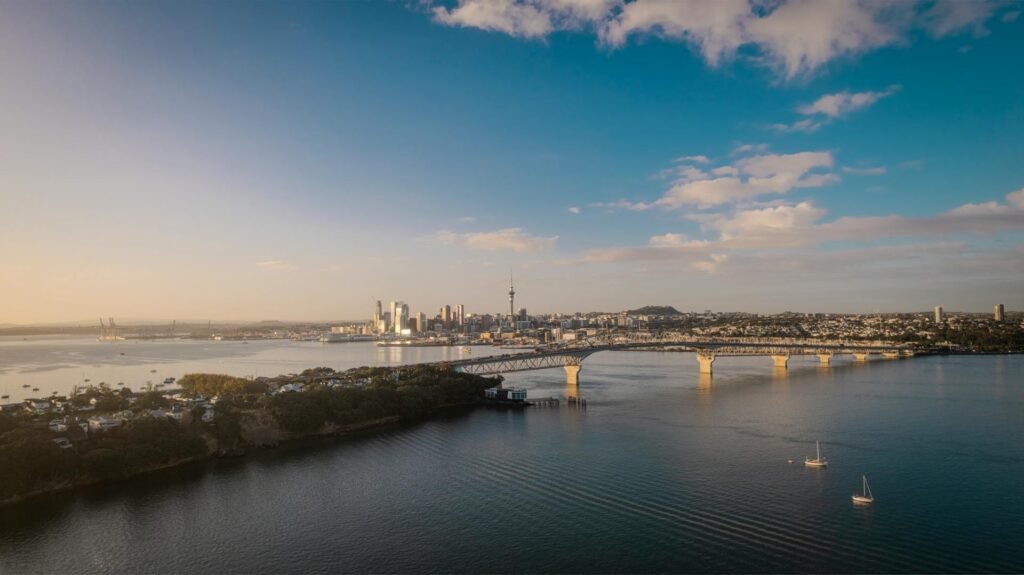
Auckland sits on a narrow isthmus between the Waitematā Harbour (eastern, the cruise/ferry harbor with the iconic Auckland Harbour Bridge) and the Manukau Harbour (western, working-class industrial). At its narrowest point, the isthmus is just 1.2 km wide — Māori in pre-contact times portaged canoes across the isthmus rather than rounding North Cape. The geography produces the city’s distinctive character: water visible from almost everywhere, with the Hauraki Gulf islands forming a constant horizon.
The city is built on the Auckland volcanic field — 53 volcanic cones formed over the past 200,000 years. Major cones visible in the city: Maungawhau / Mount Eden (196 m, the highest central cone), Maungakiekie / One Tree Hill (the iconic memorial-topped cone), Maungarei / Mount Wellington, Rangitoto Island (the youngest and largest, erupted just 600 years ago). The most recent eruption in the region was Rangitoto’s; the volcanic field remains officially active.
Auckland Council oversees 4,938 km² spanning 13 local board areas: the central CBD (Waitematā), the inner suburbs (Mount Eden, Ponsonby, Parnell), the North Shore (Devonport, Takapuna, Albany), the West (Henderson, Waitakere Ranges), the South (Manukau, Papakura, Pukekohe), and the surrounding rural-and-coastal districts.
Climate Overview
Auckland has an oceanic climate (Köppen Cfb) — mild and wet by global standards, with significant maritime moderation. Summer (December–February): warm (highs 22–26 °C, occasional 30 °C+ days), relatively dry, with reliable sunshine. Winter (June–August): mild (highs 14–17 °C, lows 7–10 °C), wet (the wettest stretch), with very rare frost and almost never snow on the coast. Spring and autumn are pleasant transitional seasons. Auckland weather is famously variable — the saying “four seasons in one day” applies, though less dramatically than for Melbourne.
Best Time to Visit
November to April is the prime window — pleasant temperatures, long daylight hours, and the full programming calendar including the America’s Cup heritage events, Auckland Pride (February), the Auckland Anniversary Day Regatta (late January, the world’s largest one-day yachting event), and the Pasifika Festival (March, the world’s largest Polynesian cultural festival). May–October winter: cool and wet but pleasant for cultural travelers; hotel prices significantly lower. February–March: peak — combine pleasant late-summer weather with the major festivals. December 25–January 5: the New Zealand summer holiday season; everything is open but Aucklanders flee to the beach; hotel prices spike. Outdoor activities: best November–April for sailing, hiking, and beach time; the surfing beaches west of Auckland (Piha, Karekare) have year-round surf but are coldest June–August.
Auckland’s Districts & Neighborhoods
Auckland CBD / Waitematā
The central business district along Queen Street and the waterfront. Sky Tower (328 m, the Southern Hemisphere’s tallest structure, with observation deck and SkyJump bungy/skywalk); Britomart (the post-2010s redeveloped historic warehouse district with restaurants and boutiques); the Auckland Ferry Terminal; Viaduct Harbour (the America’s Cup-era marina district); Wynyard Quarter (the newest waterfront redevelopment with the Maritime Museum); the historic Queen Street shopping district.
Ponsonby & Grey Lynn
The hip inner-western suburbs. Ponsonby Road: the country’s most concentrated boutique-shopping and restaurant strip; restored 19th-century wooden villas; the city’s most polished cosmopolitan dining; the working LGBTQ+ neighborhood. Grey Lynn: more residential, gentrified, with the Saturday Grey Lynn Park Farmers Market.
Mount Eden & Newmarket
Inner-southern suburbs. Maungawhau / Mount Eden (the 196-meter volcanic cone with a panoramic Auckland viewing platform from the summit); the Mount Eden Village shopping strip; the iconic Auckland War Memorial Museum and the Auckland Domain park nearby. Newmarket: upmarket shopping district with the Westfield Newmarket mall.
Parnell & Auckland Domain
Eastern inner-city — Auckland’s oldest neighborhood. Parnell Road with restored Victorian villas now housing boutiques, antique shops, and traditional Italian restaurants; the Auckland Domain (75-hectare park, the largest and oldest in the city, with the Auckland War Memorial Museum, Auckland Wintergardens, and the iconic cricket-and-rugby field).
Devonport & the North Shore
Across the harbor via a 12-minute ferry (or via the Auckland Harbour Bridge for cars). Devonport: charming Victorian seaside town with cafés, boutique guesthouses, and the volcanic Mount Victoria (the second-best Auckland panoramic viewing point). Takapuna: the working North Shore beach suburb. Albany: northern suburbs and Massey University.
Karangahape Road (K Road)
The eclectic inner-city street known as “K Road” — historically the LGBTQ+ and alternative culture district; now a mix of late-night clubs, vintage shops, vegan restaurants, and the Karangahape Market. The Newton Range Project of murals; the queer-cultural anchor of the city.
Waiheke Island
40 minutes by ferry from central Auckland — the wine-and-art island of the Hauraki Gulf. 30+ vineyards (Cable Bay, Mudbrick, Stonyridge, Te Motu, Goldwater); art galleries; swimming beaches at Onetangi and Palm Beach; the Headland Sculpture on the Gulf biennial event. The day-trip favorite of Auckland weekenders; consider overnight at a vineyard B&B.
West Auckland (Henderson & Waitakere Ranges)
The western suburbs and the Waitakere Ranges rainforest. Piha and Karekare: dramatic black-sand surf beaches; the Arataki Visitor Centre for the rainforest. The cinematic landscapes that featured in The Piano (filmed at Karekare) and Xena: Warrior Princess.
Top Things to Do in Auckland
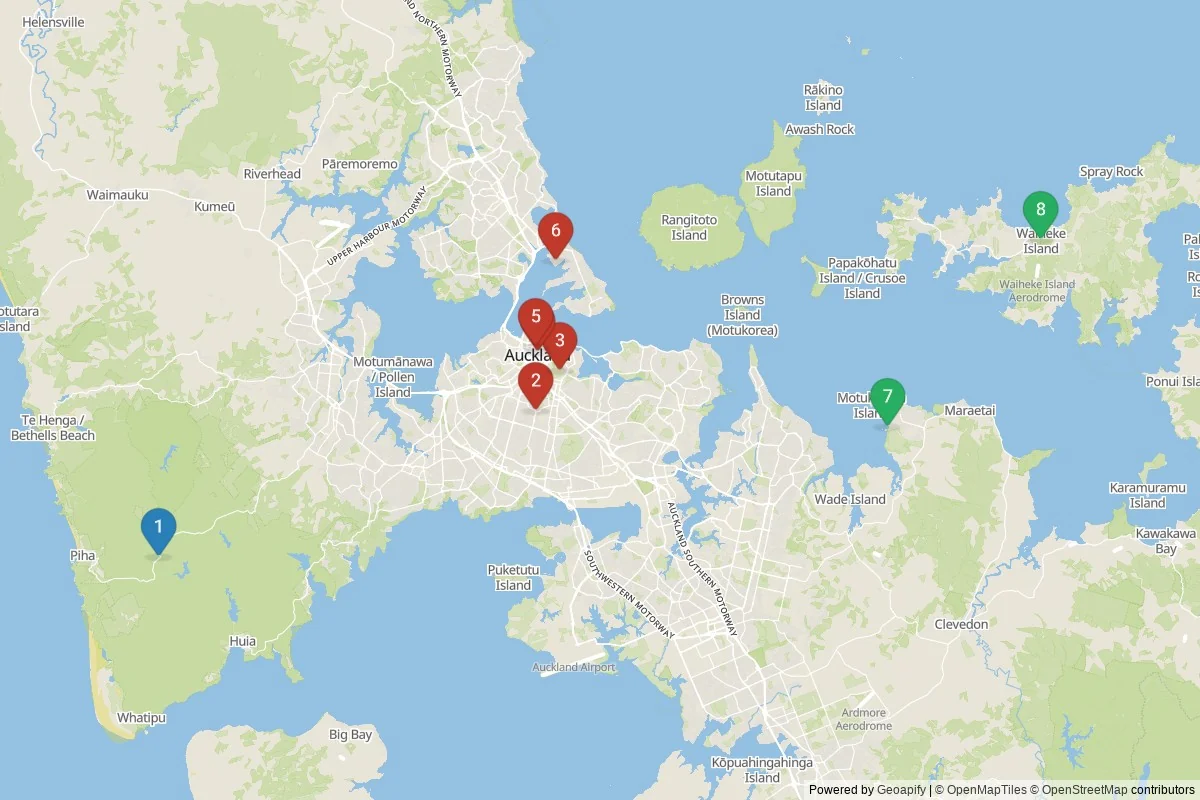
| # | Sight | Cluster | Type | Time | Entry | Best |
|---|---|---|---|---|---|---|
| 1 | Black-Sand Surf Beach Day at Piha or Karekare | Cluster A | Beach | 45 minutes | — | — |
| 2 | Mount Eden (Maungawhau) | Cluster B | Park | 15 min | Free | — |
| 3 | Auckland War Memorial Museum | Cluster B | Museum | — | — | — |
| 4 | Walk the Auckland Domain & Wintergardens | Cluster B | Museum | — | Free | — |
| 5 | the Sky Tower | Cluster B | Tower | — | — | — |
| 6 | Hauraki Gulf Wildlife Cruise | Cluster B | — | — | — | — |
| 7 | Devonport Day Trip via Harbour Ferry | Cluster C | Beach | — | — | — |
| 8 | Day Trip to Waiheke Island | Cluster C | Beach | — | — | — |
1. Visit the Sky Tower
The 328-meter Auckland Sky Tower — the Southern Hemisphere’s tallest structure. The main observation deck (186 m) provides 360° panoramic views; the upper SkyDeck (220 m) is for the more adventurous. Brave visitors can do the SkyJump (192-meter wire-controlled bungy descent, NZD 290) or the SkyWalk (1.2-meter-wide outdoor catwalk around the tower, NZD 190). General entry NZD 32 adult.
2. Day Trip to Waiheke Island
The 40-minute Fullers ferry from Auckland Ferry Building reaches the wine-and-art island. Hop-on-hop-off bus (NZD 70 including ferry, all-day) lets you visit multiple wineries and beaches. Top wineries: Mudbrick (the iconic ocean-view vineyard restaurant), Cable Bay (architecture-and-wine), Stonyridge (premium Bordeaux-style reds), Te Motu. Best beaches: Oneroa, Onetangi, Palm Beach. Plan a full day; overnight at a vineyard B&B is the better experience for wine fans.
3. Climb Mount Eden (Maungawhau)
The 196-meter volcanic cone in central Auckland — the city’s highest natural point. The summit walk (15 min from the parking area) reveals the deep grass-covered crater and offers 360° panoramic views of the city, harbors, and surrounding cones. Free; open dawn to dusk; respectful of the cultural sensitivity (the cone is a sacred Māori site).
4. Auckland War Memorial Museum
The country’s most significant museum, atop the Auckland Domain hill. Three floors covering: Pacific Islander cultures (the world’s most comprehensive collection); Māori cultural heritage (the iconic Hotunui meeting house and the 25-meter Te Toki-a-Tāpiri war canoe); natural history of New Zealand; and a War Memorial for fallen New Zealanders. Daily Māori cultural performances at 11:00, 12:00, 13:30; NZD 32 adult including performance.
5. Black-Sand Surf Beach Day at Piha or Karekare
The Waitakere Ranges 45 minutes west of Auckland host the country’s most dramatic black-sand surf beaches. Piha: the iconic beach with Lion Rock and the surf-club tradition; consistent waves; popular but spread out. Karekare: more remote, less crowded, the setting for The Piano (1993). Important safety note: these beaches have notorious rip currents; only swim between the flags during patrolled hours (Boxing Day to Easter, typically 10:00–18:00). Multiple drownings each year despite warnings.
6. Walk the Auckland Domain & Wintergardens
The 75-hectare central park surrounding the Auckland War Memorial Museum. The Domain contains: the museum; the Auckland Wintergardens (a 1916 Victorian glasshouse complex with cool and tropical houses); the iconic Cenotaph War Memorial; and a 5 km running track. Free entry. The annual Christmas in the Park concert (mid-December) draws over 200,000 attendees.
7. Devonport Day Trip via Harbour Ferry
12-minute ferry from Auckland CBD to Devonport — the charming Victorian seaside village on the North Shore. Cafés, antique shops, the volcanic Mount Victoria (with another panoramic Auckland viewpoint), North Head (with WWII coastal defense fortifications), and beach swimming at Cheltenham Beach. Plan a half-day. Ferry NZD 9 return.
8. Hauraki Gulf Wildlife Cruise
The Hauraki Gulf is one of the world’s most ecologically rich semi-enclosed marine areas — over 25 species of whales and dolphins, multiple seabird colonies. Day cruises from Auckland include whale-watching (Bryde’s whales year-round, with seasonal humpbacks), Tiritiri Matangi Island bird sanctuary day trips (one of the world’s most successful conservation islands with takahē, kiwi, and stitchbird re-introductions), and Rangitoto Island hikes (the 600-year-old volcanic cone). NZD 50–150 per person depending on tour.
How to Get to Auckland
By Air
Auckland Airport (AKL), 21 km south of central Auckland, is New Zealand’s primary international airport. Direct nonstop routes from Australia (Sydney, Melbourne, Brisbane), Asia (Singapore, Hong Kong, Tokyo, Seoul, Shanghai, Beijing, Manila, Mumbai), North America (Los Angeles, San Francisco, Vancouver, Houston), Europe (Doha, Dubai, Istanbul, London via Singapore), South America (Santiago via Auckland is the major Pacific hub). Carriers: Air New Zealand (the flag carrier), Qantas, Singapore Airlines, Cathay Pacific, Emirates, Qatar Airways, United, Delta, Air Tahiti Nui, Fiji Airways.
From the airport: SkyBus express NZD 18 one-way (45–60 min); Uber/Ola NZD 60–90; taxi NZD 75–95; SuperShuttle shared van NZD 35; rental car from major brands (Avis, Budget, Hertz, Europcar) NZD 60–120/day plus airport surcharge.
By Domestic Flight
New Zealand’s compact size makes domestic flights the practical default for inter-city travel. Auckland-Wellington: 1 hour, NZD 80–200. Auckland-Christchurch: 1h25min, NZD 100–250. Auckland-Queenstown: 1h45min, NZD 140–280. Major airlines: Air New Zealand, Jetstar New Zealand.
By Bus
InterCity coach network connects Auckland to all major North Island destinations: Wellington (12 hours), Rotorua (3.5 hours), Taupo (4.5 hours), Hamilton (1.5 hours). Slower than flying but a scenic option for budget travelers.
By Ferry from Auckland Harbour
Daily fast-ferry services to Waiheke Island (40 min), Devonport (12 min), Rangitoto Island, Great Barrier Island (4 hours).
Visa Notes
New Zealand requires entry authorization for nearly all foreign visitors. Citizens of 60+ visa-free countries (US, UK, Canada, Australia, all EU member states, Japan, South Korea, Singapore, Brunei, etc.) must obtain the NZeTA (New Zealand Electronic Travel Authority) before boarding via the official Immigration New Zealand portal — NZD 17 + IVL (International Visitor Conservation and Tourism Levy) NZD 100 = NZD 117 total; valid 2 years, multiple entries, up to 3 months per visit. Australian citizens enter without NZeTA. Other nationalities: apply for visitor visa via Immigration NZ portal (~NZD 250). Common mistakes: using unofficial third-party visa websites that overcharge 200–500%; not obtaining NZeTA before boarding (airlines deny boarding without it); bringing fresh fruit, meat, or biological materials (NZ has the world’s strictest biosecurity — declare or discard).
Getting Around Auckland
Buses (AT Metro)
The Auckland Transport bus network covers most major areas. AT HOP card rechargeable smart card (NZD 5 deposit + recharge) required for discounted fares; single bus fare NZD 2–4 with HOP card. The Link buses (Inner Link, City Link, Outer Link) are color-coded loops around central Auckland.
Trains (Auckland Heavy Rail)
Three lines (Western, Southern, Eastern) plus the new Onehunga Line connect outer suburbs to the central Britomart Station. The City Rail Link underground tunnel project opens 2026 with new Mt Eden, Karangahape, and Aotea stations transforming central transit access. Same AT HOP card.
Auckland Harbour Ferries
Daily commuter ferries from the historic Ferry Building serve Devonport, Bayswater, Birkenhead, Stanley Bay, Half Moon Bay, and Waiheke Island. Same AT HOP card discount.
Ride-Hailing
Uber, Ola, and Zoomy all operate. Standard taxis Co-op Taxis and Auckland Co-op available. Uber fares CBD-to-airport NZD 60–90.
Walking
Central Auckland is walkable — Queen Street and the waterfront are pedestrianized in parts. Hills make walking challenging for travelers with mobility issues; the central city has significant elevation change from the waterfront to the Sky Tower.
Self-Drive Cars
Practical for visitors planning North Island road trips. Rental from NZD 60–120/day plus insurance. Important driving notes: left-side driving (like UK and Australia); roundabouts give right-of-way to traffic from the right; speed cameras strictly enforced. International driving permit (IDP) required for non-English-language license holders. One-way road trip: Auckland to Wellington is 600 km / 8 hours; the most popular New Zealand “Pacific Coast Highway” North Island route.
Food & Drink in Auckland
Auckland’s cuisine combines British-colonial heritage, Pacific Islander traditions (the world’s largest Polynesian population), significant East Asian influence (post-1990 Chinese, Korean, Japanese, Vietnamese immigration), and the broader New Zealand-Australian “Modern Pacific Rim” fine-dining tradition.
What to Try
- Hāngī — traditional Māori earth-oven cooked meal: chicken, pork, lamb, kumara (sweet potato), and other vegetables steamed underground over hot stones; the country’s defining indigenous cooking method.
- Pavlova — meringue dessert topped with whipped cream and fresh fruit (kiwifruit, strawberries, passion fruit); contested between NZ and Australia for inventor status.
- Fish and chips — battered hoki or snapper fillets with chips; the universal Kiwi takeaway.
- Lamb roast — New Zealand lamb is widely considered the world’s best; Sunday family roast is the cultural standard.
- Whitebait fritters — small fish eggs in egg-and-flour batter; seasonal autumn specialty.
- Pies (mince, steak-and-cheese, butter chicken) — Aussie/Kiwi savory pies; the universal lunch staple.
- Hokey Pokey ice cream — vanilla ice cream with crunchy honeycomb-toffee pieces; the iconic Kiwi flavor.
- Manuka honey — the country’s premium honey, with claimed antibacterial properties.
- Sauvignon Blanc — particularly from Marlborough; New Zealand’s most globally celebrated wine variety.
- Flat white — espresso with steamed milk; a Kiwi-Australian invention now globally exported.
- Pacific Island cuisine: Samoan oka (raw fish in coconut), Tongan lupulu, Cook Islands rukau (taro leaves), Fijian palau (rice and coconut curry).
Where to Eat
Pasture (Parnell): the country’s only Two-Michelin-star restaurant (and the only NZ restaurant in the World’s 50 Best). Ahi (CBD): contemporary modern Pacific Rim. The Grove (CBD): traditional fine-dining. Cocoro: Japanese fine-dining. Cassia (Britomart): contemporary Indian; multiple “World’s 50 Best” appearances. Casita Miro (Waiheke Island): Spanish-influenced. Mudbrick (Waiheke): vineyard-restaurant. Depot (CBD): the canonical Auckland casual upscale. The French Café: classic Auckland fine-dining. Ponsonby Road: dozens of contemporary restaurants. Wynyard Quarter: waterfront dining. Karangahape Road: alternative and ethnic dining. Sweet Sister and Honey Bones: contemporary cafés.
Drinks
New Zealand wine: Marlborough Sauvignon Blanc (the country’s signature export), Central Otago Pinot Noir (the South Island masterpiece), Hawke’s Bay Chardonnay and red blends, Waiheke Island Bordeaux-style reds. Craft beer: the post-2010 NZ craft beer movement has been impressive — Garage Project, Behemoth, Yeastie Boys, Hallertau, 8 Wired. Coffee: New Zealand has world-class third-wave coffee culture; the flat white originated here (or Australia, depending on source); Allpress, Coffee Supreme, Atomic, Eight Thirty are canonical roasters. L&P (Lemon & Paeroa): the iconic NZ soft drink. Manuka honey-based drinks: contemporary local specialty.
A Note on Tap Water
Tap water in Auckland is completely safe to drink and excellent quality. The supply comes from the Hunua and Waitakere Ranges catchments, naturally filtered through native forest. No bottled water needed; ice universally safe; refillable bottles encouraged. The CDC traveler health page for New Zealand rates NZ as the lowest risk. Food safety: very high; sushi and raw fish at any reputable restaurant are safe; the NZ biosecurity system is among the world’s strictest, protecting from contaminated food entering the country.
Frequently Asked Questions About Visiting Auckland
Do I need a visa to visit Auckland?
Yes — virtually all foreign visitors need authorization for New Zealand. Citizens of 60+ visa-free countries (US, UK, Canada, Australia, all EU member states, Japan, South Korea, Singapore, Brunei, etc.) must obtain the NZeTA (New Zealand Electronic Travel Authority) before boarding via the official Immigration New Zealand portal. Cost: NZD 17 NZeTA fee + NZD 100 IVL (International Visitor Conservation and Tourism Levy) = NZD 117 total; valid 2 years, multiple entries, up to 3 months per visit. Australian citizens: no NZeTA needed. Other nationalities: apply for a Visitor Visa via the Immigration NZ portal (~NZD 250). Common mistakes: using unofficial third-party visa websites that overcharge 200–500%; not obtaining NZeTA before boarding (airlines deny boarding without it); bringing fresh fruit, plants, seeds, or wood items — New Zealand biosecurity is among the world’s strictest, with mandatory declarations and on-the-spot fines from NZD 400.
Is Auckland safe for tourists?
Auckland is among the world’s safer major cities. The US State Department rates New Zealand at “exercise normal precautions” — the most relaxed advisory. Real risks: extreme UV exposure — New Zealand has the world’s highest skin cancer rates due to thin ozone over the South Pacific; SPF 50+ sunscreen is essential year-round; the country’s UV index reaches 12+ in summer; rip currents at the west-coast surf beaches (Piha, Karekare) — only swim between flags during patrolled hours; volcanic and geological hazards — White Island erupted in 2019 killing 22 tourists; Mount Ruapehu and several others remain active; check the GeoNet alert status before active-volcano hiking; traffic accidents — left-side driving for visitors unfamiliar with the convention; rural roads are narrow and slow; petty theft from cars at popular trail-head parking lots (Mount Eden, Piha) — never leave valuables visible; “sleeping rough” homelessness in some central Auckland areas (a recent post-2020 trend); biosecurity — declare ALL food, plant, or biological materials on arrival; on-the-spot fines for non-declaration. Drug laws: cannabis is decriminalized for personal use but not legal; harder drugs carry standard Western penalties. LGBTQ+ travelers: New Zealand is among the world’s most LGBTQ+-friendly countries; same-sex marriage legal since 2013; Auckland has a thriving Pride community.
How many days do I need in Auckland?
Three to four days handles Auckland; combined with North Island day/overnight trips, 7+ days. A solid 4-day Auckland plan: Day 1 — Sky Tower observation + CBD walking + Britomart + Waitematā Harbour ferry to Devonport + dinner in Ponsonby. Day 2 — Mount Eden climb morning + Auckland War Memorial Museum + Auckland Domain + Wintergardens + Karangahape Road evening. Day 3 — Waiheke Island full day (Cable Bay or Mudbrick winery + lunch + Onetangi Beach + sunset ferry back). Day 4 — Piha or Karekare black-sand surf beach + Waitakere Ranges hike + dinner at Pasture or The Grove. Add Days 5–7 for Rotorua (geothermal + Māori cultural village, 3 hours south) + Taupo (lake + Tongariro Crossing) + Coromandel Peninsula (Cathedral Cove + Hot Water Beach). 10-day North Island: 4 days Auckland + 3 days Rotorua/Taupo + 3 days Wellington. 14-day NZ classic: 4 days Auckland + 2 days Rotorua + 2 days Wellington + 5 days South Island highlights (Christchurch, Queenstown, Milford Sound).
What’s the best area to stay in Auckland?
Central CBD / Waterfront — convenient for ferries, Britomart shopping, Sky Tower; SO Auckland, Hotel Britomart, Park Hyatt Auckland, QT Auckland; NZD 250–700/night. Ponsonby — hip inner-western neighborhood; boutique guesthouses and Airbnb; NZD 180–450/night; the choice for restaurant-focused stays. Parnell — Victorian heritage neighborhood; The Grand Hotel Parnell, City Lodge Parnell; NZD 150–350/night. Mount Eden / Newmarket — quieter residential; near the volcanic cone and Newmarket shopping; NZD 130–300/night. North Shore (Takapuna/Devonport) — beach-suburb atmosphere; commute to CBD via ferry; NZD 150–350/night; good for travelers wanting calm and beach access. Viaduct Harbour — waterfront luxury; Hilton Auckland, The Sebel Viaduct; NZD 300–700/night. Waiheke Island — for vineyard B&B stays; Mudbrick Vineyard, Te Whau Lodge; NZD 400–1,500/night. Skip: budget hotels south of the CBD on Symonds Street — generally lower-quality.
How much does it cost to visit Auckland’s major sights?
Auckland is moderately expensive by global standards. Sky Tower observation: NZD 32 adult; SkyJump: NZD 290; SkyWalk: NZD 190. Auckland War Memorial Museum: NZD 32 adult including Māori cultural performance. Auckland Wintergardens: free. Mount Eden volcanic cone: free. Auckland Domain: free. Devonport ferry round-trip: NZD 9. Waiheke Island ferry round-trip: NZD 50 (Fullers); winery hop-on-hop-off bus combo NZD 95. Waiheke wine-tasting flights: NZD 25–80 per winery. Hauraki Gulf whale-watching: NZD 165 per person. Tiritiri Matangi bird sanctuary day: NZD 89 ferry + NZD 20 entry. Local meals: fish-and-chips lunch NZD 15–25; café lunch NZD 18–35 per person; mid-range dinner NZD 35–80 per person; fine-dining NZD 90–300 per person; Waiheke vineyard lunch NZD 80–180 per person. Flat white: NZD 5–7. Bus single ride (AT HOP card): NZD 2–4. Uber CBD-to-airport: NZD 60–90. Rental car: NZD 60–120/day plus insurance. Overall daily budget: NZD 150 (frugal hostel + AT HOP + fish-and-chips), NZD 300 (mid-range hotel + restaurants + 1 paid activity), NZD 800+ (luxury hotel + fine dining + private touring).
Should I drink the tap water in Auckland?
Yes — Auckland’s tap water is completely safe to drink and excellent quality. The supply comes from the Hunua and Waitakere Ranges catchments — naturally filtered through native New Zealand forest, treated to high standards. No bottled water needed; refillable bottles are encouraged by city policy; many cafés and restaurants offer free filtered tap water on request. Ice is universally safe. The CDC traveler health page for New Zealand rates New Zealand as the lowest risk; standard hygiene precautions apply. The bigger health concerns: extreme UV exposure (SPF 50+ sunscreen essential year-round; the country has the world’s highest skin cancer rates); sandfly bites in the South Island; mosquito-borne disease risk is minimal in Auckland.
What payment methods work in Auckland — credit cards or cash?
Heavily card-and-contactless. Credit/debit cards (Visa, Mastercard, AmEx, Discover, JCB): accepted virtually everywhere — hotels, restaurants, cafés, taxis, supermarkets, museums, public transit. Contactless tap-to-pay universal. New Zealand dollars (NZD): useful for small purchases, tipping, market stalls; ATMs abundant (ANZ, BNZ, ASB, Westpac) with low fees for foreign cards. Mobile payment: Apple Pay, Google Pay, Samsung Pay all work universally. Tips: not customary in New Zealand — Kiwis genuinely do not tip routinely; restaurant service is included in the price; tipping for exceptional service is appreciated (5–10%) but not expected; round up taxi fares as the standard. Service charges: no general service charge in restaurants; 15% surcharge on public holidays at many restaurants (a uniquely Kiwi convention). GST: 15% Goods and Services Tax included in displayed prices; no tourist refund scheme (NZ does not offer GST refunds for non-residents like Australia or Europe). Eftpos card: New Zealand’s local debit network; foreign cards work but eftpos-specific machines occasionally don’t accept foreign chips — bank cards usually more compatible. IVL (International Visitor Levy): NZD 100, paid with NZeTA, supports tourism infrastructure and conservation.
What about volcanoes, earthquakes, and the broader New Zealand natural-hazard awareness?
New Zealand sits on the active Pacific Ring of Fire and has significant geological hazards worth understanding. Earthquakes: NZ has 14,000+ earthquakes per year; most too small to feel; significant earthquakes happen approximately every decade — the 2011 Christchurch earthquake (magnitude 6.3, 185 deaths) and the 2016 Kaikoura earthquake (7.8) are recent major events. Wellington and the South Island are higher-risk than Auckland. Download the NZ Civil Defence app for real-time warnings. Volcanoes: Auckland is built on the active Auckland Volcanic Field (the most recent eruption was Rangitoto Island 600 years ago); broader North Island volcanic activity includes Mount Ruapehu, Mount Tongariro, and Mount Taranaki — all currently dormant but considered active. The 2019 White Island (Whakaari) eruption killed 22 tourists during a sightseeing visit and led to the indefinite closure of active-volcano sightseeing; current advisories prohibit ascending Mt Tongariro and Ngauruhoe during volcanic alerts. Check the GeoNet alert system before mountain hiking. Tsunamis: NZ’s exposure is significant; Pacific-wide tsunamis from distant earthquakes (Chile, Japan, Alaska) can reach NZ coasts; tsunami warnings are issued via the Civil Defence app. Bushfires: lower than Australia but real risk in summer; fire bans declared frequently January-March; never light fires in restricted-zone bush. Weather hazards: rapid changes in mountainous areas; the Tongariro Crossing has had multiple fatalities of unprepared hikers caught in sudden weather. UV: as mentioned, NZ has the highest skin cancer rates globally; the Antarctic ozone hole is closest in October-November; SPF 50+ sunscreen, wide-brim hats, UPF clothing are essential year-round, especially November-March. Animal hazards: no snakes, no large predators, no scorpions. The single hazardous spider (white-tailed) has a painful bite but not life-threatening. NZ is unusually safe for wildlife.
Education & Notable People
Auckland is New Zealand’s largest education center, anchored by the University of Auckland.
Major Universities
- University of Auckland — founded 1883; the country’s largest and highest-ranked university; ~46,000 students; particularly strong in medicine, law, business, and Pacific Islander studies.
- Auckland University of Technology (AUT) — the country’s third-largest university; strong applied programs.
- Massey University (Auckland Campus) — the country’s largest university by enrollment overall.
- Unitec Institute of Technology — vocational and applied education.
Notable People
Sir Edmund Hillary (1919–2008) — co-conquered Mount Everest with Tenzing Norgay in 1953; New Zealand’s most celebrated national figure; commemorated on the NZ five-dollar note. Kate Sheppard (1847–1934) — leader of the New Zealand women’s suffrage movement; NZ became the first country to grant women the vote in 1893; commemorated on the NZ ten-dollar note. Sir Peter Jackson — Academy Award-winning film director (Lord of the Rings, Hobbit, King Kong); his Wingnut Films company is Auckland-based. Russell Crowe — Academy Award-winning actor, born in Wellington but Auckland-raised. Lorde — singer-songwriter (Ella Yelich-O’Connor), Auckland-born and -based. Sam Neill — actor (Jurassic Park), Northern Ireland-born but New Zealand-raised. Taika Waititi — Academy Award-winning film director (Jojo Rabbit, Thor: Ragnarok), Wellington-Auckland-based. Helen Clark — Prime Minister 1999–2008, longtime Auckland resident. Jacinda Ardern — Prime Minister 2017–2023, Auckland-area native. Christopher Luxon — current Prime Minister (since 2023).
Sister Cities & International Relations
Auckland’s sister-city network reflects the city’s Pacific-Rim cultural and trading position.
Auckland’s sister and partnership cities include (selection):
- Fukuoka, Japan — paired since 1986; the most active Asian partnership.
- Brisbane, Australia — Australia-NZ Tasman partnership.
- Guangzhou, China — paired since 1989.
- Galway, Ireland — Celtic-cultural partnership.
- Pusan / Busan, South Korea — port-city friendship.
- Los Angeles, California, USA — Pacific Rim partnership.
- Honolulu, Hawaii, USA — Polynesian-cultural connection.
- Apia, Samoa — Pacific Islander partnership reflecting the substantial Samoan-Auckland community.
- Nuku’alofa, Tonga — Tongan-Auckland community connection.
Auckland hosts the headquarters of multiple Pacific Islander regional cooperation institutions — including the Forum Fisheries Agency and various inter-island organizations. The 2021 America’s Cup brought significant international visibility; the 2026 City Rail Link opening is the largest infrastructure project in New Zealand history. The Auckland NZ official tourism portal coordinates international promotion.
AFRIKA
Cairo Hurghada Johannesburg Marrakech
ASIA
Abu Dhabi Agra Antalya Bangkok Batam Beijing Bengaluru Cebu City Chiang Mai Chiba Chennai Da Nang Dammam Delhi Denpasar Dubai Fukuoka Guangzhou Guilin Ha Long Hanoi Ho Chi Minh City Jakarta Jaipur Johor Bahru Kolkata Krabi Kuala Lumpur Kyoto Macau Mecca Medina Mugla Mumbai Osaka Pattaya Penang Phuket Riyadh Seoul Shanghai Shenzhen Singapore Taipei Tokyo Zhuhai
EUROPE
Amsterdam Athens Barcelona Berlin Brussels Budapest Copenhagen Dublin Florence Frankfurt am Main Heraklion Krakow Lisbon London Madrid Milan Munich Nice Paris Porto Prague Rhodes Rome Stockholm Venice Vienna Warsaw
NORTH AMERICA
Cancun Las Vegas Los Angeles Miami New York City Orlando San Francisco Toronto Vancouver
SOUTH AMERICA
Buenos Aires Lima Rio De Janeiro
OCEANIA
Auckland Honolulu Melbourne Sydney