
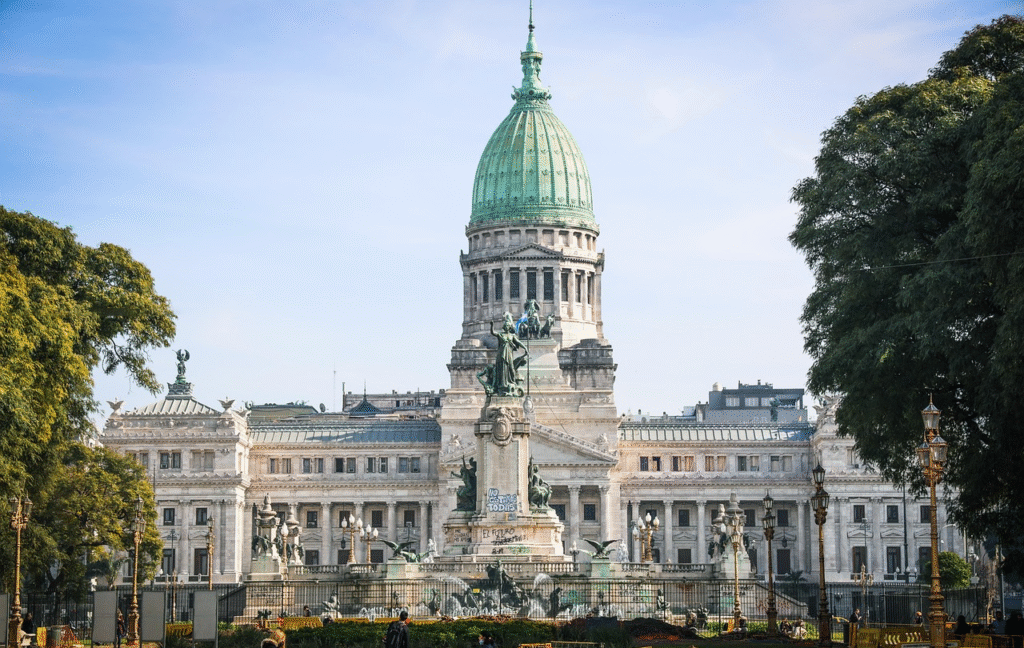
Photo credit: The Argentine National Congress, Buenos Aires
Buenos Aires is the capital of Argentina and one of South America’s most distinctive cultural capitals — often called the “Paris of South America” for its Beaux-Arts boulevards, French neoclassical architecture, and continental European sensibility shaped by the massive Italian-and-Spanish immigration of the late 19th and early 20th centuries. The city’s defining cultural exports — tango (music and dance, UNESCO Intangible Cultural Heritage 2009), Argentine asado (the country’s grilling tradition), Maradona-and-Messi football culture, the literary tradition of Jorge Luis Borges — all emerged from this distinctive Buenos Aires melting pot. The city’s neighborhoods (barrios) are deeply differentiated: the elegant Recoleta with its famous cemetery (where Eva Perón is buried); the trendy Palermo with the country’s best dining; the colorful working-class La Boca with the El Caminito street and Boca Juniors stadium; the historic San Telmo with the Sunday antiques market and tango clubs; the political center around the Plaza de Mayo with the Casa Rosada (Pink House — the presidential office). After several decades of dramatic economic turmoil (defaults, hyperinflation, currency controls), Buenos Aires has reinvented its tourism appeal — the favorable post-2023 exchange rates have made the city one of South America’s best-value major destinations for international visitors.
Buenos Aires by District: The 21 Comunas
Buenos Aires is divided into 21 communes. The map below shows their official OSM boundaries, colour-coded to match the table — a quick way to orient yourself before zooming in on individual sights.
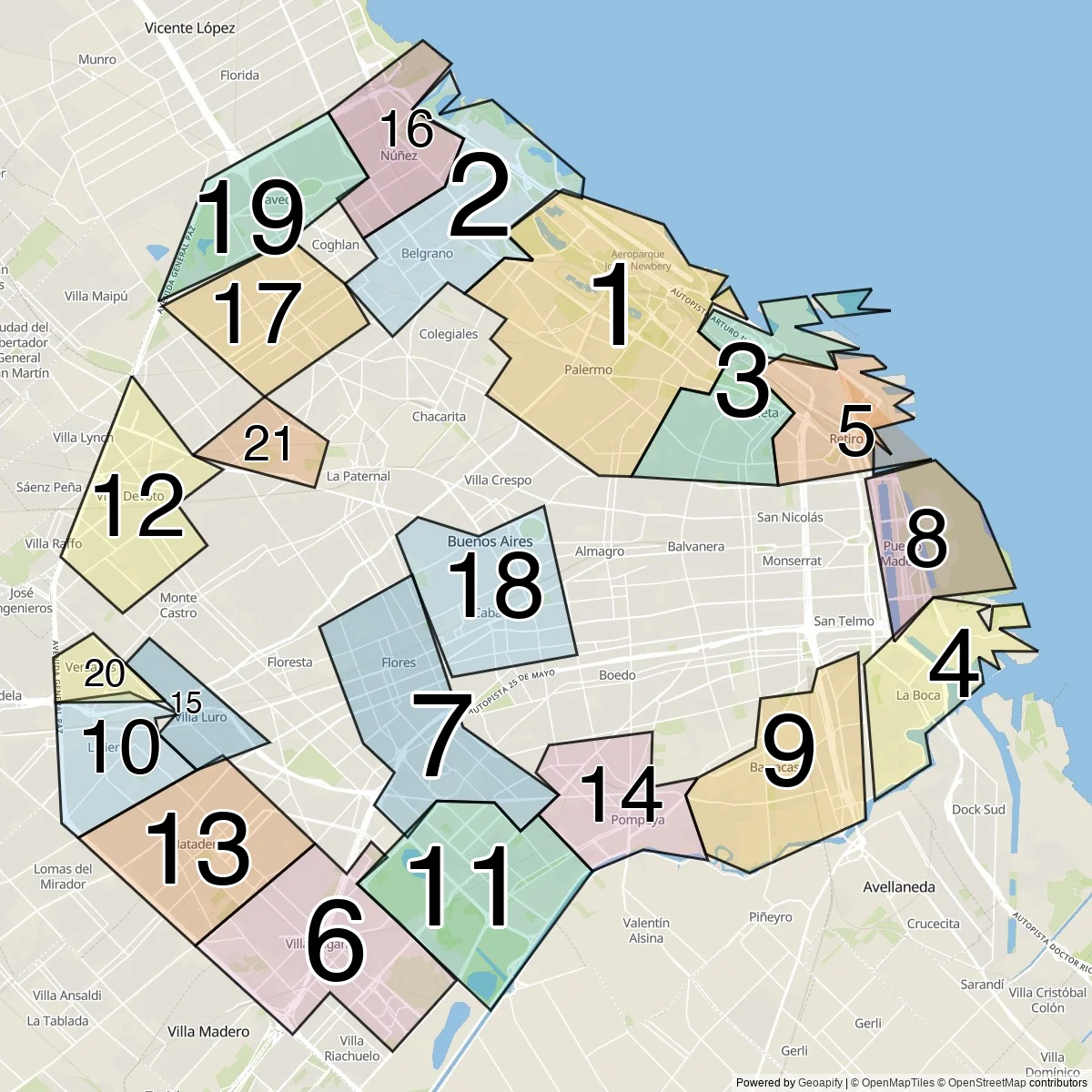
| # | Comunas |
|---|---|
| 1 | Palermo |
| 2 | Belgrano |
| 3 | Recoleta |
| 4 | La Boca |
| 5 | Retiro |
| 6 | Villa Lugano |
| 7 | Flores |
| 8 | Puerto Madero |
| 9 | Barracas |
| 10 | Liniers |
| 11 | Villa Soldati |
| 12 | Villa Devoto |
| 13 | Mataderos |
| 14 | Nueva Pompeya |
| 15 | Villa Luro |
| 16 | Núñez |
| 17 | Villa Urquiza |
| 18 | Caballito |
| 19 | Saavedra |
| 20 | Versalles |
| 21 | Agronomía |
Buenos Aires at a Glance: Essential Facts for Travelers
| Location | Eastern Argentina (Río de la Plata estuary) |
|---|---|
| Coordinates | 34.6037°S, 58.3816°W |
| Population | ~3.12 million (Autonomous City, 2024); metro area (Gran Buenos Aires) ~15.6 million |
| Area | 203 km² (City); 4,758 km² (metro) |
| Elevation | ~25 m above sea level |
| Time Zone | Argentina Time (ART, UTC−3 — no daylight saving) |
| Calling Code | +54 (city code 11) |
| Currency | Argentine peso (ARS $); USD widely accepted at favorable rates |
| Languages | Spanish (Rioplatense dialect with distinctive Italian-influenced intonation and the voseo — “vos” instead of “tú”); English widely spoken in tourism and business; significant Italian, Yiddish, and German immigrant heritage |
| Climate | Humid subtropical — hot humid summers, mild winters; opposite-hemisphere seasons (summer Dec–Feb, winter Jun–Aug) |
| Founded | 1536 (Pedro de Mendoza, failed); permanently 1580 (Juan de Garay) |
| Famous For | Tango (UNESCO Intangible Heritage 2009), Asado grilling, Recoleta Cemetery (Eva Perón), La Boca and El Caminito, Plaza de Mayo, Casa Rosada, gateway to Patagonia and Iguazu Falls, Italian-immigrant cuisine, Boca Juniors and River Plate football |
Upcoming Events in Buenos Aires
| Date | Title | Details |
|---|---|---|
| 2026-09-10 to 2026-09-20 | Principio de extasis – Ballet del Colon world premiere | The Ballet Estable of the Teatro Colon, directed by Julio Bocca, dances the world-premiere run of Principio de extasis, a contemporary work inspired by Jorge Luis Borges’s El Aleph. Spanish choreographer Goyo Montero created the piece with an original score by Oscar-winning composer Gustavo Santaolalla and a recorded narration by actor Ricardo Darin. Evening performances begin at 20:00 and the closing Sunday show on 20 September at 17:00. Ticket prices vary; seats are sold online and at the box office on Tucuman 1171. [Source] |
| 2026-09-18 to 2027-03-14 | Viva Frida at MALBA | MALBA opens its 25th-anniversary season with Viva Frida, an exhibition organised with the Museo Frida Kahlo in Mexico City and curated by Circe Henestrosa. Objects from the Casa Azul, including drawings, photographs, corsets, accessories and clothing, show how Frida Kahlo’s creative practice reached far beyond painting. The show occupies Room 3 on level 1 of the museum on Avenida Figueroa Alcorta and runs deep into 2027. Ticket prices vary; expect strong demand on weekends for one of the city’s most anticipated shows. [Source] |
| 2026-09-20 | Buenos Aires Marathon | The Buenos Aires Marathon is the city’s premier road race, sending thousands of runners on a flat, fast 42-kilometre loop past landmarks including the Obelisco, Puerto Madero, Palermo’s parks and the Casa Rosada. Staged in September, in the pleasant early-spring weather, it draws elite international fields chasing quick times alongside masses of amateurs, with a lively, supportive crowd throughout. Entry is by paid registration; spectating is free. Shorter associated races cater to less-experienced runners. It is one of South America’s biggest marathons. The exact 2026 date is confirmed by the organisers. [Source] |
| 2026-09-22 | Juan Diego Florez in Recital at Teatro Colon | Peruvian tenor Juan Diego Florez, one of the world’s leading bel canto voices, returns to Buenos Aires for a special recital evening at the Teatro Colon. The concert is part of the theatre’s 2026 season, which also features seven opera titles and the world premiere of the ballet Borges. Hearing a star of this rank in the Colon’s celebrated acoustics is a highlight for opera lovers; ticket prices vary widely by section, and the ornate 1908 hall itself is worth the visit alone. [Source] |
| 2026-10-01 | Casa FOA 2026 at Palacio Molina | Casa FOA, Argentina’s leading architecture and interior design exhibition, opens its 2026 edition in the Palacio Molina, a historic 1890 industrial building in Barracas once linked to the Alpargatas factory. Forty-two intervened spaces across more than 5,700 square metres show the work of architects, designers and landscapers, and the show traditionally kick-starts the restoration of the building it occupies. It runs through late October; ticket prices vary. A fixture for design lovers and anyone curious about the city’s industrial heritage. [Source] |
| 2026-10-31 | La Noche de los Museos | La Noche de los Museos is one of Buenos Aires’ most beloved annual events, when hundreds of museums, galleries and cultural spaces throw open their doors for free late into the night. Crowds move between exhibitions, live music and special activities across the city, with extended public transport helping visitors hop from one venue to the next. Typically held on a single night in late October or early November, it turns the whole city into an open, festive cultural circuit. It is completely free; the main challenge is choosing which of the many venues to visit. The exact date is confirmed by the city. [Source] |
City News in Buenos Aires – last 14 days
| Date | Category | Headline | Details |
|---|---|---|---|
| 2026-09-14 | Public safety | Apartment fire guts unit in 13-storey Recoleta building | An apartment in a 13-storey building at the corner of Avenida Callao and Quintana in Recoleta caught fire in the early morning. Firefighters brought the blaze, which is believed to have started in the living room of the affected unit, under control by around 7.30. Four people were treated at the scene by SAME ambulance crews and one person was taken to Hospital Rivadavia. Images published afterwards showed the burned-out apartment left, in the words of one report, completely destroyed. [Source] |
| 2026-09-14 | Local government | City labour courts make launch conditional on funding transfer | The city’s new labour justice system is making its start conditional on the transfer of the resources agreed with the national government. A transfer of around 60 billion pesos is expected, and a mechanism could be activated allowing judges and employees of the national labour courts to move across to the new porteno jurisdiction. The standoff is part of the broader, slow-moving handover of judicial competences from the nation to the autonomous city of Buenos Aires. [Source] |
| 2026-09-14 | Public transport | Giant electric ferry now links Buenos Aires and Colonia | One of the largest electric ships in the world now connects Buenos Aires with Colonia del Sacramento in Uruguay across the Rio de la Plata. The battery-powered vessel, which cost around 200 million US dollars, replaces conventional fuel on one of the region’s busiest ferry crossings and carries both passengers and vehicles. Its entry into service is being watched internationally as a test case for large-scale electric passenger shipping on a commercial route of this size. [Source] |
| 2026-09-14 | Public transport | Bus, subte and toll prices rise again in October | Fares for buses, the subte and toll roads in the Buenos Aires area will rise again in October under the indexation scheme that adjusts prices monthly in line with inflation. The increases continue the policy of letting ticket prices track the general price level rather than freezing them, which means commuters now see small rises almost every month. The subte and the city’s toll corridors are adjusted by the city government, while most bus lines fall under national jurisdiction. [Source] |
| 2026-09-14 | Sports | City officials visit Madrid Grand Prix as Formula 1 push continues | City officials travelled to the Formula 1 Grand Prix in Madrid as part of the continuing effort to bring the world championship back to Buenos Aires. The delegation studied how the Spanish capital stages its race while the city refines plans to upgrade its historic autodrome. Argentina last hosted a Formula 1 race in Buenos Aires in 1998, and a return would be a major coup, though securing a slot on the crowded calendar remains a long and expensive process. [Source] |
| 2026-09-14 | Business | Poverty estimated to have risen to 31-32 percent this year | Poverty is rising again in Argentina this year and is estimated at between 31 and 32 percent of the population, according to reporting by Clarin. Rising prices for essentials weigh most heavily on lower-income households, and the trend matters politically for a government that points to disinflation as its main achievement. For greater Buenos Aires, home to the country’s largest concentrations of both wealth and hardship, the figure frames the daily reality of millions of residents. [Source] |
| 2026-09-12 | Education | PISA results show eight in ten students lack basic math skills | Argentina’s latest PISA results have put education back in the spotlight: roughly eight in ten students lack basic mathematics skills, and the 2025 test scores show students also lagging in reading and science. Experts quoted by the Buenos Aires Herald point to structural problems in the school system rather than any single cause. The results have revived debate about learning loss, teacher training and school funding across the country, including in the capital’s own classrooms. [Source] |
Buenos Aires Events & City News Archive
Sources: Infobae, Teatro Colon, MALBA, Maraton de Buenos Aires, Teatro Colon, Arte por Excelencias, Ambito, Buenos Aires Ciudad
Weather Forecast for the Next 14 Days in Buenos Aires
| Date | Weather | Max °F | Min °F | Rain mm |
|---|---|---|---|---|
| 2026-09-14 | ☁️ | 55.9 °F | 42.7 °F | 0.0 mm |
| 2026-09-15 | ☁️ | 65.9 °F | 48.1 °F | 0.0 mm |
| 2026-09-16 | ☁️ | 54.4 °F | 46.1 °F | 0.0 mm |
| 2026-09-17 | ☁️ | 67.5 °F | 50.7 °F | 0.0 mm |
| 2026-09-18 | ☁️ | 67.2 °F | 54.1 °F | 0.0 mm |
| 2026-09-19 | ☁️ | 71.9 °F | 59.5 °F | 0.0 mm |
| 2026-09-20 | ⛈️ | 74.6 °F | 60.6 °F | 13.2 mm |
| 2026-09-21 | 🌧️ | 63.1 °F | 50.8 °F | 15.6 mm |
| 2026-09-22 | ⛅ | 52.2 °F | 44.1 °F | 0.0 mm |
| 2026-09-23 | ☁️ | 54.8 °F | 44.5 °F | 0.0 mm |
| 2026-09-24 | ☁️ | 62.3 °F | 48.1 °F | 0.0 mm |
| 2026-09-25 | ☁️ | 59.5 °F | 52.7 °F | 0.0 mm |
| 2026-09-26 | ☁️ | 66.0 °F | 52.7 °F | 0.0 mm |
| 2026-09-27 | 🌧️ | 66.0 °F | 60.1 °F | 8.4 mm |
Buenos Aires’s History
Buenos Aires was first founded in February 2, 1536 by Spanish conquistador Pedro de Mendoza, but the initial settlement was abandoned five years later after starvation, disease, and Querandí indigenous resistance overwhelmed the colony. The permanent foundation came on June 11, 1580 under Juan de Garay, who established a new town named after the patroness of sailors, Santa María del Buen Ayre (“Saint Mary of Fair Winds”), shortened to Buenos Aires.
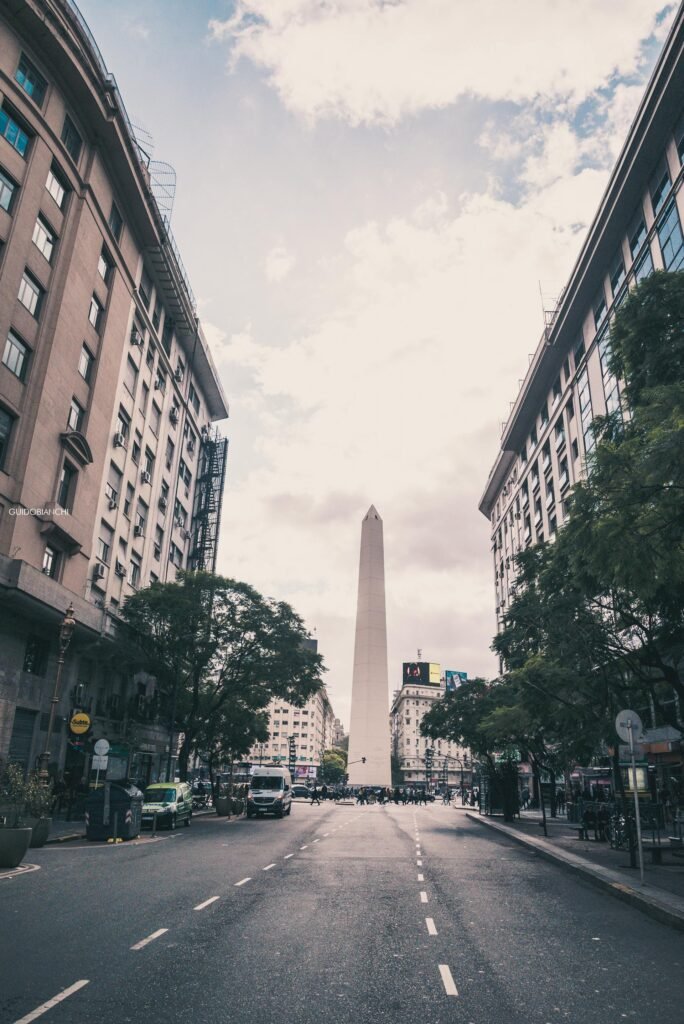
For nearly two centuries Buenos Aires remained a remote southern outpost of the Spanish American empire, overshadowed by Lima and Mexico City. The transformative moment came in 1776, when Spain elevated the city to the capital of the new Viceroyalty of the Río de la Plata covering modern Argentina, Uruguay, Paraguay, Bolivia, and parts of Brazil. The new administrative status and the loosening of Spanish trade monopolies fueled rapid commercial growth.
The May Revolution of 1810 in Buenos Aires began the Argentine War of Independence; Argentina declared independence in 1816. The 19th century brought decades of civil war between centralist (Buenos Aires) and federalist (provincial) factions; the dictatorship of Juan Manuel de Rosas (1835–1852); eventual constitutional consolidation under President Bartolomé Mitre (1862–1868) and the Argentine modernization program. The 1880 establishment of Buenos Aires as a federal capital district (separate from Buenos Aires Province) settled the political geography.
The late 19th and early 20th centuries (1880–1930) were Buenos Aires’s golden era. Massive European immigration — primarily Italian (over 50% of arrivals from 1880–1930) and Spanish (about 30%), with substantial smaller populations of Germans, Russians, Polish Jews, Welsh, French, Irish, Syrian-Lebanese, and Armenian — quintupled the city’s population in 40 years. Argentine wheat, beef, and wool exports made the country among the world’s wealthiest per-capita (ranking 7th globally in 1913). Beaux-Arts architecture from this period — the Teatro Colón opera house (1908), the Congreso Nacional (1906), the Edificio Kavanagh (1936) — defines the city’s distinctive Europeanized character. The defining cultural invention was tango, emerging from immigrant working-class neighborhoods around 1880 and reaching its first golden age by 1920.
The 20th century brought political instability and decline. The 1930 military coup ended democratic government; multiple successive coups and dictatorships punctuated the rest of the century. Juan Perón‘s populist rule (1946–1955, then again 1973–1974) — and the parallel cultural status of his wife Eva Perón “Evita” — remain central to Argentine political identity. The brutal 1976–1983 military dictatorship (“La Junta”) murdered or disappeared approximately 30,000 Argentines; the Mothers of Plaza de Mayo protests in central Buenos Aires drew global attention to the regime’s crimes. Democracy was restored in 1983.
The 1990s and 2000s brought repeated economic crises — the 1989 hyperinflation, the 2001 sovereign default (one of the largest in history), the post-2018 currency collapse. Yet Buenos Aires has retained its cultural energy throughout, and the post-2023 reform program under President Javier Milei has dramatically transformed the country’s monetary policy and ended the “blue dollar” (parallel exchange rate) era that had characterized travel since 2019.
Geography, Climate & Best Time to Visit Buenos Aires
Geographic Setting
Buenos Aires sits on the western (Argentine) shore of the Río de la Plata — the wide estuary formed by the Paraná and Uruguay rivers meeting the Atlantic. The river is so wide at Buenos Aires (~50 km across to Colonia in Uruguay) that it feels more like a sea than a river. The city is built on the flat pampas plain extending inland to the west; the metropolitan area sprawls across 4,758 km² of suburbs collectively known as Gran Buenos Aires or “Conurbano.”
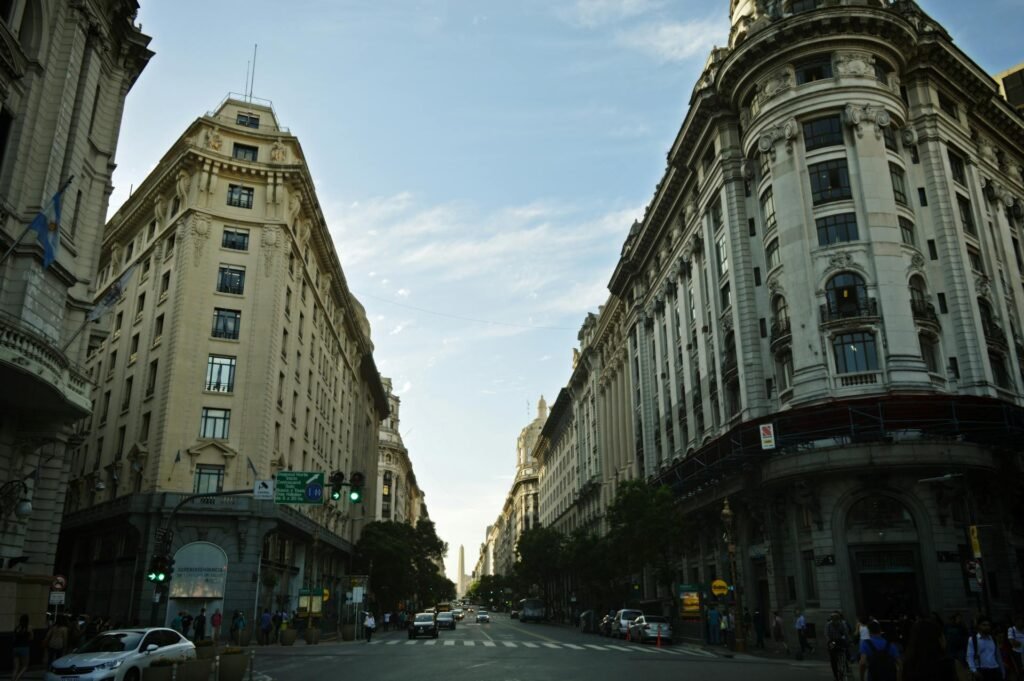
The city is divided into 48 official barrios (neighborhoods), each with distinct character. For travelers, the most-visited cluster is the downtown north-of-Avenida-Rivadavia core: Recoleta, Retiro, Palermo, San Telmo, Plaza de Mayo, Puerto Madero. The southern barrios (La Boca, Constitución) and the western/northern outer suburbs are less frequently visited.
Climate Overview
Buenos Aires has a humid subtropical climate (Köppen Cfa). Summer (December–February, opposite hemisphere): hot (highs 28–34 °C, occasional 38 °C+ heatwaves), humid; the city’s hottest stretch. Autumn (March–May): pleasant, comfortable temperatures, lower humidity. Winter (June–August): mild (highs 14–18 °C, lows 5–10 °C), occasionally damp; very rare snow. Spring (September–November): the prime tourism season — pleasant temperatures, the jacaranda blossom in November (one of the city’s signature visual moments).
Best Time to Visit
March to May and September to November are the unambiguous best windows — pleasant temperatures, lower humidity, the iconic Buenos Aires energy without summer overcrowding. December–February: summer high season; the city is hot, humid, and many locals flee to the beach (Punta del Este, Mar del Plata) during peak January. June–August: cool but rewarding for cultural travelers wanting fewer tourists; tango season (the country’s biggest tango festivals are in August). Festival timing: Buenos Aires Tango Festival (August); Buenos Aires Jazz Festival (November); Festival Internacional de Cine (April); Carnaval Porteño (February). Avoid: the December 30–January 5 holiday week (locals on vacation, many places closed).
Buenos Aires’s Districts & Neighborhoods
Recoleta
The elegant Belle-Époque residential neighborhood north of the city center. The defining feature is Recoleta Cemetery (Cementerio de la Recoleta) with the elaborate marble mausoleums of Argentina’s wealthiest families — and the tomb of Eva Perón (Evita, in the Duarte family vault). The adjacent Centro Cultural Recoleta, Museo Nacional de Bellas Artes, and the famous Floralis Genérica giant metal-flower sculpture in Plaza de las Naciones Unidas. Upscale shopping along Avenida Alvear. The most consistently safe central neighborhood.
Palermo
The largest and trendiest neighborhood, subdivided into Palermo Soho (the boutique-and-restaurant cluster), Palermo Hollywood (the media-and-design district), Palermo Chico (residential), and Las Cañitas (the upscale dining strip). The Buenos Aires version of Brooklyn or Soho: independent shops, third-wave coffee, the country’s most concentrated dining scene, vibrant nightlife. The Parque Tres de Febrero (city’s largest park) and the Rosedal rose garden anchor the western edge.
San Telmo
The historic working-class neighborhood south of Plaza de Mayo — cobblestone streets, late-19th-century architecture, the Sunday San Telmo antiques market (Feria de San Pedro Telmo), the historic Mercado de San Telmo covered market, and the city’s most concentrated tango house (milonga) scene. The neighborhood that invented Argentine tango. Streetcorner buskers and dancers; touristy but genuinely atmospheric.
La Boca
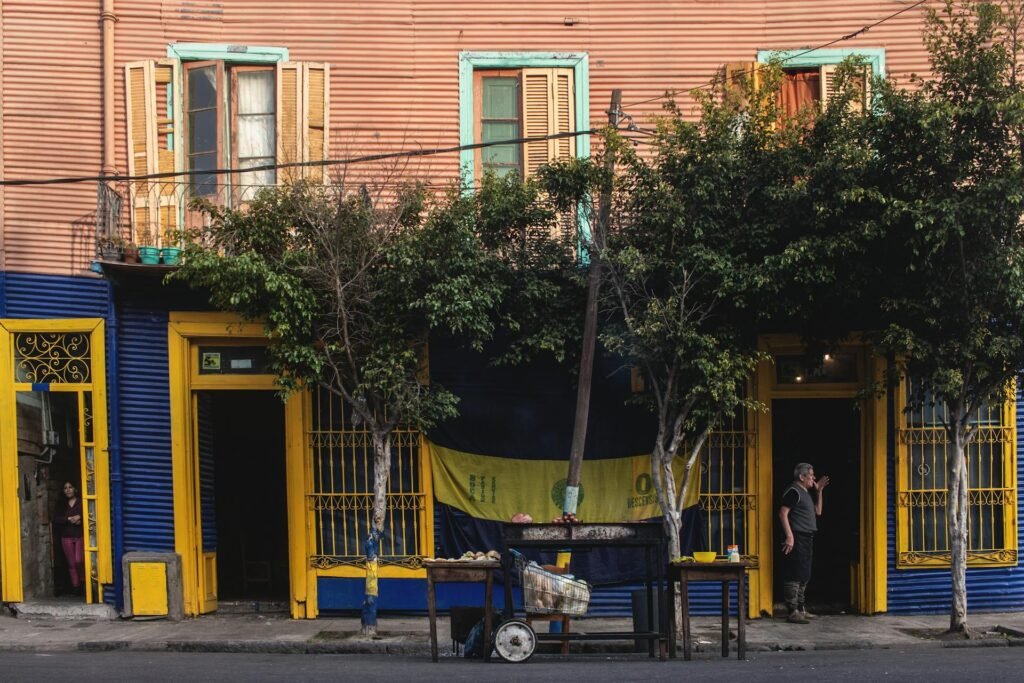
The southernmost working-class barrio along the Riachuelo river — the famous El Caminito pedestrian street with brightly colored corrugated-iron houses, painted by Argentine artist Quinquela Martín; La Bombonera stadium (Estadio Alberto J. Armando, home of Boca Juniors). Important safety note: La Boca is one of the city’s poorest neighborhoods; tourists should stay on El Caminito and the immediate tourist zones, avoid wandering side streets, and leave before nightfall.
Centro & Plaza de Mayo
The political and historic core. Plaza de Mayo contains the Casa Rosada (Pink House — the presidential office; the famous Eva Perón balcony from which she addressed the working-class “descamisados“), the Catedral Metropolitana (Pope Francis served here as archbishop 1998–2013), and the Cabildo (colonial-era town hall). The pedestrianized Calle Florida runs north to Plaza San Martín.
Puerto Madero
The redeveloped post-1990s docklands east of Plaza de Mayo — modern high-rise condos, upscale restaurants along the converted brick warehouses, the Puente de la Mujer Santiago Calatrava-designed pedestrian bridge, the Costanera Sur Ecological Reserve. The city’s newest residential luxury district.
Retiro & Recoleta Connection
The northern central district between Plaza San Martín and Recoleta. Retiro Bus Terminal for long-distance buses, the Tren a las Nubes station, the major hotels (Four Seasons Buenos Aires, Park Hyatt, Alvear Palace).
Belgrano & the Northern Suburbs
The wealthier residential neighborhoods further north — Belgrano, Vicente López, San Isidro, Olivos (the official presidential residence). Less touristy but reflect the city’s middle-class life. The Argentine-Chinese community (“Chinatown”) clusters in Belgrano.
Top Things to Do in Buenos Aires
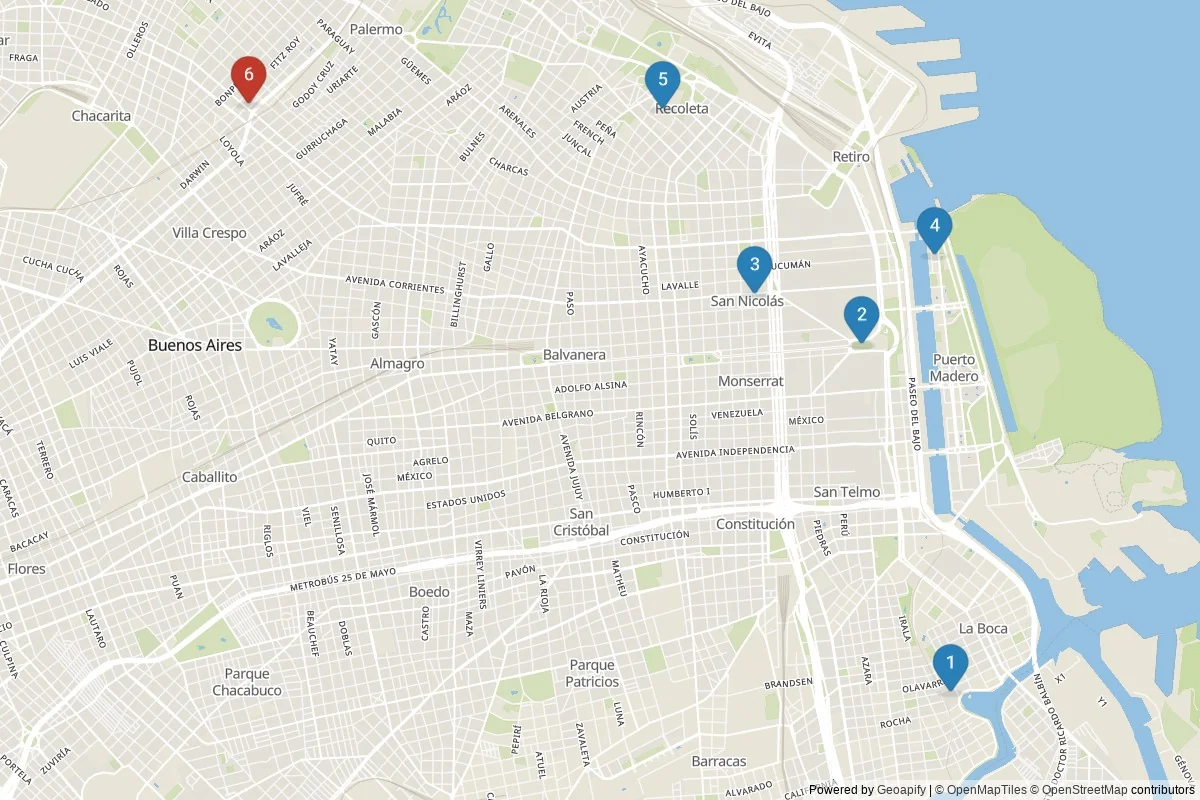
| # | Sight | Cluster | Type | Time | Entry | Best |
|---|---|---|---|---|---|---|
| 1 | Walk El Caminito & La Boca | Cluster A | Stadium | — | — | — |
| 2 | Plaza de Mayo & Casa Rosada | Cluster A | — | 90 minutes | Free | Afternoon |
| 3 | Watch (or Take) Tango | Cluster A | Market | — | free | — |
| 4 | Eat Asado at a Traditional Parrilla | Cluster A | — | — | — | — |
| 5 | Recoleta Cemetery & Tomb of Eva Perón | Cluster A | — | 2 hours | Free | — |
| 6 | Day Trip to Tigre & the Paraná Delta | Cluster B | Museum | — | — | — |
1. Watch (or Take) Tango
The defining Buenos Aires experience. Tango show options: tourist dinner-shows at venues like Café de los Angelitos, El Querandí, or Tango Porteño (USD 80–180 per person with dinner) — polished and photogenic. Authentic milongas (working tango dance halls) at Salón Canning, La Catedral, El Beso, or La Viruta; admission USD 5–15; visitors are welcome to watch or take an intro class beforehand. The traditional San Telmo street performances on Sundays at Plaza Dorrego during the antiques market are free and genuine.
2. Visit Recoleta Cemetery & Tomb of Eva Perón
The 19th-century Recoleta Cemetery contains the most elaborate funerary architecture in South America — 4,800 vaults of Argentina’s wealthiest families. The tomb of María Eva Duarte de Perón (“Evita,” 1919–1952) is the most-visited; located in the Duarte family vault on the main pathway. Free entry; allow 2 hours. Combine with the adjacent Centro Cultural Recoleta and the Floralis Genérica sculpture.
3. Walk El Caminito & La Boca
The 100-meter pedestrian street in La Boca lined with brightly colored corrugated-iron houses — originally painted by Quinquela Martín using leftover ship paint. Tango buskers, street artists, souvenir shops. Important safety note: stay on El Caminito and the immediate tourist zones; do NOT wander side streets; do NOT visit after dark; consider Uber rather than walking from the metro. Combine with La Bombonera stadium tour (Estadio Alberto J. Armando, home of Boca Juniors; USD 25 standard tour) if you’re a football fan.
4. Plaza de Mayo & Casa Rosada
The political heart of Argentina. Casa Rosada (the presidential office, painted the famous pink color — local legend says it was mixed from white and red to symbolize political unity); Cabildo (colonial-era town hall, the only surviving colonial Spanish building); Catedral Metropolitana where Pope Francis served as archbishop 1998–2013, with the tomb of independence hero José de San Martín; the Pirámide de Mayo obelisk commemorating independence. The famous Madres de Plaza de Mayo still march every Thursday afternoon. Free entry; allow 90 minutes.
5. Sunday at San Telmo Antiques Market
The largest weekly market in South America — every Sunday 10:00–17:00, the cobblestone streets around Plaza Dorrego and along Calle Defensa fill with antique dealers, vintage clothing, leather goods, tango buskers, and street performers. Stretching 1.5 km from the plaza north to Avenida Belgrano. The post-market Sunday tango in Plaza Dorrego from 18:00 is one of the city’s most beloved free cultural traditions.
6. Eat Asado at a Traditional Parrilla
The Argentine asado is the country’s defining culinary tradition — slow-grilled beef and offal over wood embers. Recommended parrillas: Don Julio (Palermo, multiple “World’s 50 Best” appearances), La Cabrera (Palermo, the famous side-dish “buckets”), El Pobre Luis (Belgrano, the legendary local choice), Las Cabras (Palermo Soho, mid-range), El Mirasol (Recoleta). Order: provoleta (grilled cheese); chorizo and morcilla (sausages); asado de tira (short ribs); bife de chorizo (sirloin); vacío (flank); paired with Malbec wine. Argentinian beef is genuinely exceptional; expect USD 25–60 per person at quality parrillas.
7. Visit Teatro Colón Opera House
The 1908 Beaux-Arts opera house — consistently ranked among the world’s top 5 acoustically. The interior tour (USD 12–20) showcases the marble grand staircase, golden auditorium, and chandelier; performance tickets USD 15–200 for opera, ballet, or symphony. The opera and ballet seasons run March–November; the December–February summer season has limited programming.
8. Day Trip to Tigre & the Paraná Delta
The Paraná River delta begins 30 km north of Buenos Aires — a labyrinth of channels, mangroves, and stilt houses accessible only by boat. The Tren de la Costa commuter train + Tigre port + boat tour combination makes a satisfying half-day excursion. River cruises (USD 25–80) range from 60-minute round trips to full-day excursions including lunch at riverside restaurants. The Tigre Town itself has the Mercado de Frutos craft market and the Naval Museum.
How to Get to Buenos Aires
By Air
Two major airports serve the city. Ministro Pistarini International Airport (EZE, Ezeiza), 22 km southwest of central Buenos Aires, handles most international flights. Aeroparque Jorge Newbery (AEP), just 5 km from central Buenos Aires on the riverfront, handles primarily domestic and some regional South American flights. Carriers: Aerolíneas Argentinas (the flag carrier), LATAM, American Airlines, United, Delta, Iberia, British Airways, Lufthansa, Air France, Turkish Airlines, Emirates, plus most major Latin American carriers.
From EZE Ezeiza: Tienda Leon airport bus ARS 18,000 (~USD 18) to central Buenos Aires (45–75 min); private airport taxi ARS 35,000–55,000 (~USD 35–55); Uber ARS 25,000–45,000; ride-hailing is the practical default. From AEP: short 15-minute taxi or Uber to central Buenos Aires.
By Long-Distance Bus
The Retiro Bus Terminal is South America’s largest, with services across Argentina, Uruguay, Chile, Brazil, Paraguay, and Bolivia. Cama-bed seat overnight services to Mendoza (14 hours, ARS 45,000), Bariloche (22 hours), Iguazu Falls (16 hours), Salta (18 hours). Buenos Aires to Montevideo (Uruguay): 30 minutes by Buquebus ferry across the Río de la Plata.
By Ferry (Buquebus & Colonia Express)
The Río de la Plata crossings to Colonia del Sacramento, Uruguay (the small UNESCO heritage town): 75-minute fast ferry, USD 35–60 each way. Montevideo: 2.5-hour ferry, USD 60–110 each way. Punta del Este: combined ferry-and-bus, 4 hours. Most travelers add at least a day trip to Colonia.
Visa Notes
Argentina offers visa-free entry for up to 90 days for citizens of most Western countries — including all EU member states, US, UK, Canada, Australia, New Zealand, Japan, South Korea, Singapore, Brazil, Mexico, Chile, and all other South American countries. Chinese, Indian, Russian passport holders need a visa applied for in advance. Important update: the 2009 “reciprocity fee” (USD 160 for US visitors) was eliminated in 2016; US passport holders enter freely. Passport must have 6+ months remaining validity. Verify current rules with the Argentine National Migration Directorate.
Getting Around Buenos Aires
Subte (Subway)
The 6-line Subte is South America’s oldest metro system (founded 1913). Lines A, B, C, D, E, H connect most major districts. SUBE card rechargeable transit card (ARS 1,500 deposit + recharge) required; single rides ARS 150–300 (~USD 0.15–0.30). The metro is efficient and inexpensive; English signage limited.
Buses (Colectivos)
Extensive but Spanish-language-dominated colectivo network. SUBE card works on buses; same low fares; Google Maps shows real-time bus directions.
Uber, Cabify & Taxis
Uber and Cabify operate but are subject to ongoing legal-political disputes with Buenos Aires taxis; service is reliable in practice. Yellow-and-black radio taxis are abundant and use meters; insist on the meter or use Uber. Standard taxi fares: ARS 1,500 flagfall + ARS 100/km.
Walking
Buenos Aires’s compact central neighborhoods (Recoleta, San Telmo, Plaza de Mayo, Puerto Madero) are genuinely walkable. The wider Palermo Soho and Recoleta walking circuits are particularly atmospheric. Safety note: stay alert in crowded areas for pickpockets; avoid empty streets after dark in any neighborhood including the historic core.
Ecobici Bike-Share
The municipal Ecobici bike-share system has stations across central Buenos Aires; free for the first 30 minutes; useful for exploring Palermo’s wide tree-lined avenues. The dedicated bike paths along Avenida 9 de Julio and Avenida del Libertador are scenic.
Food & Drink in Buenos Aires
Argentine cuisine combines Spanish colonial heritage, massive Italian immigrant influence (the largest external influence on the country’s cuisine — pasta, pizza, gelato), the country’s exceptional beef culture, and the increasingly sophisticated Buenos Aires fine-dining scene (multiple appearances on “World’s 50 Best Restaurants” lists in the 2020s).
What to Try
- Asado — the national grilling tradition; multiple cuts (bife de chorizo, vacío, asado de tira, entraña, mollejas/sweetbreads) cooked over wood embers; the iconic Sunday family meal.
- Empanadas — baked or fried turnovers filled with beef, chicken, ham-and-cheese, or vegetables; regional variations from Salta (lemony) to Tucumán (tradition) to Mendoza (sweet). Universal Argentine snack.
- Milanesa — Italian-immigrant breaded fried cutlet; eaten as milanesa con papas fritas or as milanesa napolitana (with cheese, tomato, ham on top) or in sandwiches.
- Pizza al horno de barro — Buenos Aires pizza is distinctly Italian-Argentine: thick wheat-flour crust, generous cheese, no tomato sauce sometimes; fugazzeta (cheese-stuffed double-crust topped with onions) is the Buenos Aires specialty. El Cuartito, Güerrín, Las Cuartetas are canonical Italian-Argentine pizzerias.
- Choripán — chorizo sausage on grilled bread; the Argentine street-food classic.
- Dulce de leche — milk caramel; the national obsession; in alfajores, ice cream, churros, on toast, in cakes.
- Alfajores — sandwich cookies filled with dulce de leche, often coated in chocolate or coconut.
- Helado — Italian-influenced Argentine ice cream; particularly the tres tres dulce de leche and chocolate-amargo (dark chocolate) flavors. Cadore, Rapanui, Volta, Freddo are canonical.
- Provoleta — grilled provolone cheese; the classic Argentine starter.
- Mate — the country’s traditional caffeine-rich infused herb tea; shared from a communal gourd with a metal straw (bombilla); the social ritual.
- Malbec wine — Argentine wine, primarily from Mendoza; the country’s defining grape.
Where to Eat
Don Julio (Palermo, three-time World’s 50 Best appearance): canonical parrilla. La Cabrera (Palermo): asado with elaborate side dishes. El Pobre Luis (Belgrano): legendary local parrilla. Tegui (Palermo): Michelin-starred contemporary Argentine. Aramburu (Recoleta): contemporary tasting menu. Trevora (Palermo): Spanish-Argentine fine-dining. Mishiguene: contemporary Jewish-Argentine. Naturaleza Sabia: vegetarian fine-dining. Las Pizarras Bistro: French-Argentine. El Cuartito (Recoleta): historic Italian-Argentine pizza. Pizzería Güerrín (Centro): the iconic Buenos Aires pizza institution since 1932. Café Tortoni: historic café in the Centro since 1858. Cadore, Rapanui: helado.
Drinks
Malbec: Argentine red wine, primarily from Mendoza; brands like Catena Zapata, Achaval-Ferrer, Pulenta Estate are internationally recognized. Torrontés: the country’s signature white grape, primarily from Salta. Fernet con cola: bitter herbal liqueur with cola; the Buenos Aires student-and-bar standard. Mate: the social tea ritual. Coffee: traditional Italian-influenced espresso culture; modern third-wave coffee scene has grown rapidly post-2018. Craft beer: the post-2015 craft beer movement has produced excellent local brewers (Antares, Strange Brewing, Cervecería Patagonia).
A Note on Tap Water
Tap water in Buenos Aires is generally safe to drink — the municipal water utility AySA treats the supply to international standards. However, water mineral content and taste vary; many residents and most foreign visitors prefer bottled water as a default. Bottled water: widely available, ARS 2,000–5,000 per liter (~USD 2–5); major brands Villa del Sur, Eco de los Andes, Glaciar. Ice in mid-range and upmarket restaurants is generally safe. The CDC traveler health page for Argentina rates Argentina as moderate-risk; standard precautions apply. Beef and asado safety: Argentine beef is excellent; raw or rare beef from reputable parrillas is widely consumed and safe.
Frequently Asked Questions About Visiting Buenos Aires
Do I need a visa to visit Buenos Aires?
For most foreign passport holders, no — Argentina offers visa-free entry for up to 90 days for citizens of most Western and many Asian countries: all EU member states, US, UK, Canada, Australia, New Zealand, Japan, South Korea, Singapore, Brazil, Mexico, Chile, and most other South American countries. Chinese, Indian, Russian passport holders need a visa applied for in advance via Argentine consulates. Important update: the controversial 2009 “reciprocity fee” (USD 160 for US visitors) was eliminated in 2016 — US travelers enter freely. Passport must have 6+ months remaining validity. The 2024 Argentina policy changes: visa rules and entry fees have shifted multiple times under different administrations; verify current rules with the Argentine National Migration Directorate 2–4 weeks before travel. Common mistakes: using unofficial third-party visa websites; assuming the reciprocity fee still applies (it does not for US/Canadian/Australian visitors as of 2016).
Is Buenos Aires safe for tourists?
Buenos Aires has moderate safety concerns by international standards — somewhat more crime risk than European capitals but less than many Latin American capitals. The US State Department rates Argentina at “exercise normal precautions” — the most relaxed advisory level. Real risks: pickpocketing and bag-snatching at tourist areas (Plaza de Mayo, El Caminito, San Telmo Sunday market, Subte system); “motochorros” — motorbike-riding thieves snatching bags from pedestrians; airport-area “express kidnappings” (taking ATM card and demanding withdrawal) — rare but documented; use registered remises or pre-arranged hotel transport; currency-exchange scams with counterfeit pesos; fake police “checking IDs”; football match violence (avoid the most violent Boca-River derbies as a tourist); traffic accidents — Argentine drivers are aggressive; La Boca after dark — stay on El Caminito tourist zone only; protests and political demonstrations can disrupt central streets unpredictably. Drug enforcement: standard Latin American penalties for trafficking; personal-use possession in private decriminalized in most provinces. Female travelers: standard urban precautions; Argentine men are notorious for verbal harassment (catcalling/”piropos”) but physical danger is rare. LGBTQ+ travelers: Argentina has been broadly progressive — same-sex marriage legal since 2010; Buenos Aires has an active gay community in Palermo and San Telmo.
How many days do I need in Buenos Aires?
Four to five days handles Buenos Aires well; combined with side trips (Colonia Uruguay, Tigre, Mendoza), 7–10 days makes a satisfying Argentine trip. A solid 5-day Buenos Aires plan: Day 1 — arrive, Plaza de Mayo + Casa Rosada + Cabildo + Catedral + lunch in Centro + Florida pedestrianized street + Teatro Colón tour. Day 2 — Recoleta morning (Cemetery + Eva Perón tomb + Centro Cultural Recoleta + Museo Nacional de Bellas Artes) + lunch in Recoleta + Palermo afternoon (Bosques de Palermo + Rosedal rose garden) + dinner in Palermo Soho. Day 3 — San Telmo Sunday antiques market (or Saturday alternative) + Plaza Dorrego tango + lunch at Mercado de San Telmo + La Boca afternoon (El Caminito + La Bombonera stadium tour) + asado dinner at Don Julio. Day 4 — Tigre and Paraná Delta full day trip (train + boat tour + Tigre town). Day 5 — Puerto Madero + Reserva Ecológica + Palermo Hollywood evening tango milonga. Add Day 6 for Colonia del Sacramento (Uruguay) day trip (75-min ferry from Puerto Madero). Add Days 7–8 for Iguazu Falls overnight or Mendoza wine country overnight. 14-day Argentina classic: 5 days Buenos Aires + 3 days Mendoza + 2 days Bariloche + 3 days Iguazu + 1 day Colonia.
What’s the best area to stay in Buenos Aires?
For first-time visitors, the central upscale neighborhoods. Recoleta: elegant residential, most consistently safe central neighborhood; Alvear Palace (the country’s iconic luxury hotel), Park Hyatt Buenos Aires, Four Seasons Hotel Buenos Aires; USD 200–800/night for luxury; mid-range Hotel Pulitzer Buenos Aires, Loi Suites; USD 80–200/night. Palermo: trendier neighborhood; Faena Hotel (Argentina’s iconic Philippe Starck-designed luxury in Puerto Madero), Mansion Vitraux, BoBo Hotel; USD 100–500/night; the choice for younger travelers wanting nightlife and dining access. Puerto Madero: modern luxury along the river; Faena Hotel, Hilton, Madero; USD 200–600/night; ideal for business travelers and Puerto-Madero-restaurant focus. San Telmo: bohemian historic neighborhood with tango focus; boutique guesthouses; USD 50–150/night. Microcentro (downtown): convenient transit access but characterless; mid-range chain hotels; USD 60–150/night. Skip: La Boca, Constitución for accommodation; security concerns make them poor bases. Note on prices: Argentine hotel prices have varied dramatically with the country’s monetary instability; recent reforms have stabilized USD-denominated rates closer to international norms.
How much does it cost to visit Buenos Aires’s major sights?
Buenos Aires is currently one of South America’s better-value major destinations after 2024 monetary reforms stabilized exchange rates. Recoleta Cemetery: free. Casa Rosada exterior: free; museum tours free with reservation. Plaza de Mayo: free. Teatro Colón guided tour: USD 15–25. Teatro Colón performance tickets: USD 15–200 depending on production and seat. Museo Nacional de Bellas Artes: free. MALBA (Museo de Arte Latinoamericano): USD 8. El Caminito and La Boca: free; La Bombonera stadium tour USD 25. Tigre day trip: train USD 2 + boat tour USD 25–80. Colonia del Sacramento ferry: USD 35–70 each way. Tango shows: tourist dinner-shows USD 80–180; authentic milongas USD 5–15. Local meals: empanada USD 1.50–3 each; sit-down lunch USD 8–25; asado at top parrilla USD 25–60 per person; mid-range dinner USD 20–50 per person; Don Julio or La Cabrera USD 35–80 per person; fine-dining USD 60–200 per person. Coffee: USD 2–5 per cup. Wine: Malbec mid-range USD 8–20 per bottle in restaurants; premium USD 25–100. Uber across the city: USD 4–10. Subte fare: USD 0.20–0.30. Overall daily budget: USD 60 (frugal hostel + empanadas + walking), USD 150 (mid-range hotel + restaurants + 1 paid activity), USD 400+ (luxury hotel + fine-dining + private guide).
Should I drink the tap water in Buenos Aires?
Tap water in Buenos Aires is generally safe to drink — meets municipal standards. However, the mineral content and chlorination taste vary across districts, and most foreign visitors and many locals prefer bottled water as a default. Bottled water: widely available, ARS 2,000–5,000 per liter (~USD 2–5); major brands Villa del Sur, Eco de los Andes, Glaciar. Practical default: use bottled water for drinking; tap water is fine for brushing teeth. Ice in mid-range and upmarket restaurants is generally safe. The CDC traveler health page for Argentina rates Argentina as moderate-risk; standard hygiene precautions apply. Argentine beef and food safety: parrilla restaurants are universally safe; the country’s beef quality is exceptional; raw or rare beef from reputable parrillas is widely consumed without issue.
What payment methods work in Buenos Aires — and what’s the deal with the “blue dollar”?
Major monetary reforms in 2024 dramatically simplified Argentine tourism. Pre-2024 situation: Argentina had multiple parallel exchange rates (the “blue dollar” / “MEP” / “tourist dollar”), with cash USD valued 30–80% higher than the official rate at currency exchanges and informal vendors; foreign credit cards used the unfavorable official rate; tourists routinely brought USD cash. Post-2024 reforms: the multiple-rate system has been largely consolidated under President Javier Milei’s monetary stabilization program; the gap between exchange rates has narrowed significantly. Current best practices: Credit cards (Visa, Mastercard, AmEx): now offer reasonable exchange rates; widely accepted at hotels, restaurants, and most retail. USD cash: still widely accepted at tourist-facing businesses (hotels, parrillas, transfers) — bring some USD as backup. ATMs: foreign cards work but withdrawal limits are low (ARS 100,000–200,000 per transaction, often USD 30–60 equivalent); high fees apply. Currency exchange: at official banks and reputable casa de cambio; the “blue dollar” parallel market still exists at exchange shops (cuevas) but the rate spread has narrowed. Cash USD in clean bills (USD 50 or 100 bills, no folds or marks) gets the best informal exchange. Mobile payment: Mercado Pago is the dominant local app but requires an Argentine bank account; Apple Pay and Google Pay work at most card terminals. Tips: not strictly required but appreciated — round up restaurant bills 10%; USD 1–3 per drink at bars; USD 2–5 per bag to hotel porters; USD 5–15 per day for tour guides; in cash USD if possible. Important: the Argentine peso has been historically volatile; rates may change significantly during your visit. Check current exchange rates and current monetary policy before arrival.
What about tango — how do I experience the real thing vs the tourist version?
Tango is genuinely Buenos Aires’s defining cultural export and rewards understanding the two tiers. Tourist tango shows: dinner-and-show productions at venues like Café de los Angelitos, El Querandí, Tango Porteño, Esquina Carlos Gardel; USD 80–180 per person with multi-course dinner; choreographed and polished; designed for visitors. Worth it once for the spectacle and accessibility. Authentic milongas (working tango dance halls): the local experience. Recommended addresses: Salón Canning (Palermo, traditional milonga venue); La Catedral (Almagro, atmospheric converted warehouse, mixed-age, post-midnight); El Beso (Centro, traditional with strict cabeceo protocol); La Viruta (Palermo, modern milonga venue with intro classes and live music); Confitería Ideal (Centro, historic 1912 venue); USD 5–15 admission; classes available 30–90 minutes before milonga starts (USD 15–25). Etiquette at milongas: the cabeceo — the eye-contact invitation from across the dance floor — is how dance partners are chosen; never ask someone to dance verbally; never refuse a cabeceo invitation unless you have a specific reason; cuts of 3–4 tunes form a tanda, with breaks (cortinas) of non-tango music between; never leave a partner mid-tanda. Dress code: locals dress nicely (gentlemen often in jacket; women in dresses); not formal but not tourist casual. Music: traditional milongas play classic-era tango (1920s–1950s recordings); newer venues mix electro-tango. If you want to learn: book group classes at one of the established schools (DNI Tango, Estudio La Esquina, La Viruta) — 10-class packages USD 100–200; private lessons USD 30–60 per hour. Sunday Plaza Dorrego free tango after the San Telmo market (~18:00) is the casual entry point for casual observers; the dancers are mixed amateur-and-professional. Pro tip: many locals consider the tourist dinner-shows a slightly embarrassing simulacrum of real tango; combining one show experience for the spectacle with at least one authentic milonga visit gives the fuller picture.
Education & Notable People
Buenos Aires is one of South America’s most concentrated higher-education centers, anchored by the University of Buenos Aires.
Major Universities
- Universidad de Buenos Aires (UBA) — founded 1821; Argentina’s largest public university and one of South America’s most prestigious; ~340,000 students; particularly strong in medicine, law, and engineering. Free tuition (since 1949) for all admitted students, regardless of nationality.
- Universidad Torcuato Di Tella (UTDT) — leading private university with strong business and economics programs.
- Universidad de San Andrés — leading liberal-arts and business school.
- Universidad Católica Argentina (UCA) — leading Catholic private university.
- Instituto Tecnológico de Buenos Aires (ITBA) — leading engineering institute.
Notable People
Jorge Luis Borges (1899–1986) — Argentina’s greatest literary figure, world-influential author of Ficciones and The Aleph; lifelong Buenos Aires resident. Eva Perón (“Evita”) (1919–1952) — political and cultural icon; her tomb at Recoleta Cemetery is one of the most-visited graves in Latin America. Juan Domingo Perón (1895–1974) — three-time Argentine president (1946–1955, 1973–1974); the defining political figure of 20th-century Argentina. Pope Francis (Jorge Mario Bergoglio, 1936–2025) — born in Buenos Aires; served as Archbishop of Buenos Aires 1998–2013 before election as Pope. Diego Maradona (1960–2020) — football legend, born in Buenos Aires; led Argentina to the 1986 World Cup. Lionel Messi — born in Rosario but the country’s most globally recognized contemporary figure; led Argentina to the 2022 World Cup. Astor Piazzolla (1921–1992) — celebrated tango-fusion composer. Carlos Gardel (1890–1935) — tango legend, the “King of Tango.” Mauricio Macri, Cristina Fernández de Kirchner, Javier Milei — recent presidents. Julio Cortázar — celebrated novelist. Quinquela Martín — painter of La Boca’s colorful houses.
Sister Cities & International Relations
Buenos Aires’s sister-city network reflects the city’s identity as the cultural capital of Spanish-speaking South America.
Buenos Aires’s sister and partnership cities include (selection):
- Madrid, Spain — paired since 2000; the natural Spanish-language-world partnership.
- Rome, Italy — reflects the massive Italian-Argentine immigration heritage.
- São Paulo, Brazil — South American regional partnership.
- Mexico City, Mexico — Hispanic-world friendship.
- Tel Aviv, Israel — partnership reflecting the substantial Jewish-Argentine community.
- Miami, Florida, USA — paired since 1979; significant Argentine diaspora in Miami.
- Beijing, China — increasingly significant economic partnership.
- Kyiv, Ukraine — paired since 1995.
- Yerevan, Armenia — Armenian-Argentine community friendship.
Buenos Aires is the seat of the Argentine national government and the headquarters of several Latin American regional cooperation institutions. The city hosted the 1978 FIFA World Cup, the 2018 G20 Summit, and the 2024–2025 reformed economic transition under President Javier Milei. The post-2023 monetary reforms have eliminated the previously chaotic “blue dollar” parallel exchange rate, dramatically simplifying tourism. The Buenos Aires City Tourism Office coordinates international promotion.
AFRIKA
Cairo Hurghada Johannesburg Marrakech
ASIA
Abu Dhabi Agra Antalya Bangkok Batam Beijing Bengaluru Cebu City Chiang Mai Chiba Chennai Da Nang Dammam Delhi Denpasar Dubai Fukuoka Guangzhou Guilin Ha Long Hanoi Ho Chi Minh City Jakarta Jaipur Johor Bahru Kolkata Krabi Kuala Lumpur Kyoto Macau Mecca Medina Mugla Mumbai Osaka Pattaya Penang Phuket Riyadh Seoul Shanghai Shenzhen Singapore Taipei Tokyo Zhuhai
EUROPE
Amsterdam Athens Barcelona Berlin Brussels Budapest Copenhagen Dublin Florence Frankfurt am Main Heraklion Krakow Lisbon London Madrid Milan Munich Nice Paris Porto Prague Rhodes Rome Stockholm Venice Vienna Warsaw
NORTH AMERICA
Cancun Las Vegas Los Angeles Miami New York City Orlando San Francisco Toronto Vancouver
SOUTH AMERICA
Buenos Aires Lima Rio De Janeiro
OCEANIA
Auckland Honolulu Melbourne Sydney