
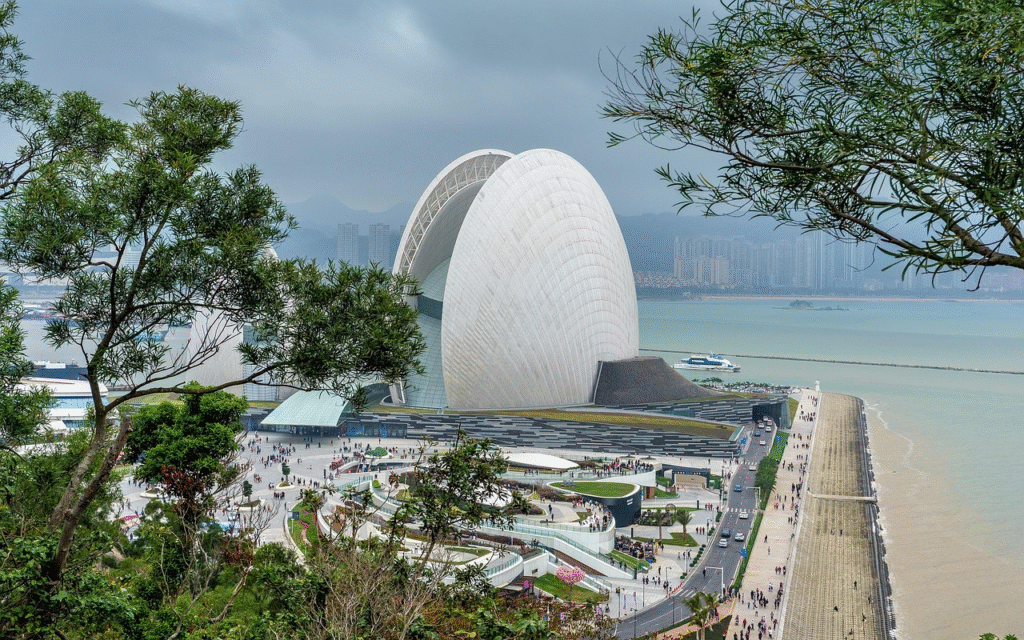
Photo credit: The twin clamshell domes of the Zhuhai Grand Theatre on Yeli Island
Tucked along the western shore of the Pearl River Estuary in southern China’s Guangdong Province, Zhuhai is a coastal city of palm-lined promenades, 146 offshore islands, and a soundtrack of crashing surf that you don’t usually associate with mainland China. A short walk across the Gongbei border connects the city to Macau; the 55-kilometer Hong Kong–Zhuhai–Macau Bridge — the world’s longest sea crossing — links it directly to Hong Kong’s airport. Yet despite its position at the heart of the Greater Bay Area’s economic engine, Zhuhai keeps a low-rise, garden-city feel that makes it one of China’s most livable destinations and a refreshingly uncrowded alternative to its neighbors.
Zhuhai by District: The 3 区
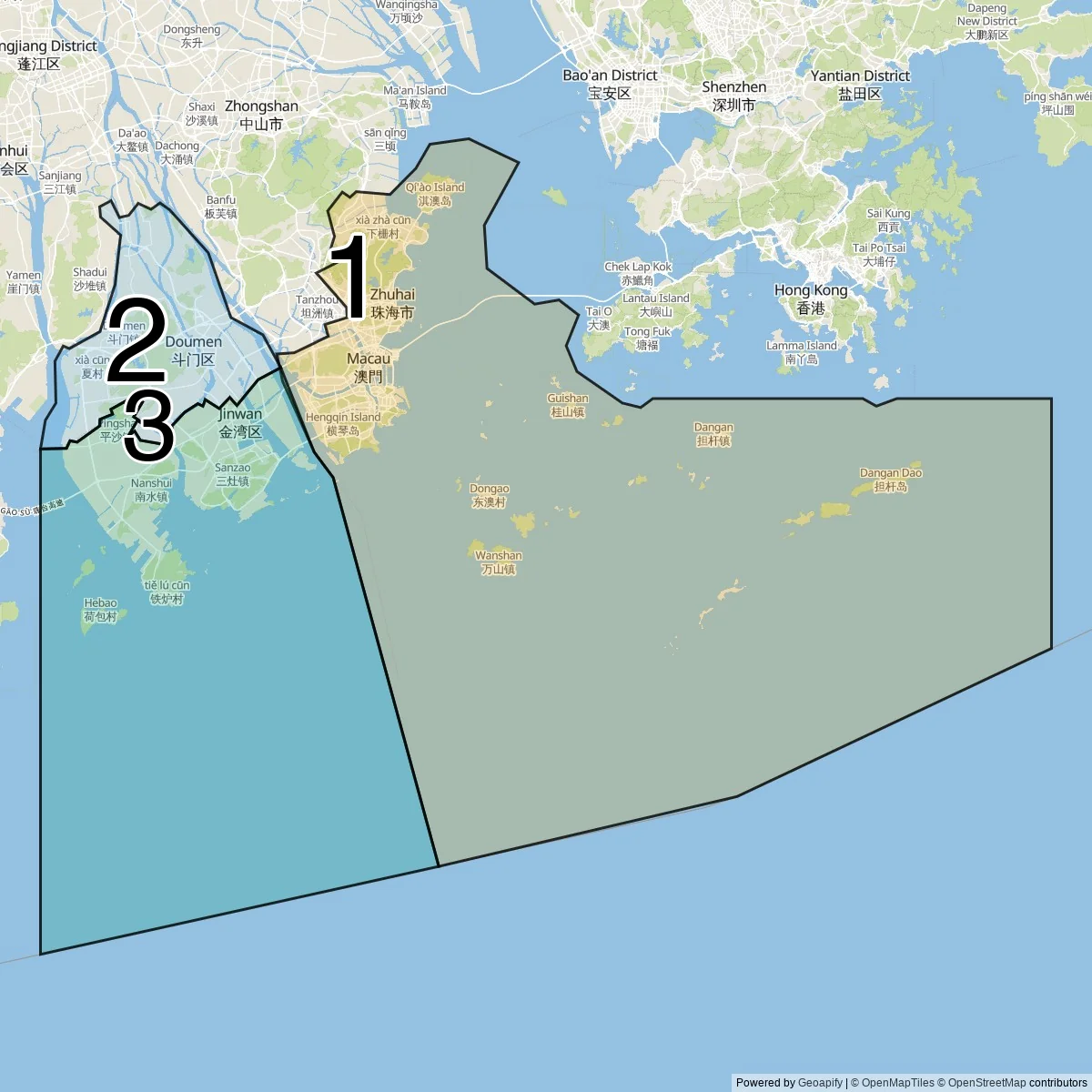
Zhuhai is divided into 3 districts. The map below shows their official OSM boundaries, colour-coded to match the table — a quick way to orient yourself before zooming in on individual sights.
| # | 区 |
|---|---|
| 1 | 香洲区 · Xiangzhou |
| 2 | 斗门区 · Doumen District |
| 3 | 金湾区 · Jinwan District |
Zhuhai at a Glance: Essential Facts for Travelers
| Location | Guangdong Province, South China (Pearl River Delta) |
|---|---|
| Coordinates | 22.2710°N, 113.5767°E |
| Population | ~2.47 million (2023 estimate) |
| Area | 1,736 km² (incl. 146 offshore islands; ~7,727 km² maritime) |
| Elevation | ~13 m above sea level |
| Time Zone | China Standard Time (CST, UTC+8) |
| Calling Code | +86 (city code 0756) |
| Currency | Chinese Yuan Renminbi (CNY ¥) — Macau pataca and HK dollar widely accepted near border |
| Official Language | Mandarin (普通话); Cantonese (广东话) widely spoken |
| Climate | Humid subtropical — mild winters, hot humid summers, typhoon season May–October |
| Status | One of China’s original four Special Economic Zones (SEZ, est. 1980) |
| Famous For | Hong Kong–Zhuhai–Macau Bridge (HZMB), Wanshan Archipelago, Lovers’ Road, Fisher Girl Statue, Zhuhai Air Show |
Upcoming Events in Zhuhai
| Date | Title | Details |
|---|---|---|
| 2026-09-25 | Mid-Autumn Festival in Zhuhai | Zhuhai celebrates the Mid-Autumn Festival on 25 September, when families gather under the full moon to share mooncakes and light lanterns. The seaside city’s promenades, including the famous Lovers’ Road waterfront, fill with strolling families, while parks and residential communities hang lanterns and hotels offer festival menus. The holiday, among the most cherished in the Chinese calendar, emphasises reunion, and the sight of the moon rising over the sea gives Zhuhai’s celebration a particularly romantic flavour. Public festivities are free, with mooncakes and treats sold everywhere. [Source] |
| 2026-10-01 to 2026-10-07 | National Day Golden Week in Zhuhai | The National Day holiday brings Golden Week to Zhuhai from 1 to 7 October, one of the busiest and most festive stretches of the year. Expect flags and flower displays along Lovers’ Road, holiday programmes at Chimelong International Ocean Resort and other attractions, and crowds of visitors from across the Greater Bay Area, many arriving over the Hong Kong-Zhuhai-Macau Bridge. Public celebrations are free, while attractions charge their usual or holiday rates and hotels fill quickly. Book transport and rooms well ahead during this peak week. [Source] |
| 2026-10-15 to 2026-10-17 | RemaxWorld Expo and CSF stationery fair | RemaxWorld Expo, the world’s leading trade fair for the printer and imaging industry, returns to the Zhuhai International Convention and Exhibition Center for three days from 15 October, alongside the CSF stationery and cultural products fair. Zhuhai styles itself the global capital of print consumables, and manufacturers, buyers and resellers from dozens of countries come to source cartridges, printers, office supplies and stationery. The fairs are aimed at trade visitors, with registration required, and together they fill the halls on the city’s exhibition waterfront. [Source] |
| 2026-11-10 to 2026-11-15 | Airshow China 2026 (China International Aviation and Aerospace Exhibition) | Airshow China, the country’s only state-approved international aerospace exhibition, returns to Zhuhai for six days from 10 November. The biennial showcase pairs trade halls filled with aircraft, engines, avionics and defence technology with breathtaking flight demonstrations over the airfield at the China International Aviation Exhibition Center near Jinwan. Early days are reserved for trade visitors and delegations, with public days following, and ticket prices vary by day. It is the city’s signature international event, drawing enormous crowds and world attention to Zhuhai. [Source] |
| 2026-11-16 to 2026-11-17 | Hengqin trade fair cluster: Food and Beverage Asia Fair and HORECA | A cluster of international trade fairs opens at the Tianmu Qintai Conference Center in Hengqin on 16 November, headlined by the Food and Beverage Asia Fair and the HORECA hospitality show, with parallel events covering packaging, printing, construction and private-label goods. The two-day gathering brings regional buyers together with suppliers targeting the Greater Bay Area’s food service and hotel markets. Attendance is geared to trade visitors with registration required. The fairs underline Hengqin’s push to become a convention destination alongside neighbouring Macau. [Source] |
| 2026-12-03 to 2026-12-05 | Global Artificial Intelligence Expo (AIE) | The Global Artificial Intelligence Expo comes to the Zhuhai International Convention and Exhibition Center for three days from 3 December, presenting AI hardware, software and applications from robotics and smart manufacturing to city management and consumer products. Exhibitors and speakers explore how artificial intelligence is reshaping industries across the Greater Bay Area’s technology corridor. The expo is aimed at professionals and tech enthusiasts, with registration required and entry terms varying by visitor type. It closes out a packed exhibition season in the city. [Source] |
City News in Zhuhai – last 14 days
| Date | Category | Headline | Details |
|---|---|---|---|
| 2026-09-14 | Public transport | Zhuhai bus card type to stop accepting top-ups | A type of Zhuhai public transport card will soon stop accepting top-ups, according to an announcement circulated by local media, and holders are being advised to prepare for the change. Passengers are urged to check the operator’s notices on how remaining balances and card replacements will be handled as newer payment options, including upgraded cards and mobile payment codes, take over daily fare collection. The change is part of the modernisation of the city’s bus payment system, and service channels are available for questions. [Source] |
| 2026-09-14 | Local government | Zhuhai launches 2026 Cybersecurity Awareness Week with AI security in the leading role | Zhuhai has launched its 2026 Cybersecurity Awareness Week, with artificial intelligence security taking the leading role in this year’s programme. The campaign brings lectures, exhibitions and community activities that teach residents how to guard against online fraud, data leaks and AI-enabled scams. Government departments, schools and enterprises take part in themed days across the week. Organisers say the focus reflects how rapidly AI tools are entering daily life, bringing new risks alongside convenience, and they urge citizens to build basic digital self-defence habits. [Source] |
| 2026-09-14 | Culture | Stufish-designed Zhuhai Chimelong Theatre officially opens | The Zhuhai Chimelong Theatre, designed by international entertainment architecture studio Stufish, has officially opened, with ArchDaily featuring a picture gallery of the striking venue. The purpose-built theatre adds a landmark performance space to the Chimelong International Ocean Resort area, designed for large-scale resident shows within sweeping curved forms. The opening strengthens Zhuhai’s ambitions as an entertainment destination for visitors from across the Greater Bay Area. Architecture publications highlighted the building’s sculptural design and its role in the resort’s expanding cultural offer. [Source] |
| 2026-09-14 | Public safety | Rainstorm and thunderstorm warnings in effect for parts of Zhuhai | Weather authorities placed parts of Zhuhai under warnings as heavy rain moved through, with an orange rainstorm alert for towns in Doumen district and a yellow thunderstorm and gale warning in effect for the high-tech zone. Residents were advised to avoid dangerous outdoor areas, guard against short-term deluges and stay alert to official updates. Forecasters also tracked a tropical depression expected to spare Guangdong a direct landfall while still feeding bands of rain. Schools and communities activated routine precautions during the alerts. [Source] |
| 2026-09-14 | Business | Zhuhai’s richest man Zhu Baoguo steps down as chairman of two pharma companies in one day | Zhu Baoguo, described as Zhuhai’s richest man, resigned as chairman of two pharmaceutical companies on a single day, handing over the reins during a low period for the businesses. Commentators describe the move as retiring without fully stepping back, with the founder expected to retain influence while a younger generation of managers takes charge. The twin resignations mark a notable succession moment for the health-products group he built. Investors are watching how the leadership handover shapes strategy at the listed companies. [Source] |
| 2026-09-14 | Public transport | Important Zhuhai transport corridor to begin construction within the year | An important transport corridor in Zhuhai is set to begin construction within the year, according to a report that presented the news as a boost for the city. The project is expected to improve connections across the road network and support development along its route. Preparatory work has been progressing ahead of the construction start. Details of the alignment and timetable were reported as authorities push forward a series of infrastructure upgrades across the Greater Bay Area city. [Source] |
| 2026-09-13 | Local affairs | Foreign media guests wowed by first sight of Zhuhai rush to explore the HZMB bridge | Foreign media guests visiting Guangdong exclaimed in wonder at their first sight of Zhuhai and headed eagerly to explore the Hong Kong-Zhuhai-Macau Bridge, according to a bilingual feature. The visitors praised the seaside city’s clean boulevards and relaxed atmosphere before touring the world’s longest sea-crossing bridge, learning about its engineering and its role in knitting the Greater Bay Area together. The trip forms part of a publicity programme showcasing Guangdong’s development to international audiences through first-hand visits. [Source] |
| 2026-09-13 | Business | Zhuhai biotech Trinomab reshapes tetanus prevention as monoclonal antibody era begins | Tetanus prevention is entering a monoclonal antibody era, and Zhuhai-based innovative drug company Trinomab is reshaping the field, according to local reporting. The firm’s antibody products offer an alternative to traditional serum-based tetanus prophylaxis, promising more consistent protection with fewer adverse reactions. The coverage highlights how a Zhuhai biotech has moved from research to changing clinical practice nationally. The company’s progress underlines the city’s growing biomedical industry cluster and its ambitions in high-value pharmaceutical innovation. [Source] |
| 2026-09-13 | Local affairs | Over 30 Zhuhai tourism enterprises exhibit at the 2026 Guangdong Tourism Expo | More than 30 culture and tourism enterprises from Zhuhai are exhibiting together at the 2026 Guangdong Tourism Expo, presenting the city’s resorts, attractions, hotels and travel routes to buyers and holidaymakers. The delegation showcases Zhuhai’s island tourism, theme parks and coastal leisure offerings as the city competes for visitors within the Greater Bay Area’s crowded travel market. Officials use the provincial platform to promote upcoming seasonal campaigns. The strong turnout reflects tourism’s growing weight in the local economy. [Source] |
| 2026-09-12 | Local affairs | New aviation attraction opens near Zhuhai airport as a home for flight fans | A new attraction for aviation fans has opened near Zhuhai’s airport and quickly become an internet-famous check-in spot, taking visitors from watching flights to understanding them. Billed as a dedicated home for plane spotters, the venue combines viewing areas for aircraft take-offs and landings with exhibits explaining aviation. The opening plays to Zhuhai’s identity as host city of Airshow China and gives families a new weekend destination. Local media report enthusiastic early crowds sharing photos of the site online. [Source] |
| 2026-09-11 | Education | Zhuhai’s first financial education base unveiled to help seniors guard their savings | Zhuhai has unveiled its first financial education base, an initiative aimed at helping older residents guard their savings against fraud and mis-selling. The centre offers courses, counselling and exhibitions that explain common scams targeting seniors, from fake investments to impostor officials, and teaches practical steps for protecting money. Banks and regulators are cooperating on the programme. Organisers hope the base will become a model for community financial literacy work across the city as its population ages. [Source] |
| 2026-09-11 | Business | Domestically built 5,000-tonne heavy-lift vessel departs Zhuhai for Nigeria | A domestically built 5,000-tonne super heavy-lift vessel has set sail from Zhuhai bound for Nigeria, in a showcase of the city’s marine engineering capabilities. The departure marks the deployment of major Chinese-made offshore equipment to an international project. The shipment underlines Zhuhai’s role in high-end ocean engineering manufacturing, a sector the city has cultivated alongside its port and shipbuilding industries. Engineers and workers saw the giant vessel off as it began the long voyage to West Africa. [Source] |
| 2026-09-10 | Public transport | Zhuhai Airport pitches ‘Fly via Zhuhai’ to Hong Kong travel industry | Zhuhai Airport held a dedicated promotion event for Hong Kong’s travel industry under the banner Fly via Zhuhai, Travel at Will, pitching itineraries that combine the Hong Kong-Zhuhai-Macau Bridge with onward domestic flights. The roadshow presented route networks, transfer services and package products to Hong Kong travel agents, encouraging them to funnel travellers through Zhuhai for mainland trips. The initiative deepens cross-border aviation cooperation and positions the airport as a convenient gateway for Hong Kong residents exploring China. [Source] |
| 2026-09-07 | Business | Global media and scholars explore China Southern Power Grid’s green vision in Zhuhai | Global media representatives and scholars visited Zhuhai to explore China Southern Power Grid’s green vision, touring facilities that showcase renewable integration, smart grids and low-carbon technology. The delegation learned how the utility supports clean energy across the Greater Bay Area, including cross-border electricity supply to Macau. Participants discussed energy transition themes with company experts during the visit. The programme highlights Zhuhai’s role in the region’s sustainable infrastructure and gave international visitors a first-hand look at power-sector decarbonisation efforts. [Source] |
Zhuhai Events & City News Archive
Sources: Zhuhai Municipal Government, EventsEye, Sina Finance, Sohu, ArchDaily, Zhuhai.com, Sohu, 21st Century Business Herald
Weather Forecast for the Next 14 Days in Zhuhai
| Date | Weather | Max °F | Min °F | Rain mm |
|---|---|---|---|---|
| 2026-09-14 | 🌧️ | 84.7 °F | 76.9 °F | 4.2 mm |
| 2026-09-15 | ⛈️ | 85.8 °F | 76.0 °F | 5.6 mm |
| 2026-09-16 | 🌧️ | 85.8 °F | 76.1 °F | 2.4 mm |
| 2026-09-17 | ☁️ | 85.5 °F | 78.4 °F | 0.0 mm |
| 2026-09-18 | ⛅ | 87.1 °F | 78.2 °F | 0.0 mm |
| 2026-09-19 | ☀️ | 87.4 °F | 76.6 °F | 0.0 mm |
| 2026-09-20 | 🌧️ | 89.2 °F | 77.9 °F | 1.8 mm |
| 2026-09-21 | 🌧️ | 88.0 °F | 76.0 °F | 6.0 mm |
| 2026-09-22 | 🌧️ | 86.6 °F | 77.6 °F | 5.7 mm |
| 2026-09-23 | 🌧️ | 86.0 °F | 78.6 °F | 2.4 mm |
| 2026-09-24 | 🌧️ | 85.7 °F | 78.8 °F | 0.6 mm |
| 2026-09-25 | 🌧️ | 83.3 °F | 78.1 °F | 7.2 mm |
| 2026-09-26 | 🌧️ | 84.1 °F | 79.4 °F | 0.6 mm |
| 2026-09-27 | 🌧️ | 85.8 °F | 78.8 °F | 2.1 mm |
Zhuhai’s History
Zhuhai’s modern story begins on August 26, 1980, when Deng Xiaoping designated this then-fishing-village stretch of coastline as one of China’s original four Special Economic Zones, alongside Shenzhen, Shantou, and Xiamen. The mandate was simple but radical: experiment with market reforms, attract foreign investment, and act as a controlled laboratory for the broader opening-up of China. Unlike Shenzhen — which leveraged Hong Kong’s proximity into hyperscale manufacturing — Zhuhai chose a deliberately slower path, capping building heights, preserving its coastline, and developing as a tourism, light-industry, and university city.
The deeper history is older and more layered. The Zhuhai area falls within the ancestral homeland of the Cantonese-speaking Pearl River Delta peoples; settlements at Tangjia and Qi’ao Island date back to the Song and Ming dynasties. In the mid-19th century, the foreign concessions of Macau (Portuguese) and Hong Kong (British) pulled commerce away from these fishing communities, and Zhuhai’s recorded history quieted for a century. The Xianshan Maritime Pass on Qi’ao Island still preserves Qing-dynasty fortifications built to repel pirates and later British naval incursions during the Opium Wars.
The Sun Yat-sen connection is genuine but often misstated. The father of modern China, Sun Zhongshan (Sun Yat-sen), was born in 1866 in Cuiheng Village — today administratively in Zhongshan City rather than Zhuhai, though the village sits closer to Zhuhai than to central Zhongshan. His revolutionary travels passed through Macau and the Zhuhai coastline frequently, and his family residence at Cuiheng is a 30-minute drive from Zhuhai’s center.
After the 1997 handover of Hong Kong and the 1999 return of Macau, Zhuhai’s role shifted from coastal SEZ to the western anchor of the Greater Bay Area (GBA) megaregion. The opening of the Hong Kong–Zhuhai–Macau Bridge in October 2018, and the launch of the Guangdong-Macao In-Depth Cooperation Zone in Hengqin in September 2021, cemented Zhuhai’s position as the integration hub between mainland China and the Macau SAR.
Geography, Climate & Best Time to Visit Zhuhai
Geographic Setting
Zhuhai sits at the southwestern edge of the Pearl River Estuary, directly across the water from Hong Kong’s Lantau Island (about 65 km east via the HZMB) and immediately adjacent to Macau — the two cities share a continuous urban border at Gongbei. The municipality covers roughly 1,736 km² of land, but its administrative reach extends across nearly 7,700 km² of South China Sea, including the Wanshan Archipelago‘s 146 islands. The mainland portion is largely flat coastal plain framed by low granite hills (the tallest, Phoenix Mountain in Xiangzhou, reaches just 437 m).
This geography produces a city of three distinct sub-environments: the dense urban core hugging the Pearl River and Macau border in Xiangzhou District; the agricultural and aquaculture lowlands of Doumen District to the west; and the international-airport, technology-corridor, and free-trade landscape of Jinwan District in the south, plus the rapidly developing Hengqin Cooperation Zone directly south of Macau.
Climate Overview
Zhuhai has a humid subtropical climate (Köppen Cwa) moderated by its coastal position. Winters (December–February) are mild and dry, with daytime highs of 16–20 °C and lows that rarely drop below 8 °C — light layers and a windproof shell are enough. Summers (June–September) are hot, humid, and stormy, with daily highs near 32 °C, overnight lows around 26 °C, and relative humidity routinely above 85%. Annual rainfall averages around 2,000 mm, concentrated April through September.
Typhoons & Storm Season
Zhuhai sits squarely in the South China Sea typhoon track. Typhoon season runs roughly May through October, with peak risk July–September. The city issues a tiered warning system: a Typhoon Signal No. 8 closes schools, halts public transport, and shuts most businesses; Signal No. 9 or 10 brings the city to a standstill. The 2017 Typhoon Hato and 2018 Typhoon Mangkhut caused significant damage along Lovers’ Road and the coastal districts. Check current advisories from the China Meteorological Administration and the Macau Meteorological and Geophysical Bureau before travel during these months.
Best Time to Visit
October to early December is genuinely Zhuhai’s golden window: typhoons have passed, humidity drops, temperatures sit at 22–28 °C, and the biennial Zhuhai Air Show (odd-numbered years, usually early November) draws aviation enthusiasts from around the world. March to April is the second-best window — pleasant temperatures and azalea blooms on Phoenix Mountain — though the spring “back-and-forth” cold fronts can bring sudden drops. July–September is the season most foreign visitors should avoid unless beach time on Wanshan is the explicit goal and a flexible schedule allows ducking storms.
Zhuhai’s Districts & Neighborhoods
Zhuhai is administered as three formal districts plus two special functional zones. Understanding the geography saves real time on the ground.
Xiangzhou District (香洲区) — the Urban Core
The historic and commercial heart, home to the Gongbei Port of Entry, Lovers’ Road (Qing Lu / 情侣路), the Fisher Girl Statue, and the Zhuhai Grand Theatre on Yeli Island. Most visitors base themselves here. Gongbei is the dense, neon-lit border-shopping district immediately adjacent to Macau — fantastic for street food and budget hotels, intense in the evenings. Jida, just east of Gongbei, is the upscale commercial strip with Galleria-style malls, international chain hotels, and the Bay Area Theatre. Tangjiawan, 20 km north along the coast, has a historic-village center, the Sun Yat-sen Memorial Middle School, and the UIC and Sun Yat-sen University Zhuhai campuses.
Doumen District (斗门区) — Rural & Cultural West
Zhuhai’s largest district by area and least visited by tourists. Rural villages, fish farms, lotus ponds, and the Doumen Old Street — a preserved Qing-Republican-era trade street with traditional ancestral halls. Worth a day trip for travelers wanting a slower, more rural side of Guangdong. Also home to Jintai Temple and the Huangyangshan Forest Park (waterfalls and hiking).
Jinwan District (金湾区) — Airport, Beaches & Tech
South of the urban core, Jinwan contains Zhuhai Jinwan International Airport, the technology corridor of the South Zhuhai New Town, and the long sandy beach of Feishaitan. The district also hosts the biennial Air Show grounds. Less hotel inventory than Xiangzhou, but useful for early flights or business at the airport-area exhibition zone.
Hengqin Guangdong-Macao In-Depth Cooperation Zone (横琴粤澳深度合作区)
The fast-changing free-trade island directly south of Macau, connected by tunnel and bridge. Hengqin hosts Chimelong Ocean Kingdom (one of the world’s largest aquariums and theme parks), the new financial district, and the University of Macau’s mainland-side campus. The zone operates under hybrid Macau-mainland rules — a special HK/Macau passport channel speeds entry — and is the most visually new and architecturally ambitious part of Zhuhai.
Wanshan Marine Development Pilot Zone — the Archipelago
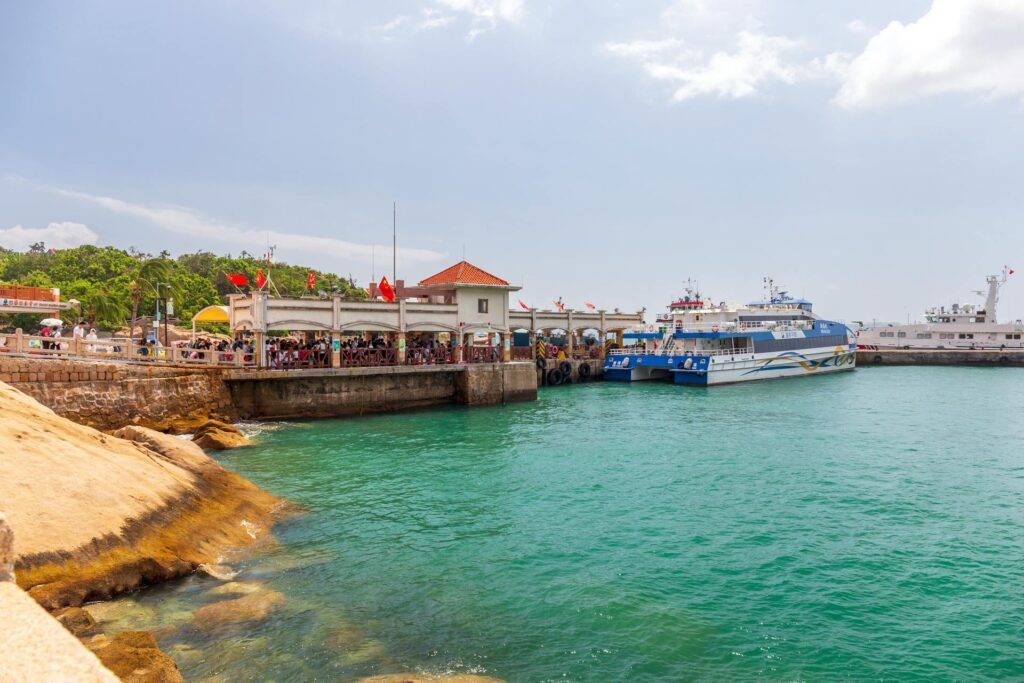
The 146-island chain stretching south into the South China Sea. Most are uninhabited, but ferries from Xiangzhou’s Xiangzhou Port reach Dong’ao (the most-visited resort island), Wailingding (fishing village and beach), and Guishan (snorkeling and seafood). Day trips and overnight stays are both feasible from late October through early June.
Top Things to Do in Zhuhai
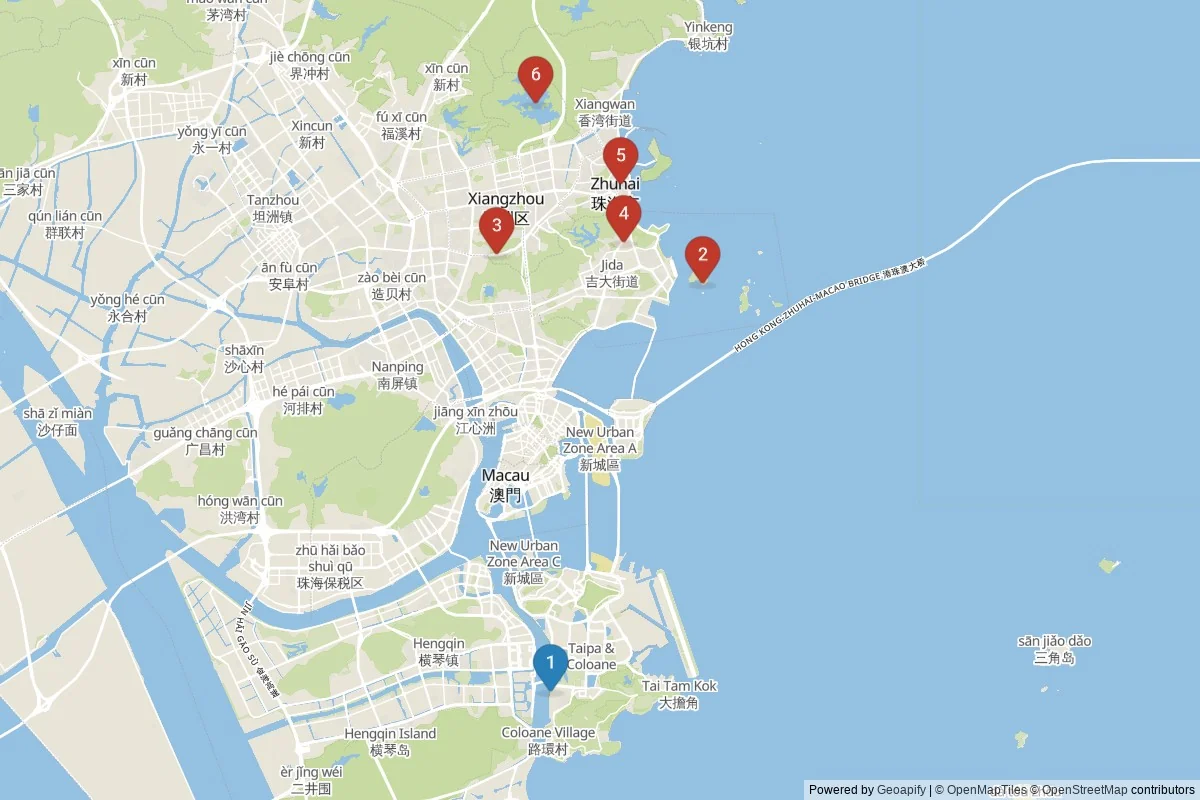
| # | Sight | Cluster | Type | Time | Entry | Best |
|---|---|---|---|---|---|---|
| 1 | Chimelong Ocean Kingdom (Hengqin) | Central | Theme park | Full day | ¥350 | Morning |
| 2 | Zhuhai Grand Theatre (Yeli Island) | Outer | Architecture | ~1 hr | Free ext. | Evening |
| 3 | New Yuan Ming Palace (圆明新园) | Outer | Cultural park | ~3 hrs | ¥120 | Morning |
| 4 | Fisher Girl Statue | Outer | Landmark sculpture | ~30 min | Free | Anytime |
| 5 | Walk Lovers’ Road | Outer | Coastal promenade | ~2 hrs | Free | Sunset |
| 6 | Phoenix Mountain Hiking | Outer | Mountain trail | ~3 hrs | Free | Morning |
| 🚗 | Cross HZMB to Hong Kong | Day trip | Mega-bridge ride | ~1 hr | ¥65 | Morning |
| 🚗 | Day Trip: Dong’ao Island | Day trip | Island day trip | Full day | ¥150 ferry | Anytime |
1. Walk (or Cycle) Lovers’ Road
The Qing Lu coastal promenade stretches more than 28 kilometers along Zhuhai’s eastern shoreline, from the Macau border in the south to Tangjiawan in the north. The signature stretch — about 8 km from the Fisher Girl Statue south to Yeli Island — is paved, shaded with palms, and dotted with sculptures, viewing platforms, and outdoor cafés. Cycle-share bikes (Meituan, HelloRide) are everywhere; sunset along the central stretch is the city’s signature experience.
2. Visit the Fisher Girl Statue (渔女像)
Zhuhai’s defining city symbol — a 9.9-meter granite sculpture of a young woman holding a pearl above the sea, designed by sculptor Pan He and unveiled in 1982. The statue sits on a small rocky outcrop along Lovers’ Road and is best visited at sunrise or sunset, when the light bounces off the Pearl River Estuary behind her. Free, open 24 hours.
3. Zhuhai Grand Theatre on Yeli Island
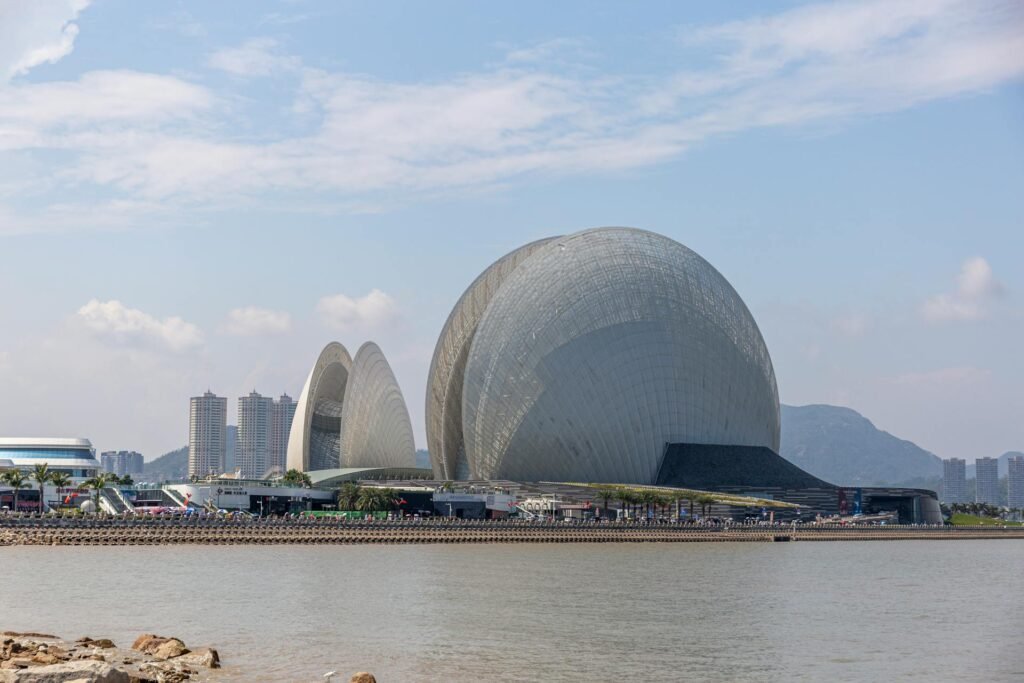
The twin clamshell-shaped concert and opera halls — one large, one small — are mainland China’s only theatre built on an island and one of the most photographed buildings in Guangdong. Open for self-guided exterior visits during daylight; tickets to performances available via the venue’s official channels. The illuminated nighttime view from the Yeli Bridge is unmissable.
4. Chimelong Ocean Kingdom (Hengqin)
Mainland China’s most-visited theme park outside Shanghai Disney — and one of the world’s largest aquariums by water volume. Whale shark tank, beluga performances, Manta roller coaster, fireworks-and-water shows nightly. Adult tickets ~¥330–380 weekday, ~¥430 weekend; arrive at opening to manage queues at the headline rides. The adjacent Chimelong Spaceship and Hengqin Bay hotels are family-favorites.
5. New Yuan Ming Palace (圆明新园)
A roughly half-scale recreation of Beijing’s destroyed Old Summer Palace, set among lakes and pavilions in northern Xiangzhou. The replica architecture — palaces, marble bridges, the famous “Twelve Animals” fountain — is supplemented with evening cultural performances. Touristy but visually striking, and the gardens themselves are worth the entry (~¥60).
6. Day Trip to Dong’ao Island
The most accessible island in the Wanshan chain, a 70-minute high-speed ferry from Xiangzhou Port (~¥150 round-trip). Clear water, low-key resorts, snorkeling, and seafood shacks where you pick your fish from the tank. Stay overnight to catch the genuinely dark night sky and a sunrise from Nansha Bay.
7. Cross the HZMB to Hong Kong (or back)
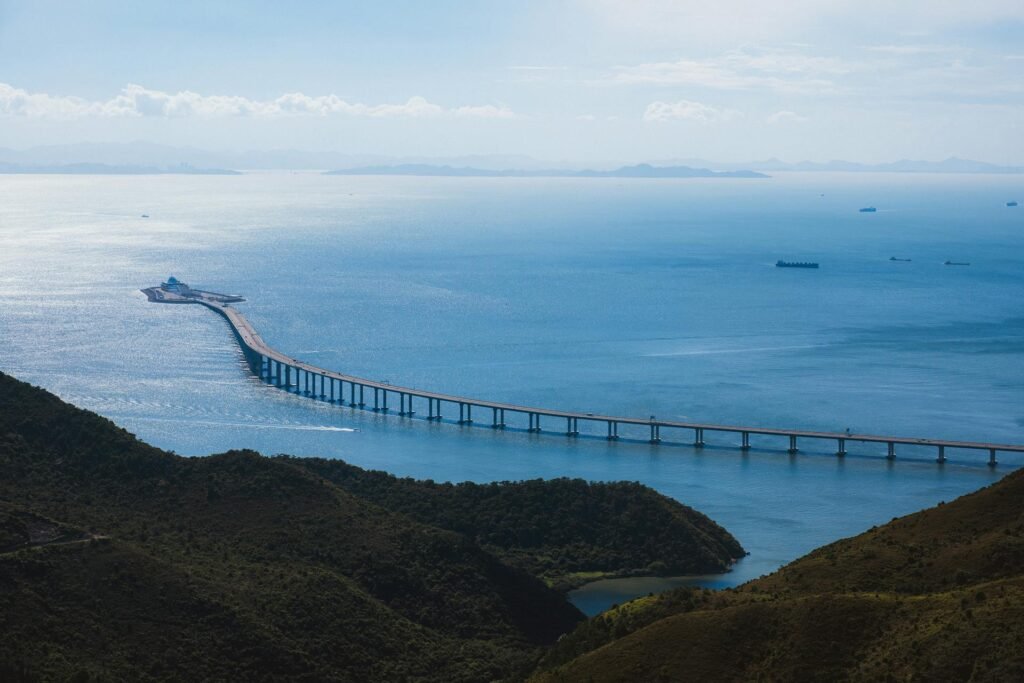
The Hong Kong–Zhuhai–Macau Bridge shuttle bus runs 24/7 from the Zhuhai Port to Hong Kong’s airport and city in 45–60 minutes. Even one-way as a day trip is worth doing for the experience of crossing the world’s longest sea bridge, with the 6.7-km undersea tunnel section connecting the artificial islands. Tickets ¥58–65 one-way; e-channel for HK/Macau permit holders, full immigration for foreign passports.
8. Phoenix Mountain (凤凰山) Hiking
The forested ridge running north–south through central Zhuhai gives the city its garden character. Multiple trailheads offer easy 1- to 3-hour hikes with sea views; the Banzhangshan summit is the most rewarding. Best in autumn and winter; the park is free.
How to Get to Zhuhai
By Air
Zhuhai Jinwan International Airport (ZUH) in Jinwan District is the city’s primary airport, with domestic flights to most major Chinese cities and a growing list of regional Asian routes (Bangkok, Seoul, Singapore, Manila, Tokyo). The airport is 42 km southwest of central Xiangzhou — about 45 minutes by airport bus (¥30) or taxi (¥120–150).
For international visitors, Hong Kong International Airport (HKG) is usually the smartest entry point: HZMB shuttle bus to Zhuhai Port in 45 minutes (¥58) plus a 20-minute taxi to the city center. Macau International Airport (MFM) is a 20-minute drive from the Gongbei border; Guangzhou Baiyun (CAN) is 90 minutes north by high-speed rail; Shenzhen Bao’an (SZX) connects via the Shenzhen-Zhongshan Link (opened 2024) and the Shekou ferry.
By High-Speed Rail
Zhuhai Station, immediately adjacent to the Gongbei border, is the southern terminus of the Guangzhou-Zhuhai Intercity Railway. Direct trains to Guangzhou South take 60–90 minutes (¥70–80); through services connect Hong Kong’s West Kowloon Station via Guangzhou. The new Zhuhai-Macau Light Rail connects Hengqin to Macau via a sub-sea tunnel.
By Bridge or Tunnel
The HZMB shuttle (mentioned above) is the fastest Hong Kong link. The Shenzhen-Zhongshan Link (opened June 2024) brings Shenzhen within 30 minutes by car. From Macau, simply walk across Gongbei Port of Entry — one of the world’s busiest land borders, with over 400,000 daily crossings.
By Ferry
Daily high-speed ferries run from Zhuhai’s Jiuzhou Port to Hong Kong’s Sheung Wan (75 minutes) and Shenzhen Shekou (60 minutes). The Wanshan Archipelago ferries depart from Xiangzhou Port (different terminal — confirm in advance).
Visa Notes
Mainland China requires a visa for most foreign passport holders entering through Zhuhai. The 240-hour visa-free transit policy (expanded December 2024 to 54 nationalities) applies to qualifying travelers entering through Zhuhai’s ports — including Gongbei from Macau and the airport — provided onward travel to a third country is booked. The Macau side requires only a Macau entry stamp (visa-free or visa-on-arrival depending on nationality). Check current rules with the official China Visa Application Service Center 4–6 weeks before travel.
Getting Around Zhuhai
Buses
Zhuhai’s bus network is dense, modern, and the most useful local option. Single fare ¥2 in cash or via WeChat Pay / Alipay (preferred — many buses no longer accept cash). Most signage is bilingual Chinese-English; the Lingnan Pass (岭南通) stored-value card works on buses and ferries. Bus routes 3, 9, 9A, and 10 run the Lovers’ Road corridor.
Ride-Hailing & Taxis
DiDi dominates ride-hailing — the English-language app accepts international credit cards and is the easiest option for visitors. Metered taxis start at ¥10 (first 3 km) and are abundant near the Gongbei border, Jida, and the airport. Most drivers do not speak English; have your destination written in Chinese characters or saved on Baidu/Amap maps.
Bike-Sharing
HelloRide and Meituan dockless bikes are everywhere, ¥1.50–2 per 30 minutes via WeChat/Alipay mini-program. Lovers’ Road is purpose-built for cycling. E-scooters are available but require local registration and are not realistic for short-stay visitors.
Metro & Light Rail
Note: Zhuhai does not have a heavy metro system. The previous Zhuhai Tram Line 1 was decommissioned in 2021 due to low ridership. The newer Hengqin Light Rail connects Hengqin to Macau (cross-border ticketing). For most visitors, buses, taxis, and bikes cover the city.
Walking
The Gongbei–Jida–Yeli Island corridor is walkable end-to-end. Crossings are signalized, sidewalks are wide, and the seafront promenade is uninterrupted for kilometers. Summer humidity makes long walks brutal — plan early mornings and evenings.
Food & Drink in Zhuhai
Zhuhai’s culinary identity is fundamentally Cantonese, with strong subtropical-seafood and Macau-influenced threads. Dim sum, congee, roast goose, steamed fish, and seafood barbecue are the staples; the Macau border injects Portuguese-influenced egg tarts, pork chop buns, and African chicken into the everyday vocabulary.
What to Try
- Wanshan Seafood — squid, prawn, garoupa, and grouper from the archipelago, typically steamed whole with ginger and scallion. The seafood stalls along Xiangzhou Seafood Street (香洲海鲜街) let you pick from tanks and have it cooked to order.
- Doumen Aquaculture Specialties — eel, mud carp, and white-shrimp dishes from the fish farms of western Zhuhai.
- Dim Sum (yum cha) — the regional ritual; weekend mornings at the bigger restaurants (Lianhua, Tian Hai) are family-packed and great fun. Look for har gow (shrimp dumplings), siu mai, char siu bao, and the Cantonese specialty cheung fun (rice noodle rolls).
- Macanese Crossovers — Lord Stow’s-style Portuguese egg tarts (look for “葡式蛋挞”), pork chop buns, and African chicken at Macau-influenced spots near Gongbei.
- Sweet Soups (糖水) — late-evening Cantonese dessert tradition; black sesame, red bean, ginger milk pudding, and mango pomelo sago.
Where to Eat
Gongbei Food Street for late-night street food and budget eats; Xiangzhou Seafood Street for tank-to-table seafood; Jida for international cuisine and chain-mall food courts; Tangjiawan Old Town for traditional ancestral-hall restaurants with home-style Cantonese cooking. Reservations are not the norm at most local restaurants — turn up early (6–7 pm) to avoid waits at the popular spots.
Drinks & Bars
The Lovers’ Road Bar Street in Jida is the central evening hub; Hengqin’s resort hotels have higher-end cocktail bars; craft beer is a growing scene (Zhuhai Brewing Co. taproom near Yeli Bridge). Tea remains the cultural drink — oolong, pu’er, and Cantonese-style milk tea (奶茶) are everywhere.
A Note on Tap Water
As across mainland China, tap water in Zhuhai is not safe to drink without boiling. Use sealed bottled water (¥2–5 per liter) or filtered water from hotel kettles (boiled at minimum 100 °C). Ice in reputable restaurants is generally safe; food-poisoning risk is comparable to other large Chinese cities — eat at busy, established places where turnover is high.
Frequently Asked Questions About Visiting Zhuhai
Do I need a visa to visit Zhuhai?
For most foreign passport holders, yes — Zhuhai is mainland China and falls under the standard PRC visa regime. The good news is that the 240-hour (10-day) visa-free transit policy, expanded December 17, 2024, now covers 54 nationalities (including US, UK, all EU member states, Canada, Australia, Japan, South Korea, and Singapore) entering through 60 designated ports — Zhuhai’s Gongbei Port of Entry, Zhuhai Jinwan International Airport, and the Hong Kong–Zhuhai–Macau Bridge Port are all qualifying. Requirements: a confirmed onward ticket to a third country (not the country you came from), proof of accommodation, and travel limited to specified provinces (Guangdong qualifies). The Macau side requires only a Macau entry stamp, which is visa-free for 90+ days for most Western passports. For longer stays or non-transit purposes, apply for a tourist (L) visa via the official China Visa Application Service Center 4–6 weeks before travel. Passport must have at least 6 months remaining validity.
Is Zhuhai safe for tourists?
Zhuhai is genuinely one of the safer cities in China and considerably safer than the global tourist-city average. The US State Department rates mainland China at “exercise increased caution” — primarily for arbitrary-detention and dual-national risks rather than street crime. Real risks in Zhuhai: scooter and e-bike traffic (sidewalks are shared and locals ride aggressively — watch when stepping off curbs); typhoon-season storm surges along Lovers’ Road (May–October); scam taxis at the Gongbei border charging tourist prices to nearby destinations (use DiDi or insist on the meter); counterfeit currency when changing money in unofficial spots near the border (use bank ATMs or official exchange counters). Petty theft is uncommon but possible in the Gongbei crowds. Political and digital sensitivity: VPNs are technically illegal; Google, Facebook, Instagram, WhatsApp, and most Western news sites are blocked — download WeChat, DiDi, and Amap before crossing the border. Public photography of military, police, and government buildings can attract attention; avoid it.
How many days do I need in Zhuhai?
Two to three days handles Zhuhai itself comfortably; combined with Macau next door, five days gives a satisfying twin-city experience. A solid 3-day Zhuhai plan: Day 1 — Lovers’ Road cycling (Fisher Girl Statue + Yeli Island + Zhuhai Grand Theatre) + sunset photography + Gongbei Food Street dinner. Day 2 — Hengqin morning (Chimelong Ocean Kingdom or the new financial district) + Macau border crossing for afternoon (Senado Square + A-Ma Temple + egg tarts) + back to Zhuhai for the evening. Day 3 — Dong’ao Island day trip (ferry from Xiangzhou Port) or Doumen rural-cultural day (Old Street + Jintai Temple). Add Day 4 if you want HZMB to Hong Kong as a side trip, or Day 5 for Tangjiawan and the Sun Yat-sen heritage sites. Air Show visitors (early November in odd years) should budget an extra day.
What’s the best area to stay in Zhuhai?
Gongbei (downtown, Macau border) — the practical default for first-time visitors; walking distance to Macau, dense food and shopping, budget to mid-range hotels (¥250–800/night); intense in the evenings. Jida (just east of Gongbei) — the upscale strip with Galleria malls and international chain hotels (Sheraton, InterContinental, Hyatt Regency Beauty); quieter than Gongbei but well-connected; ¥600–1,500/night. Tangjiawan (northern Xiangzhou, 25 min from center) — quieter, college-town feel, mid-range business hotels, useful base if visiting UIC or the university zone; ¥350–800/night. Hengqin (across the bay) — resort hotels around Chimelong Ocean Kingdom; family-and-theme-park focus; ¥800–2,500/night. Jinwan — airport-adjacent, useful only for early flights or Air Show attendance; otherwise too far from the action. Skip: cheap unbranded “guesthouses” near the border without an English-speaking staff — registration with local police is mandatory for foreigners and unfamiliar small hotels often refuse foreign guests.
How much does it cost to visit Zhuhai’s major sights?
Zhuhai is one of mainland China’s more affordable major cities. Fisher Girl Statue: free, 24-hour access. Lovers’ Road promenade: free. Zhuhai Grand Theatre exterior: free (performance tickets vary by show, ~¥180–880). New Yuan Ming Palace: ~¥60 entry. Phoenix Mountain hiking: free. Chimelong Ocean Kingdom: ¥330–380 weekday, ~¥430 weekend (children/seniors discounted; multi-day packages available). Chimelong Spaceship: ~¥350. Dong’ao Island ferry: ¥150 round-trip + ¥50 island entry. Wailingding Island ferry: ¥180 round-trip. HZMB shuttle to Hong Kong: ¥58–65 one-way. Local meals: dim sum lunch ¥40–80 per person; seafood dinner at Xiangzhou Seafood Street ¥150–400 per person; mall food court ¥30–50; street food ¥10–25. DiDi across the city: ¥15–35; taxi ride airport to Gongbei ¥120–150. Overall daily budget: ¥300 (frugal) to ¥1,200 (comfortable mid-range, excluding theme parks).
Should I drink the tap water in Zhuhai?
No — as in the rest of mainland China, tap water in Zhuhai is not safe to drink without boiling. Use sealed bottled water (¥2–5 per liter at convenience stores; major brands include Nongfu Spring, Wahaha, and C’estbon) for drinking and brushing teeth. Hotel kettles boil water to a safe temperature — Chinese hotel staff routinely refill thermoses with hot water on request. Reusable filter bottles (LifeStraw, Grayl, or any 0.1-micron filter rated for biological contaminants) work well across Guangdong. Ice in mid-range and upmarket restaurants is generally safe; avoid ice from street-stall drinks. The CDC traveler health page for China recommends bottled or boiled water and standard food precautions. Tap water is fine for showering and bathing. Traveler’s diarrhea is the most common health issue; eat at busy, established restaurants where food turnover is high, and consider a hepatitis A and typhoid booster before travel.
What payment methods work in Zhuhai — can I use credit cards?
Plan for a mostly-cashless trip but bring a contingency. WeChat Pay and Alipay dominate to a degree that surprises Western visitors — taxis, buses, street stalls, bike-shares, and most restaurants accept these QR-code apps almost exclusively. Foreign credit cards: both Alipay and WeChat Pay now accept linked international Visa, Mastercard, JCB, and Discover cards (set up the connection before arrival; in-app it’s “Tour Pass” for Alipay and “Service / Pay” for WeChat). UnionPay is universally accepted at point-of-sale terminals. Visa/Mastercard physical cards work at international hotel chains, larger malls (Wanda, Galleria), and some upscale restaurants — but not at most local businesses. Cash: bring some renminbi for older small businesses, temple donations, and emergencies; ATMs (Bank of China, ICBC, China Construction Bank) accept foreign cards with a ¥3,000–5,000 daily withdrawal limit and a ¥15–25 international transaction fee. Macau pataca (MOP) and Hong Kong dollar (HKD) are widely accepted near the Gongbei border at 1:1 with renminbi (a slight loss for the visitor — use CNY where possible).
What about internet access, VPNs, and which apps to install before arrival?
The Great Firewall is real: Google services, Facebook, Instagram, X (Twitter), WhatsApp, YouTube, most Western news sites, and many cloud services are blocked in mainland China including Zhuhai. Install before crossing the border: WeChat (essential — messaging, payments, mini-program services); Alipay (payments + Tour Pass); DiDi (ride-hailing, English available); Amap or Baidu Maps (Google Maps doesn’t work properly inside China); Trip.com or Ctrip (hotels and high-speed rail tickets); Pleco (offline Chinese dictionary). VPNs: technically illegal under PRC law but widely used; Western brands (ExpressVPN, NordVPN, Astrill) work intermittently; install and test before departure as the App Store inside China cannot download most VPN apps. International roaming from your home carrier bypasses the firewall entirely while it lasts — for a short trip, just use roaming for sensitive access. Hong Kong and Macau SIM cards retain unrestricted internet when used in mainland China (a useful workaround for cross-border travelers). The Hengqin Cooperation Zone has slightly more relaxed rules in some Macau-linked locations, but don’t count on it.
Education & Notable People
Zhuhai’s deliberately cap-the-height, university-friendly development strategy has produced one of mainland China’s densest concentrations of higher education campuses. The Tangjiawan University Town in northern Xiangzhou hosts more than ten campuses, and Hengqin’s new university zone is rapidly expanding.
Major Universities
- BNU-HKBU United International College (UIC) — founded 2005 in Tangjiawan, the first full-degree joint-venture liberal-arts university between mainland and Hong Kong institutions. English-language teaching, around 7,000 students.
- Sun Yat-sen University, Zhuhai Campus — branch of the Guangzhou-based flagship, with strong oceanography and marine-engineering programs.
- Beijing Normal University, Zhuhai Campus — pedagogy and humanities focus.
- University of Macau Hengqin Campus — UM’s mainland-side facility, a key plank of Hengqin’s hybrid Macao-mainland regime.
- Jinan University Zhuhai Campus — overseas Chinese-student focused, with notable journalism and translation programs.
Sun Yat-sen Connection
Sun Yat-sen — born 1866 in nearby Cuiheng (now Zhongshan) — used the Zhuhai coastline as a transit corridor between his Macau medical practice and his revolutionary networks in southern China. The Sun Yat-sen Memorial Middle School in Tangjiawan and the nearby Sun family residences form part of the regional Sun Yat-sen heritage trail; the most-visited site is across the border in Zhongshan.
Other Notable Figures
Dong Mingzhu — the formidable chairwoman of Gree Electric, China’s largest air-conditioner manufacturer (headquartered in Zhuhai) and one of the most prominent female business leaders in the country. Yung Wing — the first Chinese student to graduate from an American university (Yale, 1854), born in Nanping, present-day Zhuhai. Rong Hong (the Chinese name of Yung Wing) has a memorial in Nanping.
Sister Cities & International Relations
As one of China’s founding Special Economic Zones, Zhuhai built up an active sister-city network from the mid-1980s onward, with a focus on coastal, port, and university cities that align with its tourism and tech-park identity.
Zhuhai’s international friendship and sister cities include (selection):
- Coffs Harbour, Australia — paired since 1988; a beach-and-tourism economy parallel.
- Redondo Beach, California, USA — paired since 1994; another seaside-resort partnership.
- Liepāja, Latvia — port-city sister relationship since 2002.
- Tartu, Estonia — university-city friendship link.
- Stockton, California, USA — sister-city since 1995.
- Iwaki, Japan — coastal partnership.
- Sopron, Hungary — friendship city since 2007.
- Krasnodar, Russia — paired since 2006.
Zhuhai also plays a central role in the Greater Bay Area (GBA) 11-city megaregion alongside Hong Kong, Macau, Guangzhou, Shenzhen, Foshan, Dongguan, Huizhou, Zhongshan, Jiangmen, and Zhaoqing — a coordinated economic-development plan launched in 2017 covering more than 70 million people. The Guangdong–Macao In-Depth Cooperation Zone in Hengqin is the most concrete expression of this integration, applying Macau-style legal and tax frameworks to a slice of mainland territory and rebalancing Macau’s casino-heavy economy toward technology, finance, and education.
AFRIKA
Cairo Hurghada Johannesburg Marrakech
ASIA
Abu Dhabi Agra Antalya Bangkok Batam Beijing Bengaluru Cebu City Chiang Mai Chiba Chennai Da Nang Dammam Delhi Denpasar Dubai Fukuoka Guangzhou Guilin Ha Long Hanoi Ho Chi Minh City Jakarta Jaipur Johor Bahru Kolkata Krabi Kuala Lumpur Kyoto Macau Mecca Medina Mugla Mumbai Osaka Pattaya Penang Phuket Riyadh Seoul Shanghai Shenzhen Singapore Taipei Tokyo Zhuhai
EUROPE
Amsterdam Athens Barcelona Berlin Brussels Budapest Copenhagen Dublin Florence Frankfurt am Main Heraklion Krakow Lisbon London Madrid Milan Munich Nice Paris Porto Prague Rhodes Rome Stockholm Venice Vienna Warsaw
NORTH AMERICA
Cancun Las Vegas Los Angeles Miami New York City Orlando San Francisco Toronto Vancouver
SOUTH AMERICA
Buenos Aires Lima Rio De Janeiro
OCEANIA
Auckland Honolulu Melbourne Sydney