
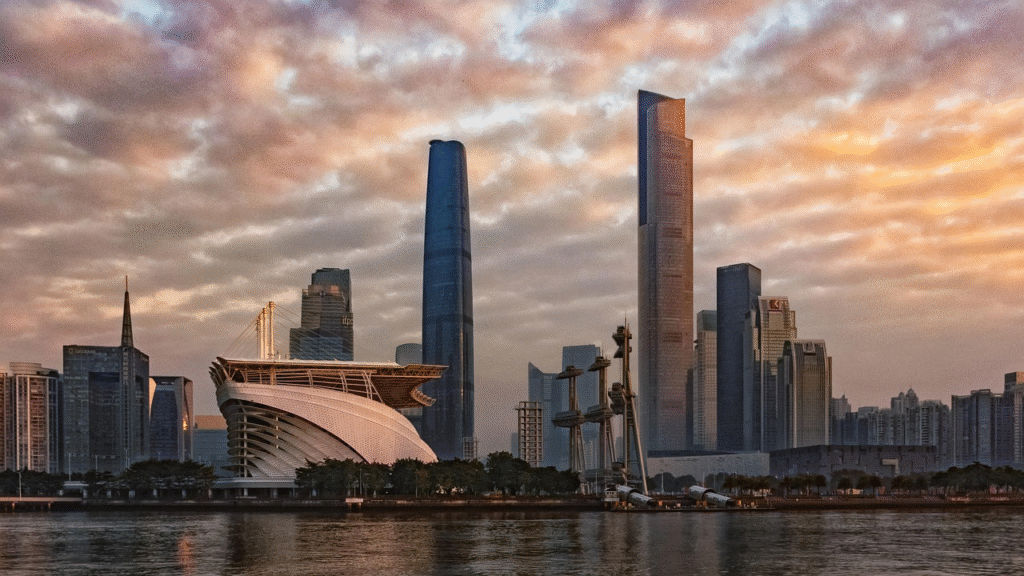
Photo credit: TNCities
Guangzhou, historically known as Canton, is a dynamic metropolis where ancient traditions seamlessly blend with cutting-edge innovation. As the capital of Guangdong Province and China’s third-largest city, this southern powerhouse serves as a gateway between East and West, offering visitors an intoxicating mix of revolutionary history, world-class cuisine, and architectural marvels that pierce the subtropical sky.
Guangzhou at a Glance: Essential Facts for Travelers
Guangzhou: Key Facts & Tourism Statistics
| International arrivals | 5.01 million (2024, inbound overnight visitors) — Guangzhou Statistical Communiqué on National Economic and Social Development 2024 |
|---|---|
| Population | 18.8 million (2023, Guangzhou Municipal Statistics Bureau) |
| Best time to visit | October, November, December, March and April |
| Airport to city centre | Metro Line 3 (from CAN/Baiyun): ~45 min, ~US$1 |
| Currency | Renminbi (CNY) |
| Time zone | UTC+8 (CST) |
| Visa | China offers visa-free entry (30 days) to many European and Asian nationalities and 240-hour visa-free transit — check the latest NIA rules. |
How many tourists visit Guangzhou per year?
Guangzhou recorded 5.01 million inbound overnight visitors (incl. Hong Kong, Macao, Taiwan; foreigners: 2.05M) in 2024, according to Guangzhou Statistical Communiqué on National Economic and Social Development 2024.
What is the best time to visit Guangzhou?
The most comfortable months to visit Guangzhou are typically October, November, December, March and April, based on 1991–2020 climate normals for temperature and rainfall.
How do I get from the airport to central Guangzhou?
The Metro Line 3 (from CAN/Baiyun) takes about 45 minutes to the city centre for about US$1 (~CNY 7 to Zhujiang New Town).
What currency is used in Guangzhou?
Guangzhou uses the Renminbi (CNY); the local time zone is UTC+8 (CST).
Do I need a visa to visit Guangzhou?
China offers visa-free entry (30 days) to many European and Asian nationalities and 240-hour visa-free transit — check the latest NIA rules.
How many people live in Guangzhou?
Guangzhou has a population of about 18.8 million (permanent residents), per Guangzhou Municipal Statistics Bureau (2023).
Guangzhou climate: monthly averages (1991–2020)
| Month | Avg high | Avg low | Rain |
|---|---|---|---|
| Jan | 18.5 °C | 10.2 °C | 48 mm |
| Feb | 20.1 °C | 12.3 °C | 64 mm |
| Mar | 23.1 °C | 15.7 °C | 140 mm |
| Apr | 26.6 °C | 20 °C | 230 mm |
| May | 29.2 °C | 23.1 °C | 332 mm |
| Jun | 30.7 °C | 25.2 °C | 388 mm |
| Jul | 31.6 °C | 25.7 °C | 260 mm |
| Aug | 31.5 °C | 25.5 °C | 295 mm |
| Sep | 30.4 °C | 24.1 °C | 178 mm |
| Oct | 28.2 °C | 20.5 °C | 61 mm |
| Nov | 24.6 °C | 16.1 °C | 39 mm |
| Dec | 20 °C | 11.2 °C | 40 mm |
Data last verified: 2026-09-01 · Climate: Open-Meteo ERA5 reanalysis, monthly normals computed from daily data 1991–2020 · Sources: Guangzhou Statistical Communiqué 2024 (arrivals) · Guangzhou Statistics Bureau (population) · Guangzhou Metro (transfer) (primary source) · World’s most visited cities · Methodology
Upcoming Events in Guangzhou
| Date | Title | Details |
|---|---|---|
| 2026-09-14 | 12th Euro-Asian Mediations Digital Art Biennale | The 12th edition of the Euro-Asian Mediations Digital Art Biennale opened in Guangzhou on 14 September 2026, gathering digital and media artists from across Europe and Asia for the long-running exchange exhibition. Reported by China’s international broadcaster CGTN, the biennale showcases contemporary digital creation and cross-cultural dialogue between the two continents. Admission arrangements and the closing date are set by the organisers, so check current local listings for venue and opening hours before visiting. A worthwhile stop for fans of new-media art during Guangzhou’s autumn season. [Source] |
| 2026-09-18 to 2026-09-20 | Guangdong Science Popularization Innovation Exhibition | The Guangdong Science Center in Panyu hosts the 2026 Guangdong Science Popularization Innovation Exhibition from 18 to 20 September, spreading more than 110 booths across over 12,000 square metres. Displays showcase the province’s advances in artificial intelligence, quantum technology, life sciences and green development, alongside academician lectures, a science-themed IP parade, Yingge dance performances, a science stage and a stamp-collecting lucky draw. Three thousand free tickets are offered via registration, each admitting an accompanying young child to the science centre as well; a fun, hands-on weekend for families. [Source] |
| 2026-09-25 to 2026-09-27 | Mid-Autumn Festival Lantern Displays | The Mid-Autumn Festival, one of China’s most important traditional holidays, falls in late September in 2026 and is celebrated across Guangzhou with glowing lantern displays, mooncakes and family gatherings. Parks such as Yuexiu Park and the Guangzhou Cultural Park host spectacular lantern exhibitions, while families admire the full moon and light colourful lanterns. The city takes on a festive glow, and public spaces fill with visitors enjoying the mild autumn evenings. Many displays are free or low-cost, offering visitors a wonderful window onto Cantonese festival traditions and the warmth of this reunion holiday. [Source] |
| 2026-09-30 | Guangzhou Symphony Orchestra Subscription Concert | The Guangzhou Symphony Orchestra, one of China’s leading ensembles, continues its 2026/27 season with the second concert of its subscription series on 30 September, featuring Yang Yang on the podium. The orchestra opened the season earlier in September under conductor Huang Yi and performs at its long-time home, the Xinghai Concert Hall on Ersha Island, renowned for its acoustics. Tickets vary by seat category; an elegant evening for classical music lovers visiting the city. [Source] |
| 2026-10-01 to 2026-10-11 | Guangzhou International Lighting Festival | The Guangzhou International Lighting Festival illuminates the city centre each autumn, transforming Flower City Square, the Canton Tower and the Pearl River waterfront with dazzling light installations, projections and drone shows. Timed around the National Day holiday, the free festival draws huge evening crowds to admire artworks by lighting designers from China and abroad. Guangzhou, a global hub of the lighting industry, uses the event to showcase cutting-edge technology and artistry. Strolling among the glowing displays after dark is one of the most spectacular free experiences the city offers in October. [Source] |
| 2026-10-15 to 2026-11-04 | Canton Fair 2026 (Autumn Session) | The China Import and Export Fair, universally known as the Canton Fair, is the country’s largest and oldest trade fair, held every spring and autumn at the vast Canton Fair Complex in Guangzhou’s Pazhou district. The autumn session runs in three phases from mid-October, gathering tens of thousands of exhibitors and buyers from around the world across electronics, machinery, homeware, textiles and more. Primarily a business-to-business event requiring registration, it is a barometer of global trade and a defining fixture of Guangzhou’s economy. An unmissable date for anyone in international commerce. [Source] |
City News in Guangzhou – last 14 days
| Date | Category | Headline | Details |
|---|---|---|---|
| 2026-09-14 | Public safety | Man arrested after knife attack outside Panyu hotpot restaurant | Police in Panyu district said they arrested a 35-year-old suspect surnamed Li after a man attacked people with a knife outside a hotpot restaurant. All of those wounded in front of the restaurant received medical treatment and none had life-threatening injuries, according to the official notification. Officers responded and the case is under further investigation. The incident drew wide attention on Chinese social media and international coverage before police issued their account of events. [Source] |
| 2026-09-14 | Local government | City pushes 167 old-neighbourhood renovation projects benefiting 360,000 residents | Guangzhou has advanced a cumulative 167 renovation projects in ageing residential compounds so far this year, improvements that benefit about 360,000 residents across the city. The programme upgrades old housing estates with repairs, better utilities and improved shared spaces, part of a national drive to modernise urban neighbourhoods built decades ago. City officials say the work will continue through the remainder of the year as Guangzhou balances redevelopment with the needs of established communities in its dense central districts. [Source] |
| 2026-09-14 | Local government | Marine economy blueprint targets 730 billion yuan in ocean output by 2030 | Guangzhou has set out plans for its ocean economy to surpass 730 billion yuan in annual gross output by 2030. The blueprint calls for vigorous development of the cruise and yacht industry with new leisure products on the water, a satellite internet data hub serving marine industries, and deeper integration of maritime business with low-altitude and space technology, including offshore commercial rocket launch, recovery and testing services. The strategy positions the port city to capture emerging blue-economy sectors. [Source] |
| 2026-09-14 | Business | Science bureau issues management rules for city innovation fund | The Guangzhou Municipal Science and Technology Bureau has published management measures for the city’s science and technology innovation fund, setting out how the vehicle will be run and how money will flow to research and early-stage companies. The rules are intended to standardise fund operations and steer capital toward strategic technology fields, complementing Guangzhou’s push to grow its innovation economy. Investors and startups in the city will be watching how the fund deploys resources under the new framework. [Source] |
| 2026-09-14 | Culture | Euro-Asian digital art biennale opens its twelfth edition in the city | The 12th Euro-Asian Mediations Digital Art Biennale has opened in Guangzhou, presenting digital and media art that bridges creative scenes across Europe and Asia. Covered by China’s international broadcaster CGTN, the recurring exhibition brings international artists’ screen-based and technology-driven work to local audiences and reinforces the city’s ambitions as a hub for contemporary culture alongside its trade-fair economy. The biennale adds an international dimension to an autumn cultural season that also features major light-art and museum programming. [Source] |
| 2026-09-14 | Sports | Greater Bay Area cycling enthusiasts race amid the city’s green hills and waters | Cycling enthusiasts from around the Greater Bay Area gathered in Guangzhou for a road event that sent riders racing through green, scenic hill-and-water landscapes. The gathering reflects the boom in recreational cycling across southern China’s megacity cluster, with amateur clubs from neighbouring cities joining local riders for a day of competition and fitness. Organisers used the outing to promote the region’s growing network of greenways and outdoor sports culture, a trend city authorities are keen to encourage. [Source] |
| 2026-09-14 | Business | Guangshang Center completed as world’s tallest offset-core steel skyscraper | China Construction Eighth Engineering Bureau has completed the Guangshang Center, giving Guangzhou a new architectural landmark described as the world’s tallest super-high-rise built with an offset steel core-tube structure. The unconventional engineering, which places the building’s structural core off-centre, posed unusual construction challenges for the project team. The tower adds to a skyline already famous for Canton Tower and the twin towers of Zhujiang New Town, underlining the city’s appetite for ambitious commercial architecture. [Source] |
| 2026-09-14 | Public transport | Air Canada moves into China Southern’s home hub | Trade publication China Travel News reports that Air Canada is entering the Guangzhou market, long the stronghold of home carrier China Southern Airlines. The move would give the Canadian flag carrier a foothold at Baiyun International Airport, one of the world’s busiest hubs, and expand transpacific options for travellers in the Greater Bay Area. Competition on China-North America routes has been intensifying as carriers rebuild networks, and Guangzhou’s huge origin-and-destination market makes it an attractive target. [Source] |
| 2026-09-14 | Business | Trading in Guangzhou Automobile H shares halted in Hong Kong | The Hong Kong stock exchange announced that trading in the H shares of Guangzhou Automobile Group would be halted on 14 September. Trading suspensions of this kind typically precede a significant corporate announcement, though the company had not disclosed the reason at the time of the halt. GAC, one of China’s major state-backed carmakers and a joint-venture partner of Toyota and Honda, is headquartered in Guangzhou, and investors will be watching closely for the pending disclosure. [Source] |
| 2026-09-14 | Local affairs | Cybersecurity Week activities bring Hong Kong delegation to the city | A Hong Kong delegation promoted cross-border cybersecurity collaboration at China Cybersecurity Week events held in Jinan and Guangzhou. The national awareness campaign gathers officials, companies and researchers each September for exhibitions and forums on data protection, online fraud prevention and critical infrastructure security. For Guangzhou, hosting part of the programme underscores its position in the Greater Bay Area’s digital economy, while the Hong Kong visit highlights efforts to align security standards and cooperation across the border. [Source] |
| 2026-09-12 | Public transport | China Southern to resume direct Guangzhou-New Delhi flights after six years | China Southern Airlines will restore its direct service between Guangzhou and New Delhi, six years after the route was suspended, becoming the third major Chinese carrier to restart India connections. The resumption reflects a gradual thaw in China-India travel links and restores a key corridor for traders and students moving between the two countries. For Baiyun airport, the route strengthens its role as southern China’s international gateway, and further frequencies are expected to depend on demand and bilateral aviation arrangements. [Source] |
Guangzhou Events & City News Archive
Sources: CGTN, Newsgd, Guangzhou Municipality, Guangzhou Symphony Orchestra, Canton Fair, Sina Finance, Sohu, Sina Finance
Weather Forecast for the Next 14 Days in Guangzhou
| Date | Weather | Max °F | Min °F | Rain mm |
|---|---|---|---|---|
| 2026-09-14 | ⛈️ | 89.2 °F | 75.5 °F | 12.2 mm |
| 2026-09-15 | ⛈️ | 88.9 °F | 76.6 °F | 7.9 mm |
| 2026-09-16 | 🌧️ | 86.3 °F | 77.3 °F | 3.1 mm |
| 2026-09-17 | 🌧️ | 89.3 °F | 76.8 °F | 0.7 mm |
| 2026-09-18 | 🌧️ | 90.1 °F | 76.2 °F | 0.6 mm |
| 2026-09-19 | 🌧️ | 91.6 °F | 77.5 °F | 3.3 mm |
| 2026-09-20 | 🌧️ | 92.1 °F | 78.3 °F | 1.2 mm |
| 2026-09-21 | 🌧️ | 91.6 °F | 78.2 °F | 3.3 mm |
| 2026-09-22 | 🌧️ | 91.9 °F | 79.0 °F | 5.4 mm |
| 2026-09-23 | 🌧️ | 88.2 °F | 78.4 °F | 1.2 mm |
| 2026-09-24 | ⛅ | 89.9 °F | 77.5 °F | 0.0 mm |
| 2026-09-25 | ☁️ | 87.4 °F | 75.9 °F | 0.0 mm |
| 2026-09-26 | ☁️ | 90.9 °F | 76.1 °F | 0.0 mm |
| 2026-09-27 | ☁️ | 92.9 °F | 79.0 °F | 0.0 mm |
Guangzhou’s History
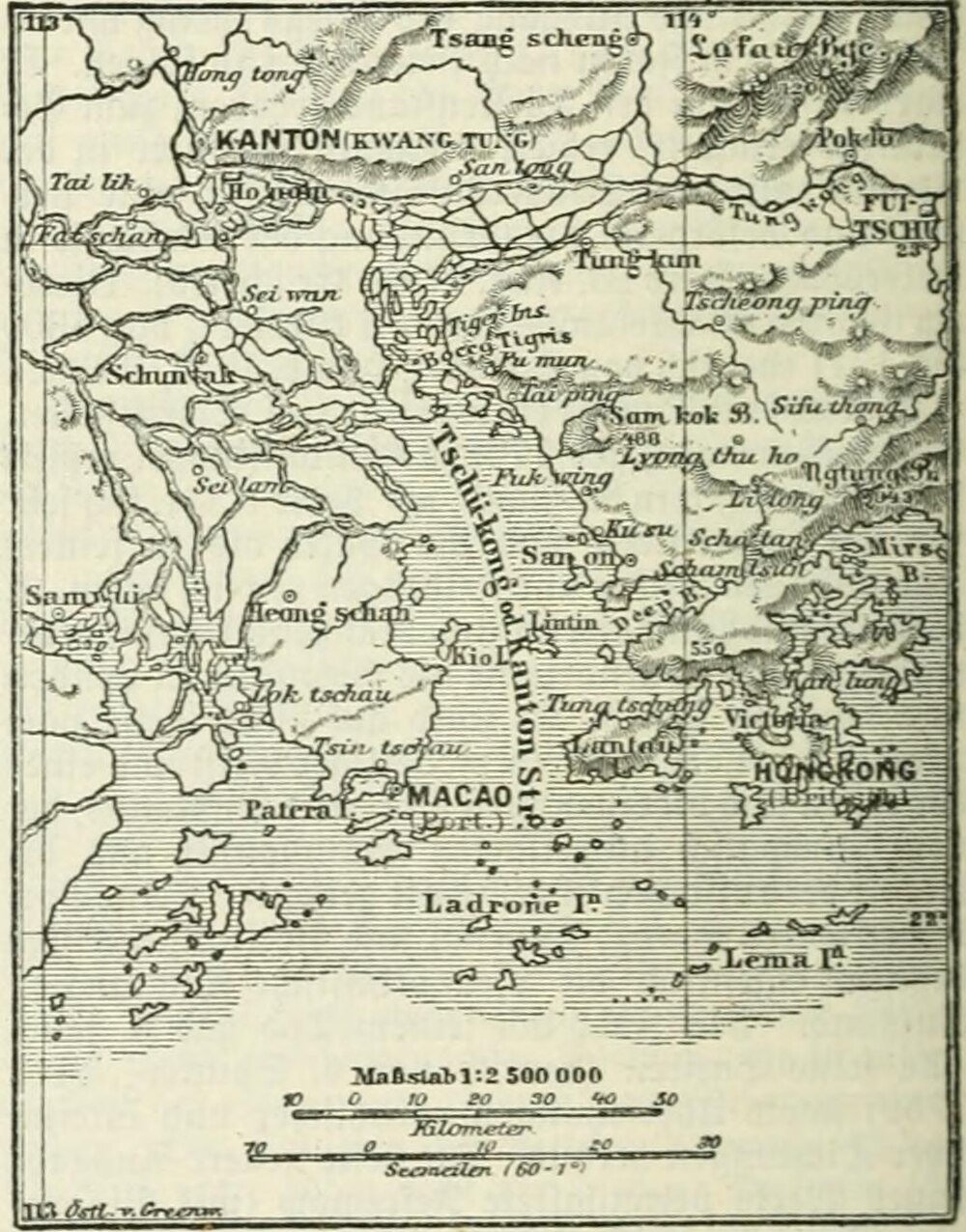
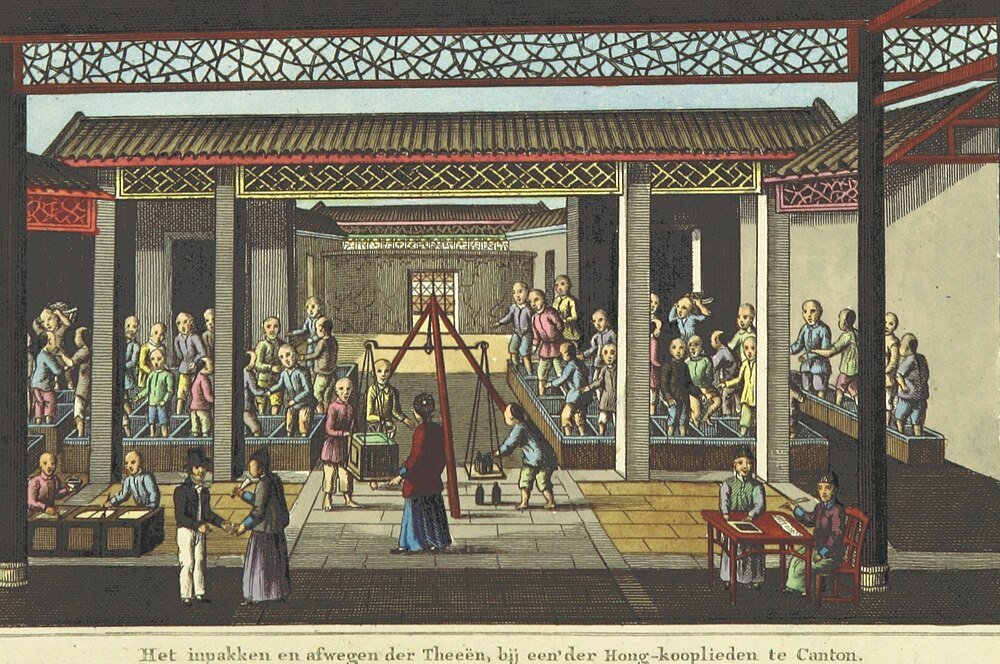
Guangzhou — better known to the West for centuries as Canton — is the city that defined every European stereotype of Imperial China. The tea, the porcelain, the silk, the lacquer-ware, and the silver-paid trade that drained Western treasuries to feed European demand for Chinese goods all flowed through this Pearl River port. For 85 years (1757–1842), Canton was officially the only Chinese port open to foreign trade, and by 1840 it was probably the most important commercial city on earth. Modern Guangzhou is older, larger, and quieter about its global role — but the long-haul trade pattern continues.
Ancient Foundations
Guangzhou’s story stretches back over 2,000 years. The settlement of Panyu was established around 214 BCE during the Qin Dynasty’s southern expansion. By 206 BCE, Panyu had become the capital of the Nanyue Kingdom, an independent realm under King Zhao Tuo (a former Qin general) that controlled much of southern China and northern Vietnam. After the Western Han Dynasty absorbed the kingdom in 111 BCE, Panyu remained a crucial provincial capital. The current name Guangzhou (“Wide Prefecture”) dates to 226 CE, when the Three Kingdoms-era Wu state established Guang Province here.
Maritime Silk Road Gateway
Guangzhou’s strategic position along the Pearl River made it the southern terminus of the Maritime Silk Road, connecting China to Southeast Asia, India, Arabia, East Africa, and ultimately the Mediterranean. Arab and Persian merchants established the famous “Fanfang” (foreigner quarter) in Guangzhou as early as the Tang Dynasty (618–907) — long before any Europeans arrived. The 9th-century city had perhaps 200,000 foreign residents.
European contact began in 1517 with the Portuguese (later confined to Macao). By 1711, the British East India Company had established a trading factory in Guangzhou. Emperor Qianlong’s 1757 “Canton System” made Guangzhou the only port permitted for European trade — confining Western traders to a small enclave on the river bank, the famous Thirteen Factories (each “factory” was actually a trading-house warehouse, not a manufacturing facility). The city’s tea, porcelain, and silk exports created the staggering trade imbalance that British opium imports were later designed to reverse — leading to the First Opium War (1839–1842), which ended with the Treaty of Nanking, the cession of Hong Kong to Britain, and the formal end of the Canton System.
Revolutionary Era and Modern Transformation
The 20th century brought dramatic changes. Sun Yat-sen, the “Father of Modern China,” made Guangzhou the base for his republican revolution; in 1924, he established the Whampoa Military Academy here under the joint KMT-CCP United Front, training the officer cadre (Chiang Kai-shek, Zhou Enlai, Lin Biao) that would dominate Chinese politics for the next half-century. The city was renamed Guangzhou (rather than Panyu, the older formal name) in 1918.
Guangzhou endured Japanese occupation from 1938 to 1945 and the chaos of the Chinese Civil War. Under the People’s Republic from 1949, the city’s commercial role was muted; the Canton Fair (Spring and Autumn import-export expos), launched in 1957, was for three decades China’s only major channel to global trade — making Guangzhou disproportionately important during the Cultural Revolution years. The 1978 reform-and-opening-up policy unlocked Guangzhou’s full economic potential; the city has been a manufacturing and commercial powerhouse ever since.
Geography, Climate & Best Time to Visit Guangzhou
Geographic Setting
Guangzhou sits at the heart of the Pearl River Delta — one of the world’s most densely populated urban regions, with over 60 million residents across the megacity cluster of Guangzhou, Shenzhen, Hong Kong, Macao, Foshan, Dongguan, and Zhuhai. Guangzhou itself has 18.7 million residents within city limits. The flat terrain at just 21 metres above sea level makes the city ideal for walking and cycling; the Pearl River (Zhujiang) winds through the metropolitan area, providing scenic waterways and the famous evening cruise routes.
Subtropical Climate
Guangzhou has a humid subtropical monsoon climate with annual average temperature 22°C. Summers (June–September) are hot, humid, and punctuated by serious afternoon thunderstorms; the city receives nearly 2,000 mm of annual rainfall, almost all of it April–August. The typhoon season runs June–October — major typhoons can shut the city down for 1–3 days at a time. Winters (December–February) are mild but humid; Guangzhou rarely freezes but the lack of indoor heating in older buildings makes January–February surprisingly uncomfortable.
| Month | High (°C) | Low (°C) | Rainfall (mm) | Sunshine (hrs/day) |
|---|---|---|---|---|
| January | 18.3 | 9.8 | 43 | 4.3 |
| February | 18.4 | 11.3 | 65 | 2.6 |
| March | 21.6 | 14.9 | 85 | 2.4 |
| April | 25.5 | 19.1 | 182 | 2.6 |
| May | 29.4 | 22.7 | 284 | 4.1 |
| June | 31.3 | 24.5 | 258 | 5.0 |
| July | 32.7 | 25.3 | 228 | 7.1 |
| August | 32.6 | 25.2 | 221 | 6.4 |
| September | 31.4 | 23.8 | 172 | 6.1 |
| October | 28.6 | 20.5 | 79 | 6.2 |
| November | 24.4 | 15.7 | 42 | 5.9 |
| December | 20.5 | 11.1 | 24 | 5.6 |
Best Time to Visit
October to early December is the optimal travel window — temperatures of 20–28°C, low humidity, minimal rain, and clear visibility. March–April is the second window, before the rainy season builds. Avoid May–August if possible — heat, humidity, daily afternoon thunderstorms, and active typhoon risk. The Spring Canton Fair (mid-April to mid-May) and Autumn Canton Fair (mid-October to mid-November) are major business events that fill hotels at premium rates; book months ahead if visiting in those windows.
Guangzhou’s Districts & Neighborhoods
Guangzhou is administratively divided into 11 districts. The visitor’s working map: Yuexiu for historic core, Tianhe for modern business and Canton Tower, Liwan for traditional Cantonese culture, Haizhu for the south bank.
Yuexiu District
The historic heart and traditional center of Guangzhou. The compact 34 km² area packs in 1 million residents and the highest concentration of cultural sights — Sun Yat-sen Memorial Hall, Yuexiu Park, Chen Family Ancestral Hall, Temple of the Six Banyan Trees, the Sacred Heart Cathedral, the Mausoleum of the Nanyue King. Best base for first-time visitors prioritizing heritage sights.
Tianhe District
The modern business center with Guangzhou’s futuristic skyline — Canton Tower, the Guangzhou Opera House (Zaha Hadid), the Pearl River New Town CBD, the East Tower (530 m), and the West Tower (440 m). Home to 2.24 million residents in 96 km². Luxury shopping malls (Taikoo Hui, Grandview Mall, Teemall) and international hotels. Best for business travelers and modern-China enthusiasts.
Liwan District
Western Guangzhou, the heartland of traditional Cantonese culture and old shophouses. The famous Shamian Island — the historic foreign-concession area with European-style architecture preserved as a heritage zone — is here. The Shangxiajiu Pedestrian Street showcases Lingnan-style colonnaded shophouses, traditional Cantonese restaurants, and the original Guangzhou shopping district. Densely populated (20,953 people/km²) with the most authentic local atmosphere.
Haizhu District
An island in the Pearl River, connected to the rest of the city by 11 bridges and a tunnel. The Pazhou International Convention & Exhibition Center (10.5 km², the world’s third-largest exhibition complex) hosts the Canton Fair twice yearly. Mix of residential neighborhoods and emerging cultural attractions; quieter alternative to the bustling north banks.
Baiyun District
Largest district by population (3.7 million), encompassing both urban areas and the scenic Baiyun Mountain (White Cloud Mountain). Home to the airport. Stay here for nature access while remaining metro-connected to the city center.
Panyu District
2.65 million residents in the southern suburbs. Home to Chimelong Tourist Resort (the largest theme park complex in southern China), the Guangzhou South high-speed rail station, and many of the suburban gated communities. Good value accommodation for budget-conscious visitors with a tolerance for longer commutes.
Top Things to Do in Guangzhou
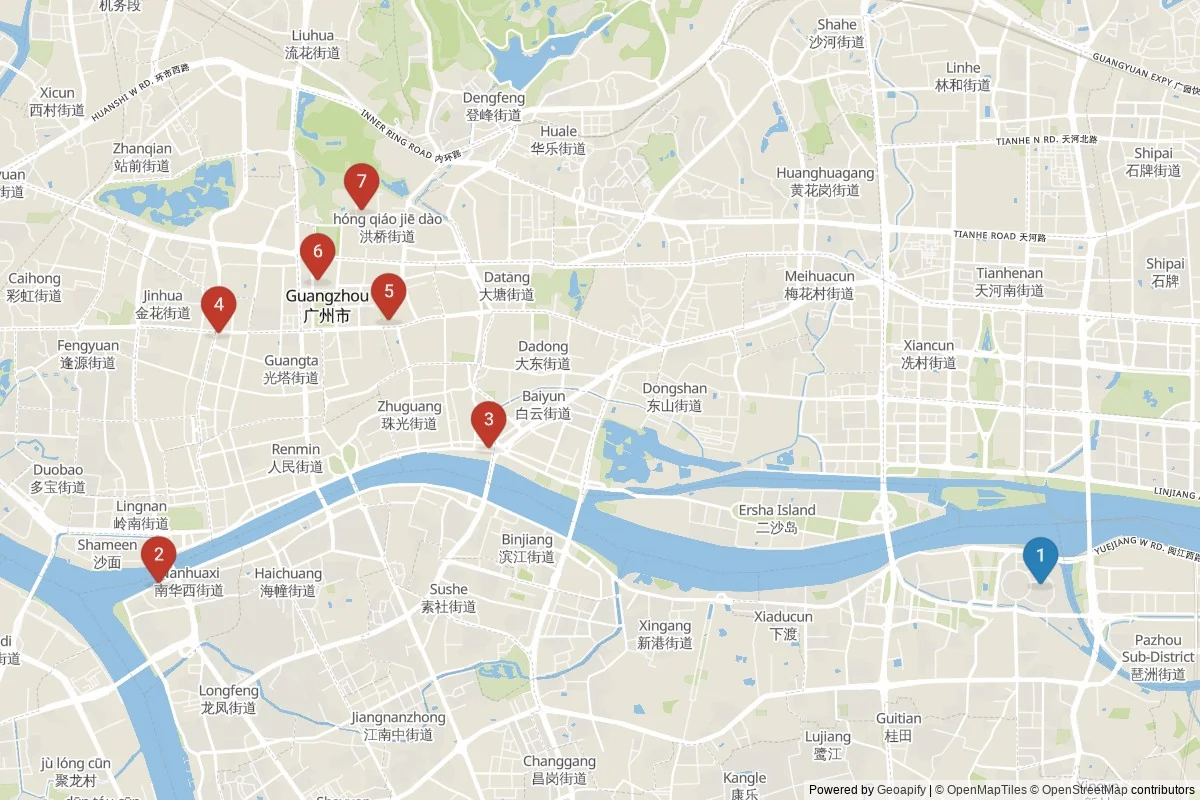
| # | Sight | Cluster | Type | Time | Entry | Best |
|---|---|---|---|---|---|---|
| 1 | Canton Tower | Central | Observation tower | ~2 hrs | ¥150 top | Sunset |
| 2 | Shamian Island | Outer | Colonial quarter | ~1.5 hrs | Free | Afternoon |
| 3 | Pearl River Cruise | Outer | River cruise | ~1 hr | ¥80 | Evening |
| 4 | Chen Clan Ancestral Hall | Outer | Folk-art museum | ~1.5 hrs | ¥10 | Morning |
| 5 | Beijing Road | Outer | Shopping street | ~1.5 hrs | Free | Evening |
| 6 | Six Banyan Temple | Outer | Buddhist temple | ~45 min | ¥5 | Morning |
| 7 | Yuexiu Park & Five Rams | Outer | Urban park | ~1.5 hrs | Free | Morning |
| 🚗 | Day Trip: Foshan (martial arts) | Day trip | Day trip | ½ day | ¥6 metro | Morning |
Guangzhou’s headline sights are dense — three days handles the city, four to five with a Foshan or Kaiping diaolou day-trip.
Iconic Landmarks
Canton Tower
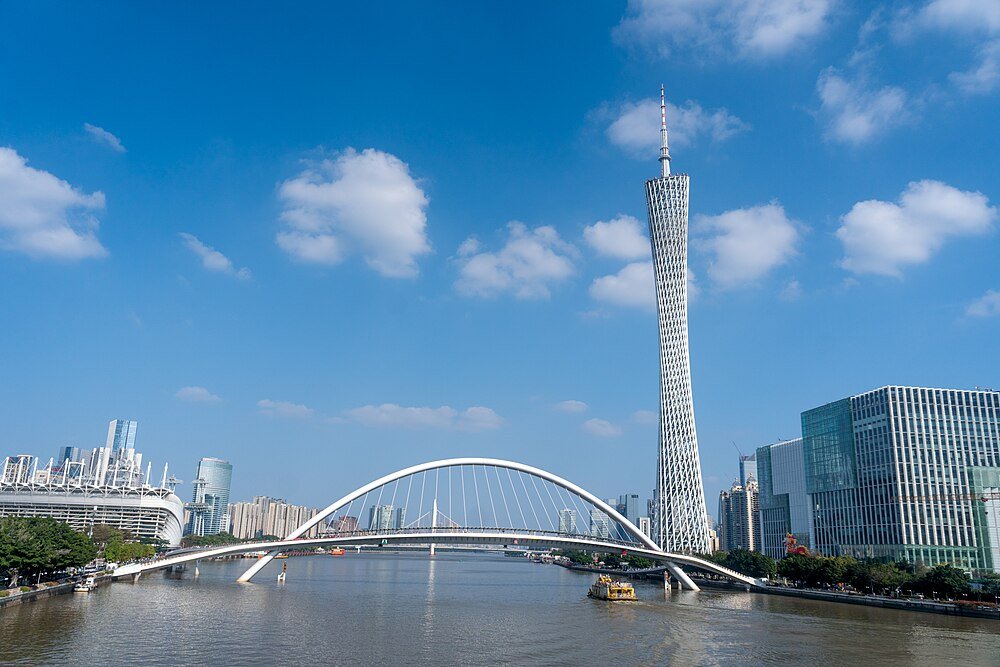
Standing 600 metres tall, the Canton Tower (天线塔) was the world’s tallest TV tower from 2010 until 2012 (Tokyo Skytree took the crown). The distinctive twisted “Skinny Lady” silhouette houses observation decks at multiple levels, restaurants, the world’s highest Ferris wheel (above the 488 m Skyfall), and the world’s highest bungee jump. Tickets ~228 RMB (Sky Drop, observation deck) via cantontower.com. Visit at sunset to watch the city transform into a glittering constellation; the tower itself is illuminated nightly with shifting LED patterns.
Sun Yat-sen Memorial Hall
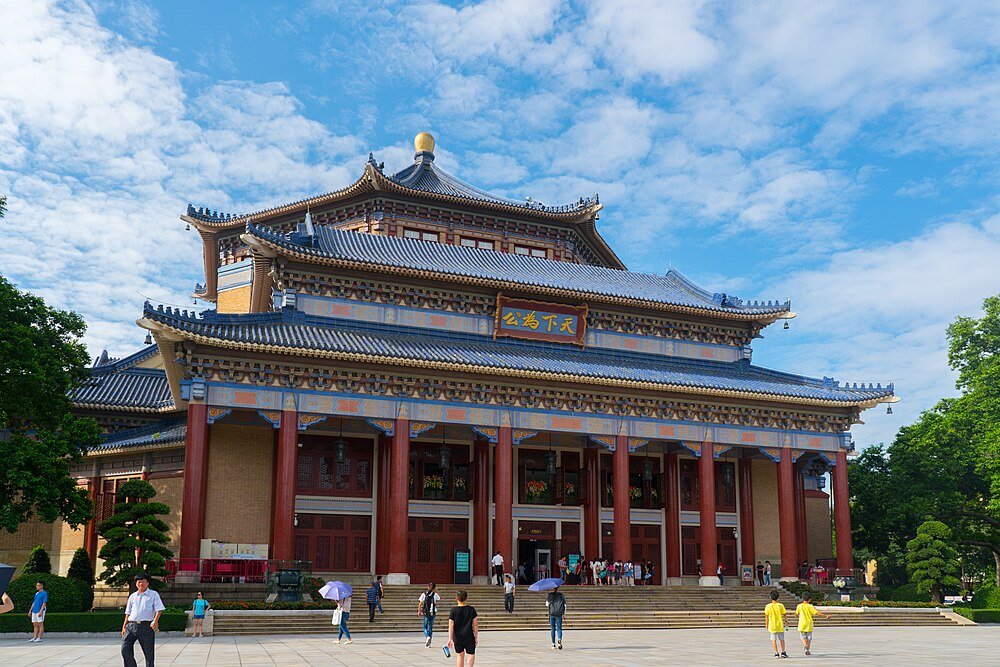
The 1929–1931 octagonal blue-tiled hall honors the Father of Modern China with traditional Chinese palatial architecture and sprawling gardens. The hall hosts performances and serves as a major Republican-era memorial site. Free entry to the gardens; ~10 RMB to enter the hall.
Temple of the Six Banyan Trees (Liurong Temple)
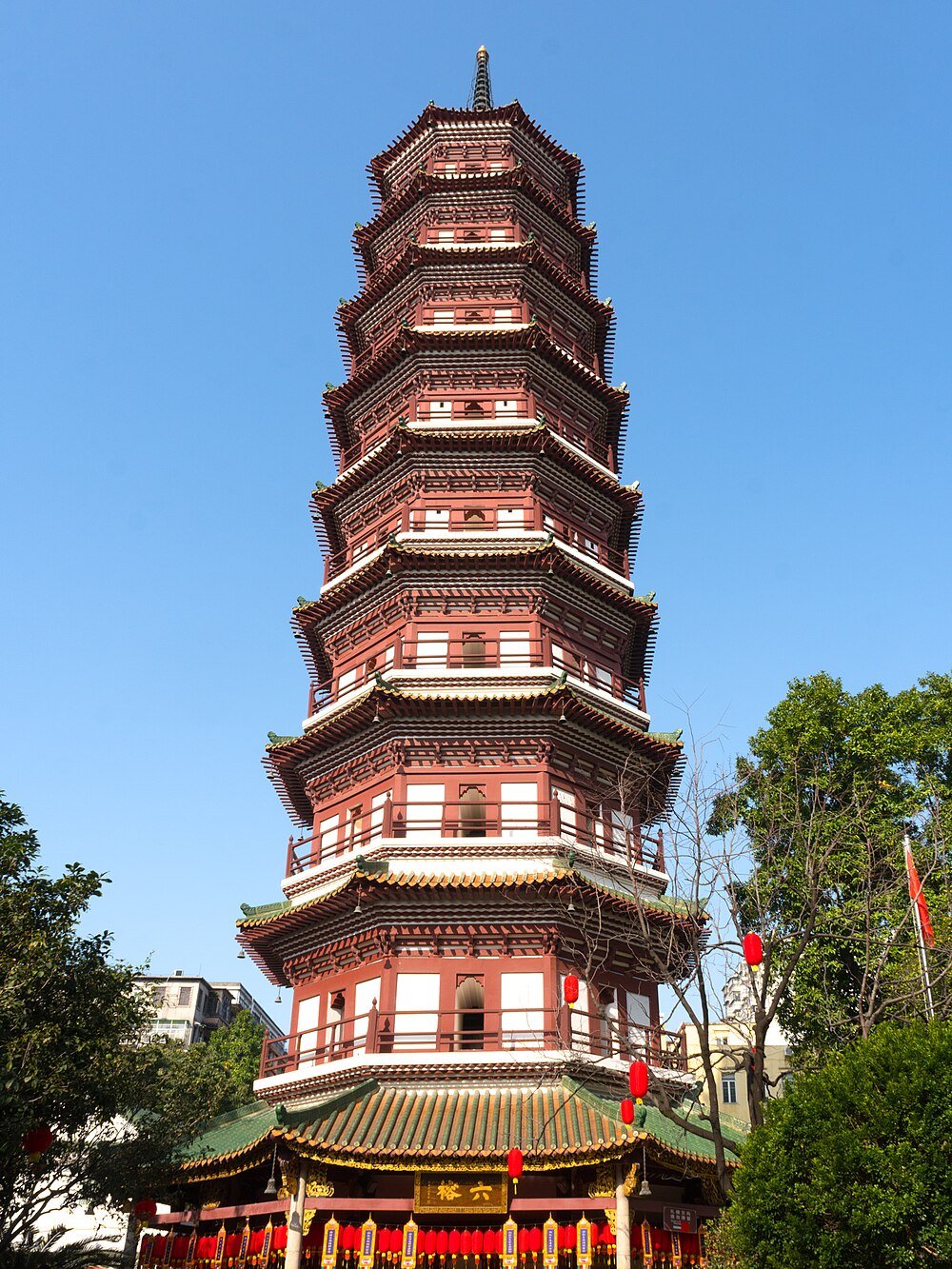
Founded in 537 CE, this Buddhist temple is most famous for the Flower Pagoda (Hua Ta) — a 17-storey octagonal pagoda built 1097, with bright orange-and-blue ceramic tiles. The 11th-century poet Su Dongpo named the temple after the six banyan trees in the courtyard. Tickets ~5 RMB.
Sacred Heart Cathedral (Stone House Cathedral)
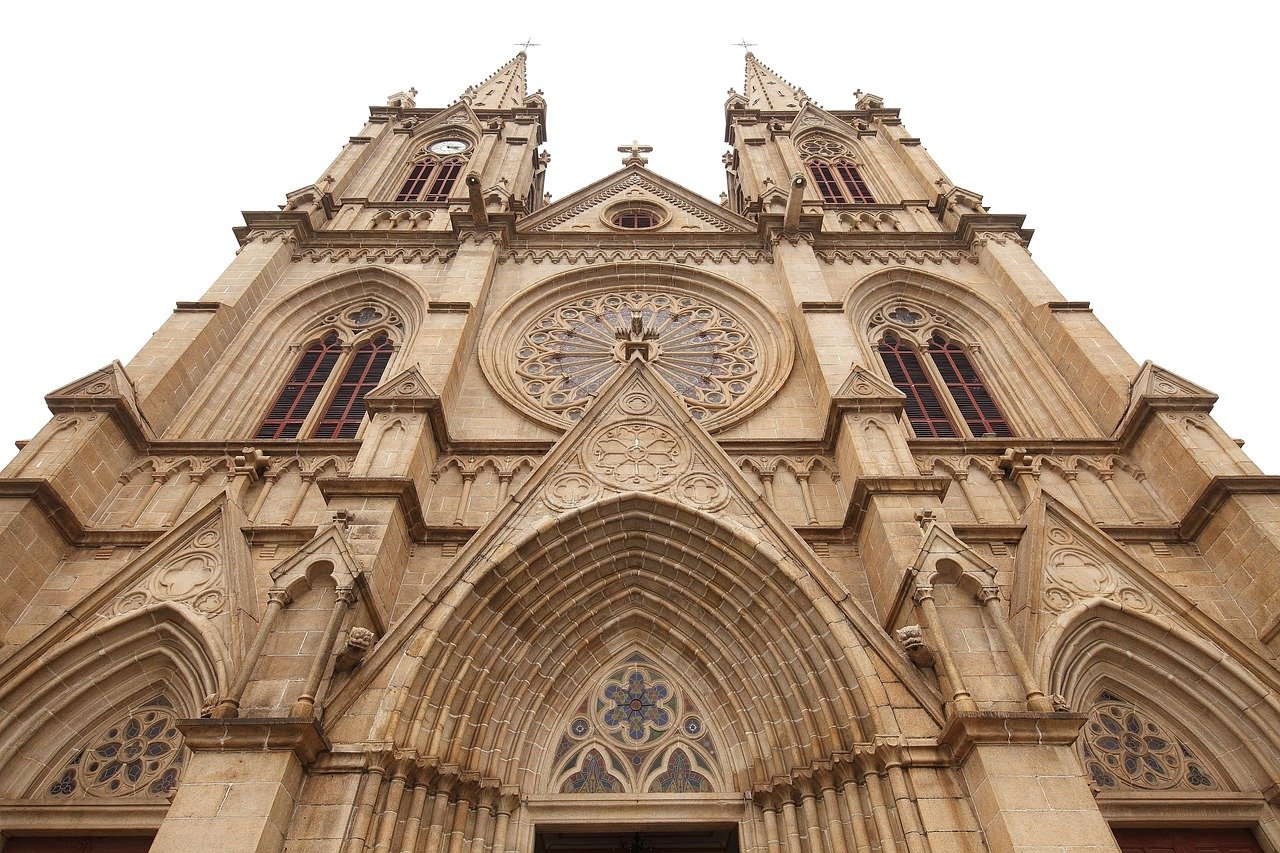
This Gothic Revival masterpiece (built 1863–1888) features twin 58-metre granite spires and beautiful stained-glass windows. Designed by French architect Léon Vautrin, it’s one of only four all-stone Gothic churches in the world (along with Notre-Dame de Paris, Cologne Cathedral, and Westminster Abbey). Free entry; an active Catholic parish.
Museums and Culture
Guangzhou Opera House
Designed by Zaha Hadid (her first major Chinese commission, completed 2010), this futuristic crystal-like structure hosts world-class performances and stands as one of Guangzhou’s most photographed buildings. Tour tickets and performance tickets via gzdjy.org.
Mausoleum of the Nanyue King Museum
Discovered accidentally in 1983 during a hotel construction excavation, this is the underground tomb of King Zhao Mo (137–122 BCE), the second king of the Nanyue Kingdom — and one of the most important archaeological finds in southern China. The collection includes a famous jade burial suit, gold seals, and bronze weapons. Tickets ~12 RMB.
Chen Family Ancestral Hall (Chen Clan Academy)
Built 1894 as a school for the Chen clan members of all 72 Chen-named villages in Guangdong Province, this is the finest surviving example of Lingnan architecture — intricate roof ridges with hand-shaped ceramic figurines, wood carvings, brick carvings, stone carvings, and traditional Cantonese craftsmanship at its 19th-century peak. Tickets ~10 RMB.
Parks and Natural Areas
Yuexiu Park
The largest urban park in central Guangzhou, home to the iconic Five Goats Statue (Wuyang) — the symbol of Guangzhou, commemorating the legend of five immortals who arrived riding goats. The historic Zhenhai Tower is a 14th-century Ming Dynasty fortress turned museum. Free park entry; tower museum ~10 RMB.
Baiyun Mountain
“White Cloud Mountain” — the highest peak in Guangzhou (382 m) — escape the urban hustle with a cable car ride or 90-minute hike. Panoramic city views, mist-shrouded peaks, and traditional teahouses at the summit. Tickets ~5 RMB; cable car ~25 RMB.
Baomo Garden
30 km south in Panyu District, this serene Qing-style garden features traditional water gardens, ancient pavilions, and 5,000+ stone carvings telling Chinese legends through art. The single best classical Chinese garden experience in the Guangzhou region.
Shopping and Entertainment
Shangxiajiu Pedestrian Street
Liwan District’s historic walking street, the original Cantonese commercial heart. Combines traditional Lingnan-style colonnaded shophouses with modern shopping; the dim sum restaurants, dried-seafood markets, and the Guangzhou-style Cantonese pastries are the draw.
Pearl River New Town & Tianhe Shopping
The modern shopping district — Taikoo Hui, Grandview Mall, Teemall, and the underground Wansheng Plaza. International luxury brands, Chinese designer boutiques, modern entertainment complexes, and the contemporary Cantonese fine-dining scene cluster here.
How to Get to Guangzhou
By Air
Guangzhou Baiyun International Airport (CAN), located 28 km north of downtown, is one of China’s three busiest airports — handling over 60 million passengers annually. Hub for China Southern Airlines, the largest Chinese airline. Direct flights from major Asian, European, North American, and African cities. The Airport Express metro line (Line 3 North Extension) reaches Tiyu Xilu in central Tianhe in 35 minutes. Live status at gbiac.net.
By High-Speed Rail
Guangzhou South Railway Station (Guangzhounan) — the largest railway station in Asia when built in 2010 — connects the city to China’s high-speed rail network. Direct services: Beijing (8 hours), Shanghai (8 hours via Hangzhou), Hong Kong West Kowloon (47 minutes), Wuhan (4 hours). The Guangzhou–Hong Kong high-speed rail launched 2018 has dramatically simplified Hong Kong–Guangzhou trips. Booking via 12306.cn or via Trip.com / 12go for foreign-card-friendly booking.
By Ferry
Regular ferry services connect Guangzhou to Hong Kong, Macao, and other Pearl River Delta cities — useful scenic alternatives to rail. The Lianhua Mountain Wharf in Panyu has the most regular Hong Kong-bound services.
Getting Around Guangzhou
Guangzhou Metro
The Guangzhou Metro (since 1997) is one of the world’s top-10 busiest systems with over 8.9 million daily riders. The network includes 14 main lines plus the Guangfo Line connecting to Foshan and the futuristic APM (Automated People Mover) in the Pearl River New Town business district. Fares 2–14 RMB by distance. Yang Cheng Tong (Sheep City Pass) — the rechargeable transit card — works on metro, bus, and ferry. Routes at gzmtr.com.
Buses
Most buses feature air conditioning at ¥1–2 per ride. The extensive network covers all districts and provides an economical way to explore the city.
Taxis and Ride-Hailing
Taxis are readily available with meters starting at ¥10 for the first 2 km. DiDi Chuxing (the dominant Chinese ride-hailing app) is the practical equivalent of Uber; the app now supports international cards via WeChat Pay or Alipay linkage. Foreign-issued credit cards work at most major hotels and shopping malls but not at smaller restaurants and street vendors.
Pearl River Ferries
Cross-river ferries operate every 5–30 minutes during daylight, providing scenic transportation and sightseeing opportunities. Evening dinner cruises from Tianzi Pier showcase the illuminated skyline and bridges (~150–400 RMB per person).
Baiyun Mountain Cable Car
Eight-seater gondolas transport visitors to the city’s highest point, offering panoramic views and access to hiking trails. Tickets ~25 RMB.
Food & Drink in Guangzhou
Cantonese Cuisine Capital
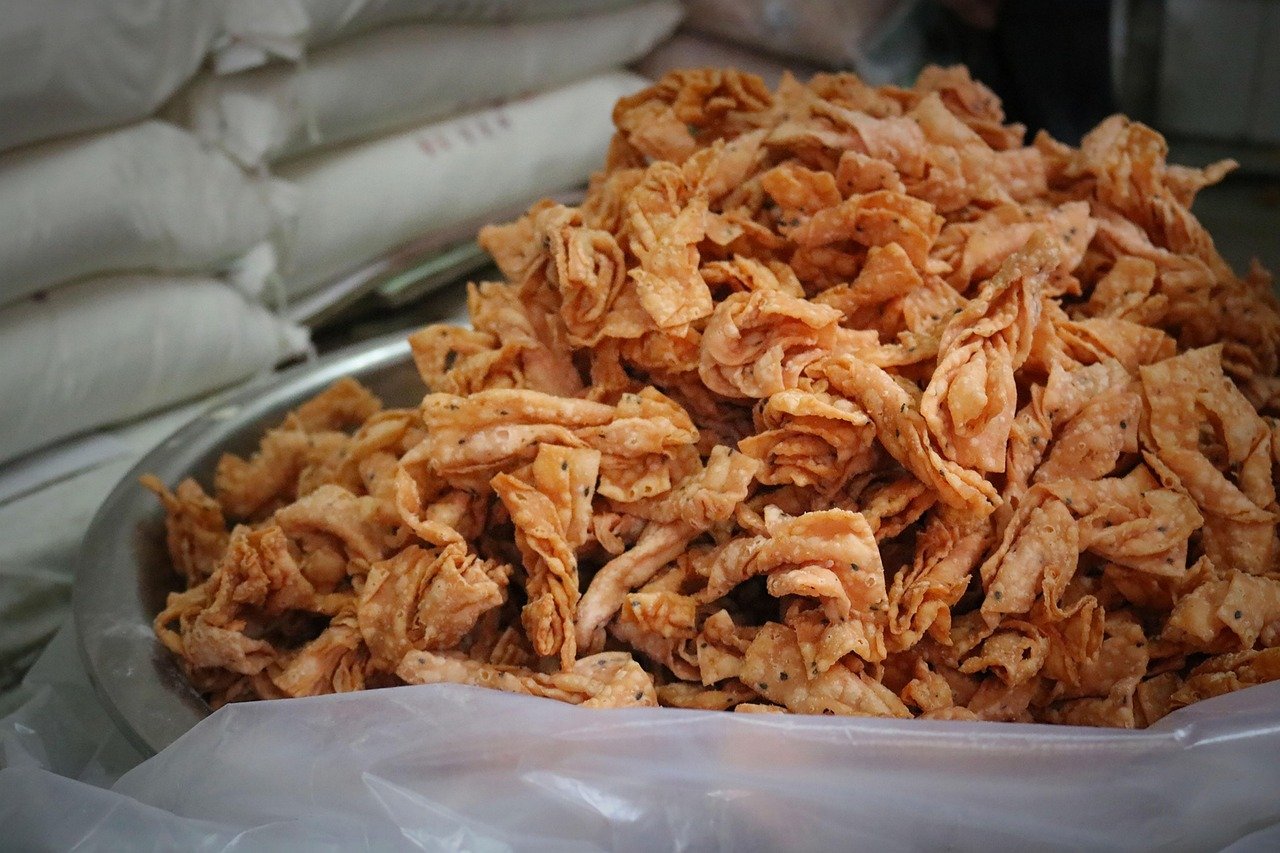
Guangzhou is the global capital of Cantonese cuisine — and Cantonese is the regional Chinese tradition that has most influenced restaurants worldwide (the standard “Chinese restaurant” outside East Asia is, until recently, almost entirely Cantonese-style). The Cantonese philosophy emphasizes fresh ingredients, mild seasonings, and masterful cooking techniques that preserve natural tastes. The local saying: “The Cantonese will eat anything with four legs except a table, anything with wings except an airplane, and anything in the water except a submarine.“
Must-Try Dishes
Dim Sum (Yum Cha)
Experience the morning ritual of “yum cha” (drinking tea with dim sum) at a traditional Cantonese teahouse: bite-sized dumplings (har gow shrimp, siu mai pork), steamed buns (char siu bao with barbecued pork), delicate pastries, and an essential pot of tea. The classics: Tao Tao Ju (the city’s oldest yum cha house, since 1880), Pin Shi Long, Lin Heung Tea House at Liwan Plaza.
Slow-Cooked Soups (Lao Huo Liang Tang)
The Cantonese signature — soups simmered for 4–8 hours, combining medicinal herbs with fresh ingredients, served before the meal as a nourishing tonic. Each Cantonese family has favorites; restaurants serve seasonal versions adjusted to current weather and supposed health benefits.
Congee (Zhou)
Creamy rice porridge served with various toppings — fish, pork, century egg, ginger — represents the ultimate Cantonese comfort food. The classic Guangzhou congee places: Yang Cheng Wan and the early-morning markets where you can eat congee at standing-only counters for ¥10.
Roast Goose (Shao’e)
The Cantonese roast-meat tradition reaches its peak with Cantonese roast goose — crispy lacquered skin, succulent meat, served with plum-sauce dip. Pin Lo (the most famous goose specialist) and Yat Lok are the institutional names.
Where to Eat
Traditional yum cha houses in Liwan District offer authentic dim sum experiences. Tianhe District features international cuisine and upscale dining at the Pearl River New Town malls. Street food markets throughout the city provide affordable local specialties and regional variations — particularly the Fangcun Tea Market (the world’s largest tea trading center) for tea-and-pastry pairings.
Guangzhou by District: The 11 区
Guangzhou is divided into 11 districts. The map below shows their official OSM boundaries, colour-coded to match the table — a quick way to orient yourself before zooming in on individual sights.
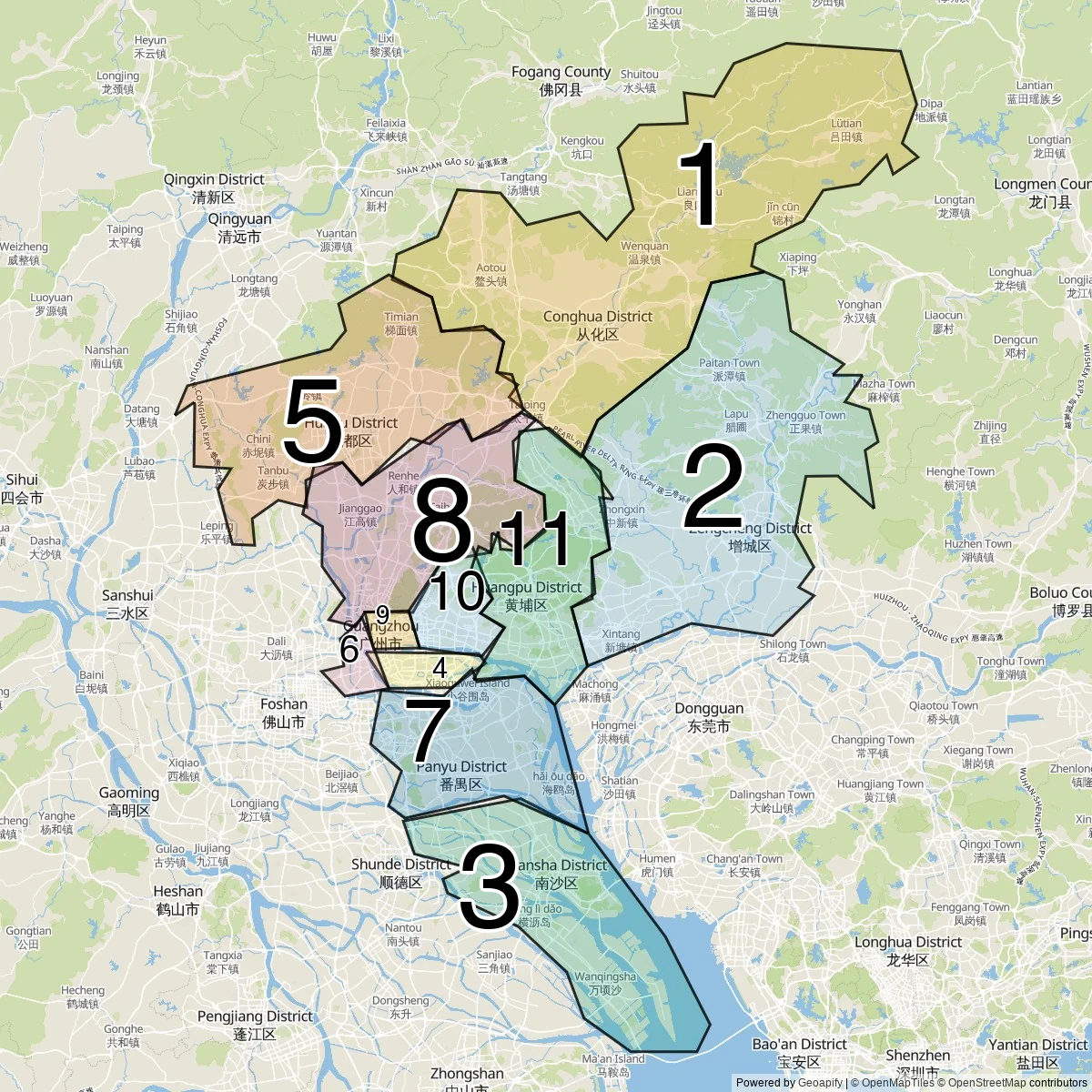
| # | 区 |
|---|---|
| 1 | 从化区 · Conghua District |
| 2 | 增城区 · Zengcheng District |
| 3 | 南沙区 · Nansha District |
| 4 | 海珠区 · Haizhu District |
| 5 | 花都区 · Huadu District |
| 6 | 荔湾区 · Liwan District |
| 7 | 番禺区 · Panyu District |
| 8 | 白云区 · Baiyun District |
| 9 | 越秀区 · Yuexiu District |
| 10 | 天河区 · Tianhe District |
| 11 | 黄埔区 · Huangpu District |
Frequently Asked Questions About Visiting Guangzhou
Do I need a visa to visit Guangzhou?
Probably yes — but rules have shifted dramatically in 2024–2025. Most US, EU, UK, Australian, Canadian, Japanese, and ASEAN passport-holders can use the 240-hour transit visa-free policy if entering and exiting through different cities or ports — Guangzhou qualifies as a transit point. Citizens of around 38 countries (most EU members, Australia, New Zealand, Japan, South Korea, Malaysia, Thailand) can also enter visa-free for tourist stays up to 30 days under the bilateral agreements signed since November 2024. Most other nationalities still need a tourist visa applied for at the Chinese embassy before travel; the official portal is visaforchina.cn. Guangzhou has a 144-hour visa-free transit policy for many nationalities entering from Hong Kong/Macao via the Guangzhou-Shenzhen-Hong Kong High-Speed Rail. Always check the latest at the Chinese Ministry of Foreign Affairs 4–6 weeks before travel.
Is Guangzhou safe for tourists?
Guangzhou is genuinely safe — China overall has very low violent crime rates by international standards. The US State Department rates China at “exercise increased caution” — primarily for legal and political risks of arbitrary detention rather than street-crime concerns. Real risks: pickpocketing in crowded markets and metro stations during peak hours; counterfeit money in change at smaller shops (check large-denomination notes); rare overcharging at touristy tea-tasting scams (“would you like to try our tea?” and then demanding 500 RMB). Air quality: occasionally poor in winter due to regional pollution patterns; check live readings at aqicn.org/city/guangzhou. Apps and connectivity: Google, Facebook, WhatsApp, Instagram, and most Western news sites are blocked behind the Great Firewall; install a reputable VPN before arrival if you need them. Typhoons: June–October peak; check forecasts.
How many days do I need in Guangzhou?
Three full days handles the city; four to five with day-trips. A solid 3-day plan: Day 1 — Yuexiu (Sun Yat-sen Memorial + Yuexiu Park + Mausoleum of the Nanyue King + Temple of the Six Banyan Trees) + dinner in Liwan; Day 2 — Tianhe (Pearl River New Town + Canton Tower at sunset + Guangzhou Opera House) + Pearl River dinner cruise; Day 3 — Shamian Island + Shangxiajiu Pedestrian Street (Liwan) + Chen Family Ancestral Hall + Cantonese yum cha brunch. Day 4–5: Foshan (the Cantonese opera and Bruce Lee birthplace, 30 min by metro), Hong Kong (47 min by HSR from Guangzhou South), or the Kaiping diaolou UNESCO watchtowers (3 hours west). Canton Fair visitors: budget 5–7 days for the fair itself (April–May or October–November) plus 2 days minimum for sightseeing.
What’s the best area to stay in Guangzhou?
Three solid options. Tianhe District / Pearl River New Town — the modern business choice; international hotels (Mandarin Oriental, Four Seasons, W, Conrad, Park Hyatt) clustered around the CBD with easy metro access; $100–500/night; the area’s nightly skyline-and-Canton Tower view is unbeatable. Yuexiu District — the historic central choice; mid-range hotels walking distance to the Sun Yat-sen Memorial, Yuexiu Park, and the metro hub; $50–200/night. Liwan District / Shamian Island — the cultural-heritage option; boutique hotels in restored European-concession buildings on Shamian Island, walking distance to Cantonese yum cha temples and the Shangxiajiu Pedestrian Street; $80–250/night. Skip: hotels far from a metro line — Guangzhou’s surface traffic during rush hour is genuinely brutal.
How much does it cost to visit Guangzhou’s major sights?
Guangzhou’s headline sights are remarkably affordable. Canton Tower observation deck: ~228 RMB via cantontower.com (Sky Drop and Bubble Tram extra). Sun Yat-sen Memorial Hall: ~10 RMB. Mausoleum of the Nanyue King: ~12 RMB. Chen Family Ancestral Hall: ~10 RMB. Temple of the Six Banyan Trees: ~5 RMB. Yuexiu Park: free (Zhenhai Tower museum ~10 RMB). Sacred Heart Cathedral: free. Shamian Island walking: free. Baiyun Mountain: ~5 RMB entry, ~25 RMB cable car. Pearl River dinner cruise: 150–400 RMB per person depending on operator and meal level. Guangzhou Opera House tour: ~30 RMB. Chimelong Tourist Resort (Panyu, theme park): ~250–350 RMB single-park ticket.
Should I drink the tap water in Guangzhou?
No — tap water in Guangzhou meets Chinese drinking-water standards at the treatment plant, but locals universally drink bottled or boiled water due to inconsistent distribution-system quality. Always use bottled water (2–5 RMB per liter at convenience stores) for drinking and brushing teeth. Hotels typically provide complimentary bottled water and electric kettles for boiling water. Restaurants serve free tea or hot water (boiled, safe) and bottled water; ice in major hotel restaurants is generally safe but rare in local restaurants (Chinese culinary tradition is to serve tea, not ice water, with meals). Tap water is fine for showering. The CDC traveler health page recommends bottled or boiled water for China.
Can I use Western payment methods in Guangzhou?
This is the practical question that surprises most first-time visitors. Like Shenzhen and Beijing, cash and Western cards are increasingly difficult to use; Guangzhou is one of the world’s most cashless cities, with everything from street food to taxi rides paid via WeChat Pay or Alipay mobile QR codes. Good news (since 2023–2024): WeChat Pay and Alipay both now allow international visitors to link foreign credit cards directly inside the apps, making them usable for most transactions. Practical advice: download WeChat and Alipay before arrival, link a Visa or Mastercard inside each, and have ~500 RMB cash as backup. International credit cards (Visa, Mastercard, Amex) work at most major hotels, large restaurants, department stores, and Canton Fair vendor stands — but not at small restaurants, street vendors, or many local shops. ATMs at Bank of China, ICBC, and HSBC accept foreign cards (~3,000 RMB withdrawal limit per transaction).
Is tipping expected in Guangzhou?
No — and tipping can occasionally cause confusion. Tipping is not part of Chinese service culture, and excellent service is the baseline expectation. Restaurants: never tip; some upscale Western-style restaurants and luxury hotel restaurants add a 10% service charge (服务费 fúwùfèi) to the bill — that’s the closest equivalent. Taxis: pay the meter exactly; no tip. Hotel porters: 5–20 RMB per bag at luxury Western-brand hotels is appreciated; not expected at standard or budget hotels. Tour guides: 100–300 RMB per person for half-day group tours, more for full private day; bus drivers typically not tipped. Spa, hair: not customary. Yum cha tea-pouring: tap your bent index and middle finger gently on the table next to your teacup as a thanks gesture (this is the traditional “finger kowtow” thank-you when someone pours your tea — replaces verbal thanks during conversation). The single exception: high-end Western-targeted resorts may have a tip culture; otherwise, your money stays in your pocket.
Economy & Business
Trade and Commerce Hub
Guangzhou has been southern China’s economic heartbeat since 1949, hosting the legendary Canton Fair (China Import & Export Fair) twice yearly. Established 1957, it was for three decades China’s primary channel to global commerce; today it remains the world’s largest trade fair by attendance, drawing 200,000+ international buyers each session. The Spring Fair runs mid-April to early May; the Autumn Fair mid-October to early November.
Industrial Powerhouse
The Guangzhou industrial base includes automotive manufacturing (Honda, Toyota, Nissan all have major joint-venture plants), electronics, textiles, and petrochemicals. Major international companies including Honda, Toyota, P&G, 7-Eleven, FedEx, and Coca-Cola operate significant Guangzhou operations.
Service Sector Leadership
As Guangdong Province’s service-sector leader, Guangzhou dominates software development, logistics networks, and financial services. The massive Pazhou International Convention Center (10.5 km², the world’s third-largest exhibition complex) hosts the Canton Fair plus year-round events including LED CHINA, Auto Guangzhou, and the Guangzhou International Lighting Exhibition.
Culture & Arts
Musical Heritage
The Guangzhou Symphony Orchestra (founded 1957, refounded 1998) performs at the Guangzhou Opera House and the Xinghai Concert Hall — China’s first concert hall designed specifically for symphonic acoustics. The hall is named after Guangzhou-born composer Xian Xinghai, who wrote the iconic Yellow River Cantata.
Contemporary Art Scene
The triennial Guangzhou Triennial transforms the city into a contemporary art showcase; the Guangdong Museum of Art has gained international recognition with exhibitions at the Venice Biennale. The Redtory Art & Design Factory (a converted 1950s canning factory) hosts contemporary galleries, design studios, and indie cafés.
Sports and Entertainment
Tianhe Stadium hosted the 2010 Asian Games and Women’s Football World Cup matches; the 60,000-seat venue regularly hosts Guangzhou FC matches and international football. Guangzhou Evergrande Taobao FC (now Guangzhou FC) is the most-decorated Chinese Super League team of the 2010s.
Education
Academic Excellence
Sun Yat-sen University (founded 1924), one of China’s elite “Project 985” universities, houses the Tianhe-2 supercomputer — which held the world speed record from 2013 to 2016 with 33.86 petaflops. The futuristic Guangzhou Library in Tianhe is one of China’s most architecturally striking modern libraries. South China University of Technology and the Guangzhou Academy of Fine Arts are the other major specialized institutions.
Diverse Institutions
The city hosts numerous specialized universities including the Xinghai Conservatory of Music, South China Normal University, and the Guangdong University of Foreign Studies — creating a vibrant international student community of 50,000+ across the city.
Guangzhou rewards travelers who balance the obvious with the historic: three days for Yuexiu, Tianhe, and Liwan; a fourth for Baiyun Mountain or a Foshan day-trip; a fifth for the Kaiping diaolou watchtowers (UNESCO, 130 km southwest). The city is older, larger, and far more nuanced than its modern manufacturing-hub reputation suggests — and its 2,300-year-old commercial DNA still shapes how the city feels, eats, and operates.
AFRIKA
Cairo Hurghada Johannesburg Marrakech
ASIA
Abu Dhabi Agra Antalya Bangkok Batam Beijing Bengaluru Cebu City Chiang Mai Chiba Chennai Da Nang Dammam Delhi Denpasar Dubai Fukuoka Guangzhou Guilin Ha Long Hanoi Ho Chi Minh City Jakarta Jaipur Johor Bahru Kolkata Krabi Kuala Lumpur Kyoto Macau Mecca Medina Mugla Mumbai Osaka Pattaya Penang Phuket Riyadh Seoul Shanghai Shenzhen Singapore Taipei Tokyo Zhuhai
EUROPE
Amsterdam Athens Barcelona Berlin Brussels Budapest Copenhagen Dublin Florence Frankfurt am Main Heraklion Krakow Lisbon London Madrid Milan Munich Nice Paris Porto Prague Rhodes Rome Stockholm Venice Vienna Warsaw
NORTH AMERICA
Cancun Las Vegas Los Angeles Miami New York City Orlando San Francisco Toronto Vancouver
SOUTH AMERICA
Buenos Aires Lima Rio De Janeiro
OCEANIA
Auckland Honolulu Melbourne Sydney