
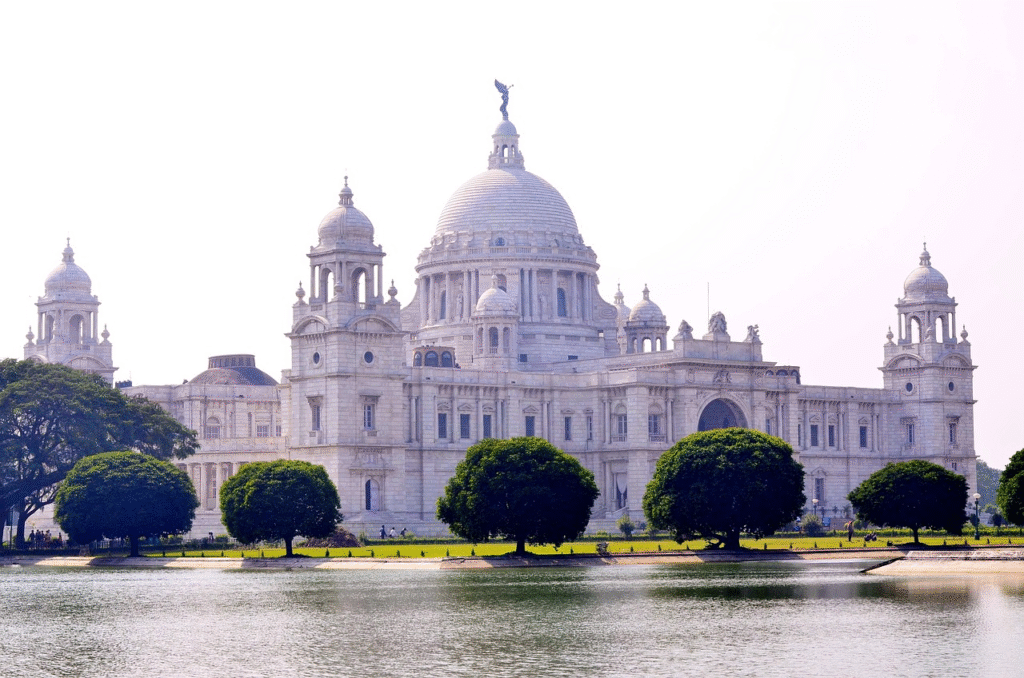
Photo credit: Victoria Memorial, Kolkata
Kolkata — formerly spelled Calcutta until the official 2001 name change — is the capital of West Bengal and one of India’s most distinctive cultural cities. As the capital of British India from 1772 to 1911, Kolkata was the second-most-important city of the entire British Empire after London for nearly 140 years; the layered legacy of colonial-era Beaux-Arts architecture, Anglo-Bengali intellectual culture, and the city’s role as the country’s literary, cinematic, and artistic capital remains visible block by block. The defining figures of modern Bengali culture — Nobel-winning poet Rabindranath Tagore, filmmaker Satyajit Ray, physicist Jagadish Chandra Bose, freedom-fighter Subhas Chandra Bose, missionary Mother Teresa — all worked from Kolkata. Today’s city is India’s third-largest metropolitan area (over 14 million people in the broader Howrah-Kolkata-Hooghly conurbation), home to the country’s most intellectually-anchored Bengali-speaking population, the iconic Howrah Bridge (one of the world’s busiest cantilever bridges), the Victoria Memorial (the most-visited single colonial-era monument in India), the working-class tradition of hand-pulled rickshaws (the last city in India to retain them), and a food culture that combines Bengali sweet-and-mustard traditions with the vast Anglo-Indian fusion legacy. Kolkata earns its other modern nickname — “City of Joy” (from Dominique Lapierre’s 1985 book about the city’s resilience) — as much through cultural depth as through the still-visible challenges of poverty, urban decay, and chronic infrastructure stress.
Kolkata by District: The 6 Boroughs
Kolkata is divided into 6 kmc boroughs. The map below shows their official OSM boundaries, colour-coded to match the table — a quick way to orient yourself before zooming in on individual sights.
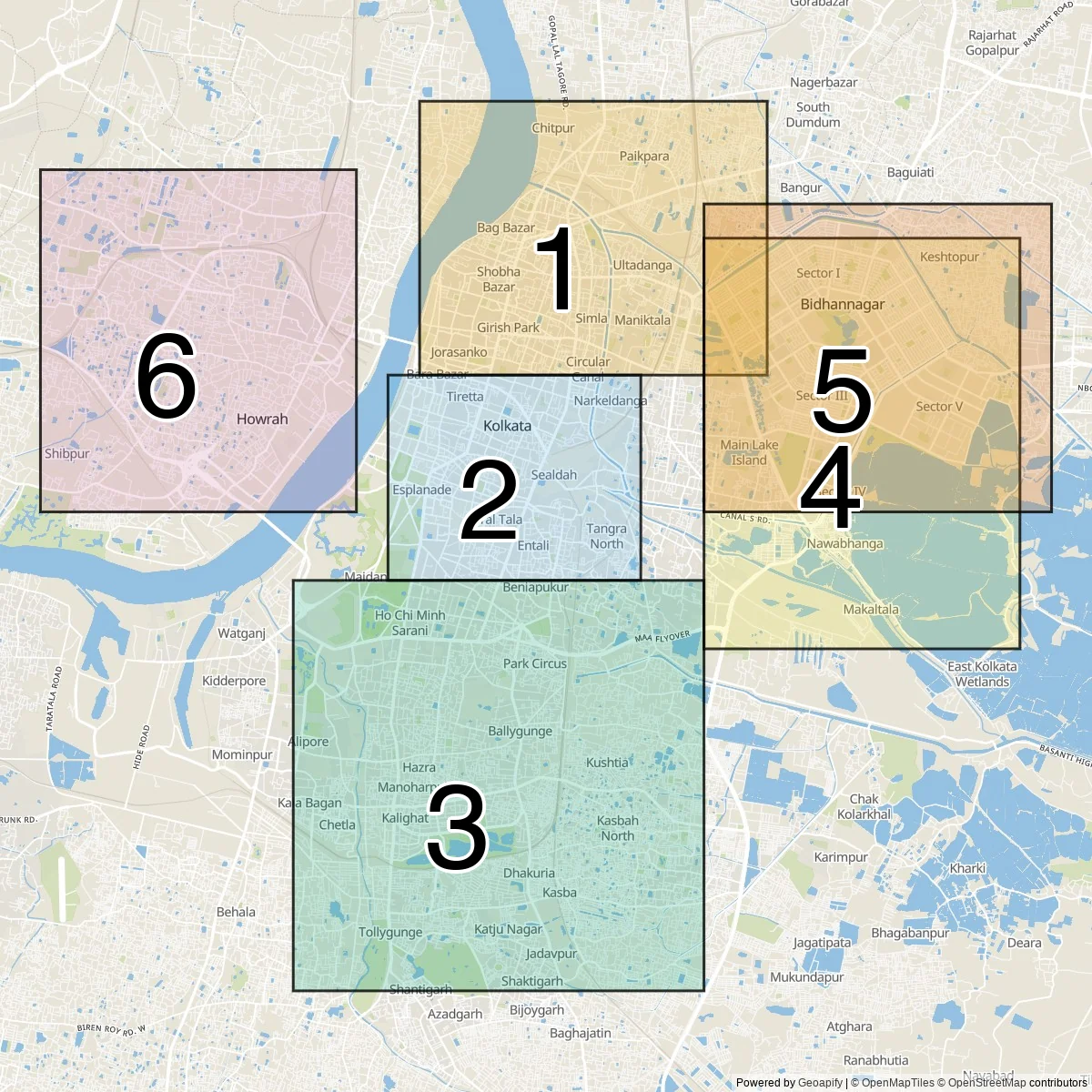
| # | Boroughs |
|---|---|
| 1 | Uttar Kolkata · North Kolkata |
| 2 | Madhya Kolkata · Central Kolkata |
| 3 | Dakshin Kolkata · South Kolkata |
| 4 | Purba Kolkata · East Kolkata |
| 5 | Bidhannagar · Salt Lake (BD) |
| 6 | Howrah · Howrah (across) |
Kolkata at a Glance: Essential Facts for Travelers
| Location | West Bengal state, eastern India (Ganges Delta, Hooghly River) |
|---|---|
| Coordinates | 22.5726°N, 88.3639°E |
| Population | ~4.5 million (city, 2024 estimate); metro area (Kolkata Metropolitan Region) ~14.85 million |
| Area | 206 km² (city); 1,886 km² (metro) |
| Elevation | ~9 m above sea level (flat Ganges delta) |
| Time Zone | Indian Standard Time (IST, UTC+5:30 — no daylight saving) |
| Calling Code | +91 (city code 33) |
| Currency | Indian Rupee (INR ₹) |
| Languages | Bengali official and widely spoken; English widely in business and tourism; Hindi, Urdu, and many other Indian languages in the broader population |
| Religion | Predominantly Hindu (~76%) with significant Muslim (~20%), Christian, and Sikh minorities; the country’s largest Jewish community historically (now reduced to a few hundred); Tibetan Buddhist refugee community |
| Climate | Tropical wet-and-dry — hot humid summers, mild winters, monsoon June–September |
| Founded | Officially 1690 by British East India Company (Job Charnock); earlier settlements documented; renamed from Calcutta to Kolkata in 2001 |
| Famous For | Victoria Memorial, Howrah Bridge, hand-pulled rickshaws, Rabindranath Tagore literary heritage, Satyajit Ray cinema, Bengali sweets (rasogolla, sandesh, mishti doi), Mother Teresa’s Missionaries of Charity, Durga Puja festival |
Upcoming Events in Kolkata
| Date | Title | Details |
|---|---|---|
| 2026-10-09 to 2026-12-26 | Arpita Akhanda: Under the Moon Across Many Waters – Emami Art | Under the Moon Across Many Waters, a solo exhibition by Arpita Akhanda, opened on 9 October 2026 at Emami Art, Kolkata Centre for Creativity (777 Anandapur, EM Bypass), and runs until 26 December. Working with paper weavings, kinetic sculpture, performance, video and woven installations, Akhanda explores memory, family albums and archives, home and the histories of Partition. A new series made for the show, Carry, Borrow, Sow (2026), is built around a boat motif linked to the cardinal directions and the phases of the moon. The gallery does not state admission details. Suits contemporary art audiences. [Source] |
| 2026-11-05 to 2026-11-22 | Kushal Ray: A Few Things To See Along the Way – Emami Art | Emami Art at the Kolkata Centre for Creativity, 777 Anandapur on the EM Bypass, shows photographer Kushal Ray from 5 to 22 November 2026. Born in Calcutta in 1960, Ray started out as a sports reporter at The Telegraph and left in 1991 to photograph full time. The exhibition brings together 44 prints from Intimacies, his 1998 to 2009 study of a four-generation joint family in an old Calcutta house, large prints from three decades of visits to Ladakh, and street scenes of Calcutta from 1990 to 1993. Admission details are not listed; contact the gallery before visiting. [Source] |
| 2026-11-08 | Kali Puja and Diwali | Kali Puja falls on Sunday 8 November 2026, the same night as Diwali, and in Kolkata the goddess Kali is honoured with an intensity rivalling Durga Puja itself. Thousands of pandals appear across the city and at famous temples such as Kalighat and Dakshineswar, where devotees queue late into the night for the midnight worship. Streets glow with lamps and firecrackers as Diwali celebrations merge with the puja. Pandal-hopping is free, and the atmosphere after dark is among the most electric of Kolkata’s year. [Source] |
| 2026-12-11 to 2026-12-13 | Swara Samrat Festival 2026 (14th season) | The 14th Swara Samrat Festival returns to Nazrul Mancha on Southern Avenue from 11 to 13 December 2026, organised by the Shreeranjani Foundation Trust as a tribute to Ustad Ali Akbar Khan. Hindustani and Carnatic classical music meet over three days: Ustad Shujaat Khan plays sitar and Aditi Mangaldas presents Kathak on the opening evening from 5pm, Ustad Amaan Ali Bangash plays sarod on day two, and Pt. Ajoy Chakrabarty sings the grand finale on 13 December. Days two and three start at 1pm. Ticket prices vary by seat; ideal for classical music lovers. [Source] |
| 2026-12-16 to 2026-12-23 | 32nd Kolkata International Film Festival (KIFF) | The 32nd Kolkata International Film Festival will run from 16 to 23 December 2026, as announced by the Chief Minister of West Bengal at Nandan, where the first preparatory meeting was also held. Founded in 1995 and organised by the state’s Information and Cultural Affairs Department, KIFF is described as India’s third-oldest international film festival. Actor Prosenjit Chatterjee chairs the festival and Mithun Chakraborty serves as chief advisor. Screening venues, the film programme and ticketing details had not yet been published, so check closer to the date. A highlight of the winter season for cinephiles. [Source] |
| 2026-12-20 | Tata Steel World 25K Kolkata 2026 | Kolkata’s Tata Steel World 25K road race returns on Sunday 20 December 2026. Alongside the elite World 25K and the 25K run, the programme includes an Open 10K, the Ananda Run, a Senior Citizens’ Run, a Champions with Disability category and a virtual run, so runners of very different levels can take part. The event displays a World Athletics Gold Label from 2025. Registration is open online with fees varying by category; check the official race information for the start area and timings. A big winter sporting day for the city. [Source] |
City News in Kolkata – last 14 days
| Date | Category | Headline | Details |
|---|---|---|---|
| 2026-10-30 | Public transport | Beleghata to Sector V Metro link due by late December or early January | The Metro link between Beleghata and Sector V is expected to be ready by the end of December or early January, according to the general manager of Kolkata’s Metro, as reported by The Times of India. The section is set to connect the two parts of the city by Metro. The headline does not say whether the timeline refers to completion of construction, safety inspections or the start of passenger services, and it gives no details on fares or frequencies. [Source] |
| 2026-10-30 | Public transport | Seven-hour block in Sealdah division to disrupt train services | A seven-hour traffic block in the Sealdah division of the railways will affect train operations, The Times of India reports. In railway terms, a traffic block is a period during which normal train movements are halted on a section of track, usually to allow work to be carried out. The headline does not say which date the block is scheduled for, which lines and stations are affected or how many local and long-distance services will be cancelled, diverted or rescheduled. [Source] |
| 2026-10-30 | Public safety | Fire breaks out at South City’s Tower 3; seven fire engines sent | A fire broke out at Tower 3 of the South City complex in Kolkata, the Telegraph India reports. Seven fire engines were rushed to the scene to bring the blaze under control. The incident at the high-rise complex in the south of the city was also covered by several other outlets. The headline does not give the cause of the fire, the extent of the damage or whether anyone was injured or had to be evacuated from the building. [Source] |
| 2026-10-30 | Public safety | 18 of 120 firecracker samples fail police tests before Bazi Bazaars | Police checks on firecrackers ahead of the Bazi Bazaars, the city’s firecracker fairs, found that 18 out of 120 samples failed, The Times of India reports. The tests are carried out to ensure that the crackers offered for sale meet the applicable standards. The headline does not say which standards the failed samples breached, which manufacturers or sellers were affected, or what action will be taken against them before the fairs open to the public. [Source] |
| 2026-10-30 | Public safety | Kali Puja pandals told to widen gates and avoid dim lighting | Lessons drawn from Chorbagan are shaping safety rules for this year’s Kali Puja in Kolkata, The Times of India reports. According to the headline, the temporary pandals that house the festival’s displays will need wider gates, and dimly lit pandals will not be allowed. The headline does not explain what happened at Chorbagan, who issued the guidelines or how they will be enforced, but the measures concern the structures visited by large crowds during the festival. [Source] |
| 2026-10-30 | Business | TPG, Bain Capital and CVC vie for Baazar Kolkata’s parent company | Three major investment firms, TPG, Bain Capital and CVC Capital, are in the race for the parent company of Baazar Kolkata, Moneycontrol reports. The three bidders are among the best-known names in global private equity. The headline does not reveal the size of the stake on offer, the valuation under discussion, the current owners’ plans or when a decision on the preferred bidder is expected to be made. [Source] |
| 2026-10-29 | Public safety | West Bengal warns of strict action over firecracker rule violations | The West Bengal government has warned of strict action against anyone violating the rules on firecrackers during Diwali and Chhath, The Hindu reports. The state’s Director General of Police said that no sky lanterns may be released without formal permission from the fire department. The warning applies across the state, including Kolkata, during the festival period. The snippet does not set out the penalties for violations or the full list of restrictions that will be enforced. [Source] |
| 2026-10-29 | Environment | Orange alert as Kolkata braces for more rain from Cyclone Arnab | Kolkata is likely to see more rain as a result of Cyclone Arnab, and an orange alert has been issued, the Telegraph India reports. An orange alert signals that residents should be prepared for weather that could disrupt daily life. The headline does not say how much rain is expected, how long the wet spell will last or whether any specific areas of the city face a higher risk of waterlogging. Travellers should keep an eye on updated forecasts. [Source] |
| 2026-10-29 | Local government | Calcutta High Court declines to halt redrawing of Kolkata municipal wards | The Calcutta High Court has refused to stay the delimitation of wards in the Kolkata Municipal Corporation, the legal news site Bar and Bench reports. Delimitation is the process of redrawing the boundaries of the electoral wards from which municipal councillors are elected. With the court declining to pause it, the process can continue. The headline does not say who brought the challenge, what grounds were raised or whether the case will be heard again later. [Source] |
| 2026-10-29 | Public safety | Kolkata Police bust fake currency racket; four arrested | Kolkata Police have broken up a counterfeit currency racket and arrested four people in Burrabazar and Howrah, India Today reports. According to the headline, the arrests were made in both of these areas. The headline does not give the amount of fake money seized, the denominations involved, the identities of the suspects or how long the network is believed to have been operating in and around the city. [Source] |
| 2026-10-29 | Local government | Former minister Indranil Sen remanded in 13 days of police custody | Former West Bengal minister Indranil Sen has been sent to police custody for 13 days, The Hindu reports. Sen served as the state’s minister for tourism and culture during the period when Mamata Banerjee led the government. The snippet does not say which court issued the order, what charges he faces or when he is next due to appear, and it gives no indication of how his lawyers responded to the decision. [Source] |
| 2026-10-29 | Culture | Restaurant Week India returns with seven Kolkata restaurants | Restaurant Week India is back after a pilot edition in April, now involving more than 100 restaurants in over 15 cities, The Hindu reports. In Kolkata, seven establishments are taking part and serving curated three-course menus. The organisers hope the event will encourage diners to try new cuisines and discover restaurants beyond their usual choices. The article lists the participating venues, their menus and prices, offering visitors a structured way to sample the city’s dining scene. [Source] |
| 2026-10-29 | Public safety | NHRC raises human rights concerns over parading of three people | The National Human Rights Commission has flagged concerns over the parading of three people in south Kolkata, The Hindu reports. The commission took suo motu cognisance of the incident based on media reports. It observed that the contents of the news report, if true, raise serious issues of human rights violations. The snippet does not describe the circumstances of the incident, who was responsible or what steps the commission has asked the authorities to take. [Source] |
| 2026-10-27 | Culture | The stories behind Bengal’s patachitra artists at Durga Puja | Visitors to Kolkata’s Durga Puja pandals this year may have spotted patachitra artists selling paintings, kurtas and curios, The Hindu notes. Behind these colourful wares lies a world of travelling storytellers and sung scrolls, a tradition that combines painting with storytelling. The feature describes the craft as caught between reinvention and the risk of losing its story, and it looks at the people who keep this art form going and the stories they tell through their work. [Source] |
Kolkata Events & City News Archive
Sources: Emami Art, Emami Art, Bangla Calendar Today, HappeningNext, NewKerala / ANI, Procam International – Tata Steel World 25K, Marathons.com, Times of India Kolkata
Weather Forecast for the Next 14 Days in Kolkata
| Date | Weather | Max °F | Min °F | Rain mm |
|---|---|---|---|---|
| 2026-10-31 | 🌧️ | 86.0 °F | 76.6 °F | 5.4 mm |
| 2026-11-01 | 🌧️ | 86.9 °F | 76.3 °F | 3.1 mm |
| 2026-11-02 | ⛈️ | 86.0 °F | 75.7 °F | 3.2 mm |
| 2026-11-03 | ☁️ | 87.3 °F | 75.7 °F | 0.0 mm |
| 2026-11-04 | ☁️ | 85.6 °F | 73.8 °F | 0.0 mm |
| 2026-11-05 | ☁️ | 84.2 °F | 70.9 °F | 0.0 mm |
| 2026-11-06 | ☀️ | 84.7 °F | 69.7 °F | 0.0 mm |
| 2026-11-07 | ☀️ | 83.8 °F | 69.4 °F | 0.0 mm |
| 2026-11-08 | ⛅ | 85.2 °F | 69.4 °F | 0.0 mm |
| 2026-11-09 | 🌧️ | 86.9 °F | 72.7 °F | 0.6 mm |
| 2026-11-10 | 🌧️ | 88.3 °F | 73.2 °F | 0.6 mm |
| 2026-11-11 | ☁️ | 87.4 °F | 71.7 °F | 0.0 mm |
| 2026-11-12 | ⛅ | 87.2 °F | 67.3 °F | 0.0 mm |
| 2026-11-13 | ☀️ | 85.0 °F | 66.8 °F | 0.0 mm |
Kolkata’s History
The Kolkata area was inhabited for centuries by Bengali fishing-and-farming villages along the Hooghly River — a distributary of the Ganges. The villages of Kalikata, Sutanati, and Gobindapur existed long before European arrival. The name “Kalikata” — Anglicized as “Calcutta” — likely derives from the goddess Kali whose temple at Kalighat remains one of Kolkata’s holiest sites.
The transformative European moment came in August 24, 1690, when Job Charnock of the British East India Company established a trading post at Sutanuti on behalf of the Mughal Emperor Aurangzeb’s authorization. The Company purchased the three villages from local Mughal-aligned landowners in 1698 and began constructing Fort William. The 1756–1757 conflict with the Nawab of Bengal Siraj-ud-Daulah — including the infamous “Black Hole of Calcutta” incident — culminated in the Battle of Plassey (June 23, 1757), where Robert Clive’s victory established British political dominance over Bengal and effectively launched the British Empire in India.
From 1772 to 1911, Calcutta served as the capital of British India — making the city the political, administrative, and commercial center of the entire British Empire’s largest colonial possession. The Bengal Renaissance of the 19th century — the intellectual movement led by figures like Raja Ram Mohan Roy, Iswar Chandra Vidyasagar, Bankim Chandra Chattopadhyay, and culminating in Rabindranath Tagore (Nobel Literature 1913, the first non-European Nobel laureate) — fundamentally shaped modern Indian intellectual, literary, religious, and political thought. Calcutta produced the country’s first universities, newspapers, theaters, and modernist art movements.
The British moved the imperial capital to Delhi in 1911 (partly in response to the growing Bengali political consciousness and partly for geographical centrality). Calcutta declined in political importance but remained India’s commercial and intellectual capital through the 1947 Independence. Partition in 1947 split Bengal — the new East Pakistan (later Bangladesh) gaining the Muslim-majority eastern districts; the city absorbed millions of Hindu refugees, transforming demographics and stressing infrastructure. Mother Teresa founded the Missionaries of Charity in 1950 at the height of the post-Partition humanitarian crisis.
Post-independence Kolkata navigated multiple crises: the 1971 Bangladesh Liberation War brought another massive refugee wave; the long Communist Party (Marxist) rule of West Bengal from 1977 to 2011 — the world’s longest democratically elected communist government — stabilized but didn’t economically transform the city. The 2011 election of Mamata Banerjee‘s Trinamool Congress ended communist rule. The official renaming from “Calcutta” to “Kolkata” took effect on January 1, 2001, restoring the Bengali-language original spelling.
Modern Kolkata has navigated economic decline (the once-dominant jute and textile industries have largely disappeared) and rebuilt around services, IT (the New Town Salt Lake area), education, and culture. The city retains its character as India’s literary, artistic, and intellectual capital — and arguably the country’s most distinctively non-Bollywood cultural center.
Geography, Climate & Best Time to Visit Kolkata
Geographic Setting
Kolkata sits on the eastern bank of the Hooghly River — a distributary of the Ganges flowing south to the Bay of Bengal — in the vast deltaic plain of the Ganges-Brahmaputra Delta. The geography is fundamentally flat (~9 meters above sea level), with the river forming the city’s defining axis. The eastern wetlands of the East Kolkata Wetlands (a Ramsar-listed wetland system) provide natural sewage filtration; the western bank (Howrah) is industrial and densely populated.
The city’s working districts: BBD Bagh (Dalhousie Square) — the colonial-era administrative core; Park Street & Esplanade — central commercial; South Kolkata (Ballygunge, Gariahat, Jadavpur) — upmarket residential; North Kolkata (Shyam Bazaar, College Street) — the traditional Bengali intellectual center; Salt Lake / Bidhannagar and New Town — the planned modern districts with IT parks; Howrah across the river — industrial and residential.
Climate Overview
Kolkata has a tropical wet-and-dry climate (Köppen Aw). Summer (March–May): brutal — daytime highs 35–42 °C, very humid, with occasional Norwester thunderstorms (“Kalbaisakhi”). Monsoon (June–September): heavy rains and high humidity (often 85%+), with periodic flooding. Post-monsoon and winter (October–February): the pleasant stretch — daytime 22–28 °C, low humidity, clear skies; the only realistic window for most outdoor exploration.
Best Time to Visit
October to early March is the unambiguous best window. October–November: post-monsoon clear weather; Durga Puja in October is the country’s most spectacular Hindu festival — Kolkata’s defining annual event with thousands of elaborately constructed pandals (temporary temples) across the city, week-long celebrations. December–February: cool and dry; perfect for cultural and museum exploration. March–May: too hot for most outdoor activities. June–September: monsoon rains and flooding; avoid unless culturally curious about the rainy-season Kolkata. Major events: Durga Puja (October, 10 days), Kolkata International Book Fair (January-February, Asia’s largest), Kolkata Film Festival (November), Saraswati Puja (January-February), Poush Mela (December, near Shantiniketan).
Kolkata’s Districts & Neighborhoods
BBD Bagh (Dalhousie Square)
The colonial-era administrative heart. Writers’ Building (1777, the former East India Company secretariat); St. Andrew’s Church; GPO (General Post Office); the iconic Royal Exchange. The architectural heart of British Calcutta; severely deteriorated but still atmospheric.
Park Street & Esplanade
The central commercial-and-dining district. Park Street — Kolkata’s restaurant row, particularly atmospheric during Christmas-and-New-Year illuminations. Indian Museum (the country’s oldest, founded 1814). Maidan — the vast 1,200-acre central park “the lungs of Kolkata” hosting football matches, political rallies, and morning yoga.
Victoria Memorial & Surrounding Cultural Zone
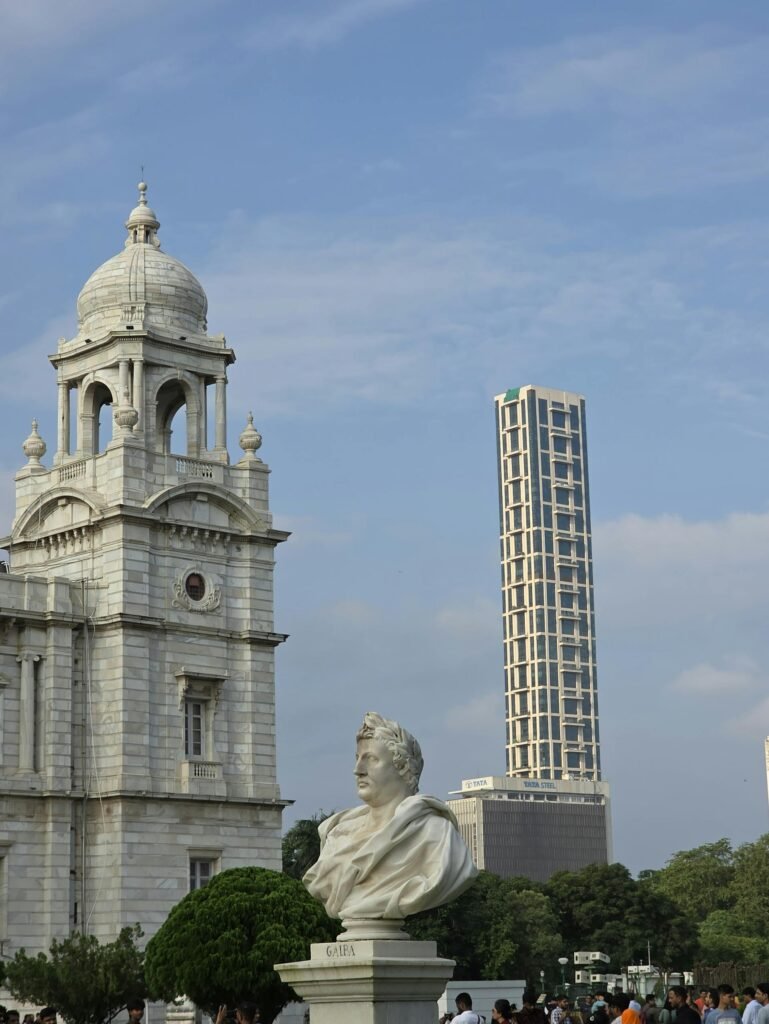
The cultural heart. Victoria Memorial (1906–1921, Indo-Saracenic white marble palace built to commemorate Queen Victoria); St. Paul’s Cathedral (Gothic Revival); National Library; Birla Planetarium; surrounding gardens with the Eden Gardens cricket stadium.
North Kolkata (Shyam Bazaar, College Street)
The traditional Bengali intellectual center. College Street — the world’s largest second-hand book market and the location of Kolkata’s premier universities (Presidency, Calcutta University). Indian Coffee House (the historic intellectual gathering spot since 1947). Kumartuli — the potters’ quarter where the Durga idols are sculpted. The narrow lanes of old-style Bengali wooden architecture.
South Kolkata (Ballygunge, Gariahat)
Upmarket residential and shopping. Gariahat with the iconic flyover and saree markets. Lake Gardens. Concentrations of contemporary restaurants and the South City Mall.
Salt Lake (Bidhannagar) & New Town
The post-1960s planned modern districts. Salt Lake: government offices, mid-rise residential, the IT-services Sector V. New Town (Rajarhat): the newest planned district with the city’s modern shopping malls (Eco Park, City Centre) and contemporary residential.
Howrah (Across the Hooghly)
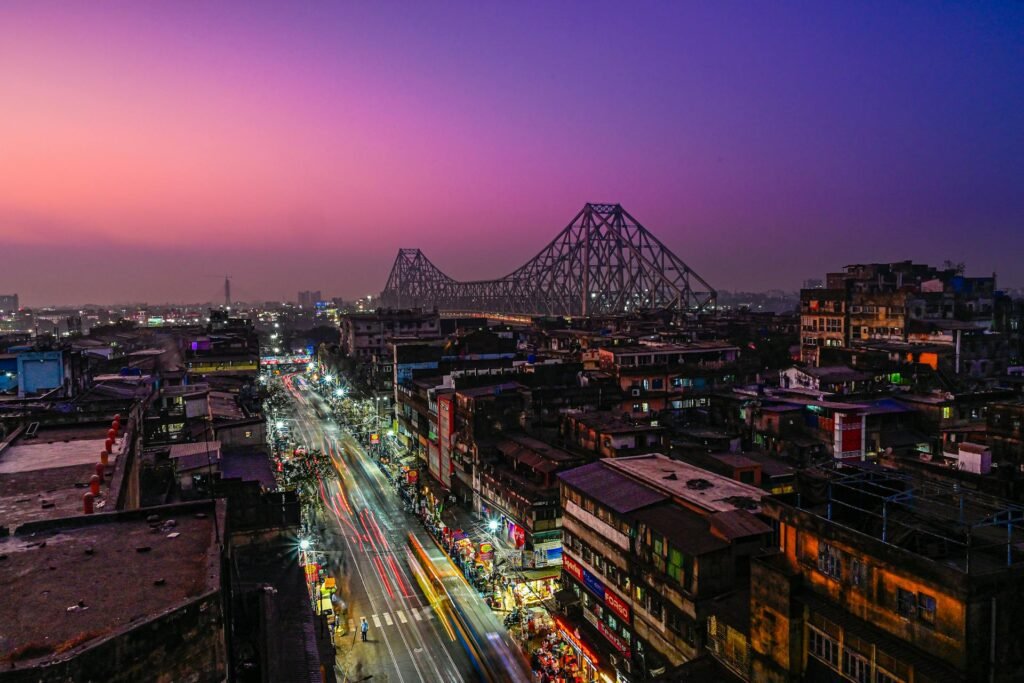
The working-class industrial city across the river. Howrah Bridge (the iconic 1943 cantilever bridge — one of the world’s busiest, 100,000+ vehicles and 150,000+ pedestrians daily). Howrah Station (one of India’s largest railway stations). Less touristic but visually iconic for the bridge crossing experience.
Top Things to Do in Kolkata
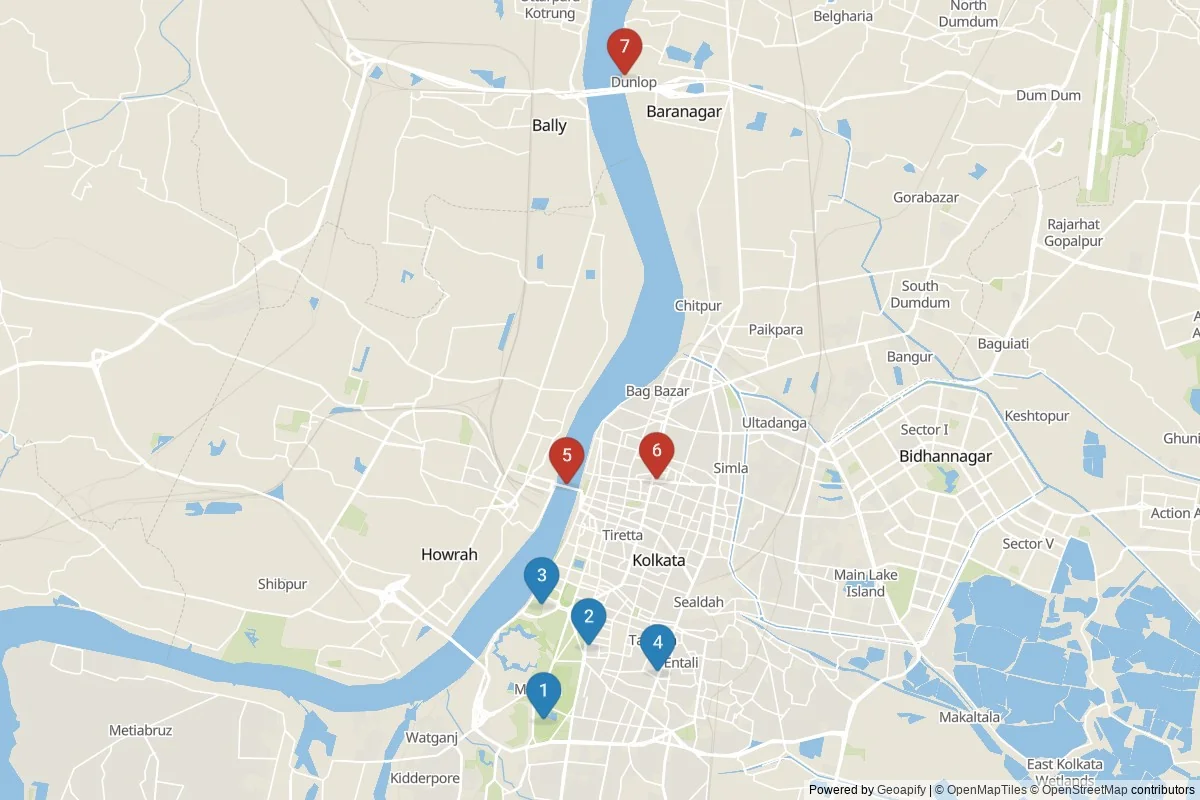
| # | Sight | Cluster | Type | Time | Entry | Best |
|---|---|---|---|---|---|---|
| 1 | Victoria Memorial | Day 1 · South | Marble monument & museum | ~2 hrs | ₹30 / ₹500 | Morning |
| 2 | Indian Museum | Day 1 · South | Museum (Asia’s oldest) | ~2 hrs | ₹50 / ₹500 | Morning |
| 3 | Eden Gardens | Day 1 · South | Cricket stadium | ~30 min | Free (exterior) | Anytime |
| 4 | Mother House | Day 1 · South | Pilgrimage / heritage | ~30 min | Free | 8–12 or 15–18 |
| 5 | Howrah Bridge | Day 2 · North | Iconic cantilever bridge | ~30 min | Free | Sunrise |
| 6 | Jorasanko Thakur Bari | Day 2 · North | Tagore birthplace museum | ~1.5 hrs | ₹50 / ₹150 | Late morning |
| 7 | Dakshineswar Kali Temple | Day 2 · North | Hindu temple (north of city) | ~1.5 hrs | Free | Early morning |
1. Visit the Victoria Memorial
The 1906–1921 white-marble Indo-Saracenic palace commissioned by Lord Curzon to commemorate Queen Victoria — the most-visited single colonial-era monument in India. The interior houses an exceptional collection of British India art, Bengali history exhibitions, and the famous 25-foot bronze Victory statue on the dome. The surrounding gardens are the city’s most beautiful public space. Entry INR 30 nationals / INR 200 foreigners; plan 3 hours including grounds.
2. Walk the Howrah Bridge
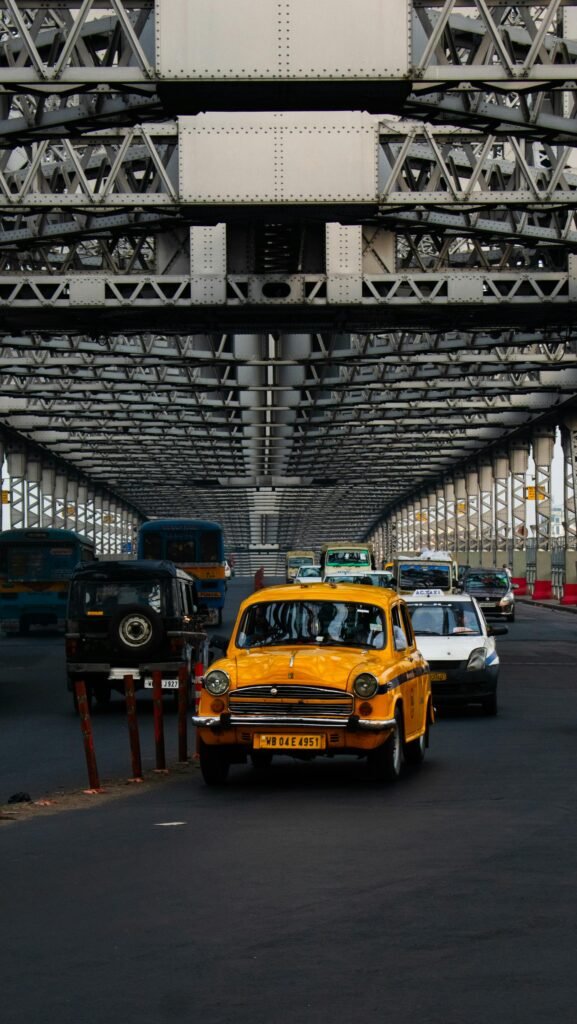
The 705-meter cantilever bridge across the Hooghly — one of the world’s busiest. Walking the 1.5 km pedestrian path is a quintessential Kolkata experience; do it at dawn (5:30–7:00 am) for atmosphere and lighter foot traffic. Photography of the bridge itself is restricted (it’s classified as a defense structure); but the bridge as backdrop is universally photographed. Combine with a Hooghly River boat trip from Babu Ghat for the panoramic perspective.
3. Explore College Street & Coffee House
The 1.5 km stretch of College Street is the world’s largest second-hand book market — hundreds of small bookstalls covering Bengali literature, academic texts, English-language books, and antiquarian editions. Indian Coffee House on College Street — operating since 1947 — is the historic intellectual gathering spot where filmmaker Satyajit Ray, philosopher-poet Rabindranath Tagore (during his lifetime), and generations of Bengali intellectuals discussed ideas. The vegetable cutlets and coffee remain canonical. Free; plan 2–3 hours.
4. Time a Visit for Durga Puja (October)
The country’s most spectacular Hindu festival — Kolkata’s defining annual event. For 5 days in October, the city constructs thousands of elaborately themed pandals (temporary temples), each housing a clay idol of the goddess Durga slaying the buffalo demon Mahishasura. The pandals are works of community art — competing for awards from international media coverage. Visit during Saptami through Dashami (the 7th to 10th days). The festival’s final day (Dashami) sees thousands of idol-immersion processions to the river. UNESCO Intangible Cultural Heritage inscription in 2021 recognizes the festival’s cultural significance.
5. Mother Teresa’s Missionaries of Charity
The Mother House (54A AJC Bose Road) where Mother Teresa lived from 1953 until her death in 1997 — now a small museum with her tomb. The adjacent Nirmal Hriday (“Pure Heart”) home for the dying at Kalighat — the original facility where the order’s work began. Both are working religious facilities; visits should be respectful; photography limited. Free.
6. Indian Museum
India’s oldest museum (1814) and one of the largest in Asia. The collection covers Indian archaeology (the famous 2,000-year-old Bharhut Stupa railing), zoology, geology, anthropology, and economic botany. The building itself is an iconic Italianate colonial structure. Entry INR 75 nationals / INR 500 foreigners; plan 3+ hours.
7. Day Trip to Shantiniketan
The cultural retreat 160 km north of Kolkata founded by Rabindranath Tagore in 1901 — Visva-Bharati University (“the universal university”). The peaceful campus and museum dedicated to Tagore are the spiritual heart of Bengali high culture. 2.5 hours each way by Shatabdi Express train. Poush Mela (late December) is the famous annual festival.
8. Hand-Pulled Rickshaw Ride & Old Kolkata Walking
Kolkata is the last city in India to still operate hand-pulled rickshaws (the older, more atmospheric, ethically complicated transit form). The drivers are mostly poor migrant Biharis; the practice is controversial but the rickshaws remain a working transit mode. A short ride INR 50–150 with respect. Walking tour of North Kolkata’s old wooden mansions with a local guide gives the cultural depth. Several operators run heritage walks (INR 800–2,500 per person).
How to Get to Kolkata
By Air
Netaji Subhas Chandra Bose International Airport (CCU), 17 km northeast of central Kolkata. Direct international routes from Bangkok, Singapore, Kuala Lumpur, Dubai, Doha, Hong Kong, Yangon, Dhaka, Kathmandu, Paro (Bhutan); seasonal direct to London. Domestic flights connect to all major Indian cities — Delhi (2 hours), Mumbai (2.5 hours), Bangalore (2.5 hours), Chennai (2 hours), Hyderabad. Carriers: IndiGo, Air India, Vistara, SpiceJet, Akasa Air, plus international carriers.
From the airport: Volvo airport bus INR 60–200 to multiple central destinations; Ola/Uber INR 350–700 to central Kolkata (45–90 min); prepaid taxi from official airport counter INR 400–600.
By Train
Kolkata is India’s busiest railway hub. Howrah Station (across the river) and Sealdah Station (central east) are the two major terminals. Rajdhani Express to Delhi: 17 hours; Vande Bharat Express to Patna: 7 hours; Coromandel Express to Chennai: 26 hours; Mumbai-Howrah Express: 30 hours. The new Kolkata Metro East-West Line connects Howrah to the city center. Book via the IRCTC official portal; foreign tourist quota seats can be booked in advance through Indian Railways’ tourist quota system.
By Long-Distance Bus
Esplanade and Karunamoyee bus stands serve intercity destinations. Buses to Bangladesh (Dhaka via the Petrapole-Benapole border) are the unique international land option.
By Sea
The Port of Kolkata (Diamond Harbour) historically India’s busiest; reduced relevance for passenger travel today.
Visa Notes
India offers e-Visa for tourists from over 165 countries through the official Indian Government e-Visa portal. 30-day, 1-year, and 5-year tourist e-Visa options; fee $10–80 depending on duration and nationality; processed in 3–5 working days. Passport must have 6+ months remaining validity. Common mistake: applying through unofficial third-party sites that charge 200–500% premiums; always use the .gov.in domain. Bangladesh land border travel: special travel permits may apply; verify with the Indian Bureau of Immigration.
Getting Around Kolkata
Ride-Hailing (Ola & Uber)
The default for foreign visitors. Ola (homegrown) and Uber both operate with English apps, transparent pricing, and credit-card payment. Across central Kolkata costs INR 150–400; airport-to-central INR 350–700.
Kolkata Metro
India’s oldest metro system (opened 1984). North-South Line (Blue) connects Dum Dum (airport area) to Kavi Subhash (south); East-West Line (Green) connects Howrah to Salt Lake / Sector V (the new IT district, opened in phases 2020-2024). Single fares INR 5–25; cheap and air-conditioned.
Trams (Last in India)
Kolkata is the last Indian city to operate trams — the Calcutta Tramways Company has run since 1873, the oldest electric tramway in Asia. A few routes still operate primarily in central Kolkata as a heritage transit. INR 6 per ride; atmospheric for a 30-minute tourist ride.
Hand-Pulled Rickshaws
The last city in India to retain hand-pulled rickshaws — about 6,000 still operate in central Kolkata. The practice is controversial (driver welfare); short rides INR 50–150. Worth experiencing once for the cultural and historical perspective; respect the driver’s labor.
Auto-Rickshaws & Yellow Ambassador Taxis
Auto-rickshaws and the iconic yellow Hindustan Ambassador taxis (the last city where Ambassadors still serve as taxi fleet) are ubiquitous. Meters exist but are often “broken” for tourists; agree the fare in advance or use Ola/Uber.
Boats & Hooghly Ferries
Cross-river ferries from Babu Ghat, Howrah Ferry Ghat, and other landings; INR 10–25 single fare; atmospheric river-crossing alternative to the bridge.
Food & Drink in Kolkata
Bengali cuisine is one of India’s most distinctive regional traditions — emphasizing fish (the city sits in the world’s largest river delta), mustard oil, panch phoron (5-spice blend), and an elaborate sweet tradition that includes the iconic rasogolla (whose origin Kolkata claims, contested by Odisha). The city’s food culture also includes significant Anglo-Indian, Mughal, Chinese, and Tibetan refugee influences.
What to Try
- Macher Jhol — Bengali fish curry; the regional staple; ilish (hilsa) is the prized fish.
- Macher Paturi — fish steamed in banana-leaf with mustard paste; the most refined Bengali dish.
- Kosha Mangsho — slow-cooked Bengali mutton curry.
- Shorshe Ilish — hilsa fish in mustard sauce; the iconic Bengali fish preparation.
- Kathi Roll — the Kolkata street-food invention (1930s): grilled meat or vegetable filling wrapped in a paratha; the global progenitor of the modern “wrap.” Nizam’s in central Kolkata is the canonical originator.
- Phuchka (Pani Puri / Golgappa) — Kolkata’s version of the hollow-puri-with-spicy-water street snack.
- Mughlai Paratha — Mughal-influenced stuffed flatbread.
- Bhetki Macher Cutlet — Anglo-Indian fried fish cutlets.
- Rasogolla — Bengal’s iconic spongy cottage-cheese sweet in sugar syrup; GI-tagged 2017 (after a court dispute with Odisha).
- Sandesh — molded cottage-cheese sweet; less syrupy than rasogolla.
- Mishti Doi — sweet yogurt with palm jaggery; eaten as dessert from earthenware pots.
- Cha-and-Lebu — sweet milky Bengali tea with a slice of lime; the universal street drink.
- Tibetan-Kolkata cuisine: momos (dumplings) and thukpa (noodle soup) from the Tibetan refugee community in central Kolkata.
Where to Eat
6 Ballygunge Place: refined traditional Bengali. Bhojohori Manna: classic Bengali, multiple branches. Oh! Calcutta: contemporary Bengali fine-dining. Mocambo (Park Street, since 1956): Anglo-Indian and Continental institution. Peter Cat (Park Street, since 1975): the iconic Anglo-Indian restaurant (chelo kebab institution). Trincas (Park Street): the live-music historic establishment. Flurys (Park Street): the iconic Tearoom and Bakery since 1927. Nizam’s (Hogg Market): kathi roll origin. Tewary Brothers: kathi roll classic. K.C. Das: rasogolla institution. Indian Coffee House (College Street): the historic intellectual gathering with iconic vegetable cutlets. Tiretti Bazar Chinatown: morning breakfasts at the historic Chinese-Bengali community shops.
Drinks
Cha: Bengali sweet milky tea with cardamom; the universal social drink. Indian Coffee: filter coffee from the Coffee House; less common in Bengal than South India but iconic at the College Street venue. Lassi: yogurt drink. Aam Panna: raw-mango summer drink. Sherbet: traditional cooling drinks at Royal Indian Hotel and similar heritage venues. Limited bar culture: Park Street has the historic bars (Trincas, Olypub) and contemporary venues; alcohol regulation moderate in West Bengal.
A Note on Tap Water
Tap water in Kolkata is not safe to drink for foreign visitors. Use sealed bottled water (INR 20–40 per liter at convenience stores; major brands Bisleri, Kinley, Aquafina) for drinking and brushing teeth. Reusable filter bottles work well. Hotel kettles boil water reliably. Ice at mid-range and upmarket restaurants is generally safe. The CDC traveler health page for India recommends bottled or boiled water plus hepatitis A, typhoid, hepatitis B, Japanese encephalitis, rabies vaccinations consideration. Traveler’s diarrhea is the most common visitor complaint.
Frequently Asked Questions About Visiting Kolkata
Do I need a visa to visit Kolkata?
Yes — most foreign passport holders need a visa for India, but the e-Visa system makes the process straightforward. Citizens of 165+ countries — including the US, UK, all EU member states, Canada, Australia, New Zealand, Japan, South Korea, Singapore, Brazil, Mexico — apply at the official Indian Government e-Visa portal. 30-day single entry $10–25; 1-year multiple entry $40; 5-year multiple entry $80; processed in 3–5 working days. Tourists must enter through 31 designated airports including Kolkata’s Netaji Subhas Chandra Bose International (CCU). Passport must have at least 6 months remaining validity and at least two blank pages. Common mistakes: using unofficial third-party visa sites that overcharge by 200–500%; arriving without printing the e-Visa approval (print two copies); not realizing the e-Visa cannot be used for journalism, research, or paid work. Bangladesh land border crossing from Kolkata: requires specific permits and overland visa endorsement; verify with the Indian Bureau of Immigration.
Is Kolkata safe for tourists?
Kolkata is generally safer than many Western media accounts suggest — among India’s safer major cities for foreign tourists. The US State Department rates India at “exercise increased caution.” Real risks in Kolkata: chronic infrastructure stress — flooding during monsoon (June–September); narrow crowded streets; uneven sidewalks; pickpocketing in tourist crowds (Howrah Bridge, College Street, Park Street, the New Market); traffic accidents — Kolkata traffic is chaotic; pedestrians have minimal priority; scams targeting tourists — fake “registered guides” at Victoria Memorial demanding fees; airport-area taxi inflation; “petition” scams; air pollution — Kolkata’s AQI routinely 150–300 (unhealthy) during winter months; summer heat April-May 40 °C+ heatwaves; monsoon flooding regularly closes some neighborhoods; credit-card skimming at low-rent ATMs (use bank-branch ATMs); political demonstrations occasional but predictable; religious tension very rare but possible during major Hindu-Muslim festival overlaps. Female travelers: standard urban precautions; Kolkata is generally considered safer than Delhi for solo female travel; dress modestly especially at religious sites. LGBTQ+ travelers: same-sex relationships were decriminalized in India in 2018; Kolkata has a growing visible queer community; same-sex marriage not yet legal. Drug enforcement: India has harsh penalties for drug offenses — multi-year prison sentences for possession; trafficking carries the death penalty in extreme cases.
How many days do I need in Kolkata?
Three to four days handles Kolkata’s main sights; combined with Shantiniketan and the Sundarbans, 6–7 days makes a satisfying West Bengal trip. A solid 4-day Kolkata plan: Day 1 — Victoria Memorial morning + St. Paul’s Cathedral + Maidan park + Indian Museum afternoon + Park Street dinner at Peter Cat or Mocambo. Day 2 — Howrah Bridge dawn walk + Mullick Ghat flower market + Kalighat temple + Kumartuli potters’ quarter + lunch at College Street Coffee House + Indian National Library + dinner. Day 3 — Mother Teresa’s Mother House morning + South Park Street Cemetery + lunch + Salt Lake / New Town modern Kolkata + Eco Park afternoon + Park Street nightlife evening. Day 4 — Day trip to Shantiniketan (Rabindranath Tagore’s university town, 2.5 hours by Shatabdi Express) or Sundarbans (the world’s largest mangrove forest, requires 2-day overnight to reach properly). Add Days 5–7 for the Darjeeling Himalayan railway (12-hour overnight train to Darjeeling + 2 nights). 10-day Bengal classic: 3 days Kolkata + 2 days Shantiniketan + 2 days Sundarbans + 3 days Darjeeling. Festival timing: time Kolkata visit for Durga Puja in October if possible — the country’s most spectacular Hindu festival, the city becomes a sprawling cultural celebration.
What’s the best area to stay in Kolkata?
Park Street area / Central: the practical default; international hotel chains (The Oberoi Grand Kolkata since 1839, The Park Kolkata, Taj Bengal); INR 8,000–25,000/night (USD 100–300). Sudder Street / Esplanade: budget-traveler central; near Indian Museum and New Market; backpacker hostels and budget guesthouses; INR 1,500–5,000/night. South Kolkata (Ballygunge / Gariahat): upmarket residential; boutique guesthouses; INR 3,000–10,000/night. Salt Lake / New Town: modern planned districts; business hotels (Hyatt Regency, Westin Kolkata Rajarhat); INR 6,000–15,000/night; useful for IT-sector visitors but far from heritage sights. Alipore (Diamond Harbour Road): upmarket residential; ITC Royal Bengal, JW Marriott; INR 10,000–30,000/night; quieter but transit-dependent for Park Street. Howrah: across the river, mostly working-class — convenient for early train departures only; mid-range chain hotels. Skip: cheap unbranded hotels in Sudder Street with no security; some older budget hotels lack reliable amenities.
How much does it cost to visit Kolkata’s major sights?
Kolkata is one of India’s most affordable major cities. Victoria Memorial: INR 30 nationals / INR 200 foreigners; INR 100 light-and-sound show. Indian Museum: INR 75 nationals / INR 500 foreigners. St. Paul’s Cathedral: free. Mother Teresa’s Mother House: free. National Library: free entry. Marble Palace: free with advance permit (INR 50 fee through hotel concierge). Kalighat Temple: free; donations welcome. South Park Street Cemetery: free. Shantiniketan day trip Shatabdi Express round-trip: INR 800–1,400. Sundarbans 2-day tour: INR 4,500–12,000 per person. Local meals: kathi roll street food INR 60–150; Indian Coffee House meal INR 80–250; sit-down Bengali restaurant lunch INR 250–500 per person; Park Street restaurant dinner INR 800–2,500 per person; fine-dining INR 2,500–6,000 per person; rasogolla at K.C. Das INR 15–30 per piece. Ola/Uber across the city: INR 150–400. Yellow Ambassador taxi: INR 200–500 typical city trips. Hand-pulled rickshaw: INR 50–150 short rides. Tram heritage ride: INR 6. Metro single ticket: INR 5–25. Overall daily budget: INR 1,500 (frugal hostel + street food + walking), INR 4,500 (mid-range hotel + restaurants), INR 12,000+ (luxury hotel + fine dining).
Should I drink the tap water in Kolkata?
No — tap water in Kolkata is not safe to drink for foreign visitors. The Kolkata Municipal Corporation treats the supply but distribution-network contamination is widespread; most locals boil before drinking. Always use sealed bottled water (INR 20–40 per liter at convenience stores; major brands Bisleri, Kinley, Aquafina, Bailey) for drinking and brushing teeth. Reusable filter bottles (LifeStraw, Grayl, Sawyer 0.1-micron filter) work well in India. Hotel kettles boil water reliably. Ice: at mid-range and upmarket restaurants, ice is machine-made from purified water and generally safe; avoid ice from street stalls without obvious purified-water source. The CDC traveler health page for India recommends bottled or boiled water plus hepatitis A, typhoid, hepatitis B, Japanese encephalitis (for long-term travelers), and rabies vaccinations consideration. Monsoon-season disease risk: dengue is endemic; significant during late monsoon and post-monsoon (August-October). Air pollution: Kolkata winter AQI routinely 200–300 (unhealthy); sensitive travelers should consider N95 masks November-February.
What payment methods work in Kolkata — credit cards, UPI, or cash?
India’s digital-payment revolution has reached Kolkata. UPI (Unified Payments Interface) dominates everyday transactions — Google Pay, PhonePe, Paytm with QR codes at virtually every shop. However, UPI requires an Indian bank account, impractical for most foreign visitors. Practical visitor payment mix: Credit/debit cards (Visa, Mastercard, AmEx, JCB): accepted at hotels, mid-range and upmarket restaurants, malls (South City, Quest Mall), and chain stores; contactless growing. Indian rupees in cash: essential for street food, taxis, hand-pulled rickshaws, markets, and smaller restaurants; carry small bills (10, 20, 50, 100). ATMs: HDFC, ICICI, Axis, SBI, Kotak all accept foreign cards; daily limits INR 10,000–25,000 per transaction; INR 150–250 international fees. Currency exchange: avoid airport and hotel exchanges (poor rates); bank-branch exchanges and Thomas Cook offices on Park Street are reliable. Foreign exchange: bring USD, EUR, GBP in clean bills only. Tipping: 10% at restaurants without service charge (many automatically add 10% — check the bill); INR 20–50 per bag to hotel porters; INR 100–200 per day for housekeeping; INR 200–500 per day for tour guides; round up taxi fares; tip hand-pulled rickshaw drivers generously given their labor (INR 20–50 over agreed fare). Tip in Indian rupees; USD/EUR cash tips not the local norm.
What about Durga Puja, festivals, and Bengali cultural context?
Kolkata’s cultural identity is deeply Bengali, which is more distinct from “generic Indian” culture than many visitors realize. Durga Puja (Bengali: দুর্গাপূজা) is the defining annual event — 5+ days in late September or October celebrating the goddess Durga’s victory over the buffalo demon Mahishasura. The city constructs thousands of elaborately themed pandals (temporary temples, some up to 100 feet tall) competing for awards; the festival was inscribed on UNESCO Intangible Cultural Heritage in 2021. Pandal-hopping at night (when illuminated and crowded) is the experience; the final day (Bijoya Dashami) sees thousands of clay-idol immersion processions to the Hooghly. Timing your visit for Durga Puja: book accommodation 4–6 months ahead; expect heightened prices; the city’s energy and crowds peak; everything else in Kolkata partially shuts down. Other major Bengali festivals: Kali Puja (Diwali week, October-November); Saraswati Puja (January-February); Poila Boishakh (Bengali New Year, mid-April); Rabindra Jayanti (Tagore’s birthday, May 7); Christmas in Park Street (December — the city’s most elaborate Christmas illuminations outside Goa, reflecting the historic Anglo-Indian community). Bengali language and culture: most Kolkatans speak Bengali first; English second; Hindi understood but less spoken than in Delhi or Mumbai; learning a few Bengali phrases (Apnar nam ki? — What’s your name? Dhonyobad — Thank you; Bhalo achi — I’m well) is appreciated. Bengali intellectual heritage: Kolkata is India’s traditional literary, cinematic, and intellectual center; visit College Street, Indian Coffee House, and Shantiniketan for that side of the city. Cultural sensitivities: remove shoes at religious sites; cover shoulders and knees at temples and during religious processions; the Kalighat temple has specific rituals — observe respectfully or join a guided tour for proper engagement. Visiting Mother Teresa’s institutions: the Mother House and Nirmal Hriday are working religious facilities; respectful behavior expected; photography limited; consider donating if visiting.
Education & Notable People
Kolkata is India’s most concentrated traditional intellectual center, with the country’s oldest universities and a remarkable literary heritage.
Major Universities
- University of Calcutta — founded 1857; India’s first modern university and one of the largest in Asia (~750,000 students across affiliated colleges).
- Presidency University — founded 1817 as Hindu College; the country’s first modern Western-style higher education institution; alma mater of much of the Bengal Renaissance.
- Indian Institute of Management Calcutta (IIM-C) — founded 1961; the country’s first IIM and one of the top three.
- Indian Statistical Institute (ISI) — global-leader in statistical sciences.
- Jadavpur University — strong engineering and humanities.
- St. Xavier’s College — Jesuit-affiliated, prestigious liberal-arts institution.
- Visva-Bharati University (Shantiniketan, 160 km north) — founded by Rabindranath Tagore in 1921.
Notable People
Rabindranath Tagore (1861–1941) — the most globally celebrated Bengali; Nobel Literature 1913 (the first non-European laureate); composer of the national anthems of both India (“Jana Gana Mana”) and Bangladesh (“Amar Sonar Bangla”); founder of Visva-Bharati University. Satyajit Ray (1921–1992) — internationally celebrated filmmaker (the Apu Trilogy); Academy Honorary Award 1992; the defining figure of Bengali parallel cinema. Jagadish Chandra Bose (1858–1937) — physicist and biophysicist; discovered the electromagnetic wave detector before Marconi. Subhas Chandra Bose (1897–1945) — controversial independence-movement leader; founded the Indian National Army; the city’s airport bears his name. Mother Teresa (1910–1997) — Albanian-Indian Catholic missionary; Nobel Peace Prize 1979; founded the Missionaries of Charity in Kolkata. Amartya Sen — Nobel Economics 1998; Kolkata-born and educated. Raja Ram Mohan Roy (1772–1833) — the “Father of the Bengal Renaissance”; social reformer. Swami Vivekananda (1863–1902) — Hindu spiritual leader; born in Kolkata. Mihir Sen — first Asian to swim the English Channel. Sourav Ganguly — celebrated cricket player and former India captain. Mamata Banerjee — current Chief Minister of West Bengal since 2011.
Sister Cities & International Relations
Kolkata’s sister-city network reflects the city’s deep cultural and political heritage and its role as India’s traditional cultural capital.
Kolkata’s sister and partnership cities include (selection):
- Kunming, China — paired since 2013; “Sister City of Songtsen Gampo” partnership.
- Long Beach, California, USA — paired since 1957; one of the oldest US-India sister relationships.
- Odessa, Ukraine — paired since 1959; longstanding cultural friendship.
- Dhaka, Bangladesh — paired since 1981; shared Bengali heritage despite political separation.
- Naples, Italy — paired since 2000.
- Thessaloniki, Greece — paired since 2005.
- Marseille, France — friendship city.
- Incheon, South Korea — partnership.
Kolkata hosts the Asia-Pacific Regional Trade Office and serves as eastern India’s diplomatic and commercial hub for ASEAN and South Asian regional cooperation. The city is the headquarters of the Eastern Indian Railway Zone and the Calcutta Stock Exchange (India’s second-oldest). The West Bengal Tourism Department coordinates Kolkata’s international promotion alongside Indian national tourism initiatives.
AFRIKA
Cairo Hurghada Johannesburg Marrakech
ASIA
Abu Dhabi Agra Antalya Bangkok Batam Beijing Bengaluru Cebu City Chiang Mai Chiba Chennai Da Nang Dammam Delhi Denpasar Dubai Fukuoka Guangzhou Guilin Ha Long Hanoi Ho Chi Minh City Jakarta Jaipur Johor Bahru Kolkata Krabi Kuala Lumpur Kyoto Macau Mecca Medina Mugla Mumbai Osaka Pattaya Penang Phuket Riyadh Seoul Shanghai Shenzhen Singapore Taipei Tokyo Zhuhai
EUROPE
Amsterdam Athens Barcelona Berlin Brussels Budapest Copenhagen Dublin Florence Frankfurt am Main Heraklion Krakow Lisbon London Madrid Milan Munich Nice Paris Porto Prague Rhodes Rome Stockholm Venice Vienna Warsaw
NORTH AMERICA
Cancun Las Vegas Los Angeles Miami New York City Orlando San Francisco Toronto Vancouver
SOUTH AMERICA
Buenos Aires Lima Rio De Janeiro
OCEANIA
Auckland Honolulu Melbourne Sydney