
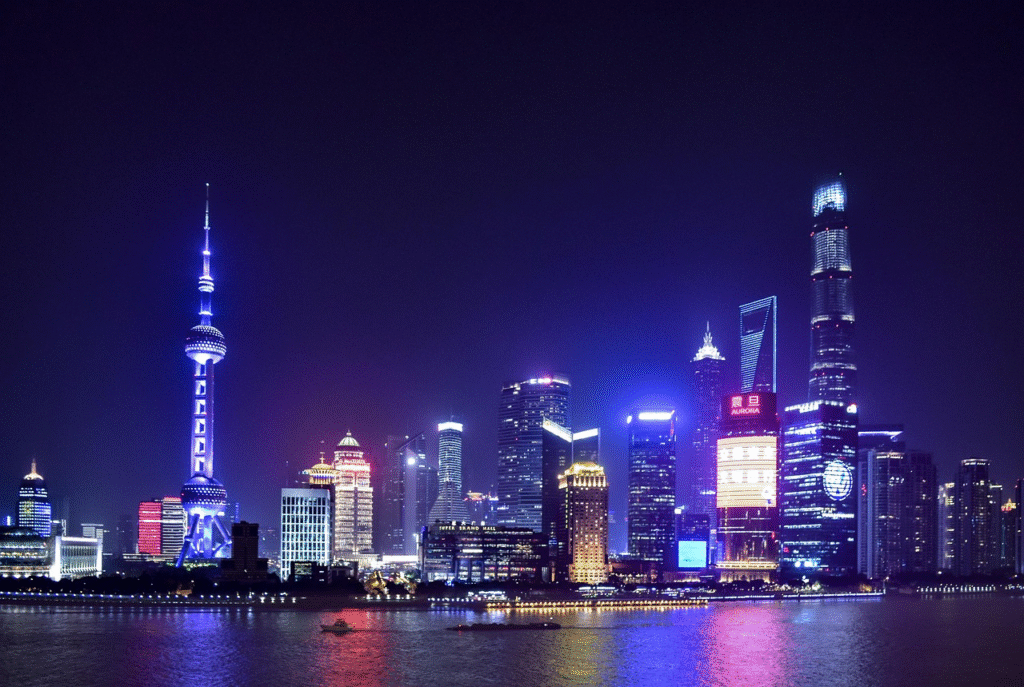
Photo credit: hyungname, pixabay
Shanghai stands as China’s most dynamic metropolis, where ancient traditions seamlessly blend with cutting-edge innovation. This sprawling megacity of 24 million residents serves as the nation’s economic powerhouse, featuring the world’s busiest port, towering skyscrapers that pierce the clouds, and historic neighborhoods that whisper tales of revolution and resilience. From the colonial grandeur of the Bund to the futuristic skyline of Pudong, Shanghai offers an electrifying urban experience unlike anywhere else on Earth.
Shanghai at a Glance: Essential Facts for Travelers
| Location | East China, Yangtze River Delta |
|---|---|
| Coordinates | 31°14’N, 121°28’E |
| Population | 24.8 million (2017) |
| Area | 6,340.5 km² (2,448 square miles) |
| Elevation | 4 meters above sea level (average) |
| Time Zone | UTC+8 (China Standard Time) |
| Calling Code | +86 21 |
| Postal Code | 200000 |
| ISO Code | CN-SH |
| Known For | World’s busiest port, financial hub, Oriental Pearl Tower, The Bund |
| Mayor | Gong Zheng (since 2012) |
| Party Secretary | Li Qiang (since 2017) |
| Official Website | english.shanghai.gov.cn |
Upcoming Events in Shanghai
| Date | Title | Details |
|---|---|---|
| 2026-09-05 to 2026-10-31 | Shanghai Symphony Orchestra 2026-27 Season | The Shanghai Symphony Orchestra, one of Asia’s oldest and most acclaimed ensembles, opens its new concert season in September at the striking Shanghai Symphony Hall in the former French Concession. Autumn programmes feature symphonic masterworks, guest conductors and soloists, and contemporary Chinese compositions, performed in a hall celebrated for its warm acoustics. Concerts offer an elegant night out in one of the city’s most cultured districts. Ticket prices vary by programme and seating, and the orchestra also stages chamber concerts and family-friendly events throughout the season. [Source] |
| 2026-09-12 to 2026-10-04 | Shanghai Tourism Festival 2026 | The Shanghai Tourism Festival is a month-long citywide celebration running from mid-September into early October, opening with a colourful evening float parade down Huaihai Road. Throughout the festival, dozens of attractions offer half-price admission, and neighbourhoods host performances, markets, food events and light displays that show off the city at its most festive. It is a fantastic, affordable time to explore Shanghai, with discounts at museums, gardens, river cruises and sightseeing landmarks. Family-friendly and lively, the festival draws both locals and visitors out to enjoy the pleasant early-autumn weather. [Source] |
| 2026-09-25 to 2026-09-27 | Mid-Autumn Festival in Shanghai | The Mid-Autumn Festival, one of China’s most cherished holidays, falls in late September in 2026 and is celebrated across Shanghai with lantern displays, mooncakes and family gatherings under the full moon. Classic gardens such as Yu Garden in the Old City glow with elaborate lantern installations, while riverside promenades and parks host seasonal events. It is a wonderfully atmospheric time to visit, though popular spots grow crowded and many locals travel to see family. Sampling mooncakes and strolling the illuminated Bund and gardens make for a memorable, traditional Shanghai evening. [Source] |
| 2026-10-03 to 2026-10-14 | Rolex Shanghai Masters 2026 | The Rolex Shanghai Masters is one of tennis’s elite ATP 1000 tournaments, bringing many of the world’s top male players to the Qizhong Forest Sports City Arena in the Minhang district each October. The distinctive magnolia-roofed stadium hosts thrilling matches over roughly two weeks, from early rounds to a high-stakes final, drawing big crowds and international broadcast attention. It is the highlight of Shanghai’s sporting calendar and one of Asia’s most prestigious tennis events. Tickets range widely by session and seat, with the later rounds the hottest draws. [Source] |
| 2026-10-09 to 2026-10-15 | Shanghai Fashion Week (Autumn 2026) | Shanghai Fashion Week is China’s most influential fashion event, and its autumn edition each October fills venues around Xintiandi and across the city with runway shows, showrooms and trade events. Home-grown designers and international labels present new collections, while the accompanying trade fairs connect brands with buyers, cementing Shanghai’s status as the country’s fashion capital. The week is a magnet for designers, influencers and a style-conscious crowd whose street looks are photographed worldwide. Some shows are industry-only, but pop-ups, exhibitions and retail events give the public plenty to enjoy. [Source] |
| 2026-10-16 to 2026-11-15 | China Shanghai International Arts Festival 2026 | The China Shanghai International Arts Festival is the country’s largest performing-arts festival, running from mid-October into November with a rich programme of theatre, dance, opera, orchestral concerts and cross-disciplinary work. It brings leading Chinese and international companies to stages across the city, from grand opera houses to intimate theatres, alongside exhibitions, forums and outdoor events. A cornerstone of Shanghai’s cultural calendar, it offers audiences a chance to see world-class performances and new commissions. Ticket prices vary widely by show, and some public and outdoor events are free. [Source] |
City News in Shanghai – last 14 days
| Date | Category | Headline | Details |
|---|---|---|---|
| 2026-09-14 | Business | Meituan and McDonald’s launch drone delivery in the city | Delivery platform Meituan and McDonald’s have launched a drone delivery service in Shanghai, flying burgers and fries to designated pickup points along automated routes. The service marks an expansion of Meituan’s low-altitude logistics network into one of the world’s most valuable consumer markets, after earlier rollouts in southern China. Orders are carried by autonomous drones and handed over at landing stations, cutting delivery times in congested districts. The move underlines how quickly China’s low-altitude economy is commercialising, with Shanghai serving as a showcase city. [Source] |
| 2026-09-14 | Business | Golden September: over 10,000 second-hand homes signed in 13 days | Shanghai’s property market is showing real strength in the traditional Golden September sales season, with more than ten thousand second-hand home transactions registered in the first thirteen days of the month. Momentum has been strong enough that some new developments are quietly withdrawing the discounts they had been offering. The figures set Shanghai apart from the broader Chinese housing market, where many cities remain sluggish, and analysts see the city’s resilience as an important signal for sentiment nationwide as policymakers try to stabilise the sector. [Source] |
| 2026-09-11 | Business | AI chip maker Enflame nearly triples in stock market debut | Enflame, a Tencent-backed designer of artificial intelligence chips, nearly tripled in its trading debut on Shanghai’s stock market as investors bet heavily on domestic alternatives to Nvidia. The blockbuster listing reflects surging demand for home-grown AI computing power as China pushes for semiconductor self-sufficiency. The rally made the debut one of the year’s most striking on the Shanghai exchange and underscored the city’s role as the financing hub for China’s chip ambitions, with more AI hardware firms lining up to list. [Source] |
| 2026-09-13 | Business | 2,000 servers deployed under the sea near the city | China has placed around two thousand servers in an underwater data centre off the Shanghai coast, scaling up a concept Microsoft trialled and later shut down. Submerging servers uses seawater for cooling, cutting the energy and land demands of conventional data centres, and the facility pairs naturally with offshore wind power in the East China Sea. The project positions Shanghai at the frontier of green computing infrastructure as demand for AI processing soars, though engineers must still prove long-term reliability and maintenance economics under water. [Source] |
| 2026-09-14 | Culture | Baoshan lines up nearly 200 activities for National Day holiday | The northern district of Baoshan has announced nearly two hundred activities for the upcoming National Day holiday, spanning culture, tourism, exhibitions, markets and family entertainment. The programme is designed to capture holiday crowds during one of China’s busiest travel weeks, with riverside venues, cultural spaces and commercial districts all joining in. District authorities are using the Golden Week calendar to showcase Baoshan’s transformation from an industrial base into a leisure destination, and the listings give residents plenty of reasons to stay local. [Source] |
| 2026-09-14 | Culture | Shanghai intangible heritage exhibition opens in Brussels | An exhibition of Shanghai’s intangible cultural heritage has opened in Brussels, bringing traditional crafts and artistry from the city to European audiences. The showcase, reported by People’s Daily, presents the skills and works of Shanghai artisans as part of cultural exchange between China and Europe. Such touring exhibitions have become a fixture of the city’s cultural diplomacy, exporting traditions from paper cutting to embroidery, and they mirror the growing programme of international art shows travelling in the opposite direction to Shanghai’s own museums. [Source] |
| 2026-09-12 | Sports | Herlings and Farres shine at MXGP of China | The MXGP of China brought round eighteen of the motocross world championship to Shanghai’s Oriental Beauty Valley circuit, where Jeffrey Herlings starred in the premier class and Farres impressed in MX2. The Chinese round has become a fixture on the world calendar, drawing international teams and a growing local fanbase to the purpose-built track. The weekend included qualifying heats and championship motos in both classes, with points shaping the title fights as the season heads toward its finale. [Source] |
| 2026-09-14 | Sports | China GT weekend under scrutiny after fire and rescue delays | Motorsport observers are dissecting what went wrong at the China GT round in Shanghai after a car caught fire during the weekend and the rescue response appeared slow, prompting sharp criticism of safety procedures. Reports say several teams have since threatened to withdraw permanently from the series’ events, alarmed by how the incident was handled. The episode has triggered debate about marshalling standards and emergency readiness in the fast-growing Chinese racing scene, with organisers under pressure to publish findings and fixes. [Source] |
| 2026-09-13 | Public safety | Influenza A wave sends multiple school classes into home quarantine | An early wave of influenza A is sweeping through Shanghai schools only days into the new term, with multiple classes told to stay home under quarantine arrangements as infections spread. Parents report rapid case growth in several districts, and schools are stepping up temperature checks, ventilation and cleaning. Health advice urges vaccination and keeping symptomatic children at home. The outbreak echoes similar reports from Hangzhou and other eastern cities, putting seasonal flu control back at the top of school agendas this autumn. [Source] |
| 2026-09-12 | Public safety | Man seriously burned after refuelling accident | A man in Shanghai suffered serious burns after splashing petrol on himself while refuelling on his own, with the fuel igniting roughly fifteen minutes later. The delayed ignition shows how petrol vapour can linger on clothing and skin long after a spill, turning a routine mistake into a life-threatening accident. He was taken to hospital with severe injuries. Safety officials regularly warn against do-it-yourself refuelling with portable containers, urging drivers to let station staff handle fuel and to change contaminated clothing immediately. [Source] |
| 2026-09-14 | Local government | Xu Jing appointed deputy head of city Party organisation department | Xu Jing has been appointed deputy head of the Organisation Department of the Shanghai Party Committee, also taking charge of the bureau responsible for retired veteran cadres. The organisation department oversees personnel appointments across the city’s government and Party apparatus, making its leadership changes closely watched signals within Shanghai’s administration. The appointment continues a series of personnel adjustments in the city this year as leadership teams are refreshed ahead of upcoming political cycles and planning deadlines. [Source] |
| 2026-09-14 | Education | Shanghai team snatches Yangtze Delta cybersecurity title | A Shanghai team clinched victory in the final of the Yangtze River Delta cybersecurity attack-and-defence competition, prevailing in a dramatic finish against rivals from across the region. The contest pits teams against realistic hacking and defence scenarios, part of efforts to cultivate security talent for the delta’s digital economy. The win burnishes Shanghai’s reputation in a field where demand for skilled professionals far outstrips supply, and organisers use the event to identify talent for roles protecting critical infrastructure. [Source] |
Shanghai Events & City News Archive
Sources: Shanghai Symphony Orchestra, Shanghai Tourism Festival, Shanghai Masters, Shanghai Fashion Week, South China Morning Post, The Paper, Reuters, Times of India
Weather Forecast for the Next 14 Days in Shanghai
| Date | Weather | Max °F | Min °F | Rain mm |
|---|---|---|---|---|
| 2026-09-14 | 🌧️ | 88.0 °F | 73.5 °F | 0.4 mm |
| 2026-09-15 | ☁️ | 84.3 °F | 72.4 °F | 0.0 mm |
| 2026-09-16 | ☁️ | 84.5 °F | 69.5 °F | 0.0 mm |
| 2026-09-17 | 🌧️ | 87.5 °F | 71.7 °F | 0.6 mm |
| 2026-09-18 | 🌧️ | 87.3 °F | 74.5 °F | 0.3 mm |
| 2026-09-19 | 🌧️ | 88.2 °F | 76.6 °F | 0.9 mm |
| 2026-09-20 | ⛅ | 86.7 °F | 73.9 °F | 0.0 mm |
| 2026-09-21 | ⛅ | 85.2 °F | 73.0 °F | 0.0 mm |
| 2026-09-22 | ☀️ | 86.8 °F | 72.7 °F | 0.0 mm |
| 2026-09-23 | ☀️ | 86.5 °F | 71.2 °F | 0.0 mm |
| 2026-09-24 | ☀️ | 88.0 °F | 74.3 °F | 0.0 mm |
| 2026-09-25 | ☀️ | 90.3 °F | 73.9 °F | 0.0 mm |
| 2026-09-26 | ⛅ | 94.4 °F | 77.5 °F | 0.0 mm |
| 2026-09-27 | 🌧️ | 87.6 °F | 77.8 °F | 0.6 mm |
Shanghai’s History
Shanghai is the only Chinese megacity that owes its modern identity less to imperial dynasties than to nineteenth-century foreign concessions. The city was a quiet fishing port for most of its history; the British, French, Americans, and Japanese collectively created the modern Shanghai through a century of international settlement before the Communist takeover formally ended the era in 1949. The current twenty-six million-person megacity is the latest layer.
Ancient Beginnings
The Shanghai area has been inhabited since around 4000 BCE, but the settlement first appears in historical records in 960 AD as a fishing village. By 1074, Shanghai had grown enough to warrant its own tax office; in 1264 it merged with three neighboring villages and became a regional port shipping cotton from the Yangtze Delta to Beijing and Japan. During the Ming Dynasty, Shanghai built defensive walls in 1554 — 10 metres high, 5 km in circumference — to repel Japanese pirates. Under the Qing Dynasty (1644–1911), powerful merchant guilds (the huiguan) made Shanghai a major regional marketplace, but the city was still secondary to Suzhou and Hangzhou.
The Era of Foreign Influence
Everything changed with the First Opium War (1839–1842). The Treaty of Nanjing forced Shanghai to open to foreign trade as one of five “treaty ports.” The British Concession was established in 1843, the French Concession in 1849, the American Settlement followed in 1848 (later merging with the British area to form the International Settlement in 1863). The Japanese joined in 1895. Each enclave operated its own police force, courts, and regulations — extraterritorial sovereign zones inside Chinese soil.
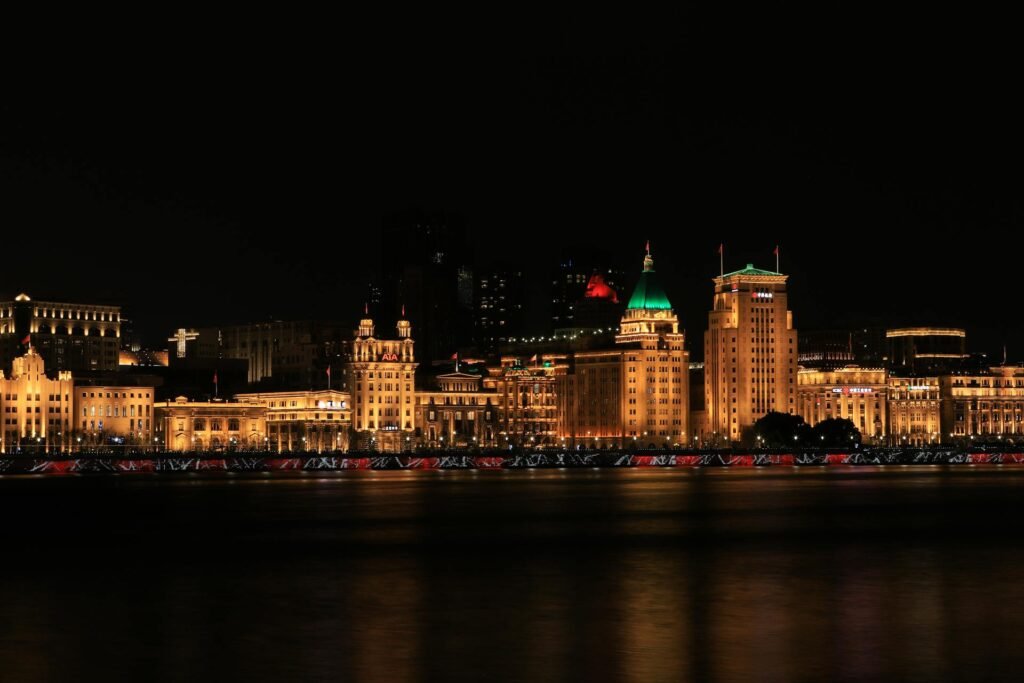
The result was the most cosmopolitan city in Asia. By 1900, Shanghai had become a global trading hub on a scale that rivaled Hong Kong and Singapore. The Bund’s iconic colonial buildings — the Customs House, HSBC Building, Peace Hotel — were built between 1865 and 1929 as the financial spine of the British-led International Settlement. The French Concession’s tree-lined avenues, art deco apartment buildings, and Catholic churches created a self-consciously Parisian neighborhood that survives nearly intact today.
Revolution and Turmoil
Shanghai became the birthplace of modern Chinese political movements. The May Fourth Movement (1919) — protests against the Versailles Treaty’s transfer of German concessions to Japan — radicalized urban Chinese intellectuals. In 1921, the Chinese Communist Party was founded at a secret meeting in the French Concession; the original meeting house at Xingye Road is now a major political pilgrimage site. The May 30th Movement (1925) erupted after British police shot Chinese student protesters; nationwide strikes followed.
The 1932 January 28 Incident saw Japan attack Shanghai with 70,000 troops; the city’s defenders held the line for weeks. The 1937 Battle of Shanghai — three months of brutal urban combat — preceded the Rape of Nanjing. Japanese occupation lasted from 1937 to 1945.
A Sanctuary in Dark Times
Between 1938 and 1941, Shanghai became one of the few places on earth that accepted Jewish refugees fleeing Nazi Europe without requiring a visa. Around 18,000 Jews settled in Hongkou District’s “Designated Area” — a story powerfully documented at the Shanghai Jewish Refugees Museum on Changyang Road. French Jesuit priest Robert Jacquinot de Besange created an internationally-recognized safety zone in Nantao protecting hundreds of thousands of Chinese civilians from Japanese reprisals during the 1937 invasion.
Communist Era and Modern Transformation
After WWII, Shanghai briefly returned to the Republic of China; in May 1949, the People’s Liberation Army entered the city. Foreign businesses fled to Hong Kong, slums were replaced with workers’ housing blocks, and the Communist Party that had been founded here forty years earlier now ruled. Shanghai also became the launching point for Mao’s Cultural Revolution in 1966, with the Shanghai Commune declared in 1967.
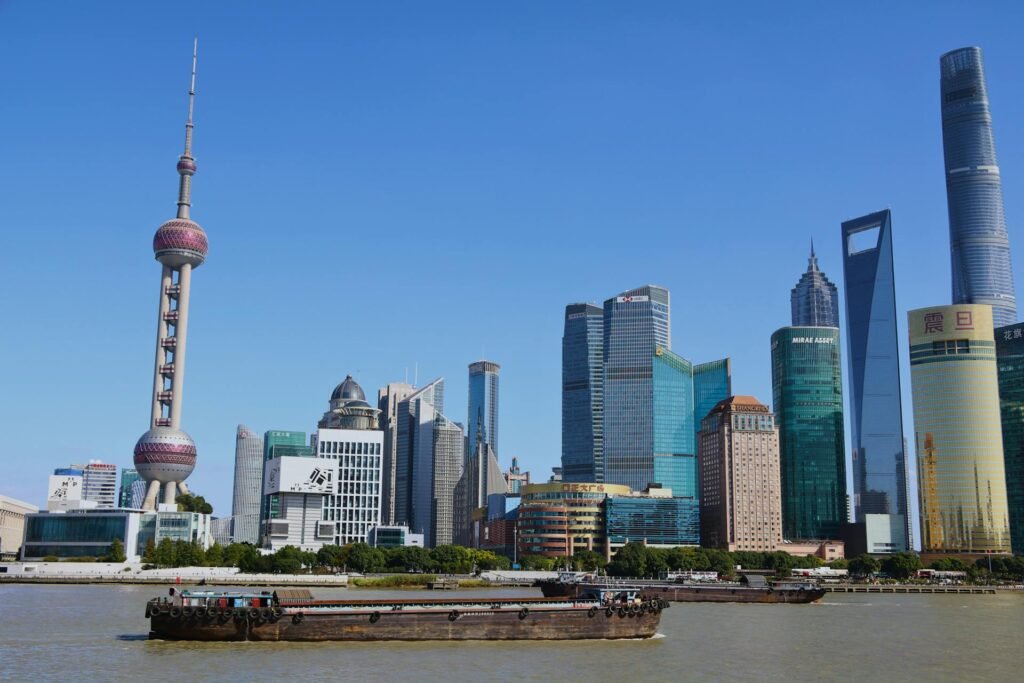
The 1980s reform era under Deng Xiaoping initially favored Shenzhen and the southern coast; Shanghai’s revival came later. The 1990 establishment of the Pudong Special Economic Zone — empty farmland directly across the Huangpu River from the historic Bund — transformed the city. Within twenty years, Pudong became the forest of skyscrapers (the Oriental Pearl Tower, Jin Mao Tower, World Financial Center, Shanghai Tower) that defines the modern Shanghai skyline. The Port of Shanghai became the world’s busiest container port in 2010 — a position it has held ever since, handling 49+ million TEU annually.
Geography, Climate & Best Time to Visit Shanghai
Geography
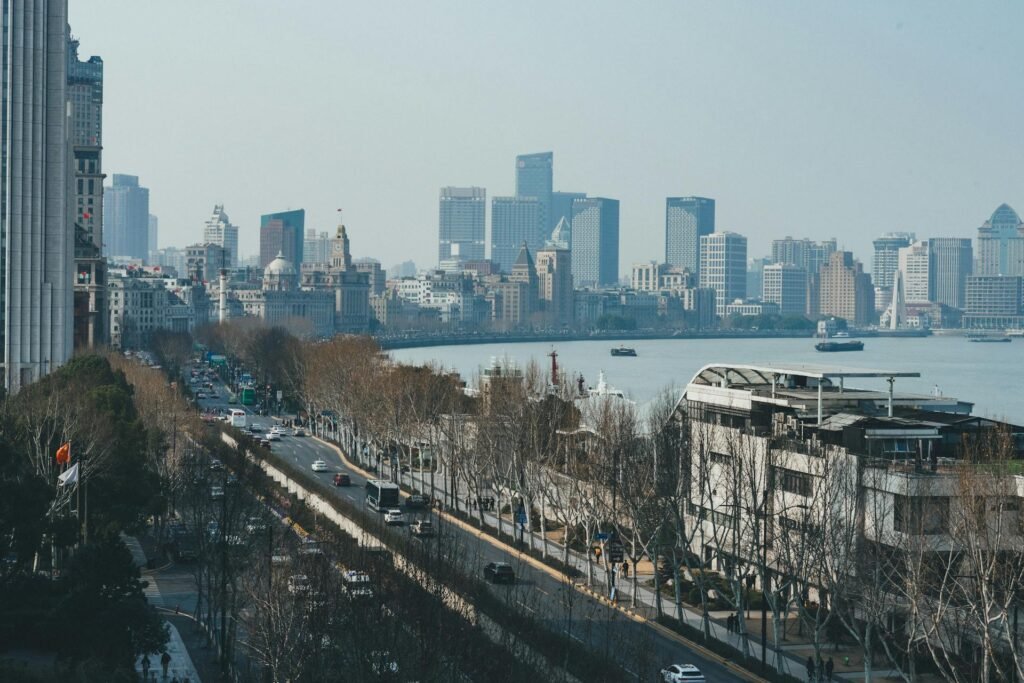
Shanghai sprawls across the Yangtze River Delta at 31°14’N, with average elevation of just 4 metres above sea level — exceptionally vulnerable to typhoon storm surge and rising seas. The city covers 6,341 km² of mostly flat alluvial terrain. The Huangpu River divides the urban core into historic Puxi (west bank) and futuristic Pudong (east bank). Shanghai’s outer reach includes Chongming Island at the Yangtze’s mouth — China’s third-largest island — and the working port and industrial complexes along Hangzhou Bay.
Climate
Shanghai has a humid subtropical climate with four sharply distinct seasons. Summers (June–September) are hot, humid, and wet — daily highs 28–32°C with 80%+ humidity, plus typhoon risk in August–September. Winters (December–February) are mild but damp; January lows around 0–4°C, indoor heating is inconsistent in older buildings. Annual rainfall averages 1,112 mm.
| Month | Avg High (°C) | Avg Low (°C) | Rainfall (mm) |
|---|---|---|---|
| January | 7.7 | 0.5 | 39 |
| April | 17.8 | 10.6 | 94 |
| July | 29.9 | 24.8 | 156 |
| October | 19.9 | 14.7 | 58 |
Best Time to Visit
April–May and September–early November are the optimal windows — temperatures of 18–25°C, lower humidity, less rain, and the year’s best air quality. July–August is brutal: 32°C+, 90% humidity, daily afternoon thunderstorms, peak typhoon season. December–February is quiet and atmospheric but cold and damp. Air quality: Shanghai is significantly cleaner than Beijing but still occasionally poor in winter; check live readings at aqicn.org/city/shanghai.
Shanghai’s Districts & Neighborhoods
Shanghai administratively divides into 16 districts. The visitor’s working geography is split between Puxi (west of the Huangpu River — historic, dense, walkable) and Pudong (east bank — modern skyscrapers, finance, the airport).
Central Districts (Puxi)
Huangpu District is Shanghai’s historic heart — home to the Bund, Nanjing Road shopping pedestrian zone, People’s Square, Yu Garden, and the major museums. Merged with the former Luwan District in 2011 to incorporate the trendy Xintiandi entertainment district.
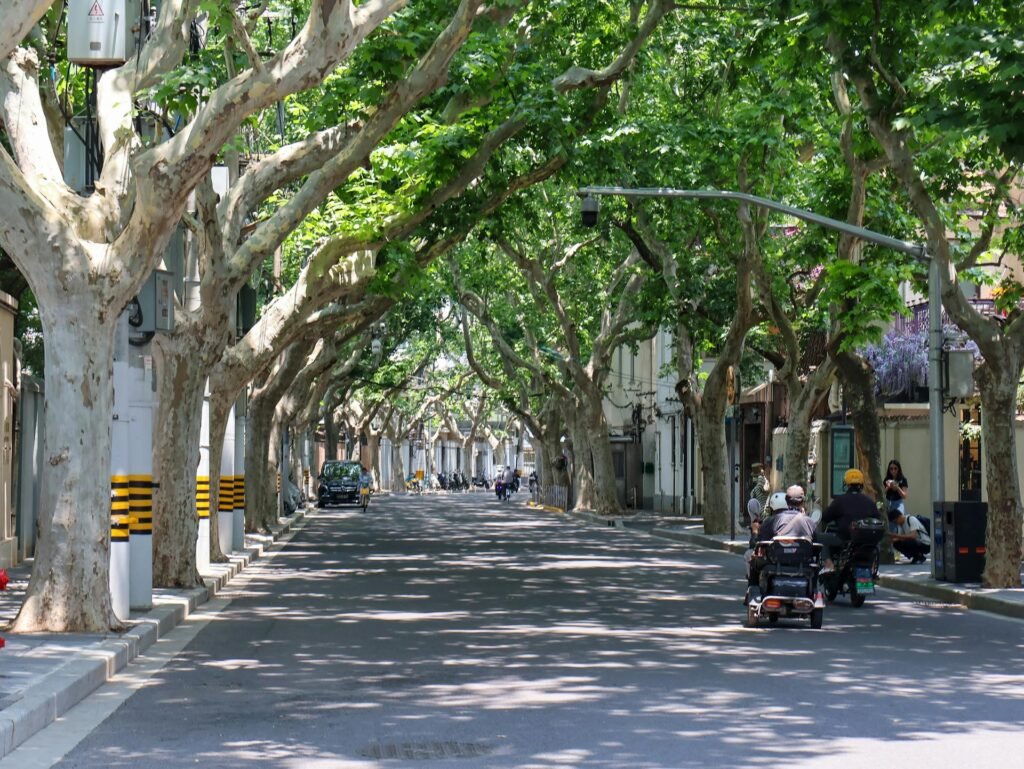
Xuhui District contains the bulk of the historic former French Concession — tree-lined avenues, art deco apartment buildings, boutique shops, and the city’s densest concentration of cafés and design hotels. Best for travelers prioritizing atmosphere over sightseeing convenience.
Jing’an District centers on the gilded Jing’an Temple (an active Buddhist temple ringed by glass skyscrapers) and the eastern stretch of Nanjing West Road. Merged with Zhabei District in 2015. Mix of historic and modern; major luxury hotel cluster.
Pudong New Area
Pudong was farmland in 1990. Today it houses the Shanghai Tower (632 m), Oriental Pearl Tower, Jin Mao Tower, Shanghai World Financial Center (“the bottle opener”), Pudong International Airport, the world’s only commercial Maglev train, and the Lujiazui financial district. The Bund Promenade across the river offers the canonical Pudong skyline view.
Outer Districts
Chongming District — three Yangtze-mouth islands, lush wetland parks, the gentle counterpoint to urban Shanghai. Songjiang District houses ancient water towns including Zhujiajiao and the UNESCO-listed Yu Garden’s outer cousin sites. Jinshan District offers beach access on Hangzhou Bay.
Where to Stay
First-time visitors: Huangpu District (near the Bund and Nanjing Road) — luxury hotels (Peninsula, Waldorf Astoria, Fairmont Peace Hotel) and mid-range options. Atmosphere seekers: Xuhui’s former French Concession — boutique hotels in restored shikumen houses. Business travelers: Pudong/Lujiazui — modern luxury (Mandarin Oriental, Park Hyatt, Ritz-Carlton, Four Seasons). Budget: Jing’an or southern Huangpu — international chains and serviced apartments at $80–180/night.
Top Things to Do in Shanghai
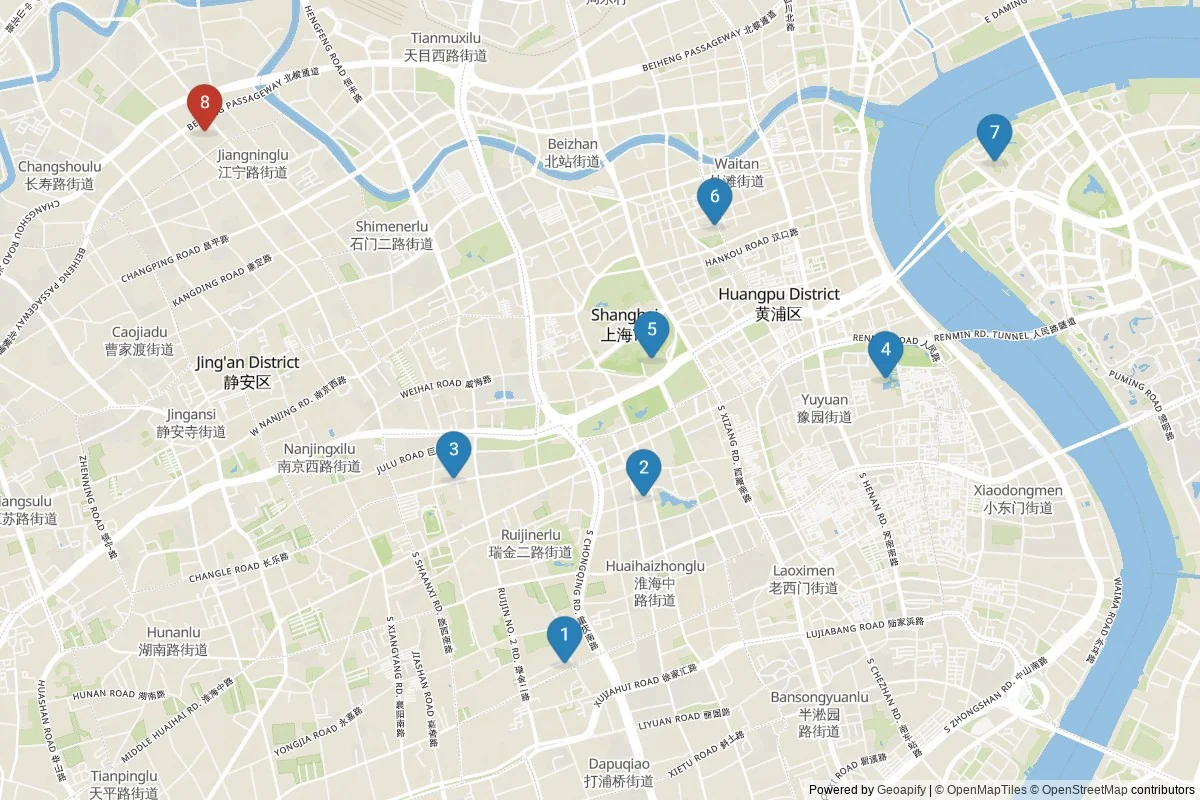
| # | Sight | Cluster | Type | Time | Entry | Best |
|---|---|---|---|---|---|---|
| 1 | Former French Concession | Cluster A | Square | — | — | — |
| 2 | Xintiandi & Tianzifang | Cluster A | District | — | — | — |
| 3 | Longhua Temple and Pagoda | Cluster A | Temple | — | — | — |
| 4 | Yu Garden (Yùyuán) | Cluster A | Bridge | — | — | — |
| 5 | Shanghai Museum | Cluster A | Museum | — | Free | — |
| 6 | The Bund (Wàitān) | Cluster A | — | — | — | Sunset |
| 7 | Oriental Pearl Tower & Pudong Skyline | Cluster A | Museum | — | — | — |
| 8 | Jade Buddha Temple (Yùfó Sì) | Cluster B | Temple | — | — | — |
Shanghai’s headline sights split between the colonial-era Bund and the futuristic Pudong skyline. Three days handles the city; four to five with day-trips to water towns or Hangzhou.
The Bund (Wàitān)
Shanghai’s most photographed mile. 52 buildings from the 1920s and 1930s line the western bank of the Huangpu River — the Customs House, the HSBC Building (with the famous bronze lions guarding the entrance), the Peace Hotel (with its emerald-pyramid roof), the Shanghai Pudong Development Bank Building. Walk it at sunset for the canonical experience: 1920s European architecture in front, the Pudong skyscraper skyline reflected in the river behind.
Oriental Pearl Tower & Pudong Skyline
The Oriental Pearl Tower (468 m) is the visual icon of modern Shanghai. The observation deck and rotating restaurant offer panoramic city views; the Shanghai History Museum at its base is genuinely good (and underrated). Tickets ~220 RMB. Better view options for many: the Shanghai Tower observation deck on the 118th floor (632 m, world’s fastest elevators at 18 m/s) — tickets ~180 RMB; or the Shanghai World Financial Center 100th-floor “skywalk” with glass floor segments.
Yu Garden (Yùyuán)
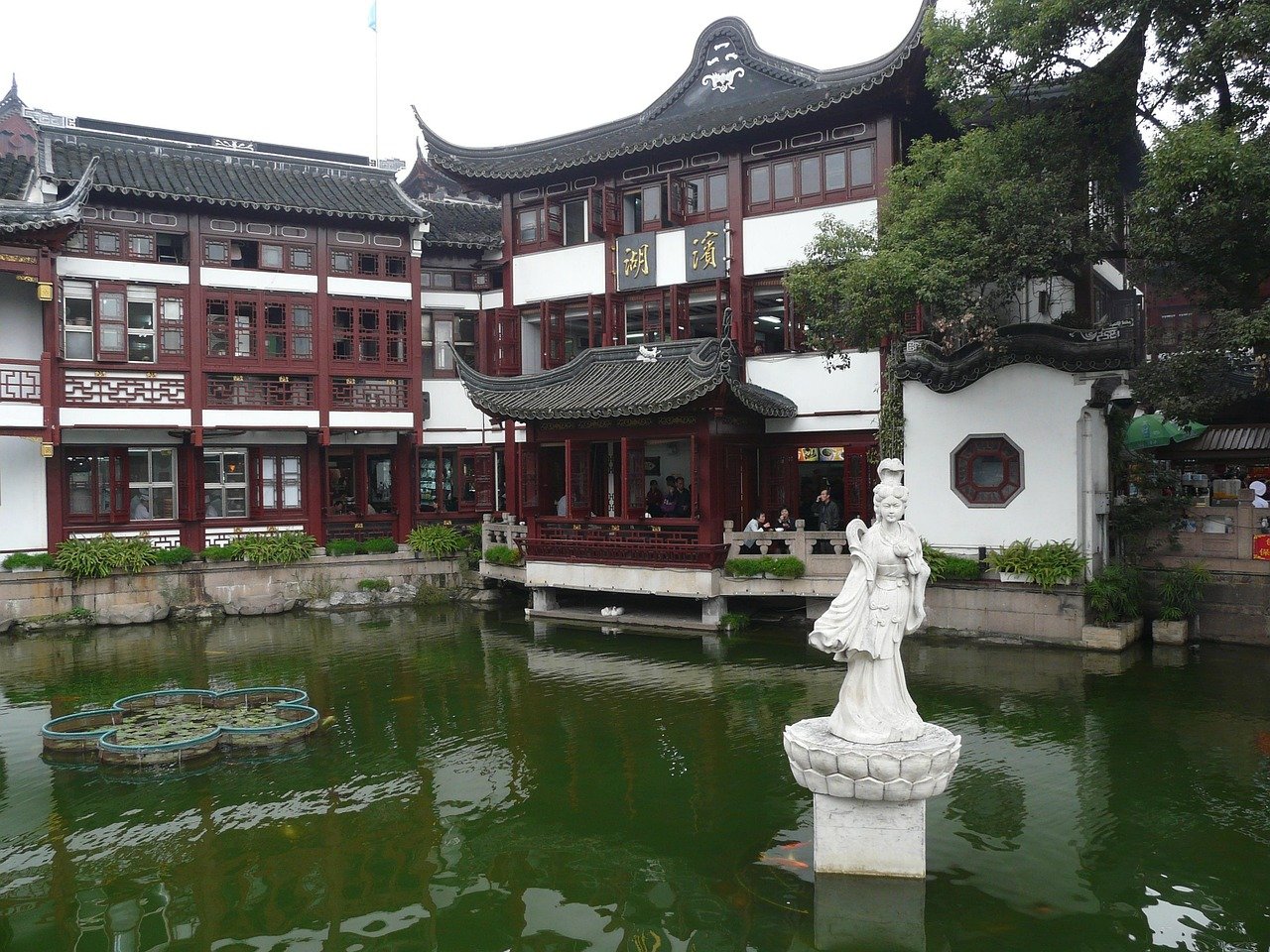
The Yu Garden, completed in 1577 during the Ming Dynasty, is the finest classical Chinese garden in central Shanghai — lotus ponds, zigzag bridges, rockeries, traditional pavilions. Tickets ~40 RMB. The surrounding Yuyuan Bazaar is touristy but atmospheric — try Nanxiang’s xiaolongbao (the original soup-dumpling specialist, established 1900) and the souvenir-and-handicraft alleys.
Shanghai Museum
The Shanghai Museum at People’s Square houses one of China’s finest classical art collections — bronze ritual vessels, Tang Dynasty Buddhist sculpture, Song Dynasty ceramics, Yuan and Ming paintings. The architecturally distinctive round-on-square building references the ancient Chinese cosmological concept of “round heaven, square earth.” Free entry but timed tickets required via WeChat mini-program. The new Shanghai Museum East (Pudong, opened 2024) houses temporary exhibitions and the broader collection.
Former French Concession
The 8 km² area south and west of People’s Square is Shanghai’s most genuinely walkable neighborhood — plane-tree-shaded streets, art deco apartment buildings, restored shikumen lane houses, and the city’s densest collection of independent boutiques, cafés, and design-led restaurants. Wander Wukang Road, Anfu Road, Yongkang Road, and the Tianzifang arts maze.
Jade Buddha Temple (Yùfó Sì)
An active Buddhist temple in Putuo District housing two extraordinary jade Buddha statues brought from Myanmar in 1882 — a 2-metre seated Buddha and a smaller reclining Buddha, both carved from single blocks of Burmese white jade. The temple has roughly 100 resident monks; daily Buddhist practices, vegetarian restaurant on site. Tickets ~20 RMB.
Xintiandi & Tianzifang
Xintiandi is the upscale shopping-and-dining district built around restored shikumen-style stone-gate houses. The 1st National Congress of the CCP Memorial is here. Tianzifang, a few blocks south, is the smaller-scale arts-and-crafts maze in similar restored alleys — busier with locals, more authentic, more crowded.
Longhua Temple and Pagoda
Shanghai’s oldest Buddhist temple complex (founded 247 CE, present buildings from the Song and Qing dynasties). The seven-story brick pagoda dates to 977 CE; the working monastery houses a golden Buddha statue and active prayer halls. Tickets ~10 RMB.
How to Get to Shanghai
By Air
Shanghai Pudong International Airport (PVG), 45 km east of downtown, is China’s second-busiest airport and Shanghai’s primary international gateway. Two terminals; major airlines include China Eastern (hub), Air China, China Southern, and most international flag carriers. Connected to central Shanghai by the Maglev train (8 minutes to Longyang Road, 50 RMB), Metro Line 2 (1h 15min, 9 RMB), and the new S1 Express Line opening in stages.
Shanghai Hongqiao International Airport (SHA), 13 km west of downtown, handles primarily domestic flights and select regional international routes (Tokyo, Seoul, Taipei). Direct connection to Hongqiao Railway Station — a seamless transport hub for high-speed rail.
By Rail
Four major railway stations connect Shanghai to all of China:
Shanghai Hongqiao Station — Asia’s largest railway hub (opened 2010). High-speed rail (Gaotie/G-trains) to Beijing in 4h 18min, Hangzhou in 45 min, Nanjing in 1h, Suzhou in 25 min. Booking via 12306.cn or via Trip.com for foreign-card-friendly booking.
Shanghai Railway Station handles older conventional and overnight services. Shanghai South Station (with its iconic circular roof) serves southern provinces. Shanghai West Station connects to western and northwestern regions.
By Sea
Shanghai Port — the world’s busiest container port — also offers passenger ferry services. International ferry services to Osaka and Kobe (Japan, 2 days) depart from the Shanghai International Cruise Terminal. Coastal ferries to Ningbo, Wenzhou, and Putuoshan depart from Shiliupu Pier near the Bund.
Getting Around Shanghai
Shanghai Metro
The Shanghai Metro is the world’s largest urban rail network — 21 lines, 831 km of track, 508 stations, 13+ million daily riders. Operational since 1995, the system covers all major districts and tourist attractions. Fares 3–9 RMB by distance. Transit cards (the rechargeable Shanghai Public Transport Card, or contactless mobile payment via WeChat/Alipay) are essential. Routes at service.shmetro.com/en.
Maglev Train
The Shanghai Maglev (Shanghai Maglev Train), operational since 2002, connects Longyang Road Station to Pudong Airport in 8 minutes — reaching peak speeds of 431 km/h during the express daytime runs. The German-built magnetic levitation system remains the world’s only operational commercial Maglev. Tickets 50 RMB one-way (40 RMB with same-day flight ticket).
Buses and Trolleys
Shanghai operates the world’s oldest continuously running trolleybus network (since 1914), alongside extensive standard bus routes. Routes are well-marked but not foreign-friendly; Google Maps doesn’t work in China — use Baidu Maps or Amap (Gaode) via WeChat mini-programs.
Taxis and Ride-Hailing
Licensed taxis are everywhere; meters start around 14 RMB. DiDi Chuxing is the dominant ride-hailing app; the international version supports foreign cards via WeChat Pay or Alipay linkage (since 2023–2024 update). Foreign-issued credit cards work at most major hotels but not at small shops or street vendors.
Cycling
Shared bikes (Hellobike, Meituan Bike) are everywhere; flat terrain makes cycling comfortable. App registration usually requires a Chinese phone number or WeChat Pay-Alipay-linked international card.
Food & Drink in Shanghai
Shanghai cuisine (Hu Cai or benbang cai) is one of China’s eight major regional traditions — characterized by sweetness, slow-cooked richness, and a Yangtze Delta seafood emphasis. Beyond local cuisine, Shanghai’s cosmopolitan history makes it the easiest Chinese city for any cuisine: Sichuan, Cantonese, Beijing duck, plus the best non-Chinese international dining in mainland China.
Signature Dishes
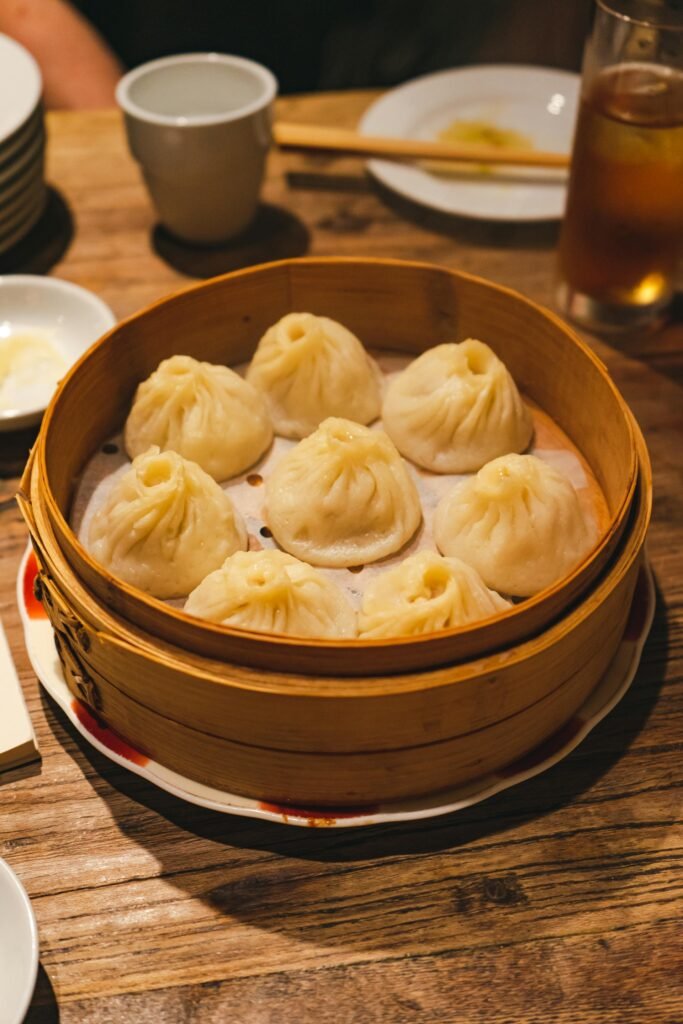
Xiaolongbao (small basket dumplings, often called soup dumplings) — the iconic Shanghai dim sum. Pork-filled, sealed wonton skin, hot broth inside, served with black vinegar and ginger. Nanxiang Mantou Dian (originated 1900) at Yu Garden is the institutional name; Din Tai Fung is the polished international chain (Taiwanese-founded but rooted in Shanghainese tradition).
Hong shao rou (red-braised pork belly) — slow-simmered pork belly in soy sauce, rice wine, and rock sugar, until the meat melts. Mao Zedong’s reportedly favorite dish.
Da zha xie (Shanghai hairy crab) — the autumn delicacy, in season September–December, sourced from nearby Yangcheng Lake. Steamed whole, eaten with vinegar-and-ginger dip, traditionally paired with warmed yellow rice wine. Females (with the prized roe) preferred October–November; males November–December.
Shengjianbao — pan-fried pork buns with a crispy bottom and soup-filled interior. The breakfast standard. Cong you ban mian — scallion-oil noodles. Zui ji (drunken chicken) and Lion’s head meatballs round out the canonical home cooking.
Street Food and Markets
The Yuyuan Bazaar food alleys serve scallion pancakes, stinky tofu, sweet osmanthus cakes, and grilled skewers. Wujiang Road in Jing’an is the more contemporary food street; Yongkang Road in the French Concession hosts the trendy international food bar scene.
Dining Districts
The former French Concession is Shanghai’s restaurant heartland — concentrated independent restaurants serving traditional Shanghainese, modern Chinese, and excellent Italian/French. Xintiandi hosts upscale dining in restored shikumen houses (Lost Heaven, Crystal Jade Golden Palace, Din Tai Fung). Pudong/Lujiazui houses fine dining at the major luxury hotels (Ultraviolet, Mr. and Mrs. Bund). Shanghai has 47 Michelin-starred restaurants as of the latest 2024 guide.
Tea Culture
Traditional teahouses in Yu Garden and the French Concession serve premium Chinese teas — Longjing (Dragon Well green tea, from neighboring Hangzhou), Pu’er, Tieguanyin, Jasmine. The Huxinting Teahouse in Yu Garden has been serving since 1855 in its zigzag-bridge pavilion. The Shanghai International Tea Culture Festival in spring features tastings and ceremonies.
Culture & Arts in Shanghai
Museums and Galleries
Beyond the Shanghai Museum (already covered), the China Art Museum (former 2010 Expo China Pavilion) in Pudong is one of Asia’s largest contemporary art museums. The Power Station of Art, converted from a 1985 industrial power plant, hosts cutting-edge contemporary exhibitions and the Shanghai Biennale. The M50 Arts District along Suzhou Creek is the city’s contemporary gallery hub. The Long Museum (Pudong and West Bund), the Yuz Museum, and the Rockbund Art Museum are the leading private collections.
Performing Arts
The Shanghai Grand Theatre at People’s Square hosts opera, ballet, classical music, and major touring shows in three halls (1,800-seat main, 600-seat medium, 300-seat experimental). The Shanghai Oriental Art Center in Pudong (the architectural butterfly-shaped pavilion) is the rival venue. Schedules at the Shanghai Grand Theatre portal.
Traditional Arts
Shanghai-style acrobatics — formally a Han Dynasty tradition — features daily evening shows at the Shanghai Centre Theatre and the dedicated Shanghai Acrobatics Theatre. The Shanghai-grown Yueju Opera (a soft, elegant Zhejiang-Shanghai female-only opera tradition) and Pingtan (storytelling with sung narrative) are the regional specialties.
Shanghai by District: The 16 区
Shanghai is divided into 16 districts. The map below shows their official OSM boundaries, colour-coded to match the table — a quick way to orient yourself before zooming in on individual sights.
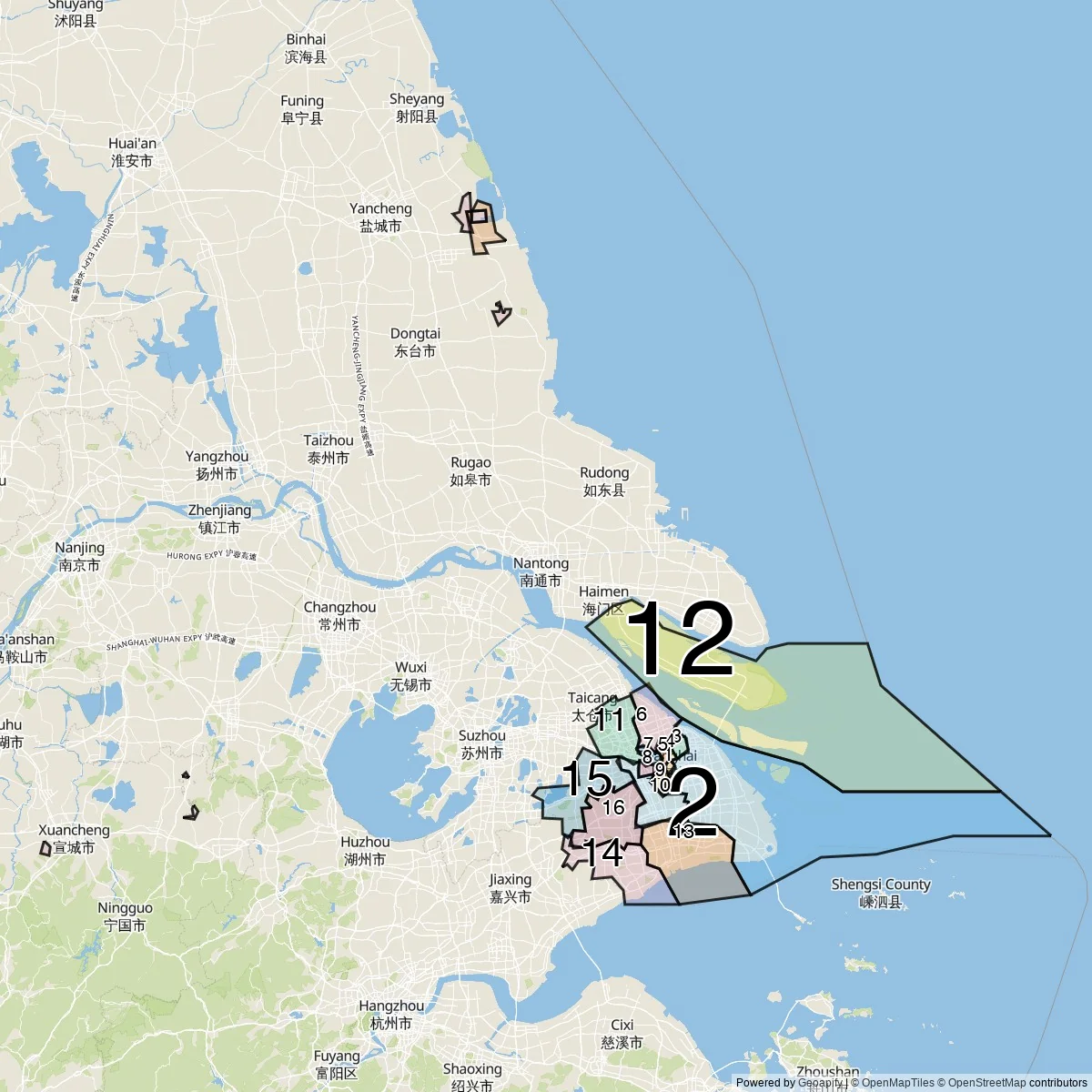
| # | 区 |
|---|---|
| 1 | 黄浦区 · Huangpu District |
| 2 | 浦东新区 · Pudong |
| 3 | 杨浦区 · Yangpu District |
| 4 | 虹口区 · Hongkou District |
| 5 | 静安区 · Jing’an District |
| 6 | 宝山区 · Baoshan District |
| 7 | 普陀区 · Putuo District |
| 8 | 长宁区 · Changning District |
| 9 | 徐汇区 · Xuhui District |
| 10 | 闵行区 · Minhang District |
| 11 | 嘉定区 · Jiading District |
| 12 | 崇明区 · Chongming District |
| 13 | 奉贤区 · Fengxian District |
| 14 | 金山区 · Jinshan District |
| 15 | 青浦区 · Qingpu District |
| 16 | 松江区 · Songjiang District |
Frequently Asked Questions About Visiting Shanghai
Do I need a visa to visit Shanghai?
Probably yes — but rules have shifted dramatically in 2024–2025. Most US, EU, UK, Australian, Canadian, Japanese, and ASEAN passport-holders can use the 240-hour transit visa-free policy if entering and exiting through different cities or ports — Shanghai qualifies. Citizens of around 38 countries (most EU members, Australia, New Zealand, Japan, South Korea, Malaysia, Thailand) can also enter visa-free for tourist stays up to 30 days under the bilateral agreements signed since November 2024. Most other nationalities still need a tourist visa applied for at the Chinese embassy before travel; the official portal is visaforchina.cn. Always check the latest at the Chinese Ministry of Foreign Affairs 4–6 weeks before travel.
Is Shanghai safe for tourists?
Shanghai is one of the world’s safest major cities — China overall has very low violent crime rates, and Shanghai in particular is heavily policed and tourist-friendly. The US State Department rates China at “exercise increased caution” — primarily for the legal and political risks of arbitrary detention rather than street-crime concerns. Real risks: pickpocketing in crowded markets and metro stations during peak hours; “tea ceremony” scams targeting tourists at the Bund and People’s Square (friendly local invites you to a teahouse, then bills several hundred dollars); fake taxi scams from PVG airport (always use the official taxi queue or a pre-booked transfer). Air quality: occasionally poor in winter; check live readings at aqicn.org/city/shanghai. Apps and connectivity: Google, Facebook, WhatsApp, Instagram, and most Western news sites are blocked behind the Great Firewall; install a reputable VPN before arrival if you need them.
How many days do I need in Shanghai?
Three full days handles the headlines comfortably; four to five days lets you do day-trips. A solid 3-day plan: Day 1 — Bund walking tour + Yu Garden + Yuyuan Bazaar lunch + Shanghai Museum + sunset on the Bund Promenade across the river; Day 2 — French Concession (Wukang Road, Anfu Road, Tianzifang) + Xintiandi + Jing’an Temple + dinner at Lost Heaven or Mr & Mrs Bund; Day 3 — Pudong (Shanghai Tower observation deck + Oriental Pearl Tower + Lujiazui) + Maglev train to Pudong Airport experience + dinner at Hai Di Lao or any Sichuan specialist. Day 4–5: Suzhou day trip (25 min by bullet train, classical gardens, UNESCO sites), Hangzhou day trip (45 min by bullet train, West Lake, Lingyin Temple), or Zhujiajiao water town (45 min by metro + bus, ancient canal town).
What’s the best area to stay in Shanghai?
Three solid options. Huangpu / The Bund — the historic center with iconic Bund views; luxury hotels (Peninsula, Waldorf Astoria, Fairmont Peace Hotel, Capella Jian Ye Li) at $250–800/night, walking distance to Yu Garden, Nanjing Road, and the major museums. Former French Concession (Xuhui / Huangpu old Luwan area) — the most atmospheric choice; restored shikumen boutique hotels, plane-tree-shaded streets, the city’s best café and design scene; my pick for second-time visitors. Pudong / Lujiazui — modern luxury (Mandarin Oriental, Park Hyatt at SWFC, Ritz-Carlton at IFC, Four Seasons) with skyline views; easy Maglev access to Pudong Airport, but feels detached from the historic city. Skip: hotels far from a metro line — Shanghai’s surface traffic during rush hour is brutal.
How much does it cost to visit Shanghai’s major sights?
Shanghai’s headline sights are reasonably priced. Shanghai Tower observation deck: ~180 RMB. Oriental Pearl Tower: ~220 RMB (combined ticket with Shanghai History Museum). Shanghai World Financial Center 100F skywalk: ~180 RMB. Yu Garden: ~40 RMB. Shanghai Museum (People’s Square): free but timed tickets via WeChat mini-program. Jade Buddha Temple: ~20 RMB. Longhua Temple: ~10 RMB. Bund walking: free. Maglev train (Longyang Road to Pudong Airport): 50 RMB one-way; 40 RMB with same-day flight ticket. Day trip to Suzhou by bullet train: ~80 RMB round trip. Day trip to Hangzhou: ~140 RMB round trip.
Should I drink the tap water in Shanghai?
No — Shanghai tap water meets Chinese drinking-water standards at the treatment plant, but locals universally drink bottled or boiled water due to inconsistent distribution-system quality. Always use bottled water (2–5 RMB per liter at convenience stores) for drinking and brushing teeth. Hotels typically provide complimentary bottled water and electric kettles for boiling water. Restaurants serve free tea or hot water (boiled, safe) and bottled water; ice in major hotel restaurants is generally safe but rare in local restaurants. Tap water is fine for showering. The CDC traveler health page recommends bottled or boiled water for China.
Can I use Western payment methods in Shanghai?
This is the practical question that surprises most first-time visitors. Cash and Western cards are increasingly difficult to use; Shanghai is one of the world’s most cashless cities, with everything paid via WeChat Pay or Alipay mobile QR codes. Good news (since 2023–2024): WeChat Pay and Alipay both now allow international visitors to link foreign credit cards directly inside the apps, making them usable for most transactions. Practical advice: download WeChat and Alipay before arrival, link a Visa or Mastercard inside each, and have ~500 RMB cash as backup. International credit cards (Visa, Mastercard, Amex) work at most major hotels, large restaurants, department stores, and some metro stations — but not at small restaurants, street vendors, or many local shops. ATMs at Bank of China, ICBC, and HSBC accept foreign cards (~3,000 RMB withdrawal limit per transaction).
Is tipping expected in Shanghai?
No — tipping is not part of Chinese service culture. Restaurants: never tip; some upscale Western-style restaurants and luxury hotel restaurants add a 10% service charge (服务费 fúwùfèi) to the bill — that’s the closest equivalent. Taxis: pay the meter exactly; no tip. Hotel porters: 5–20 RMB per bag at luxury Western-brand hotels is appreciated; not expected at standard or budget hotels. Tour guides: 100–300 RMB per person for half-day group tours, more for full private day. Spa, hair: not customary. The single exception: high-end Western-targeted resorts may have a tip culture; otherwise, your money stays in your pocket.
Festivals & Events
Shanghai’s calendar is dense year-round. Major events include the Longhua Temple Fair (April, 300-year tradition) — incense, vegetarian feasts, traditional opera; the Dragon Boat Festival (May/June, lunar calendar) — boat racing on Suzhou Creek, sticky rice dumplings (zongzi); the Shanghai International Film Festival (June, FIAPF-accredited) — the biggest film event in mainland China; the Formula 1 Chinese Grand Prix (April) at the Shanghai International Circuit; the Mid-Autumn Festival (September/October, lunar) — lanterns, mooncakes; and the Shanghai International Marathon (November) past the Bund and through Pudong.
Shopping in Shanghai
Nanjing Road stretches westward from the Bund as Shanghai’s most famous shopping spine. The eastern section (Nanjing East Road, fully pedestrianized) hosts mass-market and tourist shops. The western section (Nanjing West Road around Jing’an Temple) hosts the major luxury malls — Plaza 66, HKRI Taikoo Hui, and The Réel.
The former French Concession houses Shanghai’s best independent designer scene — boutiques along Wukang Road, Anfu Road, and Changle Road feature local Chinese designers and curated international labels. Huaihai Road caters to a younger trendy crowd with international fast fashion. Yu Garden Bazaar offers the traditional silk, tea, and handicrafts; bargain hard.
Shanghai rewards travelers who give the city the time it deserves. Three days for the headline sights; four to five for slower exploration of the French Concession and a day-trip to Suzhou (the classical-garden city, 25 min by bullet train) or Hangzhou (West Lake, 45 min by bullet train). The contrast between 1920s colonial grandeur and 21st-century futurism is unique to Shanghai — and the city remains the easiest Chinese megacity for international visitors.
AFRIKA
Cairo Hurghada Johannesburg Marrakech
ASIA
Abu Dhabi Agra Antalya Bangkok Batam Beijing Bengaluru Cebu City Chiang Mai Chiba Chennai Da Nang Dammam Delhi Denpasar Dubai Fukuoka Guangzhou Guilin Ha Long Hanoi Ho Chi Minh City Jakarta Jaipur Johor Bahru Kolkata Krabi Kuala Lumpur Kyoto Macau Mecca Medina Mugla Mumbai Osaka Pattaya Penang Phuket Riyadh Seoul Shanghai Shenzhen Singapore Taipei Tokyo Zhuhai
EUROPE
Amsterdam Athens Barcelona Berlin Brussels Budapest Copenhagen Dublin Florence Frankfurt am Main Heraklion Krakow Lisbon London Madrid Milan Munich Nice Paris Porto Prague Rhodes Rome Stockholm Venice Vienna Warsaw
NORTH AMERICA
Cancun Las Vegas Los Angeles Miami New York City Orlando San Francisco Toronto Vancouver
SOUTH AMERICA
Buenos Aires Lima Rio De Janeiro
OCEANIA
Auckland Honolulu Melbourne Sydney