
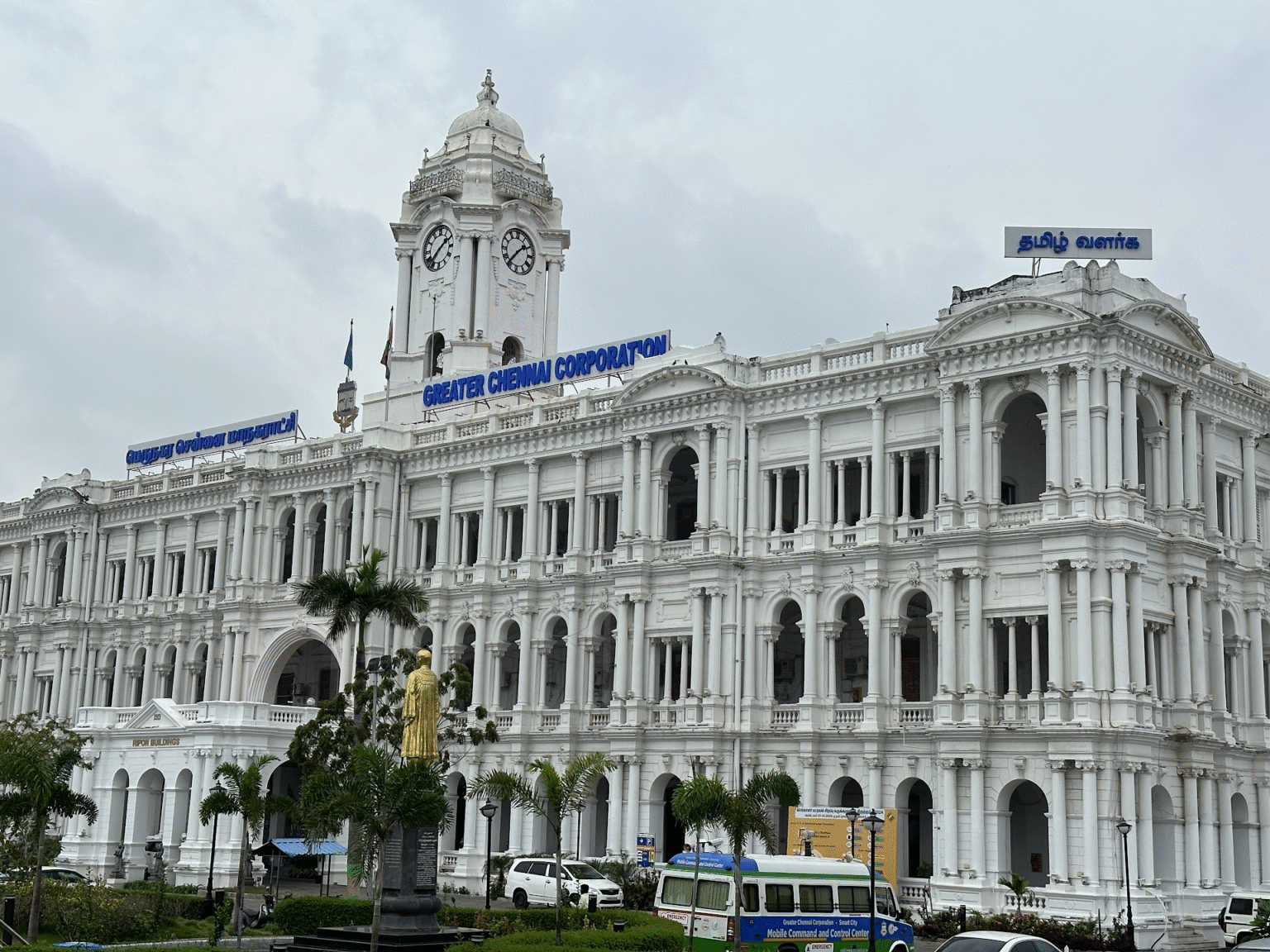
Photo credit: Chennai’s stunning coastline and urban landscape from above
Chennai, the vibrant capital of Tamil Nadu, stands as India’s sixth-largest city and a captivating blend of ancient traditions and modern innovation. Formerly known as Madras until 1996, this coastal metropolis hugs the Bay of Bengal with its famous Marina Beach while serving as South India’s cultural and economic powerhouse. With over 4.6 million residents and a rich history spanning from ancient Tamil kingdoms to British colonial rule, Chennai offers visitors an authentic taste of South Indian heritage alongside cutting-edge technology hubs and world-class healthcare facilities.
Chennai at a Glance: Essential Facts for Travelers
Chennai: Key Facts & Tourism Statistics
| International arrivals | 0.79 million (2024, foreign tourist arrivals) — Ministry of Tourism, India Tourism Data Compendium 2024 |
|---|---|
| Population | 4.65 million (2011, Census of India 2011) |
| Best time to visit | December, January and February |
| Airport to city centre | Chennai Metro Blue Line (from MAA): ~35 min, ~US$0.6 |
| Currency | Indian rupee (INR) |
| Time zone | UTC+5:30 (IST) |
| Visa | Most nationalities need an Indian e-Visa (indianvisaonline.gov.in), typically issued for tourism up to 90 days. |
How many tourists visit Chennai per year?
Chennai recorded 0.79 million foreign tourist arrivals (FTAs) via Chennai airport, port-of-entry statistic in 2024, according to Ministry of Tourism, India Tourism Data Compendium 2024.
What is the best time to visit Chennai?
The most comfortable months to visit Chennai are typically December, January and February, based on 1991–2020 climate normals for temperature and rainfall.
How do I get from the airport to central Chennai?
The Chennai Metro Blue Line (from MAA) takes about 35 minutes to the city centre for about US$0.6 (~INR 50 to city centre).
What currency is used in Chennai?
Chennai uses the Indian rupee (INR); the local time zone is UTC+5:30 (IST).
Do I need a visa to visit Chennai?
Most nationalities need an Indian e-Visa (indianvisaonline.gov.in), typically issued for tourism up to 90 days.
How many people live in Chennai?
Chennai has a population of about 4.65 million (city proper (Census 2011); metro area ~11M), per Census of India 2011 (2011).
Chennai climate: monthly averages (1991–2020)
| Month | Avg high | Avg low | Rain |
|---|---|---|---|
| Jan | 27.9 °C | 20.8 °C | 15 mm |
| Feb | 30 °C | 21.2 °C | 7 mm |
| Mar | 32.6 °C | 23.1 °C | 9 mm |
| Apr | 34.5 °C | 26.1 °C | 15 mm |
| May | 36.5 °C | 28 °C | 38 mm |
| Jun | 35.5 °C | 27.8 °C | 65 mm |
| Jul | 34.2 °C | 26.9 °C | 70 mm |
| Aug | 33.3 °C | 26.3 °C | 98 mm |
| Sep | 32.6 °C | 25.9 °C | 109 mm |
| Oct | 30.6 °C | 24.6 °C | 215 mm |
| Nov | 28.5 °C | 23.3 °C | 225 mm |
| Dec | 27.5 °C | 22 °C | 116 mm |
Data last verified: 2026-09-01 · Climate: Open-Meteo ERA5 reanalysis, monthly normals computed from daily data 1991–2020 · Sources: MoT India Tourism Data Compendium 2024 (FTAs) · Census of India (population) · CMRL (transfer) (primary source) · World’s most visited cities · Methodology
Upcoming Events in Chennai
| Date | Title | Details |
|---|---|---|
| 2026-09-14 | Vinayaka Chaturthi (Ganesh Festival) | Vinayaka Chaturthi, the festival honouring the elephant-headed god Ganesha, is celebrated across Chennai in September with brightly decorated pandals, clay idols and community pujas. In the days that follow, processions carry idols to the sea for immersion, with Marina Beach and the Bay of Bengal shoreline drawing large, festive crowds. Streets fill with music, sweets and colour, making it one of the city’s most visible public celebrations. Viewing the festivities is free; visitors are advised to expect heavy traffic and dense crowds near the immersion points. [Source] |
| 2026-09-25 to 2026-09-27 | Gem & Jewellery India International Fair (GJIIF) 2026 | The Gem and Jewellery India International Fair returns to the Chennai Trade Centre in Nandambakkam from 25 to 27 September 2026, assembling manufacturers, wholesalers, retailers, exporters and importers from across the country. Halls glitter with gold, diamond, silver, platinum and gemstone collections alongside contemporary designs and allied services, making the fair a key South Indian sourcing platform ahead of the wedding and festive season. It is aimed primarily at trade buyers, who register for entry, and doubles as a networking hub for the region’s sizeable jewellery industry. [Source] |
| 2026-10-03 | KYN Live 2.0 – The Crossover: Benny Dayal, Shruti Haasan & Andrea Jeremiah | KYN Live 2.0 – The Crossover brings a triple-headline night to Adityaram Palace City on East Coast Road on 3 October 2026, pairing playback favourite Benny Dayal with actor-singers Shruti Haasan and Andrea Jeremiah. The show mixes Tamil film hits, indie pop and rock-tinged sets, aimed squarely at Chennai’s young concert crowd, and the ECR venue south of the city is best reached by car or cab. Tickets are sold online in several tiers, with early-bird allocations typically the cheapest and premium sections closest to the stage. [Source] |
| 2026-10-11 to 2026-10-20 | Navaratri and Golu Festival | Navaratri, the nine-night festival of the goddess, is one of Tamil Nadu’s most cherished celebrations, and in Chennai it is marked above all by Bommai Golu, the tiered display of dolls and figurines arranged in homes and temples. Families visit one another to admire the arrangements, exchange gifts and sing, while temples such as Kapaleeshwarar in Mylapore hold special rituals and Saraswati Puja honours learning. The festival culminates in Vijayadashami. Most events are free and open to visitors, offering a warm window into Tamil domestic and temple tradition. [Source] |
| 2026-10-15 to 2026-10-17 | FoodVision Expo 2026 | FoodVision Expo, a trade show for India’s food and beverage manufacturing and processing industry, makes its Chennai stop at the Chennai Trade Centre from 15 to 17 October 2026. Exhibitors run live demonstrations of processing machinery, packaging equipment and ingredient technologies that drive modern food production, spanning dairy, bakery, beverage and snack lines. The event targets manufacturers, food technologists and procurement teams rather than general visitors, with trade registration granting entry. For anyone in the region’s fast-growing food sector it offers a compact way to survey suppliers and innovations under one roof. [Source] |
| 2026-10-23 | S. J. Jananiy in Concert at Raga Sudha Hall | Carnatic vocalist and composer S. J. Jananiy performs at Raga Sudha Hall in Mylapore on Friday 23 October 2026, an intimate venue favoured by Chennai’s classical-music connoisseurs. Known for pairing a rigorous classical foundation with her own compositions and devotional repertoire, she presents an evening recital in the months before the city’s famed December music season. Seating at the hall is limited, and entry to such recitals is commonly free or modestly priced, so arriving early is sensible; check listings for this concert’s exact arrangements. A rewarding stop for rasikas and curious newcomers alike. [Source] |
City News in Chennai – last 14 days
| Date | Category | Headline | Details |
|---|---|---|---|
| 2026-09-14 | Public safety | Chennai Customs seizes hydroponic ganja worth Rs 97 lakh, arrests passenger | Chennai Customs officers seized hydroponic cannabis valued at around 97 lakh rupees and arrested the passenger allegedly carrying the consignment. Hydroponically grown cannabis, typically smuggled from destinations where indoor cultivation is industrialised, commands a steep premium on the illicit market and has featured in a series of recent seizures at Indian airports. Officials are now tracing the supply chain behind the haul, and the arrested traveller faces prosecution under narcotics laws as authorities continue to tighten screening of inbound passengers and baggage. [Source] |
| 2026-09-14 | Culture | Religious fervour and colossal offerings mark Vinayaka Chaturthi across Tamil Nadu | Temples and neighbourhood pandals across Tamil Nadu celebrated Vinayaka Chaturthi with devotion, creative idol designs and enormous offerings, while in Madurai the spotlight fell on the seven-foot monolithic Mukkuruni Vinayakar inside the renowned Sri Meenakshi Sundareshwar Temple. In Chennai, community pujas and decorated clay idols drew steady crowds, and idols themed on Chief Minister Vijay appeared in some localities. Immersion processions toward the coast follow in the coming days, with police and civic agencies coordinating routes, timings and crowd management around Marina Beach. [Source] |
| 2026-09-13 | Public transport | Long-awaited cab pick-up plaza at Chennai airport opened after two-year delay | Civil Aviation Minister Kinjarapu Rammohan Naidu virtually inaugurated the delayed cab pick-up facility at Chennai airport, designed to cut kerbside congestion and streamline vehicle movement for arriving passengers. The plaza can handle 28 vehicles at a time across its two pick-up lanes, giving app-based cabs and taxis a dedicated area away from the terminal frontage. The minister said the facility would reduce congestion, and he also outlined a larger transformation plan for the airport, signalling further upgrades to capacity and passenger amenities at one of South India’s busiest gateways. [Source] |
| 2026-09-13 | Local affairs | Electricity demand peaks this September as unscheduled power cuts return to Tamil Nadu | Unscheduled power cuts have returned across Tamil Nadu as electricity demand runs unusually high for September, straining supplies in Chennai and beyond. Demand has held around 20,500 megawatts in recent months, well above the 16,000 to 17,000 megawatts typical at this time last year, leaving the Tamil Nadu Power Distribution Corporation grappling with a shortfall of more than 3,000 megawatts. Households and businesses have reported outages arriving without warning, and the utility is trying to bridge the gap through additional purchases and load management. [Source] |
| 2026-09-13 | Local government | Udhayanidhi Stalin accuses TVK-led government of failing on power cuts and price rise | Former Deputy Chief Minister and DMK leader Udhayanidhi Stalin has accused the TVK-led Tamil Nadu government of failing to address recurring power cuts and rising prices, sharpening opposition attacks as outages spread. In unusually blunt remarks, he called the administration of Chief Minister C. Joseph Vijay uncivilised and dismissed the actor-turned-politician as a dummy Chief Minister. The broadside signals an escalating confrontation between the DMK, now in opposition, and the ruling TVK over living costs and infrastructure, themes set to dominate state politics in the months ahead. [Source] |
| 2026-09-13 | Local government | Left parties to contest Tamil Nadu bypolls in Dharapuram and Madurantakam | The Left parties will contest the coming Tamil Nadu byelections, with the CPI fielding a candidate in Dharapuram and the CPI(M) in Madurantakam, and names to be announced on 15 September. Party leaders described the contests as byelections imposed on the people rather than routine polls, framing their campaigns as a referendum on the state government. Madurantakam lies in the wider region south of Chennai, so the contest will be followed closely in the capital as an early electoral test for the ruling dispensation and the opposition parties. [Source] |
| 2026-09-13 | Public transport | Bridge to replace part of Pallavaram-Thoraipakkam Radial Road on Pallikaranai marshland | A bridge is set to carry part of the Pallavaram-Thoraipakkam Radial Road across the ecologically sensitive Pallikaranai marshland in southern Chennai, replacing the existing at-grade stretch. The busy link connects the airport corridor with the IT belt along Old Mahabalipuram Road, and the road embankment across the wetland has long been seen as constraining water flow through one of the city’s last major flood sinks. Elevating the carriageway is intended to help both hydrology and traffic; detailed designs and construction timelines are awaited from the authorities. [Source] |
| 2026-09-13 | Public safety | Chennai records surge in fever and dengue cases as doctors urge caution | Doctors in Chennai are urging residents to take precautions as the city records a rise in fever and dengue cases. Hospitals and clinics are seeing more patients with viral fevers in a familiar seasonal pattern, as stagnant water left by intermittent rain gives Aedes mosquitoes places to breed. Physicians advise prompt testing for persistent high fever, severe body aches or falling platelet counts, and recommend clearing standing water around homes, using repellents and protecting children, while civic health teams typically step up fogging and source-reduction drives during such spikes. [Source] |
| 2026-09-13 | Sports | Tenders floated for sports facilities worth Rs 63 lakh in Perambur | Tenders have been floated for sports facilities worth about 63 lakh rupees in Perambur, a densely populated neighbourhood in north Chennai. The planned works are meant to give residents, particularly young people, better access to organised sport close to home, in a city that has been steadily adding neighbourhood playgrounds and community amenities. Contractors will be chosen through the bidding process before construction begins, and local sports enthusiasts will be watching for the promised facilities to move from paper to the ground without the delays that often dog civic projects. [Source] |
| 2026-09-13 | Culture | Malvika Singh brings Cooking for my Firefly and memories of Delhi to Chennai | Publisher and columnist Malvika Singh is in Chennai for an evening of readings and conversation around her memoir Cooking for my Firefly, presented by the Prakriti Foundation at Amethyst Cafe. Blending recipes with recollection, the book is less a cookbook than a memoir of life, love and friendship, steeped in the author’s Delhi. The session continues the foundation’s tradition of intimate literary evenings in the city, giving readers the chance to hear the stories behind the dishes and to have their copies signed. [Source] |
| 2026-09-13 | Local affairs | Chennai’s golden dog of Besant Nagar found safe and glowing still | Besant Nagar’s beloved golden dog is safe, residents learned, after the gold-painted fibreglass figure vanished from its selfie point on Besant Avenue Road and set off an outpouring of concern. The quirky statue stands on a stretch promoted under the Greater Chennai Corporation’s Health Walk initiative, and walkers who found it missing in the morning feared it had been stolen. Word finally spread that the sculpture is unharmed, prompting a collective sigh of relief among the locality’s regulars, for whom the glowing landmark has become part of the daily routine. [Source] |
Chennai Events & City News Archive
Sources: Tamil Nadu Tourism, TradeIndia Trade Shows, KYN, 10times, Chennai Events, Rediff, The Hindu, The Hindu
Weather Forecast for the Next 14 Days in Chennai
| Date | Weather | Max °F | Min °F | Rain mm |
|---|---|---|---|---|
| 2026-09-14 | ⛈️ | 88.4 °F | 76.1 °F | 22.7 mm |
| 2026-09-15 | ☁️ | 89.7 °F | 78.4 °F | 0.0 mm |
| 2026-09-16 | ⛈️ | 90.6 °F | 78.3 °F | 0.8 mm |
| 2026-09-17 | ⛈️ | 93.0 °F | 77.5 °F | 4.2 mm |
| 2026-09-18 | ⛈️ | 91.9 °F | 78.3 °F | 4.8 mm |
| 2026-09-19 | ⛈️ | 89.7 °F | 76.5 °F | 4.5 mm |
| 2026-09-20 | ⛈️ | 87.9 °F | 75.8 °F | 14.4 mm |
| 2026-09-21 | 🌧️ | 86.5 °F | 75.8 °F | 6.0 mm |
| 2026-09-22 | ⛈️ | 87.8 °F | 75.8 °F | 6.6 mm |
| 2026-09-23 | ⛈️ | 89.0 °F | 77.3 °F | 6.6 mm |
| 2026-09-24 | 🌧️ | 89.2 °F | 76.0 °F | 9.6 mm |
| 2026-09-25 | ☁️ | 87.5 °F | 77.5 °F | 0.0 mm |
| 2026-09-26 | ☁️ | 89.0 °F | 78.4 °F | 0.0 mm |
| 2026-09-27 | ☁️ | 88.8 °F | 77.7 °F | 0.0 mm |
Chennai’s History
Chennai — known as Madras until 1996 — is the southern Indian metropolis with the longest continuous urban history of any major Indian city. Tamil settlements, Portuguese trading posts, and British colonial fortresses overlap with the modern Tamil cinema industry, the country’s automotive manufacturing capital, and one of the world’s leading classical-music scenes. Six million people live in the city; another six million across the metro region.
Ancient Roots and Early Settlements
Long before British ships arrived on the Coromandel Coast, the area that became Chennai was home to thriving Tamil settlements. Mylapore, one of Chennai’s oldest neighborhoods, may correspond to the ancient port of “Mailarpha” mentioned by the Greek geographer Ptolemy in the 2nd century CE. According to Christian tradition, the Apostle Thomas preached in the area and was martyred on St. Thomas Mount in 72 CE — making Mylapore one of Christianity’s earliest Asian footholds.
By the 7th and 8th centuries, the Tamil nayanmar and alvar saint-poets celebrated Mylapore, Triplicane, and Tiruvottiyur temples in their devotional verses (the Tamil literature of bhakti). These sacred sites — including the Kapaleeshwarar Temple and Parthasarathy Temple — formed the spiritual backbone of regional Tamil identity that persists today.
Portuguese Pioneers
The Portuguese were the first Europeans to establish a significant Coromandel Coast presence, arriving in 1523 and naming their Mylapore colony São Tomé de Meliapore after the apostle’s traditional martyrdom site. They built churches on St. Thomas Mount and near the apostle’s tomb (the current San Thome Basilica was built over Portuguese foundations in 1893). Portuguese control flickered between 1662–1749, but their architectural legacy survives in weathered chapels and colonial-era structures.
British Foundation and Fort St. George
Chennai’s modern history began on 22 August 1639, when Francis Day of the British East India Company, working with his Tamil translator Beri Thimmappa, secured land from local Vijayanagara-affiliated Nayak ruler Damarla Venkatadri. By 1640, Fort St. George rose on the coastline — named after England’s patron saint — and became the nucleus of Madrasapattinam, the regional headquarters of British Coromandel Coast trade.
By 1653, Madras had become the Madras Presidency, one of British India’s three major administrative zones (alongside Bombay and Calcutta). The settlement absorbed nearby villages — Triplicane, Egmore, Mylapore — by 1700, creating a cosmopolitan mix of Tamil, Telugu, Portuguese, Armenian, and British communities. Fort St. George remains an active government complex today; the Tamil Nadu Legislative Assembly meets within its walls.
Colonial Conflicts and Growth
Madras was a prize fought over by European powers. During the Carnatic Wars, French forces under Admiral La Bourdonnais captured Madras in 1746, returning it in 1749 after the Treaty of Aix-la-Chapelle. The fort survived French sieges in 1759 and attacks by Mysore’s Hyder Ali in 1769 and 1780. By 1801, the Nawab of Arcot ceded his territories to the British, cementing Madras Presidency control over much of South India.
Even global conflicts touched Madras: in September 1914, the German cruiser SMS Emden shelled the city’s oil depots — making Madras the only Indian city directly attacked during World War I. World War II brought Japanese bombing raids in 1942–1943, though damage was minimal.
Independence and Modern Transformation
After Indian independence in 1947, Madras became the capital of the new Madras State. The 1965 anti-Hindi protests — fierce student-led demonstrations against the imposition of Hindi as the sole national language — reshaped Indian language politics; today, the constitutional protection of official Tamil and the bilingual federal model trace directly back to those Madras protests. In 1969, the state was renamed Tamil Nadu (“Tamil Country”), and in 1996, the city itself officially adopted its pre-colonial name Chennai, derived from Chennapattanam, a 17th-century settlement adjacent to Fort St. George.
Post-1990s economic liberalization transformed Chennai into a major industrial and IT hub — particularly automotive manufacturing (the city makes ~40% of India’s vehicles) and information technology services along the OMR corridor. The 2004 Indian Ocean tsunami killed 160 people on Marina Beach; the 2015 monsoon floods paralyzed the city for two weeks; the 2019 water crisis saw the four major reservoirs almost completely empty. Through each crisis, Chennai has demonstrated remarkable resilience.
Geography, Climate & Best Time to Visit Chennai
Coastal Geography
Chennai sprawls across a flat coastal plain along the Bay of Bengal, where golden sand beaches meet urban development. The crown jewel is the 13-kilometre Marina Beach — one of the world’s longest urban beaches and the city’s defining outdoor space. Two rivers frame the city: the Cooum River through the north and the Adyar River through the south, both emptying into the Bay. The Buckingham Canal (a 19th-century British navigation canal) connects these waterways inland.
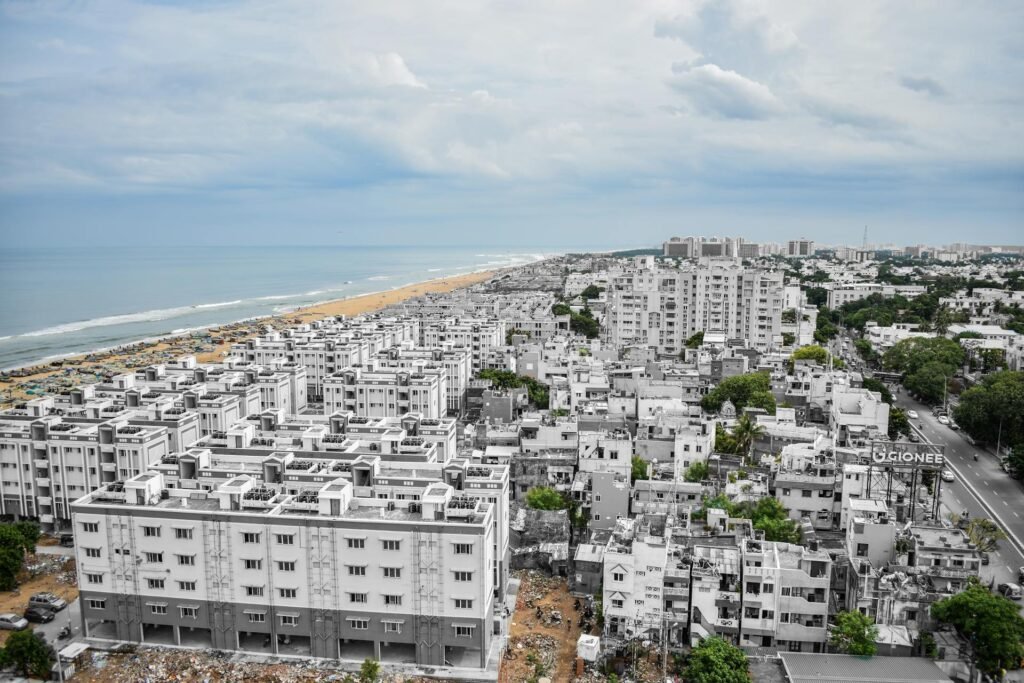
At an average elevation of just 6 metres above sea level, Chennai is dangerously flat — the city’s flood vulnerability has worsened with climate change. A few low hills like St. Thomas Mount provide modest elevated viewpoints. The greater Chennai metropolitan area covers 1,189 km² and houses ~12 million residents.
Tropical Climate
Chennai has a tropical wet-and-dry climate — and is famous (and notorious) for being one of India’s hottest major cities. Average daytime temperatures range 28.9–33°C; evenings remain warm at 20–27°C. The truly distinct feature is the Northeast Monsoon: unlike most of India which gets its rain from the Southwest Monsoon (June–September), Chennai gets the bulk of its annual rainfall in October–December.
| Season | Months | Character | Rainfall |
|---|---|---|---|
| Winter | December-February | Pleasant and dry | 13-146mm |
| Summer | March-June | Hot with sea breezes | 15-54mm |
| Southwest Monsoon | July-September | Moderate rainfall | 100-129mm |
| Northeast Monsoon | October-November | Heavy rainfall | 291-349mm |
Best Time to Visit
December to February is the optimal travel window — comfortable temperatures (cool by Chennai standards), minimal rainfall, and crucially the Madras Music Season (December–early January), when the city becomes the global capital of Carnatic classical music with 1,000+ concerts in two weeks. March to May can be punishingly hot (up to 40°C with high humidity) but sea breezes provide some relief. The monsoon months (October–November) bring dramatic weather and lush landscapes but can be genuinely disruptive — major flooding has hit Chennai multiple times in the last decade.
Chennai’s Districts & Neighborhoods
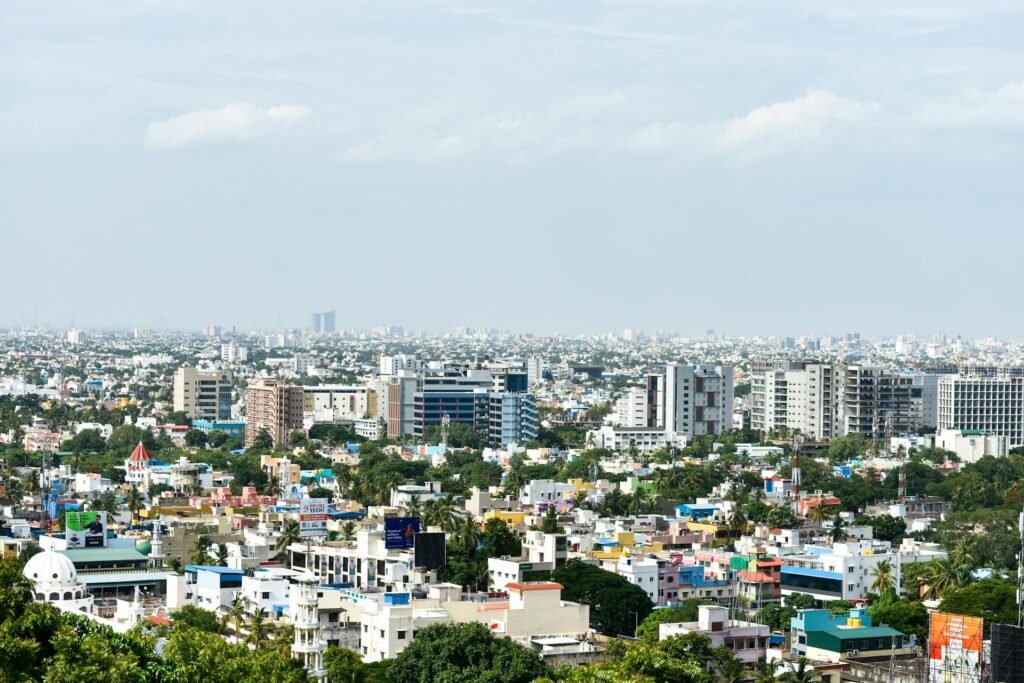
Chennai administratively divides into 15 zones encompassing 200 wards. The visitor’s working map is shorter: George Town for British colonial heritage, Mylapore for Tamil culture, T. Nagar for shopping, Adyar for upscale residential, the OMR/IT Corridor for modern Chennai.
Historic Core
Fort St. George & George Town: the colonial heart, home to the original British fort, government buildings, the historic St. Mary’s Church (the oldest Anglican church east of Suez, 1680), the Madras High Court, and the bustling commercial district of Parry’s Corner. Stay here for history-buff sightseeing, though the area lacks tourist hotels.
Mylapore: one of Chennai’s oldest neighborhoods, centered around the magnificent Kapaleeshwarar Temple (a 7th-century Shiva temple, rebuilt in 16th-century Pallava style). This area offers authentic Tamil culture, classical music venues, the historic San Thome Basilica, and the daily flower-and-fruit markets along Mada Streets.
Central Chennai
Triplicane: a culturally rich area housing the Parthasarathy Temple (one of the 108 Vaishnavite Divya Desams) and walking distance to Marina Beach. Budget travelers and culture enthusiasts find authentic local experiences here.
T. Nagar: the dense commercial-and-shopping zone — Chennai’s main retail district for sarees, jewelry (the famous Pothys, Saravana Stores), and electronics. Excellent connectivity to multiple metro lines and ideal for first-time visitors balancing shopping with sightseeing.
Egmore: home to the Government Museum, Egmore Railway Station (the southern hub for trains within Tamil Nadu), and many budget accommodations. Perfect for culture enthusiasts and budget-conscious travelers.
Modern Chennai
Adyar: an upscale residential area with the Theosophical Society Gardens (250 acres of mature banyan groves), quality restaurants, IIT Madras adjacent, and proximity to the OMR IT corridor. Best for business travelers and those seeking quieter accommodations.
Besant Nagar: a coastal neighborhood with Elliot’s Beach, the cluster of cafés, and a relaxed atmosphere. Popular with young travelers and beach lovers.
Kodambakkam: the heart of Tamil cinema (Kollywood) with film studios — particularly AVM Studios, Vijaya Vauhini Studios, and Prasad Group — clustered along the streets that gave the industry its name.
IT Corridor
Sholinganallur & OMR: the modern tech hub along Old Mahabalipuram Road, featuring the IT parks (Tidel Park, Mahindra City), shopping malls, and contemporary hotels. Best base for business travelers; the metro now connects OMR directly to central Chennai.
Top Things to Do in Chennai
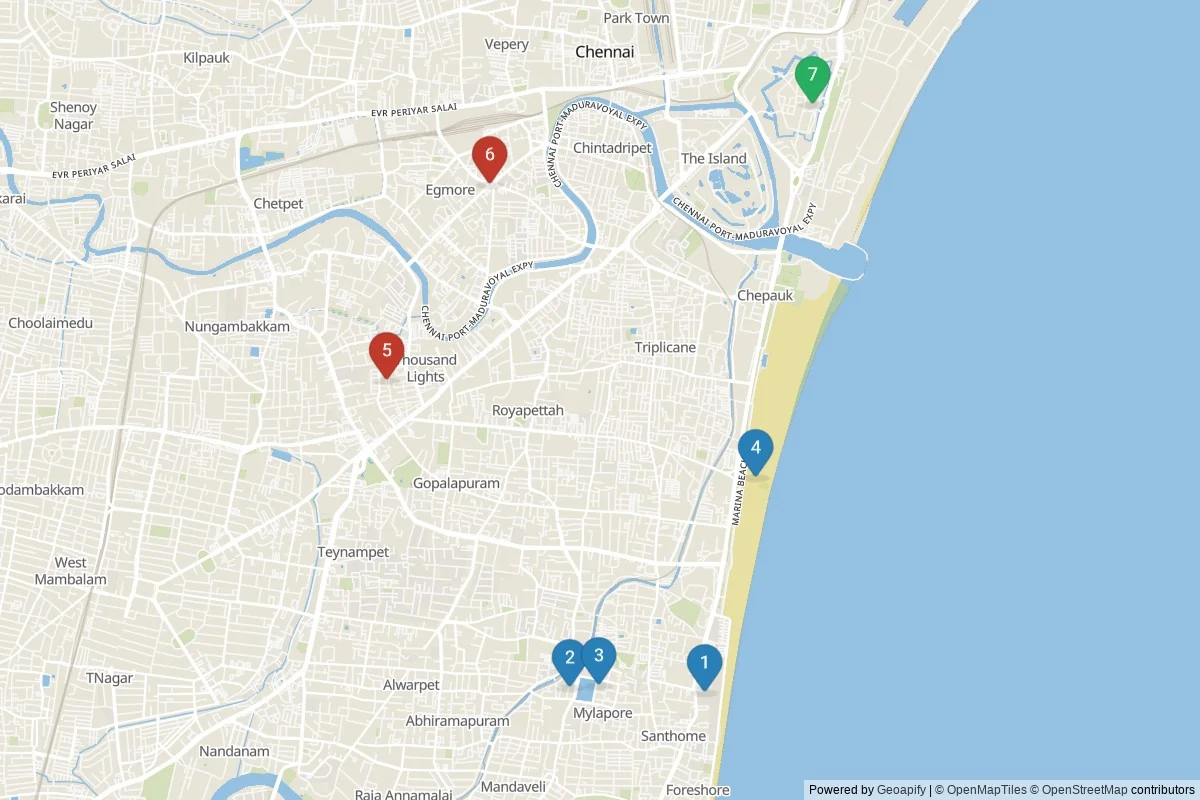
| # | Sight | Cluster | Type | Time | Entry | Best |
|---|---|---|---|---|---|---|
| 1 | San Thome Basilica | Central | Basilica | ~45 min | Free | Morning |
| 2 | Mylapore (Mada Streets) | Central | Old quarter | ~2 hrs | Free | Evening |
| 3 | Kapaleeshwarar Temple | Central | Hindu temple | ~1 hr | Free | Early morning |
| 4 | Marina Beach | Central | Urban beach | ~2 hrs | Free | Sunset |
| 5 | Valluvar Kottam | Outer | Monument | ~30 min | ₹10 | Anytime |
| 6 | Government Museum (Egmore) | Outer | Museum | ~2 hrs | ₹15 / ₹250 | Morning |
| 7 | Fort St. George | Far | Historic fort | ~2 hrs | ₹15 / ₹200 | Morning |
| 🚗 | Day Trip: Mahabalipuram | Day trip | UNESCO ruins | Full day | ₹40 / ₹600 | Morning |
| 🚗 | Day Trip: DakshinaChitra | Day trip | Heritage village | ½ day | ₹120 / ₹350 | Morning |
Chennai’s headline sights are spread across the city — three full days handles the essentials with planning. Pace yourself; the heat is real.
Historic Landmarks
Fort St. George (1640) — India’s first British fortress, now housing the Fort Museum with colonial artifacts, weapons, and the historic St. Mary’s Church (the oldest surviving Anglican church east of Suez). The Tamil Nadu Legislative Assembly still meets here. Tickets ~250 INR foreigners via asi.nic.in.
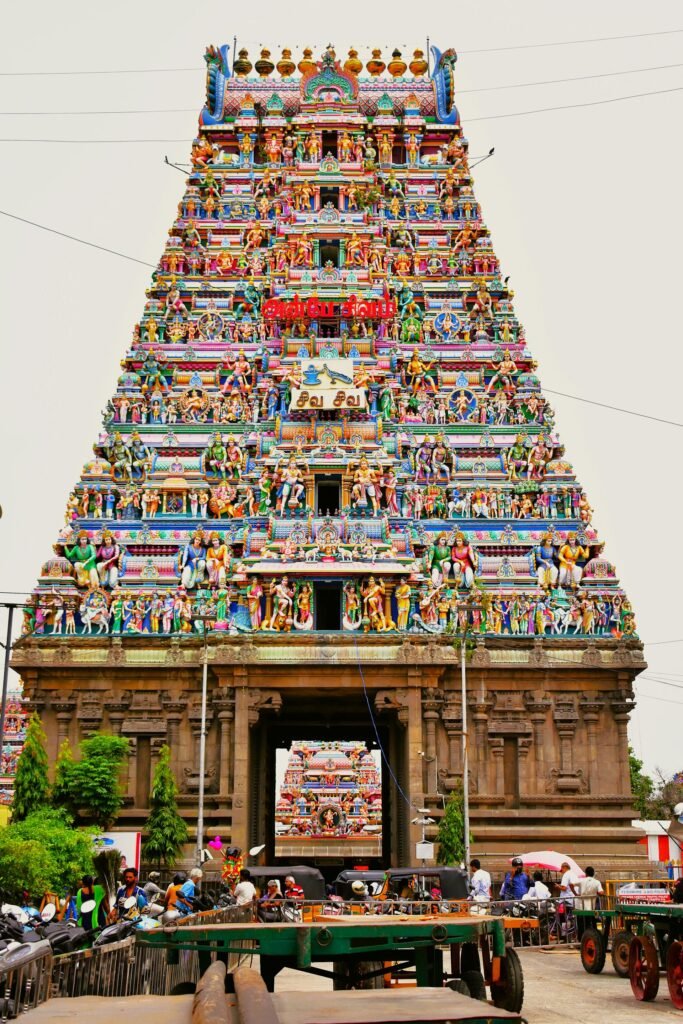
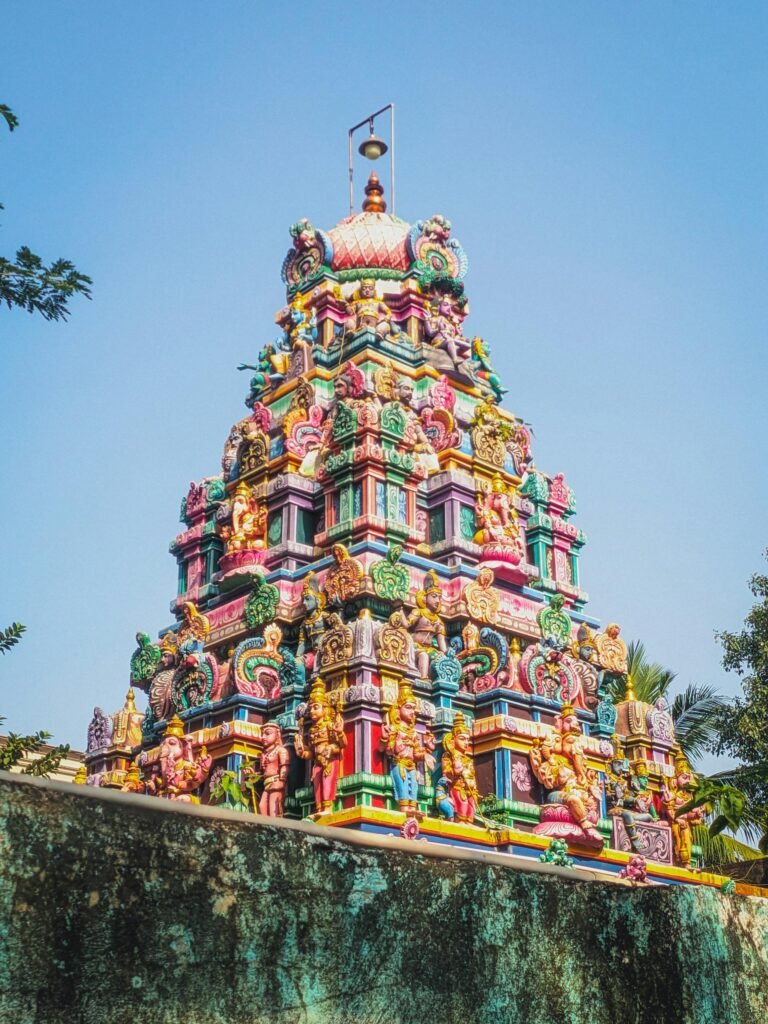
Kapaleeshwarar Temple — the stunning Mylapore temple dedicated to Shiva, with a 37-metre gopuram covered in colorful sculptures. The current structure dates to the 16th century but the lineage stretches back to the 7th century. Active worship; modest dress required, no leather, photography restrictions inside the inner shrine. Free entry.
San Thome Basilica — built 1893 over the tomb of Apostle Thomas, this neo-Gothic cathedral is one of only three churches in the world built directly over an apostle’s tomb (the others being St. Peter’s in Rome and Santiago de Compostela). Major Catholic pilgrimage site and architectural marvel.
Beaches and Waterfront
Marina Beach — at 13 km, one of the world’s longest urban beaches. Perfect for sunset walks, people-watching, and trying local snacks like sundal (spiced chickpeas) from beach vendors. The beach features memorials to Tamil Nadu political leaders (former Chief Ministers MGR, Jayalalithaa, Karunanidhi) and offers horse rides. Swimming is officially discouraged due to dangerous undercurrents.
Elliot’s Beach — the quieter alternative in Besant Nagar with the Karl Schmidt Memorial (Dutch sailor’s memorial 1930) and a cluster of beachfront cafés. Cleaner and less crowded than Marina Beach; popular with young Chennaiites at sunset.
Covelong Beach — 40 km south, a golden-sand beach with water sports, fishing-village atmosphere, and the historic Covelong Fort. Combine with the seaside temples at Mahabalipuram (UNESCO World Heritage, 60 km south) for an excellent day trip.
Museums and Culture
Government Museum (Egmore, founded 1857) — one of India’s largest museums; six galleries housing the famous Amaravati Buddhist sculpture collection, ancient Indus Valley artifacts, and the Bronze Gallery (the world’s finest collection of South Indian Chola bronzes — Nataraja Shiva and the dancing-deity sculptures). Tickets via chennaimuseum.org.
National Art Gallery (in the Indo-Saracenic Pantheon Complex next to the Government Museum) — vibrant Indian paintings from Rajput and Mughal schools, plus ancient South Indian musical instruments.
Kalakshetra Foundation (Besant Nagar) — the premier institution for Bharatanatyam classical dance, founded by Rukmini Devi Arundale in 1936. Visitors can attend performances and structured visits to the dance school’s banyan-shaded campus. Bookings via kalakshetra.in.
Religious Sites
Parthasarathy Temple (Triplicane) — an 8th-century Vaishnavite temple, one of the 108 sacred Divya Desams, dedicated to Lord Krishna as Arjuna’s charioteer (Parthasarathy). Active worship; modest dress required.
Thousand Lights Mosque — a striking Shiite mosque (1810) on Anna Salai, named for the thousand oil lamps lit during festivals. The most prominent mosque in Chennai.
St. Thomas Mount — the hilltop where Apostle Thomas was martyred, featuring the 16th-century Portuguese-built Our Lady of Expectation Church housing what tradition holds is the original cross used in the apostle’s martyrdom. Free panoramic city views.
Parks and Nature
Guindy National Park — remarkably located within the city, this 2.8 km² park is one of the world’s smallest national parks, home to spotted deer, blackbucks, and jackals. Adjacent to the IIT Madras campus.
Theosophical Society Gardens (Adyar) — 250 acres of peaceful gardens including the Adyar Banyan Tree, one of the largest banyans in the world (the original trunk fell in 1989, but the aerial root system survives). Walking paths, ancient trees, a serene atmosphere, and free entry.
Arignar Anna Zoological Park (Vandalur, 30 km south) — one of Asia’s largest zoos at 602 hectares, with diverse wildlife and conservation programs.
How to Get to Chennai
By Air
Chennai International Airport (MAA), 15 km southwest of the city center, is India’s third-busiest airport handling 25+ million passengers annually. Direct flights from major Indian cities and international destinations including Singapore, Dubai, Doha, Kuala Lumpur, London, Frankfurt, Tokyo, and New York. Connected to central Chennai by metro (Blue Line, 25 minutes to Egmore), prepaid taxis, and Ola/Uber. Live status at aai.aero/en/airports/chennai.
By Rail
Chennai is a major railway hub with excellent connectivity. Chennai Central (recently renamed MGR Chennai Central) is the primary station for long-distance trains to major cities — Mumbai (24 hours), Delhi (28 hours), Kolkata (24 hours), Bangalore (5 hours by Vande Bharat or Shatabdi). Chennai Egmore handles trains within Tamil Nadu and to nearby southern states. The Southern Railway network operates both express and local services.
By Road
Four major national highways connect Chennai to the rest of India:
- NH 16: coastal route to Kolkata via Visakhapatnam
- NH 48: western corridor to Mumbai via Bangalore
- NH 16/NH 32: route to Tirupati and Hyderabad
- East Coast Road (ECR): scenic coastal drive to Pondicherry (3 hours) and beyond
The Chennai Mofussil Bus Terminus (CMBT) in Koyambedu is one of Asia’s largest bus terminals, connecting the city to destinations across South India.
By Sea
Chennai Port is India’s second-largest port, handling cargo and occasional cruise traffic. While not a common tourist entry point, cruise ships occasionally dock here on Indian Ocean itineraries — the Costa and Cordelia Cruises seasonal services are the most regular.
Getting Around Chennai
Chennai’s transport options have improved dramatically with the metro expansion since 2015.
Chennai Metro
The Chennai Metro Rail system operates two lines (more under construction). The Blue Line runs from Chennai Central via Airport to Wimco Nagar; the Green Line connects Chennai Central to St. Thomas Mount. Trains air-conditioned, frequent (5–8 minutes peak), and offer a reliable way to avoid Chennai’s notoriously bad surface traffic. Phase 2 expansion is currently building Lines 3, 4, and 5 — significantly expanding coverage by 2026–2027.
Suburban Trains
The extensive suburban railway network is the backbone of Chennai’s working-class transport, connecting the city center to suburbs and satellite towns. Trains run frequently but can be crowded during peak hours. The Beach–Tambaram line is particularly useful for tourists heading to Mahabalipuram (via connecting bus from Tambaram).
Buses
The Metropolitan Transport Corporation (MTC) operates over 3,800 buses carrying 3.1 million passengers daily. Routes cover the entire city with both regular and air-conditioned services. The red MTC buses are economical (~10–25 INR per ride) but require some local knowledge for routing.
Auto-rickshaws and Taxis
Auto-rickshaws are ubiquitous and perfect for short distances. Always negotiate the fare beforehand or insist on the meter (Chennai’s prepaid auto-stands at major railway stations are reliable). App-based Ola and Uber offer transparent pricing throughout the city; Ola Auto books an auto-rickshaw at metered prices.
Car Rentals and Driving
Self-drive car rentals are available, but Chennai’s traffic can be challenging for visitors. Hiring a car with a driver (~2,500–4,000 INR per day) is often more practical for day trips like Mahabalipuram and Pondicherry.
Food & Drink in Chennai
Chennai is the global capital of South Indian cuisine — and one of the most distinctive regional Indian food traditions. Tamil-Brahmin vegetarian, Chettinad spice tradition, Tamil-Muslim biryani, and the modern multi-influence dining scene all find their fullest expression here.
South Indian Classics
Start your day with crispy dosas (the masala dosa is the canonical breakfast), fluffy idlis, and crispy vadas served with coconut chutney and sambar. Chennai’s filter coffee is legendary — served in traditional steel tumbler-and-davara sets, stronger and more aromatic than coffee anywhere else in India. Try it at Sangeetha, Saravana Bhavan (the Chennai institution with global branches), Murugan Idli Shop, or the legendary 100-year-old Rayar’s Cafe in Mylapore.
Chettinad cuisine represents Chennai’s spiciest offerings — complex spice blends and fiery curries from the region 400 km southwest. Don’t miss Chettinad chicken, kuzhi paniyaram, or mutton sukka, prepared with roasted spices that create layers of heat and flavor.
Street Food Adventures
Marina Beach comes alive in the evenings with vendors selling sundal, bajji (vegetable fritters), thengai mangai pattani sundal, and fresh coconut water. T. Nagar and Mylapore offer excellent murukku (spiral savory snacks) and traditional sweets like mysore pak and jangiri. The Sowcarpet neighborhood (the city’s North Indian and Marwari quarter) is the surprising location for chaat, kachori, and other North Indian street snacks.
Traditional Meals
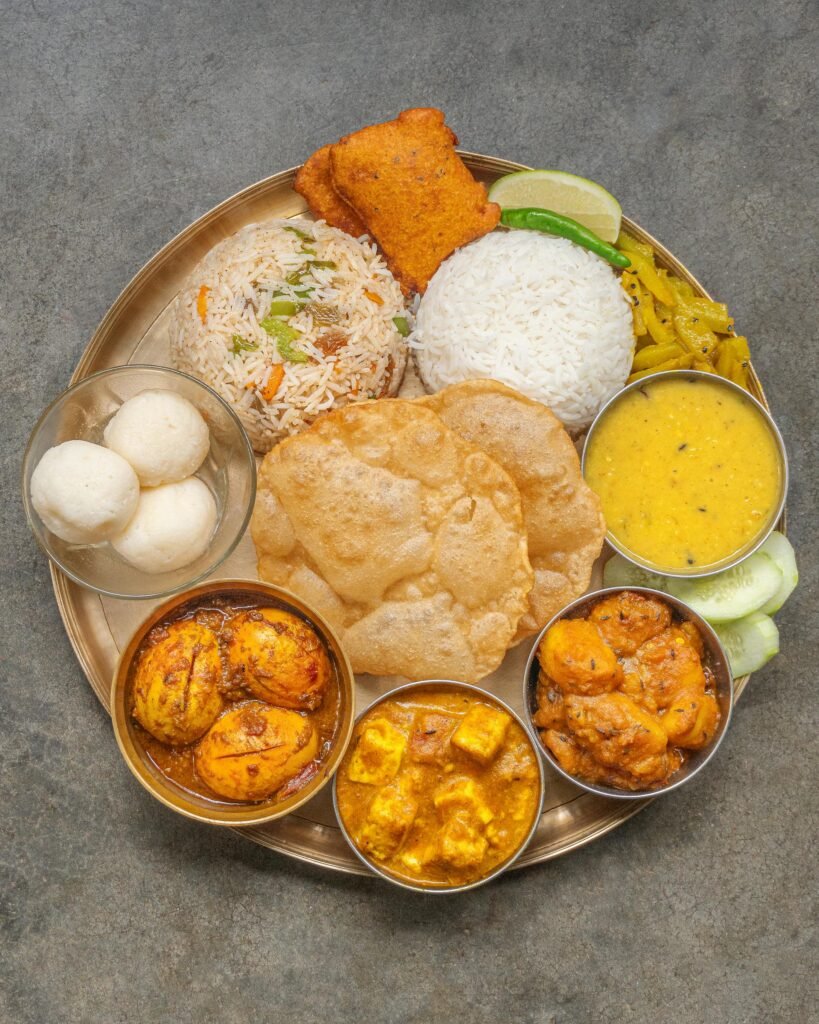
Experience a proper South Indian “meals” (thali) served on banana leaves — the elaborate spread includes rice, sambar, rasam, multiple vegetable curries, pickles, papad, and payasam (sweet dessert). Saravana Bhavan and Murugan Idli Shop are local institutions for vegetarian fare; for non-vegetarian Tamil meals, try Vasanta Bhavan, Buhari, or the iconic Anjappar Chettinad.
Seafood Specialties
Being a coastal city, Chennai excels in seafood. Try fish curry with coconut milk, prawn masala, crab roast, and the nethili meen varuval (anchovy fry). The fishing communities along the coast prepare fresh catches with traditional Tamil spices.
Where to Eat
Fine dining: Dakshin at ITC Grand Chola for upscale South Indian; Peshawri and Royal Vega for excellent North Indian; Avartana at ITC Grand Chola for modernist South Indian (Asia’s 50 Best). Local favorites: Rayar’s Cafe (Mylapore, since 1947, the city’s oldest filter coffee); Ratna Cafe for traditional breakfast; Buhari for biryani (the restaurant claims to have invented “Chicken 65” in 1965). Sweet treats: Grand Sweets & Snacks for traditional Tamil mithai and savories; Naturals for fresh-fruit ice creams.
Culture & Arts
Chennai is one of the most culturally rooted cities on earth — the global capital of Carnatic classical music, the birthplace of Bharatanatyam classical dance in its modern form, and home to Kollywood, the second-largest Indian cinema industry by revenue.
Classical Music and Dance
Chennai is the undisputed capital of Carnatic classical music — the South Indian classical music tradition. The annual Madras Music Season (mid-December to early January) is the world’s largest classical music festival of any tradition: 1,000+ concerts in two weeks at venues across the city, ranging from free temple performances to ticketed events at The Music Academy (since 1927, the most prestigious Carnatic venue), Narada Gana Sabha, and Krishna Gana Sabha. Schedule: musicacademymadras.in.
Bharatanatyam classical dance was revived in Chennai by Rukmini Devi Arundale, whose Kalakshetra Foundation (founded 1936) remains the premier institution for this ancient temple-dance tradition. Performances regularly take place at Kalakshetra and the major sabhas (cultural societies).
Tamil Cinema
Chennai is the heart of Tamil cinema, known as Kollywood after the Kodambakkam neighborhood where the studios cluster. The industry produces 200+ films annually and has given India some of its biggest stars (Rajinikanth, Kamal Haasan, Vijay, Suriya). Film music is deeply integrated into Chennai’s cultural fabric — A.R. Rahman (Oscar-winner for “Slumdog Millionaire”) emerged from this scene. The Madras Film Festival in December is the city’s leading film cultural event.
Literature and Publishing
As a major center for Tamil literature — the only Indian classical language with continuous literary tradition since 300 BCE — Chennai hosts numerous literary festivals (The Hindu Lit for Life in January is the leading English-language event) and is home to many prominent publishers. The city celebrates Tamil literary heritage while also being a significant center for English-language publishing in South India.
Sports
Cricket
The M.A. Chidambaram Stadium in Chepauk — built in 1916, one of the world’s oldest cricket grounds — is the home venue of the Chennai Super Kings IPL team and the Tamil Nadu first-class cricket team. Hosted four Cricket World Cups and numerous memorable matches. The “Chepauk crowd” is legendary for its sustained, knowledgeable cricket support — even when CSK plays away teams, the crowd is reportedly fair to visiting batsmen.
Tennis and Other Sports
Chennai hosted the ATP Chennai Open (2 decades, now discontinued and moved to Pune as Maharashtra Open) at the SDAT Tennis Stadium in Nungambakkam. The city has produced tennis stars including Vijay Amritraj, Ramanathan Krishnan, and Mahesh Bhupathi. The Jawaharlal Nehru Stadium hosts football and athletics events; the Guindy Race Course has been conducting horse racing since 1777. Chennai hosted the 2013 Chess World Championship, reflecting the city’s strong chess culture (Tamil Nadu is the home state of five-time world champion Viswanathan Anand).
Chennai by District: The 15 Zones
Chennai is divided into 15 municipal zones. The map below shows their official OSM boundaries, colour-coded to match the table — a quick way to orient yourself before zooming in on individual sights.
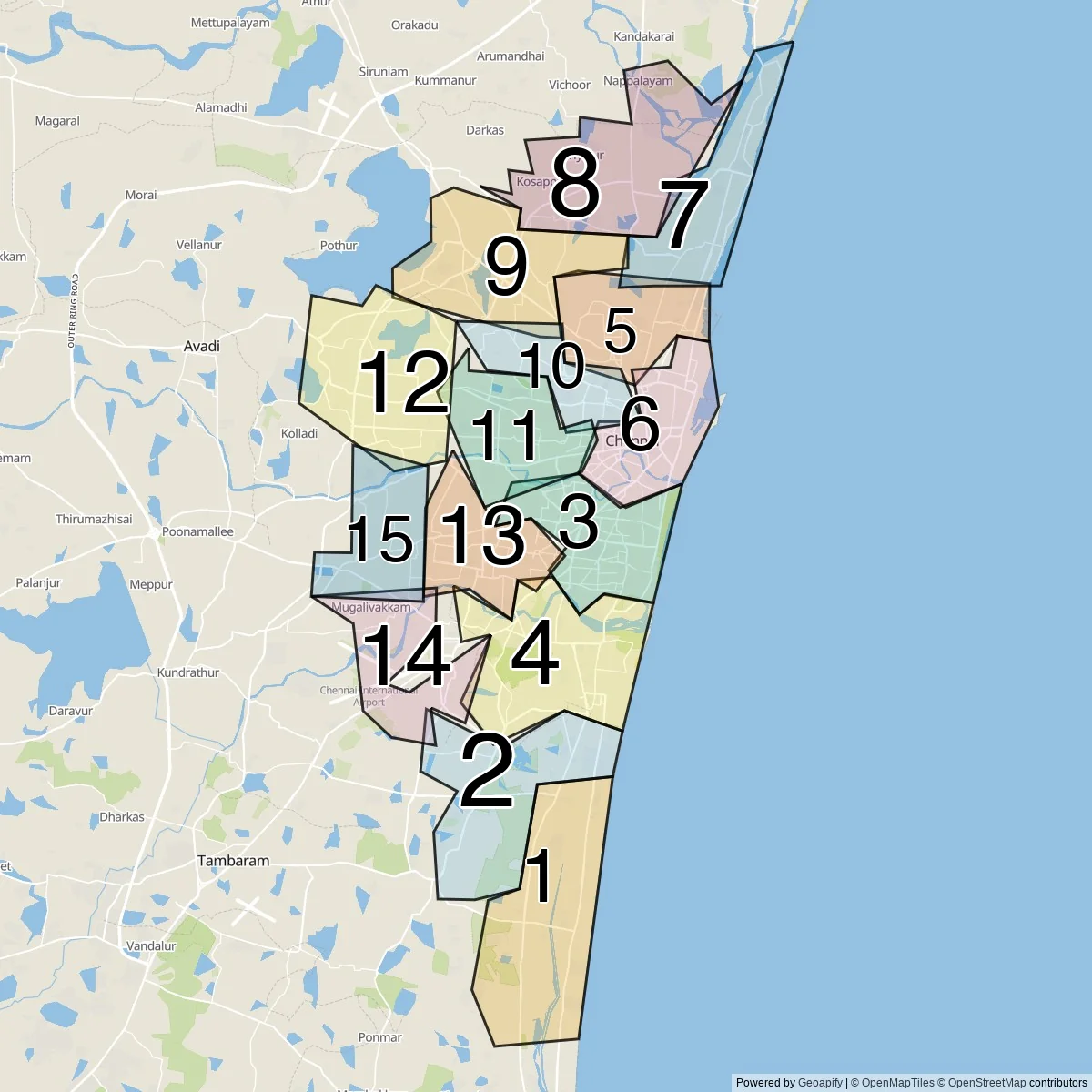
| # | Zones |
|---|---|
| 1 | Zone 15 Sholinganallur |
| 2 | Zone 14 Perungudi |
| 3 | Zone 9 Teynampet |
| 4 | Zone 13 Adyar |
| 5 | Zone 4 Tondiarpet |
| 6 | Zone 5 Royapuram |
| 7 | Zone 1 Tiruvottiyur |
| 8 | Zone 2 Manali |
| 9 | Zone 3 Madhavaram |
| 10 | Zone 6 Thiru. Vi. Ka. Nagar |
| 11 | Zone 8 Anna Nagar |
| 12 | Zone 7 Ambattur |
| 13 | Zone 10 Kodambakkam |
| 14 | Zone 12 Alandur |
| 15 | Zone 11 Valasaravakkam |
Frequently Asked Questions About Visiting Chennai
Do I need a visa to visit Chennai?
Almost certainly yes — India does not have visa-free entry for most nationalities. Citizens of around 170 countries — including the US, UK, EU member states, Canada, Australia, Japan, and most of Asia — can apply for an e-Visa online before travel through the official portal at indianvisaonline.gov.in/evisa. The e-Tourist Visa is typically valid 30 days, 1 year, or 5 years with multiple entries; processing takes 2–4 working days. Cost ranges roughly $25–80 depending on nationality and validity. Apply at least a week before travel; never use third-party sites that charge inflated fees. Citizens of Nepal and Bhutan don’t need a visa; OCI/PIO cardholders enter freely. Always check current rules on the Bureau of Immigration India site before booking.
Is Chennai safe for tourists?
Chennai is one of the safer major Indian cities — generally less aggressive scam culture than Delhi or Mumbai, and lower violent crime rates. The US State Department rates India at “exercise increased caution”; the UK FCDO issues similar guidance. Common risks: pickpocketing in crowded markets (T. Nagar, Pondy Bazaar) and at major railway stations; auto-rickshaw fare inflation (always insist on the meter or use Ola Auto/Uber); the rare beggar-and-tour-tout combination at major sights. Marina Beach swimming is officially discouraged due to dangerous undercurrents — multiple drownings annually. Monsoon flooding: October–November can be genuinely disruptive; the 2015 floods stranded the city for two weeks. Solo women travelers: Chennai is generally fine but stick to well-lit areas at night and prefer registered taxis over auto-rickshaws after dark. Walking around in central districts is generally safe at all hours.
How many days do I need in Chennai?
Three full days handles the city’s headlines comfortably; four to five days lets you do day-trips. A solid 3-day plan: Day 1 — Fort St. George + Government Museum + Marina Beach evening; Day 2 — Mylapore (Kapaleeshwarar Temple + Mada streets + San Thome Basilica) + Triplicane (Parthasarathy Temple) + Theosophical Society Gardens; Day 3 — Kalakshetra Foundation + Elliot’s Beach + St. Thomas Mount + dinner at Dakshin or Avartana. Day 4–5: Mahabalipuram day-trip (UNESCO World Heritage shore temples, 60 km south, 2 hours each way), Pondicherry (the former French colonial town, 3 hours south), or Kanchipuram (the silk-weaving and temple-city 75 km west). The Madras Music Season (December–early January) is worth a dedicated 5–7 day visit on its own.
What’s the best area to stay in Chennai?
Three solid options. T. Nagar / Nungambakkam — central, dense restaurant and shopping scene, walking distance to multiple metro lines, mid-range to luxury hotels (Park Hyatt, Taj Coromandel, Leela Palace, Hyatt Regency) at $80–350/night. Egmore / Kilpauk — the historic-and-budget choice; close to railway stations, the Government Museum, and the heritage area; budget-to-mid-range guesthouses at $30–100/night. OMR / Adyar — the modern IT-corridor option; contemporary hotels (Hyatt Regency Chennai, Sheraton Park Hotel), quieter atmosphere, easy connectivity for business travelers; further from heritage sights. Skip: the immediate area around Chennai Central railway station for sleep — chaotic at night and not pleasant for tourists.
How much does it cost to visit Chennai’s major sights?
Chennai’s headline sights use dual pricing. Fort St. George Museum: 250 INR foreigner / 25 INR Indian via asi.nic.in. Government Museum & National Art Gallery: 250 INR foreigner / 15 INR Indian via chennaimuseum.org. Kapaleeshwarar Temple, Parthasarathy Temple, San Thome Basilica: free entry. Marina Beach, Elliot’s Beach: free. Theosophical Society Gardens: free. Guindy National Park: 35 INR. Arignar Anna Zoological Park: 50 INR Indians / 250 INR foreigners. Madras Music Season concerts: free for many sabha events; ticketed at the Music Academy 250–2,500 INR depending on artist. Mahabalipuram day-trip with private taxi: 3,500–5,500 INR full day. Pondicherry day-trip private taxi: 4,500–7,000 INR full day.
Should I drink the tap water in Chennai?
No — tap water in Chennai is not safe for foreign visitors. The city has known water-quality issues, and the recurring water-supply crises (2019 was the most severe) have stressed treatment systems. Always use sealed bottled water (20–30 INR per liter from convenience stores; major brands include Bisleri, Aquafina, Kinley, Himalayan) for drinking, brushing teeth, and ice. Major hotel restaurants and reputable establishments use filtered water and ice — generally safe. The CDC traveler health page recommends bottled or boiled water for India. Tap water is fine for showering. Reusable filter bottles (LifeStraw, Grayl) work well in India.
What’s the Madras Music Season and is it worth planning around?
The Madras Music Season (mid-December to early January) is the world’s largest classical music festival of any tradition — and one of the genuinely unique cultural experiences anywhere. For roughly three weeks, the city hosts 1,500+ concerts of Carnatic music, Bharatanatyam dance, and Tamil classical literature across 80+ venues (the sabhas). The season ranges from free temple performances to ticketed evening concerts at The Music Academy (since 1927, the most prestigious venue), Narada Gana Sabha, and Krishna Gana Sabha. Practical advice: book accommodations 3–6 months ahead (peak demand); the season schedule and ticketing at musicacademymadras.in and the Sabha phone app; leading sabhas often have free morning lecture-demonstrations alongside paid evening concerts; the kutcheri (concert) circuit is most enjoyable when you sample multiple venues to compare different artists. Even if you don’t follow the music technically, the cultural atmosphere is extraordinary.
Is tipping expected in Chennai?
Yes — moderate tipping is expected in tourist-facing service. Restaurants: 10% standard for sit-down service if no service charge is added (some restaurants now add 5–10% automatically — check the bill); round up at casual places. Filter coffee shops and tiffin restaurants: not customary; round up if you wish. Hotel porters: ₹50–100 per bag at 4–5 star hotels. Hotel housekeeping: ₹100–200 per night left at end of stay. Auto-rickshaw drivers: round up to nearest ₹10. Taxi/Uber drivers: not strictly expected, but ₹20–50 for a long ride or extra help is appreciated. Tour guides: ₹500–1,000 per person for half-day, ₹1,500–3,000 for a full private day. Spa, salon: 10% if pleased. Concert ushers and venue staff: not customary; tipping rare in cultural-event settings. Tipping in cash (small notes) is expected; card machines rarely allow tip add-on. Don’t over-tip — Western percentages are seen as flashy rather than generous.
Economy & Business
Automotive Hub
Chennai is known as the “Detroit of India” — over 40% of India’s automobiles are manufactured here. Major plants include Hyundai, Ford (recently restructured), BMW, Royal Enfield, Mahindra, Daimler, Renault-Nissan, and dozens of auto-parts suppliers concentrated in the Sriperumbudur and Oragadam industrial zones west of the city.
Information Technology
Since 2004, Chennai has emerged as a major IT destination alongside Bangalore and Hyderabad. The Old Mahabalipuram Road (OMR) IT Corridor houses global companies — IBM, TCS, Infosys, Wipro, Cognizant, HCL, Capgemini, HP — in modern complexes including Tidel Park and Mahindra City. The IT sector employs roughly 600,000 in greater Chennai.
Healthcare
Chennai is one of India’s leading medical tourism destinations with world-class hospitals — Apollo Hospitals, Fortis Malar, MIOT International, Sankara Nethralaya (specializing in eye care). The combination of advanced medical technology with cost-effective treatment attracts patients from across Asia, the Middle East, and increasingly the global market.
Port and Trade
Chennai Port is India’s second-largest port, handling 60+ million tonnes of cargo annually. The strategic location makes Chennai a gateway for trade with Southeast Asia and beyond.
Chennai rewards travelers who lean into its unique culture — three days for the headlines, four to five days for the Madras Music Season experience or the south-coast day-trip to Mahabalipuram and Pondicherry. The city is genuinely different from northern India: more measured, more Tamil, more religiously and linguistically continuous with its 2,000-year past. The filter coffee is excellent. The classical music is unmatched. And the city itself is older, deeper, and more interesting than most international visitors give it credit for.
AFRIKA
Cairo Hurghada Johannesburg Marrakech
ASIA
Abu Dhabi Agra Antalya Bangkok Batam Beijing Bengaluru Cebu City Chiang Mai Chiba Chennai Da Nang Dammam Delhi Denpasar Dubai Fukuoka Guangzhou Guilin Ha Long Hanoi Ho Chi Minh City Jakarta Jaipur Johor Bahru Kolkata Krabi Kuala Lumpur Kyoto Macau Mecca Medina Mugla Mumbai Osaka Pattaya Penang Phuket Riyadh Seoul Shanghai Shenzhen Singapore Taipei Tokyo Zhuhai
EUROPE
Amsterdam Athens Barcelona Berlin Brussels Budapest Copenhagen Dublin Florence Frankfurt am Main Heraklion Krakow Lisbon London Madrid Milan Munich Nice Paris Porto Prague Rhodes Rome Stockholm Venice Vienna Warsaw
NORTH AMERICA
Cancun Las Vegas Los Angeles Miami New York City Orlando San Francisco Toronto Vancouver
SOUTH AMERICA
Buenos Aires Lima Rio De Janeiro
OCEANIA
Auckland Honolulu Melbourne Sydney