
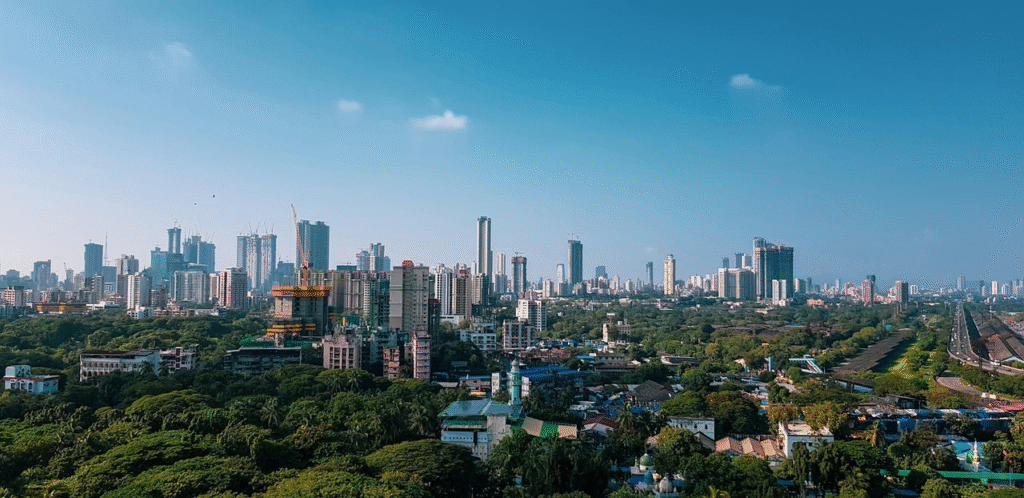
Photo credit: Mumbai skyline and waterfront
Mumbai, India’s financial capital and the heart of Bollywood, stands as one of the world’s most dynamic megacities. Formerly known as Bombay, this coastal metropolis on the Arabian Sea is where ancient traditions meet cutting-edge commerce, creating an intoxicating blend of chaos and opportunity. With over 20 million residents in its metropolitan area, Mumbai generates more than a third of India’s income tax revenue while serving as the country’s entertainment hub, producing over 1,000 films annually.
Mumbai at a Glance: Essential Facts for Travelers
| Location | Western coast of India, Maharashtra state |
|---|---|
| Coordinates | 19.0760°N, 72.8777°E |
| Population | 12.5 million (city), 20.5+ million (metropolitan area) |
| Area | 603 square kilometers (city) |
| Elevation | 11 meters above sea level |
| Time Zone | Indian Standard Time (UTC+5:30) |
| Calling Code | +91 22 |
| Postal Codes | 400001-400104 |
| Known For | Bollywood, financial capital, Gateway of India, street food |
| Current Mayor | Kishori Pednekar (as of 2019) |
| Official Website | mumbaicity.gov.in |
| Languages | Marathi (37.8%), Hindi (21.6%), English (widely spoken) |
| Climate | Tropical, monsoon season June-September |
Upcoming Events in Mumbai
| Date | Title | Details |
|---|---|---|
| 2026-09-13 to 2026-09-20 | Bandra Fair (Mount Mary Feast) | Held around the Nativity of Mary each September, the week-long Bandra Fair centres on the hilltop Basilica of Our Lady of the Mount in Bandra. Pilgrims of all faiths climb to the shrine, while the surrounding streets turn into a bustling fair with stalls selling the traditional wax offerings, sweets, toys and food. It is one of Mumbai’s most atmospheric community festivals, blending devotion and carnival. Entry is free; the fair is busiest on the opening Sunday and weekends. [Source] |
| 2026-09-14 to 2026-09-24 | Ganeshotsav (Ganesh Chaturthi) | Mumbai’s biggest and most beloved festival honours the elephant-headed god Ganesha, when thousands of clay idols are installed in homes and elaborately decorated public pandals across the city. Famous mandals such as Lalbaugcha Raja draw enormous queues, and the celebrations end with joyous processions carrying the idols to the sea for immersion on Anant Chaturdashi. Streets fill with drumming, dancing and sweets, especially modak. Viewing the pandals is free; expect large crowds and heavy traffic near Lalbaug and Girgaon Chowpatty. [Source] |
| 2026-09-19 | Sufiana Safar by A.R. Rahman at the NCPA | Sufiana Safar, an evening of Sufi music presented by Oscar-winning composer A.R. Rahman, comes to the National Centre for the Performing Arts at Nariman Point on 19 September. The programme explores the devotional Sufi tradition that has deeply shaped Rahman’s own songwriting, performed in the intimate acoustics of India’s leading performing-arts complex. Ticket prices vary by section, and demand for anything carrying Rahman’s name is intense, so early booking is strongly advised for this one-night engagement. [Source] |
| 2026-09-27 to 2026-10-04 | Nakshatra Dance Festival at the NCPA | The NCPA’s Nakshatra Dance Festival returns from 27 September to 4 October, celebrating Indian classical dance across several evenings at the Nariman Point complex. The programme presents leading exponents of classical forms, and within the festival window a Kathak masterclass by Pandit Rajendra Gangani on 2 October gives students direct access to one of the tradition’s foremost gurus. Ticket prices vary per performance, and workshops may require separate registration; a feast for lovers of Indian classical dance. [Source] |
| 2026-10-07 | Aab’o-Hawaa: An Evening with Gulzar at the NCPA | Aab’o-Hawaa brings the legendary poet, lyricist and filmmaker Gulzar to the NCPA on 7 October for an evening of verse and conversation. One of India’s most beloved literary voices, Gulzar has shaped generations through his Urdu poetry and his film songs, and hearing him in person remains a rare treat. Ticket prices vary by section; for admirers of Hindi and Urdu poetry this is among the standout cultural dates of Mumbai’s autumn season. [Source] |
| 2026-10-11 to 2026-10-19 | Navratri Garba and Dandiya Nights | During the nine nights of Navratri, Mumbai comes alive with Garba and Dandiya-Raas, the energetic Gujarati folk dances performed in swirling circles to live and recorded music. Grounds and clubs across the city, particularly in the western suburbs, host ticketed dance nights where participants dress in vibrant traditional attire and dance late into the evening. It is a highlight of the city’s autumn calendar and welcomes newcomers keen to learn the steps. Ticket prices vary by venue; community events are often free. [Source] |
| 2026-11-12 to 2026-11-15 | META Theatre Festival at the NCPA | A concentrated festival of acclaimed Indian theatre takes over the NCPA from 12 to 15 November, showcasing productions associated with the Mahindra Excellence in Theatre Awards. The announced line-up includes The Old Man and the Sea, Nihsango Ishwar, The Departed Dawn and Swang: Jas ki Tas, spanning several Indian languages and staging styles. Ticket prices vary per show. For theatre lovers it is a chance to catch some of the country’s most celebrated recent productions in one weekend. [Source] |
City News in Mumbai – last 14 days
| Date | Category | Headline | Details |
|---|---|---|---|
| 2026-09-14 | Culture | Mumbai decks up in devotion as 11-day Ganesh festival begins | The city plunged into its biggest festival as the 11-day Ganeshotsav began, with 2,702 mandals receiving civic approval to set up pandals across Mumbai. Among the most spectacular is the GSB Seva Mandal’s famously opulent Ganpati, reported to carry insurance cover of 703 crore rupees and adorned with 66 kilograms of gold and 335 kilograms of silver. Streets, homes and housing societies filled with processions and music as the festival opened in faith and fervour. [Source] |
| 2026-09-14 | Local government | Police deny Jarange-Patil permission for Azad Maidan hunger strike | Mumbai Police denied Maratha quota activist Manoj Jarange-Patil permission for a hunger strike at Azad Maidan, citing law and order concerns, after which his team filed a fresh application assuring a peaceful protest. Jarange announced he would come to Mumbai regardless and protest alone, while Chief Minister Devendra Fadnavis appealed to him to reconsider the timing in view of the ongoing Ganesh festival. The standoff kept the city administration on alert through the festive week. [Source] |
| 2026-09-14 | Public transport | Festive transport push: late-night Metro, 386 special trains, 5,743 buses | Transport agencies scaled up massively for the Ganeshotsav rush. Central Railway is running 386 special trains and authorities lined up 5,743 buses to the Konkan, with stations such as CSMT, Dadar, Thane and Panvel seeing packed platforms and long queues at peak hours. Mumbai Metro services are being extended until 00:30 from 14 to 25 September, with Line 2A running 241 services on Saturdays, so devotees can reach pandals and processions late into the night. [Source] |
| 2026-09-14 | Local government | Gadkari, stuck in Worli traffic, pitches replacing ageing flyovers | Union minister Nitin Gadkari arrived nearly an hour late to an event after getting stuck in traffic between Worli and his venue, and turned the delay into an argument: he pitched new construction technology to replace Mumbai’s ageing flyovers. The remarks put a spotlight on the city’s chronic congestion and the condition of decades-old elevated roads, where repairs and lane closures regularly compound the daily crawl for commuters. [Source] |
| 2026-09-14 | Public safety | Caretaker booked after iron gate falls on woman in Tardeo | Police have booked a building caretaker for negligence after a dilapidated iron gate at a Tardeo building fell on a 23-year-old woman. Jenny Yazdi Dara Bamji suffered fractures to her cheekbones and nose, a head injury, palate damage and three broken teeth in the incident on 27 August. The case highlights the danger posed by poorly maintained fixtures in the city’s older buildings, an issue housing activists have flagged repeatedly. [Source] |
| 2026-09-13 | Local affairs | Triple-digit overnight showers drench Mumbai after dry August | Heavy overnight rain drenched Mumbai, with some gauges recording triple-digit millimetre totals after an almost-dry August. The India Meteorological Department placed the region on orange alert and forecast more showers with gusty winds, and waterlogging was reported in parts of the city. The late-season burst complicated preparations for Ganesh mandals on the eve of the festival, forcing organisers to protect pandals and idols from the downpours. [Source] |
| 2026-09-13 | Public safety | Coast Guard intercepts diesel smuggling vessel off Mumbai | The Indian Coast Guard intercepted a vessel suspected of smuggling diesel off the Mumbai coast and arrested six people on board. Fuel smuggling by sea undercuts taxed supply chains and raises safety concerns, and the interception underlines the surveillance effort maintained along the busy shipping lanes off the city, where fishing craft, tankers and cargo traffic converge on one of India’s largest port complexes. [Source] |
| 2026-09-13 | Public safety | Senior citizen loses 64 lakh rupees to fraudsters in digital arrest scam | A senior citizen from Mumbai lost 64 lakh rupees in a scam that combined a fake insurance refund with a so-called digital arrest, in which fraudsters posing as officials keep victims on video calls and pressure them into transferring money. Police have been warning repeatedly that no genuine agency conducts arrests over video calls, yet the con continues to claim educated, elderly victims across the city with devastating financial consequences. [Source] |
| 2026-09-13 | Education | CM orders forensic audit of MHT-CET centres facing complaints | Maharashtra’s chief minister has ordered a forensic audit of MHT-CET examination centres against which complaints have been received. The state’s common entrance test steers admissions to engineering, pharmacy and other professional courses, so the integrity of its centres directly affects lakhs of students and their families each year. The audit is meant to establish whether irregularities occurred and to shore up confidence in the high-stakes admissions process. [Source] |
| 2026-09-13 | Public transport | MSRTC to add 5,000 new Lal Pari buses; tendering complete | The Maharashtra State Road Transport Corporation will bolster its fleet with 5,000 new Lal Pari buses, with the tendering process now complete. The distinctive red buses are a lifeline linking Mumbai with towns and villages across the state, and the fresh stock is meant to replace ageing vehicles and improve reliability on intercity routes. For millions of migrants working in the city, the Lal Pari remains the affordable ride home. [Source] |
Mumbai Events & City News Archive
Sources: Mount Mary Basilica, Lalbaugcha Raja, NCPA Mumbai, Maharashtra Tourism, Hindustan Times, Hindustan Times, Hindustan Times, The Hindu
Weather Forecast for the Next 14 Days in Mumbai
| Date | Weather | Max °F | Min °F | Rain mm |
|---|---|---|---|---|
| 2026-09-14 | 🌧️ | 83.8 °F | 77.3 °F | 9.1 mm |
| 2026-09-15 | 🌧️ | 83.6 °F | 76.6 °F | 11.3 mm |
| 2026-09-16 | 🌧️ | 84.1 °F | 77.0 °F | 6.9 mm |
| 2026-09-17 | 🌧️ | 84.7 °F | 77.4 °F | 6.7 mm |
| 2026-09-18 | 🌧️ | 82.9 °F | 76.6 °F | 6.9 mm |
| 2026-09-19 | 🌧️ | 85.0 °F | 77.1 °F | 2.1 mm |
| 2026-09-20 | 🌧️ | 86.1 °F | 77.2 °F | 2.1 mm |
| 2026-09-21 | ⛈️ | 86.7 °F | 77.4 °F | 10.2 mm |
| 2026-09-22 | ⛈️ | 84.6 °F | 75.9 °F | 21.0 mm |
| 2026-09-23 | 🌧️ | 83.8 °F | 75.9 °F | 13.8 mm |
| 2026-09-24 | ⛈️ | 83.4 °F | 76.0 °F | 38.4 mm |
| 2026-09-25 | 🌧️ | 83.5 °F | 75.8 °F | 9.6 mm |
| 2026-09-26 | ⛈️ | 86.6 °F | 76.4 °F | 3.6 mm |
| 2026-09-27 | ⛈️ | 87.6 °F | 77.4 °F | 5.4 mm |
Mumbai’s History
Mumbai’s history is the story of seven islands becoming one city, then becoming an empire’s most important port, then becoming the world’s most populous metropolitan area to be built on reclaimed swamp. Each layer is still visible if you know where to look.
From Seven Islands to One Megacity
Mumbai’s geography is its origin story. What is now a single landmass was originally seven separate islands scattered around a lagoon. Archaeological evidence suggests Dravidian fisherfolk called Kolis settled here before 1500 BCE — stone tools at archaeological sites hint at much older civilizations. Through centuries of ambitious land reclamation projects starting in the 17th century, the islands gradually merged into a single unified territory by 1862. The Koli fishing community still exists in pockets along the Mumbai shoreline today.
Early Empires and the Birth of Mahikavati
The region passed through Mauryan, Shatavahana, and Chalukya hands, each leaving cultural imprints. By the 7th century, Hindu traditions resurged after a period of Buddhist dominance. In the 13th century, King Bhimdev established his capital on Mahim Island, calling it Mahikavati — Mumbai’s first emergence as a political center.
Portuguese Colonial Era
The pivot came in 1508 when Portuguese explorer Francisco de Almeida sailed into the natural harbor and dubbed it “Bom Bahia” (Good Bay) — the etymological origin of “Bombay.” Following the 1534 Treaty of Bassein, Portugal gained control of the islands from Sultan Bahadur Shah of Gujarat. Portuguese rule introduced Christianity, built forts like Madh Fort, and established a feudal land system, though it was marked by religious tensions and forced conversions.
British East India Company Takes Control
A royal marriage changed everything. In 1661, the islands became part of England’s dowry when King Charles II married Catherine of Braganza. Seven years later, the British East India Company leased the territory for £10 per year, recognizing the strategic value of the natural harbor. Under Governor Gerald Aungier (1669–1677), the British actively welcomed diverse communities — Gujarati Hindu traders, Goan refugees, Muslim weavers, and Parsi entrepreneurs — laying the foundation for the city’s signature multicultural character that still defines it.
Industrial Revolution and Railway Age
The 19th century turned Mumbai into a global trading hub. After an 1803 fire destroyed much of the old Fort area, the city rebuilt with grander Victorian Gothic architecture. The 1850s brought Asia’s first railway line connecting Mumbai to Thane, followed by links to textile centers like Ahmedabad. The American Civil War’s cotton shortage in 1865 catapulted Mumbai into a global textile powerhouse, and the 1869 opening of the Suez Canal cemented its position as Europe’s favorite trading partner east of Suez.
Independence Movement and Modern Mumbai
Mumbai was a crucial center for India’s independence movement. Mahatma Gandhi operated from the city for 30 years; the final symbolic moment came in 1948 when Britain’s last troops departed through the Gateway of India. After independence, Mumbai became Maharashtra’s capital in 1960, solidifying its role as India’s financial and cultural powerhouse.
Challenges and Resilience
The late 20th century brought both growth and tests. The 1982–83 textile workers’ strike devastated the manufacturing sector. Political tensions led to riots in the 1980s. The city faced major terrorist attacks — the 1993 bombings and the 2008 attacks on hotels and landmarks. Through all of it, Mumbai’s signature has been an extraordinary capacity to absorb shock and keep functioning.
Geography, Climate & Best Time to Visit Mumbai
Location and Topography
Mumbai sits on Salsette Island along India’s western coast, with its heart on a narrow peninsula jutting into the Arabian Sea. Average elevation is 11 meters above sea level, keeping most of the city flat. The Sanjay Gandhi National Park to the north reaches 496 meters; three lakes — Tulsi, Vihar, and Powai — provide natural beauty within the urban landscape; the Western Ghats plateau rises dramatically to 1,600 meters in the inland backdrop.
Climate Patterns
Mumbai has a tropical climate with warm temperatures year-round, averaging 27°C (80°F) annually. Three distinct seasons: a hot, dry period from March to May with temperatures reaching 33°C; the dramatic monsoon season from June to September when 95% of the annual rainfall (~1,700 mm) drenches the streets; and a cooler, drier period from October to February with pleasant temperatures around 24–30°C.
| Month | High (°C) | Low (°C) | Rainfall (mm) | Sunshine Hours |
|---|---|---|---|---|
| January | 31 | 16 | 0.6 | 8.7 |
| February | 31 | 17 | 1.5 | 9.1 |
| March | 33 | 21 | 0.1 | 8.8 |
| April | 33 | 24 | 0.6 | 9.5 |
| May | 33 | 26 | 13 | 9.6 |
| June | 32 | 26 | 574 | 5.0 |
| July | 30 | 25 | 868 | 2.4 |
| August | 29 | 25 | 553 | 2.4 |
| September | 30 | 24 | 306 | 5.5 |
| October | 33 | 23 | 63 | 7.7 |
| November | 33 | 21 | 15 | 8.2 |
| December | 32 | 18 | 1.0 | 8.2 |
Best Time to Visit
The sweet spot is November through February — temperatures around 24–30°C, minimal rainfall, comfortable humidity (67–71%), and 8+ hours of daily sunshine. Perfect for Marine Drive sunset walks and outdoor sightseeing. The monsoon season (June–September) brings dramatic transformation — heavy rains create both challenges (transportation disruption, flooding) and unique experiences (cooler temperatures, atmospheric energy). March to May is uncomfortably hot and humid; avoid if possible.
Mumbai’s Districts & Neighborhoods
South Mumbai (SoBo)
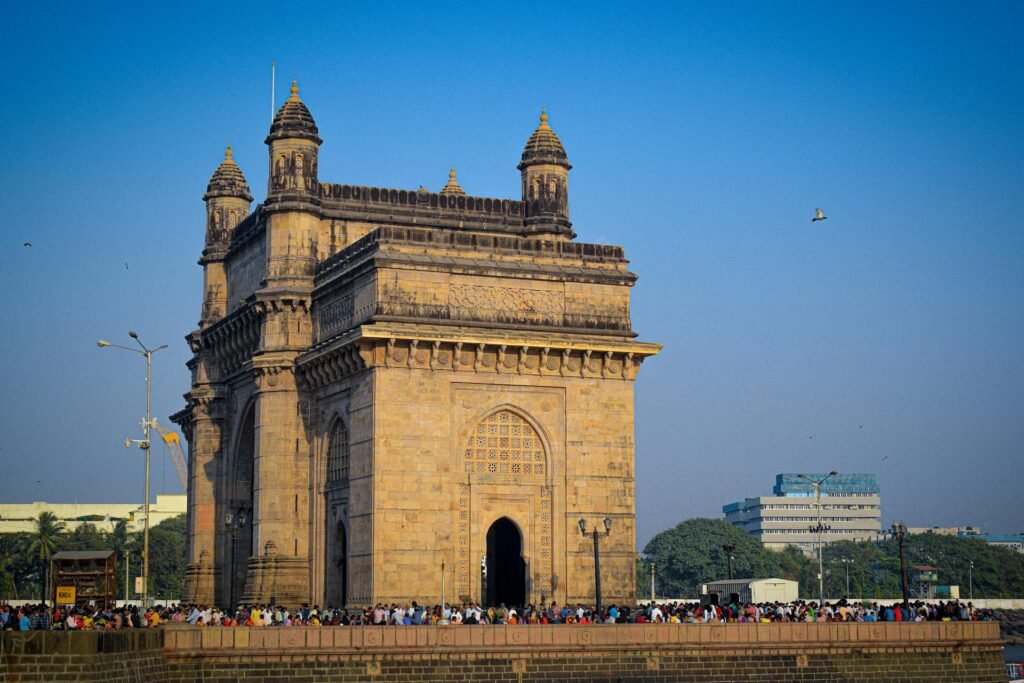
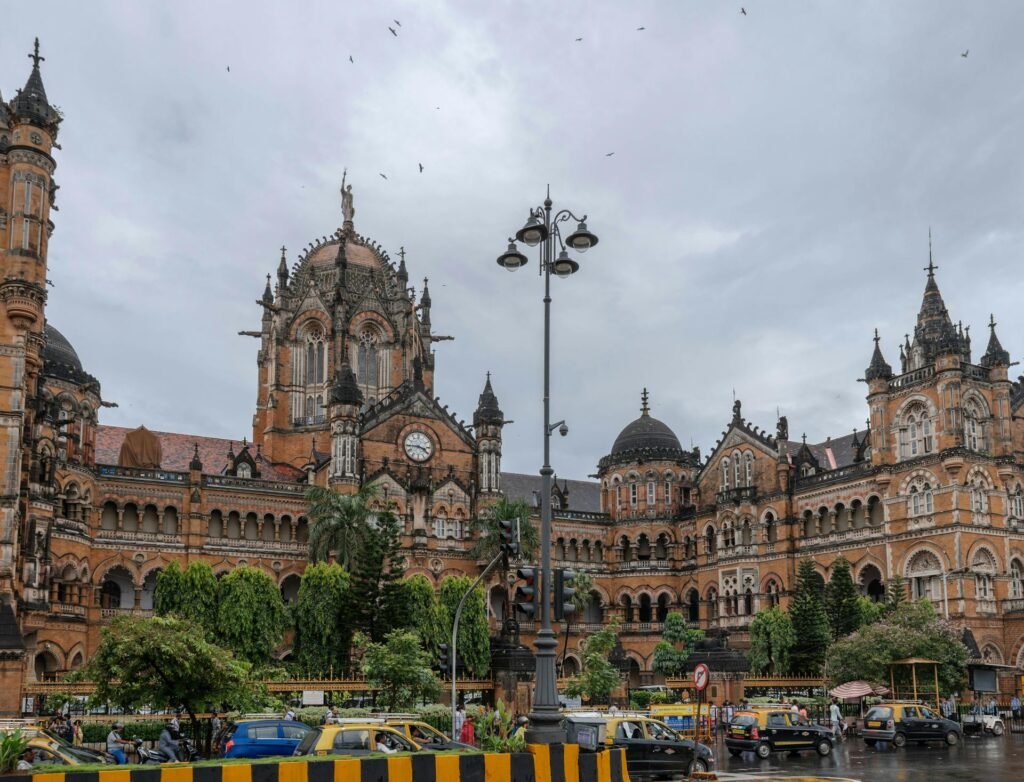
South Mumbai is the historic and commercial heart. Colaba, once a chain of islands, now houses the iconic Gateway of India and the Taj Mahal Palace Hotel. The Fort District showcases Victorian Gothic architecture including the UNESCO World Heritage Chhatrapati Shivaji Terminus and the Bombay High Court. Marine Drive‘s “Queen’s Necklace” promenade connects the business district of Nariman Point to Chowpatty Beach. Where to stay: Colaba and Fort offer heritage hotels and proximity to attractions; Nariman Point provides modern business hotels with sea views.
Central Mumbai
Byculla houses the Dr. Bhau Daji Lad Museum and offers a glimpse into Mumbai’s industrial past. The area around Chhatrapati Shivaji Terminus buzzes with activity, while nearby Crawford Market (1869) remains a vibrant trading hub with its Norman-Gothic architecture.
Western Suburbs
Bandra has become Mumbai’s trendy neighborhood — cafés, boutiques, the Bandra-Kurla Complex business district, and the celebrity-residence street where many Bollywood stars live. Juhu Beach attracts both locals and visitors; Versova offers a quieter coastal experience. The upscale Malabar Hill area features the Hanging Gardens and the sacred Banganga Tank. Where to stay: Bandra for modern amenities and nightlife; Juhu for beachfront hotels and easy airport access.
Northern Suburbs
Northern areas like Thane and Kalyan-Dombivali are major residential hubs connected to the city center by the extensive suburban railway. The Sanjay Gandhi National Park provides a green escape with the ancient Kanheri Caves — Buddhist monastic caves dating to the 1st century BCE.
Top Things to Do in Mumbai
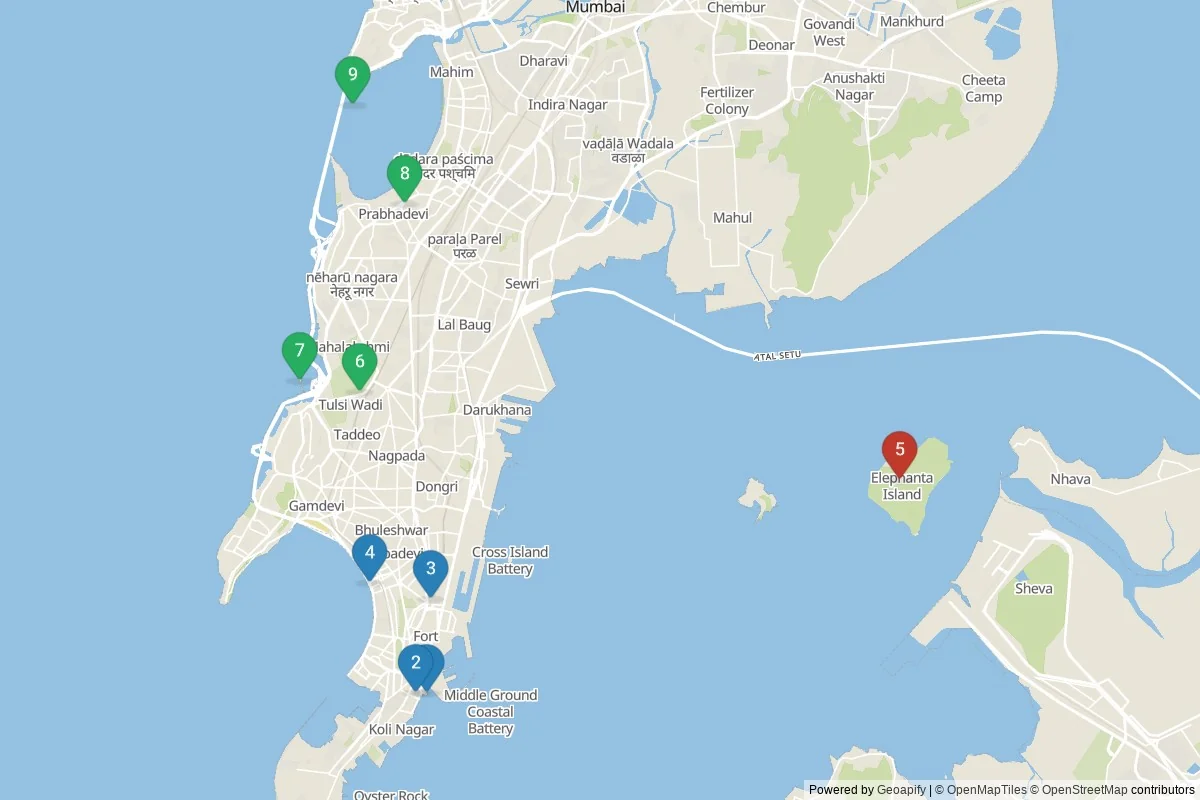
| # | Sight | Cluster | Type | Time | Entry | Best |
|---|---|---|---|---|---|---|
| 1 | Gateway of India | Central | Historic arch | ~30 min | Free | Morning |
| 2 | Colaba Causeway | Central | Market street | ~1.5 hrs | Free | Evening |
| 3 | Chhatrapati Shivaji Terminus | Central | Train station | ~30 min | Free outside | Anytime |
| 4 | Marine Drive | Central | Promenade | ~1 hr | Free | Sunset |
| 5 | Elephanta Caves | Outer | Rock-cut caves | ½ day | ₹40 / ₹600 + ferry | Morning |
| 6 | Dhobi Ghat | Far | Open-air laundry | ~30 min | Free | Morning |
| 7 | Haji Ali Dargah | Far | Mosque/shrine | ~45 min | Free | Afternoon |
| 8 | Siddhivinayak Temple | Far | Hindu temple | ~1 hr | Free | Tuesday morning |
| 9 | Bandra-Worli Sea Link view | Far | Bridge viewpoint | ~30 min | Free | Sunset |
| 🚗 | Day Trip: Sanjay Gandhi NP | Day trip | Day trip | ½ day | ₹85 | Morning |
Iconic Landmarks
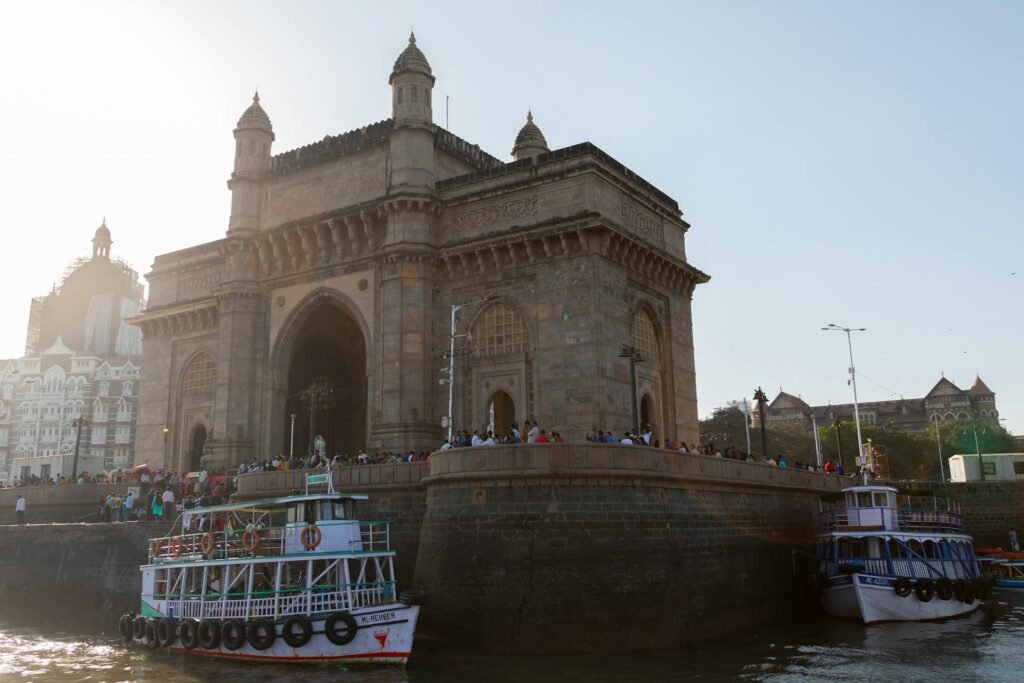
The Gateway of India (1924) is Mumbai’s most recognizable monument, built to commemorate King George V’s visit. The grand stone archway offers stunning views of the Arabian Sea and serves as the departure point for ferries to Elephanta Island. The Chhatrapati Shivaji Terminus (formerly Victoria Terminus) is a Victorian Gothic masterpiece blended with traditional Indian design — a UNESCO World Heritage Site that remains one of the world’s busiest railway stations.
Museums and Cultural Sites
The Chhatrapati Shivaji Maharaj Vastu Sangrahalaya (formerly Prince of Wales Museum) houses an impressive collection of Mughal paintings, ancient terracotta figures, and jade carvings within its stunning Anglo-Saracenic architecture. Mani Bhavan Gandhi Museum preserves the room where Mahatma Gandhi lived for 17 years — intimate insights into his life and philosophy.
Religious and Spiritual Sites
The Haji Ali Dargah, built in 1431, rises from a small island accessible by causeway during low tide. This white marble mosque and Sufi shrine honors Saint Haji Ali and provides breathtaking sunset views. The Banganga Tank complex on Malabar Hill features a sacred stepwell surrounded by Hindu temples — a village-like atmosphere amid the urban sprawl.
Natural Attractions
Elephanta Island, reached by a one-hour ferry from the Gateway of India, houses UNESCO World Heritage rock-cut temples dedicated to Lord Shiva. The 8th-century caves feature a magnificent three-faced Shiva statue and intricate mythological carvings. The Sanjay Gandhi National Park offers 104 km² of wilderness within the city limits — home to the Kanheri Caves where Buddhist monks once meditated, plus over 1,000 plant species, 274 bird varieties, and a small leopard population.
Beaches and Waterfront
Marine Drive, the “Queen’s Necklace” for its nighttime illumination, is the perfect promenade for sunset walks. Chowpatty Beach at its northern end is the city’s classic street-food beach. Juhu Beach 30 km north provides a more relaxed coastal experience.
Markets and Shopping
Crawford Market (1869, Norman-Gothic architecture) remains a sensory adventure — spices, textiles, fresh produce. Zaveri Bazaar nearby glitters with jewelry. Colaba Causeway offers everything from antiques to contemporary fashion at constant negotiation.
How to Get to Mumbai
By Air
Chhatrapati Shivaji Maharaj International Airport (BOM) is India’s busiest aviation hub, 15 km north of downtown. The airport handles both international and domestic flights; Terminal 2 features striking modern architecture. The new Navi Mumbai International Airport is scheduled to open in 2025 to expand the city’s aviation capacity dramatically.
By Rail
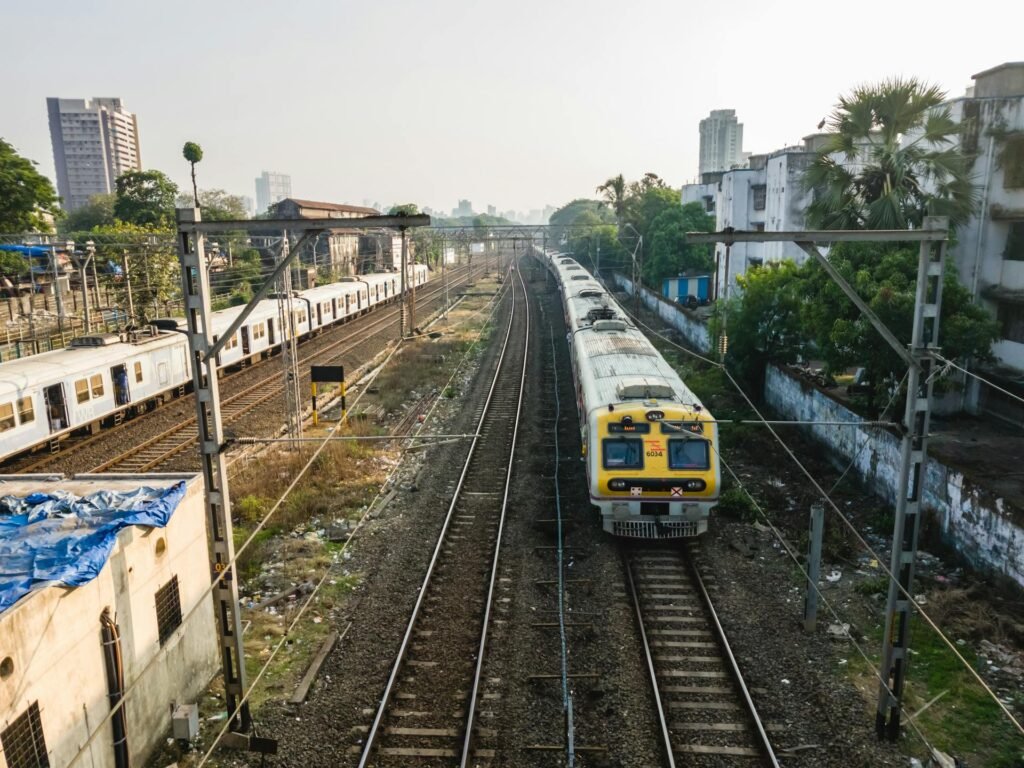
Mumbai is the headquarters of both Western and Central Railways, connecting to every corner of India. Major stations: Chhatrapati Shivaji Terminus for Central Railway services to eastern and southern India; Mumbai Central for Western Railway connections to Delhi and Gujarat; Lokmanya Tilak Terminus near Kurla for long-distance services to Kolkata and Bangalore.
By Road
The Maharashtra State Road Transport Corporation (MSRTC) operates from the State Transport Terminal near Mumbai Central Station, with 16,000 buses serving 5.8 million passengers daily. Regular services connect Mumbai to major cities including Ahmedabad, Bangalore, Goa, and Pune.
By Sea
Mumbai’s ports — Jawaharlal Nehru Port and Nhava Sheva Port — handle 40% of India’s foreign trade. While primarily commercial, ferry services operate to nearby coastal destinations and islands.
Getting Around Mumbai
Suburban Railways
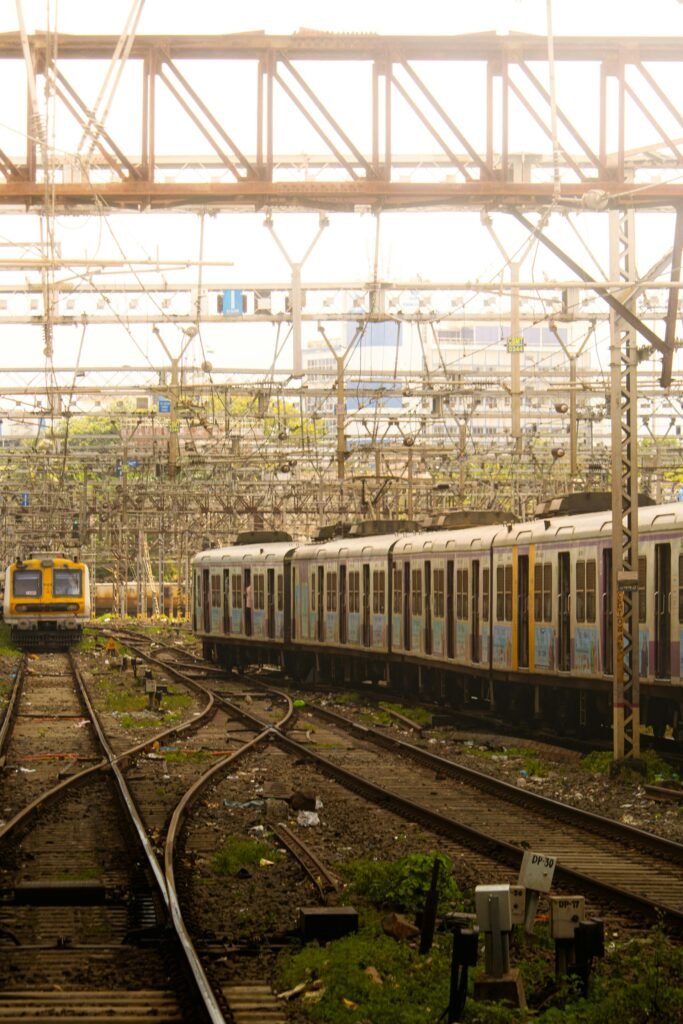
Mumbai’s suburban railway network forms the city’s backbone, carrying 8 million passengers daily across 302 km of track. The Western Line runs from Churchgate to Vasai-Virar via Dadar and Santacruz; the Central Line connects CST to Thane and Kalyan-Dombivali. Trains run from early morning until past midnight, with services every few minutes during peak hours. The crowding at peak times is famously extreme — first-time visitors should travel off-peak.
Mumbai Metro
The modern Mumbai Metro launched in 2014 with its first 12-km line and 12 stations. Multiple additional lines have opened or are under construction, providing air-conditioned comfort and efficient connectivity between key areas of the city. The Aqua Line under the Arabian Sea (operational 2024) connects the western and eastern suburbs.
BEST Buses
The Brihanmumbai Electric Supply and Transport (BEST) operates 3,400 buses across 340 routes, moving 4.5 million passengers daily. Iconic red buses provide comprehensive coverage with route numbers displayed in Marathi and Arabic numerals.
Taxis and Auto-Rickshaws
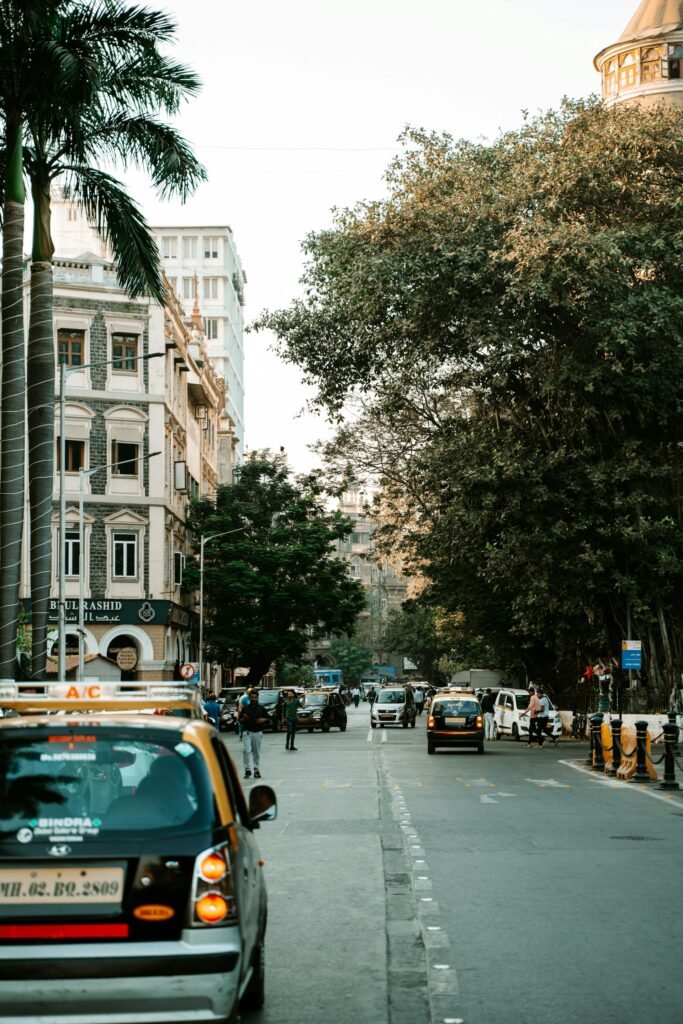
Mumbai’s distinctive black-and-yellow taxis and three-wheeled auto-rickshaws provide point-to-point transportation. Auto-rickshaws operate primarily in the suburbs (they’re banned in South Mumbai); taxis serve the entire city. Both use meters; agree the route before you start.
Ride-Hailing
Uber and Ola operate throughout Mumbai, offering convenient alternatives to traditional taxis with upfront pricing and GPS tracking. The default for most visitors.
Ferries
BEST also operates ferry services from the Gateway of India to Elephanta Island and other coastal destinations — scenic alternatives to road transport.
Food & Drink in Mumbai
Mumbai eats globally. The city’s culinary landscape reflects its multicultural population — a fusion of regional Indian cuisines alongside international influences, ranging from sub-100-rupee street food to upscale Michelin-style dining.
Street Food Culture
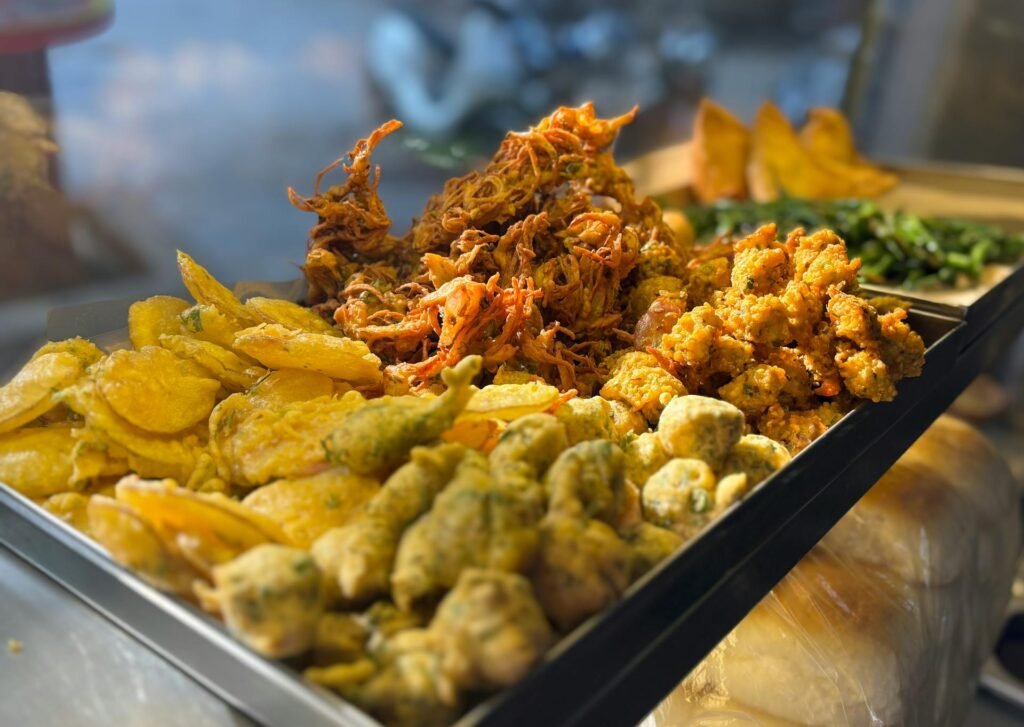
Mumbai’s street food is one of the world’s great food cultures. Vada pav — often called Mumbai’s burger — is a spiced potato fritter served in bread with chutneys. Pav bhaji, a spicy vegetable curry served with buttered bread, originated in Mumbai and remains a local favorite. Chaat varieties include bhel puri, sev puri, and pani puri — explosive flavors and textures, all under 100 rupees a plate.
Regional Specialties
Mumbai’s diverse communities each contribute distinct culinary traditions. Gujarati restaurants serve vegetarian thalis with sweet and savory dishes side-by-side. South Indian establishments offer dosas, idlis, and sambhar. Muslim areas feature fragrant biryanis and kebabs (Mohammed Ali Road during Ramadan is the experience to seek out). Parsi cafés serve unique dishes like dhansak (meat stewed with lentils) and patra ni machhi (fish steamed in banana leaves) — Britannia & Co. and Kyani & Co. are the surviving institutions.
Seafood and Coastal Cuisine
Mumbai’s coastal location ensures fresh seafood. Local preparations include koliwada prawns, Bombay duck curry, and fish thalis featuring coconut-based gravies influenced by neighboring Goan and Konkani cuisines. The Koli fishing community’s traditional preparations are the most authentic versions.
The Dabbawala System
Mumbai’s famous dabbawalas operate a remarkable lunch delivery system, transporting home-cooked meals from kitchens to office workers throughout the city. Studied by Harvard Business School and Six Sigma analysts for its near-zero error rate (one mistake per six million deliveries), this century-old system demonstrates Mumbai’s unique approach to food logistics — and the importance of home-cooked meals in local culture.
Modern Dining Scene
Contemporary Mumbai features rooftop bars with Arabian Sea views, innovative restaurants blending traditional Indian flavors with international techniques, and the country’s most ambitious fine-dining scene. The Bandra and Lower Parel areas have emerged as the dining destinations; heritage hotels like the Taj Mahal Palace offer legendary afternoon tea experiences.
Mumbai by District: The 9 Wards
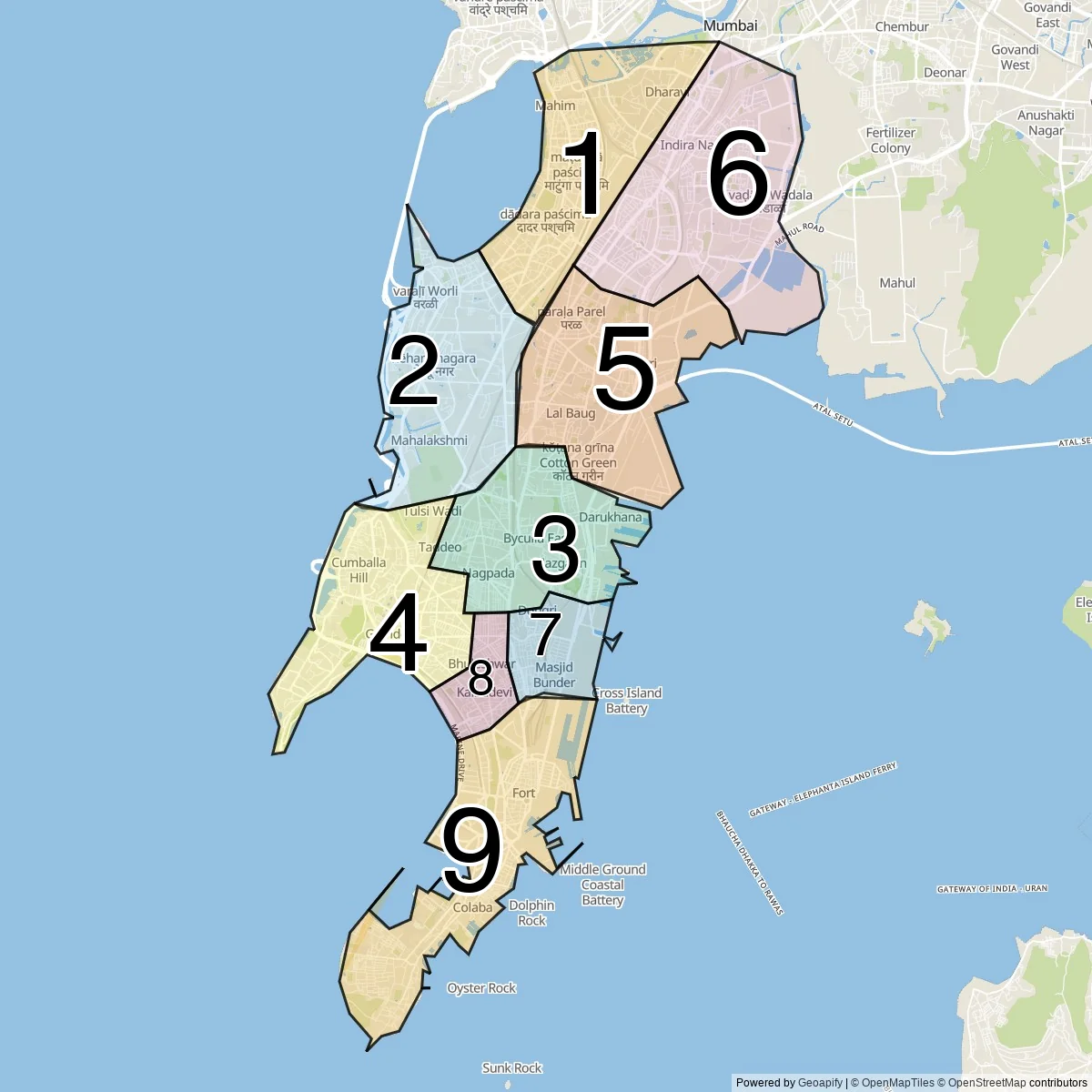
Mumbai is divided into 9 civic wards. The map below shows their official OSM boundaries, colour-coded to match the table — a quick way to orient yourself before zooming in on individual sights.
| # | Wards |
|---|---|
| 1 | G/N Ward |
| 2 | G/S Ward |
| 3 | E Ward |
| 4 | D Ward |
| 5 | F/S Ward |
| 6 | F/N Ward |
| 7 | B Ward |
| 8 | C Ward |
| 9 | A Ward |
Frequently Asked Questions About Visiting Mumbai
Do I need a visa to visit India?
Yes — almost every nationality needs a visa to enter India. The simplest route for tourism is the official e-Visa applied via the Indian government portal at indianvisaonline.gov.in/evisa. Tourist e-Visas come in 30-day, 1-year, and 5-year variants depending on your nationality, with multiple entries allowed on the longer durations. The fee ranges from USD 25 to USD 80 depending on duration. Apply at least 4 days before travel; processing typically takes 72 hours. Always confirm current eligibility at the Indian Ministry of External Affairs before booking.
Is Mumbai safe for tourists?
Mumbai is generally safe for tourists during the day in mainstream districts. The US State Department rates India at “exercise increased caution” — a moderate advisory mostly driven by border regions, not Mumbai. Real risks are scams (taxi fare manipulation, bogus “tour guides” near tourist sites), pickpocketing in crowded markets and on local trains, and the chaotic traffic when crossing streets. The Red Fort and CST station areas attract more aggressive solicitors. Avoid taking photos of the Taj Mahal Palace Hotel from non-tourist angles after the 2008 attacks (security is enhanced). Women travelers should use ride-hailing rather than local taxis after dark. Drug laws are strict — penalties are severe.
How many days do I need in Mumbai?
Three full days is comfortable; four lets you add Elephanta Island. A solid 3-day plan: Day 1 South Mumbai walking tour — Gateway of India, Taj Mahal Palace exterior, Colaba Causeway shopping, CST and the Fort District; Day 2 Marine Drive walk + Chowpatty Beach + Mani Bhavan + Dhobi Ghat (open-air laundry); Day 3 Bandra-Worli Sea Link drive + Bandra cafés + dinner in Lower Parel. Add a 4th day for Elephanta Island ferry. Mumbai’s traffic congestion means sightseeing distances are longer than they look on the map — budget extra time for transit.
What’s the best area to stay in Mumbai?
Three solid options. South Mumbai (Colaba, Fort, Marine Drive) is the classic tourist base — walking distance to Gateway of India, CST, and Marine Drive, with heritage hotels like the Taj Mahal Palace, Oberoi, and Trident. Pricey but irreplaceable for sightseeing convenience. Bandra (West) is the trendy alternative — modern hotels, dining and nightlife, easier airport access (10–15 min vs 60+ to South Mumbai during peak). Juhu / Andheri is the airport-area choice for short stays focused on transit; not great for sightseeing. Skip the Western Suburbs further out unless you have specific business reasons.
How much does it cost to visit the major sites?
Most Mumbai landmarks have very low entry fees by Western standards. Gateway of India is free to visit (the monument itself; nearby ferry to Elephanta is paid). Elephanta Caves entry is INR 600 for foreign visitors plus INR 230 ferry round-trip. Chhatrapati Shivaji Maharaj Vastu Sangrahalaya (Prince of Wales Museum) is INR 700 for foreigners. Mani Bhavan Gandhi Museum is INR 200. Sanjay Gandhi National Park is INR 65 entrance plus INR 80 for the Kanheri Caves area. Marine Drive, Chowpatty Beach, and the city’s markets are all free to walk through. The Mumbai Tourism portal at maharashtratourism.gov.in publishes current rates.
Should I drink the tap water in Mumbai?
No. The CDC’s India travel health page strongly recommends bottled or treated water for visitors, and the local norm follows the same advice. Mumbai’s tap water is treated by the municipal authority but may pick up contamination through old distribution pipes and rooftop tanks. Bottled water (Bisleri, Aquafina, Kinley) is sold everywhere at INR 20–40 per liter — always check the seal is intact (some vendors refill bottles). Use bottled water for tooth-brushing too, especially for the first several days. Avoid ice in roadside stalls (often made from tap water); reputable hotels and restaurants use filtered water.
Do I need to dress conservatively in Mumbai?
Mumbai is the most cosmopolitan and dress-relaxed of major Indian cities — significantly more so than Delhi or Jaipur. For sightseeing in tourist areas: covered shoulders and knees fit in everywhere; jeans, t-shirts, and shorts (not too short) are common on locals. For religious sites — Haji Ali Dargah, Banganga, mosques, and temples — modest dress is required (covered shoulders, knees, head-covering for women in mosques) and shoes must be removed. For upscale dining and rooftop bars in Bandra/Lower Parel/Colaba — smart-casual is the norm, jeans+shirt for men, casual dresses for women all fit. Beach areas like Juhu and Versova: shorts and t-shirts are fine, but full beachwear (bikinis, etc.) outside resort beaches will draw attention.
Is tipping expected in Mumbai?
Yes, but not at US-percentage levels. Restaurants: 5–10% in cash if no service charge is included; many places automatically add a 5–10% “service charge” (check the bill) — additional tipping is then optional. Hotel porters: INR 50–100 per bag at upscale hotels. Taxis: round up to nearest INR 50–100, or 10% for longer trips. Auto-rickshaws: not expected, but rounding up is appreciated. Tour guides: INR 200–500 per person for full-day private tours. Spa/salon: 10% if pleased. Hotel housekeeping: INR 100/day at upscale hotels. Carry small bills (INR 10s, 20s, 100s); tipping is mostly cash even when you pay the bill by card.
Culture & Arts in Mumbai
Bollywood and Film Industry
Mumbai is the heart of India’s Hindi film industry, producing approximately 250 films annually. The “masala” format combines romance, action, drama, and music into three-hour spectacles that transcend language barriers and dominate South Asian and diaspora cinema. Studios, theaters, and film-related businesses throughout the city contribute significantly to the local economy and cultural identity. Film City in Goregaon offers public tours of working sets.
Theater and Performing Arts
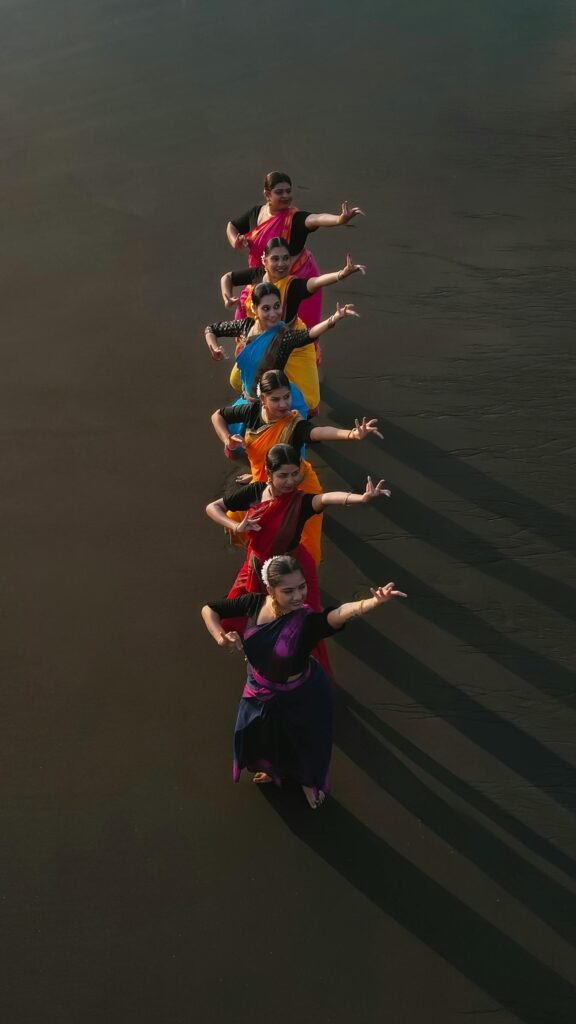
Mumbai has a vibrant theater scene. Prithvi Theatre (established 1944) and the National Centre for Performing Arts (NCPA) host everything from classical Indian performances to contemporary international productions. The Symphony Orchestra of India performs regularly; Bharatiya Vidya Bhavan preserves classical Indian arts.
Festivals and Celebrations
Ganesh Chaturthi (August/September) transforms Mumbai into a city-wide celebration — elaborate processions, towering idols, and infectious energy throughout the streets. The 11-day festival ends with idol immersions at Chowpatty Beach in some of the largest crowds the city sees all year. The Banganga Music Festival in January brings renowned Indian classical musicians to perform at the ancient tank complex. The Kala Ghoda Arts Festival (February) showcases contemporary creativity across visual arts, dance, theater, and music — Mumbai’s leading cultural event.
Art Galleries and Museums
The Jehangir Art Gallery features rotating contemporary exhibitions; the National Gallery of Modern Art displays cutting-edge installations. These venues, concentrated in South Mumbai near the Kala Ghoda district, create a vibrant arts neighborhood accessible to both locals and visitors.
Mumbai is a city of contrasts and unrelenting energy, where ancient traditions coexist with modern ambitions. Whether the draw is the colonial architecture, the Bollywood pulse, the food, or just the singular density of human activity, the city rewards visitors who lean into the chaos rather than try to organize it.
AFRIKA
Cairo Hurghada Johannesburg Marrakech
ASIA
Abu Dhabi Agra Antalya Bangkok Batam Beijing Bengaluru Cebu City Chiang Mai Chiba Chennai Da Nang Dammam Delhi Denpasar Dubai Fukuoka Guangzhou Guilin Ha Long Hanoi Ho Chi Minh City Jakarta Jaipur Johor Bahru Kolkata Krabi Kuala Lumpur Kyoto Macau Mecca Medina Mugla Mumbai Osaka Pattaya Penang Phuket Riyadh Seoul Shanghai Shenzhen Singapore Taipei Tokyo Zhuhai
EUROPE
Amsterdam Athens Barcelona Berlin Brussels Budapest Copenhagen Dublin Florence Frankfurt am Main Heraklion Krakow Lisbon London Madrid Milan Munich Nice Paris Porto Prague Rhodes Rome Stockholm Venice Vienna Warsaw
NORTH AMERICA
Cancun Las Vegas Los Angeles Miami New York City Orlando San Francisco Toronto Vancouver
SOUTH AMERICA
Buenos Aires Lima Rio De Janeiro
OCEANIA
Auckland Honolulu Melbourne Sydney