
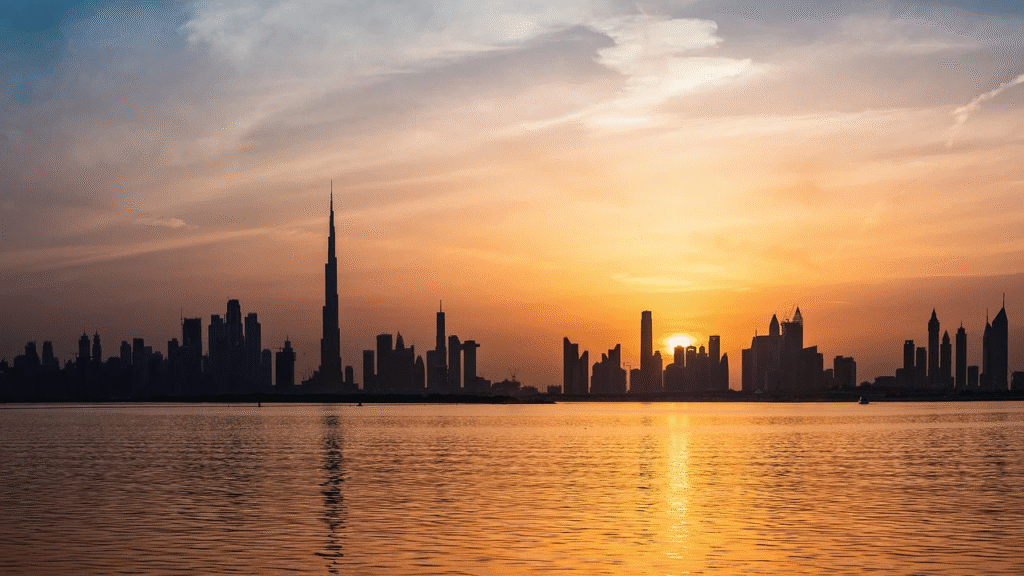
Dubai is the most extreme urban experiment of the past fifty years. The city the world recognizes today — Burj Khalifa, Palm Jumeirah, glass-tower skyline along Sheikh Zayed Road — barely existed in 1990. Drive past the Dubai Frame and you can see both versions in a single glance: the historic Bur Dubai and Deira districts on one side, the futuristic Downtown and Marina on the other, separated by less than thirty years of construction. This guide covers what works on the ground in 2026: which districts to base yourself in, the headline attractions worth the ticket prices, the food culture beyond the hotel restaurants, and the practicalities of navigating a city designed primarily for cars in a climate that demands air conditioning ten months of the year.
Dubai at a Glance: Essential Facts for Travelers
Dubai: Key Facts & Tourism Statistics
| International arrivals | 19.59 million (2025, international overnight visitors) — Dubai Department of Economy and Tourism (DET), annual results Feb 2026 |
|---|---|
| Population | 3.85 million (2024, Dubai Statistics Center) |
| Best time to visit | November, December, January, February and March |
| Airport to city centre | Dubai Metro Red Line (from DXB T1/T3): ~25 min, ~US$2 |
| Currency | UAE dirham (AED) |
| Time zone | UTC+4 (GST) |
| Visa | Many nationalities receive a free visa on arrival for 30–90 days (check ICP/GDRFA). |
How many tourists visit Dubai per year?
Dubai recorded 19.59 million international overnight visitors in 2025, according to Dubai Department of Economy and Tourism (DET), annual results Feb 2026.
What is the best time to visit Dubai?
The most comfortable months to visit Dubai are typically November, December, January, February and March, based on 1991–2020 climate normals for temperature and rainfall.
How do I get from the airport to central Dubai?
The Dubai Metro Red Line (from DXB T1/T3) takes about 25 minutes to the city centre for about US$2 (AED ~6–8 with Nol card, to Downtown).
What currency is used in Dubai?
Dubai uses the UAE dirham (AED); the local time zone is UTC+4 (GST).
Do I need a visa to visit Dubai?
Many nationalities receive a free visa on arrival for 30–90 days (check ICP/GDRFA).
How many people live in Dubai?
Dubai has a population of about 3.85 million (emirate population), per Dubai Statistics Center (2024).
Dubai climate: monthly averages (1991–2020)
| Month | Avg high | Avg low | Rain |
|---|---|---|---|
| Jan | 23.9 °C | 13.9 °C | 17 mm |
| Feb | 25.6 °C | 14.7 °C | 13 mm |
| Mar | 28.8 °C | 16.9 °C | 16 mm |
| Apr | 33.8 °C | 20.3 °C | 5 mm |
| May | 38.5 °C | 24 °C | 0 mm |
| Jun | 40.6 °C | 26.3 °C | 0 mm |
| Jul | 41.8 °C | 28.9 °C | 2 mm |
| Aug | 42.1 °C | 29.3 °C | 1 mm |
| Sep | 39.8 °C | 26.6 °C | 1 mm |
| Oct | 36 °C | 23.2 °C | 1 mm |
| Nov | 30.6 °C | 19.4 °C | 3 mm |
| Dec | 26.1 °C | 15.7 °C | 8 mm |
Data last verified: 2026-09-01 · Climate: Open-Meteo ERA5 reanalysis, monthly normals computed from daily data 1991–2020 · Sources: Dubai DET/Media Office (arrivals) · Dubai Statistics Center (population) · RTA (transfer) (primary source) · World’s most visited cities · Methodology
Upcoming Events in Dubai
| Date | Title | Details |
|---|---|---|
| 2026-09-30 to 2026-10-24 | Pluma – Acrobatic Show at Dubai Festival City | Pluma, a circus-style acrobatic show, takes up residence at Dubai Festival City Mall from 30 September to 24 October. The staged spectacle combines acrobatics and theatrical effects in a format aimed at families and children as much as adults, and its location inside the mall makes it an easy add-on to a day of shopping and dining by Dubai Creek. Ticket prices vary by date and seating category; performances run on multiple days each week, so check the schedule before booking. [Source] |
| 2026-10-12 to 2026-10-16 | GITEX Global 2026 | GITEX Global, one of the world’s largest technology exhibitions, takes over the Dubai World Trade Centre each October, drawing tech giants, startups and government leaders to showcase the latest in AI, cloud, cybersecurity, robotics and more. Its co-located Expand North Star is among the biggest gatherings of startups and investors anywhere. Keynotes, launches and demos fill the halls, making it a magnet for the global tech industry. Entry is ticketed, with parts aimed at trade visitors. It is an essential date for anyone tracking the future of technology in the region. [Source] |
| 2026-10-14 | Global Village Season 31 Opening | Global Village opens its 31st season on 14 October, and the multicultural park in Dubailand then runs daily until May 2027. Dozens of country pavilions offer shopping and street food from around the world, alongside the Carnaval funfair with more than 200 rides and games, stunt shows and nightly entertainment on the main stage. Returning favourites include the EXO Planet City attractions and the Cyber City Danger Zone stunt show. Tickets for the new season go on sale later in the year; prices vary. [Source] |
| 2026-10-24 to 2026-11-22 | Dubai Fitness Challenge (30×30) | The Dubai Fitness Challenge, known as 30×30, urges residents to complete 30 minutes of activity a day for 30 days, turning the emirate into a giant open-air gym each autumn. Free classes, pop-up fitness villages, cycling and running events and community workouts spring up across the city, from the beach to the parks. Landmark routes such as Sheikh Zayed Road are given over to walkers and runners on special days. Most activities are free and open to all ages and abilities. It is a citywide celebration of health that has become a signature Dubai initiative. [Source] |
| 2026-11-03 to 2026-11-08 | Dubai Design Week 2026 | Dubai Design Week returns to Dubai Design District (d3) from 3 to 8 November under the patronage of Sheikha Latifa bint Mohammed. The programme spans large-scale installations, exhibitions, workshops and a design marketplace, headlined by the Abwab group exhibition on how language is communicated and remembered, the Urban Commissions competition on public space, and Downtown Design, the Middle East’s leading fair for contemporary design. Access varies by element, with much of the outdoor programme open to casual visitors; a key week for creatives. [Source] |
| 2026-11-07 | Amr Diab Live at Coca-Cola Arena | Egyptian superstar Amr Diab, one of the Arab world’s most successful and enduring recording artists, headlines the Coca-Cola Arena in City Walk on Saturday 7 November. His arena shows draw a huge cross-section of Dubai’s Arabic-speaking communities and visitors, mixing decades of hits with newer material. Ticket prices vary widely by category and typically sell quickly for an artist of this stature, so early booking is advisable. Doors and support details are confirmed closer to the date on the ticketing platforms. [Source] |
City News in Dubai – last 14 days
| Date | Category | Headline | Details |
|---|---|---|---|
| 2026-09-14 | Public transport | Metro Blue Line 24 percent complete, Gold Line tender this year | Dubai’s Roads and Transport Authority says 24 percent of the Metro Blue Line project has been completed. The line, a roughly 30-kilometre extension with new stations serving fast-growing districts on the way to Dubai Silicon Oasis and Academic City, is the network’s biggest expansion since it opened. In parallel, the tender for building the future Metro Gold Line is expected to be issued before the end of the year, the next stage in the long-term growth of the driverless system. [Source] |
| 2026-09-14 | Business | Dubai has welcomed about seven million tourists this year | Sheikh Mohammed bin Rashid announced that Dubai has received seven million tourists, adding that everyone is welcome in the country. Figures reported alongside put international overnight visitors at 6.97 million for the first eight months of 2026, keeping the city on course for another record tourism year. Officials also highlighted the sector’s growing contribution to the local economy, underlining how central tourism remains to Dubai’s diversification strategy despite a turbulent regional backdrop. [Source] |
| 2026-09-14 | Public transport | Regional tensions still ripple through Dubai flight schedules | Emirates, Etihad and flydubai continue to face delays as ongoing regional tension affects Middle East airspace, and travellers are being advised to check their flight status before heading to the airport. At the same time, flydubai says it has maintained its momentum and resumed operations to 125 destinations. The mixed picture shows carriers restoring networks quickly whenever conditions allow, while schedules remain vulnerable to short-notice airspace changes across the region. [Source] |
| 2026-09-14 | Local government | Dubai to host first international railway conference in 2027 | Under the patronage of Sheikh Hamdan bin Mohammed, the Roads and Transport Authority will organise the Dubai International Railway Conference and Exhibition in 2027, presented as the first international rail event of its kind hosted in the city. The announcement comes as Dubai pushes ahead with major rail expansion, including the Metro Blue Line now under construction, and it positions the emirate as a regional hub for railway technology, suppliers and investment. [Source] |
| 2026-09-14 | Local affairs | Global Village confirms 14 October opening | Global Village will open its gates for the new season from 14 October, Al Bayan reports, confirming the return date for the multicultural park in Dubailand. Season 31 then runs until May 2027 with country pavilions, street food from around the world and the Carnaval funfair. Tickets for the new season are to go on sale later in the year, and the park is once again expected to rank among the city’s most visited attractions through the winter months. [Source] |
| 2026-09-13 | Education | Higher education to add 5.1 billion dirhams to Dubai by 2033 | Higher education is projected to contribute 5.1 billion dirhams to Dubai’s economy by 2033, according to figures reported by Al Bayan. The projection reflects the city’s push to attract international branch campuses and grow its student population under its long-term education strategy with a 2033 horizon. A larger university sector is seen as feeding directly into the talent pipeline for the knowledge economy the emirate wants to build alongside trade, tourism and finance. [Source] |
| 2026-09-13 | Sports | India women win Asia Cup in Dubai and repeat trophy snub | India’s women defeated Sri Lanka in the final of the Women’s Asia Cup in Dubai and then declined to collect the trophy from Pakistan Cricket Board chief Mohsin Naqvi, repeating the gesture made by India’s men at their tournament in 2025. The refusal, rooted in the standoff between the two countries’ cricket boards, overshadowed the presentation ceremony and dominated coverage of what had been a decisive Indian victory on the field. [Source] |
| 2026-09-13 | Culture | Dubai PodFest returns for fifth edition at Arab Media Summit | The Dubai Press Club will host the fifth edition of Dubai PodFest as part of the Arab Media Summit 2026, bringing together podcasters, creators and media figures from across the region. The event has grown into a key gathering for the fast-expanding Arabic podcast scene, and its programme traditionally features workshops, talks and live recordings alongside the summit’s broader media agenda, cementing Dubai’s role as a production hub for regional audio content. [Source] |
Dubai Events & City News Archive
Sources: Platinumlist, GITEX Global, Global Village, Dubai Fitness Challenge, Dubai Design Week, Emarat Al Youm, Emarat Al Youm, Conde Nast Traveller Middle East
Weather Forecast for the Next 14 Days in Dubai
| Date | Weather | Max °F | Min °F | Rain mm |
|---|---|---|---|---|
| 2026-09-14 | ⛅ | 104.4 °F | 84.9 °F | 0.0 mm |
| 2026-09-15 | ☀️ | 104.0 °F | 82.4 °F | 0.0 mm |
| 2026-09-16 | ☁️ | 100.9 °F | 81.0 °F | 0.0 mm |
| 2026-09-17 | ☀️ | 100.0 °F | 82.0 °F | 0.0 mm |
| 2026-09-18 | ☀️ | 99.0 °F | 81.4 °F | 0.0 mm |
| 2026-09-19 | ☀️ | 96.1 °F | 80.8 °F | 0.0 mm |
| 2026-09-20 | ⛅ | 97.6 °F | 75.1 °F | 0.0 mm |
| 2026-09-21 | ☀️ | 100.5 °F | 83.8 °F | 0.0 mm |
| 2026-09-22 | ☀️ | 98.8 °F | 82.8 °F | 0.0 mm |
| 2026-09-23 | ☀️ | 98.4 °F | 82.9 °F | 0.0 mm |
| 2026-09-24 | ☀️ | 96.4 °F | 82.3 °F | 0.0 mm |
| 2026-09-25 | ☀️ | 99.0 °F | 81.1 °F | 0.0 mm |
| 2026-09-26 | ☀️ | 99.2 °F | 81.8 °F | 0.0 mm |
| 2026-09-27 | ☀️ | 94.5 °F | 81.1 °F | 0.0 mm |
Dubai’s History
Bronze Age tools, pearl beds, oil wells, and an 828-meter tower — Dubai’s history is the unlikeliest condensation of human urban development on the planet. Five thousand years of fishing-village life produced a settlement so small it didn’t merit serious mention on regional maps until the 19th century. The transformation since 1969 is what people come to see.
Early Settlement and the Al Maktoum Dynasty
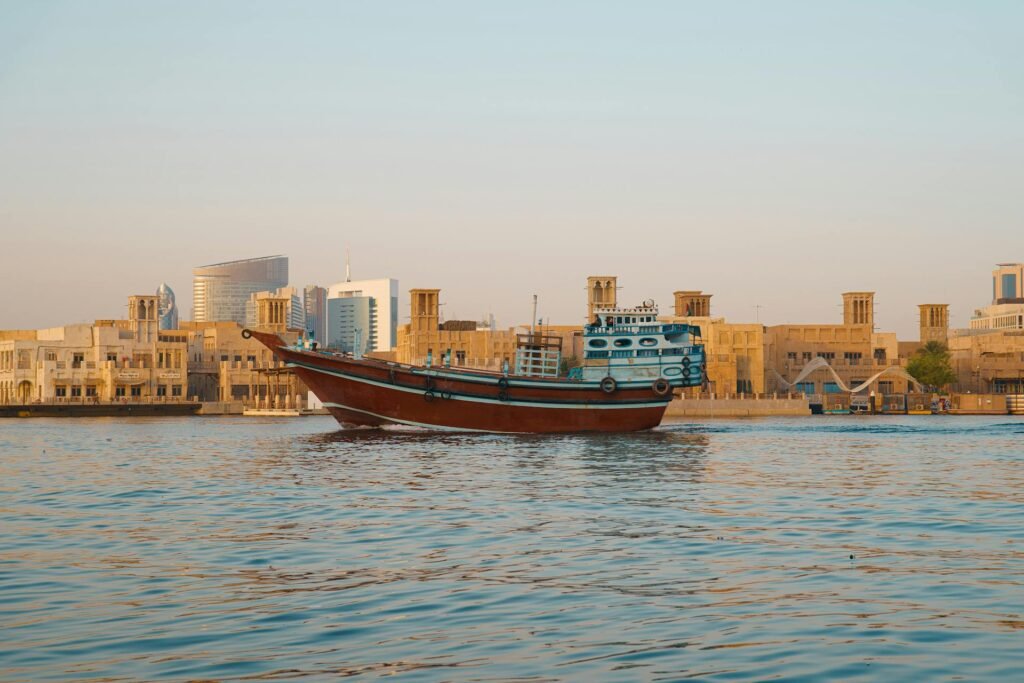
Archaeology dates continuous human habitation along Dubai Creek to the Bronze Age — the natural harbor provided exactly what fishing and pearl-diving communities needed. The modern political history begins in 1793, when the Bani Yas tribe took control of the area. In 1833, Sheikh Maktoum bin Buti established Dubai as an independent trading hub, founding the Al Maktoum dynasty that has ruled continuously ever since — an unbroken chain now nearly two centuries long.
British Influence and Economic Evolution
During the 18th and 19th centuries, British naval power gradually extended over the region through maritime treaties, leading to the moniker “Trucial States.” Dubai’s economy initially centered on pearl diving, which dominated until the 1920s when the Japanese cultured-pearl industry collapsed the market. The pivotal commercial decision came in 1904, when Dubai declared itself a free port — attracting Persian merchants fleeing taxation, British ships seeking favorable terms, and Indian traders looking for a regional base. That single policy decision still defines the city’s character.
Oil Discovery and Modern Development
Oil was discovered offshore in 1966 and onshore in 1969 — the financial foundation for everything that came next. Compared to Abu Dhabi or Kuwait, Dubai’s oil reserves were modest, which forced an early diversification strategy that rivals haven’t had to develop. When Britain withdrew from the Gulf in 1971, Dubai became a founding member of the United Arab Emirates. Under Sheikh Rashid bin Saeed Al Maktoum, oil revenues funded port construction (Jebel Ali, the world’s largest manmade harbor), airport expansion, and the early infrastructure for a service-economy bet.
The Contemporary Miracle
The late 20th and early 21st centuries witnessed Dubai’s most dramatic transformation. Mega-projects redefined what was possible in urban development: the Palm Jumeirah artificial islands (started 2001), the Burj Al Arab hotel (opened 1999, the sail-shaped icon), and ultimately the Burj Khalifa (opened 2010 at 828 meters — still the world’s tallest building). Under current ruler Sheikh Mohammed bin Rashid Al Maktoum, Dubai has positioned itself as the regional hub for finance, tourism, aviation, and increasingly tech, with the 2020 World Expo (held 2021–22) marking its arrival as a global event capital.
Geography, Climate & Best Time to Visit Dubai
Dubai sits at the northern edge of the eponymous emirate, divided by the historic Khor Dubai (Dubai Creek), a saltwater inlet stretching up to 1.3 kilometers wide. The creek separates traditional Deira to the north from Bur Dubai to the south, and traditional wooden abra boats still ferry passengers across it the way they have for generations.
Geographic Layout
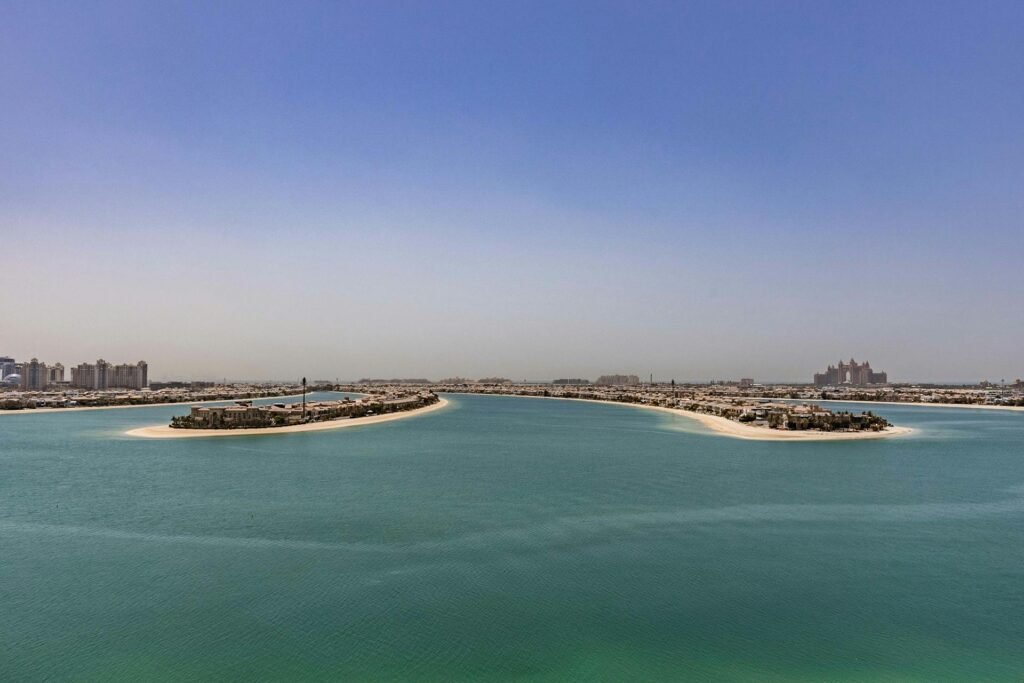
Dubai is constrained northward by its border with Sharjah, so the city has grown predominantly southward along the coast. The result is a linear metropolis stretching from the historic creek down through Jumeirah’s golden beaches to the futuristic Marina district, anchored along Sheikh Zayed Road — the multi-lane spine that connects everything.
Climate Overview
Dubai has a pure desert climate with abundant year-round sunshine — about 9.6 hours of daily sun on average. Two seasons matter: a brutal hot period from May to September (highs above 40°C, with summer humidity that turns the streets into walking saunas) and a temperate cool season from November to March (highs in the 24–32°C range, exactly the weather most visitors want). Rainfall is essentially a rumor — about 7 rainy days per year, mostly clustered in February.
| Month | Avg High (°C) | Avg Low (°C) | Rainfall (mm) | Sunshine Hours |
|---|---|---|---|---|
| January | 24.0 | 13.7 | 11 | 8.2 |
| February | 24.6 | 14.5 | 36 | 8.8 |
| March | 27.9 | 17.0 | 22 | 9.1 |
| April | 32.4 | 20.1 | 8 | 9.8 |
| May | 36.8 | 23.5 | 1 | 10.7 |
| June | 38.8 | 26.1 | 0 | 11.1 |
| July | 40.6 | 28.9 | 0 | 10.8 |
| August | 40.4 | 29.3 | 0 | 10.5 |
| September | 38.7 | 26.3 | 0 | 10.2 |
| October | 35.1 | 22.7 | 0 | 9.7 |
| November | 30.5 | 18.3 | 2 | 9.1 |
| December | 26.2 | 15.4 | 14 | 8.4 |
Best Time to Visit
November through March is the sweet spot — daytime temperatures of 24–32°C, pleasant evenings for outdoor dining or beach walks. December and January are the absolute peak; book early if you’re targeting that window. Summer (May–September) means 40°C+ highs but the city is engineered for exactly this — every taxi, mall, hotel, and restaurant runs at 22°C, hotel rates drop 30–50%, and the hot-season is when Dubai becomes affordable. The Arabian Gulf stays warm year-round, 22°C in winter to 32°C in summer.
Dubai’s Districts & Neighborhoods
Dubai is officially divided into nine sectors and 132 communities, but visitors really only need to know six or seven areas. The choice of where to stay defines the trip — beach-and-marina vibe versus glass-tower downtown versus old-town heritage.
Historic Core: Deira and Bur Dubai
The heart of old Dubai. Deira (north of the creek) holds the famous Gold Souk and Spice Souk and is a working commercial neighborhood where most Emiratis don’t actually live anymore — it’s predominantly South Asian and East African by population. Bur Dubai (south of the creek) contains the Al Fahidi Historic District with restored wind-tower architecture and the Dubai Museum in Al Fahidi Fort. These areas offer authentic cultural experiences and budget-friendly accommodations far below Marina-area prices.
Jumeirah: Coastal Luxury
Stretching 10–15 kilometers southwest of downtown, Jumeirah is Dubai’s premium coastal strip — pristine beaches, luxury villas, and the iconic Jumeirah Mosque (the only mosque in Dubai non-Muslims can visit on guided tours). The neighborhood splits into numbered communities (332–352) and offers some of the city’s best beachfront resorts.
Downtown Dubai and Business Bay
Home to the Burj Khalifa, Dubai Mall, and the Dubai Fountain, this is the modern center the world recognizes from postcards. Adjacent Business Bay is more office-towers and serviced-apartment territory. Hotels here range from family-friendly Address-brand mid-luxury to outright top-tier (Armani Hotel inside the Burj Khalifa itself). The sweet-spot for first-time visitors who want to walk to the headline sights.
Dubai Marina and JBR
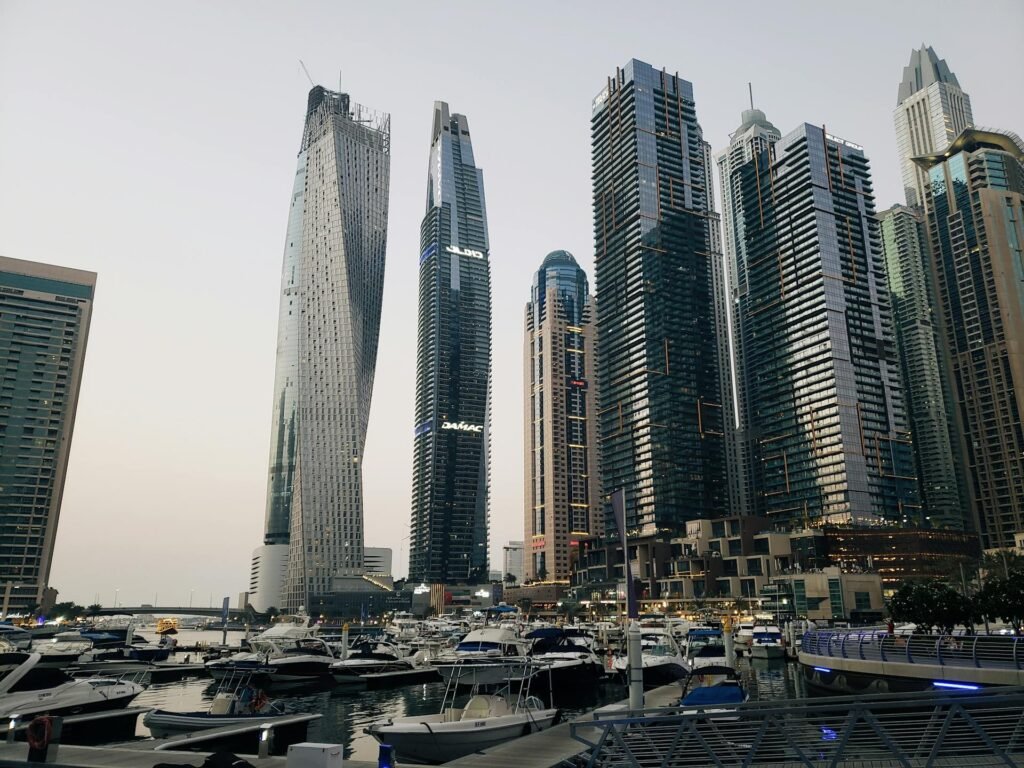
The Marina showcases Dubai’s high-rise architectural ambition — a forest of skyscrapers around an artificial harbor, with the long pedestrian Marina Walk along the water. Jumeirah Beach Residence (JBR) next door provides beachfront living with restaurant and entertainment density. Best for cosmopolitan trip-planning with both beach and city access; a longer commute to Downtown but well-served by the Red Line metro.
Palm Jumeirah
The world-famous artificial palm-shaped island, opened 2009, hosts luxury resorts including the original Atlantis The Palm and the newer Atlantis The Royal. Aquaventure waterpark, several signature restaurants, and the View at the Palm observation deck are the headline attractions. Think of it as a resort island within the city — beautiful but isolated; you’ll commute back to the mainland for most non-beach activities.
Al Barsha and Emirates Hills
Al Barsha (communities 373, 376, 671–673) mixes residential and commercial — its main draw for visitors is the Mall of the Emirates (with Ski Dubai inside). Emirates Hills (393–394) is the city’s most exclusive gated residential development, sometimes nicknamed the “Beverly Hills of Dubai” — for visitors, mostly relevant for golf at the adjacent Emirates Golf Club.
Top Things to Do in Dubai
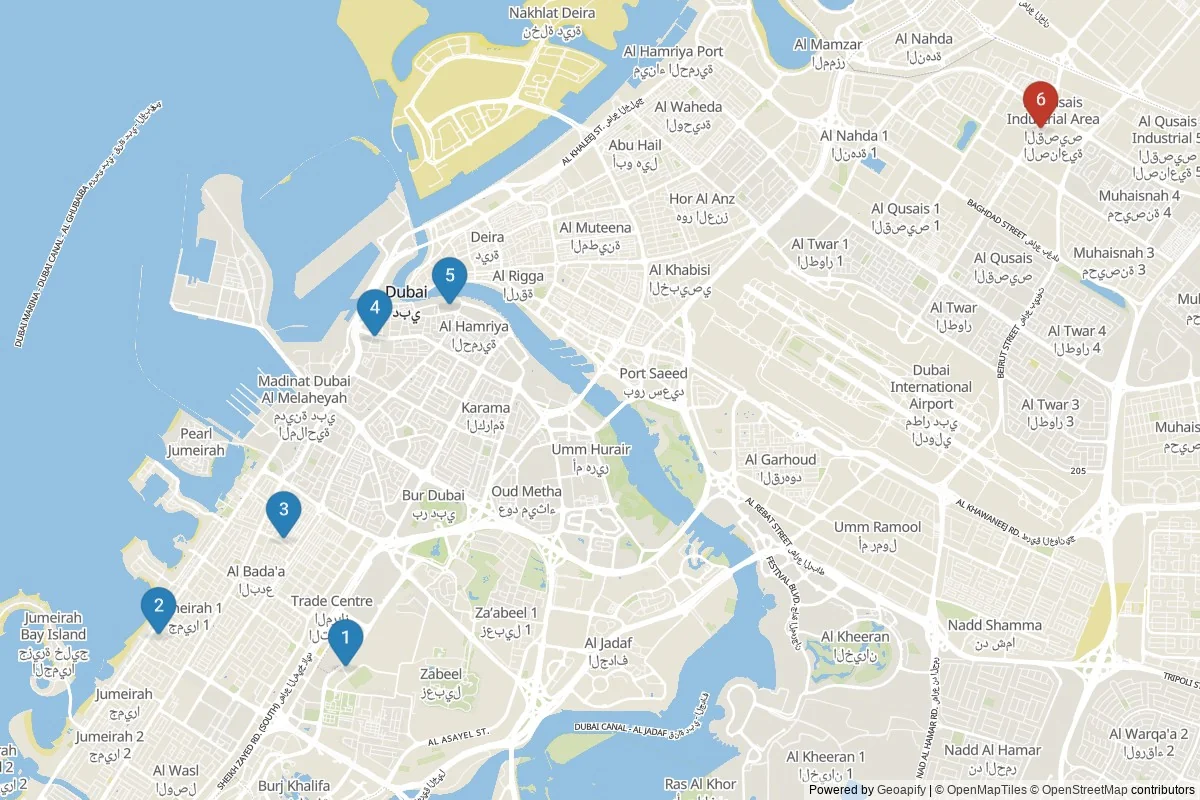
| # | Sight | Cluster | Type | Time | Entry | Best |
|---|---|---|---|---|---|---|
| 1 | Gardens and Recreation | Cluster A | Garden | — | — | — |
| 2 | Shopping Experiences | Cluster A | Aquarium | — | — | Morning |
| 3 | Architectural Marvels | Cluster A | Beach | 30 minutes | free | Sunset |
| 4 | Beach and Water Activities | Cluster A | Park | — | free | — |
| 5 | Cultural Attractions | Cluster A | Museum | — | — | — |
| 6 | Desert Adventures | Cluster B | Market | — | — | Sunrise |
Dubai’s tourism playbook is built around superlatives — tallest, largest, biggest. The trick is balancing these spectacles with the cultural and outdoor experiences that give the trip dimension. A 4–5 day plan handles the headline attractions plus a desert-safari day and time at the souks.
Architectural Marvels
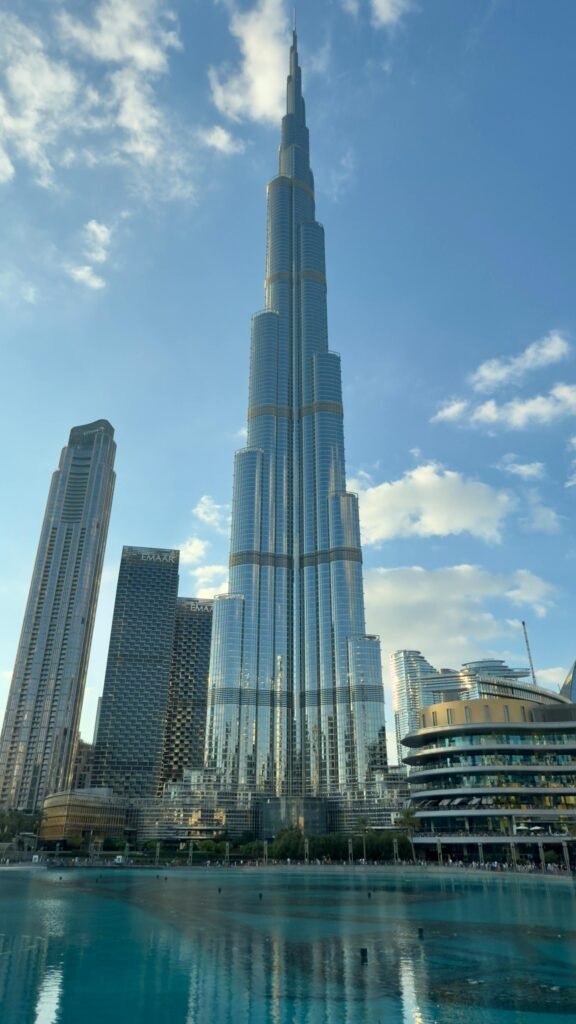
The Burj Khalifa stands 828 meters tall, the world’s tallest building since 2010 — observation decks operate on levels 124, 125 (the standard At The Top experience), and 148 (At The Top SKY, separately ticketed and significantly more expensive). Book online in advance via the official portal; the sunset slot books out earliest. The adjacent Dubai Fountain presents 5-minute water shows every 30 minutes from 6 PM, with jets reaching 50 stories high — free, viewable from the lake-side promenade or the boardwalk. The Burj Al Arab, the sail-shaped 321-meter hotel on its own artificial island, is best appreciated from the public Jumeirah Beach view; entering requires a restaurant or afternoon-tea reservation.
Shopping Experiences
Dubai Mall covers 1,200+ stores plus an aquarium, ice rink, dinosaur skeleton, and dining for every budget — plan a half-day even if you don’t shop. Mall of the Emirates houses Ski Dubai, an indoor ski slope with real snow and resident penguins, plus a wide retail selection. For traditional shopping, the Gold Souk in Deira dazzles with hundreds of meters of jewelry windows (open from morning into late evening), while the Spice Souk next door fills the air with cardamom, saffron, frankincense, and tea. Ibn Battuta Mall offers a unique themed experience with sections styled after the regions of the 14th-century explorer’s travels.
Cultural Attractions
The Al Fahidi Historic District preserves Dubai’s heritage with restored traditional buildings, art galleries, and small museums. The Dubai Museum in Al Fahidi Fort traces the city’s transformation from fishing village to global metropolis (the fort itself is the city’s oldest existing building). The Heritage and Diving Village in Al Shindagha showcases traditional Bedouin life, pearl diving demonstrations, and live craft work — particularly active during weekends and the winter heritage festivals.
Beach and Water Activities
Public Jumeirah Beach offers free access with white sand and clear water; Jumeirah Beach Park adds family facilities. The Palm Jumeirah resorts have private beaches with full water-sports rentals (parasailing, jet-ski, banana boats). For the cheapest classic Dubai water experience, take an abra across Dubai Creek for 1 AED — wooden boats running every few minutes between Deira and Bur Dubai, the same way they have for generations.
Desert Adventures
Half-day desert safaris are practically mandatory. The standard package includes 4×4 dune-bashing through the Lahbab “Big Red” dunes, sandboarding, camel rides, and a Bedouin-style camp dinner with falconry, traditional dance, and shisha. Premium operators offer overnight camping, hot-air-balloon sunrise flights, or private 4×4 tours. Book through hotel concierges or established operators (Platinum Heritage, OceanAir, Arabian Adventures) — the budget end of the market is lower-quality.
Gardens and Recreation
The Dubai Miracle Garden (open from November to early summer only — closes during the heat) showcases over 45 million flowers in spectacular themed displays. The adjacent Dubai Butterfly Garden houses thousands of butterflies in climate-controlled domes year-round. Sports enthusiasts can enjoy world-class golf at the Emirates Golf Club (home of the Dubai Desert Classic European Tour event each January), or visit Dubai International Cricket Stadium — ICC’s headquarters — during the city’s regular hosting of major tournaments.
How to Get to Dubai
By Air
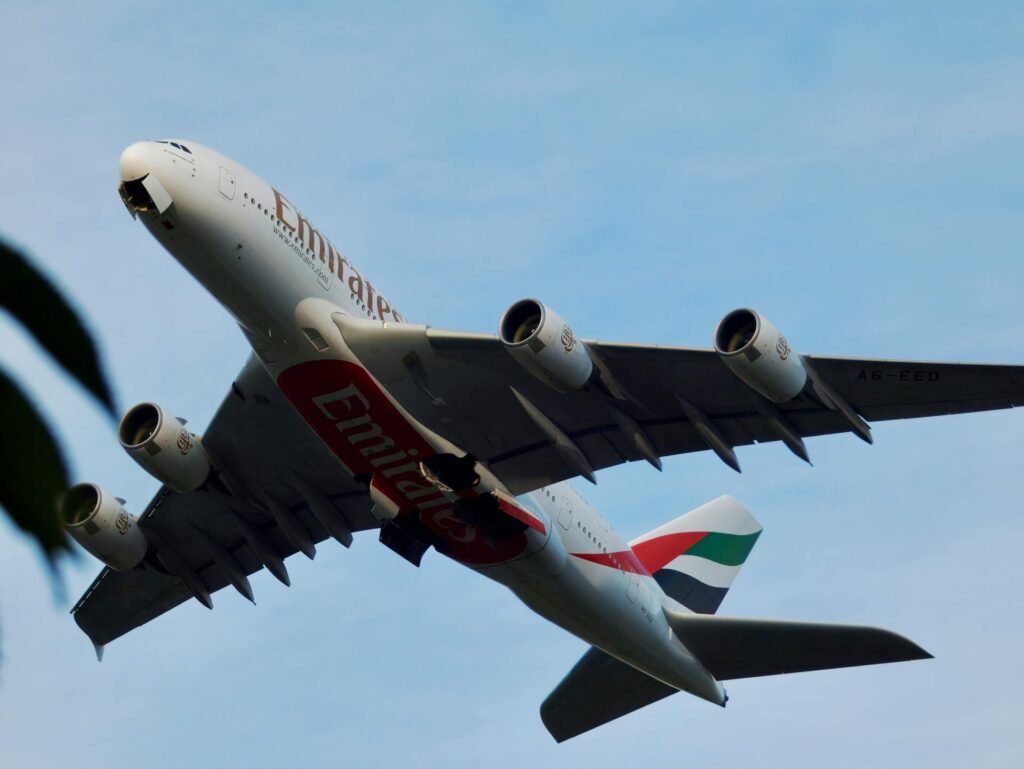
Dubai International Airport (DXB) is the primary gateway, just 5 km from Dubai Creek and arguably the world’s most important hub between Europe and Asia — 5th busiest globally by passenger traffic, with direct flights to over 240 destinations. Emirates Airlines, the home carrier, operates the world’s largest A380 fleet from here, plus a substantial 777 fleet. Terminal 3 handles all Emirates flights and is one of the most pleasant terminals in the world to transit through. Dubai World Central (DWC / Al Maktoum International) is the secondary airport, currently mostly cargo and budget-airline passengers, with a long-term plan to scale to 160 million passengers annually.
By Sea
Port Rashid handles passenger ferries to Doha, Kuwait, and Omani ports. Dubai is now also a major Persian Gulf cruise port, with Carnival, MSC, and Costa all running winter Mediterranean-Gulf seasons. Traditional dhows still operate cargo routes throughout the Gulf, and the Dubai Marina-area dhow cruises are the most accessible way for visitors to experience them.
By Road
Dubai connects to the rest of the UAE and beyond via modern multi-lane highways. Abu Dhabi is 90 minutes by car on Sheikh Zayed Road. Sharjah is 30 minutes (and connected by frequent buses). Cross-border travel to Oman takes 4–5 hours to Muscat via the Hatta border crossing. Saudi Arabia is now accessible via direct land routes following the post-2020 thaw in regional travel relations.
Getting Around Dubai
Dubai is built for cars, but the visitor doesn’t need one. The Metro Red Line connects most places that matter for tourists, ride-hailing apps work seamlessly, and the climate makes walking a winter-only activity in any case.
Public Transportation
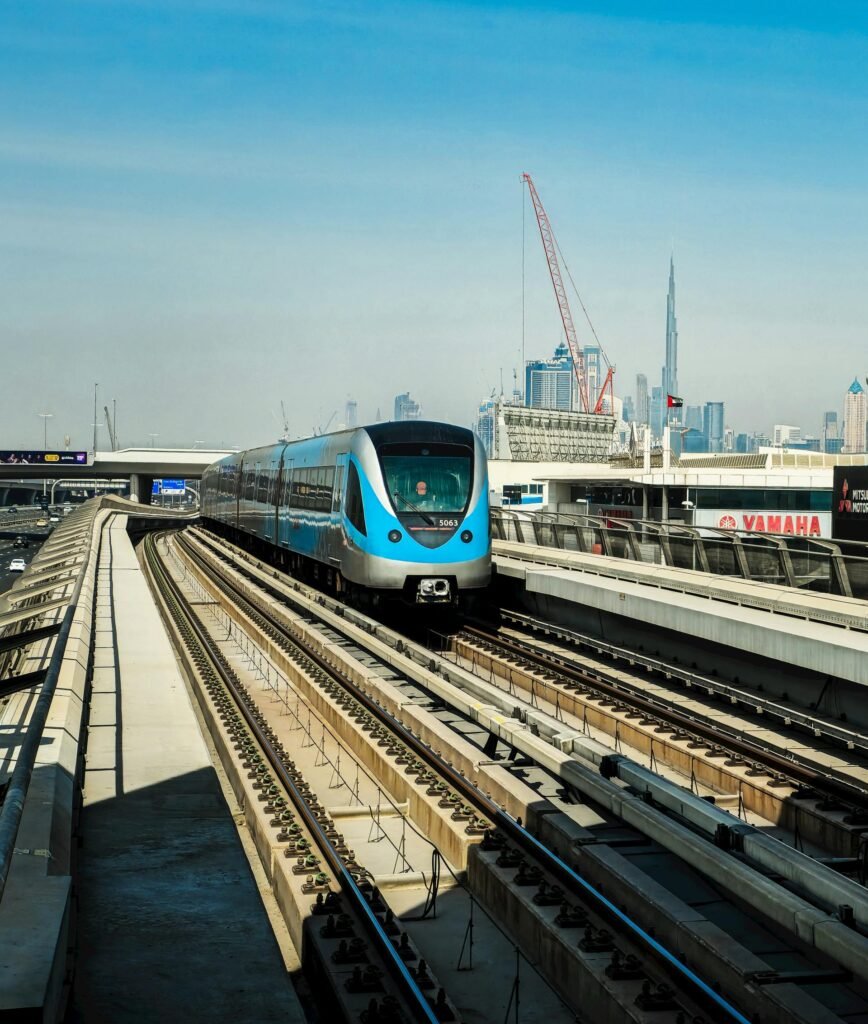
The Dubai Metro, operated by the Roads and Transport Authority (RTA), is driverless, fully air-conditioned, and one of the cleanest urban rail systems anywhere. Two main lines: the Red Line connects DXB Airport, Deira, Bur Dubai, Downtown Dubai, the Marina, and JBR — covers 90% of what tourists need. The Green Line serves the Old Town districts. Trains run every 4–8 minutes; women-and-children-only carriages run during peak hours. The bus network covers gaps — over 1,300 vehicles, every stop air-conditioned to 22°C while you wait. The Dubai Tram connects Marina/JBR with the Red Line, and the Palm Monorail runs along Palm Jumeirah.
Water Transport
The traditional abra boats across Dubai Creek are the most authentic Dubai transport experience — wooden vessels with engines, running every few minutes for 1 AED per ride. Modern water taxis and the Dubai Ferry connect Marina, JBR, and Downtown via Persian Gulf routes for a more scenic alternative.
Private Transportation
Dubai has over 1 million registered vehicles for 1.8 million residents — the city’s car-centric culture in numbers. The Salik electronic toll system charges 4 AED per gate, automatically billed to a windshield tag. Taxis are abundant, well-regulated, and metered (the cream-colored RTA fleet is the standard). Uber and Careem both operate citywide and integrate with the official RTA dispatch system.
Nol Card
The Nol Card is Dubai’s unified transport payment system — valid for metro, bus, tram, and water taxis. Buy at any metro station, top up at the same machines, contactless tap to ride. The Silver Nol covers about 90% of visitors’ needs.
Food & Drink in Dubai
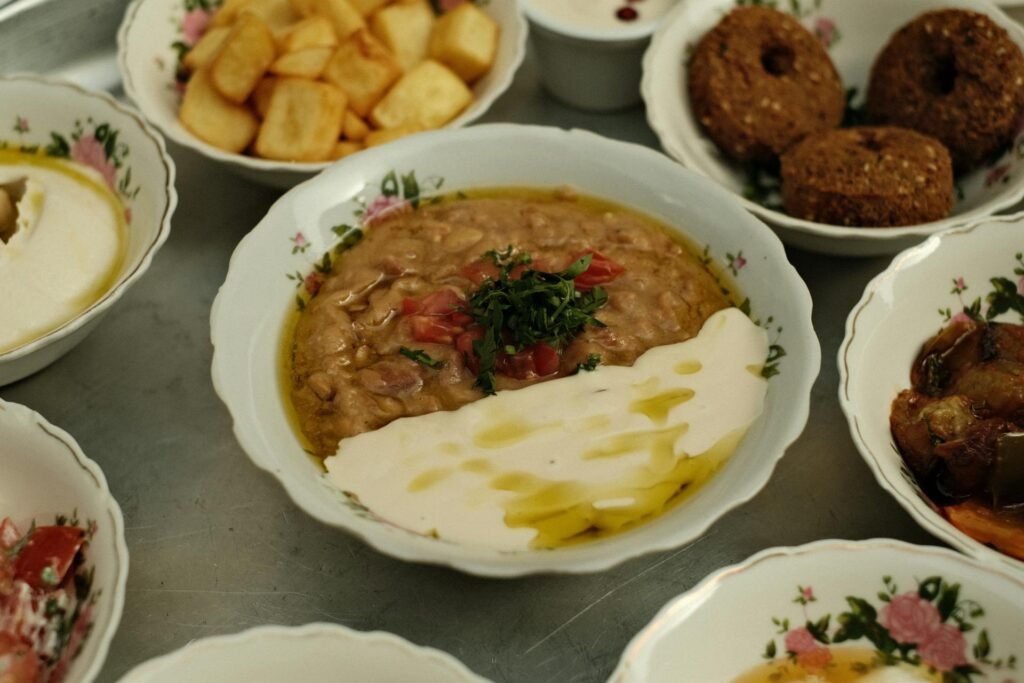
Dubai eats globally. The city’s multinational population (89% expatriate) created a food scene that reflects Pakistan, India, the Levant, the Philippines, the UK, and increasingly the global Michelin-starred circuit — but the traditional Emirati food, ironically, is the hardest to find.
Traditional Emirati Cuisine
Local specialties include machboos (spiced rice with meat, fish, or chicken — the national dish), luqaimat (sweet syrup-soaked dumplings), khanfaroosh (saffron-spiced fritters), and harees (a slow-cooked wheat-and-meat porridge eaten during Ramadan). Look for these at Al Fanar (multiple locations), Aseelah at the Radisson Blu Deira Creek, Logma for casual Emirati street food, and the heritage village restaurants in Al Shindagha. Don’t expect to find Emirati food in mainstream restaurants by default — it’s a specialty cuisine here.
International Dining
Dubai now has 14 Michelin-starred restaurants as of the 2024 guide, including 3-star Trésind Studio (Indian fine dining) and 2-star Stay by Yannick Alléno. Luxury hotels host most of the high-end establishments — the Burj Al Arab’s Al Mahara, Atlantis The Palm’s Nobu, the Burj Khalifa’s At.mosphere, and Dubai Mall’s Pierchic on the over-water boardwalk. Mid-range international dining concentrates around Downtown, JBR, and Dubai Marina.
Street Food and Markets
The historic souks offer fresh juices, shawarma, and karak chai (the spiced milk tea that’s basically Dubai’s coffee equivalent). The Dubai Fish Market near the creek lets you buy fresh-caught seafood and have it cooked on-site at the adjacent restaurants. Al Seef along the creek waterfront has revived a heritage food district with both traditional and modern Emirati operators. The Global Village seasonal market (open November to April) showcases food from 90+ countries.
Dining Etiquette
Dubai accommodates international visitors while maintaining Islamic norms. Alcohol is served at licensed hotel restaurants, bars, and most touristy areas; the law has loosened significantly since 2020 — you no longer need a personal liquor license to drink, and visiting tourists can buy at MMI or African+Eastern stores. Public consumption and public drunkenness remain strictly prohibited. Ramadan still applies — eating, drinking, or smoking in public during daylight hours is officially prohibited (most hotels operate normally, with screened sections), and many cultural events are themed around iftar.
Culture & Arts in Dubai
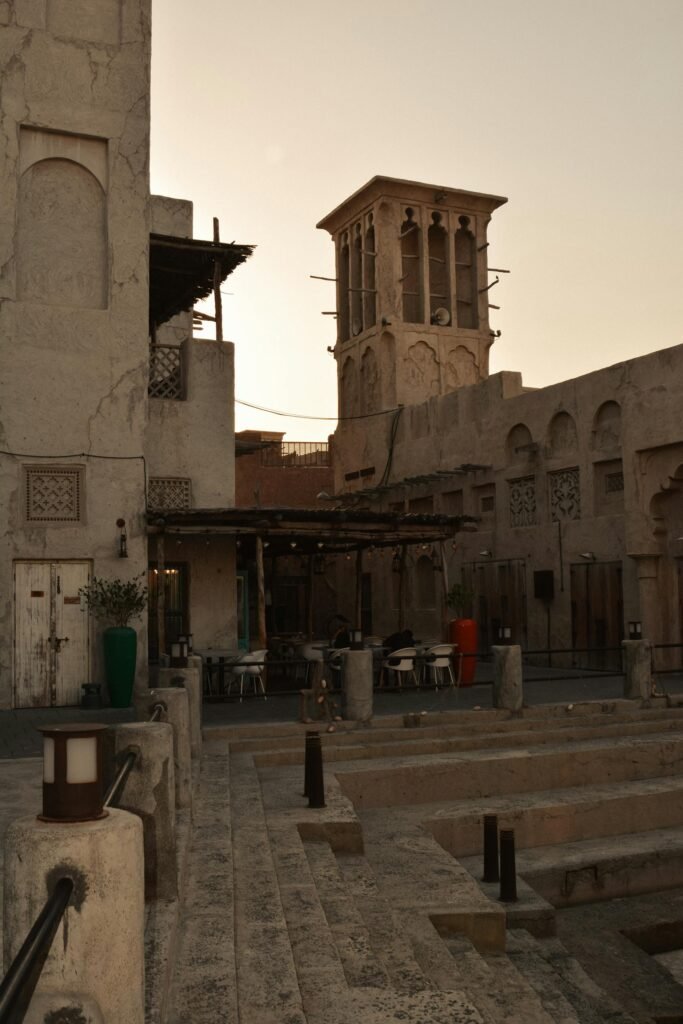
Dubai’s cultural scene is younger than its skyline, but it has matured fast — particularly since the 2010s push to position the city as a Gulf cultural capital alongside Abu Dhabi.
Museums and Heritage Sites
The Dubai Museum in Al Fahidi Fort chronicles the city’s transformation through interactive exhibits and historical artifacts, in the city’s oldest building. The surrounding Al Fahidi Historic District features restored coral-and-gypsum architecture with the distinctive wind towers (early air conditioning) that defined Gulf urban design before electricity. The Etihad Museum covers the founding of the UAE in 1971 — historically rich and architecturally striking. The Museum of the Future, opened 2022, is the city’s signature recent addition — partly a museum, partly a corporate-vision installation, but visually stunning.
Performing Arts
The Dubai Opera in Downtown Dubai (opened 2016) is the city’s premier venue for opera, ballet, classical concerts, and major touring shows — the dhow-shaped building is itself an attraction. The Madinat Theatre at Madinat Jumeirah hosts international ballet, opera, and contemporary theater in a more intimate setting.
Art Galleries and Creative Districts
Alserkal Avenue in Al Quoz is the contemporary-art heart of the city — converted warehouses housing galleries, studios, performance spaces, and a robust schedule of exhibitions and events. The annual Art Dubai fair every March has become the leading contemporary art fair in the Middle East.
Festivals and Events
The Dubai Shopping Festival (December–January) combines retail with entertainment, while the Dubai Food Festival (February) showcases the city’s culinary scene. The Global Village seasonal market (October–April) is part theme park, part international bazaar. The Dubai International Film Festival ran for 14 editions through 2017 and was replaced by the smaller-scale Dubai International Content Market.
Sports & Recreation in Dubai
Dubai has bet heavily on sports tourism, with year-round high-end facilities and a steady calendar of international events drawing global athletes and audiences.
Cricket
The Dubai International Cricket Stadium serves as the headquarters of the International Cricket Council (relocated here from London in 2005) and regularly hosts T20 World Cup, Asia Cup, and IPL matches. The 25,000-seat stadium is the largest cricket venue in the UAE and a stop on the global cricket calendar.
Golf
The Emirates Golf Club hosts the annual Dubai Desert Classic on the European PGA Tour every January, attracting a top-tier international field. The city has multiple championship courses designed by Greg Norman, Karl Litten, and Ernie Els — playable year-round but most pleasant November to March.
Water Sports
The Marina, Mina Seyahi, and Palm Jumeirah marinas all rent jet skis, paddleboards, sailboats, and offer deep-sea fishing charters. The Persian Gulf is calm enough for beginners and warm enough year-round for water activity.
Motor Sports
Dubai Autodrome in Motor City hosts regional race events, karting, and driving experiences with a fleet ranging from formula cars to GT supercars. Grandstand tickets to the nearby Abu Dhabi Grand Prix (Formula 1) at Yas Marina Circuit each November are also a major draw, with many visitors basing themselves in Dubai for the race weekend.
Dubai by District: The 5 Communities
Dubai is divided into 5 communities. The map below shows their official OSM boundaries, colour-coded to match the table — a quick way to orient yourself before zooming in on individual sights.
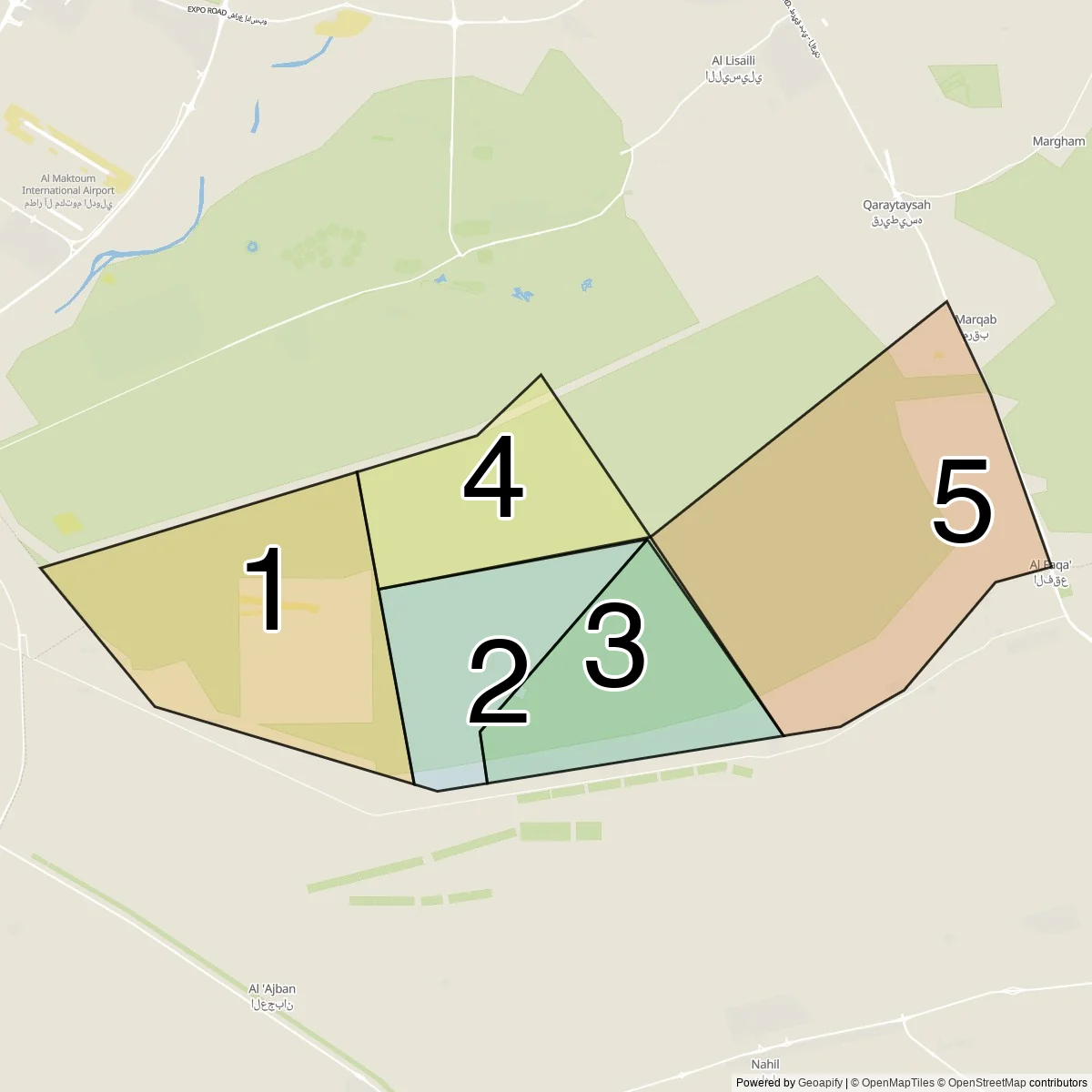
| # | Communities |
|---|---|
| 1 | حفير · Hefair |
| 2 | Al O’shoosh |
| 3 | Saih Shua’Alah |
| 4 | سيح الدحل · Saih Al Dahal |
| 5 | Al Fagaa’ |
Frequently Asked Questions About Visiting Dubai
Do I need a visa to visit Dubai?
Many travelers don’t need one for short stays. The UAE grants 30-day visa-free entry to passport holders from over 80 countries — including the US, UK, EU member states, Canada, Australia, Japan, and most of Latin America — extendable to 90 days for some nationalities. Citizens of GCC countries (Saudi Arabia, Kuwait, Bahrain, Qatar, Oman) enter visa-free with national IDs. For all other nationalities or longer stays, the standard route is the e-Visa applied for via the official portal at smartservices.icp.gov.ae (UAE Federal Authority for Identity, Citizenship, Customs & Port Security) or via Emirates / Etihad airlines if you’re flying with them. Always check the current eligibility list at the UAE government portal u.ae before booking.
Is Dubai safe for tourists?
Dubai is one of the safest major cities on earth for visitors — violent crime is statistically rare, and the city is heavily monitored, well-lit, and well-policed. The US State Department rates the UAE at “exercise normal precautions” — its lowest advisory level. The real risks for tourists are legal rather than physical: public displays of affection are restricted, drug laws are extraordinarily strict (even trace amounts in luggage carry serious consequences), photographing government buildings or military sites is prohibited, and posting critical content about the UAE on social media can have legal consequences. Read the UK Foreign Office’s UAE customs and laws guidance before traveling.
How many days do I need in Dubai?
Three full days handles the headline sights without rushing; five days is comfortable and lets you add a desert safari plus an Abu Dhabi day trip. A solid 4-day plan: Day 1 the Burj Khalifa observation deck, Dubai Mall, and the Dubai Fountain at sunset; Day 2 Old Dubai — Al Fahidi Historic District, the Gold and Spice Souks via abra crossing; Day 3 a desert safari (sunset trip with Bedouin-camp dinner); Day 4 Palm Jumeirah, Atlantis Aquaventure, or beach day at JBR. Add a 5th day for Abu Dhabi (Sheikh Zayed Grand Mosque, Louvre Abu Dhabi, Yas Island). The city’s compact downtown means you’ll cover ground faster than in larger metropolises like Bangkok or Cairo.
What’s the best area to stay in Dubai?
Depends on your priorities. Downtown Dubai (around Burj Khalifa and Dubai Mall) is the easy default for first-time visitors — central, walkable to the headline sights, dense restaurant choice. Dubai Marina / JBR is the beach-and-skyline option, with cosmopolitan dining and direct sand access. Palm Jumeirah is the resort-island experience for visitors prioritizing beach and luxury over centrality — beautiful but isolated. Jumeirah proper is the upscale beachfront strip between the Marina and Downtown. Skip Deira unless you’re price-conscious and want the historic-area experience (cheaper hotels, but tourist amenities are thinner). Skip Bur Dubai for the same reason. Avoid the budget end of the airport-area neighborhoods — you’ll spend trip-time in transfers.
How much does it cost to visit the Burj Khalifa?
Adult tickets to the standard “At the Top” observation deck (levels 124 and 125) start around AED 169 if booked online via the official portal at burjkhalifa.ae; sunset slots run higher. The premium “At the Top SKY” experience (level 148, the highest observation deck) is significantly more expensive — typically AED 400+. Walk-up tickets are subject to availability and routinely sell out for sunset on weekend evenings. Pro tip: the Burj Khalifa is more striking from outside than from inside — many visitors find the view from the Dubai Fountain promenade or the Address Sky View bridge more memorable than the actual observation deck. The Dubai Fountain shows are free and run every 30 minutes after 6 PM.
Should I drink the tap water in Dubai?
Technically it’s safe — Dubai’s tap water meets WHO standards and is desalinated to drinking quality at the source — but the local norm is bottled water, partly for taste (the desalination process can leave a mineral-flat taste) and partly because storage tanks on older buildings can affect water quality at the tap. The CDC’s UAE travel health page notes that bottled water is widely recommended for tourists. Bottled water is sold everywhere — Masafi, Al Ain, Mai Dubai are reliable local brands at AED 1–3 per liter at supermarkets, AED 5–10 at restaurants. Hotels typically provide complimentary bottled water in rooms.
Do I need to dress conservatively in Dubai?
Modest by Western standards in public, freer in tourist zones. For shopping malls, government buildings, and traditional areas: shoulders covered, knees covered for both men and women — yes, malls actually enforce this with security. For mosques: women cover hair, arms, knees (loaner abayas at the Jumeirah Mosque tour); men long pants, no sleeveless. For beaches and pools: standard swimwear is fine at hotel beaches and at JBR’s public beach; bikinis are common at Marina and Palm beaches. For nightlife and upscale restaurants: smart-casual is the norm, and many venues enforce dress codes (no shorts, no sandals, no athletic wear after dark). The UAE government etiquette guide covers the rules in detail. During Ramadan, dress codes tighten across all venues.
Is tipping expected in Dubai?
Yes — Dubai tipping culture sits between US generosity and European reservation. Restaurants: a 10% service charge is often added automatically (check the bill); if not, leave 10–15% in cash for sit-down meals. Taxis: round up to the nearest AED 5–10, or 5% for longer rides. Hotel porters: AED 10–20 per bag. Hotel housekeeping: AED 10–20 per day. Tour guides and desert-safari drivers: AED 50–100 per person for a half-day. Spa and salon: 10–15%. Valet parking: AED 20. Carry small notes (AED 10s and 20s); the cashless-payment culture is strong but tipping is still mostly cash. Service workers in Dubai are predominantly low-paid expatriates from South Asia and the Philippines for whom tips are economically meaningful.
Economy & Business in Dubai
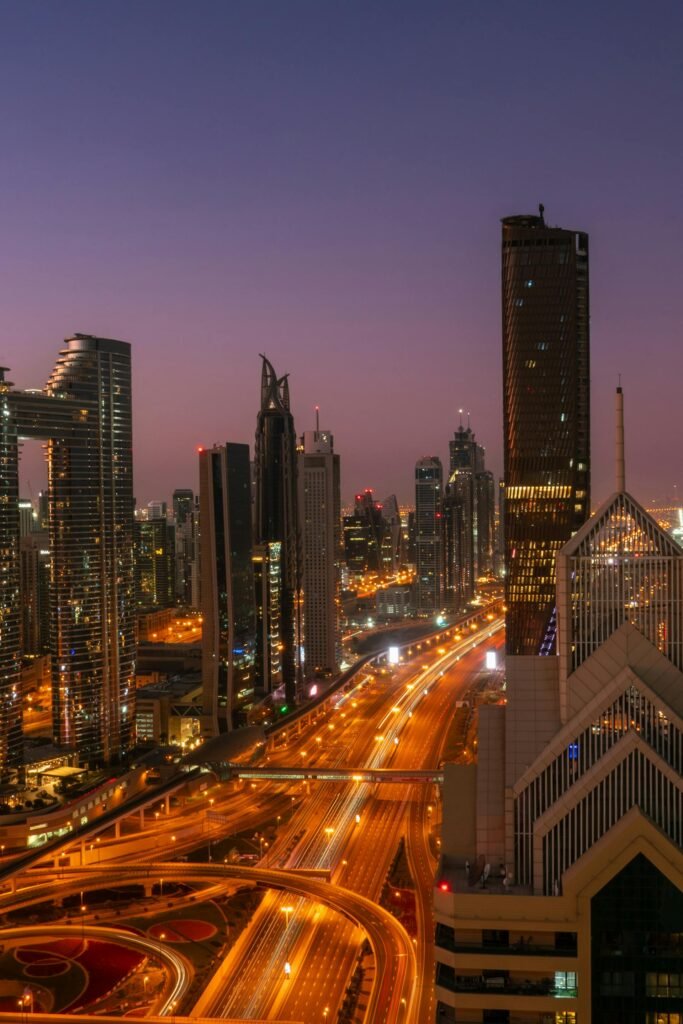
Dubai has transformed itself into a global business hub. With roughly 1% of the UAE’s oil reserves but the lion’s share of regional commerce, the emirate’s diversification bet has been one of the most successful national economic strategies of the past 50 years.
Trade and Logistics
The Jebel Ali Port ranks among the world’s top 10 busiest container ports, handling 14+ million TEUs annually, while Dubai International Airport ranks 5th globally for passenger traffic and 4th for cargo. The combination positions Dubai as one of the most important logistics nodes between Asia, Europe, and Africa.
Financial Services
Dubai ranks 19th on the Global Financial Centres Index, hosting regional headquarters for major international banks. The Dubai International Financial Centre (DIFC) offers a separate common-law-based regulatory framework that has attracted global financial-services firms — its own courts, its own regulator, English as the legal language.
Tourism Industry
Tourism contributes roughly 12% of Dubai’s GDP. The city consistently ranks among the world’s top 5 most-visited destinations and has been the world’s #1 most-visited city by international arrivals in some recent years. Visitor numbers have recovered fully from the 2020 disruption and are now setting new records.
Innovation and Technology
Dubai has positioned itself as a regional tech hub. The Dubai Internet City free zone hosts the regional offices of Microsoft, Google, Meta, and most major tech firms. The emirate has invested heavily in AI infrastructure, blockchain pilots, and a planned Hyperloop route to Abu Dhabi (still aspirational), with the goal of becoming a model “smart city.”
Dubai is the city you go to specifically to see what cities can become when they’re built fast, funded richly, and unconstrained by historical urban patterns. Whether the appeal is the architecture, the shopping, the desert, or the food, the city rewards visitors who lean into the spectacle while making time for the older, slower neighborhoods that show what was here before the boom — and what’s quietly continuing alongside it.
AFRIKA
Cairo Hurghada Johannesburg Marrakech
ASIA
Abu Dhabi Agra Antalya Bangkok Batam Beijing Bengaluru Cebu City Chiang Mai Chiba Chennai Da Nang Dammam Delhi Denpasar Dubai Fukuoka Guangzhou Guilin Ha Long Hanoi Ho Chi Minh City Jakarta Jaipur Johor Bahru Kolkata Krabi Kuala Lumpur Kyoto Macau Mecca Medina Mugla Mumbai Osaka Pattaya Penang Phuket Riyadh Seoul Shanghai Shenzhen Singapore Taipei Tokyo Zhuhai
EUROPE
Amsterdam Athens Barcelona Berlin Brussels Budapest Copenhagen Dublin Florence Frankfurt am Main Heraklion Krakow Lisbon London Madrid Milan Munich Nice Paris Porto Prague Rhodes Rome Stockholm Venice Vienna Warsaw
NORTH AMERICA
Cancun Las Vegas Los Angeles Miami New York City Orlando San Francisco Toronto Vancouver
SOUTH AMERICA
Buenos Aires Lima Rio De Janeiro
OCEANIA
Auckland Honolulu Melbourne Sydney