
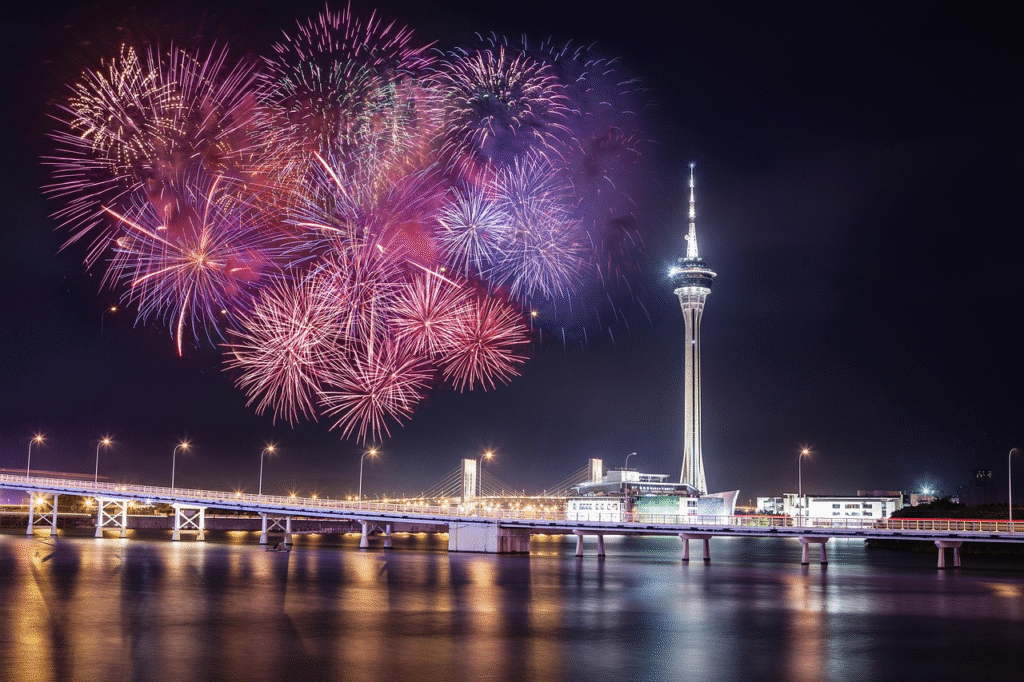
Macau is what happens when 400 years of Portuguese colonial rule meets the Pearl River Delta and 21st-century Chinese gambling money. The Special Administrative Region — 30 square kilometers of land, smaller than the city of Manhattan — squeezes UNESCO World Heritage Portuguese baroque, working Chinese temples, the largest casino industry on the planet, and one of Asia’s most distinctive food scenes into a single, walkable enclave 50 km west of Hong Kong. The historic center looks like Lisbon transplanted to the South China Sea; the Cotai Strip looks like Las Vegas reimagined with Chinese ambition. Both are real, both are within a 20-minute taxi ride of each other, and both reward a few unhurried days. This guide covers what works on the ground today: which neighborhoods are worth your hours, the cuisine you can’t find anywhere else, and how to navigate a city defined by the unlikely overlap of its two parents.
Macau at a Glance: Essential Facts for Travelers
| Official Name | Macao Special Administrative Region of the People’s Republic of China |
|---|---|
| Location | Pearl River Delta, South China Sea, 50km west of Hong Kong |
| Coordinates | 22°12′N 113°33′E |
| Population | ~650,000 (2017: 622,567) |
| Area | 30.5 square kilometers |
| Population Density | Over 21,000 people per km² |
| Highest Point | Alto de Coloane (172.5 meters) |
| Time Zone | UTC+8 (China Standard Time) |
| Calling Code | +853 |
| Currency | Macanese Pataca (MOP) |
| Official Languages | Chinese (Cantonese) and Portuguese |
| Internet Domains | .mo, .澳門, .澳门 |
| ISO Codes | MO, MAC, 446 |
| Known For | Casinos, Portuguese egg tarts, UNESCO Historic Center, Grand Prix |
| Current Leadership | Chief Executive under China’s “One Country, Two Systems” |
| GDP (2016) | $44.11 billion total, $67,079 per capita (4th highest globally) |
| Life Expectancy | 84.5 years (2nd highest globally) |
Upcoming Events in Macau
| Date | Title | Details |
|---|---|---|
| 2026-09-05 to 2026-10-01 | Macau International Fireworks Display Contest | One of Macau’s signature annual events, the International Fireworks Display Contest lights up the night sky over the Outer Harbour and Macau Tower on several Saturdays in September, culminating around China’s National Day on October 1. Competing teams from around the world stage dazzling pyrotechnic shows choreographed to music, judged over the weeks of the contest. Crowds gather free of charge along the waterfront promenades and at Nam Van Lake for the best views. It is a spectacular, family-friendly highlight of the calendar. [Source] |
| 2026-09-15 to 2026-09-27 | 2026 Youth Fashion and Creative Works Exhibition | The 2026 Youth Fashion and Creative Works Exhibition runs from 15 to 27 September at the Pavilion of Exhibitions and Artistic Shows for Young People in Tap Seac. Organised by the Macau Productivity and Technology Transfer Center with support from the education bureau, it showcases nearly 200 works from 26 training courses, spanning fashion designs, jewellery, AI-generated 2D animation, computer animation and 3D interior design. The show opens at 6:30pm on 15 September and is viewable daily from noon to 8pm; admission is free, ideal for families and design fans. [Source] |
| 2026-09-25 to 2026-09-27 | Mid-Autumn Festival in Macau | The Mid-Autumn Festival, one of the most important dates on the Chinese calendar, transforms Macau in late September with glowing lantern displays, family reunions and the sharing of mooncakes. Neighbourhoods, temples and squares are decorated with colourful lanterns, and the historic centre takes on a festive glow as residents gather to admire the full moon. Visitors can sample traditional and modern mooncakes from local bakeries and enjoy special events across the city. The celebrations are free to enjoy and deeply atmospheric. [Source] |
| 2026-10-03 to 2026-10-31 | Macao International Music Festival | The Macao International Music Festival, organised by the Cultural Affairs Bureau, brings a season of world-class concerts to venues across the city each autumn, including the Macao Cultural Centre and historic churches and theatres. The programme spans symphonic works, opera, chamber music, jazz and cross-cultural collaborations, featuring international orchestras and soloists alongside local talent. Ticket prices vary by performance, with some events free. Reflecting Macau’s blend of Chinese and Portuguese heritage, it is a cultural highlight for classical-music lovers. [Source] |
| 2026-10-15 to 2026-10-18 | MIF – Macao International Trade and Investment Fair | The Macao International Trade and Investment Fair, known as MIF, is one of the region’s leading business expos, held each October at the Cotai Expo inside The Venetian Macao. It gathers exhibitors, investors and delegations from mainland China, Portuguese-speaking countries and beyond to showcase products, forge partnerships and explore opportunities across sectors from finance to tourism. Alongside the exhibition floor are forums, matchmaking sessions and conventions. Largely aimed at trade visitors, it highlights Macau’s role as a business bridge between China and the world. [Source] |
| 2026-10-16 to 2026-10-18 | Lusofonia Festival | The Lusofonia Festival celebrates the culture of Portuguese-speaking communities, a legacy of Macau’s centuries as a Portuguese trading port. Held over a weekend in October, usually around the Taipa Houses and Carmo Fair area, it features food stalls, music, dance and craft from countries such as Portugal, Brazil, Cape Verde, Angola and Mozambique. Families come to sample Lusophone cuisine, watch performances and browse market stalls. Entry is free, making it a lively, flavour-filled window onto Macau’s unique multicultural identity. [Source] |
City News in Macau – last 14 days
| Date | Category | Headline | Details |
|---|---|---|---|
| 2026-09-14 | Business | City tops 30 million visitors 22 days earlier than last year | Macau has passed 30 million visitor arrivals this year, hitting the milestone 22 days earlier than in 2025, according to the Public Security Police. Arrivals have averaged 119,000 a day, up 8 percent year on year, with a single-day record of 247,000 set on 2 May. Ahead of the Mid-Autumn Festival and National Day holidays, police say they will fine-tune border arrangements, reinforcing coordination with Macau Customs, the Zhuhai border inspection station and Hong Kong’s Immigration Department. The airport is also reporting steady growth. [Source] |
| 2026-09-14 | Local government | Education hub and culture district top priorities in new Five-Year Plan | Secretary for Social Affairs and Culture O Lam says Macau will focus on building a cross-border higher-education hub in neighbouring Hengqin and developing an integrated tourism and culture district under the newly released Third Five-Year Plan covering 2026 to 2030. Speaking to representatives of more than 30 community organisations at the China-Portuguese-speaking countries trade platform complex, she said the government would translate the plan into practical policies aimed at improving residents’ well-being while diversifying the economy beyond gaming. [Source] |
| 2026-09-14 | Local government | Hengqin government service station opens with 58 cross-border services | The Macao Government Service Station in the Guangdong-Macao In-Depth Cooperation Zone begins operating on Wednesday, on the second floor of the zone’s Administrative Service Center. Staffed initially by representatives of four Macau departments covering identification, economic development, finance and pharmaceutical administration, it offers 58 services spanning identity verification, trademarks, taxation, pharmaceuticals and financial matters, including help with loan approvals. The station complements 477 online services from 35 Macau departments, creating a joined-up online and offline system for residents and businesses in Hengqin. [Source] |
| 2026-09-14 | Public safety | Door-to-door mosquito campaign launched as ovitrap index hits 64 percent | Health officials are visiting 30,000 households to warn residents about mosquito risks after the city’s ovitrap index reached 63.9 percent in August, a level signalling elevated risk of mosquito-borne disease transmission. The Health Bureau’s citywide operation to eliminate stagnant water runs twice a year and has been extended to new priority areas, focusing on districts with high mosquito indices, dense populations, many elderly residents and concentrations of low-rise buildings. Intelligent bio-mosquito traps acquired from the mainland are also being tested at hospitals and other sites. [Source] |
| 2026-09-14 | Public safety | Police probe MPay accounts allegedly drained by phone numbers’ previous holders | Members of the public report that funds in their children’s MPay e-wallet accounts appear to have been transferred by the previous holders of their recycled phone numbers, and cases have been reported to police. The Monetary Authority of Macao says its preliminary understanding is that the matter may involve a dispute over account ownership, with the Judiciary Police following up and the financial institution cooperating. The episode highlights the risks of tying e-wallet access to mobile numbers that are later reassigned to new users. [Source] |
| 2026-09-14 | Local affairs | Tourism office seals 46 ZAPE flats in illegal accommodation crackdown | The Macao Government Tourism Office has sealed 46 of 134 units reported in the ZAPE district this year as suspected illegal tourist accommodation, following a resident’s complaint aired on public broadcaster TDM. Between January and August, authorities carried out 216 interdepartmental joint operations and 360 inspections, sealing 166 suspected illegal lodging units citywide. The resident said she had reported her building twice without resolution for months, prompting the office to disclose its enforcement figures and pledge continued action against unlicensed operators. [Source] |
| 2026-09-14 | Local affairs | Temporary car park planned for Nam Van Lake Plot C9 by December | The Public Works Bureau will build a temporary car park on Nam Van Lake Plot C9, with completion expected by December, as part of this year’s policy of putting idle land to temporary use. The roughly 3,000-square-metre plot should provide about 100 motorcycle spaces and more than 90 light-vehicle spaces, including accessible bays and electric-vehicle charging facilities. The design-build contract has been awarded for 5.688 million patacas, according to the bureau, adding parking supply near the lakeside while long-term plans for the site are decided. [Source] |
| 2026-09-14 | Culture | Nearly 200 works by local teens go on show at Tap Seac | The 2026 Youth Fashion and Creative Works Exhibition opens on 15 September at the Pavilion of Exhibitions and Artistic Shows for Young People in Tap Seac, running until 27 September. Organised by the Macau Productivity and Technology Transfer Center with support from the Education and Youth Development Bureau, the free exhibition gathers nearly 200 works produced in 26 courses, from fashion and jewellery designs to AI-generated 2D animation, computer animation and 3D interior design. Daily viewing hours run from noon to 8pm. [Source] |
| 2026-09-14 | Culture | Fireworks contest wows crowds with synchronised drone shows | Travel industry press reports that this year’s Macao International Fireworks Display Contest is dazzling spectators by pairing its pyrotechnic displays over the Outer Harbour with synchronised drone shows. The competition, one of the city’s signature annual events, continues on Saturdays through early October, with teams from around the world choreographing displays to music. The addition of drone formations reflects a broader trend in large-scale public spectacles, and the free waterfront viewing keeps the contest one of Macau’s most popular family evenings. [Source] |
| 2026-09-14 | Sports | Record turnout as more than 1,000 seniors join Sports Day at Tap Seac | The 2026 Macao Seniors’ Sports Day drew more than a thousand participants to the Tap Seac Multisport Pavilion on Sunday morning, the highest turnout in the event’s history. Co-organised by the Sports Bureau and the Macau Elderly Sports Association, the morning featured prize-winning recreational and physical activities designed around the health needs of older people. Officials say the initiative aims to encourage seniors to stay active, with regular exercise linked to better mobility and wellbeing in the city’s rapidly ageing population. [Source] |
| 2026-09-14 | Sports | Harimoto and Moregard take titles at WTT Champions Macao | Japan’s Tomokazu Harimoto and Sweden’s Truls Moregard were crowned champions at the WTT Champions Macao table tennis tournament, which wrapped up in the city. The elite event brought many of the world’s top-ranked players to Macau, continuing the territory’s run as a regular host on the World Table Tennis calendar. Strong crowds followed the week’s matches, and the finals capped a run of international sporting fixtures that bolster Macau’s push to position itself as a City of Sports Events. [Source] |
| 2026-09-14 | Business | Gaming commissions and rebates climbed 12 percent in 2025 | Casino operators’ spending on gaming commissions, customer rebates and cost of goods rose 12 percent in 2025 and accounted for 26 percent of the industry’s total expenses, according to figures reported by trade outlet GGRAsia. The data points to intensifying competition for premium players as concessionaires court high-value customers with rebates and reinvestment. Expense discipline remains a key theme for investors watching Macau’s six operators balance market-share battles against margins while also funding their required non-gaming investment commitments. [Source] |
| 2026-09-09 | Business | City spends 16 billion dollars on push beyond gaming, Fortune reports | Fortune magazine reports that Macau is spending 16 billion US dollars to reinvent itself as a business and events destination rather than a pure gaming hub. The investment wave spans convention facilities, entertainment arenas, and the non-gaming commitments the six casino concessionaires accepted when their licences were renewed. The strategy aims to diversify an economy long dominated by baccarat revenue, drawing corporate travellers, exhibitions and international entertainment. Analysts note the shift mirrors Las Vegas’s earlier evolution toward conventions and shows. [Source] |
Macau Events & City News Archive
Sources: Macao Government Tourism Office, Macau Daily Times, Instituto Cultural, The Venetian Macao, Macau Daily Times, Macau Daily Times, Macau Daily Times, Macau Daily Times
Weather Forecast for the Next 14 Days in Macau
| Date | Weather | Max °F | Min °F | Rain mm |
|---|---|---|---|---|
| 2026-09-14 | 🌧️ | 83.7 °F | 76.8 °F | 4.3 mm |
| 2026-09-15 | ⛈️ | 85.1 °F | 75.9 °F | 11.0 mm |
| 2026-09-16 | 🌧️ | 85.2 °F | 76.9 °F | 2.5 mm |
| 2026-09-17 | ☁️ | 84.7 °F | 78.8 °F | 0.0 mm |
| 2026-09-18 | ⛅ | 86.1 °F | 78.6 °F | 0.0 mm |
| 2026-09-19 | ☀️ | 86.1 °F | 77.8 °F | 0.0 mm |
| 2026-09-20 | 🌧️ | 87.9 °F | 78.1 °F | 1.5 mm |
| 2026-09-21 | 🌧️ | 86.9 °F | 75.9 °F | 5.7 mm |
| 2026-09-22 | 🌧️ | 85.9 °F | 77.5 °F | 7.8 mm |
| 2026-09-23 | 🌧️ | 85.4 °F | 78.4 °F | 2.4 mm |
| 2026-09-24 | 🌧️ | 84.9 °F | 79.0 °F | 1.5 mm |
| 2026-09-25 | 🌧️ | 82.4 °F | 78.0 °F | 6.9 mm |
| 2026-09-26 | 🌧️ | 82.9 °F | 79.3 °F | 0.6 mm |
| 2026-09-27 | 🌧️ | 84.8 °F | 79.2 °F | 1.8 mm |
Macau’s History
Macau is the only place on earth where Portuguese baroque churches and Chinese sea-goddess temples have been working neighbors for 400 years. The compressed history that produced this overlap — Ming-dynasty fishing village, Iberian colonial capital, Asian commercial pivot, post-1999 gaming megacity — is what makes the territory unlike anywhere else.
Ancient Foundations and Chinese Settlement
Archaeological evidence on Coloane Island puts continuous human activity in the Macau area back 3,500 to 4,000 years. During the Qin Dynasty (221–206 BCE), the area fell under the jurisdiction of Guangdong’s Panyu County. Chinese settlers established communities here during the Han Dynasty (2nd century BCE to 2nd century CE), turning Macau into a vital stopover for merchant ships moving between Southeast Asia and Guangzhou. By the Song Dynasty (960–1279 CE), Macau was officially incorporated into Xiangshan County. A significant population surge came in 1277 when about 50,000 refugees fled to Macau’s coastal areas during the Mongol invasion of southern China. The neighborhood of Mong Há became the heart of the Chinese settlement, anchored by what may be Macau’s oldest temple — a shrine dedicated to Guanyin, the Buddhist Goddess of Mercy. During the Ming Dynasty (1368–1644 CE), fishermen from Guangdong and Fujian migrated to the area and built the iconic A-Ma Temple, where they prayed for safe voyages. The temple gave Macau its name — derived from “A-Ma-Gau,” Bay of A-Ma.
Portuguese Arrival and Colonial Era
The mid-16th century changed everything. Portuguese traders arrived in 1513 and gradually consolidated their position; by 1557 Portugal had established Macau as its primary gateway to East Asia. The result was a uniquely lucrative maritime route linking Goa, Cochin, Malacca, Macau, and Japan, with the city thriving as the crossroads where silk, spices, porcelain, and Japanese silver changed hands. The Napoleonic Wars brought economic disruption — Britain pressured Portugal to open its ports, causing turmoil in both Macau and Goa. The city pivoted to opium and tea trade, though Hong Kong’s rise after 1844 quickly overshadowed it. In 1845, Portugal declared Macau a free port; by the 1870s, the territory had reinvented itself as a major departure point for Chinese laborers heading overseas. At the peak of that wave, up to a quarter of all Chinese emigrants sailed through Macau. After decades of legal disputes, China formally recognized Portuguese control in 1887.
Modern Era and Return to China
Macau played an outsized role in modern Chinese history when revolutionary leader Sun Yat-sen spent time here in 1892, using the city as a base for what would become the 1911 revolution. During World War II, Portugal’s neutrality made Macau one of East Asia’s only safe havens for refugees from across the region. Negotiations for the territory’s return to China began as early as 1928 but were delayed by wars and political shifts. Inspired by Hong Kong’s “One Country, Two Systems” model, Portugal and China finally reached agreement in 1987. On December 20, 1999, Macau officially became a Special Administrative Region of China — President Jiang Zemin called it “the final chapter of Western colonialism in Asia.” The “One Country, Two Systems” framework runs until at least 2049, preserving the unique Portuguese-Chinese blend that defines the territory.
Geography, Climate & Best Time to Visit Macau
Geographic Overview
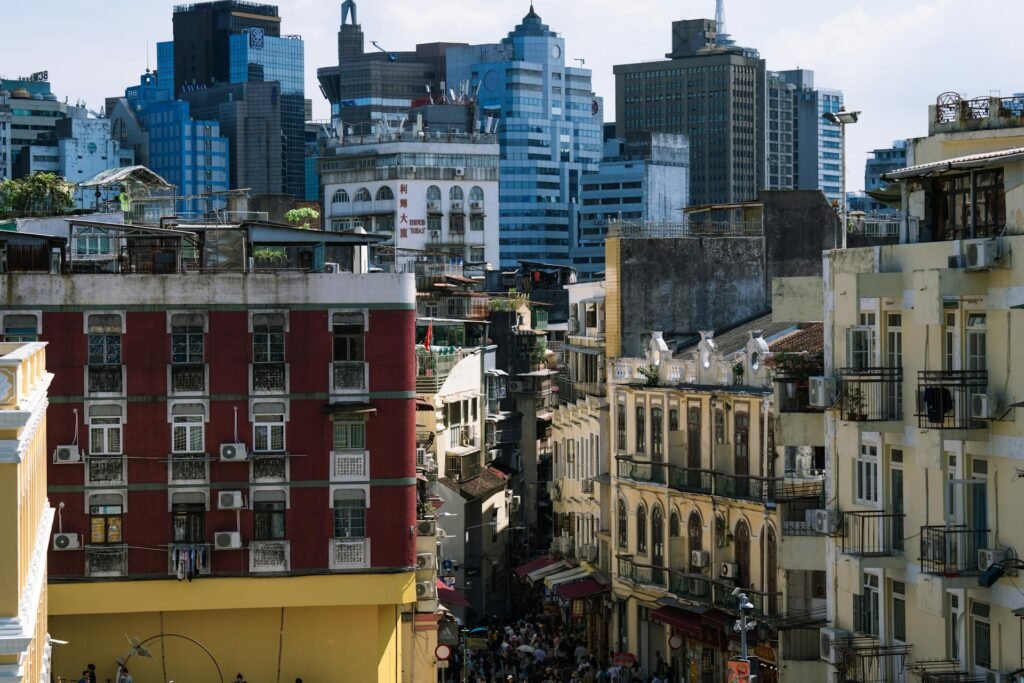
Macau is the Macau Peninsula plus two former islands (Taipa and Coloane), now connected by bridges and aggressive land reclamation projects — what was three separate islands in the Portuguese era is now an interconnected urban landscape, with the Cotai Strip occupying reclaimed land that didn’t exist before 2003. The territory features rolling granite hills surrounded by flat cityscape, with Alto de Coloane as the highest point at 172.5 meters. Macau sits in the Pearl River Delta, with sleek bridges connecting the peninsula to mainland China and now (since 2018) to Hong Kong via the world’s longest sea-crossing bridge.
Climate and Weather Patterns
Macau enjoys a subtropical monsoon climate — warm, humid summers and mild, dry winters. Summer (June–August) brings frequent heavy rainfall (over 300mm in May, June, and August), winter (December–February) is dry and mild around 17–18°C. The most photogenic and most visit-friendly months are November and March.
| Month | Avg. High (°C) | Avg. Low (°C) | Rainfall (mm) | Sunshine Hours |
|---|---|---|---|---|
| January | 17.5 | 11.9 | 30.2 | 2.8 |
| February | 17.5 | 12.8 | 53.2 | 2.8 |
| March | 20.4 | 15.9 | 77.6 | 3.2 |
| April | 24.2 | 19.9 | 196.0 | 4.1 |
| May | 28.2 | 23.7 | 347.4 | 5.8 |
| June | 30.1 | 25.5 | 350.8 | 6.8 |
| July | 31.5 | 26.3 | 251.9 | 8.0 |
| August | 31.2 | 25.9 | 327.7 | 7.2 |
| September | 30.0 | 24.8 | 194.1 | 6.5 |
| October | 27.2 | 22.2 | 102.8 | 6.0 |
| November | 24.6 | 17.8 | 43.1 | 4.7 |
| December | 20.4 | 13.4 | 35.2 | 3.8 |
| Annual Average | 25.3 | 20.0 | — | 5.4 |
Best Time to Visit
Spring (March–April) and autumn (October–November) are the sweet spots — temperatures in the low-to-mid 20s°C and significantly lighter rainfall. Summer (June–August) is hot, very humid, and prone to typhoons; the upside is that the casino and shopping resorts are perfectly engineered for indoor weather. Winter (December–February) is mild around 17–18°C with minimal rain — ideal for outdoor heritage walking, but cooler than the typical East Asian winter expectation. Annual humidity averages 79.6%, with summer months pushing 82–87% and winter dropping to a more comfortable 69–70%.
Macau’s Districts and Neighborhoods
Macau’s compactness — barely 30 km² — masks real neighborhood diversity. Where you stay shapes the trip; the difference between staying in the historic peninsula and on the Cotai Strip is the difference between two essentially separate cities a 20-minute taxi apart.
Macau Peninsula Districts
Nossa Senhora de Fátima serves as the northern gateway and the closest hotel cluster to the mainland China border crossing — budget-friendly, useful for travelers prioritizing transit access over historic charm. Santo António houses the Ruins of St. Paul’s and represents the heart of Macau’s UNESCO-listed historic center; boutique hotels and guesthouses sit within walking distance of the headline sights. São Lazaro is the artsy and eclectic neighborhood, with creative spaces, galleries, and trendy cafés — bohemian by Macau standards while remaining close to historic sites. São Lourenço offers historic waterfront charm with colonial architecture and harbor views; mid-range hotels with character. Sé is the central business district with shopping, energy, and the widest range of accommodation from budget to luxury.
Island Areas
Nossa Senhora do Carmo (Taipa) is the cultural hub of Taipa Island — Taipa Village’s pastel-colored colonial buildings and excellent restaurants make this the secret-favorite neighborhood for repeat visitors. São Francisco Xavier (Coloane) offers tranquil villages, a more relaxed pace, and the original Portuguese egg tart bakery (Lord Stow’s), making it the choice for travelers who want quiet beach-resort vibes away from the casinos. Cotai Strip is Macau’s modern face — mega-resorts like The Venetian, Galaxy, Wynn Palace, and the Parisian on entirely reclaimed land. World-class accommodations, shopping, and entertainment, ideal for the full integrated-resort experience.
Top Things to Do in Macau
Historic Landmarks and UNESCO Sites
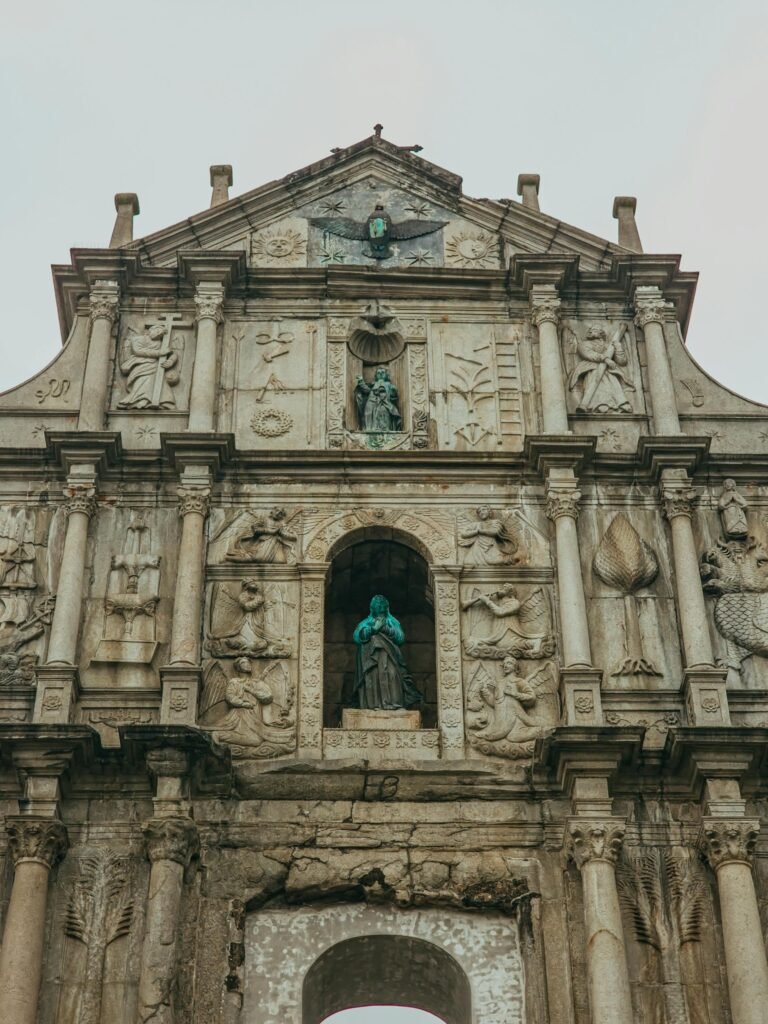
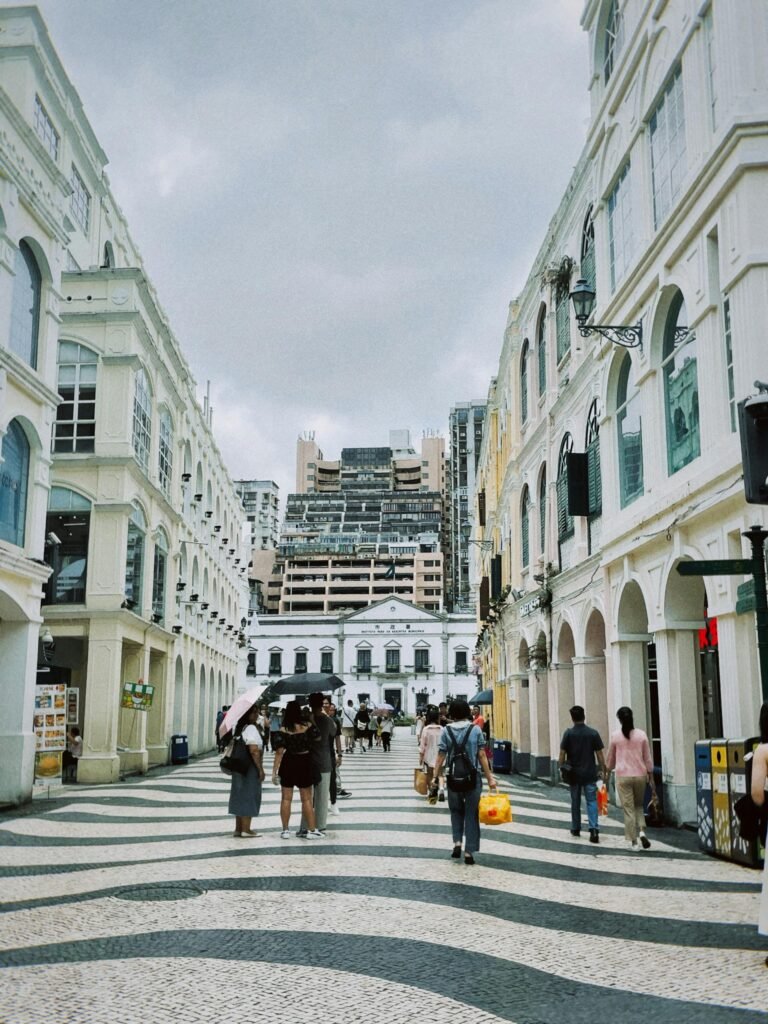
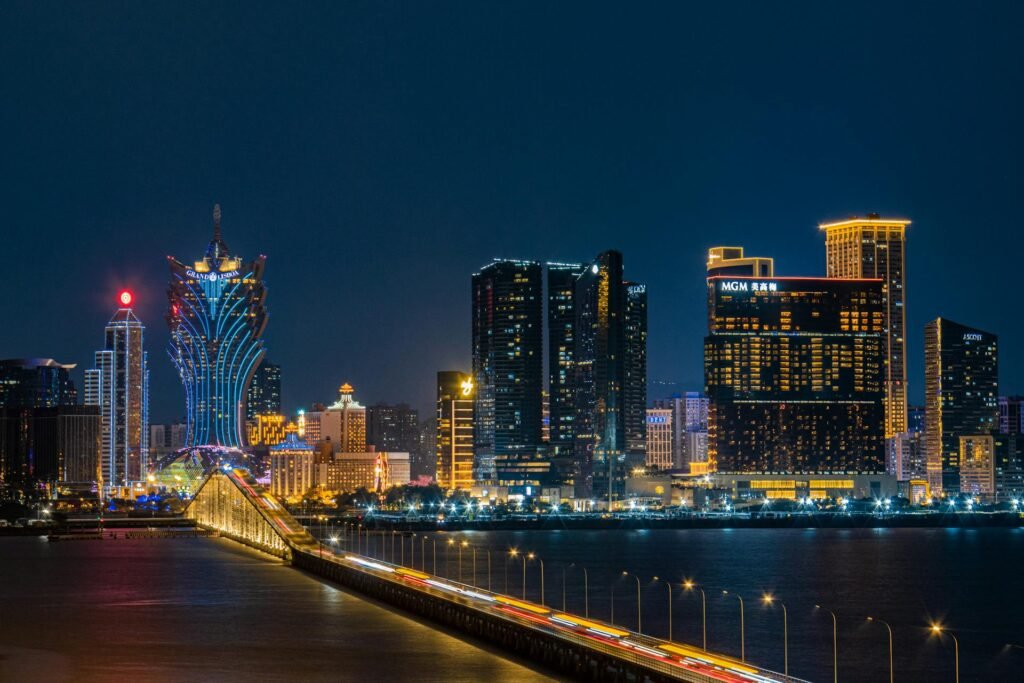
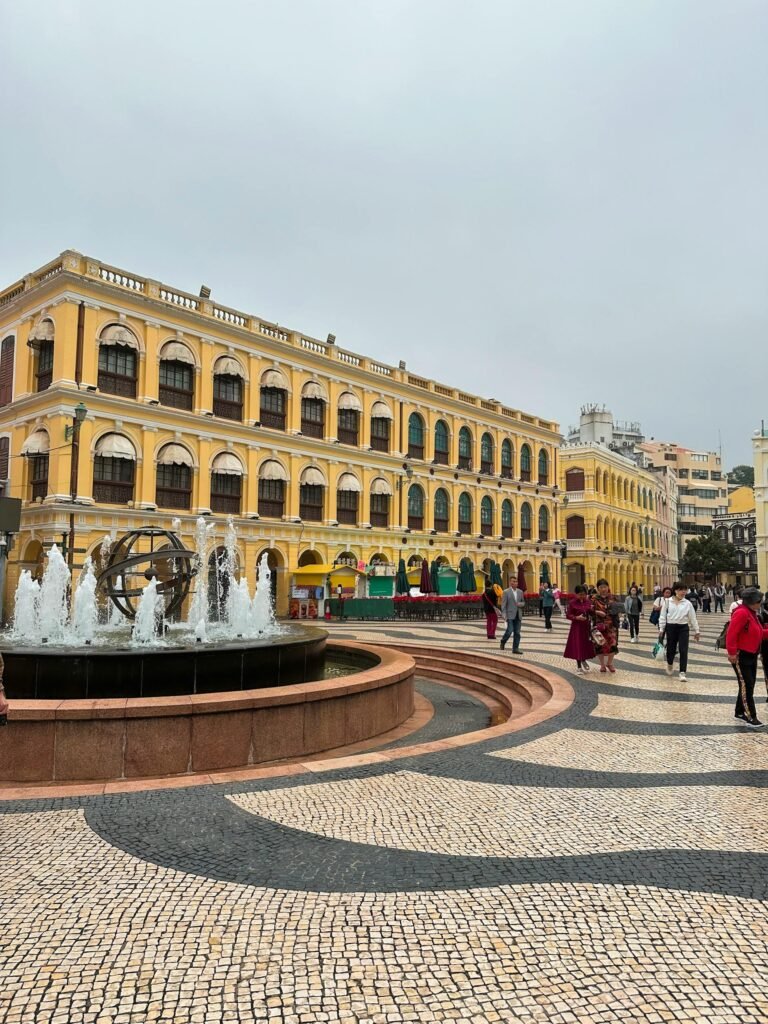
The Ruins of St. Paul’s stand as Macau’s most photographed landmark — a 17th-century church facade that survived fires and typhoons to become the city’s symbol. The intricate stone carvings blend European Christian iconography with Asian artistic elements (look for the Chinese characters and a chrysanthemum motif), embodying Macau’s defining cultural fusion. The A-Ma Temple, dedicated to the sea goddess Mazu, is one of Macau’s oldest religious sites and the temple that gave the territory its name. Senado Square serves as the heart of Macau’s Historic Center, with distinctive Portuguese-style wave-patterned mosaic pavements (calçada portuguesa) and pastel-colored colonial buildings. The Macau Museum in the historic Monte Fort offers comprehensive insight into the territory’s 400-year story of cultural exchange.
Modern Attractions and Entertainment
The Macau Tower rises 338 meters above the city, with panoramic observation decks, restaurants, and the world’s highest commercial bungee jump (233 meters — operated by AJ Hackett, Guinness-certified). The Venetian Macao recreates Venice with indoor canals, gondola rides, and a vast luxury-shopping arcade — one of the world’s largest casino resorts and best understood as a destination in itself. Galaxy Macau features over 2,200 hotel rooms, 50+ restaurants, an artificial beach, and a wave pool. Wynn Palace on Cotai is known for its lakeside gondola and a particularly serious gourmet dining scene.
Cultural Experiences
Taipa Village preserves traditional Macanese culture in narrow streets lined with colonial architecture and authentic Macanese restaurants — the unique Portuguese-Chinese-African-Indian fusion cuisine you can’t find anywhere else. Coloane Village offers a glimpse of old Macau with its fishing-village atmosphere; the original Lord Stow’s Bakery still operates here, the birthplace of the iconic Portuguese-Macanese egg tart. The Macau Grand Prix Museum (renovated 2021) showcases the territory’s motorsport heritage and the legendary Guia Circuit that has hosted racing since 1954.
How to Get to Macau
By Air
Macau International Airport (MFM) has been the territory’s aviation gateway since 1995. Flights connect Macau to most major Asian cities — Bangkok, Beijing, Shanghai, Manila, Tokyo, Kuala Lumpur, Singapore — plus a few European destinations via Air Macau and visiting carriers. The airport is small, efficient, and a 15-minute taxi ride from Cotai or 25 minutes from the historic peninsula.
By Sea
For most international visitors arriving via Hong Kong, ferries are the standard route. TurboJET operates roughly 150 daily trips between Macau and Hong Kong, with the journey taking about one hour. Routes connect to Hong Kong International Airport (skip-the-Hong-Kong-immigration “in-transit” service for connecting flights), Central, Kowloon, and other points. Additional ferry routes serve Shekou (Shenzhen) for travelers from mainland China.
By Land
The Hong Kong-Zhuhai-Macau Bridge, the world’s longest sea-crossing bridge at 55 km, opened in 2018 and revolutionized land travel. Private cars require special permits but cross-border buses operate continuously between Hong Kong, Macau, and Zhuhai. Direct bus services also connect Macau to Shekou (Shenzhen), Gongbei (Zhuhai), Shenzhen Airport, and Guangzhou.
By Helicopter
Helicopter services run between Macau and Hong Kong (about 15 minutes) or Shenzhen — a distinctly luxurious arrival option with spectacular Pearl River Delta views.
Getting Around Macau
Public Transportation
The Macao Light Rapid Transit (LRT) opened in 2019 — driverless, modern, air-conditioned trains connecting Taipa, Cotai, and (since 2023) the Macau Peninsula. The single Taipa Line is the system’s spine, with extensions to the peninsula now operational. Macau’s bus system offers comprehensive coverage with comfortable, air-conditioned vehicles connecting all districts and major attractions; routes to border crossings and the airport make it the cheapest way to move around.
Casino courtesy buses are the secret weapon of getting around Macau — every major casino runs free shuttles between border crossings, the airport, the ferry terminal, and their resorts. You don’t need to be a hotel guest; the buses are open to anyone.
Taxis and Ride Services
Taxis are readily available, though traffic can be heavy in popular areas. Most drivers speak Cantonese and basic English; having destinations written in Chinese characters is helpful. Uber does not operate in Macau — the local equivalents are Macau Taxi and the official MOPay-integrated services.
Walking
Macau’s compact size makes walking the best option for the historic peninsula — the major attractions cluster within easy walking distance of each other, and the Portuguese-mosaic pavements are pedestrian-priority by design. Cotai is too spread-out for walking; rely on courtesy buses there.
Driving Considerations
Unlike mainland China, Macau follows left-hand traffic rules due to its Portuguese heritage — a Hong Kong-style legacy that catches mainland Chinese drivers off guard. Rental cars are available but unnecessary given the territory’s size and excellent public transport.
Food & Drink in Macau
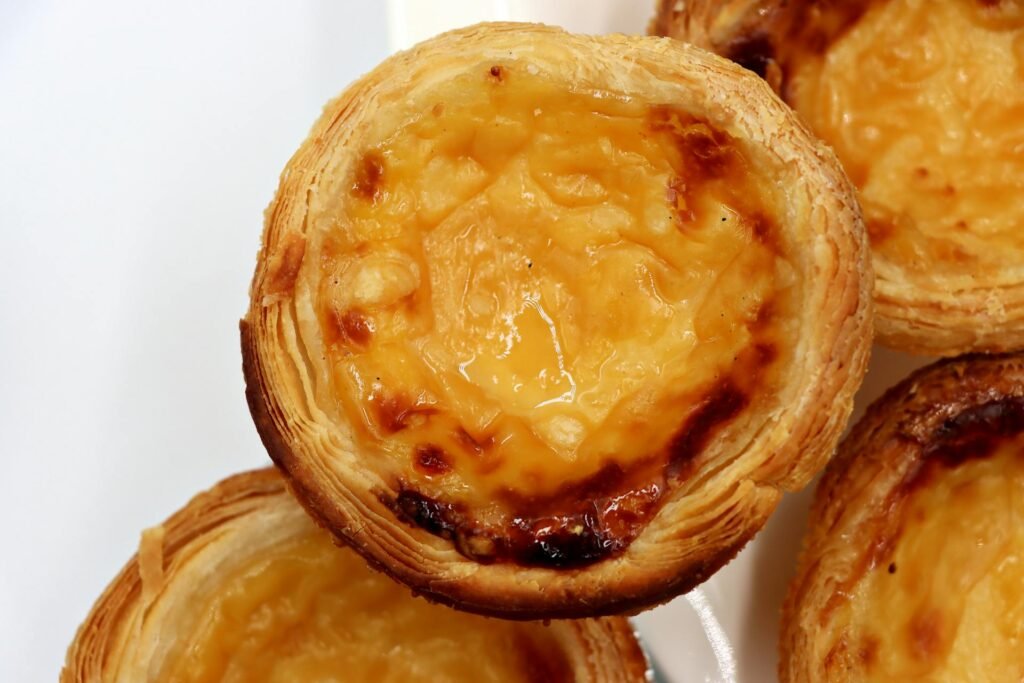
Macau’s culinary scene represents one of the world’s most successful fusion cuisines — Portuguese, Chinese, African, Indian, and Southeast Asian influences blended over four centuries of cultural exchange. The cuisine is genuinely unique: there’s nothing else like authentic Macanese food anywhere on earth.
Signature Macanese Dishes
Portuguese Egg Tarts (Pastéis de Nata) are Macau’s most famous culinary export — flaky pastry shells filled with rich custard, best eaten warm. The original Lord Stow’s Bakery in Coloane still operates and is considered the canonical version. African Chicken showcases Macanese fusion at its finest — chicken marinated in coconut, peanut, and spice-based sauce, reflecting Portuguese colonial connections to Africa and Asia. Minchi is the Macanese comfort food: minced meat (usually pork or beef) stir-fried with diced potatoes, onions, and soy sauce, traditionally topped with a fried egg. Serradura is the canonical dessert — layered whipped cream and crushed Marie-biscuit “sawdust” — simple, beloved, and served at virtually every traditional Macanese restaurant.
Dining Experiences
Traditional Cha Chaan Tengs (Hong Kong-style tea restaurants) serve local favorites in casual, popular-with-locals settings. Portuguese restaurants in areas like Taipa Village maintain authentic Iberian traditions while incorporating local ingredients — A Petisqueira and Antonio’s are the established names. Dim sum culture thrives in Macau’s Cantonese restaurants — Lung Wah Tea House (since 1962) is the best old-school experience. The Cotai Strip resort restaurants have quietly become some of Asia’s most ambitious fine-dining destinations: Robuchon au Dôme at Grand Lisboa Palace, Wing Lei at Wynn, and Jade Dragon at City of Dreams hold multiple Michelin stars among them.
Beverages
Portuguese wine culture remains strong in Macau, with most restaurants offering excellent Vinho Verde, Douro, and Alentejo selections at fair prices. Chinese tea culture also flourishes — traditional tea houses like Long Wa serve various varieties alongside dim sum and local pastries.
Culture & Arts in Macau
Macau’s cultural landscape reflects its position as a bridge between civilizations, with artistic expression that draws fluently from both Eastern and Western traditions.
Festivals and Celebrations
Chinese New Year transforms Macau with lion dances, dragon parades, lantern displays, and street celebrations that blend traditional Chinese customs with Macanese elements. Macau Arts Festival presents an annual showcase of international theater, music, dance, and visual arts. Dragon Boat Festival (Tun Ng) features colorful racing competitions on Macau’s waterways. The International Fireworks Display Contest (every September) lights the city’s skyline with pyrotechnic displays from international teams — one of Asia’s most photographed events. Macau Grand Prix Week in November turns the city’s streets into one of the world’s most challenging racing circuits.
Museums and Galleries
The Macau Museum of Art houses Chinese and Western art collections with particular emphasis on works that reflect Macau’s cultural fusion. The Maritime Museum explores the territory’s seafaring heritage. The Taipa Houses Museum preserves traditional Macanese domestic architecture in beautifully restored colonial homes — a free, atmospheric afternoon visit.
Architecture
The Historic Center of Macao, designated UNESCO World Heritage in 2005, preserves over 20 historic locations that demonstrate the territory’s role in cultural exchange between East and West — Senado Square, the Ruins of St. Paul’s, A-Ma Temple, the Mandarin’s House, the Moorish Barracks, and the surrounding street network all fall within the protected zone.
Sports and Recreation in Macau
Macau Grand Prix
Since 1954, the Macau Grand Prix has transformed the territory’s streets into one of the world’s most challenging racing circuits. The Guia Circuit hosts annual competitions in November featuring motorcycles, touring cars, and Formula 3 single-seaters — many F1 careers (Ayrton Senna, Michael Schumacher, Lewis Hamilton) include a Macau F3 win on the way up.
Horse Racing
The Macau Jockey Club, operating since 1989, hosts horse racing with capacity for 15,000 spectators. Legal betting adds to the atmosphere — racing days are popular with both locals and visiting bettors.
Adventure Sports
The Macau Tower bungee jump at 233 meters is the world’s highest commercial bungee jump (Guinness-certified, operated by AJ Hackett). The same tower also offers a Skywalk (outside-the-tower walk on a platform without handrails) and a Tower Climb — adventure activities with spectacular city views built in.
Water Activities
Coloane’s beaches — Hac Sa (Black Sand Beach) and Cheoc Van — offer swimming and water sports. The territory’s coastal location supports sailing, kayaking, and casual fishing.
Macau by District: The 8 堂區
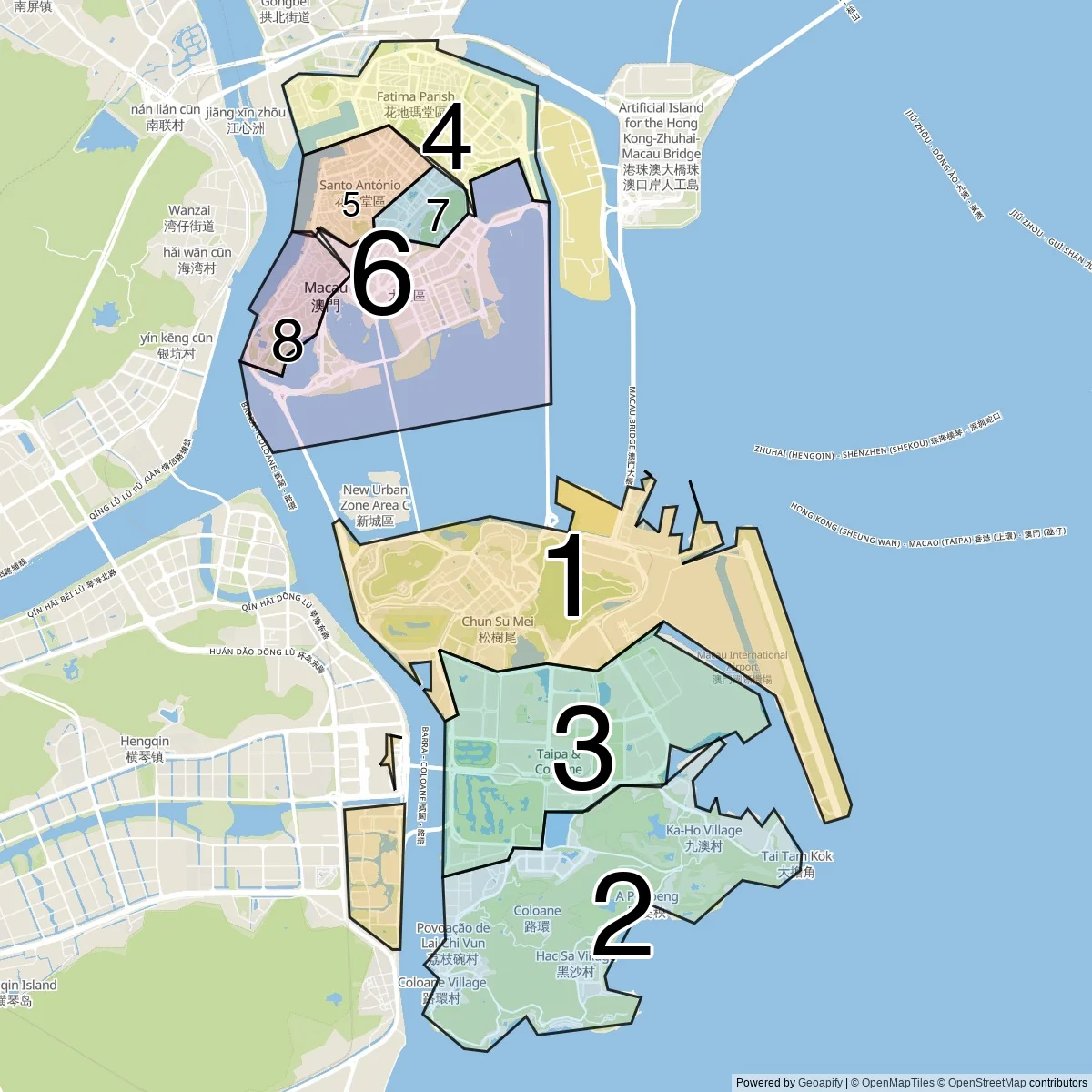
Macau is divided into 8 parishes. The map below shows their official OSM boundaries, colour-coded to match the table — a quick way to orient yourself before zooming in on individual sights.
| # | 堂區 |
|---|---|
| 1 | 嘉模堂區 Nossa Senhora do Carmo |
| 2 | 聖方濟各堂區 São Francisco Xavier |
| 3 | 路氹填海區 Zona do Aterro de Cotai · Cotai Landfill Zone |
| 4 | 花地瑪堂區 Nossa Senhora de Fátima |
| 5 | 花王堂區 Santo António · Santo António |
| 6 | 大堂區 Sé |
| 7 | 望德堂區 São Lázaro |
| 8 | 風順堂區 São Lourenço |
Frequently Asked Questions About Visiting Macau
Do I need a visa to visit Macau?
Many travelers don’t. Macau grants visa-free entry of 30 to 90 days to passport holders from over 60 countries — including the US, UK, EU member states, Canada, Australia, Japan, and most of Latin America. Citizens of mainland China need a separate Two-way Permit. Macau and Hong Kong have separate visa regimes — a visa-free Hong Kong entry doesn’t automatically extend to Macau, and vice versa, though arrival is straightforward at any of the territory’s checkpoints. Always verify the current eligibility list at the official Public Security Police Force of Macau or the Identification Services Bureau (DSI) portal before booking.
Is Macau safe for tourists?
Very. Macau consistently ranks among the safest places in Asia for visitors — violent crime is rare, the territory is heavily monitored (especially the casino zones), and the police presence is visible. The US State Department rates Macau at “exercise normal precautions” — its lowest advisory level. Standard precautions apply: pickpocketing in busy tourist areas (especially Senado Square and around the Ruins of St. Paul’s), watch your bag in casino crowds, and don’t leave valuables unattended at restaurants. Drug laws are extraordinarily strict — possession of even small amounts can carry serious consequences.
How many days do I need in Macau?
Two days is the comfortable minimum to do the headline sights without rushing; three is ideal if you want to explore the islands beyond the casino strip. A solid 2-day plan: Day 1 the historic peninsula — Ruins of St. Paul’s, Senado Square, A-Ma Temple, Macau Tower views, and a Macanese dinner in Taipa Village; Day 2 the Cotai Strip resorts (Venetian, Galaxy, Wynn Palace) plus Coloane Village for the original pastel de nata at Lord Stow’s Bakery. Stretch to three days if you want a relaxed pace, time on Coloane’s beaches, or proper casino-resort decompression. Macau is an easy weekend trip from Hong Kong (one-hour ferry); many visitors do it as a 1-day trip but really benefit from staying overnight.
What’s the best area to stay in Macau?
Depends on what you came for. The historic peninsula (Santo António, Sé) puts you walking-distance from the UNESCO sites — the obvious base for first-time visitors and culture-focused trips. The Cotai Strip (Sands Cotai Central, Venetian, Galaxy, Wynn Palace, Parisian) is the integrated-resort experience — beach club, multiple restaurants, casino, mall, and entertainment all under one roof; ideal if you want to hardly leave the property. Taipa Village is the secret-favorite of repeat visitors — pastel-colored colonial streets, atmospheric Macanese restaurants, boutique hotels, and a 5-minute taxi to either the historic center or Cotai. Coloane is the quietest option, with beach resorts and a slow village pace — best for trips combining Macau with downtime.
How much does it cost to visit the Ruins of St. Paul’s?
The Ruins of St. Paul’s facade itself is free to visit — it’s a public outdoor monument, accessible 24/7 from Senado Square via the pedestrian Rua de São Paulo. The adjacent Crypt and Museum of Sacred Art (housed in what remains of the church behind the facade) are also free, with displays of historical religious artifacts. Most of Macau’s UNESCO World Heritage sites in the historic center — Senado Square, A-Ma Temple, the Mandarin’s House, Moorish Barracks, the Lou Kau Mansion — are similarly free or charge nominal entry fees of MOP 5–20. Macau Tower observation deck is the major paid attraction in the heritage area at MOP 165. Check current pricing at the official Macau Government Tourism Office portal.
Should I drink the tap water in Macau?
Macau’s tap water meets WHO standards and is technically safe to drink at the source, but local norm — like in nearby Hong Kong — is bottled water. The CDC’s Macau travel health page advises bottled water for visitors as a precaution. The water itself is sourced from mainland China via the Pearl River Delta and is heavily treated, but old building plumbing can affect taste at the tap. Bottled water (Watson’s, Bonaqua, Vita) is sold everywhere at MOP 5–10 per liter at convenience stores. In hotels and major restaurants, water is generally safe; ice in fancier establishments is made from filtered water.
What language is spoken in Macau?
Cantonese is the primary spoken language (83% of residents), with Mandarin at 5% and growing. Portuguese remains an official language at 0.7% — bilingual Cantonese-Portuguese street signs across the city are one of the most visible legacies of the colonial era. English is widely understood in tourist areas, casinos, hotels, and major restaurants — about 21% of the population speaks it as a second language. You’ll get by easily in English at any tourist-facing business, including taxis and ferry counters. Knowing a few Cantonese words (“m̀hgōi” = thank you, “néih hóu” = hello) is appreciated but not required. Menu translations are standard at most restaurants.
Is tipping expected in Macau?
Less than in the US, similar to Hong Kong. Most restaurants and hotels add a 10% service charge automatically (check the bill — it’s usually labeled “service charge” or “加一”). When the service charge is included, additional tipping is optional — leave the small change or round up if service was excellent. Restaurants without service charge: 10% in cash for sit-down meals. Taxis: not expected; round up to the nearest MOP, or skip entirely. Hotel porters: MOP 10–20 per bag at upscale hotels. Spa, salon, hair: 10% if pleased with service. Casino dealers: tips are common when winning hands; chips of small denomination are the norm. Carry small notes (MOP 10s and 20s); the cashless culture is strong but tipping remains mostly cash.
Economy and Business in Macau
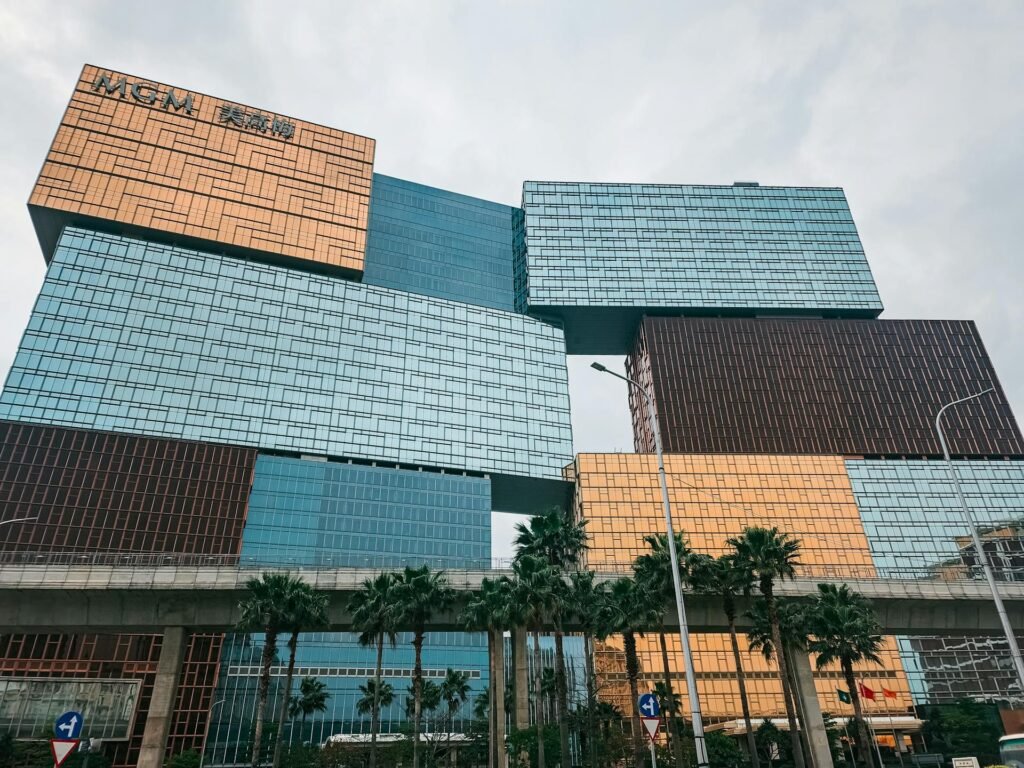
Macau is one of the world’s most prosperous places by per-capita income — 2016 GDP of $44.11 billion produced per capita income of $67,079, ranking fourth globally. The economic foundation is gaming, but the strategic position and unique administrative status produce wider opportunities.
Gaming Industry
The casino industry is Macau’s primary economic engine. After the 2002 end of the Stanley Ho gaming monopoly, international operators (Las Vegas Sands, Wynn Resorts, MGM, Galaxy, Melco, SJM) invested billions in integrated resorts — turning Macau into the world’s largest gambling destination by revenue, surpassing Las Vegas every year since 2006. The Cotai Strip alone houses mega-resorts like The Venetian Macao, Galaxy Macau, Wynn Palace, City of Dreams, and the Parisian, combining gaming with luxury hotels, shopping, dining, and live entertainment.
Tourism and Services
Tourism scaffolds the gaming economy and extends into cultural heritage, dining, shopping, and entertainment sectors. Macau welcomed over 29 million visitors in 2013 and has rebuilt steadily following the 2020–22 pandemic restrictions, with arrivals now back near pre-pandemic levels.
Traditional Industries
Manufacturing — textiles and fireworks especially — maintains a small but distinctive role. Macau’s unemployment rate (2% in 2017) reflects economic vitality and a tight labor market.
Financial Services
Macau’s status as a Special Administrative Region provides specific advantages for financial services and trade within the Greater Bay Area economic zone. The Greater Bay Area integration with Hong Kong, Shenzhen, Guangzhou, and the surrounding Pearl River Delta has been a major focus of Beijing’s regional planning since 2019.
Demographics and Diversity in Macau
Macau’s population grew from 196,000 in 1950 to over 622,000 by 2017, making it one of the world’s most densely populated territories at over 21,000 people per square kilometer. Despite the density, residents enjoy the second-highest life expectancy globally at 84.5 years.
Ethnic Composition
The population is predominantly Chinese (88.7% in 2016), with Portuguese heritage at 1.8% and other Asian backgrounds making up nearly 10%. The Filipino community has grown rapidly to 4.62%, reflecting Macau’s role as a regional employment hub. The historic Macanese community — mixed Chinese-Portuguese ancestry — is small in number but culturally significant, preserving unique traditions, cuisine, and the Macanese Creole language (Patuá).
Languages
Cantonese dominates as the primary spoken language (83.3%), while Mandarin has grown to 5% reflecting increased mainland connections. Portuguese remains an official language at 0.7% — bilingual Cantonese-Portuguese street signs across the city are one of the most visible legacies of the colonial era. English usage has doubled as a second language (21.1%) due to international business and tourism.
Religion
Buddhism represents the primary religious tradition (approximately 80%), including Tibetan Buddhist practices. Catholic (4%) and Protestant (1%) communities reflect Portuguese colonial influence, while 15% of residents embrace other beliefs or none.
Macau is a small territory with an outsize identity — Portuguese baroque churches, Chinese sea-goddess temples, the world’s largest casino industry, Macanese fusion cuisine, and a UNESCO-listed historic core all packed into 30 square kilometers. Whether the draw is the world-class gaming, the heritage architecture, the egg tarts, or the unique Portuguese-Chinese cultural overlap that exists nowhere else, Macau rewards visitors who give it more than the standard day-trip-from-Hong-Kong allotment.
AFRIKA
Cairo Hurghada Johannesburg Marrakech
ASIA
Abu Dhabi Agra Antalya Bangkok Batam Beijing Bengaluru Cebu City Chiang Mai Chiba Chennai Da Nang Dammam Delhi Denpasar Dubai Fukuoka Guangzhou Guilin Ha Long Hanoi Ho Chi Minh City Jakarta Jaipur Johor Bahru Kolkata Krabi Kuala Lumpur Kyoto Macau Mecca Medina Mugla Mumbai Osaka Pattaya Penang Phuket Riyadh Seoul Shanghai Shenzhen Singapore Taipei Tokyo Zhuhai
EUROPE
Amsterdam Athens Barcelona Berlin Brussels Budapest Copenhagen Dublin Florence Frankfurt am Main Heraklion Krakow Lisbon London Madrid Milan Munich Nice Paris Porto Prague Rhodes Rome Stockholm Venice Vienna Warsaw
NORTH AMERICA
Cancun Las Vegas Los Angeles Miami New York City Orlando San Francisco Toronto Vancouver
SOUTH AMERICA
Buenos Aires Lima Rio De Janeiro
OCEANIA
Auckland Honolulu Melbourne Sydney