
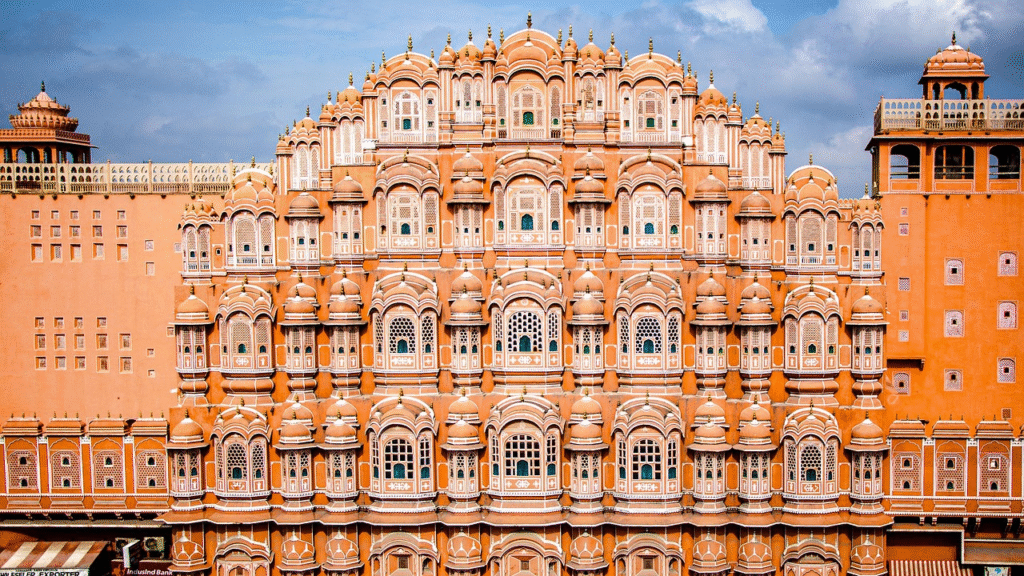
Photo credit: Hawa Mahal, the iconic Palace of Winds in Jaipur’s Old City
Welcome to Jaipur, Rajasthan’s rose-tinted capital where history comes alive in shades of pink and saffron. Known as the Pink City for its distinctive blush-colored architecture, this vibrant metropolis of 3.1 million people seamlessly blends royal heritage with modern energy. Founded in 1727 by the visionary Maharaja Sawai Jai Singh II using ancient principles from the Shilpa Shastra, Jaipur stands as one of India’s most meticulously planned cities and a UNESCO World Heritage Site.
Jaipur at a Glance: Essential Facts for Travelers
| Location | Rajasthan, India |
|---|---|
| Coordinates | 26°56′N 75°49′E |
| Population | 3.1 million (metropolitan area) |
| Area | 467 km² |
| Elevation | 442 meters above sea level |
| Time Zone | IST (UTC+5:30) |
| Calling Code | +91-141 |
| Postal Codes | 302001-302042 |
| Known For | Pink City architecture, royal palaces, astronomical observatory, textiles, jewelry |
| Founded | 1727 by Maharaja Sawai Jai Singh II |
| Official Website | jaipurmc.org |
Upcoming Events in Jaipur
| Date | Title | Details |
|---|---|---|
| 2026-09-18 | Rahul Dua Live: Allow Me! Stand-up Comedy | Comedian Rahul Dua brings his stand-up show Allow Me! to Jaipur’s Maharana Pratap Auditorium on 18 September 2026 at 7 pm. Known nationally from the comedy competition Comicstaan and for relatable storytelling about middle-class life, work and family, Dua serves an evening of observational humour in Hindi and English. Tickets start at around 799 rupees, with higher categories for closer seats. The show suits students, young professionals and anyone after an easy night of laughter, and popular dates in his touring calendar tend to fill up quickly. [Source] |
| 2026-09-19 | Akhil Sachdeva: Homecoming India Tour | Singer-composer Akhil Sachdeva, the voice behind Bollywood hits such as Tera Ban Jaunga and frontman of the band Nasha, performs in Jaipur on 19 September 2026 as part of his Homecoming India Tour. The 9 pm concert at the Downtown venue blends soulful Hindi ballads with high-energy Punjabi-flavoured live sets. Tickets range from roughly 999 to 4,999 rupees depending on category. The evening is aimed at fans of romantic Bollywood music and live-band performances, and it marks one of the bigger touring acts stopping in the Pink City this month. [Source] |
| 2026-09-20 | Run for Humanity 2026 | Early risers take over the Pink City on 20 September 2026 for Run for Humanity, a community road run flagging off at 5:30 am. Registration costs roughly 299 to 499 rupees depending on category, with proceeds supporting the humanitarian cause behind the event. The pre-dawn start beats the September heat and lets participants cover the course through Jaipur’s distinctive streets before traffic builds. The run suits families, fitness groups, corporate teams and charity supporters looking for an active Sunday morning with a feel-good purpose. [Source] |
| 2026-10-03 to 2026-10-04 | Franchise Conclave 2026 at Rajasthan International Centre | The Franchise Conclave 2026 comes to the Rajasthan International Centre in Jaipur on 3 and 4 October, opening at 10 am each day. The business expo connects franchise brands with prospective investors and entrepreneurs from across Rajasthan, offering exhibition stalls, information sessions and networking opportunities spanning food, retail, education and services. Entry passes cost roughly 299 to 499 rupees. Aimed at aspiring business owners, professionals considering a switch to self-employment and existing franchisees looking to expand, it is one of the larger business-focused gatherings in the city this autumn. [Source] |
| 2026-10-11 to 2026-10-20 | Navratri and Dussehra Celebrations | Through mid-to-late October, Jaipur celebrates the nine nights of Navratri and the festival of Dussehra with fervour. Temples fill with worshippers, communities stage garba and dandiya dance nights, and Ramlila performances retell the epic Ramayana. Dussehra culminates with the burning of towering effigies of the demon king Ravana at large grounds across the city, marking the triumph of good over evil. It is a vibrant, family-centred season of music, colour and devotion. Most public events are free; dates follow the Hindu lunar calendar. [Source] |
| 2026-11-06 to 2026-11-09 | Diwali Festival of Lights in the Pink City | Jaipur celebrates Diwali with main festivities running from Dhanteras on 6 November to Govardhan Puja on 9 November 2026, and Lakshmi Puja falling on the night of 8 November. The Pink City is famous nationwide for its Diwali illuminations, when the bazaars of the walled city, Johari Bazaar among them, glow with elaborate lighting displays that draw evening crowds of families and photographers. Markets stay open late for festive shopping in the run-up, and homes across the city are decorated with diyas and rangoli. Strolling the illuminated bazaars is free and unforgettable. [Source] |
City News in Jaipur – last 14 days
| Date | Category | Headline | Details |
|---|---|---|---|
| 2026-09-14 | Local government | BJP Wins Majority in Jaipur Municipal Corporation Election | The Bharatiya Janata Party has secured a majority in the Jaipur Municipal Corporation election, with reports of the final tally giving the party 63 wards against 44 for the Congress. The civic body returns to a single corporation for the city after a period of division, and the result hands the BJP control over Jaipur’s municipal administration, covering services such as sanitation, roads and local infrastructure. Counting produced some tight races, including wards decided by margins of barely a hundred votes. [Source] |
| 2026-09-14 | Local government | Rajasthan Civic Polls: BJP Takes Jaipur, Kota and Udaipur; Congress Wins Ajmer and Bikaner | Results from Rajasthan’s urban local body elections show the BJP winning the mayoral battlegrounds of Jaipur, Kota and Udaipur, while the Congress captured Ajmer, Bikaner and Alwar. The polls, held in two phases, were widely read as a mid-term test for the ruling party ahead of the 2028 assembly elections. Both camps claimed momentum from the mixed map, and attention now turns to board formation and mayoral selections in the state’s cities as the new civic bodies take office. [Source] |
| 2026-09-14 | Culture | Record 18 Lakh Devotees Throng Moti Dungri Temple for Mehndi Utsav | Jaipur’s Moti Dungri Ganesh Temple drew a record crowd of around 18 lakh devotees for its annual Mehndi Utsav ahead of Ganesh Chaturthi, with viral social media reels credited for swelling attendance. Around 3,500 kilograms of mehndi from the temple were distributed, with reports of huge quantities taken within hours, and the queues included many single men drawn by the popular belief that the temple’s mehndi brings blessings for marriage. The festival underlined how online virality is reshaping attendance at the city’s traditional religious celebrations. [Source] |
| 2026-09-14 | Education | Rajasthan SET: Jaipur Candidates Walk Out After 30-Minute Paper Delay | Candidates at a Jaipur centre for the Rajasthan State Eligibility Test walked out of the examination hall after their paper was delayed by around 30 minutes, protesting the disruption to a high-stakes test that determines eligibility for assistant professor posts. The incident has raised questions about whether affected candidates will be offered a re-examination or compensatory time, and it adds to recurring complaints about administration of large recruitment and eligibility exams in the state, where delays can unsettle even well-prepared candidates. [Source] |
| 2026-09-14 | Public safety | Man Accused of Killing Wife and Three Daughters Arrested After Two Days | Rajasthan Police have arrested a Jaipur man accused of killing his wife and three daughters, ending a two-day manhunt. According to reports, the accused fled after the killings and travelled to a temple, reportedly seeking divine blessings, before he was traced and detained. The quadruple murder has shaken the neighbourhood where the family lived, and investigators are now piecing together the sequence of events and the motive as the accused is processed through the courts. [Source] |
| 2026-09-13 | Public transport | Air India Bhopal-Delhi Flight Diverted to Jaipur Over Technical Issue | An Air India flight from Bhopal to Delhi was diverted to Jaipur after a technical issue and landed safely at the city’s airport, where the aircraft underwent safety checks. Reports described the problem as engine-related, and passengers, among them members of India’s Asian Games-bound shooting contingent travelling on a diverted service, were accommodated while the airline arranged onward travel. The incident caused delays but no injuries, and Jaipur’s airport once again served as the designated diversion field for flights in the region. [Source] |
Jaipur Events & City News Archive
Sources: AllEvents Jaipur, Rajasthan Tourism, Drik Panchang, The Times of India via Google News, The Indian Express via Google News, The New Indian Express via Google News, Moneycontrol via Google News, The Times of India via Google News
Weather Forecast for the Next 14 Days in Jaipur
| Date | Weather | Max °F | Min °F | Rain mm |
|---|---|---|---|---|
| 2026-09-14 | 🌧️ | 88.3 °F | 78.1 °F | 2.6 mm |
| 2026-09-15 | ⛈️ | 87.1 °F | 75.5 °F | 6.7 mm |
| 2026-09-16 | ⛈️ | 87.5 °F | 74.7 °F | 1.1 mm |
| 2026-09-17 | ⛈️ | 88.4 °F | 73.0 °F | 2.2 mm |
| 2026-09-18 | ⛈️ | 84.7 °F | 71.8 °F | 10.9 mm |
| 2026-09-19 | ⛅ | 88.7 °F | 73.1 °F | 0.0 mm |
| 2026-09-20 | ☁️ | 88.9 °F | 73.9 °F | 0.0 mm |
| 2026-09-21 | ☀️ | 89.7 °F | 73.3 °F | 0.0 mm |
| 2026-09-22 | ☀️ | 91.3 °F | 73.1 °F | 0.0 mm |
| 2026-09-23 | ☀️ | 93.7 °F | 73.4 °F | 0.0 mm |
| 2026-09-24 | ⛅ | 95.3 °F | 74.0 °F | 0.0 mm |
| 2026-09-25 | ☀️ | 96.7 °F | 77.7 °F | 0.0 mm |
| 2026-09-26 | ☀️ | 97.4 °F | 77.3 °F | 0.0 mm |
| 2026-09-27 | ☀️ | 95.4 °F | 78.6 °F | 0.0 mm |
Jaipur’s History
Jaipur is one of the few major cities in the world that was designed before it was built — laid out in 1727 from a mathematical grid by an astronomer-king who was less interested in conquest than in measuring the heavens. The Pink City survives as one of the most coherent works of urban planning in pre-modern India, the unrivalled gateway to Rajasthan, and (since 2019) a UNESCO World Heritage Site.
The Vision of Maharaja Jai Singh II
Maharaja Sawai Jai Singh II (r. 1699–1743) was no ordinary ruler. A brilliant mathematician and astronomer who corresponded with Jesuit scientists in Portugal and built five astronomical observatories across India, Jai Singh designed Jaipur as a deliberate intellectual exercise. His architect, the Bengali Brahmin Vidyadhar Bhattacharya, applied the principles of the ancient Hindu treatise Shilpa Shastra — the city was divided into nine rectangular blocks representing the nine planetary divisions of the universe (the navagraha), with the royal palace complex occupying the central two blocks. The wide grid avenues were precisely sized: 108 feet for the main streets (a sacred Hindu number), 54 feet for the secondary streets, and so on in halving ratios. The walled city took just four years to build (1727–1731).
The Pink Transformation
Jaipur earned its famous “Pink City” moniker in 1876, when Maharaja Ram Singh II ordered every building inside the walled Old City to be painted pink to welcome Prince Albert Edward, Prince of Wales (the future Edward VII), on his Indian tour. Pink — specifically the warm terracotta-rose tone — was traditional Rajput hospitality color. The maharaja made the painting permanent; modern Rajasthani conservation law requires Old City building owners to maintain the pink (technically, sandstone-orange) facades, with regular re-painting at owner expense.
Colonial Era and Independence
During British rule, Jaipur remained a princely state in indirect alliance with the Crown, allowing it to preserve much of its architectural heritage and royal court traditions. The maharajas continued to commission grand buildings — the Albert Hall Museum (1887) is the most striking — and the city remained a center of textile, jewelry, and handicrafts production. After Indian independence in 1947, Jaipur merged with neighboring princely states (Bikaner, Jodhpur, Jaisalmer, Udaipur and others) to form the new state of Rajasthan in 1949–1950, with Jaipur as the capital.
Modern Jaipur
Today, Jaipur is a metropolis of ~4 million people, blending its preserved heritage core with sprawling modern suburbs. In July 2019, the walled Old City was inscribed on the UNESCO World Heritage List, recognizing its outstanding example of 18th-century planned urbanism in South Asia. The city anchors India’s Golden Triangle tourist circuit (Delhi–Agra–Jaipur), hosts the world’s largest free-entry literary festival (Jaipur Literature Festival), and remains the global capital of gemstone trading — particularly emeralds, rubies, and the local Jaipuri Kundan-Meenakari jewelry tradition.
Geography, Climate & Best Time to Visit Jaipur
Jaipur sits at 442 metres elevation in northeastern Rajasthan, surrounded by the rugged Aravalli Hills — the eroded remnants of one of the world’s oldest mountain ranges. The strategic location on the historical Mughal road from Delhi to Gujarat is now matched by modern position: Jaipur is 300 km southwest of Delhi (4–5 hours by Vande Bharat Express), 200 km west of Agra and the Taj Mahal, and 180 km from Ranthambhore National Park (one of India’s premier tiger reserves). This puts Jaipur at the optimal hub of the Delhi–Agra–Jaipur Golden Triangle and a natural launching point for deeper Rajasthan exploration.
Climate Patterns
Jaipur has a hot semi-arid climate with three distinct seasons. The Thar Desert influence makes summer brutal and winter remarkably cool — temperature swings exceed 35°C between hottest May days and coldest January nights. The city faces serious water scarcity: groundwater reserves have dropped to critical levels, and the local government has periodic restrictions on car-washing, garden watering, and hotel pool operations during dry months.
| Month | High (°C) | Low (°C) | Rainfall (mm) | Rainy Days |
|---|---|---|---|---|
| January | 22.5 | 8.1 | 6.8 | 1.2 |
| February | 25.6 | 10.9 | 9.6 | 1.4 |
| March | 31.5 | 16.2 | 4.9 | 1.1 |
| April | 37.1 | 21.7 | 8.4 | 1.8 |
| May | 40.4 | 25.8 | 17.5 | 3.2 |
| June | 39.4 | 27.5 | 59.6 | 6.8 |
| July | 34.3 | 25.8 | 202.7 | 14.2 |
| August | 32.4 | 24.5 | 202.5 | 14.8 |
| September | 33.7 | 23.2 | 67.6 | 7.9 |
| October | 33.6 | 19.1 | 22.7 | 2.1 |
| November | 29.3 | 13.5 | 3.6 | 0.8 |
| December | 24.5 | 9.2 | 3.2 | 0.7 |
Best Time to Visit
October to March is the ideal window — comfortable daytime temperatures (22–33°C), cool evenings (8–19°C, jacket weather in December–January), and minimal rainfall. This is also peak tourist season, with peak-season prices and crowds. April–June is brutal: 40°C+ daily highs, dust-laden winds (the local loo), and outdoor exploration possible only before 9 am or after 6 pm. July–September brings the southwest monsoon — heavy afternoon rain, lush green Aravalli hills, and the rare opportunity to see Jaipur in its rainwashed contrast to the dust-baked rest of the year. The Diwali festival (October–November) and the Jaipur Literature Festival (late January) both fall in the optimal weather window.
Jaipur’s Districts & Neighborhoods
Jaipur splits between the meticulously planned 18th-century walled Old City (the UNESCO-listed Pink City core) and the sprawling 20th-century modern districts that grew up around it.
Old City (Walled City)
The UNESCO-listed walled core of Jai Singh II’s grid — entered through grand gates including Tripolia, Chandpole, and Sanganeri. Major attractions cluster here: Hawa Mahal (Palace of Winds), City Palace complex, Jantar Mantar observatory, and the colorful traditional bazaars. Stay here for maximum cultural immersion — boutique heritage hotels in restored haveli mansions; expect noise, persistent touts, and crowds.
Civil Lines
Developed during the British era, Civil Lines offers a more spacious and ordered layout with broad tree-lined avenues. Houses many government offices, the State Secretariat, schools, and substantial mid-range hotels. Excellent base for travelers wanting the central location with quieter accommodations.
C-Scheme and Modern Jaipur
Jaipur’s modern commercial heart, west of the Old City — shopping malls (World Trade Park, Crystal Palm Mall), high-end restaurants, business hotels, and the city’s chic café-and-cocktail scene. Ideal for travelers seeking contemporary amenities while keeping easy access to the heritage core.
Bani Park
The traveler-friendly mid-range neighborhood — dozens of guesthouses, B&Bs, and small heritage-style hotels at $40–80/night, walking distance to the Pink City and easy connectivity to Jaipur Junction railway station. Strong base for repeat visitors.
Where to Stay Recommendations
Luxury heritage: the legendary Rambagh Palace (former residence of Jaipur’s last Maharaja, now Taj Hotels), Jai Mahal Palace (250-year-old palace, also Taj-managed), Samode Haveli, Sujan Rajmahal Palace — $400–1,500/night. Boutique heritage: Alsisar Haveli, Diggi Palace (the original Jaipur Lit Fest venue), Hotel Pearl Palace — $80–200/night. Budget: Bani Park guesthouses, Atithi Guest House, Pearl Palace Heritage — $25–60/night. Modern: Marriott Jaipur and Hyatt Regency in C-Scheme.
Top Things to Do in Jaipur

| # | Sight | Cluster | Type | Time | Entry | Best |
|---|---|---|---|---|---|---|
| 1 | Stepwells and Water Architecture | Cluster A | — | 90 minutes | free | — |
| 2 | Albert Hall Museum | Cluster A | Museum | — | — | Night |
| 3 | Hawa Mahal (Palace of Winds) | Cluster A | Museum | — | — | Sunrise |
| 4 | Nahargarh Fort | Cluster A | — | — | — | Sunset |
| 5 | Jaigarh Fort | Cluster A | Palace | — | — | — |
| 6 | Amber Fort (Amer Fort) | Cluster A | Palace | — | — | — |
| 7 | Jantar Mantar Observatory | Cluster B | Monument | — | — | — |
Jaipur’s headlines are dense and visually overwhelming — pink sandstone architecture in nearly every direction. Three full days handles the city; four days lets you add Amer Fort and a half-day at Ranthambhore tiger safari (3 hours each way).
Hawa Mahal (Palace of Winds)
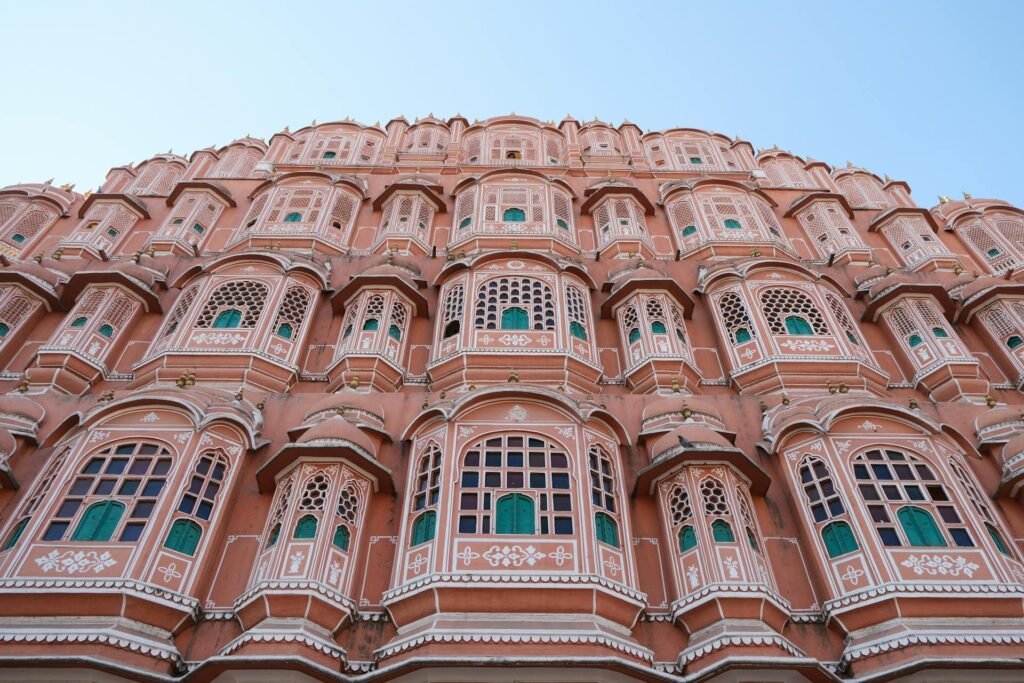
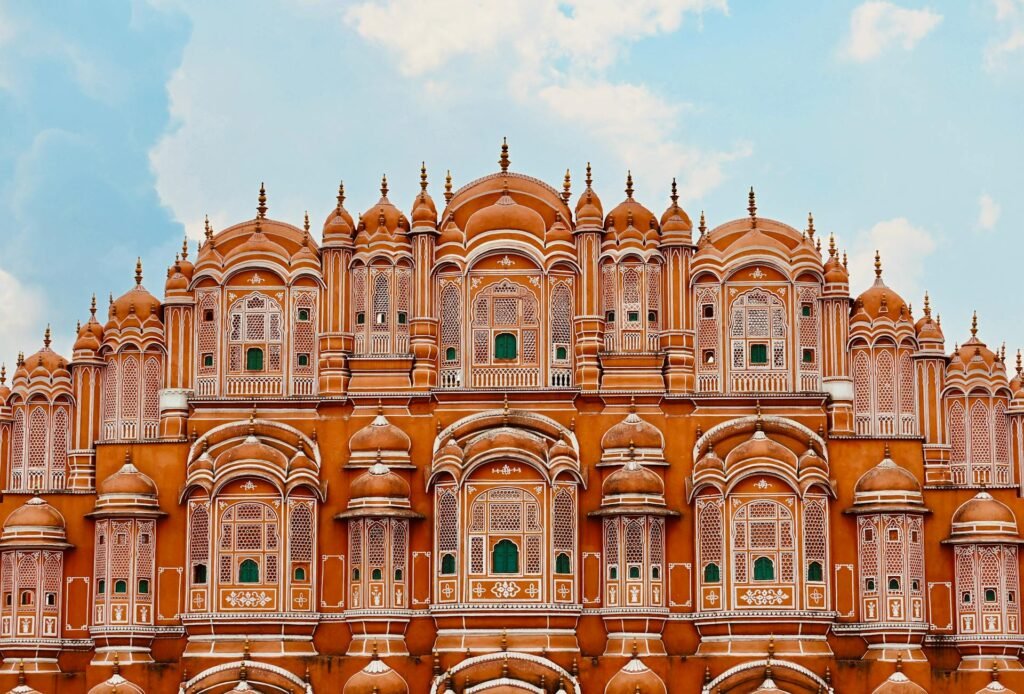
Built in 1799 by Maharaja Sawai Pratap Singh, the five-story pink sandstone facade with 953 intricately carved windows (jharokhas) is Jaipur’s icon. The honeycomb design wasn’t pure decoration — it allowed royal women in purdah to observe street processions and festivals while remaining unseen, with the cleverly engineered window angles creating natural air-conditioning by drawing breezes through the structure. The interior — five levels of chambers and a small museum — is reachable via a side entrance. Tickets ~50 INR Indians / 200 INR foreigners. Best photographed from the rooftop café across the street at sunrise or 5 pm light.
City Palace Complex
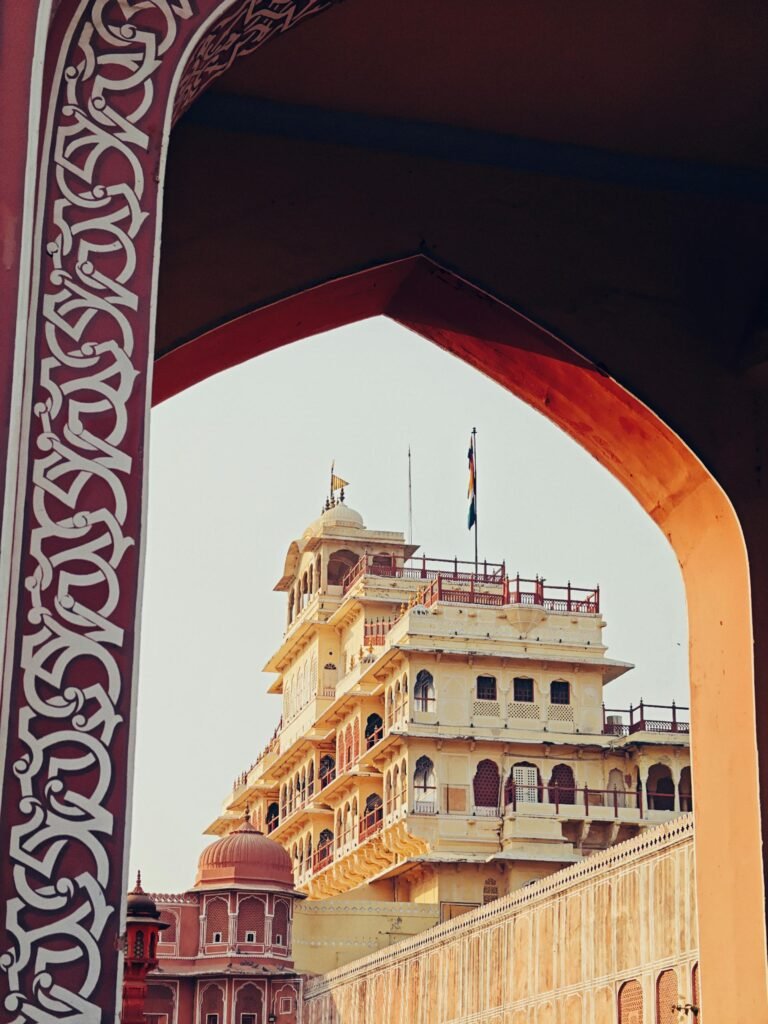
The royal residence at the heart of the planned city, blending Rajput, Mughal, and European architectural traditions. Highlights: the Mubarak Mahal (Welcome Palace, 1900); the Maharani’s Palace with restored royal weapons and miniature paintings; the Diwan-i-Am (Hall of Public Audience) with the world’s largest single piece of silver (a pair of Gangajalis, urns made for Maharaja Sawai Madho Singh II to carry holy Ganges water to England in 1902); and the four ornate Pritam Niwas Chowk doors representing the four seasons. The Chandra Mahal tower wing is still inhabited by the descendants of the royal family. Tickets ~700 INR foreigners (including museum + select royal apartments) via royaljaipur.in.
Jantar Mantar Observatory
The UNESCO World Heritage centerpiece — and arguably Jaipur’s single most important historical attraction. Built by Jai Singh II between 1728 and 1734, this astronomical observatory contains 19 architectural instruments of monumental scale, designed for naked-eye astronomical measurements with extraordinary precision. The Samrat Yantra (the world’s largest stone sundial, 27 metres tall) measures local time accurate to two seconds. The Jai Prakash Yantra measures positions of celestial bodies; the Rama Yantra measures altitude and azimuth. This is the largest and best-preserved of Jai Singh’s five observatories (the others are in Delhi, Mathura, Ujjain, and Varanasi). Tickets ~50 INR Indians / 200 INR foreigners.
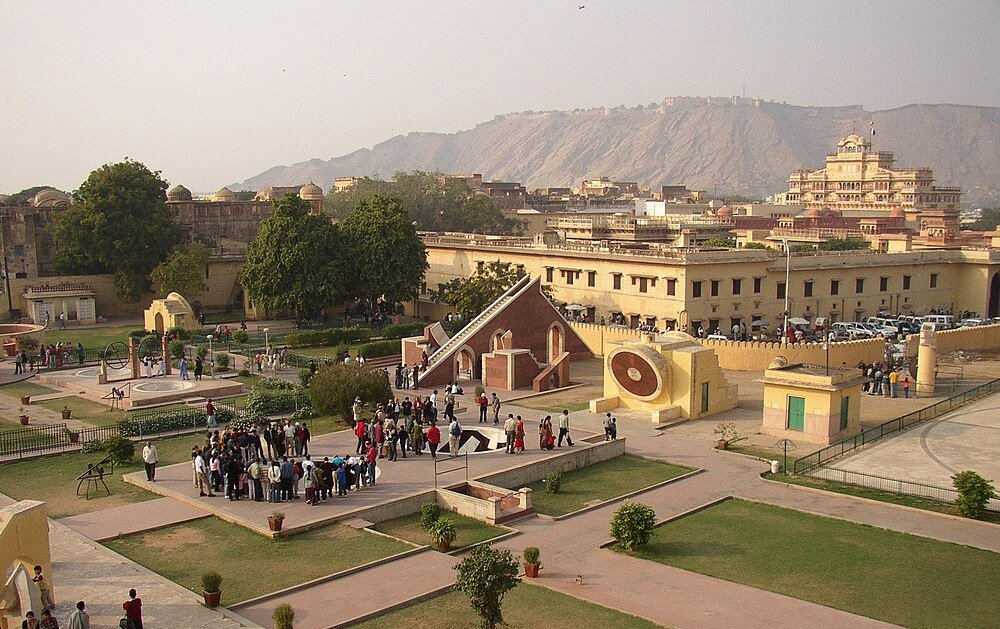
Tourists exploring the fascinating astronomical instruments at Jantar Mantar observatory in Jaipur
Amber Fort (Amer Fort)
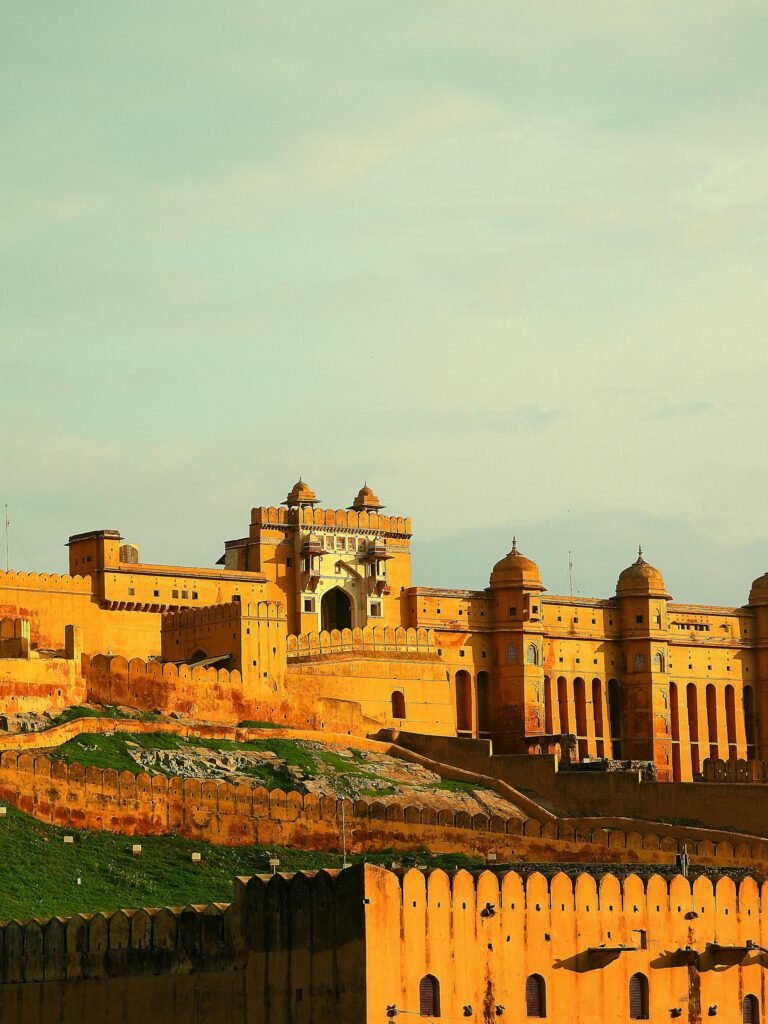
11 km from central Jaipur, the Amer Fort (1592–1727) was the original capital of the Kachwaha Rajputs before Jai Singh II built modern Jaipur. The fort’s massive sandstone walls, marble pavilions, and intricate charbagh Mughal-style gardens cover a hilltop overlooking Maota Lake. The Sheesh Mahal (Mirror Palace) is the showstopper — entire walls and ceiling covered in tiny convex mirrors that reflect candlelight into thousands of stars. Ganesh Pol (the Elephant Gate) and Diwan-i-Aam are the other architectural highlights. Tickets ~500 INR. The traditional elephant rides up to the gate remain available but are now limited (and increasingly controversial — choose to walk or use the jeep route instead). Tickets via tourism.rajasthan.gov.in.
Nahargarh Fort
“Tiger Fort” — built in 1734 on a steep ridge of the Aravalli Hills overlooking Jaipur city, originally as a defensive retreat. The fort’s name (literally “abode of tigers”) reflects its hilly forest setting. The Padao Restaurant at the fort serves the city’s most famous sunset view; expect crowds at golden hour. Tickets ~50 INR Indians / 200 INR foreigners.
Jaigarh Fort
“Victory Fort” — the military counterpart to Amer Fort’s palace. Houses Jaivana, the world’s largest wheeled cannon (cast in 1720, weighing 50 tonnes; its single test-firing reportedly carried a cannonball 35 km). The fort’s massive walls and strategic position offer panoramic views back to Amer Fort. Tickets ~85 INR Indians / 200 INR foreigners (or combine with Amer Fort ticket).
Albert Hall Museum
The most striking colonial-era building in Jaipur — designed by Sir Samuel Swinton Jacob in Indo-Saracenic style and opened in 1887, set within the lush Ram Niwas Garden. The collection includes an Egyptian mummy (donated 1880s), Persian carpets, Mughal miniatures, antique weapons, and an extraordinary collection of regional Rajasthani folk art. Tickets ~40 INR Indians / 300 INR foreigners. Beautifully illuminated at night.
Stepwells and Water Architecture
The geometric perfection of Panna Meena Ka Kund, just outside Amer Fort, is one of the most photographed stepwells in India — symmetrical zig-zag staircases descending eight stories underground. Chand Baori at Abhaneri (90 minutes east of Jaipur, on the Agra road) is one of India’s deepest stepwells: 3,500 perfectly symmetrical steps descending 13 stories. Both are free or nominal entry.
How to Get to Jaipur
Jaipur is the easiest Rajasthani city to reach — direct flights from major Indian cities, regional trains, and excellent road links to Delhi and Agra make it a natural pivot point for north India travel.
By Air
Jaipur International Airport (JAI) serves both domestic and international flights, located 13 km southeast of the city center. Direct flights from major Indian cities (Delhi, Mumbai, Bangalore, Kolkata, Chennai), plus international destinations including Dubai, Sharjah, Bangkok, Muscat, and Singapore. From the airport: prepaid taxis (~500–700 INR to central Jaipur), Ola/Uber, app-based ride-hails (faster and cheaper than airport taxis). Live status at aai.aero/en/airports/jaipur.
By Rail
Jaipur Junction is one of north India’s major railway stations, with frequent connections via Vande Bharat Express, Shatabdi Express, and Rajdhani Express: Delhi (4–5 hours by Vande Bharat), Mumbai (12–16 hours), Agra (4–5 hours), Ahmedabad (10 hours). The Palace on Wheels luxury heritage train tours pass through Jaipur as part of its 8-day Rajasthan circuit. Booking via irctc.co.in — foreigners may need OTP-validated registration; alternatively use cleartrip.com or 12go.
By Road
Jaipur sits at the intersection of major national highways (NH 8, NH 11, NH 12). The new Delhi-Mumbai Expressway (gradually opening in stages 2023–2025) cuts the Delhi-Jaipur drive time from 5–6 hours to 3.5 hours via the Sohna route. Drive times: Delhi 5–6 hours via NH 48 (or 3.5 via the new Expressway), Agra 4–5 hours, Ranthambhore 3–4 hours. Long-distance buses run by Rajasthan State Road Transport Corporation (RSRTC) connect to all major Rajasthani cities; private operators (Volvo AC) run Delhi-Jaipur services overnight.
Getting Around Jaipur
Jaipur’s compact Old City is walkable; outer attractions need transport.
Auto-Rickshaws
The dominant mode of local transport. Three-wheeled auto-rickshaws are everywhere; expect 100–250 INR for short rides within central Jaipur, 400–600 INR to Amer Fort. Always negotiate the fare beforehand or insist on the meter (most won’t agree at tourist hotspots — book through Ola Auto/Uber Auto for fixed pricing).
Cycle Rickshaws
Traditional pedal-powered rickshaws operate in the Old City’s narrow lanes — environmentally friendly, slow, ideal for short Old City explorations. ~50–100 INR for short hops; bargain firmly.
Taxis and Car Rentals
Both government-approved Rajasthan State Taxi and private operators offer day-rentals (8 hours / 80 km, ~2,000–3,500 INR for AC sedan) — ideal for touring Amer Fort + Jaigarh Fort + Nahargarh combinations or for day trips to Pushkar (3 hours) or Abhaneri stepwell. Hotels can arrange reliable taxi services with English-speaking drivers.
App-Based Ride Services
Uber and Ola dominate, with transparent pricing in INR and English-language interfaces. Both apps now also offer Auto bookings — the best way to avoid auto-rickshaw fare-haggling. For longer day-trips, full-day Ola Outstation bookings are available.
Local Buses
Rajasthan State Road Transport Corporation (RSRTC) operates city buses across major routes. Cheap (~20 INR) but crowded and confusing for first-time visitors; tourists generally skip them in favor of autos and ride-shares.
Food & Drink in Jaipur
Jaipur is the capital of Rajasthani cuisine — one of India’s most distinctive regional traditions, shaped by the desert climate that requires preservation techniques (drying, ghee preservation, pickling) and minimal water for cooking. The flavors are bold, the spices fierce, and the desserts famously syrup-heavy. Eating well in Jaipur is among the great pleasures of north India.
Must-Try Dishes
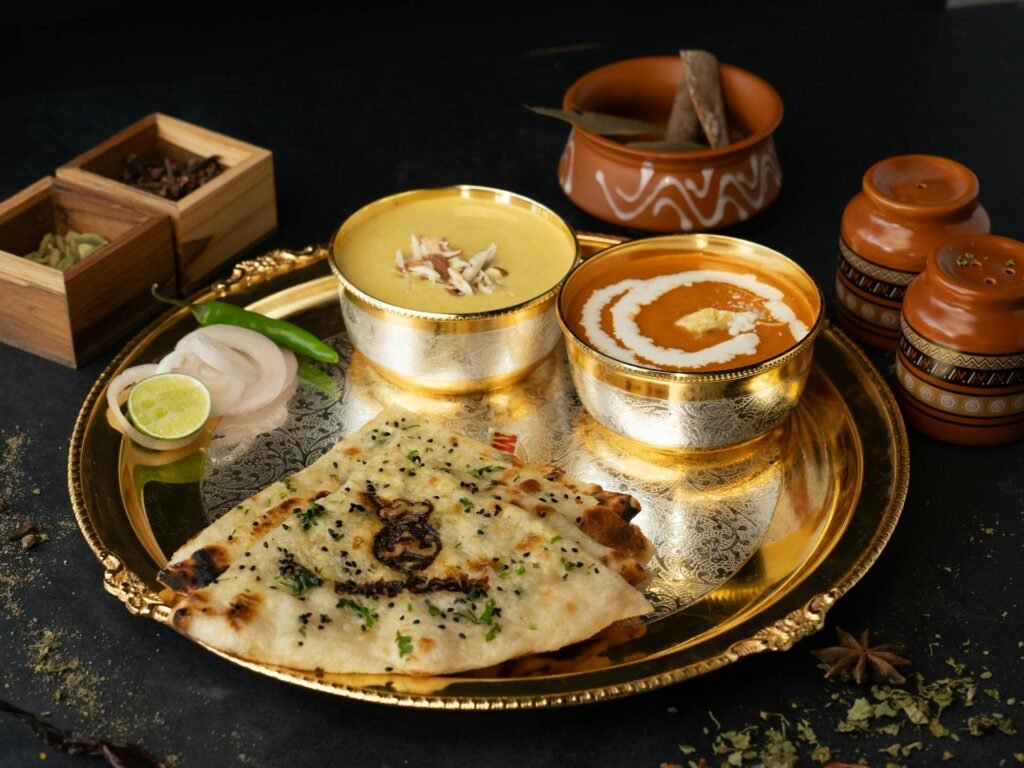
Dal Baati Churma — Rajasthan’s signature dish: hard wheat-flour rolls (baati) baked in cow-dung embers, broken open and drenched in ghee, served with five-lentil curry (panchmel dal) and crumbled sweetened wheat (churma). The combination requires a hand to eat properly.
Laal Maas — a fiery red mutton curry from the royal Mewar tradition, slow-cooked with Mathania red chillies and yogurt; the heat is genuinely serious. Safed Maas (its lesser-known white counterpart) uses cashew, almond, and cream for a silky non-spicy alternative. Gatte ki Sabzi — gram-flour dumplings simmered in spiced yogurt gravy, the classic Rajasthani vegetarian. Ker Sangri — desert berries and beans, the signature Rajasthani vegetable dish that exists in no other regional cuisine.
Street Food Adventures
The lanes of Johari Bazaar, Bapu Bazaar, and Tripolia Bazaar serve textbook Rajasthani street food. Pyaaz Kachori — flaky onion-stuffed deep-fried pastry — is at its absolute best at Rawat Mishtaan Bhandar (Sindhi Camp, since 1953); Mirchi Vada — entire green chillies stuffed with spiced potato and deep-fried; Ghevar — disc-shaped fried sweet that’s particular to the Teej festival; Kulfi — traditional Indian frozen dairy in clay pots, the Lassiwala on MI Road has been making the city’s best lassi (yogurt drink) since 1944.
Dining Experiences
The luxury heritage hotels run Rajasthan’s most iconic fine-dining: Suvarna Mahal at Rambagh Palace, Steam at Rambagh, and the alfresco dining at Marigold. 1135 AD inside Amer Fort offers theatrical Rajput-court-style dining. Chokhi Dhani village resort on the Tonk Road outskirts hosts the textbook tourist-Rajasthani-cultural-dinner experience — folk dance, camel rides, and authentic regional thali. The traditional haveli restaurants in the Old City — LMB (since 1727 in Johari Bazaar), Surya Mahal — serve traditional Rajasthani thalis on silver platters.
Culture & Arts in Jaipur
Jaipur is one of India’s most culturally vital cities, with traditional crafts that have continued unbroken for three centuries alongside one of the world’s most famous literary festivals.
Traditional Crafts
The city is renowned for: hand-block printing (the village of Sanganer just south of Jaipur is the textile-printing capital), blue pottery (a unique Persian-influenced ceramic tradition that uses no clay), Kundan-Meenakari jewelry (gemstone-inset gold work that originated in the Mughal courts), tie-dye (bandhej), silver filigree, and marble inlay. Artisan workshops in the Old City — particularly around Khajanewalon ka Rasta for jewelry and Maniharon ka Rasta for lacquer bangles — allow visitors to observe craftspeople working with techniques essentially unchanged since Jai Singh II commissioned the original craftsmen colonies. Anokhi Museum (in Amer) and Jaipur Wax Museum are dedicated to these traditions.
Performing Arts
Traditional Rajasthani folk music and dance — including the iconic Ghoomar (rotation dance), Kalbelia (snake-charmer dance, UNESCO Intangible Heritage), and the legendary Bhopa singers of the Pabuji epic — are performed at heritage hotels and cultural centers across the city. Jaipur Kathak Kendra is the country’s leading institution for the Kathak classical dance tradition.
The annual Jaipur Literature Festival (late January) is the world’s largest free literary festival, drawing 250,000+ attendees and the world’s leading authors to the lawns of Diggi Palace. The Jaipur International Film Festival follows in early February.
Museums and Galleries
Beyond the Albert Hall Museum, the City Palace Museum showcases royal artifacts, weapons, and miniature paintings. The Jawahar Kala Kendra — designed by architect Charles Correa as a tribute to Jai Singh II’s nine-block planning — hosts contemporary Rajasthani art exhibitions, music recitals, and book launches. The Anokhi Museum of Hand Printing in a restored haveli at Amer documents the city’s textile-block-printing tradition.
Jaipur by District: The 5 Tehsils
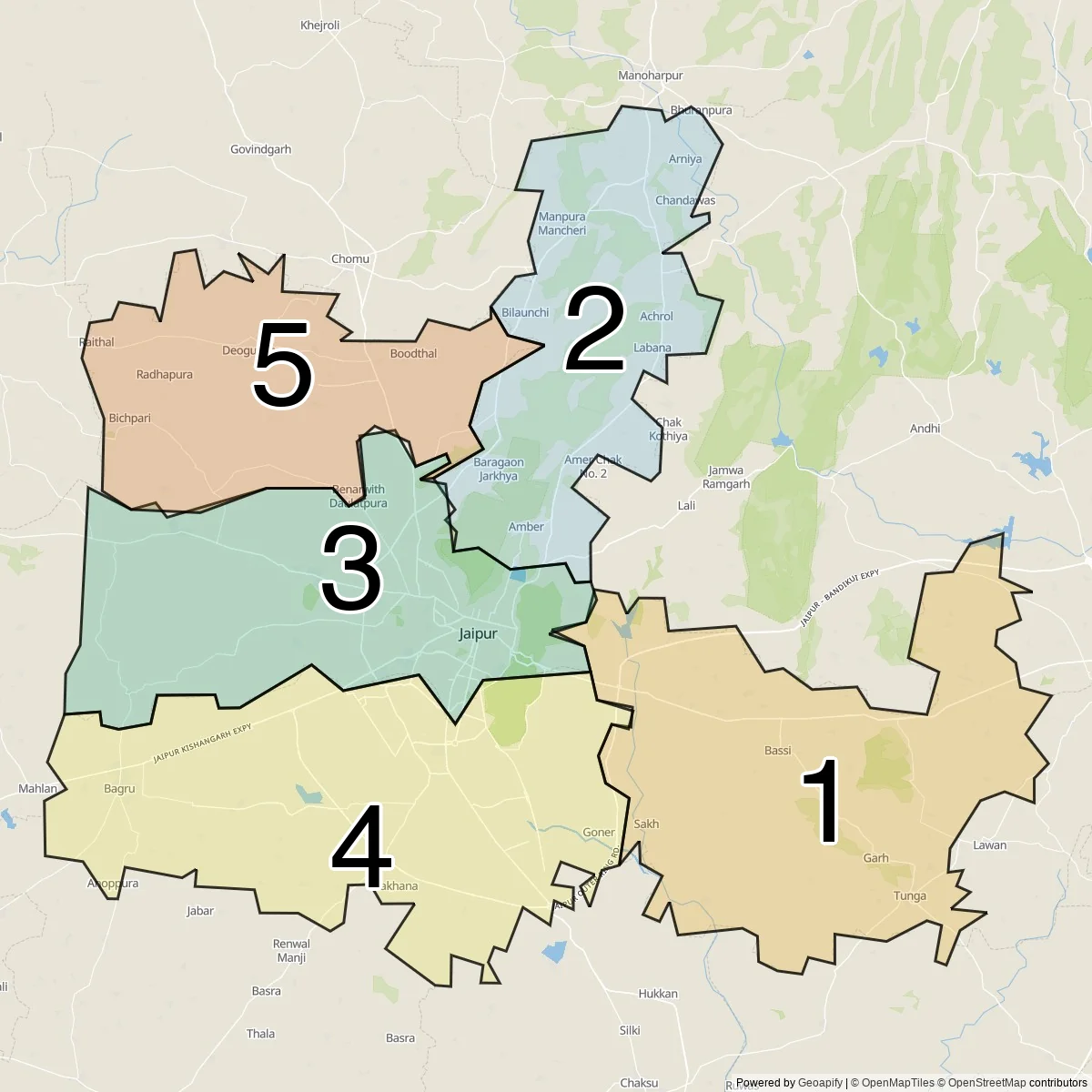
Jaipur is divided into 5 tehsils. The map below shows their official OSM boundaries, colour-coded to match the table — a quick way to orient yourself before zooming in on individual sights.
| # | Tehsils |
|---|---|
| 1 | Bassi Tehsil |
| 2 | Amber Tehsil |
| 3 | Jaipur Tehsil |
| 4 | Sanganer Tehsil |
| 5 | Jalsoo Tehsil |
Frequently Asked Questions About Visiting Jaipur
Do I need a visa to visit Jaipur?
Almost certainly yes — India does not have visa-free entry for most nationalities. Citizens of around 170 countries — including the US, UK, EU member states, Canada, Australia, Japan, and most of Asia — can apply for an e-Visa online before travel through the official portal at indianvisaonline.gov.in/evisa. The e-Tourist Visa is typically valid 30 days, 1 year, or 5 years with multiple entries; processing takes 2–4 working days. Cost ranges roughly $25–80 depending on nationality and validity. Apply at least a week before travel; never use third-party sites that charge inflated fees. Citizens of Nepal and Bhutan don’t need a visa; OCI/PIO cardholders enter freely. Always check the current rules on the Bureau of Immigration India site before booking.
Is Jaipur safe for tourists?
Jaipur is generally safe for tourists who exercise standard precautions, though it requires more situational awareness than European or East Asian capitals. The US State Department rates India at “exercise increased caution”; the UK FCDO issues similar guidance. Common risks: pickpocketing in the busy bazaars (Johari, Bapu, Tripolia); aggressive touts and “free guide” approaches near the Hawa Mahal and City Palace; auto-rickshaw and gemstone-shop scams (the “best price for friend” approach); occasional drink-spiking incidents at dive bars. Women travelers should take extra care — solo women report more harassment in Jaipur than in Mumbai or Bangalore; avoid empty Old City lanes after dark, dress modestly (covered shoulders/knees), and prefer registered taxis over auto-rickshaws at night. Avoid: travel-agent-recommended “factory tours” that turn into pressure-sales sessions for carpets and gemstones; politically tense periods around major Hindu-Muslim festivals.
How many days do I need in Jaipur?
Three full days is the practical minimum to do Jaipur without rushing; four to five gives breathing room for the surrounding sights. A solid 3-day plan: Day 1 — Old City walking tour (Hawa Mahal exterior + interior + rooftop café, City Palace complex, Jantar Mantar) + evening at Bapu/Johari/Tripolia bazaars; Day 2 — Amer Fort (full morning) + Jaigarh Fort + Nahargarh sunset + Padao Restaurant dinner; Day 3 — Albert Hall Museum + Jal Mahal photo stop + Jawahar Kala Kendra + Chokhi Dhani village resort dinner. Day 4–5: day-trip to Abhaneri Chand Baori stepwell (90 min) + Bhangarh “haunted” fort, OR Ranthambhore tiger safari (3 hours each way, full day), OR Pushkar sacred lake town (3 hours).
What’s the best area to stay in Jaipur?
Three solid options. Old City (Walled City) — boutique heritage hotels in restored haveli mansions for maximum atmosphere; walking distance to Hawa Mahal, City Palace, and the bazaars; expect noise and persistent touts; $40–150/night. Civil Lines / C-Scheme — the modern central choice; quiet residential streets, mid-range business hotels (Marriott, Hyatt Regency, Trident) at $80–200/night, easy connectivity to both Old City and Jaipur Junction; my pick for first-time visitors. Bani Park — the budget-and-mid-range guesthouse cluster at $25–70/night, walking distance to the Old City and the railway station. Heritage luxury: Rambagh Palace, Jai Mahal Palace, Samode Haveli for a once-in-a-trip splurge ($400–1,500/night). Avoid: areas more than 5 km from the Old City — auto-rickshaw fares add up quickly.
How much does it cost to visit Jaipur’s major sights?
Jaipur’s headline sights use dual pricing — Indians pay much less than foreigners. Hawa Mahal: 50 INR Indians / 200 INR foreigners. City Palace: 200 INR Indians / 700 INR foreigners (full ticket including museums + select royal apartments) via royaljaipur.in. Jantar Mantar: 50 INR Indians / 200 INR foreigners. Amer Fort: 100 INR Indians / 500 INR foreigners; combo with Jaigarh ~600 INR. Nahargarh Fort: 50 INR Indians / 200 INR foreigners. Albert Hall Museum: 40 INR Indians / 300 INR foreigners. Composite Pass (covers Amer + Hawa Mahal + Jantar Mantar + Albert Hall + Nahargarh + Jaigarh + Sisodia Rani Garden) saves money if you visit four+ sites: 1,000 INR Indians / 1,000 INR foreigners (specifically priced equally for the foreigner discount). Camera fee: typically 50–200 INR additional at major sites. Half-day organized city tour: 800–1,500 INR. Full-day private car + driver: 2,500–4,000 INR.
Should I drink the tap water in Jaipur?
No — tap water in Jaipur is not safe for foreign visitors. The semi-arid climate and water scarcity have stressed the municipal supply, and the distribution network has known quality issues. Always use sealed bottled water (20–30 INR per liter from convenience stores; major brands include Bisleri, Aquafina, Kinley, Himalayan) for drinking, brushing teeth, and ice. Major hotel restaurants and reputable establishments use filtered water and ice — generally safe. Reusable filter bottles (LifeStraw, Grayl) work well in India and reduce plastic waste. The CDC traveler health page recommends bottled or boiled water for India. Tap water is fine for showering. Public water dispensers (“piaus”) at temples and tourist sites are not safe for foreigners; bring your own bottle. Be aware: even the bottled water you receive at restaurants has occasionally been refilled and resealed — check the seal before drinking.
What about the heat in summer — is it really that bad?
Yes — and it’s the single most important factor in trip planning. April through June brings genuinely punishing heat: daily highs above 40°C, peaks above 45°C in May–June, dust-laden hot winds (the local loo), and outdoor sightseeing realistically possible only before 9 am or after 6 pm. The combination of heat + crowds + walking can produce serious heat exhaustion in unaccustomed visitors; heatstroke is the #1 medical issue at Jaipur tourist sites in summer months. Practical advice: visit October through March (the practical Jaipur season); if visiting April–June, plan early-morning sightseeing (5:30–9:00 am at Amer Fort), midday breaks indoors, and late-afternoon/evening continuation; carry electrolyte rehydration salts, wear loose breathable clothing with sun cover, drink 4+ liters of water per day. The Diwali festival (October–November) and Jaipur Literature Festival (late January) both fall in the optimal weather window.
Is tipping expected in Jaipur?
Yes — moderate tipping is expected in tourist-facing service. Restaurants: 10% standard for sit-down service if no service charge is added (some restaurants now add 5–10% automatically — check the bill); round up at casual places. Hotel porters: ₹50–100 per bag at 4–5 star hotels. Hotel housekeeping: ₹100–200 per night left at end of stay. Hotel doormen: ₹20–50 for opening cab doors and assisting with bags. Auto-rickshaw drivers: round up to nearest ₹10. Taxi/Uber drivers: not strictly expected, but ₹20–50 for a long ride or extra help is appreciated. Tour guides: ₹500–1,000 per person for half-day, ₹1,500–3,000 for a full private day; bus/car drivers ₹100–300 for a full-day trip. Spa, salon: 10% if pleased; some upscale resort spas add 18% service charge automatically. Camel/elephant ride operators: ₹50–100 directly to the operator (in addition to the official ride fee). Tipping in cash (small notes) is expected; card machines rarely allow tip add-on.
Shopping in Jaipur
Jaipur is one of India’s great shopping cities — for gemstones especially, but also for textiles, handicrafts, leather, and jewelry across price ranges. Bargaining is a cultural expectation in the traditional bazaars.
Traditional Markets
Johari Bazaar — the historic gemstone and jewelry market; specializing in the famous Kundan (gemstones inset in gold leaf) and Meenakari (enamel work) traditions. Bapu Bazaar — textiles, leather goods, embroidered shoes (juttis), and handicrafts. Tripolia Bazaar — lac bangles, brassware, and traditional household items. Maniharon ka Rasta — the lac-bangle alley where artisans make the colored bracelets while you wait. Khajanewalon ka Rasta — silver-jewelry alley.
What to Buy
Jaipur is the global capital of gemstone trading — particularly emeralds (the famous Colombian-cut Jaipur emeralds), rubies, sapphires, and the Rajasthani topaz. Reputable dealers at the Gem Palace on MI Road and the larger workshops in the Johari Bazaar are well known to international jewelers. Other quality buys: hand-block printed cotton from Sanganer or Bagru, Anokhi textiles (the leading global brand), blue pottery, leather mojari/jutti shoes, and traditional Rajasthani jewelry. Always bargain in traditional markets; government-emporium Rajasthali stores have fixed prices and reliable quality but lower negotiation room.
Sports & Recreation
Jaipur’s sports scene is anchored by cricket, with the Sawai Mansingh Stadium as the premier venue — host to international Tests and ODIs since 1969, IPL home matches for the Rajasthan Royals, and matches during the 1987 and 1996 Cricket World Cups plus the 2006 ICC Champions Trophy. Match-day atmospheres are particularly intense for IPL home games.
For recreational sports, the Rambagh Golf Club at the Rambagh Palace offers an 18-hole course set on the historic palace grounds. Jaipur Greens Golf Course at the Tonk Road extension offers a more modern alternative. Several luxury hotels provide tennis, swimming, and Ayurvedic spa facilities. The annual Jaipur International Marathon (October) and the Jaipur Wall City Walk running event are the city’s leading mass-participation events.
Education & Notable People
The University of Rajasthan (1947) anchors Jaipur’s higher-education sector and ranks among India’s leading state universities. The Indian Institute of Information Technology Kota and the Manipal University Jaipur serve the technology-and-management student population. The Jaipur Rugs Foundation works internationally on traditional carpet-making and rural women’s empowerment.
Jaipur has produced several notable personalities: Maharaja Sawai Man Singh II (1912–1970, the last reigning Maharaja, who handed Jaipur State to independent India in 1949); Maharani Gayatri Devi (1919–2009, the cosmopolitan “Queen of Jaipur” and politician, whose 1997 memoir A Princess Remembers became a global bestseller); the late actor Irrfan Khan (1967–2020, internationally known for Life of Pi, The Lunchbox, and Slumdog Millionaire); Grammy-winning slide-guitarist Vishwa Mohan Bhatt (b. 1952, inventor of the Indianized Mohan veena); cricketer Sandeep Sharma; and Rajasthani folk-classical singer Ila Arun.
Jaipur rewards travelers who slow down. Three days for the headline sights, a fourth for Amer Fort and the surrounding hilltop forts, a fifth for shopping deep in the Old City bazaars or a day trip to Ranthambhore tigers or the Abhaneri stepwell. The Pink City offers the most concentrated dose of pre-modern Indian planned urbanism — and proves that 18th-century Rajasthan understood urban design lessons that 21st-century mega-cities are still relearning.
AFRIKA
Cairo Hurghada Johannesburg Marrakech
ASIA
Abu Dhabi Agra Antalya Bangkok Batam Beijing Bengaluru Cebu City Chiang Mai Chiba Chennai Da Nang Dammam Delhi Denpasar Dubai Fukuoka Guangzhou Guilin Ha Long Hanoi Ho Chi Minh City Jakarta Jaipur Johor Bahru Kolkata Krabi Kuala Lumpur Kyoto Macau Mecca Medina Mugla Mumbai Osaka Pattaya Penang Phuket Riyadh Seoul Shanghai Shenzhen Singapore Taipei Tokyo Zhuhai
EUROPE
Amsterdam Athens Barcelona Berlin Brussels Budapest Copenhagen Dublin Florence Frankfurt am Main Heraklion Krakow Lisbon London Madrid Milan Munich Nice Paris Porto Prague Rhodes Rome Stockholm Venice Vienna Warsaw
NORTH AMERICA
Cancun Las Vegas Los Angeles Miami New York City Orlando San Francisco Toronto Vancouver
SOUTH AMERICA
Buenos Aires Lima Rio De Janeiro
OCEANIA
Auckland Honolulu Melbourne Sydney