
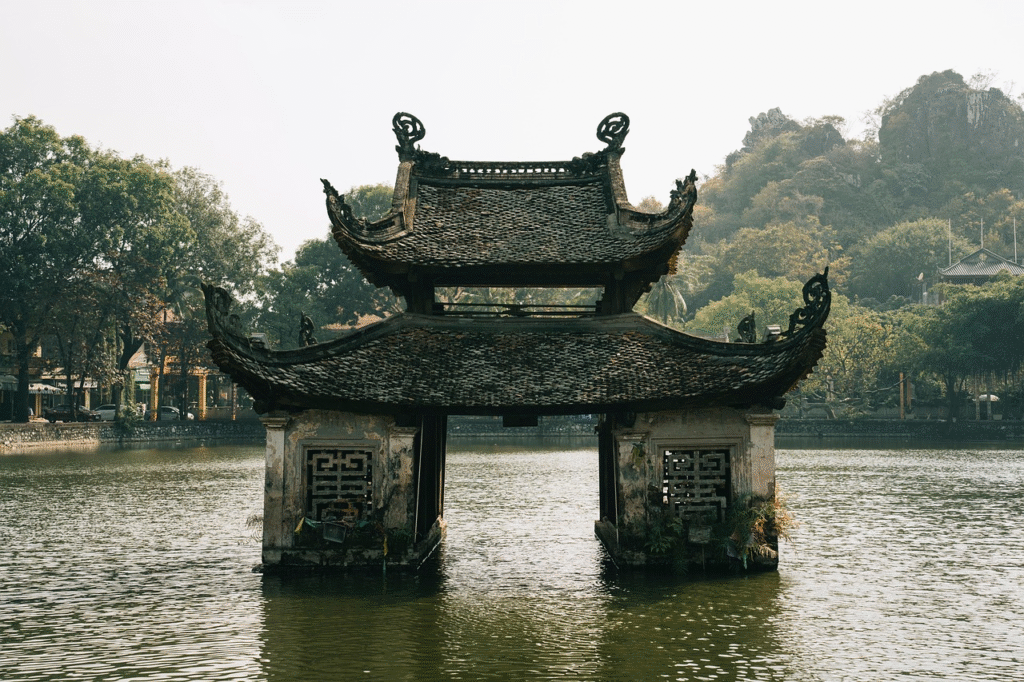
Photo credit: Hoan Kiem Lake and the Huc Bridge, Hanoi
Hanoi is Vietnam’s capital and the country’s most layered city — a place where a 1,000-year continuous urban history is visible block by block, where French-colonial boulevards collide with medieval guild streets and Communist-era concrete monuments, and where five million scooter-borne residents conduct their daily lives in a continuous, beautifully chaotic motion. The Old Quarter (the “36 Streets,” each historically named for the goods sold there) preserves a 13th-century Vietnamese commercial geography largely intact; the French Quarter south of Hoan Kiem Lake offers tree-lined avenues, art-deco villas, and the Opera House; the modern western districts host the country’s top universities and tech industry. Hanoi’s food culture — pho, bun cha, banh cuon, cha ca — is widely considered Vietnam’s most refined, and the city is the launchpad for Vietnam’s most-visited single destination, Ha Long Bay, 2.5 hours east. Slower-paced than Ho Chi Minh City, denser with cultural history, and possessed of one of Southeast Asia’s most distinctive sensibilities — Hanoi rewards travelers willing to explore on foot, sit at sidewalk plastic stools, and let the city’s rhythm reveal itself.
Hanoi by District: The 6 Phường
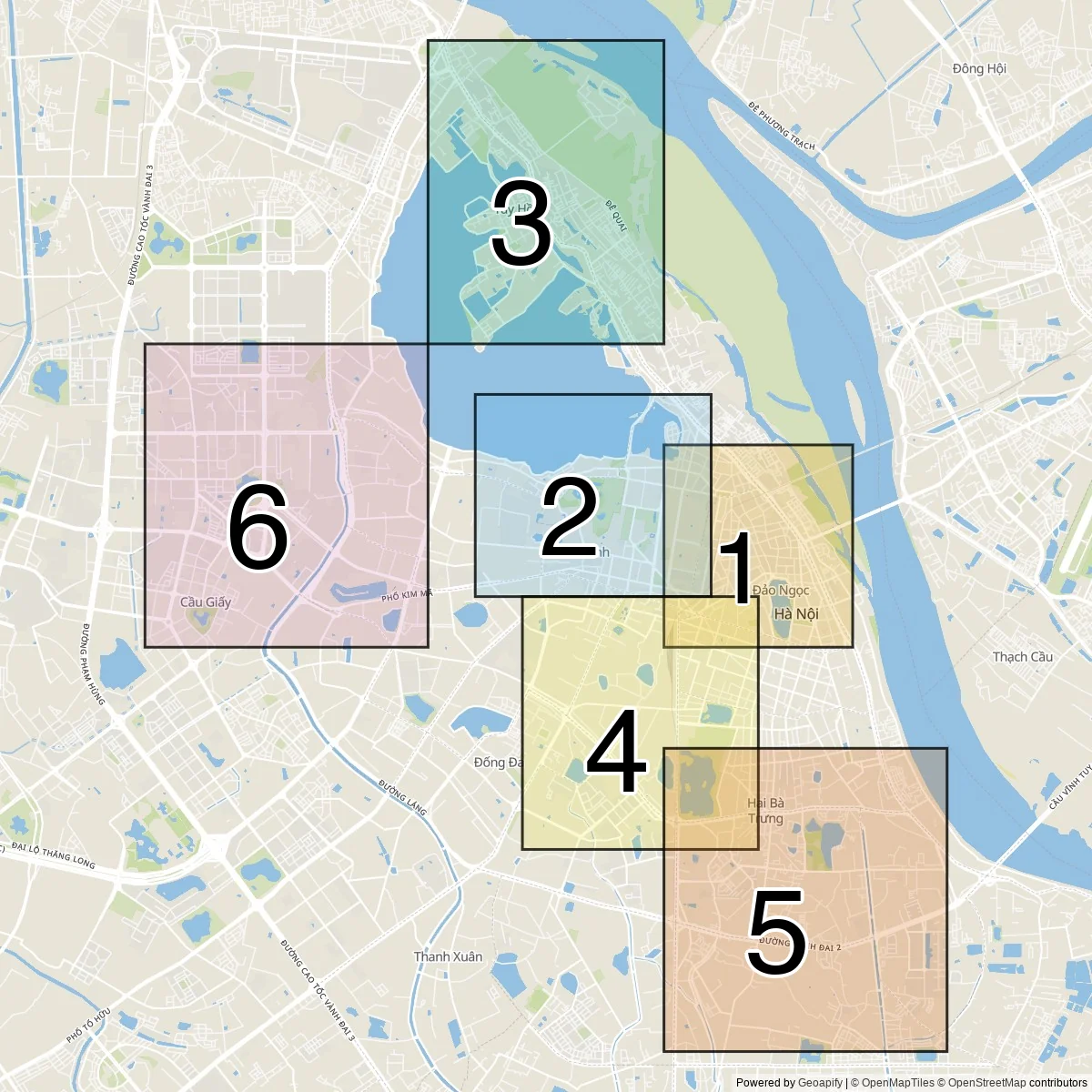
Hanoi is divided into 6 central wards. The map below shows their official OSM boundaries, colour-coded to match the table — a quick way to orient yourself before zooming in on individual sights.
| # | Phường |
|---|---|
| 1 | Hoàn Kiếm · Old Quarter |
| 2 | Ba Đình · Government area |
| 3 | Tây Hồ · West Lake |
| 4 | Đống Đa · University area |
| 5 | Hai Bà Trưng · South Centre |
| 6 | Cầu Giấy · New West |
Hanoi at a Glance: Essential Facts for Travelers
| Location | Red River Delta, Northern Vietnam |
|---|---|
| Coordinates | 21.0285°N, 105.8542°E |
| Population | ~8.5 million (2024 metro estimate); city proper ~5.2 million |
| Area | 3,359 km² (city; after 2008 expansion) |
| Elevation | ~10 m above sea level |
| Time Zone | Indochina Time (ICT, UTC+7 — no daylight saving) |
| Calling Code | +84 (city code 24) |
| Currency | Vietnamese Dong (VND ₫); USD widely accepted at tourism businesses |
| Languages | Vietnamese; English widely spoken in tourism zones; French rare but present in older intellectual circles |
| Climate | Humid subtropical with four distinct seasons — hot humid summers, cool dry winters; the rainiest April–September |
| Founded | 1010 (as Thăng Long, “Ascending Dragon,” by Emperor Lý Thái Tổ); officially renamed Hà Nội in 1831 |
| Famous For | Hoan Kiem Lake, Old Quarter “36 Streets,” Temple of Literature, Ho Chi Minh Mausoleum, French Quarter, pho, bun cha (the dish President Obama and Anthony Bourdain shared), gateway to Ha Long Bay and Sa Pa |
Upcoming Events in Hanoi
| Date | Title | Details |
|---|---|---|
| 2026-09-01 to 2026-09-30 | Hanoi Autumn Festival 2026 | Throughout September the capital celebrates its most beautiful season with the Hanoi Autumn Festival, a month-long cultural and tourism programme built around heritage spaces, art performances and traditional cuisine. Expect themed displays and pedestrian-street activities around Hoan Kiem Lake and the historic quarter, autumn-flavoured food promotions and plenty of photo-friendly installations celebrating the city’s famous golden light, milk-flower scent and lakeside charm. Most public activities are free to enjoy. Autumn is widely considered the best time to visit Hanoi, and the festival gives the season a festive framework. [Source] |
| 2026-09-11 to 2026-09-20 | Thang Long – Hanoi Festival 2026 | Under the theme Heritage Flow, the second Thang Long – Hanoi Festival fills ten days with art and heritage programmes across the capital’s most storied sites, including the Thang Long Imperial Citadel, the Temple of Literature, the Hanoi Museum and Bat Trang pottery village. Highlights range from an international art exchange with Japan, South Korea and India to the MOVE Fest youth music night, craft exhibitions with hands-on experiences and pottery-inspired fashion in Bat Trang. Most programmes are open to the public, and the closing ceremony on 20 September caps the celebration. [Source] |
| 2026-09-18 to 2026-09-25 | Mid-Autumn Festival in the Old Quarter | The Mid-Autumn Festival, or Tet Trung Thu, transforms Hanoi’s Old Quarter into a riot of colour in the weeks up to 25 September 2026. Hang Ma street glows with lanterns, masks and star-shaped toys, while children parade, lion dances weave through the lanes, and families share mooncakes. Traditionally a harvest and children’s festival, it fills the ancient streets with music and light after dark. Browsing the festive markets is free, with treats and toys for sale. It is one of the most enchanting and family-friendly times to wander old Hanoi. [Source] |
| 2026-10-10 | Liberation of the Capital Day | Each 10 October, Hanoi marks the anniversary of the 1954 Liberation of the Capital, when Viet Minh forces entered the city as French troops withdrew. The commemoration brings flag displays, flower arrangements, exhibitions and cultural programmes across the capital, especially around Hoan Kiem Lake and historic sites. The date is a source of pride for Hanoians and a focal point of the city’s identity and history. Most events are free and open to the public. Visiting around this time offers insight into Hanoi’s revolutionary past amid the beauty of its celebrated autumn. [Source] |
| 2026-10-13 to 2026-10-15 | MTA Hanoi 2026 | Vietnam’s leading precision engineering and machine tool exhibition returns to the north, taking over the Vietnam Exhibition Center in Dong Anh for three days. MTA Hanoi gathers international manufacturers of machine tools, automation systems, metrology equipment and cutting technology, serving the fast-growing factories of the Red River Delta manufacturing belt. The trade fair is aimed at industry professionals, with entry for trade visitors who register in advance, and it doubles as a window on Vietnam’s push into higher-value manufacturing. Seminars and live machinery demonstrations round out the programme. [Source] |
| 2026-11-01 | Hanoi Creative Design Festival 2026 | Hanoi’s UNESCO Creative City credentials go on full display as the Creative Design Festival returns from 1 November, transforming landmarks and creative spaces across the capital. Previous editions have drawn hundreds of thousands of visitors with architecture pavilions, design exhibitions, installations, workshops and performances staged around Hoan Kiem Lake, the Opera House and repurposed heritage buildings. The festival celebrates the city’s young design scene and its industrial and colonial-era architecture in equal measure. Most venues and activities are free to visit, and the full programme is published shortly before opening. [Source] |
City News in Hanoi – last 14 days
| Date | Category | Headline | Details |
|---|---|---|---|
| 2026-09-14 | Local government | Thai King and Queen arrive for state visit to Vietnam | King Maha Vajiralongkorn and Queen Suthida of Thailand arrived in Hanoi to begin a state visit to Vietnam, a landmark trip underlining warming ties between the two Southeast Asian nations. The royal couple’s programme in the capital includes official ceremonies and meetings with Vietnam’s senior leadership, with Vietnamese media noting that the King personally piloted the royal aircraft into Noi Bai International Airport. State visits at this level are rare and carefully choreographed, and the occasion brings heightened protocol and security across central Hanoi. [Source] |
| 2026-09-14 | Public transport | Railway to Lao Cai and Hai Phong requires resettling 7,347 households | Authorities are drawing up resettlement plans for 7,347 households affected by the planned Lao Cai – Hanoi – Hai Phong railway, one of Vietnam’s most important new infrastructure corridors. The standard-gauge line will link the Chinese border, the capital and the country’s biggest northern port, dramatically improving freight and passenger connections. Compensation and relocation are among the most sensitive parts of such megaprojects, and officials are working through where affected families will be moved and how livelihoods will be restored before construction can proceed on schedule. [Source] |
| 2026-09-14 | Public transport | 7.5-billion-dollar airport races to open VIP terminal for APEC 2027 | Construction crews are racing to complete the VIP terminal of a 7.5-billion-dollar airport under development outside Hanoi so that it can receive official delegations during Vietnam’s APEC host year in 2027. The project is one of the largest aviation investments in the country’s history and is intended to expand capacity for the capital region alongside Noi Bai. Prioritising the ceremonial and VIP facilities first reflects the diplomatic calendar, with full passenger operations to follow in later phases as the remaining infrastructure is built out. [Source] |
| 2026-09-14 | Local government | City studies raising over 1,000 hectares of Red River floodplain | The city is studying plans to raise and develop more than 1,000 hectares of Red River floodplain land, potentially opening a vast new area for urban use along the waterway. Elevating the low-lying banks would reduce flood exposure and allow the parks, housing and public spaces envisioned in the riverside masterplan to proceed. The floodplain has historically been lightly used because of seasonal high water, and any development must balance flood-safety rules with the city’s ambition to finally turn the river into its central landscape axis. [Source] |
| 2026-09-14 | Business | New framework rolled out to attract strategic investors | Hanoi has rolled out a new framework designed to attract strategic investors to the capital, setting out criteria and incentives for large, high-quality projects in priority sectors. The mechanism is intended to speed up procedures and give major investors clearer commitments as the city competes with other Vietnamese localities for technology, finance and infrastructure capital. It follows new decentralisation powers granted to the capital, and officials hope the framework will translate Hanoi’s talent pool and market size into a stronger pipeline of flagship investments. [Source] |
| 2026-09-14 | Business | Daewoo Hotel listed for sale at 220 million dollars | The landmark Hanoi Daewoo Hotel has been put on the market with an asking price of about 220 million dollars as its owner works through debt difficulties. The five-star property in Ba Dinh district, opened in the 1990s, has hosted presidents and dignitaries and remains one of the capital’s best-known hotels. The listing reflects broader strain among Vietnamese property groups that borrowed heavily during the boom years, and market watchers are following closely who might acquire such a rare trophy asset in central Hanoi. [Source] |
| 2026-09-14 | Business | FamilyMart opens its first stores in the capital | Japanese convenience store chain FamilyMart has entered the Hanoi market, opening its first stores in the capital after years of operating mainly in southern Vietnam. The move intensifies competition in the city’s fast-growing convenience retail sector, where chains such as Circle K and WinMart have expanded aggressively to serve young urban customers. Convenience formats are winning share as Hanoians embrace ready meals and late-night shopping, and FamilyMart’s arrival signals confidence that the northern market can support further modern retail growth in the years ahead. [Source] |
| 2026-09-14 | Public safety | Torrential rain dumps over 400 millimetres on parts of the city | Intense downpours battered northern Vietnam, with rainfall in parts of Hanoi exceeding 400 millimetres and forecasters warning of further localised totals above 250 millimetres. Authorities issued flood warnings for low-lying wards, where streets quickly became waterlogged and traffic slowed to a crawl during peak hours. Residents were urged to avoid underpasses and riverside areas as water levels rose. The deluge is part of a prolonged spell of dangerous weather over the north, straining the capital’s drainage system and keeping emergency crews on standby. [Source] |
| 2026-09-14 | Public safety | Parents again find spoiled seafood and chicken at school kitchen | Parents monitoring deliveries at a Hanoi school discovered stale shrimp and chicken with a foul smell arriving at the canteen kitchen, reigniting anger over school food safety in the capital. The find follows an earlier incident that prompted a commune to overhaul supervision of its semi-boarding meal programme. Families are demanding stricter supplier checks, transparent inspections and accountability from schools, while education authorities face growing pressure to tighten the controls covering meals served to hundreds of thousands of children across the city every day. [Source] |
| 2026-09-14 | Education | Nearly 5,600 students sit the city’s excellent-student examination | Nearly 5,600 of the capital’s top pupils sat Hanoi’s excellent-student examination for the 2026-2027 school year, the annual contest that identifies candidates for national teams in subjects from mathematics to literature. Competition is fierce, as strong results open doors to national competitions, university admission advantages and international olympiad selection. The exam underlines the intensity of Hanoi’s academic culture, where gifted-student training is a point of pride for schools, and results will determine which students advance to represent the city at national level. [Source] |
| 2026-09-14 | Education | AI lessons introduced from grade one as parents urge age-appropriate design | Hanoi is introducing artificial intelligence instruction for pupils beginning in grade one, making the capital an early mover in bringing AI literacy into primary classrooms. Parents broadly welcome the initiative but are urging education authorities to ensure the curriculum suits each age group, with playful, screen-light approaches for the youngest children and more substantial content in higher grades. Teachers will need training and materials to deliver the lessons well. The rollout reflects a national push to prepare Vietnam’s workforce for a technology-driven economy. [Source] |
| 2026-09-14 | Culture | Mid-Autumn colours light up the Old Quarter | The Old Quarter has burst into colour ahead of the Mid-Autumn Festival, with Hang Ma street and the surrounding lanes draped in red lanterns, star-shaped toys and paper masks. Crowds of families and young people flock into the historic streets each evening to shop, take photographs and soak up the festive atmosphere, while traditional toy makers enjoy their busiest weeks of the year. The seasonal transformation has become one of Hanoi’s most photogenic spectacles, drawing visitors well before the festival itself peaks in late September. [Source] |
| 2026-09-12 | Local government | Five more Red River bridges planned by 2038 | City planners expect to add five more bridges across the Red River by 2038 as part of a sweeping vision for a landscaped boulevard axis along both banks. The plans, now under consultation, tie into studies for a ten-lane riverside avenue, new urban districts and a network of metro lines serving the corridor. The Red River has long divided the historic core from newer districts, and the bridge programme is meant to knit the two banks together as the capital pushes ambitious growth targets for the northern side. [Source] |
| 2026-09-12 | Culture | Thang Long-Hanoi Festival 2026 opens with heritage-themed programme | The second edition of the capital’s flagship cultural festival opened with an evening art programme, launching ten days of heritage-themed events across the city’s landmark sites. Under the banner Heritage Flow, the programme spans an international art exchange with Asian partner countries, youth music performances, craft displays and activities at venues from the Imperial Citadel to Bat Trang pottery village. The festival is part of Hanoi’s effort to turn its dense concentration of monuments and traditions into a living cultural industry that engages younger audiences. [Source] |
Hanoi Events & City News Archive
Sources: Vietnam Tourism, Vietnam.vn, Vietnam Tourism, Hanoi Municipality, MTA Hanoi, Hanoi Creative Design Festival, VietnamPlus, VOV
Weather Forecast for the Next 14 Days in Hanoi
| Date | Weather | Max °F | Min °F | Rain mm |
|---|---|---|---|---|
| 2026-09-14 | 🌧️ | 80.4 °F | 74.8 °F | 32.1 mm |
| 2026-09-15 | ⛈️ | 77.5 °F | 74.6 °F | 112.1 mm |
| 2026-09-16 | ⛈️ | 78.5 °F | 73.8 °F | 54.0 mm |
| 2026-09-17 | ⛈️ | 79.0 °F | 74.3 °F | 29.3 mm |
| 2026-09-18 | ⛈️ | 86.5 °F | 75.5 °F | 3.5 mm |
| 2026-09-19 | 🌧️ | 89.6 °F | 74.2 °F | 0.6 mm |
| 2026-09-20 | ⛅ | 90.1 °F | 75.3 °F | 0.0 mm |
| 2026-09-21 | ☁️ | 89.0 °F | 74.3 °F | 0.0 mm |
| 2026-09-22 | ☁️ | 89.0 °F | 75.5 °F | 0.0 mm |
| 2026-09-23 | ⛈️ | 87.9 °F | 77.1 °F | 4.6 mm |
| 2026-09-24 | 🌧️ | 85.2 °F | 75.8 °F | 2.8 mm |
| 2026-09-25 | 🌧️ | 86.4 °F | 76.0 °F | 2.2 mm |
| 2026-09-26 | ⛈️ | 86.4 °F | 76.8 °F | 8.4 mm |
| 2026-09-27 | ⛈️ | 85.0 °F | 76.2 °F | 20.4 mm |
Hanoi’s History
Hanoi’s continuous history stretches over 2,000 years, making it one of Southeast Asia’s oldest capitals. Archaeological evidence shows early Vietnamese settlement in the Red River Delta from at least the 3rd millennium BCE. Cổ Loa, 20 km north of modern Hanoi, was the capital of the ancient Âu Lạc kingdom in the 3rd century BCE — the earliest formally identifiable Vietnamese state. The current city’s foundation is conventionally dated to 1010 CE, when Emperor Lý Thái Tổ, the founder of the Lý dynasty, moved his capital from Hoa Lư to a riverside site he named Thăng Long (“Ascending Dragon”) after seeing a dragon rising from the river in a vision. Lý and the succeeding Trần dynasty built the city’s defining monuments — the Temple of Literature (Văn Miếu), founded 1070 as Vietnam’s first university; One Pillar Pagoda; the Imperial Citadel of Thăng Long (UNESCO 2010); and the layout of the present-day Old Quarter.
The 13th-century Trần dynasty oversaw three successful defenses against Mongol invasions under General Trần Hưng Đạo, including the decisive 1288 Battle of Bạch Đằng. The 15th century brought brief Chinese Ming occupation followed by the celebrated Lê dynasty‘s restoration under Lê Lợi, who emerged from the famous Returning Sword Lake (modern Hoan Kiem) legend with a magical sword returned to a divine turtle. The Lê dynasty made Thăng Long the cultural and political center of Vietnam for nearly 400 years.
In 1802, the new Nguyễn dynasty moved the capital to Hué in central Vietnam, demoting Thăng Long. The city was renamed Hà Nội (“between rivers”) in 1831 under Emperor Minh Mạng. French colonial conquest of northern Vietnam culminated in 1883, and Hanoi became the capital of French Indochina (covering present-day Vietnam, Laos, and Cambodia) from 1902 to 1954. The French built the city’s defining tree-lined boulevards, the Opera House (1911, modeled on the Palais Garnier), the Hanoi Hilton (Hỏa Lò Prison), and a Beaux-Arts colonial core that remains the architectural backbone of central Hanoi.
The 20th century brought decades of war. Hồ Chí Minh declared Vietnamese independence from the steps of the Hanoi Opera House on September 2, 1945; the First Indochina War with France (1946–1954) ended with the French defeat at Dien Bien Phu and the 1954 Geneva Accords partitioning Vietnam at the 17th parallel — Hanoi became the capital of the communist Democratic Republic of (North) Vietnam. The Vietnam War (1955–1975) brought sustained American bombing of Hanoi, including the December 1972 “Christmas Bombings” (Operation Linebacker II) — the most intensive air campaign of the war. The 1975 fall of Saigon (renamed Ho Chi Minh City) reunified Vietnam under Hanoi’s communist government.
The 1986 Đổi Mới (Renovation) economic reforms opened Vietnam to market mechanisms; the 1995 normalization of relations with the United States enabled Hanoi’s rapid post-1990s transformation. The 2008 administrative expansion roughly tripled the city’s area; the post-2010 metro construction, the explosion of motorbike and now car ownership, and the influx of multinational investment have reshaped the city dramatically while its core cultural fabric remains intact.
Geography, Climate & Best Time to Visit Hanoi
Geographic Setting
Hanoi sits in the Red River Delta of northern Vietnam — a flat, agriculturally rich, monsoon-fed delta extending from the Truong Son mountains to the Gulf of Tonkin coast. The Red River (Sông Hồng) runs along the city’s eastern edge, periodically flooding the surrounding plain (the historic foundation of the Red River Delta’s dense rice agriculture). The city center sits around Hoan Kiem Lake (the “Lake of the Restored Sword”) — Hanoi’s symbolic heart. The post-2008 administrative city extends west to the foothills of the Ba Vi Mountains and north toward the Soc Son airport area.
Central Hanoi divides into several distinct quarters: the Old Quarter (Hoàn Kiếm District north of the lake) — the medieval commercial city of “36 Streets”; the French Quarter (south and east of Hoan Kiem Lake) — the planned colonial avenues with embassies, the Opera House, and the country’s grandest colonial buildings; Ba Dinh District — the political center with the Ho Chi Minh Mausoleum, Presidential Palace, and Temple of Literature; Tay Ho (West Lake) District — the lakeside neighborhood with expatriate residences, restaurants, and the iconic West Lake; Long Bien — the east-bank residential and industrial area; and the new western districts of Cau Giay, Tu Liem, and My Dinh.
Climate Overview
Hanoi has a humid subtropical climate with genuine four seasons — distinctly different from southern Vietnam’s tropical year-round warmth. Spring (March–April): mild (18–24 °C), humid, with nồm condensation fog. Summer (May–September): hot and very humid (highs 30–35 °C), with frequent afternoon thunderstorms; daily rain July–August. Autumn (October–November): the year’s best weather — sunny, cool (20–28 °C), low humidity, blue skies. Winter (December–February): cool to cold (8–18 °C), often gray and drizzly; occasional cold snaps drop temperatures to 5 °C overnight; rare snowfall in the surrounding mountains.
Best Time to Visit
October to early December is genuinely the prime window — clear blue skies, comfortable cool weather, the city looking its best, and the most reliable conditions for Ha Long Bay day trips. March–April is the second-best window — warm, dry, with the spring festival energy. May–September is hot, humid, and rainy with occasional typhoons; tolerable but uncomfortable. December–February is cool and atmospheric — Hanoi looks particularly beautiful with mist on the lakes — but expect drizzle and gray skies; pack warm layers. Festival timing: Tết (Vietnamese Lunar New Year) — late January or early February — is the country’s largest celebration but most family-run businesses close for 5–7 days; not ideal for first-time visitors. Mid-Autumn Festival (Tết Trung Thu) in September brings lantern displays and mooncakes — particularly atmospheric in the Old Quarter.
Hanoi’s Districts & Neighborhoods
Old Quarter (Hoàn Kiếm District)
The defining Hanoi district — the medieval commercial city of the “36 Streets,” each historically named for the goods sold there (Hàng Bạc for silver, Hàng Bồ for baskets, Hàng Mã for paper goods, etc.). Today the streets are dense with shops, hawker stalls, “bia hơi” street-beer corners, motorbike traffic, and 1,000-year-old tube houses converted to boutique guesthouses. Hoan Kiem Lake at the southern edge with the iconic red Huc Bridge leading to Ngoc Son Temple. Most travelers stay in the Old Quarter — walkable to most central sights, dense food and accommodation, atmospheric beyond comparison.
French Quarter (south and east of Hoan Kiem Lake)
The colonial-era planned district — wide tree-lined avenues, art-deco and Beaux-Arts villas, embassies and consulates, the Hanoi Opera House (1911), the Sofitel Metropole (1901), and the country’s most upscale dining and luxury hotel cluster. Quieter than the Old Quarter; ideal for travelers wanting a less intense pace.
Ba Dinh District
The political center. Ba Dinh Square with the imposing Ho Chi Minh Mausoleum (the leader’s embalmed body on display, the country’s most-visited single monument); Presidential Palace (the French Governor-General’s residence, now state ceremony); One Pillar Pagoda; Ho Chi Minh Museum; and the Imperial Citadel of Thăng Long (UNESCO 2010, partly excavated). 30 minutes walk from Hoan Kiem Lake.
Tay Ho (West Lake) District
Hanoi’s largest lake (500 hectares) and the expatriate-favorite residential area. Lakeside walking paths, Tran Quoc Pagoda (Hanoi’s oldest, founded 6th century), Sheraton Hanoi and Pan Pacific Hanoi luxury hotels, the Quang An flower market (best at 4–5 am), and a concentration of international restaurants and cafés. The Ciputra and Phu Tay Ho areas are upscale residential.
Cau Giay & the Western Tech Corridor
The post-2008 western expansion — high-rise condominiums, modern shopping malls (Lotte Center, Vincom Royal City), the National Convention Center, and the country’s leading tech firms (FPT, Viettel, VNG). Less tourist relevance.
Long Bien (East Bank)
Across the Red River via the historic 1902 Long Bien Bridge (designed by Gustave Eiffel’s firm, damaged in American bombing, partially restored). The east bank is largely residential and agricultural, with the working-class Gia Lam district and the Vietnamese Air Force airport area. Day-trip-worthy for the Long Bien Bridge itself and the riverside banana plantation walks.
Top Things to Do in Hanoi
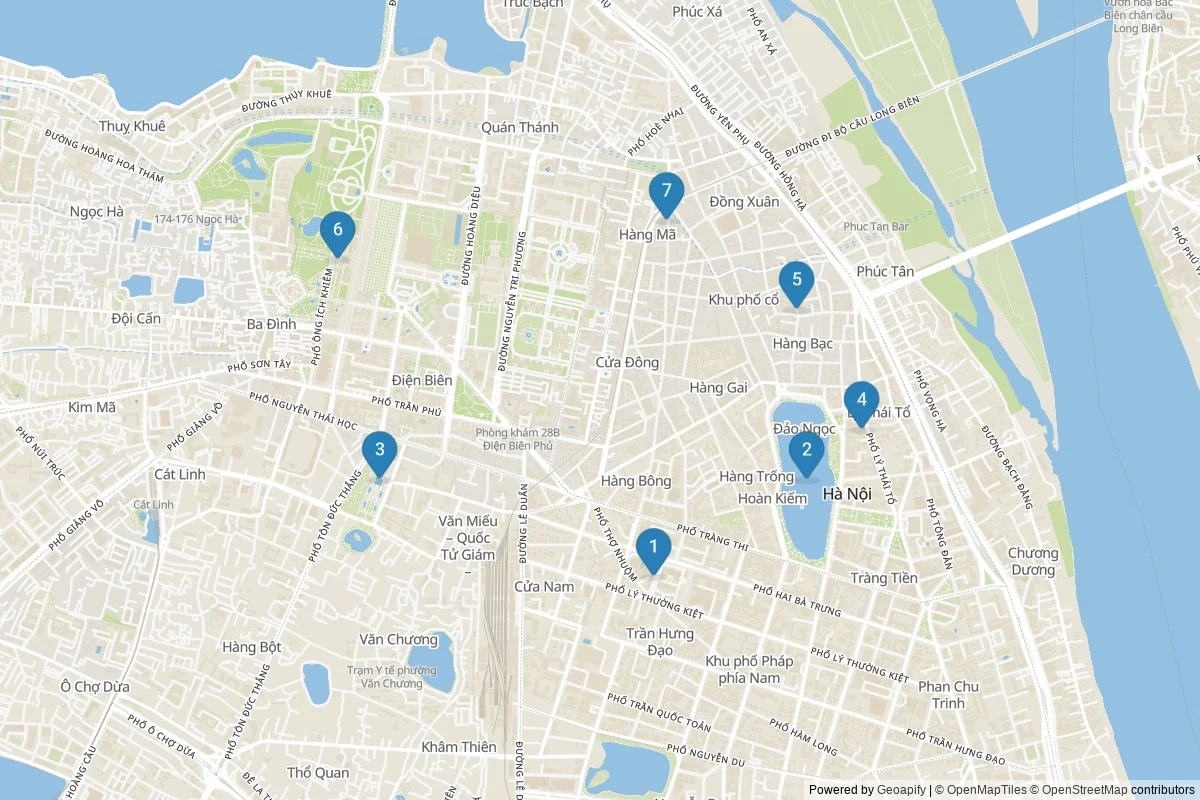
| # | Sight | Cluster | Type | Time | Entry | Best |
|---|---|---|---|---|---|---|
| 1 | Hoa Lo Prison (‘Hanoi Hilton’) | Central | Historical site | ~1.5 hrs | 30,000₫ | Morning |
| 2 | Hoan Kiem Lake & Ngoc Son Temple | Central | Lake & temple | ~1 hr | 30,000₫ | Morning |
| 3 | Temple of Literature (Văn Miếu) | Central | Confucian temple | ~1.5 hrs | 30,000₫ | Morning |
| 4 | Thang Long Water Puppet Theatre | Central | Cultural show | ~1 hr | 100,000₫ | Evening |
| 5 | Old Quarter Walk | Central | Historic district | ~3 hrs | Free | Morning |
| 6 | Ho Chi Minh Mausoleum & Ba Dinh | Central | National monument | ~1.5 hrs | Free | Morning |
| 7 | Bun Cha (Obama/Bourdain spot) | Central | Culinary | ~1 hr | 85,000₫ | Lunch |
| 🚗 | Day Trip: Ha Long Bay | Day trip | UNESCO bay | Full day | $80–150 | Morning |
1. Walk the Old Quarter
The defining Hanoi experience — a self-guided morning wander through the 36 Streets. Suggested loop: start at Đồng Xuân Market (the largest wholesale market), south through Hàng Mã (the paper-and-funeral-offerings street, particularly atmospheric before Tết), to Hàng Bạc (silver), past the Bach Ma Temple (the Old Quarter’s oldest, 9th century), south on Hàng Dao (silk), ending at Hoan Kiem Lake. Best at 6:30 am when residents do tai chi by the lake, or in the evening when “bia hơi” street-beer corners come alive. Plan 3–4 hours.
2. Hoan Kiem Lake & Ngoc Son Temple
The city’s spiritual heart. The 16-hectare Hoan Kiem Lake (the “Lake of the Restored Sword,” from the founding legend of King Lê Lợi and the divine turtle) is ringed by paved walking paths and centered on the iconic Turtle Tower. The 18th-century Ngoc Son Temple sits on a small island reached by the bright-red Huc Bridge; the temple houses the preserved body of a giant softshell turtle (the last of the lake’s legendary species, died 2016). Entry to Ngoc Son ₫50,000 (~US$2).
3. Visit the Temple of Literature (Văn Miếu)
Vietnam’s first university, founded 1070 — the most important Confucian temple complex in the country. Five courtyards, each crossed through a ceremonial gate, lead through landscaped gardens to the Khue Van Pavilion and the Stelae of Doctors — 82 stone steles atop carved tortoises bearing the names of doctoral graduates from 1442 to 1779. The most peaceful and beautifully designed historic site in the city. Entry ₫70,000 (~US$3); plan 90 minutes.
4. Ho Chi Minh Mausoleum & Ba Dinh Complex
The country’s most-visited historical monument — the embalmed body of Hồ Chí Minh on display in a granite mausoleum in Ba Dinh Square. Free entry but with strict protocols (no hands in pockets, no cameras inside, no talking, no shorts or tank tops). The body is sent annually to Russia for re-preservation, meaning the mausoleum closes for 3 months a year (typically September–November). Combine with the Ho Chi Minh Museum, Presidential Palace grounds, and One Pillar Pagoda. Plan 3–4 hours.
5. Hoa Lo Prison (“Hanoi Hilton”)
The former French colonial prison where Vietnamese revolutionaries were jailed in the early 20th century, and where American POWs (including Senator John McCain) were held during the Vietnam War. The museum is openly polemical (the Vietnamese side of the war), but the historical artifacts and the preservation of the original 1896 prison structure are genuinely powerful. Entry ₫50,000; plan 90 minutes.
6. Eat Bun Cha (where Obama and Bourdain dined)
Hanoi’s signature dish: grilled pork patties and pork belly served in a fish-sauce broth with rice noodles and herbs. Bun Cha Huong Lien (24 Le Van Huu Street) became globally famous after President Obama and Anthony Bourdain ate there in May 2016; their plastic-stool table is preserved as a memorial. Other canonical addresses: Bun Cha Dac Kim (1 Hang Manh), Bun Cha Sinh Tu. ₫40,000–80,000 per portion.
7. Water Puppet Show (Múa Rối Nước)
The traditional Vietnamese art form — wooden puppets manipulated by hidden puppeteers standing waist-deep in water, performing Vietnamese folk tales accompanied by traditional music. The Thang Long Water Puppet Theatre next to Hoan Kiem Lake stages 8 daily 50-minute shows. Tickets ₫100,000–200,000 (~US$4–8). Touristy but uniquely Vietnamese.
8. Day Trip to Ha Long Bay
The 1,969-island UNESCO limestone-karst seascape is Hanoi’s defining side trip. 2.5 hours each way by Hanoi-Hai Phong-Ha Long expressway; tour operators offer 1-day, 2-day, and 3-day cruise options ($80–600+ per person depending on quality and duration). The full overnight cruise is the better experience; day trips feel rushed.
How to Get to Hanoi
By Air
Noi Bai International Airport (HAN), 28 km north of central Hanoi, is Vietnam’s busiest northern airport. Direct nonstop routes from most major Asian hubs (Bangkok, Singapore, Kuala Lumpur, Hong Kong, Tokyo, Seoul, Taipei, Hong Kong, all major Chinese cities), and direct from Paris, London, Frankfurt, Doha, Dubai, Istanbul. Domestic flights connect to Ho Chi Minh City (2 hours), Da Nang, Phu Quoc, Nha Trang, Hai Phong, and many others. Carriers: Vietnam Airlines, VietJet, Bamboo Airways, plus all major international carriers.
From the airport: Airport bus 86 ₫45,000 to central Old Quarter (75 minutes); Grab ₫300,000–500,000 to central Hanoi (50 minutes); airport shuttle van ₫220,000–350,000 per seat; private transfer arranged through hotels ₫400,000–700,000.
By Train
The Hanoi Railway Station (Ga Hà Nội) is the northern terminus of the Reunification Express and the gateway to the spectacular mountain railway to Sa Pa (Lao Cai). Reunification Express to Ho Chi Minh City: 32 hours, ₫650,000–1,400,000 depending on class. SP3/SP4 to Lao Cai (for Sa Pa): 8 hours overnight, ₫350,000–800,000. SE19 to Hue/Da Nang: 14 hours through the spectacular Hai Van Pass.
By Long-Distance Bus
Hanoi has multiple bus stations serving different directions: Giap Bat (south), My Dinh (west, including Sa Pa), Yen Nghia (south-west), Gia Lam (east, including Ha Long Bay direction). Sleeper bus to Sa Pa 6 hours overnight; open-tour buses to Hue, Hoi An, Nha Trang, and Saigon.
By Road / Self-Drive
The new Hanoi-Hai Phong-Ha Long Expressway (completed 2018) reaches Ha Long City in 2.5 hours. Self-drive is feasible but Vietnamese traffic is intense; most visitors hire drivers (₫1,500,000–3,000,000/day with driver).
Visa Notes
Vietnam offers visa-free entry for 45 days for citizens of 13 countries: UK, Germany, France, Italy, Spain, Russia, Denmark, Sweden, Norway, Finland, Japan, South Korea, Belarus. US, Canadian, Australian, New Zealand, and most other Western passport holders need an e-Visa from the Vietnam Immigration Department for stays up to 90 days; $25–50 fee processed in 3–5 working days. Passport must have at least 6 months remaining validity. Apply via the official government portal only.
Getting Around Hanoi
Walking
The Old Quarter and around Hoan Kiem Lake are genuinely walkable — the only realistic way to absorb the neighborhood texture. Watch for motorbikes on sidewalks and at all intersections; cross like locals do (move steadily, predictably, slowly — let motorbikes flow around you rather than stopping and starting). Weekend Walking Streets: Fri–Sun evenings 19:00–23:00, the streets around Hoan Kiem Lake close to traffic for pedestrian-only festival atmosphere with food stalls and games.
Grab & Ride-Hailing
Grab is the default and most reliable option for visitors. Reliable, transparent pricing, English-language app. Grab cars in central Hanoi ₫50,000–150,000; airport-to-Old-Quarter ₫280,000–450,000. Grab Bike (motorbike taxi) ₫25,000–60,000 — much faster in traffic for solo travelers.
Taxis
Mai Linh and Vinasun branded taxis run reliable meters. Insist on the meter; avoid unmarked airport/tourist-area taxis that often double-charge. Fares typically ₫13,000 flagfall + ₫16,000/km.
Motorbike Rentals
Self-drive scooter rentals ₫120,000–300,000/day. Important: Vietnam legally requires foreigners to hold an international driving permit (IDP) under the 1968 Vienna Convention plus a national license — many rental shops don’t check, but local police checkpoints do, and accidents without proper documentation void all insurance and travel coverage. Helmets are mandatory and enforced. Hanoi traffic is intense; not recommended for first-time motorbike users.
Public Buses
Hanoi has an extensive city bus network — modern air-conditioned buses on most routes; fares ₫7,000–10,000 per ride. Useful for longer cross-city journeys; signage primarily in Vietnamese. The Hanoi Metro Line 2A opened 2021 (the elevated Cat Linh–Ha Dong line, 13 km) — first operational urban-rail line in Vietnam.
Cyclo (Xích Lô)
The historic bicycle-rickshaw, increasingly tourist-oriented. Standard tourist route around the Old Quarter ₫150,000–300,000 for a 45-minute loop. Negotiate the price before boarding.
Food & Drink in Hanoi
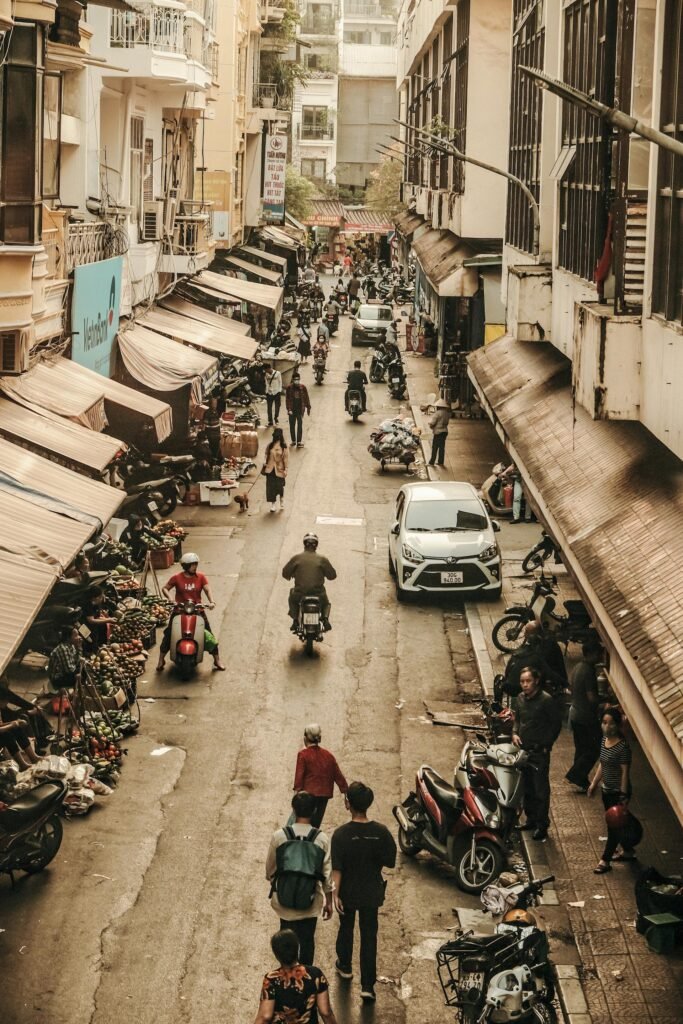
Hanoi’s food culture is widely considered Vietnam’s most refined — northern Vietnamese cuisine emphasizes light, layered flavors with restrained heat, abundant fresh herbs, and the country’s purest noodle traditions. The street-food scene is genuine, accessible, and remarkably affordable.
What to Try
- Phở — the Vietnamese national dish was born in Hanoi; the northern (Hà Nội) version uses a clearer beef broth, flat rice noodles, thinly sliced rare beef, scallions, and minimal accompanying herbs (the more elaborate southern Saigon-style version has more accoutrements). Pho Bat Dan, Pho Gia Truyen Bat Dan, Pho Thin Lo Duc, Pho 10 Ly Quoc Su are canonical.
- Bún Chả — Hanoi’s defining lunch dish: grilled pork patties and belly in fish-sauce broth, served with rice noodles, fresh herbs, and pickles. Bun Cha Huong Lien (Obama-Bourdain), Bun Cha Dac Kim.
- Chả Cá — turmeric-marinated fish grilled at your table with dill and scallions, eaten with rice noodles and dipping sauce. Cha Ca La Vong (since 1871) is the original restaurant; the street it occupies (Chả Cá Street) is named for the dish.
- Bánh Cuốn — steamed rice-flour crepes filled with minced pork and wood-ear mushroom, served with fish-sauce dip; the Hanoi breakfast staple. Banh Cuon Gia Truyen on Cua Bac is canonical.
- Bún Riêu — crab-and-tomato noodle soup, a freshwater specialty of the Red River Delta.
- Bánh Mì — Vietnamese baguette sandwich; Hanoi versions are less elaborate than Saigon’s but excellent.
- Cà Phê Trứng (Egg Coffee) — Hanoi’s most-loved 1940s invention: hot Vietnamese coffee topped with whipped sweetened egg yolk creating a tiramisu-like custard layer. Cafe Giang (39 Nguyen Huu Huan, since 1946) is the original. Cafe Dinh (13 Dinh Tien Hoang) is the canonical alternative.
- Bia Hơi — fresh draft beer served at street-corner plastic-stool spots; brewed daily, low alcohol (4%), drunk by the glass for ₫10,000 (~US$0.40). The Hanoi evening ritual. Bia Hoi Junction at the intersection of Ta Hien and Luong Ngoc Quyen is the famous tourist corner.
- Phở Cuốn — Hanoi-specialty rice-noodle rolls with beef and herbs, found in the West Lake neighborhood of Ngu Xa.
Where to Eat
Old Quarter: pho stalls, bun cha lunch spots, banh mi street vendors — pick by the queue. Cafe Giang and Cafe Dinh for egg coffee. Bia Hoi Junction for the street-beer evening. Cha Ca Street for cha ca la vong. French Quarter: Sofitel Metropole‘s Le Beaulieu and Spices Garden for upmarket French-Vietnamese fusion; La Verticale for fine-dining contemporary Vietnamese. Tay Ho (West Lake): hip cafés, expatriate restaurants. Madame Hien for elegant northern-Vietnamese in a restored French villa.
Drinks
Egg coffee + bia hơi as covered above. Cà phê sữa đá (iced milk coffee) — the universal Vietnamese morning drink. Trà đá (free iced tea) accompanies most street meals. Vietnamese craft beer: Pasteur Street Brewing, Heart of Darkness — both with Hanoi taprooms. Rượu nếp (sticky rice wine) at countryside restaurants.
A Note on Tap Water
Tap water in Hanoi is not safe to drink for foreign visitors. Use sealed bottled water (₫10,000–20,000 per 1.5-liter bottle at convenience stores; major brands Lavie, Aquafina, Vĩnh Hảo) for drinking and brushing teeth. Reusable filter bottles (LifeStraw, Grayl) work well. Reputable hotel and restaurant ice is generally safe; avoid street-stall ice. The CDC traveler health page for Vietnam recommends bottled or boiled water plus consideration of hepatitis A, typhoid, and Japanese encephalitis vaccinations before travel. Traveler’s diarrhea is the most common visitor complaint; eat at busy, established places where food turnover is high.
Frequently Asked Questions About Visiting Hanoi
Do I need a visa to visit Hanoi?
It depends on your passport. Vietnam offers 45-day visa-free entry for citizens of 13 countries: UK, Germany, France, Italy, Spain, Russia, Japan, South Korea, Belarus, Denmark, Sweden, Norway, and Finland (expanded from 15 days in August 2023). US, Canadian, Australian, New Zealand, Indian, Chinese, and most other Western passport holders need an e-Visa from the Vietnam Immigration Department, applied for at the official e-Visa portal. Vietnam expanded e-Visa to all nationalities in August 2023 — fee $25 (single entry) to $50 (multiple entry), valid up to 90 days, processed in 3–5 working days. Common mistakes: using unofficial third-party sites that overcharge 100–300%; assuming the old visa-on-arrival sticker is still valid (it has been replaced by e-Visa); arriving with less than 6 months passport validity. Print two copies of the approved e-Visa to show at airline check-in and Vietnamese immigration. For longer stays, business visas (DN) require Vietnamese company sponsorship; student visas (DH) and work visas (LD) have separate application processes.
Is Hanoi safe for tourists?
Hanoi is broadly safe — one of Southeast Asia’s safer major capitals, with very low rates of violent crime against tourists. The US State Department rates Vietnam at “exercise normal precautions” — the most relaxed travel advisory level. Real risks in Hanoi: motorbike traffic — Hanoi has 7 million motorbikes for 8.5 million residents; crossing streets safely is a learned skill (walk steadily and predictably, let motorbikes flow around you); petty theft — bag-snatching by motorbike riders, especially around tourist crowds in the Old Quarter and Hoan Kiem Lake; scams — overpriced taxis from the airport (use Grab); “free cyclo tours” that demand inflated payment at the end; fake tour operators selling Ha Long Bay packages that don’t exist (book through hotels or reputable travel agents); “I’m a student practicing English” scams that lead to commission-paying shops; credit-card skimming at smaller ATMs (use bank-branch ATMs); airport taxi scams — meters mysteriously running fast; “cyclo emergency” where the cyclo driver suddenly stops and demands more money; flooding during monsoon season (May–October) can render some streets impassable. Drug laws: Vietnam imposes extremely harsh penalties — multi-year prison sentences for trafficking even small amounts; capital punishment in extreme cases. Female travelers: Hanoi is among the safer Southeast Asian capitals for solo female travel; standard precautions apply. Cultural sensitivities: dress modestly at temples (covered shoulders and knees); never criticize Ho Chi Minh or the Vietnamese government in public; photography of military installations is forbidden.
How many days do I need in Hanoi?
Three to four days handles Hanoi well; combined with Ha Long Bay and Sa Pa, 7–10 days makes a comprehensive northern Vietnam trip. A solid 4-day Hanoi plan: Day 1 — Old Quarter walking tour + Hoan Kiem Lake + Ngoc Son Temple + bun cha lunch + water puppet show evening + bia hơi at Ta Hien street corner. Day 2 — Temple of Literature morning + Ho Chi Minh Mausoleum + Ba Dinh Complex + lunch at French Quarter + Hoa Lo Prison afternoon. Day 3 — West Lake circle + Tran Quoc Pagoda + Quang An flower market dawn + lunch in Tay Ho + Cafe Giang egg coffee + Old Quarter evening pho dinner. Day 4 — Long Bien Bridge walk to east bank banana plantations or motorbike tour of countryside or Vietnamese cooking class. Add Days 5–6 for Ha Long Bay overnight cruise (the canonical add-on). Add Days 7–8 for Sa Pa (overnight train to Lao Cai + Sa Pa rice-terrace trekking). Day-trip Hanoi from Ha Long: feasible for Old Quarter + Hoan Kiem + bun cha but too rushed. For longer trips: add Hue + Hoi An + Ho Chi Minh City for the country-spanning Vietnam classic (3 weeks total).
What’s the best area to stay in Hanoi?
For first-time visitors, Old Quarter (Hoàn Kiếm District) is the obvious default — walkable to most major sights, atmospheric, dense restaurant and accommodation choices. Recommended sub-areas within the Old Quarter: around Hang Bac Street (less intense than the main tourist drag of Ta Hien); between Hoan Kiem Lake and Dong Xuan Market; near Hang Bo / Hang Da (quieter side streets). Pricing: budget hostels ₫150,000–400,000/night per dorm bed; mid-range converted-tube-house hotels and boutique guesthouses ₫800,000–2,500,000/night; luxury hotels (Sofitel Metropole, Apricot Hotel) ₫4,000,000–15,000,000/night. French Quarter (south of Hoan Kiem Lake) — quieter, more upmarket; the Sofitel Metropole (1901) is the country’s most legendary hotel; ₫1,500,000–8,000,000/night for international chains and boutique options. Tay Ho (West Lake) — 30 minutes from the Old Quarter; quieter, lakeside, lots of expat-favored restaurants and cafés; ₫1,200,000–4,000,000/night; better for longer stays and digital-nomad travelers. Ba Dinh District — near the political sites but lacking restaurant atmosphere; not the best base. Skip: cheap unbranded hotels far from any central district — saving ₫200,000/night isn’t worth the daily commute to where you want to be.
How much does it cost to visit Hanoi’s major sights?
Hanoi is one of the world’s most affordable major capital cities. Hoan Kiem Lake: free. Ngoc Son Temple: ₫50,000 (~US$2). Temple of Literature: ₫70,000 (~US$3). Ho Chi Minh Mausoleum: free entry (closed September–November typically). Ho Chi Minh Museum: ₫40,000. One Pillar Pagoda: free. Imperial Citadel of Thang Long: ₫70,000. Hoa Lo Prison: ₫50,000. Water puppet show: ₫100,000–200,000. Vietnamese cooking class: ₫700,000–1,400,000 (~US$28–55) per person. Old Quarter cyclo tour: ₫150,000–300,000 for 45 minutes. Local meals: pho breakfast ₫35,000–80,000; bun cha lunch ₫50,000–120,000; sit-down Vietnamese dinner ₫150,000–400,000 per person; egg coffee ₫25,000–60,000; bia hơi ₫10,000–25,000 per glass; mid-range restaurant ₫250,000–500,000 per person; fine-dining ₫800,000–3,000,000 per person. Grab across the city: ₫50,000–150,000; airport-to-Old-Quarter ₫280,000–450,000. Ha Long Bay day tour: ₫1,200,000–3,500,000 per person; 1-night cruise: ₫2,000,000–8,000,000 per person; 2-night cruise: ₫4,000,000–15,000,000 per person. Overall daily budget: ₫600,000 (frugal hostel + street food + cyclo + walking), ₫2,000,000 (mid-range), ₫6,000,000+ (luxury).
Should I drink the tap water in Hanoi?
No — tap water in Hanoi is not safe to drink for foreign visitors. The Hanoi Water Supply Company treats the municipal supply, but the distribution network passes through older building plumbing where contamination is widespread; most locals boil or filter their drinking water. Always use sealed bottled water (₫10,000–20,000 per 1.5-liter bottle at any convenience store; major brands Lavie, Aquafina, Vĩnh Hảo) for drinking and brushing teeth. Reusable filter bottles (LifeStraw, Grayl, Sawyer 0.1-micron filter) work well in Vietnam. Hotel kettles boil water reliably. Ice: at mid-range and upmarket restaurants, ice is machine-made from purified water and generally safe; avoid ice from street stalls without clear bottled-water sources. The CDC traveler health page for Vietnam recommends bottled or boiled water plus consideration of hepatitis A, typhoid, hepatitis B, and Japanese encephalitis vaccinations before travel. Air pollution is the more chronic Hanoi health concern — particulate matter (PM2.5) levels are routinely 3–5× WHO guidelines, with the worst air quality from October–March; sensitive travelers may want N95 masks for outdoor walking, especially near major roads.
What payment methods work in Hanoi — cash or cards?
Hanoi remains heavily cash-dominant in working-Vietnamese transactions, with credit cards usable at international-tier establishments. Vietnamese dong (VND): essential for street food, motorbike taxis, markets, smaller restaurants, bia hơi, and souvenir shops. Credit/debit cards (Visa, Mastercard, JCB; AmEx less universal): accepted at international hotels, mid-range and upmarket restaurants, supermarkets, Grab, and many fixed-price shops; smaller restaurants and street food are cash-only. ATMs: abundant in central Hanoi (Vietcombank, BIDV, Techcombank, ACB, Sacombank) accept foreign cards with daily withdrawal limits ₫2,000,000–5,000,000 per transaction and international fees ₫55,000–110,000 plus your home bank’s. Currency exchange: avoid airport exchange counters (poor rates); go to Hà Trung Street in central Hanoi (Vietnam’s traditional gold-and-currency market with the best rates) or to bank-branch exchange counters; bring USD or EUR in clean bills (high-denomination notes get better rates; ripped or marked bills are often rejected). USD acceptance: surprisingly common in tourism — many hotels, tour operators, and even some restaurants accept USD directly at slightly unfavorable rates. Mobile payment: VNPay, Momo, ZaloPay dominate locally but require Vietnamese phone numbers; not realistic for short-stay visitors. Tipping: not strongly ingrained in Vietnamese culture but increasingly expected in tourism contexts — round up taxi fares; restaurants 5–10% in cash; ₫10,000–25,000 per bag to hotel porters; ₫50,000–150,000 per day for tour guides; ₫500,000–1,000,000 total for multi-day cruise crew shared tip jars. Tip in Vietnamese dong primarily; USD for cruise crew tips is also acceptable.
What about Old Quarter motorbike crossing and overall navigation?
Crossing Old Quarter streets is a real challenge worth understanding. Hanoi has approximately 7 million motorbikes for its 8.5 million residents — the highest motorbike density per capita of any major city in the world. How to cross safely: do not stop or jump back once you start crossing — motorbikes have learned to flow around predictable, steadily moving pedestrians; sudden stops cause accidents. Walk at a steady, slow pace; make eye contact with motorbike drivers; let the motorbikes flow around you. Cars and trucks are different — they cannot flow around you, so wait for clear gaps before they pass. Pedestrian crossings exist but are largely advisory rather than enforced; treat them as suggestions. Walking sidewalks: most Old Quarter sidewalks are occupied by parked motorbikes, fruit-vendor stalls, plastic-stool seating, and laundry; pedestrians frequently walk in the street, which works as long as you stay close to the curb. Apps: Google Maps works reasonably well in Hanoi; Grab has built-in navigation. Local landmarks: most streets in the Old Quarter are named for the goods historically sold there (Hang Bac = Silver, Hang Mã = Paper, Hang Đào = Silk, Hang Bồ = Baskets) — useful for orientation. Don’t drive yourself: Hanoi traffic is genuinely intense; first-time visitors should not attempt to drive motorbikes or cars. Hire Grab, Grab Bike for solo travelers (much faster in traffic), or arrange private cars with hotel-recommended drivers for day-tour purposes. Pedestrian-only weekends: Friday-Saturday-Sunday evenings 19:00–23:00, the streets around Hoan Kiem Lake close to motor traffic for a pedestrian-festival atmosphere with food stalls and traditional-music performances.
Education & Notable People
Hanoi is Vietnam’s educational capital — home to the country’s top public universities, traditional centers of Vietnamese scholarship, and the country’s leading research institutions.
Major Universities
- Vietnam National University, Hanoi (VNU) — the country’s flagship public research university, established 1993 as a federation of older institutions; ~50,000 students; particularly strong in humanities and social sciences.
- Hanoi University of Science and Technology (HUST) — the country’s leading technical university, founded 1956; ~30,000 students; comparable to MIT or IIT in regional reputation.
- Hanoi Medical University — the country’s premier medical school, founded 1902 under the French colonial regime.
- Foreign Trade University — the country’s leading business school, alma mater of Vietnamese diplomats and trade officials.
- Hanoi University — foreign-language and translation focus.
- National Economics University — economics and policy.
- Vietnam Maritime University — maritime, naval architecture, and logistics.
Notable People
Hồ Chí Minh (1890–1969) — the revolutionary leader and founding father of modern Vietnam, who declared independence from the steps of the Hanoi Opera House on September 2, 1945. His embalmed body is on permanent display in the Ba Dinh Square mausoleum. Võ Nguyên Giáp (1911–2013) — the military strategist who defeated the French at Dien Bien Phu (1954) and led North Vietnamese forces through the Vietnam War. Trần Hưng Đạo (1228–1300) — the 13th-century general who defeated three successive Mongol invasions, a foundational figure in Vietnamese national identity. King Lê Lợi — founder of the Lê dynasty (1418), associated with the Hoan Kiem Lake sword legend. Hữu Loan — celebrated 20th-century poet. Nguyễn Du — 18th–19th-century poet whose Tale of Kiều is Vietnam’s national epic. Trần Văn Khê — the world-renowned musicologist who preserved Vietnamese traditional music. Nguyễn Phú Trọng — General Secretary of the Communist Party of Vietnam 2011–2024.
Sister Cities & International Relations
Hanoi’s sister-city network reflects its identity as the political capital of Vietnam and a long-time partner in non-aligned and communist-bloc diplomacy.
Hanoi’s sister and partnership cities include (selection):
- Beijing, China — capital-cities partnership.
- Bangkok, Thailand — ASEAN regional partnership.
- Vientiane, Laos — historic Indochina partnership.
- Phnom Penh, Cambodia — Indochina cooperation.
- Moscow, Russia — paired since the Soviet era; cultural-and-political friendship.
- Saint Petersburg, Russia — friendship city.
- Toulouse, France — paired since 1996; cultural exchange.
- Île-de-France region, France — broader Hanoi-Paris partnership.
- Ankara, Türkiye — friendship link.
- Seoul, South Korea — paired since 1996.
- Tokyo, Japan — friendship link.
- Jakarta, Indonesia — ASEAN partnership.
Hanoi is the seat of all Vietnamese government ministries and the headquarters of the Communist Party of Vietnam. The city hosts all foreign embassies to Vietnam and plays a leading role in ASEAN diplomatic cooperation (Vietnam was ASEAN Chair in 2020 and 2020). The post-1995 normalization with the United States, the 2007 WTO accession, and the country’s growing trade integration with China, Japan, Korea, and the EU have positioned Hanoi as one of Southeast Asia’s most consequential diplomatic capitals. The Vietnam National Administration of Tourism promotes Hanoi as the cultural heart of the country.
AFRIKA
Cairo Hurghada Johannesburg Marrakech
ASIA
Abu Dhabi Agra Antalya Bangkok Batam Beijing Bengaluru Cebu City Chiang Mai Chiba Chennai Da Nang Dammam Delhi Denpasar Dubai Fukuoka Guangzhou Guilin Ha Long Hanoi Ho Chi Minh City Jakarta Jaipur Johor Bahru Kolkata Krabi Kuala Lumpur Kyoto Macau Mecca Medina Mugla Mumbai Osaka Pattaya Penang Phuket Riyadh Seoul Shanghai Shenzhen Singapore Taipei Tokyo Zhuhai
EUROPE
Amsterdam Athens Barcelona Berlin Brussels Budapest Copenhagen Dublin Florence Frankfurt am Main Heraklion Krakow Lisbon London Madrid Milan Munich Nice Paris Porto Prague Rhodes Rome Stockholm Venice Vienna Warsaw
NORTH AMERICA
Cancun Las Vegas Los Angeles Miami New York City Orlando San Francisco Toronto Vancouver
SOUTH AMERICA
Buenos Aires Lima Rio De Janeiro
OCEANIA
Auckland Honolulu Melbourne Sydney