
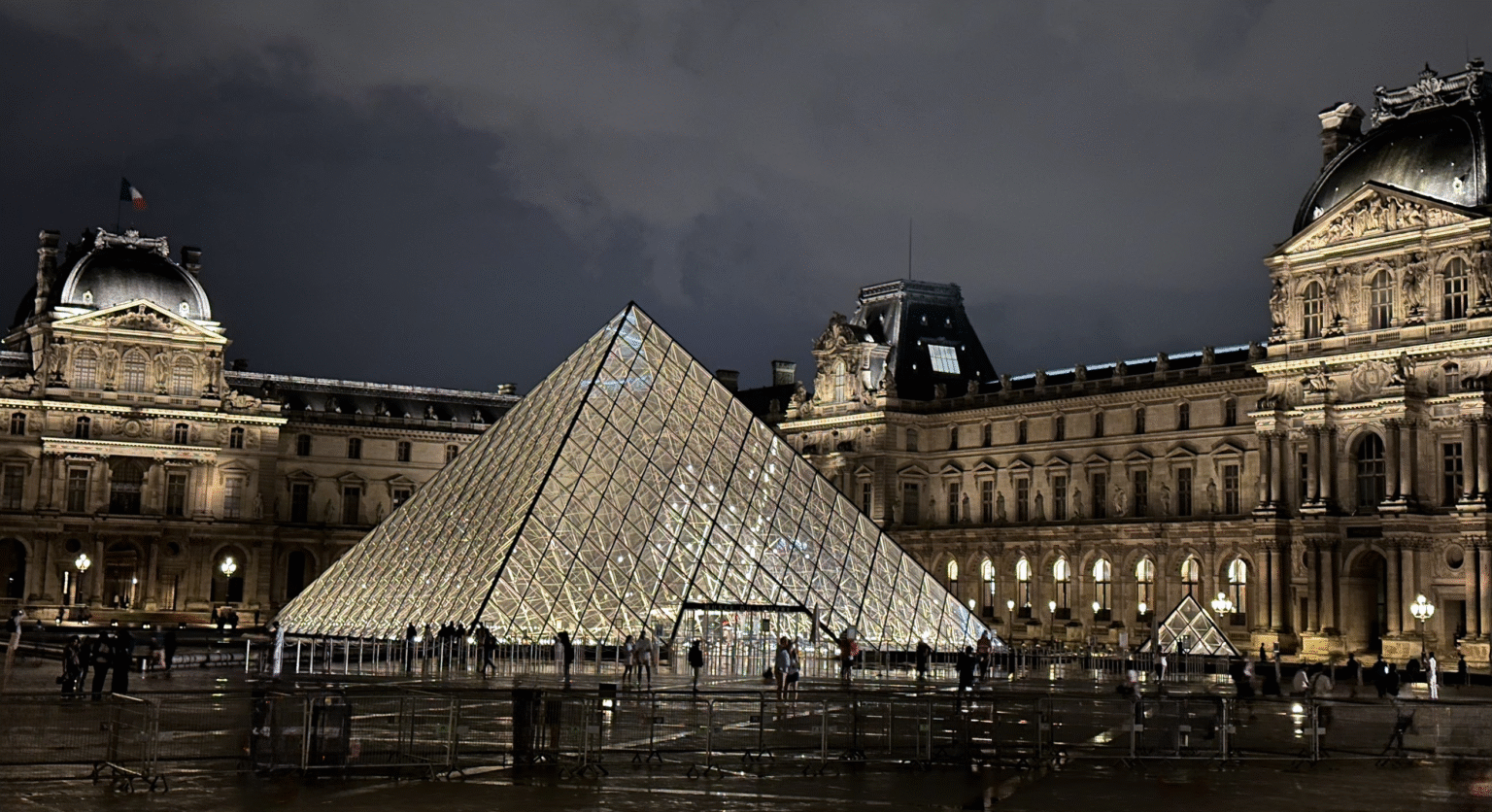
Paris is a city that rewards walking. Compress two thousand years of history, the world’s most influential museum collection, the building blocks of modern cuisine, and a working capital of 2.1 million into 105 square kilometers, and you get a place where the next discovery is almost always one bridge away. The 20 arrondissements spiral outward from the Île de la Cité like a snail shell — Roman foundations underneath, Gothic in the cathedrals, Haussmann’s cream-coloured boulevards in the middle, glass-pyramid modernism wherever a president decided to leave a mark. This guide covers what works on the ground: which arrondissements reward an unhurried day, the museums worth the queue and the ones worth booking instead, the food worth chasing past the tourist menus, and how to navigate a city built more for pedestrians than any other capital its size.
Paris at a Glance: Essential Facts for Travelers
Paris: Key Facts & Tourism Statistics
| International arrivals | 22.6 million (2024, international tourists, Greater Paris Region) — Choose Paris Region / CRT Paris Region, 2024 tourism results (press release, March 2025) |
|---|---|
| Population | 2.1 million (2022, INSEE) |
| Best time to visit | April, May, June, September and October |
| Airport to city centre | RER B (from CDG): ~35 min, ~US$15.5 |
| Currency | Euro (EUR) |
| Time zone | UTC+1/+2 (CET/CEST) |
| Visa | Schengen rules apply: visa-free short stays for many nationalities, up to 90 days in 180. |
How many tourists visit Paris per year?
Paris recorded 22.6 million international tourists, Greater Paris Region (Île-de-France) in 2024, according to Choose Paris Region / CRT Paris Region, 2024 tourism results (press release, March 2025).
What is the best time to visit Paris?
The most comfortable months to visit Paris are typically April, May, June, September and October, based on 1991–2020 climate normals for temperature and rainfall.
How do I get from the airport to central Paris?
The RER B (from CDG) takes about 35 minutes to the city centre for about US$15.5 (EUR 14 Paris Region Airports ticket (2026)).
What currency is used in Paris?
Paris uses the Euro (EUR); the local time zone is UTC+1/+2 (CET/CEST).
Do I need a visa to visit Paris?
Schengen rules apply: visa-free short stays for many nationalities, up to 90 days in 180.
How many people live in Paris?
Paris has a population of about 2.1 million (city proper; Paris Region (Île-de-France) ~12.3M), per INSEE (2022).
Paris climate: monthly averages (1991–2020)
| Month | Avg high | Avg low | Rain |
|---|---|---|---|
| Jan | 7.1 °C | 1.8 °C | 52 mm |
| Feb | 8.3 °C | 1.5 °C | 47 mm |
| Mar | 11.8 °C | 3.4 °C | 51 mm |
| Apr | 15.1 °C | 5.7 °C | 50 mm |
| May | 18.6 °C | 9.4 °C | 66 mm |
| Jun | 21.8 °C | 12.6 °C | 58 mm |
| Jul | 24.1 °C | 14.8 °C | 54 mm |
| Aug | 24.3 °C | 14.7 °C | 58 mm |
| Sep | 20.6 °C | 11.8 °C | 48 mm |
| Oct | 16 °C | 8.9 °C | 61 mm |
| Nov | 10.7 °C | 5 °C | 59 mm |
| Dec | 7.5 °C | 2.3 °C | 68 mm |
Data last verified: 2026-09-01 · Climate: Open-Meteo ERA5 reanalysis, monthly normals computed from daily data 1991–2020 · Sources: Choose Paris Region/CRT (arrivals) · INSEE (population) · RATP/Île-de-France Mobilités (transfer) (primary source) · World’s most visited cities · Methodology
Upcoming Events in Paris
| Date | Title | Details |
|---|---|---|
| 2026-09-19 to 2026-09-20 | European Heritage Days | On the third weekend of September, the Journees europeennes du patrimoine throw open the doors of thousands of monuments across Paris, many of them normally closed to the public. Visitors can step inside the Elysee Palace, government ministries, historic mansions and hidden courtyards, with special tours, talks and activities laid on. It is a rare, mostly free chance to explore the city’s architectural treasures behind the scenes. Expect long queues at the most sought-after sites, so plan a route and arrive early for the popular addresses. [Source] |
| 2026-09-28 to 2026-10-06 | Paris Fashion Week | Paris Fashion Week is the grand finale of the international fashion calendar, when the world’s leading houses unveil their new womenswear collections in spectacular runway shows across the city. While the headline catwalk shows are invitation-only, the event electrifies Paris with pop-up boutiques, exhibitions, parties and star-studded street style around venues from the Grand Palais to historic hotels. Fashion lovers can soak up the atmosphere and spot celebrities, and some brands host public presentations. It runs from late September into early October, cementing Paris’s status as the capital of style. [Source] |
| 2026-10-03 | Nuit Blanche | For one night in early October, Nuit Blanche turns Paris into a free, open-air museum of contemporary art from dusk until dawn. Museums, galleries and public spaces across the city host installations, performances, light works and happenings, with crowds wandering between them late into the night. Many venues stay open for free, and public transport often runs extended hours. It is a magical, slightly surreal way to experience the city, blending art and nightlife. Pick up the programme in advance to map out the most striking installations before you set off. [Source] |
| 2026-10-07 to 2026-10-11 | Fete des Vendanges de Montmartre | Each October, the hilltop village of Montmartre celebrates its tiny working vineyard, the Clos Montmartre, with the Fete des Vendanges, a five-day harvest festival. The cobbled streets fill with food and wine stalls, tastings, a lively parade, concerts and fireworks over the Sacre-Coeur, all in a warm neighbourhood atmosphere. It is a charming, distinctly Parisian celebration of local heritage and conviviality. Wandering the festivities is free, while tastings and some events are ticketed. Come to sample regional produce and soak up the village spirit of old Montmartre. [Source] |
| 2026-10-13 to 2026-10-18 | Mondial de l’Auto (Paris Motor Show) | Held every two years, the Mondial de l’Auto, or Paris Motor Show, returns to the Paris Expo halls at Porte de Versailles in October 2026. One of the world’s oldest and largest car shows, it gathers global manufacturers to unveil new models, electric vehicles and concept cars, alongside test drives, displays and family activities. It is a major draw for motoring enthusiasts and the merely curious. Tickets are sold by day, with reductions for children and families, and popular weekend dates get busy. Check the official dates and book online in advance. [Source] |
| 2026-10-23 to 2026-10-25 | Art Basel Paris 2026 | Art Basel Paris returns to the Grand Palais from 23 to 25 October, gathering leading international galleries under the restored glass dome for one of the season’s most important contemporary art fairs. Alongside the main sector, curated presentations and public programmes spill into venues across the city during Paris Art Week, when museums and galleries time their biggest openings to coincide. Expect museum-quality work spanning modern masters to emerging names. Tickets for the public days are sold via the fair’s website at varying prices, and timed entry slots are recommended as sessions fill quickly. [Source] |
| 2026-10-28 to 2026-11-01 | Salon du Chocolat Paris 2026 | The world’s largest chocolate fair takes over Paris Expo Porte de Versailles from 28 October to 1 November, uniting chocolatiers, pastry chefs and cocoa producers from around the globe. Visitors can taste and buy from hundreds of exhibitors, watch demonstrations by star patissiers, and catch the famous chocolate fashion show, where couture dresses made of chocolate go on parade. Children’s workshops make it a family favourite during the autumn school holidays. Tickets are sold online at varying prices, and weekday mornings are noticeably calmer than the packed weekend sessions. [Source] |
City News in Paris – last 14 days
| Date | Category | Headline | Details |
|---|---|---|---|
| 2026-09-14 | Local affairs | Papal visit brings phased traffic and parking restrictions across Paris | Ahead of the Pope’s visit to Paris, authorities have laid out traffic and parking restrictions that roll out in several phases from 2 September until 10 October. Local media have published district-by-district guides so residents can check which streets are affected and when, with limits on circulation and stationing tightening around the sites involved in the visit. Parisians are advised to anticipate closures in their neighbourhood, plan alternative routes and expect a reinforced security presence during the key days of the programme. [Source] |
| 2026-09-14 | Public transport | Giant QR codes on bus stop displays puzzle Paris passengers | Large QR codes have appeared on the information posts at Paris bus stops where waiting times are usually shown, surprising passengers who feared the classic displays were being scrapped. Ile-de-France Mobilites has explained that the codes are a new addition and do not replace conventional passenger information: travellers can scan them for real-time timetables and route details on their phones, while the usual on-screen information remains part of the network. The authority says the aim is to complement, not substitute, the existing displays at stops. [Source] |
| 2026-09-14 | Public safety | Outrage after man films himself riding the roof of a line 6 metro train | A man climbed onto the roof of a moving line 6 metro train and filmed himself, phone in hand, as he ran along the top of the carriage. The stunt, shared on social media, drew swift condemnation: the RATP denounced the act and regional transport chief Valerie Pecresse called it irresponsible, warning of the extreme dangers of so-called subway surfing on a network with live equipment and low clearances. The operator has condemned the behaviour and such acts can carry legal consequences for those involved. [Source] |
| 2026-09-14 | Business | Gibert bookshops confirm 24 job cuts in Paris stores | The management of the Gibert bookshop group has confirmed the elimination of 24 positions across its Paris stores, a heavy blow for the emblematic bookseller long associated with the Latin Quarter. In recent weeks employees had mobilised at the call of their unions, hoping to pressure the leadership into softening the plan. The confirmation of the cuts lands amid a difficult period for traditional booksellers in the capital, squeezed by online competition, changing student habits and the rising costs of operating large city-centre retail spaces. [Source] |
| 2026-09-14 | Business | Krispy Kreme closes several Paris shops less than three years after splashy debut | American doughnut giant Krispy Kreme has closed three of its Paris outlets in recent months, less than three years after its much-hyped arrival in the capital in 2022, when opening-day queues stretched around the block. The retrenchment underlines how hard the Paris food retail market can be for foreign chains, which face steep rents, fickle consumer enthusiasm once novelty fades, and formidable local competition from the city’s own bakeries and patisseries. The brand’s remaining locations continue to operate. [Source] |
| 2026-09-14 | Local government | New Bobigny prosecutor wants to bring AI into the courthouse | Alexandre de Bosschere, who took over at the head of the Bobigny prosecutor’s office in early September, has set out his objectives for France’s second-largest jurisdiction, covering Seine-Saint-Denis. Among his priorities is bringing artificial intelligence into the tribunal’s work, a project he insists is not a story for geeks but a practical tool to help an overloaded justice system process cases more efficiently. His roadmap addresses how the prosecution service can modernise while handling one of the country’s heaviest caseloads. [Source] |
| 2026-09-13 | Public transport | RER and Transilien lines face a week of disruptions | Transport operators RATP and SNCF have detailed the disruptions awaiting passengers in Paris and the Ile-de-France region from Monday 14 to Sunday 20 September, with the main difficulties concentrated on the RER and Transilien networks. Maintenance and modernisation works mean altered timetables, interruptions on certain branches and replacement arrangements at various points of the week. Commuters are advised to check their line’s status before travelling, particularly for evening and weekend journeys when most of the engineering work is scheduled. [Source] |
| 2026-09-13 | Public safety | Metro line 15 site guard critically hurt by stray bullet in Aubervilliers | A security guard working at the line 15 construction site in Aubervilliers was left in a critical condition after being struck by a stray bullet fired during a confrontation in the surrounding neighbourhood. The man, an agent guarding the Grand Paris Express works, was seriously wounded and taken into emergency care. The shooting has heightened concerns about violence spilling over around major construction sites in the northern suburbs, where clashes between groups have repeatedly endangered bystanders. [Source] |
| 2026-09-13 | Culture | Celine Dion’s emotional return packs the Plenitude Arena and nearby restaurants | Celine Dion’s first concert at the Plenitude Arena on Saturday 12 September unleashed an avalanche of praise online, with fans describing an unforgettable night and many admitting they cried as the Canadian star returned to the Paris stage. The comeback is also proving an economic boon: according to the company Sunday, restaurant traffic in western Paris and the Hauts-de-Seine rose 18 percent in a week as concert-goers flooded the area around the venue. Her run of shows is expected to keep drawing crowds in the coming days. [Source] |
| 2026-09-13 | Sports | 29th La Parisienne race brings women runners through the capital | The 29th edition of La Parisienne, the flagship women-only running event of the Paris rentree, took place on Sunday 13 September with three separate races through the capital. Participants of all levels took to the course in a festive atmosphere that mixes competitive running with charity engagement and celebration of women’s sport. Results for all three races have been published by the organisers, closing out one of the city’s most popular early-autumn sporting traditions. [Source] |
| 2026-09-13 | Local affairs | Controversial director of the Maison de l’Argentine resigns | Santiago Muzio, the contested director of the Maison de l’Argentine student residence in Paris, has resigned after months of polemics surrounding his management. Appointed in 2024 by the government of Javier Milei, Muzio had faced sustained criticism over his running of the institution, which houses Argentine students and researchers in the Cite Internationale Universitaire. His departure ends a turbulent chapter for the house, whose community had repeatedly voiced discontent with decisions taken under his leadership. [Source] |
| 2026-09-08 | Local affairs | Eiffel Tower reopens after strike over sidelining of female staff | The Eiffel Tower reopened after remaining closed for a full day when employees walked out in protest at the sidelining of female staff during a Saturday visit by a delegation of the Hindu religious organisation BAPS. Workers, shocked that women had been kept away from the visitors, held a general assembly and said such conditions should never have been accepted. The movement forced the monument shut for the day, and the religious organisation subsequently presented its apologies for the episode. [Source] |
Paris Events & City News Archive
Sources: Journees du Patrimoine, Federation de la Haute Couture et de la Mode, Ville de Paris, Fete des Vendanges de Montmartre, Mondial de l'Auto, Art Basel, Salon du Chocolat, Actu Paris
Weather Forecast for the Next 14 Days in Paris
| Date | Weather | Max °F | Min °F | Rain mm |
|---|---|---|---|---|
| 2026-09-14 | ☁️ | 83.7 °F | 64.7 °F | 0.0 mm |
| 2026-09-15 | ☁️ | 90.2 °F | 66.1 °F | 0.0 mm |
| 2026-09-16 | ☁️ | 72.2 °F | 57.0 °F | 0.0 mm |
| 2026-09-17 | ☁️ | 70.4 °F | 54.3 °F | 0.0 mm |
| 2026-09-18 | ☁️ | 71.8 °F | 55.0 °F | 2.1 mm |
| 2026-09-19 | ☁️ | 76.9 °F | 61.0 °F | 0.1 mm |
| 2026-09-20 | ☁️ | 73.6 °F | 64.0 °F | 0.0 mm |
| 2026-09-21 | 🌧️ | 74.0 °F | 62.3 °F | 0.3 mm |
| 2026-09-22 | ☀️ | 78.9 °F | 58.5 °F | 0.0 mm |
| 2026-09-23 | ☀️ | 82.6 °F | 60.4 °F | 0.0 mm |
| 2026-09-24 | ⛅ | 85.3 °F | 62.3 °F | 0.0 mm |
| 2026-09-25 | 🌧️ | 82.3 °F | 63.7 °F | 3.9 mm |
| 2026-09-26 | 🌧️ | 65.7 °F | 54.2 °F | 0.9 mm |
| 2026-09-27 | 🌧️ | 68.6 °F | 55.7 °F | 7.5 mm |
Paris’s History
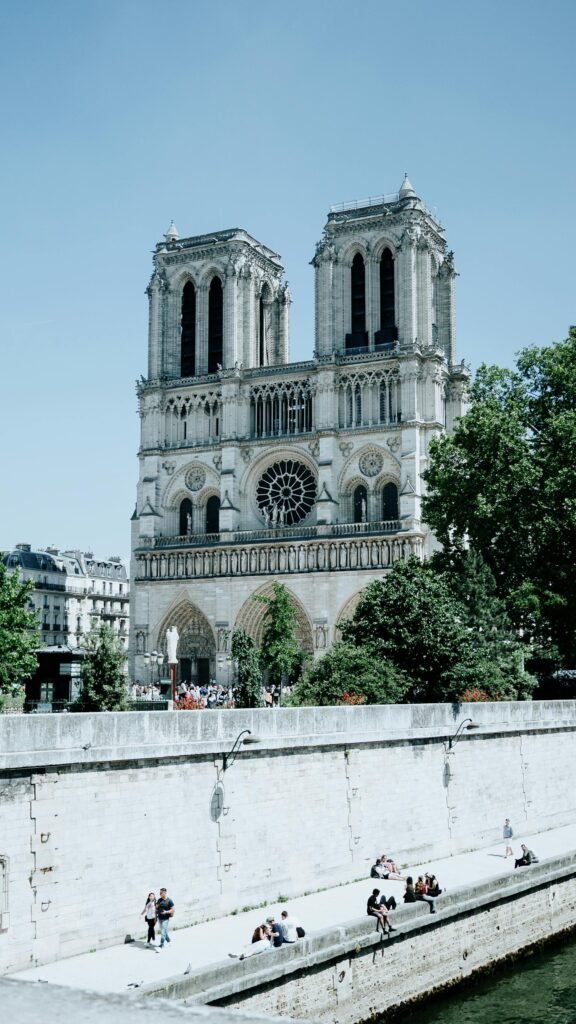
Paris has been continuously inhabited for over two millennia. Almost every layer is still visible somewhere in the city — Roman columns under a Latin Quarter church, medieval ramparts in a basement-level metro station, Haussmann’s 19th-century surgery on the street grid, the Centre Pompidou’s exposed pipework reading like a manifesto from the 1970s. The headline moments below are the ones that left the deepest physical mark.
Ancient Origins: From Lutetia to Paris
The city began over 2,000 years ago as Lutetia, a Celtic settlement of the Parisii tribe on the Île de la Cité. When Julius Caesar conquered Gaul in 53 BC the Romans transformed the river crossing into a thriving colonial city, building public baths, forums, and an amphitheater on the Left Bank. Remnants survive at the Arènes de Lutèce and the Cluny Baths — both visible to anyone wandering the 5th arrondissement today. By the 4th century the city had adopted the name Paris, derived from its original Celtic inhabitants.
Medieval Capital and Royal Power
The Merovingian dynasty made Paris their capital in the 5th century under King Clovis I. In the 12th century, Philip II Augustus transformed the medieval city with massive defensive walls and laid the groundwork for the Louvre as a fortress. The University of Paris, including what would become the Sorbonne, established the city as one of medieval Europe’s leading centers of learning. Despite the Hundred Years’ War and English occupation from 1420 to 1436, Paris endured as France’s political and cultural heart.
Renaissance and Royal Grandeur
The 16th and 17th centuries brought architectural marvels and the first systematic urban planning. Louis XIV modernized Paris with streetlights, improved water systems, and grand hospitals like Les Invalides; he replaced medieval walls with the Grands Boulevards and commissioned the magnificent royal squares that still anchor much of the central city. The Sun King eventually moved his court to Versailles, but Paris remained France’s intellectual and economic capital throughout.
Revolution and Transformation
Paris ignited the French Revolution on July 14, 1789, when a mob stormed the Bastille. The city became the epicenter of revolutionary fervor, witnessing the rise and fall of the monarchy in real time. The 19th century brought Napoleon’s architectural ambitions — the Arc de Triomphe and various monuments celebrating French glory — and then the most transformative project in the city’s history: Baron Haussmann’s massive urban renewal under Napoleon III (1853–1870), which created the wide boulevards, uniform building facades, and grand perspectives that define the Paris everyone now recognizes.
Belle Époque and World Wars
The late 19th and early 20th centuries marked Paris’s Belle Époque — a golden age of art, science, and innovation. The city hosted multiple World Expositions, including the 1889 fair that gave birth to the Eiffel Tower. Paris welcomed the 1900 and 1924 Summer Olympics, cementing its international status. Both World Wars brought occupation and hardship; the liberation of Paris on August 25, 1944, became one of the war’s defining symbolic moments.
Modern Metropolis
Post-war Paris evolved into a global city, balancing preservation of its historic character with bold new architecture. Successive presidents added their grands projets — the Centre Pompidou, the Louvre Pyramid, La Défense’s Grande Arche, the Opéra Bastille, the Philharmonie. Today, Paris continues to reinvent itself: the city hosted the 2024 Summer Olympics, has expanded its bike infrastructure dramatically under Mayor Anne Hidalgo, and is on a 2030 deadline to clean the Seine for swimming.
Geography, Climate & Best Time to Visit Paris
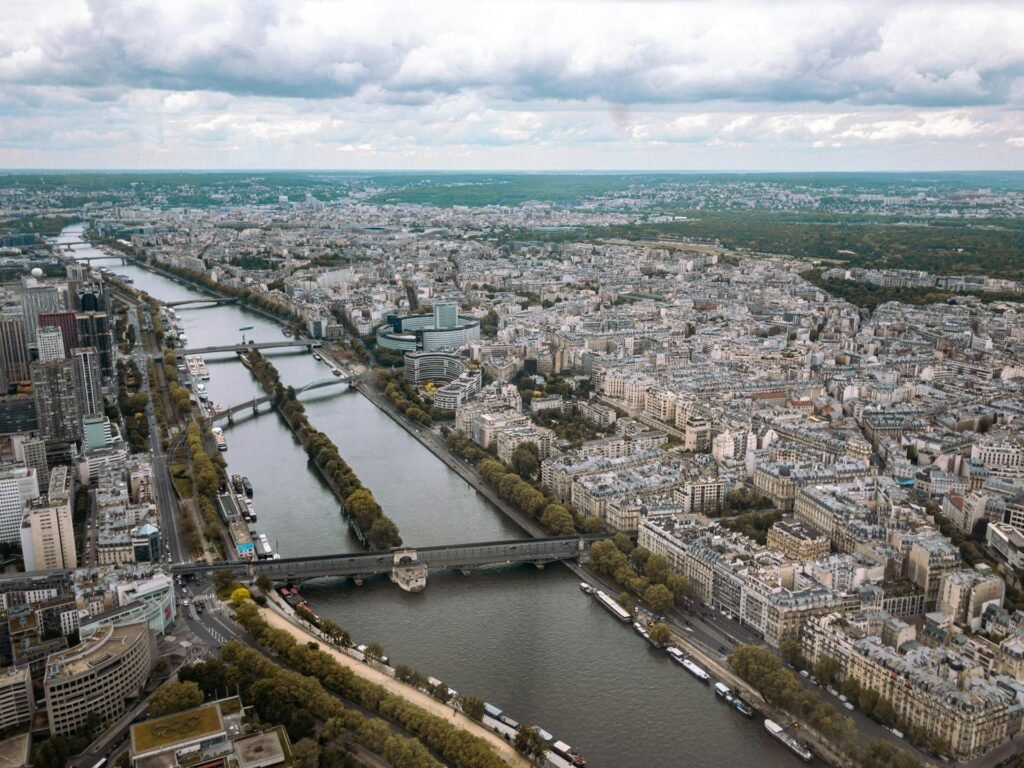
Paris sits in the gentle bowl of the Paris Basin in northern France, gently rolling between elevations of 28 and 130 meters. The Seine winds through the city in a soft S-curve, splitting it into the Right Bank (Rive Droite) and Left Bank (Rive Gauche) — the divide remains a real cultural marker, not just a geographic one. The city’s highest natural point is Montmartre at 130 meters, crowned by the Sacré-Cœur Basilica.
Geographic Setting
Two large forests, the Bois de Boulogne to the west and the Bois de Vincennes to the east, provide green lungs for the urban area and were both designed by Haussmann. The compact city center makes Paris one of Europe’s most walkable capitals — most major attractions sit within 5 km of each other, and the metro’s deepest weakness is that it sometimes makes you go underground when a 15-minute walk would have been more pleasant.
Climate and Weather Patterns
Paris enjoys a temperate oceanic climate with four genuine seasons. Average temperatures range from 4.7°C in January to 20°C in August; summer highs reach 24–25°C in normal years, with heat waves now regularly pushing into the 35–40°C range. Annual rainfall sits around 650 mm, distributed evenly through the year (May tends to be the wettest month). Sunshine hours vary dramatically — 1.5 hours of daily sun in December versus over 8 hours in June and July.
| Month | Avg High (°C) | Avg Low (°C) | Rainfall (mm) | Sunshine (hrs/day) |
|---|---|---|---|---|
| January | 7.8 | 3.6 | 54 | 1.9 |
| April | 15.5 | 7.5 | 53 | 6.0 |
| July | 24.6 | 15.5 | 63 | 7.8 |
| October | 15.8 | 9.2 | 60 | 4.1 |
Best Time to Visit
Spring (April–June) and fall (September–November) are the sweet spot — pleasant temperatures, manageable crowds, and the best of the city’s outdoor café and park culture. July and August are the peak tourist months and have the worst-of-both-worlds reputation: hottest weather, most crowded museums, and many beloved local restaurants close as Parisians take their own holidays. Winter (December–February) is genuinely quiet, perfect for museum visits and cozy bistro evenings, and the Christmas markets on the Champs-Élysées are now an established tradition.
Paris’s Districts & Neighborhoods
Paris is organized into 20 arrondissements that spiral outward from the city center like a snail shell, numbered clockwise. Each has its own character, hotel scene, and food culture, and the choice of where to base yourself shapes the trip more than any other planning decision.
Central Paris (1st–4th Arrondissements)
The historic heart includes the Louvre, Île de la Cité with Notre-Dame, and the always-trendy Marais. This area gives you walking access to the major monuments, the best concentration of small museums, and the most photogenic medieval streets in the city. Hotels range from Place Vendôme luxury to Marais boutique. The trade-offs: pricey, and parts of the 1st and 4th get overrun in summer.
Left Bank Classics (5th–7th Arrondissements)
The Latin Quarter (5th) buzzes with student energy around the Sorbonne and the Panthéon. Saint-Germain-des-Prés (6th) is the literary-café Paris of Hemingway’s A Moveable Feast, now somewhat priced into a luxury bracket but still atmospheric. The 7th holds the Eiffel Tower and Les Invalides, with elegant residential streets and embassy-quiet evenings. Charming boutique hotels, easy access to almost everything important, and a slower pace than the right bank.
Right Bank Grandeur (8th–9th Arrondissements)
The 8th encompasses the Champs-Élysées, the Arc de Triomphe, and the Golden Triangle of luxury shopping. The 9th holds the Opéra Garnier, Galeries Lafayette, and Printemps. Both are full of grand 19th-century hotels and excellent transport connections — and both are priced accordingly.
Trendy Eastern Districts (10th–12th Arrondissements)
Increasingly the move for visitors looking for authentic neighborhood Paris. Canal Saint-Martin in the 10th has become one of the city’s best food and bar scenes, the 11th around Oberkampf and Bastille is the city’s nightlife center, and the 12th includes the Bois de Vincennes. Hotel rates 20–40% below the central districts; metro connections to the headline sights remain easy.
Montmartre and Beyond (18th–20th Arrondissements)
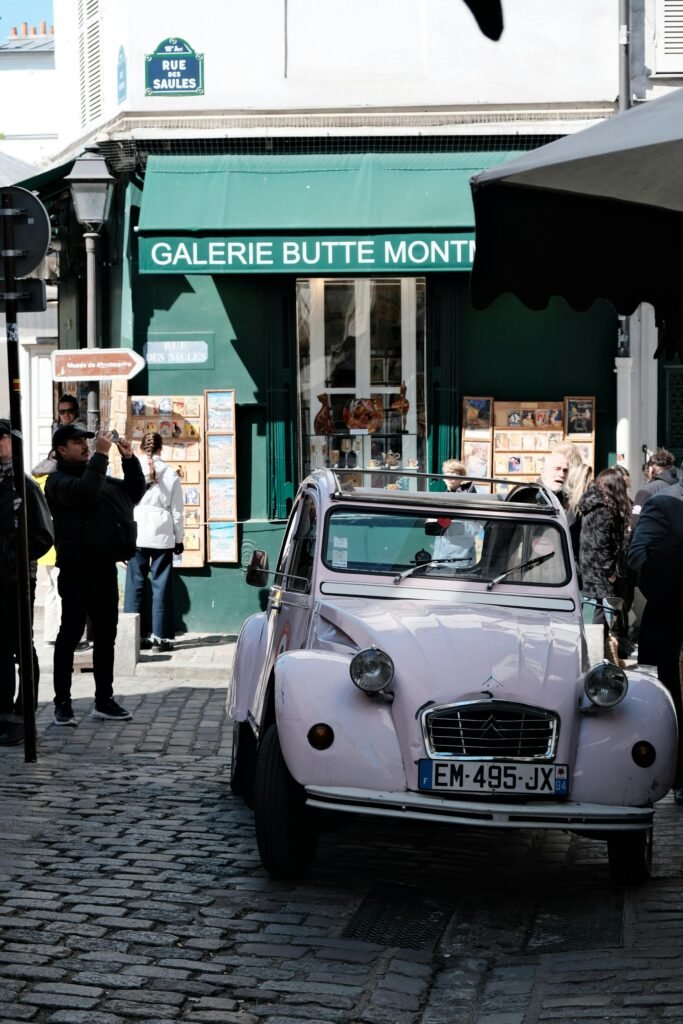
Montmartre (18th) provides the village-on-a-hill experience and the best free panoramic city view from in front of Sacré-Cœur. The eastern arrondissements like Belleville (19th–20th) offer multicultural neighborhoods, Père Lachaise cemetery, the Buttes-Chaumont park, and the most authentic working-class Paris that still exists in the city limits. Budget-friendly lodging for visitors willing to take the metro a few extra stops.
Top Things to Do in Paris
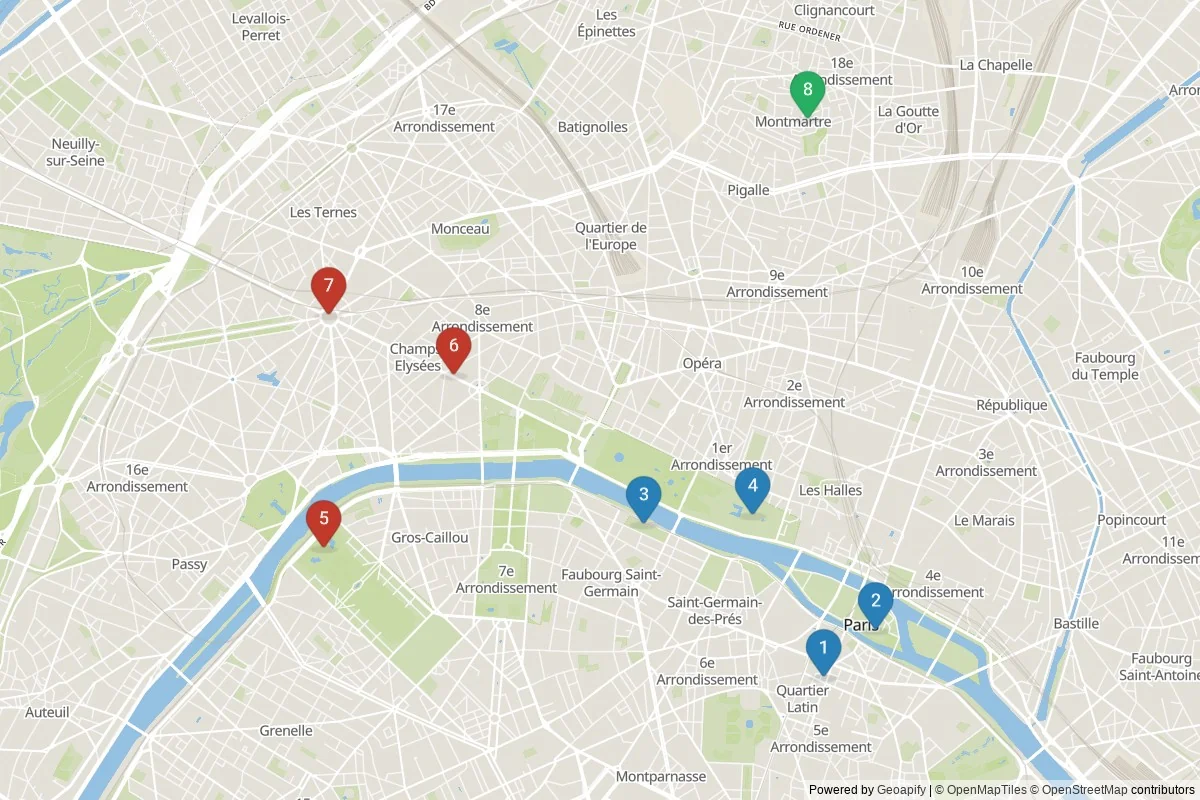
| # | Sight | Cluster | Type | Time | Entry | Best |
|---|---|---|---|---|---|---|
| 1 | Latin Quarter | Central | Old quarter | ~2 hrs | Free | Evening |
| 2 | Notre-Dame Cathedral | Central | Cathedral | ~1 hr | Free outside | Morning |
| 3 | Musée d’Orsay | Central | Art museum | ~2 hrs | €16 | Morning |
| 4 | Louvre Museum | Central | Art museum | ~3 hrs | €22 | Morning |
| 5 | Eiffel Tower | Outer | Iconic tower | ~2 hrs | €29 top | Sunset |
| 6 | Champs-Élysées | Outer | Boulevard | ~1 hr | Free | Afternoon |
| 7 | Arc de Triomphe | Outer | Monument | ~1 hr | €16 | Sunset |
| 8 | Montmartre & Sacré-Cœur | Far | Hilltop quarter | ~2 hrs | Free | Morning |
| 🚗 | Day Trip: Versailles | Day trip | Day trip | Full day | €21 | Morning |
| 🚗 | Day Trip: Mont-Saint-Michel | Day trip | Day trip | Full day | €11 | Morning |
The Paris checklist is long; the trick is sequencing. Pair major museums with nearby neighborhoods (Louvre + Tuileries + Palais Royal in one morning), reserve the time-slot tickets where possible (the Louvre and Eiffel Tower both reward booking ahead), and save evenings for walks, dinner, and the simple pleasure of looking at the city’s bridges lit up.
Iconic Landmarks
The Eiffel Tower remains the city’s most recognizable symbol and one of the rare landmarks that continues to deserve its hype — the hourly five-minute light sparkle on the hour after dark is theater on a scale few cities can match. Climb the levels for panoramic views or enjoy it from the Trocadéro gardens across the Seine, which gives you the best photo angle. Notre-Dame Cathedral reopened to the public in December 2024 after the post-2019-fire restoration; reservations are required for entry. The Arc de Triomphe anchors the Champs-Élysées and offers another commanding viewpoint over Haussmann’s grand boulevards.
World-Class Museums
The Louvre — the world’s most-visited museum, with collections that span humanity from ancient Sumer to 19th-century Europe. Plan at least half a day; book a timed-entry ticket online to skip the on-site queue. Musée d’Orsay in a converted Belle Époque train station holds the world’s finest Impressionist collection — Monet, Manet, Renoir, Cézanne, Van Gogh’s self-portraits — and is more emotionally satisfying than the Louvre for many visitors. Centre Pompidou houses modern and contemporary art behind its inside-out architecture; closes for renovation in late 2025. Musée Picasso in the Marais traces the master’s evolution across a hôtel particulier worth visiting in its own right.
Historic Neighborhoods
Wander the cobblestone streets of Montmartre, where Picasso, Renoir, and Toulouse-Lautrec once worked. The Place du Tertre has portrait artists, the Sacré-Cœur Basilica offers free panoramic views, and the funicular climbs the steepest part of the hill if you’d rather skip the stairs. The Marais combines medieval architecture with trendy boutiques, contemporary galleries, and the historic Jewish quarter centered on Rue des Rosiers. Saint-Germain-des-Prés remains the literary-café neighborhood, with Les Deux Magots and Café de Flore still serving on the same square that Sartre and de Beauvoir frequented.
Parks and Gardens
Luxembourg Gardens are the perfect Parisian green-space experience — manicured lawns, tree-lined promenades, the Medici Fountain, and the chairs that you can drag anywhere you want and sit in for free. Tuileries stretches from the Louvre to Place de la Concorde with sculpture-dotted paths and seasonal exhibitions. For larger green spaces, the Bois de Boulogne (west) and Bois de Vincennes (east) both offer lakes, walking trails, and rental boats.
Cultural Experiences
Attend a performance at the opulent Palais Garnier or the modern Opéra Bastille. Experience cabaret at the legendary Moulin Rouge or catch a concert at the historic Olympia. Browse the bouquinistes (the green-painted booksellers) along the Seine — UNESCO-listed since 1991 — for old prints, vintage magazines, and battered paperbacks. Take a Seine river cruise in the early evening for the best version of seeing the city from the water.
How to Get to Paris
By Air
Paris is served by four airports, of which two matter for most visitors. Charles de Gaulle (CDG), 25 km northeast, is Europe’s second-busiest airport with 69.5 million passengers a year and direct flights from most of the world. The RER B train reaches the city center in about 35 minutes for €11.80; taxis run a fixed fare of €56 to the right bank or €65 to the left bank. Orly (ORY), 13 km south, is the smaller second airport (32 million passengers); the Orlyval light rail to RER B is the standard transfer. Paris-Beauvais, 85 km north, primarily serves budget airlines and adds 1.5 hours of bus transfer to the trip — factor that into the price comparison. Le Bourget handles private aviation only.
By Rail
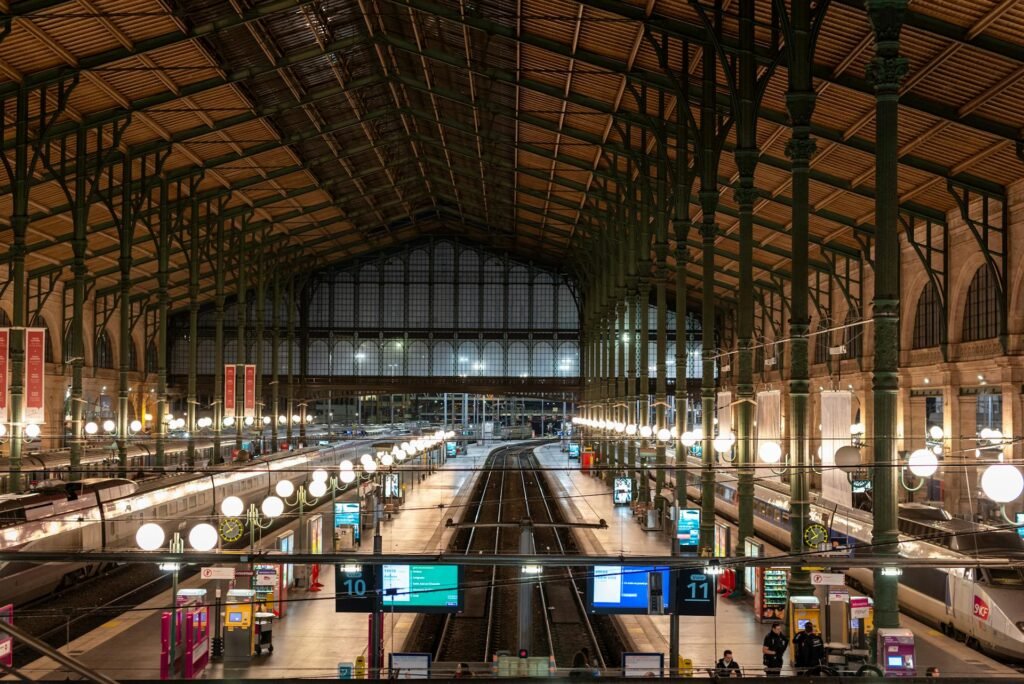
Paris is the hub of France’s extensive rail network. High-speed TGV trains connect to Lyon (2 hours), Marseille (3.5 hours), and Bordeaux (3.5 hours). International connections include Eurostar to London (2.5 hours), Brussels (1.5 hours), and Amsterdam (3.5 hours), plus ICE trains to Frankfurt and Munich. Six major stations divide by destination: Gare du Nord (UK, Belgium, Netherlands), Gare de Lyon (southeast France, Italy, Switzerland), Gare de l’Est (eastern France, Germany), Gare d’Austerlitz (southwest), Gare Montparnasse (western France), Gare Saint-Lazare (Normandy).
By Road
Paris sits at the center of France’s autoroute network. The Boulevard Périphérique ring road connects to A1 (from Lille), A4 (Reims and Strasbourg), A6 (Lyon), and A10 (Bordeaux). International coach services from FlixBus, BlaBlaCar Bus, and others arrive at Bercy and Porte Maillot terminals.
Getting Around Paris
Paris has the best urban transit system in Europe by some metrics — 16 metro lines, 5 RER suburban lines, dozens of bus and tram routes, and an aggressive recent buildout of bike infrastructure. For a visitor, the metro and walking will handle 95% of journeys.
Metro and RER
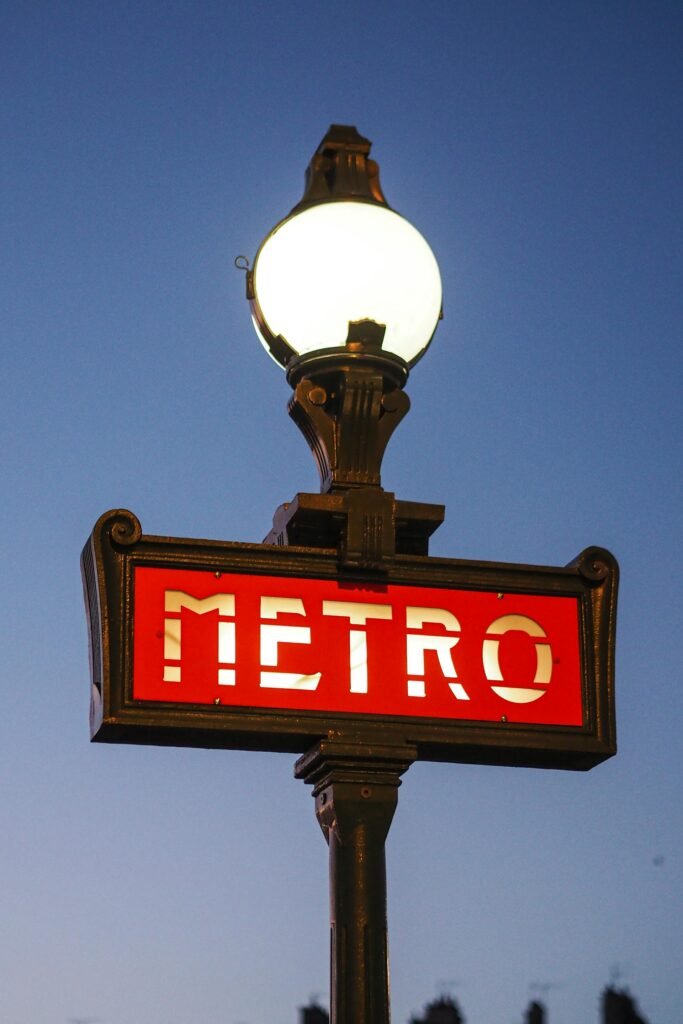
The Paris Metro covers 16 lines, over 300 stations, and 226 km — no point inside the Périphérique is more than 500 meters from a station. The RER suburban network adds 5 longer lines connecting the city to the airports, Versailles, and Disneyland. A single ticket runs €2.50 (in 2025); the Navigo Easy reusable card brings it down to €2.15 per trip. The Paris Visite tourist pass and the weekly Navigo are usually overpriced for a typical 4–5 day trip — the per-trip Navigo Easy beats both.
Buses and Trams
Paris operates over 60 bus lines covering areas the metro doesn’t reach, plus night buses (Noctilien) after the metro closes around 1 AM. Trams serve the outer arrondissements and inner suburbs. All tickets are integrated across metro/bus/tram.
Cycling and Walking
The Vélib’ bike-sharing system has over 20,000 bikes at 1,800 stations citywide. Day passes cost €5, week passes €15. Paris’s cycling infrastructure has expanded dramatically under Mayor Hidalgo — many of the major boulevards now have separated bike lanes, and the post-2024-Olympics network is the best in any major European capital. The city center is extraordinarily walkable; many seasoned visitors barely use the metro at all.
Taxis and Ride-Sharing
Traditional taxis are available at designated stands or via the G7 app. Uber and Bolt operate citywide. River shuttles (Batobus) provide a scenic alternative along the Seine, stopping at Eiffel Tower, Musée d’Orsay, Louvre, Notre-Dame, and Hôtel de Ville — slow but pleasant on a clear day.
Food & Drink in Paris
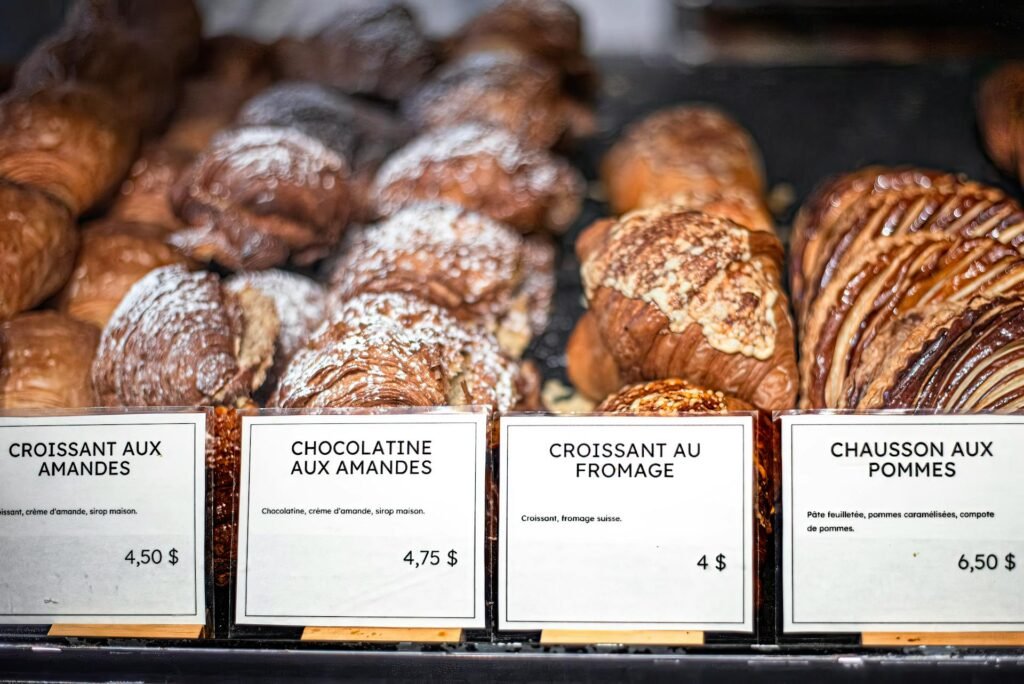
Culinary Heritage
Paris invented the modern restaurant. After the French Revolution, talented chefs formerly employed by nobility opened establishments serving haute cuisine to the bourgeoisie — the first in the format we still recognize today. The city now holds 119 Michelin stars across 132 starred restaurants (2024 guide), more than any other city in the world.
Essential Parisian Experiences
Start the day with a fresh croissant and café au lait at a neighborhood boulangerie. Have lunch at a classic bistro — coq au vin, blanquette de veau, steak frites — washed down with a pichet of house wine. Brasseries are the everything-late-night cousins of bistros, serving choucroute and oysters past midnight; Brasserie Lipp, Bofinger, and La Coupole are the classics worth visiting once. Don’t miss the city’s patisseries for macarons (Pierre Hermé, Ladurée), éclairs (L’Éclair de Génie), and seasonal tarts.
Markets and Food Shopping
Explore local markets like Marché des Enfants Rouges (the city’s oldest covered market, in the Marais) or Marché d’Aligre for fresh produce, cheeses, and prepared foods. The legendary Les Halles wholesale market moved to Rungis decades ago, but the rebuilt area retains excellent food shops. Visit fromageries for expert cheese selection (Androuet, Laurent Dubois) and caves à vin for natural-wine pairings.
Dining Districts
The Marais offers trendy small-plate restaurants and the city’s best Jewish-quarter falafel (L’As du Fallafel). Saint-Germain-des-Prés features classic bistros and upscale dining around Rue Saint-André-des-Arts. The Latin Quarter provides student-friendly options and a good selection of cheap North African couscous restaurants. Canal Saint-Martin in the 10th has become the most exciting new food district, with natural-wine bars and small-plate restaurants opening monthly.
Culture & Arts
Theatrical Tradition
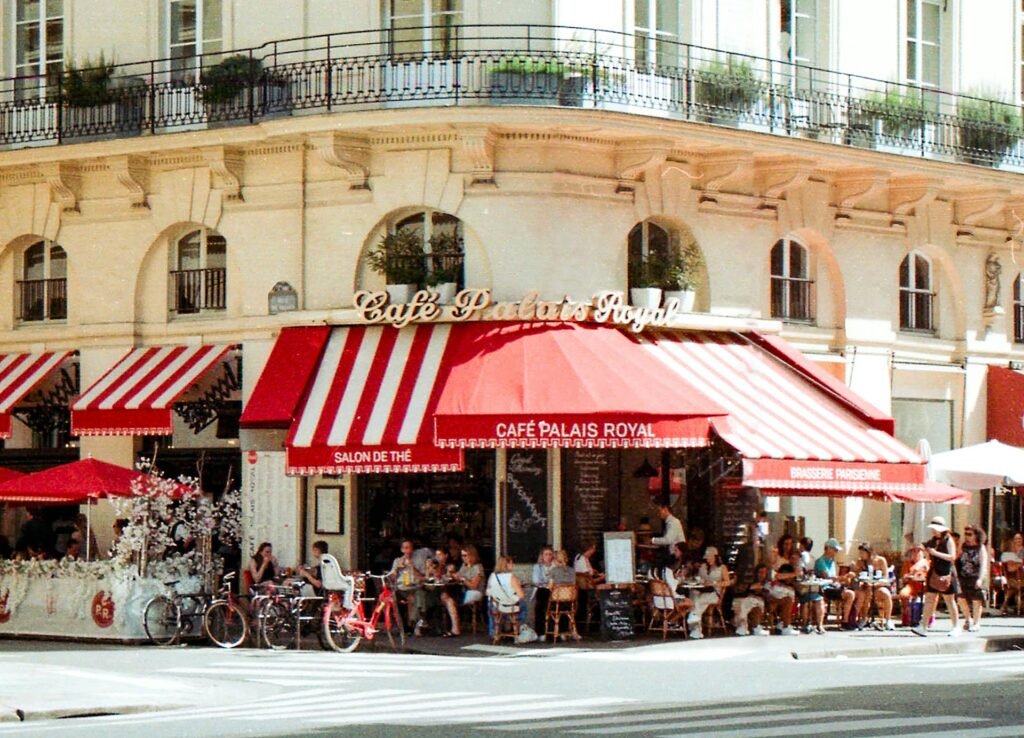
Paris remains France’s theatrical capital, anchored by the prestigious Comédie-Française, founded in 1680 — still performing nightly at the Salle Richelieu by the Palais Royal. The Palais Garnier and Opéra Bastille present world-class opera and ballet under the Opéra national de Paris banner, while venues like Théâtre du Châtelet and Théâtre de la Ville offer diverse contemporary programming. English-language productions show at the Théâtre Mogador and occasionally at the Olympia.
Music Scene
From classical concerts at the Philharmonie de Paris (the Jean Nouvel-designed concert hall in La Villette) to jazz clubs in Saint-Germain (Caveau de la Huchette, Sunset Sunside), Paris’s musical offerings span every genre. The cabaret tradition lives on at the Moulin Rouge, Lido, and Folies Bergère. Rock and pop concerts fill venues like the Zénith and Olympia, while the city’s electronic scene anchors itself around the Concrete-era venues like Rex Club.
Literary Legacy
Paris has inspired countless writers — Hugo, Balzac, Hemingway, Stein, Beckett, Houellebecq. The literary cafés (Les Deux Magots, Café de Flore, La Closerie des Lilas) maintain the tradition with markedly higher prices than they used to. Shakespeare and Company, the English-language bookshop opposite Notre-Dame, remains a working pilgrimage site for Anglophone readers. The Bibliothèque nationale de France houses millions of volumes in François Mitterrand’s striking modern building.
Artistic Heritage
Beyond the famous museums, Paris nurtures contemporary art through galleries in the Marais, Saint-Germain, and the emerging Belleville district. Street art flourishes in the 13th and 20th arrondissements — particularly along Rue Mouffetard and around Belleville. The city’s leading art schools (École des Beaux-Arts, École du Louvre, ENSAD) keep the working-artist population at one of the highest in any European capital.
Architecture Through the Ages
Medieval Foundations
Paris preserves remarkable medieval architecture. Notre-Dame (12th–14th century, reopened 2024 after restoration) and Sainte-Chapelle (1248) display Gothic at its peak — Sainte-Chapelle’s stained glass is the more transcendent of the two, and the smaller queue. The Conciergerie‘s fortress towers on Île de la Cité date to the same era. The city’s oldest church, Saint-Germain-des-Prés, traces back to the 6th century.
Renaissance and Classical Periods
The 16th and 17th centuries brought Italian Renaissance influences and French classical style. The Place des Vosges (1612) is the city’s earliest planned square and still its most photogenic; the surrounding streets contain dozens of preserved hôtels particuliers. The Louvre evolved from defensive fortress to royal palace over centuries, with each king adding a wing.
Haussmann’s Transformation
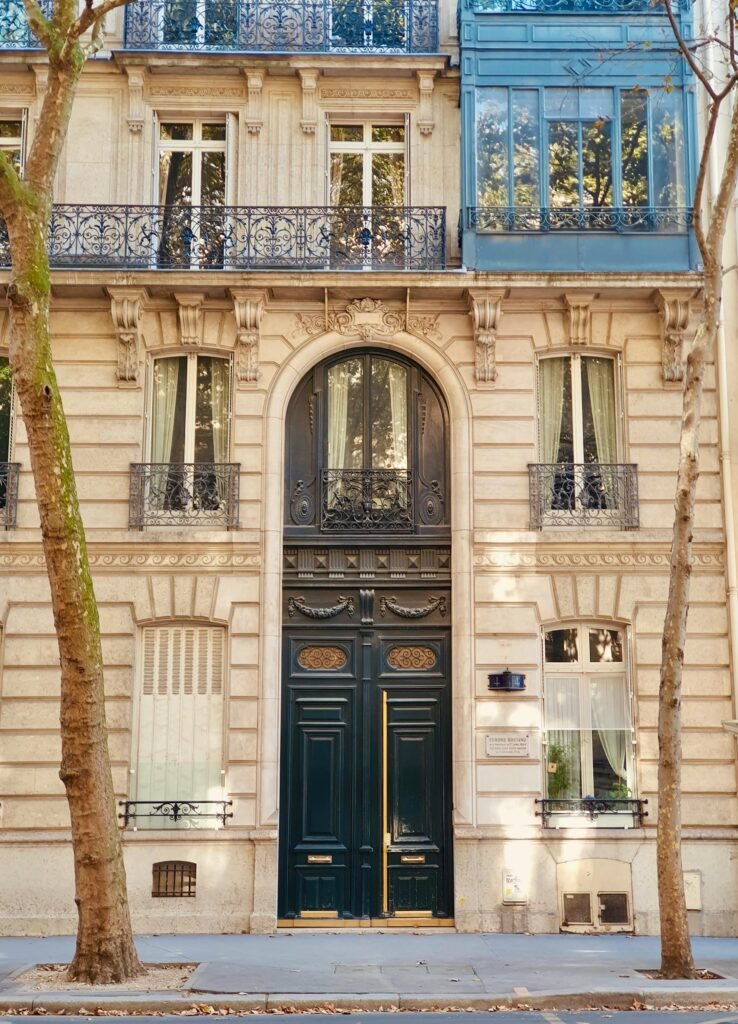
Baron Haussmann’s 1853–1870 renovation under Napoleon III created modern Paris’s distinctive character. The wide boulevards, uniform building heights (typically six or seven floors), and the cream-colored limestone facades define perhaps two-thirds of the central city by area. This period also produced the Palais Garnier opera house, numerous parks (Buttes-Chaumont and Monceau among them), and the basic street layout that pedestrians still navigate today.
Modern and Contemporary
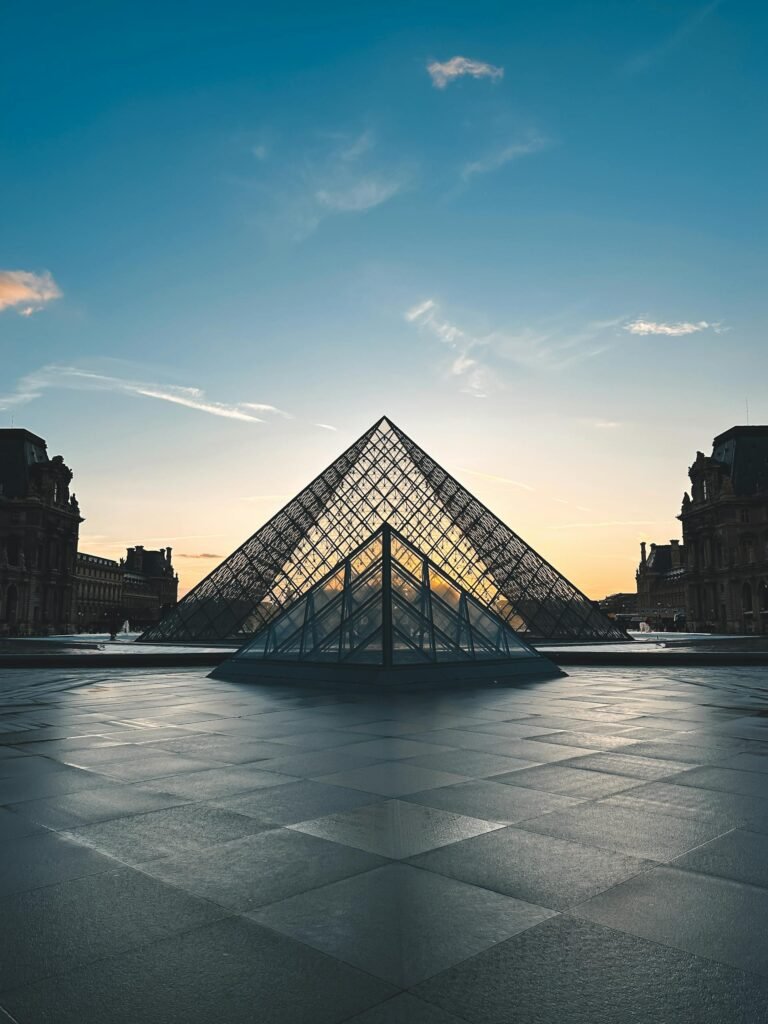
The 20th and 21st centuries added bold architectural statements. The Centre Pompidou‘s inside-out high-tech aesthetic (1977) was a sensation when built and is now a beloved landmark. The Louvre Pyramid (I.M. Pei, 1989) remains controversial in some circles but has become inseparable from the museum. The Grande Arche at La Défense (1989) frames a perfect axis with the Arc de Triomphe and the Tuileries. Recent additions include the Fondation Louis Vuitton‘s glass sails (Frank Gehry, 2014) and a renewed wave of high-rise debate around the planned Tour Triangle.
Paris by District: The 20 Arrondissements
Paris is divided into 20 arrondissements. The map below shows their official OSM boundaries, colour-coded to match the table — a quick way to orient yourself before zooming in on individual sights.
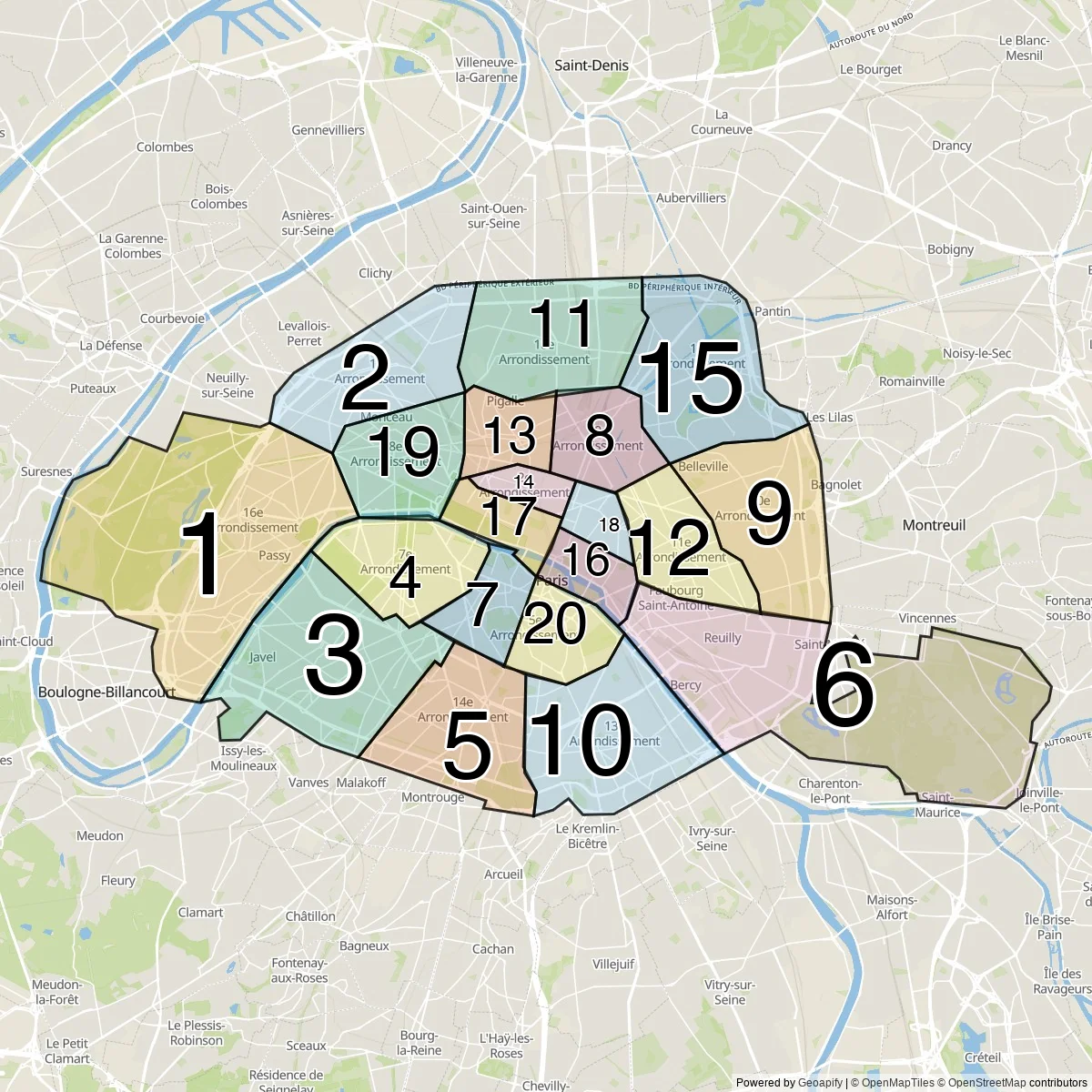
| # | Arrondissements |
|---|---|
| 1 | Paris 16e Arrondissement · 16th Arrondissement |
| 2 | Paris 17e Arrondissement · 17th Arrondissement |
| 3 | Paris 15e Arrondissement · 15th Arrondissement |
| 4 | Paris 7e Arrondissement · 7th Arrondissement |
| 5 | Paris 14e Arrondissement · 14th Arrondissement |
| 6 | Paris 12e Arrondissement · 12th Arrondissement |
| 7 | Paris 6e Arrondissement · 6th Arrondissement |
| 8 | Paris 10e Arrondissement · 10th Arrondissement |
| 9 | Paris 20e Arrondissement · 20th Arrondissement |
| 10 | Paris 13e Arrondissement · 13th Arrondissement |
| 11 | Paris 18e Arrondissement · 18th Arrondissement |
| 12 | Paris 11e Arrondissement · 11th Arrondissement |
| 13 | Paris 9e Arrondissement · 9th Arrondissement |
| 14 | Paris 2e Arrondissement · 2nd Arrondissement |
| 15 | Paris 19e Arrondissement · 19th Arrondissement |
| 16 | Paris 4e Arrondissement · 4th Arrondissement |
| 17 | Paris 1er Arrondissement · 1st Arrondissement |
| 18 | Paris 3e Arrondissement · 3rd Arrondissement |
| 19 | Paris 8e Arrondissement · 8th Arrondissement of Paris |
| 20 | Paris 5e Arrondissement · 5th Arrondissement |
Frequently Asked Questions About Visiting Paris
Do I need a visa to visit Paris?
For most travelers from outside the European Union, Paris falls under the Schengen Area visa rules. EU/EEA/Swiss citizens can enter freely with a national ID card. Citizens of the US, UK, Canada, Australia, Japan, and roughly 60 other countries enter visa-free for stays up to 90 days within any 180-day period — but starting in 2026 those visitors will need to register with the new ETIAS travel authorization system (about €7, valid 3 years). All other nationalities need a Schengen visa applied for at the French consulate in their country before travel; the official portal is france-visas.gouv.fr. Confirm current requirements before booking — the ETIAS rollout has shifted twice.
Is Paris safe for tourists?
Paris is generally safe — violent crime is rare, and the city is well-policed in the central tourist areas. The main risks are pickpocketing and tourist-targeted scams. The US State Department rates France at “exercise increased caution” primarily for the terrorism baseline that applies to all of Western Europe, not for street crime. Key precautions: pickpockets work the metro especially around Châtelet, Gare du Nord, and the queues at the Louvre and Eiffel Tower. The “petition” scam (clipboard-wielding “deaf” girls), the “found ring” scam, and the bracelet-tying scam at Sacré-Cœur are persistent annoyances. Keep wallets and phones in front pockets or zipped bags, and be alert when crossed by anyone trying to “help.”
How many days do I need in Paris?
Four full days is the comfortable minimum to do the headline sights without rushing; five to seven is ideal if you want to enjoy the city rather than rush through it. A solid 4-day plan: Day 1 the Louvre and Tuileries, then Île de la Cité (Notre-Dame, Sainte-Chapelle), evening Seine cruise; Day 2 Eiffel Tower and the 7th arrondissement, Musée d’Orsay in the afternoon; Day 3 Montmartre and Sacré-Cœur in the morning, the Marais and Centre Pompidou in the afternoon; Day 4 Versailles as a day trip (allow the full day). Add days for Musée Rodin, Père Lachaise, the Latin Quarter, and the eastern arrondissements. Paris has more to offer than any one trip can absorb — first-timers often regret budgeting too few days.
What’s the best area to stay in Paris?
Depends on what kind of trip you want. Le Marais (3rd–4th) is the all-rounder — central, walkable to most major sights, with the best small-restaurant scene; book early because the boutique hotels are limited and popular. Saint-Germain-des-Prés (6th) gives you classic Left-Bank café Paris with literary atmosphere; pricier but quieter at night. Around the Eiffel Tower (7th) works for first-time visitors prioritizing the headline view; metro access is good but the area empties out at night. Montmartre (18th) is the village-on-a-hill experience with cheaper hotels — atmospheric but a walk to the metro and steep streets. Avoid the area immediately around Gare du Nord and Pigalle at night unless you’re price-sensitive enough to accept the trade-off, and skip La Défense entirely (it’s a business district, not a tourist base).
How much does it cost to visit the Louvre?
Adult tickets are €22 when booked online via the official louvre.fr portal (the only legitimate booking site — third-party resellers add hefty markup). Booking online is essentially mandatory: walk-up tickets are subject to availability and the queues at the pyramid entrance regularly run two hours. Free admission applies to: visitors under 18, EU residents aged 18–25, and on the first Friday of every month after 6 PM (except July and August). The Eiffel Tower charges €13.10 (stairs to second floor) up to €28.30 (lift to top); the Musée d’Orsay €16. The Paris Museum Pass (€70 for 2 days, €85 for 4) covers most major museums and pays off if you’re hitting more than three of them.
Should I drink the tap water in Paris?
Yes. Paris’s tap water is treated to among the highest standards in Europe, sourced from the Loire Valley and tested constantly by the city water authority Eau de Paris. The Eau de Paris portal publishes water quality reports continuously. Restaurants will typically serve a free pitcher of tap water (une carafe d’eau, s’il vous plaît) without you needing to ask twice. The city has installed over 1,200 free public drinking fountains, including the famous green Wallace fountains, and recent additions deliver chilled and even sparkling water from the same supply. Bottled water is widely available but neither necessary nor environmentally sensible.
What’s the dress code in Paris?
Looser than reputation suggests. Parisians dress well by international standards — fewer t-shirts and athletic shorts on the street than you’d see in most American or British cities — but tourists are not expected to match the local standard. For restaurants: smart-casual is fine for most places; jacket-and-collared-shirt only required at the very top establishments, and even there increasingly relaxed. For nightclubs: door selection happens at most upscale venues — leave the sneakers and shorts at the hotel. For churches (Notre-Dame, Sacré-Cœur): covered shoulders are appreciated; nobody will turn you away for shorts. For everyday sightseeing: comfortable walking shoes matter far more than fashion — the city rewards 15,000-step days.
Is tipping expected in Paris?
Less than in the United States, more than the “service compris” myth suggests. Service is by law included in restaurant prices in France — the line “service compris” on every menu is the legal disclosure. But it’s customary to leave a small additional tip in cash for good service: 5–10% at sit-down restaurants, or simply rounding up the bill (a €37 check becomes €40). Cafés: leave the small change. Taxis: round up to the nearest euro, or 5% for longer rides. Hotel porters: €1–2 per bag. Tour guides: €5–10 for a half-day group tour, more for private guides. Hairdressers, hotel housekeeping, restroom attendants: small change is appreciated but not socially required. Don’t tip percentages on the European scale that Americans use back home — it’s sometimes interpreted as flashy.
Shopping
Luxury and Fashion
Paris remains a global fashion capital, home to Chanel, Dior, Louis Vuitton, Hermès, and most of the houses that define the global luxury industry. The Golden Triangle — bounded by the Champs-Élysées, Avenue Montaigne, and Rue du Faubourg Saint-Honoré — concentrates the flagship boutiques. Place Vendôme specializes in high-end jewelry and watches.
Department Stores and Galleries
The historic department stores Galeries Lafayette and Printemps (both on Boulevard Haussmann) offer fashion, beauty, and gourmet halls under stunning Belle Époque glass domes. The covered passages — Galerie Vivienne, Passage des Panoramas, Passage Jouffroy — are 19th-century proto-shopping-malls now full of small boutiques, tea rooms, and antiquarian bookshops, and they’re some of the most charming shopping experiences in any European city.
Markets and Antiques
The Marché aux Puces de Saint-Ouen at the northern edge of the city is the world’s largest antique flea market — better organized than its size suggests, with serious antique dealers alongside vintage clothes and reproduction-prone bric-à-brac. Open Saturdays through Mondays. The bouquinistes along the Seine sell rare books, old prints, and postcards in their olive-green boxes.
Paris continues to evolve while honoring its extraordinary past. Whether the draw is the museums, the food, the architecture, or simply the pleasure of strolling along a tree-lined boulevard at sunset, the city rewards the visitor who’s willing to slow down. The grandest sights are worth the queues, but the city’s deeper rewards are the unplanned ones — the small square nobody mentioned in any guide, the bistro with a chalkboard menu, the bookshop that turns out to have been there for 200 years.
AFRIKA
Cairo Hurghada Johannesburg Marrakech
ASIA
Abu Dhabi Agra Antalya Bangkok Batam Beijing Bengaluru Cebu City Chiang Mai Chiba Chennai Da Nang Dammam Delhi Denpasar Dubai Fukuoka Guangzhou Guilin Ha Long Hanoi Ho Chi Minh City Jakarta Jaipur Johor Bahru Kolkata Krabi Kuala Lumpur Kyoto Macau Mecca Medina Mugla Mumbai Osaka Pattaya Penang Phuket Riyadh Seoul Shanghai Shenzhen Singapore Taipei Tokyo Zhuhai
EUROPE
Amsterdam Athens Barcelona Berlin Brussels Budapest Copenhagen Dublin Florence Frankfurt am Main Heraklion Krakow Lisbon London Madrid Milan Munich Nice Paris Porto Prague Rhodes Rome Stockholm Venice Vienna Warsaw
NORTH AMERICA
Cancun Las Vegas Los Angeles Miami New York City Orlando San Francisco Toronto Vancouver
SOUTH AMERICA
Buenos Aires Lima Rio De Janeiro
OCEANIA
Auckland Honolulu Melbourne Sydney