
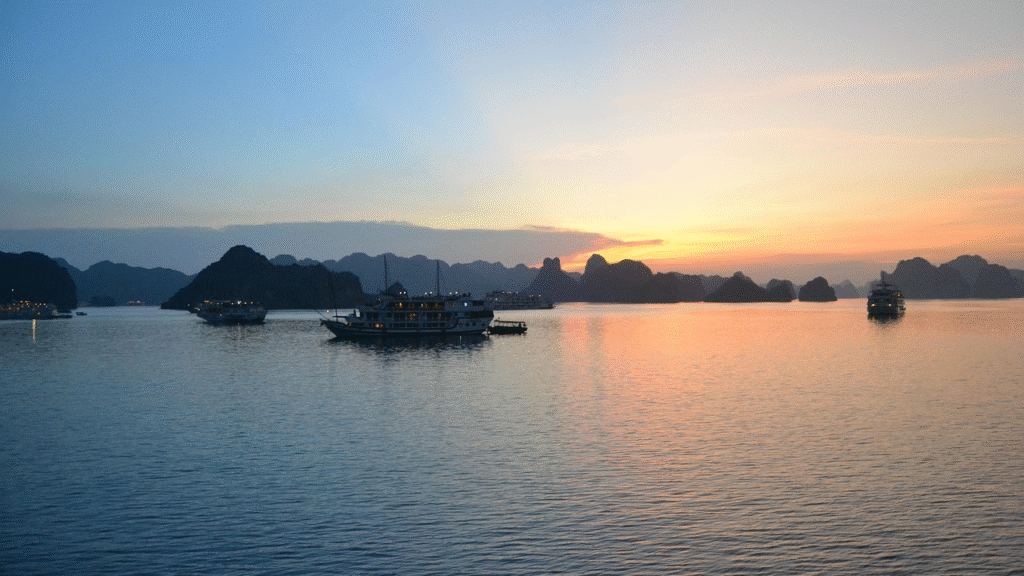
Photo credit: Junk boats at sunset among the limestone karsts of Ha Long Bay
Ha Long City exists for one fundamental reason: it sits at the edge of the most photographed seascape in Vietnam. Ha Long Bay — UNESCO World Heritage since 1994 and one of the original “New Seven Wonders of Nature” — stretches across 1,553 km² of emerald Gulf of Tonkin water, studded with more than 1,969 limestone karst islands and islets that rise vertically from the sea in spectacular jagged silhouettes. The city itself is a relatively modern provincial capital, born from the 2003 merger of the old French-colonial coal port of Hong Gai with the tourist-resort district of Bai Chay, connected by a 903-meter cable-stayed bridge. Visitors typically pass through Ha Long City as a launch pad — most board overnight cruises into the bay or take cable cars to the Sun World theme park — but the city itself offers Vietnamese street food, a working waterfront, and increasingly ambitious resort development that’s worth at least a day on the ground.
Ha Long by District: The 4 Phường
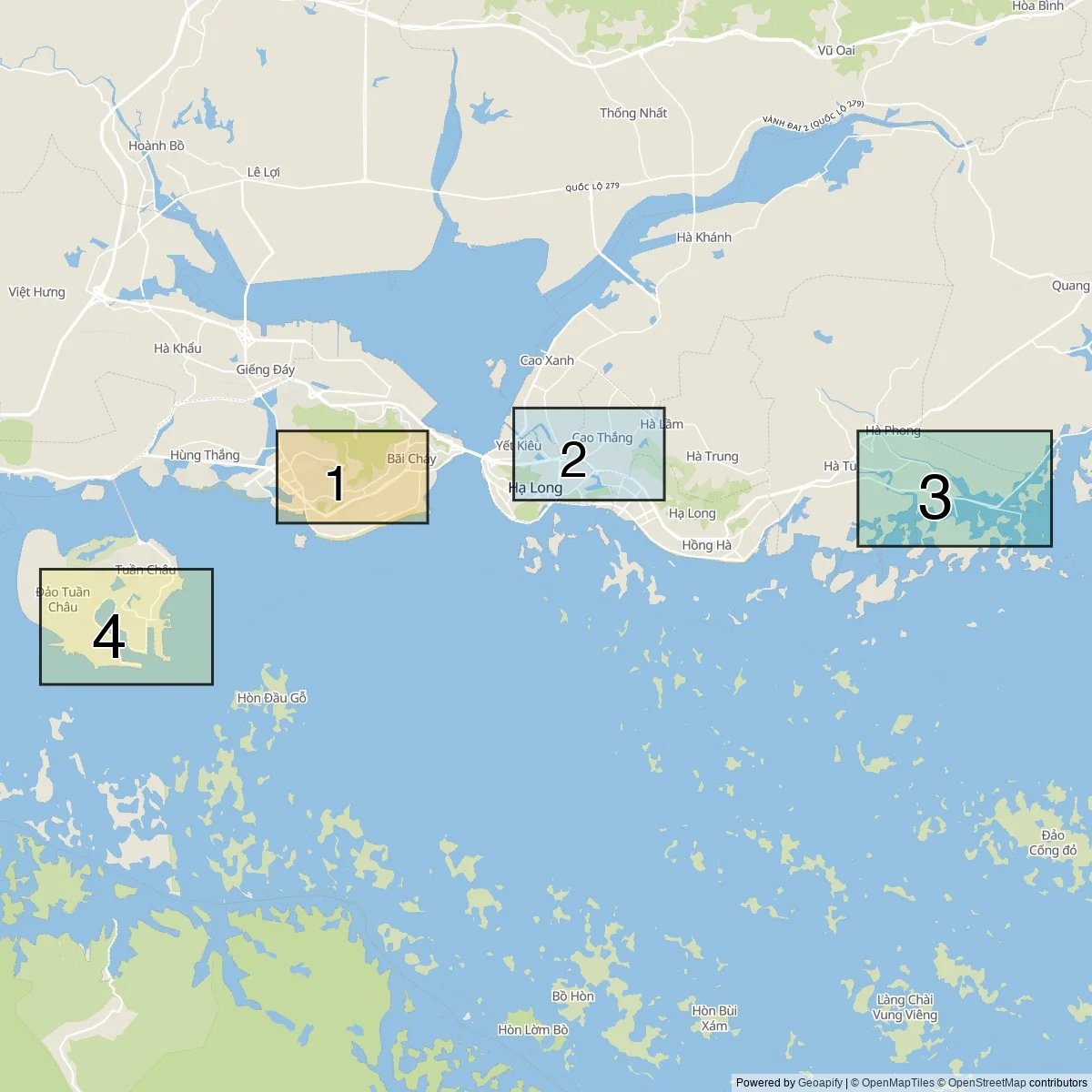
Ha Long is divided into 4 wards. The map below shows their official OSM boundaries, colour-coded to match the table — a quick way to orient yourself before zooming in on individual sights.
| # | Phường |
|---|---|
| 1 | Bãi Cháy · Bãi Cháy (West) |
| 2 | Hòn Gai · Hòn Gai (Centre) |
| 3 | Cửa Ông · Cẩm Phả side |
| 4 | Đảo Tuần Châu · Tuần Châu Island |
Ha Long at a Glance: Essential Facts for Travelers
Ha Long: Key Facts & Tourism Statistics
| International arrivals | 3.5 million (2024, international visitors, Quang Ninh province) — Quang Ninh province tourism results 2024 (Department of Tourism) |
|---|---|
| Population | 0.3 million (2019, Vietnam Population and Housing Census 2019) |
| Best time to visit | October, November, December, March and April |
| Airport to city centre | Shuttle/taxi from Van Don airport (VDO): ~50 min, ~US$15 |
| Currency | Vietnamese dong (VND) |
| Time zone | UTC+7 (ICT) |
| Visa | Vietnam issues 90-day e-visas to all nationalities; several European countries are visa-free for 45 days. |
How many tourists visit Ha Long per year?
Ha Long recorded 3.5 million international visitors, Quang Ninh province (Ha Long is the provincial hub) in 2024, according to Quang Ninh province tourism results 2024 (Department of Tourism).
What is the best time to visit Ha Long?
The most comfortable months to visit Ha Long are typically October, November, December, March and April, based on 1991–2020 climate normals for temperature and rainfall.
How do I get from the airport to central Ha Long?
The Shuttle/taxi from Van Don airport (VDO) takes about 50 minutes to the city centre for about US$15 (~50 km).
What currency is used in Ha Long?
Ha Long uses the Vietnamese dong (VND); the local time zone is UTC+7 (ICT).
Do I need a visa to visit Ha Long?
Vietnam issues 90-day e-visas to all nationalities; several European countries are visa-free for 45 days.
How many people live in Ha Long?
Ha Long has a population of about 0.3 million (city (2019 census); tourism figures cover Quang Ninh province), per Vietnam Population and Housing Census 2019 (2019).
Ha Long climate: monthly averages (1991–2020)
| Month | Avg high | Avg low | Rain |
|---|---|---|---|
| Jan | 18.6 °C | 13.9 °C | 34 mm |
| Feb | 20 °C | 15.3 °C | 24 mm |
| Mar | 22.7 °C | 18 °C | 44 mm |
| Apr | 26.2 °C | 21.5 °C | 71 mm |
| May | 28.8 °C | 24.5 °C | 216 mm |
| Jun | 30.2 °C | 26.4 °C | 270 mm |
| Jul | 30.2 °C | 26.4 °C | 310 mm |
| Aug | 30 °C | 25.7 °C | 373 mm |
| Sep | 29.2 °C | 24.5 °C | 238 mm |
| Oct | 27.4 °C | 22.3 °C | 103 mm |
| Nov | 24.3 °C | 19 °C | 51 mm |
| Dec | 20.3 °C | 15.1 °C | 31 mm |
Data last verified: 2026-09-01 · Climate: Open-Meteo ERA5 reanalysis, monthly normals computed from daily data 1991–2020 · Sources: Quang Ninh Dept. of Tourism (arrivals) · GSO Vietnam census (population) (primary source) · World’s most visited cities · Methodology
Upcoming Events in Ha Long
| Date | Title | Details |
|---|---|---|
| 2026-09-25 | Mid-Autumn Festival in Ha Long | The Mid-Autumn Festival, falling on 25 September in 2026, is celebrated joyfully across Ha Long with lantern processions, lion dances, mooncakes and activities centred on children. Neighbourhoods and the city’s waterfront come alive with colourful lanterns and performances as families gather under the full moon. Public celebrations are typically free to enjoy, and the mild autumn evenings add to the festive mood. For visitors, it is a delightful chance to experience one of Vietnam’s most beloved traditional holidays alongside local families in a spectacular seaside setting. [Source] |
| 2026-11-20 to 2026-11-22 | Halong Bay Heritage Marathon 2026 | The Halong Bay Heritage Marathon returns from 20 to 22 November, with race day on Sunday 22 November starting and finishing at the Quang Ninh Planning, Fair and Exhibition Palace on Tran Quoc Nghien street. Around 18,000 Vietnamese and international runners are expected across the marathon, half marathon, 10km and 5km distances. The seaside course along the bay has been named among the planet’s most beautiful running routes by Runner’s World UK, and this is currently Vietnam’s only World Athletics Label road race. Entry is by paid registration, while spectating along the waterfront is free. [Source] |
| 2026-11-28 to 2026-11-29 | Yen Tu Heritage Marathon 2026 | Set in the sacred Yen Tu mountain landscape about an hour’s drive west of Ha Long, the Yen Tu Heritage Marathon takes place over the weekend of 28 and 29 November, offering trail, road, half marathon, quarter marathon and fun run categories. Runners pass forests, pagodas and pilgrim paths on slopes associated with the Truc Lam Zen tradition, part of a complex recently recognised by UNESCO. Registration is paid via Vietnamese race platforms such as iRace, with distances to suit both families and serious trail runners. A scenic autumn outing combining sport with spiritual heritage. [Source] |
| 2026-12-31 | New Year 2027 Countdown in Ha Long | Quang Ninh’s year-end tourism programme culminates in a countdown celebration to welcome New Year 2027, with festivities in Ha Long on the evening of 31 December. The countdown night has in recent years centred on the 30/10 Square area with a large free concert, drawing tens of thousands of residents and visitors for live music and the midnight moment, and free tickets have been distributed for previous editions. The city has confirmed a countdown programme among its fourth-quarter events, with the detailed line-up announced closer to the date. Attendance is free. [Source] |
City News in Ha Long – last 14 days
| Date | Category | Headline | Details |
|---|---|---|---|
| 2026-09-14 | Local affairs | Dragon Park closes after a decade as Sun Group plans 214-hectare entertainment district | Dragon Park, the Sun Group amusement park in the Bai Chay tourist district, has officially stopped receiving visitors after roughly a decade of operation, Vietnamese media report. Sun World Ha Long says it is renewing its entertainment model, and twelve of its large water attractions will pause operations from 1 October. In place of the old park, the operator plans a 214-hectare entertainment and leisure complex intended to run around the clock, with local coverage comparing the concept to Singapore’s Clarke Quay district. [Source] |
| 2026-09-14 | Business | Vingroup’s Ha Long Xanh project pays over VND 26 trillion in land-use fees | A Vingroup mega-project in Quang Ninh has paid more than VND 26 trillion, roughly one billion US dollars, in land-use fees into the provincial budget, according to business media. The Ha Long Xanh development, billed at around 18 billion dollars and covering an area compared to more than 8,700 football pitches, accounted for about a third of the province’s total budget revenue in the first eight months of the year, underlining how heavily local finances currently lean on the coastal real estate boom. [Source] |
| 2026-09-14 | Business | AEON accelerates Vietnam expansion with upcoming Ha Long project | Japanese retail giant AEON is accelerating its expansion in Vietnam with upcoming projects in Thanh Hoa and Ha Long, according to Vietnam Economic Times. The move would bring one of Asia’s largest shopping mall operators to the Quang Ninh tourist hub, adding large-scale modern retail to a city better known for its bay cruises and seafood markets. AEON has been steadily building out shopping centres across Vietnam in recent years, and the planned Ha Long project extends that push into the northeastern coastal region. [Source] |
| 2026-09-13 | Culture | Giant lantern parade and artistic fireworks light up the bay for Mid-Autumn | Under the banner of a moonlit night shining bright beside the bay, Quang Ninh is staging a parade of giant lanterns accompanied by an artistic fireworks display for the Mid-Autumn season, local media report. The spectacle brings enormous illuminated lanterns through the streets near the waterfront, delighting children and families in the run-up to the festival, which falls on 25 September this year. Mid-Autumn is one of Vietnam’s most cherished celebrations, and Ha Long’s bayside setting gives the lantern processions a particularly photogenic backdrop. [Source] |
| 2026-09-13 | Local affairs | Nearly 9,000 workers build day and night at Vinhomes Global Gate Ha Long | A photo report from the construction site of Vinhomes Global Gate Ha Long shows nearly 9,000 workers building around the clock as the huge development takes shape. Day and night shifts are pushing the project forward, with cranes and crews transforming the landscape at speed. The scale of the workforce underlines the intensity of the current construction boom in Ha Long, where major property groups are racing to complete large urban and resort projects around the bay. [Source] |
| 2026-09-14 | Local affairs | Trilingual cafe security guard becomes Ha Long’s unlikely online star | A security guard at a bubble tea and coffee shop in Ha Long has become an online sensation for welcoming customers in three languages. Videos of the friendly older man cheerfully greeting and inviting in foreign guests have spread widely on Vietnamese social media, with Western tourists reportedly delighted by the multilingual reception. Several national outlets picked up the story, celebrating him as an example of the everyday hospitality that visitors encounter in the bayside tourist city. [Source] |
Ha Long Events & City News Archive
Sources: Quang Ninh Province, Halong Bay Heritage Marathon, VietnamNet, iRace, Best Marathon VN, Viet Nam News, Znews, Dan Tri
Weather Forecast for the Next 14 Days in Ha Long
| Date | Weather | Max °F | Min °F | Rain mm |
|---|---|---|---|---|
| 2026-09-14 | ⛈️ | 76.9 °F | 74.5 °F | 61.3 mm |
| 2026-09-15 | ⛈️ | 77.1 °F | 75.0 °F | 58.8 mm |
| 2026-09-16 | ⛈️ | 80.5 °F | 74.2 °F | 25.5 mm |
| 2026-09-17 | 🌧️ | 82.6 °F | 73.9 °F | 8.1 mm |
| 2026-09-18 | ⛈️ | 85.0 °F | 74.9 °F | 7.1 mm |
| 2026-09-19 | ☀️ | 87.7 °F | 77.0 °F | 0.0 mm |
| 2026-09-20 | ☀️ | 86.9 °F | 76.6 °F | 0.0 mm |
| 2026-09-21 | ⛅ | 85.9 °F | 76.1 °F | 0.0 mm |
| 2026-09-22 | ⛈️ | 83.5 °F | 77.7 °F | 2.4 mm |
| 2026-09-23 | 🌧️ | 83.6 °F | 77.0 °F | 3.8 mm |
| 2026-09-24 | 🌧️ | 83.4 °F | 75.6 °F | 3.2 mm |
| 2026-09-25 | 🌧️ | 82.9 °F | 76.8 °F | 1.4 mm |
| 2026-09-26 | 🌧️ | 83.5 °F | 78.0 °F | 1.0 mm |
| 2026-09-27 | 🌧️ | 84.7 °F | 76.4 °F | 2.0 mm |
Ha Long’s History
Ha Long Bay’s geological history dwarfs its human one. The karst topography began forming roughly 500 million years ago from the lifting of an ancient seabed; the dramatic erosion that produced the present-day towers and arches happened over the last 20 million years as rising and falling sea levels carved limestone weak points into the iconic skyline. The bay’s Vietnamese name — Vịnh Hạ Long, “Bay of the Descending Dragon” — comes from a folk legend in which the Jade Emperor sent dragons to spit jade and pearls into the sea to halt a foreign invasion; the islands are the petrified remains.
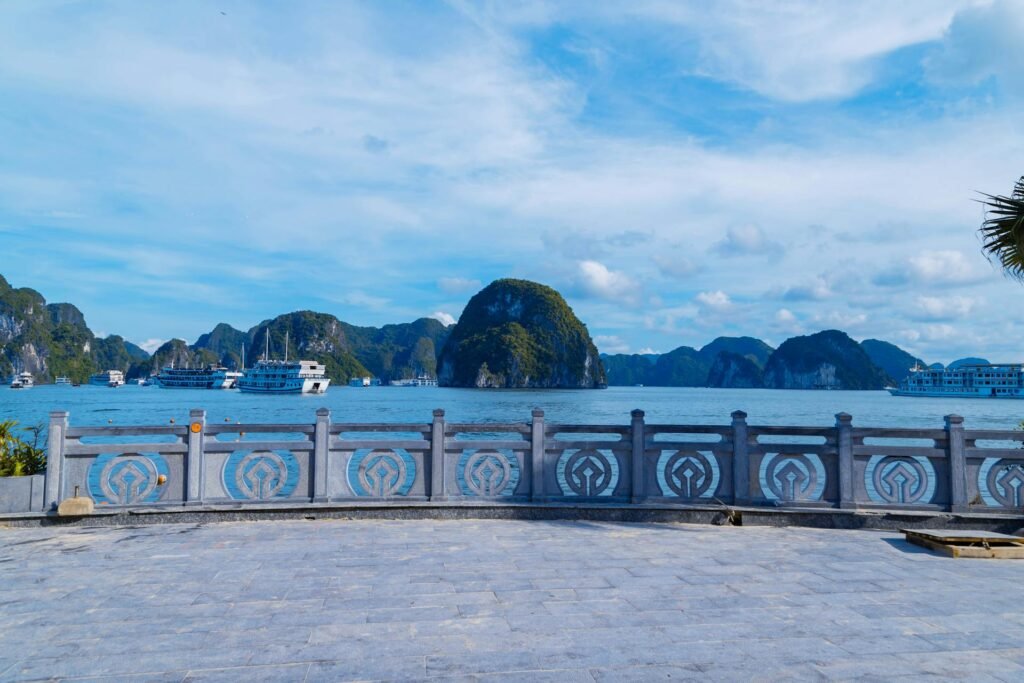
Human settlement of the surrounding karst caves dates to the Soi Nhụ culture (about 18,000–7,000 BCE) and the Hạ Long culture (about 3,500–5,000 years ago) — Mesolithic and Neolithic communities whose middens and stone tools have been excavated from caves like Mê Cung and Tiên Ông. The bay’s strategic position made it a recurring naval battlefield: General Trần Hưng Đạo defeated the invading Mongol fleet at the Battle of Bạch Đằng River just south of present-day Ha Long in 1288, driving wooden stakes into the riverbed at low tide to impale and destroy enemy ships at high tide — a manoeuvre celebrated in Vietnamese national mythology.
The modern city was effectively created by French colonial coal mining. From the 1880s, the French Société Française des Charbonnages du Tonkin developed open-cast mines around Hong Gai, turning it into one of Indochina’s most important industrial ports. The town across the bay, Bai Chay, remained a fishing settlement until the late 20th century, when post-war Vietnamese tourism development began. UNESCO inscription in 1994 transformed the bay into an internationally branded destination; the merger of Hong Gai and Bai Chay into the unified Ha Long City in 2003 and the opening of the Bai Chay Bridge in 2006 marked the city’s coming of age. The 2018 opening of Sun World Hạ Long, the 2019 expansion of the cruise port, and the 2023 joint UNESCO inscription with Cát Bà Archipelago have continued the city’s transition from coal port to luxury-tourism destination.
Geography, Climate & Best Time to Visit Ha Long
Geographic Setting
Ha Long City stretches along 50 km of Gulf of Tonkin coastline at the southern edge of Quảng Ninh Province, in northeastern Vietnam. The bay opens to the north and east into the broader Gulf of Tonkin, with the South China Sea beyond; immediately south lies Bái Tử Long Bay (a separate, less-visited UNESCO-buffer karst area) and Cát Bà Archipelago, which was added to Ha Long’s UNESCO listing in 2023.
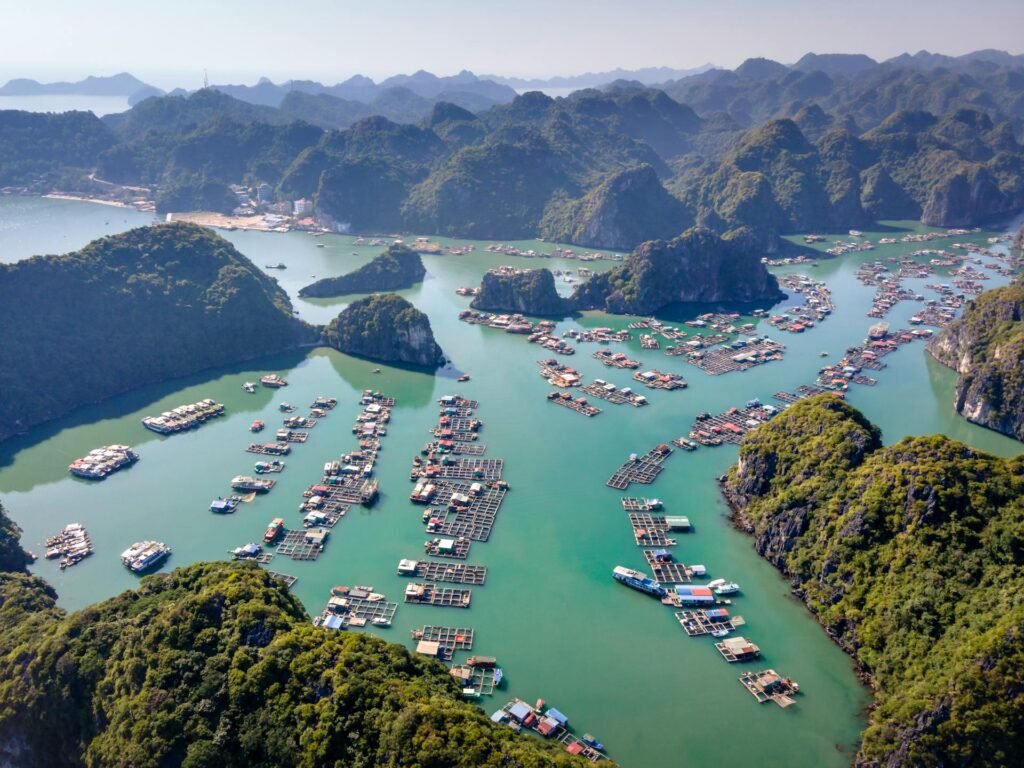
The city splits into three functional zones: the western tourist district of Bãi Cháy, with cruise terminals, resort hotels, the Sun World complex, and the Bãi Cháy Bridge access road; the eastern historic and administrative district of Hồng Gai, where the provincial government, old harbor, and Long Tiên Pagoda sit; and the inland coal-mining communities to the north and east. Inside the bay itself, the cruise boats follow corridors connecting the most-visited islands and caves; the karst topography rises to nearly 200 m at the highest islets.
Climate Overview
Ha Long has a humid subtropical climate with monsoon influence. Annual temperatures swing from cool dry winters (December–February, daytime 15–20 °C, occasional drops below 10 °C with cold-northern-front fog) to hot humid summers (June–August, daytime 30–34 °C, humidity above 85%). Annual rainfall around 2,000 mm, heavily concentrated in the summer monsoon (June–September).
Typhoon Season & Boat-Safety Considerations
The Gulf of Tonkin sits in the path of South China Sea typhoons, with peak risk July through October. When the Vietnamese government issues a typhoon-class warning, the bay closes to all cruise operations — sometimes for 2–4 days at a stretch — and overnight passengers are returned to port or kept aboard at safe anchorages. The 2002 ferry sinking near Cát Bà and the 2011 Truong Hai 06 sinking inside Ha Long Bay (12 deaths) led to significantly strengthened safety regulations. Reputable cruise operators have life jackets at every cabin, smoke detectors, and modern GPS — check operator history and recent reviews. Check current advisories from the National Centre for Hydro-Meteorological Forecasting (NCHMF) during summer travel.
Best Time to Visit
October to mid-December is the genuine sweet spot: typhoon season ends, humidity drops, temperatures sit at a pleasant 22–26 °C, and the karst silhouettes emerge crisp from the haze. March to May is the second-best window — warm temperatures, less haze than summer, though with an increasing chance of nồm (damp southerly winds that condense as mist on cold surfaces). January–February is cool, sometimes raw, with low cloud and limited visibility; cruise prices fall significantly. June–September brings the most tropical heat and the highest typhoon risk; bay water is its warmest for swimming but the air is uncomfortable and visibility can be poor. Avoid the Lunar New Year (Tết) week if possible — Vietnamese domestic tourism floods the bay, and many family-run businesses close.
Ha Long City’s Districts & Neighborhoods
Bãi Cháy — the Tourist West
The purpose-built tourism district on the western shore of Ha Long Bay. Almost all visitor accommodation, the cruise port, Sun World Hạ Long Complex, the Queen Cable Car, the Sun Wheel Ferris wheel, and the Marine Plaza shopping center are concentrated here. Bãi Cháy Beach itself — a 500-meter artificial sand strip — fronts the resort hotels. The neighborhood is purpose-designed for international visitors, with bilingual signage, ATM clusters, and easy walking access to most services. Most travelers should base themselves here.
Hồng Gai — the Historic East
Ha Long’s older, working-Vietnamese half — the provincial-government district, the old coal-loading docks, the busy Hồng Gai Night Market, the Long Tiên Pagoda at the foot of Bài Thơ Mountain, and the inscribed-poem rock face that gives the mountain its name. Far less developed for foreign tourists; better for a half-day exploration of authentic Vietnamese street life, motorbike-clogged streets, and the seafood markets where the cruise-boat catch is auctioned at dawn.
Tuần Châu Island
An artificial-causeway-connected island 8 km west of Bãi Cháy. Hosts the Tuần Châu International Marina (one of the two main cruise departure ports), the Tuần Châu Holiday Villa resort complex, and a sprawling — if dated — entertainment park. Useful primarily as a cruise embarkation point; some operators include a 30-minute pre-cruise visit.
Hà Phong & Northern Coal Districts
Inland coal-mining communities north and east of central Ha Long. Open-cast mines, miner-housing tracts, and the dramatic terraced overburden tips that form the regional skyline. Not on the standard tourist itinerary but visible from the cable car and the main highway; worth understanding as the context for the province’s coal-economy heritage.
Cát Bà Island (Hải Phòng Province)
Technically administered by Hải Phòng City to the south, but functionally Ha Long’s UNESCO sister-zone. Cát Bà is a forested limestone island with the Cát Bà National Park, Lan Hạ Bay cruises, and beach resorts on its eastern shore. Many travelers combine 2 days in Ha Long with 2 nights on Cát Bà; ferries depart from Tuần Châu Marina (1 hour) and from Bến Bính dock in Hải Phòng (45 minutes by hydrofoil to Cát Bà town).
Top Things to Do in Ha Long
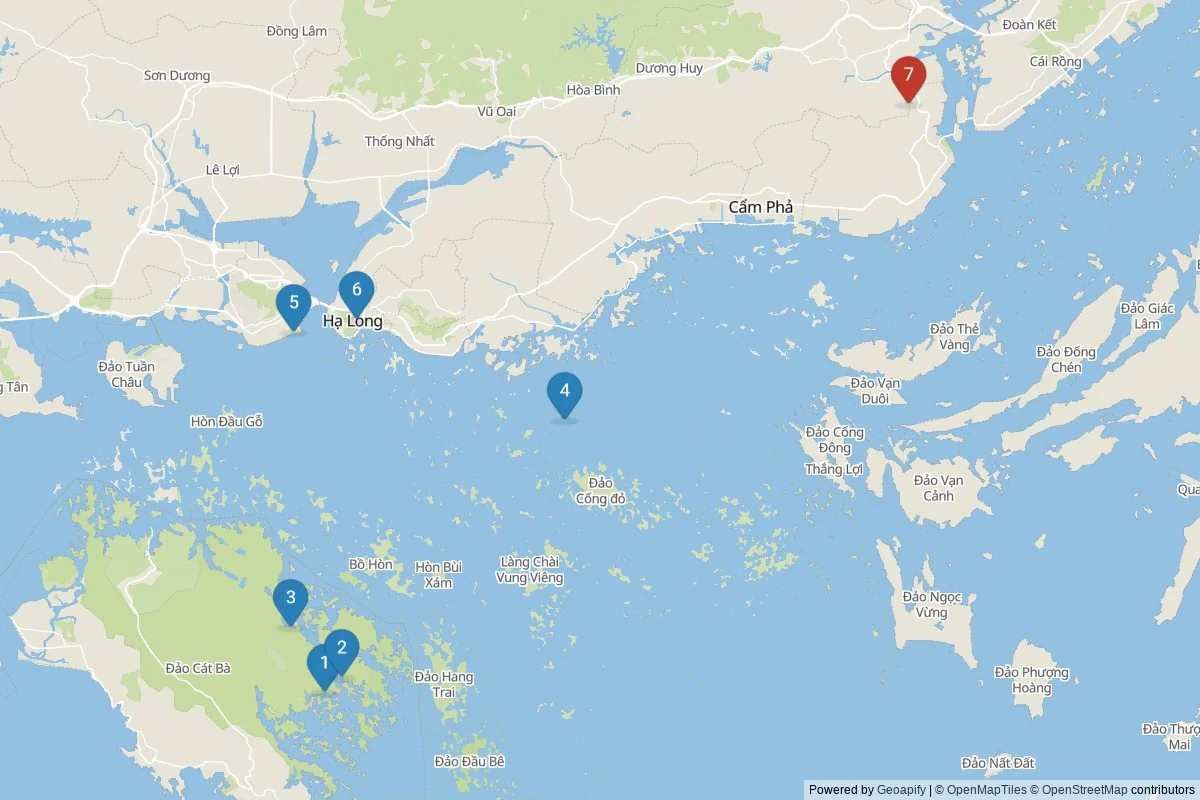
| # | Sight | Cluster | Type | Time | Entry | Best |
|---|---|---|---|---|---|---|
| 1 | Kayak in Lan Hạ Bay | Central | Kayaking | ~2 hrs | $15–25 | Morning |
| 2 | Sung Sot Cave (Surprise Cave) | Central | Karst cave | ~1.5 hrs | 250,000₫ | Morning |
| 3 | Titop Island | Central | Beach & viewpoint | ~1 hr | 50,000₫ | Morning |
| 4 | Overnight Cruise on Ha Long Bay | Central | Boat cruise | 1–2 days | $80–250 | Morning |
| 5 | Sun World Hạ Long Complex | Central | Theme park | ~4 hrs | 350,000₫ | Afternoon |
| 6 | Bài Thơ Mountain | Central | Viewpoint hike | ~1.5 hrs | Free | Sunset |
| 7 | Bái Tử Long Bay | Outer | Quiet bay area | Full day | $50–100 | Morning |
| 🚗 | Day Trip: Yên Tử Mountain | Day trip | Buddhist pilgrimage | Full day | 280,000₫ | Morning |
1. Take an Overnight Cruise on Ha Long Bay
The fundamental Ha Long experience and worth doing properly. One-night cruises from $80–250 per person hit the highlights — Sung Sot Cave, Titop Island, a kayak or bamboo-boat excursion — but feel rushed. Two-night cruises from $200–600 per person reach Bái Tử Long Bay or Lan Hạ Bay (less touristy, fewer boats) and include a deeper cultural program. Three-night cruises from $400–1,200+ per person typically combine Ha Long and Cát Bà and add hiking, deeper kayaking, and a calmer pace. The cruise market spans from budget backpacker boats to genuine luxury (Heritage Bình Chuẩn, Paradise Elegance, Stellar of the Sea). Read recent reviews carefully — operators vary wildly in maintenance and crew quality.
2. Visit Sung Sot Cave (Surprise Cave)
The bay’s most famous limestone cavern, on Bo Hon Island. Discovered by French explorers in 1901 and developed for tourism in 1999. Two enormous chambers — the second with a 30-meter-high ceiling — filled with stalactites lit dramatically by colored floodlights. Crowded mid-day; quieter on early-morning or late-afternoon cruise itineraries. Almost every cruise includes a visit.
3. Climb Titop Island
A small island with a sandy beach and a 425-step staircase to a viewing platform with the bay’s classic photo angle. The climb is steep and hot in summer but the view — karsts in all directions, cruise boats arranged below — is the picture in every Ha Long brochure. Bring water.
4. Sun World Hạ Long Complex
The 2018-opened cable car, theme park, water park, and ferris wheel complex straddling Bãi Cháy and the Bài Thơ Mountain. The Queen Cable Car — once world-record-holder for the largest cabins (230 passengers each) — links the Bãi Cháy and Bài Thơ Mountain stations across the bay and offers the city’s best aerial view. Mystic Mountain Park (Japanese garden, mirror maze, kid rides) and the Dragon Park beachside roller coasters round out the family offering. Combo tickets ~600,000–900,000 VND.
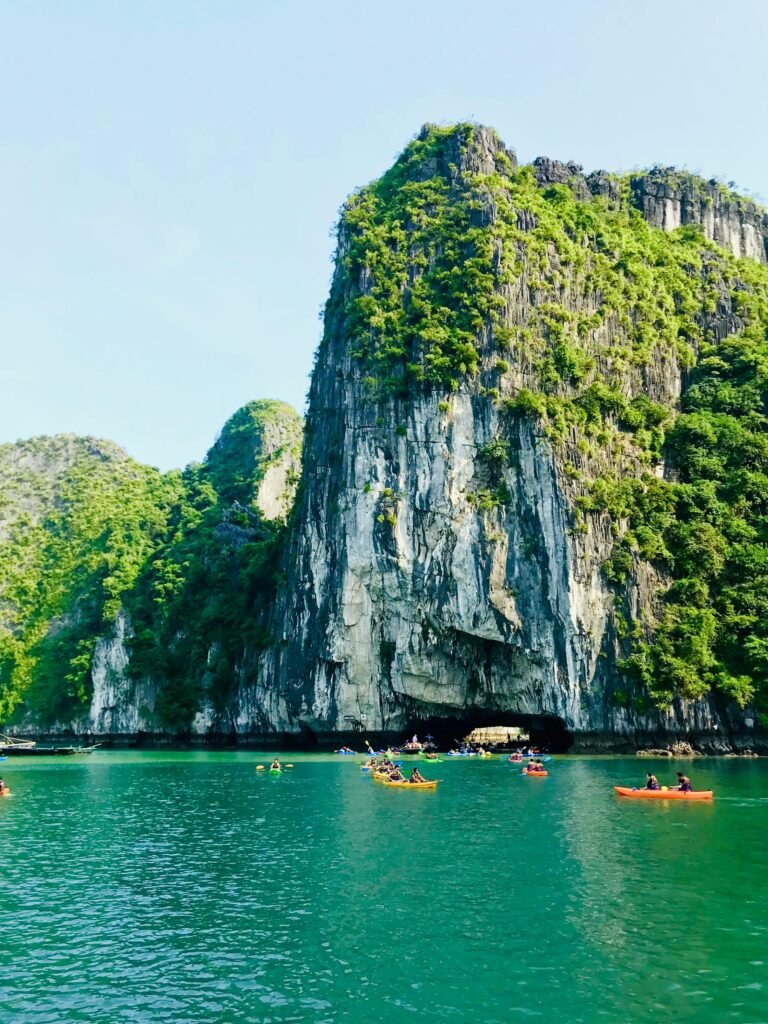
5. Kayak in Lan Hạ Bay or Bái Tử Long Bay
The crowded core of Ha Long Bay is increasingly off-limits to private kayakers — current regulations restrict launch points and route corridors. The adjoining Lan Hạ Bay (off Cát Bà) and Bái Tử Long Bay (north of the heritage zone) offer better kayaking with fewer cruise boats. Operators on Cát Bà run half-day to full-day paddling trips with floating-village stops.
6. Explore Bái Tử Long Bay (the Quiet Northern Half)
The northeastern extension of the same karst system, less than 30 minutes from Ha Long City’s docks but with a fraction of the cruise traffic. Multi-day cruises into Bái Tử Long are quieter, more atmospheric, and visit floating fishing villages still actively used. Worth seeking out for travelers who want the karst experience without the cruise-route congestion.
7. Climb Bài Thơ Mountain
The 200-meter peak in central Hồng Gai with the inscribed Chinese-poem rock face from 1468 (the “Poem Mountain”). A free 30-minute hike rewards with a 360° view of the entire bay and the city — the best free panorama in Ha Long. The trail is unmarked and steep; bring water and proper shoes. Best at sunrise.
8. Day Trip to Yên Tử Mountain
The Buddhist pilgrimage mountain 60 km west of Ha Long, sacred site of the Trúc Lâm Zen school founded by 13th-century Trần dynasty King Trần Nhân Tông. The Yên Tử cable car reaches near the summit pagoda; the full hike to the bronze Đồng Pagoda at the top is a half-day endeavour. Most rewarding February–April during the Yên Tử Spring Festival, when tens of thousands of Vietnamese pilgrims ascend.
How to Get to Ha Long
By Air
Vân Đồn International Airport (VDO), opened in 2018, is the closest airport to Ha Long — 50 km east of the city, ~75 minutes by taxi or transfer (~600,000–900,000 VND). Limited domestic flights from Ho Chi Minh City and a small selection of international charters. Most international visitors arrive at Hà Nội Nội Bài International Airport (HAN) 150 km west of Ha Long, then transfer overland by expressway (2.5 hours).
By Highway from Hanoi
The Hanoi–Hải Phòng–Ha Long Expressway (completed in stages 2018–2019) cut the Hanoi-to-Ha Long drive from 4 hours to 2.5 hours. Shuttle buses from Hanoi’s Old Quarter to Bãi Cháy run hourly via VietBus, Hoàng Long, Daiichi Travel, and others (200,000–350,000 VND); door-to-door private cars cost 1.5–2.5 million VND. Most cruise operators bundle the transfer with the cruise package.
By Ferry from Cát Bà
Direct ferry services link Cát Bà town to Tuần Châu Marina (1 hour, 280,000–350,000 VND) and Bến Bính harbor in Hải Phòng (45 minutes by hydrofoil, then 2-hour bus to Ha Long). Speedboat charters between Lan Hạ Bay and Ha Long are increasingly common.
By Train (Limited Service)
The Hà Nội–Hạ Long railway line operates a slow daily service (~7 hours) that is genuinely picturesque but impractical for time-pressed visitors. The Yên Viên–Cái Lân freight line carries little passenger traffic.
Visa Notes
Vietnam offers visa-free entry for stays up to 45 days for citizens of 13 countries (extended August 2023 from 15 days) — including the UK, Germany, France, Italy, Spain, Russia, Japan, South Korea, and Belarus. US, Canadian, Australian, and most other Western passport holders need an e-Visa from the Vietnam Immigration Department for stays up to 90 days (single or multiple entry, $25–50 fee, processed in 3–7 working days). Passport must have at least 6 months remaining validity. The visa-on-arrival channel that operated before 2023 has been replaced by the e-Visa system; do not rely on outdated guides describing in-airport visa application.
Getting Around Ha Long City
Walking & the Bãi Cháy Promenade
Most of the tourist district is genuinely walkable — the seafront promenade runs more than 4 km from Marine Plaza to Bãi Cháy Bridge, hotels and restaurants line the avenue, and the Sun World cable-car station is at the western end. Hot in summer; plan early-morning or evening walks.
Taxis & Ride-Hailing
Grab works in Ha Long but with thinner driver coverage than in Hanoi or Ho Chi Minh — wait times can be 5–15 minutes. Taxis are abundant; reputable companies include Mai Linh and Vinasun (look for the company name and meter — unmarked or “guest taxi” cars overcharge tourists). Insist on the meter or agree the fare in advance. A taxi across town (Bãi Cháy to Hồng Gai) runs 60,000–100,000 VND; airport transfer 600,000–900,000 VND.
Motorbike Taxis (Xe Ôm) & Bicycle Rentals
Xe ôm motorbike taxis are everywhere along the Bãi Cháy promenade — fare-by-negotiation (typically 30,000–80,000 VND for short rides). Many hotels rent bicycles or e-scooters for 100,000–250,000 VND/day; useful for Tuần Châu Island and the longer promenade routes. Self-drive motorbike rentals are common but legally require a Vietnamese-recognized international driving permit (1968 Convention IDP); rentals typically don’t check, but local police checkpoints do.
Local Buses
Public bus route 3 connects Bãi Cháy and Hồng Gai across the bridge; route 4 reaches Tuần Châu Marina. Fare 7,000 VND per ride. Useful for budget travelers; signage is in Vietnamese only.
Cruise & Tour Transfers
Nearly every cruise operator includes hotel pickup from Bãi Cháy or transfer from Hanoi. Confirm the meeting point and bring a hotel business card with Vietnamese-language address — taxi drivers don’t always recognize English place names.
Food & Drink in Ha Long
Ha Long’s culinary identity is fundamentally northern Vietnamese seafood, shaped by the bay’s daily catch and the broader Bắc Bộ regional palate of clean, layered flavors — fish sauce, lime, fresh herbs, restrained heat. Restaurants split between cruise-package menus (predictable but sanitized), tourist-zone Bãi Cháy restaurants (good seafood, ok service, English menus), and the Hồng Gai working-Vietnamese spots (where the locals actually eat).
What to Try
- Chả mực Hạ Long — Ha Long’s signature dish: chopped squid pounded into cakes, fried golden brown, served with sticky rice or in bánh mì sandwiches. Look for it at Hồng Gai market and at any sit-down seafood spot.
- Sá sùng — sea worms harvested from the bay’s tidal flats, dried and used as a savory umami ingredient in northern noodle broths; an acquired taste but a regional specialty.
- Fresh seafood — pick-from-the-tank prawn, mantis shrimp (tôm tít), giant clams, oysters, lobster, grouper, and crab; cooked grilled, steamed with ginger and scallion, or in tamarind sauce.
- Bún cá Quảng Ninh — local fish noodle soup with a clear, dill-perfumed broth.
- Phở and bánh cuốn — the northern Vietnamese morning staples; available everywhere.
- Egg coffee (cà phê trứng) — the Hanoi-area specialty: hot Vietnamese coffee topped with whipped sweetened egg yolk. Many Bãi Cháy cafés serve it.
- Bia hơi — the northern Vietnamese fresh-draft local lager, cheap (5,000–15,000 VND a glass) and best with grilled seafood at street-level beer halls in Hồng Gai.
Where to Eat
Bãi Cháy: international-friendly seafood restaurants along the promenade (Cua Vàng, Linh Dan, Cô Ngân are reliable). Hồng Gai Night Market: working-Vietnamese street food, busiest 18:00–22:00, fantastic chả mực bánh mì. Cruise-boat dinners: included with overnight cruises, typically multi-course Vietnamese-Western fusion. Tuần Châu Marina: tank-to-table seafood restaurants pricing up for cruise customers — bargain hard or eat elsewhere.
A Note on Tap Water
Tap water in Ha Long is not safe to drink. Use sealed bottled water (10,000–20,000 VND per 1.5-liter bottle at any convenience store; major brands Lavie and Aquafina) for drinking and brushing teeth. Reputable hotel and cruise-boat ice is generally safe; avoid ice from street stalls without obvious bottled-water sources. The CDC traveler health page for Vietnam recommends bottled or boiled water plus standard food precautions. Most foreign visitors experience some degree of stomach upset; eat at busy, established restaurants and avoid raw shellfish (yes, even oysters) on hot days. Hepatitis A and typhoid vaccination boosters are recommended before travel.
Frequently Asked Questions About Visiting Ha Long
Do I need a visa to visit Ha Long?
It depends on your passport. Vietnam offers 45 days visa-free for citizens of 13 countries: UK, Germany, France, Italy, Spain, Russia, Denmark, Sweden, Norway, Finland, Japan, South Korea, and Belarus (expanded from 15 days in August 2023). US, Canadian, Australian, New Zealand, and most other Western passport holders need an e-Visa for stays up to 90 days, single or multiple entry. Apply at the official Vietnam Immigration Department e-Visa portal — fee $25 (single entry) or $50 (multiple entry), processed in 3–5 working days, valid for entry through any of 33 designated land/sea/air ports including Vân Đồn Airport and Hanoi’s Nội Bài Airport. Common mistakes: applying through unofficial third-party websites that overcharge by 100–300%; assuming the old “visa on arrival” still exists (it has been replaced by e-Visa for most travelers); arriving with a passport that has less than 6 months remaining validity. Print two copies of the approved e-Visa PDF to show at airline check-in and immigration. For longer stays, a 3-month business visa requires Vietnamese sponsorship and adds substantially to the cost.
Is Ha Long safe for tourists?
Ha Long is broadly safe — Vietnam ranks among Southeast Asia’s safer destinations for foreign travelers, with very low violent crime against tourists. The US State Department rates Vietnam at “exercise normal precautions” — the most relaxed travel advisory level. Real risks in Ha Long: cruise-boat safety — choose reputable operators (read recent reviews, verify operator name matches the boat that picks you up, check for life jackets in cabins); typhoon-season disruption July–October (some cruises cancel last-minute); motorbike accidents — Vietnam has high road-death rates, many travel insurance policies exclude unlicensed motorbike riding; taxi overcharging at the tourist-bus drop-off near Bãi Cháy (use Grab or Mai Linh/Vinasun branded taxis with meters); petty theft from cruise-cabin valuables (use the safe; don’t leave electronics in dorm-style boats); scams involving bait-and-switch on multi-day cruise quality. Bay water safety: jellyfish blooms occur seasonally; check with cruise crew before swimming. Drug laws: Vietnam imposes extremely harsh penalties — multi-year prison sentences for trafficking even small amounts. Tap-water-related stomach upset is the most common visitor health complaint.
How many days do I need in Ha Long?
Two to three days is the realistic minimum to do justice to Ha Long. The classic plan: Day 1 — morning arrival from Hanoi (2.5 hours via expressway), afternoon board a 1- or 2-night cruise into the bay. Day 2 — full day on the cruise (caves, Titop Island, kayaking, sunset), overnight in the bay. Day 3 — morning Tai Chi on the boat, second cave or floating-village visit, return to port mid-day; afternoon Sun World cable car or Bãi Thơ Mountain hike; evening at the Hồng Gai Night Market. 5-day extended itinerary: add Day 4 for a Cát Bà Island extension (ferry from Tuần Châu, hike Cát Bà National Park, stay overnight in Cát Bà town) and Day 5 for the return-via-Hải Phòng or back-to-Hanoi loop. For travelers wanting a true “slow Ha Long”: a 3-night cruise into Bái Tử Long Bay or Lan Hạ Bay (quieter than the core heritage zone) gives the karst scenery without the cruise-route congestion. Don’t try to do Ha Long as a Hanoi day trip — the time on the bay is too short to feel meaningful.
What’s the best area to stay in Ha Long?
For most visitors, you won’t really stay in Ha Long City — you’ll spend your nights on a cruise boat in the bay. But if you do need land-based accommodation: Bãi Cháy (western tourist district) is the default. Resort hotels along the promenade — Vinpearl Resort & Spa Hạ Long, Wyndham Legend Hạ Long, Novotel Hạ Long Bay, FLC Grand Hotel — offer the best mix of comfort, services, and bay views; ₫1,800,000–6,000,000/night (US$75–250). Budget options like Sea Star Hotel and Halong Plaza offer mid-range comfort at ₫600,000–1,400,000/night. Hồng Gai (eastern historic district) has authentic Vietnamese guesthouses (₫400,000–900,000/night) for travelers wanting local atmosphere; less convenient for cruise embarkation. Tuần Châu Island resort area is purpose-built but feels artificial; useful only if your cruise departs from Tuần Châu Marina specifically. Cát Bà Town (in nearby Hải Phòng province) is a strong base for the southern Lan Hạ Bay cruise alternative. Skip: cheap unbranded budget hotels near the Bãi Cháy bus station — often poorly maintained and far from the waterfront. Most travelers spend just one land night, often before or after the cruise.
How much does it cost to visit Ha Long’s major sights?
Ha Long is relatively affordable by global standards, with cruise costs as the major variable. Ha Long Bay entrance fee (included in all cruise tickets): ₫290,000 (~US$12) per adult for full-day cruises, ₫440,000 (~US$18) for overnight. Sun World Hạ Long Complex: full-day combo ticket ₫600,000–900,000 (~US$25–37); Queen Cable Car only ₫350,000 (~US$15). Sung Sot Cave: ₫50,000 (~US$2), included in most cruise tickets. Titop Island: ₫50,000 (~US$2). Bãi Thơ Mountain hike: free. Cruise costs: 1-night budget cruise ₫1,800,000–4,000,000 per person ($75–165); 1-night mid-range ₫3,500,000–7,500,000 per person ($145–310); 2-night luxury ₫8,000,000–25,000,000 per person ($330–1,040). Cát Bà Island ferry: ₫280,000–350,000 each way. Local meals: phở or bánh mì breakfast ₫40,000–80,000; sit-down seafood dinner ₫250,000–600,000 per person; Sun World food courts ₫100,000–250,000 per person; cruise-boat meals included. Taxi across Bãi Cháy: ₫60,000–150,000. Hanoi–Ha Long shuttle bus: ₫200,000–400,000 each way. Overall daily budget excluding cruise: ₫800,000 (frugal), ₫2,500,000 (mid-range), ₫6,000,000+ (luxury day on land).
Should I drink the tap water in Ha Long?
No — tap water in Ha Long is not safe to drink for foreign visitors. The municipal supply is treated but distribution-network contamination is common, and most local Vietnamese boil or filter their drinking water. Always use sealed bottled water (₫10,000–20,000 per 1.5-liter bottle at convenience stores; major brands Lavie, Aquafina, Vĩnh Hảo) for drinking and brushing teeth. Reusable filter bottles (LifeStraw, Grayl, Sawyer with 0.1-micron filter) work well in Vietnam and dramatically reduce single-use plastic. Hotel kettles boil water reliably; coffee-stall hot water is consistently safe. Ice: reputable hotel and cruise-boat ice is generally machine-made from purified water and safe; street-stall ice is variable — avoid if the source is unclear. Tap water is fine for showering. The CDC traveler health page for Vietnam recommends bottled or boiled water plus standard food precautions and consideration of hepatitis A, typhoid, and (for longer-term travelers) Japanese encephalitis vaccinations. Traveler’s diarrhea is the most common visitor health complaint — eat at busy restaurants where food turnover is high.
What payment methods work in Ha Long — should I carry cash or cards?
Carry a mix. Ha Long has gone increasingly cashless in tourist-facing businesses but remains cash-dominant in the working-Vietnamese economy. Vietnamese dong (VND): essential for street food, taxis, markets, small restaurants, and most local shops; ATMs are abundant in Bãi Cháy (Vietcombank, BIDV, Techcombank, ACB) with foreign-card limits of ₫2,000,000–3,000,000 per transaction (~US$80–125) and ₫55,000–110,000 international fees (~US$2.30–4.60). Credit cards (Visa, Mastercard, JCB; AmEx less universal): accepted at international-chain hotels, mid-range and upmarket restaurants, the Sun World complex, and luxury cruise operators. USD acceptance: relatively common in tourist zones — cruise operators, transfer companies, and many hotels quote and accept USD directly, though usually at unfavorable conversion rates. Bring small-denomination USD (US$1, $5, $10, $20) for tipping cruise crew and small purchases. Mobile payment: VNPay and Momo dominate locally but require a Vietnamese bank account or phone number; not realistic for short-stay visitors. Tips: cruise crew tips (US$5–10 per crew member for a 1-night cruise, $10–20 for 2-night) are appreciated and the local norm; restaurants 5–10%; taxis round up to the nearest ₫10,000. Tip primarily in Vietnamese dong for local staff, in USD if specifically marked as crew-pool boxes on cruises.
What about typhoon-season cruise cancellations and bay weather?
Ha Long Bay closes to all cruise operations when the Vietnamese government issues storm-class warnings — the closure typically lasts 1–3 days. Typhoon season runs July through October, with peak risk August–September; September is statistically the worst month. What to expect if a cruise is cancelled: reputable operators reschedule or refund (always pay by credit card to preserve chargeback rights); smaller operators may offer only partial refunds. Buy travel insurance that explicitly covers natural-disaster cancellation. Bay weather during your trip: the karst landscape is genuinely magical in clear weather but disappears entirely in heavy mist or rain; check the 7-day forecast at the National Centre for Hydro-Meteorological Forecasting before booking. October to mid-December is statistically the most reliable weather window — clear skies, low humidity, dramatic karst visibility — and worth a small price premium to target. January–February brings cool drizzle and low cloud (atmospheric but limited visibility); cruise prices drop. March–May is the second-best window with warmer temperatures. June–early July typically still escapes typhoon risk and offers reliable summer weather. Late July onward: monitor forecasts carefully and have a flexible return date.
Education & Notable People
Ha Long is a provincial administrative center rather than a major university city; most of the regional higher education concentrates in Hanoi and Hải Phòng. The provincial government invests heavily in vocational and tourism education to serve the hospitality industry, and a small but growing set of branch campuses has opened over the past decade.
Major Institutions
- Hạ Long University (Đại học Hạ Long) — the province’s flagship public university, formed in 2014 from the merger of two provincial colleges. Approximately 6,000 students; strong programs in tourism management, hospitality, English, and information technology.
- Việt Bắc University Branch — engineering and natural-resources focus.
- Vocational training colleges — several institutions serving the hospitality and maritime industries, including specialized programs for cruise-boat crew and hospitality service.
Notable People & Cultural Figures
Trần Hưng Đạo — the 13th-century general who defeated the Mongol fleet at the Battle of Bạch Đằng (just south of Ha Long) in 1288 is the area’s defining historical figure. Statues, temples, and street names across the province honor him. King Trần Nhân Tông — the founder of Vietnamese Trúc Lâm Buddhism, who renounced the throne in 1293 to become a monk at Yên Tử Mountain. Among modern figures: Phạm Văn Đồng — Prime Minister of Vietnam (1955–1987) for over three decades, native of the broader Quảng Nam region but a frequent visitor and advocate for the province’s coal industry. The region has produced multiple Vietnamese national poets and cultural figures, but Ha Long’s modern reputation rests less on individual personalities than on its geological and tourism identity.
Sister Cities & International Relations
Ha Long’s international engagement reflects its UNESCO World Heritage status and the broader Quảng Ninh provincial economy of coal exports, port logistics, and growing tourism. The city’s sister-relationships emphasize port partnerships, environmental cooperation, and UNESCO-network exchanges.
Ha Long’s sister and partnership cities include (selection):
- Wakayama, Japan — friendship city since 1999; UNESCO heritage-site partnership focused on the Kii Mountain Range/Ha Long Bay parallel.
- Plovdiv, Bulgaria — sister city under the broader Vietnam-Bulgaria cultural framework.
- Niigata, Japan — port-city friendship.
- Phuket, Thailand — tourism-development knowledge exchange.
- Halong-Cattaragus, USA — small-scale sister-city volunteer link.
- Pangasinan Province, Philippines — coastal-province cooperation.
At provincial level, Quảng Ninh maintains active economic and friendship relationships with several Chinese coastal provinces (especially Guangxi, which shares Vietnam’s northern land border), with Japanese prefectures, and with South Korean ports. Ha Long Bay’s UNESCO status connects it to the global heritage-site network, including formal cooperation with Phong Nha-Kẻ Bàng National Park (central Vietnam, the country’s other UNESCO natural site) and shared best-practice exchanges with the Komodo National Park, Wadi Rum, and other natural-heritage destinations.
AFRIKA
Cairo Hurghada Johannesburg Marrakech
ASIA
Abu Dhabi Agra Antalya Bangkok Batam Beijing Bengaluru Cebu City Chiang Mai Chiba Chennai Da Nang Dammam Delhi Denpasar Dubai Fukuoka Guangzhou Guilin Ha Long Hanoi Ho Chi Minh City Jakarta Jaipur Johor Bahru Kolkata Krabi Kuala Lumpur Kyoto Macau Mecca Medina Mugla Mumbai Osaka Pattaya Penang Phuket Riyadh Seoul Shanghai Shenzhen Singapore Taipei Tokyo Zhuhai
EUROPE
Amsterdam Athens Barcelona Berlin Brussels Budapest Copenhagen Dublin Florence Frankfurt am Main Heraklion Krakow Lisbon London Madrid Milan Munich Nice Paris Porto Prague Rhodes Rome Stockholm Venice Vienna Warsaw
NORTH AMERICA
Cancun Las Vegas Los Angeles Miami New York City Orlando San Francisco Toronto Vancouver
SOUTH AMERICA
Buenos Aires Lima Rio De Janeiro
OCEANIA
Auckland Honolulu Melbourne Sydney