

Upcoming Events in Munich
| Date | Title | Details |
|---|---|---|
| 2026-10-23 to 2027-02-21 | Barcelona moderna: From Gaudi to Picasso at Kunsthalle Munchen | The Kunsthalle der Hypo-Kulturstiftung on Theatinerstrasse explores Catalan Modernisme in Barcelona between 1880 and 1914, with about 160 paintings, prints, sculptures, furniture pieces and architectural models. Works by Antoni Gaudi, Pablo Picasso, Ramon Casas, Santiago Rusinol, Isidre Nonell and the architects Domenech i Montaner and Puig i Cadafalch come from lenders including the Museu Nacional d’Art de Catalunya and the Reina Sofia. Open daily 10:00 to 20:00, until 22:00 on the Afterwork Wednesday of 11 November. A free audio guide is offered in German, English, Spanish and Catalan; tickets are sold online. [Source] |
| 2026-10-31 | FC Bayern Munchen vs Borussia Dortmund (Bundesliga) | FC Bayern Munchen host Borussia Dortmund on Saturday 31 October 2026 in matchday 8 of the 2026-27 Bundesliga season, a home fixture at the club’s Allianz Arena. The clash between the two German heavyweights is the standout football date of the weekend for visiting fans, with ticket prices varying by category. Check the official fixture list for the confirmed kick-off time before travelling. Anyone who misses this one can catch Bayern’s next Bundesliga home match on Friday 20 November 2026 against 1. FC Koln. [Source] |
| 2026-11-10 to 2026-11-13 | electronica 2026 at Messe Munchen | Messe Munchen hosts electronica, the world’s leading trade fair for electronics, under the banner Empowering the All Electric Society. More than 3,000 exhibitors and around 80,000 visitors from across the globe are expected over four days, covering semiconductors, automation with AI, electromobility and smart energy, with the electronica Automotive Conference held the day before opening. The biennial fair fills the exhibition grounds in Riem and books out hotels citywide, so leisure visitors should reserve rooms early. Attendance is aimed at trade professionals, with tickets sold online in advance. [Source] |
| 2026-11-20 to 2026-12-24 | Munich Christkindlmarkt at Marienplatz | Munich’s oldest Christmas market, run by the city, opens on Friday 20 November 2026 with the lighting of the Christmas tree by Mayor Dominik Krause, starting earlier than in past years. More than 130 stalls around Marienplatz open Monday to Saturday 10:00 to 21:00 and Sundays 10:00 to 20:00, closing for Totensonntag on 22 November and at 14:00 on Christmas Eve. The Kripperlmarkt at Alter Peter sells nativity figures, and a Krampus run with more than 300 Krampusse and Perchten takes place on 13 December. Children aged 6 to 12 can join the free Himmelswerkstatt workshops with advance registration. [Source] |
| 2026-11-24 to 2026-12-23 | Tollwood Winterfestival 2026 on the Theresienwiese | The Tollwood Winterfestival transforms the Theresienwiese into a lantern-lit village of tents from late November until two days before Christmas, with a separate New Year’s Eve party closing the year. Entry to the grounds and the Market of Ideas, with around 200 craft stalls and more than 50 organic food stands, is free, and over 90 percent of the cultural programme costs nothing. Ticketed circus and dance productions play in the Grand Chapiteau, including international acrobatics and Finnish circus arts. Weekday opening is from early afternoon, weekends from late morning. [Source] |
| 2026-11-25 to 2026-11-29 | Heim+Handwerk and FOOD & LIFE 2026 | Heim+Handwerk, Munich’s interior and lifestyle fair, runs from Wednesday 25 to Sunday 29 November 2026, open daily 09:30 to 18:00, with the FOOD & LIFE fair held in parallel on the same ticket. Theme areas cover kitchens, living and furnishing, building and outdoor, lifestyle and manufacturing, and food and enjoyment, with workshops, hands-on craft displays and in-person advice from craft businesses. Day tickets cost 17 euros online or 20 euros on site, reduced 11 or 14 euros, and children up to 12 enter free. Aimed at homeowners, renovators and food lovers. [Source] |
City News in Munich – last 14 days
| Date | Category | Headline | Details |
|---|---|---|---|
| 2026-10-30 | Public safety | Munich Airport customs seized 1.7 tonnes of drugs in 2025 | Customs officers at Munich Airport seized 1.7 tonnes of narcotics in 2025, tz reports. They also secured one billion euros in taxes and duties that were to be smuggled past the tax authorities. Among the unusual finds highlighted in the report were gold rings hidden in a baguette and weapons packed in a suitcase. The available summary does not break the seizures down by type of drug or give the number of cases handled by the airport customs office. [Source] |
| 2026-10-30 | Public safety | Maximilianstraße shops board up windows ahead of Saturday’s Gen Z protest | Luxury shops on Munich’s Maximilianstraße are boarding up their shop windows ahead of the Gen Z demonstration on Saturday, tz reports. According to the report, fears of violent riots are running high. The available summary does not say who has organised the demonstration, which route it will take, how many participants are expected or what measures the police are planning. Further details on the aims of the protest were not included in the report. [Source] |
| 2026-10-30 | Public transport | Hackerbrücke to close to cars from around 9 November | Cars will no longer be allowed to cross the Hackerbrücke from what is expected to be 9 November, tz reports. The full closure is set to last a few weeks. Whether cars will ever return to the bridge after the major renovation, which is to begin in 2027, remains open. The available summary does not describe diversion routes or say whether pedestrians, cyclists or public transport services will be affected by the closure. [Source] |
| 2026-10-30 | Local affairs | New-build project with €35 per square metre rent raises questions | An unusual new-build concept in Munich with a basic rent of 35 euros per square metre, excluding heating and utilities, is raising questions, Süddeutsche Zeitung reports. The article examines whether it is good for Munich’s housing market when private investors create flats of this kind. It also looks at what lies behind a first-letting guarantee and a rental pool in the ‘Hofmann-Höfe’ development. The available summary does not say where the project is located or how many flats it includes. [Source] |
| 2026-10-30 | Local government | Munich to consider free museum entry on 30-degree days | The Maxvorstadt district committee wants Munich residents to be able to visit air-conditioned museums free of charge on hot days, tz reports. The city is to examine whether entry could be free when temperatures reach 30 degrees. Museums under consideration include the Pinakotheken and the Lenbachhaus. The available summary does not say how the scheme would be funded, which other museums might take part or when the city is expected to reach a decision on the proposal. [Source] |
| 2026-10-30 | Culture | Munich plans interactive memorial to victims of National Socialism | The city of Munich is planning an interactive memorial lit by LEDs to commemorate the victims of National Socialism, Süddeutsche Zeitung reports. The new memorial is designed to respond to the pulse of its visitors. The aim is to keep remembrance alive even when there are soon no longer any contemporary witnesses. The available summary does not give the planned location, the cost or the timetable for the project, nor does it name the designers behind it. [Source] |
| 2026-10-30 | Public transport | A99 eastern bypass to close completely for three days in late November | The A99 motorway will be completely closed for three days at the end of November between the München-Süd and München-Ost motorway interchanges, Süddeutsche Zeitung reports. The responsible authority is asking drivers to avoid unnecessary car journeys and to use local public transport instead. The available summary does not give the exact dates or the reason for the closure, nor does it describe the recommended diversion routes for commuters and through traffic. [Source] |
| 2026-10-30 | Culture | Where Munich clubs will still party despite November dance ban | A ban on dancing officially applies in Bavaria on the so-called ‘silent days’ in November, tz reports. There are exceptions, however, and many parties are taking place in Munich thanks to the Bund für Geistesfreiheit. The report lists clubs in the city where people will still be dancing. The available summary does not name the clubs, the specific dates of the silent days or the legal basis on which the exemptions are granted. [Source] |
| 2026-10-30 | Health | Free anonymous HIV tests at Munich health department during testing weeks | As part of the Bavaria-wide HIV testing weeks, Munich’s health department (Gesundheitsreferat) in Ludwigsvorstadt is offering free and anonymous HIV tests, tz reports. Counselling is likewise offered free of charge and anonymously. The available summary does not give the exact dates of the testing weeks, the opening hours or whether an appointment is required. Further details on the address of the testing location were not included in the report. [Source] |
| 2026-10-30 | Public safety | Police arrest 31-year-old after knife attack on waiter in Altstadt | Police have arrested a 31-year-old man after a knife attack and applied for an arrest warrant, Süddeutsche Zeitung reports. The suspect is alleged to have seriously injured a 29-year-old waiter in Munich’s Altstadt at the beginning of September. The available summary does not give a motive, the exact location of the attack or details of how the suspect was traced. Further information on the next steps in the proceedings was not included in the report. [Source] |
| 2026-10-30 | Business | Munich unemployment rate edges down in subdued autumn upturn | Munich’s unemployment rate has fallen slightly, tz reports. The employment agency (Agentur für Arbeit) registered only a subdued autumn upturn on the labour market. The available summary does not give the current rate, the number of people out of work or a comparison with the previous month or the same month last year. Further details on which sectors are hiring or cutting jobs in the city were not included in the report. [Source] |
| 2026-10-30 | Public transport | Maxvorstadt wants cyclists to turn right on red at six junctions | The Maxvorstadt district committee wants to allow cyclists to turn right at red traffic lights, Münchner Merkur reports, using the green arrow sign for cyclists. The city is now to examine whether this is legally possible at six junctions along Gabelsbergerstraße. The available summary does not name the individual junctions or say when a decision is expected. Further details on how the proposal would be signposted or monitored were not included in the report. [Source] |
| 2026-10-30 | Public transport | Deep hole found on platform 11 at Munich Hauptbahnhof | A paving stone has sunk at platform 11 of Munich’s main railway station, leaving a deep hole, Münchner Merkur reports. A specialist company sealed the hole during the same night, but the cause is still unclear. The available summary does not say whether train services or passengers on the platform were affected, when exactly the hole was discovered or by whom. Further details on any planned inspections of the area were not included in the report. [Source] |
| 2026-10-29 | Culture | Trio from Basel to take over Münchner Kammerspiele | The search for a new artistic director at the Münchner Kammerspiele is over, Münchner Merkur reports. A trio from Basel will take over the leadership of the theatre from the 2028/29 season, with the stated aim of expanding it ‘with new impulses’. The available summary does not name the three members of the team or describe their previous work in Basel. Further details on their programme plans for the theatre were not included in the report. [Source] |
Munich Events & City News Archive
Sources: Kunsthalle Muenchen, Bundesliga.com, electronica – Messe Munchen, muenchen.de, Landeshauptstadt Muenchen, Referat fuer Arbeit und Wirtschaft (press release 21.10.2026), muenchen.de, Heim+Handwerk (GHM), Heim+Handwerk tickets
Weather Forecast for the Next 14 Days in Munich
| Date | Weather | Max °F | Min °F | Rain mm |
|---|---|---|---|---|
| 2026-10-30 | 🌧️ | 51.3 °F | 38.7 °F | 0.0 mm |
| 2026-10-31 | 🌧️ | 48.8 °F | 35.5 °F | 0.2 mm |
| 2026-11-01 | 🌧️ | 45.0 °F | 35.4 °F | 1.0 mm |
| 2026-11-02 | ☁️ | 43.8 °F | 32.8 °F | 0.0 mm |
| 2026-11-03 | ☁️ | 42.6 °F | 35.9 °F | 0.0 mm |
| 2026-11-04 | ☁️ | 42.7 °F | 37.1 °F | 0.0 mm |
| 2026-11-05 | ☁️ | 43.1 °F | 35.6 °F | 0.0 mm |
| 2026-11-06 | 🌧️ | 45.3 °F | 33.5 °F | 0.1 mm |
| 2026-11-07 | 🌧️ | 42.1 °F | 28.0 °F | 0.1 mm |
| 2026-11-08 | ☁️ | 42.0 °F | 28.5 °F | 0.0 mm |
| 2026-11-09 | ☁️ | 45.0 °F | 30.0 °F | 0.0 mm |
| 2026-11-10 | ☁️ | 50.5 °F | 31.7 °F | 0.0 mm |
| 2026-11-11 | ☁️ | 56.7 °F | 35.2 °F | 0.0 mm |
| 2026-11-12 | ☁️ | 54.1 °F | 44.3 °F | 0.0 mm |
Munich (München) is the capital of Bavaria and Germany’s third-largest city — a place where Alpine tradition and cosmopolitan polish sit comfortably side by side. Set on the banks of the Isar River with the Alps just an hour to the south, it pairs Gothic squares, baroque palaces and world-class museums with the most famous beer culture on earth. Munich is at once deeply traditional — Lederhosen, brass bands, beer gardens under chestnut trees — and strikingly modern, home to BMW, global insurers, and a thriving tech and start-up scene. It consistently ranks among the world’s most liveable cities: clean, green, safe and effortlessly walkable.
This guide is built to plan a real trip. It covers the city’s history and layout, the landmarks and museums worth your time, the festival calendar (Oktoberfest included), how to arrive and get around, where to eat, drink and sleep neighbourhood by neighbourhood, the best day trips into the Bavarian countryside, and the practical tips that make a visit smoother. Whether you have a long weekend or a full week, Munich rewards both the first-timer ticking off icons and the returning traveller chasing beer gardens and Alpine lakes.

Key Takeaways
- Munich is Bavaria’s capital and the gateway to the Alps — famous for Oktoberfest, beer gardens, BMW and FC Bayern, yet compact and easy to explore on foot.
- Start at Marienplatz for the New Town Hall Glockenspiel, then see the twin-domed Frauenkirche, the Residenz palace, the Viktualienmarkt food market and the vast English Garden with its river surfers.
- Best time to visit: May to early October for beer-garden weather; Oktoberfest runs 19 September–4 October 2026; December for the Christmas markets.
- Getting around is effortless: the airport (MUC) reaches the centre in about 40 minutes by S-Bahn, and the U-Bahn, S-Bahn and trams cover everything else.
- Plan 3–4 days for the city, plus day trips to Neuschwanstein Castle, the Dachau Memorial or the Bavarian Alps.
Munich at a Glance
Before you dive in, here are the essentials that frame any visit to Bavaria’s capital.
| Region | Bavaria (Bayern), southern Germany, on the Isar River |
|---|---|
| Founded | 1158, by Henry the Lion; granted city rights in 1175 |
| Population | ~1.51 million (city, 2024); ~2.9 million in the metro area — Germany’s 3rd-largest city |
| Elevation | ~520 m (1,706 ft) above sea level |
| Nicknames | “Weltstadt mit Herz” (cosmopolitan city with a heart); “Millionendorf” (village of a million) |
| Airport | Munich Airport (MUC / Franz Josef Strauß), ~40 km northeast |
| Language | German (with a distinct Bavarian dialect); English widely spoken in tourism |
| Currency | Euro (€) |
| Known for | Oktoberfest, beer gardens, the Residenz, BMW, FC Bayern, gateway to the Alps & Neuschwanstein |
| Best time to visit | Late spring to early autumn (May–Oct); December for Christmas markets |
City Profile: Getting Your Bearings
Munich is wonderfully walkable at its core. The historic Altstadt (Old Town) is a roughly circular pedestrian zone that traces the line of the medieval city walls, still marked by three surviving gates — Karlstor to the west, Sendlinger Tor to the south and Isartor to the east. At its heart lies Marienplatz, the central square that has been Munich’s civic stage since 1158. Almost everything a first-time visitor wants to see sits within a 15-minute walk of this point.
From the Old Town, the city radiates outward into distinct, walkable neighbourhoods. To the north lies Maxvorstadt, the museum-and-university quarter, and beyond it bohemian Schwabing, hugging the English Garden. South of the centre are the trendy Glockenbach and Gärtnerplatz districts, the city’s nightlife and creative core. East across the river sits Haidhausen, the so-called “French Quarter,” while elegant Lehel fills the gap between the Old Town and the Isar.
The Isar River threads through the city from south to north, and it is more public living room than barrier: in summer, locals swim, sunbathe on the gravel banks, barbecue and float downstream on rafts. Look south on a clear day and the Alps rise on the horizon — a constant reminder of how close the mountains are. For all its size and economic heft, Munich keeps a relaxed, almost small-town rhythm, which is exactly what the affectionate nickname “Millionendorf” — village of a million — is getting at.
A Brief History of Munich
Munich owes its very existence to salt and a bridge. In 1158, Henry the Lion, Duke of Saxony and Bavaria, built a bridge over the Isar near a settlement of monks — “zu den Mönchen” (by the monks), which gave the city its name and the little monk, the Münchner Kindl, who still appears on its coat of arms. By controlling the river crossing on the lucrative salt road, Henry forced trade through his new market town. Munich was granted city rights in 1175.
In 1180 Bavaria passed to the House of Wittelsbach, and from 1255 Munich became their seat of power. The dynasty would rule for an extraordinary 738 years, until 1918, and their ambitions shaped the city at every turn. Medieval Munich grew wealthy on trade, weathered plagues and fires, and steadily filled with the churches and the gabled Old Town that survive in part today. In the 19th century, King Ludwig I transformed Munich into a neoclassical “Athens on the Isar,” laying out grand boulevards like Ludwigstraße and the museum squares of the Kunstareal, and turning the city into a magnet for artists.
Medieval Munich was repeatedly tested. Fires and outbreaks of plague swept through — local legend holds that the barrel-makers, the Schäffler, danced through the streets in 1517 to coax frightened citizens back outside, a dance the Marienplatz Glockenspiel still re-enacts every day and the guild performs in person every seven years. Through it all the city kept growing, ringed by stout walls and gates, and by 1500 it was a prosperous ducal residence bristling with churches and gabled merchant houses.
Munich’s greatest transformation came after 1806, when Napoleon’s reordering of Europe elevated Bavaria to a kingdom and Munich to a royal capital. The new kings poured their wealth into making it a showcase: broad ceremonial avenues, the museum squares of Königsplatz and the Kunstareal, and grand public buildings rose in quick succession. It was in this royal heyday, in 1810, that the wedding party for Crown Prince Ludwig became the first Oktoberfest — the moment the modern, festival-loving Munich we recognise today truly began to take shape.
His grandson, the famously eccentric King Ludwig II (reigned 1864–1886), poured the royal fortune into fairy-tale castles — Neuschwanstein, Linderhof, Herrenchiemsee — that today draw millions of visitors to Bavaria, even though they helped bankrupt the crown. In 1810, the wedding of Crown Prince Ludwig and Princess Therese was celebrated with a public festival on the meadow named in her honour, the Theresienwiese; that party never really stopped, and became Oktoberfest.
The 20th century brought turbulence. The monarchy fell in 1918 and Bavaria became a Free State. Munich then became an early stronghold of the Nazi movement — the site of Hitler’s failed 1923 Beer Hall Putsch and, later, the brave student resistance of the White Rose. The Second World War left the city in ruins, and post-war Munich faced a choice: rebuild modern or restore the historic core. It largely chose the latter, painstakingly reconstructing its landmarks. The 1972 Summer Olympics announced a new, democratic Germany to the world and gave the city its striking Olympiapark and an expanded U-Bahn — though the Games were scarred by a terrorist attack that killed eleven Israeli athletes. In the decades since, Munich has reinvented itself as one of Europe’s wealthiest, most innovative cities, balancing global business with fiercely guarded Bavarian tradition.
Top Sights & Attractions in Munich
Munich packs centuries of royal Bavarian history into a compact centre. You can hit the headline sights below in two well-paced days, leaving museums and parks for the rest of your stay.
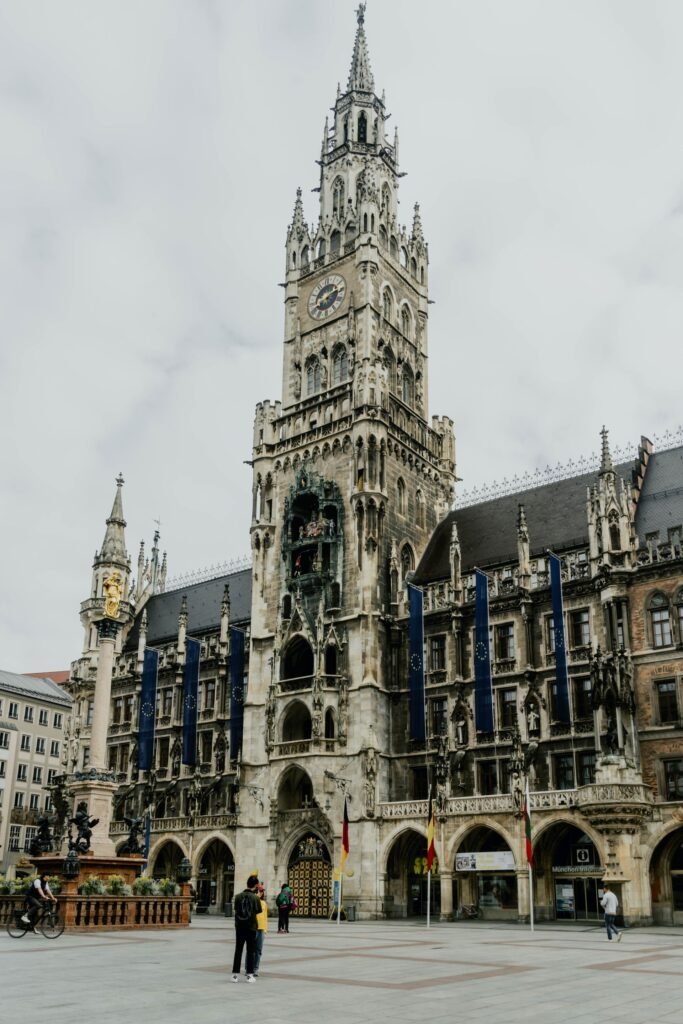
Marienplatz & the New Town Hall
Marienplatz is Munich’s main square and natural starting point, watched over by the soaring neo-Gothic New Town Hall (Neues Rathaus). Its tower holds the famous Glockenspiel, whose 43 bells and 32 life-sized figures re-enact a 16th-century knights’ tournament and a coopers’ dance — a charming, slightly creaky spectacle that plays daily at 11am and noon year-round, with an extra show at 5pm from March to October. At the square’s centre stands the golden Mariensäule (Marian column) of 1638. Don’t overlook the smaller Old Town Hall (Altes Rathaus) at the eastern end, home to a toy museum.
Frauenkirche & St. Peter’s Church
Two towers define Munich’s skyline. The Frauenkirche (Cathedral of Our Lady), a vast 15th-century brick Gothic church, is crowned with twin green onion domes so iconic that, by local convention, no building in the old centre may rise above them. A short walk away, the city’s oldest parish church, St. Peter’s — affectionately “Alter Peter” — offers the best view in Munich: climb its 306 steps for a panorama over the red rooftops, Marienplatz and, on a clear day, the Alps.
Viktualienmarkt & the Old Town
Just south of Marienplatz, the Viktualienmarkt has been Munich’s open-air food market for over 200 years — some 140 stalls of Bavarian produce, cheese, flowers, honey and street food, with a leafy beer garden at its centre where breweries rotate by the week. Wander the surrounding lanes to find the Asamkirche, a tiny, jaw-droppingly ornate baroque church built by the Asam brothers as a private chapel, and the lively shopping street Kaufingerstraße leading back toward Karlsplatz (Stachus).
The Residenz & Odeonsplatz
The Munich Residenz was the seat of the Wittelsbach dukes, electors and kings for nearly 500 years, and it shows: more than 130 rooms span Renaissance, baroque, rococo and neoclassical styles, alongside a dazzling Treasury (Schatzkammer) and the jewel-box Cuvilliés Theatre. It opens onto Odeonsplatz, framed by the Italianate Theatinerkirche and the Feldherrnhalle loggia, with the royal Hofgarten behind. This is Munich at its most regal — and entirely walkable from Marienplatz.
Nymphenburg Palace
On the city’s western edge, the baroque Nymphenburg Palace was the Wittelsbachs’ summer residence, its grand hall and “Gallery of Beauties” set within sprawling formal gardens, canals and pavilions. It’s an easy tram ride from the centre and pairs well with the adjacent Botanical Garden.
BMW Welt, Museum & Olympiapark
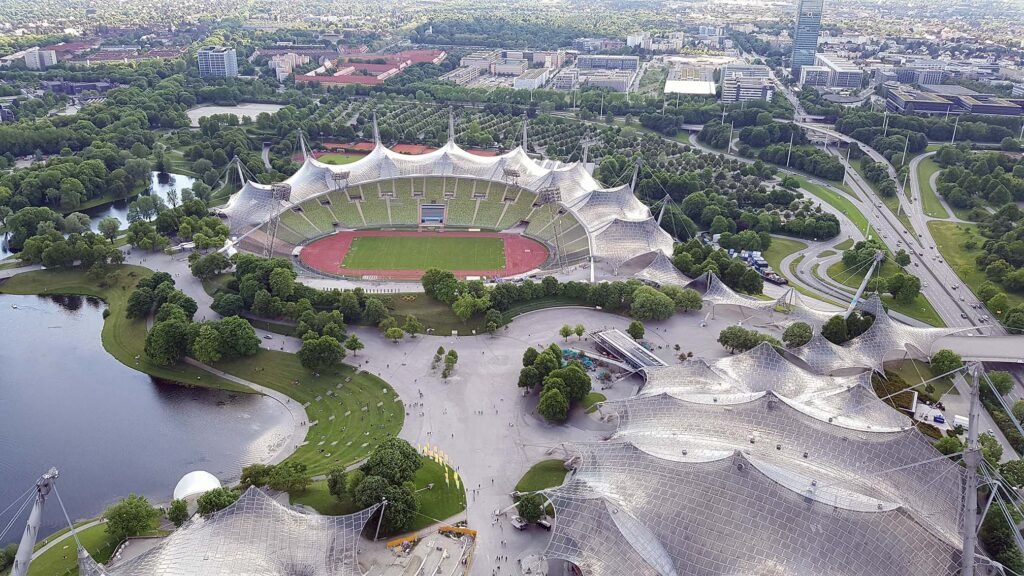
In the north, the futuristic BMW Welt showroom and the bowl-shaped BMW Museum sit beside the Olympiapark, the rolling green legacy of the 1972 Games with its sweeping tent-like roof. Ride or walk up the Olympic Tower (Olympiaturm) for 360-degree views, and in summer catch concerts and festivals on the park’s lawns.
More to See in the Centre
Beyond the headline acts, the Old Town rewards aimless wandering. The three medieval gates — Karlstor, Sendlinger Tor and Isartor — still frame the centre, and the bustling Karlsplatz (Stachus) with its fountain is a classic meeting point. For grandeur, walk Maximilianstraße, Ludwig II’s monumental boulevard of luxury boutiques running to the Bavarian parliament (Maximilianeum) across the river. Hidden gems include the lavish baroque Asamkirche, the riverside Art Nouveau swimming hall Müller’sches Volksbad, and, on the edge of the Theresienwiese, the colossal bronze Bavaria statue and Ruhmeshalle, which you can climb for a view over the Oktoberfest grounds.
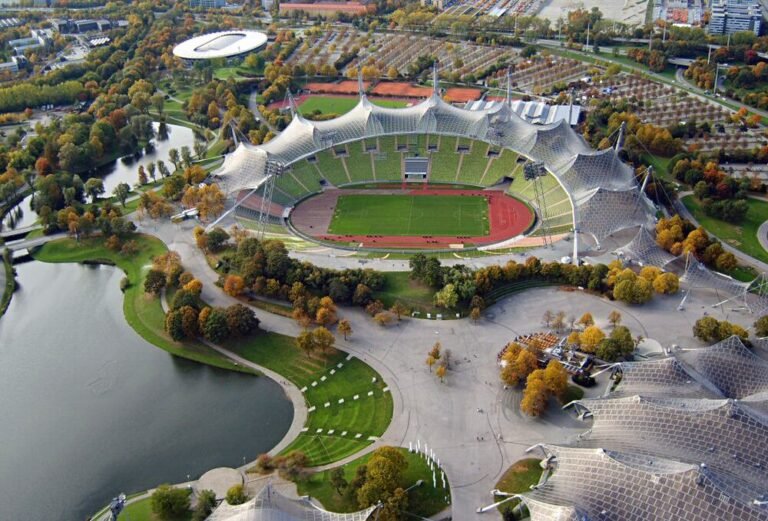
Where to Get the Best Views
For the classic rooftop panorama over Marienplatz, climb Alter Peter (St. Peter’s, 306 steps) or take the lift up the New Town Hall tower for the same scene with no stairs. North of the centre, the Olympic Tower (Olympiaturm) delivers a 190-metre, 360-degree sweep that reaches the Alps on clear days, while the grassy Olympiaberg is a free, locals’ favourite for sunsets. (Access to the Frauenkirche’s south tower has been limited during its long-running renovation.)
Museums & Galleries
Munich is one of Europe’s great museum cities, and the genius of its layout is that most of the heavyweights cluster in the walkable Kunstareal (art district) in Maxvorstadt. Pick two or three that match your interests rather than trying to do them all.
- The three Pinakotheken: The Alte Pinakothek holds Old Master paintings from the 14th to 18th centuries (Dürer, Rubens, Rembrandt); the Neue Pinakothek covers the 19th century; and the Pinakothek der Moderne brings together modern art, design, architecture and graphics under one roof. The neighbouring Museum Brandhorst adds Warhol and Twombly.
- Lenbachhaus: Set in a painter-prince’s villa, it holds the world’s most important collection of “Der Blaue Reiter” (The Blue Rider) — Kandinsky, Marc, Münter — Munich’s gift to modern art.
- Königsplatz — Glyptothek & Antikensammlungen: A neoclassical square housing Greek and Roman sculpture and antiquities, a quiet counterpoint to the painting galleries.
- Deutsches Museum: On an island in the Isar, the world’s largest science and technology museum lets you walk through a coal mine, stand under aircraft and play with hands-on experiments — a hit with families.
- NS-Dokumentationszentrum: A sober, essential museum on Munich’s role in the rise of National Socialism, on the very square where the Nazi party was headquartered.
- Bavarian National Museum & the Residenz museums: For decorative arts, royal treasures and the Wittelsbach story.

Architecture Through the Ages
Part of Munich’s charm is that you can read its whole history in its buildings, often within a single block. The Gothic era left the brick Frauenkirche and the spiky Old Town Hall; the Renaissance gave St. Michael’s Church, once the largest north of the Alps. Munich then went gloriously over the top in the baroque and rococo period — the Theatinerkirche’s golden domes, Nymphenburg Palace, and above all the tiny, dazzling Asamkirche, where the Asam brothers crammed an entire heaven of stucco and gold into a narrow lane.
The 19th century brought neoclassical grandeur under the kings — the temple-like Glyptothek and Propyläen at Königsplatz, the long sweep of Ludwigstraße — and around 1900 the flowing curves of Jugendstil (Art Nouveau) decorated the apartment facades of Schwabing. After wartime destruction, the city rebuilt its historic core while embracing bold modernism: the tent-roofed Olympiapark of 1972, the gleaming BMW Welt, the glowing Allianz Arena and a cluster of high-rises safely out beyond the protected old centre. It all adds up to a cityscape that feels historic and forward-looking at once.

Parks & Green Spaces
Few big cities are as green as Munich, and its parks are central to how locals live — not an afterthought but the city’s outdoor living room.
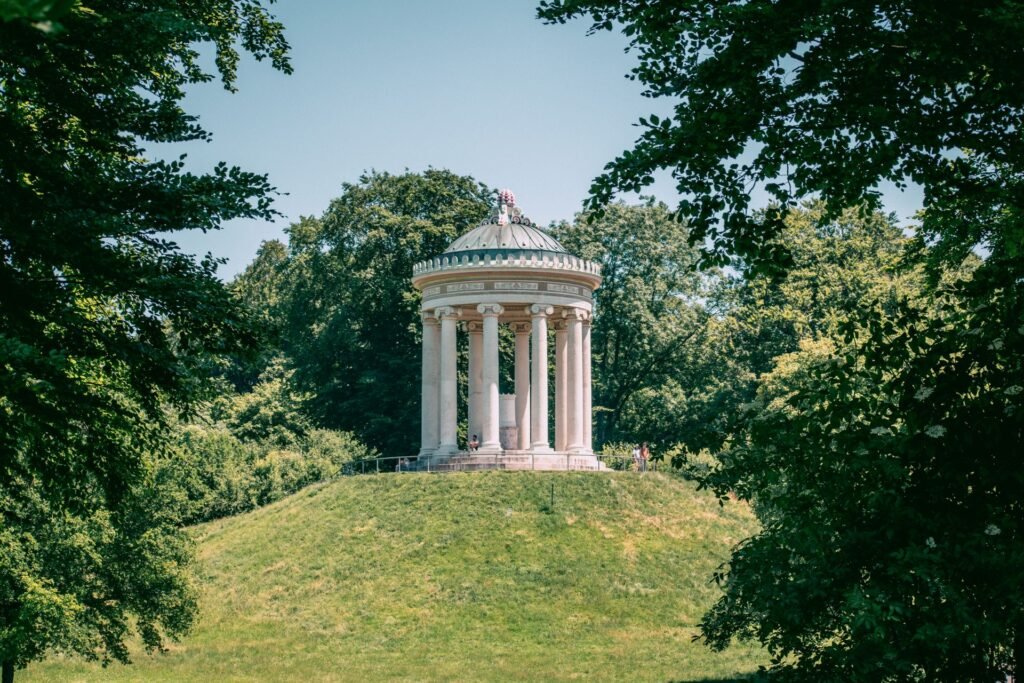
The English Garden (Englischer Garten) is the star: laid out in 1789, it is one of the world’s largest urban parks — larger than New York’s Central Park — stretching from the city centre far to the north. Within it you’ll find the Greek-style Monopteros temple on its hill, the Chinese Tower (Chinesischer Turm) beer garden, meadows for sunbathing, and the surreal spectacle of wetsuited surfers riding a permanent standing wave on the Eisbach stream near the southern entrance — a Munich institution you can watch for free.
Beyond it, the Isar riverbanks have been renaturalised into a long ribbon of gravel beaches and parkland; the Hofgarten offers formal royal calm behind the Residenz; the Nymphenburg and Olympiapark grounds add palace gardens and Olympic lawns; and the vast Hirschgarten doubles as a deer park and one of the world’s largest beer gardens. On a warm day, locals simply pick a green space and stay.
Culture, Music & Nightlife
Munich’s cultural life punches well above even its considerable weight. The Bavarian State Opera, performing in the grand Nationaltheater on Max-Joseph-Platz, ranks among the world’s great opera houses, and its summer Opera Festival is a highlight of the European calendar. The city is home to two top-tier orchestras — the Munich Philharmonic and the Bavarian Radio Symphony Orchestra — plus celebrated drama stages like the Residenztheater and the Kammerspiele. Schwabing, meanwhile, carries a bohemian literary legacy: around 1900 it was the haunt of painters like Kandinsky and writers like Thomas Mann, and even a young Lenin lived nearby.
After dark, Munich is livelier than its buttoned-up reputation suggests. The Glockenbachviertel and Gärtnerplatz are the epicentre of Munich’s bar and LGBTQ+ scene — which comes into its own each summer around the Christopher Street Day (Pride) celebrations — while the “Feierbanane” (party banana) — the curving Sonnenstraße strip — and the post-industrial Werksviertel near the Ostbahnhof concentrate the clubs. Names like Blitz, Harry Klein and Rote Sonne anchor a respected electronic-music scene. For something more traditional, a night in a beer hall with a brass band and a litre stein is its own kind of nightlife — and often the most fun.
Sports in Munich
Munich is a serious sports city. Record German champions FC Bayern Munich play at the spectacular Allianz Arena, whose inflated panel facade glows red on match nights; stadium tours and the FC Bayern Museum run year-round, and tickets to a Bundesliga game are a bucket-list experience for football fans. The legacy of the 1972 Olympics lives on in the Olympiapark, still used for concerts, ice-skating and events, and the city co-hosted the multi-sport 2022 European Championships. Beyond spectating, locals run and cycle along the Isar, swim in the river and nearby lakes in summer, surf the Eisbach wave year-round, ski in the Alps an hour or two away in winter, and pack the stands for EHC Red Bull München ice hockey.

Shopping in Munich
Shopping in Munich runs from high-street bustle to discreet luxury. The pedestrianised Kaufingerstraße and Neuhauser Straße, running west from Marienplatz, form one of Germany’s busiest shopping streets, packed with department stores and international chains. For luxury, Maximilianstraße is the address — a grand boulevard of designer flagships — complemented by elegant Theatinerstraße and the stylish Fünf Höfe arcade.
For something more local, browse the boutiques and concept stores of the Glockenbach and Maxvorstadt districts, graze the food stalls of the Viktualienmarkt and Schrannenhalle, or pick up genuine Bavarian Tracht (Lederhosen and Dirndl) at long-established outfitters like Loden-Frey — essential kit if your visit coincides with Oktoberfest. Note that, as across Germany, shops close on Sundays, so plan purchases for Monday to Saturday.
Economy & Modern Munich
It helps to understand why Munich feels so prosperous: it is one of Europe’s strongest economies, headquarters to global giants like BMW, Siemens, Allianz and Munich Re, and a magnet for technology, media, biotech and start-ups — earning nicknames like “Isar Valley.” That wealth funds the immaculate transport, parks and museums visitors enjoy, but it also makes Munich Germany’s most expensive city for housing, something you’ll notice in hotel prices. For the traveller, the upshot is a polished, safe, well-run city where almost everything simply works.
Annual Events & Festivals in Munich
Munich’s calendar revolves around its festivals, and timing your visit to one — or deliberately around it — shapes the whole experience.
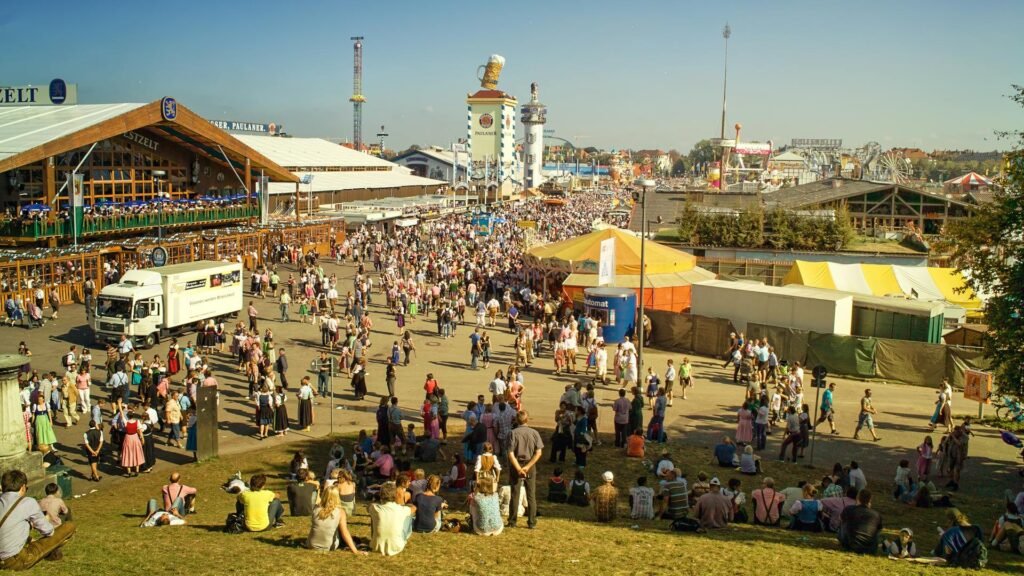
Oktoberfest (19 September–4 October 2026)
The world’s largest folk festival has been held since 1810 and draws around six million visitors to the Theresienwiese each year. Despite the name, it mostly runs in September, ending in early October. Expect 14 enormous beer tents (plus smaller ones), each run by a Munich brewery, alongside a huge fairground of rides, traditional brass music and a sea of Lederhosen and Dirndl. Entry is free; you pay for beer (served only in litre Maß steins), food and rides. The big tents fill early, especially on weekends — arrive before midday or reserve a table months ahead, and book accommodation as far in advance as you can.
A few practical notes make the Wiesn far smoother. Dressing up is half the fun — many visitors wear Tracht (a Dirndl for women, Lederhosen for men), easy to buy across the city beforehand. The festival officially opens at noon on the first Saturday, when the Mayor taps the first keg with the cry “O’zapft is!” (“It’s tapped!”). A litre Maß of beer runs to roughly €15–16 plus a tip; the big tents are free to enter but fill fast, so for a guaranteed evening or weekend seat you’ll need a table reservation, made months ahead through each individual tent. For a calmer, more traditional and family-friendly atmosphere, head to the Oide Wiesn — a nostalgic historic-fairground section with vintage rides and folk music (a small entry fee applies).
Spring & Summer Festivals
If you miss the main event, the Frühlingsfest (17 April–10 May 2026) is a smaller, more local “spring Oktoberfest” on the same grounds. Earlier in the year, Starkbierzeit — the Lenten “strong beer season” — sees breweries tap potent doppelbocks like Paulaner’s Salvator in boisterous hall celebrations, while Fasching (carnival) livens up the weeks before Lent. In summer, the Tollwood Festival brings world music, theatre, food and crafts to Olympiapark (19 June–19 July 2026), and the traditional Auer Dult markets fill Mariahilfplatz three times a year with antiques, crockery and a small funfair.
Autumn & Winter
From late November, Munich glows with Christmas markets. The traditional Christkindlmarkt fills Marienplatz (24 November–24 December 2026) with mulled wine (Glühwein), roasted almonds, crafts and lights, while the alternative Tollwood Winter Festival takes over the Theresienwiese (24 November–23 December 2026) with an eco-conscious, world-culture twist and a famous New Year’s Eve party. Smaller, atmospheric markets — from the medieval one at Wittelsbacherplatz to the pink “Pink Christmas” in the Glockenbach district — are scattered across the city.
Getting to & Around Munich
Arriving in Munich
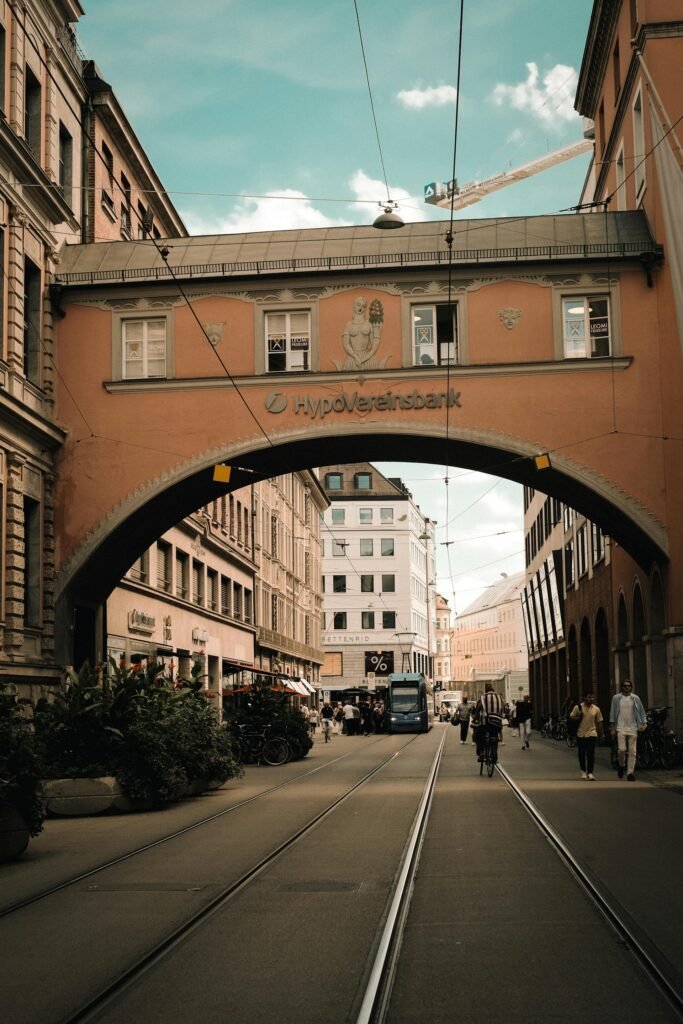
Munich Airport (MUC), about 40 km northeast of the centre, is one of Europe’s busiest and best-rated hubs. The S-Bahn lines S1 and S8 connect it directly to the main station (Hauptbahnhof) and Marienplatz in roughly 40–45 minutes, running every 10 minutes; the Lufthansa Express Bus offers a comparable, traffic-dependent ride to the centre. For rail travellers, the Hauptbahnhof sits on Germany’s high-speed ICE network, with fast, frequent connections to Nuremberg, Frankfurt, Berlin, Stuttgart, Vienna and Zurich — often a more relaxed alternative to flying within the region. Long-distance coaches (FlixBus and others) use the central bus station (ZOB) by the Hackerbrücke, the budget option for reaching cities across Germany and Europe.
Public Transport & Tickets
The MVV network — U-Bahn (metro), S-Bahn (suburban rail), trams and buses — is fast, clean, punctual and covers the whole region on a single integrated ticket. The city is divided into fare zones, with almost all visitor sights inside the central Zone M. A single ticket within Zone M costs about €3.90, while a Single-Day Ticket for the inner zone is €9.70 (a group day ticket covers up to five adults and is excellent value for friends or families). If you’re arriving or leaving by air, the Airport-City-Day-Ticket bundles airport transfers with city travel. A welcome change for families: from 2026, children aged 6–14 travel free. Validate paper tickets before boarding (digital tickets via the MVGO/MVV apps are validated automatically), and remember the same ticket works seamlessly across every mode.
On Foot, by Bike & by Taxi
The Altstadt is best explored on foot — most major sights are within a 15-minute walk of Marienplatz, and much of the centre is pedestrianised. Munich is also exceptionally bike-friendly, with protected lanes and bike-share schemes (including MVG Rad); a ride along the Isar or through the English Garden is a joy in itself. Taxis are plentiful but pricey, and ride-hailing (Uber, FreeNow, Bolt) operates citywide; for most visitors, though, public transport and your own two feet will do almost everything you need. If you do drive, note that the centre is a low-emission “Umweltzone” requiring a windscreen sticker, parking is scarce and pricey, and the easiest approach is to leave the car at an edge-of-city Park-and-Ride lot and switch to the U- or S-Bahn.
Where to Eat & Drink in Munich
Bavarian food is hearty, seasonal and built for sharing — and Munich’s beer culture is woven into everyday life, not reserved for festivals.
Bavarian Classics to Try
Order Weißwurst — mild white veal-and-pork sausages, peeled and eaten with sweet mustard and a soft pretzel — at least once; tradition says they should be eaten before noon, and many places stop serving by early afternoon. Other staples to seek out include Schweinshaxe (crispy roast pork knuckle), Schweinsbraten (pork roast with dumplings and dark gravy), Obatzda (a paprika-spiced soft-cheese spread), giant Brezn (pretzels), Leberkäse (a baked meatloaf served in a roll), and, come autumn, roast goose. The Viktualienmarkt is the easiest place to graze across many of these in a single visit.
Beer Gardens & Beer Halls
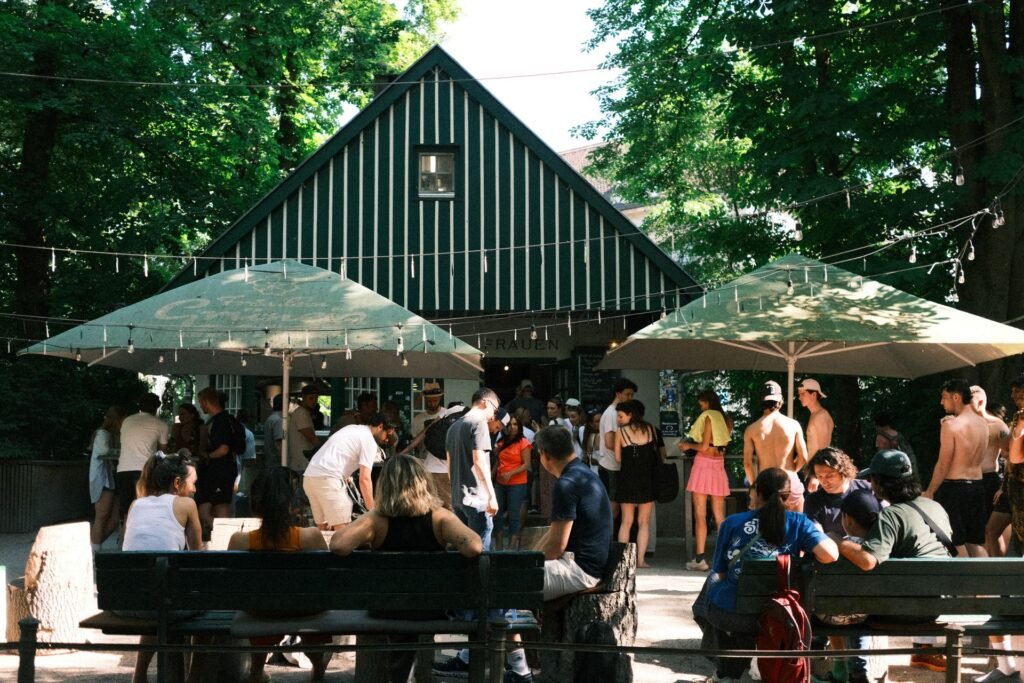
Munich’s beer is brewed by six historic houses — Augustiner, Paulaner, Hacker-Pschorr, Hofbräu, Löwenbräu and Spaten — and only beer from these breweries may, by tradition, be served at Oktoberfest. The classic way to enjoy it is in a beer garden under chestnut trees: try the cavernous Augustiner-Keller, the Chinese Tower garden in the English Garden, the deer-park Hirschgarten (one of the world’s largest), or the Viktualienmarkt’s central garden. A lovely local custom: at traditional beer gardens you may bring your own picnic food to the unclothed-table sections, as long as you buy your drinks on site. For the full brass-band-and-Maß experience indoors, the 16th-century Hofbräuhaus is the most famous beer hall in the world, touristy but undeniably fun.
Understanding Munich’s Beer
A little beer literacy goes a long way here. Bavarian brewing still follows the spirit of the 1516 Reinheitsgebot (purity law), which limited beer to water, barley and hops. The everyday Munich beer is Helles, a pale, malty lager; you’ll also meet cloudy Weißbier (wheat beer, classic with Weißwurst), darker Dunkles, the strong Bock and Doppelbock of the spring beer season, and crisp Radler (beer with lemonade) for warm afternoons. Order by the half-litre or, for the full experience, the litre Maß — and don’t be surprised when it arrives with a generous head.
Cafés, International Eats & Fine Dining
Beyond the sausages, Munich has a sophisticated café culture, strong Italian and Turkish food (a legacy of post-war migration), and a growing wave of vegetarian and vegan kitchens. At the top end, the city holds several Michelin stars — including the long-celebrated Tantris and JAN — alongside modern Bavarian and international tables. Book the best restaurants well ahead, especially around Oktoberfest and trade-fair weeks.
Coffee, Cake & Market Snacks
Don’t overlook the afternoon ritual of Kaffee und Kuchen — coffee and cake — a cornerstone of German daily life. Grand institutions like the delicatessen-café Dallmayr sit alongside cosy neighbourhood Konditoreien serving apple strudel, Sachertorte and seasonal plum cake. For a cheap, beloved snack, queue at the Schmalznudel (Café Frischhut) near the Viktualienmarkt for fresh-fried dough pastries, or graze the market stalls and the indoor Schrannenhalle for cheese, charcuterie and Bavarian sweets. It’s the easiest, tastiest way to eat like a local between sights.
Where to Stay in Munich
Munich’s neighbourhoods each have a distinct character, so where you base yourself shapes the trip. The city is compact enough that you’re never far from the action, but each area offers a different mood and price point.
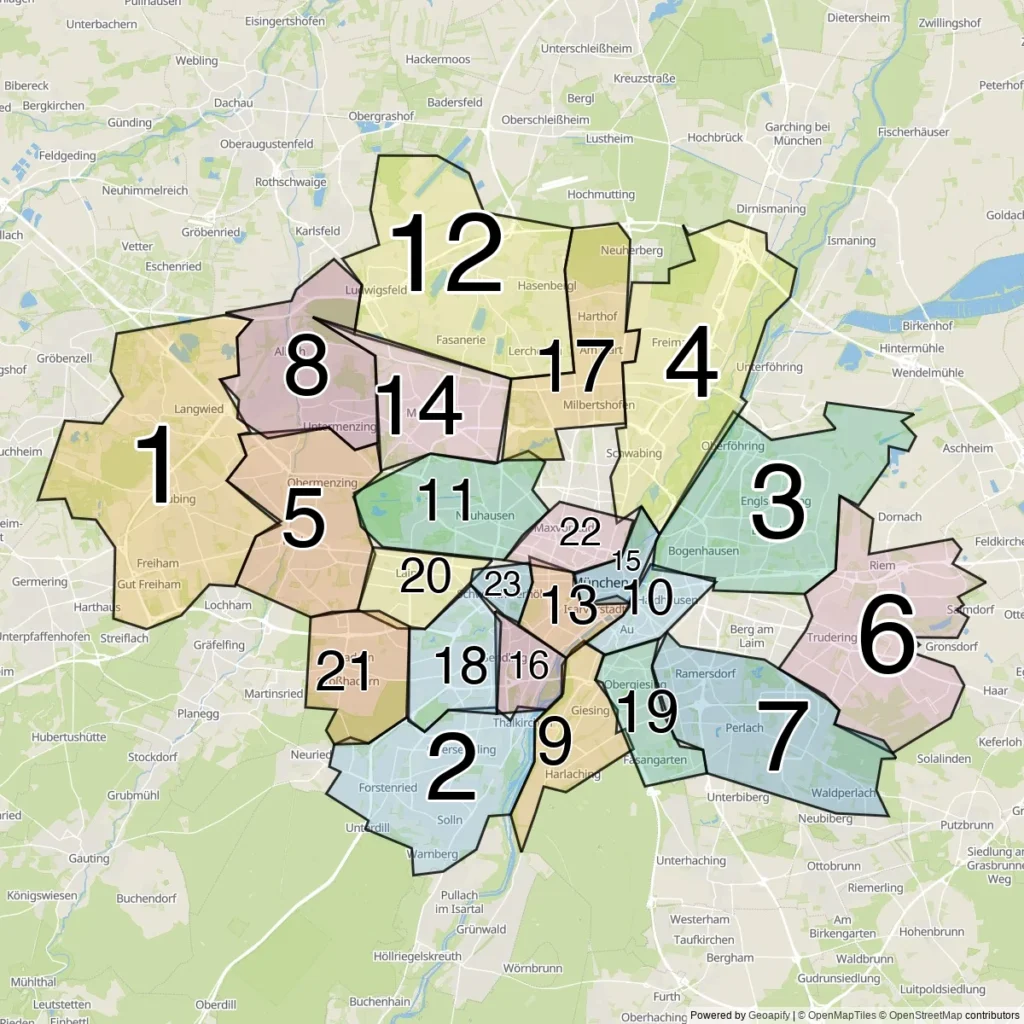
- Altstadt (Old Town): The most central choice — walk to every major sight — but also the priciest. Ideal for first-timers and short stays.
- Maxvorstadt: The museum-and-university quarter, full of cafés, galleries, bookshops and a youthful buzz; great for culture lovers and excellent value relative to the Old Town.
- Schwabing: Leafy, elegant and historically bohemian, bordering the English Garden — refined streets, relaxed café culture and good restaurants.
- Glockenbachviertel & Gärtnerplatz: Trendy, creative and the heart of Munich’s nightlife and LGBTQ+ scene, with boutiques, bars and a young crowd.
- Lehel: Quiet and upscale, between the Old Town and the Isar — handy for the museums along Prinzregentenstraße and a calm night’s sleep.
- Haidhausen: The charming “French Quarter” east of the river, residential and authentic, with good-value places and easy transit.
- Around the Hauptbahnhof: The most budget-friendly and convenient for transit and the airport train, though grittier and less charming than the rest of the centre.
Day Trips from Munich
Munich is the perfect base for southern Bavaria, and some of Germany’s most iconic excursions are within easy reach by train. The Bayern-Ticket (around €27–29 for one person, less per head for groups) gives a full day of unlimited regional-train travel across Bavaria — ideal for these trips.
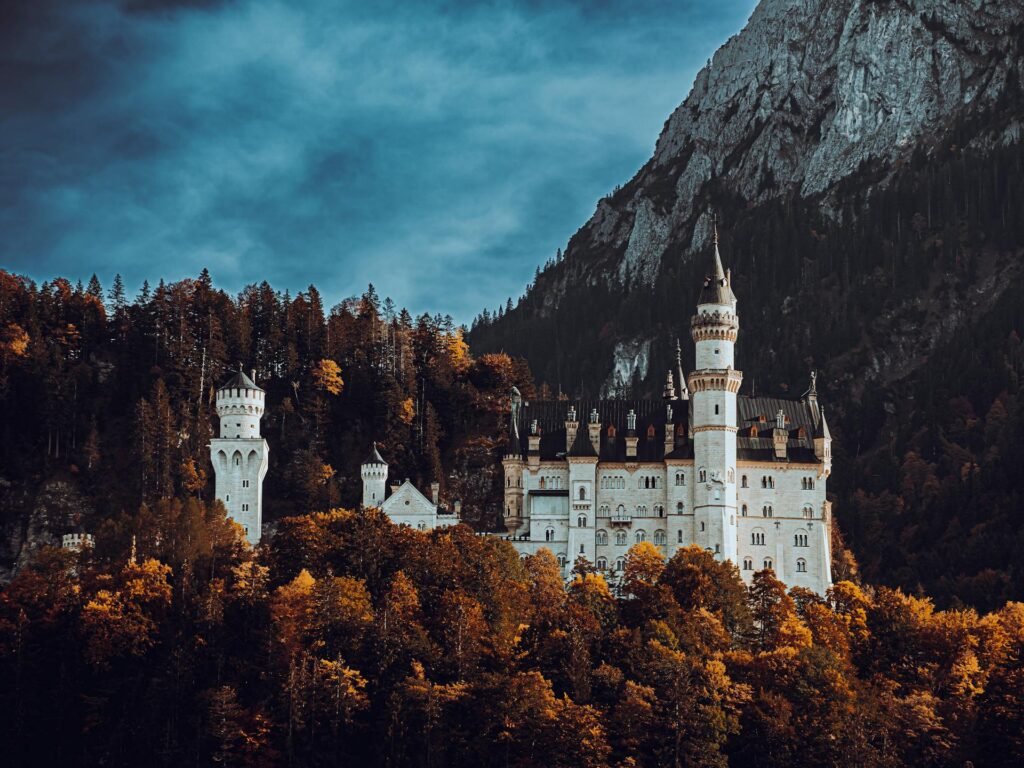
- Neuschwanstein Castle (~2 hours): Ludwig II’s fairy-tale castle near Füssen — the inspiration for Disney’s — reached by train to Füssen then a short bus ride. Book timed entry tickets online in advance; pair it with neighbouring Hohenschwangau Castle.
- Dachau Concentration Camp Memorial (~25 minutes): A sobering, profoundly important site reached directly on the S2 S-Bahn. Entry is free, the documentation is excellent, and a half-day does it justice.
- Zugspitze & Garmisch-Partenkirchen (~1.5 hours): Take the train to the Alpine resort of Garmisch, then the cog railway and cable car to the summit of Germany’s highest mountain (2,962 m) for glacier views across four countries.
- Lakes — Starnberg & Chiemsee (~30–60 minutes): Pretty pre-Alpine lakes for swimming, sailing and boat trips. Chiemsee, the “Bavarian Sea,” hosts Ludwig II’s island palace of Herrenchiemsee.
- Salzburg, Austria (~1.5 hours): Mozart’s baroque birthplace, with a hilltop fortress and “Sound of Music” scenery, just across the border.
- Nuremberg (~1 hour by ICE): A walkable medieval old town with an imperial castle, world-class history museums and, in winter, Germany’s most famous Christmas market.
- Andechs Monastery (~1 hour): A hilltop abbey brewery above Lake Ammersee — a classic local outing combining a gentle hike, monastic beer and Alpine views.
- Regensburg (~1.5 hours): A remarkably intact medieval city on the Danube — a UNESCO World Heritage old town with a 12th-century stone bridge and Roman roots.
- Berchtesgaden & the Eagle’s Nest (~2.5 hours): Dramatic Alpine scenery near Austria, the emerald Königssee lake, and the historically charged Eagle’s Nest mountaintop retreat.
- Linderhof Palace (~2 hours): The smallest and only completed of Ludwig II’s palaces, a rococo jewel set in formal gardens — often combined with Oberammergau.
- Tegernsee & the lakes (~1 hour): A genteel Alpine lake ringed by spa towns and its own monastery brewery — an easy, scenic escape from the city.
Hidden Gems & Local Favorites
Once you’ve ticked off the icons, Munich rewards going a little off-script. Join locals on the Flaucher, the wild southern stretch of the Isar with gravel beaches and summer barbecues, or seek out the serene Japanese Tea House and the quieter northern reaches of the English Garden, far from the Chinese Tower crowds. The Westend and Schlachthofviertel show an unpolished, multicultural side of the city, while the elegant Müller’sches Volksbad and leafy Praterinsel reveal the Isar at its most refined. Architecture lovers should slip into smaller churches like St. Anna im Lehel, and on a warm evening Munich’s rooftop bars swap beer-garden benches for skyline cocktails. And don’t leave without an Italian-style gelato from one of the city’s beloved Eisdielen — a summer ritual Müncheners take very seriously.
Munich with Kids
Munich is an easy, rewarding city for families. The hands-on Deutsches Museum is a guaranteed hit, with buttons to press and machines to explore, while Hellabrunn Zoo (Tierpark Hellabrunn) in the Isar floodplain is a spacious, geographically themed zoo that easily fills a day. The English Garden has playgrounds, meadows, a boating lake and the ever-popular Eisbach surfers to watch; Sea Life at the Olympiapark and the BMW Welt add rainy-day options, and the Bavaria Filmstadt studio tour on the city’s edge is fun for older children. A practical bonus from 2026: children aged 6–14 ride all public transport free, and beer gardens are family-friendly, with playgrounds and space to run around while parents relax.
Suggested Itineraries
Short on time? These routes string the highlights together efficiently, all built around Munich’s walkable centre.
- One day: Catch the Glockenspiel on Marienplatz, climb St. Peter’s tower for the view, browse the Viktualienmarkt for lunch, tour the Residenz and Odeonsplatz, then stroll into the English Garden to watch the surfers — and finish with a stein at the Hofbräuhaus or a beer garden.
- Two days: Add the Frauenkirche and Asamkirche, one of the Pinakothek galleries in the Kunstareal, and a tram out to Nymphenburg Palace, with dinner in the lively Glockenbachviertel.
- Three days: Devote day three to a day trip — Neuschwanstein for fairy-tale castles, or Dachau for history — or stay in town for BMW Welt and a wander through Olympiapark.
- Four-plus days: Layer in the Alps (Zugspitze/Garmisch), a lake day at Starnberg or Chiemsee, or a hop across the border to Salzburg.
Money, Safety & Practical Info
Munich is one of the safest large cities in Germany, with low violent crime; the usual big-city caution against pickpockets in crowded spots — the Hauptbahnhof, packed Oktoberfest tents and busy trams — is all most visitors need. The currency is the euro; cards are increasingly accepted, but keep some cash for markets, beer gardens and small cafés. Tap water is clean and safe to drink. Free Wi-Fi is common in cafés, hotels and parts of the transport network, and EU roaming applies for European visitors. Pharmacies (Apotheke) are well stocked but closed on Sundays, when an emergency-rotation pharmacy covers the city; the Europe-wide emergency number is 112.
Sightseeing Passes & Saving Money
A little planning keeps costs down in one of Germany’s pricier cities. Two city passes can pay off if you’ll combine transport with several paid sights: the München Card (public transport plus discounts) and the CityTourCard (transport plus attraction discounts), both sold for 1–6 days in single or group versions. The single best deal, though, is free: many of Munich’s state museums — including the Alte Pinakothek and the rest of the Kunstareal — charge just €1 on Sundays (special exhibitions aside), so save your gallery day for a Sunday if you can. Families gain further from the group day ticket (up to five people) and, from 2026, free public transport for children aged 6–14.
Plenty of the best of Munich costs nothing at all: wandering the English Garden and watching the Eisbach surfers, strolling the Isar paths and the Flaucher, browsing the buzz of the Viktualienmarkt, window-shopping Maximilianstraße, and stepping into the city’s churches. Tap water is free and safe, and a beer-garden meal — especially if you bring your own food to the self-service tables — is one of the best-value experiences in the city.
Best Time to Visit: Seasons & Weather
Munich has a temperate climate with warm summers, cold winters and noticeable swings — partly thanks to the Föhn, a warm Alpine wind that can bring sudden clear, mild spells (and, for some, headaches) at any time of year. Here’s how the seasons play out for travellers.
- Spring (Apr–May): Mild and blossoming, with beer gardens reopening and the Frühlingsfest in full swing. A lovely, less-crowded time to visit.
- Summer (Jun–Aug): Warm (often 25–30°C), long daylight, and the city at its most outdoor — beer gardens, Isar swimming, festivals and easy Alpine day trips. The peak season, with occasional thunderstorms.
- Autumn (Sep–Oct): Oktoberfest dominates late September into early October, the surrounding countryside turns golden, and crisp, clear days are ideal for sightseeing. Book early if your trip overlaps the Wiesn.
- Winter (Nov–Mar): Cold and often snowy, but magical during the Christmas-market season, and a gateway to skiing in the nearby Alps. Pack warm layers and waterproof shoes.

Language, Etiquette & Local Customs
A little local know-how makes Munich friendlier. The standard greeting in Bavaria is “Grüß Gott” rather than “Guten Tag,” and “Servus” works as a casual hello or goodbye among friends. You’ll hear a soft Bavarian dialect, but everyone understands standard German and most people in tourism speak good English. The cultural watchword is Gemütlichkeit — a cosy, unhurried conviviality best experienced over a shared beer-garden table.
On etiquette: tipping is done by rounding up or adding about 5–10%, stated to the server as you pay rather than left on the table. In beer gardens you’re expected to share the long tables with strangers — a friendly “Ist hier frei?” (“Is this seat taken?”) is all it takes — and in the self-service sections you may bring your own picnic. Bavarians take rules seriously: don’t cross against a red pedestrian light, especially near children, and never wander into the red-painted bike lanes. Finally, remember that Sundays and public holidays are genuinely quiet, with shops closed — so a few words of German and a relaxed pace will carry you a long way.
Tips for Visiting Munich
- Carry some cash. Card acceptance has improved, but many beer gardens, markets, bakeries and smaller cafés still prefer (or require) cash.
- Plan around Sundays. Most shops close on Sundays and public holidays — though restaurants, museums, beer gardens and bakeries stay open. Stock up on Saturday.
- Weißwurst before noon. The white sausages are a morning tradition; many traditional spots stop serving them by early afternoon.
- Say “Grüß Gott.” The standard Bavarian greeting (rather than “Guten Tag”) goes a long way; a few words of German are always appreciated.
- Tip by rounding up. Service is included, but rounding up or adding about 5–10% is customary — state the total as you pay rather than leaving coins on the table.
- Dress in layers. Weather can shift quickly, and the Föhn can bring sudden warm, clear spells; comfortable walking shoes are essential.
- Book Oktoberfest early. Accommodation and tent reservations for late September sell out many months in advance, and prices spike.
- Validate your transit ticket. Munich runs on trust with spot checks; an unvalidated paper ticket counts as fare-dodging and carries a fine.
- Enjoy free Munich. The English Garden, the Isar paths, watching the Eisbach surfers, window-shopping on Maximilianstraße and the city’s churches all cost nothing.
Frequently Asked Questions About Visiting Munich
What is Munich best known for?
Munich is best known for Oktoberfest and its centuries-old beer-garden culture, the New Town Hall and Frauenkirche on Marienplatz, the vast English Garden, and its role as Germany’s gateway to the Alps and fairy-tale castles like Neuschwanstein. It’s also home to BMW and football giants FC Bayern.
When is Oktoberfest 2026?
Oktoberfest 2026 runs from Saturday 19 September to Sunday 4 October on the Theresienwiese. It’s free to enter; you pay for food, drinks and rides. Book accommodation and any tent table reservations months in advance.
How many days do you need in Munich?
Three to four days lets you cover the Old Town, the English Garden, a couple of museums and a palace at a relaxed pace. Add one or two more days if you want day trips to Neuschwanstein, the Alps or Salzburg.
How do I get from Munich Airport to the city centre?
Take the S-Bahn S1 or S8 from the airport directly to the Hauptbahnhof and Marienplatz in about 40–45 minutes; trains run roughly every 10 minutes. The Lufthansa Express Bus is a comparable option, and the Airport-City-Day-Ticket conveniently bundles the transfer with a day of city travel.
Is Munich walkable and easy to get around?
Yes. The Old Town is compact and pedestrian-friendly, and the MVV network of U-Bahn, S-Bahn, trams and buses covers everything beyond walking distance on one integrated ticket. Munich is also one of Germany’s most bike-friendly cities.
What are the best day trips from Munich?
The most popular are Neuschwanstein Castle, the Dachau Memorial, the Zugspitze and Garmisch-Partenkirchen in the Alps, the lakes Starnberg and Chiemsee, and the Austrian city of Salzburg — all reachable as day trips by train, ideally with a Bayern-Ticket.
What is the best time to visit Munich?
Late spring to early autumn (May–October) offers the best weather for beer gardens and the Alps. Late September brings Oktoberfest, while December’s Christmas markets are magical if you don’t mind the cold.
Is Munich expensive?
Munich is among Germany’s pricier cities, especially for accommodation during Oktoberfest and major trade fairs. That said, beer-garden meals are good value, public transport is reasonable, and many of the best experiences — parks, riverside walks and historic squares — are free.
References
- Munich Tourism (munich.travel) — official visitor information.
- City of Munich (muenchen.de) — official city portal and events.
- MVV — public transport tickets, fares and timetables.
- Oktoberfest.de — official Oktoberfest dates and information.
- Deutsche Bahn — train tickets and the Bayern-Ticket for day trips.
- Wikipedia: Munich — history, geography and statistics.
AFRIKA
Cairo Hurghada Johannesburg Marrakech
ASIA
Abu Dhabi Agra Antalya Bangkok Batam Beijing Bengaluru Cebu City Chiang Mai Chiba Chennai Da Nang Dammam Delhi Denpasar Dubai Fukuoka Guangzhou Guilin Ha Long Hanoi Ho Chi Minh City Jakarta Jaipur Johor Bahru Kolkata Krabi Kuala Lumpur Kyoto Macau Mecca Medina Mugla Mumbai Osaka Pattaya Penang Phuket Riyadh Seoul Shanghai Shenzhen Singapore Taipei Tokyo Zhuhai
EUROPE
Amsterdam Athens Barcelona Berlin Brussels Budapest Copenhagen Dublin Florence Frankfurt am Main Heraklion Krakow Lisbon London Madrid Milan Munich Nice Paris Porto Prague Rhodes Rome Stockholm Venice Vienna Warsaw
NORTH AMERICA
Cancun Las Vegas Los Angeles Miami New York City Orlando San Francisco Toronto Vancouver
SOUTH AMERICA
Buenos Aires Lima Rio De Janeiro
OCEANIA
Auckland Honolulu Melbourne Sydney