
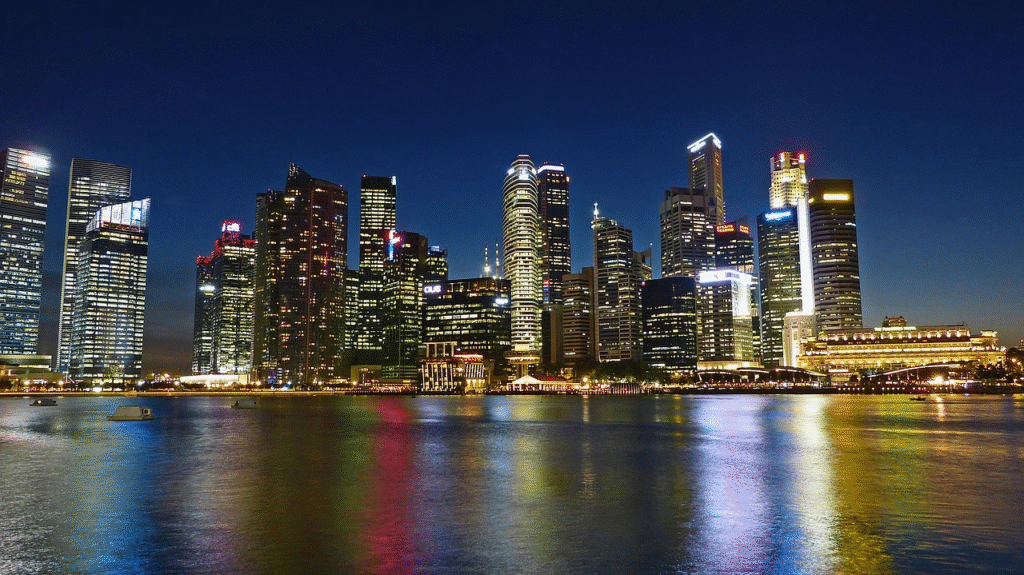
Photo credit: cegoh, Pixabay
Singapore stands as one of Asia’s most remarkable success stories, transforming from a humble trading post into a gleaming global city-state in just decades. This tiny island nation, officially known as the Republic of Singapore, punches far above its weight with its strategic location, multicultural harmony, and relentless pursuit of excellence. From the futuristic Gardens by the Bay to bustling hawker centers serving world-class street food, Singapore offers visitors an unforgettable blend of cutting-edge innovation and rich cultural heritage.
Singapore at a Glance: Essential Facts for Travelers
| Official Name | Republic of Singapore |
| Location | Southeast Asia, southern tip of Malay Peninsula |
| Coordinates | 1°17′N 103°50′E |
| Population | 5.9 million (2023) |
| Area | 728.6 km² (281 sq mi) |
| Highest Point | Bukit Timah Hill (164m) |
| Time Zone | UTC+8 (Singapore Standard Time) |
| Calling Code | +65 |
| Postal Codes | 6-digit system (e.g., 238880) |
| Official Languages | English, Mandarin, Malay, Tamil |
| Currency | Singapore Dollar (SGD) |
| Government | Parliamentary Republic |
| President | Tharman Shanmugaratnam (2023-present) |
| Prime Minister | Lawrence Wong (2024-present) |
| Independence | August 9, 1965 (from Malaysia) |
| GDP per capita | $82,800 (2022) |
| Known For | Marina Bay Sands, Gardens by the Bay, Hawker Food, Changi Airport |
| Official Website | gov.sg |
Upcoming Events in Singapore
| Date | Title | Details |
|---|---|---|
| 2026-09-11 to 2026-10-04 | Mid-Autumn Festival at Gardens by the Bay | Each autumn, Gardens by the Bay hosts a spectacular Mid-Autumn Festival, filling Supertree Grove and the gardens with a dazzling display of handcrafted lanterns, many designed by artisans and themed around Chinese legend and culture. Visitors can stroll among towering illuminated lantern sets, enjoy cultural performances, mooncakes and a lively bazaar, and admire the nightly light show. It is one of Singapore’s most beloved seasonal celebrations, especially popular with families. Entry to the outdoor gardens is free, while some attractions are ticketed; evenings are magical but can get busy. [Source] |
| 2026-09-25 to 2026-11-01 | Halloween Horror Nights at Universal Studios Singapore | Halloween Horror Nights, held on select evenings from late September through October at Universal Studios Singapore on Sentosa, is Asia’s premier Halloween event. The theme park transforms after dark into a maze of haunted houses, eerie scare zones roamed by ghouls, and live shows, drawing thrill-seekers for a night of frights. Aimed at older teens and adults rather than young children, it is intensely atmospheric and hugely popular, often selling out. Tickets are required and priced separately from daytime admission; booking ahead is strongly advised for this spine-tingling seasonal spectacle. [Source] |
| 2026-10-09 to 2026-10-11 | Formula 1 Singapore Grand Prix 2026 | The Formula 1 Singapore Grand Prix is one of the sport’s most glamorous events, a floodlit night race around the tight Marina Bay Street Circuit past the city’s illuminated skyline. Held over a weekend in early October, it combines high-speed racing with a star-studded entertainment line-up, with major music acts performing on stages around the circuit each evening. The unique night-race spectacle draws huge international crowds and transforms the downtown into a festival. Tickets vary widely by grandstand and zone; it is the highlight of Singapore’s sporting and events calendar. [Source] |
| 2026-10-10 to 2026-11-15 | Deepavali Festival and Little India Light-Up | Ahead of Deepavali, the Hindu festival of lights, Singapore’s Little India bursts into colour with a spectacular street light-up that typically launches in October and runs through the celebration. Serangoon Road and the surrounding lanes are strung with dazzling illuminations, while a festival village, bazaar and cultural performances bring crowds to browse for garlands, sweets, decorations and traditional attire. It is a vibrant, free way to experience one of the city’s major cultural festivals, immersing visitors in the sights, sounds and flavours of the district. The atmosphere is especially lively in the evenings. [Source] |
| 2026-11-13 to 2026-11-22 | Singapore Writers Festival | The Singapore Writers Festival runs from 13 to 22 November under the theme Hidden in Plain Sight, exploring how truth can be constructed, reinterpreted or concealed in literature and beyond. More than one hundred programmes spread across The Arts House and other civic district venues, spanning author talks, panels, workshops and performances featuring Singaporean and international writers. Festival passes start at 30 Singapore dollars, with discounted early-bird and youth passes available, while selected headline events are ticketed separately. The multilingual programme embraces English, Chinese, Malay and Tamil writing communities. [Source] |
| 2026-11-20 to 2026-11-29 | Kalaa Utsavam – Indian Festival of Arts | Esplanade – Theatres on the Bay presents Kalaa Utsavam, its annual Indian festival of arts, from 20 to 29 November. Timed around the Deepavali season, the ten-day celebration fills the waterfront arts centre with classical and contemporary Indian music, dance and theatre, from carnatic and Hindustani concerts to bharatanatyam and new cross-cultural commissions. Many foyer and outdoor performances are free, while theatre productions are ticketed at varying prices. The festival is a family favourite, giving audiences of all backgrounds an accessible window into the richness of Indian performing arts. [Source] |
| 2026-11-26 to 2026-11-29 | Affordable Art Fair Singapore | The 19th edition of the Affordable Art Fair takes over the F1 Pit Building on Republic Boulevard from 26 to 29 November. Over 95 local and international galleries show thousands of contemporary paintings, prints, photographs and sculptures, with about three quarters of the works priced below 7,500 Singapore dollars, making it a friendly entry point for first-time collectors. A private view opens the fair on Thursday afternoon and evening, followed by public days through Sunday. Ticket prices vary, with online booking via the fair’s ticketing partner recommended. [Source] |
City News in Singapore – last 14 days
| Date | Category | Headline | Details |
|---|---|---|---|
| 2026-09-14 | Local affairs | Haze returns: PSI in central Singapore rises to unhealthy 130 | Air quality across Singapore deteriorated as smoke from fires in Indonesia’s Kalimantan and Sumatra drifted north, pushing the Pollutant Standards Index in the central region up to 130 and into the unhealthy range, with the east and west also affected. One-hour PM2.5 readings in central Singapore reached 113. The National Environment Agency forecast air quality between the moderate band and the lower end of the unhealthy range, advising residents to reduce prolonged outdoor exertion while the haze persists. [Source] |
| 2026-09-14 | Local government | Racial Harmony Act takes effect on 15 September | The Maintenance of Racial Harmony Act comes into force on 15 September, consolidating Singapore’s laws protecting racial harmony into a single statute. The legislation introduces restraining orders against those who produce or distribute content that prejudices racial harmony, along with a community remedial initiative that offers education in place of prosecution for less serious cases. An inaugural presidential council for racial and religious harmony has also been appointed to advise on matters under the new framework. [Source] |
| 2026-09-14 | Public transport | Heavy vehicles get overnight parking at industrial and work sites from 15 September | From 15 September, heavy vehicles may park overnight at industrial, commercial and work sites, easing a long-standing shortage of approved parking for lorries, trailers and construction machinery. Owners must submit proof of consent from the premises owner before using a site, and safety and access conditions apply. The change is intended to cut illegal parking in residential estates and reduce long empty runs to distant depots, benefiting drivers who start work early at fixed sites across the island. [Source] |
| 2026-09-14 | Public safety | Jail for man who drove around with SMS blaster sending 10,500 phishing messages | A man who drove around Singapore with a so-called blaster device that transmitted more than 10,500 phishing SMS messages to nearby mobile phones has been sentenced to jail. The messages, sent between October and November 2025, impersonated legitimate organisations to harvest banking credentials from recipients. The case is among Singapore’s first prosecutions involving mobile fake base station equipment, and police have warned that telecommunications-based fraud infrastructure is being deployed physically on the streets, not just from overseas call centres. [Source] |
| 2026-09-14 | Public safety | At least $71,000 lost in job scams tied to Pokemon trading cards | Scammers exploiting the trading card craze have cost victims in Singapore at least 71,000 dollars in three weeks through fake job offers. Victims were recruited for supposed online tasks such as opening digital packs of Pokemon and other trading cards in exchange for commissions, then induced to top up accounts with their own money to unlock earnings that never materialised. Police advised the public to be wary of jobs promising easy commissions for simple online activities and to verify recruiters independently. [Source] |
| 2026-09-14 | Public safety | Six jailed over $4.9 million armed robbery during poker game at King Albert Park bungalow | Six men have been jailed for a 4.9 million dollar armed robbery carried out during a poker game at a good class bungalow in King Albert Park. Armed with machetes, the group entered the property through an unlocked gate, tied up the people inside and made off with cash and valuables. The court heard how the raid was planned around the high-stakes private game. The sentences close one of Singapore’s most dramatic recent violent crime cases. [Source] |
| 2026-09-14 | Local affairs | State sells off cars, handbags and homes from $2.4 billion laundering bust | Singapore is disposing of assets seized in its landmark 2.4 billion dollar money laundering case, selling luxury cars, designer handbags, jewellery and apartments confiscated from the convicted foreign nationals. Proceeds flow to the state as authorities work through one of the largest asset forfeitures in the country’s history. The sales underscore the scale of the 2023 bust, which exposed how illicit funds were parked in Singapore property, banking and luxury goods, prompting tighter checks across those sectors. [Source] |
| 2026-09-14 | Business | Bond issuance hit record US$95 billion in 2025, MAS reports | Bond issuance in Singapore reached a record 95 billion US dollars in 2025, up 21.8 percent from the previous year, according to the Monetary Authority of Singapore. The growth reflects strong corporate and financial institution demand for debt financing through the city-state, cementing its role as Southeast Asia’s leading fixed-income hub. Sustainable and green bonds contributed a growing share of volumes, and market participants expect continued momentum as regional issuers diversify funding sources beyond bank lending. [Source] |
| 2026-09-14 | Business | Singapore banks complete blockchain-enabled SGD transactions on Swift ledger | Singapore banks have completed blockchain-enabled Singapore dollar transactions using Swift’s shared ledger infrastructure, marking a milestone in the integration of distributed ledger technology into mainstream interbank payments. The trials demonstrated how tokenised settlement can work alongside existing correspondent banking rails, reducing reconciliation friction while preserving compliance controls. The experiments position Singapore’s financial sector at the forefront of efforts to modernise cross-border payments, complementing the central bank’s broader digital money initiatives with commercial bank participation. [Source] |
| 2026-09-13 | Business | Rival gyms court members stranded by True Fitness and True Yoga closures | Fitness chains across Singapore are offering discounted sign-ups and membership transfers to people affected by the abrupt closure of True Fitness and True Yoga outlets. Competitors advertised waived joining fees and honoured unused membership periods in bids to win over stranded customers, while the Singapore Fitness Alliance stepped in to help displaced employees of the chains find new jobs. The closures have revived debate about protections for consumers who prepay long-term gym packages. [Source] |
| 2026-09-14 | Local affairs | 23,100 more migrant worker dormitory beds by 2027 | Singapore will add 23,100 migrant worker dormitory beds by 2027 as part of efforts to improve housing standards for the workforce that builds and maintains the city. The new capacity comes with upgraded specifications, including better ventilation, more space per resident and improved isolation facilities, reflecting standards introduced after the pandemic exposed overcrowding risks. The expansion is also meant to support demand from major construction projects while easing pressure on older dormitories slated for retrofitting. [Source] |
| 2026-09-14 | Education | SUTD gives students and staff access to GPT, Claude and Gemini | The Singapore University of Technology and Design has rolled out a platform giving its roughly 3,000 students and 170 faculty access to leading artificial intelligence models, including GPT, Claude and Gemini. The university says hands-on access will let students compare model strengths, build AI-augmented projects and develop critical judgement about machine-generated output. The initiative is among the most comprehensive AI tool deployments at a Singapore university and reflects the city-state’s push to embed AI literacy across higher education. [Source] |
| 2026-09-13 | Culture | Inclusive festival lets visitors see the world through disabled artists’ eyes | An inclusive arts festival in Singapore is inviting visitors to experience life from the perspective of artists with disabilities through interactive installations. The works translate the artists’ sensory worlds, from visual impairment to neurodivergence, into immersive encounters that audiences can walk through and touch. Organisers hope the festival will shift public perceptions of disability from sympathy to appreciation of creative talent, and the participating artists worked alongside designers to shape how their experiences are presented. [Source] |
| 2026-09-13 | Sports | More than 610 join Samsung Singapore’s first heart-health walkathon | Samsung Electronics Singapore staged its first walkathon in support of heart health, drawing more than 610 participants who completed a course promoting active lifestyles. The event combined the walk with health screenings and fitness activities, tying into wearable technology that tracks heart metrics. Proceeds and awareness efforts were directed at cardiovascular health causes. Corporate mass-participation events of this kind have grown steadily in Singapore, complementing the city’s packed calendar of runs, rides and charity walks. [Source] |
Singapore Events & City News Archive
Sources: Gardens by the Bay, Resorts World Sentosa, Singapore GP, Visit Singapore, Singapore Writers Festival, Esplanade – Theatres on the Bay, Affordable Art Fair, The Straits Times
Weather Forecast for the Next 14 Days in Singapore
| Date | Weather | Max °F | Min °F | Rain mm |
|---|---|---|---|---|
| 2026-09-14 | 🌧️ | 89.6 °F | 77.0 °F | 2.4 mm |
| 2026-09-15 | 🌧️ | 89.1 °F | 77.3 °F | 1.2 mm |
| 2026-09-16 | ☁️ | 90.5 °F | 75.2 °F | 0.0 mm |
| 2026-09-17 | 🌧️ | 90.6 °F | 76.5 °F | 5.0 mm |
| 2026-09-18 | 🌧️ | 89.3 °F | 76.7 °F | 6.7 mm |
| 2026-09-19 | 🌧️ | 85.6 °F | 73.4 °F | 9.9 mm |
| 2026-09-20 | ⛈️ | 87.8 °F | 75.7 °F | 9.3 mm |
| 2026-09-21 | 🌧️ | 87.5 °F | 77.5 °F | 3.0 mm |
| 2026-09-22 | 🌧️ | 83.4 °F | 78.4 °F | 4.8 mm |
| 2026-09-23 | 🌧️ | 85.3 °F | 77.7 °F | 7.8 mm |
| 2026-09-24 | ☁️ | 90.4 °F | 77.5 °F | 0.0 mm |
| 2026-09-25 | 🌧️ | 81.3 °F | 78.8 °F | 9.6 mm |
| 2026-09-26 | 🌧️ | 82.1 °F | 76.6 °F | 8.4 mm |
| 2026-09-27 | 🌧️ | 79.8 °F | 75.8 °F | 16.2 mm |
Singapore’s History
Singapore is one of the rare cases of a 20th-century city-state that genuinely went from third-world to first-world inside two generations. Sleepy fishing village under the Johor Sultanate; British trading post from 1819; pre-war commercial port of the Straits Settlements; Japanese-occupied “Shōnan-tō” during WWII; brief independence as Malaysian state; expelled from Malaysia in 1965 with no natural resources, no fresh water supply, and 75% Chinese population in a Malay region. The transformation since is the modern Singapore story.
Ancient Origins as Temasek
The island appears in Chinese maritime records as early as the 3rd century CE under the name Pu Luo Chung; later in the 14th century as Temasek (“Sea Town” in Old Javanese). The strategic location at the southern tip of the Malay Peninsula, controlling the entrance to the Strait of Malacca, made it a natural trading post on the Maritime Silk Road. Archaeological evidence at Fort Canning Hill suggests a substantial 14th-century settlement that was abandoned (likely after Majapahit-Siam conflicts) before the British arrived.
The Lion City Legend
The name “Singapore” derives from the Sanskrit Singapura (“Lion City”). According to the Sejarah Melayu (Malay Annals), Prince Sang Nila Utama of Palembang (Srivijaya) sighted a strange large beast on the island in 1299 and named his new kingdom for it. The animal he saw was almost certainly a Malayan tiger — but the name stuck.
Colonial Transformation
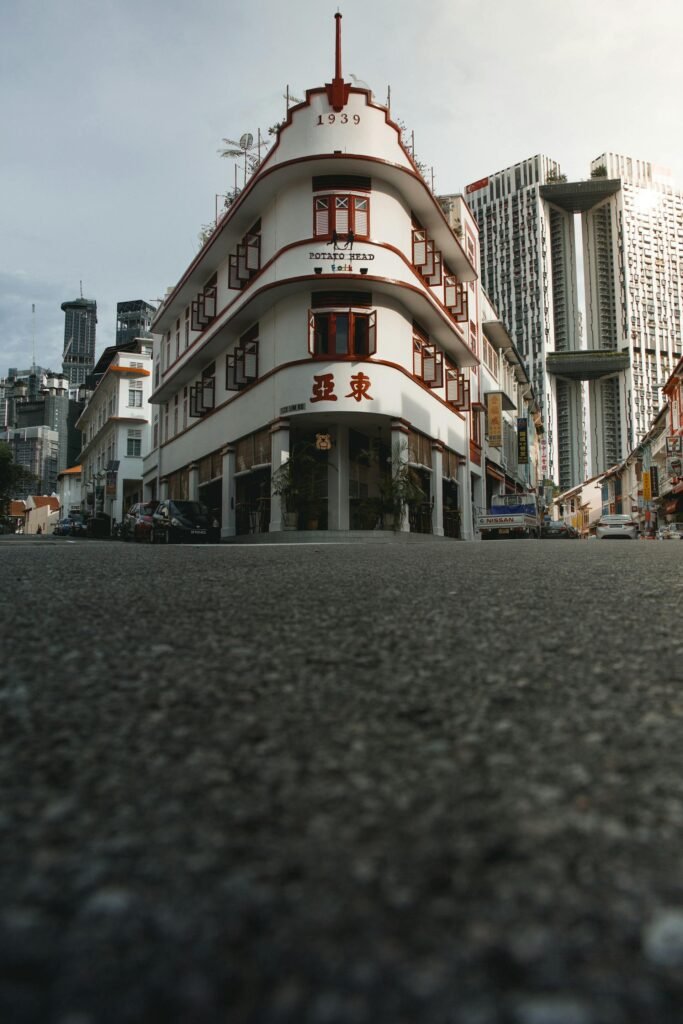
Singapore’s modern history begins on 29 January 1819, when Sir Thomas Stamford Raffles of the British East India Company landed on the island and signed a treaty with the Sultan of Johor establishing a trading post. With 150 men and a vision, Raffles transformed the sparsely-populated fishing settlement into a free port. His urban planning is still visible: the deliberate ethnic-quarter layout (Chinese, Malay, Indian, European), the gridded core, and the riverfront customs zones.
By 1867, Singapore had become the crown jewel of British Malaya — a duty-free port, the world’s busiest stop for ships sailing between Europe and East Asia, and a magnet for Chinese, Indian, Malay, Arab, Armenian, and Jewish traders. The population exploded from a few hundred in 1819 to over 100,000 by 1880.
World War II and Japanese Occupation
Singapore’s darkest chapter began on 15 February 1942, when Japanese General Yamashita’s army captured the “impregnable” British fortress in what Winston Churchill called “the worst disaster and largest capitulation in British history.” 80,000 British, Indian, and Australian troops surrendered. For three and a half years, Singapore was renamed Shōnan-tō (“Light of the South”) under brutal Japanese occupation; the Sook Ching massacre killed an estimated 25,000–50,000 Chinese-Singaporean civilians. Japan surrendered on 12 September 1945; the experience permanently ended Singaporean trust in the British colonial system.
The Road to Independence
Post-war Singapore moved gradually toward self-rule. Women gained voting rights in 1947. In 1959, Singapore achieved internal self-governance with Lee Kuan Yew as the first Prime Minister at age 35. Singapore briefly joined the Federation of Malaysia in 1963 — but ideological differences (Lee’s “Malaysian Malaysia” vision conflicted with bumiputera ethnic-Malay-favoring policies) and ethnic tensions led to expulsion. On 9 August 1965, Singapore became an independent republic — celebrated as National Day. Lee Kuan Yew famously wept on television announcing the separation.
The Miracle Years
Under Lee Kuan Yew’s pragmatic and authoritarian leadership (PM 1959–1990, then Senior Minister and Minister Mentor until his death in 2015), Singapore transformed from a developing nation with high unemployment and no natural resources into one of the world’s wealthiest economies. The strategy: ruthless meritocracy, aggressive foreign investment courting, world-class education, multiethnic harmony as official policy, mandatory savings (CPF), and what critics called “soft authoritarianism.” By the 1990s, Singapore was an “Asian Tiger”; by 2010, GDP per capita exceeded most Western European countries.
Lee’s son Lee Hsien Loong served as Prime Minister 2004–2024; the political system remains dominated by the People’s Action Party (PAP), which has won every general election since independence. Lawrence Wong became Singapore’s fourth Prime Minister in May 2024.
Geography, Climate & Best Time to Visit Singapore
Singapore sits at one of the world’s most strategically important locations — the southern tip of the Malay Peninsula, where the Indian Ocean’s Strait of Malacca meets the South China Sea. The country comprises 64 islands totaling 728 km², with the main island (Pulau Ujong) connected to Malaysia by two land crossings: the historic Johor-Singapore Causeway (1924) and the Tuas Second Link (1996).
Geography and Landscape
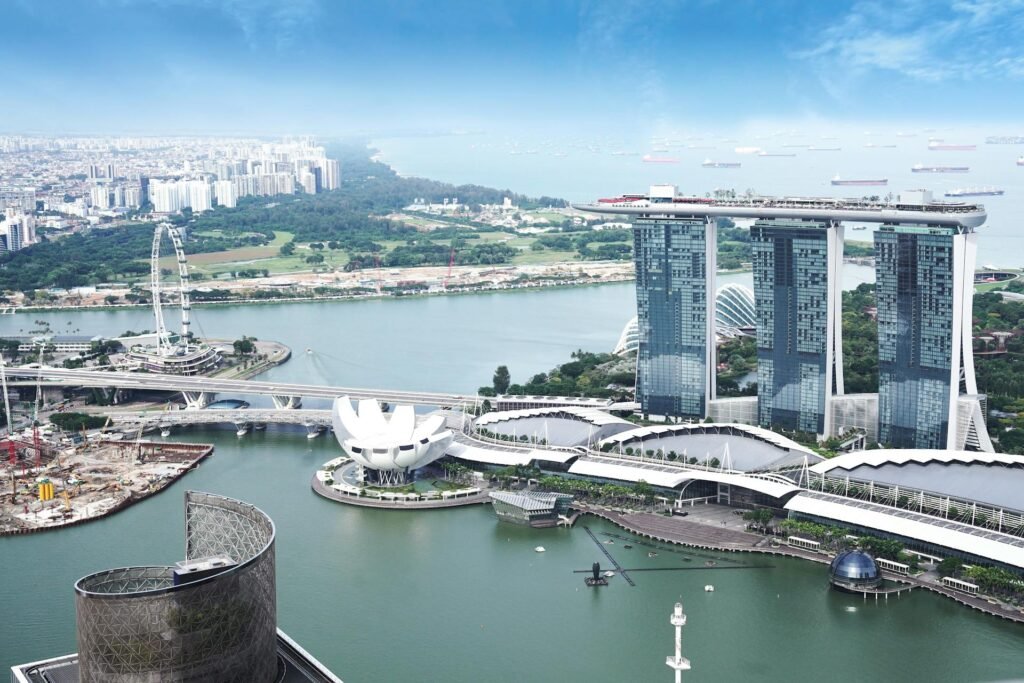
Despite its compact size, Singapore packs unexpected geographic diversity. Bukit Timah Hill at 164 m is the highest point and harbours one of the world’s only primary rainforests inside a city of 5+ million people. Aggressive land reclamation has expanded Singapore’s territory by over 25% since 1959 — Marina Bay, Jurong Island, the western container port, and the Tuas megaport are all reclaimed. The Singapore Strait separates the island from Indonesia’s Riau Islands; the Johor Strait is the northern border with Malaysia.
Tropical Climate Year-Round
Singapore has a tropical rainforest climate (Köppen Af) — consistently warm and humid year-round, with no real seasons. Temperatures hover between 23°C overnight and 32°C daytime; humidity sits at 80–90% throughout the year. Two monsoon seasons differ in rainfall pattern more than temperature: the Northeast Monsoon (December–March) brings cooler air and more rain; the Southwest Monsoon (June–September) is drier. Brief, intense afternoon thunderstorms are routine year-round.
Best Time to Visit
February to April is the optimal travel window — the driest stretch with the most consistent sunshine. May–July brings warm but mostly dry conditions. August–October is shoulder season with thinner crowds. November–January is the wettest period — but also when Orchard Road comes alive with Christmas lights and Chinese New Year celebrations span weeks. Pack lightweight breathable clothing, a compact umbrella, and reef-safe sunscreen regardless of when you visit. Watch the haze season (September–October some years) when smoke from Indonesian peat fires can push air quality into “unhealthy” range — check live readings at haze.gov.sg.
Singapore’s Districts & Neighborhoods
Singapore divides into five planning regions, but the visitor’s working geography is much smaller. The Central Region holds 90% of the major sights; visitors rarely need to venture into the residential outer regions.
Central Region — Marina Bay, Colonial District, Orchard
The heart of modern Singapore. Marina Bay hosts the iconic Marina Bay Sands integrated resort, Gardens by the Bay, the Merlion, the ArtScience Museum, and the Singapore Flyer. The Colonial District centers on Raffles Hotel, the Padang, the National Gallery (in the restored Supreme Court and City Hall buildings), and the Civic District museums. Orchard Road is the 2.2 km shopping spine. Stay here for first-time-visitor convenience.
Chinatown & Tanjong Pagar
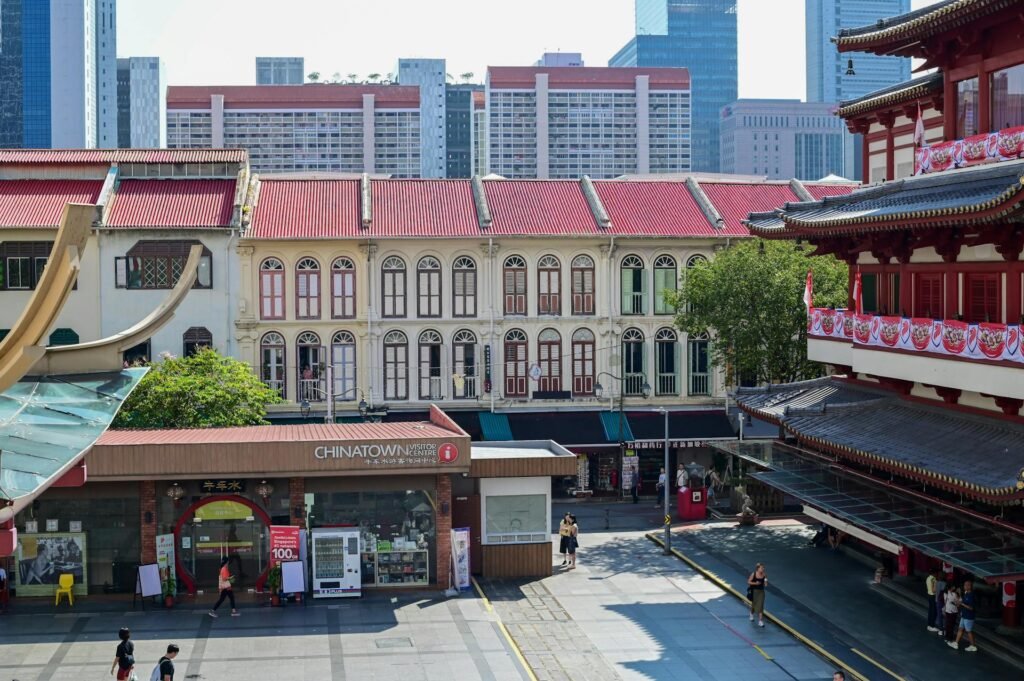
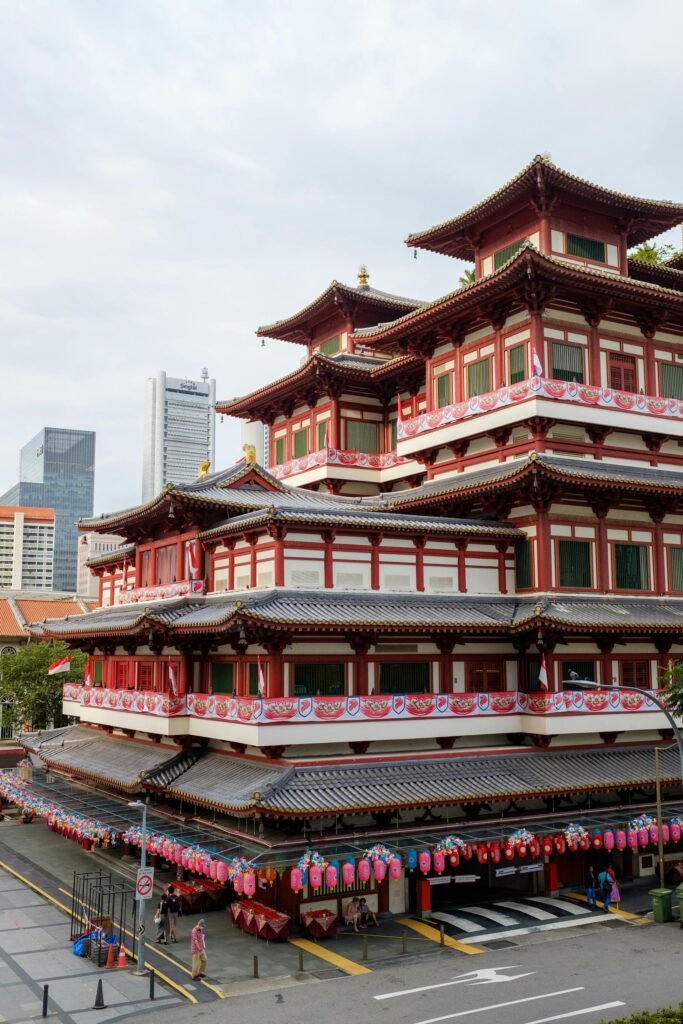
Singapore’s Chinatown preserves restored Hokkien and Teochew shophouses alongside the Buddha Tooth Relic Temple and Sri Mariamman Temple (the oldest Hindu temple in Singapore — Chinatown being the area set aside by Raffles for Chinese settlement, but the religious mix is older). The neighbouring Tanjong Pagar district has evolved into a trendy dining and nightlife area packed with restored shophouses housing fine-dining restaurants and craft cocktail bars.
Little India & Kampong Glam
Two of Singapore’s most authentic ethnic enclaves. Little India centers on Tekka Centre (the 24-hour Mustafa Centre is here) and the colorful Sri Veeramakaliamman Temple; the morning flower-and-spice markets are extraordinary. Kampong Glam (the historic Malay-Muslim quarter) anchors on the gold-domed Sultan Mosque and the boutique-and-café strip of Haji Lane.
Sentosa Island
Singapore’s resort island, connected by causeway, monorail, and cable car. Hosts Universal Studios Singapore, S.E.A. Aquarium, multiple beach clubs, and integrated-resort hotels. Family-friendly day trip; you can do most of it in one full day.
East Coast & Katong
The East Coast stretches along Singapore’s southern shoreline; East Coast Park is the locals’ weekend cycling and seafood-dinner destination. Katong & Joo Chiat are the historic Peranakan neighborhoods — colorful shophouses, the famous Katong laksa, and Peranakan museums.
Holland Village & Dempsey Hill
Expat-friendly residential neighborhoods with international dining, boutique shopping, and a more relaxed pace than central Singapore. Particularly Dempsey Hill (a former British army barracks now converted into a dining and lifestyle quarter) is one of the city’s most pleasant evening destinations.
Top Things to Do in Singapore
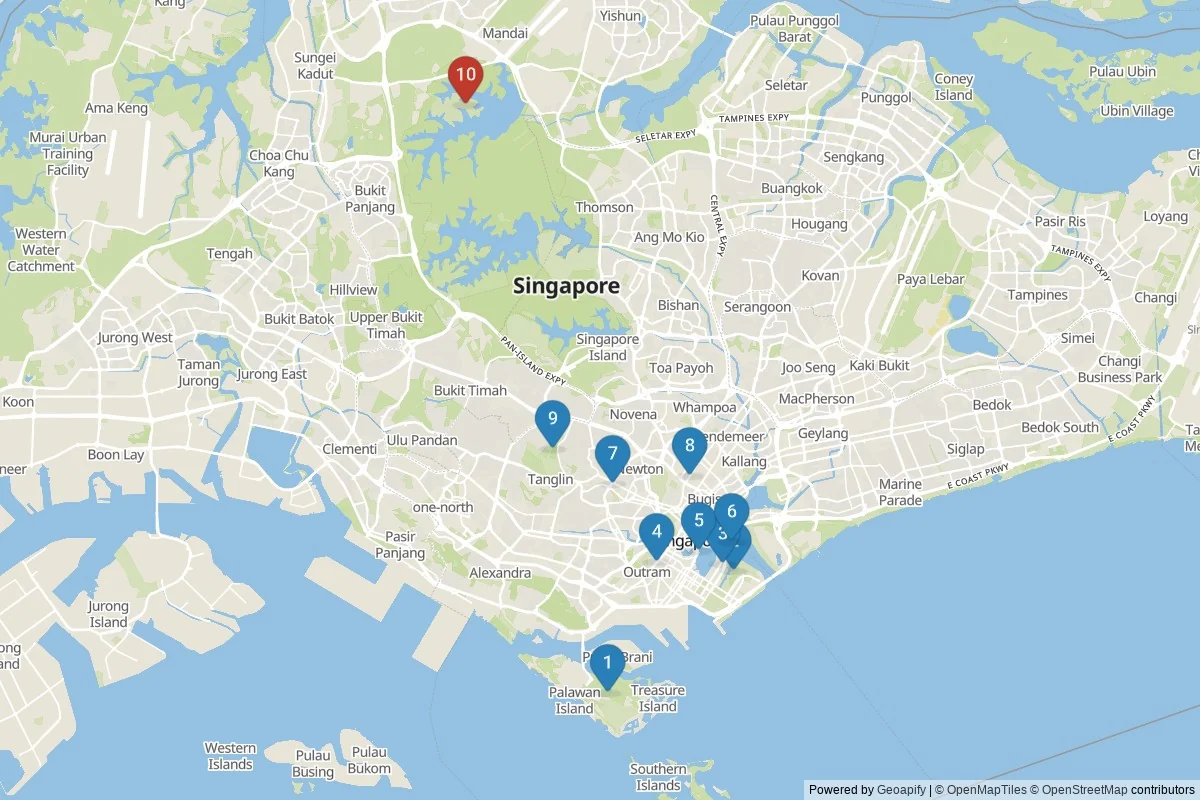
| # | Sight | Cluster | Type | Time | Entry | Best |
|---|---|---|---|---|---|---|
| 1 | Sentosa Island | Central | Resort island | Full day | S$10 entry | Morning |
| 2 | Gardens by the Bay | Central | Botanical garden | ~3 hrs | S$28 domes | Evening |
| 3 | Marina Bay Sands SkyPark | Central | Observation deck | ~1.5 hrs | S$32 | Sunset |
| 4 | Chinatown | Central | Old quarter | ~2 hrs | Free | Evening |
| 5 | Merlion Park | Central | Iconic statue | ~30 min | Free | Sunrise |
| 6 | Singapore Flyer | Central | Observation wheel | ~30 min | S$40 | Sunset |
| 7 | Orchard Road | Central | Shopping district | ~2 hrs | Free | Afternoon |
| 8 | Little India | Central | Cultural quarter | ~1.5 hrs | Free | Morning |
| 9 | Botanic Gardens (UNESCO) | Central | Botanical garden | ~2 hrs | Free | Early morning |
| 10 | Singapore Zoo | Outer | Zoo | ½ day | S$49 | Morning |
Singapore’s headline sights are dense and well-organized. Three full days handles everything; four to five days lets you do day trips.
Iconic Landmarks
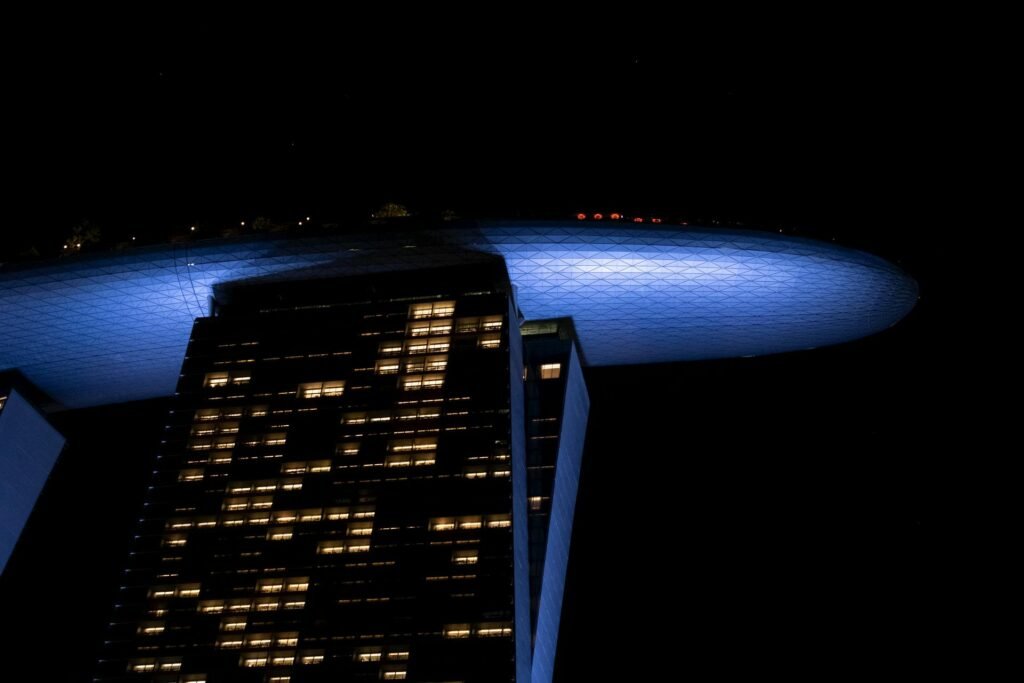
Marina Bay Sands — the three-tower hotel topped by a 1.2-hectare Skypark with the world’s largest rooftop infinity pool (hotel guests only) and the public Sands SkyPark Observation Deck. The light-and-water show Spectra at the Marina Bay event plaza runs nightly free of charge. Tickets to observation deck S$32.
Gardens by the Bay — the 101-hectare nature park anchored by the 18 Supertree structures and the climate-controlled Cloud Forest and Flower Dome conservatories. The free Garden Rhapsody light show at the Supertrees runs nightly at 7:45 pm and 8:45 pm. Conservatory tickets S$53. Booking via gardensbythebay.com.sg.
Merlion Park — the half-lion, half-fish 8.6-metre statue spouting water into the bay. Free, the canonical Singapore photo spot.
Singapore Flyer — the 165 m observation wheel; less popular since Marina Bay Sands SkyPark opened, but offers the best 360-degree view of Marina Bay including views into Indonesia and Malaysia on clear days. Tickets ~S$40.
Cultural Attractions
National Gallery Singapore — the world’s largest collection of Southeast Asian art, housed in the beautifully restored former Supreme Court and City Hall buildings. The DBS Singapore Gallery on the ground floor is free; main galleries S$20. Excellent rooftop bar with skyline views.
Asian Civilisations Museum — across the river from Boat Quay, focused on Asian artifacts from across the continent including the Tang Shipwreck Collection (a 9th-century Arab dhow recovered from the Java Sea). Tickets S$20.
Raffles Hotel — the colonial-era grand dame (1887), birthplace of the Singapore Sling cocktail at the Long Bar. Even non-guests can visit the Long Bar (S$39 per Sling) and walk through the lobby.
Chinatown Heritage Centre — restored shophouses recreating early 20th-century Chinese-Singaporean immigrant life. Tickets S$20.
Nature and Wildlife
Singapore Botanic Gardens — the only tropical garden inscribed as a UNESCO World Heritage Site (2015). Free entry to the main gardens; the National Orchid Garden with 60,000+ orchids is S$15.
Mandai Wildlife Reserve — the integrated park combining the Singapore Zoo (open-concept moats instead of cages), Night Safari (the world’s first nocturnal zoo), River Wonders, and the new Bird Paradise (replacing Jurong Bird Park in 2023). Multi-park tickets via mandai.com; allow a full day.
Bukit Timah Nature Reserve — a primary rainforest in the geographic center of the island, with hiking trails to the 164 m summit. Free; you’ll spot long-tailed macaques.
Food Experiences
Hawker Centres — Singapore’s cultural heart. Maxwell Food Centre in Chinatown (Tian Tian Hainanese Chicken Rice is the institutional name), Lau Pa Sat (Victorian-era market in the financial district), Newton Food Centre, Old Airport Road Food Centre, and Tekka Centre in Little India.
Michelin-starred hawker stalls — Singapore is uniquely the place where you can eat Michelin food for under S$10. Hill Street Tai Hwa Pork Noodle (Crawford Lane, often 1+ hour queue) and Liao Fan Hawker Chan (Chinatown, soya sauce chicken rice) both hold the distinction.
How to Get to Singapore
By Air
Singapore Changi Airport (SIN) consistently ranks as the world’s best airport (Skytrax #1 from 2013 to 2020, currently top 3). Four terminals plus the iconic Jewel Changi Airport (with the world’s tallest indoor waterfall, the Rain Vortex). Hub for Singapore Airlines; serves direct flights to 380+ cities. From Changi to downtown:
- MRT (East-West Line) — 45–60 min, S$2.50
- Taxi — 20–45 min depending on traffic, S$30–45
- Grab/Gojek — similar to taxi, S$25–40
- Airport Shuttle — S$10 per person to most hotels
Schedules and live status at changiairport.com.
By Land
Two land crossings link Singapore to Malaysia. The Johor-Singapore Causeway (Woodlands ↔ Johor Bahru) is the busier of the two; the Tuas Second Link (Tuas ↔ Gelang Patah) is the alternative crossing — typically faster on weekends and Malaysian public holidays. The forthcoming JB-Singapore Rapid Transit System (RTS) opening in 2027 will dramatically improve cross-border commuter and tourist flow. Bus services from Kuala Lumpur, Penang, and other Malaysian cities also operate via the causeways.
By Sea
Cruise ships dock at the Marina Bay Cruise Centre Singapore and HarbourFront Centre; Singapore is a major Asian cruise hub. Ferry services from HarbourFront reach Indonesian Riau Islands (Batam, Bintan) in under an hour; from Tanah Merah Ferry Terminal for Bintan resorts.
Getting Around Singapore
Singapore has one of the world’s best urban transit systems. Locals say it’s quietly the best thing about the city.
Mass Rapid Transit (MRT)
The MRT is the spine — 6 colour-coded lines, 134 stations, expanding rapidly. Trains every 2–4 minutes during peak hours, 5:30 am to midnight (2:30 am Fri/Sat). Air-conditioned, efficient, English announcements. Fares S$1–2 by distance with the EZ-Link card or contactless mobile payment. Tourist passes (S$10/day, S$25/3-day) at TransitLink offices. Routes at lta.gov.sg.
Buses
The bus network covers what the MRT doesn’t, particularly residential neighborhoods. All air-conditioned; same EZ-Link card works. Real-time arrival information at every bus stop.
Taxis and Ride-Hailing
Taxis are abundant and metered — but expensive at peak hours, late nights, and in rain (surcharges add 25–50%). Grab (Southeast Asia’s regional Uber) and Gojek dominate the ride-hail market — transparent pricing, English interface, accept international cards.
Walking and Cycling
Singapore’s compact size and excellent pedestrian infrastructure (covered walkways everywhere) make walking pleasant for short distances. The 300 km Park Connector Network links parks via dedicated cycling-and-walking paths. Bike-share via SG Bike and Anywheel.
Cable Car
The Singapore Cable Car connects Mount Faber → HarbourFront → Sentosa Island. Spectacular harbor views; functions as both transport and tourist attraction. Tickets S$35.
Food & Drink in Singapore
Singapore’s food scene is the world’s most concentrated culinary melting pot — Hokkien Chinese, Cantonese, Teochew, Hainanese, Hakka, Malay, Indian, Peranakan (Chinese-Malay creole), and modern international all coexist within walking distance. Eating well is the cheapest pleasure in Singapore, and the most expensive — depending entirely on which type of meal you choose.
Hawker Culture (UNESCO Heritage)
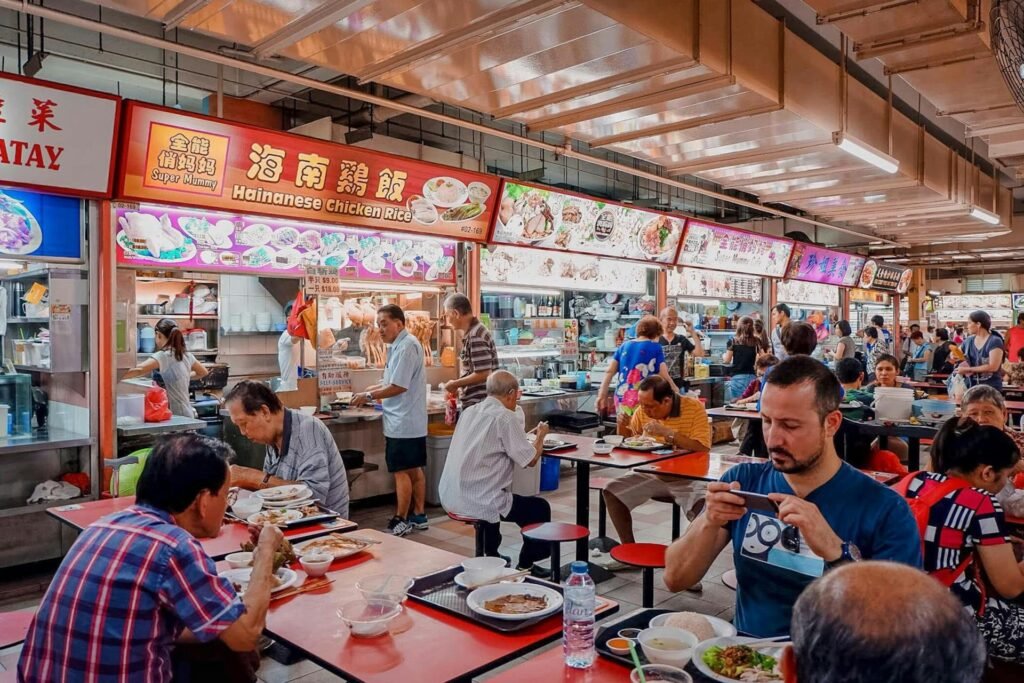
In 2020, Singapore’s hawker culture was inscribed on UNESCO’s Representative List of the Intangible Cultural Heritage of Humanity — recognition of the social and cultural significance of these communal-table food courts where dozens of stalls each specialize in one or two dishes perfected over generations.
Don’t-miss hawker centres: Maxwell Food Centre (Chinatown — Tian Tian Hainanese Chicken Rice), Lau Pa Sat (Victorian iron market in the financial district — satay street outside in evenings), Newton Food Centre (made famous by Crazy Rich Asians), Tiong Bahru Market (the locals’ favorite), Old Airport Road Food Centre (where Anthony Bourdain ate). Cheap (S$5–10 for a full meal) and authentic.
Must-Try Dishes
Hainanese Chicken Rice — Singapore’s national dish: poached chicken served with chicken-stock-fragrant rice, chili sauce, dark soy, and ginger paste. Tian Tian (Maxwell) and Wee Nam Kee (Far East Plaza) are the famous names.
Chili Crab — fresh mud crab in tangy-sweet-spicy tomato-and-egg sauce. Eaten with deep-fried mantou (Chinese bread) to soak up the sauce. Jumbo Seafood (East Coast) and No Signboard Seafood are the institutional names. Pricey: S$80–120 for a whole crab.
Laksa — spicy coconut-curry noodle soup. Katong laksa (with cut-up noodles eaten with a spoon) is the unique Peranakan version. 328 Katong Laksa on East Coast Road is the gold standard.
Char Kway Teow — flat rice noodles wok-fried with dark soy sauce, Chinese sausage, fishcake, bean sprouts, and egg. The “wok hei” (breath of the wok) is the test of a great char kway teow.
Satay — grilled marinated meat skewers (chicken, beef, mutton) with peanut sauce and ketupat rice cakes. Lau Pa Sat’s Satay Street (Boon Tat Street, evenings) is the touristy but excellent option.
Bak Kut Teh — pork rib soup with garlic and pepper, the breakfast specialty. Song Fa Bak Kut Teh (Clarke Quay) is the chain.
Peranakan Cuisine
The unique Peranakan (Nyonya) cuisine fuses Chinese cooking with Malay spices — slow-cooked, complex, often spicy. Signature dishes: ayam buah keluak (chicken with black nuts, the regional treasure), otah (grilled spiced fish cake in banana leaf), and kueh (colorful rice-based desserts). Try at Candlenut (the only Michelin-starred Peranakan restaurant), Blue Ginger, or the food court at the Peranakan Museum.
International Dining
Singapore’s restaurant scene has the highest concentration of Michelin-starred restaurants per capita in Asia outside Tokyo and Hong Kong. Odette (#1 Asia’s 50 Best Restaurants 2019), Les Amis, Burnt Ends, Cloudstreet, Cure, and dozens of others compete at the global fine-dining level. Reservations 1–3 months ahead.
Drinks and Beverages
Singapore Sling — the iconic gin-cherry-pineapple cocktail invented at Raffles Hotel’s Long Bar in 1915. Touristy, expensive (S$39), but worth the experience once.
Kopi and Teh — local coffee and tea. Vocabulary lesson: Kopi = coffee with condensed milk; Kopi O = black coffee with sugar; Kopi C = with evaporated milk; Teh tarik = “pulled” tea with condensed milk, foamed by pouring between cups.
Tiger Beer — the local lager, founded in Singapore in 1932; ubiquitous at hawker centres. The newer Brewerkz and Trouble Brewing represent the craft scene.
Culture & Arts in Singapore
Singapore’s cultural identity rests on its multiethnic harmony — a deliberate political project rather than an organic outcome — combined with a rapidly maturing global arts scene.
Multicultural Harmony
Singapore’s official ethnic categorization is CMIO — Chinese (~74%), Malay (~14%), Indian (~9%), Others (~3%). Each ethnic group has constitutionally protected language, religious practice, and cultural expression. The government’s ethnic-quota housing policy (HDB Ethnic Integration Policy) prevents enclaves from forming. Religious harmony is taken seriously: Chinese Buddhist temples, Sunni Muslim mosques, Tamil Hindu temples, and Catholic and Anglican churches often sit on the same block.
Languages and Communication
Four official languages: English (the working language), Mandarin Chinese, Malay (the national language), and Tamil. Singlish — the unique English-based creole incorporating elements of all four — is the unofficial lingua franca; the government oscillates between disapproval and grudging acceptance. Visitors get by easily in standard English.
Arts and Entertainment
Esplanade — Theatres on the Bay (nicknamed “the durian” for its spiky architecture) — Singapore’s premier performing arts complex with three theatres hosting opera, ballet, classical music, jazz, and theatre. Schedules at esplanade.com. National Gallery Singapore covers Southeast Asian art comprehensively; Singapore Art Museum focuses on contemporary; National Museum of Singapore covers history.
Festivals and Celebrations
Chinese New Year (January–February) — Chinatown lights up, family reunion dinners, lion-and-dragon dances. Hari Raya Puasa (end of Ramadan, dates shift annually) — Kampong Glam celebrations. Deepavali (October–November) — Little India lights and festivities. Christmas (December) — Orchard Road’s tropical-Christmas displays. National Day (9 August) — military parade and fireworks at Marina Bay. Singapore Grand Prix (September, F1 night race) — the only night-time F1 race; tickets via singaporegp.sg.
Singapore by District: The 5 Regions
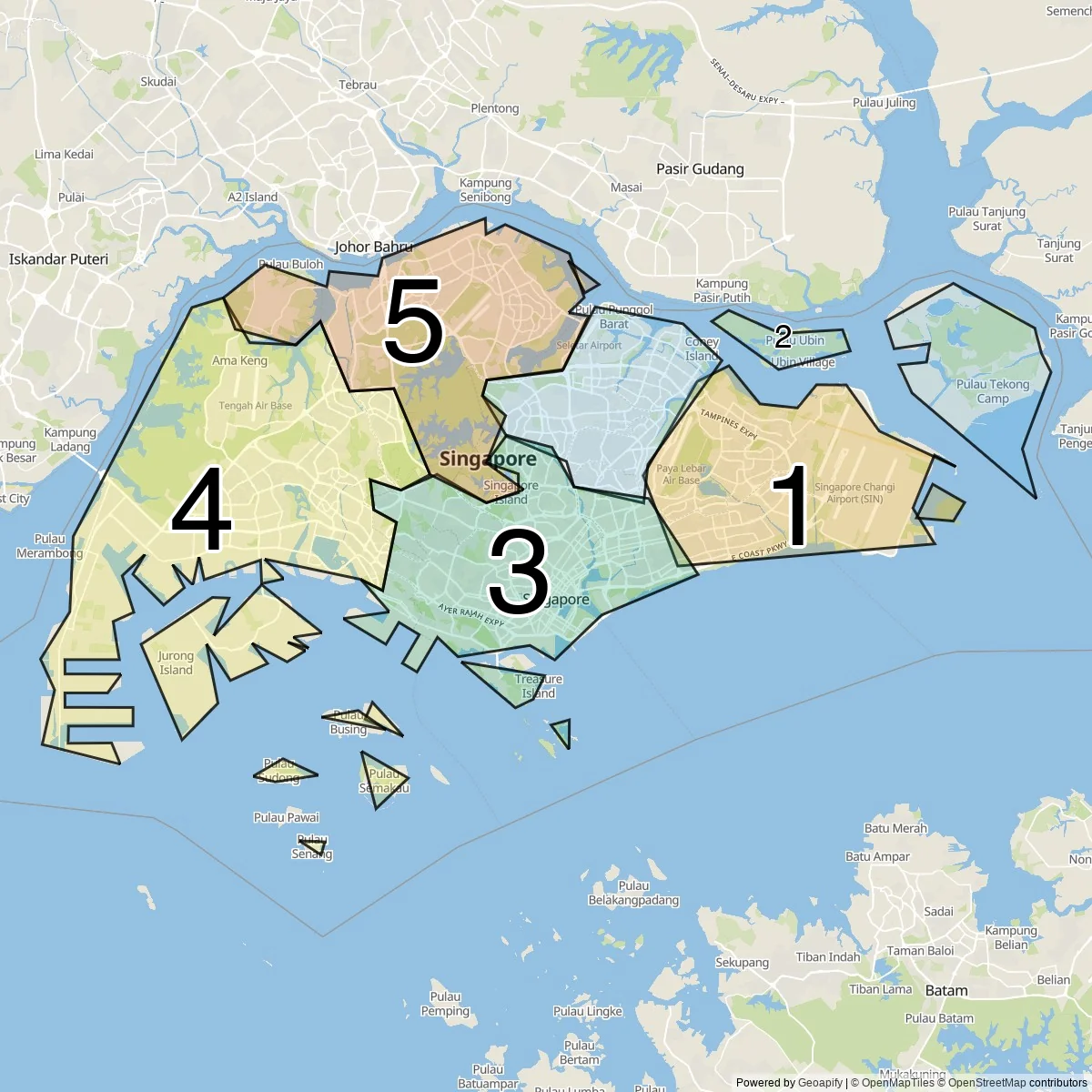
Singapore is divided into 5 regions. The map below shows their official OSM boundaries, colour-coded to match the table — a quick way to orient yourself before zooming in on individual sights.
| # | Regions |
|---|---|
| 1 | East Region |
| 2 | North-east Region |
| 3 | Central Region |
| 4 | West Region |
| 5 | North Region |
Frequently Asked Questions About Visiting Singapore
Do I need a visa to visit Singapore?
Most likely not. Citizens of around 165 countries — including the US, UK, EU member states, Canada, Australia, New Zealand, Japan, South Korea, and most of Asia — enter Singapore visa-free for 30 to 90 days depending on nationality. Other nationalities need an e-Visa applied for online before travel via the official portal at ica.gov.sg (Immigration & Checkpoints Authority). All international travelers must complete the Singapore Arrival Card (SGAC) online within 3 days before arrival — required at eservices.ica.gov.sg/sgarrivalcard. Passport must have at least 6 months remaining validity.
Is Singapore safe for tourists?
Singapore is one of the world’s safest cities — consistently ranking in the top 5 globally for low crime rates. The US State Department rates Singapore at “exercise normal precautions” — its lowest advisory level. Walking around at any hour is genuinely fine, including for solo women travelers. Real concerns: strict laws with severe penalties — chewing gum import is restricted, jaywalking carries fines, public intoxication is enforced, and drug offenses carry the death penalty (Singapore executes drug traffickers; even small amounts of cannabis can result in caning and prison). Don’t litter (steep fines), don’t smoke in public except designated zones, and don’t bring chewing gum, durian on public transport, or vapes (vaping is illegal). The very strictness is what makes Singapore so safe — accept the rules and you’ll have an effortless visit.
How many days do I need in Singapore?
Three full days handles the headlines comfortably; four to five days lets you do day-trips. A solid 3-day plan: Day 1 — Marina Bay (Marina Bay Sands SkyPark + Gardens by the Bay + Spectra light show + dinner at Lau Pa Sat) + Merlion Park; Day 2 — Cultural quarters (Chinatown morning + Tiong Bahru lunch + Little India afternoon + Kampong Glam dinner) + National Gallery Singapore; Day 3 — Mandai Wildlife Reserve (Singapore Zoo + Night Safari) OR Sentosa Island (Universal Studios + S.E.A. Aquarium + beach evening). Day 4–5: Botanic Gardens + Pulau Ubin (the kampong-style island), Johor Bahru day trip (cross the causeway for cheaper food and shopping), or Bintan/Batam ferry day trip (Indonesian island resorts, 50 min by ferry).
What’s the best area to stay in Singapore?
Three solid options. Marina Bay / Colonial District — the obvious central choice; luxury hotels (Marina Bay Sands, Mandarin Oriental, Fullerton, Ritz-Carlton, Capella Sentosa) with iconic skyline views, walking distance to all major sights; S$300–800/night. Orchard Road — the shopping-and-business spine; high concentration of luxury malls and 4-5 star hotels; convenient but more “modern Asian city” than “atmospheric”; S$200–500/night. Chinatown / Tanjong Pagar — the boutique-hotel district in restored shophouses (The Working Capitol, Hotel 1929, Bondinier); more atmospheric, walking distance to hawker centres; S$150–300/night. Skip: anything more than 5 metro stops from central Singapore — the city is so easy to navigate that proximity matters less than character.
How much does it cost to visit Singapore’s major sights?
Singapore is one of Asia’s pricier destinations but the headline sights are reasonable. Marina Bay Sands SkyPark Observation Deck: S$32 (free for hotel guests). Gardens by the Bay conservatories (Cloud Forest + Flower Dome combo): S$53 via gardensbythebay.com.sg. Singapore Flyer: S$40. National Gallery Singapore: S$20 (free for SG/PR/citizens). Asian Civilisations Museum: S$20. Universal Studios Singapore: S$83 adult day ticket. S.E.A. Aquarium: S$48. Mandai Wildlife Reserve (Singapore Zoo + Night Safari combo): ~S$77 adult. Singapore Botanic Gardens: free entry; National Orchid Garden S$15. Singapore Cable Car: S$35 round trip. Hawker meal: S$5–12; mid-range restaurant: S$25–60 per person; fine dining: S$150–400.
Should I drink the tap water in Singapore?
Yes, absolutely. Singapore’s tap water meets WHO drinking-water standards and is rigorously tested — drink it freely, brush your teeth with it, and use ice without concern. The PUB (Singapore’s national water agency) publishes regular quality reports. Singapore’s “Four National Taps” strategy (imported water from Malaysia, local catchment, NEWater recycled, and desalinated) makes the city-state’s water supply one of the world’s most secure. Restaurants serve free chilled tap water without asking. Bottled water is widely available but unnecessary. Public drinking fountains are common in malls and parks.
Is tipping expected in Singapore?
No — tipping is not customary in Singapore. Most restaurants automatically add a 10% service charge plus 9% GST (Goods and Services Tax) to the bill — that’s the closest equivalent to a tip. Hawker centres: never tip. Taxis and Grab: pay the meter exactly; rounding up to nearest dollar is fine but not expected. Hotel porters: S$2–5 per bag at upscale hotels is appreciated but never expected; not at all at standard hotels. Tour guides: S$10–30 per person for half-day, more for private full-day. Spa/salon: not customary; service charge already includes it. Concierges: S$5–20 for special arrangements at luxury hotels. The rule of thumb: in service-charge contexts, that’s the tip; in non-service-charge contexts, a tip is appreciated but never required.
What’s the deal with Singapore’s strict laws?
Singapore takes its laws seriously, and the rules genuinely affect tourist behavior. Chewing gum: import and sale banned (you can chew but not import); medicinal nicotine gum is exempted. Jaywalking: S$50–500 fines, enforced. Smoking: only in designated yellow-box zones; S$200+ fines elsewhere. Vaping (e-cigarettes): completely illegal — possession alone fines up to S$2,000; don’t bring vapes through Changi. Littering: S$300–2,000 fines plus possible “Corrective Work Order” community service. Eating or drinking on the MRT: S$500 fine. Public drunkenness: actively enforced. Drug offenses: severe — possession of small amounts of cannabis (15g+) carries mandatory caning; trafficking carries the death penalty (executed, not theoretical — Singapore executes drug offenders annually). Bringing alcohol or cigarettes: duty-free allowance is just 1 liter of alcohol and zero cigarettes — even one carton attracts duty. The good news: the rules are clearly posted, consistently enforced, and tourists who follow them have an extraordinary trip.
Shopping in Singapore
Singapore is one of Asia’s premier shopping destinations — air-conditioned malls everywhere, English-speaking sales staff, and tourist GST refund (8% from 2024) for purchases over S$100.
Orchard Road
The 2.2 km shopping spine houses 5,000+ retail outlets. Major malls: ION Orchard (architectural icon), Ngee Ann City (Takashimaya anchor), Paragon (luxury), Mandarin Gallery (boutique), 313@Somerset (mid-range and youth).
Marina Bay Sands
The Shoppes at Marina Bay Sands — luxury shopping with a literal canal running through the basement. Flagship stores for Chanel, Hermès, Louis Vuitton, plus the Apple flagship floating on Marina Bay.
Traditional Markets
Chinatown Street Market — souvenirs and Chinese goods along Pagoda and Temple Streets. Mustafa Centre (Little India) — 24-hour department store famous for electronics, gold, and travel goods at competitive prices. Arab Street & Haji Lane — textiles, carpets, Middle Eastern goods, plus the indie-fashion-and-café strip.
Electronics
Funan (recently rebuilt) and Sim Lim Square are the major electronics hubs. Compare prices carefully at Sim Lim — locals warn that some smaller shops there target tourists.
Singapore rewards travelers who treat it as both destination and gateway. Three days for the headlines (Marina Bay + Gardens by the Bay + Sentosa, hawker dinners, Botanic Gardens, the major museums). Add a day for Mandai (Singapore Zoo + Night Safari + Bird Paradise). Add another for a Malaysian day-trip (JB) or Indonesian day-trip (Batam ferry). The combination of the region’s best transit system, world-class food, multilingual ease, and tropical-island climate makes Singapore one of Asia’s most pleasant introductory destinations.
AFRIKA
Cairo Hurghada Johannesburg Marrakech
ASIA
Abu Dhabi Agra Antalya Bangkok Batam Beijing Bengaluru Cebu City Chiang Mai Chiba Chennai Da Nang Dammam Delhi Denpasar Dubai Fukuoka Guangzhou Guilin Ha Long Hanoi Ho Chi Minh City Jakarta Jaipur Johor Bahru Kolkata Krabi Kuala Lumpur Kyoto Macau Mecca Medina Mugla Mumbai Osaka Pattaya Penang Phuket Riyadh Seoul Shanghai Shenzhen Singapore Taipei Tokyo Zhuhai
EUROPE
Amsterdam Athens Barcelona Berlin Brussels Budapest Copenhagen Dublin Florence Frankfurt am Main Heraklion Krakow Lisbon London Madrid Milan Munich Nice Paris Porto Prague Rhodes Rome Stockholm Venice Vienna Warsaw
NORTH AMERICA
Cancun Las Vegas Los Angeles Miami New York City Orlando San Francisco Toronto Vancouver
SOUTH AMERICA
Buenos Aires Lima Rio De Janeiro
OCEANIA
Auckland Honolulu Melbourne Sydney