
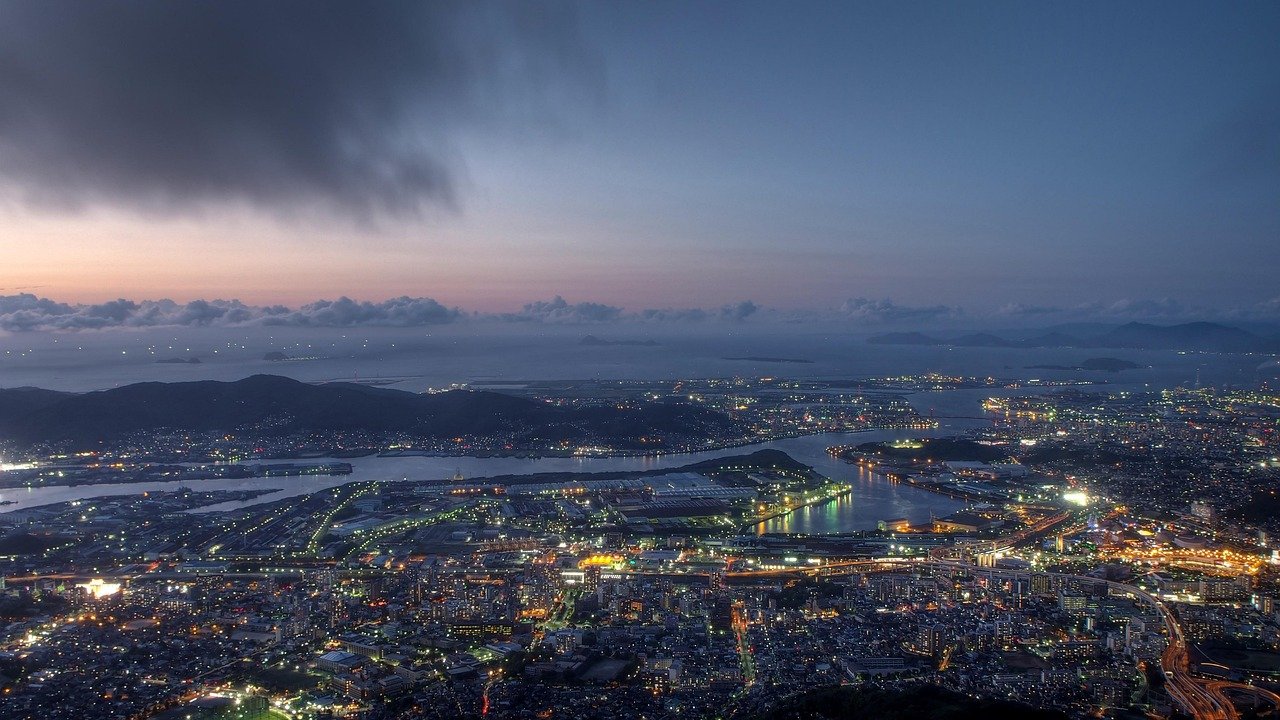
Photo credit: Fukuoka at dusk (Shin Masa, pixabay)
Fukuoka is the largest city on the southern Japanese island of Kyushu — and the country’s most consistently ranked “most livable” major city for the past decade. The modern metropolis was formally created in 1889 by the merger of two historically separate cities: the samurai-administrative town of Fukuoka west of the Naka River and the merchant-commercial city of Hakata to the east. Hakata remained the dominant identity for trade, food, and culture; the central train station (Hakata Station), the famous Hakata ramen, the Hakata Gion Yamakasa festival, and the mentaiko (spicy cod roe) specialty all carry the older name. Geographically closer to Seoul and Shanghai than to Tokyo, Fukuoka has played a continuous role as Japan’s gateway to mainland Asia for over 1,300 years — making it the country’s most internationally connected mid-sized city. Modern visitors come for the yatai (open-air street food stalls along the Naka River, the country’s only surviving major yatai culture), the Ohori Park with the ruins of Fukuoka Castle, day trips to Dazaifu Tenmangu and the Beppu hot springs, and the relaxed pace that distinguishes Kyushu’s largest city from the relentless rhythm of Tokyo or Osaka.
Fukuoka by District: The 7 区 (Ku)
Fukuoka is divided into 7 wards. The map below shows their official OSM boundaries, colour-coded to match the table — a quick way to orient yourself before zooming in on individual sights.
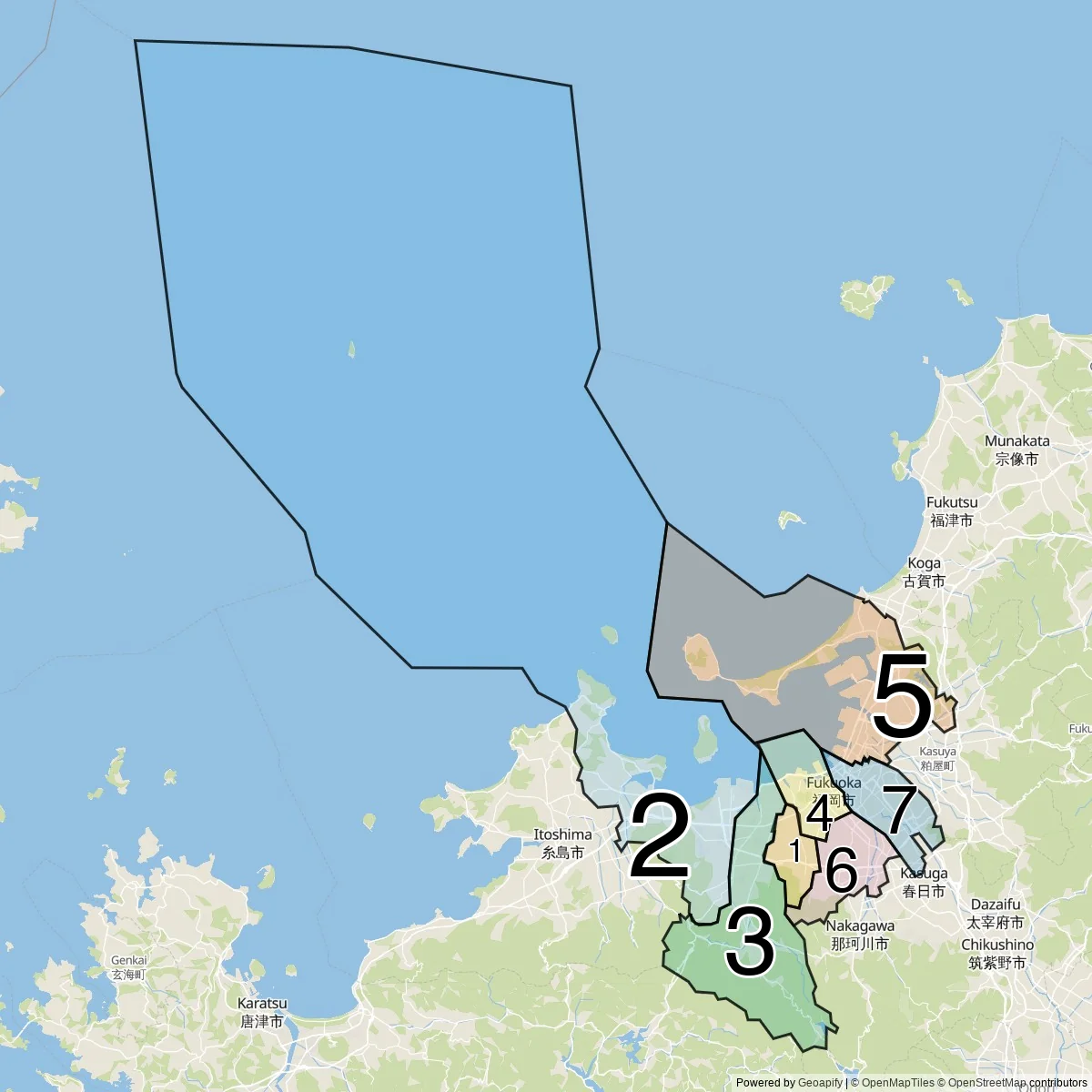
| # | 区 (Ku) |
|---|---|
| 1 | 城南区 · Jonan Ward |
| 2 | 西区 · Nishi Ward |
| 3 | 早良区 · Sawara Ward |
| 4 | 中央区 · Chūō Ward |
| 5 | 東区 · Higashi Ward |
| 6 | 南区 · Minami Ward |
| 7 | 博多区 · Hakata Ward |
Fukuoka at a Glance: Essential Facts for Travelers
| Location | Fukuoka Prefecture, northern Kyushu, southwestern Japan |
|---|---|
| Coordinates | 33.5904°N, 130.4017°E |
| Population | ~1.62 million (city, 2024); metro area ~2.57 million |
| Area | 343 km² (city proper) |
| Elevation | Sea level to ~150 m |
| Time Zone | Japan Standard Time (JST, UTC+9 — no daylight saving) |
| Calling Code | +81 (city code 092) |
| Currency | Japanese Yen (JPY ¥) |
| Languages | Japanese; Hakata dialect of western Japanese widely spoken locally; English signage on major transit and tourist sites |
| Climate | Humid subtropical — hot humid summers, mild winters; typhoon season June–October |
| Status | Designated city; capital of Fukuoka Prefecture; largest city in Kyushu |
| Famous For | Hakata ramen, yatai street-food stalls, Hakata Gion Yamakasa festival, Dazaifu Tenmangu shrine, Ohori Park, gateway to Beppu hot springs, mentaiko cod roe |
Upcoming Events in Fukuoka
| Date | Title | Details |
|---|---|---|
| 2026-09-19 to 2026-10-31 | Autumn Flowers at Uminonakamichi Seaside Park | Uminonakamichi Seaside Park, a vast national park stretching along a sandy spit across the bay from central Fukuoka, bursts into colour each autumn. From September into October, sweeping fields of cosmos bloom in pink and white, while the round bushes of kochia turn from green to fiery red, drawing families and photographers. Reached by ferry or train from the city, the park also offers cycling paths, a flower garden, playgrounds and a small animal forest, making it a perfect day out. A modest entry fee applies, with children admitted free. [Source] |
| 2026-10-10 to 2026-12-13 | Fear Exhibition (Kyofushin-ten) Fukuoka | The hit horror exhibition Kyofushin-ten, created by horror writer Nashi, the creative company Yami and TV Tokyo producer Tokio Omori, arrives at the sixth-floor event hall of BOSS E-ZO FUKUOKA in Jigyohama from 10 October to 13 December. Its rooms explore common phobias such as sharp points, confined spaces and the feeling of being watched, and earlier editions have drawn around 200,000 visitors in Japan. Hours are 11am to 6pm on weekdays and 10am to 6pm on weekends and holidays. Tickets cost 2,200 yen for adults, 1,800 yen for high-school students and 1,600 yen for children. [Source] |
| 2026-10-30 to 2027-01-11 | teamLab: Fukuoka Castle Ruins Light Festival | For the first time in seven years, art collective teamLab transforms the Fukuoka Castle ruins in Maizuru Park into a night-time digital art space, running from 30 October 2026 to 11 January 2027. The historic stone walls and grounds become luminous installations that change in response to people’s presence, turning an evening stroll through the ruins into an immersive artwork. Sessions run nightly from around 6:15pm or 6:30pm until 10pm depending on the season. Tickets are required for entry, and the festival suits families, couples and photographers alike. [Source] |
| 2026-10-31 to 2027-01-11 | Himiko’s Mirrors Special Exhibition at Kyushu National Museum | Kyushu National Museum in Dazaifu, a short train ride from central Fukuoka, stages one of the largest exhibitions of ancient bronze mirrors ever held. In AD 239 Queen Himiko of Wa sent envoys to China’s Wei court and received a hundred bronze mirrors, and the show uses the latest research to trace how triangular-rimmed mirrors decorated with deities and beasts helped build the Yamato kingship. Open 9:30am to 5pm, until 7pm on Saturdays, and closed most Mondays. Admission is 2,000 yen for adults and 1,200 yen for university students, free for under-18s. [Source] |
| 2026-11-07 to 2026-11-08 | Mr.Children Tour 2026 ‘Saturday in the park’ | Japanese rock giants Mr.Children bring their Tour 2026 ‘Saturday in the park’ to Marine Messe Fukuoka Hall A for two added shows on 7 and 8 November. The arena tour follows the band’s new album Ubugoe, released in March 2026, and the Fukuoka dates were among four extra performances added to the main 28-show run. Saturday’s concert starts at 5pm and Sunday’s at 4pm, with doors opening an hour earlier. Reserved seats cost 14,300 yen in advance, and preschool children are not admitted, so this one is for teenage and grown-up fans. [Source] |
| 2026-11-08 | Fukuoka Marathon 2026 | The 13th Fukuoka Marathon takes over the city on Sunday 8 November, with 13,000 runners on the full 42.195km course, a 5.2km fun run for 2,000 participants and a 5.2km wheelchair race. Entries closed in May after the online application period, and around 3,500 volunteers support the race weekend. Cheering from the roadside is free, and the race falls on the same day the Kyushu Grand Sumo Tournament opens, making it a big sporting Sunday in Fukuoka for local fans and visitors alike. [Source] |
| 2026-11-08 to 2026-11-22 | Grand Sumo Tournament – Kyushu Basho 2026 | The Grand Sumo Kyushu Basho returns to the Fukuoka Kokusai Center from 8 to 22 November 2026, bringing fifteen days of top-division wrestling to the city in the sport’s final tournament of the year. Doors open from 8:45am on most days, with lower divisions in the morning and the top-ranked wrestlers fighting in late afternoon. General ticket sales begin on 19 September, and organisers note there will be no unreserved-seat sales this time, so buying ahead is essential; box seats and arena chairs for weekend days sell out especially quickly. [Source] |
City News in Fukuoka – last 14 days
| Date | Category | Headline | Details |
|---|---|---|---|
| 2026-10-09 | Sports | Tour de Kyushu cycle race brings traffic restrictions to Tenjin | Tenjin in Fukuoka City will form part of the course of the Tour de Kyushu cycle race, with traffic restrictions in place on October 10, FBS Fukuoka Broadcasting reported on October 9, 2026. The headline-only item does not list the affected roads or the times of the closures. Drivers, bus users and visitors heading to the Tenjin area on race day should check official traffic information in advance and allow extra time for their journeys. [Source] |
| 2026-10-09 | Public safety | Man, 68, indicted over drunk-driving crash that killed three-year-old | A 68-year-old man has been indicted in Fukuoka on charges of dangerous driving resulting in death and injury over a drunk-driving accident in which a three-year-old child died, Fukuoka TNC News reported. The headline-only item does not name the defendant or give the date and exact location of the crash. It also does not describe the circumstances of the collision or say when the trial will begin. The indictment opens court proceedings against the driver. [Source] |
| 2026-10-09 | Public safety | Licence reissue requests surge in Fukuoka after Times Car image leak | Following the problem at Times Car, applications to reissue driving licences have surged in Fukuoka as well, au Web Portal reported. Images of licences were leaked, and concern about possible impersonation is spreading. The headline-only item does not say how many people in Fukuoka have applied or how many licence images were affected. Licence holders worried that the leaked images could be misused by someone posing as them are seeking reissued licences. [Source] |
| 2026-10-09 | Business | Fukuoka office vacancy rate rises to 5.02% in September | The office vacancy rate in Fukuoka rose to 5.02% in September, the Nikkei reported. In the Tenjin district, the rate was considerably higher at 9.03%. The headline-only item does not explain the reasons for the increase, name the organisation that compiled the data or compare the figures with earlier months. The numbers offer a snapshot of the office property market in the city, with Tenjin standing out for its higher share of empty space. [Source] |
| 2026-10-09 | Business | Medical DX firm is first Fukuoka City-supported company to list | A company working in medical digital transformation (DX) has newly listed on the stock market, becoming the first such listing from a Fukuoka City support programme, d Menu News reported. The headline-only item does not name the company, the exchange or the specific support scheme involved. The listing marks a first for the city’s support programme, which the item links to a business active in digitalising healthcare. [Source] |
| 2026-10-09 | Local government | Fukuoka Prefecture covered ¥680,000 travel costs of assembly caucus | It has emerged that Fukuoka Prefecture paid travel expenses of about 680,000 yen for the Depopulation Caucus, a voluntary group of members of the Fukuoka Prefectural Assembly, TBS News Dig reported. The costs related to the group’s petitioning activities directed at the national government. The headline-only item does not say over what period the payments were made or how the prefecture has responded. The report centres on public funds covering trips by an informal association rather than an official body. [Source] |
| 2026-10-09 | Public transport | Air Do adds New Chitose–Fukuoka flights for holiday seasons | Air Do will increase services on its New Chitose–Fukuoka route during the year-end and New Year holidays and the spring break, bringing the route to two round trips a day, the Hokkaido Shimbun reported. The headline-only item does not give exact dates for the additional flights or their departure times. Travellers planning trips between New Chitose and Fukuoka during these busy holiday periods should check the airline’s timetable for details before booking. [Source] |
| 2026-10-09 | Culture | Fukuoka publisher reprints Nobel poet Carson’s ‘Autobiography of Red’ | A Fukuoka publisher is reprinting its Japanese translation of Autobiography of Red by Carson, the poet who has been awarded the Nobel Prize, 47NEWS reported. The headline-only item does not name the publisher or say how many additional copies are being printed. The reprint connects a local publishing house with the work of a Nobel laureate, and readers in Japan will be able to find the translated edition back in print. [Source] |
| 2026-10-08 | Culture | Environmental art exhibition presents works in Fukuoka | Participants of My Five Continents Friends are showing their works in Fukuoka in an exhibition that presents environmental art as a path to diplomacy, VOI.ID reported. The headline-only item does not give the venue, the dates or the names of the participating artists. The show links environmental themes with international exchange. Visitors interested in attending should look for venue information and opening times before making plans, as these are not included in the summary. [Source] |
| 2026-10-08 | Environment | Fukuoka City food drive booth at Avispa’s Okayama match | The Fukuoka City Environment Bureau will set up a food drive booth at Avispa Fukuoka’s match against Okayama on Saturday, October 10, according to an announcement on the club’s official website. The headline-only item does not say what kinds of food can be donated or where in the stadium the booth will be located. The booth gives supporters attending the game an opportunity to take part in the city’s food drive. [Source] |
| 2026-10-07 | Local government | Online media outlet to back 10 candidates in Fukuoka prefectural election | An online media outlet plans to field ten recommended candidates in the Fukuoka Prefectural Assembly election, arguing that a complete replacement of members is needed, Fukuoka TNC News reported. The candidates are being trained and supported through an election school. The organisers also say cooperation among forces outside both the LDP and the Democratic camp is necessary. The headline-only item does not name the outlet or the candidates, nor does it give the date of the election. [Source] |
| 2026-10-07 | Business | Ōtō to submit integrated resort proposal for prefectural adoption | Ōtō is set to submit a proposal for a Fukuoka integrated resort (IR) bid, with the aim of having it adopted by the prefecture, Focus Gaming News reported. The headline-only item does not describe the planned location, size or partners of the project, nor the timetable for the prefecture’s decision. According to the report, the decision on whether to take up the proposal now rests with the prefecture, which would have to adopt it for the bid to move ahead. [Source] |
| 2026-10-07 | Business | RAMEN TECH 2026 start-up event opens in Tenjin | RAMEN TECH 2026 opened on October 7, 2026 with a party on the 10th floor of Tenjin Business Center II. The event brings together startups, investors and supporters from Japan and overseas. It runs for five days, with events taking place at locations across Fukuoka. The opening in Tenjin marked the start of a programme aimed at connecting the city’s startup community with investors and supporters from home and abroad. [Source] |
| 2026-10-03 | Local government | Fukuoka among four cities meeting ‘secondary capital’ criteria | Fukuoka is one of four cities, together with Sapporo, Nagoya and Osaka, that meet the criteria for a secondary capital, The Japan Times reported. The headline-only item does not explain who set the criteria, what they involve or what being recognised as a secondary capital would mean in practice. The report places Fukuoka in the same group as the three other large cities, while details on any next steps were not included in the summary. [Source] |
Fukuoka Events & City News Archive
Sources: Uminonakamichi Seaside Park, TV Tokyo, Nishinippon Shimbun (PR Times), Internet Museum, A-JP Live Events, City of Fukuoka, City of Fukuoka Shisei Dayori, Ticket Oozumo
Weather Forecast for the Next 14 Days in Fukuoka
| Date | Weather | Max °F | Min °F | Rain mm |
|---|---|---|---|---|
| 2026-10-10 | ⛅ | 72.6 °F | 60.1 °F | 0.0 mm |
| 2026-10-11 | 🌧️ | 74.8 °F | 62.4 °F | 0.3 mm |
| 2026-10-12 | 🌧️ | 74.6 °F | 62.2 °F | 0.3 mm |
| 2026-10-13 | 🌧️ | 76.0 °F | 60.9 °F | 4.5 mm |
| 2026-10-14 | ⛈️ | 69.1 °F | 56.4 °F | 16.5 mm |
| 2026-10-15 | ⛅ | 68.7 °F | 52.2 °F | 0.0 mm |
| 2026-10-16 | ☁️ | 70.0 °F | 51.3 °F | 0.0 mm |
| 2026-10-17 | ☁️ | 71.0 °F | 51.9 °F | 0.0 mm |
| 2026-10-18 | 🌧️ | 66.8 °F | 56.0 °F | 15.2 mm |
| 2026-10-19 | 🌧️ | 68.8 °F | 62.6 °F | 14.8 mm |
| 2026-10-20 | 🌧️ | 71.6 °F | 63.4 °F | 3.0 mm |
| 2026-10-21 | 🌧️ | 69.8 °F | 59.9 °F | 7.8 mm |
| 2026-10-22 | ☁️ | 58.4 °F | 45.4 °F | 0.0 mm |
| 2026-10-23 | ⛅ | 63.1 °F | 44.1 °F | 0.0 mm |
Fukuoka’s History
Fukuoka’s recorded history stretches back nearly 2,000 years, anchored by its strategic position on the closest Japanese coastline to mainland Asia. The neighboring island of Shikanoshima yielded the famous Gold Seal of the King of Na in 1784 — a golden state seal granted by the Han dynasty Chinese emperor in 57 CE to a king of “Na,” historically interpreted as the earliest documented Japanese state. The seal is now a National Treasure displayed at the Fukuoka City Museum.
The medieval period brought two of Japanese history’s most consequential events to Fukuoka Bay. In 1274 and again in 1281, the Mongol fleet of Kublai Khan attempted invasions of Japan landing on the Fukuoka coast — both repelled in part by storms remembered as the kamikaze (“divine wind”). The defensive Genko-borui stone walls built between the invasions remain partially visible along Fukuoka’s beaches. The 1281 invasion was the largest naval armada in history at that time (4,400 ships, 140,000 troops); its failure secured Japanese independence and gave the kamikaze its enduring military and cultural significance.
The Tokugawa-era saw the establishment of two distinct cities on either side of the Naka River: Fukuoka, the samurai-administrative castle town founded by Kuroda Nagamasa in 1601 west of the river; and Hakata, the older merchant city east of the river. Hakata had been a thriving trade port since the 8th century, serving Japan’s commercial and cultural exchange with Tang China and Korea — the source of imported Chinese tea ceremony culture, Zen Buddhism, and silk weaving.
On April 1, 1889, the two cities were administratively merged into the modern Fukuoka City. The political compromise was that the city name became “Fukuoka” but the central railway station retained the “Hakata” name — a balance that has persisted for over 130 years.
Twentieth-century Fukuoka grew rapidly as Kyushu’s commercial center. Fukuoka Airport (the first international flights in 1950) and the post-1975 Sanyo Shinkansen high-speed rail extension to Hakata Station made the city the gateway to the rest of Japan. Heavy American bombing in June 1945 destroyed much of the central city; the post-war reconstruction created the modern grid-pattern Tenjin and Hakata commercial districts. The 1989 opening of the Yokohama-Hakata Shinkansen Nozomi service brought the Tokyo-Fukuoka journey under 5 hours; the 2011 extension to Kagoshima created the Kyushu Shinkansen network.
Modern Fukuoka has positioned itself as Japan’s most livable major city, consistently ranking in the global top-10 quality-of-life rankings (Monocle, Mercer). The 2014 designation as a Japanese National Strategic Special Zone allowed Fukuoka to experiment with relaxed business regulations, attracting a notable startup scene. The city is now Japan’s most internationally connected mid-sized city — closer to Seoul (1.5 hours by air) than to Tokyo (2 hours by air).
Geography, Climate & Best Time to Visit Fukuoka
Geographic Setting
Fukuoka sits on Hakata Bay in the northern Fukuoka Prefecture of Kyushu Island — the southernmost of Japan’s four main islands. The bay opens to the north onto the Genkai Sea and the Tsushima Strait beyond, with Korea’s southern coast just 200 km north. The city’s geography splits cleanly: the historic samurai-castle district of Old Fukuoka west of the Naka River; the merchant-and-port district of Hakata east of the river; the Seaside Momochi waterfront development on reclaimed land to the west; and the residential and commercial expansion in all directions.
The broader prefecture extends south and east to include Dazaifu (the historic religious-administrative center 12 km southeast), Munakata (UNESCO-listed since 2017 for its sacred islands), and the rural agricultural areas of central Kyushu. The neighboring Oita Prefecture (east) contains the country’s most famous hot-spring towns — Beppu and Yufuin — both feasible as day trips from Fukuoka.
Climate Overview
Fukuoka has a humid subtropical climate (Köppen Cfa) significantly warmer than central Honshu Japan. Summer (June–September): hot (28–34 °C) and very humid (often 85%+); the rainy season (tsuyu) typically June–July with continuous drizzle; typhoon season July–October with periodic dramatic storms. Winter (December–February): mild (5–12 °C), occasionally cool with rare snow flurries; significantly warmer than Tokyo or Kyoto winter. Spring (March–May) and autumn (September–November) are pleasant and clear.
Best Time to Visit
March to May and October to November are the unambiguous best windows — pleasant temperatures, low humidity, sakura cherry blossom in late March-early April, autumn colors in November. July hosts the famous Hakata Gion Yamakasa festival (July 1–15, culminating in the dramatic Oiyama dawn race on July 15) — worth timing a visit around if you can handle the heat. December hosts the Hakata Light Up Walk illumination event. August: hot and crowded with domestic obon-holiday tourists; book accommodation 4+ months ahead. Typhoon-prone September: build flexibility into itineraries. Check current weather and typhoon advisories with the Japan Meteorological Agency (JMA).
Fukuoka’s Districts & Neighborhoods
Hakata-ku (Hakata Ward)
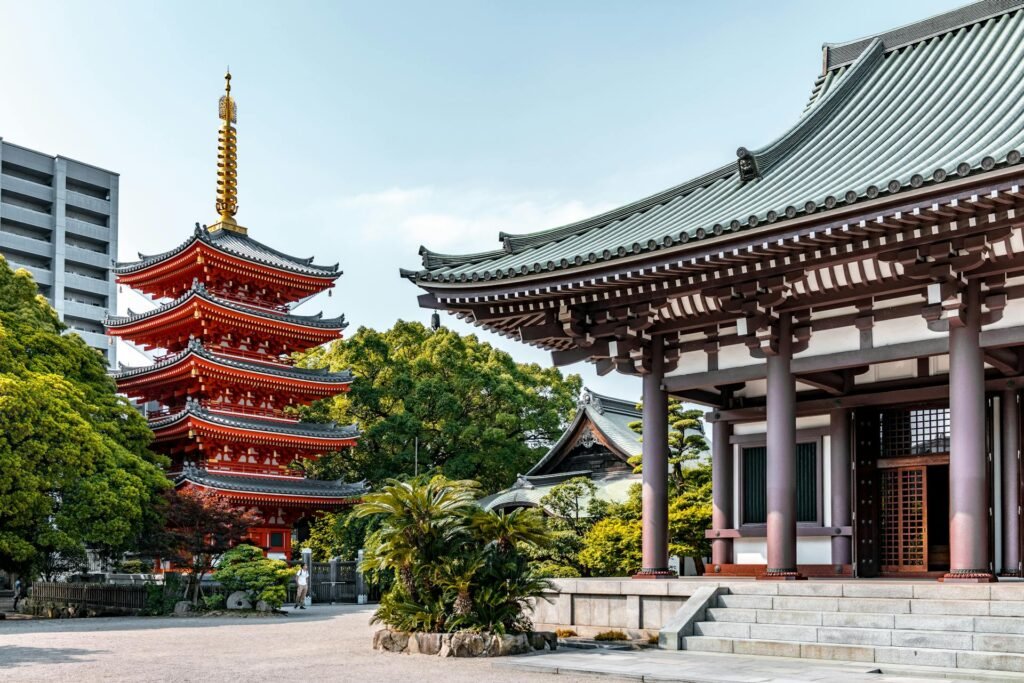
The transportation and commercial hub east of the Naka River. Hakata Station — Kyushu’s largest railway terminus with shinkansen connections to all major Japanese cities — anchors the district. Canal City Hakata shopping complex; Kushida Shrine (the spiritual home of the Hakata Gion Yamakasa); the Tochoji Temple with its giant wooden Buddha; the Fukuoka Asian Art Museum. Densely walkable; the practical default base for short-stay visitors.
Chuo-ku (Tenjin)
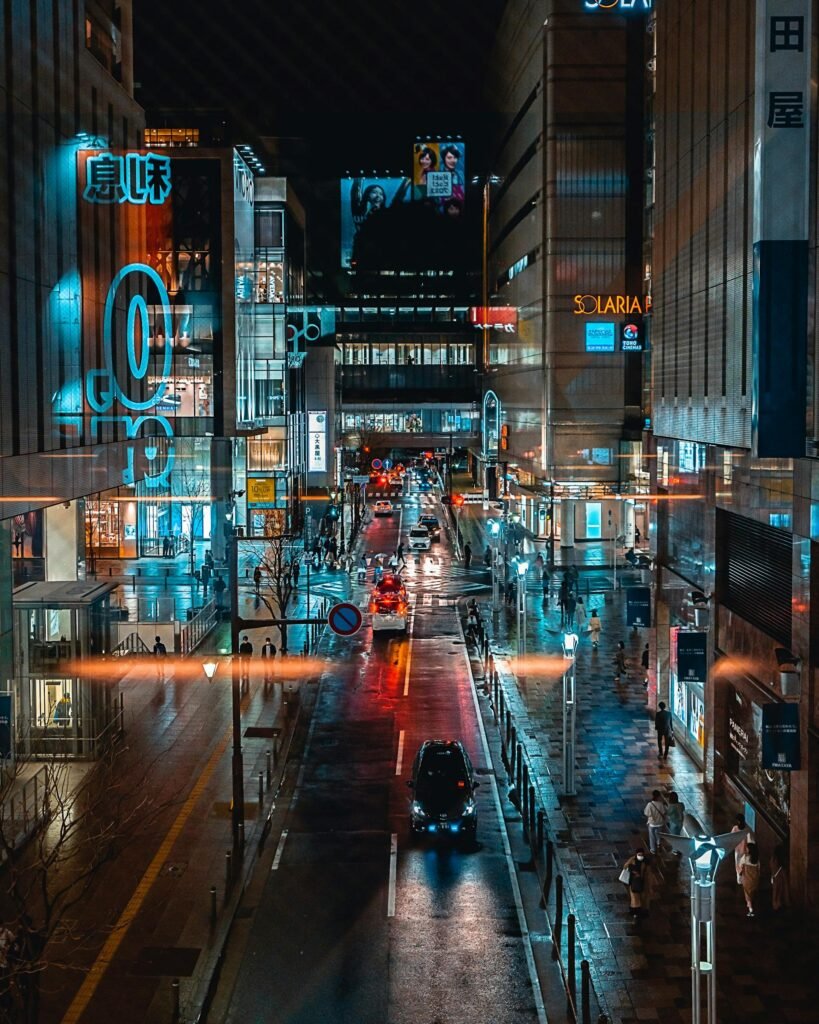
The west-of-river modern commercial center — Fukuoka’s downtown. Tenjin Underground Shopping Street (one of Japan’s largest underground malls); department stores (Solaria Plaza, Iwataya, Mitsukoshi, Daimaru); the major bus terminal; the Acros Fukuoka stepped-pyramid building with rooftop gardens. The locus of evening dining and shopping; busiest after-work hours.
Daimyo & Imaizumi
The hip side-streets just west of Tenjin — Fukuoka’s most fashionable nightlife and restaurant district. Narrow streets lined with craft cocktail bars, independent designer shops, vinyl record stores, third-wave coffee, and the country’s best concentration of small-format izakaya. The post-2010 generation’s Fukuoka.
Nakasu
The river island between Hakata and Chuo wards — Japan’s most concentrated entertainment district outside Tokyo. The famous Nakasu yatai street with open-air food stalls along the Naka River (best after dark, 18:00–01:00). Adult-entertainment establishments dominate the inner blocks; the river-facing waterfront is family-friendly.
Seaside Momochi
The Tokyo-Bay-style reclaimed-land waterfront development west of central Fukuoka. Fukuoka Tower (234 m, the city’s signature observation deck); Seaside Momochi Beach (the artificial beach); Fukuoka PayPay Dome (the country’s first retractable-roof baseball stadium and home of the SoftBank Hawks); the Hilton Sea Hawk Resort.
Ohori & Maizuru Parks
The western district containing Ohori Park (the moat of the original Fukuoka Castle, now a popular jogging-and-rowing pond) and Maizuru Park (the castle ruins on the high ground above). The Fukuoka Castle ruins survive only as walls and foundations; the area is the city’s premier cherry-blossom spot in late March-early April.
Dazaifu (Day Trip, 30 minutes)
The historic religious-administrative center 12 km southeast. Dazaifu Tenmangu Shrine (one of Japan’s most-visited Shinto shrines, dedicated to the deity of scholarship and the spirit of the exiled court noble Sugawara no Michizane, died 903). The atmospheric plum garden blooms in February-March; the Kyushu National Museum on the hill behind the shrine. The famous umegae mochi (grilled plum-stamped rice cake) is the local specialty.
Top Things to Do in Fukuoka
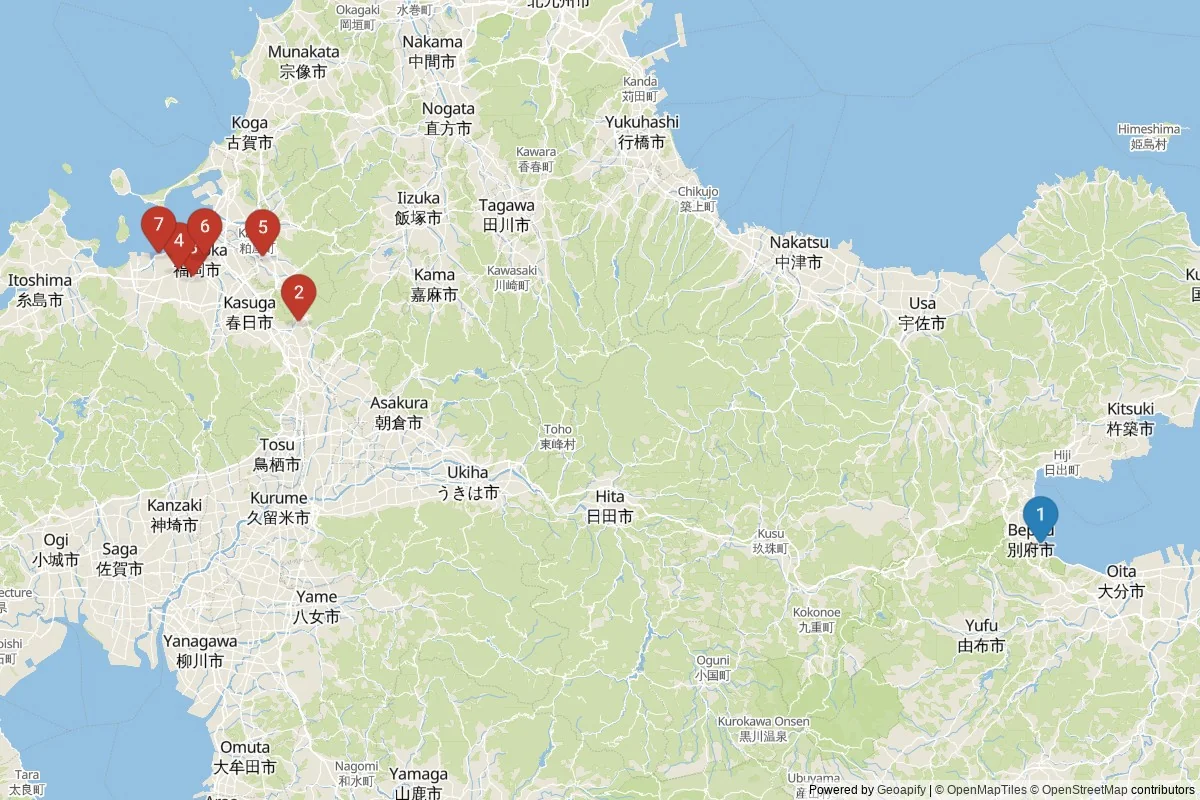
| # | Sight | Cluster | Type | Time | Entry | Best |
|---|---|---|---|---|---|---|
| 1 | Day Trip to Beppu Hot Springs | Cluster A | — | 2 hours | — | — |
| 2 | Day Trip to Dazaifu Tenmangu | Cluster B | Museum | 30 minutes | — | — |
| 3 | Tochoji Temple & the Hakata Old Town Walking Trail | Cluster B | Temple | — | Free | — |
| 4 | Eat at the Nakasu Yatai Stalls | Cluster B | — | 30 minutes | — | Sunset |
| 5 | Fukuoka Castle Ruins & Ohori Park | Cluster B | Museum | — | Free | — |
| 6 | Kushida Shrine & Hakata Old Town | Cluster B | Temple | — | Free | — |
| 7 | Fukuoka Tower & Seaside Momochi | Cluster B | Beach | — | — | — |
1. Eat at the Nakasu Yatai Stalls
The defining Fukuoka experience. Approximately 100 open-air yatai (food stall) operators set up nightly along the Naka River from sunset to 01:00, serving Hakata ramen, oden (fish-cake stew), yakitori, gyoza, and tempura at small communal counters seating 6–10 people. The yatai culture is uniquely Fukuoka — most other Japanese cities banned them decades ago. Plan for about 30 minutes per stall; sample 2–3 in an evening. Prices ¥600–2,000 per dish; cash mostly, some accept QR-code mobile payment.
2. Visit Kushida Shrine & Hakata Old Town
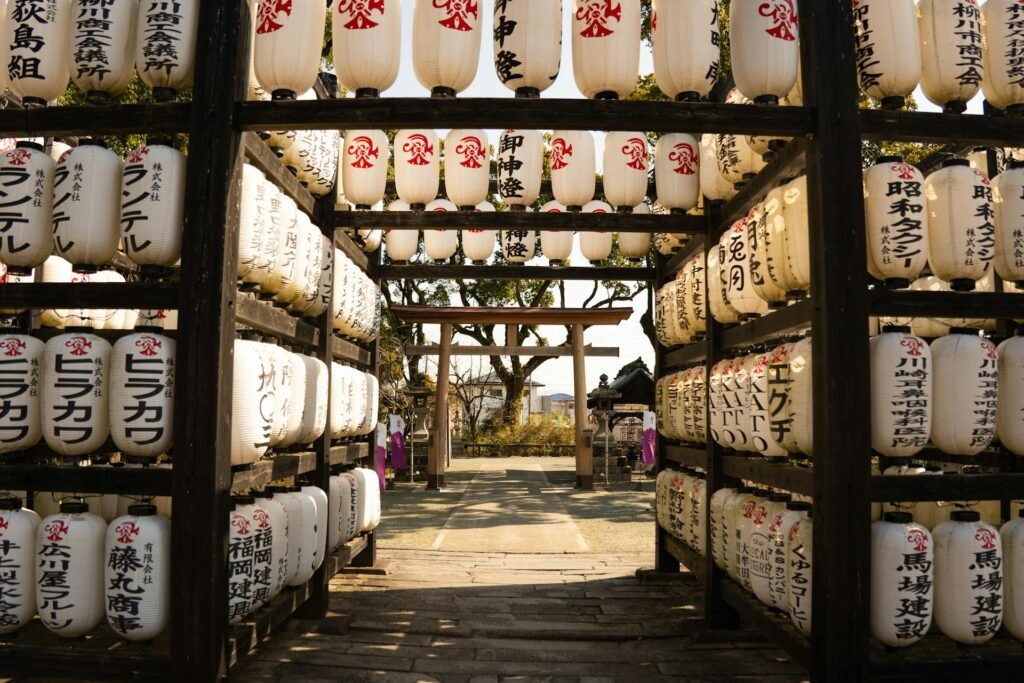
The 8th-century shrine that anchors Hakata’s traditional identity; site of the dramatic Hakata Gion Yamakasa festival each July. The 1.5-meter-wide Yamakasa float from the previous year is preserved on display year-round. The surrounding Hakata Old Town heritage walking trail covers temples, shrines, traditional shops, and the Hakata Machiya Folk Museum. Free shrine entry; museum ¥200.
3. Day Trip to Dazaifu Tenmangu
Japan’s most-visited Tenmangu shrine — dedicated to the spirit of Sugawara no Michizane (845–903), the brilliant court noble unfairly exiled to Dazaifu, who became enshrined as the deity of scholarship. Today thousands of students visit before university entrance exams. The atmospheric plum garden blooms in February-March; the Komyozen-ji Zen rock garden nearby is among Japan’s most beautiful. Combine with the Kyushu National Museum on the hill behind. 30 minutes by Nishitetsu train from Tenjin; ¥420 each way.
4. Fukuoka Castle Ruins & Ohori Park
The 1601 castle of the Kuroda samurai clan was almost entirely dismantled in the Meiji-era anti-feudalism movement; only the foundations and a few walls survive in Maizuru Park. The adjacent Ohori Park — formerly the castle’s outer moat — is now a 2-km circular jogging-and-rowing pond with cherry blossom trees, the Japanese-style Friendship Garden, and the Fukuoka Art Museum. Spring cherry blossom season here is the city’s prime hanami spot. Free.
5. Fukuoka Tower & Seaside Momochi
The 234-meter triangular observation tower at Seaside Momochi — Japan’s tallest seaside tower. The 360° observation deck offers Hakata Bay, the city, and on clear days the inland mountains. Combine with the artificial Seaside Momochi Beach, the Fukuoka PayPay Dome (SoftBank Hawks baseball if in season), and the Hilton Hawks Sea Hawk’s interior. Tower admission ¥800.
6. Day Trip to Beppu Hot Springs
The country’s most-visited hot-spring city, 2 hours east of Fukuoka by Sonic limited express train (¥4,400 each way). Beppu has more onsen wells than any other Japanese town and the famous Jigoku Meguri (Hell Tour) — eight different colored thermal pools you visit but don’t bathe in. Yufuin (3 hours from Fukuoka) is the more upscale, smaller hot-spring resort with elegant ryokan inns. Plan a full day for Beppu, ideally overnight at a traditional ryokan.
7. Tochoji Temple & the Hakata Old Town Walking Trail
The 9th-century temple in central Hakata houses the country’s largest seated wooden Buddha (10.8 m tall, completed 1992 from a single camphor-tree trunk). The temple is on the Hakata Old Town walking trail connecting multiple historic shrines and temples in a 90-minute loop. Free entry to most; small donation requested.
8. Itoshima Coastal Day Trip
The peninsula 30 minutes west of Fukuoka by train, popular with locals for weekend beach trips. The Sakurai Futamigaura “wedded rocks” beach with the iconic white torii gate framing the ocean sunset, the Itoshima oyster huts (winter season specialty), and the surfing-friendly Pacific beaches. Less developed than the central city beaches; ideal for a slower-paced afternoon.
How to Get to Fukuoka
By Air
Fukuoka Airport (FUK) is unusually close to central Fukuoka — just 5 km from Hakata Station (one of the world’s closest major-city airports to the city center). Direct nonstop routes from most major Asian hubs (Seoul, Busan, Shanghai, Beijing, Hong Kong, Taipei, Bangkok, Singapore, Manila), several European cities (Frankfurt, Helsinki seasonal), and Hawaii (Honolulu); domestic flights to Tokyo, Sapporo, Naha, Osaka, Nagoya. Carriers: Japan Airlines, All Nippon Airways, Korean Air, Asiana, Cathay Pacific, Lufthansa, Finnair, and many more.
From the airport: Fukuoka City Subway ¥260 to Hakata Station (5 minutes); airport bus ¥260 to Tenjin (15 minutes); taxi ¥1,200–1,800 to central city. The airport-to-city transit is genuinely the fastest in Japan.
By Shinkansen (High-Speed Train)
Hakata Station is the western terminus of the Sanyo Shinkansen and the southern starting point of the Kyushu Shinkansen. From Tokyo: Nozomi shinkansen 5 hours, ¥22,800 reserved seat. From Osaka: 2.5 hours, ¥15,000. From Kyoto: 3 hours, ¥15,800. From Hiroshima: 1 hour, ¥9,000. From Kagoshima (Kyushu Shinkansen): 1.5 hours, ¥11,000. Japan Rail Pass covers the Sanyo Shinkansen (Tokyo to Hakata) but only on Hikari and Sakura services (not Nozomi); recently the Mizuho service was restricted to JR Pass holders as well.
By Ferry from Korea
Unusually short international ferry: Fukuoka to Busan on JR Beetle high-speed ferry (3.5 hours, ¥9,500–14,000) or Camellia Line overnight ferry (8 hours, ¥9,000–25,000). The shortest international sea route to Japan.
By Long-Distance Bus
Highway buses connect Fukuoka to all major Japanese cities; overnight services to Tokyo (14 hours, ¥10,000) and Osaka (10 hours, ¥7,000) are popular budget options.
Visa Notes
Japan offers visa-free entry for up to 90 days for citizens of 68 countries — including all EU member states, US, UK, Canada, Australia, New Zealand, Singapore, South Korea, Hong Kong (SAR passport), Taiwan. Chinese passport holders need a visa in advance. Passport must have at least 6 months remaining validity. The Visit Japan Web system streamlines digital immigration and customs declarations before arrival. Check current entry rules with the Japanese Ministry of Foreign Affairs.
Getting Around Fukuoka
Fukuoka City Subway
The city’s three-line subway system covers most major districts. Kuko Line (orange) connects the airport, Hakata Station, Tenjin, and Ohori Park — the most useful for visitors. Hakozaki Line (blue) covers eastern Hakata; Nanakuma Line (green) covers southern and western districts. Single fares ¥210–340; one-day pass ¥640.
Buses (Nishitetsu)
The Nishitetsu bus network is comprehensive but Japanese-language-dominated. The most useful routes connect Tenjin to Seaside Momochi/Fukuoka Tower; flat ¥150 fare within the inner city. The Open Top Bus Fukuoka tourist double-decker offers a 60-minute panoramic city loop.
Trains (Nishitetsu & JR)
The Nishitetsu Tenjin-Omuta Line connects central Tenjin to Dazaifu (30 minutes, ¥420) and onward south. JR services connect Hakata Station to Itoshima (Chikuhi Line, 30 minutes) and broader Kyushu destinations.
Taxis & Ride-Hailing
Japanese taxis are spotless and metered (¥420 flagfall plus ¥80 per 240 m). Go (formerly JapanTaxi) and S.Ride apps enable English-language hailing. Uber operates limited service in Fukuoka.
Walking & Cycling
Central Fukuoka is walkable — Hakata Station to Tenjin is about 20 minutes on foot. Mercari Bicycle and other bike-share systems operate at major stations. Ohori Park is a popular cycling loop.
Food & Drink in Fukuoka
Fukuoka — and specifically Hakata — has a strong claim to being Japan’s best food city. The Kyushu island climate produces excellent ingredients (the country’s best beef rivals at Kobe in Saga Prefecture; superb seafood from the Tsushima and Genkai seas), and the specific Hakata culinary tradition — built around tonkotsu (pork-bone) broth ramen, motsunabe (offal hot-pot), and mentaiko — is genuinely distinctive.
What to Try
- Hakata Ramen — the city’s defining dish: thin straight noodles in milky white pork-bone (tonkotsu) broth, topped with chashu pork, scallions, kikurage (wood-ear mushrooms), and pickled ginger. The original of the now-global tonkotsu style. Ichiran (the originator of the solo-dining booth concept), Ippudo (the globally exported brand), Shin-Shin, Daichoen, Hakata Ikkousha are canonical.
- Motsunabe — offal hot-pot in soy or miso broth with cabbage, garlic chives, and gobo (burdock root); the Hakata cold-weather staple. Yamanaka, Rakutenchi, Motsunabe Tagoto are well-regarded.
- Mizutaki — Hakata-style chicken hot-pot with a clear, milky chicken broth, dipping ponzu, and rice porridge to finish. Hakata Hanamidori, Suikyo, Toritakashi are canonical.
- Mentaiko — spicy marinated pollock roe; the regional condiment exported nationally and the country’s most-iconic associated food product. Fukusaya Cocoyama and Fukuya are the canonical mentaiko brands; available everywhere as a sandwich filling, pasta sauce, or rice topping.
- Yakitori & Tebasaki — chicken-on-skewer street food; Fukuoka has more yakitori-yatai than ramen-yatai.
- Karashi-mentaiko — the spicier “mustard” variety of mentaiko.
- Goma-saba — Hakata-specialty raw mackerel marinated in soy and sesame; a brilliant izakaya starter.
- Umegae-mochi — Dazaifu specialty grilled rice cake with a plum imprint; eaten warm.
- Hakata-Tonkotsu Pasta & Karashi-Mentaiko Pasta — the Hakata fusion innovation of pasta with regional flavors.
Where to Eat
Nakasu yatai stalls (evenings): ramen, yakitori, oden, gyoza — pick the busiest stall. Hakata Ramen Stadium on the 9th floor of Canal City Hakata: 8 famous ramen shops in one location for the comparison-tasting experience. Ichiran Hakata (multiple locations): the originating solo-dining booth experience. Hakata Old Folk Museum street: traditional Japanese sweets. Tenjin and Daimyo: the latest izakaya, craft-cocktail, and contemporary Japanese restaurants. Itoshima oyster huts (winter): the all-you-can-eat oyster experience.
Drinks
Local sake: Kyushu produces several respected sake breweries — Hizen Kurabito Shuzo, Yamadanishiki, Sasamori. Shochu: Kyushu is the center of Japanese shochu (distilled spirits); Fukuoka favors barley shochu (mugi-jochu). Hakata Beer and craft beer: the post-2015 craft-beer scene includes Hakata Craft Beer Co. and several taprooms. Green tea: Yame tea from south Fukuoka Prefecture is one of Japan’s most respected green teas. Awashima coffee: the Fukuoka third-wave coffee scene is among Japan’s most developed.
A Note on Tap Water
Tap water in Fukuoka is completely safe to drink — Japanese municipal water systems are among the world’s cleanest, treated to drinking-water standards exceeding most countries’ bottled-water requirements. No bottled water needed; refillable bottles are fine. Ice is universally safe. The CDC traveler health page for Japan rates Japanese food and water as the same low-risk as other developed countries. Foodborne illness is uncommon. Raw fish (sashimi) is universally safe at reputable establishments; raw chicken (torisashi, occasionally served at specialty restaurants) carries non-zero salmonella risk.
Frequently Asked Questions About Visiting Fukuoka
Do I need a visa to visit Fukuoka?
For most foreign passport holders, no — Japan offers visa-free entry for up to 90 days for citizens of 68 countries, including the US, UK, Canada, Australia, New Zealand, all EU member states, Singapore, South Korea, Hong Kong (SAR passport), Taiwan, and most other developed-economy nations. Chinese mainland passport holders need a visa applied for in advance at a Japanese consulate. Visa-free travelers must: have a valid passport (Japan does not technically require 6 months remaining, but airlines often do); have an onward/return ticket; have proof of accommodation; have sufficient funds. Visit Japan Web: the digital immigration-and-customs system simplifies arrival — complete the online forms before flying; QR codes scanned at Fukuoka Airport immigration. Always verify current rules with the Japanese Ministry of Foreign Affairs. Working Holiday Visa: available to citizens of partner countries (Australia, NZ, Canada, UK, Germany, France, Spain, etc.) for stays up to 1 year with limited work authorization.
Is Fukuoka safe for tourists?
Fukuoka — like Japan as a whole — is among the world’s safest tourist destinations. The US State Department rates Japan at “exercise normal precautions” — the most relaxed advisory level. Violent crime against tourists is statistically negligible; pickpocketing exists but at a fraction of European or American rates. Real risks in Fukuoka: typhoons July–October can disrupt travel; earthquakes are a periodic regional risk (the 2005 Fukuoka earthquake was magnitude 7.0); traffic — Japanese cyclists frequently use sidewalks; watch for them; nightlife area scams in Nakasu — be cautious of touts offering “bargain” club access; some establishments charge inflated bills to foreign visitors; stick to clearly-priced yatai food stalls and bar areas; medical-cost shock — Japanese healthcare is excellent but uninsured foreigners pay full sticker prices; comprehensive travel insurance essential; summer heat exhaustion — Fukuoka summers are humid and dangerous for outdoor exertion; natural-disaster preparedness: download the JMA earthquake-warning app on your phone. Drug laws: Japan imposes extremely harsh penalties for any drug offense including small amounts of cannabis — multi-year prison sentences and deportation. LGBTQ+ travelers: Japan is broadly welcoming but same-sex marriage is not yet recognized nationally; openly LGBTQ+ travelers face no specific concerns in Fukuoka.
How many days do I need in Fukuoka?
Three days handles Fukuoka well; combined with Beppu hot springs and Dazaifu day trips, 5–7 days makes a satisfying Kyushu trip. A solid 3-day Fukuoka plan: Day 1 — arrive, Hakata Old Town walking trail + Kushida Shrine + Tochoji giant Buddha + evening yatai stalls along Nakasu. Day 2 — Dazaifu day trip morning (Tenmangu shrine + Komyozen-ji rock garden + Kyushu National Museum) + afternoon Ohori Park + dinner in Daimyo neighborhood. Day 3 — Fukuoka Tower + Seaside Momochi + lunch at Itoshima coastal restaurants + Hakata ramen tasting at the Ramen Stadium + craft cocktail evening in Daimyo. Add Days 4–5 for Beppu/Yufuin hot-springs overnight trip (2 hours east, traditional ryokan experience). Add Days 6–7 for the broader Kyushu circuit — Nagasaki (2 hours west via shinkansen), Kumamoto Castle, Kagoshima with Sakurajima volcano. 10-day Japan classic: 4 days Tokyo + 2 days Kyoto + 1 day Hiroshima + 3 days Fukuoka/Kyushu. Day-trip Fukuoka from Hiroshima or Osaka: feasible via shinkansen but feels rushed; overnight is the right pace.
What’s the best area to stay in Fukuoka?
Hakata Station area (Hakata-ku) — the practical default for first-time visitors and shinkansen-arrival travelers. International hotel chains (Hotel Nikko Fukuoka, JR Kyushu Hotel Blossom Hakata, Hotel Centraza Hakata); ¥8,000–25,000/night (US$53–165). Walking distance to Hakata Station, the underground shopping mall, Canal City Hakata, and the Kushida Shrine. Tenjin / Chuo-ku — the modern downtown commercial center; Solaria Hotel Fukuoka, Hotel Mystays Premier Fukuoka, ANA Crowne Plaza; ¥9,000–22,000/night; closer to the nightlife of Daimyo and Imaizumi. Nakasu — central island between the two ric — useful only for nightlife-focused short visits, otherwise too noisy. Seaside Momochi — the Hilton Hawks Sea Hawk and similar luxury hotels with bay views; ¥15,000–40,000/night; ideal for travelers wanting waterfront amenity. Yufuin or Beppu — for the traditional onsen ryokan experience as part of a Fukuoka trip; ¥18,000–60,000/night per person including two meals. Skip: cheap unbranded hotels far from any train station; airport-adjacent hotels useful only for early flights.
How much does it cost to visit Fukuoka’s major sights?
Fukuoka offers excellent value for Japan — lower than Tokyo or Kyoto across most categories. Kushida Shrine: free. Tochoji Temple: free. Ohori Park: free. Fukuoka Castle ruins: free. Fukuoka Asian Art Museum: ¥200. Hakata Machiya Folk Museum: ¥200. Fukuoka Tower: ¥800. Fukuoka City Museum: ¥200 + special exhibitions extra. Dazaifu Tenmangu: free. Kyushu National Museum: ¥430 + special exhibitions. Local meals: yatai dish ¥600–1,500; ramen ¥800–1,500 per bowl; motsunabe shared hot-pot ¥3,500–6,000 per person; chain breakfast set ¥500–800; mid-range Japanese dinner ¥2,500–5,500 per person; fine-dining ¥8,000–25,000 per person. Coffee at a café: ¥400–700 per cup. Subway one-day pass: ¥640. Nishitetsu train to Dazaifu: ¥420 each way. Sonic to Beppu: ¥4,400 each way. Shinkansen Fukuoka to Tokyo: ¥22,800 reserved. Cycling rental: ¥1,000–1,500/day. Overall daily budget: ¥7,000 (frugal hostel + ramen and yatai), ¥18,000 (mid-range hotel + restaurants + 1 attraction), ¥40,000+ (luxury hotel + fine dining + onsen ryokan).
Should I drink the tap water in Fukuoka?
Yes — tap water in Fukuoka is completely safe to drink straight from the tap. Japan’s municipal water systems are among the cleanest in the world, treated to drinking-water standards exceeding most countries’ bottled-water requirements. Fukuoka’s supply meets all national drinking-water standards. No bottled water needed; ice in restaurants is universally safe; tap water in any restaurant or hotel is safe; refillable water-bottle stations are common at major sights. Reusable filter bottles are unnecessary in Japan. Food safety: Japan has very low foodborne illness rates. Raw fish (sashimi, sushi) at reputable establishments is consistently safe due to rigorous regulatory standards. Yatai food stalls in Fukuoka have specific health codes; the long-established stalls are reliably safe. Higher-risk items: torisashi (raw chicken) — occasionally served at specialty restaurants — carries non-zero salmonella risk; raw eggs (tamago gohan) — Japanese-regulated eggs are sterilized and broadly safe but consume freshly cracked. The CDC traveler health page for Japan recommends standard hygiene precautions but does not require water-purification measures.
What payment methods work in Fukuoka — credit cards or cash?
Significantly improved card acceptance in recent years but still cash-friendly. Credit cards (Visa, Mastercard, JCB, AmEx): accepted at most hotels, department stores, chain restaurants, supermarkets, convenience stores (7-Eleven, Lawson, FamilyMart), and the Fukuoka subway. Suica / PASMO IC cards: rechargeable transit cards that double as small-payment cards at convenience stores and vending machines; Apple Pay supports Suica natively on iPhone; the local Kyushu nimoca card works similarly. Mobile payment: PayPay dominates QR-code payments locally — many yatai stalls and small restaurants accept PayPay even when they don’t take credit cards; requires a Japanese phone number for full registration but tourists can use Apple Pay / Google Pay at NFC-enabled terminals. Cash: still needed for many small restaurants, traditional ryokans, temple donations, smaller yatai stalls, and most outdoor markets. ATMs: at 7-Eleven (Seven Bank), FamilyMart, and Japan Post Bank accept foreign cards with daily limits of ¥100,000–300,000 and reasonable fees. Currency exchange: airport rates are competitive; banks and post offices exchange. No tipping culture: Japan does not have a tipping tradition; restaurants will return cash left as tips, and tipping can cause genuine confusion. The price you see is what you pay; excellent service is included.
What about the yatai food stall culture — how does it work?
The Nakasu yatai stalls are one of Fukuoka’s most distinctive experiences and reward understanding the conventions. What yatai are: small open-air food stalls with a few stools at a counter under a canvas-and-wood roof; approximately 100 of them set up nightly along the Naka River and in Tenjin from around 18:00 to 01:00. Each yatai is a permanent license operated by the same family for decades. Etiquette: stalls have 6–10 stools at a counter; wait if the stall is full (the wait is rarely more than 30 minutes); when a seat opens, the owner will gesture you in. What to order: most yatai are specialized — ramen-yatai serve only ramen; yakitori-yatai serve only chicken skewers; oden-yatai serve only oden (fish-cake stew). Order what they’re famous for. Payment: cash mostly (¥600–2,000 per person for a basic meal); some yatai now accept PayPay QR-code mobile payment. Language: Japanese-language-dominant; the owners are usually very patient with foreign visitors; pointing at displayed menus or saying “osusume” (“recommended”) works fine. Drinks: beer (Asahi, Sapporo, Kirin), sake, and shochu (highball) are the standard accompaniment. Best practice: visit 2–3 yatai in an evening to sample different specialties; don’t camp at a single stall for an extended meal — yatai are designed for quick turnover. Avoid yatai with mostly non-Japanese customers — these may be tourist-trap operations with inflated prices; the best yatai have a Japanese-customer majority. Best time: 19:30–21:30 is the peak; after 22:00 the locals start arriving; weekday evenings less crowded than weekends.
Education & Notable People
Fukuoka has a respected concentration of higher-education institutions, anchored by Kyushu University as Kyushu’s flagship public research university.
Major Universities
- Kyushu University (Kyudai) — Kyushu’s flagship public research university; one of Japan’s seven “Imperial Universities” (founded 1903 as Kyushu Imperial University); ~18,500 students; nationally ranked in engineering, medicine, and biological sciences; main campus at Ito to the west of central Fukuoka.
- Seinan Gakuin University — Baptist-mission private university with strong international-studies programs.
- Fukuoka University — large private university with comprehensive faculties.
- Kyushu Sangyo University — private university with engineering and arts emphasis.
- Fukuoka Institute of Technology — engineering and technology focus.
Notable People
Sugawara no Michizane (845–903) — the Heian-era court noble and scholar, exiled to Dazaifu, deified as the deity of scholarship after his death; the Tenmangu shrine cult remains one of Japan’s most-visited religious traditions. Kuroda Nagamasa (1568–1623) — the daimyo who founded Fukuoka Castle in 1601. Tetsuya Honda — celebrated contemporary mystery novelist. Yu Suzuki — pioneering video game designer (Out Run, Virtua Fighter, Shenmue), born in Fukuoka. Hiroshi “Tonkatsu” Hashimoto — celebrated chef who popularized fukuoka tonkatsu. Soichi Noguchi — Japanese astronaut, three space flights (2005, 2009-2010, 2020). Kazuo Inamori — founder of Kyocera and KDDI, born in Kagoshima but a longtime Fukuoka resident. Tomoyuki Sugano — celebrated baseball pitcher. The SoftBank Hawks baseball team (formerly Daiei Hawks) has produced multiple Japanese national team stars.
Sister Cities & International Relations
Fukuoka’s sister-city network reflects the city’s identity as Japan’s gateway to East Asia and a deliberate node in Pacific Rim cultural-and-economic cooperation.
Fukuoka’s sister and partnership cities include (selection):
- Busan, South Korea — paired since 1989; the closest international city (200 km by ferry); the most active Japan-Korea sister relationship.
- Atlanta, Georgia, USA — sister city since 2005.
- Auckland, New Zealand — paired since 1986.
- Ipoh, Malaysia — friendship city.
- Yangon, Myanmar — friendship link.
- Bordeaux, France — paired since 1982.
- Guangzhou, China — sister city since 1979.
- Hanoi, Vietnam — partnership city.
Fukuoka plays a central role in the Hakata Bay International Conferences initiative and hosts the headquarters of multiple Japan-Korea-China trilateral cooperation institutions. The city was designated a National Strategic Special Zone in 2014, allowing relaxed business-and-startup regulations that have attracted significant venture capital and international entrepreneurial activity. The Fukuoka City Tourism Information Center coordinates the city’s tourism promotion.
AFRIKA
Cairo Hurghada Johannesburg Marrakech
ASIA
Abu Dhabi Agra Antalya Bangkok Batam Beijing Bengaluru Cebu City Chiang Mai Chiba Chennai Da Nang Dammam Delhi Denpasar Dubai Fukuoka Guangzhou Guilin Ha Long Hanoi Ho Chi Minh City Jakarta Jaipur Johor Bahru Kolkata Krabi Kuala Lumpur Kyoto Macau Mecca Medina Mugla Mumbai Osaka Pattaya Penang Phuket Riyadh Seoul Shanghai Shenzhen Singapore Taipei Tokyo Zhuhai
EUROPE
Amsterdam Athens Barcelona Berlin Brussels Budapest Copenhagen Dublin Florence Frankfurt am Main Heraklion Krakow Lisbon London Madrid Milan Munich Nice Paris Porto Prague Rhodes Rome Stockholm Venice Vienna Warsaw
NORTH AMERICA
Cancun Las Vegas Los Angeles Miami New York City Orlando San Francisco Toronto Vancouver
SOUTH AMERICA
Buenos Aires Lima Rio De Janeiro
OCEANIA
Auckland Honolulu Melbourne Sydney