
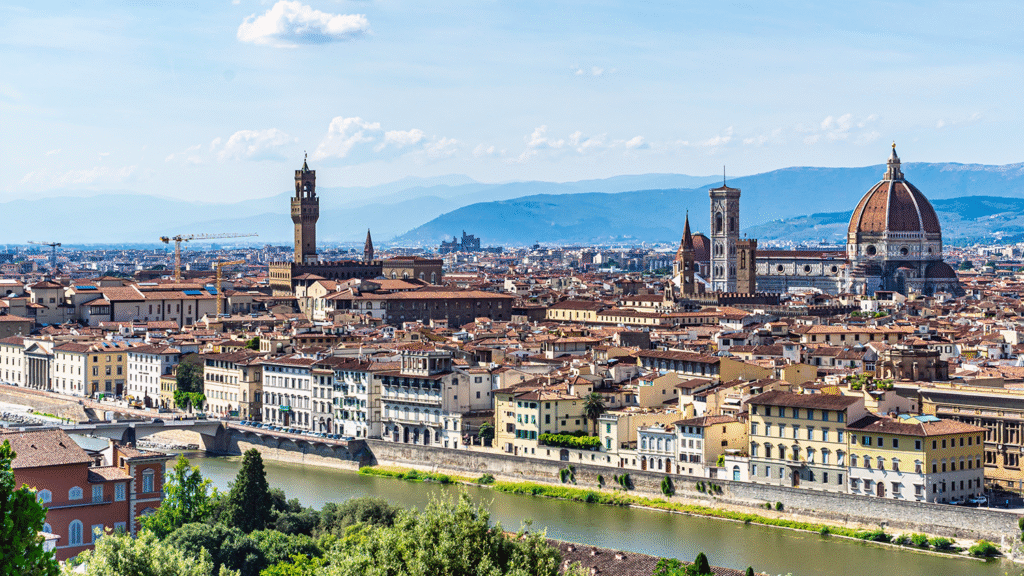
Photo credit: Florence Duomo and the historic city
Florence is the capital of Tuscany and arguably the most influential single city in the cultural history of Europe. Between roughly 1400 and 1600, Florence and the Medici banking family funded and produced the Italian Renaissance — the intellectual, artistic, and political movement that fundamentally reshaped Western civilization. The artistic concentration is staggering: Michelangelo’s David stands in the Galleria dell’Accademia; Botticelli’s Primavera and Birth of Venus in the Uffizi; Brunelleschi’s Duomo (1436, then the world’s largest dome and an architectural problem solved before any modern engineering tools); the Ponte Vecchio medieval bridge with its goldsmith shops; the Palazzo Pitti and Boboli Gardens; the Basilica di Santa Croce with the tombs of Michelangelo, Galileo, and Machiavelli. The entire historic center has been UNESCO World Heritage since 1982. Beyond the Renaissance headlines, Florence offers excellent Tuscan cuisine (the bistecca alla fiorentina steak, ribollita bread-and-bean soup, the country’s most refined leather and stationery craftsmanship), perfectly placed day trips to Pisa, Siena, San Gimignano, and the Chianti wine country, and a compact walkable urban scale that rewards multi-day exploration.
Florence by District: The 5 Quartieri
Florence is divided into 5 districts (quartieri). The map below shows their official OSM boundaries, colour-coded to match the table — a quick way to orient yourself before zooming in on individual sights.
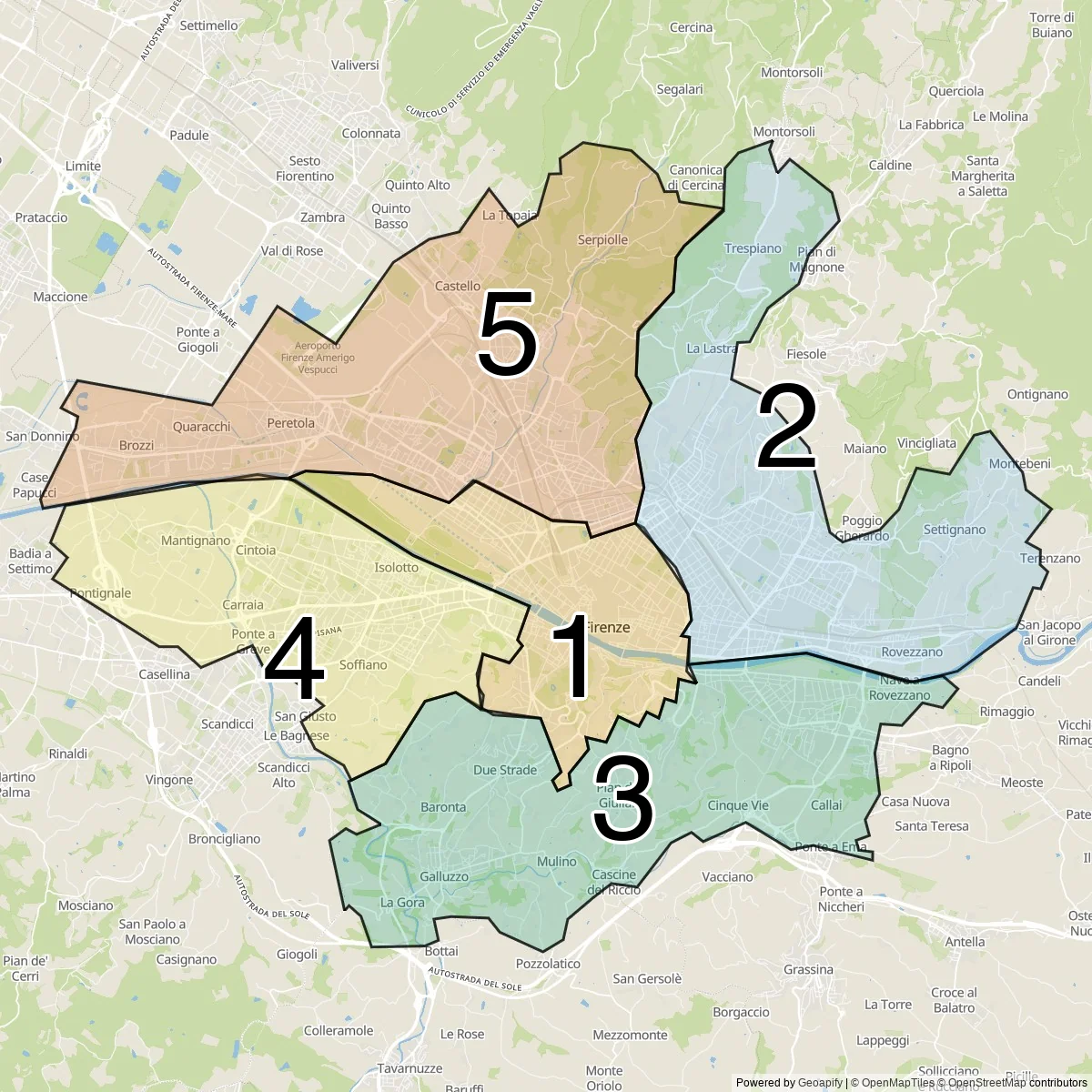
| # | Quartieri |
|---|---|
| 1 | Quartiere 1 |
| 2 | Quartiere 2 |
| 3 | Quartiere 3 |
| 4 | Quartiere 4 |
| 5 | Quartiere 5 |
Florence at a Glance: Essential Facts for Travelers
| Location | Tuscany region, central Italy (Arno River valley) |
|---|---|
| Coordinates | 43.7696°N, 11.2558°E |
| Population | ~361,000 (city, 2024); metro area ~1.52 million |
| Area | 102 km² (city proper) |
| Elevation | ~50 m (city center; surrounding hills to ~700 m) |
| Time Zone | Central European Time (CET, UTC+1) / Central European Summer Time (CEST, UTC+2) |
| Calling Code | +39 (city code 055) |
| Currency | Euro (EUR €) |
| Languages | Italian (official); English widely spoken in tourism; the city’s historic Tuscan dialect (fiorentino) is the basis for standard Italian |
| Climate | Humid subtropical with Mediterranean influence — hot humid summers, cool wet winters |
| Founded | Roman colony 59 BCE; Renaissance flourishing 1400–1600 under the Medici family |
| Famous For | UNESCO Historic Centre (1982), birthplace of the Renaissance, Duomo, Uffizi Gallery, Michelangelo’s David, Ponte Vecchio, Tuscan cuisine, gateway to Tuscany wine country |
Upcoming Events in Florence
| Date | Title | Details |
|---|---|---|
| 2026-09-06 to 2026-10-04 | Domenica al Museo (Free First Sunday) | On the first Sunday of each month, Italy’s state museums open their doors for free, and in Florence that includes world-famous institutions such as the Uffizi Galleries, the Accademia (home of Michelangelo’s David) and the Bargello. On these days admission is waived, giving residents and visitors the chance to explore priceless collections without a ticket, though queues can be long and some sites require timed entry. Falling on the first Sundays of September and October, it is a superb budget-friendly way to experience Florence’s extraordinary art. [Source] |
| 2026-09-10 to 2027-01-05 | Beyond the Renaissance: From Durer to Parmigianino at Palazzo Medici Riccardi | Palazzo Medici Riccardi hosts Oltre il Rinascimento. Tra Durer e Parmigianino from 10 September 2026 to 5 January 2027, a major exhibition on European Mannerist printmaking built from around 150 works from the private collection of artist Georg Baselitz and the Museum of Fine Arts in Budapest. Curated by Daniel Blau, Sergio Risaliti and Valentina Zucchi, it includes prints by Albrecht Durer, among them the famous Rhinoceros, alongside Lucas Cranach the Elder and chiaroscuro woodcuts by Beccafumi and Ugo da Carpi. Admission prices vary; the Medici palace setting adds to the appeal. [Source] |
| 2026-09-20 to 2026-09-21 | eno Florence Wine Excellence 2026 | The second edition of eno Florence Wine Excellence fills the Fortezza da Basso on 20 and 21 September 2026, from 10 am to 6 pm daily. More than 350 wineries pour over 1,400 wines, joined by 11 masterclasses and a programme built around wine production, market trends and wine culture in central Italy. Sunday welcomes both trade operators and wine lovers, while Monday is reserved for industry professionals. Tickets vary by day and access type. For enthusiasts it is a rare chance to taste across the cellars of Tuscany and beyond under one roof. [Source] |
| 2026-09-27 | Corri la Vita 2026 | Corri la Vita is Florence’s huge annual charity walk and run in support of breast-cancer research and care, drawing tens of thousands of participants on the last Sunday of September. Runners and walkers set off from the city centre along routes that wind past palaces, gardens and landmarks, combining sport with solidarity. Entry is through the purchase of an official T-shirt, with proceeds funding local hospitals and associations. Open to all ages and fitness levels, it is as much a civic celebration as a sporting event. [Source] |
| 2026-10-01 to 2026-10-31 | Autumn Prose Season at Teatro della Pergola | Teatro della Pergola, dating from 1656 and one of the oldest theatres in Italy, launches its autumn prose season in October with a programme of classic and contemporary drama. The elegant horseshoe auditorium hosts leading Italian actors and directors in productions ranging from Shakespeare and Goldoni to modern works, along with guided tours of the historic building. Tickets vary by performance, and the theatre remains a jewel of Florence’s cultural life. For visitors it offers a chance to experience Italian theatre in a truly historic setting. [Source] |
| 2026-10-22 to 2026-10-25 | Florence Creativity Autumn Fair | Florence Creativity is a popular autumn fair dedicated to arts, crafts and do-it-yourself hobbies, held at the Fortezza da Basso exhibition centre. Hundreds of exhibitors present materials and finished works for sewing, embroidery, painting, jewellery-making, decoration and more, alongside workshops, demonstrations and courses for all skill levels. The fair draws crowds of enthusiasts looking for inspiration and supplies as the creative season begins. Entry is ticketed, and the event is a lively, hands-on contrast to the city’s grand museums, especially popular with hobbyists and families. [Source] |
City News in Florence – last 14 days
| Date | Category | Headline | Details |
|---|---|---|---|
| 2026-09-14 | Local affairs | Over 15,000 Attend Mukki Day Milk Festival in Florence | More than 15,000 people filled the Mukki dairy plant in Florence for Mukki Day, the company’s Festa del Latte. Families, children, grandparents and curious visitors spent the day exploring the facility, with entertainment and discovery activities built around milk and how it is produced. The strong turnout confirmed the affection Florentines hold for the historic local dairy brand, and the open-doors format gave residents a rare look inside one of the city’s best-known food producers. [Source] |
| 2026-09-14 | Local affairs | Reddish Algae Appears in the Arno at Anconella | A reddish alga has appeared in the Arno river near the Anconella area of Florence, prompting an inspection by the regional environment agency Arpat after a report from the municipal police. In a sample taken upstream of the Varlungo bridge, technicians found an abundant presence of the organism, which they attribute to persistent heat and the river’s low flow. The agency’s explanation points to seasonal conditions rather than pollution, though monitoring of the waterway continues as summer temperatures linger into September. [Source] |
| 2026-09-14 | Education | Push to Start School in October Divides Florence Head Teachers | A proposal to delay the start of the school year until October, circulated through petitions and reviving old debates, is dividing opinion among Florence school principals. One head teacher calls the idea hard to implement because 200 days of lessons must be guaranteed, another considers it unrealistic, while others point out that the real problem lies at the other end of the calendar, in June, when classrooms swelter. The discussion comes just as tens of thousands of local students prepare to return to class. [Source] |
| 2026-09-14 | Business | eno Florence Wine Excellence Grows: 350 Wineries and 1,400 Wines Expected | The second edition of eno Florence Wine Excellence is set to grow substantially, with more than 350 wine producers and over 1,400 wines heading to the Fortezza da Basso. Organised by Firenze Fiera, the fair positions Florence as a central marketplace for Italian wine, combining tastings with masterclasses and business meetings for the trade. The growth from the debut edition signals confidence in the city as a wine-industry hub, bringing producers, buyers and enthusiasts together in the heart of Tuscany. [Source] |
| 2026-09-14 | Public safety | Wild Boar Crossing Causes Three-Car Crash, Four Injured | A wild boar crossing the road near Ponte a Vicchio, in the province of Florence, triggered an accident involving three cars. Six people were travelling in the vehicles and four of them were injured and taken for treatment. The collision highlights a recurring hazard on roads in the Mugello and surrounding countryside, where wildlife frequently strays onto carriageways, particularly at dawn and dusk. Authorities regularly remind drivers to moderate speed on rural stretches where animal crossings are common. [Source] |
| 2026-09-14 | Local affairs | Homeless Encampments Return Overnight at Torregalli Hospital | At Torregalli hospital in Florence, homeless people are again camping overnight, with at least five settling on the pavement near the emergency-room entrance and others occupying the waiting area inside. Residents and staff have voiced frustration, and protests have also flared against the nearby dormitory facility. The situation illustrates the pressure on the city’s shelter system and the difficulty of balancing care for vulnerable people with the day-to-day functioning of a busy hospital campus in the south-west of the city. [Source] |
| 2026-09-14 | Public safety | Police Chief Orders 30-Day Closure of Fast Food Venue After Violence | Florence’s police chief has ordered a 30-day closure of a fast-food outlet that had become a flashpoint for violence, after episodes including insults and threats against the manager. A preventive measure was also issued against a man linked to the trouble, who had posted selfies with customers on social media. The closure uses powers designed to protect public order around problem venues, and it reflects a wider effort to curb night-time disorder in the neighbourhoods around the city centre. [Source] |
| 2026-09-14 | Public transport | School Return Brings Traffic Stress Test for Florence’s New Mobility Plan | More than thirty thousand students return to class, giving Florence’s reworked traffic system its first real test. The hottest zones are around the Nencioni bridge works and the viali ring roads, where construction is already squeezing flows, while access problems persist near the Villani school, described as walled in by roadworks. Officials and traffic police are watching morning peaks closely, since the combination of school runs, commuters and construction detours will show whether the new mobility arrangements can cope. [Source] |
| 2026-09-14 | Education | Support Teacher Transferred, Disabled Student Left Without Familiar Aide | The family of a disabled student at the Porta Romana art institute in Florence received difficult news at the start of September: the support teacher who had followed the young man for three years has been transferred. The change leaves him without his trusted aide as he approaches his final-year exams, and it has reignited debate about continuity in special-needs support, where frequent staff rotation undermines the relationships on which students with disabilities depend for their progress. [Source] |
| 2026-09-14 | Business | Chamber of Commerce Tackles Energy Costs, Jobs and Development | Energy costs, employment and development take centre stage as the Florence Chamber of Commerce convenes a new session of its Colloqui dell’economia series, featuring the president of Leonardo, Francesco Macri. Chamber president Massimo Manetti says the starting point must be training, linking workforce skills to the competitiveness of local firms. The initiative brings business leaders together to address the pressures weighing on Tuscan companies, from high energy bills to the search for qualified staff in key sectors. [Source] |
| 2026-09-13 | Public safety | Nights of Fear at Fortezza Car Park: Guards Attacked, Station Troubles Grow | Security guards at the Fortezza car park in Florence have endured repeated night-time violence, with one man assaulting two guards badly enough to send them to hospital before returning on subsequent evenings with blows and stones. At Santa Maria Novella station, meanwhile, police have issued more than thirty removal orders amid thefts and crack use. The episodes intensify concern about safety around two of the city’s key transport and parking hubs and add pressure for stronger patrols in the area. [Source] |
| 2026-09-13 | Public safety | Man, 58, Dies in Tractor Accident in Scandicci | A 58-year-old man died when his tractor overturned in via di Triozzi Basso in Scandicci, on the outskirts of Florence. He was working in his vegetable garden among olive trees, not far from his house and family, when the machine tipped over. Paramedics from the 118 emergency service, firefighters and carabinieri attended, but nothing could be done to save him. The tragedy adds to the toll of agricultural machinery accidents that recur in the Tuscan countryside every year. [Source] |
| 2026-09-12 | Culture | Medici Bronzes Restored to Former Glory at the Chapel of Princes | After four centuries, the monumental bronze statues of Grand Dukes Ferdinando I and Cosimo II have returned to the spotlight at the Chapel of Princes in Florence’s Medici Chapels, following a painstaking conservation project. The restoration also encompassed reliquaries, reviving the splendour of the dynastic mausoleum of the Medici family. Visitors can now admire the gleaming figures within the marble-clad chapel at San Lorenzo, and the project underscores the continuous conservation work that keeps the city’s Renaissance heritage alive. [Source] |
| 2026-09-11 | Culture | Giotto’s Bardi Chapel Revealed Anew After Four-Year Restoration | A landmark four-year conservation project at the basilica of Santa Croce in Florence has brought new clarity to the Bardi Chapel, one of Giotto’s most revolutionary painted spaces. The restoration reveals details of the frescoes unseen for generations, sharpening scenes from the life of Saint Francis and deepening understanding of Giotto’s technique. The unveiling is a major moment for art historians and visitors alike, restoring legibility to a work that shaped the course of Western painting. [Source] |
Florence Events & City News Archive
Sources: Ministero della Cultura, Citta Metropolitana di Firenze, eno Florence Wine Excellence, I Grandi Vini, Corri la Vita, Teatro della Pergola, Florence Creativity, La Nazione Firenze
Weather Forecast for the Next 14 Days in Florence
| Date | Weather | Max °F | Min °F | Rain mm |
|---|---|---|---|---|
| 2026-09-14 | ☁️ | 84.8 °F | 59.7 °F | 0.0 mm |
| 2026-09-15 | ☀️ | 85.9 °F | 58.4 °F | 0.0 mm |
| 2026-09-16 | ☁️ | 84.3 °F | 59.6 °F | 0.0 mm |
| 2026-09-17 | ☁️ | 82.6 °F | 64.5 °F | 2.4 mm |
| 2026-09-18 | 🌧️ | 75.2 °F | 66.3 °F | 6.6 mm |
| 2026-09-19 | ☁️ | 76.7 °F | 61.9 °F | 0.0 mm |
| 2026-09-20 | ☁️ | 80.7 °F | 53.0 °F | 0.0 mm |
| 2026-09-21 | ☁️ | 82.8 °F | 53.4 °F | 0.0 mm |
| 2026-09-22 | ⛅ | 80.4 °F | 58.2 °F | 0.0 mm |
| 2026-09-23 | ⛅ | 75.1 °F | 54.2 °F | 0.0 mm |
| 2026-09-24 | ☁️ | 74.1 °F | 56.3 °F | 0.0 mm |
| 2026-09-25 | ☁️ | 74.4 °F | 57.5 °F | 0.0 mm |
| 2026-09-26 | ⛈️ | 75.2 °F | 60.3 °F | 14.7 mm |
| 2026-09-27 | 🌧️ | 75.6 °F | 64.4 °F | 3.9 mm |
Florence’s History
Florence was founded in 59 BCE as a Roman colony named Florentia (“Flourishing”) on a strategic Arno River crossing along the Via Cassia road from Rome to northern Italy. The Roman grid (cardo and decumanus) is still visible in the modern Florentine street layout around the central Piazza della Repubblica.
The medieval city grew dramatically in importance from the 11th century with the development of banking and the wool trade. The Florentine florin — minted from 1252 — became Europe’s most trusted gold coin and the foundation of medieval European banking. The city’s economy and political institutions developed in parallel: the Arti Maggiori (Major Guilds) of bankers, judges, wool merchants, silk weavers, and physicians dominated the constitutional Republic; the Arti Minori (Minor Guilds) of artisans formed the broader citizen class.
The transformative arrival was the Medici family, who moved to Florence from rural Mugello in the 13th century, established themselves in banking (the Medici Bank founded 1397 by Giovanni di Bicci), and gradually became the city’s de-facto political rulers. Cosimo de’ Medici “il Vecchio” (1389–1464) consolidated family political power; his grandson Lorenzo “il Magnifico” (1449–1492) became Renaissance Florence’s defining patron — sponsoring Michelangelo, Botticelli, Verrocchio, and many others, and presiding over the city during its cultural peak.
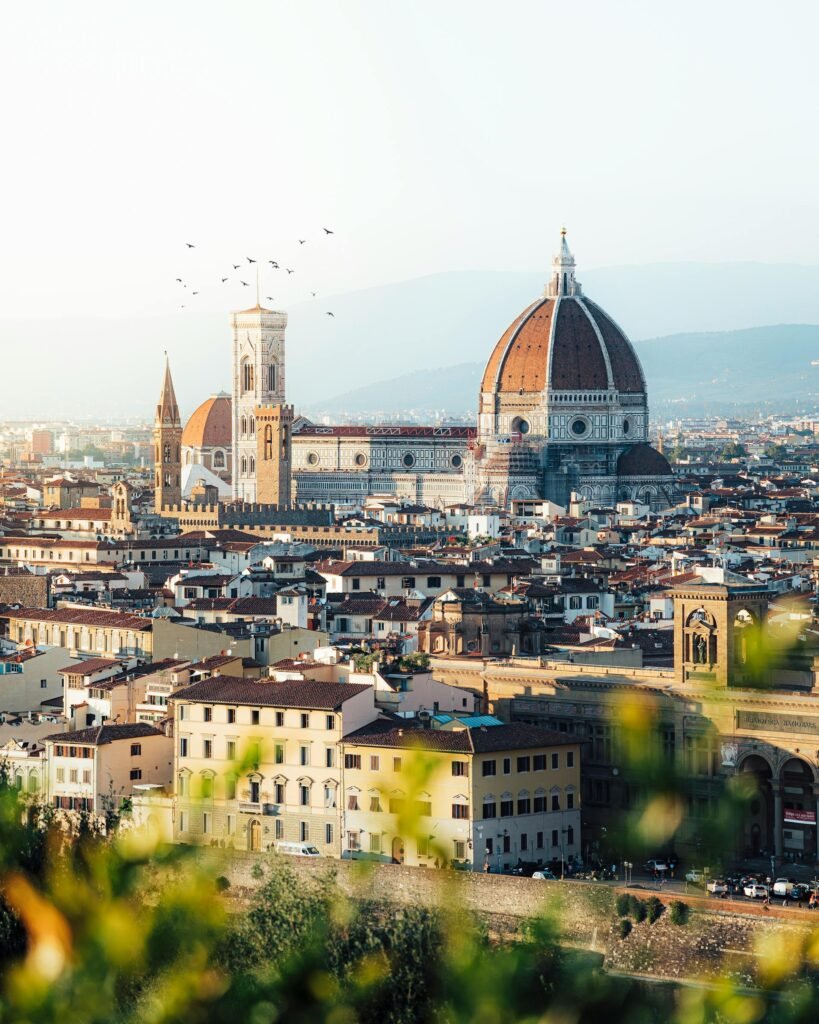
The Italian Renaissance (c. 1400–1600) was concentrated and substantially originated in Florence. Key moments: Filippo Brunelleschi’s competition-winning 1418 design for the Cathedral dome (completed 1436 — for nearly 400 years the world’s largest masonry dome and an engineering miracle); the development of linear perspective (Brunelleschi, formalized by Leon Battista Alberti); Donatello’s bronze David (1440s, the first freestanding nude bronze since antiquity); Botticelli’s Primavera (1480s); Michelangelo’s David (1501–1504, the city’s defining sculpture); the parallel humanist intellectual movement of Marsilio Ficino, Pico della Mirandola, Niccolò Machiavelli; and the scientific revolution beginning with Galileo Galilei (born in Pisa but Florence-based at the Medici court).
The Sack of Rome (1527) displaced many Roman artists and intellectuals to Florence; the Council of Trent (1545–1563) Counter-Reformation reshaped religious patronage; the Medici family was elevated to Grand Dukes of Tuscany in 1569 by the Holy Roman Emperor. The dynasty ruled Florence as the Grand Duchy until 1737, when the last Medici (Gian Gastone) died without heirs.
The 18th and 19th centuries brought Habsburg-Lorraine rule, the brief Napoleonic period, and ultimately Italian unification in 1861. Florence served as the capital of unified Italy from 1865 to 1871, before Rome was secured and the capital moved south. The city’s modern boundary expansion and many of the central piazzas date from this brief “capital” period.
Twentieth-century Florence suffered the 1944 destruction of all bridges by the retreating German army except the Ponte Vecchio (reportedly spared on Hitler’s personal order), and the catastrophic November 4, 1966 Arno flood that damaged thousands of artworks, archives, and books in the historic center. The post-1966 restoration mobilized international volunteers (“Mud Angels“) and produced new conservation techniques still used worldwide. UNESCO World Heritage inscription in 1982 for the historic center recognized the city’s exceptional concentration of cultural patrimony.
Geography, Climate & Best Time to Visit Florence
Geographic Setting
Florence sits in a relatively narrow Arno River valley in central Tuscany, framed by the Apennine foothills rising to the north (notably the Fiesole hills) and the rolling Chianti countryside to the south. The Arno River bisects the historic center east-west; the famous Ponte Vecchio medieval bridge is the city’s only surviving pre-WWII bridge. The geography produces hot humid summers (the valley traps heat) and cool wet winters; surrounding hill towns (Fiesole, Bellosguardo) are noticeably cooler.
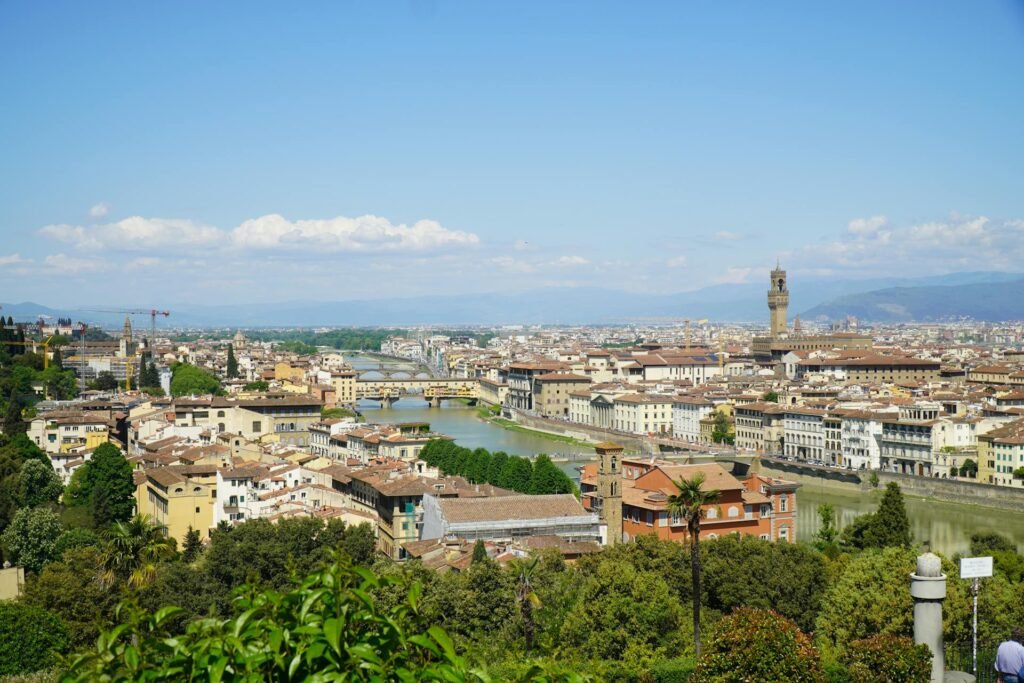
The compact UNESCO-listed historic center divides into two halves: the larger north of the Arno (Cathedral district, Piazza della Signoria, Uffizi, Santa Maria Novella) and the smaller south of the Arno (“Oltrarno” — Palazzo Pitti, Boboli Gardens, Santo Spirito, San Niccolò). Most major sights are within a 1.5 km walkable square.
Climate Overview
Florence has a humid subtropical climate with Mediterranean influence (Köppen Cfa). Summer (June–September): hot (highs 30–35 °C, occasional 38 °C+ heatwaves), humid, with occasional thunderstorms. Winter (December–February): cool to cold (highs 8–13 °C, lows 0–5 °C, occasional frost), often gray and wet; rare snow. Spring (March–May) and autumn (October–November) are the most pleasant — comfortable temperatures and lower crowds than summer peak.
Best Time to Visit
April–June and September–early November are the prime windows — pleasant temperatures, fewer crowds than peak summer, the wine harvest in September, and the Tuscan countryside at its most photogenic. July–August: very hot, very crowded, many family-run trattorias closed for staff vacation in August; book accommodation 6+ months ahead. November–March: cool, atmospheric, dramatically less crowded; perfect for cultural travelers willing to bring a jacket; hotel prices significantly lower. Italian Easter (varies, March–April): atmospheric religious processions; restaurants and shops adjust schedules around Easter Sunday. August 15 Ferragosto: many family-owned businesses closed for the national holiday.
Florence’s Districts & Neighborhoods
Piazza del Duomo & the Cathedral District
The geographic and symbolic center. The Duomo (Cattedrale di Santa Maria del Fiore) with Brunelleschi’s iconic red-tiled dome; the adjacent Giotto’s Campanile bell tower; the Battistero di San Giovanni (baptistery) with Ghiberti’s “Gates of Paradise” bronze doors; the Opera del Duomo Museum housing the original works. Densely walkable and intensely visited; the Duomo complex is the canonical first-day stop.
Piazza della Signoria & Uffizi
The political and civic center for 700 years. Piazza della Signoria with the imposing Palazzo Vecchio (the medieval town hall, still the city’s seat of government), the Loggia dei Lanzi (the open-air sculpture gallery with Cellini’s Perseus and Giambologna’s Rape of the Sabine Women), and the famous outdoor copy of Michelangelo’s David. The adjacent Galleria degli Uffizi houses the world’s most important Renaissance art collection.
Ponte Vecchio & the Arno Bridges
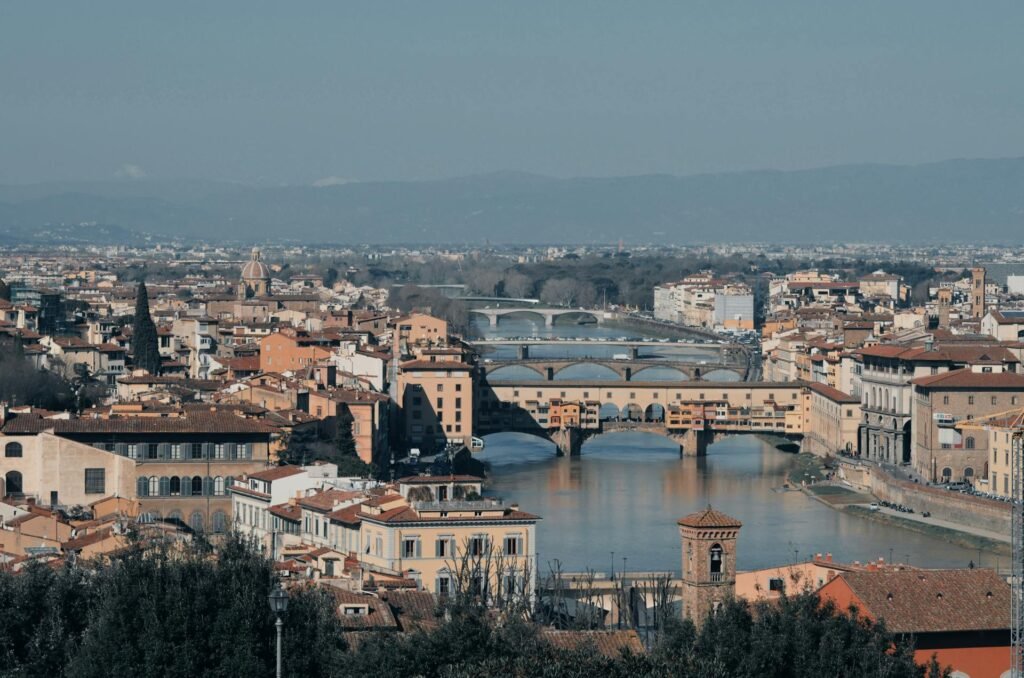
The 1345 medieval bridge — the only Florence bridge to survive WWII bombing — with its row of goldsmith shops on both sides. The Ponte Vecchio is the central pedestrian crossing connecting the north bank Uffizi area to the south bank Oltrarno. Best photographed from the adjacent Ponte Santa Trinita bridge at sunset or from the southern bank Lungarno.
Oltrarno (South Bank)
The “other side of the Arno” — quieter than the northern bank, with the city’s traditional artisan and craft workshops. The Palazzo Pitti (former Medici Grand Duke residence, now housing five major museums); the Boboli Gardens (the 16th-century formal Medici gardens, UNESCO 2013); Piazza Santo Spirito (the neighborhood square with weekend markets); the working artisan streets of Via Maggio and Borgo San Frediano. The trendier post-2010 dining scene clusters here.
Santa Croce
The eastern neighborhood around the Basilica di Santa Croce (the Franciscan church containing the tombs of Michelangelo, Galileo, Machiavelli, Rossini, and Foscolo). The surrounding streets contain the city’s best leather workshops (the famous Scuola del Cuoio leather school) and the historic Mercato di Sant’Ambrogio market.
San Lorenzo & Santa Maria Novella
The two adjacent northern neighborhoods. San Lorenzo: the Medici family church (with Michelangelo’s New Sacristy tombs), the historic central market (Mercato Centrale, the working-class food market with a renovated upper-floor food hall since 2014); the leather-and-souvenir market on the surrounding streets. Santa Maria Novella: the train station, the Dominican basilica (with Masaccio’s revolutionary Trinity fresco — the first true linear-perspective painting in art history, c. 1426).
Fiesole (Hill Town North of Florence)
The Etruscan-Roman hilltop town 8 km north of central Florence, 300 m above the city — the original Etruscan settlement before Florence’s founding. The famous panoramic view over Florence from the Piazza Mino; the surviving Roman amphitheater; multiple Renaissance-era villas. A half-day side trip from central Florence via Bus 7.
Top Things to Do in Florence
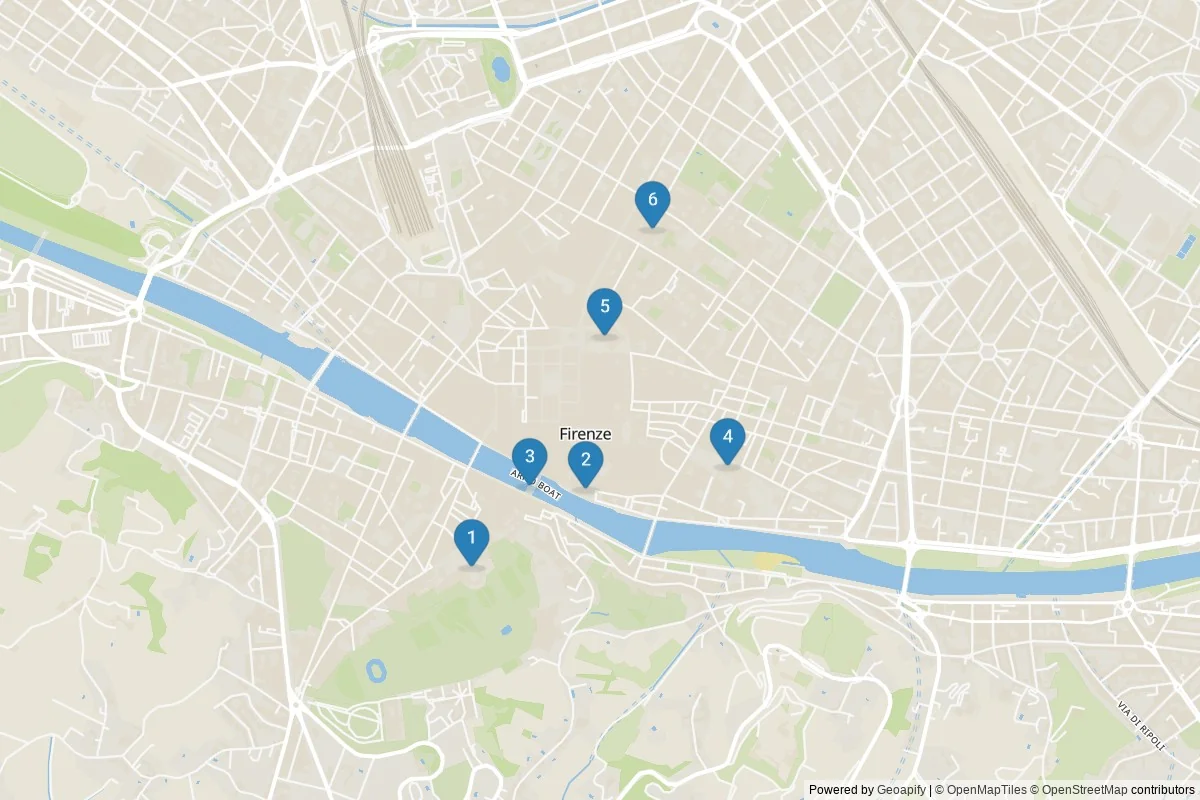
| # | Sight | Cluster | Type | Time | Entry | Best |
|---|---|---|---|---|---|---|
| 1 | Palazzo Pitti & Boboli Gardens | Central | Palace & gardens | ~3 hrs | €22 | Afternoon |
| 2 | Uffizi Gallery | Central | Art museum | ~3 hrs | €25 | Morning |
| 3 | Ponte Vecchio | Central | Historic bridge | ~30 min | Free | Sunset |
| 4 | Basilica of Santa Croce | Central | Basilica | ~1 hr | €8 | Morning |
| 5 | Duomo (Santa Maria del Fiore) | Central | Cathedral | ~2 hrs | €30 | Morning |
| 6 | Accademia Gallery (David) | Central | Art museum | ~1.5 hrs | €16 | Morning |
| 🚗 | Day Trip: Pisa | Day trip | Day trip | Full day | €20 | Morning |
| 🚗 | Tuscany Wine Country (Chianti) | Day trip | Day trip | Full day | €50–100 | Afternoon |
1. Climb the Duomo
Brunelleschi’s 1418–1436 dome remains an engineering marvel — built without internal scaffolding using a herringbone brick pattern that supported its own weight as it rose. The 463-step climb to the upper viewing terrace is the canonical Florence experience — Fresco of the Last Judgment by Vasari and Zuccari visible up close, dramatic views over the city from the top. Advance booking essential via the official Florence Cathedral website; book 2–4 weeks ahead; €30 combined ticket including Duomo, Baptistery, Campanile, and Museum. Plan 90 minutes for the climb itself, 4 hours for the full complex.
2. Uffizi Gallery
The world’s most concentrated Renaissance art collection. Highlights include Botticelli’s Birth of Venus and Primavera, Leonardo’s Annunciation, Caravaggio’s Medusa and Bacchus, Raphael’s Madonna del Cardellino, Michelangelo’s Doni Tondo, the largest Cimabue collection, and the iconic Botticelli room. Reservations strongly recommended via the official Uffizi portal; €25 standard plus €4 reservation fee; book 4–6 weeks ahead in summer. Plan 3–5 hours minimum; the museum is genuinely large.
3. See Michelangelo’s David
The 5.17-meter Carrara marble sculpture, completed 1504, displayed in the purpose-built tribune at the Galleria dell’Accademia. Carved from a single damaged block of marble that had been languishing for 25 years before Michelangelo (then 26 years old) accepted the commission. The companion gallery contains Michelangelo’s unfinished Slaves/Prisoners series — fascinating sculptures showing figures emerging from the rough stone. €16; advance booking essential (€4 reservation fee). Plan 90 minutes.
4. Walk Across Ponte Vecchio
The 1345 medieval bridge with its row of goldsmith and jewelry shops on both sides — the only Florence bridge to survive WWII. The upper-floor Corridoio Vasariano (Vasari Corridor) was built 1565 to allow the Medici to walk from Palazzo Vecchio to Palazzo Pitti without mixing with the public; partially open to the public via guided tours from late 2024 after major restoration. The bridge is genuinely beautiful at sunset; best photographed from the adjacent Ponte Santa Trinita.
5. Explore Palazzo Pitti & Boboli Gardens
The Medici Grand Duke residence — converted in the 17th century by Cosimo I de’ Medici from a smaller 15th-century banker’s palace. The complex houses five museums: Palatine Gallery (Renaissance and Baroque paintings); Royal Apartments; Modern Art Gallery; Costume Gallery; and the Treasury of the Grand Dukes. The adjacent Boboli Gardens (UNESCO 2013) is a 45,000 m² Renaissance Italian garden — the prototype of European formal-garden design. Combined ticket €22; plan a half-day.
6. Basilica of Santa Croce
The Franciscan church on Piazza Santa Croce — the burial place of Michelangelo, Galileo Galilei, Niccolò Machiavelli, Gioacchino Rossini, and many other Italian luminaries. The interior contains spectacular Giotto frescoes (Peruzzi and Bardi Chapels), Donatello sculptures, Brunelleschi’s Pazzi Chapel, and the famous Cimabue Crucifix (which suffered severe damage in the 1966 flood and has become an iconic symbol of cultural-heritage conservation). Entry €8; allow 2 hours.
7. Day Trip to Pisa
The famous Leaning Tower of Pisa is 75 minutes from Florence by train (€9 each way). The Piazza dei Miracoli contains the Tower, the Cathedral, the Baptistery, and the Camposanto Monumental cemetery — UNESCO since 1987. Most travelers spend a half-day in Pisa, often combined with a half-day in Lucca (the perfectly preserved Renaissance walled city 30 minutes from Pisa). Plan a full day round-trip from Florence.
8. Tuscany Wine Country Day Trip
The Chianti Classico region begins 20 km south of Florence — rolling vineyards, cypress-lined drives, hilltop villages (Greve in Chianti, Castellina, Radda, Panzano). Organized day tours (€80–180 per person) include 2–3 winery visits with tastings, lunch, and a country drive. Self-drive is the most flexible option. Combine with a visit to San Gimignano (the medieval “Manhattan of Tuscany” with 14 surviving tower-houses) and/or Siena (the medieval Gothic-cathedral rival city, 90 minutes south). For wine connoisseurs, the broader Brunello di Montalcino region (2 hours south) is the Italian wine pinnacle.
How to Get to Florence
By Air
Florence Peretola Airport (FLR), 7 km northwest of the historic center, is small but useful. Direct nonstop flights from many European cities (Paris, Amsterdam, Frankfurt, Munich, Vienna, Madrid, Barcelona, Brussels, Geneva, Copenhagen, London City, Manchester) but limited long-haul. Larger options: Pisa Airport (PSA) 85 km west (more low-cost carriers including Ryanair); Bologna Airport (BLQ) 100 km north (better long-haul). The 2024 expansion of Florence airport will add more long-haul routes.
From the airports: Florence Peretola tram €1.70 (20 minutes to central Florence); Pisa Airport PisaMover + Trenitalia €13.30 (75 minutes to Florence SMN); Bologna Airport bus + train ~90 minutes; taxi from Florence Peretola €25–30 fixed; private transfer €60–100.
By Train
Italy’s excellent high-speed rail network. Florence Santa Maria Novella (SMN) station is in the historic center. Rome-Florence: 90 min on Frecciarossa (€25–80). Milan-Florence: 1h45min (€30–90). Venice-Florence: 2h (€25–70). Naples-Florence: 3h (€40–110). Tickets via Trenitalia or Italo (the private competitor); advance booking discounts.
By Long-Distance Bus
FlixBus connects Florence to most major European cities. Cheaper than trains for budget travelers but slower.
By Car
Modern motorways connect Florence to all major Italian cities — A1 to Rome and Milan, A11 to Pisa, A14 to Bologna and the Adriatic coast. Important: Florence’s ZTL (Zona a Traffico Limitato) restricts vehicle access to the historic center — €100+ fines for unauthorized entry; most hotels can register your license plate; otherwise park at peripheral lots and walk in.
Visa Notes
Florence is in Italy, a Schengen Area member. EU/EEA/Swiss citizens: no documentation. Citizens of 60+ visa-free countries: 90 days within any 180-day Schengen window. ETIAS launches in late 2025. Other nationalities apply for Schengen visa at Italian embassies. Passport must have 6+ months remaining validity.
Getting Around Florence
Walking
The defining Florence transit mode — the entire historic UNESCO-listed center is genuinely walkable (1.5 km × 1.5 km core). Most major sights are within 15 minutes walk of each other. Comfortable closed-toe shoes essential; the historic stone streets are unforgiving.
Buses (ATAF)
The ATAF city bus network covers neighborhoods beyond the walking zone. Single ticket €1.70 (valid 90 minutes); 24-hour pass €5. The tramway T1 and T2 connect Florence Peretola Airport to central Florence — the most useful single transit line for visitors.
Bicycle Rentals
Florence is relatively bike-friendly with dedicated cycle paths along the Arno; rentals €15–25/day from multiple central shops. The flat valley terrain makes cycling practical.
Taxis & Ride-Hailing
Florence taxis are white with the city seal. Uber is restricted in Italy (only Uber Black operates legally; standard Uber is not available). FreeNow app works for licensed taxis. Standard fares: €4 flagfall + €1.80/km. Important: from Florence Airport €25 fixed tariff to central historic center.
Self-Drive Cars
Avoid driving within the Florence historic center (the ZTL fines are punitive); useful only for surrounding Tuscany day trips. Rental cars from major brands at the airport and SMN station; €40–100/day depending on category.
Food & Drink in Florence
Tuscan cuisine is the most influential of Italian regional culinary traditions — refined, rustic, ingredient-focused, and shaped by the broader Tuscan rural tradition of cucina povera (poor cuisine: making elegant dishes from humble ingredients).
What to Try
- Bistecca alla Fiorentina — the city’s defining dish: a 1+ kg T-bone steak from local Chianina cattle, grilled rare over wood embers, served unsalted (salt applied at table). Traditionally for sharing 2+ persons. Trattoria Mario, Trattoria Sostanza, Cibreo, Buca dell’Orafo are canonical.
- Ribollita — Tuscan bread-and-bean soup with cavolo nero kale; the rustic winter staple.
- Pappa al Pomodoro — Tuscan tomato-bread soup; summer comfort food.
- Tagliatelle al Cinghiale — wild boar ragù pasta; the iconic Tuscan game dish.
- Crostini Toscani — chicken-liver pâté on toasted bread; the universal Tuscan appetizer.
- Pappardelle alle Lepre — wide pasta with hare ragù.
- Lampredotto — slow-braised tripe sandwich (the Florentine working-class lunch); served at street stalls (lampredottai) like L’Antico Trippaio at the central market.
- Schiacciata fiorentina — focaccia-style flatbread, eaten plain or with cured meats.
- Pecorino di Pienza — Tuscan sheep’s-milk cheese; the regional pride.
- Cantuccini and Vin Santo — almond biscotti dipped in sweet dessert wine; the classic Tuscan after-dinner pairing.
- Gelato — Florence is one of the world’s gelato capitals; Vivoli, Gelateria dei Neri, La Carraia, Perchè No! are canonical.
- Chianti Classico — the regional red wine (Sangiovese-dominant); look for the Gallo Nero (Black Rooster) seal certifying DOCG quality.
Where to Eat
Trattoria Mario (San Lorenzo): canonical bistecca, lunch only, cash only, queue. Trattoria Sostanza (“Il Troia”): the legendary bistecca and butter chicken since 1869. Cibreo: refined modern Tuscan in three sister venues. Buca dell’Orafo: traditional Florentine since 1932. Il Latini: communal-table Tuscan abundance. Trattoria 4 Leoni (Oltrarno): Florentine classics. Cammillo: traditional. Mercato Centrale (San Lorenzo): the food hall upper floor serves everything from pizza to seafood. L’Antico Trippaio: lampredotto street sandwich. Procacci: white truffle panini bar. Vivoli: gelato. Enoteca Pinchiorri: 3-Michelin-star contemporary Tuscan fine-dining (€350+ per person).
Drinks
Chianti Classico: the regional Sangiovese-based red. Brunello di Montalcino: the more concentrated southern Tuscan version. Vino Nobile di Montepulciano: the third major Tuscan red. Vermentino: the Tuscan-Ligurian coastal white. Vin Santo: the sweet dessert wine. Negroni: invented in Florence in 1919 by Count Camillo Negroni; the iconic Italian cocktail. Caffè: Italian espresso culture is universally excellent in Florence — order at the bar (banco) for cheaper prices than table service. Aperol Spritz and Negroni Sbagliato: the universal Italian aperitif drinks. Limoncello: digestif from Sorrento, widely served after meals.
A Note on Tap Water
Tap water in Florence is completely safe to drink and meets all EU standards. Most restaurants serve free tap water (acqua del rubinetto) on request — though Italian restaurants more commonly serve bottled water (still naturale or sparkling frizzante) for €2–5. Public drinking fountains (fontanelle) operate throughout central Florence with safe potable water. The CDC traveler health page for Italy rates Italy as low-risk. The bigger summer health risk is heat exhaustion — drink 3+ liters daily during July-August.
Frequently Asked Questions About Visiting Florence
Do I need a visa to visit Florence?
Schengen rules. EU/EEA/Swiss citizens: national ID. Visa-free citizens of 60+ countries (US, UK, Canada, Australia, Japan, South Korea, Singapore, Brazil, Argentina, etc.): 90 days within any 180-day Schengen window. ETIAS launches late 2025 — €7. Other nationalities: Schengen visa at Italian embassies (€90). Passport 6+ months remaining validity. Verify with the Italian Visa portal.
Is Florence safe for tourists?
Florence is among Europe’s safest tourist cities. US State Department rates Italy at “exercise normal precautions.” Real risks: pickpocketing in tourist crowds (Duomo, Uffizi queue, Ponte Vecchio, Piazza della Signoria) and on Bus 7 to Fiesole; scams at the train station (fake “porters” demanding fees, fake taxis); summer heat July–August (35 °C+); traffic and motorbike-only zones in the historic center; ZTL fines for unauthorized vehicle entry to historic center; fake Renaissance art and forged “antiques” at street stalls; flash flooding in narrow streets during sudden summer storms. Drug enforcement: Italian penalties moderate for personal use, harsh for trafficking. LGBTQ+ travelers: Italy is broadly welcoming; civil unions legal; Florence has an active gay community.
How many days do I need in Florence?
Three to four days handles Florence well; with Pisa, Lucca, San Gimignano, Siena, and Chianti day trips, 5–7 days makes a satisfying Tuscan trip. A solid 4-day Florence plan: Day 1 — Duomo + Baptistery + Campanile climb + lunch at Trattoria Mario (San Lorenzo) + Mercato Centrale + Bistecca dinner. Day 2 — Uffizi morning (book 6+ weeks ahead) + lunch in Oltrarno + Palazzo Pitti + Boboli Gardens + Ponte Vecchio sunset + Santa Croce church. Day 3 — Galleria dell’Accademia (David) + San Lorenzo Medici Chapel + Bargello sculpture museum + lunch + Fiesole afternoon for panorama. Day 4 — Chianti or Pisa day trip + farewell dinner. Add Day 5 for San Gimignano + Siena. Add Day 6–7 for Cinque Terre or Lucca + Pisa overnight. 10-day Italy classic: 4 days Florence + 3 days Rome + 2 days Venice + 1 day Pompeii.
What’s the best area to stay in Florence?
The compact historic center is the obvious choice. Centro Storico / near Duomo: boutique hotels in restored palaces; Brunelleschi Hotel, Hotel Cellai, Helvetia & Bristol, Antica Torre Tornabuoni 1; €150–700/night. Oltrarno (south of Arno): quieter, artisan neighborhood; Hotel Lungarno (with Arno views), Riva Lofts, Palazzo Belfiore; €180–500/night. Santa Maria Novella: near train station; useful for transit; The Westin Excelsior, Grand Hotel Minerva; €200–600/night. Santa Croce: leather district, quieter than Duomo; Hotel Plaza Lucchesi; €140–350/night. San Niccolò (eastern Oltrarno): residential neighborhood with views to Piazzale Michelangelo; €130–400/night. Luxury heritage hotels: Four Seasons Hotel Firenze (the country’s only Four Seasons in a converted Renaissance palace), Belmond Villa San Michele (Fiesole hilltop former monastery); €800–4,000+/night. Skip: budget hotels near the train station with no neighborhood character.
How much does it cost to visit Florence’s major sights?
Florence’s headline attractions require advance booking and are moderately priced. Duomo complex combined ticket (Duomo, Baptistery, Campanile, Crypt, Museum): €30; reservation €4. Climbing the Cupola: included in above. Uffizi Gallery: €25 + €4 reservation. Galleria dell’Accademia (David): €16 + €4 reservation. Palazzo Pitti combined ticket (5 museums + Boboli): €22. Boboli Gardens only: €11. Santa Croce: €8. Palazzo Vecchio: €17 (museum); €25 combined with tower climb. Bargello: €11. Santa Maria Novella: €7.50. San Lorenzo Medici Chapels: €11. Boboli + Bardini Gardens: €18. Florence Card: €100 for 3-day pass covering 70+ museums (worth it if visiting 4+ major museums). Local meals: panino al lampredotto €5; sit-down lunch €15–30 per person; mid-range dinner €25–55 per person; bistecca alla fiorentina €50–80 per kilo (typically 1+ kg for 2 to share); fine-dining €120–400+ per person. Tuscany wine tasting day tour: €80–180 per person. Train to Pisa: €9 each way. Train to Siena: €11 each way. Overall daily budget: €80 (frugal hostel + walking + free churches), €220 (mid-range + restaurants + 2 museums), €700+ (luxury hotel + fine dining).
Should I drink the tap water in Florence?
Yes — Florence’s tap water is completely safe to drink and meets all EU standards. The supply comes from protected Apennine mountain catchments. Many restaurants serve free tap water (acqua del rubinetto) on request, though bottled water (still or sparkling) is the more common Italian default at €2–5 per bottle. Public drinking fountains (fontanelle) operate throughout the historic center. The CDC traveler health page for Italy rates Italy as low-risk; standard hygiene precautions apply. Heat-related health: summer 35 °C+ days require 3+ liters of water; the surrounding Tuscan countryside has even less shade.
What payment methods work in Florence — credit cards or cash?
Italy is moving toward cards and contactless. Credit cards (Visa, Mastercard, AmEx, JCB): accepted at hotels, mid-range and upmarket restaurants, museums, ticket booths, supermarkets, and most retail in the historic center; contactless universal. Cash (Euros): still expected at some small trattorias, street-food spots (lampredotto stalls), tips, market stalls, and many gelaterie. ATMs: abundant (Intesa Sanpaolo, UniCredit, Banco BPM, Banca Sella) accept foreign cards with daily limits €600–1,000 and modest fees. Currency exchange: airport and city counters reasonable; banks offer comparable rates; bring USD/GBP if needed. Digital wallets: Apple Pay, Google Pay, Samsung Pay all work. Tips: not strongly ingrained — Italian restaurants usually include service (“servizio“) in the bill; check before adding additional tip; round up the bill or leave €1–5 per person for good service; €1 per drink at bars (or just round up); €1–2 per bag to hotel porters; €1–3 per night for housekeeping; €10–30 per day for tour guides. “Coperto” charge (cover charge for bread and seat): €1–4 per person at sit-down restaurants — standard practice, not a scam. VAT: 22% standard rate (10% for restaurants and accommodation); included in displayed prices. Non-EU tourists can claim VAT refunds at the airport for purchases over €70 from a single retailer in the same day. Italian restaurant hours: lunch 12:30–14:30 and dinner from 19:30; kitchens close 22:30 typically; many restaurants close one full day per week (often Sunday or Monday).
What about the Renaissance art viewing — how do I avoid lines and what should I prioritize?
The Florence art experience is one of the great cultural pilgrimages, and crowd management is a real consideration. Advance booking strategy: book Uffizi 4–6 weeks ahead via the official portal (or via Florence Card); same for Galleria dell’Accademia (David) and Duomo complex; skip-the-line tickets from third-party operators cost €5–10 more than direct booking. Visit early in the morning: museums open 8:15–9:00; arrival 15 min before opening puts you at the front of the queue. Tuesdays are good: many state museums are closed Mondays, redirecting traffic to other days. Florence Card (€100, 3 days): includes 70+ museums plus skip-the-line privileges; mathematically worth it if visiting Uffizi + Accademia + Pitti + Duomo. Priority list for first-time visitors: 1. Duomo complex (book climbing reservation); 2. Uffizi (book 4+ weeks ahead); 3. Galleria dell’Accademia (David, book 2+ weeks ahead); 4. Palazzo Pitti + Boboli Gardens; 5. Bargello sculpture museum (smaller crowds, exceptional Donatello collection); 6. Santa Maria Novella basilica (Masaccio’s Trinity); 7. Medici Chapels (Michelangelo’s New Sacristy); 8. Palazzo Vecchio (Vasari’s frescoes); 9. Santa Croce (artist tombs); 10. Brancacci Chapel (Masaccio frescoes — smaller crowds). Don’t try to see everything in one trip: 3 days handles the top 5 with quality time; longer visits add depth. Pro tip: many smaller museums (Bargello, Brancacci Chapel, Santa Maria Novella, Palazzo Davanzati) are less crowded than the headline three and often more rewarding for connoisseurs. The Vasari Corridor reopened partially after 2024 restoration — guided tours through the elevated covered walkway from Palazzo Vecchio to Palazzo Pitti are now bookable; €45 with advance reservation. Free museum days: first Sunday of each month from October to March — extremely crowded; consider paying full price during the rest of the year.
Education & Notable People
Florence is anchored by the University of Florence and hosts several international academic and cultural institutions.
Major Universities
- Università degli Studi di Firenze — founded 1321, predecessor of the modern University of Florence; ~50,000 students; strong programs in art history, architecture, and humanities.
- European University Institute (EUI) — Fiesole-based; the EU’s research university for political science, economics, history, and law.
- Polimoda Institute of Fashion Design and Marketing — leading fashion school.
- Conservatorio Luigi Cherubini — historic conservatory.
- Many American university satellite programs: NYU Florence, Syracuse Florence, SAIS, Stanford, Sarah Lawrence, Smith.
Notable People
Cosimo de’ Medici “il Vecchio” (1389–1464) — banker and de-facto ruler of Florence. Lorenzo “il Magnifico” (1449–1492) — Renaissance Florence’s defining patron. Michelangelo Buonarroti (1475–1564) — painter, sculptor, architect, poet; spent significant parts of his career in Florence (David, the New Sacristy tombs). Leonardo da Vinci (1452–1519) — born in Vinci near Florence; trained in Verrocchio’s Florence workshop. Sandro Botticelli (1445–1510) — Renaissance painter; the Birth of Venus and Primavera. Niccolò Machiavelli (1469–1527) — political philosopher; The Prince. Dante Alighieri (1265–1321) — author of The Divine Comedy; exiled from Florence in 1302. Giovanni Boccaccio (1313–1375) — author of The Decameron. Galileo Galilei (1564–1642) — Pisan-born scientist who spent his final decades in Florence under Medici patronage. Gioacchino Rossini — celebrated 19th-century composer (buried in Santa Croce). Filippo Brunelleschi — the Renaissance architect who solved the Duomo dome problem. Donatello, Ghiberti, Masaccio — all major Florentine Renaissance artists. Salvatore Ferragamo and Guccio Gucci — 20th-century fashion designers, both Florence-based (the Ferragamo museum is on Piazza Santa Trinita; Gucci was born in Florence in 1881).
Sister Cities & International Relations
Florence’s sister-city network reflects the city’s identity as a UNESCO heritage capital.
Florence’s sister and partnership cities include (selection):
- Kyoto, Japan — paired since 1965; both former imperial capitals with concentrated cultural heritage.
- Edinburgh, Scotland, UK — paired since 1964.
- Reims, France — friendship city.
- Dresden, Germany — paired since 1978; both cities damaged by WWII bombing.
- Philadelphia, Pennsylvania, USA — paired since 1964.
- Boston, Massachusetts, USA — friendship link.
- Cape Town, South Africa — partnership city.
- Nanjing, China — paired since 1980.
- Damascus, Syria — paired since 1957.
- Sidi Bel Abbès, Algeria — friendship city.
Florence hosts the European University Institute at Fiesole — the EU’s flagship research university for political science, economics, and law, with a sprawling campus in the historic Badia Fiesolana. The UNESCO Office in Italy coordinates regional heritage protection from Florence. The Visit Florence tourism portal coordinates the city’s international promotion.
AFRIKA
Cairo Hurghada Johannesburg Marrakech
ASIA
Abu Dhabi Agra Antalya Bangkok Batam Beijing Bengaluru Cebu City Chiang Mai Chiba Chennai Da Nang Dammam Delhi Denpasar Dubai Fukuoka Guangzhou Guilin Ha Long Hanoi Ho Chi Minh City Jakarta Jaipur Johor Bahru Kolkata Krabi Kuala Lumpur Kyoto Macau Mecca Medina Mugla Mumbai Osaka Pattaya Penang Phuket Riyadh Seoul Shanghai Shenzhen Singapore Taipei Tokyo Zhuhai
EUROPE
Amsterdam Athens Barcelona Berlin Brussels Budapest Copenhagen Dublin Florence Frankfurt am Main Heraklion Krakow Lisbon London Madrid Milan Munich Nice Paris Porto Prague Rhodes Rome Stockholm Venice Vienna Warsaw
NORTH AMERICA
Cancun Las Vegas Los Angeles Miami New York City Orlando San Francisco Toronto Vancouver
SOUTH AMERICA
Buenos Aires Lima Rio De Janeiro
OCEANIA
Auckland Honolulu Melbourne Sydney