
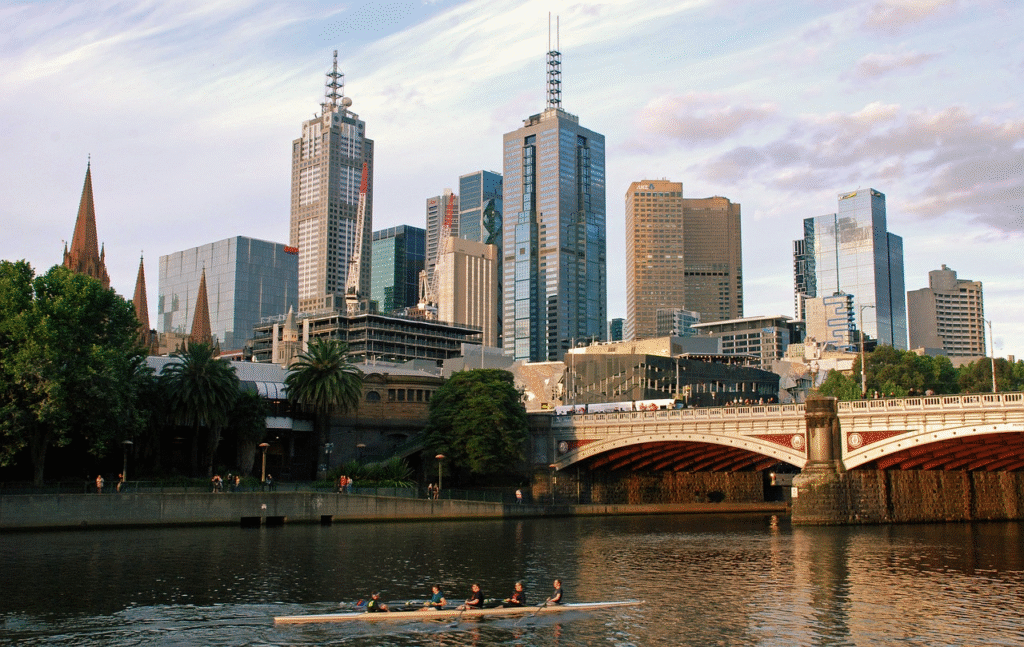
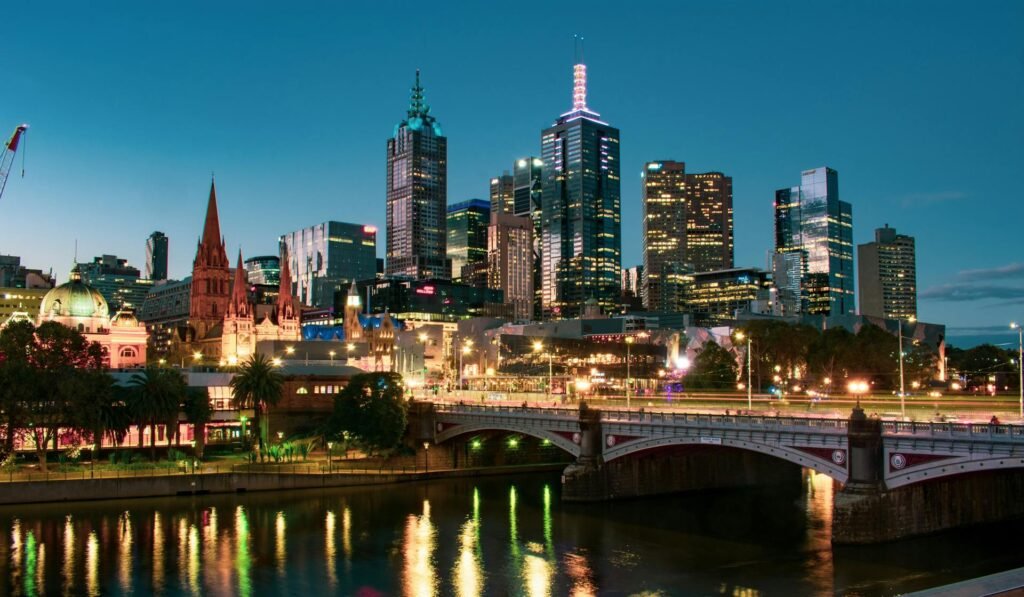
Photo credit: Melbourne skyline and the Yarra River
Melbourne is the second-largest city in Australia, the capital of Victoria state, and an institution: voted “Most Livable City in the World” seven times by The Economist (2011–2017) for reasons that locals understand as obvious — a comprehensive tram network, world-class coffee, multicultural dining, the country’s most celebrated arts and sports calendar, and a layered urban character that combines Victorian-era heritage with mid-century European immigration and contemporary Asian-Australian creative energy. Founded in 1835 on the traditional lands of the Wurundjeri people of the Kulin Nation, Melbourne grew dramatically during the 1850s gold rush when discoveries 100 kilometers north made the city briefly one of the richest in the world. The Victorian-era grand civic architecture — Flinders Street Station, the Royal Exhibition Building (UNESCO 2004), the State Library — survives substantially intact. Modern Melbourne layers on top: the laneway street-art alleys (Hosier Lane, AC/DC Lane), the broader Italian, Greek, Vietnamese, Lebanese, Ethiopian, and Indian dining traditions, the MCG (Melbourne Cricket Ground) as a global sporting cathedral, and the surrounding day-trip destinations of the Great Ocean Road, Yarra Valley wineries, and Phillip Island.
Melbourne by District: The 14 Suburbs
Melbourne is divided into 14 inner suburbs. The map below shows their official OSM boundaries, colour-coded to match the table — a quick way to orient yourself before zooming in on individual sights.
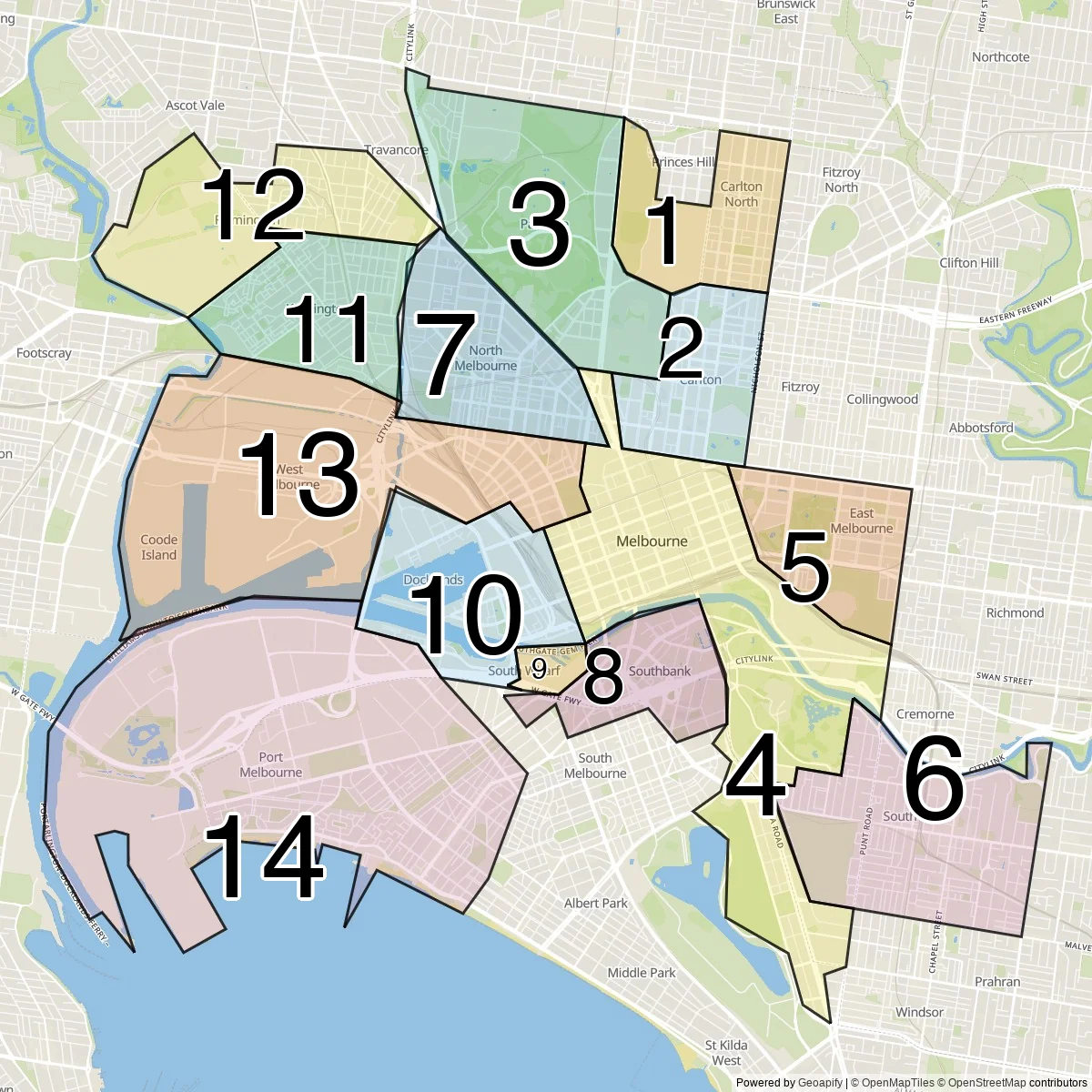
| # | Suburbs |
|---|---|
| 1 | Carlton North |
| 2 | Carlton |
| 3 | Parkville |
| 4 | Melbourne |
| 5 | East Melbourne |
| 6 | South Yarra |
| 7 | North Melbourne |
| 8 | Southbank |
| 9 | South Wharf |
| 10 | Docklands |
| 11 | Kensington |
| 12 | Flemington |
| 13 | West Melbourne |
| 14 | Port Melbourne |
Melbourne at a Glance: Essential Facts for Travelers
| Location | Victoria state, southeastern Australia (Port Phillip Bay) |
|---|---|
| Coordinates | 37.8136°S, 144.9631°E |
| Population | ~5.21 million (metro, 2024); city of Melbourne (CBD) ~177,000 |
| Area | 9,993 km² (Greater Melbourne metro) |
| Elevation | Sea level to ~600 m (Dandenong Ranges east of city) |
| Time Zone | Australian Eastern Standard Time (AEST, UTC+10) / Daylight Saving Time AEDT (UTC+11, October–April) |
| Calling Code | +61 (city code 03) |
| Currency | Australian Dollar (AUD $) |
| Languages | English (official); significant Greek, Italian, Mandarin, Vietnamese, Arabic communities; Wurundjeri Aboriginal language recognition increasing |
| Climate | Temperate oceanic — mild summers, cool winters; famously variable (“four seasons in one day”) |
| Founded | 1835 (on the traditional lands of the Wurundjeri/Kulin Nation); state capital since 1851 |
| Famous For | MCG sports cricket-and-football, coffee culture, laneway street art, Royal Exhibition Building (UNESCO 2004), gateway to Great Ocean Road, Melbourne Cup, Australian Open tennis |
Upcoming Events in Melbourne
| Date | Title | Details |
|---|---|---|
| 2026-09-04 to 2027-01-31 | Margaret Preston: A Retrospective at NGV Australia | The Ian Potter Centre at Federation Square stages a major retrospective of Margaret Preston, one of Australia’s most influential modernists, celebrated for her bold woodblock prints and still lifes and her pioneering engagement with Australian flora and design. The exhibition traces her career across painting, printmaking and decorative arts, gathering works from collections around the country. It runs until the end of January 2027, with tickets required, and pairs naturally with the free Australian collection galleries in the same landmark building on the Yarra. [Source] |
| 2026-10-01 to 2026-10-19 | Melbourne Fringe Festival | The Melbourne Fringe Festival transforms the city each October with hundreds of bold, independent performances across theatre, comedy, cabaret, dance, visual art and experimental work. Staged in venues from grand theatres to tiny bars and unexpected spaces, the open-access festival champions emerging and adventurous artists, offering some of the most original programming of the year. Many shows are affordable, and the atmosphere is playful and inclusive. It is a celebration of creativity and one of Australia’s leading independent arts festivals. [Source] |
| 2026-10-10 to 2026-10-31 | Spring Racing Carnival | Melbourne’s Spring Racing Carnival gallops into action through October, building toward the famous Melbourne Cup in early November. Marquee October meetings include the Caulfield Cup and the Cox Plate at Moonee Valley, drawing top thoroughbreds, big crowds and a sea of fashion. Racegoers dress up for a day of betting, hospitality and spectacle at Melbourne’s historic tracks, where sport meets social occasion. Ticket prices vary by meeting and enclosure. It is a defining feature of the city’s spring calendar. [Source] |
| 2026-10-16 to 2026-10-25 | Melbourne International Jazz Festival 2026 | The Melbourne International Jazz Festival returns with ten days of jazz, improvisation and boundary-pushing contemporary music in venues across the city, from concert halls and jazz clubs to free outdoor stages. The citywide programme typically features international headliners alongside Australia’s finest improvisers, late-night jam sessions and family-friendly events. Ticket prices vary by concert, with a substantial free programme woven through the festival. It is a highlight of Melbourne’s packed October cultural calendar, drawing audiences from across the country and filling the city’s music rooms night after night. [Source] |
| 2026-10-17 to 2026-10-18 | Italian Festa and Expo at the Royal Exhibition Building | The Royal Exhibition Building hosts the Italian Festa and Expo, a free weekend celebration of Italian culture in the heart of Carlton, Melbourne’s historic Italian quarter. Expect food stalls and cooking demonstrations, wine and produce exhibitors, live music and dancing, cultural displays and activities for children, all under the dome of the UNESCO World Heritage-listed venue. The festa draws Italian-Australian families and food lovers alike, and nearby Lygon Street restaurants make it easy to extend the celebration. Entry is free, with food and drink purchases on site. [Source] |
City News in Melbourne – last 14 days
| Date | Category | Headline | Details |
|---|---|---|---|
| 2026-10-09 | Sports | South Melbourne meet Melbourne Victory in Australia Cup final | The 2026 Hahn Australia Cup Final brings together two Melbourne clubs, South Melbourne and Melbourne Victory. An official match preview has been published ahead of the decider between the two sides. For football fans in the city, the final offers a local showdown with the cup title at stake. The preview snippet does not state the kick-off time, the venue or the expected line-ups, nor does it say whether tickets are still available. [Source] |
| 2026-10-09 | Business | Converted cottage in Melbourne’s CBD ranked among world’s best bars | A bar housed in a converted cottage in Melbourne’s central business district has been ranked among the best bars in the world. The recognition highlights a venue in an unusual setting for a bar, a former cottage in the heart of the city. The brief report does not name the bar, the ranking in which it appears or its exact position on the list, but it points visitors to a notable drinking spot in the city centre. [Source] |
| 2026-10-09 | Local affairs | Melbourne Assembly forum to give participants a say on city’s future | Participants at the upcoming Melbourne Assembly forum will have the opportunity to raise issues that could help shape the future of the city. The organisers argue that journalists do not have a monopoly on asking the right questions and describe this as an underrated skill. The forum is therefore designed to let people outside the newsroom contribute their own questions on matters affecting Melbourne. The summary does not mention the date or venue of the event. [Source] |
| 2026-10-09 | Culture | Refurbished Melbourne theatre reopens ‘for the next generation’ | A theatre in Melbourne has reopened following a refurbishment, with the renovated venue presented as ready for the next generation. The brief snippet does not name the theatre, the architects involved, the scope of the refurbishment or the cost of the works. It also gives no information on the programme planned for the reopened venue. For theatregoers and visitors, the reopening adds a refreshed venue to the city’s cultural life. [Source] |
| 2026-10-09 | Business | Adore Beauty opens largest flagship store at Melbourne Central | The beauty retailer Adore Beauty has opened its biggest flagship store to date at Melbourne Central. The new outlet is the largest of the company’s flagship locations so far. The brief report does not provide details on the store’s floor space, the product range, opening hours or the number of staff employed there. For shoppers in the city centre, the opening adds another destination for beauty products. [Source] |
| 2026-10-09 | Culture | Australian Open on-court looks to debut at Melbourne Fashion Week | Outfits designed for the court at the Australian Open are set to make their debut on the runway at Melbourne Fashion Week. The presentation brings together two of the city’s major events, tennis and fashion, on one stage. The brief report does not reveal which brands or designers are involved, which players will wear the outfits on court or when exactly the show takes place during the fashion week. [Source] |
Melbourne Events & City News Archive
Sources: National Gallery of Victoria, Melbourne Fringe, Racing.com, Melbourne International Jazz Festival, What's On Melbourne, Google News Melbourne, Google News Melbourne, The Age
Weather Forecast for the Next 14 Days in Melbourne
| Date | Weather | Max °F | Min °F | Rain mm |
|---|---|---|---|---|
| 2026-10-10 | 🌧️ | 69.8 °F | 57.9 °F | 0.9 mm |
| 2026-10-11 | ⛅ | 74.5 °F | 53.1 °F | 0.0 mm |
| 2026-10-12 | 🌧️ | 67.9 °F | 52.3 °F | 7.4 mm |
| 2026-10-13 | 🌧️ | 57.2 °F | 47.3 °F | 1.6 mm |
| 2026-10-14 | 🌧️ | 56.6 °F | 49.3 °F | 0.9 mm |
| 2026-10-15 | ☁️ | 65.9 °F | 43.2 °F | 0.0 mm |
| 2026-10-16 | 🌧️ | 58.3 °F | 50.9 °F | 9.0 mm |
| 2026-10-17 | 🌧️ | 65.8 °F | 53.9 °F | 1.2 mm |
| 2026-10-18 | ☁️ | 68.5 °F | 51.0 °F | 0.0 mm |
| 2026-10-19 | ☀️ | 79.6 °F | 53.2 °F | 0.0 mm |
| 2026-10-20 | 🌧️ | 75.5 °F | 58.8 °F | 8.4 mm |
| 2026-10-21 | 🌧️ | 58.8 °F | 51.7 °F | 4.8 mm |
| 2026-10-22 | ⛅ | 63.5 °F | 48.3 °F | 0.0 mm |
| 2026-10-23 | ☁️ | 75.1 °F | 49.3 °F | 0.0 mm |
Melbourne’s History
Melbourne sits on the traditional lands of the Wurundjeri people of the Kulin Nation, who have inhabited the area for at least 40,000 years. The Wurundjeri name for the area was Birrarung (“river of mists”) — the modern Yarra River. European exploration began with George Bass and Matthew Flinders charting Bass Strait between 1798 and 1803; the first European settlement at Sullivan Bay (Sorrento) in 1803 failed within months.
The decisive settlement came in 1835, when John Batman from Tasmania arranged the disputed Batman’s Treaty with eight Wurundjeri elders — purportedly purchasing 600,000 acres for blankets, tools, and flour. The British colonial government in Sydney repudiated the treaty in August 1835, but tolerated the resulting settlement on the bay-front site. The new town was named Melbourne in March 1837 after the British Prime Minister Lord Melbourne. Indigenous dispossession followed rapidly: by the 1860s the Wurundjeri population had collapsed; the surviving community persists today and has gained increasing public recognition through formal welcome-to-country ceremonies, the Yarra River Renaming initiative, and the post-2017 implementation of Victorian government Aboriginal partnership frameworks.
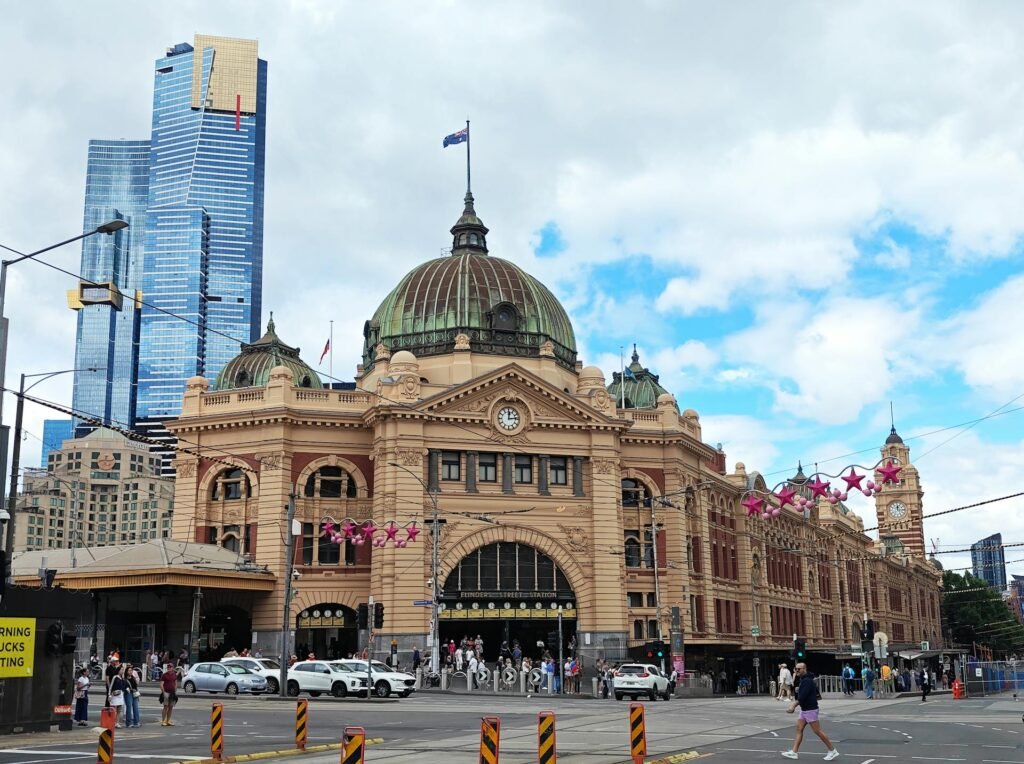
The 1851 Victorian Gold Rush transformed Melbourne. Gold discoveries at Ballarat (100 km west) and Bendigo (150 km north) drew global immigration; the city’s population jumped from 23,000 in 1851 to 280,000 by 1880. Victorian-era Melbourne became one of the world’s richest cities — the so-called “Marvellous Melbourne” of the 1880s — funding the construction of the grand civic architecture that still defines the city: Royal Exhibition Building (1880, UNESCO World Heritage 2004), Flinders Street Station (1909, the iconic clock-tower riverside terminus), State Library of Victoria (1854), and the now-restored mansions of South Yarra and Toorak.
Melbourne served as the capital of Australia from 1901 to 1927, when the new Federal Parliament met in Melbourne while Canberra was being built. The city hosted the 1956 Summer Olympics (the first Olympics in the Southern Hemisphere). Post-war European immigration — especially from Italy and Greece — transformed the city’s food culture and demographics; the post-1975 Vietnamese refugee settlement and ongoing Chinese, Indian, and broader Asian immigration have continued the multicultural transformation.
Recent decades have brought Melbourne global recognition. The Economist’s “Most Livable City” ranking (#1 from 2011 to 2017) gave the city its modern brand. The 2017–2018 marriage-equality reforms made Melbourne one of the most progressive major Australian cities. The 2020–2021 COVID-19 pandemic brought the world’s longest cumulative lockdowns (262 days) to Melbourne; the city’s recovery and the broader reshaping of CBD-vs-suburban work patterns continue to play out.
Geography, Climate & Best Time to Visit Melbourne
Geographic Setting
Melbourne sits at the head of Port Phillip Bay in southeastern Australia. The city is built along the Yarra River (Birrarung), with the central business district (CBD) on the river’s north bank. The geography includes the flat coastal plain of the bay, the rolling hills of the Dandenong Ranges 35 km east (rising to 600 m), the Mornington Peninsula south of the city, and the gateway to the volcanic Western District plains beyond.
The CBD itself is built on the famous Hoddle Grid — a rectangular grid of straight, wide streets between Spencer Street and Spring Street, La Trobe Street and Flinders Street. The grid produces unusually walkable city navigation. The intricate laneway network threading through the blocks contains many of the city’s most-photographed cafés, street-art murals, and small bars.
Climate Overview
Melbourne has a temperate oceanic climate (Köppen Cfb) famously known for “four seasons in one day” — dramatic same-day swings of 15+ °C are common, particularly during spring and autumn. Summer (December–February): warm to hot (highs 24–32 °C with occasional 40 °C+ heatwaves), low humidity. Winter (June–August): cool (highs 12–16 °C), with grey skies and frequent rain. Spring (September–November) and autumn (March–May) are pleasant but variable. The city experiences occasional “southerly busters” — cold-front weather changes that drop temperatures 15+ °C in 30 minutes.
Best Time to Visit
October to April is the prime window — warm days, long evenings, the full programming calendar including the Melbourne Cup (first Tuesday in November), the Australian Open tennis (mid-late January), the F1 Australian Grand Prix (late March), the Boxing Day Test at MCG (December 26), and the Melbourne Food and Wine Festival (March). February–March is the year’s hottest stretch, with occasional 40 °C+ heatwave days. June–August is cool, gray, often wet — the wine-and-coffee-and-comedy-festival winter; Melbourne International Comedy Festival in late March-April. April–May brings spectacular autumn colors in the Dandenong Ranges and Royal Botanic Gardens. September–October: spring blossom and AFL football grand-final fever.
Melbourne’s Districts & Neighborhoods
Melbourne CBD (Central Business District)
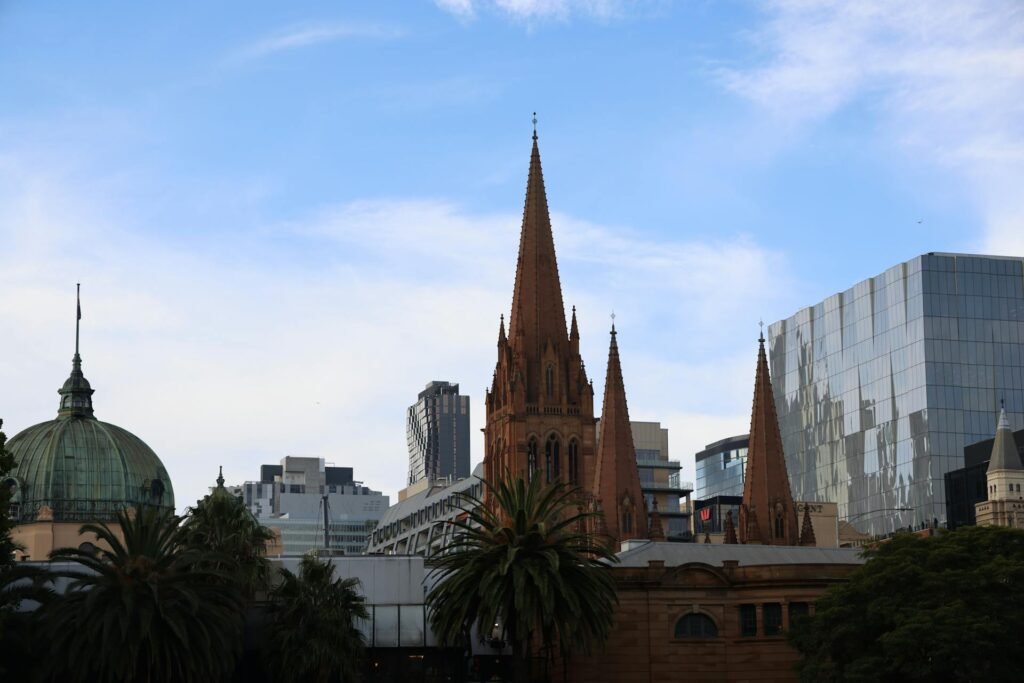
The compact rectangular Hoddle Grid downtown. Flinders Street Station (the iconic clock-tower terminus); Federation Square (the controversial modernist plaza with the National Gallery of Victoria Ian Potter Centre, ACMI cinema museum, and outdoor screen); St Paul’s Cathedral; Royal Exhibition Building in Carlton Gardens (UNESCO 2004); State Library of Victoria. The laneway network threading through the grid contains the city’s most-photographed spots: Hosier Lane (the street-art Mecca), AC/DC Lane (named for the band), Centre Place (the café concentration), and Degraves Street (the breakfast destination).
Carlton & Fitzroy
North of the CBD — the Italian-heritage and creative-class neighborhoods. Carlton: Lygon Street (the “Little Italy” restaurant strip since the 1950s); the University of Melbourne; the Royal Exhibition Building. Fitzroy: Brunswick Street (boutiques, bars, vegan cafés); Smith Street; the most concentrated bohemian and LGBTQ+-friendly neighborhood.
Southbank & the Yarra River South
The post-1990s redeveloped south bank of the Yarra opposite the CBD. Crown Casino and entertainment complex; the National Gallery of Victoria International (NGV); the Arts Centre Melbourne spire; the riverside promenade with restaurants and bars. The Eureka Skydeck observation tower offers 360° views.
St Kilda & the Beach
10 km south of the CBD on Port Phillip Bay. St Kilda Beach (the city’s accessible swimming beach); Luna Park (the iconic 1912 amusement park with the giant clown mouth entrance); St Kilda Pier (with the colony of little penguins under the breakwater rocks); Acland Street (the Jewish-immigrant pastry shops with the famous walls of cakes); Albert Park (the F1 circuit and golf course). Beach-town atmosphere; tram 16 from CBD.
Richmond & Cremorne
East of the CBD across the Yarra. Richmond’s Bridge Road: Vietnamese restaurants (the country’s best); the MCG immediately north. Cremorne: media-and-tech district with Slack, Carsales.com.au, and growing creative agencies.
South Yarra & Toorak
Upmarket residential and shopping district 4 km southeast of CBD. Chapel Street (upscale boutiques and restaurants); Toorak Road (luxury-residential mansions); Royal Botanic Gardens (94 hectares of landscaped gardens, the city’s premier green space).
Brunswick & the Northern Suburbs
Further north of Fitzroy. Brunswick: post-industrial creative district with the city’s best craft beer scene; coffee culture central. Coburg, Northcote, Thornbury: progressive residential neighborhoods. Footscray (western inner suburb): Vietnamese-Ethiopian-Sudanese immigrant community with one of the country’s best multicultural food markets.
Top Things to Do in Melbourne
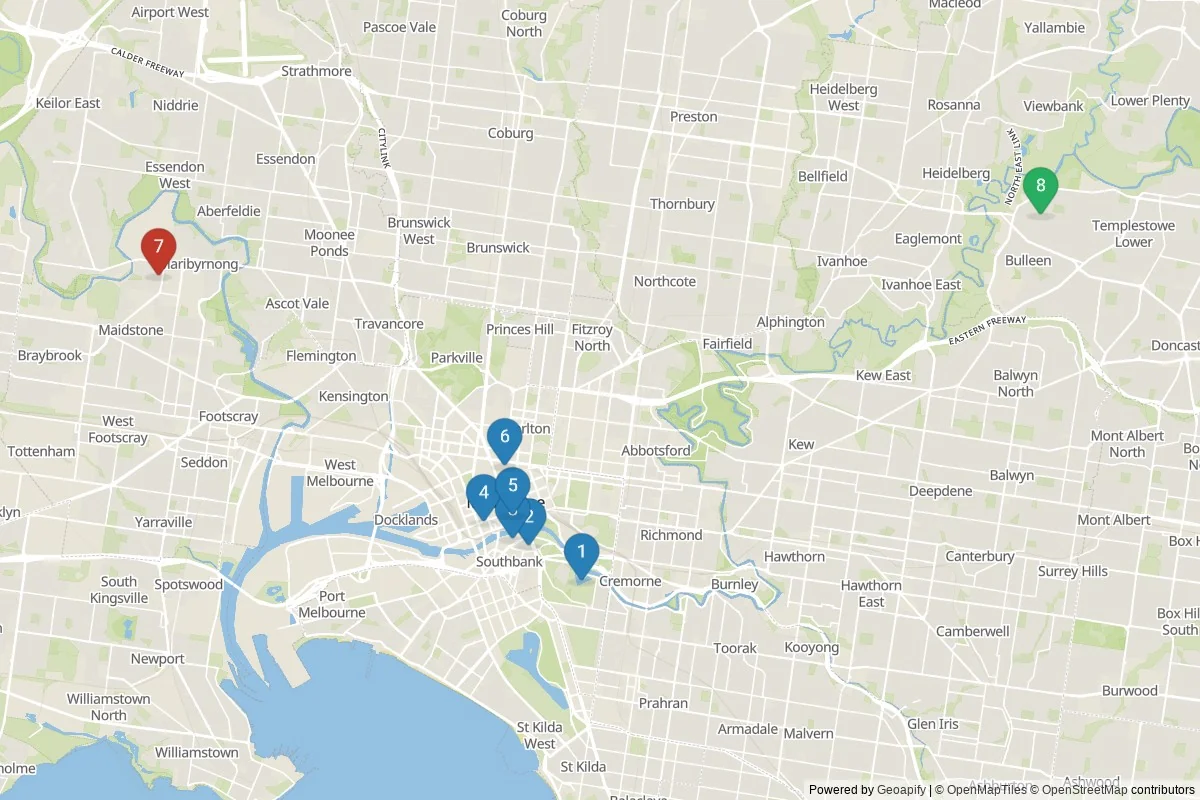
| # | Sight | Cluster | Type | Time | Entry | Best |
|---|---|---|---|---|---|---|
| 1 | Royal Botanic Gardens & Shrine of Remembrance | Cluster A | Garden | — | Free | — |
| 2 | National Gallery of Victoria | Cluster A | Square | — | free | — |
| 3 | Eureka Skydeck (Tallest Observation in the Southern Hemisphere) | Cluster A | Tower | — | $30 | — |
| 4 | the MCG (Melbourne Cricket Ground) | Cluster A | Museum | — | $30 | — |
| 5 | Coffee & Laneway Walking Tour | Cluster A | Market | 4 hours | — | Morning |
| 6 | Day Trip: Great Ocean Road | Cluster A | Park | 14 hour | — | — |
| 7 | Day Trip: Phillip Island Penguin Parade | Cluster B | Park | — | — | Sunset |
| 8 | Yarra Valley Wine Region | Cluster C | Museum | 1 hour | — | — |
1. Coffee & Laneway Walking Tour
The defining Melbourne morning experience. Begin at Degraves Street in the CBD (Pellegrini’s, since 1954, the originator of the city’s espresso culture); continue to Centre Place, Manchester Lane, and the central laneways; finish at Hosier Lane for the street-art tour. The Melbourne coffee scene is widely considered the world’s best (largely because the city resisted Starbucks expansion in the 2000s); independent third-wave coffee shops dominate. Recommended addresses: Patricia, Industry Beans, Market Lane, Auction Rooms, Proud Mary. Allow 3–4 hours.
2. Visit the MCG (Melbourne Cricket Ground)
The country’s most sacred sporting venue — the 100,000-seat stadium that hosts the Boxing Day Test cricket (December 26), the AFL Grand Final (last Saturday in September), and major concerts. The on-site Australian Sports Museum and stadium tours offer insider access. Stadium tour AUD $30; combo with the National Sports Museum AUD $42.
3. Royal Botanic Gardens & Shrine of Remembrance
The 94-hectare Royal Botanic Gardens immediately south of the CBD — Melbourne’s signature green space. Tan Track (the 3.8 km running circuit around the gardens, a Melbourne ritual) is the city’s most-used outdoor space. Combine with the adjacent Shrine of Remembrance (1934, Australia’s national WWI memorial). Free entry.
4. National Gallery of Victoria
Australia’s oldest and most-visited public art gallery, split across two sites. NGV International at Southbank houses the European and Asian art collection (the iconic stained-glass ceiling of the Great Hall is a Melbourne photographic landmark). NGV Australia at the Ian Potter Centre at Federation Square houses the Australian collection including the most extensive collection of Indigenous Australian art outside the Northern Territory. Both free entry; special exhibitions ticketed.
5. Eureka Skydeck (Tallest Observation in the Southern Hemisphere)
The 88-floor observation deck at Eureka Tower in Southbank — the tallest in the Southern Hemisphere. The Edge — a glass cube extending out from the building at 285 m above the ground — provides the dramatic photo opportunity. AUD $30 standard adult; AUD $45 with The Edge.
6. Day Trip: Great Ocean Road
The 243-km coastal drive west of Melbourne — one of the world’s great scenic drives. The Twelve Apostles (limestone stacks rising from the Southern Ocean) are the headline image; the route also covers Lorne, Apollo Bay, the Otway National Park rainforest, and Loch Ard Gorge. A 12–14 hour day trip from Melbourne if rushing through; an overnight is the better experience.
7. Day Trip: Phillip Island Penguin Parade
140 km south of Melbourne, Phillip Island is famous for the nightly Penguin Parade — hundreds of little (fairy) penguins emerging from the sea at sunset and walking up the beach to their burrows in the dunes. The Nature Park visitor center provides covered viewing stands. The same island has the Phillip Island Grand Prix Circuit (MotoGP) and the Koala Conservation Reserve.
8. Yarra Valley Wine Region
1 hour northeast of Melbourne — Victoria’s premier cool-climate wine region. Domaine Chandon, De Bortoli, Yering Station, Levantine Hill are the canonical wineries; the TarraWarra Museum of Art combines contemporary Australian art with wine country. Healesville Sanctuary on the way has the country’s best concentration of native Australian wildlife (platypus, Tasmanian devil, koala, wombat).
How to Get to Melbourne
By Air
Melbourne Airport (MEL, Tullamarine), 23 km northwest of the CBD, is Australia’s second-busiest airport. Direct nonstop routes from most major Asia-Pacific cities, North America (Los Angeles, San Francisco, Vancouver, Dallas-Fort Worth, Houston), Europe (London, Doha, Dubai), and the Middle East. Carriers: Qantas, Virgin Australia, Jetstar, Rex, Air New Zealand, Singapore Airlines, Cathay Pacific, Emirates, Qatar Airways, United, Delta, Air Canada, British Airways, and many more.
From the airport: SkyBus express bus to CBD AUD $24 one-way / $44 return (every 10 minutes, 30 minutes journey); Uber/Didi/Ola AUD $50–80; taxi AUD $55–80; Rideshare car rentals; the planned Airport Rail Link (target 2031) will eventually provide a rail connection. Avalon Airport (AVV), 55 km southwest, serves Jetstar low-cost flights.
By Train
The XPT rail service from Sydney to Melbourne takes 11 hours (twice daily, AUD $90–130); not particularly fast but a relaxing alternative to flying. The Vline network connects Melbourne to all major Victorian regional cities — Geelong (1 hour, AUD $9), Ballarat (90 min), Bendigo (2 hours), Warrnambool (3.5 hours).
By Long-Distance Bus
Greyhound Australia connects Melbourne to Sydney (12 hours overnight, AUD $90–150) and other major Australian cities. Firefly low-cost bus services with overnight runs to Adelaide and Sydney.
By Sea / Ferry
Spirit of Tasmania overnight passenger and vehicle ferry connects Melbourne (Geelong port) to Devonport, Tasmania (9–11 hours each way, AUD $200–500+ per person plus vehicle).
Visa Notes
Australia requires a visa for all foreign visitors. Citizens of 41 ETA-eligible countries (most Western European nations, US, Canada, Japan, South Korea, Singapore, Brunei, Hong Kong SAR, Taiwan, Malaysia): apply for an Electronic Travel Authority (ETA) subclass 601 for AUD $20 service charge; valid 1 year, multiple entries, max 3 months per visit. EU/UK/Schengen-equivalent citizens: free eVisitor (subclass 651) visa with similar terms. Other nationalities: apply for a Visitor Visa (subclass 600) AUD $190; processing 6–8 weeks. Passport must have at least 6 months remaining validity. Common mistakes: using unofficial visa websites that charge 200–500% premiums; arriving without onward/return tickets; bringing fresh fruit or seeds (Australian biosecurity is among the world’s strictest — declare or discard).
Getting Around Melbourne
Trams (the World’s Largest Tram Network)
Melbourne’s 250-km tram network is the world’s largest urban tram system — and the defining transit experience of the city. Free travel within the Free Tram Zone covers the entire CBD plus Docklands; outside the zone, a myki card (AUD $6 deposit + recharge) is required for all public transport. Single-trip fare AUD $5.30 (capped at AUD $10.60 per day). Lines 11 (St Kilda), 96 (East Brunswick), 86 (Bundoora) are particularly useful. The free City Circle Tram (Route 35) loops the CBD on the historic burgundy trams every 12 minutes.
Suburban Trains (Metro)
The 16-line suburban train network is dense and useful for getting to outer-suburban attractions. Same myki card; same AUD $5.30 single fare / $10.60 daily cap. Major hubs at Flinders Street, Southern Cross, and Melbourne Central stations. The new Metro Tunnel (opened 2025) provides a fifth CBD station and connections.
Buses
Melbourne’s bus network fills the gaps trains and trams don’t cover; same myki fares. Less useful for visitors than trams.
Ride-Hailing
Uber, Didi, Ola, and the local 13cabs taxi app all operate. Fares CBD-to-airport AUD $50–80; CBD-to-St Kilda AUD $25–40.
Cycling
Melbourne has reasonable bike infrastructure with dedicated lanes on many CBD streets and the popular Yarra River Trail (38 km riverside path). Lime and Beam dockless bike-share systems operate; bikes can be parked at any designated rack.
Walking
The CBD is genuinely walkable — the grid is 1 km × 0.5 km, with all major sights walkable from any central hotel. The laneway network is the walking-tour highlight.
Food & Drink in Melbourne
Melbourne arguably has the most multicultural food scene of any major English-speaking city, built on successive waves of post-WWII immigration: Italian and Greek from 1945; Vietnamese from 1975; Lebanese, Sri Lankan, Indian through the 1980s and 1990s; Ethiopian, Sudanese, and broader African from the 2000s; Chinese, Korean, Japanese growing throughout. The result is a depth and quality of multicultural dining that locals routinely take for granted.
What to Try
- The Melbourne breakfast — smashed avo on sourdough toast with poached eggs, perhaps fetta; the dish that conquered the world (and gave Australia the modern brunch). At Top Paddock, Hash, Industry Beans, Three Bags Full.
- Coffee — Melbourne is widely considered the world’s best coffee city. The magic (Melbourne’s invention — 3/4 flat white, 1/4 short black) is the local order. Patricia, Market Lane, Auction Rooms, Sensory Lab are canonical addresses.
- Vietnamese pho and banh mi — Richmond’s Victoria Street and Footscray’s Hopkins Street rival Saigon for quality.
- Italian — Carlton’s Lygon Street has been the city’s “Little Italy” since the 1950s. Pellegrini’s is the canonical Italian-Australian institution; Tipo 00, Caterina’s are the contemporary Italian standards.
- Greek — Oakleigh’s Eaton Mall has the country’s most concentrated Greek dining; the Stalactites classic CBD souvlaki institution.
- Chinese — Box Hill (eastern suburb) and Glen Waverley have the country’s most extensive Chinese-Australian dining; HuTong, Lau’s Family Kitchen, Cantonese Yum Cha at the CBD’s Flower Drum.
- Lebanese, Persian, Afghan — the western suburbs of Coburg, Brunswick, and Sydney Road dominate.
- Indigenous-Australian “bush tucker” — the slowly-growing dining tradition centered on native ingredients. Big Esso by Mabu Mabu and Charcoal Lane are notable.
- Pavlova, lamington, Anzac biscuits — the canonical Australian sweets.
- Australian wine — Yarra Valley (cool-climate), Mornington Peninsula, Bellarine Peninsula are the immediate wine regions; broader Victorian wines (King Valley, Heathcote, Rutherglen) are widely available.
Where to Eat
CBD laneways: Tipo 00 (modern Italian, Little Bourke Street); Chin Chin (modern Asian, Flinders Lane); MoVida (Spanish tapas, Hosier Lane). Carlton Lygon Street: Pellegrini’s, Tiamo, Trattoria Emilia, DOC. Fitzroy: Cumulus Inc., Marion, Smith & Daughters. Richmond Victoria Street: Minh Tan, Tho Tho, Thy Thy. Footscray: Sister of Soul, Co Thu Quan. South Yarra: Stokehouse, France-Soir. St Kilda: Donovans (the iconic seafront restaurant), Lau’s Family Kitchen, Monarch Cake Shop (Acland Street). Brunswick: Gao Lao, Mahanakhon, A Mosaiu. Fine-dining: Attica (Melbourne’s three-hat restaurant, ranked among the world’s best); Lume, Vue de Monde, Brae (Birregurra, 90 min west).
Drinks
Coffee — already covered. Australian craft beer: Mountain Goat (Richmond), Stomping Ground, Moon Dog, Burnley Brewing — the city has 50+ active microbreweries. Wine: Yarra Valley cool-climate Pinot Noir and Chardonnay; Mornington Peninsula similar; broader Australian wines. Spirits: Starward Whisky (Port Melbourne distillery, exporting globally); local gins from Four Pillars (Yarra Valley) and Melbourne Gin Company. Aperitif culture: well-established in Melbourne; Lebanese arak, Italian Aperol Spritz, contemporary Australian bitters-based cocktails. Tea: T2 (Australian premium tea brand, Melbourne origin) and many specialty tea cafés.
A Note on Tap Water
Tap water in Melbourne is completely safe to drink — the city’s water comes from protected catchments in the Yarra Ranges and Thompson Reservoir, naturally filtered through eucalyptus forests, and treated to high Australian standards. No bottled water needed; many cafés and restaurants offer free filtered water on request; refillable water bottles are encouraged by city policy. The CDC traveler health page for Australia rates Australian food and water as the lowest risk; standard hygiene precautions apply. Australian agricultural biosecurity is the more significant consideration — declare all food on arrival.
Frequently Asked Questions About Visiting Melbourne
Do I need a visa to visit Melbourne?
Yes — Australia requires a visa for all foreign visitors, but the process is simple and electronic for most travelers. Citizens of 41 ETA-eligible countries — including the US, Canada, Japan, South Korea, Singapore, Brunei, Hong Kong (SAR), Taiwan, Malaysia, Greece, Switzerland — apply for the Electronic Travel Authority (ETA, subclass 601) at the official Department of Home Affairs portal; AUD $20 service charge; valid 1 year, multiple entries, max 3 months per visit. EU/UK/Schengen-equivalent citizens: free eVisitor (subclass 651) with similar terms; apply via the same portal. Other nationalities: apply for a Visitor Visa (subclass 600) AUD $190; processing 6–8 weeks. Common mistakes: using unofficial visa websites that charge 200–500% premiums; assuming the ETA covers working in Australia (it doesn’t — only tourism and short business meetings); arriving with passport expiring within 6 months; bringing fresh fruit, plants, seeds, or wood items — Australian biosecurity is among the world’s strictest; ALL food and biological materials must be declared on arrival; on-the-spot fines for non-declaration up to AUD $5,500.
Is Melbourne safe for tourists?
Melbourne is one of the world’s safest major cities — consistently ranked in the global top 10 for safety. The US State Department rates Australia at “exercise normal precautions” — the most relaxed advisory level. Real risks in Melbourne: traffic — pedestrians need to look right first (left-hand drive); the tram network has dedicated tram lanes that can be deadly for inattentive walkers; petty theft — bag-snatching and pickpocketing at major tourist sites; St Kilda nightlife — occasional incidents in the late-night beach-front district; heat exhaustion during 40 °C+ summer heatwaves; sun exposure — the UV index in Australia is among the highest globally; the country has the world’s highest skin-cancer rates; SPF 50+ sunscreen, wide-brim hats, and long sleeves are not optional but essential; credit-card skimming at low-end ATMs; nightlife scams in some King Street and Crown Casino areas; “flat white delivery” scams — fake Uber Eats riders ringing apartment buildings then asking for payment; medical-cost shock — Australian healthcare is excellent but uninsured foreign visitors pay full prices; comprehensive travel insurance is essential. Drug enforcement: Australia imposes harsh penalties — possession of even small amounts results in arrest; commercial trafficking carries long prison sentences. Indigenous Australian cultural sensitivities: respect “do not enter” signs at culturally significant sites; learn about Welcome to Country and Acknowledgement of Country protocols at major venues.
How many days do I need in Melbourne?
Three to four days handles Melbourne well; combined with Great Ocean Road and Phillip Island, 5–7 days makes a satisfying Victorian trip. A solid 4-day Melbourne plan: Day 1 — arrive, CBD laneway coffee walk + Federation Square + NGV International + dinner at a Carlton Italian restaurant. Day 2 — Royal Botanic Gardens + Shrine of Remembrance morning + St Kilda Beach afternoon + Acland Street cakes + dinner at Cumulus Inc. Day 3 — Great Ocean Road day trip (Twelve Apostles + Loch Ard Gorge + Otway National Park; 12-hour day) or Yarra Valley wineries (Healesville Sanctuary + Domaine Chandon + lunch at TarraWarra; 8-hour day). Day 4 — MCG morning tour + Australian Sports Museum + Brunswick craft beer afternoon + Hosier Lane street-art evening. Add Day 5 for Phillip Island Penguin Parade. Add Days 6–7 for Tasmania (Spirit of Tasmania overnight ferry from Geelong port) or Sydney (1.5 hour flight). 2-week Australia classic: 4 days Melbourne + 4 days Sydney + 3 days Cairns/Great Barrier Reef + 3 days Uluru/Red Centre. Day-trip Melbourne from Sydney: feasible via 90-minute flight but the trip is genuinely worth 3+ days.
What’s the best area to stay in Melbourne?
Melbourne CBD — the practical default for first-time visitors; walking distance to most major sights; international hotel chains (Sofitel Melbourne on Collins, Park Hyatt Melbourne, Westin Melbourne, Crown Towers, W Melbourne); AUD $250–800/night (US$165–530). Mid-range chain hotels (Mantra Bell City, Mercure Welcome Melbourne, Adina Apartment Hotels) AUD $180–350/night. Boutique CBD heritage hotels (QT Melbourne, Adelphi Hotel) AUD $300–600/night. Southbank / Crown Casino area — modern luxury and waterfront views; Langham Melbourne, Crown Metropol, Hilton South Wharf; AUD $300–900/night. South Yarra / Toorak — upscale residential character; small boutique hotels and serviced apartments; AUD $250–600/night; close to Chapel Street shopping. St Kilda — beach-resort atmosphere; The Prince, Tolarno Hotel, Novotel Melbourne St Kilda; AUD $180–400/night; tram 15 minutes from CBD. Fitzroy / Carlton — boutique guesthouses and Airbnb apartments; bohemian neighborhood character; AUD $200–500/night. Skip: cheap unbranded hotels along Spencer Street near the bus terminal — generally older and lower-quality.
How much does it cost to visit Melbourne’s major sights?
Melbourne is moderately expensive by Asian standards but reasonable by Western city standards. National Gallery of Victoria (NGV): free general entry; special exhibitions AUD $20–35. Federation Square: free. Royal Botanic Gardens: free. Shrine of Remembrance: free entry; donations welcome. Eureka Skydeck: AUD $30; The Edge AUD $45. MCG stadium tour: AUD $30; combo with Sports Museum AUD $42. Royal Exhibition Building & Museum tour: AUD $15. Melbourne Zoo: AUD $48. Old Melbourne Gaol: AUD $33. Healesville Sanctuary: AUD $48. Phillip Island Penguin Parade: AUD $32 (general view), $58 (premium plus penguins close-up). Great Ocean Road full-day tour: AUD $130–300 per person. Yarra Valley winery tour: AUD $150–400 per person depending on level. Free Tram Zone covers entire CBD + Docklands. myki one-day cap: AUD $10.60. Local meals: laneway café breakfast AUD $20–35; chain restaurant lunch AUD $20–30; mid-range dinner AUD $40–80 per person; fine-dining AUD $150–400 per person; Italian/Greek/Vietnamese ethnic dining AUD $25–50 per person. Coffee at any café: AUD $4.50–6 per cup. Crown Casino dinner-show: AUD $80–200 per person. Overall daily budget: AUD $150 (frugal hostel + cafés + walking + trams), AUD $350 (mid-range), AUD $1,000+ (luxury hotel + fine dining + private touring).
Should I drink the tap water in Melbourne?
Yes — tap water in Melbourne is completely safe to drink and arguably better than most bottled brands. Melbourne’s water comes from protected catchments in the Yarra Ranges and Thomson Reservoir — naturally filtered through eucalyptus forests, treated to high Australian standards. The water is famously soft and excellent for tea and coffee (one of the secret ingredients of the city’s coffee quality). No bottled water needed; many cafés provide free filtered water on request; refillable water bottle stations are common at major sights, parks, and stations. The CDC traveler health page for Australia rates Melbourne food and water as the lowest risk; standard hygiene precautions apply. Food safety: Australia has excellent food safety standards; raw oysters are widely safe; raw beef carpaccio at reputable restaurants is fine. The bigger health concerns in Melbourne: sunburn (UV index extreme in summer; sunscreen non-negotiable), heat-related illness during 40 °C+ heatwaves, and the strong winds of the Southerly Buster weather changes.
What payment methods work in Melbourne — credit cards or cash?
Heavily card-and-contactless — Australia is one of the world’s most cashless societies. Credit/debit cards (Visa, Mastercard, AmEx, Discover, JCB): accepted virtually everywhere — hotels, restaurants, cafes, taxis, public transit (via Touch and Go), supermarkets, museums, even most food trucks; contactless tap-to-pay is universal. Australian dollars (AUD): useful for small purchases, tipping, and emergencies; ATMs are abundant (Commonwealth Bank, ANZ, NAB, Westpac) accept foreign cards with daily limits AUD $1,000–2,000 and small fees. Digital wallets: Apple Pay, Google Pay, Samsung Pay all work universally; Apple Pay supports myki transit card on iPhone. Currency exchange: airport and city exchange counters are competitive; bank-branch exchanges offer comparable rates; bring USD or EUR if needed. Tips: not strongly ingrained in Australian service culture but appreciated for good service — 10–15% at restaurants if no service charge is added (most don’t add one); round up taxi fares; AUD $2–5 per bag to hotel porters; AUD $5–10 per night for housekeeping; AUD $20–50 per day for tour guides. GST (Goods and Services Tax): 10% included in displayed prices; tourists can claim refunds via the TRS (Tourist Refund Scheme) at the airport for purchases over AUD $300 from a single retailer; register at airport before departure. “BYO” (Bring Your Own): many smaller restaurants are BYO wine only — bring your own bottle for a corkage fee of AUD $5–15.
What about the famous Melbourne coffee culture and weather variability?
Two distinctive Melbourne realities worth understanding. Coffee culture: Melbourne is widely considered the world’s coffee capital — largely because the city resisted Starbucks expansion in the 2000s, allowing the independent specialty-coffee scene to mature. The local language: a “flat white” is an espresso with steamed milk (a Melbourne invention now global); a “long black” is an Americano (espresso over hot water); a “short black” is a simple espresso; a “magic” is a 3/4 flat white with 1/4 short black (a Melbourne-only specialty). Cafe culture: independent cafés dominate; Patricia, Market Lane, Auction Rooms, Industry Beans, Proud Mary are canonical; coffee prices AUD $4.50–6 per cup. Most cafés don’t open before 7 am and close by 16:00; the Australian breakfast culture is morning-focused. Espresso etiquette: order at the counter; sit down with your number; don’t expect the European take-away style. Weather variability: Melbourne is famous for “four seasons in one day” — same-day temperature swings of 15+ °C are common. The cause is the city’s position between hot inland Australia and the cold Bass Strait — wind shifts between hot northerly and cold southerly air masses produce dramatic short-term changes. Practical tip: layer your clothing for any outing more than 4 hours long; check the day’s forecast (which often spans 12–28 °C in autumn or spring); the Southerly Buster wind change can drop temperatures 15 °C in 30 minutes during summer evenings — relief from the heat but bring a light jacket. UV protection: the Australian sun is dangerously strong year-round; SPF 50+ sunscreen, wide-brim hats, and UPF-rated clothing are essential, particularly summer. Skin cancer affects roughly 2 in 3 Australians by age 70 — the country has the world’s highest rates.
Education & Notable People
Melbourne is Australia’s leading education center, home to two of the country’s Group of Eight (Go8) top universities and the country’s largest concentration of international students.
Major Universities
- University of Melbourne — founded 1853, Australia’s #2 university (often #1 in Times Higher Education rankings); ~52,000 students; particularly strong in medicine, law, and humanities.
- Monash University — founded 1958, Australia’s largest university by enrollment (~83,000 students across multiple campuses), Group of Eight member; strong in engineering, sciences, and pharmacy.
- RMIT University — design, technology, and applied arts focus; central CBD campus.
- Deakin University — multi-campus, strong in business, education, and health sciences.
- La Trobe University — Bundoora campus, comprehensive faculties.
- Swinburne University of Technology — engineering, design, and information technology focus.
- Victoria University — Footscray-based, applied focus.
Notable People
Cate Blanchett — Academy Award-winning actress, born in Melbourne 1969. Eric Bana — actor (Hulk, Munich, Troy), Melbourne-born and -raised. Geoffrey Rush — Oscar-winning actor. Kylie Minogue — global pop star, born in Melbourne. Sidney Nolan — celebrated 20th-century painter, born in Melbourne; Ned Kelly series is the defining Australian modernist art. Germaine Greer — feminist writer (The Female Eunuch), born in Melbourne 1939. Christina Stead, Helen Garner, Peter Carey — celebrated Australian writers with Melbourne ties. Donald Bradman — although born in NSW, the cricketing legend’s career was substantially defined by Melbourne and the MCG. Anthony Mundine, Lleyton Hewitt, Mark Webber — celebrated Australian athletes. The Whitlams (band), Crowded House, Nick Cave — music. Nicholas Joseph “Nick” Cave — songwriter and novelist, longtime Melbourne resident.
Sister Cities & International Relations
Melbourne’s sister-city network reflects the city’s identity as a global cultural-and-education center.
Melbourne’s sister and partnership cities include (selection):
- Osaka, Japan — paired since 1978; the longest-running and most active Melbourne sister relationship.
- Tianjin, China — sister city since 1980.
- Thessaloniki, Greece — paired since 1984; reflects the substantial Greek-Australian community.
- Boston, Massachusetts, USA — sister city since 1985.
- St. Petersburg, Russia — paired since 1989 (Soviet-era relationship).
- Milan, Italy — paired since 2004; design-and-fashion partnership.
- Aarhus, Denmark — friendship link.
- Auckland, New Zealand — Pacific Rim partnership.
Melbourne is the seat of the Victorian state government and hosts numerous international institutional offices including the Australian Bureau of Meteorology, the Royal Botanic Gardens Victoria, the State Library, and the Victorian Arts Centre. The city is a regular host of major international events including the Australian Open tennis (one of the four tennis Grand Slam events, January), the F1 Australian Grand Prix (March), the Melbourne Cup (first Tuesday of November — Australia’s most famous horse race), the Boxing Day Test cricket, and the AFL Grand Final. The Visit Victoria tourism authority coordinates the city’s international promotion.
AFRIKA
Cairo Hurghada Johannesburg Marrakech
ASIA
Abu Dhabi Agra Antalya Bangkok Batam Beijing Bengaluru Cebu City Chiang Mai Chiba Chennai Da Nang Dammam Delhi Denpasar Dubai Fukuoka Guangzhou Guilin Ha Long Hanoi Ho Chi Minh City Jakarta Jaipur Johor Bahru Kolkata Krabi Kuala Lumpur Kyoto Macau Mecca Medina Mugla Mumbai Osaka Pattaya Penang Phuket Riyadh Seoul Shanghai Shenzhen Singapore Taipei Tokyo Zhuhai
EUROPE
Amsterdam Athens Barcelona Berlin Brussels Budapest Copenhagen Dublin Florence Frankfurt am Main Heraklion Krakow Lisbon London Madrid Milan Munich Nice Paris Porto Prague Rhodes Rome Stockholm Venice Vienna Warsaw
NORTH AMERICA
Cancun Las Vegas Los Angeles Miami New York City Orlando San Francisco Toronto Vancouver
SOUTH AMERICA
Buenos Aires Lima Rio De Janeiro
OCEANIA
Auckland Honolulu Melbourne Sydney