
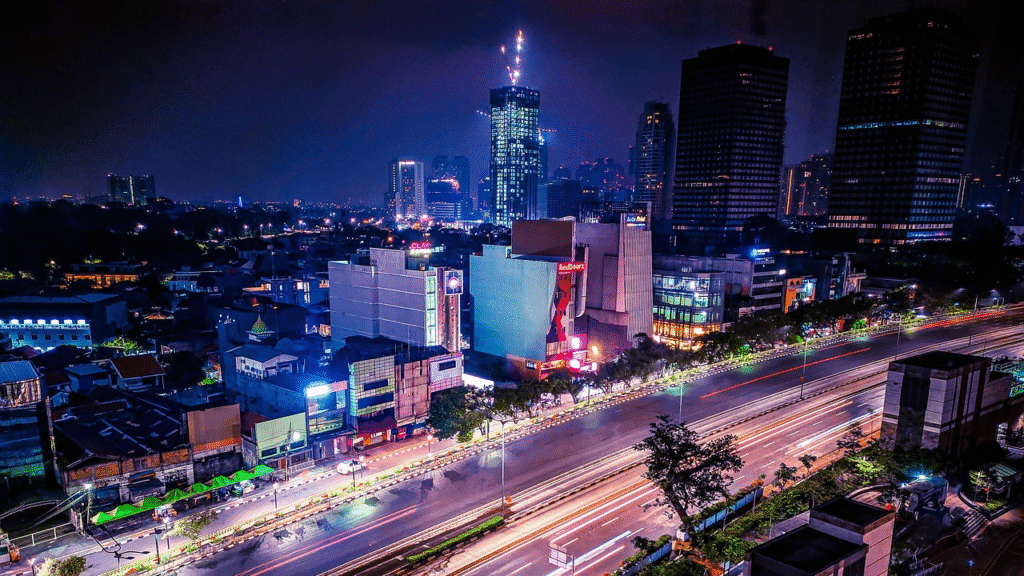
Photo credit: Jakarta night skyline
Jakarta is the capital of Indonesia and Southeast Asia’s largest urban agglomeration — a metropolitan area of over 33 million people spread across the broader Jabodetabek (Jakarta-Bogor-Depok-Tangerang-Bekasi) conurbation on the northwestern coast of Java. The city’s modern identity combines: colonial Batavia heritage (the Dutch East India Company headquarters from 1619 to 1799); independent-Indonesia political center since 1945; the country’s commercial and financial capital; and the engine of one of the world’s largest emerging-market economies. Jakarta’s defining experiences include: the historic Kota Tua (Old Batavia) with restored Dutch colonial architecture; the National Monument (Monas) at the symbolic center of independent Indonesia; the imposing Istiqlal Mosque (Southeast Asia’s largest); the country’s most concentrated shopping malls and contemporary dining; and the surrounding islands of the Pulau Seribu (Thousand Islands) for weekend escapes. The city has notorious challenges — chronic traffic congestion, periodic flooding (the city is sinking 25 cm per year, the world’s fastest), and air-quality concerns — but compensates with cultural depth, exceptional food, and remarkable energy. The 2024 official capital transfer to the new planned city of Nusantara in East Kalimantan is gradually shifting government functions, but Jakarta remains Indonesia’s economic and cultural capital indefinitely.
Jakarta by District: The 6 Kota Administrasi
Jakarta is divided into 6 administrative cities. The map below shows their official OSM boundaries, colour-coded to match the table — a quick way to orient yourself before zooming in on individual sights.
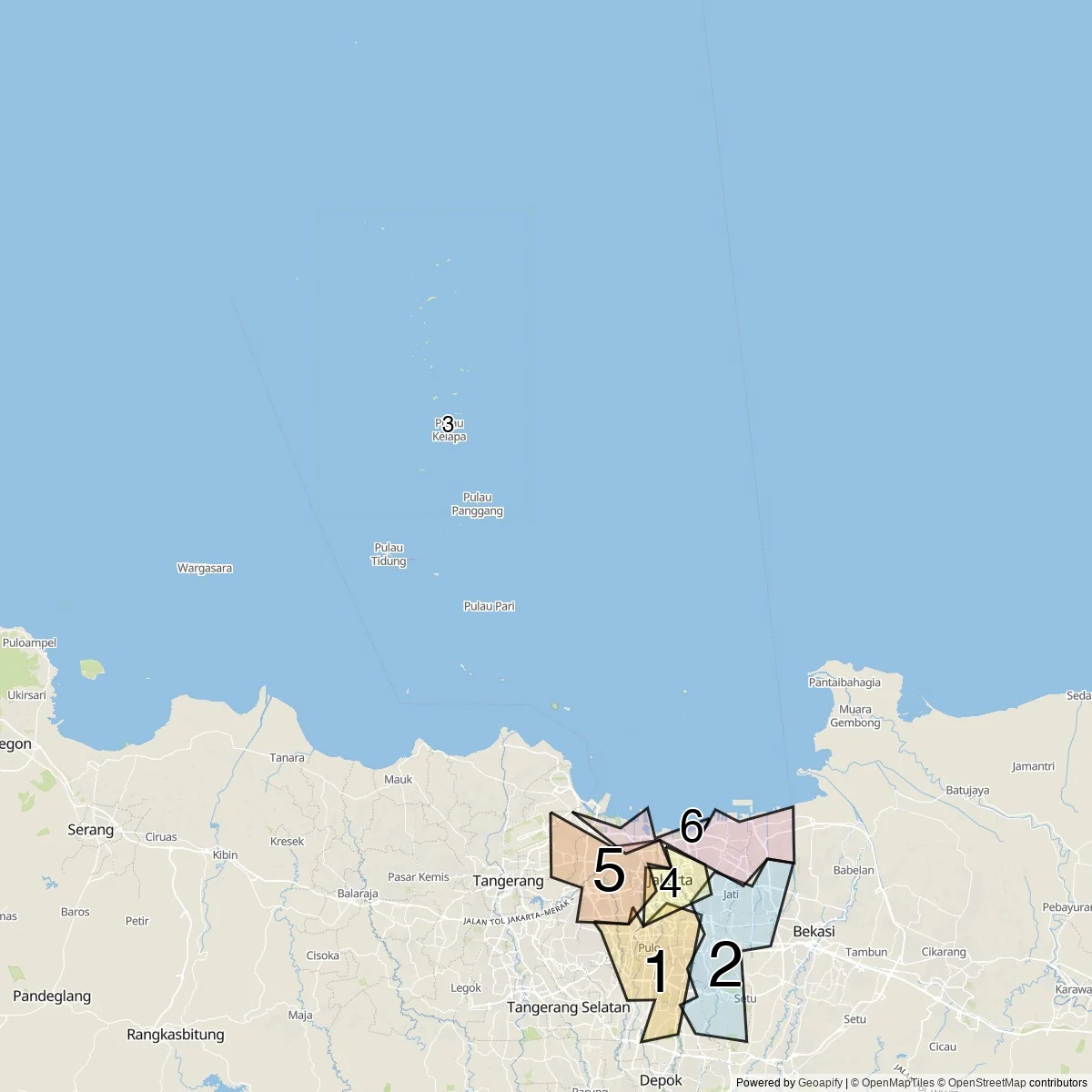
| # | Kota Administrasi |
|---|---|
| 1 | Jakarta Selatan · South Jakarta |
| 2 | Jakarta Timur · East Jakarta |
| 3 | Kepulauan Seribu · Thousand Islands |
| 4 | Jakarta Pusat · Central Jakarta |
| 5 | Jakarta Barat · West Jakarta |
| 6 | Jakarta Utara · North Jakarta |
Jakarta at a Glance: Essential Facts for Travelers
| Location | Northwestern Java, Indonesia (Java Sea coast) |
|---|---|
| Coordinates | 6.2088°S, 106.8456°E |
| Population | ~11.25 million (Special Capital Region, 2024); metro area (Jabodetabek) ~33.45 million — Southeast Asia’s largest |
| Area | 662 km² (DKI Jakarta); 7,063 km² (Jabodetabek metro) |
| Elevation | ~8 m above sea level (and sinking) |
| Time Zone | Western Indonesia Time (WIB, UTC+7 — no daylight saving) |
| Calling Code | +62 (city code 21) |
| Currency | Indonesian Rupiah (IDR Rp) |
| Languages | Indonesian (Bahasa Indonesia) official; English widely spoken in business and tourism; Javanese, Sundanese, Betawi, Chinese, and many regional languages in the broader population |
| Religion | Predominantly Muslim (~85% nationally); significant Christian, Hindu, Buddhist, Confucian minorities; Indonesia is the world’s largest Muslim-majority country |
| Climate | Tropical monsoon — hot humid year-round, wet season December–March, drier April–November |
| Status | Special Capital Region of Jakarta (DKI Jakarta); national capital since 1945; new official capital Nusantara in East Kalimantan being phased in from 2024 |
| Famous For | National Monument (Monas), Kota Tua Old Batavia, Istiqlal Mosque (SE Asia’s largest), nasi goreng and Indonesian cuisine, Pulau Seribu islands, megacity infrastructure |
Upcoming Events in Jakarta
| Date | Title | Details |
|---|---|---|
| 2026-10-02 to 2026-10-04 | Art Jakarta 2026 at JIExpo Kemayoran | Indonesia’s leading contemporary art fair returns to the Jakarta International Expo in Kemayoran from 2 to 4 October, filling the halls with works from dozens of local and international galleries. Since moving to JIExpo the fair has grown into Southeast Asia’s liveliest art marketplace, mixing established names with emerging Indonesian talent, large-scale installations and talks. Collectors, first-time buyers and browsers are all welcome; day tickets are sold at varying prices, with a preview day typically reserved for invited guests. A must for anyone curious about the region’s booming art scene. [Source] |
| 2026-10-03 to 2026-10-04 | Indonesia Comic Con 2026 – 10th Edition | Indonesia Comic Con celebrates its milestone tenth edition on 3 and 4 October, moving to a bigger home with new Expo and Arena halls reported at the Nusantara International Convention Exhibition in Pantai Indah Kapuk 2. The country’s biggest pop-culture gathering packs in comics, anime, gaming, exclusive collectibles and cosplay competitions, plus guest artists and creators from Indonesia and abroad. Day passes are sold at varying prices and the anniversary edition is expected to draw record crowds of fans, families and collectors, so early ticket purchase is recommended. [Source] |
| 2026-10-10 | Avenged Sevenfold at Jakarta International Stadium | American heavy metal icons Avenged Sevenfold bring their Asia Tour 2026 to the Jakarta International Stadium on 10 October. Indonesia has one of the band’s most passionate fanbases anywhere, and the stadium show promises a full production of pyrotechnics, giant screens and a career-spanning setlist from Bat Country to more recent progressive material. Tickets are sold through official channels at a wide range of prices from festival-style standing to seated tribunes. The JIS in North Jakarta is reachable by Transjakarta services, and gates typically open in the late afternoon. [Source] |
| 2026-10-17 | BABYMONSTER – CHOOM World Tour at Indonesia Arena | K-pop girl group BABYMONSTER stops at the Indonesia Arena in Senayan on 17 October as part of the Southeast Asian leg of their CHOOM World Tour. The YG Entertainment act has built a huge Indonesian following, and the arena show combines powerhouse choreography, live vocals and elaborate staging in one of Jakarta’s most modern indoor venues. Tickets at varying prices are sold through official ticketing partners and tend to sell out quickly for K-pop dates, so fans should book early. Expect lightstick oceans and long merchandise queues from early morning. [Source] |
| 2026-10-24 to 2026-10-25 | Jakarta Running Festival 2026 | Jakarta’s biggest running weekend takes over the city on 24 and 25 October, with the half marathon on Saturday and the full 42.195-kilometre marathon starting at 4am on Sunday from the Gelora Bung Karno complex, alongside 10K and 5K races. The marathon course follows the capital’s iconic streets with a five-hour cut-off, and tens of thousands of runners from across Asia are expected. Registration fees vary by distance, and spectating along the route is free. Road closures around Sudirman and Thamrin make the early morning unusually calm and festive. [Source] |
| 2026-10-26 to 2026-11-01 | Jakarta Fashion Week 2027 | Southeast Asia’s most influential fashion week returns from 26 October to 1 November, presenting the 2027 season with runway shows from Indonesia’s top designers alongside emerging talent and international guests. Recent editions have been staged at Pondok Indah Mall 3 in South Jakarta, mixing ticketed catwalk presentations with open showcases, talks and pop-up retail. The week is a launchpad for modest fashion and Indonesian textiles such as batik reinterpreted for global audiences. Access varies from free public areas to invitation and ticketed shows, with the full schedule published by the organisers. [Source] |
City News in Jakarta – last 14 days
| Date | Category | Headline | Details |
|---|---|---|---|
| 2026-09-14 | Local government | Suahasil Nazara sworn in as new finance minister | President Prabowo Subianto on Monday appointed Suahasil Nazara as Indonesia’s finance minister, replacing Purbaya Yudhi Sadewa in a swearing-in ceremony in Jakarta. The seasoned economist, previously deputy minister, becomes the third finance chief under the current administration. He immediately turned attention to executing the 2026 state budget in its final four months and pledged to keep the fiscal deficit firmly below three percent, saying the president instructed him to safeguard the state budget. [Source] |
| 2026-09-14 | Business | New finance minister moves to reassure jittery markets | Newly inaugurated Finance Minister Suahasil Nazara urged capital market players not to worry about the leadership change at the ministry, promising no major policy shift and continuity in fiscal management. Jakarta shares slipped modestly on the day of the announcement before analysts characterised the market response as relatively stable and cautiously positive. Officials at the state investment body said ongoing processes, including matters tied to the Jakarta-Bandung high-speed rail operator, would not be disrupted by the transition. [Source] |
| 2026-09-14 | Public safety | Search for 129 missing after Virgo Transport accident widens | The National Search and Rescue Agency Basarnas expanded its search area to 2,600 nautical miles in the effort to find 129 people still missing after the Virgo Transport 8 accident in the Java Sea. The transport minister said the vessel was operating at less than half its maximum passenger capacity when it lost contact, ruling out overloading as a cause. Ships and aircraft from multiple agencies are combing the widened zone as families in Jakarta and other ports await news. [Source] |
| 2026-09-14 | Local affairs | Fuel reserves secure despite long queues at petrol stations | Energy and Mineral Resources Minister Bahlil Lahadalia reassured the public that national fuel reserves remain secure despite a surge in queues at petrol stations, including across the Jakarta area. The government is taking steps to keep supply flowing amid global tensions that have pushed world oil prices sharply higher, with Brent crude topping 107 dollars a barrel. Officials urged motorists not to panic buy, saying distribution to stations is being accelerated to shorten waiting lines. [Source] |
| 2026-09-14 | Public transport | MRT Jakarta positions stations as offline meeting spaces | MRT Jakarta is developing its stations and surrounding areas as spaces for people to meet and experience events in person, betting that in an increasingly digital world commuters value real-world encounters. The operator is opening its network to curated activities and community programming, extending the role of stations beyond pure transit. The push reflects a broader strategy to grow non-fare revenue and deepen the system’s place in daily city life as the network expands. [Source] |
| 2026-09-14 | Business | Indonesia finalizes fines up to 6% of global revenue for tech firms | The Ministry of Communication and Digital Affairs has finalized a sanctions mechanism that allows fines of up to six percent of global revenue for technology companies that violate Indonesian digital regulations. The rules, among the toughest in the region, will affect the many international platforms with large user bases and offices in Jakarta. Officials say the framework is designed to strengthen compliance on content moderation, data protection and child safety rather than to raise revenue. [Source] |
Jakarta Events & City News Archive
Sources: Wikipedia: Art Jakarta, Indonesia Comic Con, Songkick, tiket.com, Jakarta Running Festival, Jakarta Fashion Week, Antara News, Antara News
Weather Forecast for the Next 14 Days in Jakarta
| Date | Weather | Max °F | Min °F | Rain mm |
|---|---|---|---|---|
| 2026-09-14 | ☁️ | 95.2 °F | 78.8 °F | 0.0 mm |
| 2026-09-15 | ☁️ | 90.8 °F | 78.6 °F | 0.0 mm |
| 2026-09-16 | ⛅ | 88.5 °F | 79.5 °F | 0.0 mm |
| 2026-09-17 | ⛅ | 88.3 °F | 79.8 °F | 0.0 mm |
| 2026-09-18 | 🌧️ | 88.4 °F | 80.0 °F | 1.8 mm |
| 2026-09-19 | 🌧️ | 89.0 °F | 78.9 °F | 4.5 mm |
| 2026-09-20 | 🌧️ | 88.8 °F | 78.6 °F | 0.9 mm |
| 2026-09-21 | 🌧️ | 88.2 °F | 79.6 °F | 0.6 mm |
| 2026-09-22 | 🌧️ | 87.7 °F | 80.3 °F | 1.8 mm |
| 2026-09-23 | ☁️ | 88.7 °F | 80.8 °F | 0.0 mm |
| 2026-09-24 | ☁️ | 88.1 °F | 81.5 °F | 0.0 mm |
| 2026-09-25 | 🌧️ | 89.1 °F | 81.3 °F | 0.6 mm |
| 2026-09-26 | 🌧️ | 90.0 °F | 80.8 °F | 0.6 mm |
| 2026-09-27 | ⛅ | 89.3 °F | 80.4 °F | 0.0 mm |
Jakarta’s History
Jakarta’s site has been continuously occupied since at least the 4th century CE, when the Hindu kingdom of Tarumanagara established settlements in the Ciliwung River valley. The earliest known port settlement was Sunda Kelapa, established by the 12th-century Hindu Sunda Kingdom — a strategic spice-trade harbor on the northwestern coast of Java.
The transformative moment came on June 22, 1527, when forces from the Muslim Demak Sultanate under Fatahillah captured Sunda Kelapa and renamed it Jayakarta (“Victorious City”), commemorating the victory over the Portuguese and Sundanese forces. The date is now celebrated as Jakarta’s official founding day.
European colonization began in earnest in 1619, when the Dutch East India Company (VOC) under Jan Pieterszoon Coen destroyed the existing town and built the planned colonial city of Batavia as the VOC’s Asian headquarters. For nearly two centuries, Batavia was the most important European port in Asia — the “Queen of the East” — with canals modeled on Amsterdam, fortified Dutch architecture, and a global trading network in spices, sugar, coffee, and rubber. The historic Kota Tua district preserves much of the original Batavia urban fabric.
The VOC went bankrupt in 1799; the Dutch government took direct control of the colony, renaming it the Dutch East Indies. Batavia continued as the colonial capital through the 19th and early 20th centuries. Japanese occupation (1942–1945) during WWII ended Dutch rule and renamed Batavia “Jakarta” (the modern abbreviated form). Sukarno proclaimed Indonesian independence on August 17, 1945, and Jakarta became the capital of the new Republic of Indonesia.
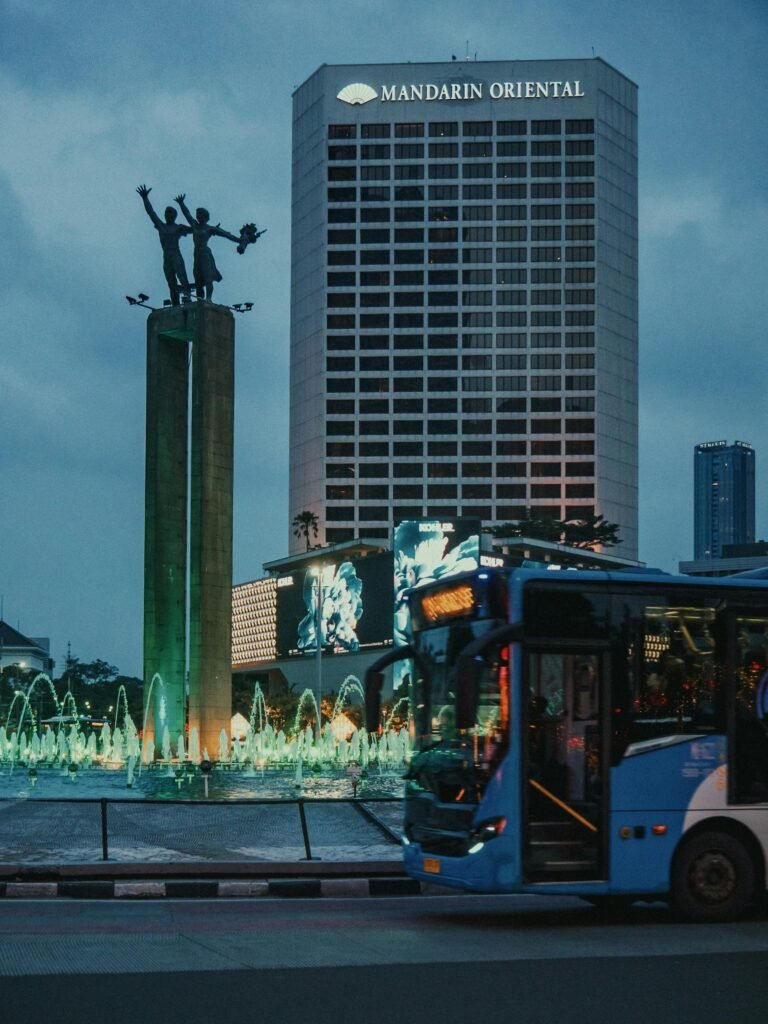
Post-independence Jakarta grew dramatically. Sukarno’s vision (1945–1965) reshaped the city with monumental architecture: the National Monument (Monas, 1961–1975); the Istiqlal Mosque (1978); the Hotel Indonesia roundabout with the iconic Welcome Statue; the Senayan sports complex for the 1962 Asian Games. Suharto’s New Order dictatorship (1967–1998) brought rapid industrialization and the development of the modern downtown business district along Jalan Sudirman and Jalan Thamrin. The 1998 Asian financial crisis and the resulting May 1998 riots (with significant anti-Chinese violence) ended the Suharto era and brought democratic reforms (Reformasi).
The 21st century has been one of dramatic growth and equally dramatic challenges. The metropolitan area (Jabodetabek) has surpassed 33 million people, making it Southeast Asia’s largest urban agglomeration. Chronic traffic congestion (Jakarta is consistently ranked among the world’s most congested cities) and land subsidence (the city is sinking 25 cm per year due to groundwater extraction, the world’s fastest rate, with 40% of the city now below sea level) led to the 2019 announcement of a new official capital, Nusantara, on the eastern coast of Borneo (Kalimantan). Government functions are phasing to Nusantara from 2024 onward, though Jakarta will remain Indonesia’s economic and cultural capital indefinitely.
Geography, Climate & Best Time to Visit Jakarta
Geographic Setting
Jakarta sits on the northwestern coast of Java at the mouth of the Ciliwung River, facing the Java Sea. The geography is fundamentally flat — coastal lowland transitioning gradually to inland hills only 30+ km south. 40% of the city is below sea level due to land subsidence, with the northern coastal areas worst affected. The Jakarta Giant Sea Wall project, begun in 2014, aims to prevent flooding.
The city is officially divided into five administrative cities (Central, North, East, West, South Jakarta) plus one administrative regency (Thousand Islands). For travelers, the working geography is: Central Jakarta (Monas, government buildings, museums); South Jakarta (Kemang, Senopati, Senayan — the modern commercial and dining districts); West Jakarta (Kota Tua historic core, Chinatown Glodok); North Jakarta (Ancol beach, Tanjung Priok port, harbor area); East Jakarta (working-class residential).
Climate Overview
Jakarta has a tropical monsoon climate (Köppen Am) — hot and humid year-round. Temperatures range 23–34 °C with very little seasonal variation. Wet season: late October to early March, with daily afternoon thunderstorms; heavy rainfall and significant flooding common. Dry season: May to September, with less rain and clearer skies. The transition months (April, October) are unpredictable. Annual rainfall ~1,800 mm.
Best Time to Visit
May to September is the best window — drier weather, lower flooding risk, more reliable conditions for outdoor activities including Pulau Seribu island trips. July–August is peak — pleasant temperatures, low humidity by Jakarta standards. October-April wet season: prepare for sudden heavy afternoon thunderstorms, traffic chaos during heavy rains, and possible flooding of low-lying areas in January-February. Festival timing: Idul Fitri (Eid al-Fitr): the end of Ramadan (dates shift annually) — most major businesses close for 1–2 weeks; the country’s most-traveled holiday period. Indonesian Independence Day (August 17): national celebrations. Jakarta Fair (June-July, the city’s largest annual exhibition).
Jakarta’s Districts & Neighborhoods
Central Jakarta (Jakarta Pusat)
The historic and ceremonial heart. National Monument (Monas) — the 132-meter obelisk topped with a 35 kg gold flame, commemorating Indonesian independence; the surrounding Merdeka Square is the city’s symbolic center. Istiqlal Mosque — Southeast Asia’s largest mosque, designed by a Christian architect (Frederik Silaban) and seating 200,000. Jakarta Cathedral directly opposite Istiqlal — the country’s official Catholic cathedral. National Museum (Museum Gajah) — Indonesia’s premier archaeological and ethnographic museum.
South Jakarta (Jakarta Selatan)
The modern commercial-and-residential district. Kemang: trendy expat-favored neighborhood with bars, restaurants, and boutiques. Senopati: hip nightlife and dining district. Senayan: financial district with the Plaza Indonesia and Senayan City malls, and the Senayan sports complex (the Gelora Bung Karno Stadium hosts major events). SCBD (Sudirman Central Business District): the financial-services skyscraper cluster. Blok M: traditional nightlife district with the famous Pasar Senen market.
West Jakarta (Jakarta Barat)
The historic and Chinese-Indonesian neighborhoods. Kota Tua (Old Batavia): the restored Dutch colonial historic center — Fatahillah Square with the Jakarta History Museum, the Wayang Museum, Café Batavia (in a restored colonial building); the surrounding cobblestone streets, the historic Sunda Kelapa harbor still serving traditional pinisi sailing ships. Glodok: Indonesia’s largest Chinatown, dense with traditional Chinese-Indonesian shops, temples, and street food.
North Jakarta (Jakarta Utara)
The harbor and coastal district. Tanjung Priok: the country’s largest port. Ancol Dreamland: a large reclaimed-land entertainment district with theme parks (Dunia Fantasi), an oceanarium (Sea World), and a marina. Sunda Kelapa: the historic harbor where traditional wooden pinisi sailing ships from Sulawesi still dock.
Thousand Islands (Kepulauan Seribu)
The archipelago of 110+ small coral islands extending 80 km north of Jakarta into the Java Sea — officially part of Jakarta’s administrative jurisdiction. Pulau Pramuka (the administrative center), Pulau Tidung (popular for budget weekend escapes), Pulau Bidadari (closer, easier day-trips), Pulau Macan (eco-luxury resort) are the most-visited. Ferry departure from Marina Ancol or speedboats from Marina Ancol Marina; 1–2 hours each way; weekend resort prices considerably higher than weekday.
Top Things to Do in Jakarta
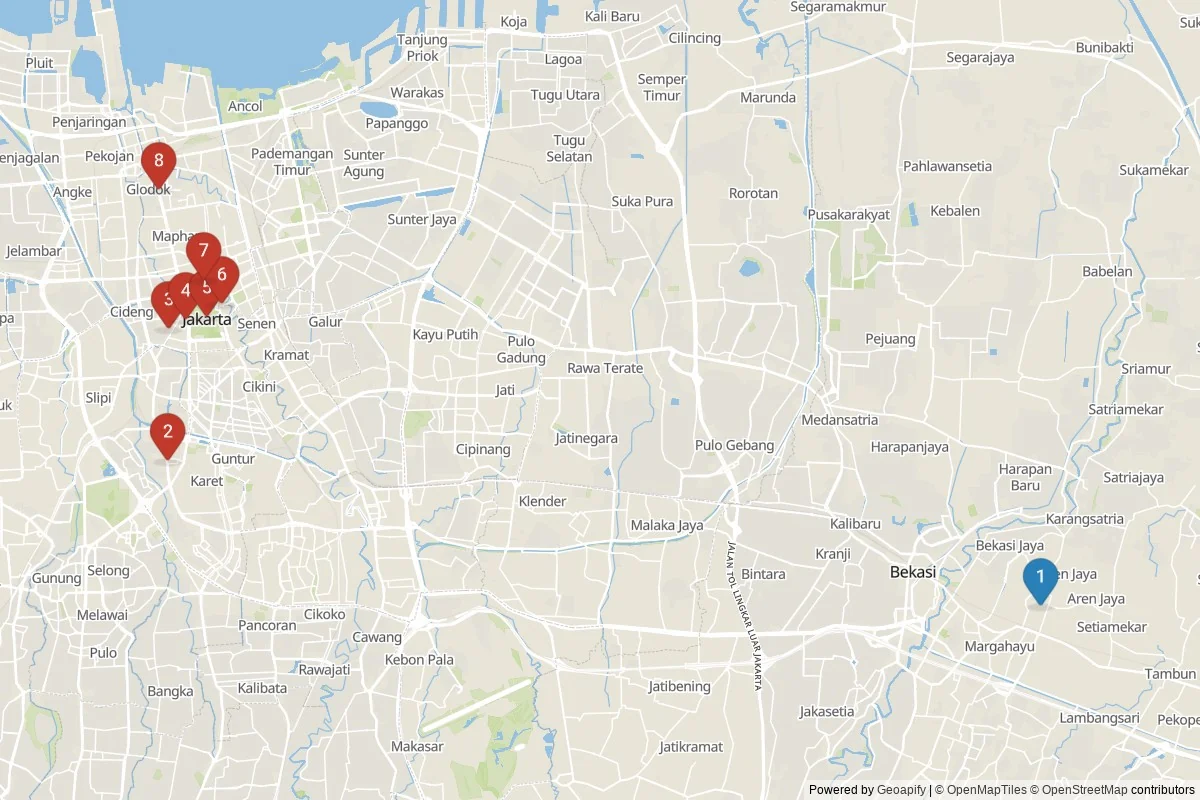
| # | Sight | Cluster | Type | Time | Entry | Best |
|---|---|---|---|---|---|---|
| 1 | Day Trip to Pulau Seribu (Thousand Islands) | Cluster A | Bridge | 90 min | — | — |
| 2 | Walk Kota Tua (Old Batavia) | Cluster B | Museum | 15 min | Free | — |
| 3 | Dine & Drink in Senopati, Kemang, or SCBD | Cluster B | — | — | — | Night |
| 4 | the National Museum | Cluster B | Museum | — | — | — |
| 5 | the National Monument (Monas) | Cluster B | Museum | 2 hours | — | — |
| 6 | Istiqlal Mosque & Jakarta Cathedral | Cluster B | Mosque | — | Free | — |
| 7 | Mall Hopping & Modern Jakarta | Cluster B | Market | — | — | — |
| 8 | Glodok Chinatown | Cluster B | Temple | — | — | Morning |
1. Visit the National Monument (Monas)
The 132-meter obelisk at Merdeka Square — the symbolic center of independent Indonesia. The internal lift to the observation deck (115 m up) offers 360° views over central Jakarta. The underground Indonesia National History Museum beneath the monument depicts the country’s independence struggle through 51 dioramas. Entry IDR 20,000 (~USD 1.30); plan 2 hours including museum.
2. Walk Kota Tua (Old Batavia)
The historic Dutch colonial heart of the city. Fatahillah Square with the 1707 City Hall (now the Jakarta History Museum) and the Wayang Museum; Café Batavia in a restored colonial building (atmospheric for coffee or meal); the surrounding cobblestone streets with stand-up motor-tricycle (sepeda ontel) and traditional photographers. The newly renovated Sunda Kelapa harbor (15 min north) still serves the traditional Sulawesi pinisi sailing ships. Free walking; museum entries IDR 10,000–25,000 each. Plan 3–4 hours.
3. Istiqlal Mosque & Jakarta Cathedral
The unique pairing — the country’s national mosque (Southeast Asia’s largest) and the Catholic cathedral facing each other across Jalan Veteran. The Istiqlal Mosque‘s designed-by-a-Christian-architect history symbolizes Indonesia’s official pluralism (the country recognizes six official religions). Free entry to both; respectful dress required for the mosque (long sleeves, ankle-length pants/skirts, head covering for women — abayas available free); guided tours run hourly.
4. Explore Glodok Chinatown
Indonesia’s largest Chinatown — concentrated in West Jakarta around Pancoran. Traditional Chinese-Indonesian shops, herbal medicine, fabrics, snacks, and the famous Petak Sembilan wet market. The Toko Merah historic red shop, the Vihara Dharma Bhakti Buddhist temple. Atmospheric and authentic; best mid-morning when markets are busiest.
5. Day Trip to Pulau Seribu (Thousand Islands)
Ferry from Marina Ancol to Pulau Tidung (90 min, IDR 50,000 each way) for a beach-and-snorkeling day; combine with the famous “Love Bridge” pedestrian bridge between two small islands. Pulau Pramuka (the administrative center) has guesthouses and a turtle sanctuary. Pulau Macan (eco-luxury resort) requires 90-minute speedboat. Note: water quality varies; mosquito-borne disease risk on some islands; consider in dry season (May–September) for best experience.
6. Visit the National Museum
The country’s premier museum, on the western side of Merdeka Square — covering Indonesia’s prehistoric, Hindu-Buddhist, Islamic, and modern periods. The collection includes the famous Pithecanthropus Erectus (Java Man) fossils, ancient Hindu-Buddhist sculptures from across the archipelago, ethnographic textiles from all 17,000+ Indonesian islands, and the iconic Bahasa Indonesia document of independence. Entry IDR 15,000 (~USD 1).
7. Mall Hopping & Modern Jakarta
Jakarta has the country’s most concentrated upscale shopping. Plaza Indonesia and Plaza Senayan (luxury); Grand Indonesia (massive flagship mall); Pacific Place (high-end); Pondok Indah Mall (suburban premium). For street markets and traditional shopping: Pasar Tanah Abang (textiles and clothing, the country’s largest wholesale market) and Pasar Baru (general goods).
8. Dine & Drink in Senopati, Kemang, or SCBD
South Jakarta’s modern dining-and-bar scene rivals any major Southeast Asian capital. Plataran Menteng (heritage Indonesian fine-dining); Lara Djonggrang (traditional Indonesian theater-restaurant); Kaum Jakarta (contemporary Indonesian); Cafe Batavia (atmospheric historic colonial). SCBD rooftop bars: SKYE, Henshin, Cloud Lounge. Senopati late-night: Awan Lounge, La Vue Rooftop.
How to Get to Jakarta
By Air
Soekarno-Hatta International Airport (CGK), 20 km west of central Jakarta, is Indonesia’s primary international airport and one of Southeast Asia’s busiest. Direct nonstop routes from most major Asian hubs (Singapore, Kuala Lumpur, Bangkok, Hong Kong, Tokyo, Seoul, Taipei, Manila, Mumbai, Dubai), the Middle East (Doha, Dubai, Jeddah), Australia (Sydney, Melbourne, Perth), and a growing list of European destinations (Amsterdam, Istanbul, Doha). Carriers: Garuda Indonesia (the flag carrier), Lion Air, Citilink, AirAsia Indonesia, Batik Air, plus most major international carriers.
From the airport: Airport Railink train IDR 50,000 (~USD 3.30) to Sudirman Station (45 min); airport bus DAMRI IDR 60,000 to multiple central destinations; Grab/Gojek IDR 150,000–300,000 to central Jakarta (60–120 min, traffic-dependent); taxi IDR 250,000–450,000.
By Train
The PT Kereta Api Indonesia network connects Jakarta to all major cities on Java. Gambir Station in Central Jakarta serves executive intercity trains; Pasar Senen serves economy. Jakarta-Bandung: 45 min on the new Whoosh high-speed train (USD 15–25), 3 hours on conventional. Jakarta-Yogyakarta: 6 hours executive (IDR 600,000–800,000). Jakarta-Surabaya: 9 hours executive. Trains are reliable and a comfortable alternative to flying.
By Bus
Extensive intercity bus network from Pulo Gebang and other terminals; useful for budget travel but slow and traffic-disrupted.
Visa Notes
Indonesia offers visa-on-arrival for citizens of 97 countries — including the US, UK, all EU member states, Canada, Australia, New Zealand, Japan, South Korea, Singapore, India, China. Visa-on-arrival: IDR 500,000 (~USD 33); valid 30 days extendable once for another 30 days. 9 ASEAN nationalities enter visa-free for 30 days. e-Visa available online via the Indonesian Immigration’s e-Visa portal for advance application. Indonesia’s “Second Home” visa (5–10 years for retirees and investors) requires significant deposit and documentation. Passport must have at least 6 months remaining validity with 2 blank pages.
Getting Around Jakarta
Ride-Hailing (Grab & Gojek)
The default for foreign visitors. Gojek (the Indonesian unicorn) and Grab both operate extensively with cars (GrabCar/GoCar) and motorcycle taxis (GrabBike/GoRide). Motorcycle taxis are dramatically faster in Jakarta traffic — a 4 km journey by car might take 60 minutes during rush hour but 15 minutes by motorbike. Single motorbike rides IDR 10,000–35,000; cars IDR 25,000–80,000 for typical central trips. Apps accept credit cards and integrate Gojek’s own GoPay digital wallet.
MRT & LRT
The post-2019 MRT (subway) and LRT (light rail) systems have begun to transform Jakarta transit. MRT Phase 1 connects Lebak Bulus (South Jakarta) to Bundaran HI (Central Jakarta) — 13 km, 13 stations, opened 2019 and expanding. LRT connects to East Jakarta and the Jabodetabek suburbs. Single fares IDR 3,000–14,000 (~USD 0.20–1); fast and reliable but covers only limited routes.
TransJakarta Bus Rapid Transit
The TransJakarta BRT network covers central Jakarta on dedicated bus lanes; useful for travelers who can navigate the routes. Single ticket IDR 3,500 (~USD 0.23); air-conditioned buses; significantly faster than ordinary traffic due to dedicated lanes.
Walking & Crossings
Jakarta is generally not walkable — sidewalks are intermittent, often broken or occupied by parked motorbikes, and intersection crossings are challenging. The exception: the central pedestrian zones around Sudirman during Sunday “Car-Free Day” (Sundays 6:00–11:00); the Kota Tua heritage area; and the modern mall districts (where indoor air-conditioned walking through linked malls is the practical alternative to outdoor walking).
Self-Drive Cars
Not recommended for visitors. Jakarta traffic is genuinely intense; navigating unfamiliar one-way systems is difficult; parking is challenging.
Food & Drink in Jakarta
Indonesian cuisine combines indigenous Java-and-archipelago traditions with significant Chinese, Dutch, Indian, and Arab influences. The country’s regional cuisines are remarkably diverse — Padang cuisine from West Sumatra; Manado cuisine from North Sulawesi; Javanese sweet sambal traditions; Balinese feasts. Jakarta hosts the broadest cross-section, plus the country’s most concentrated international fine-dining scene.
What to Try
- Nasi Goreng — Indonesian fried rice; the national breakfast standard; topped with a fried egg, krupuk (prawn crackers), and pickles.
- Mie Goreng — fried noodles; the broader regional variant of fried rice.
- Sate (Satay) — skewered grilled meat (chicken, beef, lamb, mutton) with peanut sauce; the universal Indonesian street food.
- Rendang — slow-cooked dry-coconut beef curry from West Sumatra (Padang cuisine); often voted the world’s most delicious food.
- Nasi Padang — the West Sumatran Padang-style buffet: dozens of small dishes brought to your table, pay only for what you eat. The country’s standard sit-down lunch in many districts.
- Soto — Indonesian soup; many regional varieties (Soto Betawi from Jakarta, Soto Ayam from Java).
- Gado-Gado — Indonesian salad with vegetables, tofu, tempeh, egg, krupuk, peanut sauce.
- Bakso — meatball soup, the street-food universal.
- Martabak — savory stuffed flatbread (Martabak Telur) or sweet pancake-cake (Martabak Manis); the late-night street-food classic.
- Es Teler and Es Cendol — Indonesian sweet iced drinks/desserts with shaved ice, palm sugar, coconut, and tropical fruits.
- Kopi tubruk (Indonesian-style coffee, unfiltered) and kopi luwak (the famous civet-coffee — debated ethically due to animal welfare concerns).
Where to Eat
Kaum Jakarta (Senopati): contemporary Indonesian fine-dining. Plataran Menteng: heritage Indonesian in a colonial mansion. Lara Djonggrang: traditional Indonesian theatrical experience. Bunga Rampai (Menteng): refined heritage Indonesian. RM Sederhana: classic Padang restaurant chain. Bandar Djakarta (Ancol): the canonical seafood experience. August: contemporary Asian fine-dining. Café Batavia: atmospheric colonial-era restaurant. Yogyakarta-area food courts at the major malls. Street food alternatives: Pasar Senen and the Pasar Tanah Abang night-food sections; the Sabang area on weekend nights for street-food clusters; Glodok Chinatown for Chinese-Indonesian street food.
Drinks
Kopi (coffee): Indonesia is one of the world’s largest coffee producers; Sumatran Mandheling, Javanese Arabica, Sulawesi Toraja, and the famous (and controversial) Kopi Luwak. Es Teh Manis (sweet iced tea): the universal accompaniment to Indonesian meals. Bintang Beer: the dominant local Indonesian beer. Wine and cocktails: limited availability due to Indonesia’s Muslim-majority alcohol restrictions; widely available at international-tier hotels, licensed restaurants, and bars. Tea: Javanese black tea, often served with cane sugar. Coconut water: fresh from green coconuts; the universal tropical refresher.
A Note on Tap Water
Tap water in Jakarta is not safe to drink for foreign visitors. Use sealed bottled water (IDR 4,000–10,000 per 1.5-liter bottle; major brands Aqua, Le Minerale, Pristine) for drinking and brushing teeth. Reusable filter bottles (LifeStraw, Grayl) work well. Ice in mid-range and upmarket restaurants is generally safe; avoid ice from street stalls without obvious purified-water sources. The CDC traveler health page for Indonesia recommends bottled or boiled water plus hepatitis A, typhoid, hepatitis B, Japanese encephalitis, and rabies vaccinations consideration. Mosquito-borne disease risk: dengue fever and zika are endemic; chikungunya present; insect repellent essential particularly during rainy season. Traveler’s diarrhea is the most common visitor health complaint; eat at busy, established restaurants.
Frequently Asked Questions About Visiting Jakarta
Do I need a visa to visit Jakarta?
For most foreign passport holders, yes — but Indonesian visa-on-arrival is fast and inexpensive. Citizens of 97 visa-on-arrival countries (US, UK, all EU member states, Canada, Australia, New Zealand, Japan, South Korea, Singapore, India, China, etc.) can purchase the Visa-on-Arrival (VOA) at Soekarno-Hatta Airport for IDR 500,000 (~USD 33) at the dedicated counters before immigration. Valid 30 days, extendable once in-country for another 30 days. 9 ASEAN nationalities enter visa-free for 30 days. e-Visa via the Indonesia e-Visa portal is available for advance application. Passport must have 6+ months remaining validity and at least 2 blank pages. Indonesia’s Golden Visa / Second Home Visa (5–10 years) for retirees and investors requires significant deposit. Common mistakes: using unofficial visa websites; assuming visa-on-arrival is free (it costs IDR 500,000 cash or card); not having clean USD or IDR cash for the VOA payment.
Is Jakarta safe for tourists?
Jakarta is generally safe for tourists with normal urban precautions, though crime rates exceed those of European or East Asian capitals. The US State Department rates Indonesia at “exercise increased caution” — primarily for terrorism risks. Real risks: pickpocketing in crowded markets (Pasar Tanah Abang, Glodok); traffic accidents — Jakarta has notoriously chaotic traffic and high road-death rates; motorbike-taxi safety — accidents do happen on Gojek/Grab bikes; flooding during the wet season (November-March) can shut down central districts unexpectedly; air pollution — Jakarta routinely ranks among the world’s most polluted cities; credit-card skimming at low-end ATMs (use bank-branch ATMs); petty corruption with police at random checkpoints (rare but documented); mosquito-borne diseases (dengue endemic, occasional zika and chikungunya); conservative dress expectations — Jakarta is more progressive than rural Indonesia but modest dress in religious sites is required and outside tourist areas is appreciated. Drug laws: Indonesia has extremely harsh penalties for drug offenses — possession of even small amounts carries multi-year prison sentences; trafficking carries the death penalty (Bali Nine case). LGBTQ+ travelers: same-sex relationships are not criminalized federally but are increasingly stigmatized in some provinces; Jakarta’s gay scene is discreet but exists. Female travelers: dress modestly in religious sites; be aware of cultural sensitivities around touching strangers of opposite sex.
How many days do I need in Jakarta?
Two to three days handles Jakarta proper; the city is more often a transit point for the broader Indonesia archipelago than a destination itself. A solid 3-day Jakarta plan: Day 1 — arrive, Monas (National Monument) + Museum Nasional + Istiqlal Mosque + Jakarta Cathedral + lunch at Café Batavia + Kota Tua afternoon (Fatahillah Square + Wayang Museum + Sunda Kelapa harbor) + dinner at Kaum or Plataran Menteng. Day 2 — Glodok Chinatown morning + Pasar Tanah Abang or Pasar Baru shopping + lunch in South Jakarta + mall hopping (Plaza Indonesia + Grand Indonesia) + Senopati dinner. Day 3 — Pulau Seribu (Thousand Islands) day trip: Pulau Bidadari is closer and easier; Pulau Tidung is more popular for swimming. Alternatively: many travelers fly to Bali, Yogyakarta, or Komodo after just 1-2 days in Jakarta. 10-day Indonesia classic: 1 day Jakarta + 2 days Yogyakarta (Borobudur + Prambanan UNESCO temples) + 5 days Bali + 2 days Komodo. Day-trip Jakarta: not really feasible; allow at least overnight given airport-to-city traffic.
What’s the best area to stay in Jakarta?
For most visitors, South Jakarta or Central Jakarta is the practical choice. Senopati / Senayan (South Jakarta): modern luxury and contemporary dining; The Ritz-Carlton Jakarta Pacific Place, Pullman Jakarta Indonesia, Fairmont Jakarta; USD 80–300/night. Sudirman / Thamrin (Central Jakarta CBD): skyscraper business district; Grand Hyatt Jakarta, Hotel Indonesia Kempinski, Mandarin Oriental Jakarta; USD 100–400/night. Kuningan: embassy district; Four Seasons Hotel Jakarta (relocated 2016 to Kuningan), Raffles Jakarta, JW Marriott; USD 150–500/night. Menteng: older upmarket residential; The Hermitage; USD 80–200/night. Kemang: expat-favored neighborhood with bars and restaurants; mid-range hotels; USD 50–150/night. Kota Tua: heritage area; limited modern accommodation; mostly day-trip rather than overnight. Skip: cheap unbranded hotels far from any main district with no English-speaking staff. Note: hotel prices in Jakarta have dropped considerably post-pandemic; international 5-star hotels often available at mid-range prices.
How much does it cost to visit Jakarta’s major sights?
Jakarta is one of Asia’s better-value major cities. National Monument (Monas): IDR 20,000 (~USD 1.30). National Museum: IDR 15,000 (~USD 1). Istiqlal Mosque: free. Jakarta Cathedral: free. Jakarta History Museum (Kota Tua): IDR 10,000. Wayang Museum: IDR 10,000. Ancol Dreamland: IDR 25,000 entry + theme park tickets IDR 350,000–600,000. Pulau Tidung day trip: IDR 50,000 ferry + IDR 200,000–400,000 day-tour package. Local meals: nasi padang or warung lunch IDR 30,000–80,000 (~USD 2–5); food court IDR 50,000–150,000 per person; mid-range restaurant dinner IDR 200,000–600,000 per person; fine-dining IDR 800,000–2,500,000 per person. Café latte: IDR 50,000–80,000. Grab car across central Jakarta: IDR 30,000–80,000 (~USD 2–5). Grab motorbike (much faster in traffic): IDR 10,000–35,000. MRT single ticket: IDR 3,000–14,000. Airport Railink to central: IDR 50,000. Local SIM card with data: IDR 50,000–150,000. Overall daily budget: USD 40 (frugal hostel + warung food + Grab), USD 100 (mid-range hotel + restaurants), USD 300+ (luxury hotel + fine dining + private guide).
Should I drink the tap water in Jakarta?
No — tap water in Jakarta is not safe to drink for foreign visitors. The municipal supply is treated but distribution-network contamination is widespread; most locals boil before drinking or use bottled water. Always use sealed bottled water (IDR 4,000–10,000 per 1.5-liter bottle at any convenience store; major brands Aqua, Le Minerale, Pristine) for drinking and brushing teeth. Reusable filter bottles (LifeStraw, Grayl, Sawyer 0.1-micron filter) work well in Indonesia. Hotel kettles boil water reliably. Ice in mid-range and upmarket restaurants is generally safe (machine-made from purified water); avoid ice from street stalls. The CDC traveler health page for Indonesia recommends bottled or boiled water plus hepatitis A, typhoid, hepatitis B, Japanese encephalitis, rabies, and yellow fever (if transiting through Africa) vaccinations consideration. Mosquito-borne disease risk: dengue fever is endemic year-round in Jakarta; use DEET-based insect repellent and consider mosquito-protective clothing during the rainy season. Air pollution: Jakarta routinely has AQI 100–200+ (unhealthy); sensitive travelers should consider N95 masks; the rainy season actually improves air quality temporarily.
What payment methods work in Jakarta — credit cards or cash?
Jakarta has rapidly digitized; mobile payment dominates. Mobile payment apps (GoPay, OVO, DANA, ShopeePay) dominate everyday transactions — even small warung restaurants and street food vendors accept QR-code payments. Most require an Indonesian phone number for full registration. Credit cards (Visa, Mastercard, AmEx, JCB): accepted at hotels, mid-range and upmarket restaurants, malls, supermarkets, and Grab/Gojek rides. Many smaller restaurants, warungs, and street food are cash-only. Indonesian rupiah cash: essential for warungs, street food, motorbike taxis (Gojek pays the driver cash sometimes), and small purchases. ATMs: abundant at malls, hotels, and major intersections; BCA, Mandiri, BRI, BNI all accept foreign cards with daily withdrawal limits IDR 1,500,000–3,000,000 and IDR 30,000–50,000 international fees. Currency exchange: official money changers at malls and airports; avoid unofficial street exchanges (counterfeit rupiah risk). Bring USD in clean bills (high-denomination notes get better rates). USD acceptance: some hotels and luxury tour operators accept USD; most everyday businesses do not. Tips: not strongly ingrained in Indonesian culture but appreciated — round up restaurant bills 5–10%; IDR 10,000–25,000 per bag to hotel porters; IDR 30,000–60,000 per day for housekeeping; IDR 100,000–200,000 per day for tour guides; Grab/Gojek tips not required but appreciated. “Service charge” plus VAT: many mid-range and upmarket restaurants add 11% government tax + 5% service to the bill; additional tipping not required if these are included. SIM card: get a Telkomsel or XL Axiata data SIM at the airport for IDR 50,000–150,000 (5–25 GB); essential for Grab/Gojek and GoPay.
What about Jakarta’s traffic and the move to Nusantara — should I worry?
Two distinct Jakarta realities worth understanding. Traffic congestion: Jakarta is genuinely one of the world’s most congested major cities. A 4 km journey across central Jakarta might take 60–90 minutes during 8:00–10:00 am or 17:00–21:00 pm rush hour. Practical solutions: use Grab/Gojek motorbike taxis (dramatically faster than cars in traffic — 4 km in 15 minutes vs 60 minutes by car); use the new MRT for the Sudirman-Senopati-South Jakarta corridor; plan trips for off-peak hours (10:30–16:00); build extra buffer time for airport departures (90+ minutes by car from central Jakarta, even on the airport toll road). The Nusantara new-capital project: in 2019, the Indonesian government announced the official capital would move from Jakarta to Nusantara — a planned new city in East Kalimantan (Indonesian Borneo), about 1,200 km northeast of Jakarta. The official capital transfer began in 2024 and is phased over multiple years. What this means for visitors: Jakarta remains Indonesia’s economic, cultural, and financial capital indefinitely; the population, business activity, and tourist infrastructure all remain in Jakarta. Only specific government functions (presidential palace, parliament, ministries) are gradually relocating to Nusantara. The Soekarno-Hatta Airport remains the primary international gateway. Flooding: northern Jakarta sits below sea level and floods during heavy wet-season rains; the city is sinking 25 cm per year (the world’s fastest). The Jakarta Giant Sea Wall project (2014-onwards) attempts to mitigate this. Visitors during wet season (December-March) should avoid northern Jakarta hotels and have flexible itineraries.
Education & Notable People
Jakarta is the educational anchor of Indonesia, with multiple major universities and the country’s leading research institutions.
Major Universities
- Universitas Indonesia (UI) — founded 1849; the country’s flagship public university; ~50,000 students; main campus in Depok (south of Jakarta proper).
- Bandung Institute of Technology (ITB) — Indonesia’s leading technical university (in nearby Bandung).
- Universitas Gadjah Mada (UGM) — in Yogyakarta; the country’s other flagship public university.
- Trisakti University — Jakarta-based private university.
- Atma Jaya Catholic University — Jakarta-based private Catholic university.
- Binus University — leading private business and technology university.
Notable People
Sukarno (1901–1970) — first President of Indonesia; led the independence movement; declared independence August 17, 1945. Mohammad Hatta (1902–1980) — first Vice President; co-signed the Proclamation of Independence with Sukarno. Suharto (1921–2008) — second President (1967–1998); the country’s long-time New Order dictator. Megawati Sukarnoputri — fifth President (2001–2004), Sukarno’s daughter. Joko “Jokowi” Widodo — seventh President (2014–2024). Prabowo Subianto — current President (since 2024). Pramoedya Ananta Toer (1925–2006) — celebrated novelist; the Buru Quartet. Bj Habibie — third President; aerospace engineer who developed Germany’s CN-235 aircraft. Jokowi-era cultural figures: many contemporary Indonesian musicians, filmmakers, and writers have emerged in Jakarta’s post-2014 cultural revival.
Sister Cities & International Relations
Jakarta’s sister-city network reflects the city’s role as the political-and-economic capital of one of the world’s largest emerging-market economies and the world’s largest Muslim-majority democracy.
Jakarta’s sister and partnership cities include (selection):
- Tokyo, Japan — paired since 1989; the longest-running Asian partnership.
- Beijing, China — sister city since 1992.
- Los Angeles, California, USA — paired since 1990.
- Berlin, Germany — paired since 1993.
- Rotterdam, Netherlands — paired since 1980; reflects the historic Dutch colonial connection.
- Bangkok, Thailand — ASEAN regional cooperation.
- Hanoi, Vietnam — ASEAN partnership.
- Manila, Philippines — ASEAN.
- Riyadh, Saudi Arabia — Muslim-world capital partnership.
- Cairo, Egypt — Muslim-world friendship.
Jakarta hosts the ASEAN Secretariat headquarters (ASEAN founded in Bangkok 1967; secretariat moved to Jakarta 1981) — making the city the diplomatic capital of Southeast Asia. The 2023 ASEAN summit, 2022 G20 summit, and multiple international cooperation initiatives have positioned Jakarta as one of Asia’s most consequential diplomatic capitals. The Indonesia Travel portal coordinates national tourism promotion.
AFRIKA
Cairo Hurghada Johannesburg Marrakech
ASIA
Abu Dhabi Agra Antalya Bangkok Batam Beijing Bengaluru Cebu City Chiang Mai Chiba Chennai Da Nang Dammam Delhi Denpasar Dubai Fukuoka Guangzhou Guilin Ha Long Hanoi Ho Chi Minh City Jakarta Jaipur Johor Bahru Kolkata Krabi Kuala Lumpur Kyoto Macau Mecca Medina Mugla Mumbai Osaka Pattaya Penang Phuket Riyadh Seoul Shanghai Shenzhen Singapore Taipei Tokyo Zhuhai
EUROPE
Amsterdam Athens Barcelona Berlin Brussels Budapest Copenhagen Dublin Florence Frankfurt am Main Heraklion Krakow Lisbon London Madrid Milan Munich Nice Paris Porto Prague Rhodes Rome Stockholm Venice Vienna Warsaw
NORTH AMERICA
Cancun Las Vegas Los Angeles Miami New York City Orlando San Francisco Toronto Vancouver
SOUTH AMERICA
Buenos Aires Lima Rio De Janeiro
OCEANIA
Auckland Honolulu Melbourne Sydney