
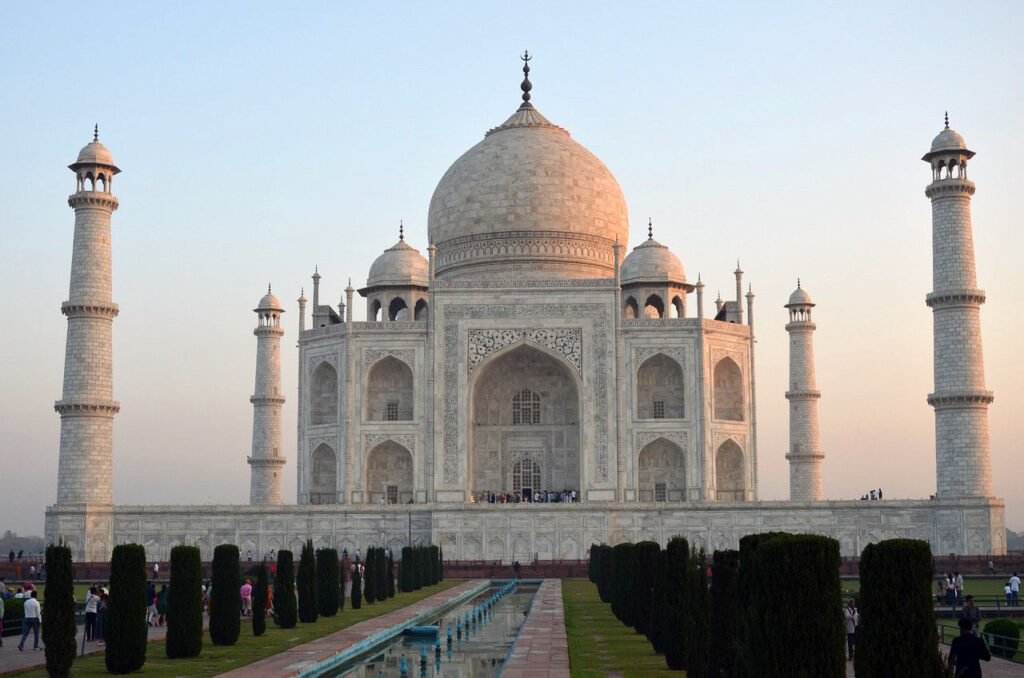
Photo credit: The magnificent Taj Mahal at golden hour
Nestled along the banks of the Yamuna River in northern India, Agra stands as one of the world’s most celebrated destinations, home to the iconic Taj Mahal and a treasure trove of Mughal architectural masterpieces. This historic city of 1.7 million people served as the capital of the mighty Mughal Empire from 1526 to 1648, leaving behind an extraordinary legacy of palaces, tombs, and monuments that continue to captivate visitors from around the globe. Beyond its world-famous marble mausoleum, Agra offers travelers an immersive journey through centuries of Indian history, vibrant local culture, and exceptional craftsmanship.
Agra at a Glance: Essential Facts for Travelers
| Location | Uttar Pradesh, Northern India |
|---|---|
| Coordinates | 27.1767°N, 78.0081°E |
| Population | 1.7 million (2023 estimate) |
| Area | 188.4 km² |
| Elevation | 168 meters above sea level |
| Time Zone | Indian Standard Time (IST, UTC+5:30) |
| Calling Code | +91 562 |
| Postal Code | 282001-282010 |
| Known For | Taj Mahal, Agra Fort, Mughal architecture, marble inlay work |
| Languages | Hindi (primary), English, Urdu |
| District Magistrate | Prabhu N Singh (2023) |
| Official Website | agra.nic.in |
Upcoming Events in Agra
| Date | Title | Details |
|---|---|---|
| 2026-09-18 | Jagran Film Festival – Agra Chapter | The travelling Jagran Film Festival makes its Agra stop at PVR Anjana Mall from 4:00 PM, bringing a curated programme of acclaimed Indian features, short films and regional cinema to the city. One of India’s largest touring film festivals, it moves through more than a dozen cities each season and gives Agra audiences a rare chance to catch award-winning titles on the big screen. Entry is typically free with prior registration; the relaxed format suits students, families and film buffs alike. [Source] |
| 2026-09-20 | Inder Sahani Live – Standup Comedy | Touring comedian Inder Sahani performs his solo standup set at Romeo Lane in Agra on Sunday evening from 6:00 PM. Known from India’s club comedy circuit and popular online clips, Sahani mixes observational humour about small-town life, family and everyday absurdities in Hindi with plenty of crowd work. The intimate cafe-style venue keeps the show up close and interactive. Ticket prices vary by seating band and the show is aimed at adult audiences; seating is limited, so early booking is advisable. [Source] |
| 2026-09-28 to 2026-10-20 | Ram Barat and Ramlila Season | Agra is famous for its grand Ram Barat, a spectacular wedding procession of Lord Ram staged during the annual Ramlila celebrations in the weeks around Dussehra. Held in traditional neighbourhoods with lavishly decorated venues, elephants, horses, tableaux and huge crowds, it is one of northern India’s most elaborate religious festivities. The wider Ramlila sees nightly enactments of the Ramayana culminating in Dussehra. Exact dates follow the Hindu lunar calendar, generally falling across late September and October; visitors should check locally for the precise schedule and main procession night. [Source] |
| 2026-10-02 | Naram Lehja by Kanha Kamboj | Performer Kanha Kamboj brings his spoken-word and storytelling show Naram Lehja to Incanto in Agra on Friday from 7:00 PM. The Hindi-Urdu evening blends shayari, poetry and gentle humour into an intimate stage set that has been touring smaller Indian cities this season. The cosy venue format encourages audience interaction, making it a good pick for poetry lovers, students and couples looking for a quieter cultural night out. Ticket prices vary by band and are sold through online event platforms. [Source] |
| 2026-10-04 | Namak Kam Hai by Vidit Sharma | Comedian Vidit Sharma performs his solo show Namak Kam Hai at Incanto in Agra on Sunday from 5:00 PM. The Hindi standup set serves self-deprecating stories about family kitchens, relationships and middle-class life, delivered in the conversational style that has built Sharma a following on the touring circuit. The early-evening slot and compact venue make it an easy outing before the working week. Ticket prices vary by band and are available online; the humour is aimed mainly at adult and young-adult audiences. [Source] |
| 2026-10-24 to 2026-10-28 | Taj Mahal Full Moon Night Viewing | The Archaeological Survey of India opens the Taj Mahal for its monthly moonlight viewing over five nights around the full moon of 26 October. Visits run between 8:30 PM and 12:30 AM in eight timed batches of up to 50 people, with only 400 tickets sold per night, so advance online booking is essential. Tickets cost about 510 rupees for Indian visitors and 750 rupees for foreigners. Seeing the white marble mausoleum glow under a clear autumn moon is a rare treat; DSLR cameras are not permitted. [Source] |
| 2026-11-06 to 2026-11-10 | Diwali Festival of Lights in Agra | Agra celebrates the five-day Diwali season from Dhanteras on 6 November through Bhai Dooj on 10 November, with the main festival of lights and Lakshmi Puja falling on Sunday 8 November. Bazaars such as Sadar Bazaar and Kinari Bazaar overflow with diyas, sweets and marigold garlands, homes and hotels glow with oil lamps, and fireworks light the skyline along the Yamuna. Most celebrations are free to experience on the streets, and evenings in the decorated markets are especially atmospheric for visitors and families. [Source] |
City News in Agra – last 14 days
| Date | Category | Headline | Details |
|---|---|---|---|
| 2026-09-14 | Local affairs | Uganda’s Vice President Jessica Alupo visits the Taj Mahal | Uganda’s Vice President Jessica Alupo toured the Taj Mahal during an official visit to Agra, joining the steady stream of visiting dignitaries who make the marble mausoleum a fixture of state itineraries in India. High-profile visits of this kind typically involve a guided tour of the monument along with heightened security arrangements around the complex. The stop underlines Agra’s continuing role as a diplomatic showcase city, where foreign leaders are regularly brought to see India’s most famous UNESCO World Heritage Site. [Source] |
| 2026-09-14 | Sports | Agra celebrates as Deepti Sharma helps India win Women’s Asia Cup | Celebrations broke out at the Agra family home of cricketer Deepti Sharma after India’s historic victory in the Women’s Asia Cup final, which sealed the team’s eighth title in the tournament. Relatives received a constant flow of well-wishers arriving to congratulate the family, reflecting the city’s pride in its star all-rounder. Deepti, who grew up in Agra, has become one of the faces of Indian women’s cricket, and her performances in the final were the talk of the neighbourhood. [Source] |
| 2026-09-13 | Business | GST on everyday electrical goods set to fall from 18 to 5 percent | Traders and consumers in Agra are set to benefit from a reduction in the goods and services tax on everyday electrical items, with the rate coming down from 18 percent to 5 percent. Local electrical merchants expect the cut to lower retail prices on commonly used household products and to lift sales in the run-up to the festive season, when demand for lights and fittings traditionally peaks. The change forms part of a wider rationalisation of GST slabs announced nationally. [Source] |
| 2026-09-13 | Public transport | Seven buses seized in crackdown on misused tourist permits | Transport enforcement teams seized seven buses that were carrying regular fare-paying passengers under the cover of tourist permits, a practice that undercuts licensed stage-carriage services. The drive covered several corridors including routes on the Agra and Purvanchal expressways. Officials said vehicles with tourist permits are not allowed to pick up point-to-point passengers like ordinary buses, and further checks are planned. The campaign is intended to protect passenger safety and the revenues of the state transport corporation. [Source] |
| 2026-09-13 | Culture | ASI to clear debris from the moat of Agra Fort | The Archaeological Survey of India is preparing to remove accumulated debris from the moat surrounding Agra Fort, the Mughal-era citadel that stands across the Yamuna bend from the Taj Mahal. The clean-up is aimed at improving the appearance and conservation of the protected monument, whose defensive ditch has silted up over the years. The fort is one of Agra’s most visited heritage sites, and the work forms part of ongoing efforts to maintain the UNESCO-listed complex. [Source] |
| 2026-09-13 | Local government | Rajnath Singh in Agra says UP has moved from mafia rule to development | Defence Minister Rajnath Singh used a public appearance in Agra to argue that Uttar Pradesh has shifted from an era of so-called mafia dominance to one of development and infrastructure building. Addressing a large community gathering, he pointed to expressways, improved law and order and industrial investment as evidence of the change. During the same visit he was honoured by the Khatik community, which also pressed demands of its own, including recognition within the armed forces. [Source] |
| 2026-09-13 | Business | Employment fair on 17 September to offer around 1,000 openings | A rozgar mela, or employment fair, will be held in Agra on 17 September with around 1,000 positions on offer from participating companies. Job seekers can register and appear for on-the-spot interviews with private-sector employers recruiting for a range of roles. Such fairs are organised regularly by the regional employment office to connect local youth with vacancies without lengthy application processes. Candidates are advised to bring their documents and certificates to the venue for verification. [Source] |
| 2026-09-13 | Education | More than 500 of 850 MBBS and BDS seats still vacant in admissions round | Admissions to medical and dental colleges in the Agra region are running well below capacity, with 516 of the 850 available MBBS and BDS seats still unfilled in the current counselling round. The vacancy level has raised concern among college administrators, who are waiting to see whether later counselling rounds bring in more candidates. Separately, counselling was also scheduled for 66 LLM seats, part of a busy admissions season across the city’s higher-education institutions. [Source] |
| 2026-09-12 | Public safety | UP constable found dead at Agra Police Lines, probe ordered | A constable of the Uttar Pradesh police was found dead at the Police Lines complex in Agra, prompting senior officers to order an investigation into the circumstances of the death. The body was sent for post-mortem examination as investigators began questioning colleagues and examining the scene. Officials said all angles are being looked into and that the findings of the inquiry will determine any further action. The death has cast a shadow over the barracks community in the city. [Source] |
| 2026-09-11 | Business | Bank services across Agra hit as employees join strike | Banking services in Agra were disrupted as employees joined a strike call, leaving many branches shut or working with skeleton staff. Routine counter services such as deposits, withdrawals and cheque clearing were affected, inconveniencing customers and traders who had to postpone transactions. Union representatives said the action was part of a wider agitation over employee demands in the banking sector. ATMs continued to serve cash-seekers, though some machines ran short as the day progressed. [Source] |
| 2026-09-11 | Local affairs | CBI court jails Agra railway official for four years over bribe | A special CBI court has sentenced a railway official posted in Agra to four years in jail for taking a bribe of 35,000 rupees. The conviction followed an investigation by the Central Bureau of Investigation, which had trapped the official while he accepted the illegal payment in exchange for favourable treatment. The court also imposed a fine as part of the sentence. The case adds to a series of anti-corruption prosecutions involving public servants in the railway administration. [Source] |
| 2026-09-11 | Public safety | Woman on her way to work stabbed in neck and back by stalker | A woman commuting to work in Agra was assaulted and stabbed in the neck and back by a man who had allegedly been stalking her, in an attack that has renewed concern over women’s safety in the city. She was rushed to hospital for treatment while police registered a case and launched a hunt for the accused. Investigators said the suspect had been harassing the victim for some time before the assault, and further legal action is under way. [Source] |
| 2026-09-08 | Public transport | Proposed bullet train would put Agra under an hour from Delhi | Under India’s proposed Delhi–Varanasi high-speed rail corridor, travel from the capital to Agra would take under one hour, with Varanasi reachable in about three and a half hours. Published travel-time estimates also cover intermediate cities such as Kanpur, Lucknow and Prayagraj, while an onward network would extend towards Patna. For Agra, a roughly 58-minute connection to Delhi could transform day tourism and commuting patterns. The project remains at the planning stage, with alignments and funding still to be finalised. [Source] |
| 2026-09-06 | Local affairs | BRICS chief justices tour Taj Mahal and Agra Fort | A 65-member delegation of chief justices and senior judges from BRICS nations travelled to Agra, where they visited the Taj Mahal and Agra Fort during a break from their official engagements in India. The judicial dignitaries were given guided tours of both UNESCO World Heritage monuments under tight security. Host authorities used the visit to showcase the city’s Mughal heritage to the visiting jurists, continuing Agra’s long tradition of receiving high-level international delegations between summit sessions. [Source] |
Agra Events & City News Archive
Sources: AllEvents, AllEvents, Uttar Pradesh Tourism, Archaeological Survey of India, BDA Festival Calendar, The Tribune, Amar Ujala, Amar Ujala
Weather Forecast for the Next 14 Days in Agra
| Date | Weather | Max °F | Min °F | Rain mm |
|---|---|---|---|---|
| 2026-09-14 | ⛈️ | 89.6 °F | 78.5 °F | 3.7 mm |
| 2026-09-15 | ⛈️ | 87.4 °F | 76.3 °F | 10.2 mm |
| 2026-09-16 | ⛈️ | 87.4 °F | 76.2 °F | 2.7 mm |
| 2026-09-17 | ☁️ | 89.5 °F | 75.8 °F | 0.0 mm |
| 2026-09-18 | ⛈️ | 86.2 °F | 74.2 °F | 7.1 mm |
| 2026-09-19 | ☁️ | 87.4 °F | 74.4 °F | 0.0 mm |
| 2026-09-20 | 🌧️ | 88.4 °F | 75.5 °F | 0.6 mm |
| 2026-09-21 | ☀️ | 89.9 °F | 76.7 °F | 0.0 mm |
| 2026-09-22 | ☀️ | 90.3 °F | 75.8 °F | 0.0 mm |
| 2026-09-23 | ☀️ | 91.1 °F | 74.3 °F | 0.0 mm |
| 2026-09-24 | ☀️ | 91.3 °F | 73.9 °F | 0.0 mm |
| 2026-09-25 | ☀️ | 92.2 °F | 74.9 °F | 0.0 mm |
| 2026-09-26 | ☀️ | 92.7 °F | 75.8 °F | 0.0 mm |
| 2026-09-27 | ☀️ | 92.7 °F | 74.5 °F | 0.0 mm |
Agra’s History
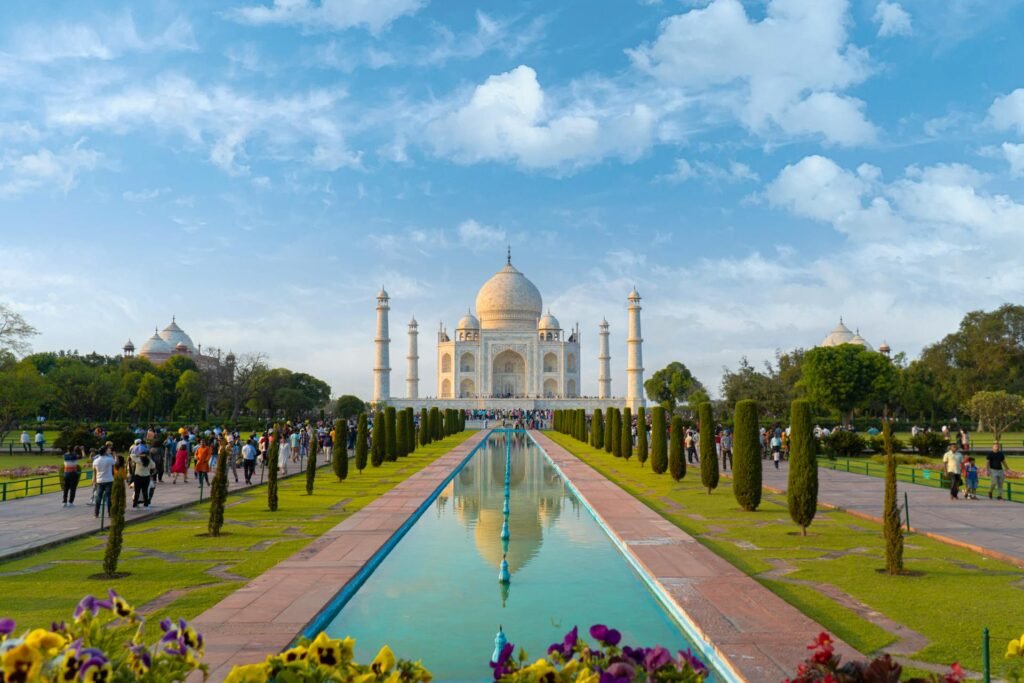
Agra is the city of one building. The Taj Mahal — a single white marble mausoleum on the banks of the Yamuna — has so completely defined the city in the global imagination that it’s easy to forget Agra was the imperial capital of one of the largest empires the world had ever seen. The fort, the Mughal palace complexes, the gardens across the river, the abandoned ghost-city of Fatehpur Sikri 40 km west: all of these belong to a 17th-century Mughal moment when Agra was, briefly, one of the great cities of the world.
Ancient references to Agra appear in Hindu texts including the Mahabharata, where it features as Agravana. The city’s golden age began in 1526 when Babur, founder of the Mughal Empire, established it as his capital after defeating Sultan Ibrahim Lodi at the First Battle of Panipat.
The Mughal Capital Era (1526–1648)
Under successive Mughal emperors, Agra became one of the world’s most populous and architecturally ambitious cities. Akbar the Great (r. 1556–1605) made it his primary residence and commissioned the massive Agra Fort in 1565 — a red sandstone citadel built on the foundations of an earlier 11th-century Rajput fort. Construction involved over 4,000 workers and took eight years. Akbar later experimented with a brand-new capital at Fatehpur Sikri (1571–1585) before abandoning it for Agra again.
The architectural zenith came under Shah Jahan (r. 1628–1658), who commissioned the Taj Mahal as a mausoleum for his favorite wife Mumtaz Mahal after her death in childbirth in 1631. Built between 1631 and 1648, the white-marble complex required 20,000+ artisans, craftsmen, and laborers from across the empire and beyond — Persian calligraphers, Italian gem-cutters, Turkish tile-workers, and the local Mughal-style architectural masters. Total cost in modern equivalent: estimated US$1 billion.
Decline and Colonial Period
Shah Jahan moved the imperial capital to Delhi in 1648 (the new walled city of Shahjahanabad), and Agra’s golden age ended within a generation. The city faced devastating invasions: Jat raiders in the early 18th century, Marathas in the late 18th century, and the British East India Company from 1803. During the 1857 Indian Rebellion, Agra Fort served as a refuge for British residents during the regional siege; the rebellion was suppressed locally by November 1857. Agra became a key administrative center of the British North-Western Provinces.
Modern Era
After India’s independence in 1947, Agra became part of Uttar Pradesh state. The city has evolved into a major tourist destination — the second-most-visited city in India after Delhi, with the Taj Mahal alone receiving 7+ million annual visitors. The traditional crafts have survived: particularly the Mughal-era pietra dura (Italian-derived “parchin kari” in Persian) marble inlay technique, still practiced by hereditary families in workshops near the Taj. Less visibly, the city’s air-pollution problem (heavy industry around Agra has caused yellowing of the Taj’s marble) is one of the more visible global heritage debates of the 21st century.
Geography, Climate & Best Time to Visit Agra
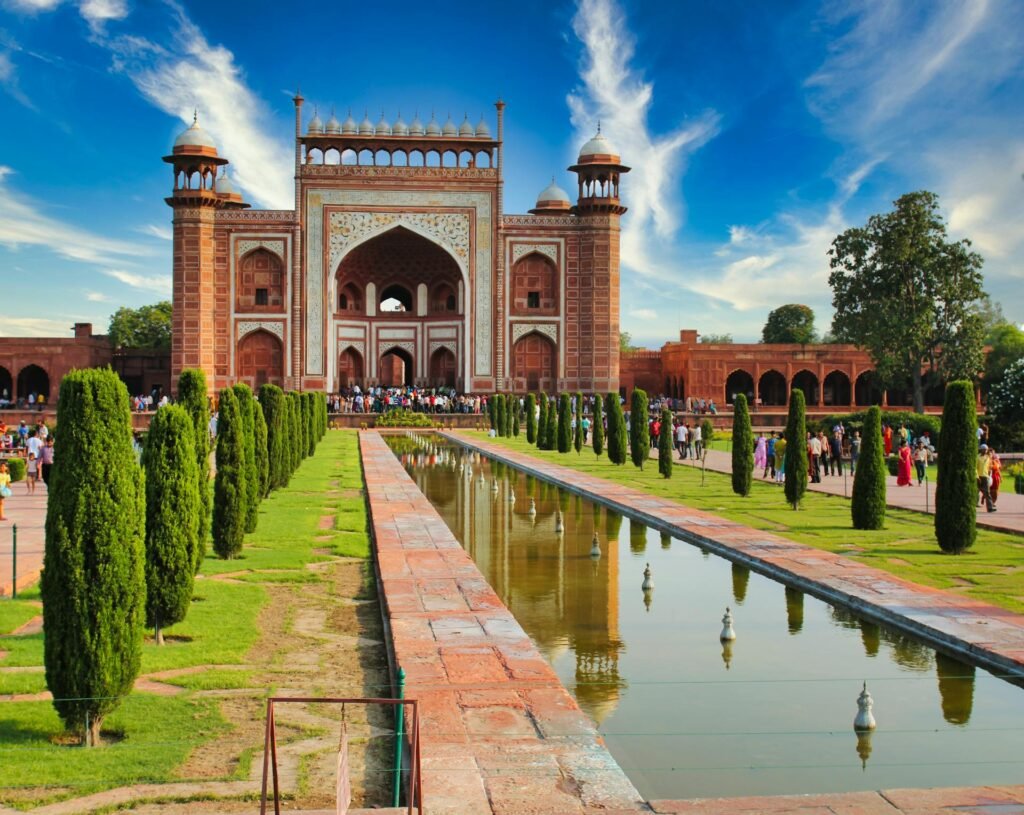
Agra sits in the fertile Gangetic plains along the Yamuna River, approximately 220 km southeast of New Delhi and 200 km east of Jaipur — making it the central pillar of India’s Golden Triangle tourist route. The terrain is flat, the elevation modest (~170 m), and the river position made the city an obvious choice for Mughal emperors seeking to control northern India’s trade routes.
Climate Patterns
Agra has a semi-arid climate with three distinct seasons. Summers (April–June) are intensely hot, with temperatures reaching 45°C, and dust storms (andhi) common in May–June. Winters (December–February) are pleasantly cool — daytime 20–25°C, nighttime 3–10°C, with morning fog frequent in December–January (occasionally heavy enough to obscure the Taj from across the river). The monsoon (July–September) brings ~720 mm of annual rainfall in heavy afternoon downpours.
| Season | Months | Temperature Range | Rainfall | Best For |
|---|---|---|---|---|
| Winter | Dec-Feb | 3-25°C | Minimal | Sightseeing, photography |
| Spring | Mar-Apr | 15-32°C | Light | Pleasant weather |
| Summer | May-Jun | 26-45°C | Low | Early morning visits |
| Monsoon | Jul-Sep | 25-35°C | Heavy | Lush gardens, fewer crowds |
Best Time to Visit
October to March is the optimal window — comfortable temperatures, minimal rainfall, and clear sunrise visibility for the iconic Taj Mahal first-light photograph. December and January can bring early-morning fog that delays Taj views until 9–10 am. Avoid April–June if possible — the heat genuinely affects how long you can spend at outdoor monuments. The Taj Mahal is closed every Friday for prayer; plan around this. The annual Taj Mahotsav festival (mid-February, 10 days) showcases traditional crafts, music, and dance at Shilpgram next to the Taj’s eastern gate.
Agra’s Districts & Neighborhoods
Agra is essentially a single-purpose tourist city; the visitor’s working geography is built around proximity to the Taj Mahal.
Taj Ganj
The area immediately surrounding the Taj Mahal — and the obvious base for first-time visitors. Narrow lanes, dozens of budget guesthouses with Taj-view rooftops, marble-inlay workshops still operating in family courtyards, small eateries serving Mughlai and tourist-friendly fare. Walking distance to the Western (main) and Southern entrances of the Taj. Atmospheric but loud and persistently touristy.
Sadar Bazaar Area
The commercial center of Agra, home to the city’s better mid-range hotels (Howard Plaza, Trident, Ramada), the main Agra Cantt railway station, banks, and the bustling Sadar Bazaar shopping district. 4 km from the Taj — short auto-rickshaw or walk. Best base for travelers who want modern hotel amenities while maintaining tourism convenience.
Fatehabad Road
The upscale luxury-hotel corridor connecting central Agra southwest toward Fatehpur Sikri. Houses the city’s five-star hotels: The Oberoi Amarvilas (with rooms designed to frame the Taj from every window), ITC Mughal, Jaypee Palace, Trident Agra. Fine-dining restaurants and modern shopping complexes. 2.5 km from the Taj.
Civil Lines
The former British cantonment area, retaining its colonial character with tree-lined streets and spacious bungalows. Quieter than the tourist quarters, with several heritage hotels in restored Edwardian buildings and the Agra Club (a colonial-era social club still in operation). Less central but the most pleasant residential atmosphere.
Top Things to Do in Agra
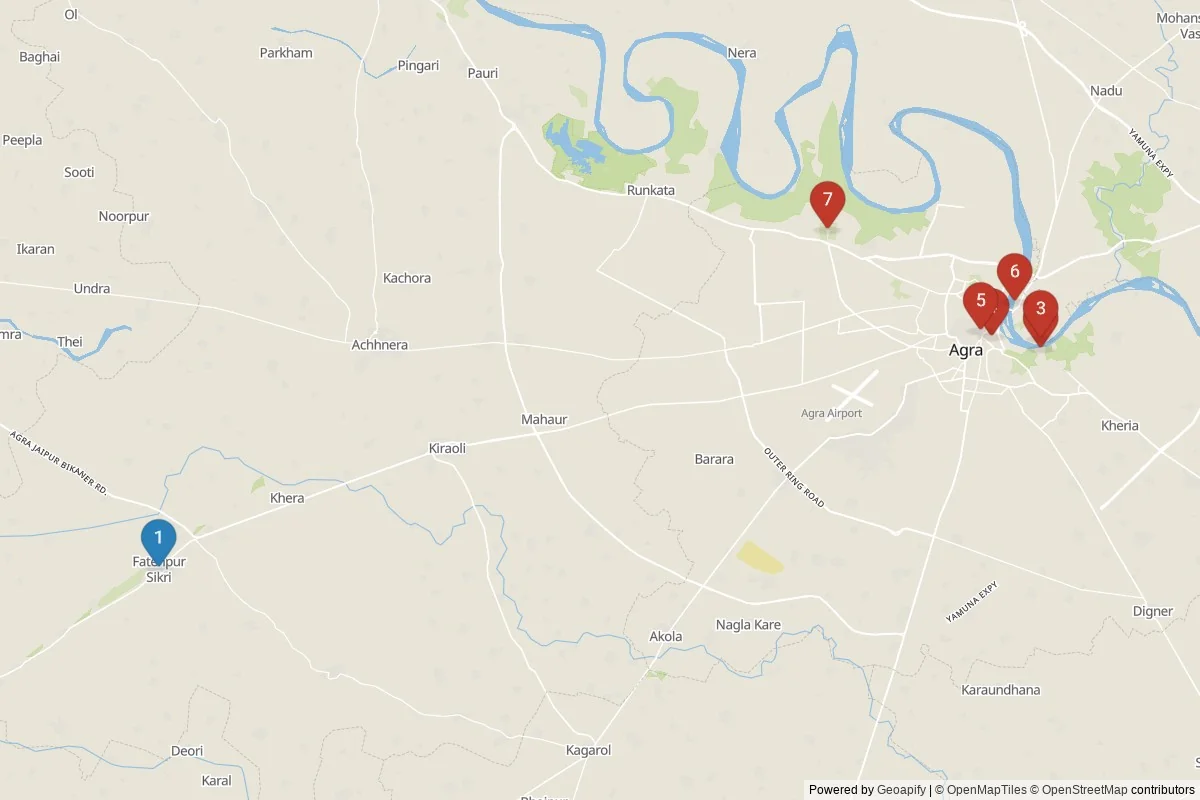
| # | Sight | Cluster | Type | Time | Entry | Best |
|---|---|---|---|---|---|---|
| 1 | Fatehpur Sikri | Cluster A | — | — | — | — |
| 2 | The Taj Mahal | Cluster B | Mosque | 90 minutes | — | Sunrise |
| 3 | Mehtab Bagh | Cluster B | Garden | — | — | Sunset |
| 4 | Agra Fort | Cluster B | Palace | — | — | — |
| 5 | Jama Masjid (Agra) | Cluster B | Mosque | — | Free | — |
| 6 | Itimad-ud-Daulah’s Tomb (Baby Taj) | Cluster B | — | — | — | — |
| 7 | Akbar’s Mausoleum, Sikandra | Cluster B | Garden | — | free | — |
Agra’s headline sights are dense — three to four days handles everything, with an obligatory full day for the Taj plus Agra Fort, and an obligatory day-trip to Fatehpur Sikri. Plan around the Friday closures at the Taj.
The Taj Mahal
The single most-photographed building on earth — and somehow it still over-delivers. Shah Jahan’s white-marble mausoleum (1631–1648) is built around perfect bilateral symmetry, with the famous main mausoleum complemented by an identical-twin red sandstone mosque (left) and an identical-twin sandstone “guest house” (right) that exists only to balance the mosque. The 22 small domes around the central dome represent the 22 years of construction. The pietra dura inlay using 28 types of semi-precious stones includes lapis lazuli from Afghanistan, jade from China, turquoise from Tibet, sapphire from Sri Lanka, and carnelian from Arabia. Sunrise viewing is the highlight — the marble passes through pink, gold, and white phases in the first 90 minutes after dawn. Tickets: 1,300 INR foreigner / 50 INR Indian via tajmahal.gov.in; night viewing available 5 nights per month around the full moon (separately ticketed). Closed Fridays.
Agra Fort
The other UNESCO World Heritage Site in Agra — and frequently the underrated highlight of the trip. The massive red sandstone Agra Fort (built by Akbar from 1565, expanded by Shah Jahan) served as the primary residence of Mughal emperors for almost a century. The complex contains palaces, mosques, and audience halls — the elegant Diwan-i-Khas (Hall of Private Audience), the mirror-mosaic Sheesh Mahal (Mirror Palace), the white-marble Moti Masjid (Pearl Mosque, sadly currently closed to visitors), and the eastern Mussamman Burj octagonal tower where Shah Jahan was imprisoned for the final 8 years of his life by his son Aurangzeb (with a clear view of the Taj across the river). Tickets ~650 INR foreigner.
Itimad-ud-Daulah’s Tomb (Baby Taj)
Often called the “Baby Taj,” this exquisite white-marble tomb was built by Empress Nur Jahan (Shah Jahan’s stepmother) for her father Mirza Ghiyas Beg between 1622–1628 — predating the Taj Mahal by a decade. Often called “the draft of the Taj Mahal,” it was the first Mughal building constructed entirely from white marble and the first to use pietra dura inlay extensively. The smaller scale and quieter visitor numbers make it more contemplative than the Taj itself. Tickets ~310 INR foreigner.
Fatehpur Sikri
40 km west of Agra, this abandoned Mughal city built by Akbar (1571–1585) is one of India’s finest preserved Mughal architectural complexes. The red sandstone complex includes the Buland Darwaza (one of the world’s largest gateways at 54 m), the elegant Panch Mahal (a five-story columned pleasure pavilion), the Diwan-i-Khas with its central pillared throne, and the marble tomb of Sufi saint Salim Chishti (still an active pilgrimage site). The city was abandoned after just 14 years — likely due to water scarcity. Tickets ~610 INR foreigner. UNESCO World Heritage Site.
Akbar’s Mausoleum, Sikandra
10 km northwest of Agra, this unique tomb combines Hindu, Christian, Islamic, Buddhist, and Jain architectural elements — reflecting Akbar’s syncretic religious philosophy of “Din-i-Ilahi.” Set in a vast Mughal garden populated by free-roaming spotted deer, peacocks, and langur monkeys, the mausoleum’s stepped pyramidal design influenced later Mughal architecture including Itimad-ud-Daulah’s Tomb. Tickets ~310 INR foreigner.
Jama Masjid (Agra)
Built by Shah Jahan’s daughter Princess Jahanara Begum in 1648 and dedicated to her — one of the few major Mughal monuments commissioned by a woman. Located opposite Agra Fort, it features the typical Shah Jahani red sandstone with white marble inlays and remains an active mosque. Free entry, modest dress required.
Mehtab Bagh
The Mughal “moonlight garden” across the Yamuna River from the Taj Mahal — originally planned by Shah Jahan as part of the Taj complex. Provides spectacular sunset views of the monument from the perfect distance and angle, especially during golden hour. Tickets ~210 INR foreigner.
How to Get to Agra
By Air
The local Agra Airport (AGR / Pandit Deen Dayal Upadhyay Airport) handles limited domestic flights, primarily from Delhi. Most international visitors fly into Delhi’s Indira Gandhi International Airport (DEL) 230 km north and travel to Agra by train or road.
By Train
Agra is exceptionally well-connected by rail with three main stations: Agra Cantt (the main station, near Sadar Bazaar), Agra Fort (closer to the historic core), and Raja Ki Mandi. The premium services from Delhi:
- Vande Bharat Express (Delhi–Agra) — 1h 45min, the fastest service.
- Gatimaan Express — 1h 40min, India’s first semi-high-speed train.
- Shatabdi Express (12001/12002) — 2h, the most popular tourist option.
- Taj Express — 3h, slower but cheaper, well-suited for day-trip from Delhi.
Booking via irctc.co.in — book early, as Delhi-Agra trains fill quickly. Foreigner-only quota tickets are also available at major stations.
By Road
The Yamuna Expressway (165 km, opened 2012) provides a smooth 3-hour drive from Delhi to Agra — toll road with consistent 100 km/h sections. Regular bus services operate from Delhi’s ISBT Sarai Kale Khan, while private taxis and pre-arranged cars (~3,500–6,000 INR one-way Delhi-Agra) offer door-to-door convenience. Driving from Jaipur takes 4–5 hours; from Lucknow ~6 hours.
Getting Around Agra
Agra is a small, visitable city — a half-day at the Taj Mahal, a half-day at the Fort, and a day-trip out to Fatehpur Sikri covers the headline sights.
Auto-rickshaws and Cycle Rickshaws
Auto-rickshaws are the dominant mode of local transport. Negotiating fares is essential — meters are rarely used. Expect 100–250 INR for short rides, 500–800 INR for half-day hire (driver waits while you sightsee). Cycle rickshaws are the gentlest way to move through the narrow lanes around the Taj and the bazaars; bargain firmly.
Taxis and Private Cars
Prepaid taxi services at the Cantt railway station and airport offer fixed pricing. Most hotels arrange private cars with drivers for sightseeing — typically 2,500–4,000 INR for a full-day Agra Fort + Taj + Fatehpur Sikri loop, with the driver waiting at each site. App-based Ola and Uber operate in Agra but with limited supply outside major hours.
Walking and Cycling
The compact tourist area around the Taj Mahal is easily walkable, though summer heat and street touts make it less pleasant during peak hours. Hotels around the Taj sometimes provide bicycles for guests; the early-morning loop around the southern Taj walls is genuinely peaceful.
Tourist Buses and Day-Trip Services
Hop-on-hop-off tourist buses connect major attractions — but services can be irregular. The Uttar Pradesh State Road Transport Corporation operates regular buses to Fatehpur Sikri (~80 INR, 1.5 hours each way). Many travelers find it more efficient to combine Fatehpur Sikri with a half-day private taxi.
Food & Drink in Agra
Agra’s culinary scene is the perfect Mughal-Indian heritage fusion — the rich, slow-cooked Mughal-court dishes that survived from the imperial kitchens, plus the local Uttar Pradesh specialties and the famous Agra sweet known throughout India.
Signature Dishes
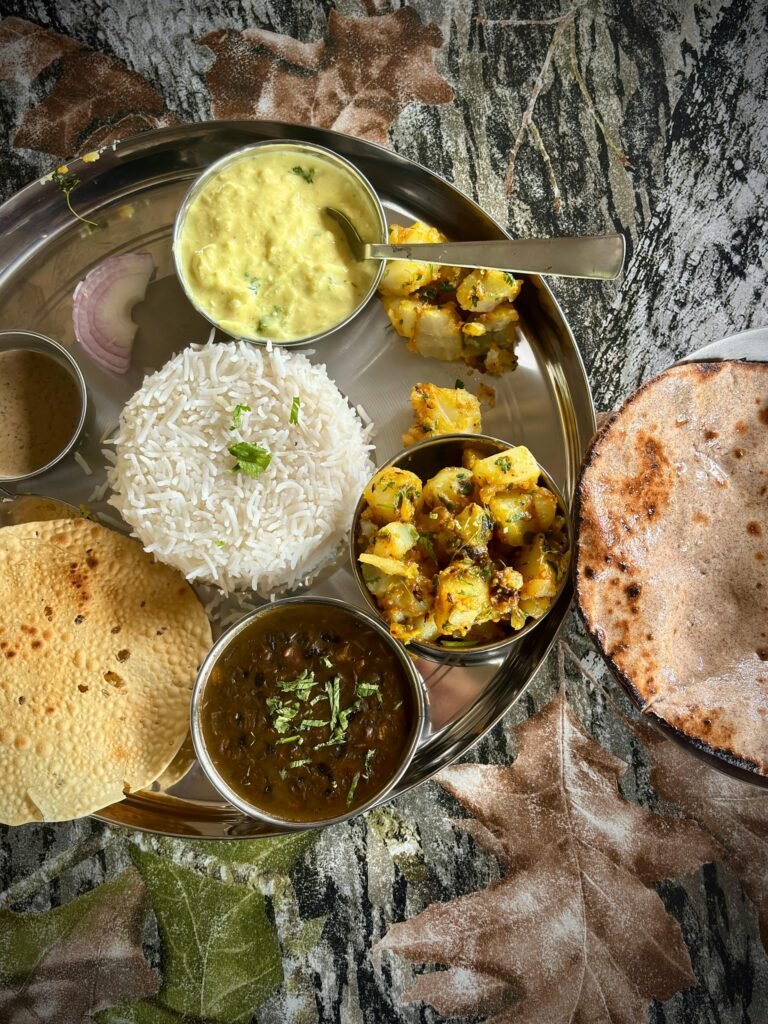
Petha is Agra’s most famous culinary export — a translucent crystallized sweet made from safed kaddu (white pumpkin / ash gourd) that comes in dozens of flavors: plain, saffron, rose, kesar (saffron-cardamom), kewda (pandan), and pista (pistachio). The annual production is over 5,000 tonnes; the city’s Panchhi Petha chain (since 1928) is the original — though every block has a competing petha shop. The Mughlai cuisine here features succulent kebabs, slow-cooked biryanis (Agra biryani is distinct from Hyderabadi or Lucknowi), and rich curries cooked in traditional tandoors. Don’t miss dal moth (a spicy lentil-and-nuts mix), bedai (deep-fried bread served with spiced potatoes — the iconic Agra breakfast), and the rich, dense kulfi.
Where to Eat
Sadar Bazaar and Taj Ganj offer the densest dining options. Pinch of Spice (Fatehabad Road) and Peshawri (ITC Mughal) are renowned for authentic Mughlai cuisine. Dasaprakash serves the city’s best South Indian food. Joney’s Place (Taj Ganj) is the legendary backpacker rooftop with Taj views. For the best petha, visit Panchhi Petha or Pracheen Petha; both are family-run businesses with branches across the city.
Street Food Scene
The lanes around Jama Masjid and Sadar Bazaar come alive in the evenings with vendors selling chaat, samosas, and jalebis. The area near Agra Fort serves excellent parathas and lassi, while the Kinari Bazaar is famous for its sweets and dry fruits. Bhagat Halwai in the Old City has been serving classic Indian sweets since 1948.
Culture & Arts in Agra
Agra’s cultural identity is essentially Mughal — the architecture, the crafts, and the performing arts traditions that survived the imperial era continue to define the city today.
Traditional Crafts
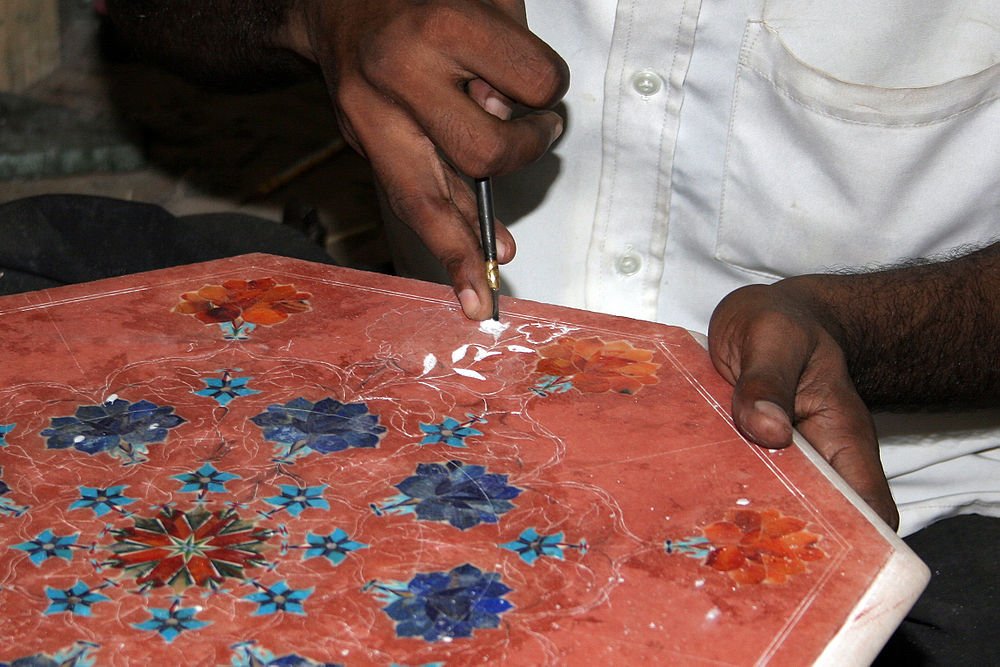
The city is renowned for its marble inlay work (pietra dura in Italian, parchin kari in Persian) — a technique introduced by Persian craftsmen during the Mughal era and refined for the Taj Mahal’s interior decoration. Artisan families in Taj Ganj continue this tradition, creating intricate floral patterns using semi-precious stones embedded into white marble bases. The skill takes a decade to fully master; small inlay pieces (jewelry boxes, small tabletops) make excellent souvenirs at workshops where you can watch the artisans at work. Agra is also famous for its leather goods (shoes, bags, jackets), carpets (both hand-knotted and machine-made), and brassware.
Performing Arts
Classical Indian music and the Kathak dance form have strong roots in Agra’s Mughal courts — the Agra gharana of Hindustani classical music is one of the major lineages of North Indian classical singing. The annual Taj Mahotsav festival (mid-February, 10 days at Shilpgram next to the Taj) showcases traditional music, dance, and crafts; the Kailash Fair (August) combines religious observance with cultural performances at Kailash Temple.
Religious Diversity
Agra’s population is predominantly Hindu (~80%) with a significant Muslim minority (~15%), reflecting the city’s multicultural Mughal heritage. The city also hosts small communities of Jains, Sikhs, Christians, and Buddhists. The Catholic Archdiocese of Agra, established in 1886, serves the regional Christian community, and several Mughal-era churches built for European traders survive in the Civil Lines area.
Agra by District: The 6 Tehsils
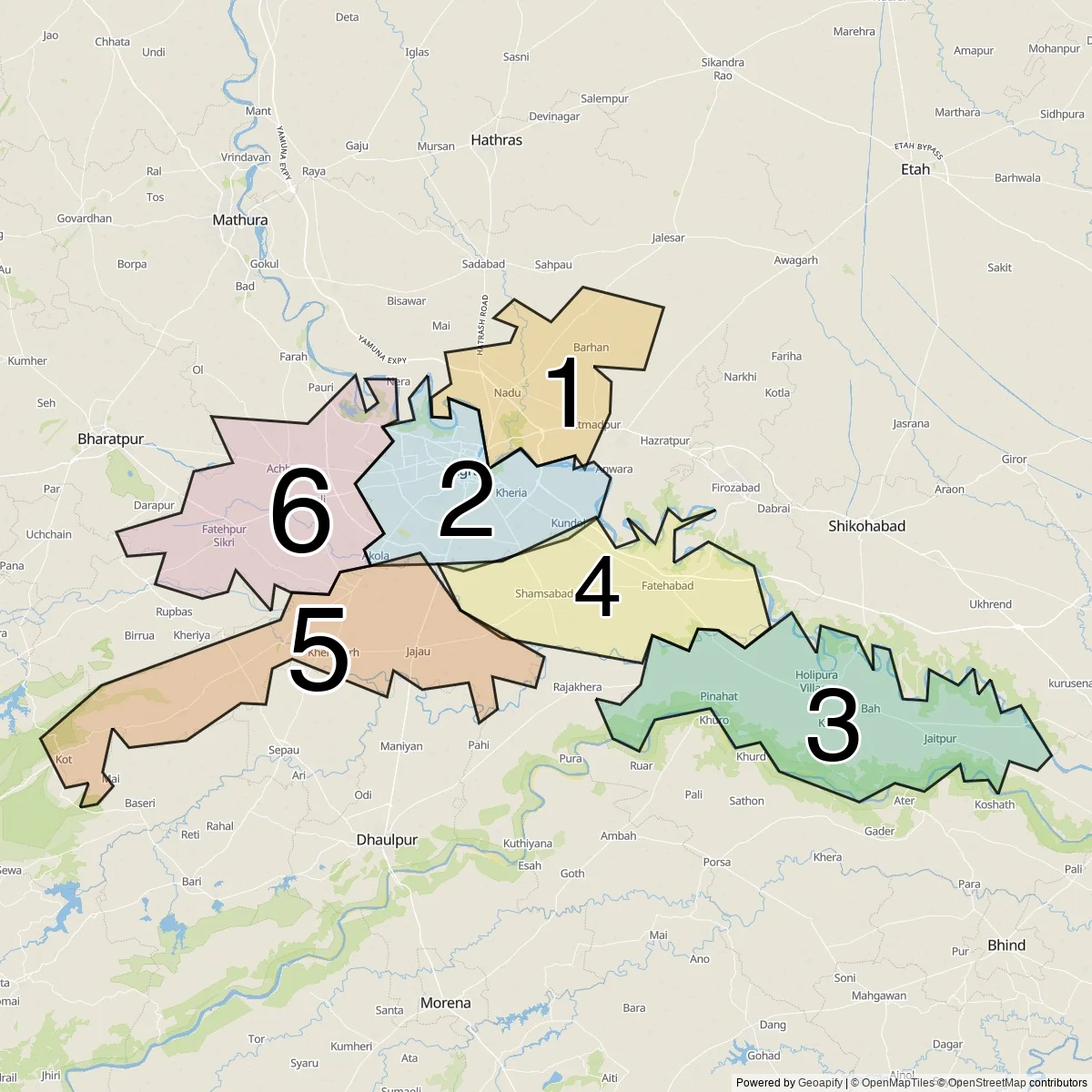
Agra is divided into 6 tehsils. The map below shows their official OSM boundaries, colour-coded to match the table — a quick way to orient yourself before zooming in on individual sights.
| # | Tehsils |
|---|---|
| 1 | Etmadpur |
| 2 | Agra |
| 3 | Bah |
| 4 | Fatehabad |
| 5 | Kheragarh |
| 6 | Kiraoli |
Frequently Asked Questions About Visiting Agra
Do I need a visa to visit Agra?
Almost certainly yes — India does not have visa-free entry for most nationalities. Citizens of around 170 countries — including the US, UK, EU member states, Canada, Australia, Japan, and most of Asia — can apply for an e-Visa online before travel through the official portal at indianvisaonline.gov.in/evisa. The e-Tourist Visa is typically valid 30 days, 1 year, or 5 years with multiple entries; processing takes 2–4 working days. Cost ranges roughly $25–80 depending on nationality and validity. Apply at least a week before travel; never use third-party sites that charge inflated fees. Citizens of Nepal and Bhutan don’t need a visa; OCI/PIO cardholders enter freely. Always check the current rules on the Bureau of Immigration India site before booking.
Is Agra safe for tourists?
Agra is generally safe for tourists who exercise standard precautions, though it has more aggressive touts than most Indian cities due to the heavy tourism economy around the Taj Mahal. The US State Department rates India at “exercise increased caution”; the UK FCDO issues similar guidance. Common risks: aggressive guides and “fake guides” approaching at the Taj entrance (“official guide tour, special price”); marble-shop and gemstone-shop scams (the friendly auto-rickshaw driver who takes you to “his uncle’s shop” expects a commission for high-pressure sales); auto-rickshaw fare inflation; the rare drink-spiking incident at tourist restaurants. Solo women travelers: Agra has a higher rate of harassment than larger Indian cities; dress modestly, prefer registered taxis to auto-rickshaws after dark, avoid empty Taj Ganj lanes at night. Avoid: any unofficial “Taj Mahal early entry” offers (only the official ticket gives morning access) and shops with aggressive touts at the Taj’s eastern gate.
How many days do I need in Agra?
One full day handles the Taj Mahal + Agra Fort; two days adds Itimad-ud-Daulah and Mehtab Bagh; three days lets you do Fatehpur Sikri properly. A solid 3-day plan: Day 1 — Taj Mahal at sunrise (gates open ~6 am, plan to arrive at 5:30 am) + late breakfast + Agra Fort + Mehtab Bagh sunset across the river; Day 2 — Itimad-ud-Daulah’s Tomb (Baby Taj) + Akbar’s Mausoleum at Sikandra + Sadar Bazaar + Kinari Bazaar shopping + Mughlai dinner at Pinch of Spice; Day 3 — Fatehpur Sikri day-trip (45 min west of Agra) + return for sunset Taj viewing from the gardens or the rooftop of your hotel. Many visitors do Agra as a day-trip from Delhi via the Vande Bharat Express (1h 45min each way) — workable for the Taj alone but rushed; an overnight in Agra dramatically improves the experience.
What’s the best area to stay in Agra?
Three solid options. Taj Ganj — closest to the Taj Mahal (5–10 minutes’ walk to the Western Gate); the obvious budget-and-mid-range choice with rooftop Taj-view restaurants and small heritage hotels at $25–80/night. Fatehabad Road — the upscale luxury hotel corridor 2.5 km from the Taj; hosts The Oberoi Amarvilas ($800–2,500/night, every room with a Taj view), ITC Mughal, and Jaypee Palace for travelers wanting world-class hotels. Sadar Bazaar Area — the central commercial district 4 km from the Taj; reliable mid-range hotels (Howard Plaza, Trident, Ramada) at $80–200/night, walking distance to restaurants and shops. Skip: hotels far from the Taj for short stays — auto-rickshaw fares add up quickly, and early-morning Taj visits work best from nearby accommodations.
How much does it cost to visit Agra’s major sights?
Agra’s headline sights use dual pricing — Indians pay much less than foreigners. Taj Mahal: 1,300 INR foreigner / 50 INR Indian (additional 200 INR for the central mausoleum interior) via tajmahal.gov.in; night viewing available 5 days per month around the full moon — separately ticketed, advance booking essential. Agra Fort: 650 INR foreigner / 50 INR Indian. Itimad-ud-Daulah’s Tomb (Baby Taj): 310 INR foreigner / 30 INR Indian. Fatehpur Sikri: 610 INR foreigner / 50 INR Indian via asi.nic.in. Akbar’s Mausoleum (Sikandra): 310 INR foreigner. Mehtab Bagh: 210 INR foreigner. Camera fees: typically 25–100 INR additional. Composite ticket: combined Taj + Fort + Itimad-ud-Daulah + Akbar’s Tomb saves ~20% if buying same-day. Half-day private taxi tour: 1,200–2,500 INR; full-day private taxi with driver: 2,500–4,500 INR including Fatehpur Sikri.
Should I drink the tap water in Agra?
No — tap water in Agra is not safe for foreign visitors. The semi-arid climate and water scarcity have stressed the municipal supply, and the distribution network has known quality issues. Always use sealed bottled water (20–30 INR per liter from convenience stores; major brands include Bisleri, Aquafina, Kinley, Himalayan) for drinking, brushing teeth, and ice. Major hotel restaurants and reputable establishments use filtered water and ice — generally safe. The CDC traveler health page recommends bottled or boiled water for India. Tap water is fine for showering. Reusable filter bottles (LifeStraw, Grayl) work well in India. Be aware: even bottled water you receive at restaurants has occasionally been refilled and resealed — check the seal before drinking.
What time should I arrive at the Taj Mahal?
Early — and earlier than you think. The Taj Mahal opens 30 minutes before sunrise (typically 6:00–6:15 am in winter, 5:30–6:00 am in summer). Arrive at the ticket gate at least 30 minutes before opening; the queue forms quickly. The first 90 minutes after sunrise are the photographic peak — the marble passes through pink, gold, and white phases as the sun rises. Closed all day Friday for prayer at the on-site mosque. The Taj closes at sunset (typically 6–7 pm); the late-afternoon golden-hour viewing is the second-best window. Avoid 10 am–3 pm — heat, harsh midday light, and peak crowds. Night viewing on the 5 nights centered around the full moon requires separate ticketing 1 day in advance at the Archaeological Survey of India office on Mall Road; sells out fast in tourist season. Practical: arrive with passport (required for foreigner ticket pickup); bring water (not refillable inside); shoes are removed before entering the central mausoleum (cloth shoe-covers are provided with the foreigner ticket).
Is tipping expected in Agra?
Yes — moderate tipping is expected in tourist-facing service. Restaurants: 10% standard for sit-down service if no service charge is added (some restaurants now add 5–10% automatically — check the bill); round up at casual places. Hotel porters: ₹50–100 per bag at 4–5 star hotels. Hotel housekeeping: ₹100–200 per night left at end of stay. Auto-rickshaw drivers: round up to nearest ₹10. Taxi/Uber drivers: not strictly expected, but ₹20–50 for a long ride or extra help is appreciated. Tour guides: ₹500–1,000 per person for half-day, ₹1,500–3,000 for a full private day; bus/car drivers ₹100–300 for a full-day trip; Taj Mahal official guide: typically ₹500–1,000 if pleased (book through the official ASI desk to avoid touts). Spa, salon: 10% if pleased. Tipping in cash (small notes) is expected; card machines rarely allow tip add-on. Don’t over-tip — Western percentages are seen as flashy rather than generous.
Shopping in Agra
Agra offers exceptional shopping for handicrafts, textiles, and souvenirs that reflect the city’s Mughal artistic heritage — particularly for marble inlay and leather goods.
Major Markets
Sadar Bazaar is the city’s main commercial hub, offering everything from clothing and electronics to handicrafts. Kinari Bazaar specializes in traditional Indian wear, jewelry, and wedding accessories. The area around the Taj Mahal features numerous shops selling marble replicas, inlay work, and other tourist souvenirs (always inspect quality carefully).
Specialty Items
Agra’s marble craftsmen create beautiful inlay pieces ranging from small jewelry boxes (1,500–4,000 INR for small pieces) to large tabletops (50,000–200,000 INR for major commissions). The city’s leather industry produces high-quality shoes (especially the local jutti and mojari styles), bags, and jackets at workshops along Sanjay Place. Carpets — both hand-knotted Persian-influenced styles and machine-made — are another specialty, with many shops offering custom designs.
Shopping Tips
Bargaining is expected in most markets, with initial prices often inflated 2–3x for tourists. Government emporiums like UP Handloom and Handicrafts Corporation and Cottage Industries Emporium offer fixed prices and reliable quality assurance — useful for high-value items. When buying marble items, ensure they’re genuine: real marble pieces are heavy, cool to the touch, and have natural veining patterns; soapstone and resin imitations are common at lower-end tourist shops.
Agra rewards travelers who balance the obvious headline sights with the quieter Mughal-era surprises. Three full days handles the city: Day 1 — Taj Mahal at dawn + Agra Fort + Mehtab Bagh sunset; Day 2 — Itimad-ud-Daulah’s Tomb + Akbar’s Mausoleum at Sikandra + city bazaars; Day 3 — Fatehpur Sikri day-trip. Pair with Delhi (3 hours) and Jaipur (4 hours) for the classic Golden Triangle circuit. The marble fades and brightens with the light; the petha is sweeter than anyone expects; and the Taj somehow remains worthy of every photograph.
AFRIKA
Cairo Hurghada Johannesburg Marrakech
ASIA
Abu Dhabi Agra Antalya Bangkok Batam Beijing Bengaluru Cebu City Chiang Mai Chiba Chennai Da Nang Dammam Delhi Denpasar Dubai Fukuoka Guangzhou Guilin Ha Long Hanoi Ho Chi Minh City Jakarta Jaipur Johor Bahru Kolkata Krabi Kuala Lumpur Kyoto Macau Mecca Medina Mugla Mumbai Osaka Pattaya Penang Phuket Riyadh Seoul Shanghai Shenzhen Singapore Taipei Tokyo Zhuhai
EUROPE
Amsterdam Athens Barcelona Berlin Brussels Budapest Copenhagen Dublin Florence Frankfurt am Main Heraklion Krakow Lisbon London Madrid Milan Munich Nice Paris Porto Prague Rhodes Rome Stockholm Venice Vienna Warsaw
NORTH AMERICA
Cancun Las Vegas Los Angeles Miami New York City Orlando San Francisco Toronto Vancouver
SOUTH AMERICA
Buenos Aires Lima Rio De Janeiro
OCEANIA
Auckland Honolulu Melbourne Sydney