
Photo credit: Patrice_Audet, pixabay
Miami stands as Florida’s vibrant crown jewel, a sun-drenched metropolis where tropical paradise meets urban sophistication. Known as the Magic City and Gateway to the Americas, this coastal stunner has evolved from a humble settlement of 300 residents in 1896 to a global destination that welcomes over 8 million visitors annually. With its year-round sunshine, Art Deco architecture, and pulsing Latin rhythms, Miami offers an intoxicating blend of beach culture, international business, and cultural diversity that captivates travelers from around the world.
Miami at a Glance: Essential Facts for Travelers
| Location | Southeastern Florida, USA |
| Coordinates | 25°47′N, 80°13′W |
| Population | 442,241 (city proper, 2020) |
| Metro Area | Over 6.1 million residents |
| Area | 143.15 km² (55 mi²) |
| Elevation | 2 meters (6 feet) above sea level |
| Time Zone | Eastern Time (UTC−5/−4) |
| Area Codes | 305, 786 |
| ZIP Codes | 33109-33196 |
| Known For | Art Deco architecture, beaches, Cuban culture, nightlife, cruise port |
| Current Mayor | Francis X. Suarez |
| Official Website | www.miami.gov |
Upcoming Events in Miami
| Date | Title | Details |
|---|---|---|
| 2026-09-14 to 2026-09-16 | Americas Food and Beverage Show | The Americas Food and Beverage Show fills the Miami Beach Convention Center from 14 to 16 September, gathering producers, importers and distributors from across the hemisphere. Exhibitors present specialty foods, beverages, ingredients and packaging, while a concurrent international buyers mission connects purchasers with suppliers. The show is a trade event aimed at industry professionals, with registration required, and it cements Miami’s role as the commercial gateway between the Americas. Demonstrations and tasting pavilions round out the programme across the exhibition halls. [Source] |
| 2026-09-18 | Gorillaz: The Mountain Tour at Kaseya Center | Damon Albarn’s genre-hopping virtual band Gorillaz brings The Mountain Tour to the Kaseya Center on Friday 18 September at 7:30pm, mixing alt-rock, hip-hop and electronica behind the animated alter egos that made them famous. Expect anthems such as Feel Good Inc and Clint Eastwood alongside newer material, with striking visuals throughout the arena show on Biscayne Boulevard. Tickets are sold through Ticketmaster in multiple price tiers. The stop is one of the fall’s most anticipated concerts for alternative-music fans in South Florida. [Source] |
| 2026-09-28 to 2026-10-01 | Sibos 2026 financial services conference | Sibos, the global financial services conference organised by Swift, convenes at the Miami Beach Convention Center from 28 September to 1 October, drawing thousands of banking, payments and technology leaders from around the world. The programme spans keynotes, panels and an exhibition floor where institutions and fintechs present the future of cross-border finance. Attendance is for registered industry delegates, with passes priced accordingly. Hosting the event is a coup for Miami, underscoring the city’s rise as an international financial and fintech hub. [Source] |
| 2026-10-01 | Anina Major: The Sacred Mangrove opens at PAMM | Perez Art Museum Miami opens The Sacred Mangrove, an exhibition by Bahamian artist Anina Major, on 1 October. Major is known for ceramic sculpture that weaves the straw-plaiting traditions of her homeland into meditations on identity, migration and belonging, themes that resonate deeply in Miami. The show joins a strong season at the waterfront museum, whose galleries also feature Basquiat and collection highlights. Museum admission applies, with prices varying by ticket type, and the bayfront terrace alone rewards a visit. [Source] |
| 2026-10-01 to 2026-10-31 | Miami City Ballet Season | Miami City Ballet, one of the leading dance companies in the United States, opens its season in October, performing principally at the Arsht Center in downtown Miami and other South Florida venues. Renowned for its vibrant, athletic style and its Balanchine repertoire, the company presents a mix of classical works, contemporary premieres and beloved story ballets across the season. Ticket prices vary by production and seating. It is a highlight for lovers of dance and the performing arts in the city. [Source] |
| 2026-10-08 | Miami Heat vs New Orleans Pelicans (NBA preseason) | Basketball returns to Biscayne Boulevard as the Miami Heat host the New Orleans Pelicans in an NBA preseason game at the Kaseya Center on Thursday 8 October at 7:30pm. Preseason fixtures offer an affordable first look at the roster as coaches trial rotations and young players fight for spots, with further home warm-ups against Minnesota and Brooklyn in the following days. Tickets are available through Ticketmaster at prices below regular-season levels, making it a good option for families and casual fans. [Source] |
| 2026-10-10 to 2026-10-11 | Miami Carnival | Miami Carnival is South Florida’s exuberant celebration of Caribbean culture, culminating in a vibrant parade and festival around Columbus Day weekend in October. Masqueraders in dazzling, feathered costumes wind through the route to the pulse of soca and calypso, joined by steel-pan bands, DJs and food vendors serving island specialties. Rooted in the traditions of Trinidad and Tobago and the wider Caribbean, the event draws huge crowds for a joyous day of music, dance and community. Tickets are required for the main venue. [Source] |
| 2026-10-29 | Picasso-Klee-Matisse: Masterpieces from the Museum Berggruen at PAMM | Masterpieces from Berlin’s Museum Berggruen come to Perez Art Museum Miami when Picasso-Klee-Matisse opens on 29 October, presenting works by three giants of European modernism. Drawn from one of the world’s celebrated modern art collections, the exhibition gives South Florida audiences a rare chance to study Picasso, Paul Klee and Henri Matisse side by side without crossing the Atlantic. Standard museum admission applies, with timed tickets likely at busy periods. The opening lands just before Miami Art Week swells the city’s art calendar. [Source] |
City News in Miami – last 14 days
| Date | Category | Headline | Details |
|---|---|---|---|
| 2026-09-14 | Public safety | Portion of Brickell Bay Drive closed after crane collapse | A portion of Brickell Bay Drive was closed after a crane collapsed in Miami’s dense Brickell district, police said, and investigators are working to determine what brought the equipment down. Officers cordoned off the affected stretch while crews assessed the scene and secured the structure, with closures forcing detours through the busy financial neighborhood. No details about injuries were confirmed in initial reports. Construction cranes crowd the Brickell skyline amid a building boom, and the incident renews scrutiny of site safety in the area. [Source] |
| 2026-09-14 | Public transport | Amazon suspends use of 21 Air after cargo plane careened off MIA runway, killing five | Amazon said it has suspended its partnership with cargo carrier 21 Air after one of the company’s planes loaded with Amazon freight careened off a runway at Miami International Airport, killing five people. The decision halts the online retail giant’s use of the operator while investigators examine the crash. Reporting has raised questions about the jet’s operator and its safety record. The tragedy has shaken the airport’s cargo community and prompted broader scrutiny of contractors flying for major shippers. [Source] |
| 2026-09-14 | Local affairs | Friends mourn five workers killed when jet struck their van at Miami airport | Friends and neighbors are mourning five workers whose lives were cut short when a cargo jet struck their van at Miami International Airport, remembering a generous crew who took pride in dangerous work. One of the victims, Julio Pineda, would return exhausted to his Miami-Dade apartment complex still wearing his reflective vest, neighbors recalled. The profile paints an intimate portrait of the ground workers who keep the airport’s freight economy moving, and of the families and community now grappling with sudden loss. [Source] |
| 2026-09-14 | Public safety | Pile of scraps catches fire at Opa-locka warehouse, no injuries reported | Firefighters battled fierce flames after a blaze broke out at a warehouse in Opa-locka over the weekend, with Miami-Dade Fire Rescue units responding in force to bring the fire under control. Officials said the flames fed on what was described as a pile of scraps at the property, and no injuries were reported. Crews remained on the scene to extinguish hot spots and prevent the fire from rekindling. The cause of the blaze is under investigation by fire officials. [Source] |
| 2026-09-14 | Public safety | Miami Gardens Police K-9 found safe nearly a week after going missing | A Miami Gardens Police K-9 that went missing has been found safe nearly a week after disappearing, officials said, ending a search that drew wide community attention. The dog was located in Hollywood after reportedly being struck by a car earlier, and was recovered and checked over. The department thanked residents who shared information during the search. The reunion brought relief to officers and animal lovers across South Florida who had followed the case closely on social media. [Source] |
| 2026-09-14 | Local affairs | Vigil held for girl killed in hit-and-run crash in Northwest Miami-Dade | A vigil was held for a young girl killed in a hit-and-run crash in Northwest Miami-Dade, as family, neighbors and classmates gathered with candles and photographs to remember her. Mourners called for the driver responsible to come forward and for justice in the case, while police continued their investigation into the crash. The gathering reflected a community’s grief and its frustration over traffic violence on residential streets. Anyone with information was urged to contact Miami-Dade authorities or Crime Stoppers. [Source] |
| 2026-09-14 | Public safety | Man critical after being found unresponsive while snorkeling near Key Biscayne | A man was rushed to the hospital in critical condition after being found unresponsive while snorkeling near Key Biscayne, authorities said. Rescue crews pulled the swimmer from the water and began treatment before transporting him to a nearby hospital. The circumstances that led to the emergency were not immediately clear. Officials routinely remind swimmers and snorkelers to use the buddy system, watch conditions and stay within protected areas, particularly late in the season when currents and boat traffic can pose added risks. [Source] |
| 2026-09-14 | Business | Billionaires are fleeing to Florida: how much money are Miami and the state really getting? | Wealthy newcomers continue to relocate to Florida, and an analysis examines how much money Miami and the state are actually gaining from the influx of billionaires and financial firms. The report weighs tax revenue, real estate activity and job creation against rising costs, noting that headline wealth figures do not always translate into broad public gains. Miami’s finance-driven boom has reshaped neighborhoods such as Brickell. The piece adds nuance to the celebrated migration story that has defined the region’s economy in recent years. [Source] |
| 2026-09-14 | Culture | Supreme Twins Foundation hosts second annual gala and fashion show in Miami | The Supreme Twins Foundation, which supports children with special needs, hosted its second annual gala and fashion show in Miami over the weekend, bringing together designers, supporters and families for an evening of style and philanthropy. The event showcased creative talent while raising funds for the foundation’s programs. Organizers said the gathering of the best and brightest in design underlines the city’s growing fashion scene and its capacity to rally around inclusive causes. Attendees praised the celebratory, community-minded atmosphere. [Source] |
| 2026-09-13 | Sports | Raiders open season with 27-13 win over Dolphins as Cousins reaches 301 career TD passes | Kirk Cousins threw three touchdown passes, reaching 301 for his career, as the Las Vegas Raiders beat the Miami Dolphins 27-13 in the season opener. Miami’s offense struggled to find rhythm and the defense could not contain the veteran quarterback, leaving fans discouraged at the start of what many view as a rebuilding year. Post-game analysis pointed to protection problems and missed opportunities. The Dolphins now look to regroup quickly before their next outing as questions mount around the roster’s direction. [Source] |
| 2026-09-13 | Sports | Messi scores but Nashville strikes late to deny Inter Miami win | Lionel Messi found the net again, but Nashville SC struck late to deny Inter Miami a victory, leaving the Herons to settle for a frustrating result in their Major League Soccer encounter. The Argentine star’s goal extended his influential run, yet defensive lapses proved costly once more as Nashville capitalized in the closing stages. The dropped points complicate Inter Miami’s positioning as the season approaches its decisive stretch, and coach and players acknowledged the need to close out matches better. [Source] |
| 2026-09-12 | Public safety | Two killed, two injured at house in Miami’s Little Havana neighborhood | Two people were killed and two others injured in violence at a house in Miami’s Little Havana neighborhood, police said, prompting a heavy law-enforcement response and an overnight investigation. Detectives processed the scene and interviewed witnesses as investigators worked to establish what led to the bloodshed and to identify those responsible. The incident stunned neighbors in the densely populated district west of downtown. Authorities asked anyone with information to come forward as the homicide investigation continues. [Source] |
| 2026-09-12 | Local affairs | Miami Beach’s Grand Theft Auto marketing deal sparks debate | A marketing tie-up between Miami Beach and the Grand Theft Auto video game franchise is stirring debate, as officials weigh publicity benefits against the game’s outlaw image. The deal aligns the city with the hugely anticipated title set in a fictionalized Vice City, betting that the association will draw younger visitors. Critics argue the franchise glamorizes crime in ways at odds with the city’s family-tourism push, while supporters call it a savvy pop-culture play. The discussion has become a talking point in local politics. [Source] |
Miami Events & City News Archive
Sources: Miami Beach Convention Center, Kaseya Center, Perez Art Museum Miami, Miami City Ballet, Miami Carnival, WPLG Local 10, WSVN, WSVN
Weather Forecast for the Next 14 Days in Miami
| Date | Weather | Max °F | Min °F | Rain mm |
|---|---|---|---|---|
| 2026-09-14 | ☁️ | 85.9 °F | 75.7 °F | 0.0 mm |
| 2026-09-15 | ☁️ | 85.8 °F | 75.9 °F | 0.0 mm |
| 2026-09-16 | ⛈️ | 86.4 °F | 77.9 °F | 7.2 mm |
| 2026-09-17 | ⛈️ | 87.0 °F | 81.7 °F | 9.1 mm |
| 2026-09-18 | ⛈️ | 87.9 °F | 80.7 °F | 15.7 mm |
| 2026-09-19 | 🌧️ | 84.4 °F | 81.7 °F | 6.8 mm |
| 2026-09-20 | 🌧️ | 86.4 °F | 81.0 °F | 4.5 mm |
| 2026-09-21 | 🌧️ | 85.7 °F | 82.8 °F | 5.1 mm |
| 2026-09-22 | ⛈️ | 83.3 °F | 77.1 °F | 31.5 mm |
| 2026-09-23 | 🌧️ | 86.9 °F | 81.6 °F | 2.7 mm |
| 2026-09-24 | ⛅ | 87.1 °F | 83.0 °F | 0.0 mm |
| 2026-09-25 | ⛅ | 87.0 °F | 83.1 °F | 0.0 mm |
| 2026-09-26 | 🌧️ | 87.3 °F | 82.6 °F | 2.1 mm |
| 2026-09-27 | 🌧️ | 87.2 °F | 82.7 °F | 1.8 mm |
Miami’s History
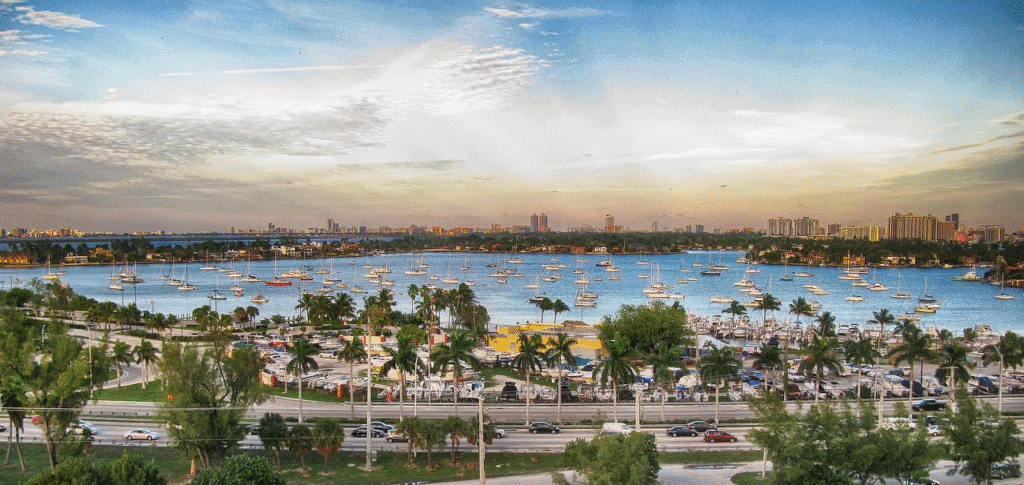
Miami is one of the youngest major American cities — and one of the fastest-changing. The city was incorporated in 1896 with just 300 residents; today the metro region holds 6.2 million. The classic Miami narrative is one of dramatic reinventions: Tequesta indigenous heritage, Spanish colonial outpost, Henry Flagler’s railroad terminus, post-WWII boom town, 1980s Cocaine Cowboys-era cocaine capital, post-1980 wave of Cuban refugees that turned it into the de-facto capital of Latin America in the United States, current era of finance migration (“Wall Street South”) and digital nomad arrival.
Indigenous and Spanish Origins
The Tequesta people inhabited the Miami River and Biscayne Bay area for at least 2,000 years. Spanish explorer Pedro Menéndez de Avilés made first European contact in 1566; a brief Jesuit mission was established and quickly abandoned. The Spanish controlled Florida (with a brief British interlude 1763–1783) until the 1819 cession to the United States. Through most of the 19th century, the area remained sparsely populated swamp and pine woodland.
The Flagler Era and Modern Founding
The transformation began in 1896 when railroad magnate Henry Flagler extended his Florida East Coast Railway south to Biscayne Bay at the urging of Cleveland-born settler Julia Tuttle. Tuttle famously sent Flagler an orange blossom to demonstrate that the great freeze of 1894–95 had spared southern Florida — a legendary marketing gesture that persuaded Flagler to extend the railroad to her property. Miami was incorporated as a city on July 28, 1896 with 300 founding residents. Flagler’s Royal Palm Hotel opened the same year.
1920s Land Boom and Bust
The Roaring Twenties brought Miami’s first speculative real estate boom — Coral Gables and Miami Beach were developed in this period; Carl Fisher’s promotion of Miami Beach as the “American Riviera” attracted northern wealth. The boom collapsed with the 1926 Great Miami Hurricane (372 dead, $115 million in damage in 1926 dollars) and the 1929 stock market crash.
Post-War Boom and Cuban Migration
WWII established Miami as a military training center; veterans returned to the area en masse postwar. The 1959 Cuban Revolution sent the first wave of Cuban exiles — primarily middle-class professionals fleeing Castro’s regime — to Miami. The 1980 Mariel boatlift brought 125,000 more Cubans in months. By 1990, Miami had become the largest Cuban-American population center in the United States and the de-facto capital for Latin American banking, media, and immigration.
The Cocaine Era and Turnaround
The 1980s “Cocaine Cowboys” era saw Miami become the entry point for South American cocaine into the US — the resulting drug-trafficking violence pushed homicide rates to historic highs and gave the city its noir reputation (Miami Vice, 1984–1989, captured the cultural moment). Federal “Operation Greenback” and crackdowns through the 1990s gradually restored order. The city’s Latin American banking concentration — combined with a tax-friendly Florida regime — turned Miami into a major financial center.
Modern Miami
Post-2000 Miami has experienced sustained growth as Latin Americans, international finance, and (post-2020) US tech and finance migrants poured in. The 2008–2010 financial crisis hit Miami hard — the housing bubble collapse was severe — but the recovery was rapid. The 2020s relocation wave from New York, San Francisco, and Chicago (driven by tax considerations, climate, and remote work) has further accelerated growth. Mayor Francis Suarez has positioned Miami as a tech-and-crypto-friendly destination (“Miami Tech Week”). Climate change and sea-level rise are the existential challenge — Miami has the highest urban-flooding-risk dollar exposure of any US city.
Geography, Climate & Best Time to Visit Miami
Geographic Setting
Miami sits on the southeastern tip of the Florida peninsula, where Biscayne Bay separates the mainland from the barrier island of Miami Beach. The metro region (Miami-Dade, Broward, and Palm Beach counties) extends 100 km north along the Atlantic coast. Average elevation is just 2 meters above sea level — one of the lowest of any major American city, which combines with rising sea levels to make Miami one of the world’s most flood-vulnerable cities. The Florida Everglades wetland ecosystem extends west of the city; Biscayne National Park and the Florida Keys begin south.
Climate
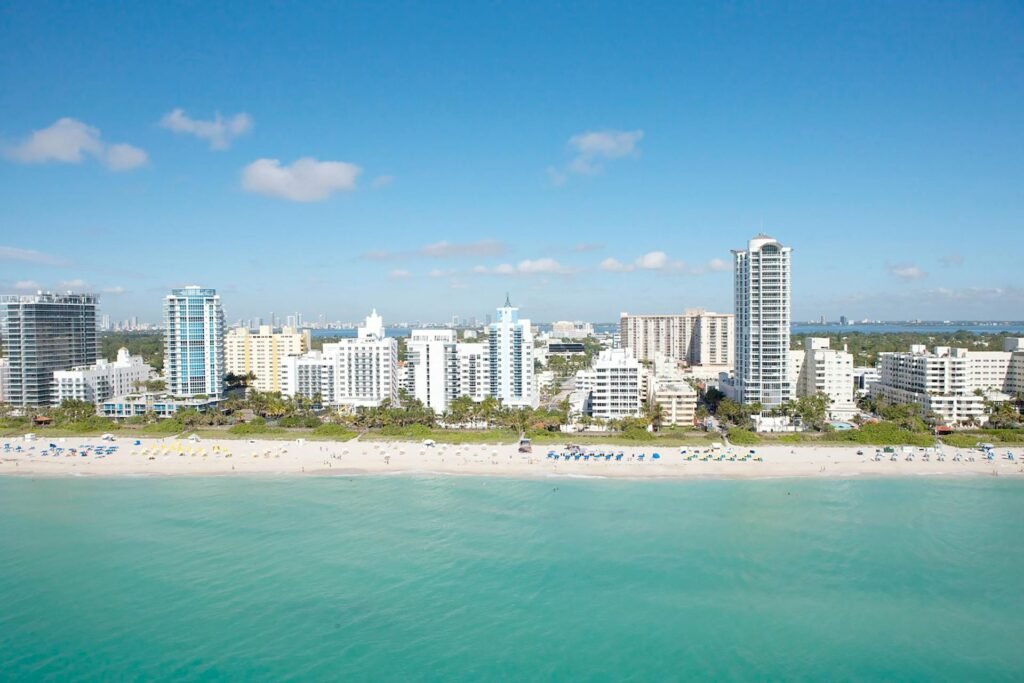
Miami has a tropical monsoon climate — warm to hot year-round with two main seasons: a wet/hurricane season (May–October) and a dry season (November–April). Average daily highs range 25–32°C; nighttime lows rarely drop below 15°C even in winter. Annual rainfall ~1,570 mm, almost all in the wet season. Humidity is constantly high.
| Month | High (°C) | Low (°C) | Rainfall (mm) | Rainy Days |
|---|---|---|---|---|
| January | 25 | 16 | 47 | 6 |
| April | 28 | 20 | 78 | 7 |
| May | 30 | 22 | 158 | 12 |
| July | 32 | 25 | 145 | 15 |
| September | 31 | 24 | 238 | 16 |
| October | 30 | 22 | 165 | 11 |
| December | 26 | 17 | 53 | 5 |
Best Time to Visit
December through April is the optimal travel window — the dry season, with mild low-humidity weather, sunny skies, and water temperatures still pleasant for swimming (22–24°C). This is also the peak tourist season — accommodation prices run 40–80% above shoulder rates and major events (Art Basel in early December, Miami Open tennis in March, F1 Miami GP in May) drive specific surge weeks. May–November is the wet/hurricane season — daily afternoon thunderstorms, brutal humidity, peak hurricane risk in August–September. Travel insurance covering hurricane delays is strongly recommended for August–October visits. Spring break (mid-March) sees Miami Beach overrun with college students; if you want quiet, avoid these weeks.
Miami’s Districts & Neighborhoods
Miami is small for a major city — Miami proper has just 442,000 residents in 142 km², though the metro region is 6.2M. Visitors mostly experience three areas: the city of Miami (downtown plus inner neighborhoods), Miami Beach (the barrier island, separate municipality), and a few outer neighborhoods like Coral Gables and Coconut Grove.
Miami Beach
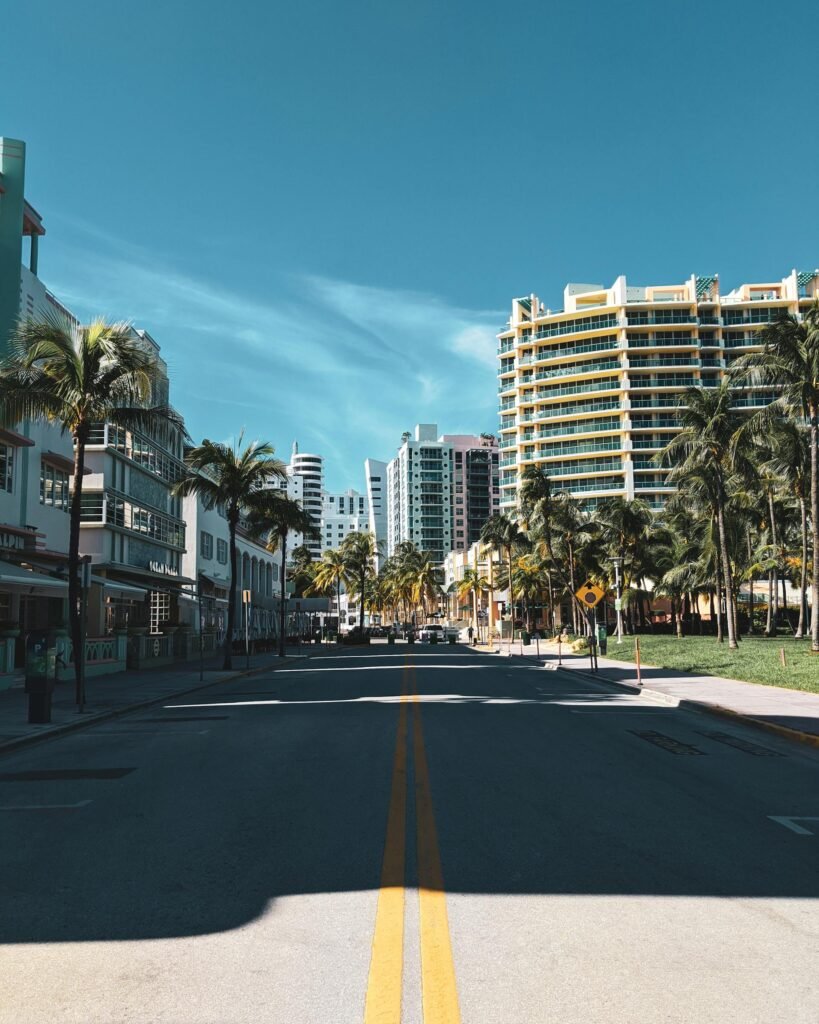
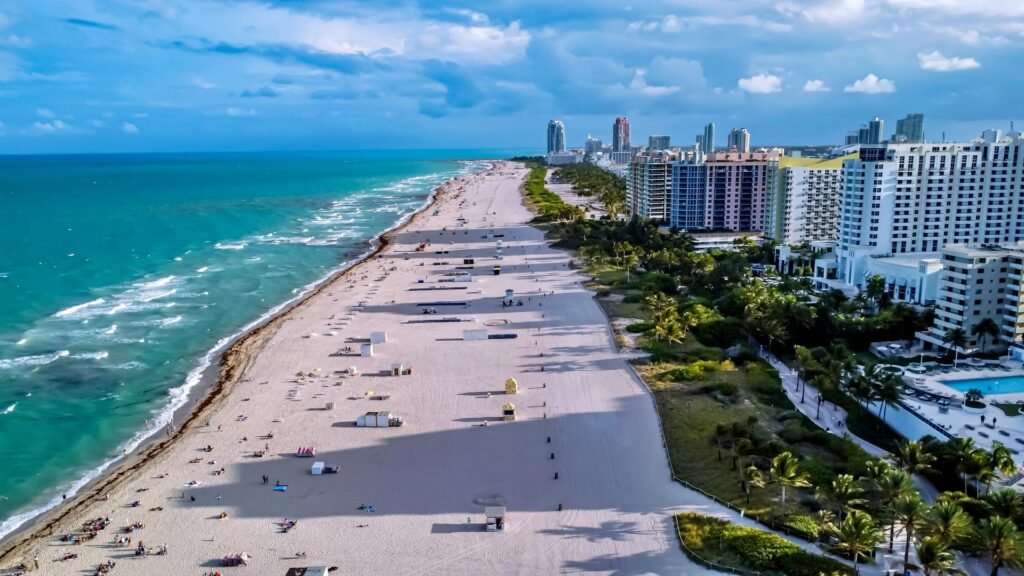
The barrier island east of mainland Miami — and the area most international visitors think of as “Miami.” Connected to the mainland by three causeways. South Beach (SoBe, the area south of 23rd Street) is the iconic strip — Art Deco hotels (the world’s largest Art Deco district), restaurants and clubs along Ocean Drive, the wide white-sand beach. Mid-Beach hosts the Faena, Fontainebleau, Eden Roc — the legendary mid-century resorts. North Beach is more residential.
Downtown Miami & Brickell
Downtown: PortMiami (cruise ship hub), Bayside Marketplace, the Miami Heat’s Kaseya Center, the relocated Miami Worldcenter mixed-use development. Brickell: Miami’s financial district just south of downtown — high-rise apartments, restaurants, the Brickell City Centre mall. Often called “Wall Street South” for the concentration of Latin American banking.
Wynwood & the Design District
Wynwood: the warehouse arts district transformed into Miami’s hipster-tourist epicenter — the iconic Wynwood Walls outdoor street-art museum, craft breweries, restaurants, galleries. Design District immediately north — luxury fashion (Hermès, Dior, Cartier, Louis Vuitton) and high-design furniture showrooms.
Little Havana
The historic heart of Cuban-American Miami, centered on Calle Ocho (8th Street) — Cuban coffee windows, cigar rollers, dominos at Máximo Gómez Park, and the famous Versailles Restaurant (the unofficial Cuban-American political-meeting place since 1971). The Calle Ocho Festival in March is the largest Hispanic-American street festival.
Coral Gables & Coconut Grove
Coral Gables: the master-planned 1920s “City Beautiful” with Mediterranean Revival architecture, the Biltmore Hotel, the Venetian Pool. Coconut Grove: the bohemian sailing community with marina restaurants, CocoWalk shopping, and historic bungalows.
Where to Stay
First-time visitors: South Beach for the iconic Miami experience. Cultural travelers: Brickell or Downtown for proximity to museums and Wynwood. Luxury: Miami Beach mid-section (Faena, Setai, Edition, Fontainebleau) or the Four Seasons Surf Club. Quieter family: Coral Gables, Surfside, or Sunny Isles. Skip: Miami International Airport hotels for sleep (only useful for transit).
Top Things to Do in Miami
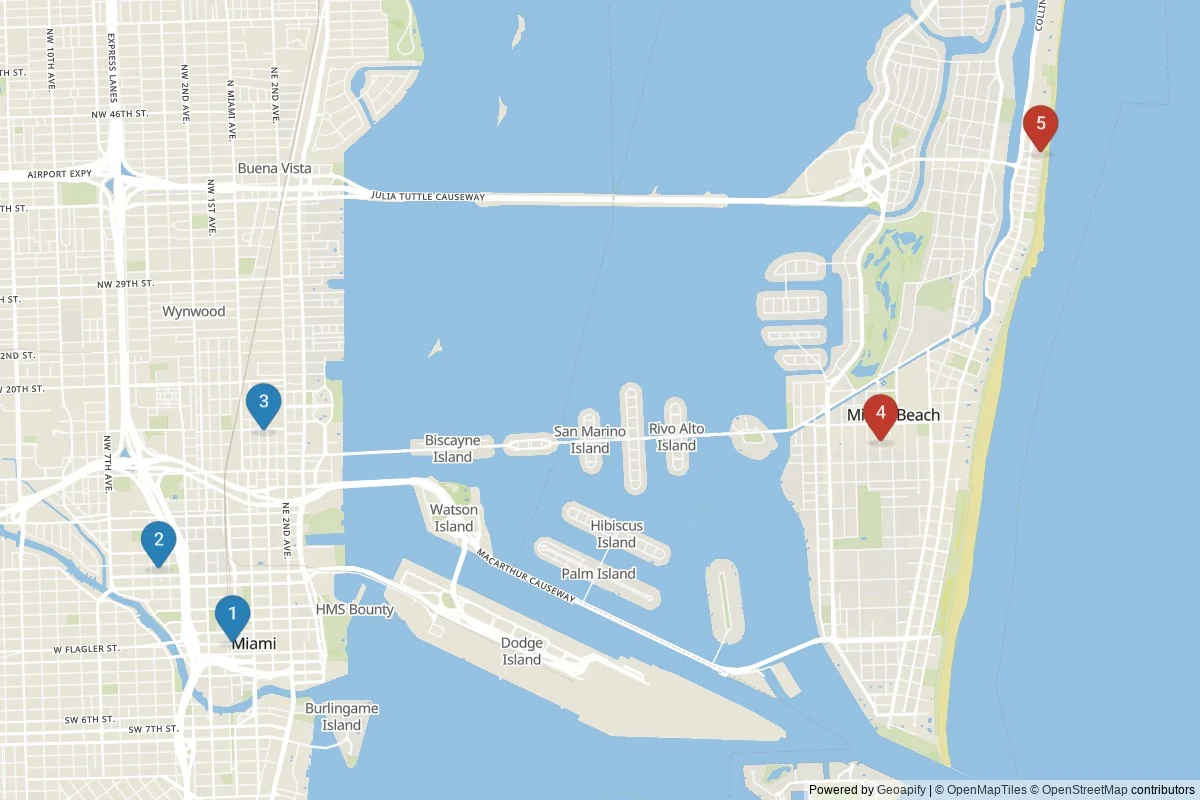
| # | Sight | Cluster | Type | Time | Entry | Best |
|---|---|---|---|---|---|---|
| 1 | Cultural Districts | Cluster A | Park | — | — | — |
| 2 | Day Trips | Cluster A | Park | 90 minutes | — | — |
| 3 | Art and Culture | Cluster A | Museum | — | — | — |
| 4 | Art Deco and Architecture | Cluster B | Museum | — | $30 | — |
| 5 | Beaches and the Outdoors | Cluster B | Park | — | Free | — |
Beaches and the Outdoors
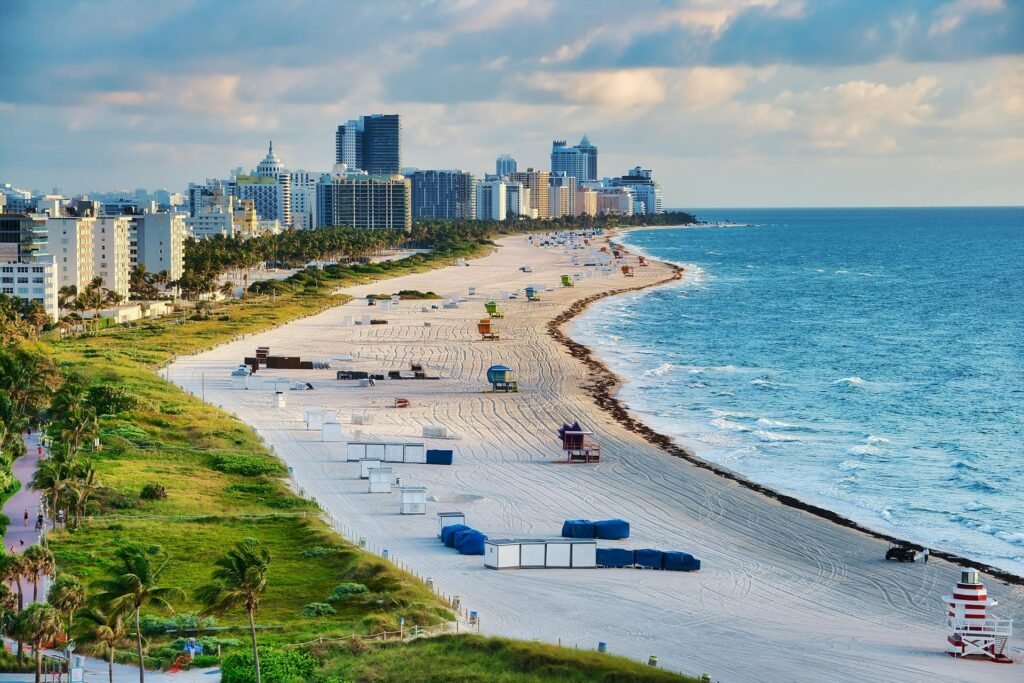
South Beach — the iconic Miami beach with white sand, Art Deco backdrop, lifeguard towers in pastel colors. Free public access; lifeguarded daily. Beach clubs along the strip rent loungers and umbrellas ($50–150/day). Crandon Park Beach (Key Biscayne) is the family-friendlier alternative. Bill Baggs Cape Florida State Park on Key Biscayne offers a historic lighthouse and unspoiled beach. Everglades National Park, an hour southwest, offers airboat tours, alligator viewing, and the unique sawgrass-and-cypress wetland ecosystem.
Art Deco and Architecture
The Miami Beach Art Deco Historic District — 800+ Art Deco, Mediterranean Revival, and Mid-Century Modern buildings concentrated on Ocean Drive, Collins Avenue, and Washington Avenue between 5th and 23rd Streets — is the largest collection of pre-WWII Art Deco architecture anywhere. Walking tours from the Miami Design Preservation League office on Ocean Drive run daily ($30). Coral Gables offers the Mediterranean Revival counterpart; the Vizcaya Museum and Gardens (1916 winter villa with Italian Renaissance gardens) is the standout.
Art and Culture
Pérez Art Museum Miami (PAMM) on the bayfront — modern and contemporary art with a Herzog & de Meuron-designed building. The Bass on Miami Beach for European art. Wynwood Walls — the open-air street-art museum. Frost Science Museum next to PAMM. The annual Art Basel Miami Beach (early December) is the largest art-and-design event in the Western Hemisphere; the citywide satellite art fairs (Art Miami, Untitled, Scope, Pulse) make Art Basel week the busiest in Miami’s calendar.
Cultural Districts
Little Havana — Cuban coffee, hand-rolled cigars, dominos at Máximo Gómez Park, Cuban-American politics at Versailles Restaurant. Wynwood — street art, breweries, the trendy hipster scene. Design District — luxury shopping in carefully designed pedestrian streets. Calle Ocho walking tours bring the Cuban-American culture alive.
Day Trips
Florida Keys — the Overseas Highway runs 180 km from Miami south to Key West. The Seven Mile Bridge is the iconic stretch; Key Largo, Islamorada, Marathon, Big Pine Key, Key West are the major stops. Allow at least overnight to do it justice. Everglades National Park — sawgrass marsh, alligators, airboat tours; 90 minutes by car. Naples and Marco Island on Florida’s Gulf Coast — 3 hours west, calmer beaches and family resorts.
How to Get to Miami
By Air
Miami International Airport (MIA) is the primary gateway — the busiest US gateway for Latin American flights, plus extensive European, Asian, and domestic service. About 13 km west of downtown; access via Metrorail (Orange Line), Tri-Rail, or taxi/Uber ($25–40 to Downtown, $35–55 to South Beach). Hub for American Airlines.
Fort Lauderdale-Hollywood International (FLL) is the secondary alternative ~50 km north — popular with budget carriers (Spirit, JetBlue, Allegiant). 30–45 min drive to Miami; Tri-Rail commuter train links FLL to MIA station.
By Rail and Bus
Brightline — the new high-speed train (since 2018, expanded 2023) runs Miami to West Palm Beach (90 min) and Orlando (3.5 hours). The MiamiCentral terminal in Downtown is genuinely impressive. Tri-Rail is the regional commuter train. Amtrak‘s Silver Service runs from Miami to New York via the East Coast (long, mostly overnight).
By Road
I-95 is the main Atlantic-coast expressway; I-75 (Alligator Alley) crosses the Everglades to the Gulf Coast. Driving in Miami requires patience — heavy traffic, aggressive driving culture, expensive valet parking ($25–60 at major hotels and restaurants).
By Sea
PortMiami is the world’s busiest cruise port — Royal Caribbean, Carnival, Norwegian, MSC, Disney all sail Caribbean cruises from here. The port is 5 minutes from Downtown.
Getting Around Miami
Metrorail and Metromover
Miami’s Metrorail is a 25 km elevated rail with two lines (Green and Orange) connecting Downtown, Brickell, the airport, and southern suburbs. Limited routes; useful primarily for airport-and-Brickell transit. Metromover is a free downtown people mover loop — useful for navigating Downtown/Brickell without a car. Single fare $2.25 with EASY card.
Public Buses
Miami-Dade Transit operates extensive bus routes, but Miami is genuinely a car-dependent city; tourists rarely find buses convenient for sightseeing.
Taxis and Ride-Sharing
Uber and Lyft dominate; transparent pricing, English interface, the practical default. South Beach to Downtown is typically $25–35; airport to South Beach $35–55. Taxis are also available at the airport, the cruise port, and major hotels but are less convenient.
Driving and Parking
Renting a car gives flexibility for day trips (Everglades, Florida Keys) but driving in central Miami is genuinely a hassle. Parking on Miami Beach: paid public parking via the ParkMobile app ($2–4/hour), or hotel valet ($30–60/day). South Beach traffic on Friday and Saturday nights is notoriously bad.
Food & Drink in Miami
Cuban Cuisine and Latin American Influence
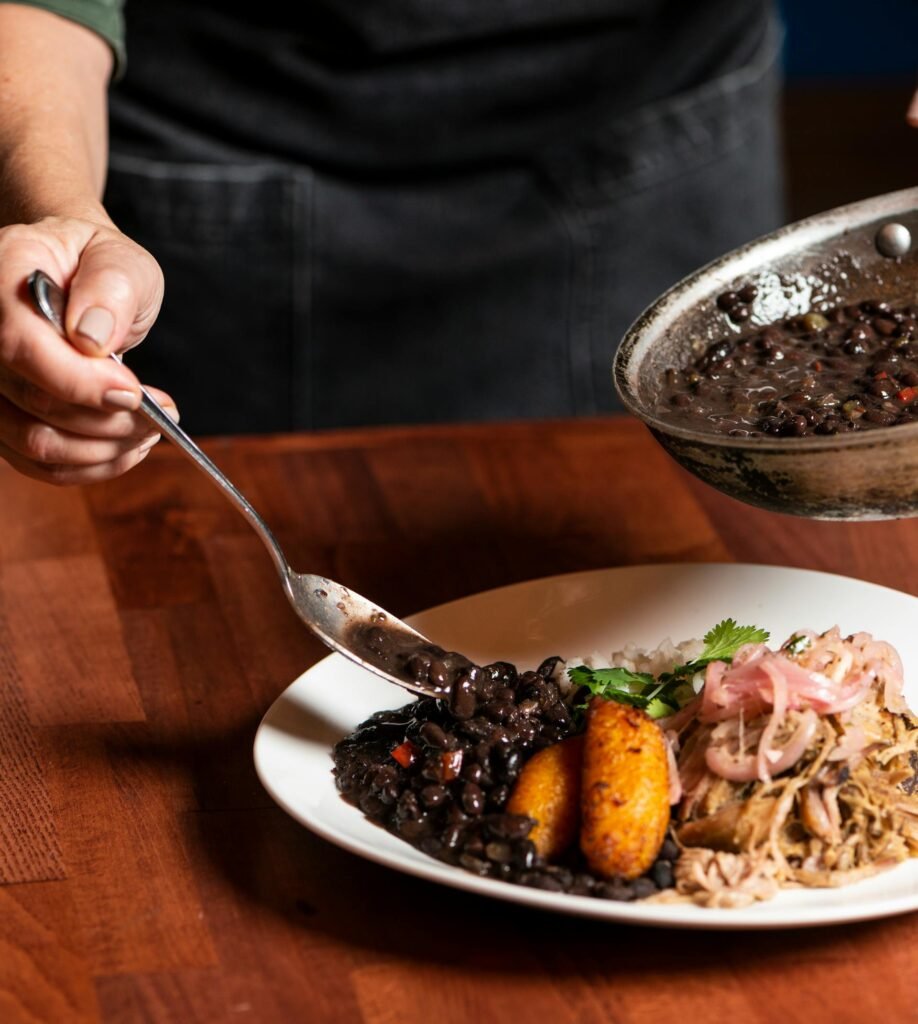
Miami’s food scene is defined by its Cuban-American heritage and the broader Latin American influence. Versailles Restaurant on Calle Ocho is the institutional Cuban-American dining experience — pressed Cuban sandwiches, ropa vieja, lechón asado, plus the all-day Cuban coffee window. Café La Carreta and Sergio’s are the neighborhood Cuban chain alternatives. El Palacio de los Jugos in Westchester for Cuban juices and seafood.
Beyond Cuban: Argentine steakhouses (Quality Meats, La Vaca Argentina), Peruvian (Cvi.che 105, La Mar by Gastón Acurio), Venezuelan (areperas across the city), Mexican (Coyo Taco), Brazilian (Fogo de Chão for the rodízio), Colombian (Las Vegas Cuban Cuisine — confusingly named).
Stone Crab and Florida Seafood
Stone crab claws are Miami’s signature seafood — a sustainable fishery (the claw regrows; the crab is returned to the water alive). Joe’s Stone Crab on South Beach (since 1913) is the institution; the season runs October 15 to May 1; reservations highly recommended.
Modern Dining Scene
Miami’s restaurant scene has matured rapidly. Stubborn Seed, Boia De, Cote (Korean steakhouse), L’Atelier de Joël Robuchon, Ariete (Coconut Grove), and the Faena Hotel restaurants are the leading fine-dining names. Mandolin Aegean Bistro (Greek), Michael’s Genuine (Design District), The Bazaar by José Andrés (SLS South Beach) define the new-Miami casual upscale category.
Nightlife
Miami’s nightlife is legendary — and genuinely competitive at a global level. The major clubs cluster on Miami Beach: LIV at the Fontainebleau, E11even (24-hour, Downtown), Story, Space Park in Wynwood, the rooftop bars at the Soho Beach House and 1 Hotel. Reservations or the door-list are essential at premier venues.
Miami by District: The 7 Neighborhoods
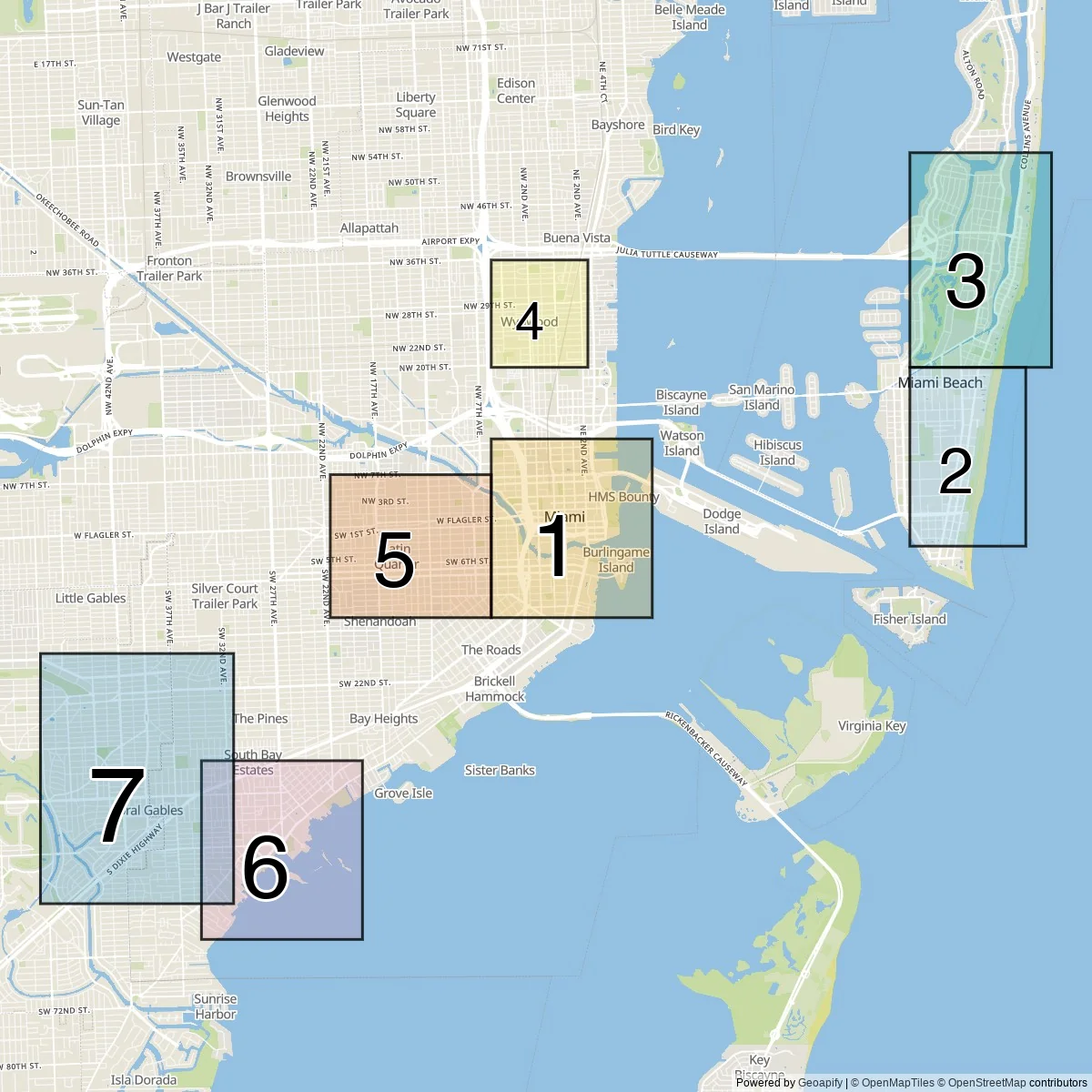
Miami is divided into 7 neighborhoods. The map below shows their official OSM boundaries, colour-coded to match the table — a quick way to orient yourself before zooming in on individual sights.
| # | Neighborhoods |
|---|---|
| 1 | Downtown Miami · Downtown / Brickell |
| 2 | South Beach |
| 3 | Mid-Beach |
| 4 | Wynwood |
| 5 | Little Havana |
| 6 | Coconut Grove |
| 7 | Coral Gables |
Frequently Asked Questions About Visiting Miami
Do I need a visa to visit Miami?
It depends on nationality. Citizens of 40 Visa Waiver Program (VWP) countries — including the UK, EU member states, Australia, New Zealand, Japan, South Korea, Singapore, and Taiwan — can enter the United States visa-free for up to 90 days for tourism, but must obtain an ESTA (Electronic System for Travel Authorization) online before travel through the official portal at esta.cbp.dhs.gov. Cost $21, valid 2 years. Beware: numerous fake third-party sites charge inflated fees — only use the .dhs.gov official site. Other nationalities need a B-2 tourist visa applied for at a US embassy. Always check the latest at travel.state.gov. Passport must have at least 6 months remaining validity beyond intended departure.
Is Miami safe for tourists?
Miami is generally safe in tourist areas but more uneven than other major US cities. Real risks: petty theft on Miami Beach (don’t leave valuables on the sand or in unlocked rental cars); aggressive panhandling in some Downtown areas; scooter and rental-car break-ins at parking lots; spring break chaos (mid-March on Miami Beach can get genuinely rowdy and at times dangerous — the city now imposes curfews in March 2024–2025). Avoid Liberty City and Overtown late at night unless you have specific reasons. Hurricane risk (June–November) is real — travel insurance covering hurricane delays is strongly recommended for August–October visits; check the NOAA National Hurricane Center. Flash flooding after heavy rain can submerge city streets even outside hurricanes. Solo women travelers: tourist areas (South Beach, Brickell, Coral Gables) are generally fine; standard urban awareness applies.
How many days do I need in Miami?
Three to four days handles Miami’s headlines comfortably; five to seven days lets you do day-trips. A solid 4-day plan: Day 1 — South Beach (beach + Art Deco Historic District walking tour + Ocean Drive evening); Day 2 — Wynwood (Wynwood Walls + galleries + breweries) + Design District + Pérez Art Museum; Day 3 — Little Havana (Calle Ocho + Versailles Restaurant lunch + Máximo Gómez Park) + Coral Gables (Vizcaya + Biltmore Hotel + Venetian Pool) + sunset at Coconut Grove; Day 4 — Everglades National Park (airboat tour + Anhinga Trail) OR Key Biscayne (Crandon Park beach + Bill Baggs lighthouse). Day 5–7: Florida Keys overnight (Key Largo + Islamorada or full Key West round-trip — 3.5 hours each way), or extended Everglades exploration. Spring break (mid-March) the city imposes curfews; if you want quiet, avoid these specific weeks.
What’s the best area to stay in Miami?
Three solid options. South Beach (Miami Beach) — the iconic Miami experience; Art Deco hotels (The Betsy, The Plymouth, the Faena), beachfront properties at $250–800/night, walking distance to Ocean Drive nightlife and the beach. Brickell / Downtown Miami — modern high-rise hotels (W Miami, JW Marriott Marquis, Kimpton EPIC) with Biscayne Bay views; closer to museums, Wynwood, the cruise port; less beach access but better for business and culture; $200–500/night. Coral Gables / Coconut Grove — quieter, family-oriented residential neighborhoods; the historic Biltmore Hotel and Mayfair House Hotel & Garden; suburban feel; $200–600/night. Skip: Miami International Airport hotels for sleep; North Miami Beach (Sunny Isles) unless you have specific reasons; Hialeah and Hollywood for tourist trips.
How much does it cost to visit Miami’s major sights?
Miami is one of America’s more expensive vacation cities, but the headline sights are reasonable. Miami Beach: free public access; loungers and umbrellas at beach clubs $50–150/day. Art Deco Historic District walking tour (Miami Design Preservation League): $30. Wynwood Walls: $25 (free if just walking the surrounding streets). Pérez Art Museum (PAMM): $16. Frost Science Museum: $30. Vizcaya Museum and Gardens: $25. The Bass: $15. Everglades National Park airboat tour: $35–50. Joe’s Stone Crab dinner (large stone crab claws): $80–150 per person. Bayside Marketplace boat tour: $35–50. F1 Miami GP weekend ticket: $400+. Art Basel Miami Beach VIP/exhibitor week: free for badge-holders, very expensive for hotels.
Should I drink the tap water in Miami?
Yes, Miami tap water is safe to drink. The Miami-Dade Water and Sewer Department sources water from the Biscayne Aquifer (a high-quality limestone aquifer) and treats it to EPA standards. Drink it freely, brush teeth with it, use ice. The Miami-Dade Water and Sewer Department publishes annual quality reports. Some Miami visitors find the water has a slightly mineral taste due to the limestone aquifer source — fine but distinctive. Bottled water is widely available at convenience stores ($1–3 per bottle) but unnecessary for safety.
Is hurricane season really that disruptive?
It can be. Atlantic hurricane season runs June 1 to November 30, with peak activity August through early October. Miami is one of the most hurricane-vulnerable major US cities; the 1926, 1992 (Hurricane Andrew, Cat 5), 2005 (Wilma), 2017 (Irma), and 2022 (Ian, indirect impact) hurricanes have all affected the metro area. Practical advice: travel insurance covering hurricane-related cancellations is strongly recommended for August–October visits; check forecasts at nhc.noaa.gov 5–7 days before flights; book flexible-cancellation accommodation. Most hotels and airlines waive change fees during named-storm threats. If a hurricane is forecast: hotels with mandatory evacuation orders typically rebook guests free, but flights may be disrupted for several days. The good news: even during peak season, only a fraction of weeks see direct hurricane impact, and forecasts now give 5+ days advance notice. Spring (March–May) and winter (December–February) avoid the risk entirely.
Is tipping expected in Miami?
Yes — and at standard high US rates. The aggressive US tipping culture applies. Restaurants: 20% is the new standard; 18% acceptable for adequate service. Many restaurants automatically add an 18–20% service charge for parties of 6+ — check the bill so you don’t double-tip. Bars: $1–2 per drink at standard bars; 20% on the tab at cocktail bars. Counter service / takeout: 10–15% or $1–3. Hotel porters: $2–5 per bag. Hotel housekeeping: $3–5 per night left at end of stay; more at upscale resorts. Hotel concierge: $5–20 for special arrangements. Valet parking: $3–5 on retrieval. Taxi/Uber/Lyft: 15–20% standard; in-app prompt makes 20% the default. Tour guides: $5–20 per person. Spa/salon: 18–20%. Coat check: $1–2. Beach attendants (chair/umbrella service): $5–10 tip on top of the rental. The Miami service economy depends heavily on tips; underpaying is genuinely felt.
Sports & Entertainment
Miami hosts every major US professional sport. The Miami Heat (NBA) play at Kaseya Center in Downtown Miami; the Miami Dolphins (NFL) and the Inter Miami CF (MLS, Lionel Messi’s team since 2023) play at Hard Rock Stadium north of the city; the Miami Marlins (MLB) at LoanDepot Park; the Florida Panthers (NHL) at Amerant Bank Arena in Sunrise. Major annual events: the F1 Miami Grand Prix (May, since 2022) at Hard Rock Stadium; the Miami Open tennis (March) at Hard Rock; the annual Super Bowl rotation visits Miami every 4–5 years.
Economy & Business
Miami’s economic base has shifted dramatically since 2020. The historical strengths — Latin American banking and trade hub, tourism, cruise industry, real estate — remain. The new additions: tech and crypto (the “Miami Tech Week” cluster, plus Founders Fund, Khosla Ventures, and various VC firms relocating from California); finance (Citadel moved its global headquarters from Chicago in 2022, joining Wells Fargo, JP Morgan, Goldman Sachs’s Latin America operations, and others); and a wave of high-net-worth individuals attracted by no-state-income-tax Florida.
PortMiami handles 1.4 million TEU and 7+ million cruise passengers annually. Miami International Airport handles the largest international cargo volume of any US gateway. The economic outlook depends substantially on climate adaptation — the city’s flood-vulnerability and insurance costs are real long-term constraints.
Notable People
Miami has produced or embraced disproportionately many cultural figures. Music: Gloria Estefan and Emilio Estefan (Sound Machine, the engine of “Miami Sound”), Pitbull (born in Miami), Rick Ross, Ace Hood, Trick Daddy. Film and TV: Miami Vice (1984–1989) defined the city’s cultural moment; Scarface (1983) created the cocaine-era mythology; current shows like Bloodline and The Glades reflect the modern noir-and-tropical mix. Sports: many MLB and NBA stars have Miami roots — Alex Rodriguez (Miami-born), Anthony Rizzo, Manny Diaz; the Williams sisters (Venus and Serena) trained extensively in nearby Delray Beach. Business and politics: Jeff Bezos has property here; the political diaspora includes both former and current Cuban-American senators (Bob Menendez, Marco Rubio) and the broader Latin American media establishment.
Miami rewards travelers who embrace its layered identity — beach city, art-and-design destination, Latin American cultural capital, US tech-finance new frontier. Three days handles the headline beach-and-Wynwood circuit. Five days adds Everglades, Coral Gables, and a Keys overnight. The city is younger, hotter, and far more global than visitors expect — and increasingly defines what “American” looks like in the 21st century.
AFRIKA
Cairo Hurghada Johannesburg Marrakech
ASIA
Abu Dhabi Agra Antalya Bangkok Batam Beijing Bengaluru Cebu City Chiang Mai Chiba Chennai Da Nang Dammam Delhi Denpasar Dubai Fukuoka Guangzhou Guilin Ha Long Hanoi Ho Chi Minh City Jakarta Jaipur Johor Bahru Kolkata Krabi Kuala Lumpur Kyoto Macau Mecca Medina Mugla Mumbai Osaka Pattaya Penang Phuket Riyadh Seoul Shanghai Shenzhen Singapore Taipei Tokyo Zhuhai
EUROPE
Amsterdam Athens Barcelona Berlin Brussels Budapest Copenhagen Dublin Florence Frankfurt am Main Heraklion Krakow Lisbon London Madrid Milan Munich Nice Paris Porto Prague Rhodes Rome Stockholm Venice Vienna Warsaw
NORTH AMERICA
Cancun Las Vegas Los Angeles Miami New York City Orlando San Francisco Toronto Vancouver
SOUTH AMERICA
Buenos Aires Lima Rio De Janeiro
OCEANIA
Auckland Honolulu Melbourne Sydney