
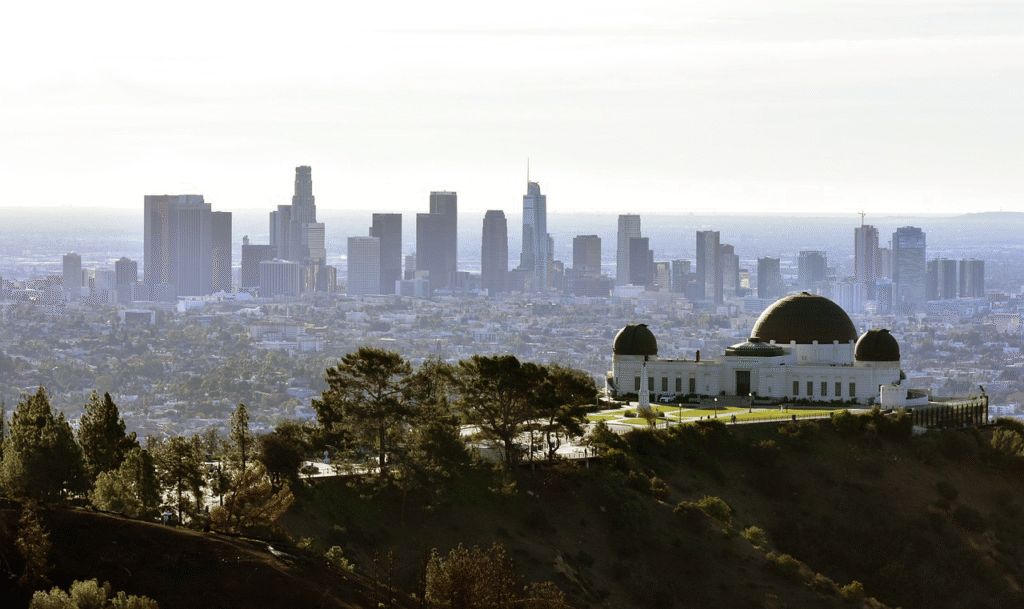
TheStoicPhotographer, pixabay
Los Angeles sprawls across Southern California like a sun-drenched dream, where palm trees sway against mountain backdrops and creativity pulses through every neighborhood. Founded in 1781 as El Pueblo de la Reina de Los Ángeles, this metropolis has evolved from a Spanish mission settlement into America’s entertainment capital and the world’s third-largest urban economy. With nearly 4 million residents speaking over 100 languages, LA embodies the California promise of endless possibility under perpetual sunshine.
Los Angeles at a Glance: Essential Facts for Travelers
| Location | Southern California, United States |
|---|---|
| Coordinates | 34°03′N, 118°15′W |
| Population (City) | 3,898,747 (2020 Census) |
| Metro Population | 13.2 million (Greater LA Area) |
| Area | 1,290.6 km² (498.3 sq mi) |
| Elevation | 100 meters (328 feet) |
| Time Zone | Pacific Time (UTC-8/-7) |
| Area Codes | 213, 310, 323, 424, 661, 818 |
| ZIP Codes | 90001-90099, 91000s series |
| Founded | September 4, 1781 |
| Incorporated | April 4, 1850 |
| Known For | Hollywood, beaches, entertainment industry, aerospace, cultural diversity |
| Current Mayor | Karen Bass (since December 2022) |
| Official Website | lacity.gov |
Upcoming Events in Los Angeles
| Date | Title | Details |
|---|---|---|
| 2026-06-14 to 2026-10-12 | Fashioning Chinese Women: Empire to Modernity at LACMA | LACMA’s exhibition Fashioning Chinese Women: Empire to Modernity runs through 12 October 2026 in the BCAM building on Wilshire Boulevard, tracing how Chinese women’s dress transformed from the Qing empire into the modern era through more than 70 exquisite ensembles. Opened on 14 June, the show spans court dress, everyday wear and modern fashion, rewarding visitors interested in textiles, design and social history alike. General museum admission applies, with timed tickets sold online and reduced or free entry windows for Los Angeles County residents; plan roughly an hour for this gallery. [Source] |
| 2026-09-04 to 2026-11-01 | Halloween Horror Nights at Universal Studios Hollywood | Halloween Horror Nights transforms Universal Studios Hollywood into a sprawling scare zone on select nights from early September through early November. The seasonal event features elaborate haunted mazes based on horror films and franchises, roaming scare actors, live shows and access to many of the park’s rides after dark. It is aimed at older teens and adults seeking genuine frights rather than young children. Tickets are separate from regular park admission and vary by date, with weekends the busiest and priciest. [Source] |
| 2026-09-27 | Abbot Kinney Festival | The Abbot Kinney Festival is one of Los Angeles’s largest free street fairs, taking over the trendy Abbot Kinney Boulevard in Venice for a single late-September day. Tens of thousands come out for live music across multiple stages, hundreds of artisan and food vendors, a beer garden, a kids’ zone and a lively community atmosphere. Celebrating the eclectic spirit of Venice, the festival showcases local makers, musicians and food trucks. Admission is free, though it draws big crowds, so arriving early is wise. [Source] |
| 2026-09-30 to 2026-10-18 | The Outsiders – Broadway Musical at the Hollywood Pantages | The Tony Award-winning musical The Outsiders plays the Hollywood Pantages Theatre from 30 September to 18 October 2026 as part of the Broadway in Hollywood season. Adapted from S. E. Hinton’s classic novel of greasers and rival socs in 1960s Tulsa, the production took the 2024 Tony for Best Musical and arrives with its acclaimed staging, rain-soaked rumble scene included. Performances run across the week at the historic Art Deco theatre on Hollywood Boulevard, with tickets in multiple price tiers through official channels; the show suits teens and adults alike. [Source] |
| 2026-10-01 to 2026-10-31 | Boo at the LA Zoo | Boo at the LA Zoo is the Los Angeles Zoo’s family-friendly Halloween celebration, running on select days throughout October in Griffith Park. Aimed at younger children, it features not-too-scary trick-or-treating stations, animal encounters, spooky decorations, crafts and seasonal shows, all set among the zoo’s usual residents. It offers a gentler alternative to the region’s more intense haunted attractions, ideal for families with small kids. The event is included with zoo admission, with special activities on designated dates; costumes are encouraged. [Source] |
| 2026-10-20 to 2026-10-21 | Bonnie Raitt Live 2026 at the Hollywood Pantages | Blues and roots legend Bonnie Raitt brings her Live 2026 tour to the Hollywood Pantages Theatre on 20 and 21 October, joined by special guest Jon Cleary and the Absolute Monster Gentlemen. The multiple Grammy-winning singer and celebrated slide guitarist draws on a catalogue spanning five decades, mixing blues, rock and soulful ballads in an intimate theatre setting rather than an arena. Tickets are sold in several price tiers through the venue’s official channels, and the two-night stand is aimed at longtime fans and newcomers to American roots music alike. [Source] |
| 2026-10-31 | West Hollywood Halloween Carnaval | The West Hollywood Halloween Carnaval is one of the largest Halloween street parties in the world, drawing hundreds of thousands to Santa Monica Boulevard every October 31. The free event fills the heart of West Hollywood with elaborate costumes, multiple stages of live entertainment, DJs and a famously festive, inclusive atmosphere rooted in the city’s LGBTQ community. Streets close to traffic for the evening as revelers parade their creativity late into the night. It is a quintessential Los Angeles Halloween experience. [Source] |
City News in Los Angeles – last 14 days
| Date | Category | Headline | Details |
|---|---|---|---|
| 2026-09-14 | Public safety | Scores of minibike riders penned in and arrested on 6th Street Bridge | Los Angeles police corralled scores of minibike riders on Sunday, thwarting an attempted takeover of the 6th Street Bridge, the viaduct linking Boyle Heights and the Arts District that has become a magnet for stunt gatherings. Officers issued more than 70 citations and impounded dozens of minibikes in the operation, which penned riders in on the span before processing them one by one. Among those cited were a father riding with his young daughter, and police signalled that further crackdowns on bridge takeovers will follow. [Source] |
| 2026-09-14 | Public safety | LAFD ladder truck crash on Figueroa Street sends seven to hospital | A Los Angeles Fire Department ladder truck was involved in a crash with three other vehicles on Figueroa Street in South Los Angeles on Sunday afternoon, sending seven people to the hospital, including one member of the department. Authorities said the injured civilians were taken for treatment while investigators worked to establish how the collision involving the large apparatus unfolded. The department has not detailed the extent of the injuries, and the stretch of Figueroa was disrupted while the scene was cleared. [Source] |
| 2026-09-14 | Sports | Ballmer apologizes as Clippers accept $30-million fine over salary cap violations | Clippers owner Steve Ballmer apologized to fans and said the franchise will comply with NBA sanctions after a league investigation into salary cap circumvention. The punishment includes a 30 million dollar fine, one of the heaviest penalties the league has imposed on a team, and Ballmer said he would accept the league’s findings rather than fight them. The episode is a bruising off-court setback for a franchise that recently opened its own arena in Inglewood and has spent heavily to chase a first championship. [Source] |
| 2026-09-14 | Sports | Chargers stumble in opener as Cardinals win 26-14 at SoFi Stadium | The Chargers opened their season with a 26-14 home loss to the Arizona Cardinals, a performance one columnist called a debacle that wasted a chance to seize the Los Angeles spotlight from the Rams. Quarterback Justin Herbert was under pressure throughout, with Arizona’s pass rush overwhelming the protection at key moments, including a crucial sack that stalled a comeback attempt. The defeat spoiled the home opener at SoFi Stadium, where Metro had laid on free shuttles for fans, and sharpened questions about the offensive line. [Source] |
| 2026-09-14 | Culture | East LA Mexican Independence Day Parade marks 80th anniversary | The East LA Mexican Independence Day Parade and Festival celebrated its 80th anniversary on Sunday, filling the streets of East Los Angeles with floats, folklorico dancers, charros on horseback and marching bands. One of the oldest and largest celebrations of its kind in the United States, the parade draws generations of families to Cesar Chavez Avenue each September to mark El Grito and Mexican independence. The milestone edition featured community groups, local dignitaries and performers, underscoring the event’s place at the heart of Eastside cultural life. [Source] |
| 2026-09-14 | Local affairs | Countdown to the 2028 Olympics is on as LA begins weekly coverage of the Games’ impact | With the 2028 Olympic and Paralympic Games drawing closer, LAist has launched a weekly Monday focus on how the event will affect Angelenos, from transportation and housing to jobs and neighborhood change. The countdown underlines how preparations are accelerating across the region, as venues, transit agencies and city departments line up plans for the world’s biggest sporting event. Reporters intend to track spending, disruption and opportunities in the run-up, giving residents a regular check on whether Olympic promises are being kept. [Source] |
| 2026-09-14 | Education | International students worry as SoCal universities pause work authorizations | International students at Southern California universities are anxious after several institutions paused work authorizations amid federal pressure. The Department of Homeland Security says it has put universities on notice that they could be violating federal rules governing work opportunities for international students, prompting schools to halt approvals while they assess their exposure. For students who depend on campus jobs and practical training to fund their studies and build careers, the freeze creates immediate financial strain and clouds decisions about staying in the United States. [Source] |
| 2026-09-13 | Local government | With mail-in rules uncertain, Californians urged to prepare to vote in November | Californians are being urged to prepare their voting plans as the Supreme Court weighs President Trump’s proposal to limit universal mail-in voting, with just seven weeks until the November election. Election officials note that voters can confirm their registration, track their ballots and locate in-person voting options in advance, whatever the court decides. The uncertainty is significant for Los Angeles County, the nation’s largest voting jurisdiction, where millions routinely cast ballots by mail and any late change to the rules could cause confusion at scale. [Source] |
| 2026-09-13 | Public transport | Metro offers free shuttle to Chargers home opener at SoFi Stadium | Metro offered free shuttle service to SoFi Stadium for the Chargers’ first home game of the season against the Arizona Cardinals, giving fans a way to skip Inglewood’s notorious game-day parking crunch. The shuttles connect rail riders to the stadium, part of the agency’s continuing push to make major events car-optional ahead of the region’s packed calendar of World Cup, Super Bowl and Olympic dates. Transit officials hope habit-forming services like these will ease congestion around the stadium district on big event days. [Source] |
| 2026-09-13 | Culture | K-Town Archive opens hundreds of firsthand Koreatown stories to the public | A new oral history project, the K-Town Archive, is sharing hundreds of firsthand accounts of life in Koreatown and neighboring communities, and anyone can now dive into the collection. The archive gathers voices of immigrants, small-business owners and longtime residents, preserving memories of one of Los Angeles’s densest and most dynamic neighborhoods, from daily life to upheavals that shaped the community. Organizers hope the freely accessible stories will serve researchers, students and families, and encourage more residents to contribute their own histories. [Source] |
| 2026-09-13 | Local government | Pratt voters could play pivotal role in deciding LA’s next mayor | One in four voters in Los Angeles’s mayoral primary backed Republican Spencer Pratt, and where that bloc lands could prove decisive in the runoff that will choose the city’s next mayor. Mayor Karen Bass and her rival are now courting an electorate frustrated over public safety, homelessness and the cost of living, and Pratt’s unexpectedly strong showing revealed an appetite for outsider candidates. Strategists in both camps are studying how to win over his supporters without alienating their own bases before November. [Source] |
| 2026-09-14 | Local affairs | Rapper Lil Durk acquitted in Los Angeles murder-for-hire case | A jury acquitted rapper Lil Durk of charges alleging a murder-for-hire plot in Los Angeles, ending a closely watched federal prosecution of one of hip-hop’s biggest names. The Chicago artist had been held since his arrest as the case moved through the courts, with prosecutors alleging he ordered violence and the defense attacking the reliability of the evidence, including the use of rap lyrics. The verdict clears the way for the rapper to resume his career and adds to debate over prosecutions built partly on artistic expression. [Source] |
Los Angeles Events & City News Archive
Sources: LACMA, Universal Studios Hollywood, Abbot Kinney Festival, Broadway in Hollywood, Los Angeles Zoo, City of West Hollywood, Los Angeles Times, Los Angeles Times
Weather Forecast for the Next 14 Days in Los Angeles
| Date | Weather | Max °F | Min °F | Rain mm |
|---|---|---|---|---|
| 2026-09-14 | ☁️ | 85.2 °F | 66.4 °F | 0.0 mm |
| 2026-09-15 | ⛅ | 80.1 °F | 63.0 °F | 0.0 mm |
| 2026-09-16 | ⛅ | 81.1 °F | 68.7 °F | 0.0 mm |
| 2026-09-17 | ☀️ | 80.2 °F | 67.6 °F | 0.0 mm |
| 2026-09-18 | ☀️ | 80.9 °F | 68.0 °F | 0.0 mm |
| 2026-09-19 | ☀️ | 82.7 °F | 68.9 °F | 0.0 mm |
| 2026-09-20 | ☁️ | 84.4 °F | 70.1 °F | 0.0 mm |
| 2026-09-21 | ☁️ | 80.0 °F | 69.0 °F | 0.0 mm |
| 2026-09-22 | ☀️ | 80.0 °F | 68.2 °F | 0.0 mm |
| 2026-09-23 | ☁️ | 81.3 °F | 69.2 °F | 0.0 mm |
| 2026-09-24 | ☁️ | 82.0 °F | 70.0 °F | 0.0 mm |
| 2026-09-25 | ☁️ | 76.8 °F | 69.1 °F | 0.0 mm |
| 2026-09-26 | ☁️ | 76.4 °F | 68.9 °F | 0.0 mm |
| 2026-09-27 | ☀️ | 76.1 °F | 67.9 °F | 0.0 mm |
Los Angeles’ History
Los Angeles is younger than most major American cities and yet has lived through more reinventions — Spanish mission, Mexican rancho, American supply town, oil boom, Hollywood, aerospace capital, tech hub. Each layer is still visible if you know where to look.
Indigenous Roots and Spanish Colonization
Long before Hollywood’s first camera rolled, the Tongva people called this coastal basin home, living here for thousands of years. Spanish explorer Juan Rodríguez Cabrillo first claimed the territory in 1542, but it wasn’t until 1771 that Franciscan monks established Mission San Gabriel, laying the groundwork for European settlement. On September 4, 1781, a diverse group of 44 settlers — Spanish families and Indigenous people — officially founded El Pueblo de Nuestra Señora la Reina de los Ángeles del Río de Porciúncula. The unwieldy name, honoring Mary as the Queen of Angels, eventually shortened to simply Los Angeles.
Mexican Period and American Conquest
After Mexico’s independence in 1821, Los Angeles became part of Mexican California, officially incorporating as a city in 1835. The settlement remained a modest cattle-ranching community until the Mexican-American War (1846–1848) brought it under U.S. control. California’s Gold Rush of 1848 transformed LA into a crucial supply hub, selling provisions to fortune-seekers heading north. The city officially joined the United States on April 4, 1850, with just 1,610 residents. Devastating floods in 1861–62 followed by severe drought wiped out the cattle industry, but this setback sparked a land speculation boom that attracted waves of immigrants from China, Japan, and Europe.
Railroad Boom and Population Explosion
The arrival of the Southern Pacific Railroad in 1876 and the Santa Fe Railway in 1885 connected LA to the rest of America, triggering explosive growth. The population skyrocketed from 6,000 in 1900 to over 319,000 by 1910. Aggressive annexation campaigns brought in Wilmington, San Pedro (1909), Hollywood (1910), and the vast San Fernando Valley (1915). Oil discovery in 1892 added black gold to the city’s appeal — by 1923, LA was producing a quarter of the world’s oil, with derricks dotting the landscape from downtown to the hills.
Hollywood’s Golden Age
The entertainment industry found its home in LA starting in 1910, when filmmakers fled East Coast winters and patent restrictions for Southern California’s year-round sunshine and diverse landscapes. The 1920s brought silent film legends; 1927’s “The Jazz Singer” ushered in the talkie era. By 1939, Technicolor masterpieces like “Gone with the Wind” cemented Hollywood’s global dominance. The 1932 Olympics showcased LA to the world, and by the same year, the city had reached one million residents. World War II transformed LA into an aerospace powerhouse, attracting defense contractors and European intellectuals fleeing fascism — including Bertolt Brecht, Marlene Dietrich, and Igor Stravinsky.
Modern Challenges and Resilience
Post-war LA embraced car culture with the 1940 opening of the Arroyo Seco Parkway, America’s first freeway. Significant challenges followed: the 1965 Watts riots exposed deep racial tensions; the 1992 unrest following the Rodney King verdict left 53 dead and caused $800 million in damage. Major earthquakes (1971 San Fernando, 1994 Northridge) tested infrastructure repeatedly. The end of the Cold War hit aerospace hard, but post-9/11 defense spending and tech innovation have driven new growth. Today’s LA leads in entertainment, technology, and international trade while working through ongoing challenges of inequality and sustainability.
Geography, Climate & Best Time to Visit Los Angeles
Geographic Setting
Los Angeles occupies a dramatic coastal basin between the Pacific Ocean and the San Gabriel Mountains, sitting at 100 meters above sea level. The city stretches 71 km north to south and 47 km east to west, covering 1,290.6 km² of diverse terrain — beaches to canyons to urban valleys. The Santa Monica Mountains divide the city, separating the San Fernando Valley (home to one-third of Angelenos) from the coastal plain. This geographic diversity creates distinct microclimates and neighborhoods, each with its own character — it can be 30°C in Burbank while 20°C at the beach.
Climate: Year-Round Paradise
LA enjoys a Mediterranean subtropical climate with warm, dry summers and mild, wet winters. Average temperatures hover around 18°C (64°F), with summer highs reaching 28–30°C (82–86°F) and winter lows rarely dropping below 15°C (59°F).
| Month | High °C | Low °C | Rain (mm) | Sunshine Hours |
|---|---|---|---|---|
| January | 20 | 9 | 79 | 7.3 |
| February | 20 | 10 | 97 | 7.9 |
| March | 21 | 11 | 62 | 8.6 |
| April | 23 | 12 | 23 | 10.1 |
| May | 24 | 14 | 7 | 8.9 |
| June | 26 | 16 | 2 | 9.2 |
| July | 28 | 18 | 0 | 11.7 |
| August | 29 | 18 | 1 | 11.3 |
| September | 28 | 17 | 6 | 9.3 |
| October | 26 | 15 | 17 | 8.2 |
| November | 23 | 11 | 26 | 7.2 |
| December | 20 | 9 | 59 | 7.1 |
The dry season (May–October) offers virtually guaranteed sunshine; the wet season (November–March) brings most of the year’s 379 mm of rainfall. Ocean temperatures range from 14°C in winter to 20°C in summer — fine for surfing year-round, comfortable for swimming June through October.
Best Time to Visit
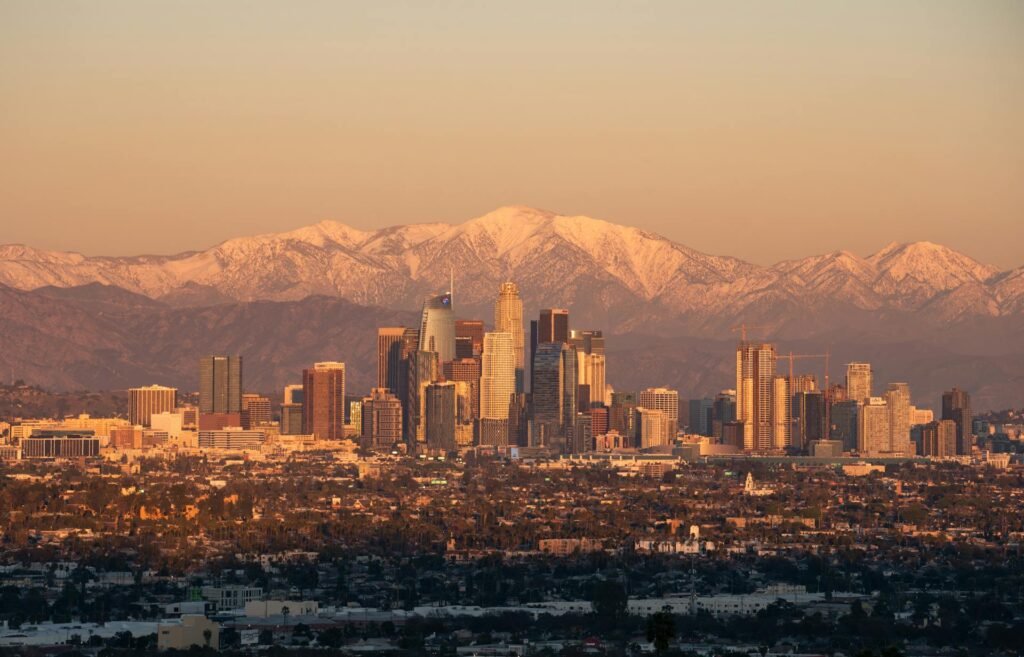
LA welcomes visitors year-round, but each season offers distinct advantages. Summer (June–September) provides perfect beach weather and outdoor festival season; also peak tourist time. Spring (March–May) and fall (September–November) offer ideal temperatures with fewer crowds. Winter (December–February) brings cooler temperatures but remains pleasant; occasional rain clears the air and creates stunning mountain views — the once-a-year sight of snow on the San Gabriel Mountains backed by palm trees in the foreground is purely an LA phenomenon.
Los Angeles’ Districts & Neighborhoods
LA’s 15 council districts encompass dozens of distinct neighborhoods, each offering unique experiences. Rather than a single downtown core, the city functions as a collection of interconnected communities — and choosing where to base yourself shapes the trip more than any other planning decision.
Downtown Los Angeles
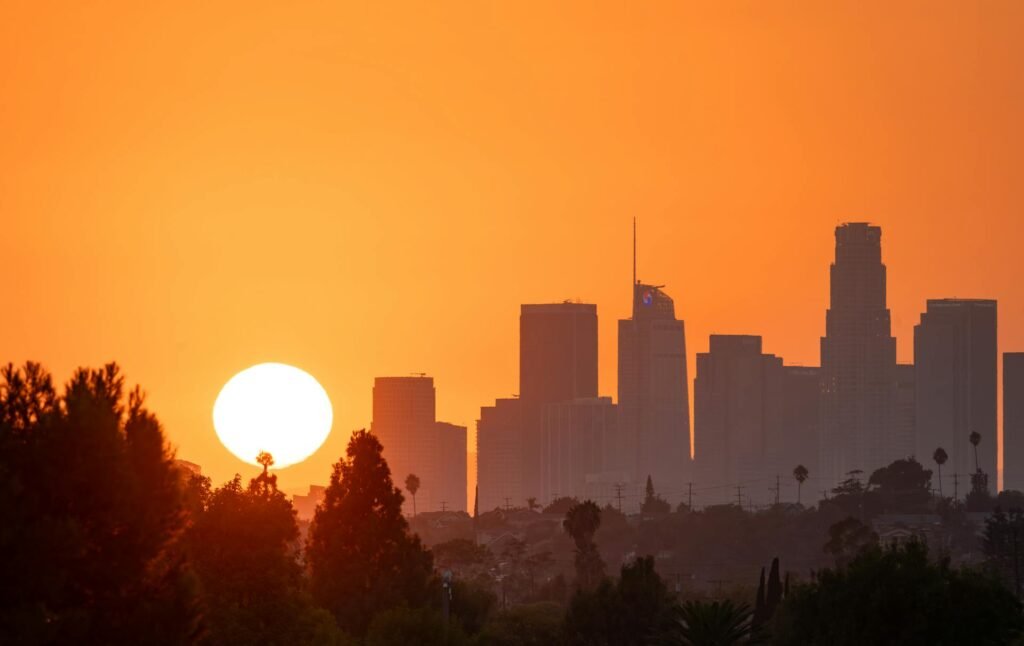
The city’s historic heart has undergone dramatic revitalization since 2010, featuring gleaming skyscrapers, world-class museums, and vibrant nightlife. Stay here for easy access to cultural attractions like the Walt Disney Concert Hall, MOCA, and the Arts District’s galleries and restaurants. The post-pandemic recovery has been uneven; some neighborhoods feel quiet at night while the Arts District thrives.
Hollywood
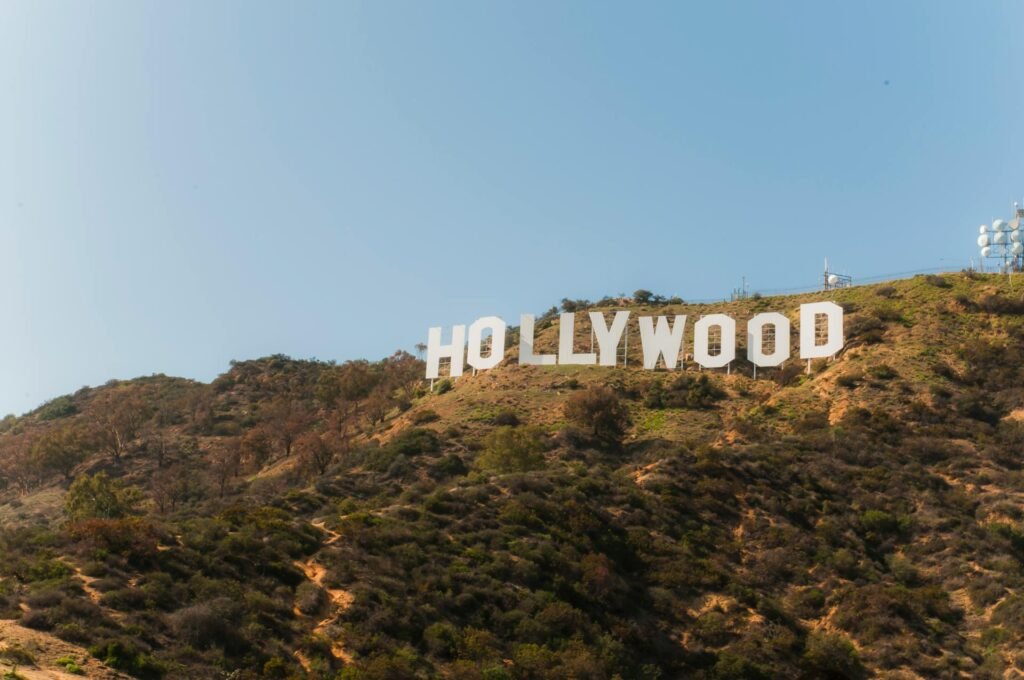
The entertainment capital offers iconic attractions like the Walk of Fame, TCL Chinese Theatre, and Hollywood Sign views from Griffith Observatory. While touristy, it remains essential for first-time visitors seeking classic LA experiences. The streets immediately around Hollywood Boulevard can feel rough; many visitors prefer to base themselves elsewhere and visit during daytime.
West Hollywood & Beverly Hills
Upscale neighborhoods perfect for luxury shopping on Rodeo Drive, celebrity spotting, and high-end dining. West Hollywood‘s Sunset Strip pulses with nightlife; Beverly Hills offers refined elegance. WeHo is also LA’s primary LGBTQ+ neighborhood with a year-round scene.
Santa Monica & Venice
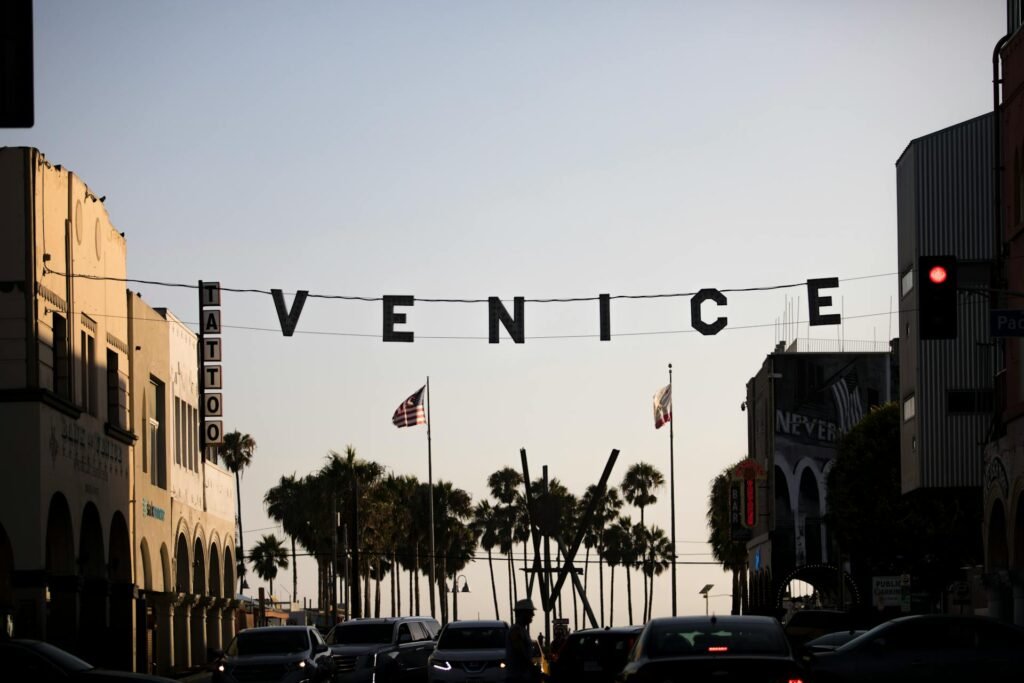
Coastal communities providing the quintessential LA beach experience. Santa Monica offers upscale seaside living with the famous pier; Venice delivers bohemian vibes, street art, and the eclectic Ocean Front Walk plus the Venice Canals (an actual replica of Venice, Italy from 1905).
Pasadena
An elegant city northeast of downtown — home to the Rose Bowl, Caltech, and beautiful Craftsman architecture. Perfect for visitors seeking a more refined, walkable LA experience away from the celebrity buzz.
Where to Stay
Choose carefully in sprawling LA. Downtown suits culture enthusiasts and business travelers. Hollywood works for first-timers wanting classic attractions. Santa Monica/Venice appeals to beach lovers. Beverly Hills/West Hollywood caters to luxury seekers. Pasadena offers charm with easy downtown access via Metro Gold Line.
Top Things to Do in Los Angeles
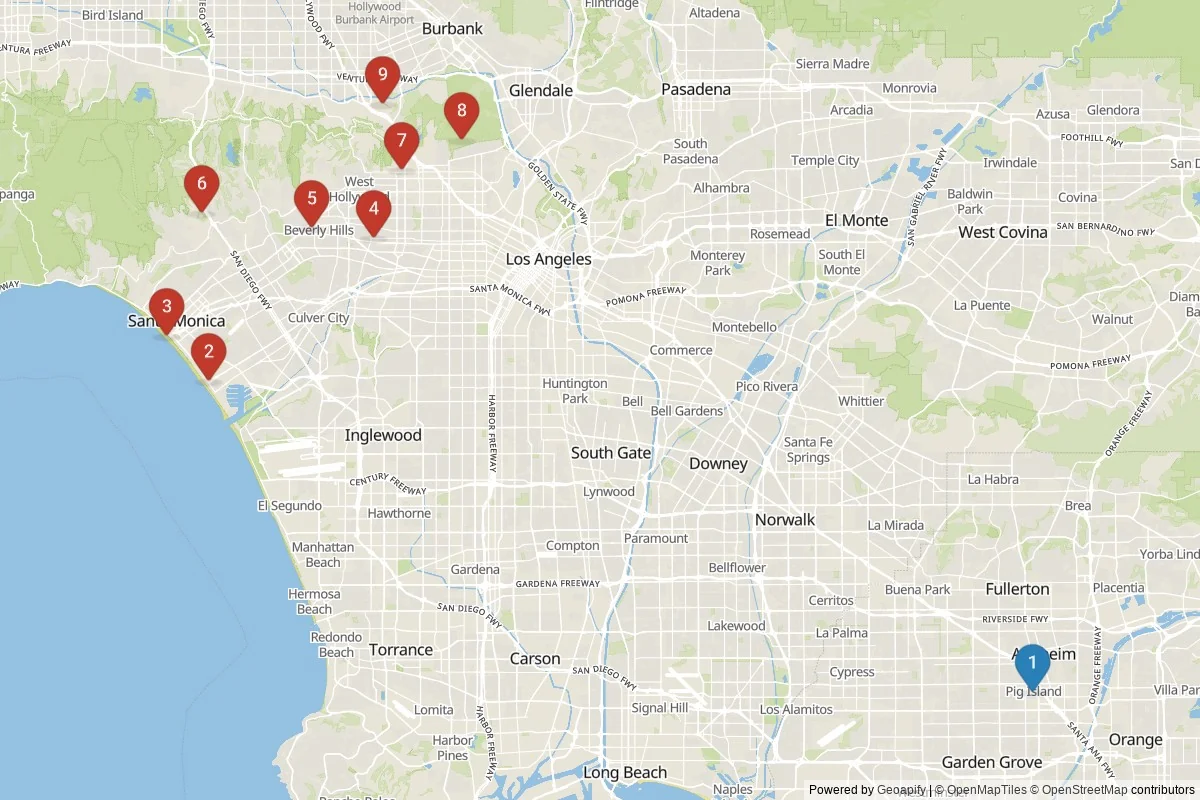
| # | Sight | Cluster | Type | Time | Entry | Best |
|---|---|---|---|---|---|---|
| 1 | Disneyland (Anaheim) | Central | Theme park | Full day | $104+ | Morning |
| 2 | Venice Beach | Outer | Beach & boardwalk | ~2 hrs | Free | Afternoon |
| 3 | Santa Monica Pier | Outer | Pier | ~2 hrs | Free | Sunset |
| 4 | LACMA | Outer | Art museum | ~2 hrs | $25 | Morning |
| 5 | Beverly Hills / Rodeo Drive | Outer | Shopping district | ~1.5 hrs | Free | Afternoon |
| 6 | Getty Center | Outer | Art museum | ~3 hrs | Free / $20 parking | Morning |
| 7 | Hollywood Walk of Fame | Outer | Star-studded blvd | ~1 hr | Free | Afternoon |
| 8 | Griffith Observatory | Outer | Observatory | ~2 hrs | Free | Sunset |
| 9 | Universal Studios Hollywood | Outer | Theme park | Full day | $109 | Morning |
| 🚗 | Day Trip: Malibu | Day trip | Day trip | ½ day | Free | Afternoon |
Iconic Landmarks
No LA visit is complete without seeing the Hollywood Sign, best viewed from Griffith Observatory, which also offers planetarium shows and panoramic city views (free admission to the building, paid for the planetarium). Walk the Hollywood Walk of Fame and catch a movie at the historic TCL Chinese Theatre, where celebrity handprints and footprints in the forecourt create a tactile connection to film history. Downtown’s Walt Disney Concert Hall showcases Frank Gehry’s stainless-steel architectural genius and world-class acoustics. The nearby Cathedral of Our Lady of the Angels impresses with its modern sacred architecture by Rafael Moneo.
Museums & Culture
The Getty Center combines impressive art collections with stunning Richard Meier architecture and panoramic city views — admission is free (parking USD 25). LACMA (Los Angeles County Museum of Art) houses over 100,000 works spanning millennia; the Urban Light installation outside has become an Instagram landmark. MOCA focuses on contemporary masterpieces in Arata Isozaki’s striking downtown building. The Broad downtown features contemporary pieces in a honeycomb-like structure designed by Diller Scofidio + Renfro — also free with timed entry. The Natural History Museum in Exposition Park features dinosaur skeletons; the nearby California Science Center houses the Space Shuttle Endeavour.
Beaches & Coastal Activities
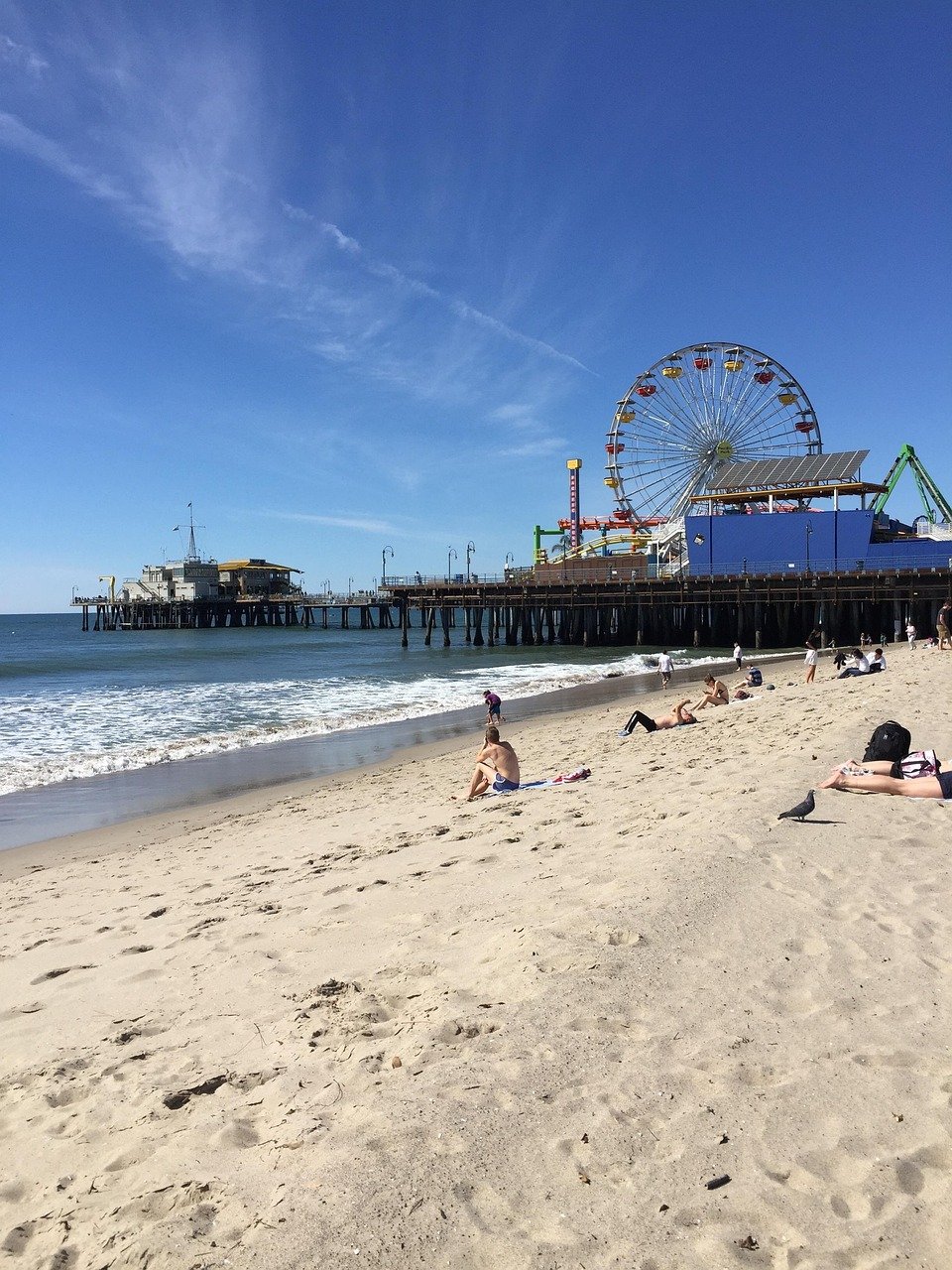
Santa Monica Pier offers classic carnival fun with its Ferris wheel and roller coaster (Pacific Park, the only amusement park on a pier in California). Venice Beach‘s Ocean Front Walk buzzes with street performers, artists, and the famous Muscle Beach outdoor gym. For a more refined beach experience, head to Manhattan Beach or Malibu’s Surfrider Beach.
anisensior, pixabay
Entertainment & Studios
Universal Studios Hollywood offers behind-the-scenes movie magic with studio tours and thrilling rides — the Wizarding World of Harry Potter is the headline draw. Warner Bros. Studios in Burbank provides more intimate glimpses of active production. For live entertainment, catch a show at the Hollywood Bowl‘s outdoor amphitheater (operating since 1922) or the Music Center’s various venues.
Parks & Outdoor Activities
Griffith Park, one of America’s largest urban parks at 4,310 acres, offers hiking trails, the Los Angeles Zoo, and the iconic Griffith Observatory. The La Brea Tar Pits provide a unique glimpse into Ice Age LA — actual fossil-extraction sites still bubbling tar in the middle of the city. For day trips: the Angeles National Forest provides mountain hiking minutes from downtown; Catalina Island offers a Mediterranean-style escape accessible by ferry from Long Beach or San Pedro.
Shopping & Dining
Rodeo Drive in Beverly Hills epitomizes luxury shopping; Melrose Avenue offers trendy boutiques and vintage finds. The Original Farmers Market and adjacent Grove provide diverse dining and shopping in a festive atmosphere. LA’s food scene reflects its diversity — authentic tacos in East LA, Korean BBQ in Koreatown, dim sum in Monterey Park, and innovative California cuisine throughout the city. Don’t miss the food truck culture that elevated street food to gourmet status (the city’s Roy Choi-pioneered Korean-Mexican fusion launched the global gourmet food truck movement).
How to Get to Los Angeles
By Air
Los Angeles International Airport (LAX) serves as the primary gateway, handling over 80 million passengers annually with flights from around the world. The airport offers connections to downtown via the K Line (formerly Crenshaw/LAX, with the LAX/Metro Transit Center connector opening 2024–25), buses, and ride-sharing services. Alternative airports include Hollywood Burbank (BUR) for Hollywood and the Valley, Long Beach (LGB) smaller and less crowded, and John Wayne (SNA) in Orange County for southern LA areas.
By Rail
Amtrak serves Union Station downtown with routes including the Pacific Surfliner (San Diego to San Luis Obispo), Coast Starlight (Seattle to Los Angeles), and Southwest Chief (Chicago to Los Angeles). The historic Union Station, built in 1939, is an architectural landmark worth visiting regardless of travel plans.
By Road
Major interstate highways connect LA to the rest of the country: I-5 runs north-south from Mexico to Canada; I-10 heads east to Florida; I-15 leads to Las Vegas and Salt Lake City; I-40 crosses the continent to North Carolina. The scenic Pacific Coast Highway (Highway 1) offers stunning coastal views from San Diego to San Francisco.
By Sea
The World Cruise Center at the Port of Los Angeles welcomes cruise ships bound for Mexico, Hawaii, and Alaska. Catalina Express ferries connect Long Beach and San Pedro to Catalina Island for day trips or overnight stays.
Getting Around Los Angeles
Metro Rail & Bus System
LA’s growing Metro system includes six rail lines covering 117 km — from underground subways (B Line/Red Line and D Line/Purple Line) to light rail connecting beaches to downtown (E Line/Expo Line). The system has expanded substantially since the 2020s; the K Line and the Regional Connector (opened 2023) now provide direct downtown-to-LAX connectivity. The TAP card provides seamless access to trains, buses, and bike-share systems. Metro buses operate extensive networks with three service levels: Local, Rapid, and Express. The Orange Line bus rapid transit (G Line) uses dedicated lanes for subway-like efficiency.
Driving
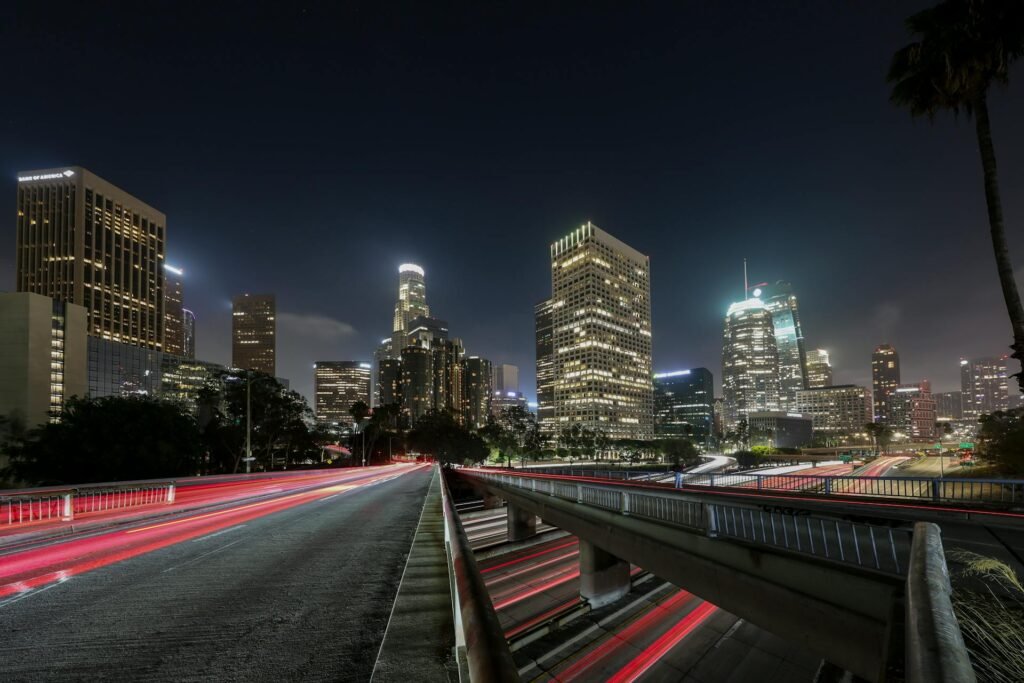
While LA remains car-centric, driving requires patience during rush hours (7–9 AM, 4–7 PM). Major freeways include the 405 (San Diego Freeway), 101 (Hollywood Freeway), and 110 (Harbor Freeway). Parking can be challenging and expensive in popular areas; many attractions offer validation. Apps like Waze are essential — a 30-minute trip during off-hours can become 90 minutes during peak traffic.
Alternative Transportation
Ride-sharing services (Uber, Lyft) are widely available and often more convenient than traditional taxis. Bike-sharing systems and dedicated bike lanes are expanding, particularly along Metro rail lines. E-scooters (Bird, Lime, Spin) provide last-mile connectivity in many neighborhoods. For longer distances, Metrolink commuter rail connects LA to surrounding counties with double-decker trains reaching speeds up to 140 km/h.
Food & Drink in Los Angeles
LA’s culinary scene reflects its incredible diversity. The city offers everything from authentic street tacos to Michelin-starred innovation, and the food culture embraces both high-end dining and casual excellence often found side by side.
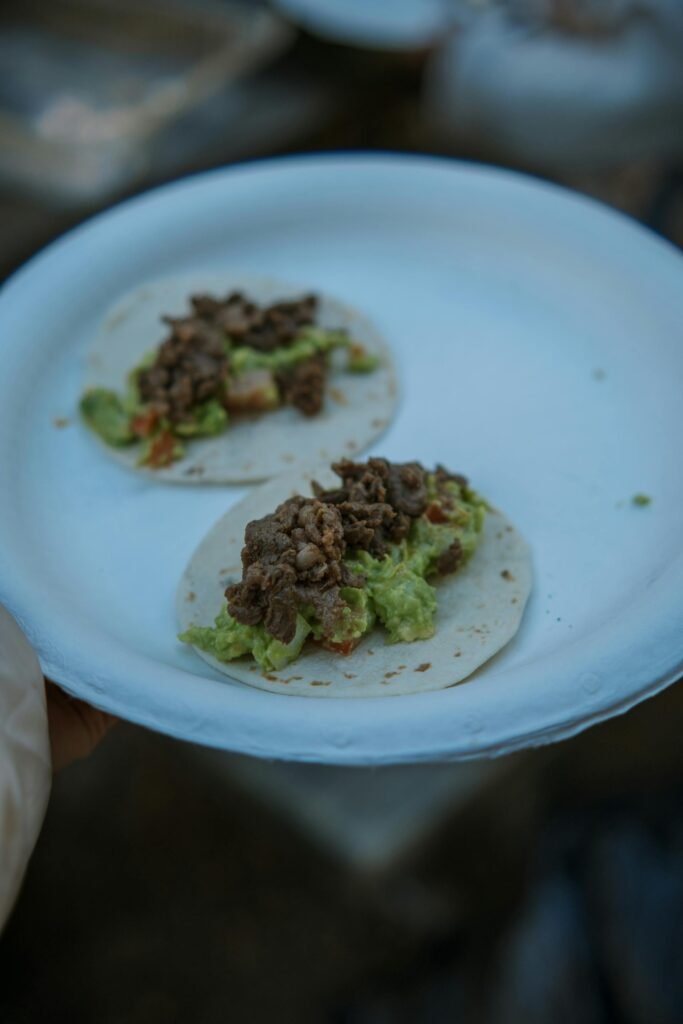
Signature LA Foods
Korean BBQ in Koreatown represents some of the best outside Korea, with 24-hour restaurants and authentic banchan. Mexican cuisine ranges from East LA’s traditional taquerias to upscale interpretations of regional specialties — try Guerrilla Tacos, Sonoratown, or the now-canonical Mariscos Jalisco truck. The city’s taco trucks have achieved legendary status, elevating street food to an art form. California cuisine, emphasizing fresh local ingredients and innovative combinations, originated here and continues to evolve. The farm-to-table movement thrives thanks to year-round growing seasons and proximity to Central Valley agriculture.
Diverse Neighborhoods
Little Tokyo offers authentic ramen, sushi, and Japanese pastries. Chinatown serves dim sum and Cantonese specialties; nearby Thai Town in East Hollywood provides some of America’s best Thai food. Persian restaurants along Westwood Boulevard create “Tehrangeles,” while Armenian cuisine flourishes in Glendale.
Food Markets & Halls
The Original Farmers Market (1934) combines local produce with international food stalls. Grand Central Market downtown features artisanal vendors alongside traditional Mexican and Central American eateries — Eggslut, Sticky Rice, and Bavel are highlights. Santa Monica Farmers Market showcases California’s agricultural bounty every Wednesday and Saturday — chefs from the city’s top restaurants shop here.
Craft Beer & Cocktails
LA’s craft beer scene spans from beach breweries in Manhattan Beach to urban taprooms in the Arts District. The city’s cocktail culture embraces both classic Hollywood glamour and innovative mixology, with rooftop bars offering stunning city views — Perch downtown and the Edition Hotel’s rooftop are the standouts.
Culture & Arts in Los Angeles
LA pulses with creative energy, from world-renowned museums to vibrant street art, establishing itself as a global cultural capital beyond its entertainment-industry fame.
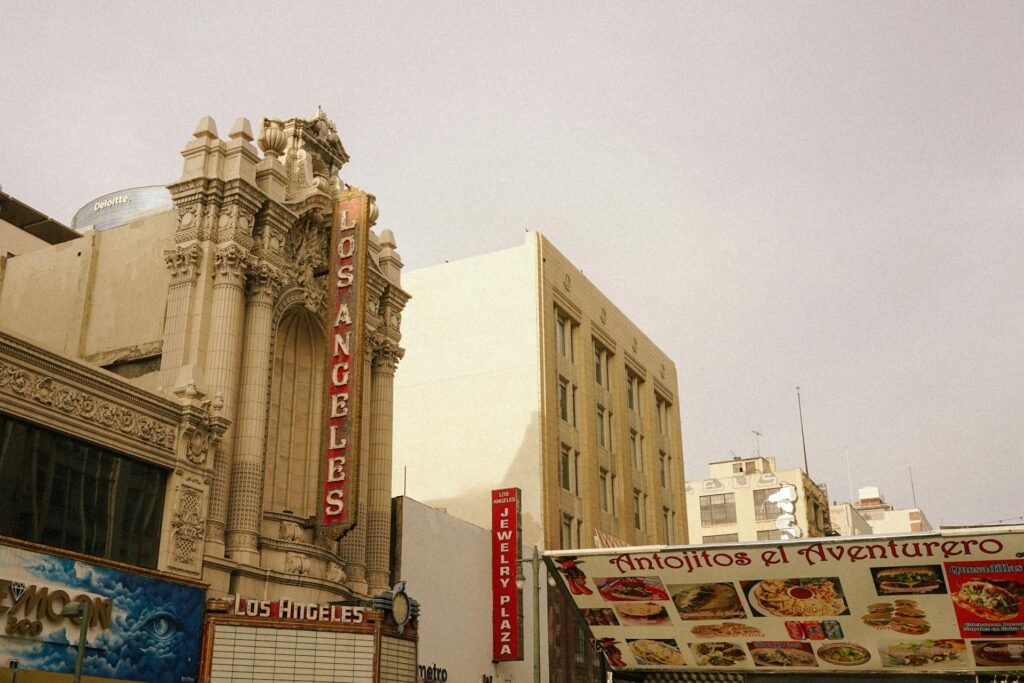
Museums & Galleries
The Getty Center offers free admission to impressive collections spanning centuries, in Richard Meier’s architectural masterpiece with panoramic city views. LACMA showcases over 100,000 artworks from ancient to contemporary; the iconic Urban Light installation has become an Instagram landmark. MOCA focuses on contemporary art in Arata Isozaki’s striking downtown building. The Hammer Museum in Westwood combines classical and modern works. The Broad features contemporary pieces in a honeycomb-like structure designed by Diller Scofidio + Renfro.
Music & Performance
The Walt Disney Concert Hall, Frank Gehry’s swooping stainless-steel masterpiece, provides world-class acoustics for the LA Philharmonic. The Hollywood Bowl offers magical summer evenings under the stars, hosting everything from classical music to pop concerts since 1922. The Music Center downtown encompasses multiple venues including the Dorothy Chandler Pavilion (former Oscar ceremony site) and the Mark Taper Forum for intimate theater productions.
Street Art & Murals
LA’s street art scene thrives throughout the city, from the colorful murals of the Arts District to Venice’s graffiti walls. The city has embraced public art, commissioning murals that reflect its diverse communities and social movements. The Mural Conservancy of Los Angeles maintains an active mural map.
Film & Television
Beyond Hollywood’s tourist attractions, LA offers numerous opportunities to experience its entertainment industry. Studio tours at Universal, Warner Bros., and Sony provide behind-the-scenes glimpses; tapings of TV shows offer chances to see productions in action (free tickets are available through TV Tickets, Audiences Unlimited, and the studios themselves).
Sports in Los Angeles
Los Angeles boasts teams in every major professional sport, creating year-round excitement for sports fans.
Professional Teams
The Lakers and Clippers share Crypto.com Arena (formerly Staples Center) downtown; the LA Sparks represent the city in the WNBA. The Dodgers play at iconic Dodger Stadium in Chavez Ravine; the Angels call Anaheim home. The Rams and Chargers both play at the stunning SoFi Stadium in Inglewood (opened 2020). The Kings (NHL) and LA Galaxy (MLS) round out the major-league representation; LAFC plays at the intimate BMO Stadium downtown.
College Sports
UCLA Bruins and USC Trojans maintain one of college sports’ great rivalries, particularly in football and basketball. Both schools have produced numerous Olympic athletes and professional stars.
Olympic Legacy
LA hosted the Summer Olympics in 1932 and 1984, and will host again in 2028. The 1984 Games were particularly successful, generating profits while showcasing the city’s venues and climate to the world. Expect significant infrastructure projects through 2027–28 in preparation.
Annual Events
The Los Angeles Marathon winds through diverse neighborhoods each March; tennis’s Indian Wells tournament draws top players to the desert two hours east. Beach volleyball tournaments take advantage of the coastal setting year-round.
Los Angeles by District: The 21 Neighborhoods
Los Angeles is divided into 21 neighborhoods. The map below shows their official OSM boundaries, colour-coded to match the table — a quick way to orient yourself before zooming in on individual sights.
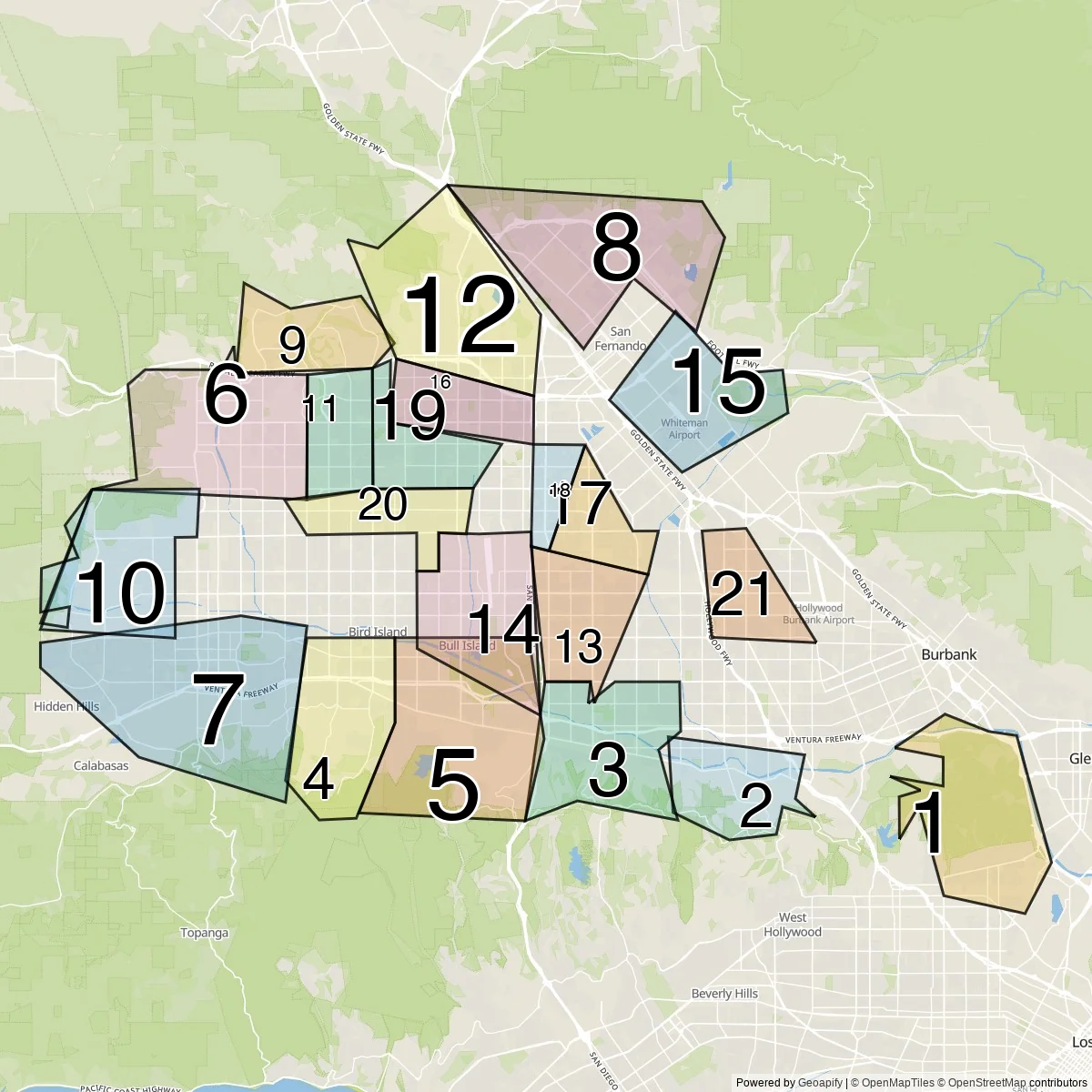
| # | Neighborhoods |
|---|---|
| 1 | Los Feliz Neighborhood Council District |
| 2 | Studio City Neighborhood Council District |
| 3 | Sherman Oaks Neighborhood Council District |
| 4 | Tarzana Neighborhood Council District |
| 5 | Encino Neighborhood Council District |
| 6 | Chatsworth Neighborhood Council District |
| 7 | Woodland Hills-Warner Center Neighborhood Council District |
| 8 | Sylmar Neighborhood Council District |
| 9 | Porter Ranch Neighborhood Council District |
| 10 | West Hills Neighborhood Council District |
| 11 | Northridge West Neighborhood Council District |
| 12 | Granada Hills North Neighborhood Council District |
| 13 | Van Nuys Neighborhood Council District |
| 14 | Lake Balboa Neighborhood Council District |
| 15 | Pacoima Neighborhood Council |
| 16 | Granada Hills South Neighborhood Council District |
| 17 | Panorama City Neighborhood Council District |
| 18 | North Hills East Neighborhood Council District |
| 19 | Northridge East Neighborhood Council District |
| 20 | Northridge South Neighborhood Council District |
| 21 | North Hollywood Northeast Neighborhood Council District |
Frequently Asked Questions About Visiting Los Angeles
Do I need a visa to visit the United States?
It depends on your nationality. Citizens of the Visa Waiver Program (VWP) countries — including the UK, EU member states, Australia, Japan, South Korea, and 35 others — can enter the US for up to 90 days without a visa, but must obtain an ESTA (Electronic System for Travel Authorization) before travel via the official portal at esta.cbp.dhs.gov. Cost is USD 21, valid for 2 years. All other nationalities need a B1/B2 tourist visa applied for at the US embassy in their country — see travel.state.gov. Apply 3+ months in advance; wait times can be long. Always confirm current eligibility before booking.
Is Los Angeles safe for tourists?
LA is generally safe in the tourist areas — Hollywood, Beverly Hills, Santa Monica, Venice, Pasadena, Downtown’s Arts District. The US State Department rates the United States at “exercise normal precautions.” Standard urban precautions apply: avoid certain South LA, East LA, and Skid Row areas at night; don’t leave anything visible in parked cars (smash-and-grab thefts are common); be aware of homeless encampments in some downtown and Venice areas — most encounters are non-threatening but can feel intense. Use ride-hailing rather than walking after dark in unfamiliar neighborhoods. Hollywood Boulevard at night attracts more aggressive solicitors than during day.
How many days do I need in Los Angeles?
Five days is the comfortable minimum for a first-time visit; seven gives breathing room. A solid 5-day plan: Day 1 Hollywood Boulevard + TCL Chinese Theatre + Griffith Observatory at sunset; Day 2 Beverly Hills + Rodeo Drive + the Getty Center; Day 3 Santa Monica Pier + Venice Beach + Manhattan Beach; Day 4 Downtown — Walt Disney Concert Hall + The Broad + LACMA + La Brea Tar Pits; Day 5 Universal Studios or Disneyland (in Anaheim) day trip. Add days for Catalina Island, Joshua Tree (2-hour drive), or San Diego (2-hour drive). LA’s geographic spread means transit between districts eats significant time.
What’s the best area to stay in Los Angeles?
Depends entirely on your priorities — and unlike most cities, getting this wrong adds hours of daily driving. Santa Monica is the easy default — beach access, walkable, restaurants, ride-hailing 15–20 min to Hollywood/downtown. Hollywood / West Hollywood for first-time visitors prioritizing classic LA experiences. Beverly Hills for luxury and central location. Downtown LA for culture and business travelers. Pasadena for refined charm with Metro access. Avoid LAX-area hotels except for very early flights — they’re isolated and dull. The cheapest hotels are in less central neighborhoods that require significant driving.
How much does it cost to visit the major attractions?
Many of LA’s best attractions are surprisingly free or affordable. Free: The Getty Center (paid parking only, USD 25), The Broad (timed-entry online), Griffith Observatory (paid planetarium), Hollywood Walk of Fame, La Brea Tar Pits (paid museum), Venice Beach, Hollywood Sign hike. Paid: LACMA USD 28; Universal Studios Hollywood USD 109+ (variable pricing); Warner Bros. Studio Tour USD 80; Hollywood Bowl shows from USD 15 (cheapest seats); Dodger Stadium tickets from USD 20 (depending on game). Check official sites before booking — third-party resellers often charge significant markups.
Should I drink the tap water in Los Angeles?
Yes — LA’s tap water is safe and meets EPA standards. The Los Angeles Department of Water and Power (LADWP) publishes annual water quality reports. The water has a higher mineral content than coastal areas (taste varies), but is safe for drinking, brushing teeth, and ice. Most restaurants serve tap water free upon request. The CDC’s USA travel health page rates the water as generally safe. Bottled water is widely available but unnecessary for drinking.
Do I need a car in Los Angeles?
Honestly — it depends. LA is famously car-centric, but the city is finally building meaningful public transit, and ride-hailing makes car-free trips feasible if you’re strategic. You don’t need a car if: you stay in a transit-rich neighborhood (Santa Monica, Hollywood, Downtown), focus on a few areas, and use Uber/Lyft for occasional hops. You probably want a car if: you plan to visit Malibu, Catalina ferry, Joshua Tree, San Diego, or want flexibility to hit multiple distant neighborhoods in one day. Rental cars run USD 50–100+/day; gas is comparatively expensive. The Metro rail system has expanded substantially, and the new K Line connects LAX to downtown — book accommodations near a Metro station and you can often skip the rental.
Is tipping expected in Los Angeles?
Yes — strongly, and at higher percentages than most other countries. Restaurants: 18–22% on the pre-tax bill is standard; 15% is now considered low. Many restaurants pre-print suggested tip amounts on the bill. Cafés / counter service: 10–15% via the iPad screen prompt is increasingly expected. Bars: USD 1–2 per drink, or 20% on tabs. Taxis / Uber / Lyft: 15–20%. Hotel housekeeping: USD 3–5 per day. Hotel porters: USD 2–5 per bag. Tour guides: 15–20% for group tours, USD 50–100 per person for full-day private tours. Spa / hair: 18–22%. American tipping culture is genuinely a higher bar than most international visitors expect; budget accordingly.
Economy & Business in Los Angeles
LA operates the world’s third-largest urban economy, generating over $1 trillion annually and rivaling entire nations in economic output.
Entertainment Industry
Hollywood remains the global entertainment capital — major studios including Disney, Warner Bros., Universal, and Paramount. The industry encompasses film, television, music, gaming, and digital media, employing hundreds of thousands directly and indirectly.
Aerospace & Technology
LA’s aerospace sector includes major contractors like Northrop Grumman, Boeing, and SpaceX (headquartered in Hawthorne). The region’s tech scene has grown dramatically — “Silicon Beach” along the Westside is home to Snap, Riot Games, Hulu, and dozens of others.
International Trade
The Port of Los Angeles ranks as North America’s busiest container port, handling goods from Asia and distributing them across the continent. Combined with the adjacent Port of Long Beach, the San Pedro Bay complex moves about 40% of all container imports into the United States.
Tourism
With over 50 million visitors annually, tourism contributes more than $34 billion to the local economy. The industry supports hundreds of thousands of jobs across hospitality, entertainment, and retail sectors.
Los Angeles continues to evolve and reinvent itself, balancing its entertainment legacy with technological innovation, international commerce, and cultural diversity. Whether the draw is Hollywood glamour, world-class museums, perfect beaches, or the food, LA offers experiences that capture the essence of the California dream under endless blue skies.
AFRIKA
Cairo Hurghada Johannesburg Marrakech
ASIA
Abu Dhabi Agra Antalya Bangkok Batam Beijing Bengaluru Cebu City Chiang Mai Chiba Chennai Da Nang Dammam Delhi Denpasar Dubai Fukuoka Guangzhou Guilin Ha Long Hanoi Ho Chi Minh City Jakarta Jaipur Johor Bahru Kolkata Krabi Kuala Lumpur Kyoto Macau Mecca Medina Mugla Mumbai Osaka Pattaya Penang Phuket Riyadh Seoul Shanghai Shenzhen Singapore Taipei Tokyo Zhuhai
EUROPE
Amsterdam Athens Barcelona Berlin Brussels Budapest Copenhagen Dublin Florence Frankfurt am Main Heraklion Krakow Lisbon London Madrid Milan Munich Nice Paris Porto Prague Rhodes Rome Stockholm Venice Vienna Warsaw
NORTH AMERICA
Cancun Las Vegas Los Angeles Miami New York City Orlando San Francisco Toronto Vancouver
SOUTH AMERICA
Buenos Aires Lima Rio De Janeiro
OCEANIA
Auckland Honolulu Melbourne Sydney