
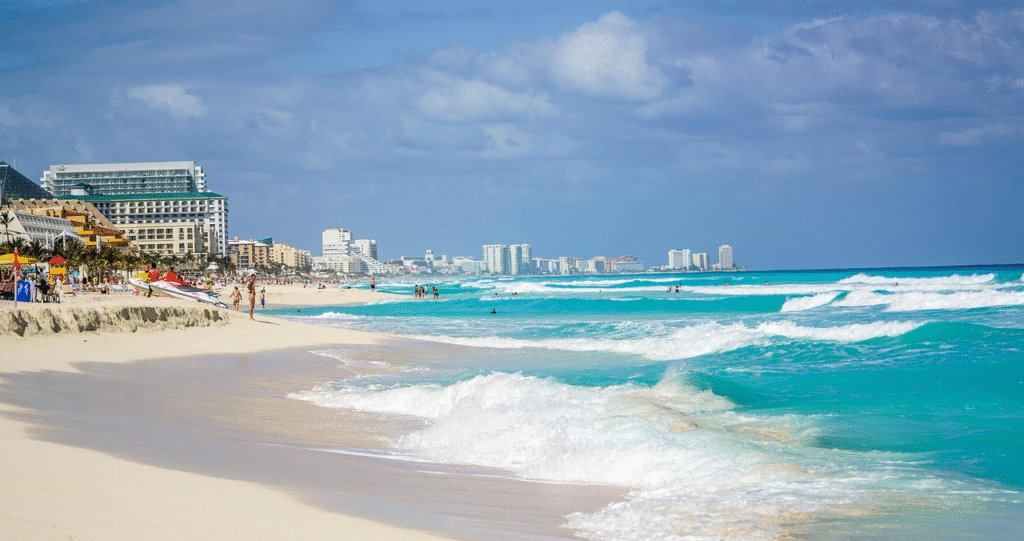
Photo credit: Michelle_Pitzel, pixabay
Cancún, the crown jewel of Mexico’s Yucatán Peninsula, beckons with its pristine white-sand beaches, crystal-clear Caribbean waters, and vibrant blend of ancient Mayan heritage and modern resort luxury. This tropical paradise has transformed from a sleepy fishing village into one of the world’s premier beach destinations, welcoming over 6 million visitors annually. Whether you’re seeking relaxation on powdery beaches, adventure in underwater cenotes, or exploration of nearby archaeological wonders, Cancún delivers an unforgettable Mexican Caribbean experience.
Cancún at a Glance: Essential Facts for Travelers
| Location | Quintana Roo state, southeastern Mexico |
|---|---|
| Coordinates | 21° 9′ 38″ N, 86° 50′ 51″ W |
| Population | 888,797 (2020) |
| Area | 2,107 km² |
| Population Density | 314 people per km² |
| Elevation | 10 meters above sea level |
| Time Zone | UTC−5 (Eastern Standard Time) |
| Calling Code | (+52) 998 |
| Postal Codes | 77500–77539 |
| Founded | April 20, 1970 |
| Known For | Caribbean beaches, Mayan ruins, resort tourism, nightlife |
| Mayor | Paul Carrillo de Cáceres |
| Official Website | www.cancun.gob.mx |
Upcoming Events in Cancún
| Date | Title | Details |
|---|---|---|
| 2026-09-15 | Grito de Independencia Celebration at Plaza de la Reforma | Cancun marks Mexican Independence eve on 15 September with a large free celebration at Plaza de la Reforma, in front of the Municipal Palace downtown. Festivities begin at 7:30 pm with cultural, musical and folkloric performances for all ages, building to the traditional Grito de Independencia ceremony at around 10:50 pm. A 200-drone light show and a headline concert by Lucero and Mijares crown the night, while a cultural corridor with food and craft stalls extends towards Parque de las Palapas. Admission is free and the atmosphere is festive and family-friendly. [Source] |
| 2026-09-21 to 2026-09-22 | Autumn Equinox at Chichen Itza | Around the autumn equinox each September, crowds gather at Chichen Itza, a UNESCO World Heritage site a few hours from Cancun, to witness the famous play of light on the pyramid of Kukulcan. As the sun sets, shadows cast by the terraces create the illusion of a serpent slithering down the staircase, a feat of ancient Maya astronomy and engineering. The site is busy on equinox days, so arriving early helps. Standard admission applies. Combining archaeology, ritual and spectacle, it is a bucket-list day trip for visitors basing themselves on the Cancun coast. [Source] |
| 2026-10-02 | Mijares Sinfonico at Plaza de Toros Cancun | Mexican pop balladeer Manuel Mijares brings his Mijares Sinfonico show to the Plaza de Toros Cancun on 2 October 2026 at 9 pm, performing his best-loved hits with symphonic arrangements. Fresh from co-headlining the city’s Independence celebrations, the veteran singer remains one of Mexico’s most cherished romantic voices. Ticket prices vary by seating section and are sold through authorised outlets. The intimate bullring-turned-concert-venue puts the audience close to the stage, and the evening suits fans of classic Latin pop of all ages, from nostalgic couples to families. [Source] |
| 2026-10-21 to 2026-10-23 | Cancun Travel Mart 2026 | The Cancun Travel Mart, the Mexican Caribbean’s premier tourism business event, celebrates its 38th edition from 21 to 23 October 2026 at the Iberostar Selection Cancun in the Hotel Zone. Since 1987 the marketplace has connected hoteliers, destination-management companies and tour operators with international buyers shaping future travel programmes for the region. The schedule mixes pre-scheduled business appointments with networking functions. Attendance is for registered industry professionals, with fees varying by participant category, and the gathering underlines Cancun’s standing as one of Latin America’s leading resort destinations. [Source] |
| 2026-10-26 to 2026-10-27 | La Jaula de las Locas at Teatro de Cancun | La Jaula de las Locas, the acclaimed Spanish-language staging of the musical comedy La Cage aux Folles, comes to the Teatro de Cancun in the Hotel Zone on 26 and 27 October 2026, its first presentation at the venue. The award-winning Mexican production combines uproarious comedy, dazzling costumes and big musical numbers in the story of a Saint-Tropez drag-cabaret family put to the test. Ticket prices vary by seating category. An ideal night out for musical-theatre lovers, it headlines an autumn season that mixes drama, comedy, dance and family shows. [Source] |
| 2026-10-30 to 2026-11-01 | Xcaret Festival de Vida y Muerte | Around the Day of the Dead, the Xcaret eco-park south of Cancun stages its Festival de la Vida y la Muerte, a large celebration of Mexico’s Day of the Dead traditions. Over several days spanning late October and early November, altars, candlelit paths, concerts, dances, food and theatrical performances honour the departed, with a strong focus on Maya and Yucatecan customs. It is a moving, family-friendly immersion in one of Mexico’s most iconic cultural traditions. Tickets are required and sell out, so booking ahead is advised. The atmospheric setting makes it a highlight of the autumn calendar. [Source] |
| 2026-11-14 | Panteon Rococo Live at Plaza de Toros Cancun | Legendary Mexico City ska-rock collective Panteon Rococo plays the Plaza de Toros Cancun on 14 November 2026, with the show starting at 8:30 pm. Known for three decades of high-energy anthems blending ska, rock, cumbia and socially conscious lyrics, the band commands one of Mexico’s most devoted live followings, and its festive dance-floor atmosphere is famous. Tickets vary by section and are sold through authorised outlets. Expect a sweaty, celebratory night that draws everyone from longtime fans to newcomers curious about the Mexican ska tradition. [Source] |
City News in Cancún – last 14 days
| Date | Category | Headline | Details |
|---|---|---|---|
| 2026-09-14 | Business | Summer Tourism Slump: Cancun Among Mexican Beach Destinations Losing Visitors | Mexico’s leading beach destinations recorded a weaker summer season, with Cancun, Puerto Vallarta and Los Cabos all losing visitors compared with the previous year. Reporting based on industry figures puts the combined decline at around 1.6 million foreign visitors across the three destinations, a significant blow for regions that depend heavily on tourism income. Hoteliers and business groups in Cancun are watching the trend closely as the sector heads into the autumn and winter booking season, when demand from North American travellers traditionally rebounds. [Source] |
| 2026-09-14 | Local government | Arboriza Cancun Enters Third Phase with 3,000 Trees to Be Planted | The municipal reforestation programme Arboriza Cancun has begun its third phase, under which 3,000 trees are to be planted across the city. The initiative aims to green public spaces, provide shade and improve urban air quality in a fast-growing destination where construction pressure on vegetation is constant. The new stage follows earlier planting rounds in parks, avenues and neighbourhood spaces and extends the effort to additional areas of the municipality. Authorities encourage residents to help water and care for the young trees to secure their survival. [Source] |
| 2026-09-13 | Public safety | Man Charged Over Attack on Hotel Receptionist in Cancun | A Cuban national has been formally bound over for trial in connection with an attack on a hotel receptionist in Cancun. The case drew attention because it involved violence against a hospitality worker in a city whose economy is built on tourism employment and where hotel staff safety is a sensitive issue. Prosecutors presented evidence linking the suspect to the assault, and the judicial process now continues before the Quintana Roo courts, which will determine the next stages of the case in the coming weeks. [Source] |
| 2026-09-13 | Local affairs | Amid Blackouts in Cancun, Calls for Federal Congress to Intervene | Faced with repeated power outages in Cancun, local voices are calling on the federal Congress to intervene. The blackouts have affected homes and businesses, raising complaints about the reliability of electricity supply in one of Mexico’s most important tourist economies, where hotels, restaurants and shops depend on constant refrigeration and air conditioning through the hot season. Petitioners want lawmakers to press for investment and answers from the power utility so that recurring interruptions are addressed before the winter high season brings peak demand. [Source] |
| 2026-09-13 | Local government | Mini Wholesale Food Hub Planned for Cancun | Plans are being drawn up for a small central de abastos, a wholesale food supply centre, to serve Cancun. The project, reported by regional media, is intended to improve the distribution of fresh produce and staple goods for the city’s markets, restaurants and retailers, potentially lowering logistics costs for goods brought into the region. Backers argue that a dedicated wholesale facility would strengthen food security and price stability for a metropolitan area that continues to grow rapidly and depends on supplies trucked in from elsewhere. [Source] |
| 2026-09-13 | Local government | Military to Manage Entire Sargassum Budget in Quintana Roo | Mexico’s armed forces are set to take charge of the entire budget allocated for combating sargassum in Quintana Roo, according to regional reporting. The navy already leads offshore containment efforts against the seaweed, which periodically blankets beaches in Cancun and along the Riviera Maya, and the change would concentrate financial control of the clean-up under military administration. The reorganisation matters greatly to the tourism industry, which regards sargassum management as critical to protecting the beach experience that draws millions of visitors each year. [Source] |
| 2026-09-13 | Public transport | Kukulcan Road Interchange Rises in Cancun, October Opening in Question | Construction of the Kukulcan road interchange in Cancun is visibly advancing, with the elevated structure now rising at the junction and attention turning to whether it will be ready in October as targeted. The distribuidor vial is designed to ease chronic congestion where traffic between downtown, the airport corridor and the Hotel Zone converges. Drivers have endured months of detours during the works, and residents are watching the timeline closely. Once finished, the interchange should shorten journeys for commuters and airport-bound travellers alike. [Source] |
| 2026-09-13 | Education | Cancun Offers Academic Benefits to Municipal Workers Through 26 Agreements | The Benito Juarez municipal government, which administers Cancun, is offering academic benefits to workers through 26 agreements with educational institutions. The conventions give municipal employees and their families access to discounts and study opportunities, encouraging staff to complete degrees or pursue further qualifications while they work. Officials present the scheme as part of a broader effort to professionalise the public workforce and improve services for residents, linking stable employment in the city government with accessible continuing-education pathways. [Source] |
| 2026-09-13 | Public transport | Cancun Airport Seeks to Recover Flights After Traffic Decline | Cancun International Airport is working to recover flight connections after a decline in traffic, according to reporting by Luces del Siglo. The airport, Mexico’s busiest gateway for international arrivals, has seen passenger numbers slip, prompting efforts to win back routes and frequencies from airlines. On a recent day the terminals handled around 177 arrivals and 172 departures. Restoring capacity is considered vital for the hotel industry ahead of the winter high season, when demand from the United States, Canada and Europe reaches its peak. [Source] |
| 2026-09-13 | Local government | Sheinbaum Reports 486,000 Welfare Beneficiaries at Cancun Address | President Claudia Sheinbaum delivered an accountability address in Cancun, reporting that some 486,000 people in the region benefit from federal Bienestar welfare programmes and calling for national unity. The visit brought the president’s report tour to Quintana Roo, where she highlighted social spending, pensions and support schemes reaching households across the state. Local officials joined the event, which drew large crowds. The stop underscores the political weight of the Caribbean coast, whose tourism economy and fast-growing population make it a priority for federal programmes. [Source] |
| 2026-09-13 | Public safety | Raids in Cancun and Playa del Carmen Yield Two Arrests and Drug Seizures | Coordinated raids in Cancun and Playa del Carmen led to two arrests and the seizure of suspected drugs, authorities reported. The operations, carried out under court-issued search warrants, form part of ongoing efforts against retail drug dealing in Quintana Roo’s main tourist cities, where distribution points have been linked to violence between rival groups. Officials said the detainees and the seized substances were placed at the disposal of prosecutors, who will determine charges as the investigations continue in the coming days. [Source] |
| 2026-09-13 | Public safety | Motorcyclist Dies After Crash in Cancun Hotel Zone | A motorcyclist died after losing control and skidding violently in Cancun’s Hotel Zone, according to local reports. Emergency services attended the scene on the boulevard that runs through the tourist strip, but the rider could not be saved. The crash adds to concern about motorcycle accidents in the city, where scooters and motorbikes are increasingly popular with workers commuting to hotel jobs. Authorities routinely urge riders to wear helmets, respect speed limits and take particular care on wet roads during the rainy season. [Source] |
| 2026-09-12 | Local affairs | Cancun and Tulum Among Top Four for Sargassum Landings in Quintana Roo | Cancun and Tulum rank among the top four locations in Quintana Roo for sargassum landings, according to a ranking reported by REPORTUR. The listing tracks where the brown seaweed has come ashore most heavily, guiding clean-up crews and informing beachgoers. While September typically brings a tapering of the sargassum season, monitoring shows the phenomenon still affecting well-known beaches. Hotels and municipal brigades continue daily collection work, and visitors can consult monitoring networks for current conditions before choosing where to swim. [Source] |
| 2026-09-10 | Business | Telxius Builds Tikal Cable Landing Station and Edge Data Center in Cancun | Telecommunications infrastructure operator Telxius is building the Tikal submarine cable landing station in Cancun alongside a new edge data centre, according to industry publication W.Media. The project connects the city to international fibre-optic capacity, strengthening digital connectivity for the region’s businesses, hotels and residents. Landing a subsea cable positions Cancun as a telecommunications gateway between Mexico, Central America and the Caribbean, and the accompanying data centre should improve speeds and resilience for local services that increasingly rely on cloud computing. [Source] |
Cancún Events & City News Archive
Sources: Riviera Maya News, INAH, Plaza de Toros Cancun, Cancun Travel Mart, Quintana Roo Hoy, Xcaret, Periodico AM via Google News, Sipse via Google News
Weather Forecast for the Next 14 Days in Cancún
| Date | Weather | Max °F | Min °F | Rain mm |
|---|---|---|---|---|
| 2026-09-14 | 🌧️ | 90.8 °F | 80.7 °F | 0.3 mm |
| 2026-09-15 | ⛈️ | 91.3 °F | 80.4 °F | 2.4 mm |
| 2026-09-16 | 🌧️ | 91.1 °F | 78.3 °F | 2.1 mm |
| 2026-09-17 | ⛈️ | 89.5 °F | 78.3 °F | 1.2 mm |
| 2026-09-18 | 🌧️ | 90.1 °F | 75.0 °F | 1.8 mm |
| 2026-09-19 | ⛈️ | 86.8 °F | 74.2 °F | 5.7 mm |
| 2026-09-20 | ⛈️ | 87.3 °F | 73.9 °F | 12.0 mm |
| 2026-09-21 | ⛈️ | 87.6 °F | 75.9 °F | 3.6 mm |
| 2026-09-22 | ⛈️ | 83.6 °F | 75.3 °F | 13.6 mm |
| 2026-09-23 | 🌧️ | 86.8 °F | 74.0 °F | 4.4 mm |
| 2026-09-24 | 🌧️ | 84.0 °F | 77.4 °F | 4.2 mm |
| 2026-09-25 | ⛈️ | 84.4 °F | 74.4 °F | 12.0 mm |
| 2026-09-26 | ⛈️ | 83.1 °F | 72.6 °F | 13.2 mm |
| 2026-09-27 | 🌧️ | 85.1 °F | 71.9 °F | 2.4 mm |
Cancún’s History
Cancún is one of the youngest tourist destinations on earth — invented from scratch in 1970 by computer model. The Mexican government picked the spot, designed the master plan, paid for the airport, and built the resort zone before anyone with a beach budget had heard of it. The story behind it is genuinely strange: a fishing village of 120 people transformed in fifty years into a metro region of nearly a million by deliberate state engineering.
The name itself comes from Mayan: kàan-kún, possibly “nest of snakes” or “place of the gold serpent.” The Mayan inhabitants who named it lived along the Yucatán coast for over a thousand years before Spanish contact, building the trade-route settlements at El Meco and El Rey whose ruins still stand inside the modern city.
Ancient Mayan Roots
The Yucatán Peninsula was the heartland of the Maya civilization, which flourished from roughly 250 to 900 CE in the Classic Period and continued (in changing forms) into the colonial era. The Cancún area was on the trade route between the great inland cities (Chichén Itzá, Cobá) and the coast — small archaeological sites including the Ruinas del Rey (right inside the modern Hotel Zone) and El Meco (just north of the city) preserve modest temples and platforms from this era. The much larger sites at Tulum, Chichén Itzá, Cobá, and Ek Balam are all reachable on day trips. After the Spanish conquest of Yucatán (1527–1546, brutally protracted), the coast became increasingly isolated as colonial development concentrated inland.
From Fishing Village to Tourism Capital
Through the 1960s, the area now occupied by central Cancún was a barrier island and lagoon system inhabited by fewer than 120 people, mostly fishermen and coconut farmers, with the occasional Mayan ruin and a great deal of mosquito-rich mangrove. In 1969, the Mexican government’s FONATUR (the Fondo Nacional de Fomento al Turismo, established the same year) selected Cancún as the site for a state-planned tourism megaproject — Mexico’s answer to Acapulco, intended to bring foreign tourist dollars to the underdeveloped Caribbean coast.
Architect Agustín Landa Verdugo designed the master plan: a 23-kilometer barrier island (“the 7”) to be built up as a luxury Hotel Zone, connected to a planned mainland service city by causeways. Construction of Cancún International Airport began in 1972; the first hotel opened in 1974. By 1981, when the city was officially founded as the seat of Benito Juárez Municipality, the population had reached 60,000 — almost entirely service-industry migrants from Yucatán, Quintana Roo, and the rest of Mexico.
Rapid Growth and Development
Few cities in modern history have grown faster. The official population was 167,730 in 1990, 397,191 in 2000, 628,306 in 2010, and 888,797 in 2020 — a 5,300% increase in three decades. The Riviera Maya corridor extending south to Playa del Carmen and Tulum developed in parallel, with the Maya Train (Tren Maya) megaproject finally connecting the inland cities of Yucatán to the coast in 2024.
Cancún has weathered serious shocks. Hurricane Wilma (October 2005), a Category 5 storm that stalled directly over the Hotel Zone for 60+ hours, was one of the most damaging Atlantic hurricanes ever recorded — most of the Hotel Zone’s beaches were stripped to bare rock, requiring an emergency $20 million federal sand-replenishment program. Recurrent sargassum seaweed blooms since 2014, swine flu in 2009, the COVID-19 pandemic, and rising violence linked to organised crime in 2018–2024 have each tested the city — yet Cancún has continued to expand. International events including WTO ministerial meetings (2003) and UN COP16 climate conference (2010) reflect the city’s outsize global profile relative to its 50-year history.
Geography, Climate & Best Time to Visit Cancún
Cancún sits on the northeastern tip of the Yucatán Peninsula, where the Caribbean Sea meets the Gulf of Mexico, in the state of Quintana Roo. The geography is genuinely unusual: a long, narrow barrier island (the Hotel Zone) separated from the mainland by the brackish Nichupté Lagoon. The mainland city (El Centro) is the working town where most residents live.
Geographic Features
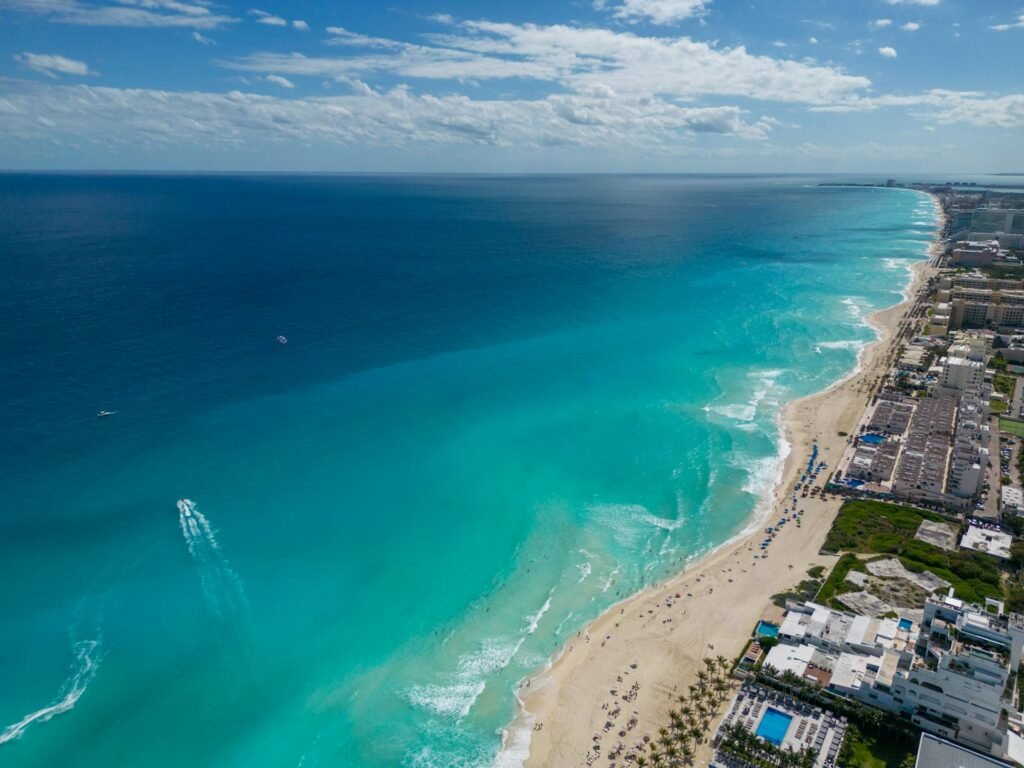
The Hotel Zone stretches 23 km along the barrier island, in the famous “7” shape that the Cancún tourist map is built around. Pristine white-sand Caribbean beaches face east; the calm inland Nichupté Lagoon faces west. Beneath the surface, the entire Yucatán Peninsula is a porous limestone plateau riddled with cenotes (natural sinkholes filled with crystal-clear groundwater) and underground river systems — the Sac Actun system south of Cancún is one of the world’s longest known underwater cave networks. Isla Mujeres sits 13 km offshore, reachable by frequent ferries; Cozumel is 60 km south. The Caribbean reefs offshore are part of the Mesoamerican Barrier Reef — the second-largest coral reef system on earth.
Tropical Climate
Cancún is genuinely tropical — warm year-round, with two main seasons: dry and pleasant from November through April, hot and humid with hurricane risk from June through November. Atlantic hurricane season peaks August–October.
| Month | High Temp (°C) | Low Temp (°C) | Rainfall (mm) |
|---|---|---|---|
| January | 28 | 21 | 136 |
| February | 29 | 21 | 46 |
| March | 30 | 22 | 53 |
| April | 32 | 23 | 38 |
| May | 33 | 24 | 88 |
| June | 33 | 25 | 138 |
| July | 33 | 25 | 224 |
| August | 34 | 25 | 221 |
| September | 33 | 25 | 221 |
| October | 31 | 24 | 221 |
| November | 30 | 23 | 138 |
| December | 28 | 21 | 136 |
Best Time to Visit
December through April is the ideal travel window — sunny skies, minimal rainfall, water temperatures of 26–28°C, and the year’s clearest visibility for diving. This is also peak season — accommodation prices run 30–50% above shoulder rates and US college spring break (mid-March) packs the Hotel Zone. May and November are the shoulder sweet spots: warm beach weather, lower prices, fewer crowds, and the year’s best value-to-comfort ratio. June through October is the rainy/hurricane season — humidity is brutal, afternoon thunderstorms are routine, and the risk of a serious hurricane forces flexible-cancellation booking. Sargassum seaweed blooms peak April through August; live monitoring at redmonitoreocancun.com shows beach-by-beach conditions.
Cancún’s Districts & Neighborhoods
Cancún has two completely different cities sharing one name: the Hotel Zone (Zona Hotelera) on the barrier island, and the mainland service city El Centro where the actual working population lives. Travelers spend most of their time in the Hotel Zone; everyone else lives in El Centro.
Hotel Zone (Zona Hotelera)
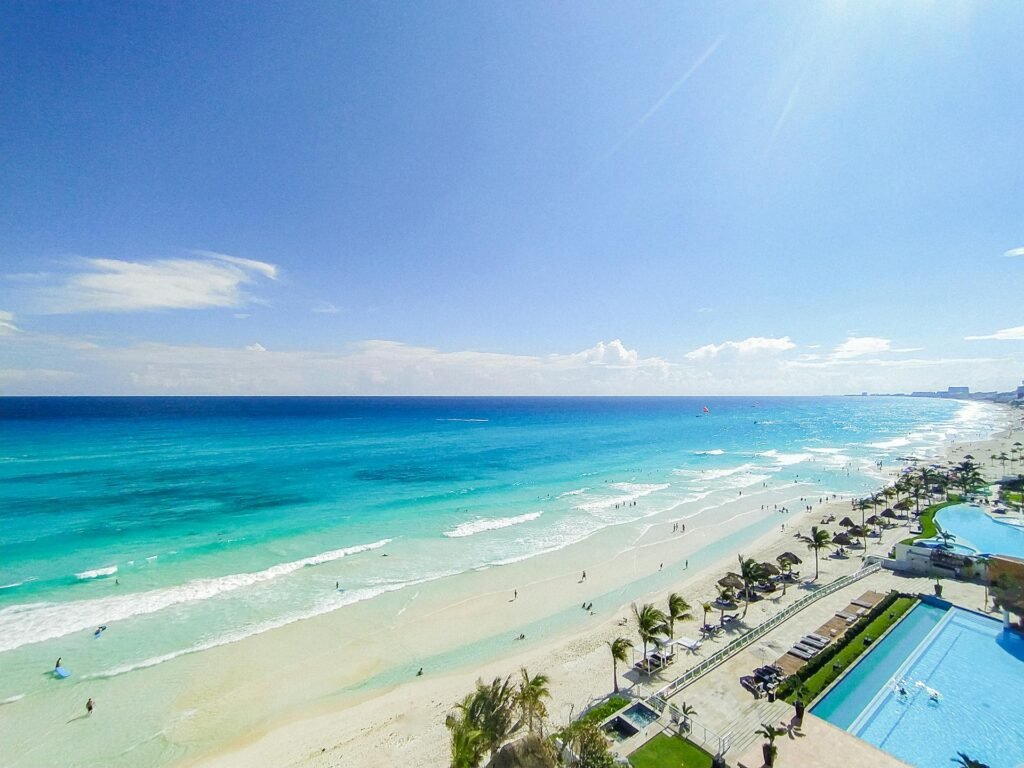
The famous 23 km strip on the barrier island, anchored by the Boulevard Kukulcán highway running its full length. The strip divides into three rough zones:
Northern Hotel Zone (Km 1–9) — closest to El Centro and the ferry pier to Isla Mujeres. Calmer, family-friendly beaches (Playa Tortugas, Playa Caracol), older mid-range hotels, and easier access to local restaurants in El Centro. Best value-to-experience ratio.
Central Hotel Zone (Km 9–17) — the all-inclusive resort heartland; mega-resorts including the Hard Rock, Royalton, Riu, and Live Aqua dominate this stretch. Punta Cancún at Km 9 is the cluster of clubs, restaurants, and shopping at La Isla mall and Forum by the Sea. Coco Bombo, Mandala, The City are the legendary Cancún nightclubs, all walking distance.
Southern Hotel Zone (Km 17–23) — quieter, more upscale resorts (Ritz-Carlton, Le Blanc, Live Aqua Beach); closer to the airport (15 minutes vs 30+ from the north). The Ruinas del Rey Mayan archaeological site is in this zone.
Downtown Cancún (El Centro)
The mainland service city — gritty, working-class, authentic Mexican, and where 95% of Cancún residents actually live. Avenida Tulum is the main commercial drag; Mercado 28 is the souvenir-and-handicrafts market; Parque de las Palapas hosts food vendors, marimba bands, and the year-round local nightlife. Restaurants here serve genuine Yucatecan food at a third the Hotel Zone prices. Tourists who skip El Centro miss the city’s only real culture.
Where to Stay
First-time beach vacationers / families: Northern or Central Hotel Zone, all-inclusive resort. Honeymooners / luxury: Southern Hotel Zone (Ritz-Carlton, Live Aqua, Le Blanc adults-only). Independent travelers / culture-seekers: small boutique hotels in El Centro at $40–80/night plus quick taxi to beaches. Budget: hostels in El Centro (Hostel Mundo Joven, Selina) at $15–30/night. Avoid: spring-break-week (mid-March) Hotel Zone if you want sleep — the partying is genuinely overwhelming.
Top Things to Do in Cancún
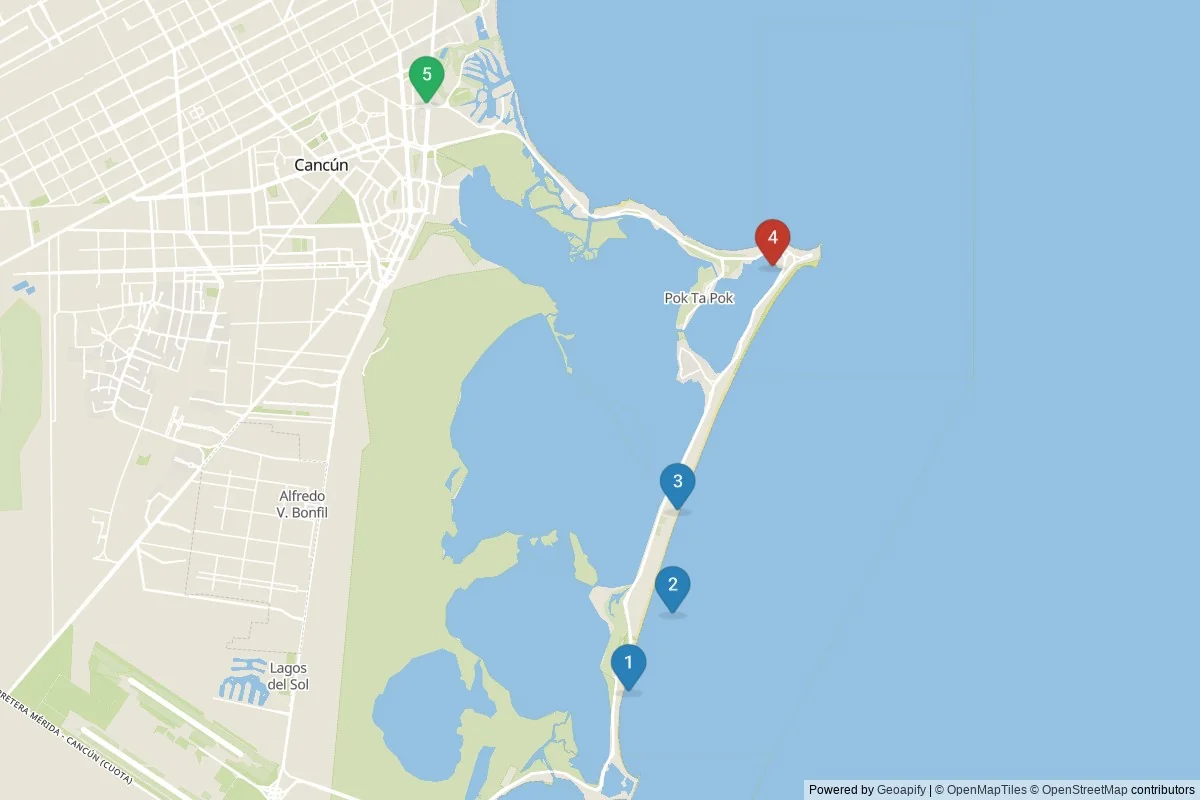
| # | Sight | Cluster | Type | Time | Entry | Best |
|---|---|---|---|---|---|---|
| 1 | El Rey Mayan Ruins | Central | Mayan ruins | ~1.5 hrs | $5 | Morning |
| 2 | Playa Delfines | Central | Beach | ½ day | Free | Morning |
| 3 | Hotel Zone Beaches | Central | Beach strip | ½ day | Free | Afternoon |
| 4 | Coco Bongo | Outer | Nightclub show | ~3 hrs | $80+ | Night |
| 5 | Mercado 28 | Far | Craft market | ~1.5 hrs | Free | Afternoon |
| 🚗 | Day Trip: Isla Mujeres | Day trip | Day trip | Full day | $20 ferry | Morning |
| 🚗 | Day Trip: Chichén Itzá | Day trip | Day trip | Full day | 614 MXN | Early morning |
| 🚗 | Day Trip: Tulum ruins | Day trip | Day trip | Full day | 95 MXN | Morning |
| 🚗 | Day Trip: Xcaret Park | Day trip | Day trip | Full day | $120 | Morning |
Cancún itself has limited cultural sights — most travelers come for the beaches, the diving, and the day-trips to Mayan archaeological sites. Three days handles the city; a week lets you do Tulum, Chichén Itzá, and the cenote ring.
Beaches and Water Activities
The Hotel Zone’s Caribbean beaches — turquoise water, white sand, no surf to speak of — are why everyone comes. Top public-access beaches: Playa Delfines (Km 17.5, the iconic “CANCÚN” sign), Playa Marlin (Km 13), Playa Caracol (Km 8.5, sheltered, family-friendly), Playa Forum (Km 9, in the heart of the entertainment zone). All Mexican beaches are technically public — even resort-fronted ones. Playa Norte on neighboring Isla Mujeres (20-min ferry from Cancún) is consistently ranked among the world’s best beaches.
The offshore Mesoamerican Reef hosts world-class snorkeling and diving — Punta Nizuc (south end) and Punta Cancún (north end) are the most accessible reefs from shore. The unique MUSA Underwater Museum (Museo Subacuático de Arte) features 500+ life-sized concrete sculptures submerged off Punta Nizuc, designed both as art installation and artificial reef substrate. Snorkel tours from PESO 1,500 (~US$80).
Archaeological Sites
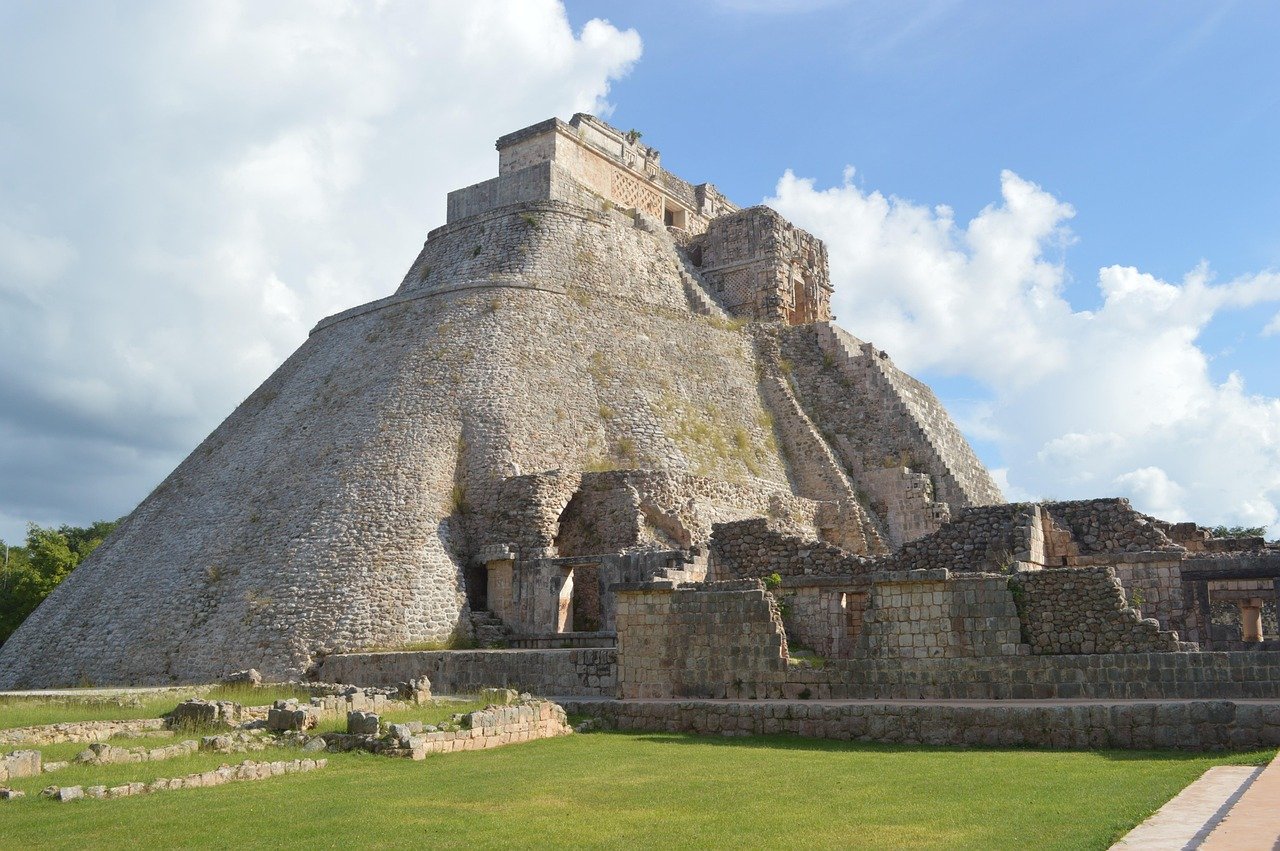
Cancún itself has only modest archaeology, but it’s the perfect base for the Yucatán’s spectacular Mayan sites:
Chichén Itzá (2.5 hours west via Highway 180, or by Maya Train) — UNESCO World Heritage and one of the New Seven Wonders of the World. The 30-metre El Castillo pyramid (Temple of Kukulkan) is famously aligned so that the spring and autumn equinoxes cast a “descending serpent” shadow on its northern stairway. Massive ball court, sacred cenote, hundreds of stone columns. Open 8:00 am–4:00 pm; arrive at opening to beat coach groups. Tickets ~614 MXN via inah.gob.mx (INAH, the National Institute of Anthropology).
Tulum (90 minutes south via Highway 307) — the only major Mayan site built on the coast. Cliff-edge ruins overlooking the Caribbean; far smaller than Chichén Itzá but stunningly photogenic. Combine with cenote stops and a meal in modern Tulum town.
Cobá (2 hours south) — sprawling jungle-engulfed site; the Nohoch Mul pyramid is one of the tallest Mayan structures (the public can no longer climb it as of 2020). Rentable bicycles or pedicabs cover the site’s 2 km circuit.
Ek Balam (2.5 hours west) — smaller but exceptionally well-preserved stucco facade work; you can still climb the main pyramid for now.
Natural Wonders
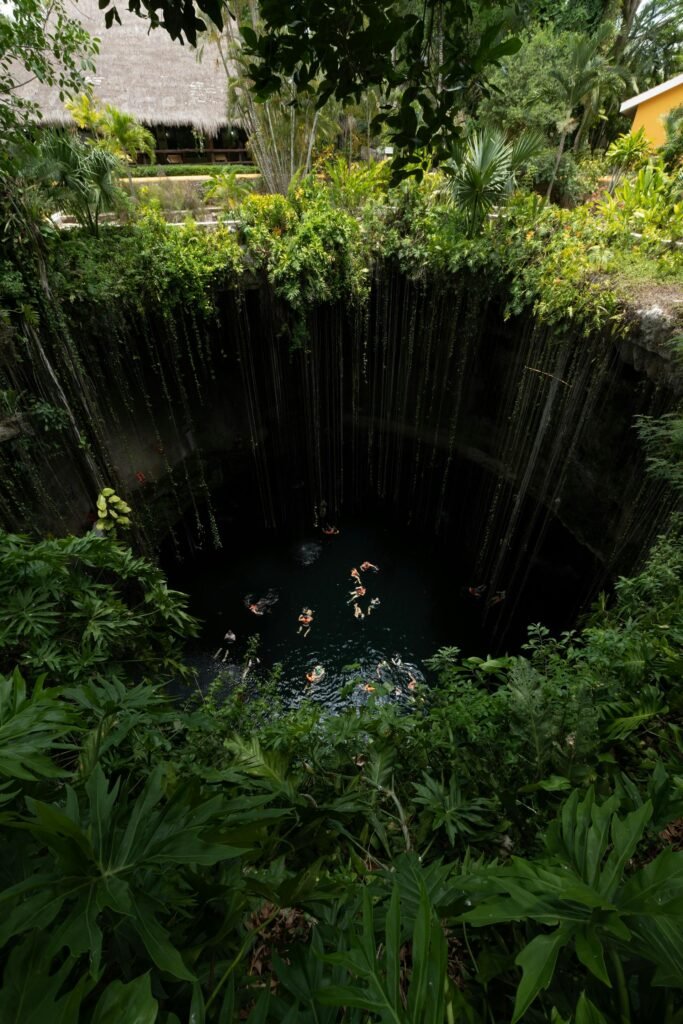
The Yucatán’s cenotes are the region’s signature natural feature — limestone sinkholes filled with cool, crystal-clear freshwater, often surrounded by stalactites and tropical vegetation. Iconic cenotes within day-trip range: Dos Ojos (huge cathedral-like chamber, world-class snorkeling), Gran Cenote (just outside Tulum, perfect first cenote), Cenote Azul (open-air, family-friendly), Cenote Suytun (the famous Instagram cenote with the central platform).
Adventure Activities
Xcaret, Xel-Há, and Xplor are the eco-park trio along the coast south of Cancún — full-day all-inclusive parks combining cenote swimming, zip-lining, underground rivers, jungle trekking, and Mayan cultural performances. Pricier than independent exploration ($80–130/day) but logistically simple. Whale shark snorkeling (June–September) — Isla Mujeres and Isla Holbox are the gathering spots; ethical operators required by Mexican law to keep distances and group sizes regulated.
How to Get to Cancún
Cancún is one of the most easily reached destinations in Latin America — direct flights from dozens of North American and European cities make it less of a trip than getting to many US national parks.
By Air
Cancún International Airport (CUN) — Mexico’s second-busiest airport, 17 km south of El Centro. Four terminals: T1 (charter), T2 (mostly Latin American), T3 (US carriers, premium), T4 (international high-volume — Aeromexico, United, Delta, American). The airport handles 30+ million passengers per year with direct flights from major hubs across North America, Europe, and Latin America. From the airport: ADO buses (~PESO 230, every 30 min, 25 minutes to Hotel Zone), private transfer ($35–65 round trip from established providers; cheapest via reputable booking sites), taxis ($45–75 one way, fixed-rate to Hotel Zone), rental cars from all major providers. Live status at asur.com.mx.
By Road
Highway 307D (the cuota toll road) connects Cancún south through Playa del Carmen to Tulum and beyond; Highway 180 connects west to Mérida and Chichén Itzá. The Cancún ADO Bus Terminal in El Centro runs comfortable AC services across the entire Yucatán — Mérida (4 hours), Mérida (6 hours), Tulum (2 hours), Chichén Itzá (3 hours). The new Maya Train (Tren Maya), opened in stages 2023–2024, connects Cancún to Mérida, Tulum, and the inland Mayan sites — though early reviews note teething problems.
By Sea
Cruise ships use the Cozumel port (60 km south); Cancún itself is not a major cruise destination. Ferries to Isla Mujeres (Ultramar from Puerto Juárez and Playa Tortugas) run every 30 minutes during daylight; ~PESO 300 round trip.
Getting Around Cancún
The Hotel Zone is a 23 km strip with public transit running its full length — getting around is genuinely easy.
Public Transportation
R-1 buses run the entire length of the Hotel Zone via Boulevard Kukulcán to El Centro, every 5–10 minutes from early morning until midnight. Fare PESO 12 (~$0.60). R-2 buses shuttle between El Centro and Puerto Juárez (the Isla Mujeres ferry pier). Have small notes ready; drivers don’t accept large bills well. The buses are essential — the alternative is taxis at $10–20 per ride within the Hotel Zone.
Taxis and Ride-Sharing
Taxis are everywhere but Cancún’s taxi mafia is genuinely a problem — fares are unmetered, often inflated 3–5x for tourists, and there is real (occasionally violent) animosity between taxi drivers and ride-share apps. Uber operates in Cancún but with friction — drivers often won’t pick up at the airport (officially Uber is allowed; in practice taxis dominate), and the airport-to-hotel run is best done by ADO bus or pre-booked private transfer. Within El Centro and the Hotel Zone, InDriver and Uber both work; always verify the agreed fare before getting in a taxi.
Rental Cars
For exploring the Yucatán beyond Cancún (cenotes, Tulum, Chichén Itzá), a rental car is the obvious choice — roads are good, signage clear, and you can stop on a whim. Major international providers operate at the airport ($35–60/day for compact). Mandatory Mexican liability insurance (LIM/SLI) is not covered by US credit cards — expect $20–35/day surcharge for required local insurance. Avoid the cheapest internet deals which often arrive with predatory mandatory insurance upcharges. Within the Hotel Zone, parking is limited and expensive — a rental is overkill for purely-Hotel-Zone stays.
Bicycles and Scooters
The Hotel Zone has a long bicycle-and-pedestrian path running its full length — pleasant in early morning before traffic and heat build. Hotels and rental shops offer bicycles ($15–25/day) and scooters ($35–50/day). Scooters require a valid driving license; helmets legally required.
Food & Drink in Cancún
Cancún is not Mexico’s food capital — that title belongs firmly to Mexico City and Oaxaca — but the regional Yucatecan cuisine is one of Mexico’s distinctive culinary traditions, and the Caribbean seafood is excellent. The trick is escaping the Hotel Zone for at least a few meals: resort food trends generic, while El Centro restaurants serve the real thing at a third the price.
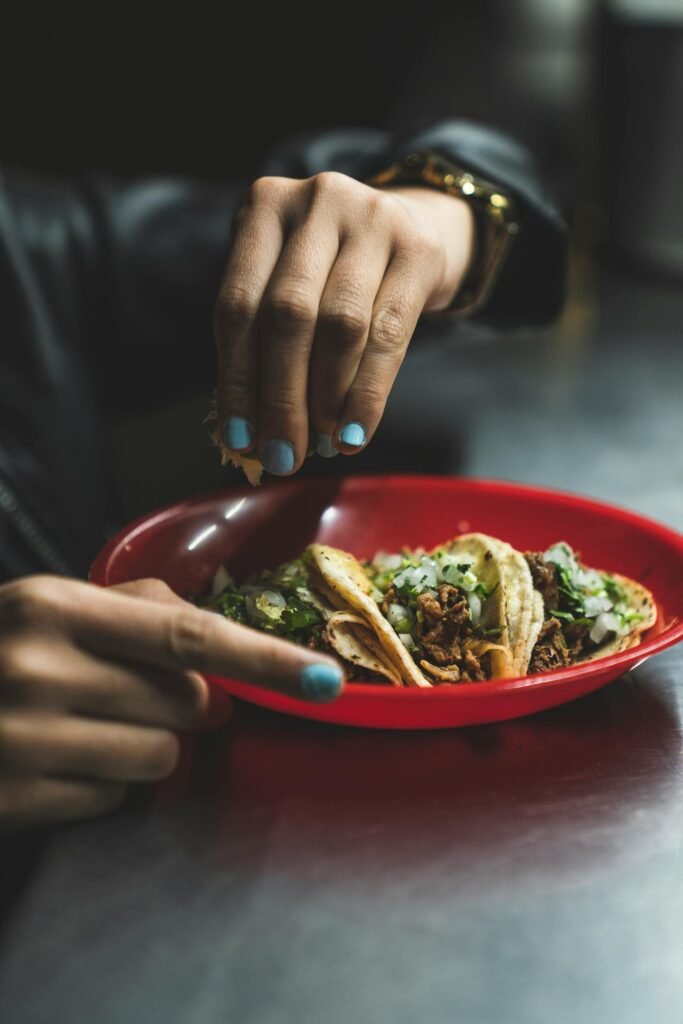
Local Cuisine
The Yucatecan tradition blends Mayan ingredients (achiote/annatto, sour orange, habanero) with Spanish and Lebanese-immigrant influences, giving the cuisine its distinctive non-spicy-but-deeply-flavored character. Must-try dishes: cochinita pibil (achiote-marinated pork slow-roasted in banana leaves, traditionally underground; the regional Sunday family dish); sopa de lima (a turkey-and-lime soup with crisp tortilla strips); papadzules (Mayan corn tortillas filled with hard-boiled egg, in pumpkin-seed sauce); panuchos and salbutes (the Yucatecan answer to tacos). Fresh-caught Caribbean seafood — grilled pescado a la talla, ceviche, lobster — features on every menu. Habanero salsa is the regional condiment; treat with respect.
Dining Options
Hotel Zone — high-end resort restaurants ($30–80/person), beachfront palapas ($15–35), and the established names: Lorenzillo’s (lobster, on the lagoon since 1988), Harry’s Steakhouse (top-tier steakhouse), La Habichuela Sunset (Yucatecan-Caribbean fusion). El Centro is where the food scene gets real: La Habichuela (the original location, 1977), Los de Pescado (legendary fish tacos, $5/lunch), El Pocito (cochinita pibil cult favorite), Mercado 28 food court (regional specialties at market prices). For local experience: the Parque de las Palapas evening food vendors in El Centro.
Drinks and Nightlife
Cancún’s bar scene runs the spectrum from sophisticated to spring-break chaos. Coco Bongo (Punta Cancún, Km 9.5) is the legendary multi-act show-club, mixing live acrobatics, cover bands, and dance with an open bar — an experience, not just a club. Mandala, The City, Palazzo form the rest of Punta Cancún’s club row. La Isla mall rooftop bars offer calmer alternatives. The Caribbean side of Mexican drinking culture means lots of tequila (try añejo tasting flights at La Destilería) and mezcal; local beers Sol, Modelo, Pacifico; and the tropical signatures — margaritas (try the original tequila-lime-Cointreau version), palomas (tequila-grapefruit-lime), and micheladas (beer-lime-spice cocktails).
Culture & Arts
Cancún is too young and too focused on tourism to have a deep cultural scene of its own — but the surrounding region’s living Mayan culture, ongoing archaeology, and Caribbean Mexican identity provide more than enough.
The Museo Maya de Cancún on Boulevard Kukulcán Km 16.5 is the city’s serious archaeological museum, with one of Mexico’s best regional Maya collections including artifacts from across the Yucatán Peninsula. Tickets ~PESO 95. The adjacent San Miguelito archaeological zone includes a small Mayan site within the museum grounds. Mercado 28 in El Centro is the major handicrafts market — Yucatecan textiles (the embroidered terno dresses), hammocks, silver jewelry, ceramics from Talavera de la Reina lineage. The annual Riviera Maya Jazz Festival (November, Playa del Carmen) and the Day of the Dead (Día de los Muertos) celebrations (October 31–November 2, Mercado 28) are the city’s cultural high points. Cancún’s coat of arms, designed in 1981, takes the form of a stylized Mayan ballgame ring — blue (sea), beige (sand), red (sun).
Cancun by District: The 4 Supermanzanas
Cancun is divided into 4 superblocks. The map below shows their official OSM boundaries, colour-coded to match the table — a quick way to orient yourself before zooming in on individual sights.
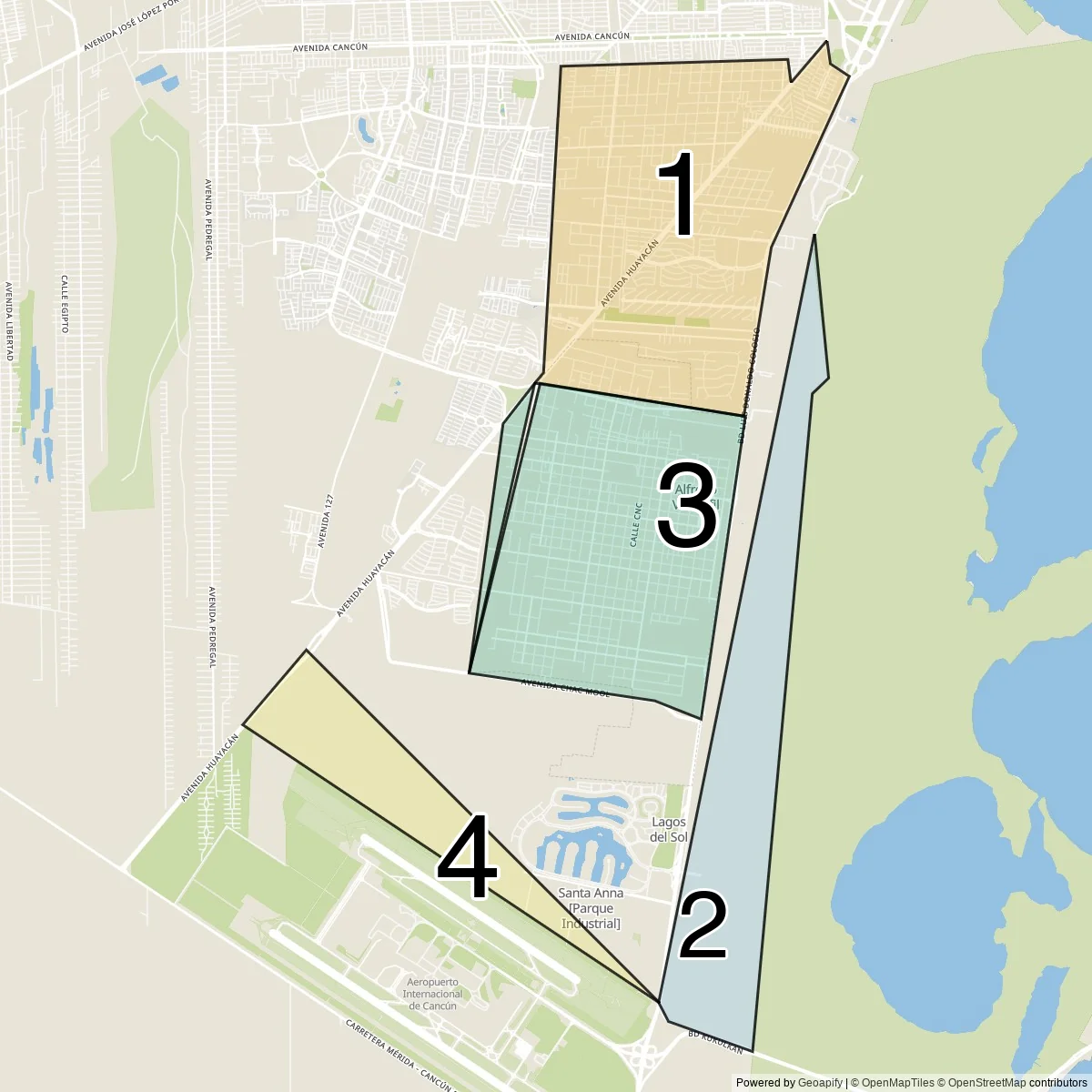
| # | Supermanzanas |
|---|---|
| 1 | Distrito 6 |
| 2 | Distrito 7 |
| 3 | Distrito 9 |
| 4 | Distrito 19 |
Frequently Asked Questions About Visiting Cancún
Do I need a visa to visit Cancún?
Probably not. Mexico is generous with tourist entry for most Western nationalities. Citizens of the US, Canada, EU member states, UK, Japan, Australia, New Zealand and around 70 other countries enter Mexico visa-free for stays of up to 180 days. The official list and current rules at gob.mx/inm (Instituto Nacional de Migración). Other nationalities (including most of South America, China, India, Russia) need a visa applied for at the Mexican consulate. FMM Forma Migratoria — the tourist permit — used to be a paper card stamped on entry, but as of 2024 it’s automatically issued electronically when you enter through Cancún airport. Keep your boarding pass and entry stamp; you’ll need them when leaving. Passport must have at least 6 months remaining validity.
Is Cancún safe for tourists?
The Hotel Zone itself is generally safe — heavily policed, family-friendly, and the violence largely doesn’t reach there. Mexico as a whole has a complicated security picture, and the US State Department rates Quintana Roo (Cancún’s state) at “exercise increased caution” — a step up from the lowest level but below high-risk states like Sinaloa or Tamaulipas. Real risks: petty theft on Hotel Zone beaches; aggressive timeshare touts (the “free taxi to your hotel” pitch is the entry point); taxi overcharging — Cancún’s taxi mafia is genuinely a problem; rare violent incidents linked to organised crime, mostly in El Centro residential neighborhoods that tourists never see. Hurricane season (June–November, peak August–October): travel insurance covering hurricane delays is strongly recommended; check the US National Hurricane Center. Spring break (mid-March): the Hotel Zone gets genuinely chaotic; avoid if you want quiet.
How many days do I need in Cancún?
Three to four days for Cancún itself, ideally extending to a week to do the surrounding region justice. A solid 4-day plan: Day 1 — beach day on Playa Delfines + sunset at Punta Nizuc + dinner in Hotel Zone; Day 2 — day trip to Chichén Itzá + Cenote Ik Kil + Valladolid colonial town; Day 3 — Isla Mujeres day trip (ferry from Puerto Juárez, golf cart rental, Playa Norte beach); Day 4 — Tulum ruins + cenote swim (Gran Cenote or Dos Ojos) + lunch in Tulum town. Day 5–7: Xcaret eco-park OR Cobá + Ek Balam, snorkeling at Punta Nizuc / MUSA underwater museum, slow day at the resort. With a week you can also reach the Sian Ka’an Biosphere Reserve south of Tulum for a full day of mangrove and dolphin tours.
What’s the best area to stay in Cancún?
Three real options. Hotel Zone (Northern, Km 1–9) — best balance of value, beach quality, family-friendliness, and access; calmer beaches, easier connection to El Centro and the Isla Mujeres ferry. Hotel Zone (Central, Km 9–17) — the all-inclusive resort heart, walking distance to Punta Cancún clubs and shopping; loud at night during high season. Hotel Zone (Southern, Km 17–23) — quieter and more upscale (Ritz-Carlton, Le Blanc, Live Aqua), closer to airport, slightly removed from nightlife. Independent travelers: small boutique hotels in El Centro at $40–80/night, plus quick taxi or R-1 bus to beaches — the only way to experience real Mexican Cancún. Skip: the Hotel Zone during US college spring break (mid-March) if you want sleep.
How much does it cost to visit Cancún’s major sights?
The beach itself is free; archaeological sites and eco-parks are where costs add up. Public Hotel Zone beaches: free (Playa Delfines, Marlin, Caracol, Tortugas — bring your own umbrella, no entrance fee). Chichén Itzá: ~PESO 614 for foreigners (~$32) via inah.gob.mx; sound-and-light show extra. Tulum ruins: ~PESO 95 (~$5). Cobá: ~PESO 95. Ek Balam: ~PESO 543. Museo Maya de Cancún: ~PESO 95. Cenotes: typically PESO 200–500 each (Gran Cenote, Dos Ojos, Suytun). MUSA underwater museum snorkel tour: ~$70–110. Xcaret eco-park (full day, all-inclusive): ~$130; Xel-Há ~$110; Xplor ~$140. Isla Mujeres ferry: ~PESO 320 round trip from Puerto Juárez; golf cart rental on the island ~PESO 1,200/day.
Should I drink the tap water in Cancún?
No — even though municipal water is treated, the distribution network has issues, and most visitors will get sick from it. Always use bottled water (PESO 12–25 per liter at OXXO and 7-Eleven convenience stores, free in many resort rooms) for drinking, brushing teeth, and ice. Major hotel restaurants and reputable establishments use filtered water and ice — generally safe. Reusable filter bottles (LifeStraw, Grayl) work well in Cancún and reduce plastic waste. The CDC traveler health page recommends bottled or boiled water for Mexico. Tap water is fine for showering. Most all-inclusive resorts use filtered systems for restaurant water and ice; ask if uncertain.
Should I be concerned about sargassum seaweed?
Possibly, depending on month. Sargassum — the brown seaweed that drifts from the Sargasso Sea — has plagued the Mexican Caribbean since 2014, with peak blooms typically April through August. When it lands, it covers beaches in thick mats, smells of sulfur as it rots, and dramatically reduces water quality at affected beaches. Practical advice: check live conditions at redmonitoreocancun.com (the official Quintana Roo monitoring system, with daily beach-by-beach color codes) before booking peak-summer travel. Generally less affected: north-facing beaches like Playa Norte on Isla Mujeres, the protected lagoon-side activities at Xel-Há, and the northern Hotel Zone beaches. Most resorts run daily beach-cleaning operations and install offshore booms during heavy bloom periods. Months with minimal sargassum: November through March — another reason to favor the dry season.
Is tipping expected in Cancún?
Yes — Cancún tipping leans more toward US norms than other parts of Mexico, partly because the tourism economy is so US-oriented. Restaurants: 15% standard for sit-down service if no service charge (“propina”) is added; check the bill carefully — some Hotel Zone restaurants automatically add 18% for foreigners; round up at casual places. All-inclusive resorts: optional but appreciated — $1–3 per drink to the bartender, $3–5 per meal to your server, $5–10 per day to your housekeeper at end of stay; many guests skip resort tipping entirely and that’s also accepted. Bell hops: $1–2 per bag. Tour guides: $5–15 per person depending on tour length and quality; bus drivers $1–3. Taxis: round up to nearest peso. Spa, salon: 10–15% if pleased. Tipping in US dollars or Mexican pesos both work; small bills appreciated.
Education
Cancún’s higher education sector has expanded with the city’s population. The Universidad del Caribe — Cancún’s flagship public university, founded 2000 — specializes in tourism management, sustainability studies, marine biology, and engineering directly relevant to the regional economy. The Universidad Tecnológica de Cancún trains technical professionals for the hospitality and tourism industries; the Universidad de Quintana Roo (UQROO) has a Cancún campus alongside its main Chetumal facility. Multiple language schools (Pop Wuj, El Bosque del Caribe, Don Quijote) cater to international students learning Spanish, with shorter intensive programs popular among visitors who extend their stays.
Sports & Recreation
Cancún Marathon & Half-Marathon (December) — annual international race held along the Hotel Zone coastline, attracting elite runners and amateur participants from across North America. The CF Atlante football club represents the region; Tigres MMA and WWE Live Mexico tour stops fill out the local pro-sports calendar. The city’s true sporting strength is water sports: world-class diving on the Mesoamerican Reef, deep-sea fishing (sailfish, marlin) — Cancún has hosted multiple legs of the Lobster Cup and other international fishing tournaments — and the calm Nichupté Lagoon’s perfect conditions for kayaking and stand-up paddleboarding. Golf is well-developed: the Iberostar Cancún, Riviera Cancún Golf, El Tinto, and the famous Playa Mujeres course on the way to Isla Mujeres are the leading courses.
Notable People from Cancún
Despite being founded in 1970, Cancún has produced surprisingly many notable figures — primarily in Mexican football and entertainment:
- Carlos Vela (b. 1989) — international football star, former Arsenal and Real Sociedad, longtime captain of Los Angeles FC and Mexican national team.
- Alejandro Vela (b. 1984) — Carlos’s brother, also a professional footballer (Cruz Azul, Necaxa).
- Miguel Sabah (b. 1979) — striker who played for Atlas, Morelia, and the Mexican national team.
- Miguel Berchelt (b. 1991) — WBC super featherweight world boxing champion (2016–2021).
- Rodolfo “Cabeza” López (b. 1983) — professional boxer.
- Ana Claudia Talancón (b. 1980) — acclaimed Mexican film and television actress (El crimen del padre Amaro).
- Ximena Lamadrid (b. 1996) — actress (Who Killed Sara?, Netflix).
Cancún rewards travelers who treat it as a base for the Yucatán Peninsula rather than as a destination in itself. Three days in the Hotel Zone for the beaches; a fourth for Chichén Itzá or Tulum; a fifth for the cenote ring; a sixth for a slow day at a Mayan ruins site like Cobá or Ek Balam. The state-engineered Caribbean strip turns out to be the perfect launchpad for the genuinely ancient civilization next door.
AFRIKA
Cairo Hurghada Johannesburg Marrakech
ASIA
Abu Dhabi Agra Antalya Bangkok Batam Beijing Bengaluru Cebu City Chiang Mai Chiba Chennai Da Nang Dammam Delhi Denpasar Dubai Fukuoka Guangzhou Guilin Ha Long Hanoi Ho Chi Minh City Jakarta Jaipur Johor Bahru Kolkata Krabi Kuala Lumpur Kyoto Macau Mecca Medina Mugla Mumbai Osaka Pattaya Penang Phuket Riyadh Seoul Shanghai Shenzhen Singapore Taipei Tokyo Zhuhai
EUROPE
Amsterdam Athens Barcelona Berlin Brussels Budapest Copenhagen Dublin Florence Frankfurt am Main Heraklion Krakow Lisbon London Madrid Milan Munich Nice Paris Porto Prague Rhodes Rome Stockholm Venice Vienna Warsaw
NORTH AMERICA
Cancun Las Vegas Los Angeles Miami New York City Orlando San Francisco Toronto Vancouver
SOUTH AMERICA
Buenos Aires Lima Rio De Janeiro
OCEANIA
Auckland Honolulu Melbourne Sydney