
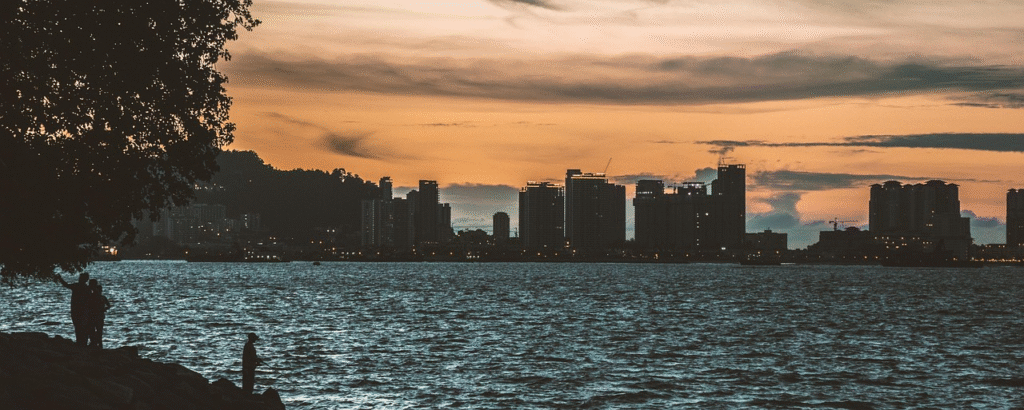
Photo credit: George Town’s heritage shophouse skyline meets modern Penang
Penang has a reasonable claim to being Southeast Asia’s most singular destination. George Town — UNESCO World Heritage since 2008 alongside Melaka — is the world’s most intact 19th-century Chinese-British colonial port town, with five-foot-way shophouses, clan kongsi temples, and the layered Peranakan culture that emerged from the marriage of Hokkien Chinese traders to Malay locals. The state’s hawker-food tradition — char kway teow, asam laksa, char hor fun, nasi kandar, cendol — has been voted the world’s best street food more times than any other single destination by global travel media. Penang Hill rises 833 meters from the city; the funicular built in 1923 climbs to cool-climate colonial bungalows and a panoramic view of the Strait of Malacca. Two giant bridges connect the island to mainland Malaysia. And in the early 21st century, Penang has reinvented itself again as the country’s semiconductor and medical-device manufacturing powerhouse, hosting Intel, AMD, Bosch, and dozens of others in industrial parks just inland from the heritage core. The island is small — you can drive its length in 90 minutes — but its cultural density rewards every extra day a traveler can spare.
Penang by District: The 5 Daerah
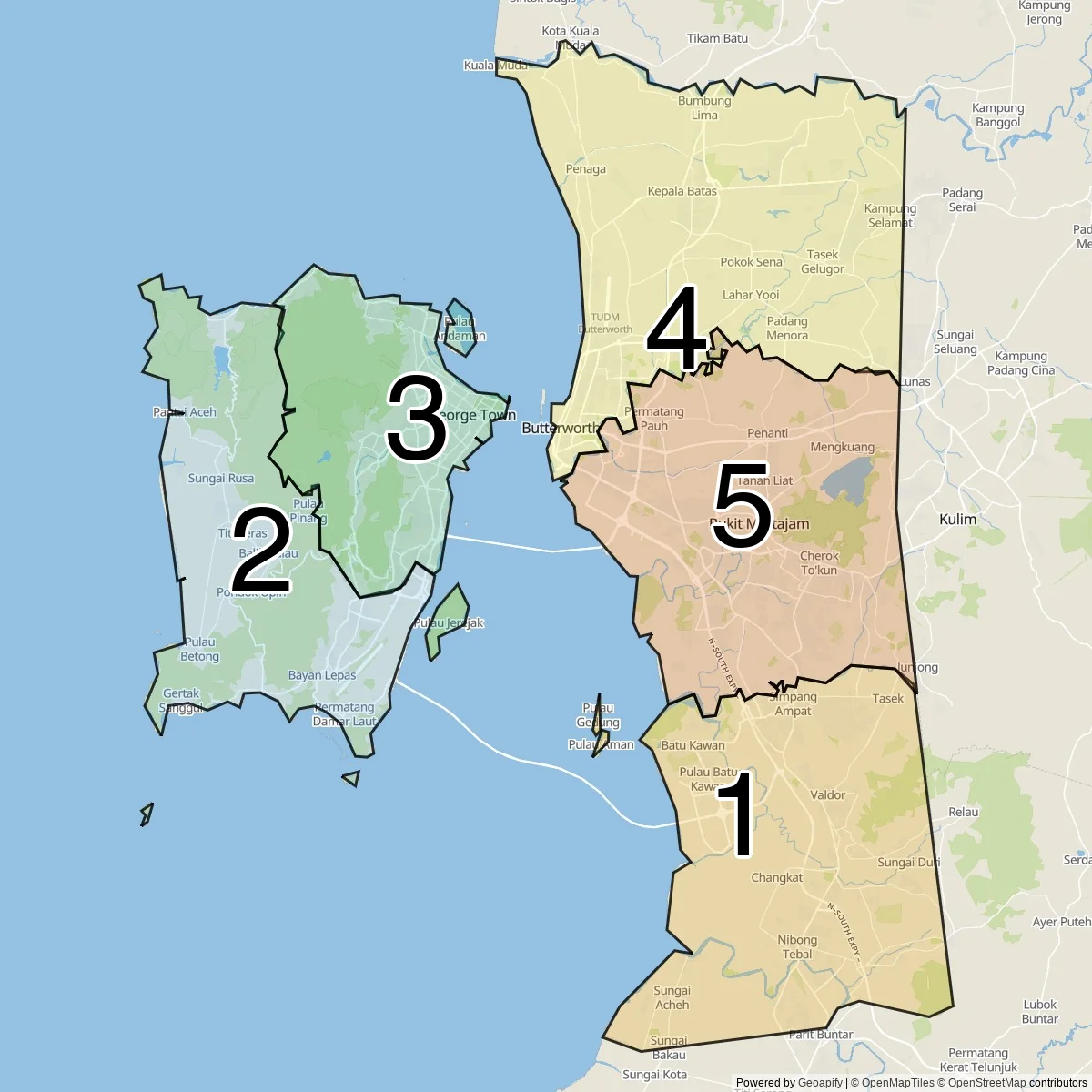
Penang is divided into 5 districts. The map below shows their official OSM boundaries, colour-coded to match the table — a quick way to orient yourself before zooming in on individual sights.
| # | Daerah |
|---|---|
| 1 | Seberang Perai Selatan · South Seberang Perai District |
| 2 | Barat Daya · South-West |
| 3 | Timur Laut · North-East |
| 4 | Seberang Perai Utara · North Seberang Perai District |
| 5 | Seberang Perai Tengah · Central Seberang Perai District |
Penang at a Glance: Essential Facts for Travelers
| Location | Northwest Peninsular Malaysia (island + mainland Seberang Perai) |
|---|---|
| Coordinates | 5.4145°N, 100.3292°E (George Town) |
| Population | ~1.74 million (state, 2020 census); George Town ~720,000 |
| Area | 1,048 km² (state); Penang Island 293 km² |
| Elevation | Sea level to 833 m (Penang Hill summit) |
| Time Zone | Malaysia Standard Time (MYT, UTC+8) |
| Calling Code | +60 (state code 04) |
| Currency | Malaysian Ringgit (MYR RM) |
| Languages | Malay (official), English widely spoken; Penang Hokkien, Mandarin, Tamil also common |
| Climate | Tropical rainforest — hot, humid year-round; two monsoon seasons (April–May, September–November) |
| Founded | 1786 (British East India Company, by Captain Francis Light) |
| Famous For | George Town UNESCO heritage core, hawker food, Penang street art, Kek Lok Si Temple, Penang Hill, Peranakan culture |
Upcoming Events in Penang
| Date | Title | Details |
|---|---|---|
| 2026-09-15 to 2026-09-16 | Free entry to three Penang heritage sites for Malaysia Day | In conjunction with Malaysia Day and the fifth anniversary of Penang Hill’s listing as a UNESCO Biosphere Reserve, the Penang government is opening three heritage attractions free of charge on 15 and 16 September: Fort Cornwallis, the Penang State Museum and the state transport gallery. Tourism executive councillor Wong Hon Wai encouraged residents and visitors to step into these historic spaces and connect with the island’s layered, multicultural past. No tickets are needed on the two days, though normal opening hours apply, and Fort Cornwallis is likely to draw the biggest crowds. [Source] |
| 2026-09-19 | Malam Citra Malaysia @ Penang in Kepala Batas | Kepala Batas stays up late for Malam Citra Malaysia, a festive night at the Bertam Street Market on Saturday 19 September from 8pm to midnight. The programme celebrates Merdeka and Malaysia Day with traditional Malay, Chinese and Indian dances, marching bands, youth performers and local artists, plus crowd-pullers including a Muay Thai championship, an esports competition and a Malaysia Day colouring contest. Organisers, supported by the Penang Youth Development Corporation and Universiti Sains Malaysia, expect five to ten thousand visitors; entry details vary, so check with the organisers before travelling. [Source] |
| 2026-09-19 | Penang Mid-Autumn Festival 2026 | The state’s official tourism calendar lists the Penang Mid-Autumn Festival for Saturday 19 September. The festival of lanterns and mooncakes is one of the most atmospheric dates on the island’s Chinese cultural calendar: community celebrations traditionally bring lantern processions, stage performances and mooncake stalls to George Town’s heritage quarter and neighbourhood venues. Families stroll with glowing lanterns after dark and share mooncakes under the full moon. Community celebrations are generally free to attend, and visitors are welcome to join the festivities alongside residents. [Source] |
| 2026-10-02 | HOMEDEC Penang at Spice Convention Centre | HOMEDEC, Malaysia’s home decoration and renovation exhibition, opens its northern edition at the Spice Convention Centre on 2 October. Open to the public, the fair lets homeowners and apartment buyers meet interior designers, browse kitchens, bathrooms, furniture and smart-home technology, and compare renovation packages with show-only offers. Entry is typically free with visitor registration. For Penangites planning to refurbish a heritage shophouse or fit out a new condominium, the exhibition conveniently gathers hundreds of suppliers and specialists under one roof. [Source] |
| 2026-10-10 to 2026-10-18 | Nine Emperor Gods Festival (Kew Ong Yah) | For the first nine days of the ninth lunar month, usually in October, Penang’s Taoist community honours the Nine Emperor Gods with one of the island’s biggest vegetarian festivals, centred on temples such as the one at Paya Terubong in Ayer Itam. Devotees dressed in white keep a strict plant-based diet, and streets fill with stalls selling meat-free ‘chai’ dishes marked by yellow flags. Processions, chanting and rituals including fire-walking draw large crowds. It is free to attend and a feast for vegetarians, blending devotion, spectacle and some of Penang’s most inventive street food. [Source] |
| 2026-11-08 | Deepavali in George Town | Penang celebrates Deepavali, the Hindu Festival of Lights, on 8 November, a public holiday across Malaysia. George Town’s Little India along Market Street and its surroundings become the festive heart of the island, with bazaars selling saris, garlands, oil lamps, sweets and spices in the weeks leading up to the day. Kolam floor art, twinkling lights and devotional music fill the streets, and temples hold special prayers. Strolling the bazaar is free, and the season is a joyful time to experience Penang’s Indian heritage. [Source] |
| 2026-11-27 to 2026-11-29 | Penang International Dragon Boat Regatta | The Penang International Dragon Boat Regatta returns from 27 to 29 November, bringing crews from Malaysia and abroad to race to the beat of drums. One of the region’s longest-established dragon boat events, the regatta features men’s, women’s and mixed categories over several distances, with paddlers powering colourful boats through the water in tightly fought heats. The three-day competition draws thousands of spectators, and watching from the banks is free, with food stalls serving the crowds. Detailed race schedules are published by the organisers closer to the date. [Source] |
City News in Penang – last 14 days
| Date | Category | Headline | Details |
|---|---|---|---|
| 2026-09-14 | Culture | Free entry to three Penang heritage sites for two days in conjunction with Malaysia Day | Three of the state’s heritage attractions will open free of charge for two days from tomorrow in conjunction with Malaysia Day: Fort Cornwallis, the Penang State Museum and the state transport gallery. The gesture also marks the fifth anniversary of Penang Hill’s recognition as a UNESCO Biosphere Reserve. Tourism executive councillor Wong Hon Wai said the initiative invites the public to step into historic spaces and appreciate the state’s layered, multicultural heritage. Officials expect families and tourists to take advantage of the free admission during the holiday period. [Source] |
| 2026-09-14 | Public transport | Batik Air to launch Penang-Batam route in October | Batik Air will launch new routes connecting Subang with Bali and Penang with Batam in October, expanding regional connectivity from the island’s airport. The Penang-Batam service gives northern Malaysia a direct link to the Indonesian island near Singapore, popular for resorts, golf and business travel. The additions reflect growing demand for point-to-point regional flights and strengthen Penang International Airport’s role as a northern hub. Schedules and fares were announced through the airline’s booking channels ahead of the launch. [Source] |
| 2026-09-14 | Local government | ProtectKarpal urges Penang to reject 28-hectare Jelutong reclamation | The ProtectKarpal coalition is urging the Penang government to reject a proposed 28-hectare land reclamation off Jelutong, arguing the project would harm the coastal environment and set a troubling precedent. Campaigners want the state to uphold environmental commitments and protect fishing grounds and water quality along the channel. The proposal, associated with plans to rehabilitate the Jelutong landfill area, is under scrutiny as authorities weigh economic arguments against ecological concerns. The debate adds to wider contention over reclamation projects around the island. [Source] |
| 2026-09-14 | Public safety | Factory bus crashes into drain in Penang, driver injured | A factory bus crashed into a drain in Penang, leaving the driver injured. Emergency services attended the scene and the injured driver was taken for treatment. The circumstances of the crash, including whether any workers were aboard at the time, were being established by police. Factory buses are a common sight ferrying workers to the island’s industrial zones, and the incident has renewed reminders about vehicle maintenance and driver alertness on busy commuter routes serving the manufacturing areas. [Source] |
| 2026-09-14 | Local affairs | Penang proposed as UN Secretariat base | Penang has been proposed as a base for a United Nations secretariat, an idea that would significantly raise the island’s international profile. Proponents point to Penang’s connectivity, talent pool and liveability as strengths for hosting international institutions. The suggestion is at an early stage and would require federal support and negotiations with the world body before anything concrete could follow. Even so, the proposal has stirred local pride and fresh debate about the state’s ambitions on the global stage. [Source] |
| 2026-09-14 | Local affairs | Scouts from across Asia-Pacific gather in Penang for Malaysian Jamboree | Scouts from across the Asia-Pacific region have gathered in Penang for the Malaysian Jamboree, according to the World Organization of the Scout Movement. The gathering brings young people from many countries together for camping, skills training, cultural exchange and community activities. Hosting the jamboree showcases Penang to a new generation of visitors and underlines Malaysia’s active role in the international scouting movement. Organisers highlighted friendship and service as the themes uniting participants throughout the programme of activities. [Source] |
| 2026-09-14 | Sports | Penang table tennis team makes history with three Sukma golds | Penang’s table tennis team made history at the recent Sukma Malaysian Games in Selangor, winning three gold, two silver and two bronze medals, the squad’s best-ever haul. The state association had initially targeted a single gold, and officials credit a long-running player development programme for the breakthrough performance. The result cements Penang’s rise as a table tennis power within Malaysia and is expected to encourage further investment in youth training. Players and coaches were widely congratulated on their return home. [Source] |
| 2026-09-14 | Local affairs | George Town wins silver at ASEAN Smoke-Free Awards | George Town has been recognised with the Silver Award at the ASEAN Smoke-Free Awards 2026 for its sustained efforts to curb smoking in public spaces. The recognition acknowledges the city’s enforcement of smoke-free zones, public education campaigns and cooperation with businesses in the heritage core. Officials welcomed the regional accolade as encouragement to push further toward a healthier urban environment for residents and for the millions of tourists who visit the UNESCO-listed city each year. [Source] |
| 2026-09-14 | Business | Kerjaya Prospek wins RM37.8 million contract for Penang affordable housing project | Construction group Kerjaya Prospek has won a contract worth about RM37.8 million for piling and related works on an affordable housing project in Penang. The award adds to the builder’s order book and signals continued momentum in the state’s push to deliver affordable homes. Work on the project is expected to proceed according to the developer’s schedule. Analysts follow such contract wins as indicators of construction-sector health in Penang, where major infrastructure and housing schemes are currently under way. [Source] |
| 2026-09-13 | Education | Mental health first aid comes to Penang schools | Schools in Penang are rolling out mental health first aid, an initiative aimed at equipping teachers and students to recognise and respond to psychological distress early. Training helps school communities spot warning signs, offer initial support and refer young people to professional help when needed. The programme responds to rising concern about student wellbeing and aims to reduce stigma around seeking assistance. Educators hope the approach will build more supportive classrooms across the state’s primary and secondary schools. [Source] |
| 2026-09-13 | Local affairs | RM100,000 raised for Penang busker Uncle Robert’s wife’s cancer treatment | Well-wishers have raised RM100,000 to fund cancer treatment for the wife of Uncle Robert, a beloved Penang street busker. The outpouring of donations reflects the affection the George Town community holds for the veteran performer, whose music has long been part of the city’s street life. The funds will help cover medical costs as the family faces the illness together. Supporters shared messages of encouragement alongside their contributions, in a striking display of community solidarity on the island. [Source] |
| 2026-09-12 | Sports | Stefano Brundo’s late goal snatches first win for Penang FC | A late goal from Stefano Brundo snatched a first win of the campaign for Penang FC, sparking celebrations among the club’s supporters. The forward struck in the closing stages to seal the points in a tight contest, easing pressure after a difficult start to the season. The victory lifts morale in the dressing room and gives the coaching staff a platform to build on. Fans will hope the result marks a turning point in the team’s fortunes this term. [Source] |
| 2026-09-12 | Culture | Iconic Wadda Gurdwara Sahib reopens after major renovation | The Wadda Gurdwara Sahib, one of Southeast Asia’s oldest and most important Sikh temples, has reopened after major renovation works, restored with the help of a RM1 million donation from philanthropist Tan Sri Jeffrey Cheah. The refurbishment safeguards a landmark that has served Penang’s Sikh community for generations and stands among the region’s most significant Sikh houses of worship. Community members celebrated the reopening, and the restored temple is expected to welcome devotees and respectful visitors alike. [Source] |
| 2026-09-11 | Business | InterContinental’s first Malaysian resort is set for Penang | InterContinental Hotels Group will open its first Malaysian resort in Penang, bringing the luxury flag to the island’s hospitality market. The planned resort strengthens Penang’s position as a leisure destination and continues a wave of upscale hotel investment, with several international brands announcing properties in recent years. The project is expected to create jobs and draw higher-spending visitors. Details of the location and opening timeline were reported alongside the announcement as the group expands its Southeast Asian footprint. [Source] |
Penang Events & City News Archive
Sources: Penang Hyperlocal, Malay Mail, Penang Hyperlocal, Penang Global Tourism, EventsEye, Penang Global Tourism, Bernama, New Straits Times
Weather Forecast for the Next 14 Days in Penang
| Date | Weather | Max °F | Min °F | Rain mm |
|---|---|---|---|---|
| 2026-09-14 | ⛈️ | 82.9 °F | 71.4 °F | 2.7 mm |
| 2026-09-15 | 🌧️ | 80.2 °F | 68.9 °F | 7.4 mm |
| 2026-09-16 | 🌧️ | 78.2 °F | 68.9 °F | 2.5 mm |
| 2026-09-17 | 🌧️ | 82.1 °F | 69.4 °F | 1.6 mm |
| 2026-09-18 | ⛈️ | 75.5 °F | 69.6 °F | 14.5 mm |
| 2026-09-19 | 🌧️ | 74.7 °F | 70.3 °F | 20.4 mm |
| 2026-09-20 | ⛈️ | 80.7 °F | 69.6 °F | 18.0 mm |
| 2026-09-21 | 🌧️ | 79.4 °F | 69.1 °F | 10.2 mm |
| 2026-09-22 | 🌧️ | 80.3 °F | 70.3 °F | 12.9 mm |
| 2026-09-23 | 🌧️ | 79.5 °F | 69.2 °F | 17.1 mm |
| 2026-09-24 | 🌧️ | 82.3 °F | 68.9 °F | 10.2 mm |
| 2026-09-25 | 🌧️ | 80.6 °F | 69.7 °F | 11.4 mm |
| 2026-09-26 | 🌧️ | 79.6 °F | 67.6 °F | 11.1 mm |
| 2026-09-27 | 🌧️ | 82.0 °F | 68.2 °F | 16.5 mm |
Penang’s History
Penang’s modern history begins on August 11, 1786, when Captain Francis Light of the British East India Company landed at what is now Fort Cornwallis, planted a Union Jack, and renamed the largely uninhabited tropical island “Prince of Wales Island”. The Sultan of Kedah, under pressure from a Siamese (Thai) invasion threat, had ceded the island to the British in exchange for promised military protection — protection that never came. The Sultan attempted to retake the island in 1791 and was repulsed; Britain unilaterally settled the dispute with a small annual rent payment that remained nominally in force until Malaysian independence in 1957.
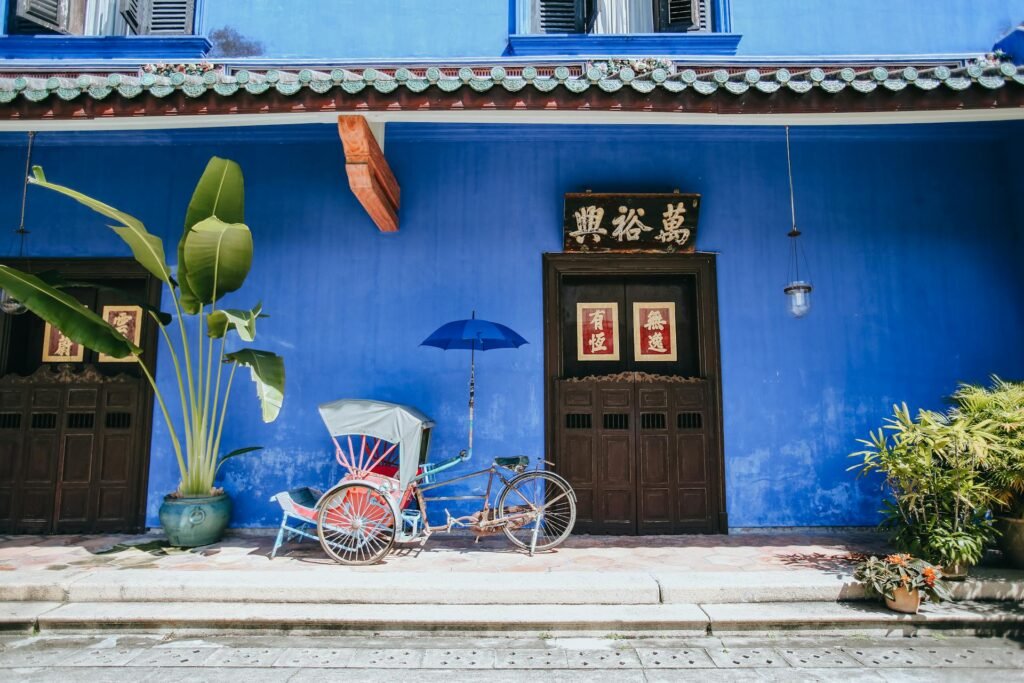
Light’s chosen capital, George Town, grew rapidly into a free port and one of British Asia’s most important commercial entrepôts. The opium trade, tin mining, and rubber exports drew waves of Chinese (especially Hokkien from Fujian Province), Indian (especially Tamil), and Malay migrants; the Peranakan or “Baba-Nyonya” culture — the syncretic Sino-Malay community whose mansions, cuisine, and embroidered slippers define Penang’s distinctive character — emerged from intermarriage between Chinese male traders and local women. The Khoo, Cheah, Yeoh, Lim, and Tan kongsi (Chinese clan associations) built elaborate temple-complexes that still anchor George Town’s heritage core.
Penang became part of the Straits Settlements (with Singapore and Melaka) in 1826, fell briefly to Japanese occupation 1941–1945, and joined the Federation of Malaya at independence in 1957. The 1957 abolition of the free-port status by the new Malaysian government dealt the city a devastating economic blow. Recovery began in 1972 with the establishment of Bayan Lepas Free Industrial Zone — the country’s first free-trade zone — which attracted electronics manufacturers (initially Intel, in 1972) and rebuilt the state’s economy on semiconductors. UNESCO World Heritage inscription in July 2008 (joint listing with Melaka) and the parallel rise of Penang’s tourism, food, and now medical-tourism economies transformed George Town from a faded port into one of Southeast Asia’s most visited heritage cities.
Geography, Climate & Best Time to Visit Penang
Geographic Setting
Penang state spans two distinct halves: Penang Island (Pulau Pinang), 293 km² of granite hills rising from a narrow coastal plain, and Seberang Perai, the mainland strip across the Penang Strait. The two halves are connected by the Penang Bridge (13.5 km, opened 1985 — Southeast Asia’s longest bridge at the time) and the Sultan Abdul Halim Muadzam Shah Bridge (“Second Penang Bridge,” 24 km, opened 2014 — Malaysia’s longest bridge). A car-and-passenger ferry service from George Town’s Weld Quay to Butterworth on the mainland has operated continuously since 1894.
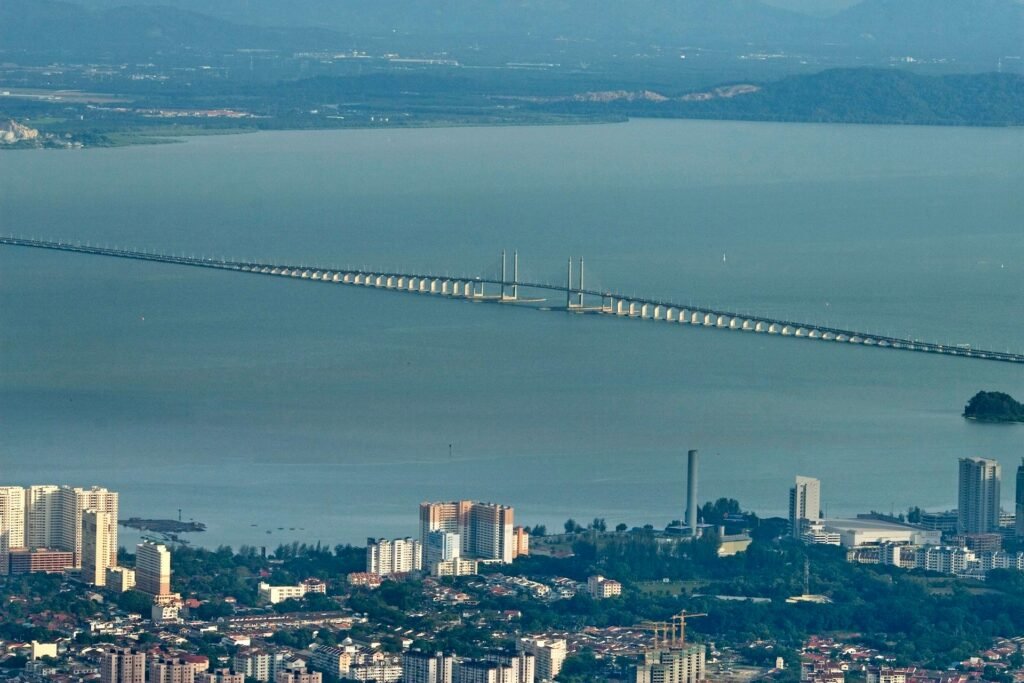
The island’s geography produces three distinct zones: the flat northeastern coastal strip, where George Town and the heritage core sit; the granite spine running north–south through the island’s interior, with Penang Hill at 833 m and the Penang National Park covering the northwestern tip; and the flat western and southern coasts, with beach resorts at Batu Ferringhi, fishing villages at Balik Pulau, and the high-tech manufacturing zone at Bayan Lepas.
Climate Overview
Penang has a tropical rainforest climate (Köppen Af). Year-round temperatures range 24–32 °C with humidity routinely above 80%. The annual rainfall of ~2,500 mm splits between two distinct rainier periods rather than true wet/dry seasons.
The Two Monsoons & Haze Season
Penang experiences a shoulder-monsoon rather than the heavy seasonal monsoons of southern Malaysia. April–May brings transitional thunderstorms with dramatic late-afternoon downpours. September–November is the wetter inter-monsoon, with longer-duration rain. Between roughly June and October, regional haze from Indonesian agricultural fires can blanket Penang for periods of 2–10 days, with air-quality readings sometimes exceeding 200 on the Air Pollutant Index (unhealthy for all groups). Check current conditions at the Malaysian Department of Environment Air Pollution Index.
Best Time to Visit
December to March is genuinely Penang’s best window — relatively dry, lower haze risk, comfortable evening temperatures, and the lead-up to Chinese New Year (typically late January or February) animates the city with lion dances and lantern displays. July to early September is a secondary window with relatively dry weather but higher haze risk. Late October to early December is the wettest stretch. Festival timing: Chinese New Year (January–February) — vibrant but many businesses close; Thaipusam (January–February) — Hindu pilgrimage spectacle; Wesak Day (May, full moon) — Buddhist lantern celebrations; George Town Festival (July–August) — month-long arts festival; Bon Odori (July) — Japanese cultural festival; Penang Hot Air Balloon Festival (February); Christmas/New Year (December) — busiest tourism period, hotel prices peak.
Penang’s Districts & Neighborhoods
George Town — the UNESCO Heritage Core
The defining district and where most travelers spend their time. The roughly 2 km² UNESCO buffer zone contains: Armenian Street with its famous Ernest Zacharevic street-art murals; Lebuh Chulia with backpacker hostels and Indian-Muslim eateries; Lebuh Acheh with Acheh Mosque and the original Malay quarter; Lebuh Cannon and Cannon Square with the Khoo Kongsi clan house; Little India centered on Lebuh Pasar; Cintra Street with the Goddess of Mercy Temple; and the Esplanade and Fort Cornwallis on the seafront. The neighborhood is extraordinarily walkable but layouts are British colonial — streets run northeast-southwest, not on a grid.
New Lane & Komtar — the Modern City Center
Just south of the heritage zone, anchored by the KOMTAR Tower (Penang’s first skyscraper, 1985), the Prangin Mall, and the Komtar bus terminal. Less atmospheric but practical: most major banks, the central food courts, and shopping malls. The Penang Times Square mall area extends the modern shopping district.
Gurney Drive & Pulau Tikus
Northwest of George Town along the coast — Penang’s middle-class shopping and dining district. Gurney Drive Hawker Centre (the famous open-air seafront food court) and the parallel Gurney Plaza and Gurney Paragon upscale malls. The Pulau Tikus neighborhood inland features colonial-era bungalows, hipster cafés, and the Pulau Tikus wet market.
Batu Ferringhi — the Beach Resort Strip
20 km west of George Town along the north coast. The historical beach-resort area with mid-century international hotels (Shangri-La Rasa Sayang, Hard Rock, PARKROYAL), the lively Batu Ferringhi night market, and parasailing/jet-ski operators. The beach itself is shorter and less spectacular than visitors hoping for a Phuket-equivalent expect; jellyfish are seasonal. Useful as a beach base only if Penang Island’s specific cultural offerings aren’t the priority.
Balik Pulau — the Rural West
The fishing-and-orchard western half of the island, accessed via a winding 30 km road through Penang Hill’s western flank. Durian orchards (peak July–August), fishing villages, traditional Malay kampungs, and the Tropical Spice Garden. A half-day side trip from George Town.
Bayan Lepas — Airport & Industrial South
South of George Town, home to Penang International Airport, the Bayan Lepas Free Industrial Zone (Intel, Bosch, Motorola, AMD, dozens of others), and growing residential developments. Not a tourist destination but useful for early flights.
Top Things to Do in Penang
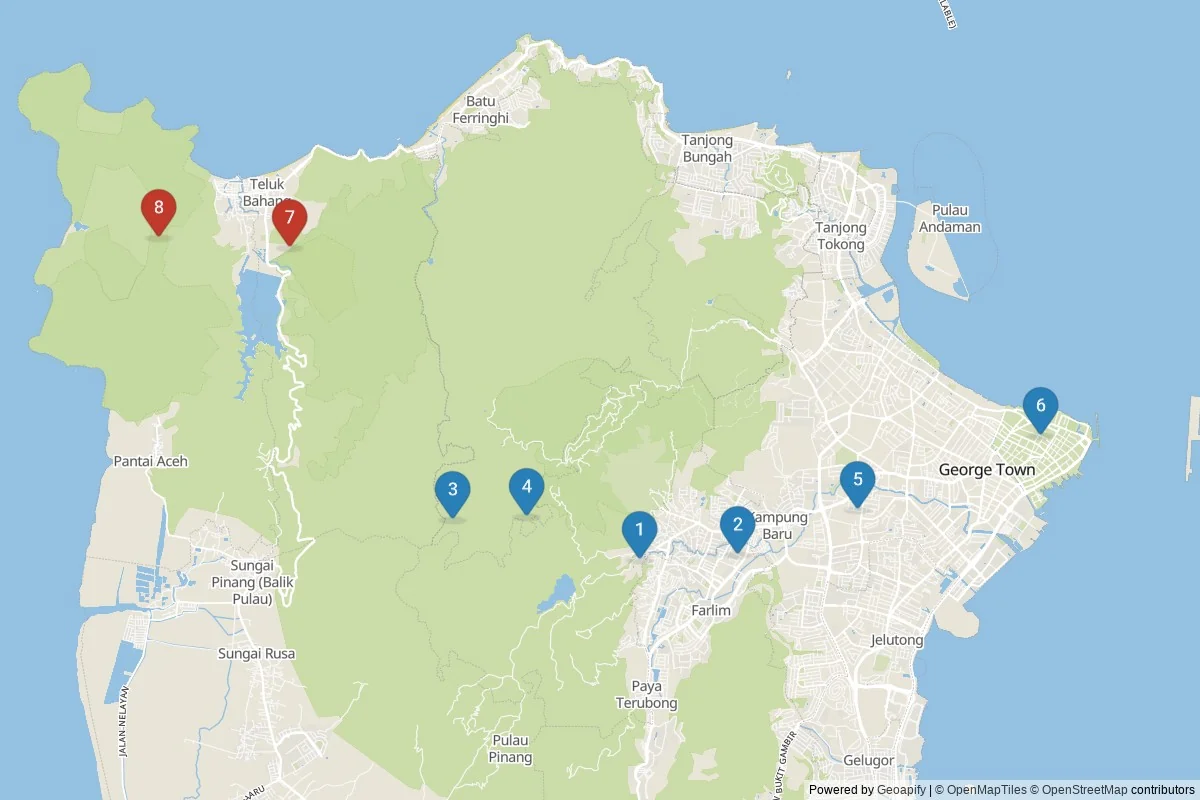
| # | Sight | Cluster | Type | Time | Entry | Best |
|---|---|---|---|---|---|---|
| 1 | Kek Lok Si Temple | Cluster A | Temple | 3 hours | Free | — |
| 2 | Cooking Classes & Food Tours | Cluster A | Market | — | — | Morning |
| 3 | the Penang Hill Funicular | Cluster A | Park | 10 minutes | — | Morning |
| 4 | Day Trip to Pulau Jerejak or Balik Pulau | Cluster A | Garden | — | — | — |
| 5 | Walk the George Town Heritage Core | Cluster A | Temple | 6 hours | — | Morning |
| 6 | Hunt the Street Art | Cluster A | — | 3 hours | free | — |
| 7 | Eat the Hawker Food | Cluster B | Temple | 6 hours | — | Night |
| 8 | Penang National Park (Teluk Bahang) | Cluster B | Park | 20 minutes | — | — |
1. Walk the George Town Heritage Core
The fundamental Penang experience: a self-guided morning wander through the UNESCO zone, beginning at the Khoo Kongsi clan house (one of the most ornate Chinese clan temples in Southeast Asia), continuing past the Cheah Kongsi and Yap Kongsi, through Cannon Square, along Armenian Street, past the Goddess of Mercy Temple (Kuan Yin Teng), to Fort Cornwallis and the Esplanade. Add the Pinang Peranakan Mansion (Church Street) for the Baba-Nyonya cultural backstory — restored merchant’s mansion, MYR 25 admission. Plan 4–6 hours; start at 8:30 am before the heat.
2. Hunt the Street Art
Penang’s Ernest Zacharevic street murals — particularly “Children on a Bicycle” on Armenian Street — went viral globally in 2012 and spawned an ecosystem of murals, wrought-iron-rod cartoons, and 3D installations across George Town. Most are concentrated in the heritage zone. The free Penang Tourism map at any visitor center marks the major pieces; expect to spend 2–3 hours hunting and photographing them.
3. Eat the Hawker Food
The unbreakable rule of Penang: follow the queues. Gurney Drive Hawker Centre (evenings) — the broad sampler menu, oceanfront atmosphere, somewhat tourist-priced. Lorong Selamat — the famous char kway teow stall (look for the woman with bright red lipstick; queues at lunch). Air Itam — the asam laksa stall by Kek Lok Si Temple, widely considered the world’s best. Joo Hooi Cafe (Penang Road) — the cendol-and-laksa cluster. Hameediyah Restaurant (Lebuh Campbell) — the nasi kandar institution since 1907. Kimberley Street Night Market — koay teow th’ng (rice noodle soup) and Hokkien mee. Macalister Road — Char Tow Kueh (carrot cake) and Wan Tan Mee. Many of the most legendary stalls operate only 5–6 hours a day; check opening times.
4. Take the Penang Hill Funicular
The 1923-built funicular climbs 833 m from Air Itam to the Penang Hill summit in about 10 minutes. The summit (cooler by 5–8 °C, often misty in the morning) offers panoramic views, colonial-era bungalows, the Habitat Penang Hill nature park (canopy walk, sky deck), and a handful of restaurants. Sunrise visits (first funicular ~6:30 am) are the best — clearest views, fewer crowds. Round-trip ticket MYR 30 (foreigner). Express line skips the queue.
5. Visit Kek Lok Si Temple
Southeast Asia’s largest Buddhist temple complex, sprawling across the hillside at Air Itam. The seven-tier pagoda blends Chinese, Thai, and Burmese architectural styles; the 30-meter bronze Kuan Yin statue dominates the upper level. Chinese New Year illumination (15 days, late January or February) is the headline event — the entire complex is lit with thousands of lanterns. Free entry; donations encouraged. Plan 2–3 hours.
6. Penang National Park (Teluk Bahang)
At 23 km², Malaysia’s smallest national park — but with hiking trails through rainforest to Monkey Beach (1.5-hour hike one way), the Meromictic Lake (saltwater on top, freshwater below — rare globally), and Pantai Kerachut. Boat charters from the entrance reach Monkey Beach in 20 minutes (MYR 50–60 each way). Bring water; the trail is moderately strenuous in the heat.
7. Day Trip to Pulau Jerejak or Balik Pulau
Pulau Jerejak — formerly a penal colony, now a small resort island reached by 15-minute ferry from Bayan Lepas. Balik Pulau — the rural western coast; durian orchards (June–August fruiting season), Tropical Spice Garden, traditional nasi kandar in fishing-village kopitiams, and twisting motorbike-friendly roads.
8. Cooking Classes & Food Tours
Penang’s food culture is more accessible than most via the local cooking-school scene. Nazlina Spice Station, Tropical Spice Garden cooking class, and several private chef-led half-day tours (MYR 200–400 per person) cover the canonical dishes — laksa paste from scratch, char kway teow wok technique, nyonya kuih sweets. Pair with morning market visits.
How to Get to Penang
By Air
Penang International Airport (PEN), in Bayan Lepas at the southern end of Penang Island, is the country’s third-busiest airport. Regional nonstop routes include Singapore, Bangkok, Hong Kong, Taipei, Jakarta, Ho Chi Minh City, Doha, Dubai, and most major Chinese cities. Domestic connections to Kuala Lumpur (45 minutes, 30+ daily flights), Langkawi, Johor Bahru, Kuching, and Kota Kinabalu. Carriers: Malaysia Airlines, AirAsia, Firefly, Cathay Pacific, Scoot, Singapore Airlines.
From the airport to George Town (~17 km, 30–45 minutes by car): Grab MYR 25–40 (the easy default); Rapid Penang Bus 401E MYR 4 to KOMTAR; metered taxi MYR 45–60 (insist on the meter, or use the airport’s fixed-fare coupon counter).
By Train
The ETS (Electric Train Service) connects Butterworth station on the mainland with Kuala Lumpur (4 hours, MYR 35–95), Ipoh (90 minutes, MYR 25), and the Thailand border at Padang Besar. From Butterworth, a 15-minute ferry or 30-minute bus across the bridge reaches George Town. Cross-border international trains (KTM-State Railway of Thailand cooperation) connect Butterworth to Bangkok via Hat Yai with a transfer (~22 hours total).
By Bus
Long-distance buses from Kuala Lumpur (5 hours, MYR 35–60), Singapore (10 hours, MYR 80–120), Bangkok (14 hours, expensive), and most Malaysian cities terminate at Sungai Nibong Bus Terminal on Penang Island. KOMTAR is the city-bus hub.
By Ferry
The historic Penang Ferry (Weld Quay ↔ Butterworth) has operated since 1894 and remains the atmospheric way to arrive — MYR 1.20 per pedestrian one-way, MYR 7.70 with car. Also: ferries to Langkawi (2.5–3 hours, MYR 70–120) from the Swettenham Pier; cruise ships also dock at Swettenham.
Visa Notes
Malaysia offers visa-free entry for up to 90 days for citizens of most Western countries — including all EU member states, US, UK, Canada, Australia, New Zealand, Japan, South Korea, and Singapore. Chinese passport holders received visa-free entry (30 days) in December 2023, and Indian passport holders the same. Passport must have at least 6 months remaining validity, and travelers technically need proof of onward/return travel. Always verify current rules with the Malaysian Immigration Department 4–6 weeks before travel. For longer stays, the Malaysia My Second Home (MM2H) long-term visa was relaunched in 2024 with revised financial requirements.
Getting Around Penang
Walking
The George Town heritage core is genuinely walkable end-to-end (the UNESCO zone is roughly 2 km × 1 km). Bring water; the equatorial sun is relentless even on overcast days.
Ride-Hailing
Grab is the dominant and easiest option for visitors. Fares are transparent in-app and credit cards accepted. A George Town–to–Batu Ferringhi ride costs MYR 25–40; airport-to-George Town MYR 25–40.
Buses (Rapid Penang)
The state-run Rapid Penang network covers the island with modern air-conditioned buses. Route 101 serves Batu Ferringhi from George Town; Route 204 reaches the airport; Route 502 goes to Balik Pulau. Single fares MYR 1.40–4 depending on distance; cash or MyRapid card. The free CAT (Central Area Transit) bus loops the heritage core continuously from 6 am to 12 am — useful for fast hops between heritage zones.
Trishaws
The classic George Town tourist transport — pedicab-style trishaws with colorful canopies. Standard tourist route around the heritage core: MYR 40–60 for a 45-minute loop. Negotiate the route and price before boarding. Many trishaw operators offer evening lit-up tours.
Self-Drive Rentals
Car rental is reasonable for travelers planning Penang Hill, Balik Pulau, or beach excursions (MYR 100–180/day for an automatic compact). George Town parking is genuinely difficult; use rental cars only for outside-the-heritage-zone trips. Driving in Penang is left-side, traffic-rule-following but motorcycle-dense. Motorbike rental MYR 35–60/day; requires an international driving permit.
Ferry to Mainland
The Penang Ferry from Weld Quay to Butterworth runs continuously 5:30 am to 12:30 am — useful for connecting to the mainland train station or as an atmospheric short cruise.
Food & Drink in Penang
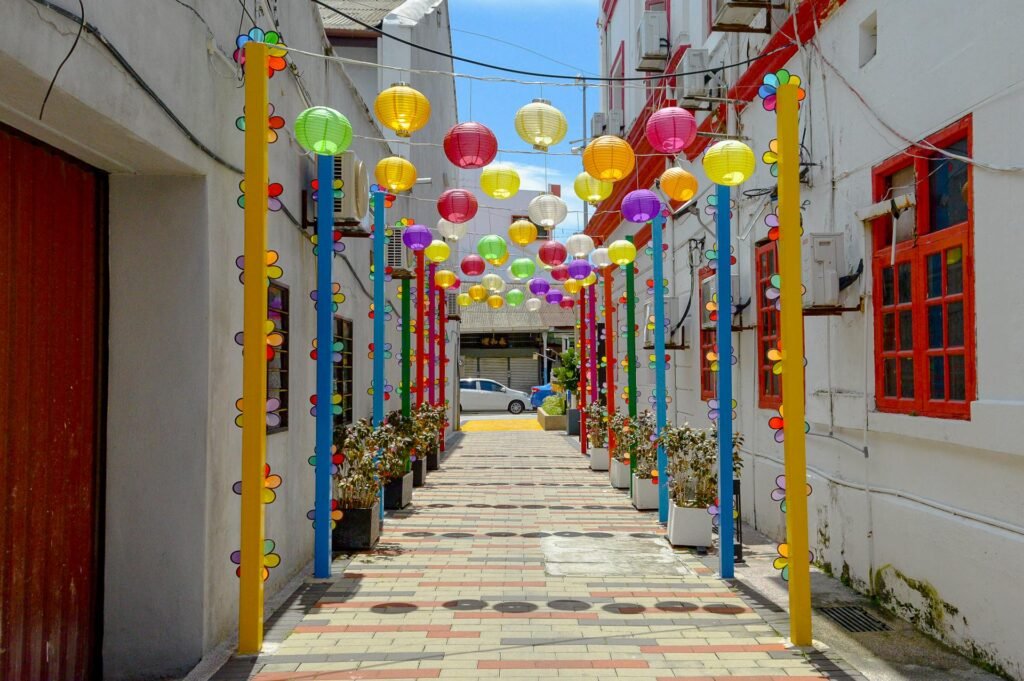
Penang’s food culture is the city’s defining cultural asset, regularly voted the world’s best street food destination by global travel media (TIME, Lonely Planet, CNN, the Robb Report). The reasons are structural: three distinct culinary traditions — Chinese (especially Hokkien), Malay, and Indian (especially Tamil-Muslim) — have evolved on the same small island for two centuries, cross-pollinating to create the unique Peranakan/Nyonya cuisine and an unusually high concentration of dishes that exist only on Penang.
What to Try
- Char Kway Teow — flat rice noodles wok-fried with prawns, Chinese sausage, cockles, bean sprouts, and chives in dark soy and chili paste. Lorong Selamat’s red-lipstick stall is canonical.
- Penang Asam Laksa — tamarind-sour fish broth with thick rice noodles, mackerel, mint, pineapple, lettuce, ginger flower, and prawn paste. The Air Itam Asam Laksa stall is widely considered the world’s best version.
- Hokkien Mee (Penang version) — spicy prawn-stock noodle soup with yellow noodles, prawns, pork ribs, and fried shallots. Different from Singapore’s Hokkien mee, which uses a stir-fry technique.
- Nasi Kandar — steamed rice with mixed Indian-Muslim curries (fish curry, prawn sambal, fried chicken, vegetables). Hameediyah Restaurant has served it since 1907.
- Roti Canai — flaky Indian-Muslim flatbread, served with dhal and curry; the breakfast standard.
- Nyonya Kuih — Peranakan pastries and rice cakes; kuih lapis (rainbow layer cake), pulut hitam (black rice pudding), kuih dadar (pandan crepe with coconut filling), ondeh-ondeh (palm-sugar-filled glutinous rice balls). Best from Moh Teng Pheow Nyonya Koay on Lebuh Carnarvon.
- Cendol — shaved ice with pandan-flavored green-rice-flour worms, palm sugar, and coconut milk; the iconic Penang dessert. Joo Hooi Cafe and Penang Road Famous Teochew Chendul are the canonical spots.
- Rojak — Penang’s distinctive sweet-sour fruit-and-vegetable salad in shrimp-paste dressing.
- Wonton Mee — egg noodles tossed in dark soy with char siew and wontons.
- Durian — the king of fruits in peak season (June–August). Penang’s Musang King and Black Thorn varieties are sold at Balik Pulau stalls during the season.
Where to Eat
Gurney Drive Hawker Centre (evenings, oceanfront) for the broad sampler experience. New World Park (Burmah Road) for indoor air-conditioned hawker. Kimberley Street Night Market for koay teow th’ng and street snacks (evenings). Lorong Selamat for char kway teow (lunch). Air Itam for the world-famous asam laksa. Joo Hooi Cafe (Penang Road) for the cendol-asam-laksa cluster. Hameediyah (Lebuh Campbell) for nasi kandar. Restoran Sup Hameed (Penang Road) for late-night nasi kandar. China House (Lebuh Pantai) for sophisticated dessert and coffee in restored shophouses. Macalister Road and Burma Road clusters for endless options.
Drinks
Teh tarik (“pulled tea” — frothy Indian-Muslim milk tea) is the everyday drink. Kopi-O (black sweet coffee) and Kopi-C (with evaporated milk) at any kopitiam. The Mansion Bar at the Eastern & Oriental Hotel for colonial-era cocktails; China House Canteen for craft cocktails; Antarabangsa (Lebuh Carnarvon) for backpacker beers; The Daily Dose for third-wave coffee.
A Note on Tap Water
Tap water in Penang is treated to safer-than-most-Southeast-Asia standards by the Penang Water Supply Corporation (PBA), but most travelers and even many locals still boil or filter for drinking due to old building plumbing. Safer default: use sealed bottled water (MYR 1.50–3 per liter at 7-Eleven and convenience stores) for drinking and brushing teeth; tap water is fine for showering. Reputable hotel and restaurant ice is generally safe. The CDC traveler health page for Malaysia recommends bottled or boiled water and standard food precautions. Traveler’s diarrhea is less common in Penang than in much of Southeast Asia, but eat at busy, established hawker stalls where food turnover is high.
Frequently Asked Questions About Visiting Penang
Do I need a visa to visit Penang?
For most foreign passport holders, no — Malaysia is one of Asia’s most generous visa-free destinations. Citizens of most Western countries — including all EU member states, US, UK, Canada, Australia, New Zealand, Japan, South Korea, Singapore, and most of ASEAN — enter visa-free for up to 90 days. Chinese passport holders received 30 days visa-free in December 2023 (extended; check current duration); Indian passport holders the same. Russian passport holders get 30 days; some African and Middle Eastern nationalities require an e-Visa or sticker visa. Passport must have at least 6 months remaining validity, and travelers technically need proof of onward/return travel (occasionally checked at airline check-in). The Malaysia Digital Arrival Card (MDAC) must be completed online within 3 days of arrival (free, mandatory for most non-Malaysian foreigners since January 2024) at the official Malaysian Immigration Department portal. Extensions are processed in-country with reasonable simplicity. For longer stays, the Malaysia My Second Home (MM2H) program offers a multi-year visa with revised 2024 financial requirements.
Is Penang safe for tourists?
Penang is one of Southeast Asia’s safer destinations and considerably safer than its reputation suggests. The US State Department rates Malaysia at “exercise increased caution” — primarily for the southern coastal areas of Sabah (which is across the country from Penang) rather than for the peninsular states. Real risks in Penang: motorbike-snatch-and-grab theft — bag snatchings from pedestrians by motorbike riders, particularly in less-trafficked areas of George Town and at night; scooter and motorcycle accidents — Malaysia has high road-death rates; many travel insurance policies exclude unlicensed motorbike riding; credit-card skimming at low-rent ATMs (use bank-branch ATMs at Maybank, CIMB, Public Bank); traffic in George Town — narrow heritage-zone streets, motorcycles weaving everywhere, scooter exhaust; regional haze June–October (Indonesian agricultural fires); jellyfish on Batu Ferringhi beach during certain seasons. Drug laws: Malaysia imposes extremely harsh penalties — possession of even small amounts of cannabis can mean a multi-year prison sentence; trafficking carries the death penalty (commuted to life sentences in October 2023 but still severe). Religious considerations: Penang is famously diverse but Malaysia is officially Islamic; dress modestly at mosques, behave respectfully near Hindu temples and Chinese temples, and don’t photograph people in religious devotion without permission.
How many days do I need in Penang?
Three to four days handles Penang well; combined with the broader Northern Malaysia circuit (Langkawi, Kuala Lumpur), 7–10 days makes a comprehensive trip. A solid 4-day Penang plan: Day 1 — George Town heritage walk (Khoo Kongsi + Cannon Square + Armenian Street murals + Cheah Kongsi + Fort Cornwallis + Esplanade); evening at Gurney Drive Hawker Centre. Day 2 — Penang Hill sunrise (first funicular at 6:30 am) + Kek Lok Si Temple + Air Itam Asam Laksa for lunch + Pinang Peranakan Mansion afternoon + Joo Hooi cendol break. Day 3 — Penang National Park hike to Monkey Beach + Batu Ferringhi beach afternoon + Batu Ferringhi night market dinner. Day 4 — Balik Pulau rural day (durian orchards if in season, Tropical Spice Garden, traditional kopitiam lunch) + Kimberley Street Night Market dinner. Add Day 5 for a cooking class or a Pulau Jerejak side trip; Day 6+ for ferry to Langkawi or onward train to Kuala Lumpur. Festival timing: George Town Festival (July–August) and Chinese New Year (late January–February) each add 2–3 days of specific programming worth budgeting for.
What’s the best area to stay in Penang?
George Town heritage core — the obvious default for first-time visitors; restored shophouse hotels (Eastern & Oriental Hotel, Macalister Mansion, Seven Terraces, Cheong Fatt Tze Mansion, The Blue Mansion are the heritage-luxury choices); MYR 200–1,500/night (US$45–340). Mid-range modern hotels (Cititel Penang, Royale Chulan, 23 Love Lane) MYR 250–500/night. Budget shophouse hostels and guesthouses MYR 50–150/night. Gurney Drive / Pulau Tikus — middle-class shopping district, oceanfront, less heritage character but easy walk to the famous hawker centre; G Hotel, Royale Chulan Penang, Bayview Beach Resort; MYR 200–600/night. Batu Ferringhi — beach resort strip 20 km west; Shangri-La Rasa Sayang, Hard Rock Hotel, PARKROYAL, DoubleTree Resort; MYR 400–1,500/night; better for resort-vacation than cultural exploration. Bayan Lepas (Queensbay) — modern shopping-mall district near the airport; useful only for early flights or business at the free-trade zone. Skip: unbranded budget hotels along the Komtar bus terminal — noisy, often poorly maintained. For first-timers, choosing a restored shophouse heritage hotel in the UNESCO zone genuinely elevates the trip.
How much does it cost to visit Penang’s major sights?
Penang is one of Asia’s best-value major destinations. Khoo Kongsi clan house: MYR 15. Pinang Peranakan Mansion: MYR 25. Cheong Fatt Tze Mansion (Blue Mansion) guided tour: MYR 25. Fort Cornwallis: MYR 25. Penang Hill funicular round-trip: MYR 30 (foreigner adult); MYR 80 express. Habitat Penang Hill: MYR 65. Kek Lok Si Temple: free; pagoda ticket MYR 2. Penang National Park entrance: free; boat to Monkey Beach MYR 50–60 each way. Penang 3D Trick Art Museum: MYR 35. Cooking class: MYR 200–400 per person. Heritage walking tour (group): MYR 80–150. Local meals: hawker dinner MYR 8–15 per dish; sit-down restaurant lunch MYR 25–50 per person; mid-range dinner MYR 60–100 per person; fine-dining MYR 150–400 per person. Grab across George Town: MYR 8–15; airport-to-George Town MYR 25–40. Trishaw heritage loop: MYR 40–60 for 45 minutes. Cable car alternatives: combo Penang Hill + Habitat ticket MYR 90. Overall daily budget: MYR 200 (frugal hawker-and-bus), MYR 500 (mid-range with one experience activity), MYR 1,500+ (heritage-hotel luxury).
Should I drink the tap water in Penang?
Tap water in Penang is significantly safer than most Southeast Asia — the Penang Water Supply Corporation (PBA) treats it to drinking-water standard, and Malaysian official guidance considers it potable. However, building-level plumbing in older shophouses and budget hotels is the weak point — corroded pipes can re-contaminate clean municipal water before it reaches your tap. Safer default for foreign visitors: use sealed bottled water (MYR 1.50–3 per liter at 7-Eleven, Family Mart, and convenience stores; major brands Cactus, Spritzer, F&N Dasani) for drinking and brushing teeth; tap water is fine for showering. Reputable hotel and restaurant ice is generally safe — Penang’s ice manufacturing is well-regulated. Reusable filter bottles (LifeStraw, Grayl, Sawyer) work well in Penang and reduce plastic waste; some hipster cafés in George Town offer free refill stations. The CDC traveler health page for Malaysia recommends bottled water for travelers as a precautionary default. Traveler’s diarrhea is uncommon in Penang compared to other regional cities; eat at busy, established hawker stalls and avoid raw shellfish on hot days.
What payment methods work in Penang — should I use cash or cards?
Mix of both. Credit cards (Visa, Mastercard, AmEx, JCB) are accepted at hotels, mid-range and upmarket restaurants, malls (Gurney Plaza, Queensbay Mall, Komtar), and most Grab rides; smaller hawkers, trishaws, traditional shophouse coffee shops, wet markets, and many street food stalls are cash only. ATMs: bank-branch ATMs at Maybank, CIMB, Public Bank, Hong Leong, RHB are abundant in George Town and at the airport; daily withdrawal limit typically MYR 3,000–5,000 with a MYR 10–20 international fee. Currency exchange: licensed money changers offer significantly better rates than airport and hotel exchange — most concentrated on Lebuh Bishop and around Pengkalan Weld; bring USD or EUR in clean bills (high-denomination notes get better rates). Mobile payment: Touch’n Go eWallet, GrabPay, and Boost dominate locally but require a Malaysian phone number for full functionality; visitors can use GrabPay through their Grab app for ride and food-delivery payments. Tips: tipping is not deeply ingrained — restaurants with a “10% service charge” on the bill don’t expect additional tips; cash tips of MYR 5–20 for tour guides, drivers, and good hawker service are appreciated. Currency note: Malaysian ringgit (MYR) is unrelated to Singaporean dollar — get the right currency. USD is occasionally accepted at upmarket hotels but at unfavorable rates.
What’s the deal with hawker food etiquette — how do I order without speaking Hokkien or Malay?
Penang hawker culture has informal but real conventions, and English works at almost every tourist-area stall. How it works: most hawker centers operate “self-service” — you grab any available seat, walk to specific stalls to order, pay each stall directly when food is served, and clear your own tray afterward. Drinks are usually ordered from a separate roving drinks-vendor who takes the order at your table. Ordering protocol: be patient with queues — Penangites take their hawker food seriously and form orderly lines. Reservations and large stalls: the famous places (Lorong Selamat char kway teow, Joo Hooi cendol) often refuse to take orders for more than 4 plates per person to keep the queue moving. Halal vs non-halal: most hawker centres in Penang have a separate non-halal section serving pork — clearly signed; respect Muslim diners by not sharing tables with pork dishes. Tipping: not expected; round up the bill or leave change. Hygiene cues: long queues + visible food turnover = safe; empty stall with old-looking food = avoid. Best opening hours: morning stalls (kopitiam breakfast, dim sum) typically 6–11 am; lunch stalls 11:30–14:30; evening hawker centers 17:00–22:30; many of the most legendary individual stalls run only 5–6 hours daily — check operating hours before walking 30 minutes through equatorial heat. Phrases worth learning: “satu” (one), “dua” (two), “tak pedas” (not spicy), “berapa harga?” (how much?). For Hokkien specifically: “kam siah” (thank you) at Chinese stalls is appreciated.
Education & Notable People
Penang has the highest concentration of higher-education institutions outside the Klang Valley and is the country’s leading center for engineering, medicine, and the sciences — reflecting both the British colonial educational legacy and the modern semiconductor-industry skill base.
Major Universities
- Universiti Sains Malaysia (USM) — Penang’s flagship public research university, founded 1969 at Minden, with strong programs in science, medicine, pharmacy, and the arts; approximately 30,000 students.
- Universiti Teknologi MARA (UiTM) Penang Branch — bumiputera-focused public university with engineering and business programs.
- Wawasan Open University — Penang’s flagship open-distance learning institution.
- Penang Medical College — Royal College of Surgeons in Ireland affiliate, training Penang-based and visiting medical students.
- Han Chiang University College of Communication — private institution in journalism and media studies.
- SEGi College Penang, KDU College, Sentral College — private colleges offering British and Australian degree-twinning programs.
Notable People
Tunku Abdul Rahman — Malaysia’s first Prime Minister and “Father of Independence” (1957), educated in Penang and a long-term resident; the Tunku Abdul Rahman Hall at the Penang Free School commemorates him. Lim Chong Eu — Penang’s Chief Minister 1969–1990, the architect of the state’s electronics-manufacturing transformation. Lim Guan Eng — Chief Minister 2008–2018, the first DAP politician to lead a Malaysian state government, instrumental in the UNESCO heritage inscription. Michelle Yeoh — Academy Award-winning actress (born Ipoh but resident in Penang during much of her childhood, attended schools in the state). Anthony Bourdain — although American, his 2014 episode set in Penang is widely credited with launching the city’s global food-tourism status. Ernest Zacharevic — Lithuanian street artist whose 2012 Penang Festival murals defined the city’s visual brand.
Sister Cities & International Relations
Penang’s sister-city network reflects its dual identity as a UNESCO heritage city and a global semiconductor hub. The relationships emphasize cultural exchange, port partnerships, and industrial cooperation with electronics-manufacturing centers.
Penang state and George Town’s sister and partnership cities include (selection):
- Adelaide, South Australia — sister city since 1973; long-running educational and cultural exchanges.
- Yokohama, Japan — port-city sister relationship since 1993.
- Kaohsiung, Taiwan — friendship city since 2000; technology and port cooperation.
- Medan, Indonesia — paired since 1984; the closest large Indonesian city and a key cross-Strait trading partner.
- Xiamen, China — sister city since 1993, reflecting the deep Hokkien cultural connection.
- Kuala Lumpur, Malaysia — domestic-twinning relationship.
- Phuket, Thailand — friendship city; UNESCO-style cooperation.
- Vancouver, Canada — friendship link, particularly through Vancouver’s large Penang-origin diaspora.
Penang plays a central role in the Indonesia-Malaysia-Thailand Growth Triangle (IMT-GT) regional cooperation framework, established 1993, which links northern Sumatra, southern Thailand, and the four northern Malaysian states (Penang, Kedah, Perak, Perlis) for trade and infrastructure cooperation. The state government runs an active inward-investment promotion arm (InvestPenang) which has positioned the island as the country’s leading semiconductor, medical-device, and electronics-and-electrical (E&E) manufacturing hub, drawing more than US$10 billion in foreign direct investment annually in recent years.
AFRIKA
Cairo Hurghada Johannesburg Marrakech
ASIA
Abu Dhabi Agra Antalya Bangkok Batam Beijing Bengaluru Cebu City Chiang Mai Chiba Chennai Da Nang Dammam Delhi Denpasar Dubai Fukuoka Guangzhou Guilin Ha Long Hanoi Ho Chi Minh City Jakarta Jaipur Johor Bahru Kolkata Krabi Kuala Lumpur Kyoto Macau Mecca Medina Mugla Mumbai Osaka Pattaya Penang Phuket Riyadh Seoul Shanghai Shenzhen Singapore Taipei Tokyo Zhuhai
EUROPE
Amsterdam Athens Barcelona Berlin Brussels Budapest Copenhagen Dublin Florence Frankfurt am Main Heraklion Krakow Lisbon London Madrid Milan Munich Nice Paris Porto Prague Rhodes Rome Stockholm Venice Vienna Warsaw
NORTH AMERICA
Cancun Las Vegas Los Angeles Miami New York City Orlando San Francisco Toronto Vancouver
SOUTH AMERICA
Buenos Aires Lima Rio De Janeiro
OCEANIA
Auckland Honolulu Melbourne Sydney