
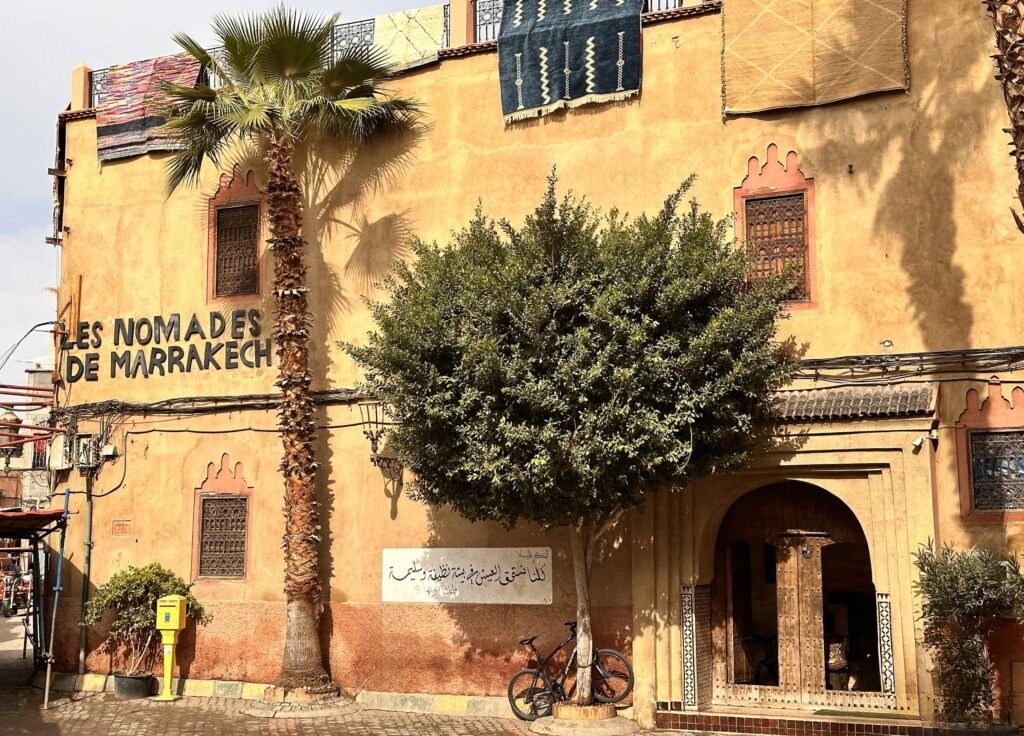
Photo credit: The Koutoubia minaret over Marrakech’s medina
Marrakech earns its nickname “the Red City” from the warm ochre walls and pink-clay dwellings that fill the 11th-century medina, but the deeper truth is sensory overload — the dawn call to prayer rippling from a hundred minarets; the souk’s narrow alleys filled with leather, brass, saffron, and argan oil; the snake charmers, henna artists, storytellers and grilled-meat carts of Jemaa el-Fnaa square (UNESCO-designated as a “Masterpiece of the Oral and Intangible Heritage of Humanity”); the snow-capped High Atlas Mountains rising visibly to the south. Founded in 1062 by the Almoravid Berber dynasty and serving variously as the imperial capital of Morocco for nearly 900 years, Marrakech has become the country’s leading tourist destination — and one of North Africa’s most photogenic cities. The medina (UNESCO 1985) and the modern Gueliz European quarter offer two utterly different cities sharing the same horizon; the modern Hivernage luxury district adds a third. Between the four are some of the best palaces, gardens, riads, and street food in the Maghreb.
Marrakech by District: The 5 Arrondissements
Marrakech is divided into 5 arrondissements. The map below shows their official OSM boundaries, colour-coded to match the table — a quick way to orient yourself before zooming in on individual sights.
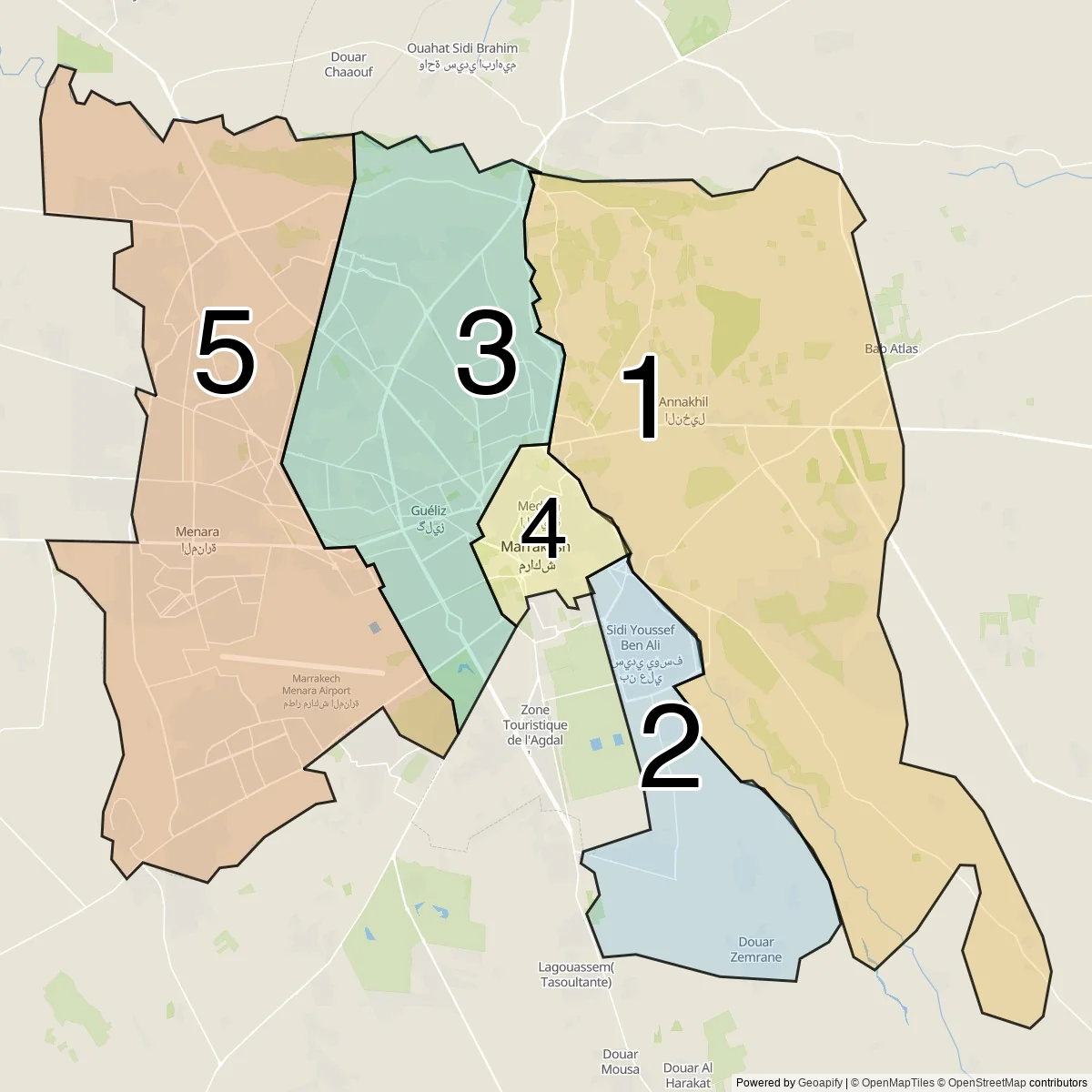
| # | Arrondissements |
|---|---|
| 1 | Arrondissement d’Annakhil مقاطعة النخيل |
| 2 | Arrondissement de Sidi Youssef Ben Ali مقاطعة سيدي يوسف بن علي |
| 3 | Arrondissement de Gueliz مقاطعة كليز |
| 4 | Arrondissement de Marrakech-Medina مقاطعة مراكش المدينة |
| 5 | Arrondissement de Ménara مقاطعة المنارة |
Marrakech at a Glance: Essential Facts for Travelers
| Location | Marrakech-Safi Region, central Morocco (north of the High Atlas Mountains) |
|---|---|
| Coordinates | 31.6295°N, 7.9811°W |
| Population | ~932,000 (2024 estimate); metro area ~1.55 million |
| Area | 230 km² (city) |
| Elevation | 466 m above sea level |
| Time Zone | Western European Time (WET, UTC+1 — Morocco uses UTC+1 year-round since 2018; pauses to UTC+0 during Ramadan) |
| Calling Code | +212 (city code 524) |
| Currency | Moroccan dirham (MAD درهم); EUR widely accepted in tourism |
| Languages | Moroccan Arabic (Darija) and Amazigh/Berber (Tashelhit) official; French widely spoken in business and tourism; English increasingly common |
| Religion | Predominantly Sunni Muslim; small Jewish community in the historic Mellah |
| Climate | Hot semi-arid — hot dry summers, mild winters with occasional rain |
| Founded | 1062 (Almoravid Berber dynasty) |
| Famous For | Jemaa el-Fnaa, Koutoubia Mosque, medina souks, Bahia Palace, Majorelle Garden, Atlas Mountain gateway, riad guesthouses |
Upcoming Events in Marrakech
| Date | Title | Details |
|---|---|---|
| 2026-02-08 to 2027-01-08 | Statues Also Breathe and Crazy Lines at MACAAL | The Museum of African Contemporary Art Al Maaden (MACAAL) devotes 2026 to a strong double bill: Statues Also Breathe, a collaborative project by the Catharsis Arts Foundation with Obafemi Awolowo University involving more than a hundred students, and Crazy Lines, an on-site installation by artist Yassine Balbzioui. Both run until 8 January 2027 alongside the revamped permanent collection, organised into seven thematic contours tracing contemporary African art since independence. Located by the Al Maaden resort south of the medina, the museum charges modest admission; check opening days before visiting. [Source] |
| 2026-09-24 to 2026-10-04 | Unibet Open Marrakech 2026 | The Unibet Open, one of Europe’s longest-running live poker tours, brings its next stop to Marrakech from 24 September to 4 October following a record-breaking Paris leg. The festival pairs a full schedule of tournaments with side events, satellites and the social trimmings that have made the tour popular with recreational players as well as professionals. Buy-ins vary across the schedule, and online qualifiers offer cheaper routes in. For visiting players it doubles as a holiday stop, mixing big poker with an exotic destination, in the organisers’ own billing. [Source] |
| 2026-09-25 to 2026-09-30 | Marrakech Short Film Festival – 6th Edition | The sixth Marrakech Short Film Festival runs from 25 to 30 September, gathering emerging and established short-film talent from Morocco and abroad for screenings, talks and industry encounters in the ochre city. Turkish actress Tuba Buyukustun, hugely popular with Moroccan audiences, presides over this year’s international jury. The festival has grown into a fixture of Marrakech’s early-autumn cultural calendar, championing new cinematic voices in the short format. Programme and venue details are published by the organisers, with tickets at varying, generally modest prices. [Source] |
| 2027-01-31 | 37th Marathon International de Marrakech | The 37th Marathon International de Marrakech takes runners through the ochre city on Sunday 31 January 2027, with the marathon setting off at 7:45 am and the half marathon at 9:15 am. The fast, flat course and mild winter temperatures make it a popular season-opener that draws international fields, with the route passing palm groves, ramparts and city landmarks. Participants collect their bibs at Place de la Koutoubia during the two days before the race. Entry is by paid registration in several categories, while spectating along the boulevards is free. [Source] |
City News in Marrakech – last 14 days
| Date | Category | Headline | Details |
|---|---|---|---|
| 2026-09-14 | Public transport | High-speed rail to Agadir advances as land procedures open | The planned high-speed rail line between Marrakech and Agadir has moved from announcements to concrete administrative action, with the land and property procedures now officially opened and expropriations able to begin along the corridor. Authorities have also given the green light to the foncier process for a Chichaoua-Essaouira link, confirming that the Atlantic resort town will be connected as part of the programme. The steps mark tangible progress on extending Morocco’s TGV network south of Marrakech, a project closely watched by residents and the tourism industry alike. [Source] |
| 2026-09-14 | Culture | Tuba Buyukustun to preside over Marrakech Short Film Festival jury | Turkish actress Tuba Buyukustun, a familiar face to Moroccan audiences through hit television dramas, will preside over the international jury of the Marrakech Short Film Festival’s sixth edition, which runs from 25 to 30 September. The appointment adds star power to a young festival that has quickly established itself in the city’s cultural calendar, showcasing short-form cinema from Morocco and around the world and giving emerging filmmakers a platform in front of industry guests and international press. [Source] |
| 2026-09-14 | Business | Regional economic forum asks whether Marrakech-Safi has enough qualified talent | A regional economic forum staged by L’Economiste turned its attention to investment in the Marrakech-Safi region, asking whether the area can supply enough qualified talent to match its ambitions. Employers, officials and educators debated the gap between the skills produced locally and those demanded by investors in tourism, industry and services. The discussion reflects a wider Moroccan preoccupation with training and retaining skilled workers as the kingdom courts international investment ahead of major infrastructure and sporting deadlines. [Source] |
| 2026-09-13 | Public safety | Dried-fruit vendor sanctioned after tourist films attempted scam | A dried-fruit vendor in Marrakech was taken in by police after a tourist filmed him attempting a brazen overcharge, reportedly demanding around 200 dirhams for a handful of peanuts and three dates. The video spread rapidly online, prompting the authorities to identify and sanction the trader. The episode has revived debate about protecting visitors from tourist traps in the medina, with officials keen to show that documented abuses will be punished in a city whose economy depends heavily on its reputation for hospitality. [Source] |
| 2026-09-14 | Public transport | String of Marrakech-bound flights diverted over medical emergencies | Several flights heading for Marrakech were diverted within a few days after passengers fell ill on board. A Ryanair service bound for the city landed in Birmingham following a passenger’s malaise, according to reporting relayed from the Daily Express, while an easyJet flight from Basel put down in Malaga and an Amsterdam-Marrakech service was rerouted to Bordeaux for medical emergencies earlier in the week. In each case crews prioritised getting the affected traveller to ground medical care, and the aircraft continued to Morocco after the interruptions. [Source] |
| 2026-09-09 | Culture | Fanny Ardant to star in Ginevra Elkann’s The Roses of Marrakesh | Variety reports that The Roses of Marrakesh, the new film from director Ginevra Elkann starring French screen icon Fanny Ardant, has been boarded by the sales company True Colours. The project, named for the Moroccan city, puts Marrakech back in the spotlight of international art-house cinema and continues the city’s long run as a setting and backdrop for European productions. Casting and sales details emerged this week as the film moves forward, with further announcements expected as production develops. [Source] |
| 2026-09-12 | Business | Price quirk: all-inclusive in Marrakech comes in cheaper than breakfast-only | A package-price comparison relayed by Bladi has thrown up a striking anomaly: an all-inclusive stay in Marrakech can work out 153 euros cheaper than the equivalent formula with breakfast only. The finding highlights the aggressive pricing battles among resorts and tour operators competing for European holidaymakers, where board upgrades are sometimes discounted more heavily than room-only or breakfast rates. For travellers, the lesson is to compare board options carefully before booking, as the intuitive assumption that less catering means a lower price does not always hold. [Source] |
Marrakech Events & City News Archive
Sources: MACAAL, Unibet Open, Femmes du Maroc, Marathon International de Marrakech, Le Matin, L'Economiste, Le360, Yabiladi
Weather Forecast for the Next 14 Days in Marrakech
| Date | Weather | Max °F | Min °F | Rain mm |
|---|---|---|---|---|
| 2026-09-14 | ☁️ | 103.9 °F | 73.8 °F | 0.0 mm |
| 2026-09-15 | ☁️ | 100.1 °F | 75.6 °F | 0.0 mm |
| 2026-09-16 | ☀️ | 94.3 °F | 68.6 °F | 0.0 mm |
| 2026-09-17 | ⛅ | 86.6 °F | 65.0 °F | 0.0 mm |
| 2026-09-18 | ⛅ | 89.0 °F | 64.8 °F | 0.0 mm |
| 2026-09-19 | ☁️ | 96.3 °F | 67.2 °F | 0.3 mm |
| 2026-09-20 | ⛅ | 100.3 °F | 68.5 °F | 0.0 mm |
| 2026-09-21 | ☁️ | 99.4 °F | 71.1 °F | 0.0 mm |
| 2026-09-22 | ⛅ | 99.3 °F | 71.2 °F | 0.0 mm |
| 2026-09-23 | ⛅ | 101.2 °F | 71.5 °F | 0.0 mm |
| 2026-09-24 | ☁️ | 87.2 °F | 74.1 °F | 0.0 mm |
| 2026-09-25 | ⛈️ | 77.8 °F | 63.0 °F | 15.2 mm |
| 2026-09-26 | ⛈️ | 73.2 °F | 60.0 °F | 22.2 mm |
| 2026-09-27 | 🌧️ | 74.4 °F | 58.3 °F | 1.0 mm |
Marrakech’s History
Marrakech was founded in 1062 CE by Yusuf ibn Tashfin, leader of the Berber Almoravid dynasty, on a strategic plain between the High Atlas Mountains and the Sahara approaches. The Almoravids — a religious-military movement from what is now Western Sahara — used Marrakech as the launching pad for their conquest of most of Morocco, much of Algeria, and ultimately al-Andalus (Muslim Iberia). The city’s name, originally Murr-Akush or Amerruk in Berber, gave the country its modern Arabic name Maghrib al-Aqsa (“the Furthest West”) and eventually the English “Morocco.”
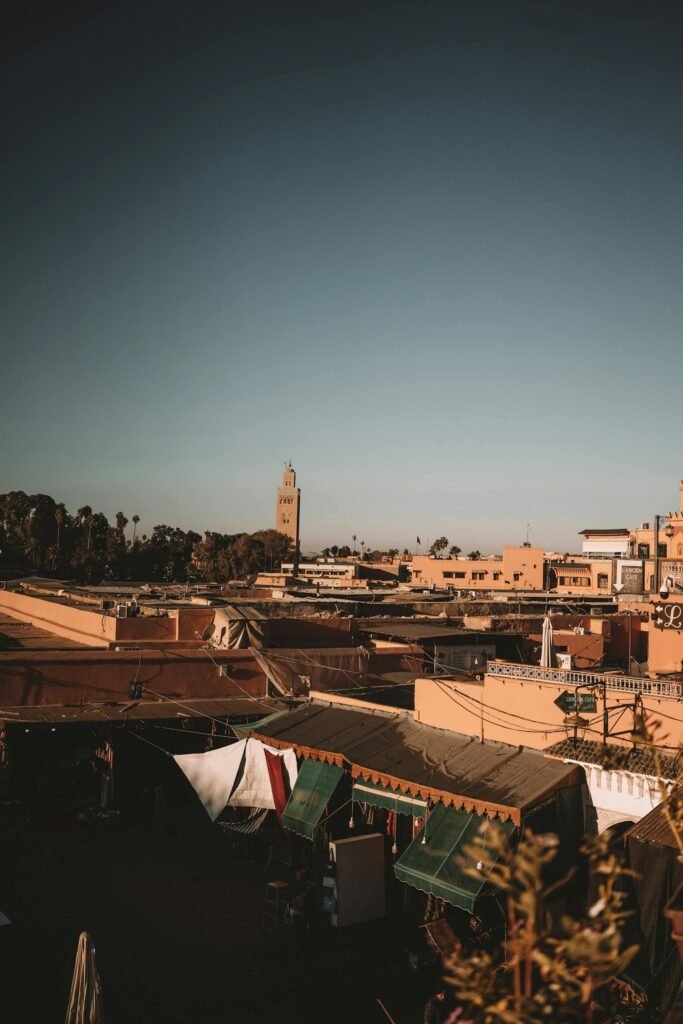
The Almoravid dynasty was overthrown in 1147 by the Almohad Berbers, who consolidated Marrakech as their North African capital and added the city’s most iconic structure — the Koutoubia Mosque (completed 1199, with its 77-meter minaret that inspired the Giralda of Seville and the Hassan Tower of Rabat). The Almohad Caliphate at its 12th-century peak ruled from the Atlantic to Tripolitania and across into Andalusia. After the Almohad collapse, the city passed to the Merinid dynasty from Fes in the 13th century and lost capital status to Fes for two centuries.
The Saadian dynasty (1554–1659) restored Marrakech to imperial-capital status and produced the city’s most opulent surviving monuments: the El Badi Palace (now ruins after later demolition by the next dynasty); the Saadian Tombs (hidden behind the Kasbah Mosque after the Alaouites bricked up the entrance in 1672, rediscovered in 1917); and the Ben Youssef Madrasa. The succeeding Alaouite dynasty — still Morocco’s ruling royal family today — moved the political capital to Meknes, then to Fes, then permanently to Rabat in 1912, but maintained Marrakech as a royal residence.
The French Protectorate of Morocco (1912–1956) under Resident-General Hubert Lyautey shaped the modern city. Lyautey’s preservationist principle was to leave the medina intact and build a new European city outside the walls — the Gueliz district with its straight grids, art-deco architecture, and the Atlas Mountains visible at the end of every avenue. Designer Jacques Majorelle arrived in 1923 and built the famous Majorelle Garden (later acquired by Yves Saint Laurent and Pierre Bergé in 1980). Marrakech became fashionable with European writers and artists from the 1930s onward — Winston Churchill painted the Atlas from the Mamounia hotel; the Rolling Stones recorded parts of Bridges to Babylon at Hassan II’s invitation; Yves Saint Laurent maintained a permanent presence here from 1966 until his death.
Modern Marrakech has navigated a complicated tourism-development balance. The 2011 terrorist bombing at the Argana café in Jemaa el-Fnaa (17 dead) and the 2023 Marrakech-Safi earthquake (magnitude 6.8, over 2,900 dead, significant medina damage in some districts) shocked the city but did not derail its tourism trajectory. The medina has been UNESCO World Heritage since 1985; the broader province hosts the COP22 climate summit, the 2023 IMF/World Bank meetings, and is preparing for the 2030 World Cup as a host city.
Geography, Climate & Best Time to Visit Marrakech
Geographic Setting
Marrakech sits on a flat plain at 466 meters elevation, framed by the High Atlas Mountains rising dramatically 60 kilometers to the south (the snow-capped peaks visible from the city for much of the year), the foothills of the Atlas immediately south and east, and the Saharan steppe to the south. The city’s geography is essentially a circle: the walled medina in the center (about 2.5 km across), the colonial-era Gueliz European district to the northwest, the Hivernage luxury hotel district to the southwest, and modern residential expansion in all directions.
The medina itself contains: Jemaa el-Fnaa at its heart; the Koutoubia Mosque just southwest of Jemaa; the Kasbah royal palace district at the southern walls; the Mellah (Jewish quarter) east of the Kasbah; the dense souks north of Jemaa; the Bahia Palace and Saadian Tombs south and east of the center; and the Riad Larroussa and Mouassine residential quarters where most converted-riad guesthouses cluster.
Climate Overview
Marrakech has a hot semi-arid climate (Köppen BSh) with the moderating effect of altitude and the cool nighttime descent from the Atlas. Summer (June–September): daytime highs of 35–42 °C, sometimes 45 °C+ during heatwaves, with surprisingly cool nights (18–22 °C) and very low humidity. Winter (December–February): daytime highs of 17–22 °C with cool nights (5–10 °C, occasional frost), occasional rain and rare dustings of snow on the surrounding hills. Annual rainfall just 250 mm, mostly November–March.
Best Time to Visit
March to May and September to November are the genuinely ideal windows — warm sunny days (22–28 °C), cool nights, low humidity, blooming bougainvillea in the gardens, and good visibility to the snow-capped Atlas Mountains. December to February is mild and uncrowded — perfect for medina exploration but cool nights require warm layers and most riads have only space heaters. June to August is genuinely uncomfortable for most travelers — 40 °C+ heat during the day, with afternoon Moroccan summer “hot wind” from the Sahara; many riads close in August. Ramadan (dates shift earlier each year by ~10 days) — restaurants close during daylight hours, tour and shop schedules disrupt, but the post-sunset (iftar) atmosphere is uniquely festive; not the best window for first-time visitors. Check current Ramadan dates and Eid timing with the Moroccan Ministry of Foreign Affairs before booking.
Marrakech’s Districts & Neighborhoods
The Medina — the Historic Walled City
The 700-hectare UNESCO-listed walled old city contains nearly all of Marrakech’s historic landmarks. The medina divides into roughly six functional sub-zones: Jemaa el-Fnaa and the central souks (the tourist heart, busiest sensory experience); Mouassine and Riad Laarouss (residential riad-conversion quarters northwest of Jemaa); Kasbah (the southern royal quarter with palaces and tombs); Mellah (the historic Jewish quarter, now mostly empty of Jews but with the synagogue still active and atmospheric); Bab Doukkala (northern artisan quarters with quieter accommodations); Sidi Mimoun (the western edge near the Koutoubia). Streets are narrow, often unpaved, and unnamed; smartphone GPS works erratically. Most travelers should base themselves here at a riad — converted traditional courtyard mansions, transformed into intimate guesthouses, are the defining Marrakech accommodation.
Gueliz — the European Modern City
The French-built modern district 1 km west of the medina via Avenue Mohammed V. Wide tree-lined boulevards, French-colonial architecture, the Marrakech Museum of Modern and Contemporary African Art, sidewalk cafés in the European style, and the city’s contemporary fashion and art galleries. Gueliz is genuinely walkable, less intense than the medina, and has the densest concentration of fine dining and bars. Best base for travelers wanting a more relaxed Marrakech experience.
Hivernage
The luxury district between Gueliz and the medina — international hotel chains (La Mamounia, Four Seasons, Marrakech Renaissance, Mövenpick), the Marrakech Royal Theatre, embassies and consulates, and the wealthier modern restaurants. La Mamounia is one of the world’s most legendary hotels — Winston Churchill’s favorite Moroccan retreat.
Palmeraie
The palm-grove area northeast of the city, where royal Saadian-era irrigation channels (khettara) created an oasis. Now hosts upscale resort hotels (Es Saadi Marrakech, Beachcomber, Selman Marrakech, Mandarin Oriental Marrakech), golf courses, camel-trek operators, and quad-bike adventure operators. Calmer than the city center; useful for travelers who want resort downtime between medina expeditions.
Sidi Ghanem & the Industrial East
The Sidi Ghanem industrial zone has reinvented itself as a design and showroom district — Moroccan furniture brands, contemporary ceramics, textile workshops, and the Sidi Ghanem International Designers (a designer outlet showroom). Worth an afternoon if shopping for Moroccan modern design.
Top Things to Do in Marrakech
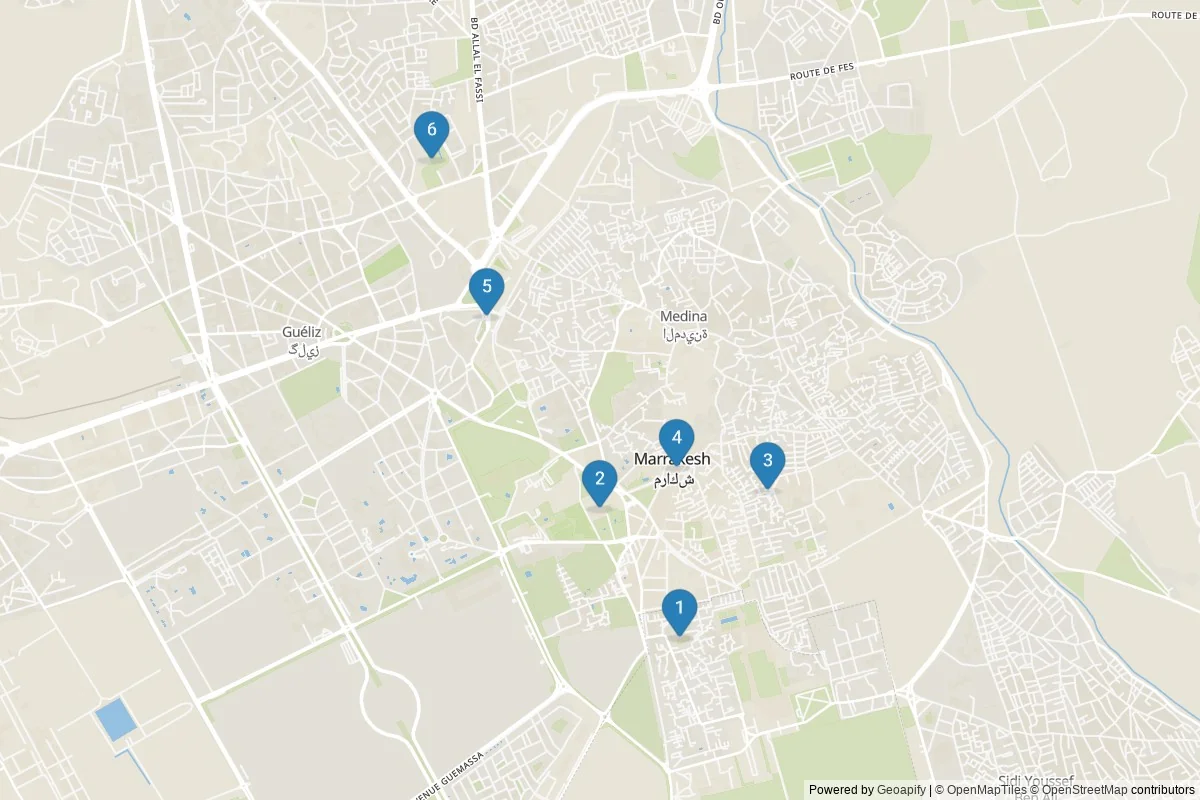
| # | Sight | Cluster | Type | Time | Entry | Best |
|---|---|---|---|---|---|---|
| 1 | the Saadian Tombs | Cluster A | — | — | — | — |
| 2 | the Koutoubia Mosque | Cluster A | Mosque | — | — | Sunset |
| 3 | the Bahia Palace | Cluster A | Palace | 2 hours | $7 | — |
| 4 | Spend an Evening at Jemaa el-Fnaa | Cluster A | Square | — | — | Evening |
| 5 | Day Trip to the Atlas Mountains | Cluster A | Mountain | 1.5 hours | — | — |
| 6 | the Majorelle Garden | Cluster A | Museum | — | — | — |
1. Spend an Evening at Jemaa el-Fnaa
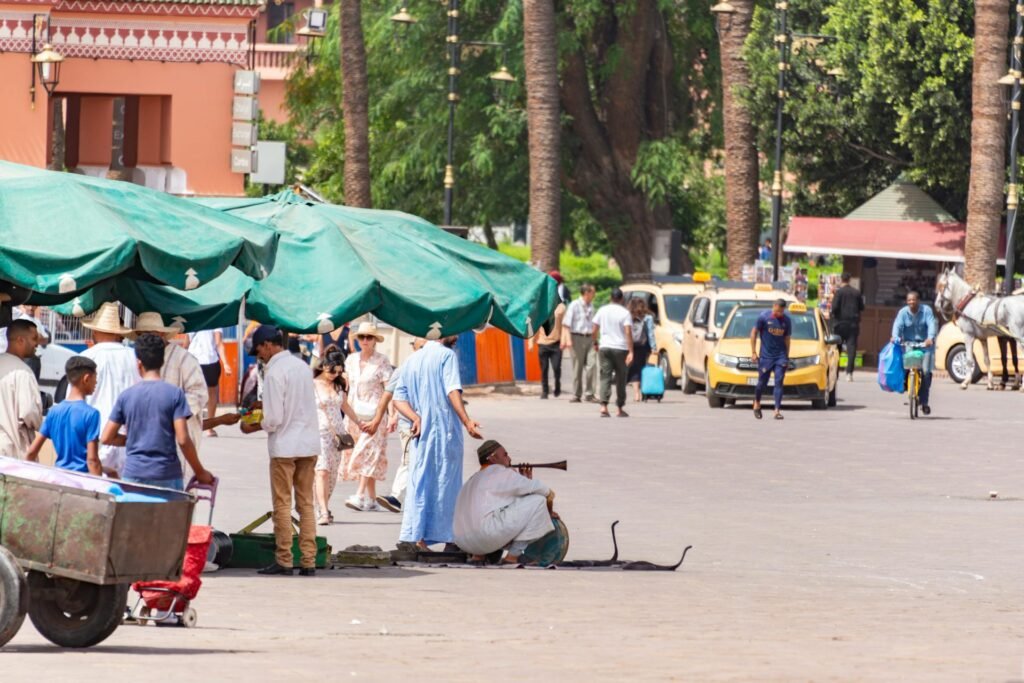
The medina’s central square is the defining Marrakech experience — UNESCO-designated as a “Masterpiece of the Oral and Intangible Heritage of Humanity” for its preservation of the medieval-style entertainment economy. Daytime: snake charmers, henna artists, monkey trainers (do NOT pay to photograph the monkeys — they are mistreated; the practice should be discouraged), orange-juice carts (5 dirhams a glass). Evening: storytellers (in Arabic), Gnaoua musicians, herbalists, fortune-tellers, and dozens of pop-up food stalls serving grilled meats, harira soup, snail soup, and sheep’s head. Bring small bills; expect aggressive tipping requests; never photograph performers without permission. Watch from a rooftop café (Café Glacier, Café Argana rebuilt) for the best overall view.
2. Visit the Koutoubia Mosque
The 12th-century Almohad mosque — the visual symbol of Marrakech — with its 77-meter minaret topped by four golden orbs. The minaret is the architectural prototype for the Giralda of Seville and the Hassan Tower of Rabat. The interior is closed to non-Muslims (Morocco’s standard rule for active mosques), but the exterior and surrounding gardens are publicly accessible and beautifully landscaped. Best at sunset, when the sandstone glows golden-pink.
3. Explore the Bahia Palace
The 19th-century Grand Vizier’s palace, built between 1859 and 1900 for Si Moussa and his son Ba Ahmed — a masterpiece of late-Moroccan architecture with carved cedar ceilings, painted plasterwork, marble floors, and a sequence of progressively more private courtyards. Plan 1–2 hours; entry MAD 70 (~US$7).
4. Discover the Saadian Tombs
The 16th-century royal mausoleum complex, sealed behind walls by the succeeding Alaouite dynasty in 1672 and effectively lost to history until rediscovery via aerial photography in 1917. The Chamber of the Twelve Columns — with its Italian Carrara marble columns and cedar-and-stucco mihrab — is widely considered the most beautiful interior space in Morocco. Entry MAD 70.
5. Wander the Majorelle Garden
The 1923 botanical garden designed by French artist Jacques Majorelle, restored and preserved by Yves Saint Laurent and Pierre Bergé from 1980 onward. The garden’s signature “Majorelle Blue” cobalt walls, exotic cacti and bamboo, and the small Berber Museum and Yves Saint Laurent Museum (the latter housing the designer’s North African collections) make this one of Marrakech’s most-visited single sites. Garden MAD 150 / YSL Museum MAD 100 (combined ticket discount); arrive at opening to avoid Instagram-crowd peak times.
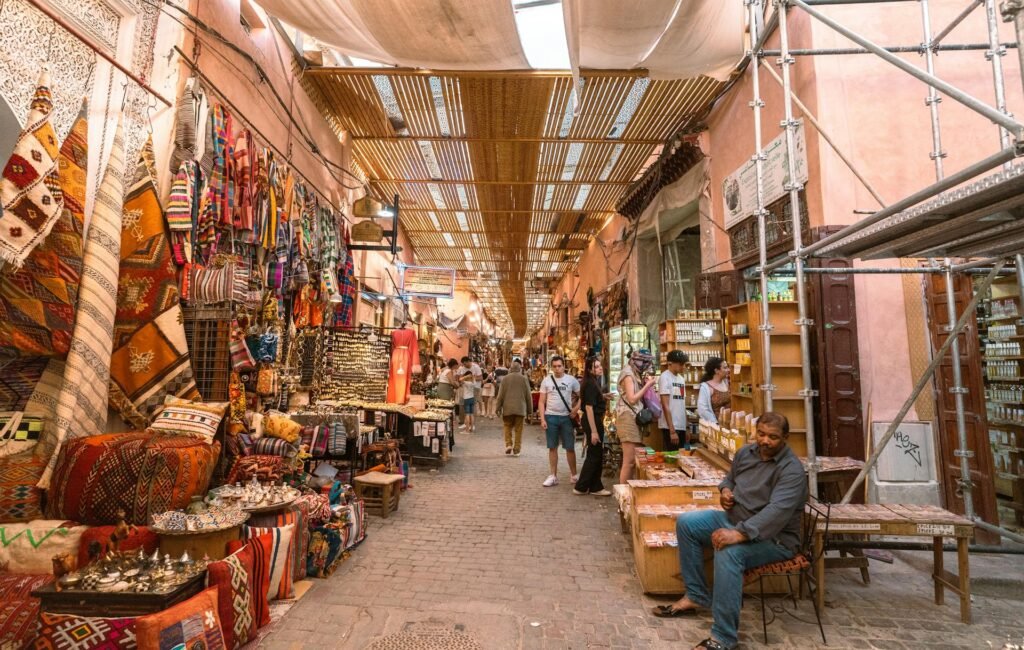
6. Get Lost in the Souks
The medina’s covered markets unfold north of Jemaa el-Fnaa across more than 40 narrow alleys grouped by specialty: Souk Smata (leather goods), Souk el Attarin (perfumes and herbs), Souk Cherratin (leather), Souk Sebbaghine (dyers, with iconic hanging-yarn photography), Souk Haddadine (metalwork). Bargain hard — initial prices are often 3–5x the realistic selling price. Tips: refuse “free” tours from young men offering directions; ignore “the souk is closed today, this is the special show” deflection scams; cash works better than card.
7. Day Trip to the Atlas Mountains
The High Atlas rises within 60 km of Marrakech. The most-visited single trip is the Ourika Valley (1.5 hours by road) — Berber villages, the seven cascades, and traditional argan-oil cooperatives. More ambitious: Imlil (2 hours) is the base for Toubkal trekking (North Africa’s highest peak at 4,167 m, climbable in 2 days for fit travelers with a guide). Ouzoud Falls (3 hours northeast) is the country’s most impressive waterfall complex.
8. Hammam Traditional Bath Experience
The Moroccan hammam — a multi-room steam-and-scrub bathhouse — is a fundamental local ritual. Public hammams (separated by gender, MAD 30–60 entry) are the authentic experience; tourist-oriented spa hammams at the riads and Hivernage hotels (MAD 400–2,000) add massage and argan-oil treatments in a more polished setting. The Hammam de la Rose and Les Bains de Marrakech are the canonical mid-range choices.
How to Get to Marrakech
By Air
Marrakech-Menara Airport (RAK), 5 km southwest of the medina, is Morocco’s second-busiest airport. Direct nonstop routes from Casablanca (45 minutes), Paris, Madrid, Barcelona, Lisbon, London, Manchester, Frankfurt, Munich, Brussels, Amsterdam, Zurich, Geneva, Moscow, Istanbul, Doha, Dubai, and many others. The post-2010 expansion of low-cost European carriers (easyJet, Ryanair, Eurowings, Vueling) has made Marrakech weekend-trip accessible from much of Europe.
From the airport: Pre-paid taxi at the official kiosk MAD 200–300 (~US$20–30) to medina or Hivernage; regular taxi negotiate firmly to MAD 70–100 daytime / MAD 100–150 nighttime; Bus 19 MAD 30 to Jemaa el-Fnaa with broader stops; private transfer arranged through your riad MAD 200 (often easier with luggage and unfamiliar medina addresses).
By Train (ONCF)
Morocco’s ONCF national railway connects Marrakech to Casablanca (3 hours, MAD 95–150 second class, MAD 145–220 first class), Rabat (4 hours), Tangier (8 hours, or 5 hours via the Al Boraq high-speed line changing at Kenitra), and Fes (7 hours). Trains are comfortable, on-time, and significantly more pleasant than driving the highway. The high-speed Al Boraq from Tangier to Casablanca opened in 2018 — first African high-speed train.
By Long-Distance Bus
CTM and Supratours operate Morocco’s premium intercity coach networks with air conditioning, assigned seats, and reasonable timeliness. Bus to Essaouira (3 hours, MAD 80–120), Agadir (4 hours, MAD 150), Ouarzazate (4.5 hours over the Atlas via the Tizi n’Tichka pass, MAD 110). Tickets bookable online or at the modern bus terminal in Gueliz.
By Road / Self-Drive
Highway A3 from Casablanca and A7 toward the south are modern motorways with tolls. Self-drive Morocco is feasible — rental cars at the airport from MAD 350–700/day — but parking in the medina is essentially impossible; rental cars are useful primarily for Atlas Mountains, Essaouira coast, or the Sahara dune circuits.
Visa Notes
Morocco offers visa-free entry for up to 90 days for citizens of most Western and many Asian countries, including all EU member states, US, UK, Canada, Australia, New Zealand, Japan, South Korea, Singapore, Malaysia, and several Latin American nations. Passport must have at least 6 months remaining validity; airlines may require proof of onward travel. Indian, Chinese, and many African passport holders need a visa in advance. Always verify current rules with the Moroccan Ministry of Foreign Affairs before travel.
Getting Around Marrakech
Walking
The medina is genuinely walkable end-to-end but disorienting — the narrow alleys are unmapped, unsigned, and densely interconnected. Smartphone GPS works erratically inside the medina (the alleys are too narrow for accurate triangulation). Tips: walk with confidence and ignore “the souk is closed today” deflection scams; refuse “free” guides who lead you on long detours expecting payment; carry a riad business card with the Arabic address and a contact phone number.
Petit Taxis
Marrakech’s petit taxis are color-coded ochre/light-yellow — small 4-passenger cabs that operate within the city. Fares should run on the meter (insist; some drivers initially refuse). A petit taxi from medina to Gueliz costs MAD 15–25 by meter; from medina to airport about MAD 70–100 daytime. Drivers may quote tourist-price flat rates of MAD 50–100 for trips that should cost MAD 20 — insist on the meter or walk away.
Grand Taxis
Beige/cream-colored larger sedans (mostly older Mercedes) that operate intercity and to nearby destinations. The Marrakech Grand Taxi Stand at the bus terminal connects to Ourika, Imlil, and Atlas villages.
Horse-Drawn Carriages (Calèche)
The classic tourist option at Jemaa el-Fnaa and the medina gates — a tour around the city walls and through the Hivernage district. MAD 100–300 for a 30–60 minute ride; agree the price and route before boarding. The carriage horses’ welfare has been a concern; the city has tightened regulations since 2020.
Ride-Hailing
InDriver and Yango operate informal ride-hailing services in Marrakech, with prices typically slightly cheaper than petit taxis. Uber ceased operating in Morocco in 2018 due to regulatory issues. Many riads will arrange private transfers and drivers for the day at fixed MAD 600–1,200 prices.
Buses
The city bus network ALSA connects Gueliz, Hivernage, Palmeraie, and the airport for flat MAD 4–5 fares. Useful for budget travelers; English signage is limited.
Food & Drink in Marrakech
Moroccan cuisine combines Berber, Arab, Andalusian, and (lightly) French influences into one of the world’s most distinctive culinary traditions. UNESCO recognized Moroccan cuisine (along with Mediterranean and Mexican) as part of the Mediterranean diet on the Intangible Cultural Heritage list.
What to Try
- Tagine — slow-cooked stew named for the conical clay vessel; many regional versions — chicken with preserved lemon and olives, lamb with prunes and almonds, kefta (meatball) with tomato and egg, fish (in coastal areas), vegetarian. The default Moroccan dinner.
- Couscous — Berber semolina steamed three times over a meat-and-vegetable broth; traditionally Friday lunch.
- Pastilla (bastilla) — the elaborate Moorish pie: thin warqa pastry layered with pigeon (now usually chicken), almonds, cinnamon, eggs, and powdered sugar. Festival dish.
- Harira — tomato-lentil-chickpea soup with herbs and a generous lemon squeeze; the traditional Ramadan iftar starter, available year-round at the Jemaa el-Fnaa stalls.
- Bissara — fava bean soup with olive oil and cumin; a breakfast staple at the Jemaa stalls.
- Mechoui — slow-roasted lamb shoulder; available at Jemaa stalls and weekend lunch restaurants.
- Tangia — Marrakech’s signature slow-cooked clay-pot dish (different from tagine) — beef or lamb sealed in a tall urn-shaped pot and slow-cooked overnight in the ashes of a hammam.
- Bread (khobz) — round flatbread baked in communal neighborhood ovens; used as utensil.
- Sweet Moroccan mint tea — green tea brewed with fresh spearmint and several sugar cubes; poured from height into small glasses. The defining Moroccan drink and a symbol of hospitality.
- Pastries — kab el ghazal (“gazelle horns” almond cookies), chebakia (sesame-honey rosettes, especially during Ramadan), m’hanncha (almond-paste snake).
Where to Eat
Jemaa el-Fnaa stalls (numbered, evening): tagine, harira, snail soup, sheep’s head, grilled meats. Café Argana rebuilt: rooftop dining over the square. Riad restaurants: Le Marrakchi (rooftop in the medina), Dar Yacout (palace setting), La Maison Arabe (cooking classes). Gueliz: L’Atelier de Patrick (French), +61 (Australian-fusion), Naranj (Lebanese), Bagatelle (French bistro). Hivernage: La Mamounia’s L’Italien and La Salle, Bo Zin Bistro. Atlas Mountain weekend lunch: Kasbah Bab Ourika overlooking the Ourika Valley.
Drinks
Morocco is officially Muslim and alcohol is regulated. Alcohol IS available at international hotels, licensed Gueliz restaurants and bars, and specialty stores (Carrefour and some supermarkets), but is not served in the medina restaurants (except at a small handful of riad rooftop bars). Local wines: Moroccan vineyards in the Meknes region produce respectable rosés and reds — Volubilia, Cuvée du Président, Médaillon are the most widely available labels. Mint tea is the national drink. Coffee: French-style espresso (café noir) and traditional Moroccan café au lait. Freshly squeezed orange juice at Jemaa el-Fnaa for MAD 5–10.
A Note on Tap Water
Tap water in Marrakech is not recommended for foreign visitors due to old building plumbing in many medina structures. Use sealed bottled water (MAD 4–10 per liter at any shop; Sidi Ali and Aïn Saïss are the dominant local brands) for drinking and brushing teeth. Reusable filter bottles (LifeStraw, Grayl) work well in Morocco. Hotel ice is generally safe at international-tier hotels and reputable riads; avoid ice from street stalls. The CDC traveler health page for Morocco recommends bottled or boiled water plus standard food precautions and consideration of hepatitis A and typhoid vaccinations before travel. Traveler’s diarrhea is the most common visitor complaint — eat at busy, established restaurants; raw vegetables (salads) at lower-tier places carry higher risk.
Frequently Asked Questions About Visiting Marrakech
Do I need a visa to visit Marrakech?
For most foreign passport holders, no — Morocco is among the more visa-friendly North African destinations. Citizens of most Western countries — including all EU member states, US, UK, Canada, Australia, New Zealand, Japan, South Korea, Singapore, Malaysia, Brazil, Mexico, and most Arab League nations — enter visa-free for up to 90 days. Chinese passport holders received visa-free entry in 2016 (up to 90 days). Indian, Russian, and most African passport holders need a visa applied for in advance at a Moroccan consulate or via the Moroccan e-Visa system launched in 2022. Passport must have at least 6 months remaining validity and airlines typically require proof of accommodation and onward/return travel. Stays beyond 90 days require an in-country residence application (Carte de Séjour) processed at the local police prefecture. Always verify current rules with the Moroccan Ministry of Foreign Affairs 4–6 weeks before travel.
Is Marrakech safe for tourists?
Marrakech is broadly safe — Morocco ranks as one of North Africa’s safer destinations and Marrakech is generally less dangerous than its reputation in some Western media suggests. The US State Department rates Morocco at “exercise increased caution” — primarily for terrorism risks rather than street-crime concerns. Real risks in Marrakech: persistent low-level scams — unsolicited “free guides” who lead you to commission-paying shops, “the souk is closed today, this special show only” deflection routines, fake police “checking documents”; pickpocketing in Jemaa el-Fnaa crowds and souk alleys; aggressive vendor harassment (less violent than annoying); petty motorcycle bag-snatch (rare but happens in less-trafficked alleys); henna scams — women approached with “free” henna that becomes mandatory payment; fake antiques at souk shops claiming “Berber heirloom” status; argan oil and saffron scams — much of what is sold as “pure” is mixed; tour-to-Sahara scams with overpriced and poorly organized desert trips. Real safety: violent crime against tourists is statistically very low; women travelers report verbal harassment but very rare physical danger; the 2011 bombing at Argana café and the rare nature of major incidents have prompted significantly tightened security. September 2023 earthquake: magnitude 6.8, primarily affected the High Atlas villages south of the city; the medina suffered some damage but tourism infrastructure is fully operational. Drug enforcement: Morocco’s cannabis laws are strict despite local availability — recent cannabis-medical legalization does not extend to recreational use; possession charges can result in significant fines and detention. Religious considerations: dress modestly, especially during Ramadan; avoid loud public conduct near mosques during prayer times.
How many days do I need in Marrakech?
Three to four days handles Marrakech well; combined with side trips to the Atlas Mountains, Essaouira coast, or Sahara dunes, 7–10 days makes a satisfying Moroccan trip. A solid 4-day Marrakech plan: Day 1 — Jemaa el-Fnaa orientation walk + Koutoubia Mosque sunset + evening street food at Jemaa. Day 2 — Bahia Palace + Saadian Tombs morning + souk wandering afternoon + traditional hammam evening. Day 3 — Majorelle Garden + YSL Museum + lunch in Gueliz + afternoon Maison de la Photographie or Berber Museum + rooftop dinner. Day 4 — Atlas Mountains day trip (Ourika Valley or Kasbah of Telouet via Tizi n’Tichka pass) + evening Bo Zin or fine-dining riad dinner. Add Day 5 for an Essaouira coast day trip (3 hours each way; better as overnight); Day 6+ for a Sahara dunes excursion (Erg Chebbi or Erg Chigaga, 3 days minimum). 7-day Morocco classic: 3 days Marrakech + 1 day Atlas + 2 days Sahara desert trip + 1 day Essaouira return. Day-trip Marrakech: theoretically feasible from Casablanca via the high-speed train but truly insufficient.
What’s the best area to stay in Marrakech?
For first-time visitors wanting the authentic experience, stay in a riad inside the medina — converted traditional courtyard mansions, almost always with rooftop terraces, plunge pools, hand-painted tile, and intimate scale (8–20 rooms). Best medina riad neighborhoods: Mouassine (north of Jemaa, mid-range to luxury), Riad Larroussa (north of Jemaa, mid-range), Kasbah (south near the royal palaces, quieter), Sidi Mimoun (west near Koutoubia, atmospheric). Riad prices range from MAD 400/night (~US$40) at simple guesthouses to MAD 15,000+/night (~US$1,500) at landmark riads (Riad Yacout, Royal Mansour, La Sultana). For travelers wanting a quieter, more European-style experience: Gueliz — modern hotels (Renaissance Marrakech, Mövenpick, Pestana CR7) at MAD 800–3,500/night; ideal for businesspeople and travelers who don’t want to navigate medina chaos. For luxury: Hivernage — La Mamounia (the legendary one), Four Seasons, Park Hyatt; MAD 4,000–25,000+/night. For resort tranquility: Palmeraie — Mandarin Oriental, Es Saadi, Beachcomber; MAD 3,000–15,000/night; useful as a base if you want pool-and-spa days between medina excursions. Skip: cheap hotels far from the medina with no riad character — Marrakech is one of the world’s great cities for atmospheric accommodation, and the riad experience is half the trip.
How much does it cost to visit Marrakech’s major sights?
Marrakech offers excellent value by European/American standards. Jemaa el-Fnaa: free (small bills MAD 5–20 for performers if you stop to watch). Koutoubia exterior & gardens: free. Bahia Palace: MAD 70 (~US$7). Saadian Tombs: MAD 70. El Badi Palace: MAD 70. Majorelle Garden + Berber Museum: MAD 150 (~US$15). YSL Museum: MAD 100. Maison de la Photographie: MAD 50. Marrakech Museum: MAD 50. Ben Youssef Madrasa: MAD 70 (when reopened from restoration). Riad guided tours: most riads run their own free orientation walks. Atlas Mountains day trip: MAD 250–600 (~US$25–60) per person with shared van + lunch. Sahara desert trip: MAD 1,500–4,500 (~US$150–450) per person for 3-day camel + camp; quality varies enormously. Hammam: public MAD 30–60, mid-range spa MAD 400–1,200, luxury hotel MAD 1,500–3,500. Local meals: street-food tagine MAD 50–100; medium-tier riad dinner MAD 150–350 per person; fine-dining riad MAD 400–1,200 per person; Gueliz/Hivernage upscale MAD 600–2,500 per person. Petit taxi medina-Gueliz: MAD 15–25 by meter. Overall daily budget: MAD 600 (frugal medina with riad guesthouse and street food), MAD 1,500 (mid-range), MAD 5,000+ (luxury riad and fine dining).
Should I drink the tap water in Marrakech?
No — tap water in Marrakech is not recommended for foreign visitors. The municipal supply meets some standards, but old plumbing in many medina buildings, riads, and budget hotels introduces contamination, and most locals filter or use bottled water for drinking. Always use sealed bottled water (MAD 4–10 per 1.5-liter bottle at any shop; major brands Sidi Ali, Aïn Saïss, Oulmès) for drinking and brushing teeth. Reusable filter bottles (LifeStraw, Grayl, Sawyer 0.1-micron) work well in Morocco and reduce plastic waste. Hotel ice is generally safe at international-tier hotels and reputable riads; avoid ice from street stalls. Raw salad: at lower-tier restaurants, raw vegetables can be the highest stomach-risk item — eat cooked vegetables in tagines/couscous and skip raw salads at uncertain places. The CDC traveler health page for Morocco recommends bottled or boiled water plus standard food precautions; consider hepatitis A, typhoid, and rabies (for desert travelers) vaccinations before travel. Traveler’s diarrhea is the most common visitor complaint — Pepto-Bismol or rehydration salts in your medicine kit are useful precautions.
What payment methods work in Marrakech — cards or cash?
Plan for mostly cash with some card backup. Marrakech is still cash-dominant in the medina and souks, with cards accepted only at international-tier hotels, mid-range and upmarket Gueliz/Hivernage restaurants, and major supermarkets. Cash (Moroccan dirham): essential for medina shops, all street food, petit taxis, calèches (horse-drawn carriages), tips, hammams, street performers, and most riad service charges. Credit cards (Visa, Mastercard, AmEx less universal): accepted at hotels, larger restaurants, museums, malls (Carre Eden, Marrakech Plaza), and many fixed-price boutiques in Gueliz. ATMs: abundant in Gueliz and at riad-adjacent medina intersections (Banque Populaire, Attijariwafa Bank, BMCE, BMCI); daily withdrawal limits MAD 2,000–5,000 per transaction with foreign-card fees MAD 20–40 plus your home bank’s. Currency exchange: Important — the Moroccan dirham is a closed currency, meaning you generally cannot buy or sell it outside Morocco. Withdraw or exchange at the airport or any bank-branch exchange counter; airport rates are competitive; avoid hotel exchange (often poor rates). Bring EUR (best rate), USD, or GBP in clean bills. EUR acceptance: many tourist-area businesses (especially restaurants in Hivernage and luxury riads) quote and accept EUR or GBP — typically at slightly worse rates than ATM. USD acceptance: surprisingly accepted at some upscale establishments. Mobile payment: cashplus and Wafacash dominate locally but require Moroccan ID; not realistic for short-stay visitors. Tipping: deeply ingrained in Moroccan tourism culture — round up taxi fares (MAD 5–10); 10% in restaurants; MAD 10–30 per bag to hotel porters; MAD 30–100 per day for housekeeping; MAD 100–300 per day for tour guides; MAD 50–100 for hammam attendants; MAD 5–10 to mosque/sight gatekeepers; small tips constantly to performers, parking helpers, and bathroom attendants in cash.
What about bargaining and souk shopping?
Bargaining is mandatory in the souks and adds significantly to both the trip experience and your savings. How it works: vendors quote inflated tourist prices (often 3–5x realistic value), and the negotiation game is expected — refusing to bargain marks you as a tourist to be overcharged. Standard practice: offer 30–40% of the initial quoted price, settle around 50–60%; walk away if the vendor doesn’t move (often called back); decide in advance the maximum you’ll pay. Items worth bargaining hard on: leather goods (be wary of fake-leather scams), brass and copper, hand-knotted rugs (the most-bargained category — initial prices may be 5–10x realistic), ceramics and tiles, jewelry, embroidered textiles, antiques (real Berber antiques are rare; most “heirlooms” are recently made), argan oil and saffron (often adulterated). Fixed-price alternatives: the Ensemble Artisanal on Avenue Mohammed V is the government-run craft showroom with fixed prices — useful as a reference for real value before you bargain in the souks. Marjane and other supermarkets: for argan oil and packaged goods, this is the safest way to buy without adulteration risk. Scams to watch: “fixed price” shop signs often mean the price is still inflated; “the king’s special workshop” pretensions; “your friend recommended us”; “free tea” hospitality that becomes mandatory tip and purchase pressure. Shipping: many shops offer international shipping for rugs and large purchases; reliable for established shops, risky elsewhere. Take a photo of the merchant and item before agreeing to ship; reputable shops won’t object. Bargain with a smile: rude or aggressive negotiation breaks the social compact and is counterproductive; the better local merchants enjoy a respectful negotiation as much as the sale itself.
Education & Notable People
Marrakech has a long educational heritage anchored by the medieval-era Ben Youssef Madrasa and the modern Cadi Ayyad University. The city has produced notable figures across Moroccan literature, music, film, and royal history.
Major Institutions
- Cadi Ayyad University — Marrakech’s flagship public university, founded 1978, named after the 12th-century Andalusian scholar; ~70,000 students across faculties of medicine, law, science, and humanities; central campus at Semlalia in Gueliz.
- Université Privée de Marrakech (UPM) — private university with international business and engineering programs.
- Ben Youssef Madrasa — the 14th-century Quranic school in the medina; closed as an active educational institution in 1960 but preserved as a museum displaying classic Moroccan Marinid architecture (under restoration since 2020).
Notable People
Yusuf ibn Tashfin — Almoravid emperor who founded the city in 1062. Ya’qub al-Mansur — the Almohad caliph (r. 1184–1199) who built the Koutoubia Mosque. Ahmad al-Mansur — the Saadian sultan (r. 1578–1603) who built El Badi Palace and made Marrakech a Saharan-trade hub. Hassan II of Morocco — the king (r. 1961–1999) who modernized the country and made Marrakech a global tourism brand; many royal palaces and gardens in the city are his patronage. Mohammed VI of Morocco — the current king, regularly visible at Marrakech royal residences. Yves Saint Laurent — French fashion designer, longtime Marrakech resident from 1966 to his death in 2008; his ashes are scattered in the Majorelle Garden. Tahar Ben Jelloun — Goncourt-winning Moroccan-French author with significant Marrakech-based fiction. Mounir Mahjoubi — politician and tech minister of French origin with Moroccan-Marrakech roots. Nour El Yakine Mouaaz — contemporary Moroccan footballer. The film industry has used the city extensively — over 100 international films have shot at the nearby Atlas Film Studios in Ouarzazate, with Marrakech as the post-production and crew base.
Sister Cities & International Relations
Marrakech’s sister-city network reflects the city’s identity as a global tourism destination and a UNESCO-listed cultural capital. The relationships emphasize cultural exchange and tourism cooperation.
Marrakech’s sister and friendship cities include (selection):
- Granada, Spain — paired since 1974; the most natural Marrakech twin, both being Moorish heritage capitals with parallel architectural legacies.
- Scottsdale, Arizona, USA — sister city since 1995; desert-and-resort-tourism partnership.
- Marseille, France — Mediterranean-port friendship.
- Florence, Italy — UNESCO heritage-city partnership.
- Timbuktu, Mali — historical Saharan-trade-route friendship.
- Konya, Türkiye — Islamic-heritage-city sister relationship.
- Yangzhou, China — paired since 2014.
- Funchal, Madeira, Portugal — friendship link.
Marrakech hosted the UNFCCC COP22 climate summit in November 2016, putting the city on the global diplomatic map; the 2023 IMF/World Bank Annual Meetings brought 15,000+ delegates to the city just weeks after the September earthquake. Morocco is a co-host of the 2030 FIFA World Cup (alongside Spain and Portugal), with Marrakech as one of the planned Moroccan host cities — major hotel and stadium infrastructure investment is underway. The Moroccan National Tourist Office coordinates Marrakech’s international promotion.
AFRIKA
Cairo Hurghada Johannesburg Marrakech
ASIA
Abu Dhabi Agra Antalya Bangkok Batam Beijing Bengaluru Cebu City Chiang Mai Chiba Chennai Da Nang Dammam Delhi Denpasar Dubai Fukuoka Guangzhou Guilin Ha Long Hanoi Ho Chi Minh City Jakarta Jaipur Johor Bahru Kolkata Krabi Kuala Lumpur Kyoto Macau Mecca Medina Mugla Mumbai Osaka Pattaya Penang Phuket Riyadh Seoul Shanghai Shenzhen Singapore Taipei Tokyo Zhuhai
EUROPE
Amsterdam Athens Barcelona Berlin Brussels Budapest Copenhagen Dublin Florence Frankfurt am Main Heraklion Krakow Lisbon London Madrid Milan Munich Nice Paris Porto Prague Rhodes Rome Stockholm Venice Vienna Warsaw
NORTH AMERICA
Cancun Las Vegas Los Angeles Miami New York City Orlando San Francisco Toronto Vancouver
SOUTH AMERICA
Buenos Aires Lima Rio De Janeiro
OCEANIA
Auckland Honolulu Melbourne Sydney