
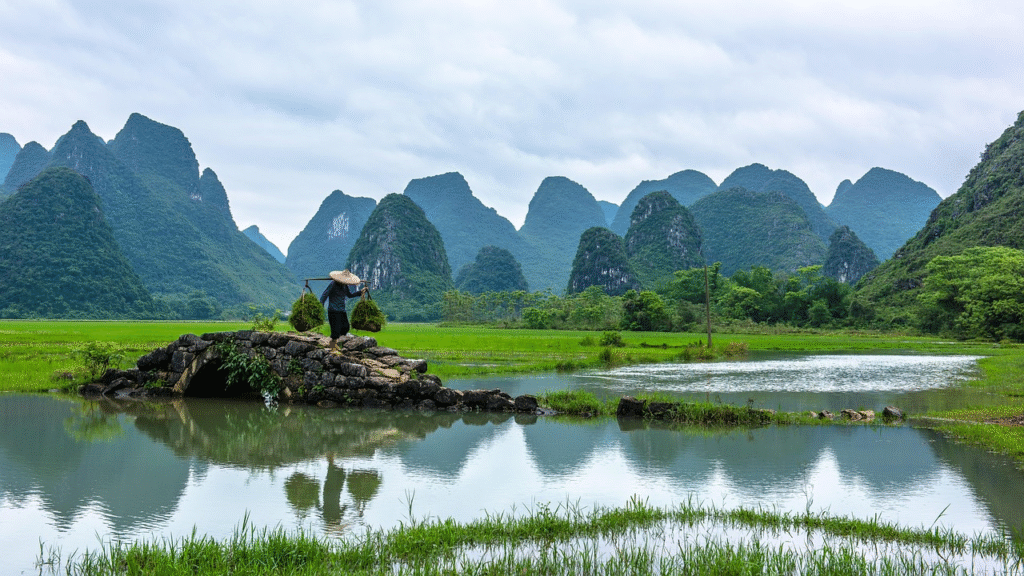
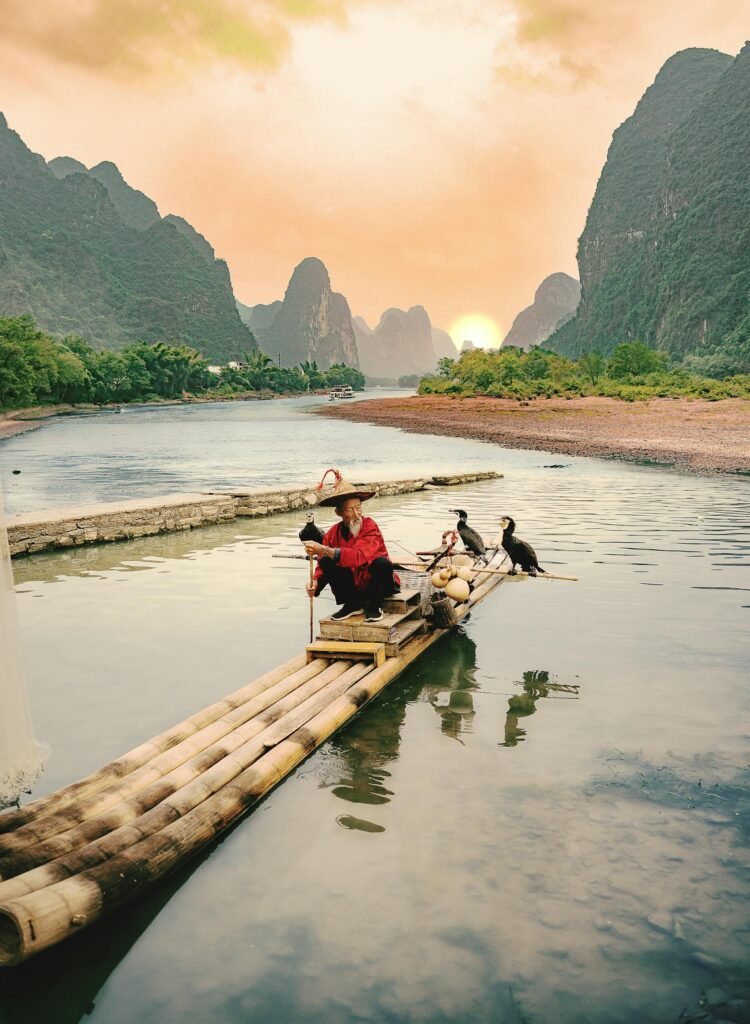
Photo credit: A traditional farmer with the Guilin karst landscape
Guilin’s reputation rests on a single iconic landscape — the limestone karst peaks rising sharply from the green Li River and surrounding rice paddies, the same view that appears on the back of China’s 20 yuan banknote and that has appeared in Chinese poetry, painting, and ink-wash art for over 1,200 years. The classical Chinese saying “桂林山水甲天下” — “Guilin’s mountains and waters are the best under heaven” — comes from Song dynasty poetry and remains the city’s official tourism slogan. Modern visitors come for the same reasons: the four-hour Li River cruise from Guilin to Yangshuo through 80 kilometers of karst scenery, the Longji rice terraces in the surrounding mountains, the bamboo-and-cormorant fishing traditions still demonstrated for travelers, and the small-city pace of Guilin itself. The city sits in Guangxi Zhuang Autonomous Region — a culturally diverse area home to Zhuang, Yao, Miao, and Dong ethnic minority communities whose villages dot the countryside surrounding Guilin proper. After two decades of high-speed-rail and airport upgrades, Guilin is now more easily reached than ever, but the landscape that drew Tang dynasty exiles remains essentially unchanged.
Guilin by District: The 17 市辖区/县
Guilin is divided into 17 districts and counties. The map below shows their official OSM boundaries, colour-coded to match the table — a quick way to orient yourself before zooming in on individual sights.
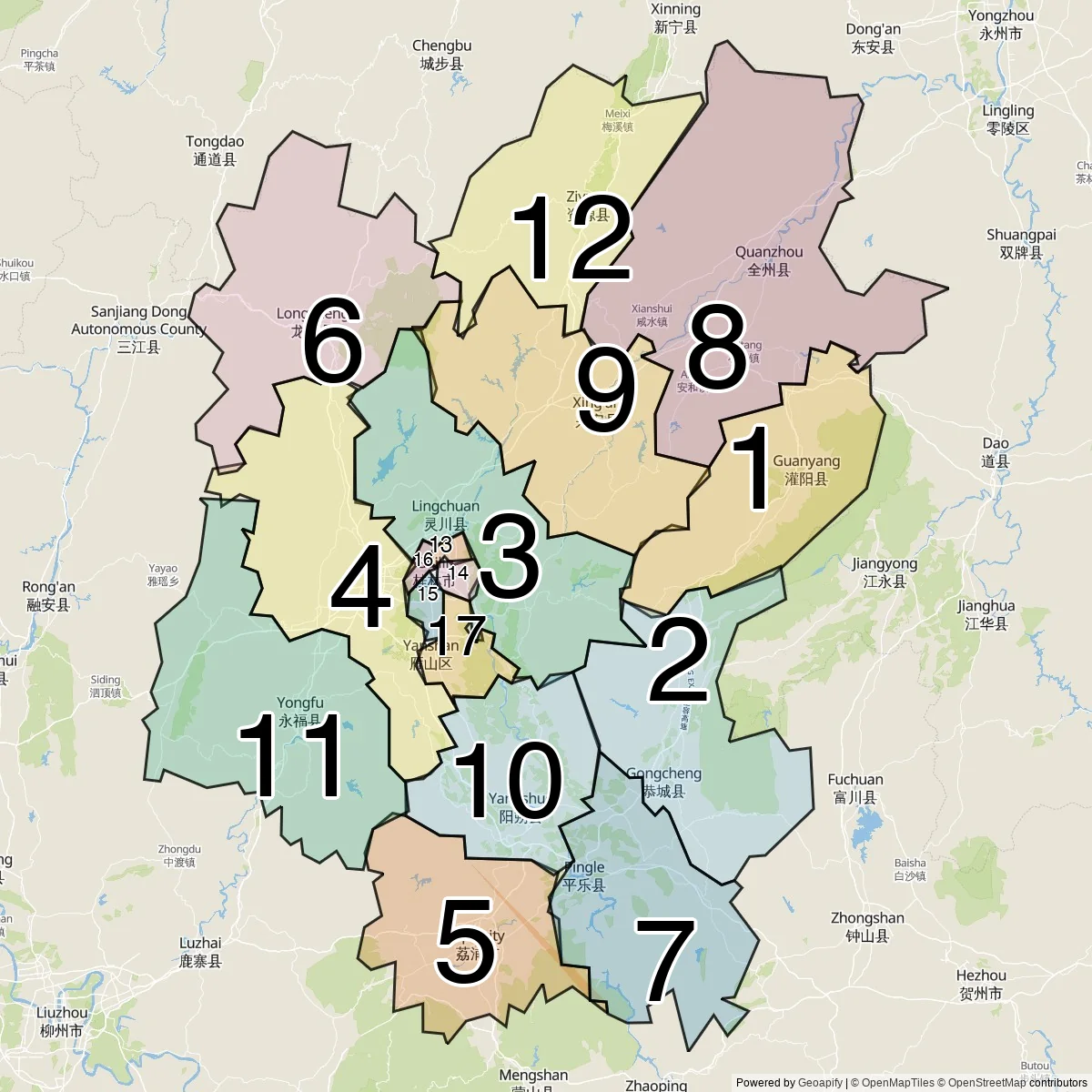
| # | 市辖区/县 |
|---|---|
| 1 | 灌阳县 · Guanyang County |
| 2 | 恭城瑶族自治县 · Gongcheng Yao Autonomous County |
| 3 | 灵川县 · Lingchuan County |
| 4 | 临桂区 · Lingui District |
| 5 | 荔浦市 · Lipu City |
| 6 | 龙胜各族自治县 · Longsheng |
| 7 | 平乐县 · Pingle County |
| 8 | 全州县 · Quanzhou County |
| 9 | 兴安县 · Xing’an County |
| 10 | 阳朔县 · Yangshuo County |
| 11 | 永福县 · Yongfu County |
| 12 | 资源县 · Ziyuan County |
| 13 | 叠彩区 · Diecai District |
| 14 | 七星区 · Qixing District |
| 15 | 象山区 · Xiangshan District |
| 16 | 秀峰区 · Xiufeng District |
| 17 | 雁山区 · Yanshan District |
Guilin at a Glance: Essential Facts for Travelers
| Location | Northeast Guangxi Zhuang Autonomous Region, Southern China |
|---|---|
| Coordinates | 25.2736°N, 110.2900°E |
| Population | ~770,000 (urban core, 2024); prefecture-level city ~4.93 million |
| Area | 27,809 km² (prefecture); 565 km² (urban core) |
| Elevation | ~150 m (city); surrounding karst peaks 200–600 m |
| Time Zone | China Standard Time (CST, UTC+8 — no daylight saving) |
| Calling Code | +86 (city code 0773) |
| Currency | Chinese Yuan Renminbi (CNY ¥) |
| Languages | Mandarin Chinese (official); Guilinhua (the local Mandarin variant); Zhuang spoken by the local Zhuang ethnic minority |
| Climate | Humid subtropical — hot humid summers, mild cool winters; rainy season April–August |
| Founded | Settlement dating to Qin Dynasty (~214 BCE); city of Guilin proper from Sui Dynasty |
| Famous For | Li River karst landscape (on Chinese 20-yuan banknote), Yangshuo, Longji rice terraces, Guilin rice noodles, classical “best landscape under heaven” |
Upcoming Events in Guilin
| Date | Title | Details |
|---|---|---|
| 2026-09-15 to 2026-10-31 | Osmanthus Blossom Season in Guilin | Guilin takes its name from the osmanthus, or gui, trees that fill the city, and each autumn these sweet-osmanthus blossoms open, perfuming the streets, parks and riverbanks with their unmistakable fragrance. From September into October the tiny golden-yellow flowers appear across the city, and locals gather them to make osmanthus tea, wine and cakes. Strolling through Guilin’s parks during the blossom season is a delight for the senses and entirely free. It is one of the loveliest and most characteristic times to visit this famously scenic city. [Source] |
| 2026-09-25 to 2026-10-25 | Golden Rice Terraces at Longji | The spectacular Longji Rice Terraces, carved into the mountainsides around Longsheng north of Guilin, turn a brilliant gold each autumn as the rice ripens before the harvest. From late September into late October the sculpted terraces glow in the sun, drawing photographers and hikers to viewpoints such as Pingan and Jinkeng. Villages of the Zhuang and Yao ethnic minorities dot the slopes, adding cultural colour to the breathtaking scenery. A ticket is required for the scenic area. The golden-harvest weeks are widely regarded as the most beautiful time to see the terraces. [Source] |
| 2026-09-25 | Mid-Autumn Festival in Guilin | The Mid-Autumn Festival, one of China’s most cherished holidays, falls on 25 September in 2026 and is celebrated warmly in Guilin with mooncakes, lanterns and family gatherings under the full moon. The city’s parks and scenic lakes, including the Two Rivers and Four Lakes, make atmospheric settings for admiring the moon, while public spaces host lantern displays and cultural activities. Many events are free to enjoy, and the mild autumn weather adds to the appeal. For visitors, it is a wonderful chance to experience a traditional Chinese reunion festival amid Guilin’s beautiful scenery. [Source] |
| 2026-10-01 to 2026-10-07 | National Day Golden Week in Guilin | China’s National Day holiday brings one of Guilin’s busiest and most festive weeks, running from 1 to 7 October 2026. The city dresses up with flags and flower displays, the Two Rivers and Four Lakes waterways glow with illuminated night cruises, and scenic spots from Elephant Trunk Hill to the Li River fill with holidaying families from across the country. Most attractions stay open longer, though tickets and hotels sell out well in advance. Expect crowds, colour and a genuinely celebratory atmosphere city-wide. [Source] |
| 2026-10-18 | Double Ninth Festival Hill Climbing | The Double Ninth or Chongyang Festival falls on Sunday 18 October in 2026, and few Chinese cities suit its hill-climbing tradition better than Guilin. Locals mark the day by ascending peaks such as Diecai Hill and Yao Mountain, honouring elders, admiring chrysanthemums and sipping chrysanthemum tea as autumn light falls across the karst landscape. Most city peaks charge modest scenic-area entry fees, while the customs themselves are free to join. A gentle, family-centred festival that rewards visitors with some of the year’s clearest views. [Source] |
| 2026-11-15 | Guilin Marathon 2026 | The Guilin Marathon returns on Sunday 15 November 2026, sending runners through one of the world’s most photogenic race settings. Full-marathon and half-marathon courses wind along the Li River and past karst limestone peaks and landmarks such as Elephant Trunk Hill, making it a bucket-list race for scenery-loving runners. Entry requires advance registration with fees varying by distance, while spectating along the riverside course is free. Late autumn brings cool, comfortable running weather, and the event caps Guilin’s sporting year. [Source] |
City News in Guilin – last 14 days
| Date | Category | Headline | Details |
|---|---|---|---|
| 2026-09-14 | Business | Guilin Tourism shares surge with five limit-ups in six sessions | Shares of Guilin Tourism Corporation, the listed operator of scenic-area attractions in the city, have hit their daily upward limit five times in six trading sessions, with turnover setting records since the company’s listing. The rally has been fuelled by expectations of a bumper Mid-Autumn and National Day travel season. The company has poured cold water on speculation, telling investors its artificial-intelligence concepts are not profitable and that it is not involved in low-altitude economy projects or the Pinglu Canal. [Source] |
| 2026-09-14 | Culture | China-Malaysia cultural exchange event brings Nanyang songs to Guilin | A China-Malaysia people-to-people exchange event, presented under the title Silk Rhythms and ASEAN Harmony with songs that crossed the South Seas, was held in Guilin, China Daily reported. The programme celebrated musical and cultural ties between China and Malaysia, part of a series of humanities exchanges linking Guangxi with Southeast Asian neighbours. Hosting the event underscores Guilin’s growing role as a stage for China-ASEAN cultural diplomacy alongside its fame as a scenic tourist destination. [Source] |
| 2026-09-14 | Education | Guilin school marks 42nd Teachers’ Day with tribute activities | Yuejin Central School in Guilin held themed activities to celebrate China’s 42nd Teachers’ Day, honouring its teaching staff with warm tributes under the motto of warming teachers’ hearts and praising those who nurture the young. Pupils and staff joined celebrations recognising educators’ dedication, part of nationwide Teachers’ Day observances held each September. Reports on the event highlight how schools across the scenic city use the occasion to strengthen respect for the teaching profession and community spirit. [Source] |
| 2026-09-14 | Public safety | Lingui police partner with property firm on community safety model | Public security authorities in Guilin’s Lingui district have joined forces with Vanke Property to build a police-enterprise partnership aimed at safer neighbourhoods, exploring a new model of community security governance. The cooperation combines police work with property-management resources to deliver convenient services for residents and strengthen everyday safety in residential compounds. Officials describe the initiative as a way of extending crime prevention and public service deeper into communities, and it is being watched as a possible template for other districts. [Source] |
| 2026-09-13 | Sports | Gui-BA basketball finals conclude in Guilin | The finals of the Gui-BA, Guangxi’s hugely popular grassroots basketball tournament, wrapped up in Guilin, bringing the region-wide competition to a festive close. Modelled on the village-basketball crazes that have swept China, the tournament pits amateur teams from across the autonomous region against each other in front of enthusiastic crowds. Staging the championship rounds gave Guilin a lively sporting weekend and another chance to pair mass sport with the city’s tourism appeal as spectators travelled in for the deciding games. [Source] |
| 2026-09-08 | Business | Analysis highlights Guilin’s luxury-hotel gap despite world-class scenery | A 36Kr analysis examines what it calls the dimensionality-reduction predicament of Guilin’s hospitality industry: the city boasts world-class mountain-and-river landscapes yet lacks beds from top international luxury hotel brands. The piece argues that the mismatch limits how much value Guilin captures from high-spending travellers, as premium visitors often stay elsewhere or shorten trips. It adds to an ongoing debate about upgrading tourism infrastructure in the city as China pushes tourism as a new engine of growth. [Source] |
| 2026-09-08 | Local affairs | Ruddy shelducks spotted at Seven Star scenic area in ecological boost | Ruddy shelducks have been observed visiting the Seven Star scenic area in Guilin, a sighting celebrated by forestry authorities as another sign of the health of the city’s waters and wetlands. The colourful migratory ducks act as informal ecological examiners, since their presence points to clean habitats and abundant food. Officials say improving water quality along Guilin’s rivers and lakes is drawing more birdlife to urban scenic spots, adding a wildlife-watching bonus for visitors to the famous karst landscape. [Source] |
Guilin Events & City News Archive
Sources: Guilin Municipality, Longsheng County, China Highlights, Ahotu, World Athletics, Eastmoney, China Daily, Sina Finance
Weather Forecast for the Next 14 Days in Guilin
| Date | Weather | Max °F | Min °F | Rain mm |
|---|---|---|---|---|
| 2026-09-14 | ⛅ | 90.5 °F | 75.6 °F | 0.0 mm |
| 2026-09-15 | 🌧️ | 92.2 °F | 74.2 °F | 0.2 mm |
| 2026-09-16 | 🌧️ | 87.4 °F | 75.4 °F | 0.6 mm |
| 2026-09-17 | 🌧️ | 88.1 °F | 73.9 °F | 7.4 mm |
| 2026-09-18 | ☁️ | 91.9 °F | 72.2 °F | 0.0 mm |
| 2026-09-19 | ☁️ | 91.9 °F | 75.6 °F | 0.0 mm |
| 2026-09-20 | ☀️ | 93.5 °F | 75.8 °F | 0.0 mm |
| 2026-09-21 | ⛅ | 93.6 °F | 78.1 °F | 0.0 mm |
| 2026-09-22 | ⛅ | 94.4 °F | 78.5 °F | 0.0 mm |
| 2026-09-23 | ⛅ | 94.6 °F | 77.5 °F | 0.0 mm |
| 2026-09-24 | ⛅ | 93.2 °F | 76.3 °F | 0.0 mm |
| 2026-09-25 | ☀️ | 92.3 °F | 76.3 °F | 0.0 mm |
| 2026-09-26 | ⛅ | 93.7 °F | 74.4 °F | 0.0 mm |
| 2026-09-27 | ☁️ | 94.9 °F | 76.2 °F | 0.0 mm |
Guilin’s History
The Guilin area’s continuous occupation dates to the Qin Dynasty (221–206 BCE), when Emperor Qin Shi Huang sent troops south to incorporate the region into the unified Chinese empire. The defining infrastructure of that early period — the Lingqu Canal, completed 214 BCE — connected the Xiang River (flowing north to the Yangtze) with the Li River (flowing south to the Pearl River) through a 36-kilometer engineered watercourse, making it possible to ship grain and troops from central China to Guangxi. The canal remains operational today and is recognized as one of the world’s oldest functional canal systems.
Guilin proper was established as Shi’an County in the Tang Dynasty (618–907) and renamed Guilin (“Forest of Sweet Osmanthus”) in the Ming Dynasty when osmanthus trees, planted throughout the city since Tang times, were declared the city’s signature flora. The Tang and Song dynasties (618–1279) were Guilin’s classical literary peak — the city served as a place of “honorable exile” for officials who fell from imperial favor. The Tang poet Han Yu wrote of the landscape; the Song-dynasty poet Wang Zhengong coined the phrase “Guilin’s landscape is the best under heaven” that became the city’s eternal slogan. The famous Sun Yat-sen-era artist Xu Beihong based much of his ink-and-brush work on the Guilin karst.
The city served as the capital of Guangxi Province from 1664 to 1936 under the Qing dynasty and into the Republican era. The 20th century brought significant disruption: heavy Japanese bombing during the Second Sino-Japanese War (1937–1945) destroyed much of the historic urban fabric; the wartime Battle of Guilin (1944) was one of the deadliest sieges in central China. The People’s Republic of China moved Guangxi’s capital to Nanning in 1958 and redesignated the broader province as the Guangxi Zhuang Autonomous Region in recognition of its largest ethnic minority. Guilin’s modern destiny became tourism.
From the 1970s onward, Guilin was opened to foreign visitors — one of China’s first openings during the Mao-era — and the 1980s and 1990s brought rapid infrastructure development. The Liangjiang International Airport (1996) and the Guilin North High-Speed Rail Station (Guiguang HSR, 2014, connecting Guangzhou to Guiyang) transformed accessibility. Tourism peaked at over 100 million annual visitors by 2018, primarily domestic Chinese — and the city has struggled with overtourism management since.
Geography, Climate & Best Time to Visit Guilin
Geographic Setting
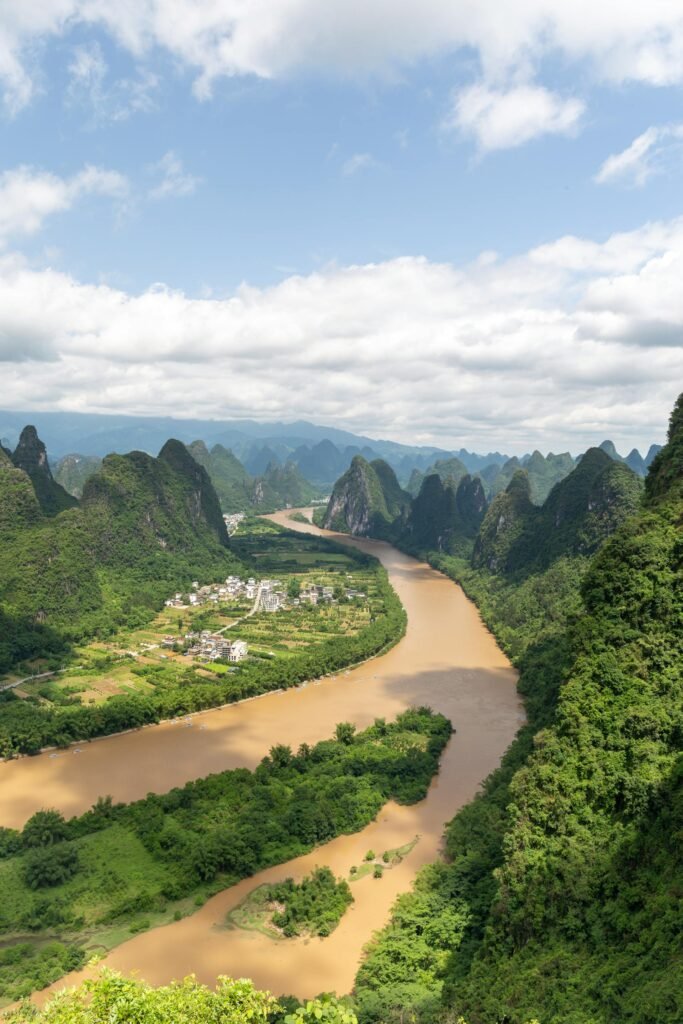
Guilin lies in the northern part of Guangxi Zhuang Autonomous Region, along the upper reaches of the Li River (Lijiang). The defining geological feature is the dense tower karst landscape — limestone formations that began as a marine seabed 300 million years ago and have eroded through 70 million years of subtropical chemical weathering into the dramatic vertical peaks and conical hills that define every Chinese postcard of southern China. The karst extends roughly 80 kilometers along the Li River downstream toward Yangshuo, the most-visited single karst-landscape destination in China.
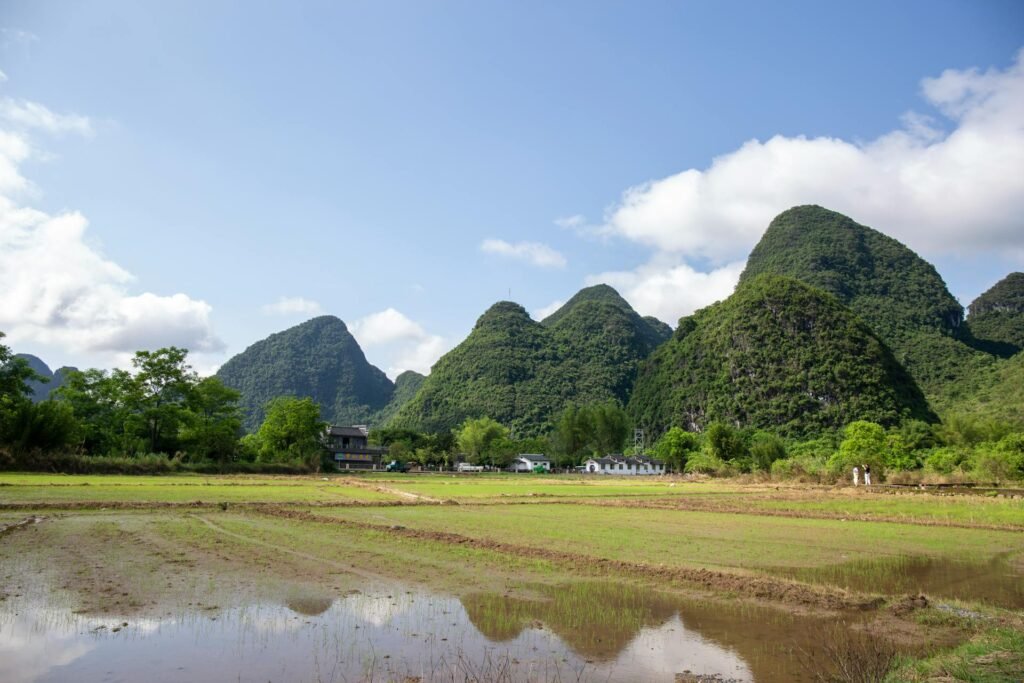
The city itself sits on the relatively flat alluvial plain between the karst peaks. Central Guilin has its own urban-scaled karst — Elephant Trunk Hill (Xiangbi Shan), Folded Brocade Hill, Solitary Beauty Peak, and Yueliang Shan (Moon Hill) rise directly from the city streets. The broader Lijiang River system provides the cruise corridor; the surrounding Longsheng County and Ziyuan County contain the famous Longji Rice Terraces and other dramatic mountain landscapes.
Climate Overview
Guilin has a humid subtropical climate (Köppen Cfa) influenced by its monsoon position. Spring (March–May): mild and wet, with frequent rain and morning mists — atmospheric for landscape photography, occasional for cruise cancellations. Summer (June–August): hot (28–34 °C) and very humid (often 85%+), with sustained rainy periods; the Li River runs high and the karst landscape is at its most lush. Autumn (September–November): the year’s most pleasant stretch — sunny, cool, low humidity, clear visibility. Winter (December–February): cool (5–14 °C), often drizzly, occasional fog; some years see brief snow on the surrounding mountains.
Best Time to Visit
April to May and September to November are the genuinely ideal windows. April–May: the karst landscape is at its most vibrant green, the Li River runs high enough for full cruises, the Longji rice terraces are at their freshly planted reflective-water best. September–November: cooler temperatures, clearer skies, the rice terraces shift to golden harvest colors, the surrounding maple forests redden. June–August: very hot and humid, with occasional cruise cancellations during heavy summer storms; the cheapest hotel rates compensate. December–February: cool, sometimes raw, with reduced cruise schedules and occasionally low water levels (cruises may switch to shorter routes); the surrounding hills are spectacular in winter mist but visibility for photography is unreliable. Chinese New Year (Lunar New Year, late January or early February): the city is busiest with domestic tourism — book months ahead and accept the crowds, or avoid entirely.
Guilin’s Districts & Neighborhoods
Central Guilin (Xiufeng & Xiangshan Districts)
The core city around the Li River downtown waterfront. Solitary Beauty Peak (Duxiu Feng) at the center; Elephant Trunk Hill on the riverside; the Two Rivers Four Lakes (Liangjiang Sihu) scenic walking and boat circuit through the historic moats. The pedestrian Zhengyang Walking Street is the main commercial and tourist artery; the Sun and Moon Twin Pagodas (Riyue Shuangta) on Shanhu Lake are the most-photographed nighttime image.
Qixing District
The eastern side of the Li River containing the Seven Star Park (the largest urban park in the city, with a network of seven karst peaks resembling the Big Dipper constellation), Reed Flute Cave (one of the world’s most spectacular illuminated cave systems), and the Guilin Zoo.
Diecai District
The northeastern district with Folded Brocade Hill (Diecai Shan) and the Mulong Lake area — quieter residential neighborhoods, useful for budget travelers.
Yangshuo County (70 km south of Guilin City)
Technically a separate county, but functionally Guilin’s most-visited “neighborhood.” Yangshuo town is a small (but crowded) tourist town at the southern end of the Li River cruise — pedestrian-only West Street (Xi Jie) with Western-style cafés, the country’s most concentrated rock climbing scene, bamboo-rafting on the Yulong River, the Impression Liu Sanjie outdoor light-and-music show (directed by Zhang Yimou), and the surrounding 20 km of karst countryside best explored by rental bicycle or scooter. Most visitors should plan at least 1 night in Yangshuo.
Longsheng County (Longji Rice Terraces)
2 hours north of Guilin by road — the Dragon’s Backbone (Longji) Rice Terraces, a 1,500-year-old engineered hillside agricultural system spread across multiple villages: Ping’an (the most accessible, Zhuang ethnic village), Tiantou Zhai / Jinkeng (Yao ethnic village, more spectacular terraces), Dazhai. Day trips are feasible but rushed; an overnight in a village guesthouse is the better experience.
Other County Destinations
Xing’an County for the historic Lingqu Canal; Ziyuan County for the dramatic Bajiao Stockade and Zi River rafting; Gongcheng Yao Autonomous County for traditional Yao villages.
Top Things to Do in Guilin
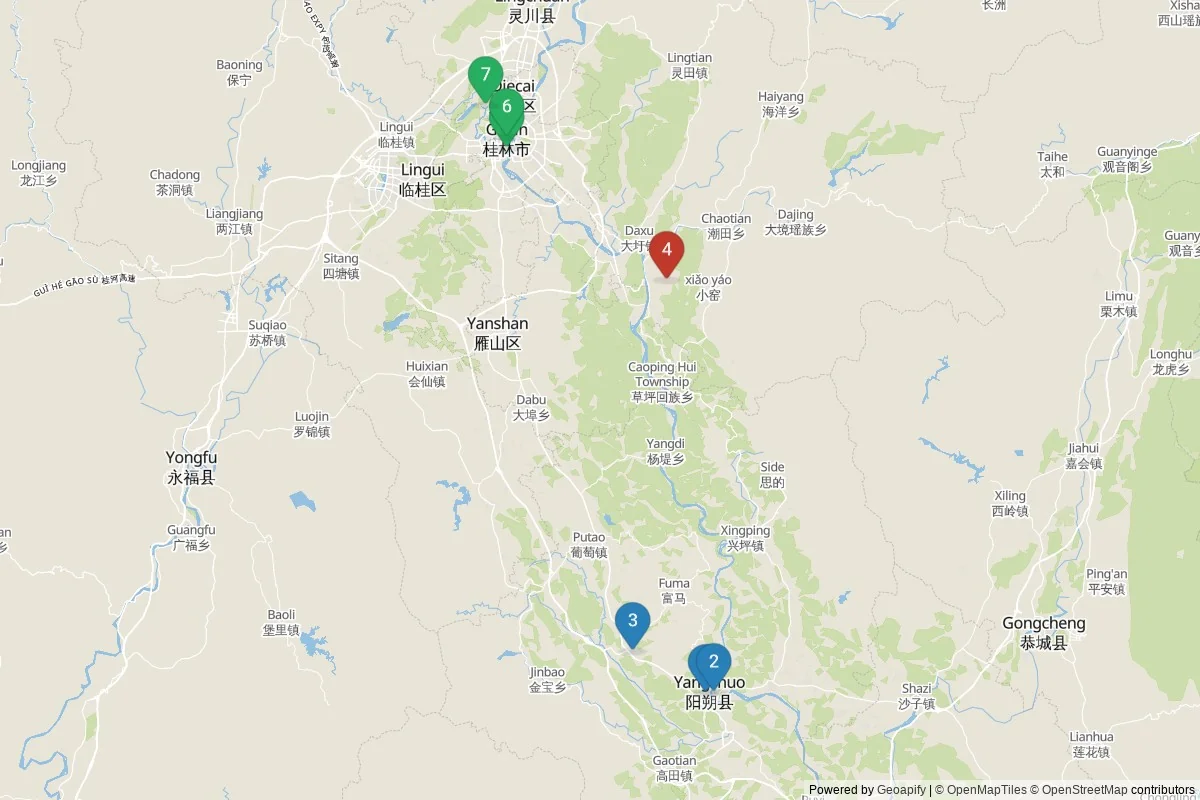
| # | Sight | Cluster | Type | Time | Entry | Best |
|---|---|---|---|---|---|---|
| 1 | Bike the Yangshuo Countryside | Central | Cycling tour | ~4 hrs | ¥30/day | Morning |
| 2 | Yangshuo Town & West Street | Central | Riverside town | Half day | Free | Evening |
| 3 | Yulong River Bamboo Rafting | Central | Bamboo raft | ~2 hrs | ¥250 | Afternoon |
| 4 | Li River Cruise to Yangshuo | Outer | River cruise | ~5 hrs | ¥215 | Morning |
| 5 | Elephant Trunk Hill | Far | Iconic landmark | ~1 hr | ¥30 | Morning |
| 6 | Two Rivers and Four Lakes | Far | Scenic waterway | ~2 hrs | ¥190 boat | Evening |
| 7 | Reed Flute Cave | Far | Karst cave | ~1.5 hrs | ¥90 | Morning |
| 🚗 | Day Trip: Longji Rice Terraces | Day trip | Terraced landscape | Full day | ¥100 | Morning |
1. Li River Cruise from Guilin to Yangshuo
The defining Guilin experience. The 80 km cruise on the Li River takes 4–4.5 hours aboard a flat-bottomed tourist boat, passing through the most-photographed karst landscape in China. The boat passes Yellow Cloth Beach (the precise view on the 20 yuan banknote), Nine Horse Fresco Hill (the famous karst formation said to resemble nine horses), and dozens of other named peaks. Cruise ticket ¥215–270 (~US$30–37); arranged through hotels or via the official cruise terminal at Mopanshan or Zhujiang. For travelers on tighter budgets: the bamboo-raft cruise on the upper Yulong River from Yangshuo is the cheaper, shorter alternative — different scenery but equally beautiful.
2. Explore Yangshuo & West Street
The small tourist town at the cruise’s downstream terminus. West Street (Xi Jie) is the central pedestrian-only commercial spine — 1,400-year-old narrow stone street lined with cafés, bars, restaurants, and souvenir shops. Hire bicycles (¥30–60/day) to explore the surrounding countryside on the network of small farm paths; the Yulong River Bamboo Rafting route is the most accessible scenic outing.
3. Watch the “Impression Liu Sanjie” Outdoor Show
Directed by famed Chinese filmmaker Zhang Yimou (also responsible for the 2008 Beijing Olympics opening ceremony), this nightly outdoor performance uses the Li River as a stage and the surrounding karst peaks as the natural backdrop. Over 600 performers across 12 karst-spanning floating platforms; the show tells the legend of the Zhuang ethnic minority’s folk-singer heroine Liu Sanjie through music, light, and choreographed boat formations. Tickets ¥210–680 depending on seat; runs 70 minutes; in Yangshuo. The most spectacular tourist show in southern China.
4. Visit the Longji Rice Terraces
The 1,500-year-old Dragon’s Backbone Rice Terraces in Longsheng County, 2 hours north of Guilin by road. The Ping’an village (Zhuang ethnic) is the most accessible viewing area; Jinkeng (Tiantou Zhai) in the Yao ethnic village has arguably more dramatic terrace views. Best seasons: early May (the water-filled reflective stage right after planting); late September/early October (the golden harvest). Recommend an overnight at a village guesthouse — sunrise photography from the upper viewpoints is the canonical Longji experience.
5. Reed Flute Cave (Ludi Yan)
The 240-meter-long limestone cave on the northwestern outskirts of central Guilin, named for the reed plant that grew at its mouth. The interior — illuminated with colored floodlights — contains spectacular stalactites and stalagmites that have inspired poetry inscriptions for over 1,200 years. Less crowded in early morning. Entry ¥120 (~US$17).
6. Climb Solitary Beauty Peak (Duxiu Feng)
The single karst peak rising 152 m directly from central Guilin — the city’s defining urban-scale landmark. Inside the former Ming dynasty Prince’s Palace grounds at the foot of the peak; the climb has 306 stone steps and rewards with 360° views of the city’s karst skyline. Entry ¥120 (combined with the Ming Palace grounds and Guangxi Normal University old buildings — the most architecturally significant cluster in Guilin).
7. Visit Elephant Trunk Hill (Xiangbi Shan)
The city’s signature single rock formation — a karst peak with a natural arch resembling an elephant drinking from the river. The most-photographed image of Guilin proper. Park entry ¥75–100 (the elephant view is also visible from the public Binjiang Road without paying). Best at sunset.
8. Bike or Bamboo-Raft the Yulong River Valley
The smaller, slower river upstream from Yangshuo — the most accessible scenery for self-guided exploration. Rent a bike (¥40–60/day) from any West Street rental shop and follow the 20+ kilometers of village paths through bamboo groves, rice paddies, and small farming hamlets. Bamboo rafts on the Yulong (different from the larger Li River boats): 1-hour shared raft ¥80–150 per person, longer routes available.
How to Get to Guilin
By Air
Guilin Liangjiang International Airport (KWL), 28 km southwest of central Guilin. Direct domestic routes to Beijing, Shanghai, Guangzhou, Shenzhen, Chengdu, Xi’an, Kunming, and most major Chinese cities; international routes to Bangkok, Seoul, Singapore, Kuala Lumpur, Taipei, Hong Kong, and seasonal European destinations. Carriers: Air China, China Southern, China Eastern, Hainan Airlines, Spring Airlines, plus regional carriers.
From the airport: Airport bus ¥20 to central Guilin (60–75 minutes); DiDi ¥100–180 (45–60 minutes); taxi ¥120–200; private transfer arranged through hotels ¥250–400.
By High-Speed Rail
The Guiguang High-Speed Railway (opened 2014) makes Guilin highly accessible: Guangzhou-Guilin 2 hours 50 minutes (¥165–280); Shenzhen-Guilin 3.5 hours; Kunming-Guilin 5 hours. The new Guigui High-Speed Rail to Guiyang and onward to Chengdu. Trains arrive at Guilin Beizhan (North Station) or Guilin Xizhan (West Station); Guilin Bei is closer to the city center. Book via the China Railway 12306 official site (some sections only work in Chinese; English versions exist on third-party booking sites for a small premium).
By Long-Distance Bus
The Guilin Long-Distance Bus Station in central Guilin connects to all surrounding cities and Yangshuo (75 minutes, ¥30–50). The bus to Longsheng (Longji rice terraces) takes 2 hours.
Visa Notes
Mainland China requires a visa for most foreign passport holders. The 240-hour visa-free transit policy (expanded December 2024 to 54 nationalities) does not currently cover entry through Guilin airport — Guilin is not on the 60 designated transit-visa ports. Solution: enter China through Beijing, Shanghai, Guangzhou, Shenzhen, or another qualifying port and travel to Guilin internally. For longer stays or direct Guilin entry, apply for a tourist (L) visa via the official China Visa Application Service Center 4–6 weeks before travel. Passport must have at least 6 months remaining validity.
Getting Around Guilin
Walking
Central Guilin is genuinely walkable — the central core is roughly 3 km × 2 km. The Two Rivers Four Lakes walking circuit is purpose-built for pedestrians. Yangshuo’s West Street area is similarly pedestrian-focused.
DiDi (Ride-Hailing)
DiDi is the dominant ride-hailing app in China and works well in Guilin. International credit cards can be linked through the English-language version. Across-city fares ¥15–50; to the airport ¥100–180.
Buses
Guilin’s city buses are clean and inexpensive — ¥2 per ride paid via WeChat Pay / Alipay (cash increasingly rare). Routes connect all major tourist sites. The Guilin–Yangshuo direct bus from the bus station runs every 30 minutes.
Taxis
Metered taxis from ¥10 flagfall; most drivers don’t speak English — have your destination saved in Chinese characters or on Baidu/Amap maps.
Bike-Sharing & Scooter Rental in Yangshuo
In central Guilin: HelloRide and Meituan dockless bikes work via WeChat. In Yangshuo: bike rental ¥30–60/day from any guesthouse or West Street shop; scooter rental ¥80–150/day (requires ID and deposit). The Yulong River and surrounding countryside reward bicycle exploration.
Cruise Boats & Bamboo Rafts
The Li River cruise (¥215–270) is both transit and destination. Bamboo rafts (¥80–200 for shared, ¥300+ for private) operate on the smaller Yulong River from Yangshuo.
Food & Drink in Guilin
Guilin’s cuisine combines Guangxi regional flavors (lighter than Sichuan, sour-and-spicy with characteristic use of pickled chilies), Zhuang ethnic minority traditions, and the broader southern Chinese rice-and-river-fish staples. The signature local dishes are well worth seeking out.
What to Try
- Guilin Rice Noodles (Guilin Mifen) — the city’s defining dish: round rice noodles topped with thinly sliced pickled vegetables, fried peanuts, scallions, chili oil, and a choice of stewed meats (beef, pork, duck) served dry or in broth. ¥10–25 per bowl at any noodle shop. The breakfast standard; eat where the queue is longest.
- Beer Fish (Pijiu Yu) — Yangshuo’s signature dish: a whole carp from the Li River braised with Liquan beer, ginger, scallions, garlic, and chilies in a clay pot. ¥80–150 for a typical fish at any West Street restaurant.
- Oil Tea (Youcha) — the Yao ethnic minority tea ceremony from the Longsheng area: green tea pounded with fried rice, peanuts, and ginger into a savory broth-like drink. Served as part of welcomes in mountain villages.
- Stuffed Lipu Taro (Lipu Niangtaro) — taro stuffed with minced pork and steamed; the regional banquet specialty.
- Bamboo Rice (Zhutong Fan) — glutinous rice steamed inside fresh bamboo segments; flavored by the bamboo’s natural oils.
- Snail Rice Noodles (Luosi Fen) — Liuzhou-area specialty (Guangxi’s larger neighboring city) widely available in Guilin: rice noodles in a pungent fermented-bamboo-shoot broth flavored with river snails. An acquired taste.
- Osmanthus tea, osmanthus wine, osmanthus desserts — Guilin’s namesake flower flavor; the autumn osmanthus blooms throughout the city.
Where to Eat
Guilin Mifen Cheng (multiple branches): the most reliable Guilin Rice Noodles for visitors. Zhengyang Walking Street central Guilin: the tourist-friendly food cluster. Yangshuo West Street: beer fish at any storefront restaurant; the food along the river boardwalk is the same quality at lower prices than West Street itself. Longsheng village guesthouses: home-cooked Yao and Zhuang minority cuisine in mountain villages — often the meal of the trip.
Drinks
Liquan Beer — the local brewery, used in Beer Fish; the regional beer of choice. Osmanthus wine (Guihua jiu) — Guilin’s traditional flavored rice wine, sweet and aromatic. Sanhua wine — high-strength clear spirit, the local hard liquor. Oil tea as covered above. Tea: Guangxi’s Hongcha (black tea) and the surrounding region’s green and pu’er teas are widely consumed.
A Note on Tap Water
Tap water in Guilin is not safe to drink for foreign visitors. Use sealed bottled water (¥2–5 per 1.5-liter bottle at convenience stores) for drinking and brushing teeth. Hotel kettles boil water reliably; Chinese hotel staff routinely refill thermoses with hot water on request. The CDC traveler health page for China recommends bottled or boiled water and standard food precautions. Ice in mid-range and upmarket restaurants is generally safe; avoid ice from street stalls. Travel insurance with medical coverage is recommended.
Frequently Asked Questions About Visiting Guilin
Do I need a visa to visit Guilin?
For most foreign passport holders, yes — Guilin is mainland China and falls under the standard PRC visa regime. Important note: Guilin is not on the list of 60 ports qualifying for the 240-hour visa-free transit policy expanded in December 2024 — direct entry to Guilin from abroad requires a regular tourist (L) visa. Workaround: enter China through a qualifying port (Beijing, Shanghai, Guangzhou, Shenzhen, Chengdu, Xi’an, Kunming, etc.) under the transit visa-free policy and then travel internally to Guilin by high-speed rail or domestic flight. For travelers needing a regular visa: apply at the official China Visa Application Service Center 4–6 weeks before travel; fees $30–185 depending on nationality and visa type; 30-day to 60-day single-entry standard. Passport must have at least 6 months remaining validity. Indian, Russian, Brazilian, and many other passport holders have visa-free or simplified visa arrangements that vary frequently — verify current rules carefully.
Is Guilin safe for tourists?
Guilin is among the safer mainland Chinese cities for foreign visitors, with strong police presence in tourist areas and very low rates of violent crime. The US State Department rates China at “exercise increased caution” — primarily for arbitrary-detention and dual-national risks rather than street-crime concerns. Real risks in Guilin: cruise-boat overcrowding during peak holiday weeks (Chinese New Year, October Golden Week) — Li River cruises sell out and quality varies dramatically; book through reputable operators in advance; tourist-trap scams at Yangshuo’s West Street — overcharging for taxis, fake “famous calligraphy” peddlers; fake Pexels-style tour ticket peddlers outside Reed Flute Cave and other attractions; traffic accidents — bicycle and motorbike rentals in Yangshuo are popular but the surrounding roads have significant truck traffic; monkey encounters in some parks; currency scams at unofficial money changers near the airport (use bank ATMs or official exchange counters); petty pickpocketing in crowded cruise-boarding queues. Political and digital sensitivity: Google, Facebook, Instagram, WhatsApp blocked — download WeChat, DiDi, Amap before crossing the border. Photography of military installations is prohibited. Drug laws: extremely strict — multi-year prison sentences for any quantity. Tap-water-related stomach upset is the most common health complaint.
How many days do I need in Guilin?
Three to four days handles the core Guilin–Yangshuo experience; with Longji rice terraces and surrounding mountain villages, 5–7 days makes a satisfying northern Guangxi trip. A solid 4-day Guilin plan: Day 1 — arrive Guilin, central city walking (Two Rivers Four Lakes circuit, Sun & Moon Pagodas evening) + Guilin rice noodles dinner. Day 2 — Li River cruise to Yangshuo (4–4.5 hours through the karst), arrive Yangshuo afternoon, West Street evening + Impression Liu Sanjie outdoor show. Day 3 — Yangshuo bicycle/scooter day in the Yulong River countryside + bamboo rafting + beer fish dinner + climbing or hiking option. Day 4 — Yangshuo morning + return to Guilin or onward by HSR. Add Days 5–6 for Longji rice terraces overnight (Ping’an or Tiantou Zhai village). 10-day Guangxi classic: Guilin (2 days) + Yangshuo (2 days) + Longji (1 night) + Nanning (2 days) + Beihai coast (2 days). Day-trip Guilin from Guangzhou or Shenzhen: feasible via 3-hour HSR but feels rushed; recommend at least 1 overnight.
What’s the best area to stay in Guilin?
Split between Guilin city and Yangshuo, depending on style. Central Guilin (around the Two Rivers Four Lakes): international hotel chains (Shangri-La, Lijiang Waterfall Hotel, Sheraton Guilin); ¥600–2,500/night (US$83–340); ideal for first-night arrivals before the cruise. Mid-range hotels and boutique guesthouses ¥250–600/night. Yangshuo town: West Street area for nightlife and dining (¥250–900/night for mid-range, ¥1,200–4,000+ for luxury including the iconic Yangshuo Mountain Retreat and Alila Yangshuo). Yangshuo countryside (Yulong River area): boutique retreats among the karst peaks — Yangshuo Tea Cozy, Tea House Hotel — ¥800–2,500/night; quieter, immersive setting. Longji rice terraces: village guesthouses at Ping’an or Tiantou Zhai (Yao village) ¥200–800/night; basic but atmospheric; consider Yangshuo Mountain Retreat’s sister property. Skip: budget hotels far from any tourist site that require taxis to reach restaurants.
How much does it cost to visit Guilin’s major sights?
Guilin is moderately affordable; entry fees are the major variable. Li River cruise (Mopanshan to Yangshuo): ¥215–270 per person; private high-end boats ¥1,000–3,000 per person. Reed Flute Cave: ¥120. Solitary Beauty Peak & Ming Palace: ¥120. Elephant Trunk Hill park: ¥75–100. Seven Star Park: ¥75. Folded Brocade Hill: ¥80. Two Rivers Four Lakes: free walking; evening boat cruise ¥185–235. Longji Rice Terraces entry: ¥80–95 (different gates for Ping’an, Dazhai, etc.). Impression Liu Sanjie outdoor show: ¥210–680 depending on seat. Yangshuo Yulong River bamboo raft: ¥80–200 per person. Local meals: Guilin rice noodles ¥10–25 per bowl; sit-down restaurant lunch ¥40–80 per person; beer fish dinner in Yangshuo ¥80–150 per person (the fish itself is the main expense); mid-range Chinese dinner ¥100–250 per person; international restaurant ¥150–400 per person. DiDi across central Guilin: ¥15–40; airport-to-Guilin city ¥100–180; Guilin city to Yangshuo private car ¥350–500 (or ¥30–50 by bus). Cruise + transfer + Impression show package typically ¥600–900 per person. Overall daily budget: ¥400 (frugal), ¥1,200 (mid-range), ¥4,000+ (luxury).
Should I drink the tap water in Guilin?
No — tap water in Guilin is not safe to drink for foreign visitors. Mainland China’s municipal water systems are treated but distribution-network contamination is common; locals boil before drinking. Always use sealed bottled water (¥2–5 per 1.5-liter bottle at convenience stores; major brands Nongfu Spring, Wahaha, C’estbon) for drinking and brushing teeth. Hotel kettles boil water reliably; Chinese hotel staff will refill thermoses with hot water on request — this is the standard local approach. Reusable filter bottles (LifeStraw, Grayl, Sawyer 0.1-micron) work well in China. Ice in mid-range and upmarket restaurants is generally safe; avoid ice from street stalls. The CDC traveler health page for China recommends bottled or boiled water plus standard food precautions and consideration of hepatitis A and typhoid vaccinations before travel. Travel insurance with medical coverage is essential — foreigners pay full sticker price at Chinese hospitals (which is high), and medevac to a Hong Kong or Singapore hospital can run tens of thousands of dollars.
What payment methods work in Guilin — credit cards or mobile?
Plan for a mostly-cashless trip but with foreign-payment friction. WeChat Pay and Alipay dominate to a degree that surprises Western visitors — restaurants, taxis, attractions, even temple donations expect QR-code payment. Both apps now accept linked international Visa, Mastercard, JCB cards (set up before arrival: “Tour Pass” in Alipay or “Service / Pay” in WeChat). Foreign credit cards (Visa, Mastercard, UnionPay; AmEx less universal): accepted at international hotels, larger restaurants, and museums; rejected at most local restaurants, taxis, and street food. UnionPay is the most widely accepted card brand. Cash (Chinese yuan): bring some for temple donations, small businesses, and emergencies; ATMs (Bank of China, ICBC, China Construction Bank) accept foreign cards with daily withdrawal limits ¥3,000–5,000 and ¥15–25 international fees plus your home bank’s. Currency exchange: airport rates are competitive; many hotel and bank-branch exchange counters offer reasonable rates; bring USD or EUR in clean bills. Tipping: not deeply rooted in Chinese culture and may be politely refused — round up taxi fares; small tips for hotel porters (¥10–20) and tour guides (¥100–300 per day) are appreciated but not strictly required. App download priority before crossing border: WeChat, Alipay, DiDi, Amap (English), Baidu Maps, Trip.com or Ctrip for booking, Pleco offline Chinese dictionary, Google Translate offline pack.
What about the Li River cruise — what should I expect and how do I book?
The Li River cruise is the trip-defining experience and deserves planning. Standard 4-hour cruise from Guilin Mopanshan Wharf to Yangshuo: ¥215–270 per person on a large 200-passenger boat; departures typically 9:00 am or 9:30 am; arrival in Yangshuo around 1:30 pm. What to expect: shared seating, multilingual audio commentary, included lunch on the boat (basic Chinese set menu), bathroom facilities, observation deck. Quality varies — premium boats have nicer interiors and better food; budget boats are crowded and the food is uninspiring. Booking: through your Guilin hotel concierge (most reliable, includes hotel transfer), through travel agents in central Guilin, or through online platforms like Trip.com / Ctrip. Avoid street touts near the central tourist area — many sell low-quality unauthorized tours. Premium alternatives: small-group boats (¥600–1,500 per person, 30–60 passengers), private boats (¥2,000–8,000 per boat for full charter), or the Guilin-side Crown Cave shorter cruise (¥100–180, less impressive but cheaper). Low water cruise (winter / dry season): cruises run from Yangti Wharf (not Mopanshan) and use smaller boats; the route is shorter and less dramatic but still beautiful. Bamboo raft alternative: not on the main Li River but on the Yulong River from Yangshuo — different scenery, much cheaper (¥80–200), 1–3 hours; recommended in addition to (not instead of) the main cruise. One-way structure: cruise from Guilin terminates in Yangshuo — return to Guilin by 75-minute shuttle bus (¥40–60) or stay overnight in Yangshuo (the recommended approach).
Education & Notable People
Guilin is the educational anchor of northern Guangxi, with Guangxi Normal University as the regional flagship institution.
Major Universities
- Guangxi Normal University (GXNU) — Guilin’s flagship public university, founded 1932; ~32,000 students; particularly strong in education, foreign-language teaching, and ethnic-minority studies; central campus at the historic former Ming Prince’s Palace grounds beneath Solitary Beauty Peak.
- Guilin University of Technology — technical-and-engineering focus.
- Guilin Medical University — regional medical training.
- Guilin University of Electronic Technology — electronics and information engineering.
Notable People & Cultural Figures
Liu Sanjie — the legendary Zhuang ethnic folk singer whose stories form the basis of countless songs, poems, and the famous outdoor light show. Yu Yue (1821–1907) — celebrated Qing-dynasty scholar and historian, native of the broader Guangxi region. Bai Chongxi (1893–1966) — Republican-era general from Guilin, played a major role in the Northern Expedition and the Sino-Japanese War. Xu Beihong (1895–1953) — celebrated modern Chinese painter, although born in Jiangsu, did extensive landscape painting based on Guilin and Yangshuo; his depictions defined modern Chinese visualization of southern landscape. Zhang Yimou — although not from Guilin, the celebrated film director’s “Impression Liu Sanjie” outdoor performance in Yangshuo has shaped the city’s modern cultural identity. Liang Yusheng — celebrated Chinese martial-arts novelist (Hong Kong era), native of broader Guangxi.
Sister Cities & International Relations
Guilin’s sister-city network reflects the city’s identity as a tourism and cultural-heritage destination. The relationships emphasize tourism cooperation, university exchange, and cultural diplomacy.
Guilin’s sister and partnership cities include (selection):
- Hastings, New Zealand — paired since 1981; long-running tourism-and-fruit-industry friendship.
- Kumamoto, Japan — friendship city since 1979; landscape-tourism partnership.
- Orlando, Florida, USA — sister city since 1990; tourism-industry cooperation.
- Toulouse, France — paired since 2006.
- Jeju City, South Korea — UNESCO-natural-heritage and tourism partnership.
- Hagi, Japan — friendship city.
- Sanya, China — domestic tourism-twinning relationship.
- Manila, Philippines — ASEAN regional partnership.
Guilin plays a leading role in the regional Pan-Pearl River Delta economic-development framework and benefits from increased connectivity through China’s Belt and Road Initiative investments in the broader Guangxi Zhuang Autonomous Region. The Guangxi Tourism Office coordinates the region’s international promotion. The city has been a UNESCO partner site through the broader South China Karst World Heritage framework, which protects sites including Guilin’s karst and related landscapes across Guangxi, Guizhou, and Yunnan provinces.
AFRIKA
Cairo Hurghada Johannesburg Marrakech
ASIA
Abu Dhabi Agra Antalya Bangkok Batam Beijing Bengaluru Cebu City Chiang Mai Chiba Chennai Da Nang Dammam Delhi Denpasar Dubai Fukuoka Guangzhou Guilin Ha Long Hanoi Ho Chi Minh City Jakarta Jaipur Johor Bahru Kolkata Krabi Kuala Lumpur Kyoto Macau Mecca Medina Mugla Mumbai Osaka Pattaya Penang Phuket Riyadh Seoul Shanghai Shenzhen Singapore Taipei Tokyo Zhuhai
EUROPE
Amsterdam Athens Barcelona Berlin Brussels Budapest Copenhagen Dublin Florence Frankfurt am Main Heraklion Krakow Lisbon London Madrid Milan Munich Nice Paris Porto Prague Rhodes Rome Stockholm Venice Vienna Warsaw
NORTH AMERICA
Cancun Las Vegas Los Angeles Miami New York City Orlando San Francisco Toronto Vancouver
SOUTH AMERICA
Buenos Aires Lima Rio De Janeiro
OCEANIA
Auckland Honolulu Melbourne Sydney