
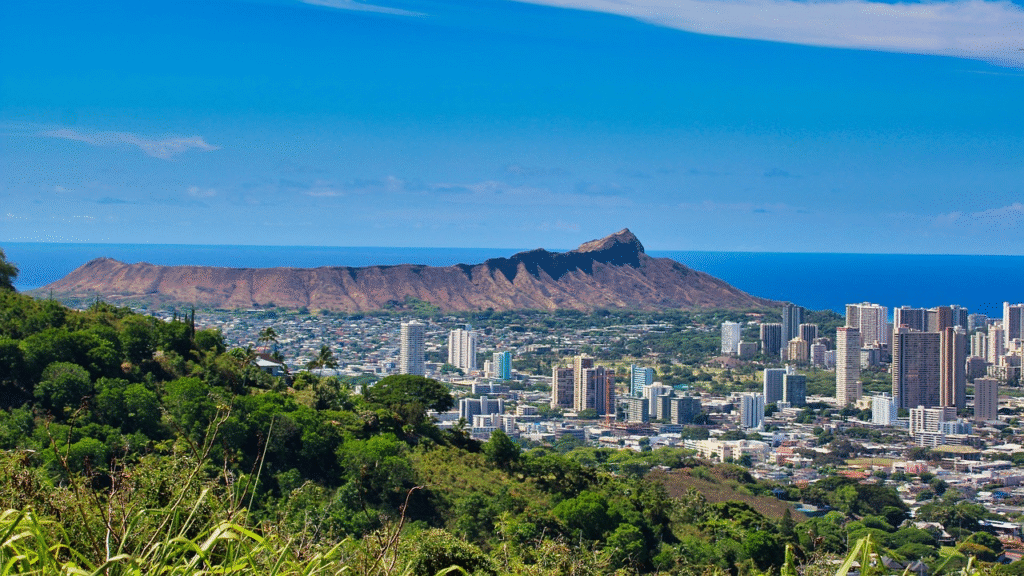
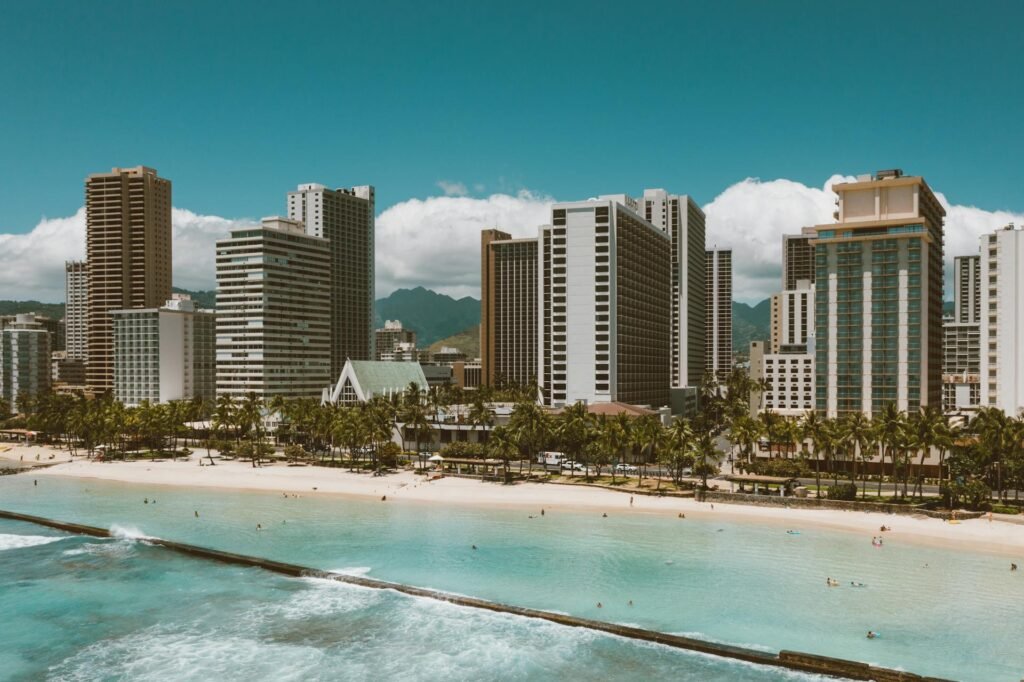
Photo credit: Honolulu skyline with Diamond Head and Waikiki
Honolulu — Hawaiian for “sheltered harbor” — is the capital of the 50th U.S. state, the largest city in the world’s most-isolated archipelago, and a place where Polynesian deep history, American military memory, and Pacific-Rim tourism continue to collide in equal parts. On the southern coast of Oʻahu, Honolulu spans from the cratered profile of Diamond Head east to the Waikiki Beach resort strip, through the high-rise downtown business district and the Native Hawaiian heritage core around ʻIolani Palace (the only royal residence on American soil), past Chinatown‘s 19th-century arcades, and out to the still-operational Pearl Harbor naval base where the December 1941 attack reshaped the world. The Aloha State’s Aloha Spirit — codified in Hawaii state law since 1986 — is the genuine cultural project: a sustained effort to keep Native Hawaiian language, hula, music, food, and ʻāina (land) ethics alive in the face of relentless tourism pressure (10+ million visitors annually). Visit with respect for the place’s complexity, and Honolulu rewards beyond any beach-postcard cliché.
Honolulu by District: The 8 Neighborhoods
Honolulu is divided into 8 neighborhoods. The map below shows their official OSM boundaries, colour-coded to match the table — a quick way to orient yourself before zooming in on individual sights.
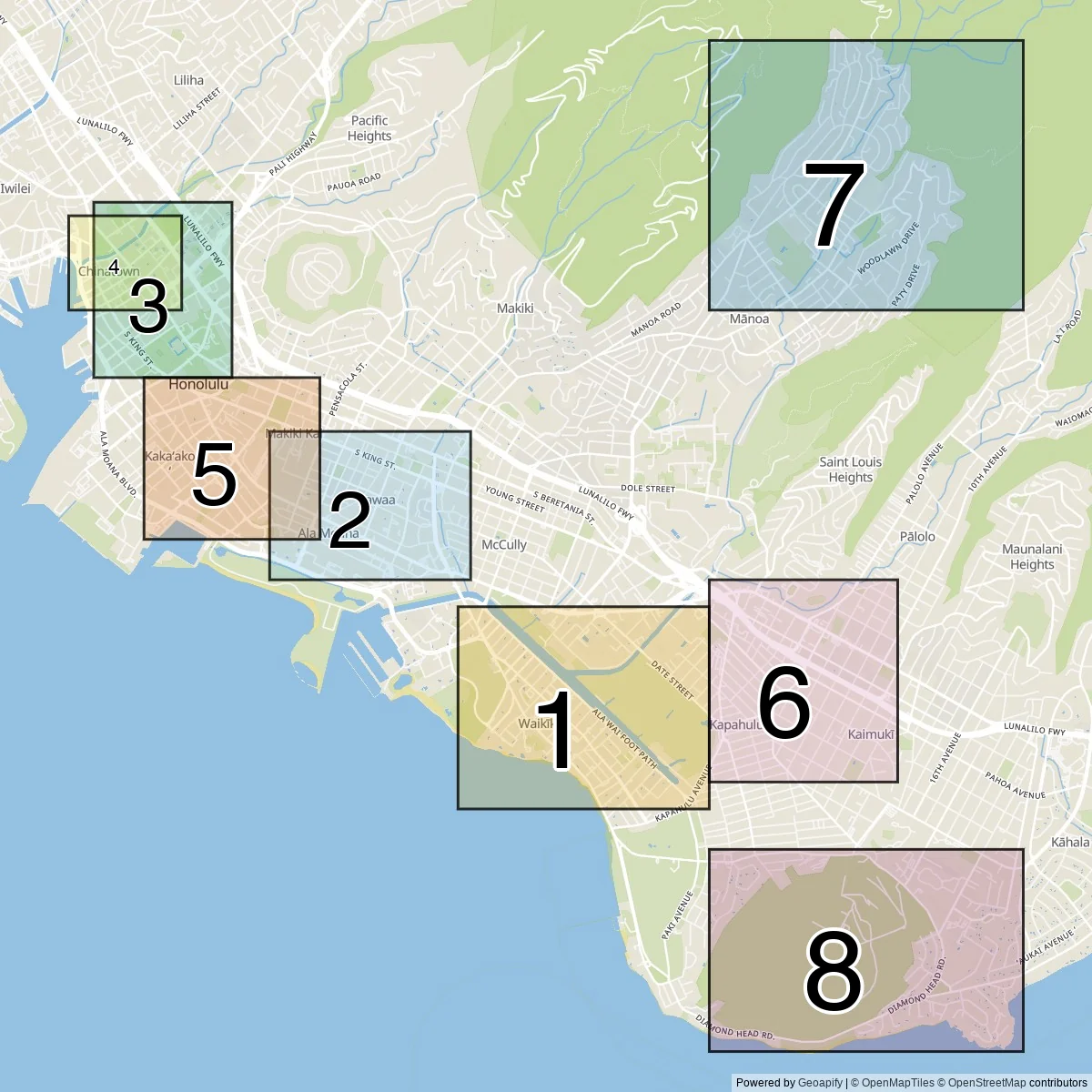
| # | Neighborhoods |
|---|---|
| 1 | Waikīkī · Waikiki |
| 2 | Ala Moana |
| 3 | Downtown |
| 4 | Chinatown |
| 5 | Kakaʻako · Kakaako |
| 6 | Kapahulu |
| 7 | Mānoa · Manoa |
| 8 | Diamond Head |
Honolulu at a Glance: Essential Facts for Travelers
| Location | South shore of Oʻahu, Hawaiian Islands, USA (central Pacific) |
|---|---|
| Coordinates | 21.3099°N, 157.8581°W |
| Population | ~343,000 (city, 2024); Honolulu County (entire Oʻahu) ~995,000 |
| Area | 177 km² (city proper); 1,545 km² (Honolulu County / Oʻahu) |
| Elevation | Sea level to 1,224 m (Mount Kaʻala on Oʻahu) |
| Time Zone | Hawaii–Aleutian Standard Time (HAST, UTC−10 — no daylight saving) |
| Calling Code | +1 (area code 808) |
| Currency | US Dollar (USD $) |
| Languages | English (de facto); Hawaiian (official, co-equal with English under state constitution); Pidgin (Hawaiʻi Creole English) widely spoken locally; significant Japanese, Tagalog, Korean, Mandarin communities |
| Climate | Tropical (Köppen As); year-round mild — warm sunny days, cool trade-wind evenings; rainy season November–March |
| US State | Hawaii (50th state, admitted August 21, 1959) |
| Famous For | Waikiki Beach, Diamond Head, Pearl Harbor / USS Arizona Memorial, ʻIolani Palace, Hawaiian culture, surfing origins, plate-lunch cuisine, North Shore big waves |
Upcoming Events in Honolulu
| Date | Title | Details |
|---|---|---|
| 2026-09-12 to 2026-09-26 | Aloha Festivals | Aloha Festivals is Hawaii’s largest cultural celebration, filling September with events across Oahu that honor Hawaiian music, dance and heritage. Highlights include the royal court investiture, the vibrant Waikiki Hoolaulea street party with food booths and live entertainment, and the colorful Floral Parade of pau riders, marching bands and floats down Kalakaua Avenue. Most public events are free and family-friendly. Now decades old, the festival is a beloved showcase of the islands’ host culture and a joyful way for visitors to experience local traditions. [Source] |
| 2026-09-27 | Kahuli Celebration Day at Bishop Museum | Bishop Museum dedicates a festive day to the kahuli, Hawaii’s beloved and endangered native tree snails, with live music, hula, puppetry and educational presentations in the historic Hawaiian Hall from 10:00 to 14:00. The family-friendly programme mixes culture and conservation, giving keiki a playful introduction to one of the islands’ rarest creatures while researchers share how they are being saved. Regular museum admission applies and prices vary; the event activities are included with entry to the Kalihi campus. [Source] |
| 2026-10-04 | A Taste of Ireland at the Hawaii Theatre | The touring Irish music and dance spectacular A Taste of Ireland stops at the Hawaii Theatre Center on 4 October. The production pairs championship-level Irish step dancing with live folk music, weaving traditional tunes and modern twists into a fast-moving stage show. It plays inside one of downtown Honolulu’s architectural gems, the ornate historic theatre on Bethel Street known as the Pride of the Pacific. Ticket prices vary by seating section; the show suits families as well as dance and music fans. [Source] |
| 2026-10-17 | Honolulu Pride Parade and Festival | Honolulu Pride brings a colorful parade and festival to Waikiki each October, celebrating the islands’ LGBTQ community with marchers, floats, music and family-friendly activities. The parade winds down Kalakaua Avenue to Kapiolani Park, where a festival features entertainment stages, food vendors and community booths. Free to attend and open to all, it draws thousands in a spirited display of aloha and inclusion. Organized by the Hawaii LGBT Legacy Foundation, it is one of the island’s largest annual gatherings of its kind. [Source] |
| 2026-10-22 to 2026-10-31 | Hawaii Food & Wine Festival | The Hawaii Food & Wine Festival is the islands’ premier culinary event, bringing world-renowned chefs, winemakers and mixologists together for tasting events across Oahu and neighbor islands in late October. Signature dinners and grand tastings spotlight local farmers, fishers and Hawaii Regional Cuisine, pairing island ingredients with global talent. Events are ticketed and range from casual to black-tie, with proceeds supporting culinary education and sustainability. It is a marquee date for food lovers and a showcase of Hawaii’s farm-to-table movement. [Source] |
| 2026-10-24 | Paula Poundstone at the Hawaii Theatre | Veteran stand-up comedian Paula Poundstone brings her sharp observational humour to the Hawaii Theatre Center on 24 October. Known for decades of touring, her spontaneous crowd work and her long-running role as a panellist on NPR’s news quiz Wait Wait… Don’t Tell Me!, Poundstone builds much of each show from unscripted conversations with the audience, so no two nights are alike. Ticket prices vary by section. An evening aimed at grown-up comedy fans in the historic downtown venue. [Source] |
City News in Honolulu – last 14 days
| Date | Category | Headline | Details |
|---|---|---|---|
| 2026-09-14 | Public transport | State leaders to study transit-oriented development elsewhere | State leaders want to gather ideas for better transit-oriented development in Hawaii by visiting other states and countries next month, at a cost of up to 300,000 dollars. The trips are intended to show how rail corridors elsewhere anchor housing and commercial growth, lessons with obvious relevance for the neighbourhoods along Honolulu’s Skyline rail line. The price tag has already drawn scrutiny, with critics asking whether the travel will translate into concrete policy at home. [Source] |
| 2026-09-14 | Local government | Audit faults city’s use of 386 million dollars in COVID relief | The City and County of Honolulu’s use of more than 386 million dollars in federal COVID-19 relief funding failed to deliver the broader community and economic recovery benefits originally envisioned, according to a report from the Office of the City Auditor. The finding lands years after the money was spent and will feed debate about how the city plans, tracks and reports on large infusions of federal cash when the next emergency or windfall arrives. [Source] |
| 2026-09-14 | Local government | Delegation urges swift approval of hurricane disaster declarations | Hawaii’s congressional delegation is urging President Trump to quickly approve Governor Josh Green’s requests for federal disaster declarations following Hurricanes Lowell and Lala, saying the back-to-back storms and other recent disasters have exceeded the capacity of state and county governments. Federal approval would unlock assistance for affected households and public infrastructure repairs, and the delegation argues that delays would compound the strain on communities still cleaning up. [Source] |
| 2026-09-14 | Local affairs | Sea Life Park begins transformation under Hawaiian ownership | The transformation of Sea Life Park under Hawaiian ownership has begun, the Star-Advertiser reports. The marine attraction beneath the Makapuu cliffs on Oahu’s windward side is one of the island’s longest-running visitor destinations, and the change of stewardship opens a new chapter for the decades-old park. The renewal is being watched closely as a test of how legacy attractions can be updated while giving Hawaiian culture and marine conservation a more central role. [Source] |
| 2026-09-14 | Education | UH team wins 3.6 million dollar grant on plantation-era contamination | A University of Hawaii at Manoa-led research team has received a five-year, 3.6 million dollar National Institutes of Health grant to investigate whether pollutants left behind by Hawaii’s plantation era could still be affecting residents’ health. The study will also examine whether wildfires and other natural disasters can bring those legacy contaminants back into the environment, a question given fresh urgency by recent fire and storm events across the islands. [Source] |
| 2026-09-14 | Education | UH seeks public input on Maunakea master plan changes | The University of Hawaii is asking the public to weigh in on proposed changes to its master plan for the Maunakea summit region, including revisions that would allow decommissioned observatory sites to be reused for astronomical purposes in the future. Maunakea’s telescopes have long been a flashpoint between the astronomy community and Native Hawaiian cultural interests, so any adjustment to the plan for the summit draws intense attention from all sides. [Source] |
| 2026-09-14 | Local affairs | District Court closed Monday after losing water and air conditioning | Honolulu District Court at Kauikeaouli Hale was closed on Monday because of a loss of water and air conditioning in the building, the state Judiciary announced on Sunday. The shutdown disrupted scheduled proceedings at one of the state’s busiest courthouses, and building systems had to be restored before normal operations could resume. The Judiciary directed court users to its announcements for updated information on affected hearings and services. [Source] |
| 2026-09-14 | Public safety | Injured hiker rescued from Manoa Falls Trail | An injured hiker in their twenties was rescued from the Manoa Falls Trail, one of the most heavily used rainforest hikes on Oahu. Rescue crews reached the hiker on the muddy path above Manoa Valley and brought them out for treatment. The popular trail to the waterfall is often slick after rain, and emergency responders are called there regularly, a reminder that even short, famous hikes near the city demand proper footwear and caution. [Source] |
| 2026-09-13 | Public safety | HPD reviews officers’ use of force in Waikiki domestic dispute | The Honolulu Police Department is investigating its officers’ use of force during a response to a domestic dispute in Waikiki. Internal reviews of this kind examine whether the force used was consistent with department policy and training, and their outcomes can lead to discipline or procedural changes. The case adds to ongoing public scrutiny of police conduct in the state’s most visited district, where incidents quickly draw wide attention. [Source] |
| 2026-09-12 | Business | Hurricane Lowell’s aftermath disrupts Kauai tourism | The aftermath of Hurricane Lowell has thrown tourism on Kauai into disarray, with the island’s visitor industry struggling to regain its footing after the storm. The disruption ripples through the whole state’s travel economy, since Honolulu serves as the main gateway for visitors connecting to the neighbor islands. With federal disaster declarations still pending, businesses that depend on a smooth autumn season face weeks of uncertainty over cancellations and repairs. [Source] |
Honolulu Events & City News Archive
Sources: Aloha Festivals, Bishop Museum, Hawaii Theatre Center, Honolulu Pride, Hawaii Food & Wine Festival, Honolulu Star-Advertiser, Honolulu Star-Advertiser, Honolulu Star-Advertiser
Weather Forecast for the Next 14 Days in Honolulu
| Date | Weather | Max °F | Min °F | Rain mm |
|---|---|---|---|---|
| 2026-09-14 | ⛅ | 85.4 °F | 72.5 °F | 0.0 mm |
| 2026-09-15 | 🌧️ | 85.6 °F | 72.7 °F | 2.9 mm |
| 2026-09-16 | 🌧️ | 85.9 °F | 74.8 °F | 1.9 mm |
| 2026-09-17 | 🌧️ | 84.1 °F | 74.8 °F | 7.5 mm |
| 2026-09-18 | 🌧️ | 83.2 °F | 74.0 °F | 4.2 mm |
| 2026-09-19 | 🌧️ | 84.7 °F | 75.5 °F | 0.9 mm |
| 2026-09-20 | 🌧️ | 83.8 °F | 75.6 °F | 1.8 mm |
| 2026-09-21 | 🌧️ | 83.4 °F | 75.7 °F | 5.1 mm |
| 2026-09-22 | 🌧️ | 84.1 °F | 75.4 °F | 2.4 mm |
| 2026-09-23 | 🌧️ | 81.9 °F | 75.1 °F | 3.3 mm |
| 2026-09-24 | 🌧️ | 82.9 °F | 73.5 °F | 3.9 mm |
| 2026-09-25 | 🌧️ | 83.2 °F | 73.0 °F | 0.3 mm |
| 2026-09-26 | 🌧️ | 81.8 °F | 73.0 °F | 2.7 mm |
| 2026-09-27 | 🌧️ | 81.3 °F | 73.0 °F | 7.2 mm |
Honolulu’s History
Honolulu’s deep history begins with Polynesian voyagers who arrived in the Hawaiian Islands between roughly 1000 and 1200 CE in oceangoing double-hulled canoes from the Marquesas and Tahiti — among the most remarkable navigational achievements in human history. The Native Hawaiian Kingdom developed sophisticated systems of ahupuaʻa (mountain-to-sea land divisions for sustainable resource management), the kapu system of religious and legal restrictions, and a hierarchical class society led by aliʻi (high chiefs).
The first European contact came in January 1778, when British Captain James Cook made landfall at Kauaʻi during his third Pacific voyage. Cook returned to Hawaiʻi in 1779 and was killed at Kealakekua Bay on the Big Island — a moment that began the tragic erosion of Native Hawaiian autonomy. Kamehameha I (the Great) consolidated control over all the Hawaiian Islands by 1810, founding the Kingdom of Hawaiʻi. His successor Kamehameha III moved the royal capital from Lahaina to Honolulu in 1845, and the city emerged as the kingdom’s commercial, political, and missionary center.
The 19th century brought catastrophic population collapse — Native Hawaiian numbers fell from an estimated 300,000–800,000 at contact to fewer than 40,000 by 1900, primarily through introduced diseases (smallpox, measles, influenza, syphilis). Christian missionary influence from 1820 onward transformed land tenure, religion, and law; the Mahele land division of 1848 privatized much of the kingdom’s territory and inadvertently created the conditions for foreign acquisition. American sugar planters consolidated economic power through the late 19th century.
On January 17, 1893, a group of American planters and businessmen — backed by U.S. Marines from the warship USS Boston — overthrew Queen Liliʻuokalani, the last reigning Hawaiian monarch, and established a provisional government. The 1898 annexation of Hawaiʻi by the United States under President McKinley remains deeply contested; the U.S. Congress formally apologized to Native Hawaiians for the overthrow in the 1993 Apology Resolution (Public Law 103-150). Hawaiʻi was admitted as the 50th U.S. state on August 21, 1959 — the result of a referendum offering statehood or territorial status (independence was not on the ballot, a fact contemporary Hawaiian sovereignty movements have repeatedly raised).
The single most-defining 20th-century moment for Honolulu was the Japanese attack on Pearl Harbor on December 7, 1941 — 2,403 Americans killed, the USS Arizona sunk with 1,177 crew (their remains still entombed within), and the immediate American entry into World War II. The USS Arizona Memorial and the broader Pearl Harbor National Memorial remain Hawaiʻi’s most-visited historical sites.
Post-statehood Honolulu has navigated rapid tourism growth, increasingly visible Native Hawaiian cultural revival (Hawaiian language and hula renaissance from the 1970s; ʻōlelo Hawaiʻi co-official 1978), and intense pressure on housing, infrastructure, and reef ecosystems. The 2008–2017 plan to build the Honolulu Rail Transit Project (HART) is the largest infrastructure undertaking in the state’s history.
Geography, Climate & Best Time to Visit Honolulu
Geographic Setting
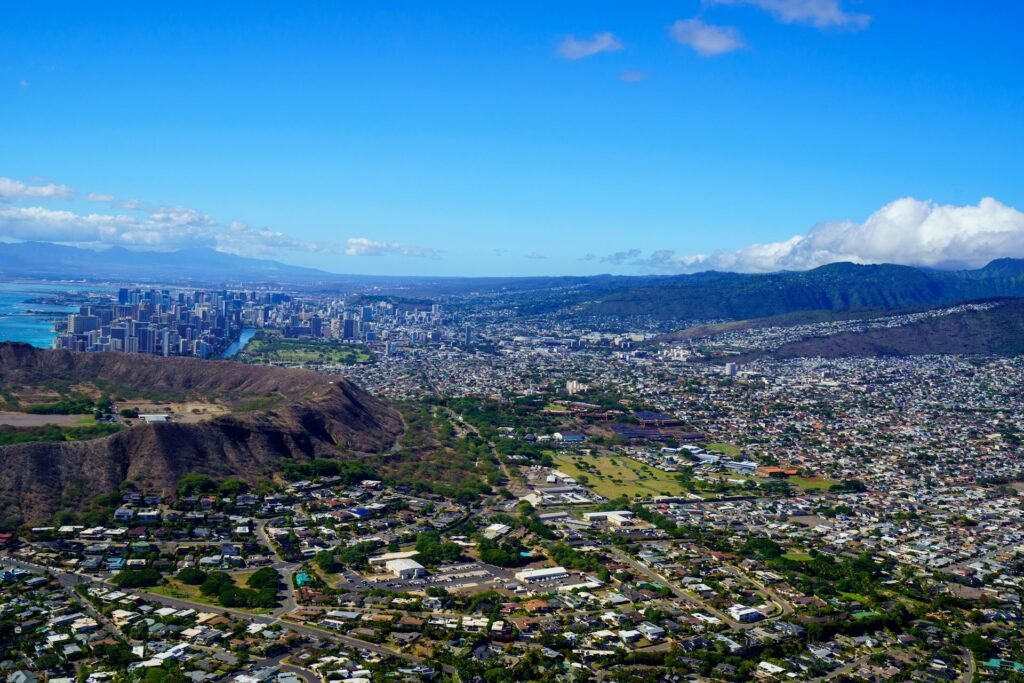
Honolulu sits on the south shore of Oʻahu — the third-largest of the eight main Hawaiian Islands but the most populous by far. The Hawaiian archipelago lies roughly 2,400 miles (3,860 km) from California — the most-isolated population center on Earth. Oʻahu is a relatively flat island (compared to the Big Island’s volcanoes or Kauaʻi’s mountainous interior), formed by two extinct shield volcanoes — the Waiʻanae Range (west) and Koʻolau Range (east) — with most of Honolulu spread across the southern coastal plain between them. The volcanic tuff cone of Diamond Head (Lēʻahi) rises 232 m at the eastern end of Waikiki, the city’s defining visual landmark.
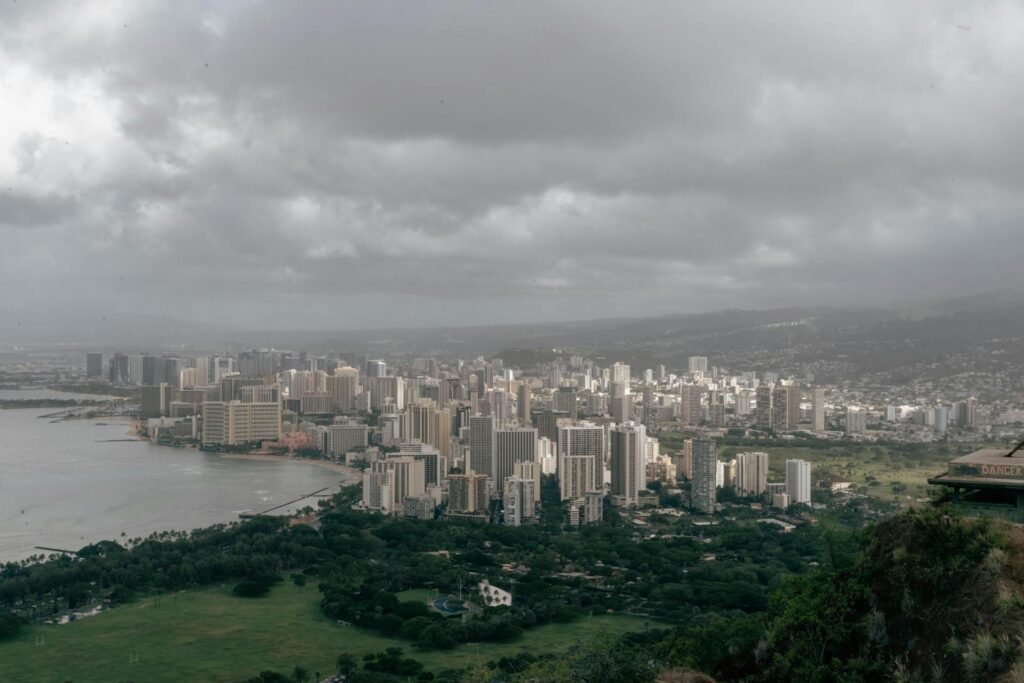
The city stretches roughly 30 km along the south shore, from the cliffs of Koko Head in the east to the Pearl Harbor naval base in the west. The geography produces a clear functional division: Waikiki (tourist beach district), Downtown (the financial-and-historic core), Chinatown (the 19th-century Asian-immigrant quarter), Kakaʻako (the new mixed-use redevelopment district), Kapahulu/Kaimukī (the local working-Hawaiian-and-Asian neighborhoods), and Mānoa/Makiki (the leafy upper residential areas with the University of Hawaiʻi at Mānoa).
Climate Overview
Honolulu has one of the world’s most stable, pleasant climates — a tropical climate with strong trade-wind moderation. Year-round daytime highs of 25–31 °C; overnight lows of 18–23 °C; humidity moderate (60–75%); reliable northeast trade winds keep the leeward south-shore-and-Waikiki areas warmer and drier than the windward (north and east) sides of the island. Annual rainfall just 450 mm in Waikiki (one of the driest urban climates in the world) but 5,000+ mm in the Koʻolau mountain rainforests just 5 km inland.
Seasons & When to Visit
Hawaiʻi has effectively two seasons. Summer (May–October): hot, dry, calm seas on south and west shores — the swimming-and-surfing-and-beach-life prime season. Winter (November–April): slightly cooler, more rain especially in November–March, dramatic surf on the North Shore (the famous Waimea, Banzai Pipeline, and Sunset Beach big-wave breaks). Whale watching: humpback whales migrate through Hawaiian waters December–April; the Hawaiian Islands Humpback Whale National Marine Sanctuary protects the population. Hurricane season: technically June–November but direct Hawaiʻi hits are rare; most “hurricanes” weaken or curve north of the islands. Tsunamis from Pacific Rim earthquakes are a recurring risk — sirens are tested monthly; download the Hawaii Emergency Management app.
Best Time to Visit
April–May and September–October are the shoulder-season sweet spots — warm weather, lower crowds than mid-summer or holiday weeks, lower hotel prices, and the year’s calmest seas across all shores. Late December–early January: peak tourism, peak prices, peak crowds — but spectacular North Shore surf and warm-clear-Hawaiʻi weather. Avoid April spring break (March–April), the Memorial Day weekend, July 4th week, Thanksgiving week, and Christmas–New Year for hotel value. Cruise-ship-day crowds significantly affect Pearl Harbor and Waikiki on certain weekdays; check cruise calendars.
Honolulu’s Districts & Neighborhoods
Waikiki
The 1.5-square-mile beach resort district that defines most international visitors’ Honolulu experience. The Waikiki Beach strip — actually a series of contiguous public beaches — fronts a wall of high-rise hotels along Kalākaua Avenue. Diamond Head rises at the eastern end; the historic Royal Hawaiian Hotel (“The Pink Palace,” 1927) and Moana Surfrider (1901) anchor the heritage strip; the International Market Place and Royal Hawaiian Center provide shopping. Crowded, commercialized, intensely touristy — but a legitimate concentration of beachfront amenity unmatched elsewhere in Hawaiʻi.
Downtown / Capitol District / ʻIolani Palace
The historical and political core 5 km west of Waikiki. ʻIolani Palace — the only royal palace on American soil, where Queen Liliʻuokalani was imprisoned after the 1893 overthrow; Hawaiʻi State Capitol; Hawaiʻi State Library; Aliʻiolani Hale (the supreme court building with the iconic King Kamehameha statue out front, the model for “Five-O Headquarters” in Hawaii Five-0); Kawaiahaʻo Church (1842 coral-block missionary church). Walkable in 2–3 hours; vital for understanding Hawaiian political history.
Chinatown
Adjacent to downtown, Honolulu’s 19th-century Asian immigrant quarter — now one of the city’s most vibrant restaurant-and-art districts. Maunakea Marketplace for live seafood and Asian groceries; Oʻahu Market for traditional Chinese ingredients; the renovated art galleries and bars along Pauahi, Hotel, and Smith Streets. First Friday art-walk evening events are the city’s most lively monthly cultural happening. Less safe after dark in some sub-blocks; daytime exploration is the default.
Kakaʻako
The newest district — a former industrial-warehouse zone redeveloped since 2010 with high-end condos, art galleries, breweries, coffee shops, and the SALT at Our Kakaʻako commercial complex. Pow! Wow! Hawaii annual mural festival has decorated the neighborhood with world-class street art. Ward Village mall and the Kewalo Basin Harbor provide additional amenity. The country’s fastest-growing urban-redevelopment success.
Pearl Harbor & ʻAiea
West of central Honolulu, the active U.S. naval base contains the Pearl Harbor National Memorial — the USS Arizona Memorial, USS Bowfin Submarine Museum, USS Missouri Battleship Memorial, and Pacific Aviation Museum. Free shuttle from the visitor center; Arizona Memorial tickets must be reserved online up to 8 weeks in advance at recreation.gov; otherwise same-day tickets run out by 7 am. ʻAiea is the working-class suburb just inland.
North Shore & the Country
The northern half of Oʻahu — 60 km from Waikiki — is “the country” in local terminology: Haleʻiwa beach town, Sunset Beach, Banzai Pipeline, Waimea Bay, the Polynesian Cultural Center at Lāʻie. Calmer pace, larger lots, fewer hotels (a deliberate community choice). The Banzai Pipeline hosts the world’s most famous big-wave surf competition each November–February.
Top Things to Do in Honolulu
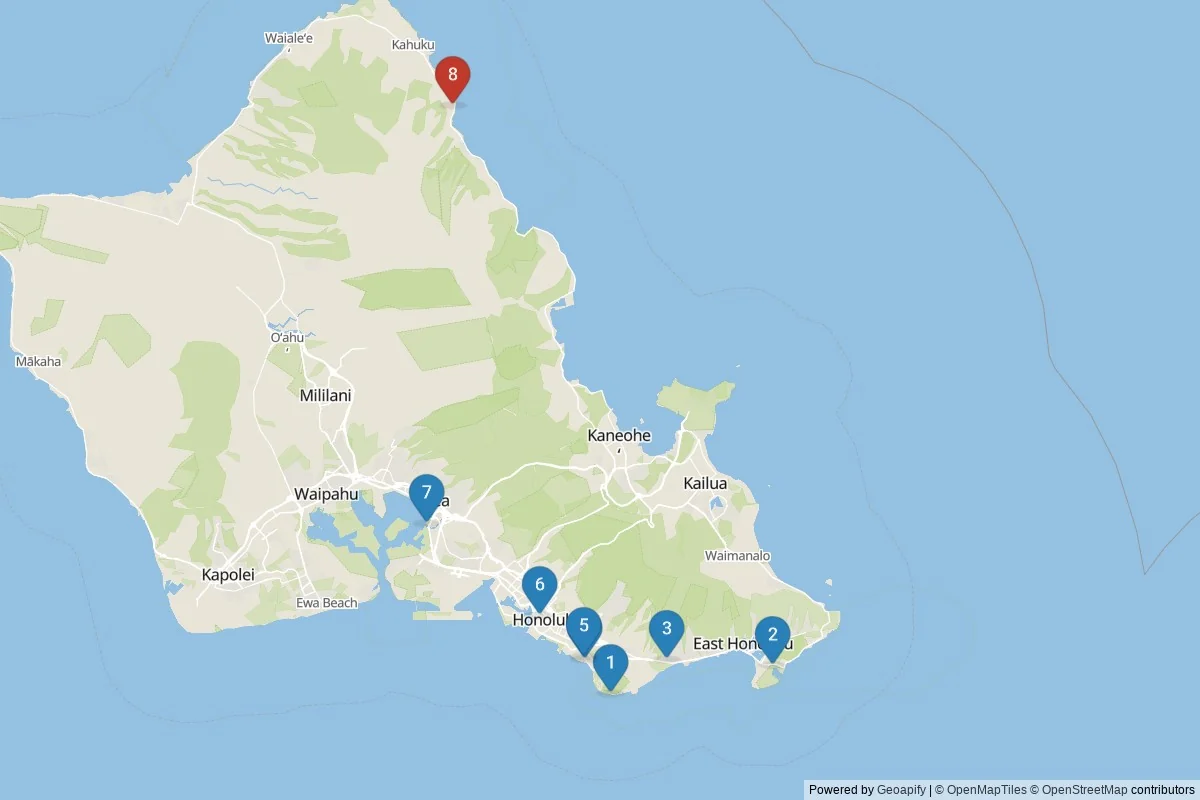
| # | Sight | Cluster | Type | Time | Entry | Best |
|---|---|---|---|---|---|---|
| 1 | Diamond Head (Lēʻahi) | Cluster A | Park | 90 minutes | $5 | Sunrise |
| 2 | Hanauma Bay | Cluster A | Park | 30 minutes | $25 | Morning |
| 3 | the North Shore | Cluster A | Beach | — | — | Sunset |
| 4 | Waikiki Beach | Cluster A | Beach | 30 minutes | $30–60/ | Sunset |
| 5 | Bishop Museum & Hawaiian Cultural Heritage | Cluster A | Museum | 20 minutes | $28 | — |
| 6 | ʻIolani Palace | Cluster A | Palace | 2 hours | $27 | — |
| 7 | Pearl Harbor & USS Arizona Memorial | Cluster A | Museum | — | free | — |
| 8 | Polynesian Cultural Center (Lāʻie) | Cluster B | Park | — | $80–110 | — |
1. Hike Diamond Head (Lēʻahi)
The 232-meter tuff-cone summit hike — Hawaiʻi’s most-photographed natural feature. The 1.3 km trail starts inside the crater, climbs through World War II-era tunnels and bunkers, and ends at the rim with 360° views over Waikiki, Honolulu, and Mānoa Valley. Reservations now required at gostateparks.hawaii.gov; non-resident entry $5 per person + $10 parking; book 2–4 weeks ahead. Plan 90 minutes round-trip; bring water; arrive at sunrise for the best light and lower temperatures.
2. Pearl Harbor & USS Arizona Memorial
The defining American historical site in the Pacific. The visitor center is free; the USS Arizona Memorial (the boat launch over the sunken battleship containing the entombed remains of 1,177 sailors and marines) requires advance tickets — book at recreation.gov 8 weeks ahead, or arrive at 6:30 am for same-day tickets. The complete Pearl Harbor experience adds the USS Missouri Battleship ($35, the surrender ship of WWII), USS Bowfin Submarine Museum ($21), and Pacific Aviation Museum ($26). Plan a full day. Dress code: no swimwear; no large bags.
3. Visit ʻIolani Palace
The only royal residence on American soil, completed 1882 by King Kalākaua. The interior tour ($27 adult, advance booking) walks through the throne room, royal apartments, basement gallery (with original royal crowns), and the upstairs chamber where Queen Liliʻuokalani was imprisoned after the 1893 overthrow. Combine with the adjacent King Kamehameha statue, the Hawaiʻi State Capitol, and Washington Place. Plan 2 hours.
4. Spend a Day on Waikiki Beach
The 3 km of contiguous Waikiki beaches — Kūhiō Beach, Royal Hawaiian Beach, Fort DeRussy Beach, Sans Souci Beach — are all public (Hawaiʻi state law requires beach access). Surfboard rental from Hans Hedemann Surf School ($30–60/hour); stand-up paddle rentals; outrigger canoe rides ($25 for 30 minutes through Waikiki Beach Services). Free hula performances at the Kūhiō Beach Hula Mound at sunset on Tuesday, Thursday, and Saturday.
5. Snorkel Hanauma Bay
The protected marine reserve 30 minutes east of Waikiki — a partially-submerged volcanic crater filled with coral and over 400 fish species. Reservations required 2 days in advance at the official Hanauma Bay booking site; entry $25 non-resident + $3 parking. Plan a full morning; bring reef-safe sunscreen (Hawaiian regulations ban oxybenzone and octinoxate sunscreens).
6. Drive (or Tour) the North Shore
The 60 km drive from Waikiki to Haleʻiwa through pineapple fields and into the surf coast. Big-wave surf-watching (November–February) at Sunset Beach, Banzai Pipeline, and Waimea Bay; calm beach swimming and snorkeling May–October. Shrimp trucks at Kahuku (Giovanni’s, Romy’s), shave ice at Matsumoto Shave Ice, and the surf-shops-and-galleries of Haleʻiwa town. Full-day excursion.
7. Polynesian Cultural Center (Lāʻie)
The 17-hectare cultural park covering Hawaiian, Sāmoan, Tongan, Fijian, Maori, Tahitian, and Marquesan cultures — performances, food, and craft demonstrations. Controversial (operated by Brigham Young University–Hawaiʻi and the LDS Church) but the most concentrated Polynesian-cultural experience in the islands. Adult day pass $80–110 depending on options; allow 6+ hours.
8. Bishop Museum & Hawaiian Cultural Heritage
The state’s largest museum and the premier Polynesian cultural and natural history collection. The Hawaiian Hall showcases royal regalia, feather capes, ancient stone weapons, and Polynesian voyaging artifacts; the Castle Memorial Building hosts changing exhibitions. Entry $28 adult; in Kalihi neighborhood, 20 minutes from Waikiki. The most respectful place to learn Native Hawaiian history before exploring the islands.
How to Get to Honolulu
By Air
Daniel K. Inouye International Airport (HNL), 4 km northwest of downtown, is the primary entry point for the entire Hawaiian Islands. Direct nonstop flights from most major U.S. mainland cities (Los Angeles 5 hours, San Francisco 5 hours, Seattle 6 hours, Phoenix 6 hours, Denver 7 hours, Dallas 8 hours, Chicago 9 hours, New York 11 hours), Asia (Tokyo 7 hours, Seoul 9 hours, Hong Kong 11 hours, Manila 11 hours, Sydney 10 hours, Auckland 9 hours), and Canada. Carriers: Hawaiian Airlines (the local flag carrier), United, American, Delta, Alaska, Southwest, JetBlue, Japan Airlines, ANA, Korean Air, Air New Zealand, Qantas, and more.
From the airport: Roberts Hawaii Express Shuttle to Waikiki $25 one-way; SpeediShuttle $20; Uber/Lyft $35–55 to Waikiki; TheBus route 20 or 23 to Waikiki $3 one-way (luggage restrictions — only one carry-on); taxi $50–65 to Waikiki; rental car (the most flexible option for inter-island and Oʻahu-wide exploration; $50–150/day at major rental brands).
By Sea / Inter-Island Travel
No regular passenger ferry currently connects Oʻahu to the other Hawaiian Islands (the Hawaii Superferry shut down in 2009). Cruise ships visit Honolulu but few use it as embarkation. Inter-island flights (Hawaiian Airlines, Southwest, and Mokulele): Honolulu–Maui 35 minutes ($60–250); Honolulu–Big Island 50 minutes; Honolulu–Kauaʻi 35 minutes.
Visa Notes
Hawaiʻi is the 50th U.S. state — U.S. visa rules apply identically to here as to the mainland. U.S. citizens: no special documentation beyond government-issued photo ID (driver’s license sufficient for domestic flights; Real ID required from May 2025). Foreign visitors: standard U.S. visa or Visa Waiver Program (ESTA) — citizens of 41 countries (most of Western Europe, Australia, New Zealand, Japan, South Korea, Singapore, Taiwan) get 90-day visa-free entry via the official ESTA portal ($21 fee, processed within 72 hours). Other nationalities apply for a B-1/B-2 tourist visa at U.S. embassies (significant wait times in some countries). Important: agricultural inspection at HNL is strict — fresh fruits, plants, and seeds from outside Hawaiʻi are confiscated; this includes inter-island transfer; declare or discard.
Getting Around Honolulu
TheBus (Honolulu Public Transit)
Honolulu’s public bus network is genuinely useful — single fares $3 (cash exact only), day pass $7.50, monthly pass $80. Route 22 runs Waikiki–Hanauma Bay; Route 8 Waikiki–Ala Moana–Downtown; Routes 20/23 Waikiki–airport. Routes 52, 55, 60 to the North Shore (a 90+ minute journey but feasible for budget travelers). HEA app shows real-time bus arrivals.
Rail (Skyline)
The new Skyline elevated rail opened June 2023 with the first segment connecting East Kapolei to Aloha Stadium — useful for Pearl Harbor and the Western Oʻahu suburbs; the planned Waikiki extension is years away. Fare $3.
Uber, Lyft, Taxi
Uber and Lyft operate normally. Fares Waikiki–Downtown $12–20; Waikiki–airport $25–35; Waikiki–North Shore $80–120. Taxis can be hailed but are more expensive than ride-hailing.
Rental Car
The default for most American visitors and the practical default for travelers wanting to see the full Oʻahu. Major brands (Hertz, Avis, Enterprise, National, Budget) at the airport from $50–150/day depending on season and vehicle. Parking in Waikiki is expensive ($30–50/day at most hotels); plan for this if booking. Hawaiian roads are well-maintained, well-signed, and generally easy to drive; the rural North Shore and east-side roads include some single-lane sections.
Walking, Biking, Trolley
Waikiki itself is walkable. Biki bike-share stations are scattered through Honolulu and Waikiki ($4.50/30 minutes single ride, $30/300-minute multi-ride pass). Hawaiʻi Visitor & Convention Bureau Pink Trolley runs hop-on-hop-off Waikiki–Diamond Head loops ($5.50 per day).
Food & Drink in Honolulu
Honolulu’s cuisine combines Native Hawaiian (roots in Polynesian-imported staples — taro/poi, sweet potato, breadfruit, fish), Plantation-era immigrant fusion (Japanese, Chinese, Filipino, Korean, Portuguese — the great-grandparents of “Hawaiian local food”), and contemporary “Hawaiʻi Regional Cuisine” (the fine-dining movement led by Roy Yamaguchi, Sam Choy, and others from the 1990s onward).
What to Try
- Poke — cubed raw fish (usually ʻahi/yellowfin tuna) marinated in shoyu, sesame oil, green onions, and sometimes seaweed; the iconic Hawaiian dish that has gone global. Try Ono Seafood, Foodland’s poke counter, or Da Poke Shack.
- Plate lunch — the local working-Hawaiian meal: two scoops of rice, one scoop of macaroni salad, and a protein (kalbi short ribs, mochiko chicken, kalua pork, teriyaki beef). Rainbow Drive-In (since 1961) is the canonical address.
- Kalua pig — slow-roasted pork cooked in an underground earth oven (imu), traditionally for lūʻau feasts. Highway Inn in Kakaʻako and the Polynesian Cultural Center serve excellent versions.
- Loco moco — white rice topped with a hamburger patty, a fried egg, and brown gravy; the Big-Island invention now a Hawaiʻi-wide breakfast staple.
- Saimin — Hawaiian noodle soup combining Japanese ramen, Chinese mein, and Filipino mami; clear broth, thin yellow noodles, char siu, fish cake, scallion. Saimin Says at Shirokiya / Japan Village Walk for the canonical taste.
- Malasada — Portuguese-immigrant deep-fried yeast doughnut covered in granulated sugar; Leonard’s Bakery on Kapahulu Avenue is the must-visit.
- Shave ice — finely shaved ice topped with tropical-fruit syrups, often with sweet azuki beans or vanilla ice cream underneath. Matsumoto Shave Ice at Haleʻiwa on the North Shore is the most-photographed.
- Spam musubi — fried Spam on a block of rice wrapped with nori seaweed; the local pocket-meal staple. Iyasume and Musubi Cafe Iyasume in Waikiki.
- Hawaiian Coffee — Kona coffee (from the Big Island), Kaʻū coffee (from the Big Island’s southern slope), and Oʻahu-grown coffees from Waialua. Try The Local Hawaiian or Honolulu Coffee Company.
Where to Eat
Rainbow Drive-In (Kapahulu) — plate lunch institution. Helena’s Hawaiian Food (Kalihi, James Beard winner) — traditional Hawaiian. Ono Seafood (Kapahulu) — poke. Leonard’s Bakery (Kapahulu) — malasadas. Marukame Udon (Waikiki, two locations) — Japanese-Hawaiian udon, perpetual queue. Roy’s Waikiki — Hawaiʻi Regional Cuisine fine-dining. MW Restaurant (Ala Moana) — innovative local-fusion fine-dining. Senia (Chinatown) — modern Hawaiian-fusion fine-dining. Pig and the Lady (Chinatown) — Vietnamese-Hawaiian fusion. Hawaiian Brian’s at Aloha Tower, SALT Kakaʻako food halls. Lūʻau evening shows — Polynesian Cultural Center, Paradise Cove, Royal Hawaiian, Hilton Hawaiian Village; cultural-and-buffet experiences $130–175 per person.
Drinks
Mai Tai — invented at the Royal Hawaiian’s “Mai Tai Bar” in 1944 (or in California, depending on the source); the canonical Hawaiian tiki cocktail. Blue Hawaii and Lava Flow — the candy-colored beach drinks. Hawaiian craft beer: Maui Brewing, Kona Brewing, Honolulu Beerworks — the local-craft scene is strong. Hawaiian rum: Koloa Rum (Kauaʻi) and KōHana Rum (Oʻahu, agricole-style). Hawaiian coffee: 100% Kona coffee is genuine and expensive; “Kona blend” usually contains as little as 10% Kona. Avoid: super-sweet beach-bar versions of canonical drinks; ask for “less syrup” if you want to taste the rum.
A Note on Tap Water
Tap water in Honolulu is completely safe to drink — among the cleanest municipal water supplies in the United States. Honolulu’s water comes from underground aquifers in the Koʻolau and Waiʻanae mountains, naturally filtered through millennia of basalt. No bottled water needed; refillable bottles are encouraged. Ice is universally safe. The CDC traveler health page for the United States rates Honolulu food and water as the same low-risk as mainland US destinations. The 2021 Red Hill fuel-leak crisis: a U.S. Navy fuel-storage facility contaminated some Pearl Harbor military housing water supplies in November 2021; the public Honolulu water system was not affected, but the incident raised significant local concern; the affected Navy housing system has been remediated.
Frequently Asked Questions About Visiting Honolulu
Do I need a visa to visit Honolulu?
It depends on your nationality. Hawaiʻi is the 50th U.S. state — U.S. visa rules apply identically here as on the mainland. U.S. citizens: no special documentation; a state-issued driver’s license (Real ID compliant from May 2025) or passport is sufficient for domestic flights. Citizens of 41 Visa Waiver Program (VWP) countries — including UK, all EU member states, Switzerland, Norway, Iceland, Japan, South Korea, Singapore, Taiwan, Australia, New Zealand, Chile, Brunei — can travel visa-free for up to 90 days by obtaining an ESTA (Electronic System for Travel Authorization) at the official ESTA portal — $21 fee, valid 2 years from issue, processed within 72 hours. Common mistakes: applying through unofficial third-party sites that overcharge 200–500%; assuming ESTA covers studying or working in the U.S. (it only allows tourism and short business meetings); booking onward travel inconsistent with visit stated; arriving with less than 6 months passport validity. Other nationalities: apply for a B-1/B-2 tourist visa at U.S. embassies and consulates — significant wait times in some countries (India, China, Brazil) currently 6 months–2 years for first-time appointments. Important: agricultural inspection at HNL is strict — fresh fruits, vegetables, plants, and seeds from outside Hawaiʻi (including the U.S. mainland) are confiscated. Hawaiʻi’s biosecurity is fragile due to its isolation.
Is Honolulu safe for tourists?
Honolulu is among the safer major U.S. tourist destinations — significantly safer than most American mainland cities for violent crime, with a strong Aloha-spirit cultural emphasis on respect for visitors and a substantial tourism-police presence in Waikiki. The US State Department does not issue specific advisories for U.S. domestic travel; standard precautions apply. Real risks in Honolulu: petty theft from cars at trail-head parking and beach lots — never leave valuables visible in rental cars at Diamond Head, Hanauma Bay, or any beach lot; aggressive panhandling in some Chinatown blocks at night; drone-and-prop scams at Waikiki tourist photo spots; ocean hazards — strong rip currents, shore breaks, and reef cuts cause many tourist injuries; obey lifeguard warnings and posted flags; never turn your back on the ocean; North Shore winter surf can be deadly for non-experts (the famous “shorebreak” at Sandy Beach has caused tourist spinal injuries); volcanic and earthquake activity on the other islands; shark encounters are very rare but possible; jellyfish (Portuguese man-of-war) wash onto south-shore beaches periodically — clean staff post warnings. Pedestrian safety: Honolulu has very high rates of pedestrian-vehicle fatalities; use crosswalks; never assume cars will stop for you. Hawaiian cultural respect: visiting sacred sites (heiau ruins, certain beaches associated with ancestor deaths) requires respectful behavior — no removing rocks, no swimming or stepping on coral, no loud or disrespectful conduct.
How many days do I need in Honolulu?
Four to five days handles Honolulu (Oʻahu) well; combined with one or two of the other Hawaiian Islands, 7–14 days makes a comprehensive Hawaii trip. A solid 5-day Honolulu plan: Day 1 — Waikiki Beach + dinner at Roy’s. Day 2 — Pearl Harbor full day (USS Arizona Memorial + USS Missouri + Aviation Museum). Day 3 — Diamond Head sunrise hike + ʻIolani Palace + downtown walking tour + dinner in Chinatown. Day 4 — Hanauma Bay snorkel morning + Lanikai Beach (windward side) + drive Round-the-Island scenic route + dinner at North Shore (Haleʻiwa or Kahuku shrimp). Day 5 — Polynesian Cultural Center (Lāʻie) day with luau evening; or rest day on Waikiki + Bishop Museum. Add Day 6 for an inter-island flight to Maui or Big Island for the volcanic geology. 10-day Hawaiʻi classic: 4 days Oʻahu (Waikiki + cultural + Pearl Harbor + North Shore) + 4 days Maui (Road to Hana + Haleakalā + Lahaina) + 2 days Big Island (Volcanoes National Park + Mauna Kea sunset). Day-trip Honolulu from a cruise ship: feasible for Waikiki + Pearl Harbor or Waikiki + Diamond Head; full Oʻahu coverage requires staying 4+ nights.
What’s the best area to stay in Honolulu?
Waikiki — the default for first-time visitors; concentration of hotels (Hawaiian Hilton Village, Sheraton Waikiki, Royal Hawaiian, Halekulani, Hyatt Regency, Outrigger Reef, Ritz-Carlton Residences), direct beach access, restaurant/bar density, easy public transit. $250–1,500/night high season. Within Waikiki: Diamond Head end (Kaiulani Avenue) is quieter; Lewers Street / Royal Hawaiian end is busiest. Kakaʻako / Ward Village — the newest development; modern luxury condos and Ritz-Carlton; less beach immediacy but excellent dining; $300–1,200/night. Aulani Disney Resort (Ko Olina, 50 minutes west of Waikiki) — family-friendly resort with cultural programming; $500–2,000/night. Turtle Bay Resort (North Shore) — the only major North Shore resort; great for surf-and-quiet stays; $400–1,500/night. For a less touristy local experience: Kailua (windward, 30 minutes from Waikiki) — small town with the famous Lanikai Beach; vacation rentals from $300/night. Skip: the Hawaiian Monarch Hotel and similar budget-Waikiki options without specific recommendations; some Chinatown / downtown budget hotels have safety concerns. Vacation rentals: Hawaiʻi has cracked down on illegal short-term rentals; check that Airbnb/VRBO listings are legally licensed (legal rentals require a state TVR/STR license number).
How much does it cost to visit Honolulu’s major sights?
Hawaiʻi is expensive — significantly more than mainland U.S. norms. USS Arizona Memorial: free (advance reservation $1 processing fee). USS Missouri Battleship: $35 adult. USS Bowfin Submarine: $21. Pacific Aviation Museum: $26. Pearl Harbor combo passes: $90–130. ʻIolani Palace: $27 guided; $20 self-guided. Diamond Head State Monument: $5 non-resident entry + $10 parking (reservations required). Hanauma Bay: $25 non-resident entry + $3 parking (reservations required 2 days ahead). Polynesian Cultural Center: $80–110 day pass, $130–180 with lūʻau. Bishop Museum: $28 adult. Lūʻau evening shows (Hilton, Royal Hawaiian, Paradise Cove): $130–175 per adult. Surfing lessons: $80–150 for 2 hours group. Outrigger canoe ride at Waikiki: $25–35. Local meals: plate lunch $14–18; poke bowl $14–22; loco moco $13–17; shave ice $5–9; malasada $1.50–3 each; mid-range restaurant dinner $35–75 per person; fine-dining $80–250 per person; lūʻau dinner $130–175 (food included with cultural show). Coffee: $5–8 per cup; 100% Kona coffee bags $35–55. Uber Waikiki–Pearl Harbor: $30–45; Waikiki–North Shore $60–110. Rental car: $50–150/day plus $25–50/day Waikiki parking. Overall daily budget: $200 (frugal hostel/AirBnb + plate lunch + walking + public transit), $400 (mid-range Waikiki hotel + restaurant meals + one activity), $1,000+ (luxury hotel + fine-dining + rental car + activities).
Should I drink the tap water in Honolulu?
Yes — tap water in Honolulu is completely safe to drink. Honolulu’s water comes from underground basalt-aquifer wells fed by Koʻolau-mountain rainfall, naturally filtered over centuries, and treated to the highest U.S. EPA standards. The Honolulu Board of Water Supply consistently meets or exceeds federal drinking-water requirements. Bring a reusable water bottle — refillable stations are available at most parks, beaches, and tourist areas; bottled water is wasteful and expensive ($3–5 per liter at tourist shops). Ice is universally safe. Note on the Red Hill fuel-leak crisis: a U.S. Navy fuel-storage facility contaminated some military-housing water supplies near Pearl Harbor in November 2021, sickening over 6,000 service members and dependents. The civilian Honolulu Board of Water Supply (which serves the public, non-military areas) was not affected. The Navy facility has been remediated and the Red Hill facility is being permanently shut down. The CDC traveler health page for the United States rates Hawaiʻi food and water as low-risk. The bigger health concerns in Honolulu are sunburn (the UV index is among the highest in the U.S.; use reef-safe SPF 30+ sunscreen — Hawaiian regulations ban oxybenzone and octinoxate, the active ingredients in many mainland sunscreens, which damage coral reefs), heat exhaustion in summer, and ocean hazards.
What payment methods work in Honolulu — credit cards or cash?
Credit cards dominate, with cash useful for small transactions. Credit/debit cards (Visa, Mastercard, AmEx, Discover): universally accepted — hotels, restaurants, taxis, Uber/Lyft, supermarkets, museums, beach equipment rentals, surf lessons. Contactless tap-to-pay is standard. U.S. dollars (USD): useful for tipping, beach hawkers, lūʻau tips, and the rare cash-only food truck or farmers’ market. ATMs: abundant; Bank of Hawaiʻi, First Hawaiian Bank, and most national banks (Chase, Wells Fargo, Bank of America) have branches and ATMs in Waikiki and downtown. No currency exchange concerns for international visitors who pre-load USD; exchange at home banks (cheaper) rather than at the airport (worst rates). Mobile payment: Apple Pay, Google Pay, Samsung Pay work everywhere accepting cards. Tipping: heavily ingrained in U.S. service culture and crucial in Hawaiʻi — 15–20% at restaurants (not optional); $1–5 per drink at bars; $2–5 per bag to hotel porters; $3–5 per day for housekeeping; 15–20% for taxi and Uber/Lyft; $5–10 for surf lesson instructors; $10–20 per person at lūʻau for performers; $5–10 per round at bars. State and county taxes: Hawaiʻi General Excise Tax 4.5%, plus additional county surcharge — total roughly 4.7%; restaurant bills and most retail purchases show the tax on the bill, distinct from the tip line. “Aloha Friday casual” dress codes are common — Hawaiian aloha shirts (locally called “aloha wear” not “Hawaiian shirts”) are appropriate even at upscale restaurants.
What about cultural etiquette and respect for Native Hawaiian heritage?
This matters more in Hawaiʻi than in most American destinations. Native Hawaiian culture is actively endangered after two centuries of colonization and population collapse; today’s Hawaiian cultural renaissance (since the 1970s) represents conscious community work to keep ʻōlelo Hawaiʻi (Hawaiian language), hula, music, food traditions, and spiritual practices alive. Respect by visitors directly contributes to this preservation. Key etiquette: “Aloha” means more than hello — it embodies love, respect, mutual care; use it sincerely or not at all. “Mahalo” = thank you. Hawaiian place names matter — make at least the effort: Diamond Head is Lēʻahi; Pearl Harbor is Puʻuloa; Honolulu means “sheltered harbor.” Sacred sites (heiau, royal mausoleums, certain beaches): do not climb on, take photos disrespectfully, or remove any objects — including pebbles or pieces of coral; longstanding Hawaiian folk belief holds that removing items from sacred places brings bad luck (some visitors report and have returned items via mail to local addresses). Beach access: all Hawaiian beaches are public to the high-water mark by state law — never accept “private beach” claims; however, respect that some shore stretches have been working Hawaiian fishing areas for generations. Surf etiquette: surfing has strict local hierarchy; beginners should learn at lessons or beginner breaks (Waikiki) — never paddle out at the Pipeline, Sunset, or Waimea Bay unless you’re at world-class level. Lūʻau cultural performances: applaud respectfully; understand the songs (hula stories) tell ancestral genealogies and historic events. Honest tip: many Native Hawaiians have complicated feelings about tourism that subsidizes their culture’s commercialization while making housing unaffordable for them; visiting with quiet respect, supporting Native-Hawaiian-owned businesses where possible, and learning at least the basics of the place’s history goes a long way.
Education & Notable People
Honolulu is the educational capital of the Pacific — anchored by the University of Hawaiʻi at Mānoa, the state’s flagship public research university, and a network of specialized institutions reflecting Hawaiʻi’s strategic position.
Major Universities
- University of Hawaiʻi at Mānoa — founded 1907; ~18,000 students; nationally ranked in Pacific Asia studies, marine sciences, astronomy (via the Mauna Kea observatories on Big Island), and Hawaiian studies.
- Chaminade University of Honolulu — Catholic private university with strong undergraduate programs.
- Hawaiʻi Pacific University — private university with strong international-business and oceanography focus.
- Brigham Young University–Hawaiʻi — LDS-affiliated university in Lāʻie on the North Shore; serves a Pacific-region student population.
- Kapiʻolani Community College — community college specializing in culinary arts, hospitality, and nursing.
- East-West Center — federally funded research and education institution focused on Asia-Pacific relations; located on the UH Mānoa campus.
Notable People
Kamehameha I (the Great) — unified the Hawaiian Islands by 1810; the official Hawaiʻi state holiday June 11 honors him; his statue stands across from ʻIolani Palace. Queen Liliʻuokalani — last reigning Hawaiian monarch (1891–1893), composer of Aloha ʻOe; deposed by American planters in 1893; her writings on the overthrow remain foundational to Native Hawaiian historical consciousness. Barack Obama — 44th U.S. President, born in Honolulu (Kapiʻolani Medical Center) and raised primarily on Oʻahu; the only U.S. President born outside the contiguous 48 states. Bruno Mars — pop singer, born and raised in Honolulu. Daniel K. Inouye — long-serving U.S. Senator (1962–2012), Medal of Honor recipient, the namesake of Honolulu International Airport. Israel “IZ” Kamakawiwoʻole — Hawaiian musician whose 1993 ukulele-and-vocal medley of “Somewhere Over the Rainbow / What a Wonderful World” became globally beloved after his 1997 death. Don Ho — 20th-century Hawaiian entertainer (“Tiny Bubbles”). The Cazimero Brothers — celebrated Hawaiian-music duo. Tia Carrere — actress, singer.
Sister Cities & International Relations
Honolulu’s sister-city network reflects the city’s identity as a Pacific Rim cultural crossroads, a major military command center, and the gateway between East and West.
Honolulu’s sister and friendship cities include (selection):
- Hiroshima, Japan — sister city since 1959; emotionally significant Pacific-war-and-reconciliation pairing.
- Nagaoka, Japan — fireworks-and-peace partnership.
- Kaohsiung, Taiwan — port-cities friendship.
- Manila, Philippines — paired since 2007; significant Filipino-American community linkage.
- Naha, Okinawa, Japan — friendship city.
- Mombasa, Kenya — Pacific-Indian Ocean partnership.
- Bruges, Belgium — heritage-city friendship.
- Vigan, Philippines — UNESCO heritage-city pairing.
- Caracas, Venezuela — Western Hemisphere capital-city friendship.
- Hainan, China — tropical-island-and-tourism partnership.
Honolulu hosts the headquarters of the U.S. Indo-Pacific Command (INDOPACOM) at Camp H.M. Smith — the largest of the U.S. Department of Defense’s combatant commands by area. The city is the meeting point for APEC (Asia-Pacific Economic Cooperation) activities and hosted the 2011 APEC Leaders’ Summit. The Hawaiʻi Tourism Authority coordinates the state’s tourism strategy. Hawaiʻi serves as the country’s primary Pacific-region cultural and diplomatic gateway.
AFRIKA
Cairo Hurghada Johannesburg Marrakech
ASIA
Abu Dhabi Agra Antalya Bangkok Batam Beijing Bengaluru Cebu City Chiang Mai Chiba Chennai Da Nang Dammam Delhi Denpasar Dubai Fukuoka Guangzhou Guilin Ha Long Hanoi Ho Chi Minh City Jakarta Jaipur Johor Bahru Kolkata Krabi Kuala Lumpur Kyoto Macau Mecca Medina Mugla Mumbai Osaka Pattaya Penang Phuket Riyadh Seoul Shanghai Shenzhen Singapore Taipei Tokyo Zhuhai
EUROPE
Amsterdam Athens Barcelona Berlin Brussels Budapest Copenhagen Dublin Florence Frankfurt am Main Heraklion Krakow Lisbon London Madrid Milan Munich Nice Paris Porto Prague Rhodes Rome Stockholm Venice Vienna Warsaw
NORTH AMERICA
Cancun Las Vegas Los Angeles Miami New York City Orlando San Francisco Toronto Vancouver
SOUTH AMERICA
Buenos Aires Lima Rio De Janeiro
OCEANIA
Auckland Honolulu Melbourne Sydney