
Photo credit: Muğla’s preserved Ottoman quarter at the foot of Hisar Mountain
Muğla is the quiet inland capital that gives its name to one of Turkey’s most coveted coastlines. The province of Muğla wraps around 1,124 km of Aegean and Mediterranean shore — including Bodrum, Marmaris, Fethiye, Dalyan, Datça, and Göcek — but the provincial capital itself sits 60 km inland at the foot of Hisar Mountain, a 1,500-meter peak that shields the city from coastal humidity. Most international travelers fly into Bodrum or Dalaman airports and never see Muğla town; those who detour discover a small, leafy provincial capital with a remarkably intact Ottoman whitewashed-house district (Saburhane), traditional arasta covered markets, the country’s most prestigious provincial university, and Türkiye’s celebrated Muğla pine honey — a deep-amber forest honey produced from the resin of Turkish pine, accounting for 80% of the world’s pine-honey production. Pair a day here with a coastal road trip and Muğla becomes the cultural anchor of a circuit that ranges from antique-Carian ruins to the country’s signature blue-water yacht harbors.
Muğla by District: The 23 İlçeler
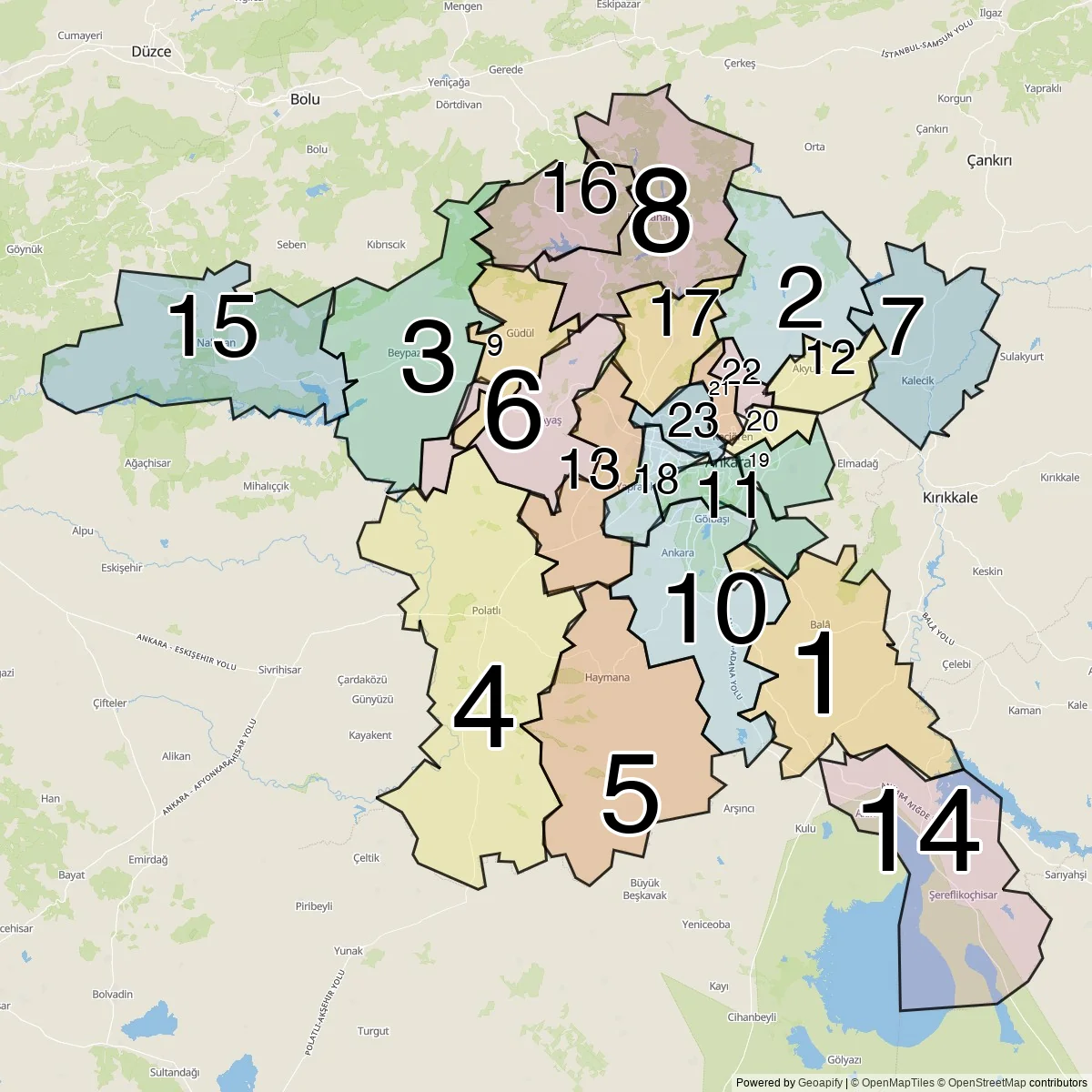
Muğla is divided into 23 districts of the province. The map below shows their official OSM boundaries, colour-coded to match the table — a quick way to orient yourself before zooming in on individual sights.
| # | İlçeler |
|---|---|
| 1 | Balâ |
| 2 | Çubuk |
| 3 | Beypazarı |
| 4 | Polatlı |
| 5 | Haymana |
| 6 | Ayaş |
| 7 | Kalecik |
| 8 | Kızılcahamam |
| 9 | Güdül |
| 10 | Gölbaşı |
| 11 | Çankaya |
| 12 | Akyurt |
| 13 | Sincan |
| 14 | Şereflikoçhisar |
| 15 | Nallıhan |
| 16 | Çamlıdere |
| 17 | Kahramankazan |
| 18 | Etimesgut |
| 19 | Mamak |
| 20 | Altındağ |
| 21 | Keçiören |
| 22 | Pursaklar |
| 23 | Yenimahalle |
Muğla at a Glance: Essential Facts for Travelers
| Location | Aegean Region, Southwestern Türkiye |
|---|---|
| Coordinates | 37.2153°N, 28.3636°E |
| Population | Province ~1.05 million (2023); city center ~108,000 |
| Area | Province 12,949 km²; 1,124 km of coastline |
| Elevation | 670 m (city center); Hisar Mountain 1,500 m |
| Time Zone | Türkiye Time (TRT, UTC+3 — no daylight saving) |
| Calling Code | +90 (province code 252) |
| Currency | Turkish Lira (TRY ₺); EUR widely accepted at coastal resorts |
| Languages | Turkish; English widely spoken in tourism zones |
| Climate | Mediterranean (coast) / mountain-Mediterranean (city) — hot dry summers, cool wet winters |
| Ancient Name | Mobolla / Mobella (Carian region capital in antiquity) |
| Famous For | Saburhane historic district, Muğla pine honey, gateway to Bodrum / Marmaris / Fethiye / Dalyan, Sıtkı Koçman University |
Upcoming Events in Muğla
| Date | Title | Details |
|---|---|---|
| 2026-09-21 | Fareler ve Insanlar (Of Mice and Men) on Stage | A Turkish-language stage adaptation of John Steinbeck’s Of Mice and Men, Fareler ve Insanlar, plays the Gazi Mustafa Kemal Ataturk Cultural Centre in Mugla on 21 September 2026 at 8 pm. Steinbeck’s Depression-era story of migrant workers George and Lennie and their fragile dream of a place of their own remains one of the repertoire’s most affecting dramas. Tickets cost around 1,096 lira. The single evening performance suits literature lovers and theatregoers from across the province, and central seats tend to sell first for touring productions of this calibre. [Source] |
| 2026-09-27 | Candles and Echoes at Herodot Cultural Centre, Bodrum | Candles and Echoes brings an atmospheric candlelit performance to the Herodot Cultural Centre in Bodrum on 27 September 2026 at 8:15 pm. Surrounded by a sea of flickering candles, performers present an evening designed for intimate, contemplative listening close to the Aegean shore. Tickets run from roughly 500 to 890 lira, and discounted allocations are sometimes offered. The format suits couples, music lovers and visitors looking for a gentler alternative to Bodrum’s nightlife; arriving early leaves time to take in the glowing setting before the performance begins. [Source] |
| 2026-10-03 | Candlelit Ballet: Golden Swan in Bodrum | Candlelit Ballet: Golden Swan comes to Bodrum’s Herodot Cultural Centre on 3 October 2026 at 8:15 pm, pairing classical dance with hundreds of candles for a strikingly photogenic staging. Dancers perform swan-themed pieces from the classical repertoire in an intimate format that brings the audience unusually close to the artistry. Tickets range from about 500 to 890 lira depending on seating. The evening appeals to families, dance enthusiasts and anyone seeking a refined cultural night out on the peninsula as the summer season winds down. [Source] |
| 2026-10-08 | Dogu Demirkol Stand-up at Metrekup Bodrum | Comedian Dogu Demirkol, one of Turkey’s most popular stand-ups and the lead actor of Nuri Bilge Ceylan’s film The Wild Pear Tree, performs at Metrekup Bodrum on 8 October 2026 at 8:30 pm. His conversational sets mix sharp observations on everyday life with self-deprecating charm, delivered in Turkish to packed rooms across the country. Tickets start from about 1,500 lira. The intimate venue format means limited capacity, so fans of Turkish comedy are advised to book early for what is typically a fast-selling autumn date. [Source] |
| 2026-10-15 to 2026-10-18 | Oludeniz International Air Games | Each October the skies above Oludeniz near Fethiye fill with colour for the International Air Games, one of the world’s premier paragliding festivals. Pilots launch from the 1,960-metre Babadag mountain and glide down over the famous Blue Lagoon, competing in accuracy landings and performing acrobatic displays, while wingsuit flyers and evening beach parties add to the spectacle. Watching the landings from Oludeniz beach is free, and the event draws thrill-seekers and photographers from around the globe. It typically runs over several days in mid-to-late October. [Source] |
| 2026-10-19 to 2026-10-25 | The Bodrum Cup | The Bodrum Cup is a celebrated international regatta that fills Bodrum’s harbour with elegant wooden gulets and modern yachts each October. Crews race across the Gulf of Gokova over several days, combining serious competition with a festive social atmosphere ashore. The sight of dozens of traditional Turkish sailing boats under full canvas is a spectacular one, and the event has grown into one of the Aegean’s best-known sailing gatherings. Watching from the marina and shore is free; taking part is by registered crew. It usually takes place in the second half of October. [Source] |
| 2026-10-26 to 2026-10-30 | Marmaris International Race Week | Marmaris International Race Week fills the bays around Marmaris with sails from 26 to 30 October 2026, organised by the Marmaris International Yacht Club. One of the eastern Mediterranean’s established end-of-season regattas, it brings together racing and cruising yachts for daily courses on the gulf, with results celebrated ashore each evening. Republic Day on 29 October falls mid-regatta, adding a festive holiday atmosphere along the waterfront. Watching from the marina and promenade is free, while participation for boats and crews is by registration with entry fees that vary by class. [Source] |
| 2026-10-31 | Ati242 Live at Mugla Sitki Kocman University | Turkish rapper Ati242, one of the prominent names of the country’s melodic rap wave, performs at the Mugla Sitki Kocman University indoor sports hall on 31 October 2026 at 9 pm. The Halloween-night show brings his atmospheric flow and singalong hooks to the province’s student heartland, and the university crowd typically turns the arena floor into one big dance pit. Tickets start from about 999 lira. Doors open ahead of the late start, and the concert suits rap fans and students looking for the biggest party night of the autumn term. [Source] |
City News in Muğla – last 14 days
| Date | Category | Headline | Details |
|---|---|---|---|
| 2026-09-14 | Public safety | Seven Suspects Caught in Bodrum ‘Streets Safe’ Operation | Police in Bodrum detained seven suspects during the latest round of the Sokaklar Guvende, or Streets Safe, operation, part of a wider push against street-level crime in the busy resort district. The sweeps target wanted individuals and offences that affect daily life in public spaces, from theft to drug dealing. The detainees were processed for judicial proceedings, and authorities say the operations will continue at intervals to keep pressure on criminal activity as the long tourism season winds down on the peninsula. [Source] |
| 2026-09-14 | Local affairs | Alzheimer Awareness Activities Held in Bodrum | Bodrum is hosting a series of awareness activities on Alzheimer’s disease, timed to coincide with September’s World Alzheimer’s Month observances. The events aim to inform residents about early signs of dementia, the importance of timely diagnosis and the support available to patients and the family members who care for them. With a sizeable community of retirees living on the peninsula year-round, local organisers see awareness work as increasingly important, and the programme brings together health professionals and community groups. [Source] |
| 2026-09-14 | Public transport | Fethiye Introduces Camera Enforcement at Pedestrian Crossings | Traffic authorities in Fethiye have begun camera-based enforcement at pedestrian crossings, monitoring drivers who fail to stop for people crossing the road. The measure is intended to strengthen compliance with right-of-way rules at busy crossing points in the district, where foot traffic swells with residents, students and visitors. Drivers caught ignoring crossings on camera face penalties under the traffic code, and officials hope the visible enforcement will change behaviour and reduce injuries at locations with a record of close calls. [Source] |
| 2026-09-14 | Business | Cruise Traffic Keeps Bodrum Port Busy | Bodrum’s port is seeing lively cruise activity, with ship calls continuing to bring international visitors to the peninsula as the season extends into autumn. Cruise arrivals feed day visitors into the town’s shops, cafes, marina district and sites such as the Castle of St Peter, providing welcome trade for local businesses beyond the peak summer weeks. Port and tourism officials track the movements closely, since cruise itineraries are an important complement to airborne and overland tourism for the local economy. [Source] |
| 2026-09-14 | Public safety | 101 Wanted Individuals Caught Across Mugla in One Week | Security forces across Mugla province apprehended 101 individuals with outstanding warrants in the space of a single week, according to local reporting. The captures came through coordinated checks and operations spanning the province’s districts, targeting people sought for a range of offences. Those detained were handed over to judicial authorities for processing. Officials present the weekly tallies as evidence of sustained enforcement pressure, aided by identity checks at transport hubs and licence-plate recognition systems on the province’s roads. [Source] |
| 2026-09-14 | Local affairs | Loggerhead Turtle Rescued in Italy Lays Eggs on Mugla Coast | A loggerhead sea turtle that had been rescued and rehabilitated in Italy has laid eggs on the Mugla coast, Anadolu Agency reports. The remarkable journey across the Mediterranean, established by researchers who identified the animal, delighted conservationists working to protect Caretta caretta nesting beaches in the region. The area’s shores, including famous nesting grounds around Dalyan’s Iztuzu beach, are among the Mediterranean’s most important for the species, and the successful nesting is being celebrated as a cross-border conservation success story. [Source] |
| 2026-09-14 | Culture | Children’s Colourful World Goes on Show in Mugla Exhibition | An exhibition in the Mugla region is showcasing the colourful world of children, bringing young people’s creative work out of classrooms and into a public gallery setting. The display gives families and residents a chance to see how local children express their imagination, and it gives the young artists the encouragement of a real audience. Community art initiatives of this kind have become a regular feature of the province’s cultural calendar, connecting schools with the wider public. [Source] |
| 2026-09-14 | Local government | Another Mugla Mayor Joins the YENI Party | Another mayor in Mugla province has switched allegiance to the YENI Party, Halk TV reports, continuing a series of defections that is reshaping the local political landscape. The move adds to the party’s growing footprint in the region’s municipalities and reflects the fluid state of alignments between national parties and local officeholders. Attention now turns to how the change affects council balances and cooperation with the provincial administration ahead of the next electoral cycle. [Source] |
| 2026-09-14 | Business | Bodrum Farmland on Sale: Four Parcels Priced at 142.3 Million Lira | Agricultural land in Bodrum has been put up for sale, with four parcels carrying a combined price of 142.3 million Turkish lira, according to local reporting. The eye-catching sum illustrates how sharply land values have risen on the peninsula, where demand for development sites keeps pressure on remaining farmland. The sale feeds a running local debate about preserving agricultural character and green space in one of Turkey’s most sought-after coastal property markets, where scarcity continues to push prices upward. [Source] |
| 2026-09-14 | Education | School Year Opens Across Mugla with Ceremonies in Bodrum and Fethiye | The 2026-2027 school year has opened across Mugla province, with wreath-laying ceremonies marking Primary Education Week in Bodrum and Fethiye and classrooms filling with returning students. In Fethiye the start of term also launched the shopkeepers’ school season, as families crowded stationers and outfitters for supplies, giving local trade a welcome boost. District officials sent messages to students, teachers and parents wishing a successful year, and the return to school restores familiar morning rhythms to towns across the province. [Source] |
| 2026-09-14 | Education | Fethiye District Governor Appeals to Philanthropists for 82 Schools | Fethiye District Governor Akkaya has issued a call to philanthropists to support the district’s 82 schools, inviting benefactors to contribute to improvements in educational facilities. Charitable support for school buildings, equipment and facilities has a long tradition in Turkey, complementing public investment, and local administrations regularly act as matchmakers between donors and needs. The appeal, made as the new school year begins, aims to channel local generosity into concrete upgrades that benefit students and teachers across the district. [Source] |
| 2026-09-09 | Local affairs | Fethiye Bay Cleanup and Mooring System Launched Ahead of COP31 | Turkiye has launched a cleanup of Fethiye Bay together with a new mooring system, an environmental project presented ahead of the COP31 climate conference. The initiative targets waste in the bay’s waters and aims to reduce the damage caused by boats dropping anchor, which harms seagrass meadows and the seabed. Fixed moorings give visiting yachts a secure alternative, protecting the marine ecosystem that underpins the area’s appeal. The project positions the popular sailing hub as a showcase for coastal stewardship. [Source] |
Muğla Events & City News Archive
Sources: Bubilet Mugla, Go Turkiye, The Bodrum Cup, Marmaris International Yacht Club, Haberturk via Google News, Bodrum Gundem via Google News, Gercek Fethiye via Google News, IHA via Google News
Weather Forecast for the Next 14 Days in Muğla
| Date | Weather | Max °F | Min °F | Rain mm |
|---|---|---|---|---|
| 2026-09-14 | ☁️ | 82.4 °F | 58.7 °F | 0.0 mm |
| 2026-09-15 | ☁️ | 82.9 °F | 56.7 °F | 0.0 mm |
| 2026-09-16 | ☁️ | 79.2 °F | 59.4 °F | 0.2 mm |
| 2026-09-17 | ☁️ | 75.0 °F | 60.5 °F | 0.1 mm |
| 2026-09-18 | 🌧️ | 77.2 °F | 59.1 °F | 1.2 mm |
| 2026-09-19 | ☁️ | 77.2 °F | 60.3 °F | 0.0 mm |
| 2026-09-20 | ☁️ | 75.4 °F | 59.8 °F | 0.0 mm |
| 2026-09-21 | ⛈️ | 76.3 °F | 58.9 °F | 1.9 mm |
| 2026-09-22 | 🌧️ | 71.9 °F | 58.5 °F | 0.6 mm |
| 2026-09-23 | 🌧️ | 71.8 °F | 57.6 °F | 2.6 mm |
| 2026-09-24 | 🌧️ | 73.9 °F | 55.9 °F | 2.2 mm |
| 2026-09-25 | ☀️ | 76.6 °F | 53.2 °F | 0.0 mm |
| 2026-09-26 | ☁️ | 79.0 °F | 53.2 °F | 0.0 mm |
| 2026-09-27 | ⛅ | 79.9 °F | 56.4 °F | 0.0 mm |
Muğla’s History
Muğla’s continuous occupation dates back to the Bronze Age, with the region forming the heart of ancient Caria — the southwestern Anatolian kingdom that produced Mausolus of Halicarnassus (modern Bodrum), whose 4th-century BCE tomb gave the world the original “mausoleum.” The city itself, known to ancient writers as Mobolla or Mobella, was a secondary Carian settlement under the political shadow of coastal Halicarnassus and Stratonicea, but its mountain position made it strategically defensible across successive empires.
After Alexander the Great brought Caria into the Hellenistic world in 334 BCE, the region passed in succession to the Seleucid Empire, the Kingdom of Pergamon, and finally to Rome in 129 BCE as part of the Province of Asia. The early Christian and Byzantine eras left scattered church remains across the province; the city itself remained a small mountain-and-agricultural center. Seljuk Turkish forces took the region in the late 13th century, followed by the Menteşeoğulları Beylik (the Menteşe principality) in 1284, which ruled Muğla as its capital for nearly 150 years and gave the broader region its historic Turkish name (Menteşe) still used in older sources.
The Ottoman Empire absorbed the Menteşe Beylik in 1424. Under Ottoman rule, Muğla served as the seat of the Menteşe Sanjak, a provincial sub-administration. The whitewashed two- and three-story houses with their distinctive cumba (covered bay windows), red-tiled roofs, and high-walled courtyards that define the Saburhane district today date primarily to the 18th and 19th centuries — the period when Muğla’s local Greek-Orthodox, Jewish, and Muslim Turkish communities all built homes in the same regional vernacular. The 1923 Turkish-Greek population exchange saw the city’s Greek-Orthodox population depart for Greece, leaving the houses largely intact.
After the establishment of the Republic of Türkiye in 1923, Muğla became the capital of Muğla Province. The post-1970s explosion of Bodrum and Marmaris as international tourism destinations reshaped the provincial economy without significantly transforming Muğla town itself — which retains its quiet, university-and-administration character to this day. The 2020 wildfires in southwest Türkiye severely affected the coastal forests; July 2025 fires caused further damage to the broader Manavgat-Marmaris fire region. UNESCO World Heritage nomination for the Saburhane houses has been under consideration since 2018.
Geography, Climate & Best Time to Visit Muğla
Geographic Setting
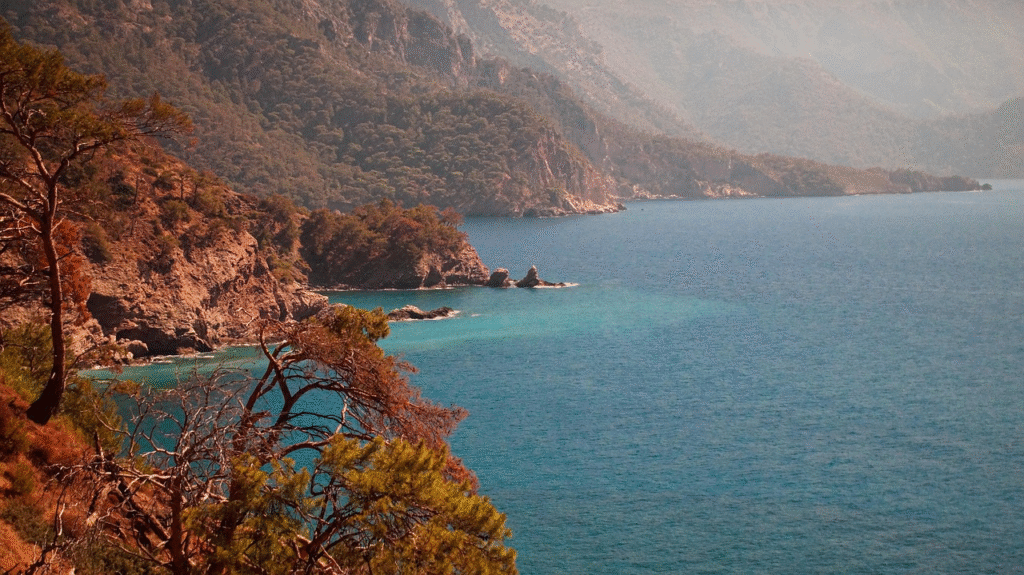
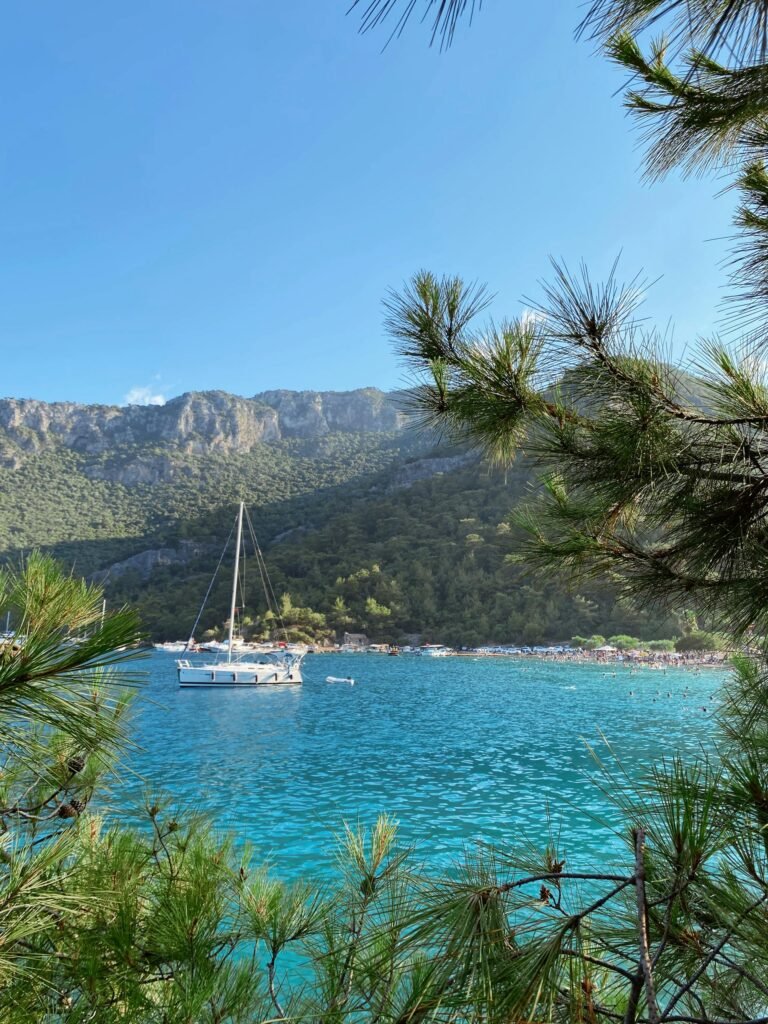
Muğla city sits at 670 meters elevation in a high mountain basin between the Hisar Mountain (1,500 m, immediately north of the city) and the broader Menteşe massif. The province extends southward to the Aegean and Mediterranean coasts, encompassing some of Türkiye’s most spectacular shoreline — pine-forested mountains plunging into turquoise water — and Türkiye’s most-visited coastal resort towns. Major coastal districts within Muğla Province: Bodrum (60 km southwest), Marmaris (50 km south), Fethiye (130 km southeast), Dalyan (75 km south), Datça (140 km southwest on the Datça Peninsula), and Göcek (115 km southeast). Two international airports serve the province: Milas-Bodrum (BJV) in the west and Dalaman (DLM) in the east.
Climate Overview
Muğla city has a mountain-modified Mediterranean climate distinctly different from the coastal resorts. Summer (June–September) is dry and warm with daytime highs of 28–35 °C and cool low-60s overnight; winter (December–February) is cool and wet with daytime highs of 8–14 °C, occasional snow, and overnight lows that can drop below freezing. The coastal resort towns are 5–10 °C warmer year-round and significantly more humid.
Wildfire Season Considerations
The pine-forested coastal mountains of Muğla Province sit in Türkiye’s highest wildfire-risk zone. July–early October is the peak risk season, with conditions worst during the August “poyraz” north-wind events. The catastrophic 2021 Manavgat-Marmaris fires burned over 200,000 hectares; the 2020 and 2025 seasons also brought significant fires affecting tourist regions. Check current advisories from the Disaster and Emergency Management Authority of Türkiye (AFAD) and the General Directorate of Forestry before forested-area trips during summer. Many of the coastal pine forests are now in active recovery and remain visible from yacht charters and coastal roads.
Best Time to Visit
Late April through early June and September through early October are the ideal windows — pleasant temperatures, the wildflowers and pine forests at their most vibrant, lower hotel prices than peak summer, and minimal wildfire risk. July–August is high tourism season for the coast — book accommodation 6+ months in advance and accept the heat. October–November brings cooling weather and the start of the Muğla pine-honey harvest. December–March is the city’s quietest period — useful for the university calendar and cultural events; coastal resorts largely close.
Muğla’s Districts & Neighborhoods
Muğla Province contains 13 districts (ilçe), each with distinct character and tourism profile. For travelers, the working geography is the city center plus the coastal-resort districts.
Menteşe (Muğla City Center)
The provincial capital district, containing the historic Saburhane Ottoman houses, the central market, Sıtkı Koçman University, and the provincial government offices. Most useful base for travelers wanting a cultural-Türkiye experience between coastal segments. The Konakaltı / Saburhane historic district immediately south of central Cumhuriyet Boulevard is the heritage focus.
Bodrum
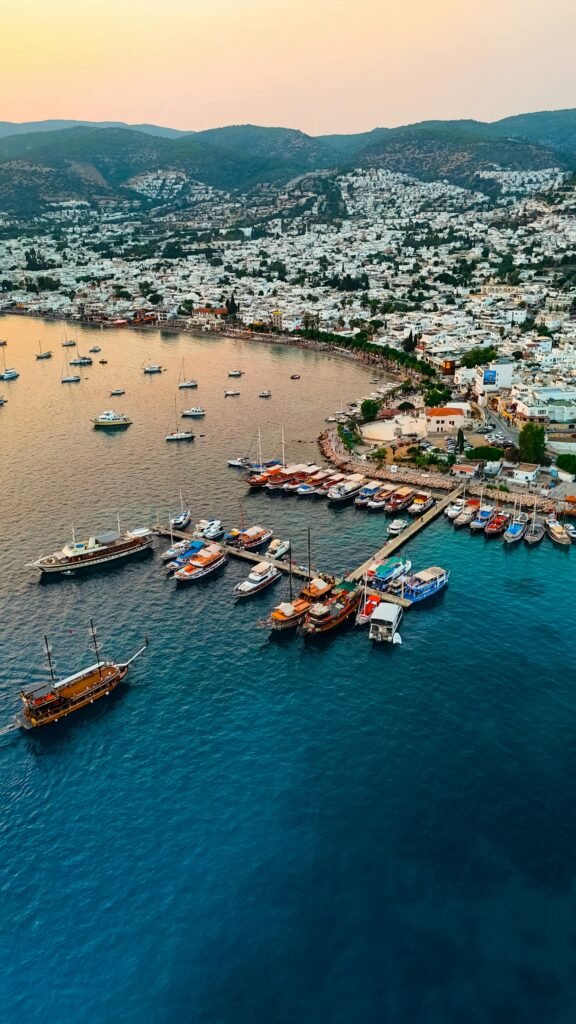
The province’s headline coastal destination — the “St. Tropez of Türkiye,” with whitewashed bougainvillea-draped villas on the Bodrum Peninsula. Bodrum Castle (Castle of St. Peter), the underwater archaeology museum, and the world-class yacht harbor anchor the town. Surrounding peninsula villages: Yalıkavak (luxury yacht marina), Türkbükü (celebrity beach clubs), Gümbet (party-budget), Bitez (mid-range family), Gümüşlük (sunset waterfront dining over the submerged ruins of ancient Myndos).
Marmaris
The province’s second tourism powerhouse — a deep pine-forested bay with a long beach promenade, a 16th-century castle, and a busy nightlife strip. More mass-market than Bodrum; popular with British and Russian package tourists. İçmeler just southwest is the quieter suburb.
Fethiye
The eastern district, anchored by Fethiye town with the picturesque Ölüdeniz Blue Lagoon (one of Türkiye’s most photographed sites), the Lycian Way long-distance hiking trail terminus, and Kayaköy ghost village (abandoned Greek-Orthodox town after the 1923 population exchange). Paragliding from Babadağ Mountain over Ölüdeniz is the signature adventure activity.
Dalyan / Köyceğiz
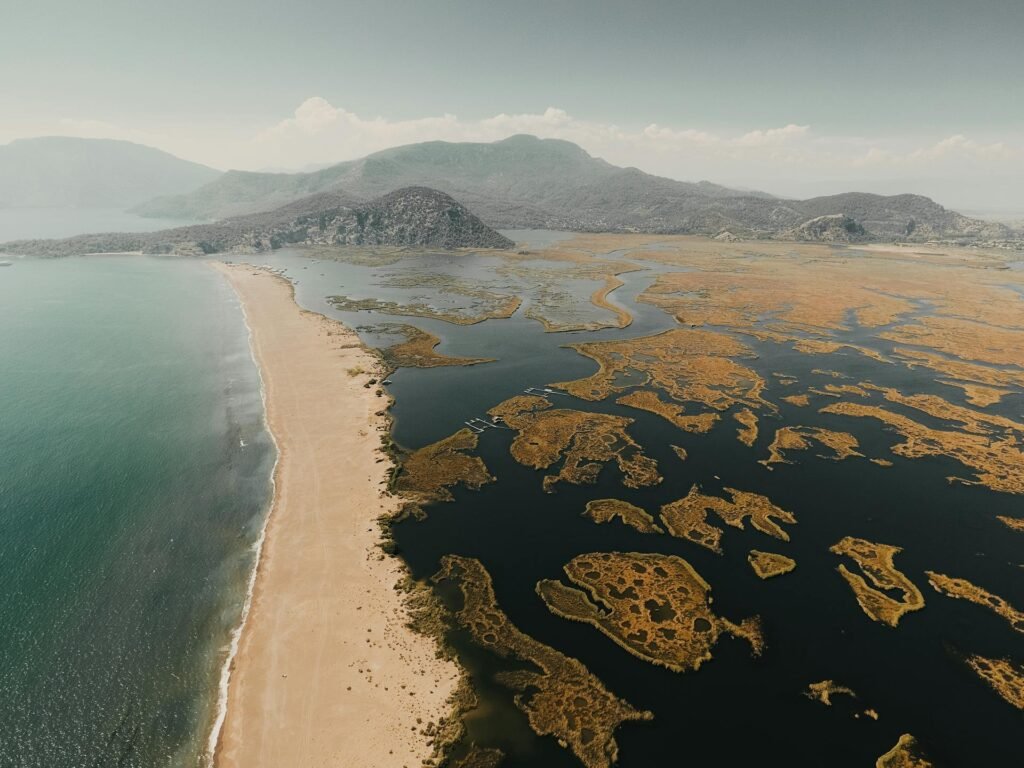
The province’s eco-tourism corner — the Dalyan River winds through reed beds past Lycian rock-cut tombs carved into the cliffs to İztuzu Beach, a protected loggerhead-turtle nesting site. The neighboring Köyceğiz Lake offers tranquil paddling and the Sultaniye Hot Springs.
Datça Peninsula
The narrow 100-km-long pine-forested peninsula that points west toward Greek Kos. Far less developed than Bodrum or Marmaris; the western tip preserves the ruins of ancient Knidos and stunning sunset coves. The peninsula is a sailing destination par excellence — many gulet (Turkish wooden yacht) charters depart from here.
Göcek & the Twelve Islands
The yacht-charter capital of Türkiye — Göcek’s six marinas anchor the country’s “Blue Cruise” tradition, with hundreds of gulets departing for 4-, 7-, and 14-day sailing trips through the protected Göcek Bay and the surrounding island archipelago. Less of a beach-resort town than a sailing-departure port.
Top Things to Do in Muğla
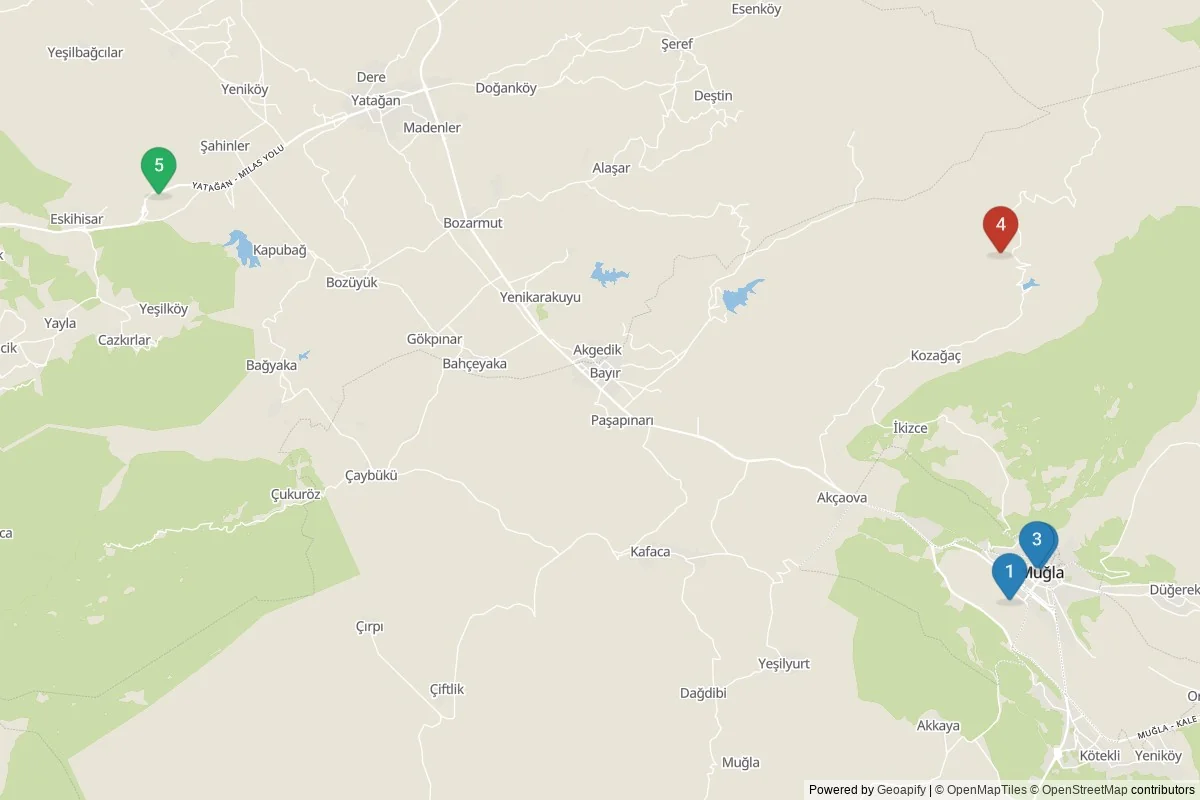
| # | Sight | Cluster | Type | Time | Entry | Best |
|---|---|---|---|---|---|---|
| 1 | Hisar Mountain Climb | Central | Mountain trail | ~2 hrs | Free | Morning |
| 2 | Saburhane Historic District | Central | Old town | ~2 hrs | Free | Anytime |
| 3 | Muğla Museum | Central | Museum | ~1 hr | ₺50 | Morning |
| 4 | Pine-Honey Producer Visit | Outer | Food experience | ~1 hr | Free | Anytime |
| 5 | Stratonicea Ancient City | Far | Ruins | ~2 hrs | ₺50 | Morning |
| 🚗 | Day Trip: Bodrum & Mausoleum | Day trip | Day trip | Full day | ₺200 | Morning |
| 🚗 | Sail Twelve Islands (Göcek) | Day trip | Boat tour | Full day | €60 | Morning |
| 🚗 | Drive the Datça Peninsula | Day trip | Scenic drive | Full day | Fuel | Morning |
1. Walk the Saburhane Historic District
The defining Muğla-city experience: a self-guided morning wander through the whitewashed Ottoman houses of the Saburhane neighborhood. Most are private residences; several have been restored as boutique guesthouses, cafés, and galleries. Vakıflar Hanı (a restored Ottoman caravanserai) and the Konakaltı historic plaza are the formal anchors. Plan 2–3 hours; bring a camera — the iconic black-and-white photograph of Muğla shows the bay-window streetscape in low afternoon light.
2. Visit the Muğla Museum
The provincial archaeological museum displays artifacts from across the Carian and Lycian sites of Muğla Province — pottery, terracotta figures, Roman-era statuary, and the Stratonicea bronze treasure. Modest size but well-curated; admission TRY 90 (~US$3). Two hours.
3. Climb Hisar Mountain
The 1,500-meter peak immediately north of the city. The well-marked 90-minute hiking trail starts at the upper edge of Saburhane and climbs through pine forest to a summit viewpoint over the entire valley. Best at dawn; bring water and proper shoes. Free.
4. Visit a Pine-Honey Producer
Muğla pine honey (çam balı) is a UNESCO-style protected designation product. The province produces an estimated 80% of the world’s pine honey — a deep-amber forest honey produced from the sugary excretions of the Marchalina hellenica scale insect on Turkish pine trees. Marmaris, Fethiye, and the Hisar Mountain forests are the main production regions. Many small producers welcome visitors for tasting and purchase; expect TRY 350–600 per kilo for premium pine honey, with vacuum-sealed export packaging available.
5. Day Trip to Bodrum & the Mausoleum
60 km southwest of Muğla city, Bodrum town is the cultural capital of the Aegean coast. The Mausoleum at Halicarnassus archaeological site — site of one of the Seven Wonders of the Ancient World — preserves the foundation and reconstructed fragments of the 4th-century BCE tomb of Mausolus. The Bodrum Castle of St. Peter houses the world’s most important Museum of Underwater Archaeology, including the recovered Uluburun shipwreck cargo. Combine with sunset at Gümüşlük.
6. Visit Stratonicea Ancient City
30 km west of Muğla, Stratonicea (modern Eskihisar) is one of the largest and best-preserved Hellenistic-Roman city sites in Türkiye, with intact theater, gymnasium, baths, and bouleuterion. Very few tourists; almost no infrastructure. A great alternative to the crowded Ephesus circuit. Free or small entry fee.
7. Sail the Twelve Islands from Göcek
The classic “Blue Cruise” — a 4–7 day sailing trip on a traditional wooden gulet through the Göcek Bay and the protected Twelve Islands archipelago. Daily swimming in turquoise coves, lunch and dinner aboard, occasional shore visits to small fishing villages. Charter prices range from €600 per person for a shared 7-day trip in shoulder season to €5,000+ per person for private high-season luxury charters.
8. Drive the Datça Peninsula
The most scenic single-day drive in southwestern Türkiye — a 100-km route from Marmaris west along the pine-forested Datça Peninsula to the ancient ruins of Knidos. Stop at the Datça town almond-grove plain, the Bayır village viewpoint, and the Palamutbükü beach. Plan 6–8 hours round-trip from Marmaris.
How to Get to Muğla
By Air
No commercial airport in Muğla city itself. The two provincial international airports are:
- Milas-Bodrum Airport (BJV) — 60 km southwest of Muğla city; serves Bodrum and the western half of the province. Direct flights from Istanbul (75 minutes), London, Manchester, Birmingham, Berlin, Munich, Vienna, Moscow, and dozens of European charter routes during summer.
- Dalaman Airport (DLM) — 100 km southeast of Muğla city; serves Fethiye and the eastern half. Direct flights from Istanbul, London, Manchester, Glasgow, Birmingham, Berlin, Stockholm, Helsinki, and other European cities.
From either airport to Muğla city: Havaş airport bus TRY 250–400 (~US$8–13); BiTaksi or Uber Türkiye from BJV TRY 800–1,200 (~US$26–40); rental car TRY 1,500–3,000/day (~US$50–100) — the most flexible option for the broader provincial circuit.
By Long-Distance Bus
The Turkish intercity bus network (Pamukkale Turizm, Kamil Koç, Metro Turizm) connects Muğla city’s Otogar (bus station) to İstanbul (11 hours, overnight, TRY 800–1,400), İzmir (5 hours, TRY 350–600), Antalya (5 hours), and most major Turkish cities. Reliable, comfortable air-conditioned coaches with onboard service.
By Car
Self-drive is the practical default for travelers planning to combine Muğla city with the coastal resorts and ruin sites. From İstanbul: 11 hours via the E87 highway. From İzmir: 4 hours. From Antalya: 5 hours through scenic Lycian Way coast.
By Sea
Yacht and ferry connections from Greek islands: Bodrum ↔ Kos (45 minutes), Marmaris ↔ Rhodes (50 minutes, hydrofoil), Datça ↔ Rhodes (90 minutes, summer only). Multi-day yacht charters from Göcek, Bodrum, and Marmaris are the iconic sea-arrival mode.
Visa Notes
Türkiye offers visa-free entry for 90 days within 180 for citizens of many countries — including Germany, France, the Netherlands, Belgium, Sweden, Norway, Denmark, Finland, Japan, South Korea, Singapore. US, UK, Canadian, Australian, and several other passport holders need an e-Visa available at the official Turkish e-Visa portal — $35–60 fee, processed in minutes online, valid 180 days for stays up to 90 days. Passport must have at least 6 months remaining validity. For longer stays, a short-term residence permit requires application within the first month at the Provincial Directorate of Migration Management.
Getting Around Muğla
Walking
Muğla city center and the Saburhane historic district are genuinely walkable end-to-end — the heritage quarter is roughly 1 km × 0.5 km, with steep streets at the foot of Hisar Mountain. Coastal resort towns vary; Bodrum, Marmaris, and Fethiye centers are walkable but reaching surrounding villages requires transport.
Local Buses (Dolmuş)
The Turkish dolmuş (shared minibus) is the workhorse of provincial transit. Fixed routes, fixed fares (typically TRY 25–60), pay the driver in cash as you exit. Routes connect Muğla city center to Bodrum, Marmaris, Fethiye, Dalaman, and all coastal resort villages. Dolmuş departures are continuous (every 15–30 minutes) on busy routes during the day.
Ride-Hailing & Taxis
BiTaksi is the dominant taxi-hailing app in Türkiye (Uber has limited operation). Metered taxis run a TRY 25 flagfall plus TRY 18/km — significantly cheaper than European norms but check the meter is running. Most drivers do not speak English; have your destination written down in Turkish or saved in maps.
Self-Drive Rentals
Car rental is the most practical option for the broader provincial circuit. International chains (Avis, Europcar, Hertz, Budget) at Bodrum and Dalaman airports; local operators offer significantly cheaper rates (TRY 1,000–2,500/day for an automatic compact). Türkiye drives on the right; roads are generally good with summer-tourist-season congestion on coastal stretches.
Domestic Flights & Yacht Charters
For provincial-internal travel, the Bodrum–Dalaman ferry (or driving the 200-km coastal route) is more common than internal flights. Yacht charters from Göcek, Bodrum, and Marmaris are both transport and destination — see “Sail the Twelve Islands” above.
Food & Drink in Muğla
Muğla’s cuisine sits at the intersection of Aegean Turkish and Mediterranean traditions — olive oil-based zeytinyağlı vegetable dishes, fresh-caught seafood, the area’s celebrated honey and almond products, and the broader Turkish breakfast (kahvaltı) culture. The coastal districts add international tourist menus on top; the inland city retains a more authentic Türkiye-Aegean character.
What to Try
- Muğla pine honey (çam balı) — the regional specialty; deep amber, less sweet than flower honey, with a distinctive pine-resin finish. Eat with fresh white cheese (beyaz peynir) and crusty bread for breakfast.
- Aegean otlu mezeler — wild herb mezzes; çiriş otu (asphodel), sirken (lamb’s quarters), radika (chicory) sautéed in olive oil with lemon. The Aegean-coast cuisine signature.
- Tarhana çorbası — fermented tarhana (yogurt-tomato-pepper-wheat) soup; the region’s classic winter starter.
- Şiş kebap and Adana kebap — grilled lamb skewer staples; the Köşk Restaurant in Bodrum and several Muğla-city ocakbaşı (charcoal-grill) restaurants do excellent versions.
- Köfte — Turkish meatballs; the local Muğla köftesi is herb-rich and small.
- Aegean seafood — sea bream (çipura), sea bass (levrek), red mullet (barbun), grilled with olive oil and lemon. Fethiye Fish Market is the spectacle — buy from the central fishmonger, take it to the surrounding restaurants for cooking.
- Aegean meze platter — eggplant salad (patlıcan salatası), yoghurt-walnut paste (haydari), spicy tomato dip (ezme), grilled octopus (ahtapot ızgara).
- Datça almonds — the peninsula’s signature crop; raw, roasted, or in marzipan products.
- Sıkma — flatbread filled with cheese, parsley, and herbs; the regional breakfast.
Where to Eat
Muğla city center: traditional ocakbaşı restaurants in the Saburhane district for grilled meats; Vakıflar Hanı courtyard for atmospheric mezze evenings. Bodrum: Otantik for traditional Turkish, Memedof for the best fine-dining Aegean cuisine, Cooks Bodrum for international, Mezze Bar for tapas-style. Marmaris: Liman Restaurant for waterfront seafood, Karabağlar Yaylası for highland-village specialties. Fethiye Fish Market: pick your fish, choose a restaurant to cook it, eat at communal tables. Datça: Datçalım for almond-and-honey local specialties.
Drinks
Turkish tea (çay) — served everywhere in tulip-shaped glasses with cube sugar; the social fabric of Turkish life. Turkish coffee (Türk kahvesi) — UNESCO-recognized intangible cultural heritage; served unfiltered with grounds and accompanied by a sip of water. Rakı — the national anise-flavored spirit; the “lion’s milk” drunk diluted with water alongside meze. Local wines: the Aegean coast produces respectable Türkiye wines — Sevilen and Kayra are the most-distributed labels; smaller boutiques like Suvla and Urla Şarapçılık are worth seeking out. Ayran — salty yogurt drink; the perfect summer accompaniment to kebabs.
A Note on Tap Water
Tap water in Muğla city is treated to drinking-water standard, but most travelers and even some locals use sealed bottled water (TRY 8–20 per 1.5-liter bottle at any market) due to older building plumbing. Reusable filter bottles (LifeStraw, Grayl) work well across Türkiye. The CDC traveler health page for Türkiye recommends bottled or filtered water for foreign visitors as a precautionary default. Reputable hotel and restaurant ice is generally safe. Traveler’s diarrhea is occasional but uncommon; eat at busy restaurants and avoid raw shellfish on hot days.
Frequently Asked Questions About Visiting Muğla
Do I need a visa to visit Muğla?
It depends on your passport. Türkiye offers visa-free entry for 90 days within any 180-day period for citizens of many countries — including Germany, France, the Netherlands, Spain, Italy, Sweden, Norway, Denmark, Belgium, Switzerland, Japan, South Korea, Singapore, and Malaysia. US, UK, Canadian, Australian, Indian, Chinese, and several other passport holders need an e-Visa obtained at the official Republic of Türkiye e-Visa portal — fee $35–60 (varies by nationality), processed within minutes online, valid for 180 days from issue for single or multiple entry, stays up to 90 days. Common mistakes: using unofficial third-party visa websites that charge 200–400% premiums; arriving with a passport with less than 6 months remaining validity; assuming the old “visa on arrival” sticker still works (it has been replaced by e-Visa for most travelers). Print two copies of the e-Visa approval to show at airline check-in and Turkish immigration. For longer stays, a short-term residence permit (1- or 2-year) requires application within the first month of arrival at the Provincial Directorate of Migration Management — significant documentation and a TRY 2,000–3,500 fee.
Is Muğla safe for tourists?
Muğla Province is broadly safe — Türkiye’s southwest tourist belt has very low rates of violent crime against foreigners, and the area is a long-standing favorite of British, German, Dutch, and Russian travelers. The US State Department rates Türkiye at “exercise increased caution” — primarily for the eastern border regions with Syria, Iraq, and Iran, not the western Aegean coast. Real risks in Muğla Province: wildfire season July–early October — monitor advisories during summer travel; scooter and motorbike accidents — Türkiye has high road-death rates, especially in coastal resort areas with international riders unused to local driving; jet-ski and parasailing injuries at Bodrum, Marmaris, and Ölüdeniz; jellyfish and sea-urchin at certain beaches; petty theft and pickpocketing in tourist crowds (especially Bodrum and Marmaris bazaars); scam currency exchange at unlicensed booths near tourist beaches (use bank ATMs or licensed exchange counters); traffic accidents on the curvy coastal roads. Earthquake risk: southwestern Türkiye sits in an active seismic zone; the 2020 Aegean (Samos) earthquake caused damage in İzmir; building standards have been significantly strengthened post-1999 but older budget hotels in coastal resorts may not meet current codes. Drug laws: Türkiye imposes harsh penalties for any quantity; do not bring even prescription opioids without proper documentation.
How many days do I need in Muğla?
Two days handles Muğla city itself; combined with the broader provincial coastal circuit, 7–14 days makes a satisfying southwestern Türkiye trip. A solid 7-day Muğla Province plan: Day 1 — Muğla city (Saburhane historic district + Muğla Museum + Hisar Mountain hike). Day 2 — Bodrum (Castle of St. Peter + Mausoleum + sunset at Gümüşlük). Day 3 — Pamukkale (the white-travertine springs, 200 km north — a long day trip) or rest day at a Bodrum-area beach. Day 4 — Datça Peninsula drive (almond orchards + Knidos ancient ruins + Palamutbükü beach). Day 5 — Marmaris (boat tour to nearby coves + Bay of Marmaris). Day 6 — Dalyan (turtle beach + rock-cut tombs + mud baths). Day 7 — Fethiye (Ölüdeniz Blue Lagoon + paragliding option from Babadağ). For yacht charters: replace days 5–7 with a 4-day Blue Cruise out of Göcek. Add days for Lycian Way hiking, Knidos and Stratonicea archaeological exploration, or onward to Antalya. Day-trip Muğla: feasible from Bodrum or Marmaris but feels rushed.
What’s the best area to stay in Muğla?
For cultural-Türkiye travelers, Muğla city center (Saburhane historic district) — restored Ottoman houses converted to boutique guesthouses (Saburhane Konağı, Beyaz Şehir Konukevi, Muğla Old Town) at TRY 1,200–2,500/night (US$40–85); excellent value and a genuine experience of provincial Türkiye. For coastal travelers, the choice depends on style: Bodrum town for whitewashed-village character with international amenity (TRY 2,500–6,000/night); Yalıkavak on Bodrum Peninsula for luxury yacht-marina sophistication (TRY 4,000–18,000/night); Türkbükü for celebrity beach clubs; Bitez for family-friendly mid-range; Marmaris town for nightlife-and-package-tour atmosphere (TRY 1,500–4,000/night); İçmeler for a quieter Marmaris alternative; Fethiye for a relaxed yacht-and-paraglide town (TRY 2,000–4,500/night); Ölüdeniz for direct beach access; Kayaköy for ghost-village atmospheric stays; Dalyan for river-and-turtle-beach (TRY 1,800–4,000/night); Datça town for off-the-beaten-track Mediterranean tranquility. Skip: undifferentiated cheap hotels in Gümbet party-zone unless that’s specifically what you want.
How much does it cost to visit Muğla’s major sights?
Muğla Province is one of the best-value European-quality destinations — but high inflation in Türkiye means prices change significantly month-to-month. Muğla Museum: TRY 90 (~US$3). Bodrum Castle & Museum of Underwater Archaeology: TRY 700 (~US$23). Mausoleum at Halicarnassus: TRY 120 (~US$4). Stratonicea ancient site: TRY 60. Knidos ancient site: TRY 60. Ölüdeniz beach entrance: TRY 80 (~US$2.50). Kayaköy ghost village: TRY 100. Babadağ paragliding: TRY 6,500–10,000 (US$215–330) per person tandem flight. Pine-honey jar (premium 1 kg): TRY 350–600. Boat tour from Marmaris: TRY 1,200–2,500 per person (full-day, with lunch). Blue Cruise gulet charter shared cabin: €600–1,800 per person for 4–7 days. Local meals: Turkish breakfast TRY 250–500 per person; sit-down kebab dinner TRY 400–800 per person; mid-range coastal seafood dinner TRY 1,000–2,500 per person; fine-dining TRY 2,500–6,000+ per person. Dolmuş Muğla–Bodrum: TRY 100–180. Rental car: TRY 1,500–3,000/day. Overall daily budget: TRY 1,500 (frugal Muğla city), TRY 5,000 (mid-range coastal), TRY 25,000+ (luxury Bodrum villa-and-yacht).
Should I drink the tap water in Muğla?
Tap water in Muğla city and the coastal resort towns is treated to drinking-water standard by the municipal authorities, but most Turkish people and nearly all foreign visitors stick to sealed bottled water as a practical default. Reasons: older building plumbing in heritage and budget hotels can re-contaminate municipal water; mineral content varies and can cause stomach upset for travelers; some smaller-town supplies have intermittent treatment quality. Bottled water costs TRY 8–25 per 1.5-liter bottle at any supermarket or konak (corner shop); major brands include Erikli, Sırma, Pınar, Hayat, and Damla. Reusable filter bottles (LifeStraw, Grayl) work well in Türkiye. Reputable hotel and restaurant ice is generally safe; avoid ice from beach stalls. The CDC traveler health page for Türkiye recommends bottled or boiled water for foreign visitors as a precautionary default. Traveler’s diarrhea is occasional but uncommon in coastal-resort areas where food turnover is rapid; raw shellfish carries higher risk in summer heat.
What payment methods work in Muğla — should I bring cash or use cards?
Mix of both, with high inflation making rate-tracking important. Credit cards (Visa, Mastercard, AmEx, JCB): widely accepted at hotels, restaurants, supermarkets, and most retail in Muğla city and coastal resorts; less commonly accepted at small village restaurants, beach beverage shacks, and traditional artisan shops. Turkish lira (TRY): essential for taxis, dolmuş, market stalls, smaller restaurants, and tipping. EUR and USD acceptance: many coastal-resort businesses (especially Bodrum, Marmaris, Fethiye) quote in or accept EUR or GBP directly — typically at slightly worse rates than official exchange, but practical for tourists. ATMs: bank-branch ATMs at Garanti, İş Bankası, Ziraat, Yapı Kredi accept foreign cards with TRY 5,000–15,000 daily withdrawal limits and a TRY 50–120 international fee plus your home bank’s. Currency exchange: official döviz büfeleri (exchange counters) offer the best rates — significantly better than airport and hotel exchange; bring USD or EUR in clean bills (high-denomination notes get better rates). Mobile payment: Papara, Garanti BBVA Mobile, and similar Turkish bank apps dominate locally but require a Turkish bank account. Inflation note: Turkish lira has lost significant value against EUR/USD/GBP since 2021 — withdraw smaller amounts more frequently rather than large lump sums; use credit cards for big purchases to lock the rate at transaction time. Tips: 10% in restaurants where service is not already included; round up taxi fares; TRY 50–200 per day for hotel housekeeping; TRY 100–500 for tour guides and drivers.
What about wildfire season — should I avoid summer travel?
The pine-forested coastal mountains of Muğla Province sit in Türkiye’s highest wildfire-risk zone. The summers of 2020, 2021, and 2025 brought catastrophic fires that affected tourist regions including Marmaris, Bodrum Peninsula, and the Datça forests. Peak risk: late July through mid-September, worst during August poyraz wind events. What this means for travelers: visibility, air quality, and forest hiking can be affected for periods of days to weeks; very rarely have tourist coastal resorts been directly evacuated, but it has happened (Bodrum-area villages, 2021). Practical precautions: book travel insurance that explicitly covers wildfire-related cancellations and re-routes; monitor AFAD (Disaster and Emergency Management Authority) for current advisories; avoid driving on forested mountain roads during kızıl bayrak (“red flag”) high-fire-danger days; do not start fires of any kind in forested areas (cigarette butts in dry pine needles cause many incidents). Should you avoid summer entirely?: no — Bodrum, Marmaris, and Fethiye remain extremely popular summer destinations with millions of European tourists annually, and the coastal towns themselves are largely fire-safe. But if smoke-affected views or potential disruption would seriously impact your trip, shoulder seasons (late April–early June and September–early October) are dramatically lower risk with arguably better weather.
Education & Notable People
Muğla city is the home of one of Türkiye’s most respected provincial universities, and the province has produced significant figures in Turkish politics, business, and the arts.
Major Universities
- Muğla Sıtkı Koçman University (MSKU) — the provincial flagship public university, founded 1992 and named after a major local benefactor; approximately 45,000 students across 12 faculties. Particularly strong in tourism, marine sciences, and forestry; an architecturally striking campus on the southern outskirts of Muğla city.
- Various vocational and tourism colleges — serving the hospitality industry of the coastal districts.
Notable People
Mausolus — 4th-century BCE satrap of Caria, whose tomb at ancient Halicarnassus (modern Bodrum, within Muğla Province) gave the world the term “mausoleum.” His sister-wife Artemisia II commissioned and completed the monumental tomb. Cevat Şakir Kabaağaçlı (Halikarnas Balıkçısı) — the “Fisherman of Halicarnassus,” exiled to Bodrum in the 1920s, whose memoir-essays defined the literary mythology of the Bodrum Peninsula. Necati Cumalı — celebrated Turkish poet, novelist, and playwright, born in Florina (now Greece) but a long-time resident of the Aegean coast. Bülent Ersoy — iconic Turkish classical singer and one of the country’s most famous transgender personalities; long-term resident of the province. Sıtkı Koçman — businessman and philanthropist who provided the founding endowment for the eponymous university.
Sister Cities & International Relations
Muğla’s sister-city network reflects the province’s strong tourism-and-cultural-exchange identity, with relationships concentrated in European Mediterranean and coastal port cities that resemble its character. Coastal districts maintain their own additional twinning relationships.
Muğla city and province’s sister and friendship cities include (selection):
- Rhodes, Greece — geographically the closest Greek island and the natural cross-Aegean partner; longstanding cultural exchange.
- Kos, Greece — sister to Bodrum District; the closest Greek island to the Bodrum Peninsula (45-minute ferry).
- Kavala, Greece — friendship city based on shared Aegean port character.
- Nantes, France — university-and-cultural partnership.
- Erlangen, Germany — university-twinning relationship.
- Strumica, North Macedonia — friendship city.
- Khujand, Tajikistan — Turkic-cultural friendship link.
Bodrum and Marmaris maintain additional active sister relationships with British, German, Dutch, and Russian tourism-source cities, reflecting the dominant nationality markets for coastal tourism. The province is a member of the Aegean Free-Trade Zone cooperation framework and participates in EU-funded cross-border programs with Greek Dodecanese island administrations. Muğla’s Sıtkı Koçman University maintains Erasmus exchange agreements with over 200 European partner institutions.
AFRIKA
Cairo Hurghada Johannesburg Marrakech
ASIA
Abu Dhabi Agra Antalya Bangkok Batam Beijing Bengaluru Cebu City Chiang Mai Chiba Chennai Da Nang Dammam Delhi Denpasar Dubai Fukuoka Guangzhou Guilin Ha Long Hanoi Ho Chi Minh City Jakarta Jaipur Johor Bahru Kolkata Krabi Kuala Lumpur Kyoto Macau Mecca Medina Mugla Mumbai Osaka Pattaya Penang Phuket Riyadh Seoul Shanghai Shenzhen Singapore Taipei Tokyo Zhuhai
EUROPE
Amsterdam Athens Barcelona Berlin Brussels Budapest Copenhagen Dublin Florence Frankfurt am Main Heraklion Krakow Lisbon London Madrid Milan Munich Nice Paris Porto Prague Rhodes Rome Stockholm Venice Vienna Warsaw
NORTH AMERICA
Cancun Las Vegas Los Angeles Miami New York City Orlando San Francisco Toronto Vancouver
SOUTH AMERICA
Buenos Aires Lima Rio De Janeiro
OCEANIA
Auckland Honolulu Melbourne Sydney