
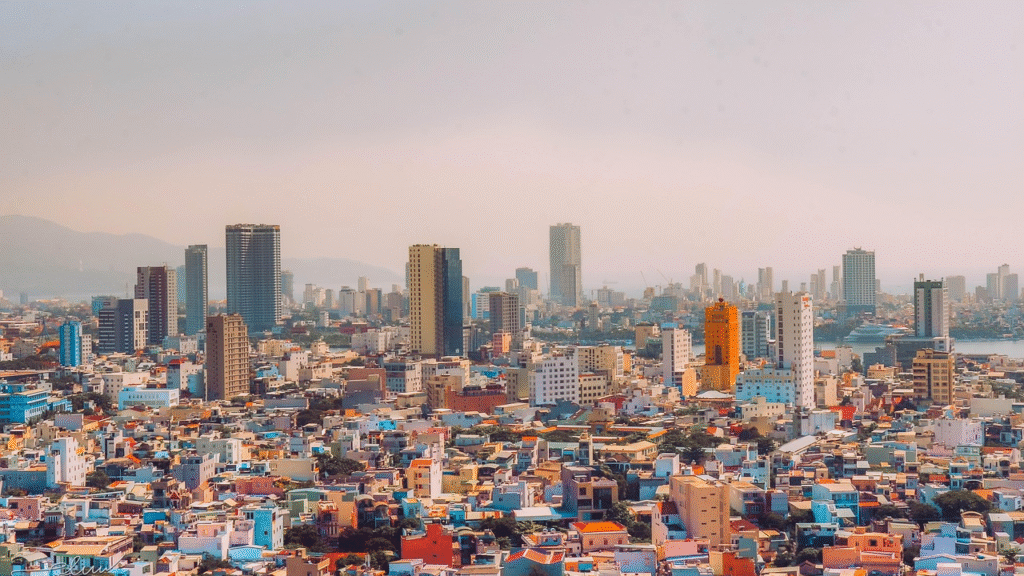
Photo credit: Da Nang’s modern skyline at dusk along the Han River
Da Nang is the third corner of Vietnam — the country’s most ambitious mid-size city, sitting at the geographical and cultural midpoint between Hanoi’s Confucian north and Ho Chi Minh City’s commercial south. Once a sleepy port town that served as the main American military base during the Vietnam War (the famous “China Beach“), Da Nang has reinvented itself over the past two decades as Vietnam’s most livable major city: 30 kilometers of broad sandy beaches, a fully modernized international airport, the country’s most architecturally ambitious bridges (the fire-breathing Dragon Bridge, the cable-stayed Tran Thi Ly Bridge), and now the global Instagram phenomenon of Ba Na Hills’ Golden Bridge — the surreal pedestrian span held aloft by two giant stone hands. Add the cultural day-trip pair of UNESCO Hoi An (30 km south) and UNESCO My Son (40 km southwest), the misty Marble Mountains, and a food culture built on the Cham-Vietnamese fusion of central Vietnam, and Da Nang earns its growing reputation as Southeast Asia’s emerging high-quality-of-life destination.
Da Nang by District: The 6 Quận
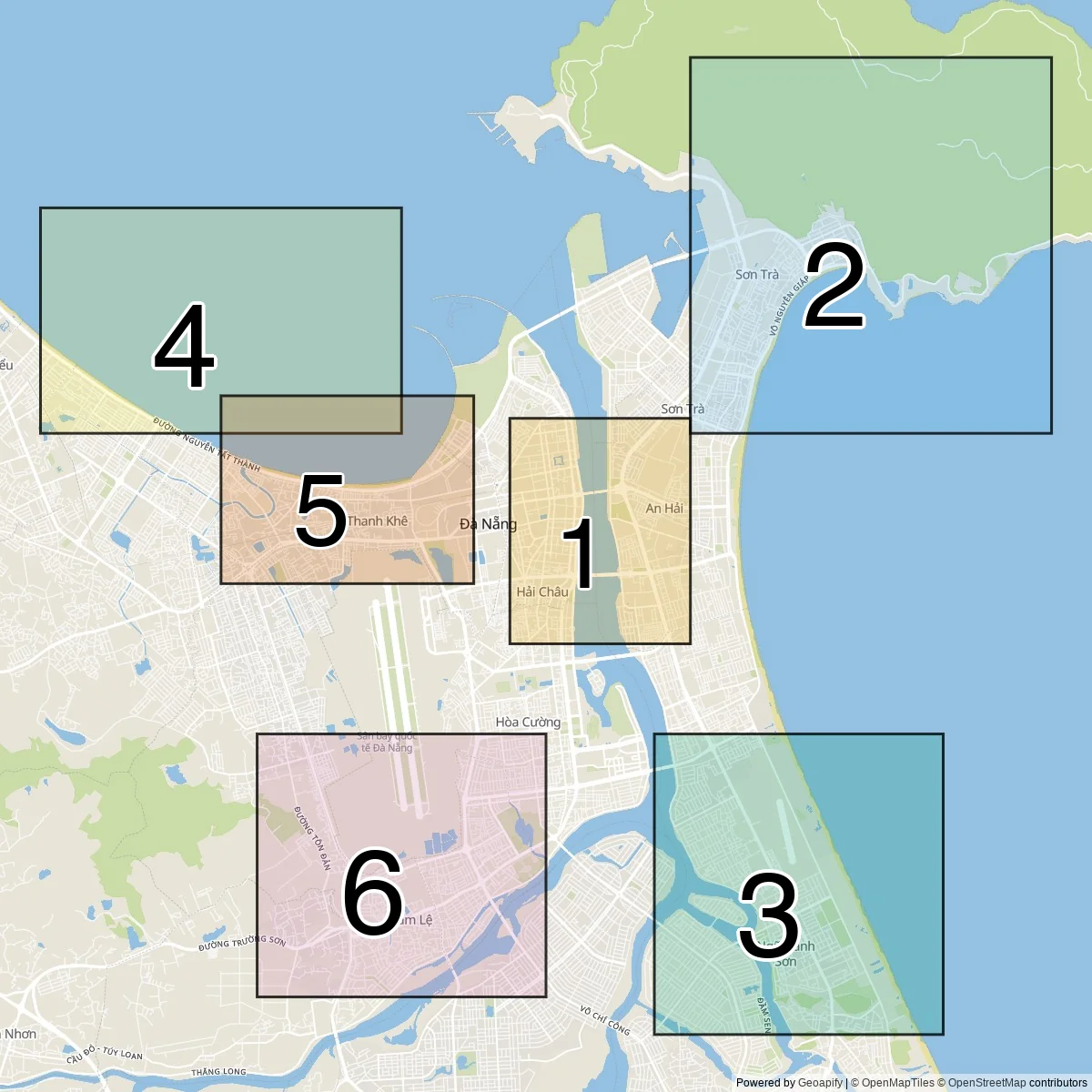
Da Nang is divided into 6 urban districts. The map below shows their official OSM boundaries, colour-coded to match the table — a quick way to orient yourself before zooming in on individual sights.
| # | Quận |
|---|---|
| 1 | Hải Châu · Hải Châu (Centre) |
| 2 | Sơn Trà · Sơn Trà (Peninsula) |
| 3 | Ngũ Hành Sơn · Ngũ Hành Sơn (Marble Mts.) |
| 4 | Liên Chiểu · Liên Chiểu (North) |
| 5 | Thanh Khê · Thanh Khê (West) |
| 6 | Cẩm Lệ · Cẩm Lệ (South-W) |
Da Nang at a Glance: Essential Facts for Travelers
Da Nang: Key Facts & Tourism Statistics
| International arrivals | 4.1 million (2024, international visitor arrivals) — Da Nang Department of Tourism, 2024 results |
|---|---|
| Population | 1.25 million (2023, General Statistics Office of Vietnam) |
| Best time to visit | February, March, April, May and June |
| Airport to city centre | Taxi/Grab (from DAD): ~15 min, ~US$5 |
| Currency | Vietnamese dong (VND) |
| Time zone | UTC+7 (ICT) |
| Visa | Vietnam issues 90-day e-visas to all nationalities; several European countries are visa-free for 45 days. |
How many tourists visit Da Nang per year?
Da Nang recorded 4.1 million international visitor arrivals in 2024, according to Da Nang Department of Tourism, 2024 results.
What is the best time to visit Da Nang?
The most comfortable months to visit Da Nang are typically February, March, April, May and June, based on 1991–2020 climate normals for temperature and rainfall.
How do I get from the airport to central Da Nang?
The Taxi/Grab (from DAD) takes about 15 minutes to the city centre for about US$5 (airport is ~3 km from centre).
What currency is used in Da Nang?
Da Nang uses the Vietnamese dong (VND); the local time zone is UTC+7 (ICT).
Do I need a visa to visit Da Nang?
Vietnam issues 90-day e-visas to all nationalities; several European countries are visa-free for 45 days.
How many people live in Da Nang?
Da Nang has a population of about 1.25 million (city, before the 2025 administrative merger with Quang Nam), per General Statistics Office of Vietnam (2023).
Da Nang climate: monthly averages (1991–2020)
| Month | Avg high | Avg low | Rain |
|---|---|---|---|
| Jan | 23.5 °C | 19.7 °C | 172 mm |
| Feb | 24.7 °C | 20.3 °C | 88 mm |
| Mar | 27 °C | 22.2 °C | 83 mm |
| Apr | 29.6 °C | 24.3 °C | 75 mm |
| May | 31.5 °C | 26 °C | 113 mm |
| Jun | 32.7 °C | 26.9 °C | 80 mm |
| Jul | 32.4 °C | 26.7 °C | 110 mm |
| Aug | 31.9 °C | 26.4 °C | 146 mm |
| Sep | 29.9 °C | 25.4 °C | 293 mm |
| Oct | 27.5 °C | 23.9 °C | 404 mm |
| Nov | 25.9 °C | 22.7 °C | 432 mm |
| Dec | 23.8 °C | 20.7 °C | 340 mm |
Data last verified: 2026-09-01 · Climate: Open-Meteo ERA5 reanalysis, monthly normals computed from daily data 1991–2020 · Sources: Da Nang Dept. of Tourism (arrivals) · GSO Vietnam (population) (primary source) · World’s most visited cities · Methodology
Upcoming Events in Da Nang
| Date | Title | Details |
|---|---|---|
| 2026-09-23 to 2026-09-26 | Hoi An Mid-Autumn Festival and International Lantern Festival | Hoi An’s ancient quarter, now part of Da Nang city, celebrates the Binh Ngo Mid-Autumn Festival across its central wards with a programme that this year includes an international lantern festival gathering works from Vietnamese and overseas makers. Expect the Heavenly Dog dance competition, lion dance performances, mooncake displays, lantern parades and illuminated lantern streets, plus lantern-making contests, art shows and cultural exchanges. Most street activities are free to enjoy, and evenings are the most atmospheric time to visit, when thousands of lanterns light the heritage streets. [Source] |
| 2026-09-24 | Hoi An Full Moon Lantern Festival | On the fourteenth night of each lunar month, Hoi An’s old town dims its electric lights and lets thousands of silk lanterns take over, and the September edition falls on the eve of the Mid-Autumn Festival, traditionally the busiest and most magical of the year. From early evening the pedestrianised streets fill with candlelit processions, folk games and music, while visitors release small paper lanterns onto the Hoai River. Strolling the old town is free; boat rides and floating lanterns cost a small fee. Arrive before sunset to secure a riverside spot. [Source] |
| 2026-09-25 | Mid-Autumn Festival (Tet Trung Thu) | The Mid-Autumn Festival, or Tet Trung Thu, is a beloved family celebration held across Da Nang in late September, when children carry colourful lanterns, lion-dance troupes perform in the streets and families share mooncakes. Markets fill with lanterns, masks and toys in the run-up, and public spaces host performances and activities for young ones. It is one of Vietnam’s most cheerful festivals, centred on children and the harvest moon. Most street festivities are free to enjoy, and it offers visitors a warm glimpse of local tradition and community life. [Source] |
| 2026-10-02 to 2026-10-04 | Vietnam Latin Xperience 2026 | Da Nang’s beachfront turns Latin for a long weekend as the Vietnam Latin Xperience returns with three days of salsa, bachata, kizomba and urban kiz. Based at the VOCO Ma Belle hotel by Son Tra Beach, the festival packs in workshops and bootcamps with international instructors, daily social parties, beach and pool parties and late-night dancefloors with guest DJs. Full passes cover all workshops and parties, and the crowd mixes dancers from across Asia with local enthusiasts. Beginners are welcome at introductory classes. [Source] |
| 2026-11-23 to 2026-12-07 | Vietnam Cultural Heritage Day Celebrations in Hoi An | Hoi An Ancient Quarter hosts two weeks of activities celebrating Vietnam Cultural Heritage Day, the national commemoration held around 23 November each year. The programme in the UNESCO-listed old town typically spans folk performances, craft demonstrations, exhibitions and community events that showcase the trading port’s centuries-old traditions, from lantern making to bai choi singing. Most activities are free and staged in the streets and heritage houses of the pedestrian quarter. It is a rewarding time for culture-minded visitors to explore the ancient town beyond its everyday sightseeing routine. [Source] |
| 2026-12-04 to 2026-12-06 | Da Nang Christmas Market at Ariyana Convention Centre | The Ariyana Convention Centre beside the My Khe beachfront hosts the Da Nang Christmas Market for one festive weekend, bringing holiday stalls, seasonal food and drink, gift shopping and family entertainment to the city’s premier events venue. The market draws the city’s international community and local families alike, with Christmas music, photo spots and activities for children creating a cheerful early-December atmosphere in the tropics. Entry arrangements and stall offerings vary by day, and the market makes an easy addition to an early-December beach break. [Source] |
City News in Da Nang – last 14 days
| Date | Category | Headline | Details |
|---|---|---|---|
| 2026-09-14 | Public safety | Tropical depression brings flood and landslide risk to central Vietnam | A tropical depression making landfall in central Vietnam is forecast to bring heavy rain, flooding and landslides across a wide area through September 16, with Da Nang directly in the affected zone. Authorities have warned residents in low-lying districts and along rivers to prepare for rising waters, while mountainous areas face landslide risk after days of saturating rain. The system follows an unusually wet stretch for the region, and officials are monitoring reservoirs and hydropower operations closely as forecasts keep the alert level high. [Source] |
| 2026-09-14 | Public safety | Sudden squall tears through the city, damaging structures | A sudden squall swept through the city with gusts powerful enough to tear an inflatable structure loose near the Han River, topple an electricity pole and knock over people travelling on the road. Videos of the incident spread quickly online, showing debris flying as riders struggled to stay upright. The damage was reported as crews moved in to clear affected streets, and the episode came amid a spell of unstable weather over central Vietnam that has kept residents and authorities on alert. [Source] |
| 2026-09-13 | Public safety | Heavy rain triggers landslides and overnight evacuations | Torrential rain sent soil and rocks spilling onto roads in parts of the city and forced dozens of households to evacuate, as authorities moved residents out of danger zones during the night. Emergency crews worked to clear debris from affected routes while officials assessed slopes at risk of further slippage. Flooding accumulated at low-lying points across several neighbourhoods before beginning to recede once the heaviest downpours passed. The evacuations highlight how vulnerable hillside and suburban areas remain during the region’s autumn storm season. [Source] |
| 2026-09-12 | Local government | Hydropower plants ordered to prevent artificial floods downstream | With heavy rain falling across the region, the city has ordered hydropower plant operators upstream not to release water in ways that could create artificial floods for communities downstream. Operators are expected to follow reservoir procedures, coordinate discharge timing with local authorities and give residents adequate warning before any release. The instruction reflects hard lessons from past flood seasons, when sudden discharges worsened inundation in low-lying districts. Officials are also requiring localities along the rivers to keep watch on water levels around the clock. [Source] |
| 2026-09-14 | Business | City eyes multi-million-dollar incentives for AI and chip projects | The city is preparing a package of incentives worth millions of dollars to attract artificial intelligence and semiconductor projects, underlining its ambition to become central Vietnam’s technology hub. The proposed support is aimed at chip design, AI development and related high-tech investment, complementing the city’s push to train engineers and build dedicated infrastructure for the sector. Da Nang has courted international technology firms intensively in recent years, and the incentive plan signals how seriously the city intends to compete for major projects. [Source] |
| 2026-09-14 | Business | EAGLE FTZ positioned as gateway for high-tech investment | A new free trade zone initiative known as EAGLE FTZ is being positioned as a gateway for high-tech investment in the central Vietnam hub, offering international companies a platform for manufacturing, logistics and research activities. The zone concept is part of the city’s broader strategy to diversify beyond tourism into semiconductors, digital industries and advanced production. Preferential policies and streamlined procedures are intended to draw both foreign and domestic investors, and the project adds momentum to the push for a stronger industrial base. [Source] |
| 2026-09-13 | Business | Cooperation deal signed with Japanese partner on materials development | The city has signed a cooperation agreement with a Japanese partner on materials development, deepening economic ties with Japan and adding another building block to its high-tech ambitions. The deal covers collaboration on developing advanced materials, an area seen as strategically important for the semiconductor and manufacturing industries the city is trying to attract. Japanese companies are already among the most active foreign investors in the region, and the agreement is expected to open doors for further joint research and industrial projects. [Source] |
| 2026-09-14 | Business | Tuyen Son complex cleared to sell 518 apartments | The Tuyen Son housing and services complex has been declared eligible to open sales of 518 apartments, clearing a key legal hurdle for one of the city’s notable residential projects. The confirmation means buyers can now sign purchase contracts with the developer under Vietnam’s regulations for future-formed housing, which require projects to meet infrastructure and licensing conditions before units go on the market. The release adds significant new supply to the local property market, where demand for well-located apartments has remained solid. [Source] |
| 2026-09-14 | Local government | Public investment disbursement climbs into national top five | Da Nang has climbed into the top five nationally for disbursement of public investment capital, driven by a set of major projects that have kept construction money flowing on schedule. Strong disbursement is closely watched in Vietnam as a measure of administrative effectiveness, since delayed payments frequently stall infrastructure works. The city’s performance reflects pressure from leaders to accelerate site clearance and contractor payments on key transport and urban projects, and it strengthens the case for further central government funding in coming years. [Source] |
| 2026-09-14 | Local government | City deepens council cooperation with Savannakhet in Laos | A delegation from the city has met counterparts from Savannakhet province in Laos to strengthen cooperation and share experience on the work of elected People’s Councils. The exchange continues a long-standing friendship between Da Nang and Lao localities, part of the wider relationship between the two neighbouring countries. Sharing know-how on how local councils organise their oversight and decision-making is a regular feature of such visits, and both sides used the meeting to reaffirm plans for continued collaboration between their legislative bodies. [Source] |
| 2026-09-14 | Public transport | Residents frustrated as inner-city road works drag on | Residents living along an inner-city road are voicing frustration over construction work that has dragged on far longer than expected, leaving the route torn up and difficult to use. Locals complain about dust, noise, blocked access to homes and businesses, and safety risks where surfaces remain unfinished, especially during the current rainy spell. The prolonged state of the project has prompted calls for the contractor and authorities to speed up the schedule and restore normal traffic on the corridor as soon as possible. [Source] |
| 2026-09-14 | Local affairs | Camera traps reveal herd of nine wild elephants in city forest | Camera traps in a special-use forest have captured images of a herd of nine wild elephants, including two calves, delighting conservationists in the city’s mountainous hinterland. The presence of young animals indicates the herd is breeding, a hopeful sign for a species under severe pressure in Vietnam, where wild elephant numbers have fallen sharply. Forest rangers monitor the area with camera traps to track wildlife and deter encroachment, and protecting the herd’s habitat is expected to become an even higher priority. [Source] |
| 2026-09-14 | Local affairs | Residents guide search teams to wartime martyrs’ graves | Local residents have pinpointed the exact location of graves believed to hold the remains of soldiers who died during the resistance war against the French, guiding search teams to the site. Excavation work follows testimony from elderly witnesses who preserved the memory of wartime burials for decades. The search for fallen soldiers’ remains is a deeply important undertaking in Vietnam, where many families still hope to recover lost relatives, and each verified site allows remains to be reburied with honours in martyrs’ cemeteries. [Source] |
Da Nang Events & City News Archive
Sources: Danang FantastiCity, Tuoi Tre, Mad Monkey Hostels, Jacky Vietnam Travel, Danang FantastiCity, Vietnam Latin Xperience Tickets, Salsa Vida, VnExpress International
Weather Forecast for the Next 14 Days in Da Nang
| Date | Weather | Max °F | Min °F | Rain mm |
|---|---|---|---|---|
| 2026-09-14 | ⛈️ | 87.7 °F | 78.4 °F | 19.1 mm |
| 2026-09-15 | ⛈️ | 87.0 °F | 77.9 °F | 9.5 mm |
| 2026-09-16 | ⛈️ | 87.4 °F | 78.1 °F | 7.6 mm |
| 2026-09-17 | 🌧️ | 87.5 °F | 77.9 °F | 1.8 mm |
| 2026-09-18 | 🌧️ | 84.9 °F | 77.5 °F | 8.3 mm |
| 2026-09-19 | 🌧️ | 83.4 °F | 76.5 °F | 10.3 mm |
| 2026-09-20 | 🌧️ | 86.1 °F | 77.2 °F | 13.6 mm |
| 2026-09-21 | 🌧️ | 84.8 °F | 78.7 °F | 3.6 mm |
| 2026-09-22 | 🌧️ | 85.6 °F | 78.3 °F | 1.2 mm |
| 2026-09-23 | 🌧️ | 85.6 °F | 76.7 °F | 2.8 mm |
| 2026-09-24 | ⛈️ | 84.7 °F | 78.0 °F | 6.6 mm |
| 2026-09-25 | 🌧️ | 84.1 °F | 77.9 °F | 1.8 mm |
| 2026-09-26 | 🌧️ | 86.2 °F | 78.4 °F | 2.0 mm |
| 2026-09-27 | 🌧️ | 86.5 °F | 77.9 °F | 1.8 mm |
Da Nang’s History
Da Nang’s story is essentially the modern history of central Vietnam compressed into a single port. The area’s earliest civilization was the Champa kingdom, a Hindu-influenced Austronesian polity that ruled central Vietnam from roughly the 2nd to the 19th centuries CE. The Cham left their architectural footprint across the region: the temples at My Son (40 km southwest, UNESCO 1999), the religious complex at Tra Kieu, and the artifacts now housed in Da Nang’s superb Museum of Cham Sculpture. The Cham coastline was finally absorbed into the expanding Vietnamese state in 1471 after the fall of Vijaya (modern Binh Dinh).
European contact began in 1535, when Portuguese ships traded at the Da Nang anchorage, then known as Cua Han. The Dutch and English East India Companies established small posts in the 17th century, but the area’s modern strategic importance dates to September 1, 1858, when a French-Spanish fleet under Admiral Rigault de Genouilly bombarded Da Nang and captured the port — the opening act of the French conquest of Vietnam. Renamed Tourane under French colonial rule, the city served as one of the empire’s main central-Vietnam ports and the closest deep-water harbor to the Hue imperial capital.
The Vietnam War (1955–1975) defined Da Nang’s late-20th-century identity. On March 8, 1965, the first U.S. Marines waded ashore at My Khe Beach (later nicknamed “China Beach“) in what marked the official beginning of large-scale American ground combat involvement. Da Nang’s airbase became one of the world’s busiest airports at its peak; the surrounding R&R district hosted hundreds of thousands of American servicemen between deployments. The city fell to North Vietnamese forces in late March 1975, weeks before the final fall of Saigon.
Post-war reconstruction was slow until the Doi Moi economic reforms of 1986 and the broader 1990s opening to foreign investment. The city’s modern transformation began around 2003 with the construction of the Han River pedestrian-and-vehicle bridges and the systematic redevelopment of the My Khe beachfront. The Da Nang International Airport upgrade in 2017, the 2014 opening of the Dragon Bridge, and the 2018 opening of Ba Na Hills’ Golden Bridge together drove a tourism boom that has reshaped the local economy. APEC 2017 was hosted in Da Nang, cementing the city’s international visibility.
Geography, Climate & Best Time to Visit Da Nang
Geographic Setting
Da Nang sits along the South China Sea coast of central Vietnam, at the eastern end of the East-West Economic Corridor that crosses the Indochinese peninsula from the Mekong River in Laos through Hue and onto the sea. The city is framed by three dramatic landscape elements: the Hai Van Pass (Cloud Pass) to the north, where the Truong Son mountain range plunges into the sea at the Vietnam-climatic-divide line; the Ba Na Hills and Truong Son foothills to the west, rising to 1,500 m within 25 km of the coast; and the long sandy beach strip running south to Hoi An, 30 km away.
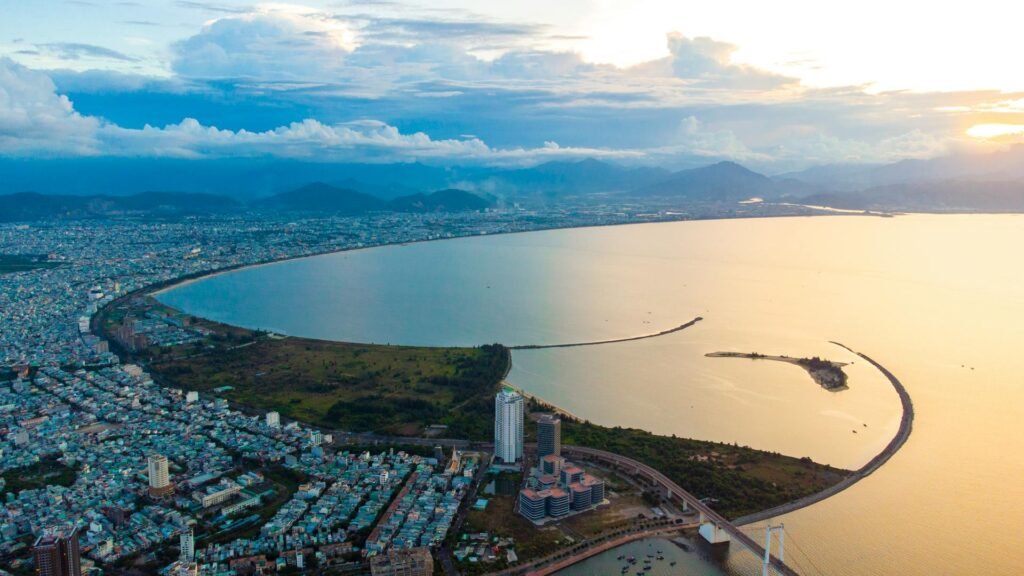
The Han River bisects the central city north-south, with the modern Hai Chau District on the west bank (administrative center, French-colonial old town, Cham Museum, Han Market) and the new Son Tra District on the east bank (beach resort strip, My Khe Beach, Sun World, Apec Park). Six pedestrian-and-vehicle bridges cross the Han, each with its own architectural signature.
Climate Overview
Da Nang has a tropical monsoon climate (Köppen Aw/Am), with two clearly defined seasons. Dry season (February–August): hot days (28–34 °C), low humidity by Southeast Asian standards, predictable sunshine — the prime beach period. Wet season (September–January): cooler (20–28 °C) but increasingly humid, with heavy afternoon rainfall and significant flooding risk in October–November.
Typhoon Season & Weather Hazards
Da Nang sits in the South China Sea typhoon track, with peak risk September through November. Most years bring 1–3 direct or near-miss storms; the city has experienced major typhoon-related flooding in 2009, 2013, 2017, and 2020. Hai Van Pass landslides regularly close the historic mountain road during heavy rains. Check current advisories from the Vietnam National Centre for Hydro-Meteorological Forecasting (NCHMF) before fall travel.
Best Time to Visit
February to May is genuinely Da Nang’s golden window — warm dry days, ocean temperatures perfect for swimming, the spring festival energy, and excellent visibility for the surrounding mountains and Hoi An side trips. June–August is hot and very busy with domestic Vietnamese tourism (especially weekends) but reliably sunny. September–November brings the highest typhoon and flooding risk; some weeks the beach is unusable. December–January is cool, sometimes drizzly, with limited beach swimming but cheaper hotel rates and far fewer tourists. The famous Da Nang International Fireworks Festival takes place in June–July and is worth timing a visit around.
Da Nang’s Districts & Neighborhoods
Hai Chau (Central West Bank)
The administrative and historical core. Han Market (the colonial-era central market), the Museum of Cham Sculpture, the Da Nang Cathedral (the “Pink Church”), and most government and bank offices. Walkable colonial-French streetscape, the original Vietnamese pho restaurants, and a dense concentration of mid-range hotels for travelers who want to be in the city center rather than the beach strip.
Thanh Khe
The northern-west residential district stretching toward Hai Van Pass. Less touristy but useful for budget guesthouses and the train station; also contains the original Da Nang airport access road.
Son Tra Peninsula & My Khe Beach Strip
The Son Tra District covers both the urban east bank along the Han River and the entire Son Tra Peninsula (a forested headland north of the city). The peninsula contains Linh Ung Pagoda with the 67-meter Lady Buddha statue, Bai Bac (North Beach), motorbike-only mountain roads through monkey forest, and several luxury resort enclaves (InterContinental Da Nang Sun Peninsula). My Khe Beach (the historic “China Beach”) runs south from the peninsula along Vo Nguyen Giap Street and is now Da Nang’s main resort strip — most international hotels (Hyatt, Sheraton, Premier Village, TIA Wellness, Pullman) line this stretch.
Ngu Hanh Son (Five Element Mountains District)
The southern district named for the Marble Mountains — five limestone-and-marble peaks rising 100 meters from the coastal plain, with Buddhist temples carved into caves and an active marble-sculpture industry at the foot. The district extends south to the start of the Hoi An road and contains an increasing concentration of new beach resorts.
Lien Chieu
The far-northwestern industrial-and-residential district at the foot of Hai Van Pass. Da Nang Port, the Lang Co lagoon access, and the Hai Van Tunnel approach. Useful for adventurous motorbike travelers exploring the Hai Van loop.
Hoa Vang (Western Suburbs)
The mountainous outer suburbs containing Ba Na Hills resort complex, the entry to the Truong Son mountain range, and several historic ethnic-minority villages. The Ba Na Hills cable car (a 5.8-kilometer ride) is the most visited single attraction in the district.
Top Things to Do in Da Nang
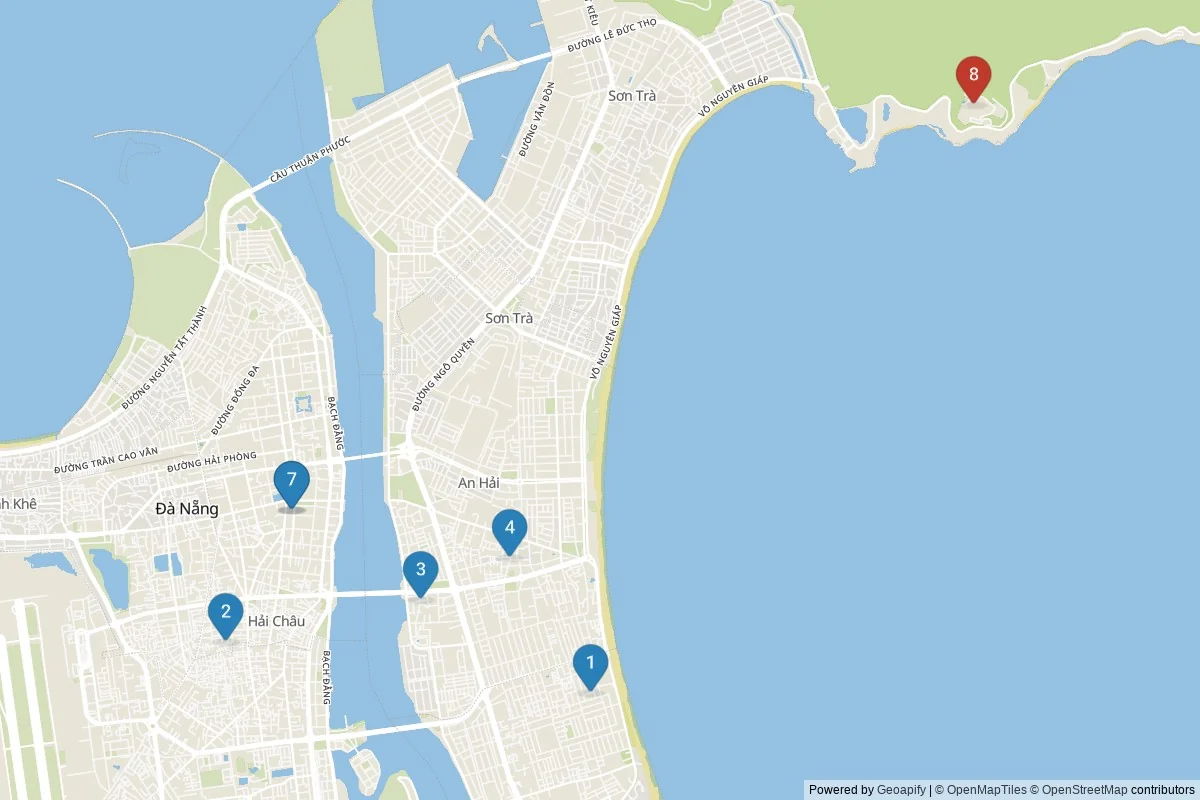
| # | Sight | Cluster | Type | Time | Entry | Best |
|---|---|---|---|---|---|---|
| 1 | Walk the Marble Mountains | Cluster A | Temple | 3 hours | $1.65 | — |
| 2 | Day Trip to My Son (UNESCO) | Cluster A | Temple | — | $6 | — |
| 3 | Watch the Dragon Bridge Fire-and-Water Show | Cluster A | Bridge | — | Free | — |
| 4 | My Khe Beach | Cluster A | Beach | — | — | — |
| 5 | Ba Na Hills & the Golden Bridge | Cluster A | Park | — | $35–42 | — |
| 6 | Day Trip to Hoi An (UNESCO) | Cluster A | Bridge | — | — | — |
| 7 | Hai Van Pass Motorbike Ride | Cluster A | Mountain | — | — | — |
| 8 | Linh Ung Pagoda & Lady Buddha | Cluster B | — | — | Free | — |
1. Visit Ba Na Hills & the Golden Bridge
The 1,500-meter mountain resort complex 25 km west of central Da Nang, accessed by a 5.8-km cable-car ride (one of the longest single-cable systems in Asia). At the top: the surreal Golden Bridge (Cau Vang) — a 150-meter pedestrian span held aloft by two giant stone hands, which became a global Instagram phenomenon when it opened in 2018; the French-village-themed Sun World Ba Na Hills park; the Linh Ung Pagoda; and the Fantasy Park indoor amusements. Combo tickets ₫850,000–1,000,000 (~US$35–42) include cable car and park access. Plan a full day; arrive early to manage Golden Bridge crowds.
2. Walk the Marble Mountains
The five marble outcrops at Ngu Hanh Son — Kim Son (Metal), Thuy Son (Water — the largest and main visitor mountain), Hoa Son (Fire), Moc Son (Wood), and Tho Son (Earth). The main mountain Thuy Son has a network of caves with Buddhist temples carved into the limestone, panoramic viewpoints, and a small archaeological museum. ₫40,000 (~US$1.65) entry plus optional elevator ₫15,000. Plan 2–3 hours; bring water; the staircase climb is steep.
3. Watch the Dragon Bridge Fire-and-Water Show
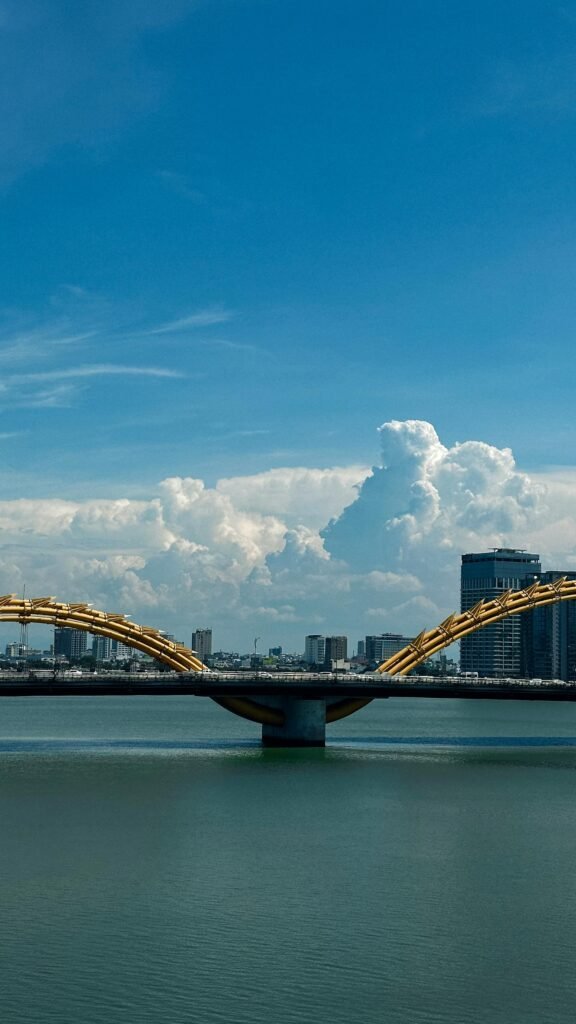
The 666-meter Dragon Bridge across the Han River — opened in 2013 with a sculptural dragon’s-head end and an LED-lit body — performs a fire-breathing-and-water-spraying show every Saturday and Sunday at 21:00. The dragon’s head shoots real fire and atomized water. Free to watch from the riverbanks; best viewing from the eastern bank (Son Tra side) or from a Han River dinner cruise.
4. Spend a Day on My Khe Beach
The 5-km-long sand beach running from the Son Tra Peninsula south. Wide, clean sand, decent surf in winter (small but rideable waves December–March), warm calm water in summer. The An Thuong tourist neighborhood inland is the best base for restaurants, bars, and budget guesthouses. Cabana, deckchair, and umbrella rental ₫50,000–100,000 per day.
5. Day Trip to Hoi An (UNESCO)
30 km south of Da Nang, Hoi An Ancient Town (UNESCO 1999) is one of Southeast Asia’s most magical destinations — a perfectly preserved 15th-to-19th-century trading port of yellow-ochre Vietnamese-French-Japanese-Chinese merchant houses, the iconic Japanese Covered Bridge, and the lantern-lit Old Town. Most travelers spend a full day, often staying overnight for the lantern atmosphere. Easy access by Grab (₫280,000 each way), tourist bus, or private driver.
6. Day Trip to My Son (UNESCO)
The My Son archaeological sanctuary 40 km southwest of Da Nang (often combined with Hoi An as a single day trip) preserves the most important Cham temple complex outside India. Built between the 4th and 13th centuries, the brick-and-sandstone Hindu temple groups (G, H, B, C, D) suffered significant American bombing damage in 1969 but remain spectacular. Entry ₫150,000 (~US$6); 09:00 dance performance daily.
7. Hai Van Pass Motorbike Ride
The 21-km Hai Van Pass (“Cloud Pass”) between Da Nang and Lang Co was made internationally famous by the BBC’s Top Gear Vietnam Special. The route winds along the spectacular coastal mountain ridge — pristine ocean views to the east, jungle to the west, abandoned French bunkers at the summit. Easy Riders tours (₫800,000–1,500,000 per person) provide motorbike with driver from Da Nang to Hue; renting a self-drive bike ₫150,000–300,000/day requires the legal-but-rarely-enforced international driving permit.
8. Linh Ung Pagoda & Lady Buddha
On the Son Tra Peninsula, the modern Linh Ung Pagoda hosts the 67-meter Lady Buddha statue — one of the tallest statues of Quan Am (Goddess of Mercy) in Vietnam, visible from much of the city. Free entry; combine with a Son Tra Peninsula motorbike loop through the protected forest.
How to Get to Da Nang
By Air
Da Nang International Airport (DAD) sits unusually within the city — just 3 km from central Hai Chau and 5 km from My Khe Beach. The 2017 terminal expansion brought it to international scale. Direct flights from Singapore, Bangkok, Kuala Lumpur, Seoul, Tokyo, Hong Kong, Taipei, Shanghai, Macau, and most major Chinese cities. Domestic connections to Hanoi (75 minutes) and Ho Chi Minh City (75 minutes) operate hourly. Carriers: Vietnam Airlines, VietJet, Bamboo Airways, Pacific Airlines.
From the airport: Grab to Hai Chau ₫60,000–100,000 (~US$2.50–4.20); to My Khe Beach ₫80,000–130,000; to Hoi An ₫280,000–400,000. Metered taxi Vinasun or Mai Linh similar fares — insist on the meter. Walking out of the terminal and crossing to the public taxi line saves the airport-pickup surcharge.
By Train
The North-South Reunification Railway connects Da Nang to Hanoi (16 hours, ₫650,000–1,400,000), Hue (2.5 hours, ₫100,000–250,000), and Ho Chi Minh City (16 hours, ₫650,000–1,400,000). The Da Nang–Hue stretch over Hai Van Pass is one of the world’s most scenic train rides; the SE19 and SE20 services are timed for daytime crossings. Book via the Vietnam Railways official site.
By Bus
Long-distance buses to and from all major Vietnamese cities terminate at the Da Nang Bus Station on Ton Duc Thang Street. Sleeper buses to Nha Trang (10 hours, ₫350,000), Hue (3 hours, ₫120,000), and Hanoi (15+ hours, ₫500,000) are common. Tourist-oriented Open Tour buses connect Da Nang–Hue–Hoi An–Nha Trang–Saigon.
By Sea
Da Nang’s Tien Sa Port handles cruise ships and connects to Quy Nhon and Hai Phong. Limited regular passenger services; primarily a cargo and cruise port.
Visa Notes
Vietnam offers visa-free entry for 45 days for citizens of 13 countries: UK, Germany, France, Italy, Spain, Russia, Japan, South Korea, Belarus, and four Nordic countries (Denmark, Sweden, Norway, Finland). US, Canadian, Australian, and most other Western passport holders need an e-Visa from the Vietnam Immigration Department for stays up to 90 days, single or multiple entry, $25–50 fee, processed 3–5 working days. Passport must have at least 6 months remaining validity. Apply through the official government portal only — many third-party sites overcharge significantly.
Getting Around Da Nang
Grab
Grab dominates Da Nang transit and is the default for most international visitors. Reliable, transparent pricing, English-language app, credit cards accepted. A Grab car across central Da Nang costs ₫40,000–80,000; Grab motorbike taxi (much faster in traffic) ₫25,000–50,000.
Motorbike Rentals
Self-drive motorbike rentals are widely available — ₫120,000–250,000/day for an automatic scooter from hotel-front rental shops. Important: Vietnam requires foreigners to hold an international driving permit (IDP) under the 1968 Geneva Convention plus a national license — many rental shops don’t check, but local police checkpoints do, and accidents without a valid license void all insurance and travel coverage. Helmet use is mandatory and enforced. Da Nang traffic is moderate by Vietnamese standards but still requires defensive driving.
Taxis
Mai Linh (green) and Vinasun (white) are the reputable companies — meters typically start at ₫13,000 and run ₫16,000/km. Unmarked taxis often overcharge; if you’re not using Grab, stick with branded taxis.
Cyclo & Pedestrian
Cyclo (pedicab) tours operate primarily as tourist novelties around Han Market and the central Da Nang area; ₫100,000–200,000 per hour for the tourist experience rather than transit. Pedestrian walking is genuinely feasible in central Hai Chau (the colonial old town is compact) and along the My Khe Beach promenade.
Bicycle Rentals
Many beach-strip hotels rent bicycles for ₫50,000–100,000/day. Da Nang has a slowly expanding bike-lane network along the Han River and the My Khe seafront. Hot in summer; plan early morning or evening rides.
City Buses
Public bus services operate on fixed routes but with limited English signage; routes 6, 7, and 12 cover the main tourist corridors. ₫7,000–20,000 per ride. Useful for budget travelers; most international visitors find Grab simpler.
Food & Drink in Da Nang
Central Vietnamese cuisine differs noticeably from the north (lighter, more vegetal) and the south (sweeter, more diverse). Da Nang’s food culture combines the original Cham heritage (slightly Indian-influenced curry seasonings), the Hue imperial cuisine (royal court complexity) from 100 km north, and the seafood-and-noodle traditions of central Vietnam.
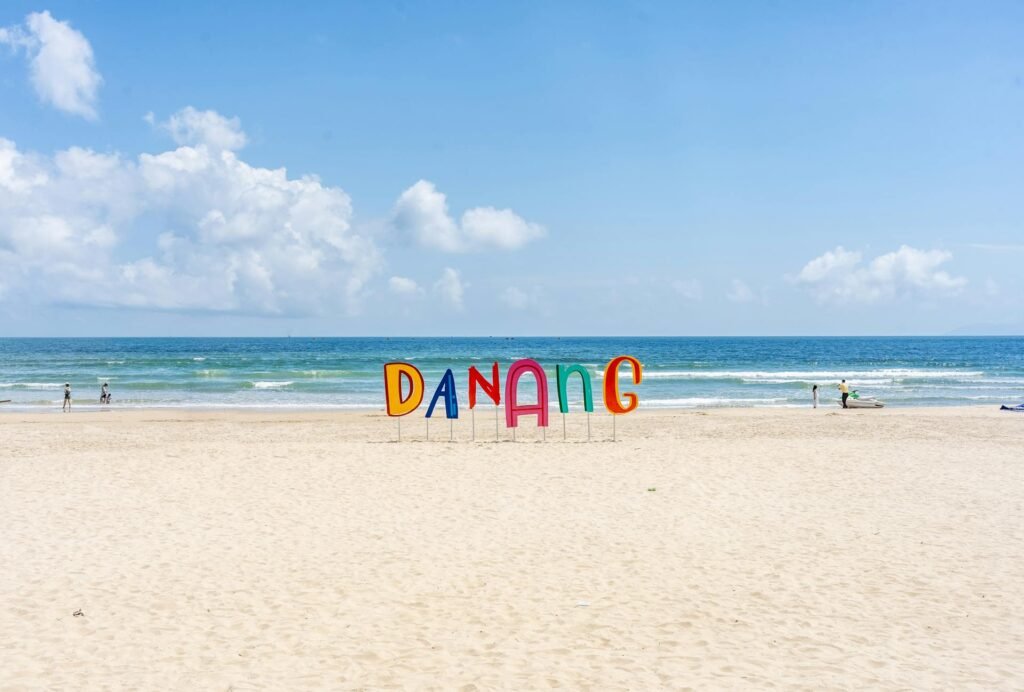
What to Try
- Mi Quang — the regional signature dish: yellow turmeric-flavored rice noodles in a small amount of intensely flavored broth, topped with shrimp, pork, peanuts, fresh herbs, and crispy rice crackers. The most distinctive central-Vietnamese noodle.
- Bun Cha Ca — fish-cake noodle soup with white rice noodles, clear broth, and grilled fish cake. Quan Ba Phien is the canonical address.
- Banh Xeo — central-Vietnamese-style stuffed pancake with shrimp, pork, bean sprouts; eaten wrapped in lettuce and herbs with peanut dipping sauce.
- Goi Cuon — fresh spring rolls with shrimp and herbs.
- Banh Mi — Vietnamese baguette sandwich with pâté, mayonnaise, pickled vegetables, fresh herbs, and meat or egg fillings. Banh Mi 96 and Banh Mi Madame Khanh in Hoi An are pilgrim-worthy.
- Bun Bo Hue — the spicy lemongrass beef noodle soup from neighboring Hue; widely available in Da Nang.
- Com Hen — clam rice with peanuts, herbs, and chili; a Hue-and-central-Vietnam specialty.
- Fresh seafood — squid, prawn, crab, snapper from the South China Sea; the seafront restaurants along My Khe and Pham Van Dong street serve simple grilled or steamed preparations.
- Vietnamese coffee — strong drip-filter coffee with sweetened condensed milk; egg coffee (Hanoi-style) widely available.
Where to Eat
An Thuong tourist neighborhood: dense concentration of restaurants, bars, and cafés near My Khe beach with English menus. Han Market and Con Market: street-food upper floors with traditional Vietnamese versions of regional dishes. Pham Van Dong street: seafront seafood restaurants. Madame Lan (waterfront): high-quality central Vietnamese tasting menus. Quan Ba Phien (Han Thuyen Street): the bun cha ca institution. Burger Bros in An Thuong: when you need a non-Vietnamese option.
Drinks
Vietnamese filter coffee (ca phe phin) at any traditional café — ₫25,000–50,000. Coconut coffee (ca phe dua) — Da Nang’s specialty blended-with-coconut-cream variant. Bia hoi (fresh draft beer) at street-level stools ₫10,000–25,000 per glass. Beer — local Saigon and Tiger brands; the craft-beer scene is growing (East-West Brewing Da Nang). Rice wine (ruou) at countryside-style restaurants.
A Note on Tap Water
Tap water in Da Nang is not safe to drink. Use sealed bottled water (₫10,000–20,000 per 1.5-liter bottle at any convenience store; major brands Aquafina, Lavie, Vinh Hao) for drinking and brushing teeth. Reputable hotel and restaurant ice is generally safe; avoid ice from beach-stall drinks. The CDC traveler health page for Vietnam recommends bottled or boiled water and standard food precautions including hepatitis A and typhoid vaccination consideration before travel. Da Nang has relatively rapid restaurant turnover and traveler’s diarrhea is less common than in some other Vietnamese cities; eat at busy, established places.
Frequently Asked Questions About Visiting Da Nang
Do I need a visa to visit Da Nang?
It depends on your passport. Vietnam offers visa-free entry for 45 days (single entry, no return permitted within 30 days for some nationalities) for citizens of 13 countries: UK, Germany, France, Italy, Spain, Russia, Japan, South Korea, Belarus, Denmark, Sweden, Norway, and Finland. US, Canadian, Australian, New Zealand, Indian, Chinese, and most other passport holders need an e-Visa issued by the Vietnam Immigration Department through the official e-Visa portal — single or multiple entry, valid up to 90 days, $25–50 fee, processed in 3–5 working days. Vietnam expanded the e-Visa coverage to all nationalities in August 2023. Common mistakes: using unofficial third-party visa sites that overcharge by 100–300%; assuming the old visa-on-arrival sticker still exists (it has been replaced by e-Visa); arriving with less than 6 months passport validity. Print two copies of the e-Visa PDF; the airline check-in agent and Vietnamese immigration officer each want to see it. For longer stays beyond 90 days, business visas (DN) require Vietnamese company sponsorship and add complexity.
Is Da Nang safe for tourists?
Da Nang is among Vietnam’s safest cities — significantly safer than Hanoi or Ho Chi Minh City for petty crime, with strong municipal investment in tourism safety and broadly low violent-crime rates. The US State Department rates Vietnam at “exercise normal precautions” — the most relaxed travel advisory level. Real risks in Da Nang: motorbike accidents — Vietnam’s road-death rate is among the world’s highest, and most travel insurance policies exclude unlicensed motorbike use; petty theft — bag-snatching on motorbikes (rare but does occur in tourist zones); scams — overpriced taxis (use Grab or Mai Linh/Vinasun branded); fake-itinerary tour packages sold on the beach; jet-ski rentals — high accident rate, often poorly maintained; jellyfish at certain times along My Khe Beach (October–November is the worst); typhoon-season flooding September–November; strong currents at My Khe Beach (lifeguards present in season). Drug laws: Vietnam imposes extremely harsh penalties — multi-year prison sentences for trafficking even small amounts; cannabis offenses are taken seriously. Beach swimming: red flag = no swimming; obey the flag. Tap-water-related stomach upset is the most common visitor health complaint.
How many days do I need in Da Nang?
Three to five days handles Da Nang plus the canonical day-trips. A solid 4-day Da Nang plan: Day 1 — arrive, settle on My Khe Beach, evening Dragon Bridge fire show (Saturday-Sunday 21:00). Day 2 — Ba Na Hills Golden Bridge full day (cable car, Sun World, French village). Day 3 — Hoi An day trip (Ancient Town + Japanese Bridge + lantern evening); optionally combine with My Son. Day 4 — Marble Mountains morning + Son Tra Peninsula afternoon (Linh Ung Pagoda + Lady Buddha) + beach evening. Add Day 5 for a Hai Van Pass motorbike ride to Lang Co + Lap An lagoon. 10-day Vietnam-central plan: pair Da Nang with 3 days in Hoi An (overnight to enjoy the lanterns), 2 days in Hue (royal tombs + Forbidden City), and 1–2 days at the Phong Nha caves. Da Nang is also the practical staging point for combined central-and-north or central-and-south Vietnam itineraries.
What’s the best area to stay in Da Nang?
The choice between My Khe Beach strip and central Hai Chau defines the trip character. My Khe Beach (along Vo Nguyen Giap Street, Son Tra District) is the international beach-resort default — Hyatt Regency Da Nang, Pullman Da Nang Beach Resort, Premier Village Da Nang, TIA Wellness, Sheraton Grand, Furama. Direct beach access, ocean-view restaurants, broader walking promenade. ₫2,500,000–10,000,000/night (US$105–420). An Thuong tourist neighborhood (Inland from My Khe) — mid-range and budget guesthouses, restaurants and cafés with English menus, easy bike rentals. ₫800,000–2,500,000/night (US$33–105). Hai Chau central district — colonial old town, Han Market, the Cham Museum, Vietnamese street life; better for cultural travelers who want authentic city character; less beach access. Mid-range business hotels ₫1,000,000–3,000,000/night. Son Tra Peninsula resorts — InterContinental Da Nang Sun Peninsula and several luxury enclaves at the tip of the peninsula; spectacular isolation, far from city dining; ₫6,000,000–25,000,000+/night. Skip: cheap unbranded hotels far inland with no public transport — Grab to the beach adds up. For first-timers wanting the canonical Da Nang experience, mid-range My Khe Beach plus 1 night in Hoi An’s Ancient Town is the winning combination.
How much does it cost to visit Da Nang’s major sights?
Da Nang is one of Vietnam’s better-value major destinations. Marble Mountains: ₫40,000 entry + ₫15,000 elevator. Museum of Cham Sculpture: ₫60,000 (~US$2.50). Linh Ung Pagoda & Lady Buddha: free. Ba Na Hills combo: ₫850,000–1,000,000 (~US$35–42), includes cable car and Sun World access. Hoi An Ancient Town tickets: ₫120,000 (~US$5) for the 5-attraction ticket. My Son sanctuary: ₫150,000 entry. Dragon Bridge fire show: free; Han River dinner cruise ₫500,000–1,000,000 per person. Easy Riders Hai Van Pass: ₫800,000–1,500,000 (~US$33–62) per person, with bike + driver. Local meals: pho/banh mi breakfast ₫35,000–80,000; mi quang lunch ₫35,000–60,000; sit-down central Vietnamese dinner ₫150,000–400,000 per person; international/upscale ₫400,000–1,000,000 per person; cruise dinner ₫700,000–1,500,000 per person. Grab across the city: ₫40,000–100,000. Airport to My Khe Beach: ₫80,000–130,000. Grab to Hoi An: ₫280,000–400,000 each way. Motorbike rental: ₫120,000–250,000/day. Overall daily budget: ₫1,200,000 (frugal), ₫3,500,000 (mid-range), ₫10,000,000+ (luxury).
Should I drink the tap water in Da Nang?
No — tap water in Da Nang is not safe to drink for foreign visitors. The municipal supply is treated but distribution and older building plumbing introduce contamination; most Vietnamese boil before drinking. Always use sealed bottled water (₫10,000–20,000 per 1.5-liter bottle at any convenience store; major brands Lavie, Aquafina, Vĩnh Hảo) for drinking and brushing teeth. Reusable filter bottles (LifeStraw, Grayl, Sawyer 0.1-micron filter) work well in Vietnam. Hotel kettles boil water reliably; the morning Vietnamese coffee in any reputable café is consistently safe. Ice in mid-range and upmarket restaurants is generally safe (machine-made from purified water); avoid ice from beach-stall drinks. The CDC traveler health page for Vietnam recommends bottled or boiled water plus standard food precautions and consideration of hepatitis A, typhoid, and Japanese encephalitis vaccinations before travel. Traveler’s diarrhea is the most common visitor complaint — eat at busy, established restaurants and avoid raw shellfish (yes, even oysters) on hot days.
What payment methods work in Da Nang — credit cards, cash, or both?
Mix of both, with cash dominant in working-Vietnamese transactions and cards usable at international-tier establishments. Vietnamese dong (VND): essential for street food, motorbike taxis, markets, Vietnamese coffee shops, and smaller restaurants; ATMs are abundant in Hai Chau and along My Khe Beach (Vietcombank, BIDV, Techcombank, ACB) with daily withdrawal limits of ₫2,000,000–3,000,000 (~US$80–125) per transaction and ₫55,000–110,000 international fees. Credit cards (Visa, Mastercard, JCB; AmEx less widespread): accepted at international hotels, mid-range and upmarket restaurants, Grab, theme parks, and most malls; small restaurants, market stalls, and budget guesthouses are cash-only. USD acceptance: surprisingly widespread in tourist zones — many hotels, transfer companies, and tour operators quote and accept USD directly at slightly unfavorable rates; bring small-denomination bills (US$1, $5, $10, $20) for tipping and small purchases. Mobile payment: VNPay, Momo, ZaloPay dominate locally but require Vietnamese bank accounts; not realistic for short-stay visitors. Tipping: not deeply rooted in Vietnamese culture but appreciated in tourist contexts — round up taxi fares; restaurants 5–10% in cash; ₫10,000–25,000 (~US$0.40–1) per bag to hotel porters; ₫50,000–150,000 (~US$2–6) per day for tour guides and drivers. Cruise/Tour package note: USD is the de-facto currency for organized excursions and Easy Riders tours.
What’s the weather story — when does typhoon season really matter?
Da Nang’s weather divides cleanly into two halves of the year, and timing matters substantially. February to August is the dry, hot season — reliable sun, low rain, daytime highs climbing from 26 °C (February) to 34 °C (June–July). This is the prime beach window. September to January is the wet, cooler season — daytime 20–28 °C, with September–November bringing the highest rainfall and typhoon risk. Typhoon-specific timing: October is the single highest-risk month for direct hits; major typhoon-caused floods have struck Da Nang in 2009, 2013, 2017, 2020, and 2024. The historic Hai Van Pass road closes regularly for landslides; the Hai Van Tunnel provides bad-weather backup but cuts the scenic experience. What this means for travelers: build flexibility into October–November itineraries; book accommodation with free cancellation; consider travel insurance with explicit natural-disaster coverage; check the Vietnam National Centre for Hydro-Meteorological Forecasting 7-day forecast before booking. December–January: cool and sometimes drizzly with limited beach swimming, but hotel prices drop significantly and Hoi An’s lantern-lit atmosphere is at its most magical. Best window overall: late February through April — warm dry days, perfect swimming, modest tourist crowds, peak Hoi An lantern beauty. Avoid: domestic Vietnamese Lunar New Year (Tết) week, usually late January or early February — most family-run businesses close, hotel prices spike, the beaches fill with domestic tourism.
Education & Notable People
Da Nang is one of central Vietnam’s primary university centers, hosting branches of national universities and one of the country’s most respected technical institutions. The post-2010 economic boom has driven rapid expansion of the higher-education sector.
Major Universities
- University of Da Nang — the parent regional university group, founded 1994, with constituent member universities in engineering, foreign languages, technical education, and economics; approximately 70,000 students across all member campuses.
- Da Nang University of Science and Technology — the flagship technical university, with respected programs in mechanical engineering, electronics, and information technology.
- Duy Tan University — Vietnam’s first private university (founded 1994), now one of the country’s largest with significant international partnerships.
- Da Nang Architecture University — specialized institution serving the construction-and-design sector that has boomed alongside the city’s growth.
- Vietnam-Korea University of Information and Communication Technology — Vietnam-South Korea joint institution focused on IT and engineering.
Notable People
Nguyen Cao Ky — Prime Minister of South Vietnam (1965–1967) and Vice President (1967–1971), born in Son Tay but a longtime resident and military commander of the Da Nang region. Nguyen Ba Thanh — Communist Party Secretary of Da Nang (1997–2003) and Chairman of the People’s Committee (2003–2011) — widely credited with driving the city’s modern transformation and the construction of the major bridges; controversial nationally but locally celebrated. Thich Quang Duc — the Buddhist monk whose 1963 self-immolation in Saigon became one of the iconic images of the Vietnam War; spent significant time at central Vietnamese pagodas including in the Da Nang region. Pham Duy — celebrated 20th-century Vietnamese composer of patriotic and folk songs, with strong central-Vietnamese cultural ties.
Sister Cities & International Relations
Da Nang’s sister-city network reflects the city’s identity as a port, an APEC-host city, and a growing technology-and-tourism hub. The relationships emphasize port cooperation, university exchange, and economic-development partnerships.
Da Nang’s sister and friendship cities include (selection):
- Kawasaki, Japan — paired since 2009; major industrial-and-port partnership.
- Sakai, Japan — historic-port-city sister relationship since 2009.
- Daegu, South Korea — friendship city since 2004; the largest South Korean expatriate community in central Vietnam lives in Da Nang.
- Oakland, California, USA — sister city since 1990; the post-war reconciliation pairing.
- Vladivostok, Russia — Pacific-port friendship since 2007.
- Larnaca, Cyprus — friendship city.
- Quezon City, Philippines — Southeast Asian cooperation.
- Yongsan-gu, Seoul, South Korea — district-level friendship.
- Brisbane, Australia — Pacific-port sister-city relationship.
Da Nang is a member of the East-West Economic Corridor initiative connecting Vietnam, Laos, Thailand, and Myanmar; the city’s port serves as the corridor’s eastern terminus. The 2017 APEC Summit hosting brought significant international visibility and infrastructure investment; the city center’s pedestrian zone improvements, the airport expansion, and several major hotels were timed for the summit. Da Nang maintains active participation in the Smart City ASEAN cooperation network and was selected in 2018 as Vietnam’s pilot smart-city. The Da Nang City People’s Committee publishes detailed economic and tourism data via its official portal.
AFRIKA
Cairo Hurghada Johannesburg Marrakech
ASIA
Abu Dhabi Agra Antalya Bangkok Batam Beijing Bengaluru Cebu City Chiang Mai Chiba Chennai Da Nang Dammam Delhi Denpasar Dubai Fukuoka Guangzhou Guilin Ha Long Hanoi Ho Chi Minh City Jakarta Jaipur Johor Bahru Kolkata Krabi Kuala Lumpur Kyoto Macau Mecca Medina Mugla Mumbai Osaka Pattaya Penang Phuket Riyadh Seoul Shanghai Shenzhen Singapore Taipei Tokyo Zhuhai
EUROPE
Amsterdam Athens Barcelona Berlin Brussels Budapest Copenhagen Dublin Florence Frankfurt am Main Heraklion Krakow Lisbon London Madrid Milan Munich Nice Paris Porto Prague Rhodes Rome Stockholm Venice Vienna Warsaw
NORTH AMERICA
Cancun Las Vegas Los Angeles Miami New York City Orlando San Francisco Toronto Vancouver
SOUTH AMERICA
Buenos Aires Lima Rio De Janeiro
OCEANIA
Auckland Honolulu Melbourne Sydney